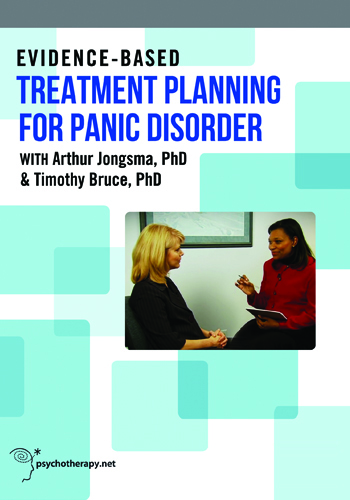
Thorough, measurable treatment plans using evidence-based methods are becoming the gold standard for clinicians working with agencies, insurance companies, and many health organizations. Even as this type of documentation becomes increasingly required, guidelines on how such plans actually look are still hard to come by. If you’ve been wondering what, exactly, comprises such a plan or have searched for resources on the empirically supported treatments on which these plans are based, you’ll find answers in this new video with Drs. Timothy Bruce and Arthur Jongsma In this video, the seasoned clinicians focus on panic disorder and demonstrate the crucial elements of evidence-based treatment planning for clients with this debilitating condition.
Noting that treatment plans aren’t created in a vacuum, but rather tailored to each client within the context of an authentic, empathic relationship, Bruce and Jongsma offer a clinical review of panic disorder’s features, as outlined in the DSM, along with a breakdown of panic attack symptoms and the potential triggers for related agoraphobia. You’ll gain a solid understanding of their six-step treatment planning process, geared toward building a plan informed by the latest empirically supported treatments (ESTs). A brief history of the EST movement provides further clinical context.
You’ll find sample treatment plans here, along with the clinicians’ expert commentary on the most researched ESTs. Through a series of live demonstrations with a client experiencing various types of panic, you’ll watch her therapist incorporate adaptive interventions using cognitive restructuring, progressive relaxation, exposure therapies, and other proven methods—with an emphasis on remembering how challenging such work can be for anxious clients. Definitions, goals, and relapse prevention are covered, too, for a well-rounded set of tools you can start using immediately to support your clients’ improvement while meeting professional requirements.
If you’ve been searching for resources on panic disorder or need to know how to create evidence-based treatment plans with confidence, look no further than this one-of-a-kind video.
Evidence-Based Treatment Planning for Anger Control Problems
-
Evidence-Based Treatment Planning for Bipolar Disorder
-
Evidence-Based Treatment Planning for Depression
-
Evidence-Based Treatment Planning for Eating Disorders and Obesity
-
Evidence-Based Treatment Planning for Panic Disorder
-
Evidence-Based Treatment Planning for Post-Traumatic Stress Disorder
-
Evidence-Based Treatment Planning for Social Anxiety Disorder
-
Evidence-Based Treatment Planning for Disruptive Child and Adolescent Behavior
-
Evidence-Based Treatment Planning for Obsessive Compulsive Disorder
-
Evidence-Based Treatment Planning for Substance Use Disorders
-
Evidence-Based Psychotherapy Treatment Planning
-
Evidence-Based Treatment Planning for Generalized Anxiety Disorder