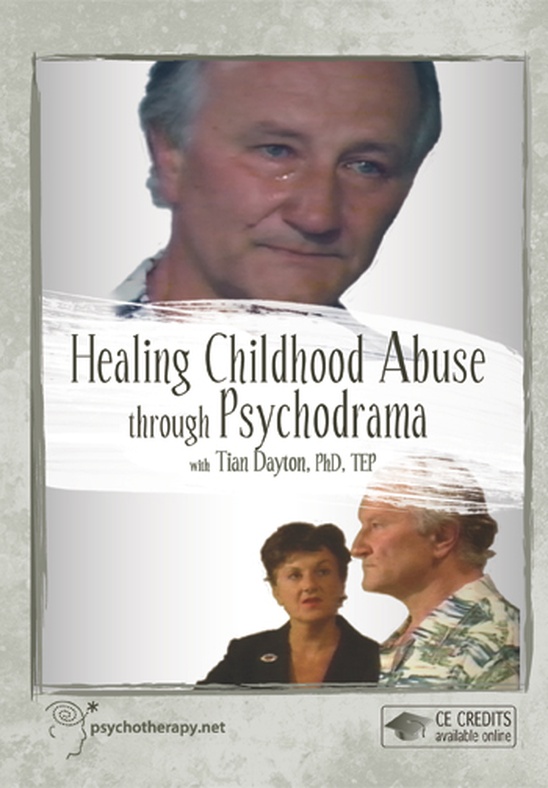
Healing Childhood Abuse through Psychodrama
Video
with
Tian Dayton, PhD, TEP
Video

Healing Childhood Abuse through Psychodrama

Psychodramatist Tian Dayton shows how psychodrama can heal the effects of child abuse in this live demonstration. Video Length: 1h 38m
Buy a Membership
COURSE DETAILS

Overview

Psychodrama recreates powerful relational dynamics from the past to bring about cathartic change in the present. Trauma from child abuse remains trapped inside us and continues to threaten our feelings of safety and wellbeing through adulthood. Psychodrama allows us to safely reinhabit the body at the point of past abuse and make sense of the experience from an adult perspective. In this video, Bob fears that he is passing on the legacy of abuse from his stepfather to his four-year-old granddaughter. He acts out scenes with his mother, stepfather and granddaughter, playing both himself and reversing roles. In so doing, Dayton helps Bob release hidden emotions, say the things he never got to as a child, and create new meaning around his past and current relationships.

About the Experts

Tian Dayton, PhD, TEP
Expert

Tian Dayton, PhD, TEP

Tian Dayton, PhD, TEP has presented psychodrama to wide audiences across the U.S. for two and a half decades. She taught psychodrama at New York University for eight years and seven as Director of program development for Caron Treatment Center. Currently, she is the director of The New York Psychodrama Training Institute. She is the author of numerous books, including The Living Stage: A Step-by-Step Guide to Psychodrama, Sociometry and Group Psychotherapy, The Drama Within: Psychodrama and Experiential Therapy and Emotional Sobriety: From Relationship Trauma…

View full profile
Disclosures

Tian Dayton was compensated for her contribution. None of her books or additional offerings are required for any of the Psychotherapy.net content. Should such materials be referenced, it is as an additional resource.

This Disclosure Statement has been designed to meet accreditation standards; Psychotherapy.net does its best to mitigate potential conflicts of interest and eliminate bias in all areas of content. Psychotherapy.net offers training for cost but has no financial or other relationships to disclose. Additionally, there is no commercial support for this activity. None of the planners or any employee at Psychotherapy.net who has worked on this educational activity has relevant financial relationship(s) to disclose with ineligible companies.

Psychotherapy.net defines ineligible companies as those whose primary business is producing, marketing, selling, re-selling, or distributing healthcare products used by or on patients. There is no minimum financial threshold; individuals must disclose all financial relationships, regardless of the amount, with ineligible companies. We ask that all contributors disclose any and all financial relationships they have with any ineligible companies whether the individual views them as relevant to the education or not. Each experts’ specific disclosures can be found in their biography.

Death, Dying & Grief in Psychotherapy: Hospital Consultation with Medically Ill Patients
  • Video

Death, Dying & Grief in Psychotherapy: Hospital Consultation with Medically Ill Patients

Using Family Play Genograms in Psychotherapy
  • Video

Using Family Play Genograms in Psychotherapy

Edith Kramer – Art Therapy’s Muse Part 3
  • Video

Edith Kramer – Art Therapy’s Muse Part 3

Albert Ellis on REBT
  • Video

Albert Ellis on REBT

Art as Therapy for Older Adults
  • Video

Art as Therapy for Older Adults