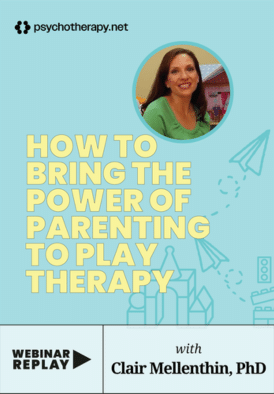
How to Bring the Power of Parenting to Play Therapy
Video
with
Clair Mellenthin, PhD
Video 1.25 CE Credits

How to Bring the Power of Parenting to Play Therapy

Play therapy can be a very powerful and highly effective therapeutic medium for working with children, even more so when parents are included in the play. In this unique, experiential webinar, child therapist Claire Mellenthin will not only describe her model of Attachment-Centered Play Therapy, but provide live demonstrations and guide you through play therapy-based exercises that you can immediately take into your own clinical work with children and their parents. Video Length: 1h 35m 55s
Available with a membership. 1.25 CE credits and access to 400+ video sessions in our library.
Buy a Membership
COURSE DETAILS

Overview

Traditional child psychotherapy training has focused almost exclusively on working with the child, relegating parents to a secondary role and marginalizing systemic issues. In addition, by the time parents either seek out or are mandated to enter therapy for their child, hurt, shame, guilt, and exhaustion have already tattered the fabric of attachment bonds, making engagement with them all the more important. Centering the clinical work around the child to the neglect of the parents’ needs, attachment styles, and personal histories, places an unrealistic burden of responsibility on the child to be the change agent. In contrast, expanding the clinical frame to include the parent’s attachment histories and styles, as well as their capacity for play can provide the therapist with the insight and tools for helping parents to be the secure base their child needs to flourish. Inclusion of the parents from the beginning in their child’s therapy can also focus clinical attention where it rightfully belongs––on the resources and reparative-healing potential within the family system. Additionally, utilizing expressive-creative, therapeutic activities with the whole family can re-direct healing efforts from words to healing language of play.

In viewing this webinar, Clair Mellenthin will teach you the core elements of Attachment-Centered Play including: assessing the unique qualities of the parents’ attachment style modeling presence, limit setting, and basic play skills when and when not to invite the parents into the room how to orient the play to effectively include parents, structure interactions between parents and children in the room, and tap into family dynamics to support healthy change


What you'll learn

  • Explain the benefits of including parents in play therapy with their child(ren)
  • Plan therapeutic interventions that utilize an attachment lens
  • Utilize techniques of Attachment-Centered Play Therapy

About the Experts

Clair Mellenthin, PhD
Expert

Clair Mellenthin, PhD

Dr. Clair Mellenthin, PhD, LCSW, RPT-S, is an internationally recognized speaker, award-winning author, and a distinguished Registered Play Therapist Supervisor. She is the visionary behind Attachment Centered Play Therapy, a transformative approach that enhances the therapeutic experience for children, teens, and their families.

View full profile

Disclosures

Clair Mellenthin was compensated for her contribution. None of her books or additional offerings are required for any of the Psychotherapy.net content. Should such materials be referenced, it is as an additional resource.

Psychotherapy.net offers trainings for cost but has no financial or other relationships to disclose.

This Disclosure Statement has been designed to meet accreditation standards; Psychotherapy.net does its best to mitigate potential conflicts of interest and eliminate bias in all areas of content. Psychotherapy.net offers training for cost but has no financial or other relationships to disclose. Additionally, there is no commercial support for this activity. None of the planners or any employee at Psychotherapy.net who has worked on this educational activity has relevant financial relationship(s) to disclose with ineligible companies.

Psychotherapy.net defines ineligible companies as those whose primary business is producing, marketing, selling, re-selling, or distributing healthcare products used by or on patients. There is no minimum financial threshold; individuals must disclose all financial relationships, regardless of the amount, with ineligible companies. We ask that all contributors disclose any and all financial relationships they have with any ineligible companies whether the individual views them as relevant to the education or not. Each experts’ specific disclosures can be found in their biography.

Recognizing and Preventing Child Neglect
  • Video

Recognizing and Preventing Child Neglect

Solution-Focused Child Therapy
  • Video

Solution-Focused Child Therapy

Object Relations Child Therapy
  • Video

Object Relations Child Therapy

Object-Relations Family Therapy
  • Video

Object-Relations Family Therapy

Group Counseling with Adolescents: A Multicultural Approach
  • Video

Group Counseling with Adolescents: A Multicultural Approach