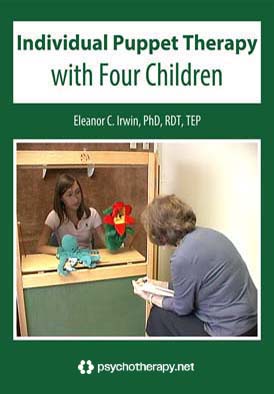
Individual Puppet Therapy with Four Children
Video
with
Eleanor Irwin, PhD
Video

Individual Puppet Therapy with Four Children

This video shows four different children (ages 6 to 13 years old) in therapy using puppets. Through four different sessions, conducted by three different therapists (two drama therapists, and one child psychiatrist), one can see how the clinician listens to and follows the interactions. Video Length: 1h 14m 09s
COURSE DETAILS

Overview

The viewer also sees how the therapist adds comments meant to aid the child in whatever he or she needs to work through by using the puppet story as a metaphor for the child’s own experience that has caused a disruption in some developmental milestones.

Each session begins with the therapist introducing the planned activity and what the child’s role will be. The child then picks the puppets he/she wants to work with, makes up a story for the puppets to act out, and introduces each puppet to the therapist. Following this the child has the puppets act out the story. At the conclusion, the child is asked to tell what the “lesson” is in the story. This sequence of events is a template for any creative arts therapist wishing to invite children to use puppets in treatment, providing a structure that helps the child first to tell the story, and then to reflect on it in order to learn from the experience.


About the Experts

Eleanor Irwin, PhD
Expert

Eleanor Irwin, PhD

Dr. Eleanor Irwin is a pioneer in the field of drama therapy, known for her innovative work with children. Through her use of dramatic play, she has helped young clients access emotional expression and healing in ways that feel natural and engaging. A co-founder of the National Association for Drama Therapy, Dr. Irwin has played a central role in shaping the field’s development. Her teaching, writing, and film work have brought wider recognition to the power of drama therapy in…

View full profile

Disclosures

Psychotherapy.net offers trainings for cost but has no financial or other relationships to disclose.

This Disclosure Statement has been designed to meet accreditation standards; Psychotherapy.net does its best to mitigate potential conflicts of interest and eliminate bias in all areas of content. Psychotherapy.net offers training for cost but has no financial or other relationships to disclose. Additionally, there is no commercial support for this activity. None of the planners or any employee at Psychotherapy.net who has worked on this educational activity has relevant financial relationship(s) to disclose with ineligible companies.

Psychotherapy.net defines ineligible companies as those whose primary business is producing, marketing, selling, re-selling, or distributing healthcare products used by or on patients. There is no minimum financial threshold; individuals must disclose all financial relationships, regardless of the amount, with ineligible companies. We ask that all contributors disclose any and all financial relationships they have with any ineligible companies whether the individual views them as relevant to the education or not. Each experts’ specific disclosures can be found in their biography.

Empowerment Family Therapy
  • Video

Empowerment Family Therapy

The 7 Skills for Addiction-Free Living: Social Skills
  • Video

The 7 Skills for Addiction-Free Living: Social Skills

Understanding Group Psychotherapy-Volume I: Outpatients
  • Video

Understanding Group Psychotherapy-Volume I: Outpatients

The Making of a Scribble
  • Video

The Making of a Scribble

Psychotherapy with the Unmotivated Patient
  • Video

Psychotherapy with the Unmotivated Patient