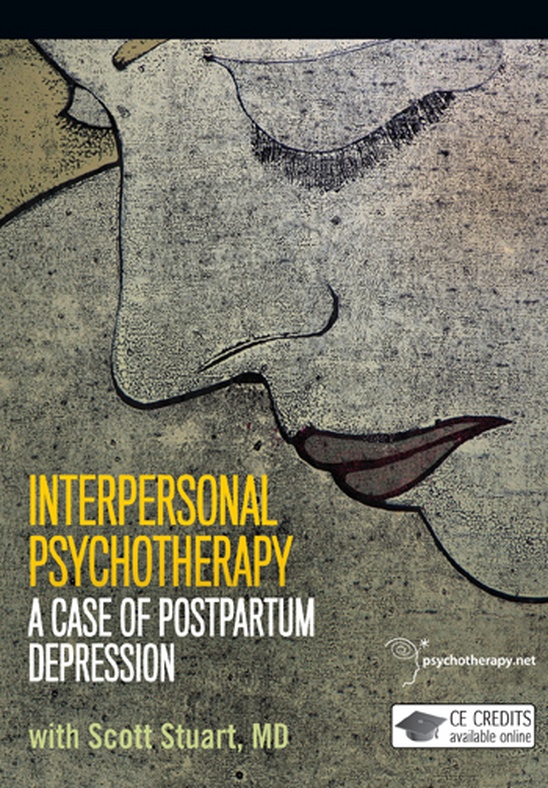
Interpersonal Psychotherapy: A Case of Postpartum Depression
Video
with
Scott Stuart, MD
Video

Interpersonal Psychotherapy: A Case of Postpartum Depression

What, exactly, is Interpersonal Psychotherapy (IPT), and how is it applied across populations? Watch Scott Stuart, MD, present the core elements of this evidence-based method in a course of therapy with a woman dealing with postpartum depression. Video Length: 1h 50m
Buy a Membership
COURSE DETAILS

Overview

Therapists wondering whether it’s possible to combine evidence-based, structured interventions with an empathic, even “heart-centered” stance will find their interest piqued by Interpersonal Psychotherapy (IPT). If you’ve never heard of IPT, wonder what it comprises, or are curious about how it differs from relational methods, you’ll gain a detailed understanding from watching this video. Here, veteran clinician Scott Stuart, MD, takes you through the nuts and bolts of IPT, demonstrating its application to postpartum depression in a course of treatment with a young mother.

Here, Stuart presents the essentials of this empirically supported approach, including its three core principles, issues treated, general trajectory, and central interventions. Emphasizing the importance of the therapeutic alliance, IPT’s collaborative nature, and its attachment-theory origins, Stuart makes a strong case for IPT as a person-centered yet tangible method adaptable to individual therapists’ temperaments and cases.

In this case, you’ll watch Stuart work with a struggling mother who’s just had her second child and is experiencing symptoms of postpartum depression. She arrives at his office frustrated by a lack of support from her husband, feeling guilty for wanting time to herself, and questioning her choice to leave her career for full-time parenting. With useful commentary interspersed alongside corresponding sessions, Stuart guides his client (and the viewer) through supportive inquiry and activities.

You’ll learn how IPT incorporates the use of affect, communication analysis, problem solving, and more to help clients move through their difficulties. With humor, sincerity, and a firm command of the model, Stuart is trustworthy and easy to follow, and you’ll see his client change dramatically by their final session. You’ll also get a feel for termination using this method, with client feedback encouraged.

This video offers an accessible primer on a multifaceted therapeutic approach. For a straightforward yet deeply engaging resource on IPT, look no further than this refreshing video.


About the Experts

Expert

Scott Stuart, MD

Dr. Stuart is a psychiatrist and a Professor Emeritus of Psychiatry and Psychology in the Departments of Psychiatry, Psychology, Obstetrics and Gynecology at the University of Iowa (USA) as well as a Professor Emeritus in the University of Southern California Department of Psychiatry. He has been active in clinical work, education and research in the areas of Interpersonal Psychotherapy and perinatal psychiatry during the last two decades. Dr. Stuart completed his medical training at the University of Kansas, followed by…

View full profile

Disclosures

Scott Stuart was compensated for his contribution. None of his books or additional offerings are required for any of the Psychotherapy.net content. Should such materials be referenced, it is as an additional resource.

This Disclosure Statement has been designed to meet accreditation standards; Psychotherapy.net does its best to mitigate potential conflicts of interest and eliminate bias in all areas of content. Psychotherapy.net offers training for cost but has no financial or other relationships to disclose. Additionally, there is no commercial support for this activity. None of the planners or any employee at Psychotherapy.net who has worked on this educational activity has relevant financial relationship(s) to disclose with ineligible companies.

Psychotherapy.net defines ineligible companies as those whose primary business is producing, marketing, selling, re-selling, or distributing healthcare products used by or on patients. There is no minimum financial threshold; individuals must disclose all financial relationships, regardless of the amount, with ineligible companies. We ask that all contributors disclose any and all financial relationships they have with any ineligible companies whether the individual views them as relevant to the education or not. Each experts’ specific disclosures can be found in their biography.

Harville Hendrix on the Healing Relationship
  • Video

Harville Hendrix on the Healing Relationship

Coming Out: Voices of Gay and Lesbian Teens and their Families
  • Video

Coming Out: Voices of Gay and Lesbian Teens and their Families

Solution-Focused Techniques with a Child
  • Video

Solution-Focused Techniques with a Child

Classroom Interventions for ADHD
  • Video

Classroom Interventions for ADHD

Robert Wallerstein: 65 Years at the Center of Psychoanalysis
  • Video

Robert Wallerstein: 65 Years at the Center of Psychoanalysis