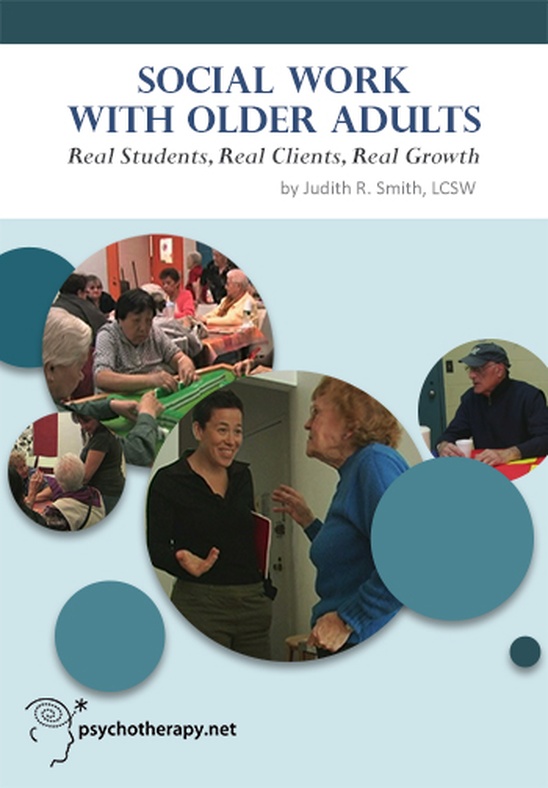
Social Work With Older Adults: Real Students, Real Clients, Real Growth
Video
with
Judith R. Smith, LCSW
Video

Social Work With Older Adults: Real Students, Real Clients, Real Growth

Under the guidance of their insightful supervisors, social work interns practice engagement, assessment, and termination skills with older clients, while also learning about the concrete needs of this population.   Video length: 1h 01m
COURSE DETAILS

Overview

The field of social work offers a variety of areas of practice and populations with which to work. Young children, adolescents, and the elderly are groups often served by social workers. As each age group has a unique set of needs, social workers must develop skills to best meet the needs of each group.

This video presents social work with the elderly from the perspective of several new social work students, and shows various interventions with older clients, from groups to home visits. One intern is shown planning and facilitating a “checking in” group for older clients. The group members quickly become engaged and begin to generate discussions on their own, showing the significance of the support the group provides. Other interns are shown helping clients arrange for in-home help, a common intervention with elderly clients whose concrete needs are often neglected. These interns must also address their clients’ resistance to help and their fear of losing independence. In addition to these interventions, interns are shown having regular meetings with their clients, talking about their week and providing clients with some much-needed interaction. This intervention illustrates the importance of listening in social work, and helps the elderly clients through their feelings of isolation.

The social work interns exhibit personal and professional growth as the video progresses. They learn how to engage their elderly clients, what health and safety matters to address, and how to help their clients accept the eventual termination of their work together. Through it all, their supervisors are seen guiding them and offering thought-provoking suggestions. The supervisors encourage the interns who are dealing with resistant clients, validate them for the support they are providing, and challenge them to look at themselves when feelings of ageism arise.

This video offers a fundamental look at the responsibilities and skills of social workers who work with the elderly, and the learning process of students as they hone those skills.

About the Experts

Judith R. Smith, LCSW
Expert

Judith R. Smith, LCSW

Judith R. Smith, LCSW, is an Associate Professor at Graduate School of Social Services at Fordham University. Her filmmaking is informed by her clinical experience as a psychotherapist, a social work researcher and professor. During her forty-year career as a clinical social worker and academic, she has produced many educational films which have grown out of her direct practice and teaching. In addition to the videos sold here, Smith’s film credits include “The separation-individuation process: The psychological birth of the human…

View full profile

Disclosures

Judith R. Smith was compensated for her contribution. None of her books or additional offerings are required for any of the Psychotherapy.net content. Should such materials be references, it is as an additional resource.

This Disclosure Statement has been designed to meet accreditation standards; Psychotherapy.net does its best to mitigate potential conflicts of interest and eliminate bias in all areas of content. Psychotherapy.net offers training for cost but has no financial or other relationships to disclose. Additionally, there is no commercial support for this activity. None of the planners or any employee at Psychotherapy.net who has worked on this educational activity has relevant financial relationship(s) to disclose with ineligible companies.

Psychotherapy.net defines ineligible companies as those whose primary business is producing, marketing, selling, re-selling, or distributing healthcare products used by or on patients. There is no minimum financial threshold; individuals must disclose all financial relationships, regardless of the amount, with ineligible companies. We ask that all contributors disclose any and all financial relationships they have with any ineligible companies whether the individual views them as relevant to the education or not. Each experts’ specific disclosures can be found in their biography.

Art as Therapy for the Trauma of War
  • Video

Art as Therapy for the Trauma of War

Inside the Juvenile Justice System: Rodricks Initial Hearing
  • Video

Inside the Juvenile Justice System: Rodricks Initial Hearing

Child Therapy Case Consultation
  • Video

Child Therapy Case Consultation

Action Methods in Couples Therapy
  • Video

Action Methods in Couples Therapy

Through the Veil – Story of Touch Drawing
  • Video

Through the Veil – Story of Touch Drawing