Ulman Personality Assessment Procedure & Discussion
Video
with
Gladys Agell, PhD
Video

Ulman Personality Assessment Procedure & Discussion

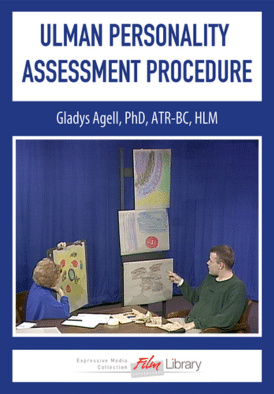
This 1996 video, Dr. Gladys Agell ATR-BC, HLM, pioneer art therapist, clinician, educator and researcher, administers the Ulman Personality Assessment Procedure (UPAP) to a 22-year-old patient at Walter Reed Army Medical Hospital. Video Length: 1h 24m 49s
COURSE DETAILS

Overview

This 1996 video, Dr. Gladys Agell ATR-BC, HLM, pioneer art therapist, clinician, educator and researcher, administers the Ulman Personality Assessment Procedure (UPAP) to a 22-year-old patient at Walter Reed Army Medical Hospital.

He is instructed to make the four-picture series of the UPAP. Afterwards, he and Dr. Agell display them in sequence and then discuss each one in detail. He verbalizes his feelings and intentions as depicted in each picture. In the second section of the video Dr. Agell discusses the young man and his responses to the UPAP with observers, eventually adding some background information.

She emphasizes to the observers that she likes to talk with clients before conducting assessments, instead of going in “cold.” She had the opportunity to talk to this man for about 20 minutes while walking with him to and from the assessment area. She clarifies that her intention was not only to get information, but to let the patient know that the power was in his hands during the assessment process. Dr. Agell also demonstrates how knowledge of other psychological and projective tests can enhance the interpretation of elements in the client’s process and completed UPAP drawings.

This video was formerly included in the Expressive Media Arts Therapies Films Collection distributed by Expressive Media Inc.

About the Experts

Expert

Gladys Agell, PhD

Gladys Agell, PhD was compensated for her contribution. None of her books or additional offerings are required for any of the Psychotherapy.net content. Should such materials be referenced, it is as an additional resource.

View full profile

Disclosures

Psychotherapy.net offers trainings for cost but has no financial or other relationships to disclose.

This Disclosure Statement has been designed to meet accreditation standards; Psychotherapy.net does its best to mitigate potential conflicts of interest and eliminate bias in all areas of content. Psychotherapy.net offers training for cost but has no financial or other relationships to disclose. Additionally, there is no commercial support for this activity. None of the planners or any employee at Psychotherapy.net who has worked on this educational activity has relevant financial relationship(s) to disclose with ineligible companies.

Psychotherapy.net defines ineligible companies as those whose primary business is producing, marketing, selling, re-selling, or distributing healthcare products used by or on patients. There is no minimum financial threshold; individuals must disclose all financial relationships, regardless of the amount, with ineligible companies. We ask that all contributors disclose any and all financial relationships they have with any ineligible companies whether the individual views them as relevant to the education or not. Each experts’ specific disclosures can be found in their biography.

Dan Siegel on Interpersonal Neurobiology
  • Video

Dan Siegel on Interpersonal Neurobiology

Existential-Humanistic Psychotherapy in Action
  • Video

Existential-Humanistic Psychotherapy in Action

A House Divided: Structural Therapy with a Black Family
  • Video

A House Divided: Structural Therapy with a Black Family

Social Work With Older Adults: Real Students, Real Clients, Real Growth
  • Video

Social Work With Older Adults: Real Students, Real Clients, Real Growth

Exploring Narradrama
  • Video

Exploring Narradrama