Julie Bindeman on Reproductive Mental Health Care, Dobbs, and Beyond

Lawrence Rubin: Hi, Julie. Thanks so much for joining me today. You describe yourself as a reproductive psychologist whose specialty centers around reproductive challenges related to fertility, pregnancy, and abortion. Did I get that right, and can you elaborate a bit on what this professional identity means?
Julie Bindeman: Reproductive Psychology is not the kind of specialty you’ll find in graduate school departments. In fact, I’m working with some colleagues to look at what is the curriculum around reproductive health in graduate programs these days. Thus far, it’s not as encouraging as I would hope it would be.
The reproductive time period actually can be anywhere from the time somebody begins to menstruate or begins the ability to produce sperm, all the way to—for men and cisgender men—more so end of life, and for cisgender women into the early 40s-ish (from perimenopause through menopause). So, it’s several decades of a person’s life.
For so many of those decades, cisgender women in particular, spend time trying to avoid pregnancy. It becomes very interesting when everything that we’ve been taught about preventing pregnancy gets turned on its head when we want to become pregnant. We have a lot of conversation in our schools about sex ed, but we don’t have any about fertility and what that means and what that looks like.
So it’s the whole gamut between the attempts at getting pregnant, even deciding, “Do I want to have a family,” and considering that; “Do I want to have a family now with this person, do we feel like we’re compatible;” all the way to, “We’re struggling to get pregnant and we need to seek out a reproductive endocrinologist for infertility,” which is a very specialized doctor.
So, I think, because there’s a specialty in the medical world, and because psychology is a little bit slower to catch up, historically speaking, the idea of a moniker of a reproductive psychologist provides some clarity about what I do, which is different than other psychologists, but also is a very particular niche that involves a lot of study.   
LR: This reminds me of a cartoon I once saw of two girls sitting on a park bench, reflecting on their lives ahead. One of them says, “Well, I think after my second divorce, I will…” It makes me think, Julie, that although the reproductive age physically starts around puberty, people’s ideas of reproduction and parenting and maybe even fertility—probably begin before they were born. Perhaps, a reproductive legacy.
JB: There’s a concept called the “reproductive narrative.” It encapsulates the idea that we all start having a reproductive story early in life, and that story changes, and it’s just as valid of a story if someone is not interested in parenting as it is if someone is very interested in parenting. And when we meet potential partners, we have to see how our reproductive stories mesh, and sometimes they mesh really well, and sometimes there needs to be some negotiation.

Reproductive Mental Healthcare in the Era of Dobbs

LR: If part of the reproductive narrative entails a chapter on the act of becoming pregnant either willingly or unwillingly, then I would think that part of that narrative, from the perspective of a reproductive psychologist, would include discussions around abortion.
JB: Here, let me assist you with it. One of the big concerns for some clients who come to me about deciding whether they should get pregnant or not, is, “Is it safe for me to carry a pregnancy in the state in which I live, and if it’s not, do we need to move?” They explore concerns like, “Do we need to move just for our pregnancy?” In certain states, people are really putting their lives on the line just to have a family.
LR: I’m not going to hide the fact that part of my intent for this interview was my interest, as I hope it will be the interest of many of our readers, in how the Dobbs ruling has impacted mental health clinicians working in the area of reproductive health. In that context, and first, how has Dobbs impacted Julie, the person of the therapist? We’ll get to Julie the therapist later.
JB: I wasn’t surprised. When the leak came in terms of what the ruling was going to be, there was already so much talk about. People were saying, “this can’t be it,” and “they’ll never do that,” and “we’re talking about established precedent for 50 years.” Unfortunately, I was sitting there saying, no, this is it, this is what the intention is. It’s only going to get worse from here.
I remember even having a conversation with my dad, who said, “No, that’s just like hysterical thinking.” Looking back to when the Dobbs decision was finally released, I wish I could say I was surprised. I was not! I had been seeing this coming since Trump was elected, quite honestly. That was the reason that I marched the day after the inauguration. I could see it coming. It was very clear to me that they were going to use whatever mechanisms of power that were available to restrict reproductive rights. So that was one part.
As a mom of someone who was born a cisgender female, I was and am also worried because my child has their whole life in front of them, and you know, I’m not sure if they’ll have a family or not. They might. They might not. That’s yet to be seen. So, I’m concerned for what their choices might look like and what is available.
I have two kids that were born cisgender male, and I worry about them and their potential partners. I knew this was going to impact IVF too. So, when the ruling in Alabama came down, people were like, “Oh my God,” and I was like, “Yeah, no, of course it’s going to IVF next, because the logical conclusion is personhood and personhood being conferred to an embryo.   
LR: The second part of my original question is, “How has Dobbs impacted the way that you are in the room with clients who are thinking about it or going through the abortion process, and what advice springs from that for other clinicians doing it or thinking of doing it?
JB: I happen to live in a state (Maryland) that is very protective of reproductive rights and, in fact, has a shield law. I submitted a letter to the committee that was reviewing it when it was a bill to say that in addition to physicians, let’s protect mental health professionals, because I think that’s an important inclusion that we have, in terms of what we might know.
When I think about worst-case scenarios, I think about people connecting the idea of personhood or person status to a fetus, and then connecting it to laws that already exist. So, if you don’t realize you’re pregnant and you have some wine, is that now endangering the welfare of a child or child abuse? Or if you have an abortion, is that considered child abuse, feticide? I think they will go after women. Even though right now they’re going after physicians, I think they will go after women eventually. It just makes logical sense to me. So that’s sort of my catastrophizing, but again, I don’t think it’s that far off.
As a therapist, I think there have been several weeks of my career that have been indelibly difficult, and nothing I learned in graduate school has been helpful. I was a grad student during September 11th in Washington, DC. That was tough because how do you process an experience with someone when you’re living it too?   
And I would say that for my clientele, the next time I had that experience was the 2016 election. I had clients, who, like me, were grieving, because we saw what the implications could look like.
And then I would say that the third time it happened in my career was the Dobbs decision. I had people calling who were panicked about it. “Are my embryos safe?” was a question I got asked a lot by clients, and I would be like, yeah, for now they are—you know, again, depending upon where you live.
Many of my clients were feeling helpless and angry, and of course, I shared that sense of anger and righteous indignation. I think it’s really challenging to be a clinician when you’re experiencing in real-time exactly what your clients are experiencing too, when you don’t necessarily have the perspective that often we are able to bring to our clients, when we’re not living what they’re living. When we do live what our clients are living, it’s so hard to have that sense of perspective, because our fear centers get activated, or at least mine does.
For clinicians who are either practicing or considering practicing in this domain, it’s important to know your state laws and how they apply to you. If you’re a clinician in Texas, for example, where they have that SB8—which is the bounty hunter laws that it’s so lovingly referred to as—clinicians are in danger under what that law is, and it is a civil penalty. So, anyone can rat you out for any reason, especially if they’re motivated by money. It’s a $10,000 fine. That’s not nothing! Most of us might not have that lying around to pay. So that becomes a very real risk.   
There are other states that are starting to look at that. There are other states that are looking at assisting minors in having abortion care. So as clinicians, I think for the time being, HIPAA protects us, but it’s really important that we are careful about what we say in our notes because notes can be subpoenaed. And so, if I’m talking to a client about an abortion they are planning or an abortion they had, I’m not going to come out and write, “… spoke about abortion.”
I might say something like, “spoke about family planning” and have it be really vague. I think those of us that are practicing in PSYPACT states also need to be aware of what are the other laws in the states where our clients might be sitting in that we don’t necessarily know because they’re not necessarily connected to the statutes that relate to psychology.   
LR: Would you say there is a dividing line/light switch moment between the way you walked into the room pre- and now post-Dobbs? On the morning after, pun fully intended, did you walk in more nervous, more fearful, and aware of having to be far more conservative or careful with your words?
JB: As a clinician who is very up to date on the laws of my state, which I know most others may not be, I’ve been an advocate for many years. I’ve helped to lobby to get some of those laws passed. And so, I wasn’t concerned, because I knew my state legislature—and in a lot of ways, I know many of them personally—that they were going to protect reproductive rights, and that is what they have done the last couple of years too. So, they did not disappoint.
Our state has done some really great things. As I said, they passed a shield law, they’ve expanded who can perform abortions. So instead of it having to be only a physician, it’s been expanded to physician assistants, nurse practitioners, and midwives, which is awesome. More care, we like it! Our Governor has gotten our own sort of storage of mifepristone and misoprostol— ‘mife’ and ‘miso,’ as it is.
So, I didn’t feel that light switch. One of my best friends who lives in Texas did feel that light switch. She had also been living under SB8 two years prior, so she was not surprised. She had had some time too, to be like, okay, now we’re really going to do this because we don’t have the Supreme Court protections. What’s happening in Texas is legal versus legally dubious.   
LR: It sounds like one doesn’t even have to identify as a reproductive psychologist or work in concert with physicians to experience these issues, because anyone who practices couples therapy or family therapy might find themselves thrown into this reproductive ring. As such, it’s just smart to know your state laws, to connect with advocacy resources, and to be very, very careful of what you’re saying and how you say it. And based on your writing, you don’t bring up abortion explicitly but talk in hypotheticals.
JB: One of the things I do as a reproductive psychologist is to conduct third-party evaluations for prospective gestational carriers. And as part of that conversation, we talk about abortion and because they are not pregnant, there’s no concern. I can talk about abortion till I’m blue in the face. They are not pregnant. Everything is a hypothetical.
But I may talk hypothetically, if they live in Texas and there is a problem with the pregnancy. I may say something like, “You are now eight weeks pregnant. You cannot get care in Texas. Let’s talk about where you can go to get care? You know that your doctor is not going to be able to save your life should your life be on the line unless it’s really dire and, you would have to ask yourself if this is something I want to risk?” It’s about looking at each client’s risk profile, which has changed since Dobbs.   

Abortion Counseling as Mental Health Care

LR: But, outside of these specific evaluations, you also do what you might call generic psychotherapy, where the issues may, but most likely will not come up. We are traditionally taught not to bring up religion or politics unless the client does, so is it the same when it comes to reproductive health and abortion if a client doesn’t broach the subject?
JB: Of course I bring it up. I bring it up because everyone thinks that once you get pregnant, it ends with a baby, and that’s just not the case. Not that I’m trying to freak my clients out that are newly pregnant and excited and whatnot, but we talk about, “Hey, have you had a conversation with your partner, should this pregnancy go in a way that you don’t expect? What might that look like? And, you know, it’s a hypothetical because it’s a very rare occurrence. And, I’d rather you have this conversation before it happens than have to have that conversation for the first time as it is happening because it’s just too much to unpack in that moment as you have to make a critical decision about the pregnancy.”
LR: You describe abortion as healthcare. Would you say that the kind of counseling that you do considers abortion as mental health care?
JB: Absolutely. I come at this from the side of the law of my state, which is specific in saying that mental health is a reason for someone to obtain abortion care past 24 weeks. I also come to it from a religious perspective, which may sound kind of odd, but in the religion that I grew up in and that I practice, which is Judaism, one of the tenets is that you save the existing person at all costs. My religion doesn’t see a developing fetus as an existing person. It sees it as a potential person. So, unless that fetus is basically sticking out of someone’s vagina—sorry to be so graphic—and has taken a breath, it is not a person.
LR: I just want to draw reader’s attention to a chapter in your new book that has a comprehensive table called, “Religious Points of View about Abortion.”
JB: When people think about this, and they’re like, “oh, but I don’t see people who are having babies because I work in geriatrics, or I work in pediatrics. This isn’t important to me. I don’t need to know this stuff.” And to that, I say, “actually you do, because how are you talking to your parents of the kids you work with about, what was the reproductive story that that child was born into? Were there losses before that child was born? After that child was born? Was it a long journey? Was it an uncomplicated journey? Was it fraught, and you weren’t sure this baby would ever get there? This is in addition to, was the baby in the NICU or anything like that, that you’re going to want to know about your patient.”
I also think it’s important because if we’re seeing young kids, their parents are often trying to expand the family, and sometimes it doesn’t work as easily as the first time. And so, how do you support a young child who knows there’s something happening with their parents but doesn’t know what it is and doesn’t have that understanding of what infertility might be or pregnancy losses might be? How do you help the parents talk to their child about it? How do you help, as a therapist, talk to the child about it, give them a place to have their own thoughts and expressions?   
For those that work with an older population, and I’ve had older clients who have been still traumatized by the Dobbs decision, because of the abortion they had in the 70s, either pre-Roe or post-Roe. Or even talking about how this is going to impact so many people and having that empathy for it. And that sadness of what I thought I knew, what I thought I could trust, that 50 years of precedent went down the drain.
So, it’s come out in lots of different age groups, and I think it’s really important. I’ve had male clients talk about it too, their concern about abortion and it not being an option—and not in that kind of cavalier, like, I don’t want to deal with that kind of way, which I think we often ascribe to men when we’re talking about abortion. That doesn’t seem to be the case, but somebody I care about might be very impacted by this.   
LR: What are some of the myths around abortion that clinicians—whether reproductive clinicians or not—need to consider when abortion enters the clinical frame?
JB: So let me first dispel a couple of myths that have existed about abortion. Abortion does not cause future infertility. Although I can’t tell you how many of my clients who had abortions when they were younger, and then as they wanted and were ready to have a family, struggled with infertility, how they made that causal. But I’m like, nope, there is nothing causal to that.
Abortions don’t cause cancer, so that’s really important to know. Also, there is no such thing as post-abortive syndrome. That is not a thing. I appreciate the American Psychological Association for a deep dive that they did in 2008. And one of their conclusions was, nope, there is no need to add something to the DSM about post-abortive syndrome. It is not a thing.
What I think is important for clinicians to think about is what research tells us, which is that most people with access to abortion feel relief. Now, there are some circumstances like terminating for medical reasons—I’m not lumping that into that. That’s a very different, specialized circumstance. But the majority of people who are seeking out mostly first-trimester abortions experience relief—95% of them!
In that 5% who might not, they might experience regret. And where this gets confabulated is the idea that regret becomes mental illness versus regret is a feeling just like lots of other feeling experiences a human can have. And it is a feeling that will come and go. And so, we don’t need to pathologize regret!   

A Reproductive Psychologist’s Personal Journey

LR: For those among our readers who have read some of your other work, can you give us—and I don’t mean to diminish it in any way—a little bit of the experience you had as Julie, the mom, along your own challenging reproductive journey?
JB: When people ask me how I found this work, I tell them I came to it honestly. My early grad school experiences centered on teens and kids. That’s what I was really interested in, and so I worked at a high school, where one of my seniors was pregnant. The way the school managed it was incredible. They threw her a baby shower, and when the baby was born, different people watched the baby so she could still go to class so she could graduate on time. What an incredible community to circle around her and help her. It was amazing.
As I continued, I worked at another school that was Catholic, and one of my seniors got pregnant. That was a very different experience. It was interesting in that conversation where we had to sit with the mom and tell her what was going on, and the mom was like, okay, cool, we’ll get an abortion. And the kid was like, nope, I don’t want that.
At the time, I didn’t make much of those experiences. I later had my own kid. When he was about 18 months old, my husband and I reflected on how great he was and decided we needed another one because the world needs another one just like him—since all children, of course, are carbon copies of one another, right?!
We did not have an issue conceiving the second time, although I had in my mind it would be a little harder because I anticipated it would take six months. In retrospect, I guess I was ambivalent, thinking I would have more time than one month. I wasn’t quite ready to have another kid, but there it was.
That pregnancy was over just as soon as it started, when at eight weeks, the ultrasound showed that I had had a miscarriage. It’s called a “missed miscarriage” because it was shown on ultrasound and I had no knowledge of it. I had a D&C. Interestingly, I had begun specializing in postpartum health after my son was born, so after the miscarriage, I wanted to learn the difficulties of the postpartum experience.
We don’t talk about postpartum and how hard it is. We really don’t talk about pregnancy losses which seem to be shrouded in secrecy. So, it wasn’t until my own miscarriage that I realized how insensitive I had been when my friends had had miscarriages. I didn’t know what to say, and so I went to the platitudes, that I think most people go to because we want to be helpful. Rarely are platitudes helpful!
My doctor was optimistic and encouraged us to try again, which we did. I became pregnant very quickly, and while everything seemed to be progressing in those early weeks, I was bleeding. Our anatomy scan at 20-weeks suggested that we have a second opinion. We were referred to a maternal fetal medicine specialist (MFM), where we learned that our baby had hydrocephalus, and ventriculomegaly, in which the brain ventricles were measuring much larger than they should have.
We were told that the best-case scenario was that our baby could live into his 40s with the developmental quality of life of a 2-month-old. That was not a best-case scenario for me! That was not the life I would want to bring into this world, and it was not what I would want to do to my son, not what I wanted to do to my marriage.
We called our clergy and talked about options, one of which was labor and delivery, and the other was that we could drive to New Jersey for a surgical abortion. I was confused because I knew abortion was legal in my state, so why did we have to go somewhere else for surgery? I later pieced together that six months before, a physician named George Tiller, who had performed an abortion in Kansas, was shot to death. His death created so much of a chilling effect that the doctors in my area stopped performing abortions. I ended up having to labor and deliver a little boy who died. It was awful, and both very different, and compounded by my miscarriage. We were later told that this was a lightning-strikes-once situation, a one in a million, and that we should try again when we were ready.
It took me about four months before my cycle came back and my story gets redundant in this way. We tried for one month and got pregnant. I was very nervous during that pregnancy, which we learned was with a girl. I was getting scanned all the time and found out at 18 weeks that the also had ventriculomegaly, hydrocephalus, and partial agenesis of the corpus callosum. Because I was 18 weeks, I was able to access a surgical abortion with one of the kindest doctors to whom I was, and am, very grateful.
We tried again quickly because I didn’t know if I would have the courage to keep trying. And we got pregnant immediately, and this was a pregnancy where I didn’t feel any symptoms, and I was disconnected from it.
At 18 weeks, the MRI showed that we were having a girl and that she was healthy. I was excited and terrified. I asked them to show us the pictures of the last baby we lost and the baby I was carrying, and the differences were so clear. The brain of the baby I was carrying had all sorts of contrasting grays and whites, compared to the blackness in the image of the baby we had lost, which represented fluid. It was a beautiful picture. I went through the rest of that pregnancy fairly terrified, and I think my MFM probably had some vicarious trauma because she had been with me from the beginning.
We went back for my checkup at 36 weeks, and she asked me, “how do you feel about having a baby this week?” I had four more weeks so I said, “I’m good.” She half-joked, “it wasn’t really a question. You’re going to have a baby this week. When would you like to have your baby?” She just didn’t want anything to happen to this child. So, my daughter was born weighing 5 lbs. even. She was fierce. We had a “normal” stay in the hospital, and then they let us go.
When she was about 14 months old, I said to my husband, “hey, so, you know we always talked about three.” He looked at me like, “are you effing crazy?” I said something like, “I must be, but I really want to try for three. If it works, great. If it doesn’t, that’s fine.” And, again, we got pregnant the first time we tried. When we got an MRI at 18 weeks—and this pregnancy just felt so different to me because I was in a place where whatever happened, happened— and my husband was really excited because it meant we could get a minivan. I remember saying something like, “I will not get a minivan unless we have the number of children we might need for a minivan.” He was like, “okay!”Our son was born healthy, and now I have an 11, 13, and an almost 17-year-old. We are very, very done.

LR: I certainly appreciate the depth of your sharing, Julie. when you first started talking about it, I thought, “She’s probably told this many, many times, and it’s going to be very matter of fact.” But you told the story as if it was so fresh, and it just suggests to me that this part of your narrative will always be alive for you, as it problably is an will be for others who have had challenging reproductive journeys.
JB: Can I read you something as you say this?
LR: Sure.
JB: In the acknowledgement section in my book, I write about my story and actually dedicate the book, to the two babies we lost. “…I am grateful for these two babies I said goodbye to before I could say hello to, as they awoke me to the passion for reproductive mental health, and, primarily, the intersection of abortion and mental health.”

Ethics, Competency, and Advocacy in Reproductive Mental Healthcare

LR: This begs the question, “Are there limits to self-disclosure in reproductive psychology, reproductive psychotherapy?”
JB: It’s a really interesting question that I look at from two different vantage points. So, one vantage point is if you’re a therapist with just sort of a normal population, whomever that normal population might be, and you become pregnant, the pregnancy itself is a disclosure, isn’t it? Like there’s a point in pregnancy where you just can’t hide it, and so it’s a disclosure, and I think it’s useful for patients to know so that they can plan, and they’re not surprised.
And then, you know, there can be a lot that might come out in the transference around maternity and nurturance, and things like that. So, I think it can actually lend itself to a lot of really useful therapeutic material. I think if you’re working with the population that I’m working with, I didn’t have a choice but to disclose because I wanted to give my clients an opportunity to change therapists if they needed to. I wanted to acknowledge, “Hey, seeing me pregnant could be really triggering, and I don’t want you to feel like you have to stay with me. Because I get it, and it can be really, really hard.”
It also came out in other ways, like with a client for whom it took months to disclose that, as a child, she had experienced terrible sexual trauma committed by a relative. She was with me through my losses, and she was with me through the birth of my daughter. After my daughter was born, she was able to say she felt like her “badness” and “evilness” contributed to my losses. She felt responsible for them.

LR: That’s very sad.

JB: Yeah! We did some good work around that. Without the disclosure, that work couldn’t have happened. I didn’t show up at my office Friday afternoon after that first ultrasound. So, you know, I had to have someone tell my clients something. And again, lots of interesting things came out from it.

LR: a lot of my resources is through an organization called the American Society for Reproductive Medicine, and within it, a professional group called the Mental Health Professional GroupDo the APA, ACA, and NASW have resources for clinicians who are finding themselves in this therapeutic arena, or who are considering or looking for guidance through live contact?

JB: Not so much within the larger professional bodies. Perhaps NASW. I couldn’t tell you specifically. Where I get a lot of my resources is through an organization called the American Society for Reproductive Medicine, and within it, a professional group called the Mental Health Professional Group. Thats where a lot of the research and work is being done. APA has had more since the Dobbs decision. Sorry to be pitching my book, that wasn’t my intent, but the reason I decided to edit this book was because there wasn’t anything for the mental health professional that had a client that was now experiencing or considering abortion.

You can’t refer someone out when we’re talking about days or weeks to decide to have an abortion. You have that ethical obligation not to abandon our clients, and we have an ethical obligation to not practice outside of our competency. And so, this book is to fill that gap in between competency and not abandoning clients.

LR: Could you recommend a couple of potential paths for advocacy for clinicians who want to get into it and make a difference that way?

JB: I think it depends on how much you want to do. There are lots of advocacy opportunities such as volunteering for a state delegate campaign in your district and talking directly to them, I found that useful and interesting. Or, talking about it at a City Council meeting where you can go on the record. You can talk about healthcare in that kind of way. These are sort of smaller things that people can do.

There’s organizations like the National Abortion Foundation. They not only have abortion funds through them, but also provide a warm line to people. I don’t think it’s a hotline. They train people so that they can help talk to people that are struggling. So that’s a great organization.

There are lots of local abortion funds. That’s a great way to get involved again, you know, depending upon how involved you want to be. So, for a birthday fundraiser one year, I’m going to pick out an abortion fund. This is where I want my contributions to go, like, contribute to this in my honor.

I have lobbied at the state level, even not in my state. I’m happy to talk to anybody. And my husband had the opportunity to go to the City Council meeting, which is where our delegates were going to talk about what happened in session. He said, “I was going to share our story, but do you want to do it? I can give the time to you.” And I said, “Oh honey, they have heard it from me. They need to hear it from you.” I was really, really proud of him.

LR: It sounds like part of what got you through your pregnancies was you and your husband moving together as a unit. I probably should have asked this question earlier on, but “Have you had the experience of working with any women or families who have been denied abortion?” I know this was addressed in the “Turnaway Study” and is very state-specific.

JB: In my state, that is not an issue for people because it’s so protected here. That being said, I’m part of PsyPact, and was working with someone in a restricted state who had gotten a poor prenatal diagnosis and who was trying to decide what to do. Part of our worked centered around getting more information. A lot of her wait-and-see was about getting further along to get more information about the pregnancy. And every piece of information she got was like adding crap to the pile. There was never good news that she was given. It was just bad, bad, bad, bad, bad.

They got to the point where they felt, “our baby is not going to survive, and this is awful, and I think we’re both ready to terminate the pregnancy.” But she lived in a state where accessing that kind of healthcare was really challenging. She had resources, she was smart, and she had people that she could connect to that could help her connect to other people.

So, initially, her abortion was denied by the hospital. They’re like, nope, we’re not going to do it. And then it was denied by insurance, they’re like, nope, we’re not going to cover it. And the hospital is like, well, if your insurance says we can’t do it, we can’t do it. So, it was sort of this merry-go-round.

She was finally able to get connected to the vice president of her insurance company and shared with him what she had gone through, and what was happening, and what she needed in terms of healthcare. He pulled the strings he needed to pull so that she could have an abortion. But otherwise, she would have had to travel.

And we do see that a lot. We’re seeing more and more people that have to carry to term because they don’t have the luxury of traveling. And while abortion funds are great, they can’t fund the entire expense of traveling and procedures, particularly later in pregnancy.

LR: On that note, I want to alert readers to the importance of the Guttmacher Map, which lists the levels of abortion restrictions by state. Julie, are there any questions I should have asked, or that you would have liked me to have asked?

JB: I don’t know if it’s a question per se, but just something to leave people with. My abortions defined what I do and defined how I work and gave me purpose in terms of the scope of practice. However, they don’t define who I am. They are just a part of who I am, but they are not the defining measure.

And I think when some people experience trauma related to their abortion or traumatic abortions, it doesn’t mean that all abortions were traumatic, are traumatic. But when people experience that kind of trauma, it’s so easy to have it define them, that they become defined by their trauma. We see them all the time in our patients, regardless of what kind of trauma it was. Or they’re trying to run from it so much that they—so they’re not defined by it. Through a lot of work that I’ve done, I feel like it’s a part of me. It’s one aspect of me. It is not the whole description of me, but there was a time where it was—like it was all I was doing.

LR: This ties into your earlier mention of the reproductive narrative and how we are born into reproductive narratives that sometimes define the entirety of our reproductive journey. I’m reminded of clients who bring with them the legacies and trauma of their ancestors, such as slavery, the holocaust, and other atrocities.

JB: Well, if you’re thinking about Norma, who was the original plaintiff in Roe versus Wade, she was the third generation of people who had unintended pregnancies but had no recourse, and she wanted a recourse. What ended up happening in that pregnancy—she had already had two other babies who had gone into foster care and then eventually were adopted—and so this third one, she adopted out because the courts were (are) are really slow.

There is a fantastic book called The Family Roe. The way it is written, and how it weaves it all, is just incredible. I think you asked earlier, too, about what resources are available for clinicians. There is an email that you can subscribe to. It’s a Substack you can subscribe to, and the journalist’s name is Jessica Valenti, and her Substack is called Abortion Every Day. She is really keeping tabs on what is happening on a granular state level, not just federal, but she’s been keeping tabs about like, what is the status of getting abortion on the ballot in different states, and what are the shenanigans that some representatives are trying to do to prevent it.

LR: Clearly, we’ve only scratched the surface, so I’ll simply end by saying thank you so much, Julie.

JB: Thank you, Larry.

©2024, Psychotherapy.net

The Importance of Being Heard: When Clients Need Us to Listen

“I feel completely useless to him. I feel like I could fall into a coma mid-session, and he wouldn’t even notice. He’d just keep jabbering away.”

Like what you are reading? For more stimulating stories, thought-provoking articles and new video announcements, sign up for our monthly newsletter.

Navigating Challenging Therapeutic Waters

I spoke these words to my clinical supervisor, Ari. I had been a therapist for just a few months and had no idea how to help one of my clients. Tony, I told Ari, had arrived early to our first session, and before I could even ask, he began telling me his goal for therapy. “I need to learn how to cope with things, especially my girlfriend. When we get into a fight, all I can do is obsess over her. I can’t function at work; I can’t even get myself to do the laundry. I just sit there, looking at my phone, waiting for her to text me.”

I had initially found Tony’s volubility refreshing. Unlike those one-word-answer clients with whom I was struggling to connect, he would answer each question with enough detail to obviate my follow-up questions. Everything about him seemed expressive, even his thick, shape-shifting mop of black hair seeming to change each session as though reflecting his current mood.

Week after week, month after month, he shared his story, telling me about the father who had always seemed intent to one-up him and the mother who would drunkenly come into his room at night and, through tears, complain about her marriage. I started to see how he replicated these childhood conditions in his romantic pursuits, choosing self-involved and emotionally unavailable partners.

Some weeks, his hair spikier than normal, he would describe the wonderful weekend he’d had with his girlfriend—going rock-climbing, going to fancy restaurants—and wonder if she might be the one. Other weeks, his hair noticeably droopier, he would recount with tears in his eyes how she hadn’t once over the past week shown any interest in him. “It might seem like I’m playing a game, but I’m just trying to gather information. Every night last week, I asked about her day, and I’d listen and ask more questions as she went on and on about her horrible coworkers. All the while I’m waiting for something, for anything, for just one question, one piece of evidence that she’s interested in me.”   

When Tony would say that he was going to start looking at engagement rings, I would feel my muscles tense and tell myself to keep my opinion to myself. When he would describe yet another way she had mistreated him—“She gets jealous if I’m on the phone with my sister too long, but like every day she’s texting her old boyfriend”—I would ask what he wanted in this relationship and what he believed he deserved. I would sometimes try to explore the similarities between his girlfriend and his parents, but he never seemed interested in that inquiry.

I initially felt such a strong connection with him, I was now telling Ari, but then something seemed to change. It now felt like it didn’t matter if I was even there, like it wouldn’t make any difference if he spent the hour talking to my plant. He would just go on and on without even pausing. If I wanted to ask a question or share an observation, I would have to interrupt him.

Ari asked some questions and then fell silent. Ari does not have expressive hair, but I’ve noticed that sometimes his brow will reveal his emotional state, and just then his forehead lines deepened. “It sounds like you’re doing good work with him,” he finally said. But I wasn’t doing any work with him, I countered; that was the problem. “When I was starting out as a therapist,” he said, “I felt a lot of pressure to say the right thing and make the right interpretation, but that’s not always what our clients need.”

Ari said that there was probably a reason Tony kept coming to see me. I thought about this and realized that he never came to sessions late, and if he ever needed to cancel a session, he would always make sure to reschedule that same week.   

“You’re listening to him,” Ari continued, “you’re paying attention. It doesn’t sound like his parents ever really listened to him. It doesn’t sound like his girlfriend really listens to him.”

When Tony entered my office later that week, I felt, for the first time in several weeks, excited about our session. Moreover, my changed mindset caused me to see him differently. I still saw the energetic 30-something with ever-evolving hair — today’s style making him resemble Rob Lowe from The Outsiders—but as I looked into his eyes, I also saw the little boy he’d once been. I saw his excitement and fear, his longing to be heard and loved.   

The session itself felt different. I had wanted to help Tony all along, but it took Ari to help me see what type of help he really needed. I had wanted to make life-transforming interpretations, but I could now see that he was not yet at a place where he could receive such interpretations.

Tony first needed the corrective experience of being heard. He needed to know that I cared enough to give him my complete attention and move at his pace without forcing my own agenda upon him. There might be time later for interpretations, but that’s not what he needed now, and understanding that made all the difference, for him and for me.   

Questions for Thought and Discussion

In what ways are the author's experiences like those of your own?

What are some of the methods you found effective for working with Clients like Tony?

What have you found to be some of the more effective uses of supervision?  

Nothing Left to Give: A Psychologist’s Path Back from Burnout

Journal 1: Warning Signs-15 January 2021

I have nothing left to give anymore. I thought the break over Christmas may have helped, but it hasn’t. I am still exhausted, more than ever, and I can’t believe I am saying this, but I feel like I am just going through the motions of caring, that I am “pretending to care,” which is so horrific to say. I do care for my clients; I’m just finding it hard to do this work.

It gets worse. I had a session today with a client. A client with multiple current crises and past traumas still left unprocessed, a presentation making up most of my caseload. This session has floored me.

I am ashamed to admit that my mind was almost completely disconnected from the client throughout the session. My mind was all over the place:

I don’t know if I can help this client anymore.

I wish this client would do what will help instead of just talking about it all the time.

I feel so out of my depth.

I don’t know if I can keep doing this kind of work.

I can’t leave; so many people depend on me.

I feel so trapped.

I need to focus on my client right now. It’s not okay that I’m caught up in my shit.

It is one crisis to the next for this client.

It will never end.

I don’t have anything more to give to this person.

I feel like I’m on autopilot. I’m here, but I’m not here.

It’s hard to know that this client will be safe.

This client deserves a psychologist that can help.

I want this session to end.

I have never been that detached before, and I know I have let her down. A thought popped into my head soon after her session with me ended – you are this client!

I was immediately taken aback as, on paper; we are nothing alike, and we don’t share similar pasts, current life situations, personalities, traumas, or even approaches to life. Despite my immediate disagreement with this thought, it repeated itself. . . you are this client!  

Right here, right now, while reflecting on this session, I still find myself rejecting this thought, this knowing. I’m not this client. My mind is saying:

This client’s experiences, past and present, are a lot more complex than mine.

This client has experienced multiple traumas, depression, and work-life stressors.

I don’t even have half of that…but maybe the similarities lie in how the suffering presents, not the causal events.

Now, this has made me stand up and listen. Despite our notable differences, our suffering does have similarities. We are both going around in circles, staying stuck in situations that are not healthy for us. We both have lost pleasure in our lives in what we do. We withdraw, keep busy or turn to substances (food for me) to cope. We both continue to push ourselves to do better and be better both professionally and personally. We both find it hard to talk about our problems to others. We keep it hidden. We are constantly irritable and exhausted. We both have very high standards and expectations of ourselves. Our worth is caught up in what we do for a living or who we are for other people. We are profoundly insecure and, at the same time, desire safe and supportive connections. We both feel disconnected from who we are. We both suffer from bouts of depression and anxiety. We both dream of escaping, breaking free from our suffering. And we are both beyond burnt out and have no more fucks to give. We are both feeling trapped in our lives.

Shit! We are alike.

Well, what do I do with that now?

I know what I have advised the client to do, and if our sufferings are similar, I need to either step back from my career as a clinical psychologist or make some significant changes to how I’m doing things right now. I need to prioritise care for myself.

But am I that bad?

Maybe this is all just in my head.

It’s just too much even to fathom right now.

Too many people need my help; I need to keep pushing through.

I need to focus on doing what is best for the clients.

Wellness Practice

Don’t shove down any insights you may be experiencing. Don’t question it. Sit with it. Pay attention. You can do so with a daily check-in.

Daily Check-in

Answer the following questions to help you check in with yourself: What is happening for me right now? What am I feeling? What is on my mind? How is my body feeling? Do this regularly to help you gain self-awareness and be in a better position to respond to any difficulties. You can even start a journal to capture these daily check-in insights.

Journal

Start a journal to record your wellness practices throughout this book. The writing process in and of itself can offer therapeutic qualities, and it helps us slow down, pay attention, look in, engage with ourselves, and process our experiences.

Journal 3: Severely Burnt Out-3 March 2021

Since my last journal entry, I have left my job and career behind. I feel deeply ashamed and guilty for leaving my job as I did. It happened so suddenly, so quickly; no one saw it coming. In some ways, even I didn’t, although I had thought about it quite a bit. A week ago, on February 25, 2021, my mind and body spoke for me—“I can’t do it anymore.”

You are not well enough to take care of others right now. Leave this for those who can. Your job is to take care of yourself, and leaving your work is caring for yourself and others.

On that day, I showed up to work at the psychology practice where I had been working for almost five years, Zest Infusion. Like many preceding days, I felt completely and utterly exhausted, emotionally, mentally, and physically. Along with this feeling, I felt a sense of dread, hopelessness, fear, anxiety, self-doubt, and a lack of care to give to anyone.

I had set up a meeting to talk to the practice director, Dr Ilze Grobler regarding the need to change my schedule to support my well-being. I was still struggling with what I wanted to do. Reducing my client load or leaving meant that clients would suffer, but if I kept working the way I was, I would suffer. Both decisions involved suffering; no one would win. I remember feeling very anxious to talk with Ilze about it all, not because of what she’d say (she’d always been compassionate) but my fears of what this meant for everyone—for clients, me, and Ilze’s business.

My heart was heavy, and my mind was too. I knew I wasn’t okay, and something needed to change, but I was battling my need to care for others and myself. I didn’t realise how bad my health was until I was in front of Ilze, letting her know what was going on. Ilze’s compassion made me feel safe enough to connect with the depths of my suffering and listen to what I needed. She mentioned that she knew of a psychologist in a similar position who needed to take time away from the profession to care for herself. At that moment, I admitted I couldn’t do it anymore. I couldn’t push. I couldn’t be present for my clients. I couldn’t adequately put my pain aside and be present; worse, doing so would create more suffering for everyone. I had to stop, and I had to stop then. Ilze’s compassion helped me to find what I needed at that moment and to express it.

I recognise that my awakening to the depths of the pain and suffering I am experiencing has happened because of two compassionate women in my life, Dr Ilze Grobler and Dr Hayley D. Quinn. Without these women, I wouldn’t have been able to take the steps I have made so far. It was Hayley and Ilze who told me…

You are not well enough to take care of others right now. Leave this for those who can. Your job is to take care of yourself, and leaving your work is caring for yourself and others. 

Maybe I can believe, in time, that it is okay to take care of me.

Wellness Practice

Surround yourself with empathic, non-judgmental, warm, kind and empowering people. If you haven’t got them, find them. You will know you’ve found one when you can be yourself around them. If there is not someone in your immediate environment (friends or family), seek out a professional. A mental health professional (e.g., psychologist, counsellor) is trained to provide a safe, secure and supportive environment, so you can be free to be yourself, to share your pain and suffering.

It will depend where you are in the world with how you go about this and what professional to see. In Australia, it can be helpful to see your doctor first, a doctor who specialises in mental health, who can do an assessment and assist with referrals to appropriately trained professionals. You can also visit the following link https://www.healthdirect.gov.au/mental-health-where-to-get-help. This page will help guide Australian readers on the next steps to link with a professional.

If you find this whole process daunting, that’s okay, it is. Bring a friend, someone you trust, so they can support you through the process. They don’t need to know what to do; you can find out together. This way, you don’t have to be alone.

Journal 4: Letting People Down-10 March 2021

I see my burning out and inability to work as being pushed off the side of a cliff, free-falling into the space below with microscopic moments of being lifted, flying to somewhere unknown, feeling scared and free simultaneously.

The past couple of weeks have been extremely challenging. I have spiraled in and out of feeling relief, quickly followed by crippling fear, guilt, and shame. I constantly think that I have let others down (Ryan, colleagues, and former clients) and that I’m selfish for prioritising my care over others. The fear, guilt, and shame are currently overtaking any feelings of relief.

The feelings of fear, guilt, and shame were most substantial when people I care about started to find out I was sick and no longer working. The day the email to my clients and colleagues went out to let them know I had left was particularly gut-wrenching. At first, I couldn’t look at the emails from clients and colleagues. The shame and fear I felt then wouldn’t allow me to read them. I feared they would hate me. I feared harm would come to them; I believed I failed them.

Further, I felt guilty for the position I put them in—not having regular, familiar, and reliable psychological care. I feared they would be angry with me, hurt, and that they’d believe I abandoned them. Or I felt like I had abandoned them. I can’t shake these feelings and thoughts; they are constant companions.

Despite how I feel or think, I must confront this fallout in a way that supports both myself and those affected. I don’t want to hide. I’ve done that before. In my late teens and early 20s, I was experiencing what I later came to recognise as clinical depression. During this time, I worked at a local restaurant fulfilling both waitressing and administrative roles. One day, I upped and left and never returned. I didn’t speak to anyone from work, friends, or family. Those close to me at the time knew something was up, but I didn’t talk; I didn’t know how back then. I felt deeply ashamed for being sick; I believed I had no reason to be. The shame kept me silent. I’ve learnt a lot since then. I’ve learnt to speak up, front up, and recognise that anyone can become mentally unwell and that there is no shame in being mentally ill. I’m thankful for the experience of clinical depression for this learning experience.

This time I want to be the person who fronts up to the fallout, speaks up, and honours the responses from colleagues and clients for my abrupt departure, doing what I couldn’t do all those years before. With this intent, I told Ryan and my family that I was sick and started reading emails from clients and colleagues.

Reading my former clients’ email responses has been particularly tough. I have felt many emotions—grief, loss, gratitude, support, compassion, kindness, and despair. Most of the responses were compassionate, demonstrating concern for me, sadness for not receiving psychological care from me anymore, and non-judgmental support; very few clients responded with what I feared (i.e., feeling abandoned, angry, and let down by me). I wasn’t mad at those who felt this way; I was glad they could express their feelings. It was a difficult time for all.

Despite the overwhelmingly compassionate responses from everyone, right at this moment, I still feel weighed down by it all. I still believe I have let my former clients down; I should be capable enough to support them and hold up my end of the relationship. I want it all to be over. I want to crawl into bed and not deal with it. I still worry about the potential harm that may come to my former clients due to not having a psychologist until they secure a new one. I worry about the workload now on the Zest Infusion team, and I feel bad for no longer financially providing for my family. I feel overwhelmingly responsible for everyone’s pain and suffering at the hands of my actions. I feel like I’m drowning. It’s like it will never end.

What keeps my head above water is the continual support from those who genuinely love and care for me—Ryan, Jayd, Hayley, and Ilze. I love when a message pops up from Hayley or Ilze to check in to see how I am going and knowing I can speak with Ryan and Jayd when I am having a bad moment. I am fortunate to have their support. It gives me the strength to continue putting my needs first, back away from being the carer for others, and allow others to care for me. It helps me to acknowledge that I’m sick and not in a position to care for anyone right now, and it would be wrong for me to do so. They are helping me focus on my choice to care for myself while also doing what is needed to finalise work. For example, setting and sticking to a workable schedule for doing the background work necessary to assist clients in being seen by another psychologist (i.e., writing reports to their doctors, handovers to new psychologists, and answering client emails) and scheduling an appointment for myself as soon as possible with a psychologist. I’m focusing on what is necessary to finalise the care for others whilst also taking care of myself.

I’m in awe of the overwhelming support from former clients for my health and well-being. Many of them have said in their messages to me something to the effect of “if there is anything you have taught me, Shannon, it is the need to prioritise care for self.” I’m so happy they have learned this from me; it helps me to know that they have learned a valuable healthcare strategy, care for themselves. More than this, everyone’s responses (including the clients) showed me that even when what you have to do affects them, it doesn’t mean they will hate you. They may express their hurt but also offer care and kindness. I’m grateful to have been surrounded by such wonderful human beings. The free-falling stopped in these moments, and I felt lifted and supported in this place of the great unknown.

Wellness Practice

You can’t change what has happened. Your illness will impact others. This doesn’t mean you are a “bad” person; it means you are human.

Acknowledge and show compassion for any undue impact on others. For example, “I’m sorry for the impact leaving work has had on you.” Don’t sacrifice your needs to take care of others right now. You will only do further harm to yourself and to the very people you don’t want to hurt.

Turn your attention to your recovery. Do the work so that this doesn’t happen again. What is one small step you can take today in service of your recovery? For example, make an appointment with your doctor to discuss a referral to see a mental health professional, prioritise rest, make time to catch up with a trusted friend, or spend time in nature.

Journal 5: Uncertainty-16 March 2021

At some point recently, I lost that lift and started to free fall again, and this time I was aware I had no place to land. I was fucking freaked out. I was staring into the abyss, and there was nothing. I have never jumped off a cliff; I always have a destination. I’m a planner; I always have a plan.

The free-falling recommenced when I was wrapping up the last bit of administrative work I had to do for my former job. This work has taken a few weeks, working full-time hours to complete, and it has filled my days and kept me from seeing the naked abyss of my life, a protector in some ways.

So, of course, I started to look for work frantically. Honestly, I have been looking for work on and off before then. If you were a fly on the wall for the past few weeks, you would have seen me sitting at my desk, editing my resume, signing up to major job sites, and applying for jobs after finishing a full day of client report writing. You would have heard a few thoughts about what I should do inside my mind. One of them was to do something within my expertise. Another was to do something entirely different with little to no responsibilities. I even thought about not working. My favourite idea was to take off in a van around Australia. At some point, I recognised that my mind and body were busy finding a place to land (i.e., a plan).

I talked about this with Ryan just the other day. I promised to talk more with him, especially when I get caught up in my head about something and take actions that are not helpful to me. Talking with him helps. I know he cares for me and has no qualms about being honest with me if what I do is not in service of that. I wouldn’t share with him or anyone in the past, and I would end up with a messy yarn of irrational thoughts, beliefs, and behaviours that only made me sicker. Talking it out with him helps untangle some of that yarn and keeps me from losing my shit. This time was no different.

On one of our daily walks with our puppy Hana, I shared with him what was happening in my mind and that I had been frantically looking for work, feeling the pressure to earn a living and pull my weight. Just voicing what was going on in my head helped. His words of encouragement, love, and support to do whatever helps me be healthy and happy have helped untangle some of this story and guided me to the firm decision to take 12 months off from working in the mental health field, stepping away from a caring role. I’m very thankful I decided to talk with him about my current messy thoughts; it has led to a critical decision.

This decision felt so good. A weight was lifted from my shoulders. My gap year began. A gap year with a stark difference; one focused on getting better and doing what is necessary to heal.

Gap Year Rule

To engage in activities that meet my needs. Care for self without engaging in work involving providing mental health care to others for at least 12 months.

While this decision and Ryan’s support have helped significantly, I realised I still didn’t have any place to land; I didn’t have a plan. I was still free falling into the unknown, uncertain where I might land. The view was cloudy, messy, unclear, scary, and foreign.

At some point (not sure when), the clouds cleared. I don’t know why; maybe a combination of journaling, talking with Ryan, and time. Whatever the reason, it became clear that I was pushing myself to find land (i.e., a work plan) because I believed doing so would help me feel safe, secure, and in control. I was looking for certainty. However, pushing myself to find a work plan only created more suffering. I needed to stop pushing myself to have a plan and instead let go, be present in the sky, this place of uncertainty, the great unknown. If I remain still, present in this place, I believe the answers will come at some point, and the plan will unfold. A plan that will likely be healthier and much wiser than the one made from pushing.

So, the plan is to be still and ignore the urge to push; to focus on caring for myself— meditating, spending time in nature, hanging with loved ones, stand-up paddle boarding, hiking, and stretching, whatever supports me at that moment.

Wellness Practice

When everything stops, it can be unnerving. Sending you into a tailspin of complicated feelings, thoughts and body sensations, often unexpectedly, especially if you are a high achiever.

Uncertainty is a tough place to be in, and reaching certainty in a moment isn’t always possible.

Instead of dealing with this all alone, talk about it with trusted friends, family or a professional. Speak it out loud. When we voice what is going on, it supports processing our experiences.

Have you ever talked something out with someone, and they haven’t said anything particular back to you, just sat there and listened, and afterwards, you have felt better, maybe even knew what to do next?

Talk with someone. If you don’t have someone, talk it out with a therapist, or write it in your journal.

***

As the sole rights holder and author of Nothing Left to Give: A Psychologist’s Path Back from Burnout, I Shannon Swales hereby grant permission to Psychotherapy.net to reprint the journal entries dated 1/15/21, 3/3/21, 3/10/21, and 3/16/21.   

The Transformative Power of Empathy in Therapy

Therapy as a Place of Safety and Respite

Each person’s therapeutic process will be unique, as will their stories, experiences, and needs. With that in mind, the approach I take with each of my clients varies. I offer a bespoke approach, tailored to the individual needs of each client, built around their personality and presentation. But regardless of their differences and needs, I will always use, and deeply value softness.

Like what you are reading? For more stimulating stories, thought-provoking articles and new video announcements, sign up for our monthly newsletter.

I have come to realise the immense importance of being gentle with my clients. Life, with all its challenges and hardships, can often leave individuals feeling battered, tired, and worn. Many of them seek therapy in a state of heightened vulnerability. It is during these moments that therapy becomes a sanctuary, one that offers them a soft place to land.

As a therapist, I believe deeply that it is my duty to create an environment of warmth, understanding, and compassion. I recognise that my clients may be carrying heavy burdens, and that it is my role to offer them temporary solace and respite from the outside world. I strive to be a gentle presence, providing a safe space where they can lower their defences and be truly seen and heard.

In this gentle space, I encourage my clients to explore their emotions at their own pace. I do not rush or push them to confront their pain before they are ready. Instead, I hold space for their vulnerability, allowing them to express themselves without judgment or criticism. I offer a listening ear, a compassionate heart, and a genuine desire to understand their experiences.

In moments of distress, I remind my clients that it is okay, and perhaps even necessary, to be gentle with themselves. I encourage self-compassion and self-care as essential tools for navigating life’s challenges. Together, we explore gentle practices such as mindfulness, relaxation techniques, and self-soothing strategies that can provide comfort and support during difficult times.

Being gentle in therapy also means recognising and respecting each client’s unique journey. I understand that what works for one person may not work for another. I adapt my therapeutic approach to meet the needs and preferences of my clients, honouring their autonomy and empowering them in their healing process.

Through gentle guidance and unconditional support, I aim to instil hope in my clients. Life may be hard, but therapy can be a refuge amidst the storm. It is a place where they can find solace, gain clarity, and develop the strength to face their challenges with resilience and grace.

In the gentle space of therapy, I strive to be a source of comfort and empowerment for my clients. I believe in their inherent worth and their capacity for growth and healing. By offering them a soft place to land, I hope to help them navigate life’s complexities with kindness, understanding, and a renewed sense of hope.

As a therapist, I am privileged to witness the incredible resilience and strength of the human spirit. Every day, I can guide individuals on their unique journey towards healing and self-discovery. One such client who stands out in my mind is a past client, Emily.

The Use of Compassion and Kindness in Therapy

When Emily first entered my office, I could sense the weight she carried on her shoulders. Her eyes held a mixture of pain, fear, longing for relief, and a need to understand and be understood. It was clear that she had been through significant hardships and was in desperate need of support.

With empathy as my compass, I created a safe and nonjudgmental space for Emily to explore her emotions and share her story. I listened intently, acknowledging the depth of her pain and validated her experiences. I understood that healing begins with feeling seen and heard, and I made it my priority to provide those for Emily. Emily’s hardships had clearly and profoundly taken their tolls—she was tired, mentally, emotionally, physically, and spiritually.

Through our sessions, I encouraged Emily to delve into her emotions and confront the underlying traumas that had shaped her life. It was not an easy process, as she had built walls of self-protection to shield herself from further pain. However, with gentle guidance, she was gradually willing and increasingly able to navigate through the layers of her past and unravel the patterns that held her back.

As our therapeutic relationship grew, Emily began to trust me and felt safe enough to peel back the layers of her vulnerability. She shared her deepest fears, insecurities, and darkest moments with me. In those moments, I realized the immense responsibility I held as her therapist, and I vowed to hold space for her pain and support her in her journey towards healing. There were moments when Emily faced overwhelming emotions that threatened to consume her. She felt lost, as if she would never find her way out of the darkness. In those moments, I provided a steady presence, a beacon of hope, reminding her that healing takes time and that she was not alone in her struggles.

Together, we explored various therapeutic techniques and coping strategies that would help Emily regain control over her life. We worked on building her resilience, nurturing self-compassion, and cultivating healthier ways of relating to herself and others. It was a collaborative process, and I marvelled at Emily’s courage and determination to confront her pain and grow from it. Over time, her wounds began to heal, and I witnessed her transformation into a resilient and empowered individual. She reclaimed her sense of self-worth and discovered her true potential.

***

Emily’s story serves as a reminder to me of the transformative power of therapy. It reaffirms my belief that every individual has the capacity to heal and grow, given the right support and guidance. As a therapist, I am honoured to walk alongside my clients, witnessing their strength and resilience as they navigate their path towards self-discovery and emotional well-being.

Questions for Thought and Discussion

In what ways is the author's orientation to therapy similar to your own?

How do you assure that therapy will be a place of safety for your clients?

How do you address situations where clients enter therapy feeling very unsafe?  

Bringing Art (Therapy) to Life: An Interview with Judith Rubin


Victor Yalom: Welcome Judy. I wanted to start out by saying how grateful I am that you’ve recently trusted psychotherapy.net to publish the vast video library you’ve created, containing over 100 expressive arts therapy titles. It’s truly an honor for us to be the caretaker of this unique and incredibly valuable library. So, thanks for that, and before we talk about the collection, I want to get some context. I understand that through some interviews you’ve given, that you were there when art therapy was just starting as a field of study and practice. I know there’s not just one art therapy, but to get us going, how would you define art therapy or art therapies? What does that really mean? 
 
Judith Aron Rubin: People get caught up in trying to define it, but it’s simple in my mind. Art Therapy is using an art form, in my case, the visual arts, to help people through therapy. And yes, there are many variations; but in its essence, it’s art plus therapy.
 

The Therapeutic Value of Art

VY: Why introduce art in therapy?
 
JR: As it turns out, and I guess we all know that we don’t start out having words as infants, but we do start out having visual experiences. Other art forms like movement, drama, and music also depend on some of the other basic sensory inputs babies have. So, these are simply ways we learn early on of taking in information about the world and then expressing experience.
 
To not take advantage of these natural and inborn languages in trying to help people get better seems almost foolish. Cooing, babbling, dramatizing, pretending, and making marks seem universal in higher primates. When given art materials to make marks, chimpanzees and apes like to draw and paint. So, it’s a natural activity that can be used to help people — another avenue to reach people and to help them find out about themselves.  
 
VY: Art Therapy is using an art form, in my case, the visual arts, to help people through therapy. It makes a lot of sense when you think of it that way because one of the things we’re always trying to do in therapy is to get people to explore new things and come to new understanding about themselves — although not necessarily to a non-verbal place. I know you were trained as an analyst and that in analysis, the clinician uses techniques like free association to help people discover new things about themselves by exploring their unconscious or preconscious. This sounds similar to your way of describing the use of art in therapy, although it’s probably more expansive.
 
JR: That’s one way of looking at the value in people expressing themselves freely like free associating with words. Free association and images is actually quite fun. And you can do it with mental images. You don’t have to draw or paint them. And in fact, there were a lot of psychologists in the 60s and 70s and 80s who were quite interested in mental imagery as a way of understanding, but also helping people.
 
VY: creating something visually, or moving or dramatizing, are all ways of cutting through those defenses. So, it’s tapping into these other ways of experiencing and seeing the world. How is that helpful to clients?
 
JR: Because they can get in touch with things that they are unable to articulate in words. It’s obvious with people who are not very verbal, or who are communicating to us through a second language, or who have hearing or expression problems. But it’s also very helpful with people who intellectualize, who use words defensively to cover up. They’re not aware that they’re doing that, but that happens. Creating something visually, or moving or dramatizing, are all ways of cutting through those defenses, allowing something to become part of someone’s awareness that they couldn’t otherwise access.
 
VY: There are two interesting points that I hear you making. One is that art therapy can be very helpful. It seems that it has historically been used quite a lot, and probably still is. I think non-art therapists think of art therapy being used more frequently with these populations who aren’t as verbal, and who may be in hospital settings with psychotic patients or others with other disabilities.
 
What I also hear you say is that it’s very helpful for people who intellectualize, which is a large percentage of the clients we see, especially higher-functioning ones. That can be a real limitation in therapy. People can talk about themselves; they can theorize and intellectualize about themselves; they can tell stories and come up with intellectual and rational explanations. But that doesn’t necessarily lead to anything happening therapeutically.
 
JR: Yeah, it’s interesting because using art in therapy seems to help people not only get to a kind of awareness or insight, but also to feelings that they aren’t aware of that are often evoked by using art material or seeing what they’ve created with the material. This can be incredibly powerful.

And the Children Shall Draw

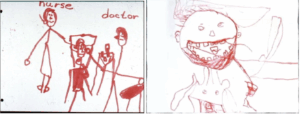
VY: I’ve just had a chance to look at a few of the videos in the vast library that you’ve created. One image that struck me was when you were working with a young girl who was non verbal. People thought that she was “retarded,” which was the term used at the time. She drew this incredible image of going to see the dentist. Do you remember that?
 
JR: I do. That was 1967 — three years before the American Art Therapy Association was formed. You’re right that it was in the beginning years, and that was exciting. Actually, it was fun. I feel lucky to have entered the field at a time when it was essentially unformed. It was about ideas and passionate people. But there hadn’t been any kind of intellectual framework developed yet.
 
VY: I feel lucky to have entered the field at a time when it was essentially unformed. It was about ideas and passionate people. This is perhaps an example of the power of art that I can refer to one image someone created in 1967, and it can immediately evoke that same image in your mind.
JR: I not only remember the image, I remember the little girl who came into the art room in her wheelchair. I remember watching her create it and thinking, “God, this kid is not only not retarded, she’s saying something that needs to be expressed.”
 
VY: But she’s saying it through a picture.
 
JR: Yes. We were assessing children in a place then called the Home for Crippled Children, meaning it was all children with disabilities, some of whom were residents and some of whom came during the day. They had about 200 kids and had invited me to start a pilot art program because they had never offered art for the children. I met with the coordinators who presented me with a list of 10 eligible children. I remember saying, “only 10 out of all these children?!”
 
They were so anxious about what these kids could or could not do, so they picked only the 10 highest functioning children with the most mobility and fine motor skills. I asked if it would be alright if we assessed everybody, which they agreed to. As a result of this assessment and this drawing, this little girl was moved back into the classroom that she had been taken out of.
 
VY: Many therapists may think, “I’m not artistic, so this isn’t for me.” Is that a common thing you find?
 
JR: Oh, sure. Many patients and adults too. Except for children. Most children don’t say that. But adolescents? Adults? Sure, but then you explain.
 
VY: That’s interesting that kids don’t say “I can’t draw, I can’t dance, I can’t sing.” It’s something they do naturally. And then what happens? How do they go from there to this idea that I can’t draw, I can’t dance, I can’t sing.
 
JR: It happens developmentally around puberty, where they become much more self-conscious in the general sense about the way they look, the way they move, the way they dress and how they draw. They become self-critical. It isn’t simply their artistic talent or lack of it, because until a certain age, most kids are un-self-consciously able to create.
 
There are little children of all ages who are blocked, who are unable to play. These children really need creative arts therapy because it’s a kind of play therapy. I think the creative arts therapists in their training, in their experience, are used to helping people who can’t create, to be able to create, if that makes any sense. It’s part of the job.

Bringing Art into the Room

VY: Let’s get into what art therapy is, and how you use these natural, innate abilities in a therapeutic context to help people. That’s a big question.
 
JR: It is a big question. With different age groups, you present it in a different way, so I’ll just stick to art therapy for the moment because that’s what I know best. But, as I said, older children, adolescents, and particularly adults are inhibited. You explain that this isn’t about being an artist.
 
In fact, artists are some of the hardest patients in art therapy because they’re so aware and self-conscious about their art, and they want to make it pretty, good, and attractive. But that’s not the purpose of art in therapy. The purpose essentially is to help people express and find themselves.
 
VY: Some of the people reading this interview may be art therapists or know something about art therapy, and want to hear from you as a renowned figure in the field. But many others are therapists who have had no exposure to art therapy, so I’m wondering how, if you’re not trained as an art therapist, can you still start incorporating some of this into your work.
 
JR: I believe you can. It’s an issue, a political issue within the field, because it’s been difficult for art therapists to be recognized as clinicians. But in actuality, the training is at least as rigorous, if not more so than the training that LMFT’s and social workers and other masters-level clinicians receive. I believe it’s at least as good as, if not better than, the training that mental health counselors get. And many people go on for PhD’s these days in art therapy or related fields like psychology, which actually is what I did my doctorate in. So, I’m licensed as a psychologist, although I don’t think of myself as primarily that.
 
There’s some anxiety about sharing techniques and activities with people who aren’t trained in the art form or who don’t know how to help people to use clay or the paint or whatever, and may not understand what they’re unleashing. The truth is that you can get to buried material that can be quite disruptive unless you know what you’re doing as a clinician or therapist. That’s the political aspect of helping others to use art. But I personally believe that everybody should be incorporating it. I wrote a book called, Artful Therapy for Non Art Therapists.
 
VY: I think giving people choices is one way to help them overcome some of the inhibitions around using art in therapy. Whether someone is trained as an art therapist or not, can you say a little bit about how to introduce some artistic activity, whether painting, clay, drawing, or whatever into the therapy?
 
JR: That’s a whole chapter in a book, and a bit hard to put into words. One way is to help it be a non-threatening activity, because a blank piece of paper is pretty threatening to most adults. What has worked for me is to give people choices, to have options. I’ll say something like, “You can use clay, or you can use chalk; or if you prefer to use markers or colored pencils, that’s fine. You can use a little piece of paper or a big piece of paper, whatever suits you.”
 
I think giving people choices is one way to help them overcome some of the inhibitions around using art in therapy. It’s about explaining to an adult or adolescent that this is a way of getting at stuff that we might not otherwise be able to get at by talking. Another way is to ask people what they remember about their dreams, because dreams contain many visual images, so in a sense, they are already thinking as an artist.
 
VY: So, you give people a choice by starting out with some of the materials in your office or encourage them to have some of these materials available if you’re working online with them. What kind of instructions do you then give them?
 
JR: These can range anywhere from open-ended to a starter. A starter is an easy and non-threatening way to begin because it doesn’t push the person in one direction or another. You can put a blot of paint on paper, fold it, and then ask the person what it reminds them of. People also like to doodle or make squiggles, so you can ask them to do that with their eyes closed and then look at it, and then turn it around as you ask them, “what does this remind you of?”
 
Each time, it’s like a Rorschach as you ask them what they see. You can get a lot of projective material from this very simple exercise. Then you can say, “OK, now take all the other colors and make it look like what you saw in it.” Because it starts with the scribble that doesn’t require people to think of making something realistic, they’re liberated.
 
VY: The idea is that you want to reduce the resistance people have to drawing, or to art in general. And whether it’s an inkblot or a squiggle, you’re priming the pump.
 
JR: Yes, because just starting with a line or a shape doesn’t give you much. But when people start to develop an image, they can begin to see something, like an image in the clouds. That’s another common experience that you can remind people of to let them know that they don’t have to be an artist to be artistic. Or you can give them clay to fiddle around with and then ask them similar questions to those you asked about the doodle, squiggle, or ink blot.
 
VY: I’m sorry to interrupt here, but this reminds me of the walk I just took with my 92-year-old father, who was looking up at clouds and seeing faces in them. In an earlier stage of his life, he was not a visual person — he was a very word-and-intellectual person. In that moment, I saw him opening up to a different world in that way, which perhaps is something that happens with the elderly. Just an aside!
 
JR: That’s fascinating because he’s not the first person I’ve heard that about. I think it’s uncommon that people who were mostly word people begin to pay attention to sounds, images, and the nonverbal when they get older.
 
VY: Getting back, you started describing the process of helping people go from a doodle to filling it in. From that point, how do you do more? How do you work with that therapeutically?
 
JR: Well, let me give you another kind of example of helping people get started, one that’s very valid, and a bit different from that other making-and-creating exercise. We used to have more magazines for selecting and cutting out pictures to paste into a collage. You certainly don’t have to be an artist to do that. You just find the images you like — or even just projectively looking at postcards or small reproductions of artwork and saying something like, “pick the one you like or the one you don’t like and let’s talk about that.” You can use art as a stimulus and find non-threatening ways of helping people to get started creating.
 
VY: How do you connect that with the therapeutic issue that someone comes in with like a relationship breakup, or if they’re feeling depressed, or not sleeping well. These are some of the bread-and-butter issues that therapists deal with. How do you relate to that?
 
JR: If it’s a grown-up, you have to listen to them first. You don’t throw the art at them right away unless they say, “I’ve come because I want art therapy,” which sometimes happens, right?
 
VY: there are many ways of hooking into what they’ve talked about and asking them to think of it visually. If you’re an art therapist, it’s more likely to happen.
 
JR: But if they’ve been in verbal therapy and they’ve hit a block and they hear somebody say, “Oh, you can past this in art therapy,” they might then ask you, “Can I do some artwork?” But most of the time, people want to tell you what’s troubling first. You know, you don’t even have to ask, why are you here? They tell you pretty fast while they’re here. And so, you listen to that and sometimes you can say, “could you make a picture about that?” or, “what color would that be?” or, “what shape would that be, that issue you’re talking about?” or, “if that person was a color or a shape, what would they be?”
 
In other words, there are many ways of hooking into what they’ve talked about and asking them to think of it visually. And then you might say, would you like to make some art to see if that would help us? When I had adults in private practice, I would give them a choice of working at the table or the easel, or while sitting looking at me, in which case I would give them a sketchbook and they would sketch. I didn’t have to look at what they were sketching.
 
Sometimes, they want you to see it and sometimes they don’t. There’s a million different ways and I think one of the advantages of being in different positional relationships is also interesting. It’s not something you do in therapy as often, although some people like August Aichhorn went for walks with his patients. Some people do, but mostly people are sitting looking at each other, and if you’re an analyst, they’re not looking at you. But anyway, in the creative arts, there’s much more flexibility about how you are in space with one another.
 
VY: Even though we may think of ourselves as progressive, liberal, or open-minded, therapists like everyone else are creatures of habit who get locked into specific ways of interacting with their clients. Analysts traditionally didn’t look at their clients, and that progressed to primarily weekly, face-to-face, 50-minute sessions. And suddenly we had Covid and online therapy, before which most therapists would have said, “oh, no, you can’t do that, you’re going to lose everything!”
 
But the field, and most therapists adapted and realized that yes, you can do good work without being in the same physical space as the client. One thing I hear you saying is the importance of encouraging therapists to be flexible, whether it’s doing art, or standing next to them, or as in the case of “responsive art” where therapists draw along with their clients. However, I can see one challenge in teaching this is encouraging therapists to question their own preconceived ideas of what therapy needs to look like.
 
JR: I worked in a psychiatric hospital and child guidance center for many, many years, which were part of the University of Pittsburgh psychiatry training program where we trained a lot of social workers, psychologists, and psychiatrists. We discovered that the best way to train people was to get them involved in doing something themselves, even briefly, and then talking to their colleagues about how to use it in their work — just to get a feel for it making something and talking about it. This is the most powerful tool to convince people that it’s useful.
 
VY: I think of group therapy and how important it is for therapists to have the experience of being part of a group to really understand the power of group therapy.
 
JR: Same thing with art. I heard this again before the association was founded, from the woman who started art therapy at NIMH, which was one of the earliest places where they were trying it out. She said that whenever you train the staff, to make sure you get them working with materials. That way they will understand what you’re trying to tell them. And I think that’s why I started making films. There’s a limit to what you can tell or say about the arts in therapy with words.
 
I want to go back to the question you asked earlier about how to help people connect what they’ve done with what’s important to them. You need to be very open and explicit about that. In fact, you can get farther if you work with the symbol, rather than making or asking for any kind of obvious connection, like, “tell me a story about that picture, or what do you think is happening in the picture?”
 
You can instead ask them questions like, “If you were that person, what would you be thinking? What would happen next? What do you think happened before?” You get them to elaborate on whatever image they’ve created, and then after you’ve explored what they can understand creatively from their own creation, imaginatively, then you say, “gee, so what do you think this has to do with you?” or, “Does this have anything to do with you?
 
VY: interpreting what their drawing means is an old myth about how art therapists tell the patient what their work means. So, you get them to elaborate on it and tell stories before jumping too quickly to interpret the meaning?
 
JR: Interpreting what their drawing means is an old myth about how art therapists tell the patient what their work means.
 
VY: Well, it’s an old myth about therapy in general that the therapist would be the expert and be able to interpret for the client or tell the client what’s happening with them, or worse, tell them what they should do with that.
 
JR: Exactly! It’s a similar myth. Making the connection themselves is certainly necessary and helpful with older clients and adolescents. I’m not always necessarily explicit with children if you see progress.
 
VY: Presumably, the clients will often make those connections themselves.
 
JR: For sure. Once they learn that it’s something connected with them, you don’t need to ask those questions. They just become curious.
 
VY: I was never trained as an art therapist, but I would keep some drawing materials in my office and occasionally would have the impulse, for whatever reason, to offer that to my clients. And I recall one client drawing with some type of tropical fruit from the country she had come from. She explained that it had this kind of thick, even prickly skin. But inside, there was this sweet, tender, meat of the fruit. And it didn’t it take interpretation on my part to understand that she was talking about herself.
 
JR: That’s the other thing. The woman who told me to never try to teach psychiatrists without materials, believed, after decades of doing it, that the first drawing is usually a self- representation, even if people don’t realize it. That may never have been tested, and I’m not sure I agree, but it’s often true.

It’s an Artistic Day in the Neighborhood

VY: Changing direction a bit to before you began making videos, you said that you were the Art Lady on Mister Rogers Neighborhood. Can you say a little bit about that, and how that led to you becoming an art therapist?
 
JR: I was indeed. I was becoming an art therapist while also becoming a child development expert. Fred and I both had the same teacher at the Child Development Center where we worked with the same children. We were colleagues, and students, and workers at the same time. One day he came to me and said, “I’m going to be doing this television program next year and I’d like you to be on it.”I remember saying that I didn’t know anything about being a television performer. He said, “that’s why I want you to be on it, because I don’t want performers — I want real people.” I initially said no because I was going to have another baby and take some time off to nurse. Fred said, “oh, you can nurse before and after the tapings.” He was a little pushy, but I continued to refuse until he said, “don’t you have a grandmother in New Jersey?”
 
When I told him that I did, he said, “well, the show is going to be shown in New Jersey” — it was only going to be shown on the eastern seaboard in the first couple of years. Then he said, “well, it’s going to be shown twice a day in New Jersey and your grandmother in the nursing home can see you.” I finally and was on about once a month for three years. It was an interesting experience.
 
VY: What did you learn?
 
JR: I learned how to adlib (laughs). No, I learned how to figure out what he wanted me to have children do that was related to the theme of his program. But I guess that reminds me that being an art therapist means that you really have to be flexible and creative and figure out ways to work in different environments with whatever sort of person or group you’re confronted with. I ended up liking doing the shows because it was fun and because I was learning a lot.
 
Around the time I was taping shows with him, I was starting a pilot program at the School for the Blind in Pittsburgh. These were the multiple handicapped blind children, or premature blind babies as they were called at the time. They were being saved in incubators on neonatal units where they had better equipment. They were premature babies who had more than one disability. They were different from “normal” blind children. Sadly, there was a lot of hostility around introducing art with these children — similar to the situation at the Home for Crippled Children, but even more so, because they already had an art program, and said, “oh, you’ll never be able to do anything. These kids won’t be able to do anything.” Of course, it turned out they were. I assessed each child, and of course, they had to be different for blind children. We used a lot of sensory materials.
 
I said to Fred, “nobody’s ever going to believe how creative these kids are. They are amazing. But there’s such skepticism about them. Even in the school with people who know blind children.”He said, “well, you’ll have to make a movie. I said that I didn’t know anything about making a movie, and he said, “well, you must know somebody with a camera.” That was our conversation. I said that I would ask the people at Children’s Hospital who were already making slides of artwork. They had just gotten a black-and-white 16mm camera and said, “We’d love to go to the school for the blind. We don’t have sound, but we’d love to do it.” It was all very spontaneous, and that was my first film.
 
Although I hadn’t yet written my first book — I had written articles, one with the director for the Journal of Education for the Blind who said you couldn’t really convey in words how creative these children were. You had to see it. He was right! With seven volunteers, we started a seven-week pilot program, in which we incorporated the artwork with the children. So, we shot on a 16mm and edited on an old Moviola. That was old-fashioned filmmaking, which was fun. That was a new creative process for me, putting the images, sounds, and narration together.

An Art Therapy Film Collection is Born

VY: From there, you went on to create art therapy videos and eventually to curate and build a collection with some of the greatest people in the field, as well as the people who were up and coming.
 
JR: It was a powerful learning experience, and one that people responded to so emotionally and intellectually, from which they started programs with children like these. It made a difference. I was convinced, and I did get into filmmaking as a way of teaching.
 
VY: This story certainly resonates with me because it parallels what I did a few decades later. As you may know, I studied with a mentor of mine, James Bugental, who was 80 years old at the time. We kept saying that we needed to capture his work on film, because even though he’d written some brilliant books, it wasn’t the same as seeing someone actually work. He would often demonstrate his therapy through role plays.
 
I ended up filming him doing a few sessions and released a video, which was the beginning of my journey of creating a vast library of my own. One thing that strikes me about both of our stories is that they start with saying “yes,” and being willing, as you were with Fred Rogers, to then act on the suggestion. That’s the creative process of life — doing something and not knowing how it’s going to work, and seeing what happens. When you’re lucky and it works well enough, you can continue to take another step.
 
JR: It was for me, as I’m sure it was for you too; it’s another creative process. I found editing films that I created, one of which was about Fred Rogers and his teachings, to be great fun. I would have a hard time separating from it to do my wifely, motherly duties. Putting together image and sound was a way of teaching. Having written a bunch of books, it was a completely different teaching process.
 
VY: that’s the creative process of life — doing something and not knowing how it’s going to work, and seeing what happensIn addition to creating a number of films yourself, you also put out a call for other art therapists and creative types to send you films that you then curated into the library which you recently handed over to Psychotherapy.net. Hopefully, people reading this interview will be intrigued and want to look. It’s a very impressive and sizeable collection — well over 100 titles. Are there any that stand out or are there even a vignette or scene or two that pop into your mind that you can share with viewers just to entice them? This might give them a sense of some of the riches in the library.
 
JR: Well, I think for non-art therapists, one of the films that might be most helpful is about children who grieve. I’m trying to remember the title now.
 
VY: I think that was one that I just watched called “A Child’s Grief.”
 
JR: It was made in Canada. I got it because I gave a talk at the Toronto Art Therapy Institute where a guy came up to me and said, “I just made a film about people doing art therapy and music therapy; are you interested in seeing it?” He turned out to be a successful documentary filmmaker, but most of the people in that film doing the work were psychologists and social workers. There were also a few art and music therapists who used very clever kinds of instructions to help children deal with the loss of a parent or a sibling. But it was more structured than what I was describing that I would do.
 
VY: I just watched that and one of the messages I got was how children grieve in different ways. And using art therapy and creative approaches allows them to express that. And obviously, it’s not just children. We all grieve, and live, and emote in different ways.
 
JR: There’s another film from Canada which I think is inspiring. It’s called “A Brush with Life.” It shows some of the work at a Canadian hospital that had a good art therapy program. It also follows a little bit of a case study of this one woman, who I believe was probably borderline and was having terrible problem. You see her laying down talking to her analyst, but you also see her painting. You also see her in and out of the hospital, and you get a sense of how art played a big role in her recovery. As a case study, it’s inspiring.
 
I also think that of the two films you decided to distribute, “Art Therapy Has Many Faces,” is a good introduction to the field and is still used a lot. Many people have made subtitles in different languages because it’s an overview and provides a nice history. The other one, “Creative Healing in Mental Health,” shows different art and drama techniques that anybody can use with people of different ages.

Tapping into Creativity in Therapy

VY: Just to be clear, those are two of your films that we had previously incorporated into our collection with your generous cooperation. That was prior to you turning over your entire collection to us, which we’ve published.
 
So, for folks who are reading this interview and are inspired to learn more about art therapy and bring creativity into their work, are there other general pointers or guidelines or inspiring thoughts you have to encourage them?
 
JR: To inspire others to explore art therapy, I offer what Fred Rogers said to me about being on television — “Try it, you’ll like it. You’ll be surprised that you’ll find something of value in it.” Maybe start out with mental imagery by saying, “Is there an image that goes with that thought, or that statement, or that idea? After all, mental imagery is something that’s going on all the time and we don’t always paint it, right?!
 
VY: And that can help unfold inner exploration. Another thing I found is that it can also tell you something about the client that you wouldn’t know through typical verbal conversations. I recall a client of mine who was artistic but worked in commercial art or advertising.
 
One day, for whatever reason, I asked her, “What goes on in your mind, what do you think about when you’re walking down the street?” It was an unusual question in a sense. What she told me, I’ll always remember. She said, “I’m not really thinking, I’m just observing. I’m seeing patterns of light. I’m seeing colors. I’m seeing shapes.”
 
It struck me that her inner world was so unique, so different from mine. Most clients, most people for that matter, would never answer that way. Someone else might be thinking or planning about what they were going to do and be excited about it.
 
Some other clients’ minds might be constantly filled with ruminations or worry about what they had to do or what bad thing could happen. It just always stayed with me to be curious about that, and really drove home the point that every person’s inner world is so unique.
 
JR: That’s the beautiful thing about art. Whenever I’ve done a workshop with any group, whether it’s teaching or therapy or some combination of the two, the consensus is to use materials in a non-threatening way that are likely to come out looking pretty.
 
They suggested oil-based clay in different colors — plasticine, which you can get at the drugstore. It’s about fiddling around, warming it up, shaping it without even thinking about what you’re making, or picking three colors, and making something out of it. It’s a kind of doodling it, which reduces anxiety. And when you ask people to place what they’ve made in front of them, it’s as true with clay as it is with doodling, if you haven’t given the topic. The uniqueness of each person is so dramatically illustrated — it’s incredible.
 
As a side thought, I used to be an art teacher, so for a while I taught some art education classes to people working in elementary and secondary education. I would go to visit them to see how they were doing. For the teachers who were really good at it, their children’s work was engaging and unique. The teachers who were imposing, either consciously or unconsciously, or had their own aesthetic, had children whose work was very similar to each other’s.
 
VY: In my experiences, many adults don’t think of themselves as being creative, and believe that creativity is about being artistic or being able to do representational drawing. I grew up in an academic family, and was always a little interested in business, but it didn’t seem like a particularly creative field.
 
But when, kind of by happenstance, I started making videos and then creating Psychotherapy.net, it dawned upon me that the ultimate creativity is about having an idea and creating something out of nothing. There are many types of creativity, but it’s an act of creation, and a conversation like you and I are having.
 
I may have started with some questions I wrote out just to give me some structure, but as you and I are talking, I don’t know what I’m going to be saying, or certainly how you’re going to respond. I may have some ideas.
 
It’s going to be entirely unique, but hopefully capture the tension or the distinction we have between wanting to explain and categorize something, versus looking at that same something as a unique or individual expression. Specifically, I’m thinking of the diagnostic process because we are updating our DSM series which contains a variety of clinical diagnostic interviews. It’s been quite an interesting discussion and exploration.
 
We are exploring the uses, benefits, and the downsides of diagnosis and the diagnostic interviewing process. There’s some benefit to having a common language for communicating with other clinicians. And because there is this common diagnostic language, you can describe someone who is borderline, or depressed, or anxious to someone else, and they will have a clear sense of what you are saying — or at least, that’s the hope. But you also don’t want to get stuck limiting someone by saying something like, “this is your typical depressed patient who has sleep problems with accompanying anxiety. That doesn’t tell the whole picture.
 
If they do a drawing and you describe the drawing, you’re not going to put it into a category. You’re not going to say, “well, this is a typical, monochromatic scribble with jagged edges.” It doesn’t make sense to think about it that way.
 
JR: In the early days of art therapy, there was a great hunger for that kind of diagnosis derived from a patient’s artwork. Can you tell this is schizo or manic depressive? And of course, it turned out you couldn’t. Projective drawings were very big in psychology. Maybe you don’t know because maybe it was before you studied.
 
VY: in the early days of art therapy, there was a great hunger for that kind of diagnosis derived from a patient’s artworkActually, I did my dissertation on the Rorschach.
 
JR: The Rorschach is different because you’re projecting onto an ambiguous stimulus.
 
VY: Actually, there is a scoring system which is empirically validated, so I’d say that both are valuable. We need to have some explanations and some common language. But we also don’t want to put our clients’ inner experiences and creativity into a box.
 
JR:  This is my problem with what I call the acronym generation; the art therapists who are now certified in EMDR and CBT. Many of the young art therapists are learning these specific approaches, and they tend to use terms like directive art therapy, which makes me shudder, but that’s a common term. To me, it’s kind of anti-creative, but giving people a theme or a task that’s not bad. Inviting is OK, prompting even, but response art is very tricky. That’s one of the hazards in art therapy, that you have to train the therapists not to project their own ideas onto what they’re seeing, and to know themselves well enough so that they can separate their perception from what is actually being said or created by the client.
 
VY: And that’s the common issue in all therapies — how to be fully engaged with the client while also being aware of your own feelings and then using awareness of your feelings in a way that’s helpful for the client.
 
JR: Same idea. Response art has wonderful potential to do good, just like AI, but there are hazards as well.
 
VY: Just to be clear, can you define what response art is?
 
JR: I’m not sure who started the term, but Barb Fish recently did her dissertation on it, and it’s become very popular. I’m currently helping my friend, Millie Chapin, a fabulous artist, to sell her artwork online through a mutual friend. A lot of art therapists are actively practicing artists. She worked with Kohut and actually became a self-psychologist who then developed an interesting technique.
 
She would talk to the patient for a while to find out what was going on, and then she’d say, “Okay, let’s draw about that. I’ll draw and you draw and then we’ll talk.” It was her response to whatever the person told her and then they would talk about both drawings together. When she first had the idea, I remembered commenting that I thought it was dangerous for people who didn’t know themselves as well as she knew herself. But this technique has been embraced by many art therapists because they love using their artist-selves as part of what’s happening. So, it’s not always responding in the sense of actually responding to what somebody’s talked about. That’s Natalie’s technique.
 
VY: Natalie Rogers, right.
 
JR: Yes! It’s literally working alongside, which can be quite helpful. I did some of that while I was working with groups of children to inspire a kind of Pied Piper kind of thing. I call that the Pied Piper Effect, because I would start working with the material then they would all start wanting to work with the material. It has an impact when the therapist becomes an important person in the process. And no matter how they try to pretend that they are on equal footing, and that the activity is a collaborative process, clients hope the clinician knows a heck of a lot more than they do.
 
VY: As we end, Judy, I know we’ve only been able to tap into a small percentage of the stories of your life and your professional development. And as our readers know, or hopefully now understand, you were right there at the beginning of the creation of the entire field of art therapy. You’ve been working since the early 60s, so have had an illustrious career, but clearly, your passion, interest, and curiosity, as far as I can tell, remain as high as ever. And that’s inspiring. I hope that those reading this interview will, by osmosis, feel a little bit of that. And hopefully this will encourage them to learn more about the field, especially by watching the videos you’ve created as they continue their own journeys through life and therapy.
 
JR: Well, I hope so, too, and that they look at the titles and trailers. It’s much like choosing the art material because there are case studies. There’s work with individuals, groups, families, and couples. So, for me to choose for somebody else what they should watch when you asked earlier, “what stands out,” is hard for me too, because I think it has to appeal to them, and then they’ll get something from us.
 
VY: Thank you, Judy, for taking the time to share your journey.
 
JR: Thank you, Victor, for asking.


About Judith Rubin

Judith Rubin, a pioneer in the field of art therapy, is on the faculty of the Department of Psychiatry, University of Pittsburgh and the Pittsburgh Psychoanalytic Society & Institute. She is a Registered, Board-Certified Art Therapist and a Licensed Psychologist. Dr. Rubin is the author of five books, including: Child Art Therapy, The Art of Art Therapy, and Art Therapy: An Introduction. She was the “Art Lady” on Mister Rogers’ Neighborhood in the 1960s

Balancing Between Creative and the Clinician: Reflections on Self-Integration

I was only 100 hours away from finishing my registrar program to be endorsed as a clinical psychologist when I confessed to my clinical supervisor:

Like what you are reading? For more stimulating stories, thought-provoking articles and new video announcements, sign up for our monthly newsletter.

“I don’t think I can do this anymore. I want to quit being a psychologist.” The pressure of clinical work was all too much. But let’s start at the beginning, a few years before that confession. Now, burnout is an experience all too familiar to psychologists, particularly early career psychologists. The insurmountable weight of emotional involvement, the pressure to provide “effective” therapy, and the complexity of cases can lead to a sense of fatigue and sometimes even disillusionment. I was no stranger to this experience. Just a few months into my clinical registrar program, working in a group private practice, I found myself teetering on the crispy edge of burnout. With what felt like the weight of the profession on my shoulders, I began to question my career choice. The disconnection from the passion that once drove me was almost too much to bear. In a bid to relieve some of the pressure, I went into solo private practice. At least then, I could practice in a way that worked for me.

Exploring a Non-Clinical Business

Unfortunately, the relief from burnout was fleeting. In another desperate bid, I explored a non-clinical creative venture. This creative detour in writing allowed me to show up as my full self, not having to hold back aspects of my personality and mask as a “professional.” The creative work also rekindled my love for helping others in a different capacity. As I helped businesses find their writing voice, I started to find mine again. Just as I thought I had found the answer in creative work, a new challenge emerged.

How could I work as both a psychologist and a creative? At the heart of my issue was a paralysing fear of stepping out of my traditional clinical role as a psychologist. I feared potential repercussions, repercussions from my peers for doing work that was wildly different from what my university degrees were in. I also feared repercussions from the psychology institution. This internal conflict made me feel like a tug-of-war rope being pulled in too many directions. I was trying to balance both worlds without breaking apart.

The Importance of Supervision and Therapy

Thankfully, clinical supervision and my own psychotherapy were stabilising forces throughout this inner turmoil. Supervision provided an open space to explore my fears, rage, and uncertainties without being shut down. My supervisor’s questioning led me to realise it was possible to have the two roles without compromising my professional integrity.

Psychodynamic psychotherapy played an equally supportive role. It helped me explore the underlying causes of my anguish, and the deeper, unconscious conflicts that were contributing to my struggles. I discovered that my fear of being a regulated professional was actually a manifestation of an unconscious fear of authority.

Supervision and therapy helped me to see this internal conflict had latched onto my professional identity as a psychologist because it felt safer than confronting the real, underlying fear. As I faced that underlying fear, my inability to see a future in the profession lifted. With space to think outside of myself, I then wondered how many other professionals were in similar situations. Turns out, there are many health professionals with non-clinical or creative businesses. Many were also silent about their non-clinical ventures for similar reasons to me.

With grief in my heart, I wished I had known how many other professionals were doing non-clinical or creative stuff at the start of my journey. It would have made holding the two jobs and two professional identities that much easier.

***

Returning to psychotherapy, I felt like I had come home. But this time, home felt like a space where I could be open, confident, and creative. For the past few months, I’ve had my biggest caseload with the most complex patients, and I am nowhere near that crispy shell of a therapist I once was. I can now channel my angst into my creative work, and as a result, I have a newfound flexibility and creativity in my therapeutic practice.

Sitting back on my supervisor’s couch with only a few hours left in my program, I reflect on my initial confession of wanting to quit psychology. I now see that it wasn’t about the profession, but about finding a way to integrate all aspects of myself.   

Integrating Generative AI and Digital Play Therapy into Clinical Practice

The Chicken Lady

When my now almost 30-year-old son and his brother were in elementary school, I took on a new role—the Chicken Lady. I didn’t intend to achieve that title, but it is one I hope I always remember because it symbolizes a pivotal moment in my time as a mother and a therapist. May we all have our own Chicken Lady experiences.  

AI generated image of a chicken in armour
Image created by Photoleap

The Chicken Lady was born soon after I realized my children were speaking a language I didn’t understand in the backseat of the car on the way home from school. They were having a very in-depth conversation about a game they had recently started to play—RuneScape, which is classified as an MMORPG (Massively Multiplayer Online Role-Playing Game). It is essentially an expansive fantasy world where players can engage in interactions, quests, combat, and skill-building activities. 

RuneScape emphasizes problem-solving and social interaction within a richly detailed environment. Typically, we would all chat together on the way home from school, discussing things that had happened during the day, what we would be doing over the weekend, and other such family-type things. When I began noticing that the conversations had shifted and I no longer understood the content, I felt a bit of sadness. To be clear, I am quite aware that kids will have their own interests and conversations. Individuation is an important developmental process.

In that moment, I thought about whether or not I would just leave this to them as their brotherly bond. I asked them questions about the game and one of them said, “You should just play it, mom.” And so, I did. This was the birth of my exploration into discovering the therapeutic value within all things digital. I witnessed the connection, the interaction, the executive function engagement (and more) within the play for my children, and I knew there had to be value within my work as a therapist as well.

Artificial Intelligence: A Brief Overview

Artificial intelligence (AI) is a very broad field of computer science focused on creating systems capable of performing tasks that typically require human intelligence, such as learning, reasoning, organizing, problem-solving, and understanding language. The term is attributed to John McCarthy and the Dartmouth Summer Research Project in 1956. As an aside, many people disagree with the term “artificial intelligence,” as they feel it does not accurately describe what this tool and process is. It is unfortunate because the connotation of intelligence that can mimic human processes often diverts conversations in ways that can be distracting. Science fiction writer Ted Chiang offers Applied Statistics as a very viable alternative. I am inclined to agree with him and his proposal of the term. 

Generative AI

Generative AI refers to a type of artificial intelligence designed to create new content such as text, images, stories, and more—to generate content through programs such as ChatGPT. Unlike traditional AI systems that follow predetermined rules, generative AI uses complex algorithms, often based on neural networks, to learn patterns from large datasets. This allows it to generate original and unique outputs that can mimic creativity and problem-solving skills.

It can be used for numerous day-to-day administrative (letters, session notes, treatment plans) and training tasks (learning objectives, quiz questions, slide decks, presentations) to create personalized therapeutic content (images, storytelling) and a variety of interventions and exercises. By integrating generative AI into therapeutic practices, therapists can offer more tailored and personalized experiences for their clients. In this regard, I offer the following table.

Aspect Description Therapeutic Application
AI Learning Process AI learns from large datasets including therapy concepts, psychology texts, articles, and more  Reading and collating large volumes of data 
Text Generation AI creates written content for therapeutic use  Writing personalized stories about overcoming anxiety 
Image Creation  AI produces images based on descriptions  Visualizing a client’s experience 
Language Understanding  AI analyzes and interprets context in communication  Grasping underlying emotions in client responses 
Customization for Therapy  Adapting AI for specific mental health applications  Training on therapy techniques, adjusting vocabulary 
Prompt Creation  Therapists and clients learn to craft effective questions for AI  Components and iterations inform the client’s conceptualizations 
Continuous Improvement  AI refines outputs based on feedback over time  Learning over time provides improved responses 
Multimodal Integration  Advanced AI systems work with text, images, and audio  Combining written responses with generated images 
Ethical Considerations  Prioritizing client privacy and data protection  Ensuring the use incorporates confidentiality, secure data storage, and client protections 

Administrative Uses

AI provides a way to complete administrative tasks quickly in therapeutic practices, streamlining processes such as letter writing, case notes, treatment planning, and business analyses. For instance, AI-powered tools can draft and format professional letters, saving therapists valuable time while ensuring consistency and accuracy, or even help finding a synonym as I have done in this paper from time to time using ChatGPT. APA has even addressed how to cite the use of ChatGPT.

AI can transcribe session case notes, summarize key points, and organize information, allowing therapists to focus more on their clients and less on paperwork. This can also assist in treatment planning, creating templates and formatting documents as desired. Additionally, AI can assist in creating personalized, evidence-based, formatted plans by analyzing sanitized client aspects and suggesting potential interventions. 

For therapists who provide trainings, AI can assist in the creation of required proposal content. If the trainer inputs a description of the training, the slide deck, or any other details, AI can generate elements such as training descriptions of specific lengths, trainer bios, learning objectives, quiz questions, and more. By providing the desired format (APA, multiple choice, true/false), prompts can guide AI to provide the information in ways that will minimize necessary alterations. All material should be evaluated and edited for accuracy. This is an area where the therapist’s expertise is critical to alter, amend, and/or add information. AI is here to format and collate information for the user, not to replace the therapist’s experience, expertise, or knowledge.

The Many Uses of AI in Therapy

Generative AI is transforming therapeutic practices by enabling the creation of personalized and vivid representations of a client’s experiences, narratives, hopes, dreams, fears, and visions. Generative AI can turn descriptive narratives (prompts) into detailed creations, providing a tangible representation of a client’s inner world. These aids are incredibly beneficial in therapy, helping clients articulate and explore complex emotions and thoughts that might be difficult to express verbally. By depicting their personalized experiences, clients can gain new insights and perspectives, facilitating deeper self-understanding and emotional processing.

Images

Visual representations can both represent and communicate important components of a client’s life. AI image generation allows for the creation of personalized images based on descriptive prompts provided by the client or therapist. These images can depict complex emotions, significant life events, or abstract concepts that might be difficult to express verbally. For instance, a client might struggle to articulate feelings of isolation, but an AI-generated image can visually convey their personalized essence of this experience.

By providing a tangible representation of a client’s inner world, these images serve as powerful therapeutic tools. They facilitate deeper emotional exploration and understanding, enabling clients to gain new insights and perspectives. This visual aid not only enhances the therapeutic process but also empowers clients by giving them a new medium to express and process their emotions.

Stories  

AI can create powerful therapeutic stories; it can craft personalized narratives based on a client’s experiences, dreams, or visions, creating rich and immersive stories that resonate deeply. These AI-generated stories can serve as powerful therapeutic tools, allowing clients to see their personalized situations from different angles, have a more objective view of representation, identify patterns in their behavior, and/or explore alternative outcomes. Narrating their experiences through AI-generated stories helps clients externalize and reframe their thoughts, leading to potentially greater clarity and emotional relief. 

Interventions

Generative AI can be invaluable in discovering interventions tailored to individual clients. By analyzing a client’s unique experiences and responses, AI can suggest personalized therapeutic strategies and interventions. These AI-driven recommendations might include specific therapeutic exercises, coping mechanisms, or behavioral techniques that align with the client’s needs and preferences and the therapist’s theoretical foundation. This tailored approach ensures interventions are highly relevant, enhancing the overall therapeutic experience and outcome. Integrating generative AI into therapy not only personalizes the treatment process but also empowers clients by providing them with tools and insights uniquely suited to their personal journey. 

Prompt Creation with AI

Creating effective prompts is arguably the most crucial aspect of integrating generative AI into therapeutic practices, particularly when exploring a client’s experiences, emotions, self-concept, identification, and representation. In the context of generative AI, a prompt is a carefully crafted input or question that guides the AI to produce relevant and meaningful output/responses. These prompts serve as catalysts for AI to generate content that mirrors the client’s inner world, whether through prompt creation, image generation, or narratives.

A prompt can capture the essence of a client’s priorities, experiences, perceptions, thoughts, and feelings. Depending on the client and the therapeutic needs, the client or the therapist could create the initial prompt with iterations and changes guided by the client. Prompts act as powerful projective tools, revealing underlying therapeutic material. As the process unfolds, subsequent iterations allow for deeper understanding for the client and therapist. By refining the initial prompt to more accurately represent their internal landscape, clients engage in a valuable process of self-discovery and expression. 

The iterative nature of prompt creation significantly enhances its therapeutic value. Each refinement can unveil new facets of a client’s self-representation, offering a fluid, dynamic, and evolving view of their inner world. As clients fine-tune their prompts, they embark on a journey of self-reflection, identifying and articulating aspects of their experiences that may have previously been unconscious or difficult to express. This process not only helps clients gain clarity but also allows therapists to track changes in the client’s self-perception and emotional state over time. By engaging with the AI-generated output—accepting, modifying, or rejecting it—clients further refine their self-understanding, benefiting both themselves and the therapeutic process.

The therapist or client, or a combination of both, can lead the prompt generation process. For example, to help a client visualize a calming environment, a therapist may ask the client to “describe a place that feels safe.” This can include colors, items, people, animals, weather, and many other aspects. A client-driven image may include a request for something which depicts “a sad little boy with brown hair, brown skin, and brown eyes who is all alone in a storm.” Aspects which do not fit the criteria can then be changed through iterations, thereby revealing the client’s experience or desired depiction.

Prompt creation can serve as a projective exercise along with the desired creation. Each version of the creation, whether initial or refined, holds valuable insights. The evolving nature of prompts encourages ongoing dialogue between client and therapist, fostering a collaborative and exploratory therapeutic environment. When used skillfully and ethically, it can significantly enhance the therapeutic process, providing both clients and therapists with tools to advance the treatment plan forward.

The Ethics of Using AI in Therapy

The integration of generative AI in therapy presents significant ethical considerations, particularly regarding the protection of personal health information (PHI) and maintaining client confidentiality. Therapists must ensure that any data input into AI systems omits identifiable information as a safeguard of a clients’ privacy. This involves adhering to strict guidelines for data anonymization and being vigilant about the types of information shared with AI tools. Ensuring that all generated content complies with privacy regulations, such as HIPAA in the United States or GDPR in the United Kingdom, is essential to maintaining trust and ethical standards in therapeutic practice.

As mentioned earlier, of key importance is the therapist’s expertise, experience, and training. While AI can provide valuable insights and tools, the therapist must have the final say in what is included and presented to the AI tool, and the decision regarding what type of output is generated within the therapeutic interaction. Therapists need to explore programs in advance and critically evaluate AI-generating programs, ensuring they align with therapeutic goals. This requires an understanding of both the technology and the therapeutic context, emphasizing the importance of ongoing education and supervision regarding the use of AI applications within therapy.

Case Example

Emily is a 16-year-old transgender girl who presented for play therapy treatment during the transitional process of altering her gender identification and representation. She utilized generative AI to explore and articulate her experiences through image and story generation. Emily was assigned male at birth but discovered her identification as female. Among other approaches and interventions, her therapeutic process was enriched by the use of generative AI. She was able to visualize and narrate her journey of self-discovery, family acceptance, and social representation.

Emily began her therapeutic gen AI journey by creating representative therapeutic images. She crafted complex prompts and many iterations that helped her create images which depicted her true identity as a female. Despite being born with male anatomy, these images allowed Emily to see herself in a way that felt authentic and congruent with her internal sense of self. The visual representations were a powerful tool in helping her recognize and affirm her identity, providing a sense of validation and clarity.

“Gay Pride Event Many Happy Teenagers”
(Created with Photoleap, numerous prompt iterations -representations of Emily’s Work)

Therapeutic Outcomes

Through the use of image and story generation, Emily achieved several therapeutic outcomes: 

1. Self-Representation: She was able to see a visual representation of herself that was congruent and customized to her experience.

2. Narrative Creation: Emily created a narrative that represented her journey, helping her process and make sense of her experiences.

3. Sharing with Others: She produced content that could be shared with others, both known and unknown, fostering understanding and support.

4. Prompt Iteration: Emily learned to determine the important components of her experience and represent them accurately through prompt creation and iterations.  

A Beginner’s Guide to Generative Artificial Intelligence

Generative AI is a type of artificial intelligence that creates new content, like text and images, based on patterns it has learned from data. Unlike traditional AI, which follows set rules, generative AI uses complex methods to generate original outputs.

Key Concepts of Generative AI:

1. Neural Networks:

  • Think of neural networks as layers of connected “nodes” that process data, similar to how our brain works.
  • They help the AI learn patterns in data, enabling it to create new content. 

2. Training Process:

  • AI learns from large amounts of data, such as texts and images.
  • AI goes through the data multiple times, adjusting its internal settings to improve accuracy.  

3. Generative AI in Action:

  • Text Generation: AI models like GPT can write coherent text based on a given prompt. They are used in chatbots and content creation.
  • Image Generation: AI tools can create images from descriptions, helping visualize concepts.  

4. Applications in Therapy:

  • AI can create personalized narrative content, like personalized storytelling.
  • AI-generated images can help clients visualize their emotions and experiences.  

Important Considerations:

5. Data Quality: The AI’s performance depends on the quality of the data it learns from.

6. Privacy: It’s crucial to keep client information private and secure.

7. Understanding Limitations: While powerful, these AI models have limitations and can sometimes produce biased and incorrect results.  

Concluding Thoughts

Integrating generative AI into Digital Play Therapy™ marks a significant evolution in the field of mental health care. Through blending advanced technology with psychotherapeutic expertise, therapists can enhance their practice in multiple ways—from creating personalized therapeutic content to streamlining administrative tasks and discovering tailored interventions that resonate with each client’s unique experiences.

Just as I embraced the world of Rune Scape to connect with my children, therapists today can embrace digital tools, including generative AI, to form deeper connections with their clients. This technology offers unparalleled opportunities for creating vivid visual representations, crafting personalized narratives, and developing customized therapeutic strategies that cater to individual needs.

However, the integration of AI into therapy must be approached with careful consideration of ethical responsibilities. Ensuring client confidentiality, maintaining rigorous training standards, and critically evaluating AI-generative programs are essential practices that uphold the integrity of therapeutic work. Therapists must balance innovation with ethical responsibility to protect clients' privacy.

Thoughtful and ethical use of AI can allow therapists to enhance their practices by offering clients more options for engaging, insightful, and effective therapeutic experiences. The future of therapy is bright with the possibilities that generative AI brings. As we continue to learn and adapt, we can utilize these technologies to transform the therapeutic process in profoundly positive ways.  

Honesty, Not Empathy, is the Greatest Gift a Clinician Can Offer

Despite spending years in my own therapy, attending graduate school, receiving excellent supervision, and working as a therapist for the past couple of years, I am still in the process of discovering what exactly people find so healing about therapy. Is it the experience of empathy and unconditional positive regard? Perhaps it’s the space to express repressed thoughts and emotions? Then again, some people say it’s the reparative attachment relationship. Others feel that it’s the wisdom and insight of the therapist that’s paramount.

Like what you are reading? For more stimulating stories, thought-provoking articles and new video announcements, sign up for our monthly newsletter.

In my previous post, I shared my belief that clients heal most when they can express themselves fully without fear of judgment and retaliation. So, when a friend expressed that her most pivotal moment in therapy occurred when her therapist expressed helplessness and despair, I was intrigued. Didn’t she want her therapist to be strong and confident? How could my friend feel safe to be herself if her therapist was so reactive? To me, this sounded like an unethical experience of countertransference. I needed to understand more.

Countertransference or Therapeutic Transparency

Ella (not her real name) had been questioning her therapist’s care and commitment relentlessly. Despite many conversations and ongoing reassurance, Ella continued to doubt that her therapist had her best interest in mind. While she repeatedly challenged and tested her therapist, they would continue to show up unconditionally without judgment.

Her therapist helped Ella to check the facts, reflected on the possibility of transference, and continued to offer a reparative attachment relationship. Ella knew that her emotions were irrational. She would lash out and her therapist would not retaliate. What more proof did she need that her therapist was not going anywhere?

About a year and a half into their course of therapy, Ella’s therapist informed her that she would be taking two weeks off for a vacation. Ella expressed fear and worry and accused her therapist of abandoning her. Her therapist listened to her nondefensively, validated her experience, and helped her cope forward.

Ella worked through object constancy and knew intellectually that her intense emotions were a reenactment from her childhood. While her therapist was away, she used every strategy from self-compassion and acceptance skills to reframing her thoughts. She engaged in distress tolerance skills and tried to keep herself busy. She reminded herself repeatedly that a temporary break does not mean the relationship is over. But her emotions got the better of her and she texted her therapist with a suicide threat. Luckily, despite being on vacation, her therapist noticed the text. She contacted Ella’s emergency contact who was thankfully able to deescalate the situation.

Upon her therapist’s return, Ella and her therapist met for a session. As soon as Ella walked into the room, her therapist burst into sobs. Through her tears, she shared that she was overwhelmed and unsure if she could help Ella, who was expecting therapy to save her from herself. Although she had wished to help Ella, the burden was too much for the therapist to bear.   

After hearing this story, I was perplexed. How could Ella have found this experience to be so therapeutic? I thought the therapist had been way too honest about her feelings. She sounded judgmental, hurtful, and perhaps even a bit self-centered. What right did she have to hijack the session with her own fears? I would’ve been devastated if my therapist were to react this way.

Ella, however, was relieved. She had experienced the tears as a piercing jolt of reality that cut straight through her debilitating insecurities. She had been unable to synthesize her rational thoughts with her internal emotional experience. While she “knew” rationally that her therapist cared about her wellbeing, she had never been able to “feel” it. She could not get herself out of the insidious loop of doubting and testing. She had been heading towards a self-fulfilling prophecy and the reaction of her therapist stopped her in her tracks.  

After this incident, Ella’s behavior shifted dramatically. She and her therapist had a meaningful repair and they continued to work together for another couple of years. She shares that although she continued to struggle with doubts, both in and out of therapy, she learned to accept her intense emotions while also choosing more effective ways to navigate them.

***

I’ve learned a lot from Ella’s story. Sometimes the most powerful tool that we have as therapists is simply our own feelings. We can be the first person to be brave and honest enough to reflect on their impact. Others may have responded with anger and accusations towards them but that’s not the same as honesty. That’s defensive and retaliatory. I’m suggesting that sometimes, what a client needs is a chance to see themselves in a mirror. And when we are certain that we have built enough safety in our relationship with them, I think being vulnerable and honest enough to share our feelings may be the biggest gift we can give them.

Questions for Reflection and Discussion

Do you agree or disagree with the notion that honesty is more important in therapy than empathy?

What are your limits of expressing your feelings with a client?

How did you address a challenging situation in therapy around expressing your feelings?  

Can You See Me? Arab Immigrants’ Quests for Identity and Belonging

The multifaceted and emotional aspects of working with Arab immigrants—a community to which I belong—is something I have learned to navigate more effectively through writing. This medium allows me to articulate the ineffable and share my thoughts more sincerely and deeply.

In the coming few paragraphs, I will describe my work with American adolescents of Arab origin, some of which can be found here; my own experience of immigration and mourning; and my experience with an analyst, where the consulting room became a microcosm of world affairs. We both were lost in our own traumas, and our work could not progress. Finally, I will share my present experience in my psychoanalytic treatment in the hopes that these stories can help you better understand Arab clients.  

Between Homelands: Arab Identity and Resilience in the Face of Stereotyping and Discrimination

Although American families of Arab origin come from 22 countries with diverse cultures and backgrounds, it’s important to note that not every Arab is Muslim, and not every Muslim is Arab. Despite these differences, many face common challenges such as acculturation stress, stereotyping, and discrimination. These difficulties have been magnified by the aftermath of September 11, ongoing wars on terror, Islamophobia, pervasive anti-Arab and anti-Palestinian rhetoric, and of the war on Gaza, which has been described by the International Court of Justice as a plausible case of genocide.

The insights I share here are based on anecdotal evidence and are not everyone’s experience. While not every Arab immigrant might relate to my narrative, immigrants from other ethnicities might find similarities.

For first-generation Arab immigrants, acknowledging the profound loss of their homeland and the deep mourning that follows is essential. Furthermore, when we come as refugees, our grief is intensified by the pain, and injustice of being forcibly displaced. Additionally, issues of racism and othering often become more pronounced in their new country.

In addition to mourning and grief, Arab immigrants must balance their love for their adopted land with the awareness that they are often rejected, misjudged, and even disdained. Employing Frantz Fanon’s concept, among the White majority, we become the “phobogenic subject”—a target of racial hatred and anxiety. Imagine, as you hold your children, looking into their eyes filled with dreams and innocence, knowing that in some places, they are not seen for who they truly are but are feared and misunderstood because of these labels. In your heart, they are cherished beyond measure, yet to others, they might only represent fear and prejudice.

In our adopted societies, and even on global and international stages, we Arabs often represent Carol Adams’ “absent referent.” This term, coined by Adams—a vegetarian feminist—illustrates how subjects of oppression are discussed as if they are not present. For animals, it means the pig becomes pork, the cow becomes beef, and the chicken becomes poultry, making our meat consumption more palatable. Similarly, the identity of the Arab is reduced to labels like Muslim, backward, and potential terrorist, as a result the killing of men, women and children, and the leveling of cities becomes acceptable. Arabs are frequently this absent referent, discussed and debated without their actual representation, their narrative or voice, rendering their perspectives and humanity invisible.

It would be wholly insufficient to explore the Arab immigrant experience without delving into Palestine and the relentless war on Gaza. I realize this is a topic that often creates anger and polarization, but it cannot be avoided in this context. Since 1948, Gaza and Palestine have been etched deeply into the Arab psyche, the significance of this tragedy has intensified since October 2023. In my practice, the impact of the war on Gaza is palpable and is a replicated experience of many, if not all, clients who are against the slaughter in Gaza.

For many, if not most of us Arabs, Palestinians and racialized people of color, Gaza looms persistently in our thoughts. The plight of the children, women, and men of the Gaza strip has shattered any remaining veneers of hope, belief, and promises for Arabs and non-Arabs alike: we have come to recognize that racialized colonization is the norm. The so-called universal values of justice and human rights have conspicuously failed us.

For many of us Arabs and other people of color, the situation in Gaza, which has been described by the Israeli historian, Raz Segal, as a textbook case of genocide, has deepened our intolerance for mediocrity and double standards. One cannot advocate for the conservation of sea turtles while remaining silent about genocide, nor can one campaign against global warming without addressing the killing of tens of thousands of civilians. In my practice I increasingly see how Gaza is compelling many of us to reevaluate our actions, career choices, and investments critically: Are they promoting justice and equality for oppressed nations worldwide or merely bolstering oppressors and enriching the affluent?

I vividly recall the dismay when the U.S. persistently ignored calls for a ceasefire and blocked international attempts at halting the carnage. We were not asking for statehood or the start of negotiations—it was a desperate call for the cessation of the killing of children who could be our children, mothers, fathers, brothers, and sisters, who could be us. It was about the basic human plea to halt the slaughter. That such calls did not spur those in power to take decisive action against the atrocities—children maimed, orphaned, and slain in the most brutal manners—was beyond comprehension.

This epiphany has deepened my insight, revealing a painful truth: despite being a mother, a psychoanalyst, a well-established middle-class member of society, and a devoted New Yorker who has served this country for decades, I am perceived differently. Standing beside my White and non-Arab friends and colleagues, a stark realization dawns: “I am not like you.” It is profoundly disconcerting to suddenly see oneself through this lens, to grasp that in the eyes of others, you are not entirely human.

Against this backdrop, immigrant Arab children and families try to adapt. Children and adolescents from American families of Arab descent, especially newly arrived immigrants, tend to excel academically. However, because of this success, they often remain overlooked by research and policy. These young individuals face the challenge of defining their identity in a society that may not fully recognize or understand their history, religion, or customs.

Moreover, adolescence is typically a period marked by separation-individuation—a second phase where the youth begin to distance themselves from their parents, as described by the psychoanalyst Peter Blos. This process can be particularly tumultuous for immigrants, as it may be compounded by their cultural displacement. Such disruptions can cause difficulties in managing emotions and lead to identity confusion, issues that could be alleviated through peer support and opportunities for identity exploration.

Studies have shown that adolescent immigrants often undergo what is termed in the literature as “double mourning,” defined as grieving not only their passage from childhood but also the loss of their homeland and cultural values. This dual loss raises complex questions about loyalty in their new cultural contexts. Additionally, the literature points to significant emotional stress among immigrant adolescents stemming from discrimination, microaggressions, and acculturative stress. These factors adversely affect their social and psychological well-being. Studies focusing on Latino adolescents in North America have highlighted family conflicts and perceived discrimination as major sources of depression and acculturative stress. The role of school environments, including their ethnic makeup and the sense of belonging they foster, is crucial for the mental health of adolescents.   

Literature suggests that immigrant adolescents are prone to emotional stress, exacerbated by discrimination, microaggressions, and stereotyping. Studies highlight that these experiences can lead to a decline in social functioning and an increase psychological distress. Further studies in the United States identify parent-adolescent conflict and perceived discrimination as key cultural risk factors for stress and depression among Latino adolescents. The educational environment, particularly the racial and ethnic composition of schools and students’ perceptions of belonging, also significantly impacts emotional and behavioral issues, indicating potential areas for targeted interventions.

In addition to these challenges, Arab American adolescents face unique pressures such as Islamophobia and negative media portrayals, which can intensify feelings of alienation and cultural dissonance. A study of Arab high school students demonstrated a strong link between perceived discrimination and mental health issues, suggesting a heightened vulnerability among this group.

The Shadow of the Phobogenic Self: Interpellation of An Arab Immigrant

In my work with middle-school-aged boys and girls who, like me, are Arab immigrants, I encountered a reflection of my own “phobogenic” self—an aspect of my identity that, due to its roots in history and heritage, attracts phobic hatred and anxiety. This was not just my experience but also that of my young clients. This recognition brought to light the process of interpellation, a term revived by French Marxist philosopher, Louis Althusser, through which I became identified as the “Arab Immigrant.”

In this role of Arab Immigrant, my subjectivity was shaped not just by personal experience but also significantly by the state and security apparatuses in the United States. These external forces crafted a version of myself that diverged sharply from the person I had been before immigrating to New York. This realization highlighted the profound impact of socio-political contexts on personal identity, particularly for immigrants like myself and my clients, whose selves are constructed at the intersection of past heritage and present circumstances. To understand what I am trying to convey here, consider the image that will come up for you right after I say, “an Arab Immigrant woman.” Other than her image, how do see her life and how she conducts herself in the world?

A Vignette with the Boys: I Am You
For a three-year period, I worked with a group of middle-school-aged Arab immigrant boys. The goal of the group was to help the students adjust to life in the United States. It was the first time I had worked with my own people in a clinical setting and the first time I had worked in my mother tongue. I thought that having lived for so long in the West, I could help the boys in their transition. Instead, they helped me see a part of me I wasn’t aware of.

Early in the treatment, I dreaded the advent of each session. God forbid one of the boys should want to enter the room before the beginning of our meeting, I would eat him with my eyes. I brushed my feelings off as a reaction to the anxiety in the room. I thought the sessions were so difficult that it was understandable that I wouldn’t look forward to meeting the boys. 

The boys, although they came to the sessions willingly, could barely sit still. They fought with each other and with whoever poked his head into the room. It felt impossible to contain them and alleviate their anxiety and mine. For me, they were interpellated Arab immigrant boys in the post-September 11 era. I could only see them through a political lens. My goals for the treatment felt superficial and inauthentic. The anxiety was palpable.

Even to this day, I vividly remember how much it weighed on my chest. I was at a loss. I wished for a manual with clear steps for conducting the treatment. Or perhaps a curriculum of sorts to contain me and the group. Have you ever had a dream where you went to the exam unprepared or perhaps to class in your pajamas? Well, this is how I felt during each session: vulnerable, unprepared, and exposed. For them, I was the White teacher: Although I ran the sessions in Arabic, a language they used among themselves, they spoke to me only in English. In addition, they took liberties that I am certain they wouldn’t have taken with an Arab woman. I conducted the treatment through artwork. If they were not drawing the flag of their country of origin, they would build clay structures that resembled erect penises with testicles or would throw food at each other and make sexually tinged jokes.

My feelings towards the boys and the treatment didn’t change until I presented my work at a case conference, where I was the only Arab and the only immigrant and where I began to experience what W.E.B. De Bois called a “double consciousness” feeling: this sense of always looking at myself through the eyes of others. The audience had only positive statements to offer. Nonetheless, I couldn’t escape my feeling of being an Other.

I couldn’t overlook the fact that we spoke a different language, literally and figuratively. I realized that I did not fool my audience with my Western-looking appearance. I am different. This early feeling of disconnection and alienation came back in full force. I felt as if I had just gotten off the boat. I appreciated that it would be hard for my audience to see through the social, cultural, and political layers between us. But I felt as if the boys and I were specimens for study. We couldn’t be understood intuitively. We needed to be dissected and examined. Something felt so sterile, disconnected, and uncomfortably clean.   

Following the case conference, my feelings for and experience of the boys shifted. I could no longer hide behind the fact that I could pass for a non-Arab. I could no longer project on the boys’ disavowed aspects of my identity. I realized that I had dreaded the sessions because they were making my interpellated self intelligible to me. I had to concede that escaping this self was as impossible as escaping my own skin. The alien feeling I had at the case conference reminded me of how things were when I first landed in New York: scared, alone, and vulnerable. This memory helped me hold the boys in mind (1). I could feel their sense of alienation, experience the lack of warmth they might have felt; taste the dread of living in a land as alien as Mars, and feel heartbroken by seemingly endless losses.

My work with the group was no longer only about the participants’ transition and integration but also about my second chance to connect with my origins. It allowed me to create something of value. From then on, I felt a connection to the boys that could only bring warmth, understanding, and patience to the room. I wish I could tell you that with a magic spell I was able to contain their anxiety and work with them. But no such luck. Our work together had to take its course. I accepted my interpellated self and accepted their stigma and mine.  

A Vignette with Girls: Colonization of the Unconscious Mind
A few years ago, I worked with a group of Arab girls. Most of them wore the hijab, which is a headscarf that covers the hair and exposes the face. Some women who wear the hijab also wear a neutrally colored, loosely fitting long coat, while others only cover their hair and neck and wear Western modest attire.

I showed videos of pertinent issues to engage the students in a dialogue. One such video was a documentary of interviews with five teenagers who immigrated to the United States from various parts of the world. Two of the five interviewees were girls, one wearing the hijab. One of the girls in the group I was working with, whom I will call Houda, shared her reaction to the video. Houda, who wore the hijab, had immigrated to the United States just a year earlier. She was helpful, engaged, and engaging. A group leader’s gift. Houda was clearly upset and deeply touched by the experience of the girl in the video with the head scarf. She told us how the kids in her class often teased her. She said that once, and without warning someone pulled her scarf off. The other girls in the group gasped and looked frozen.  

When she gathered herself again, Houda continued. One day a fellow student asked why she dressed the way she did. Houda explained that she was Muslim, and that Muslims believed that God wanted them to dress like that. The student who had asked her retorted dismissively: “What kind of God is this God that would force you to dress like this?!” Houda related the story with gut-wrenching distress. She was choking, half crying and half laughing, swaying side to side, as if not knowing what to do with the pain. In Arabic, she said, “I wished I could have told her that our God is better than yours. You are idol worshipers.”

I realized then how blinded I had been by the prevailing culture’s values. I thought all along that the hijab was a liability. Following the session, I decided to do an experiment. I wanted to wear the hijab to know how I would feel to carry something so dear, something that sets me apart from most around me. By the way, I want to stress that I come from a secular Christian family. I never wore the hijab growing up, nor was I expected to do so.

That summer was the first time I tried the hijab on. I was taken aback to see myself looking like a conservative Muslim woman. I had a dream after I saw myself in the hijab. To present the dream in context, I need to share a feature of Jordanian society where I grew up: pockets of culture and tradition made of the same substance that, paradoxically, do not seem to link. Although Christians and conservative Muslims live, work together, and have warm a respectful relationship, in Jordan, they don’t always cross paths socially. In fact, it is quite unlikely for my Jordanian family to have close or intimate relations with a conservative Muslim family: in a sense, they just do not speak the same language.  

I was taken aback, therefore, when I had the following dream. I dreamt that I was back in Jordan. It was winter and the weather was rainy and dreary. Streets flooded, mud everywhere. The kind of day that makes you not want to leave the house except in emergency.

The apartment was boisterous and alive with the sounds of children, blasting radio and the cling-clang of some culinary project in the kitchen. Freshly washed laundry was spread out on every open piece of furniture. The humidity and the aroma of home-cooked food sapped every bit of fresh air. The place felt uncomfortable and tedious. Nothing was going on except chores. No playdates to relieve you from the screeches of your quarreling children, or the hope of a lighthearted adult conversation.  

The bell rang. A middle-aged woman was at the door. She was wearing a conservative Muslim dress, head scarf, and long neutral-colored coat. She was softly walking towards me. She brought with her the hope of a pleasant chat and her three children, who would entertain mine and give me peace and quiet. My sister and brother were there. They greeted her as if they knew her. I felt I should have known who she was. I felt I was expected to greet her warmly. After all, she made the extra effort on a bad day and dragged her children along to greet me and welcome me back to Jordan.

When I woke up, I realized that this woman was no one else but me. She is my interpellated Arab immigrant self. I might believe that I am an Arab Christian or think that this made any difference in my social encounters. Christian, Muslim, white, brown, or green, my internalized sense of myself is that of a Muslim woman with a headscarf, and long neutral-colored coat. I am that woman in the mirror, shackled with tradition, fighting for recognition, gasping to rise above the stigma of her heritage. I felt sad and ashamed. Ashamed that I had dismissed and rebuffed her. I denied her existence. On which peg in my New York life does she fit? Among my American welcoming friends, she could be terribly misunderstood. I thought that no matter how hard I might have tried to explain her, tried to bring her into focus, her image will always be blurred and unclear.  

From that moment onward, I began to see how my thinking was colonized. In my article Through the Trump Looking Glass into Alice’s Wander Land: on meeting the House Palestinian I use Malcolm X’s analogy of the House vs. Field Negro to describe how I was the House Palestinian I noticed how often in my work with my people, my thinking and ways of functioning come from a colonized mind. I delivered a keynote address at the National Institute for Psychotherapies annual conference. In a 16-page essay, I repeat the word Christian seven times. I repeat it as if it were an important part of my life when I rarely, if ever, visit a church, and my connection to Christianity is mostly through Christmas gifts and Easter eggs. But on some unconscious level, I felt I needed to claim this religion, perhaps to identify with my aggressor, to tell them that “I am like you,” or, tragically, to disidentify from my own people: to the hijab, a liability is in itself colonial thinking.  

At this point in my life, I refuse to refer to myself other than a Palestinian or an Arab. I believe religion began to be used to fragment our societies because bonding together and our collective power can be formidable.

Immigrant’s Mourning: Peter Pan’s Neverland

I have wanted for a long time to claim that Arab immigrants and refugees have a unique position in terms of our struggle to adapt to life in the United States, especially regarding the history of Arab-West relations and the political issues I outlined above. I yearned to claim that the Arabs had it worse than anyone else, that our pain was more chronic, our longing more tender, our losses irretrievable, and our weeping inconsolable. But I couldn’t. Alas, the DSM-5-TR does not come with a diagnosis a la carte; there is no such thing as Arab Generalized Anxiety Disorder, Russian Paranoid Schizophrenia, or Character Disorder Français. The symptoms are the same, but the causes are different. To paraphrase Tolstoy, every happy immigrant is the same, but every unhappy immigrant is unhappy in their own way. Nonetheless, we are a particularly racialized and demonized minority. We are indeed the phobogenic subject.

Arabs might arrive in the United States as refugees escaping a war-torn homeland or an oppressive regime oppression, such as Palestine, Syria, Yemen, Sudan, and Iraq. Usually, their trip to the US is difficult: in addition to having to uproot themselves and abruptly and without permission, leave family and loved ones behind, they have to find a safe passage to their adopted homeland. When they arrive, they have to adjust to a strange land, language, smells, and faces. In addition, often they have to contend with below-the-poverty-line lives: someone who might have been a well-established office manager in his home country, because of language restrictions, would end up washing dishes for three dollars an hour, barely making ends meet.

In addition to the anguish, sadness, and hardship, they must be in a society that judges them, sees them in one light, and often disrespects them and their heritage. Considering that most of us Arabs are of the Muslim faith, Islamophobia and misrepresentation of the Islamic teachings tarnish a treasure Muslim immigrants hold dearly. A faith built on surrender and respect is misperceived and manipulated and misrepresented by politicians and mainstream media. Consequently, something you hold dearly, a book that is your blueprint for good and patient living, wrongly becomes deformed and ugly. The Arab Muslim immigrant is left heartbroken and dissociated from a logic that does not make sense.

The experience of immigrants, in general, tends to include periods of mourning. I once felt that immigration was like a never-ending funeral—an infinite procession of losses—relationships interrupted, events not attended, words left unsaid, memories that cannot be recaptured… A world and life are gone forever, but they are undying in my mind. I likened this experience to Peter Pan and his Neverland (2). Peter was an immigrant; he left his home in Kensington Gardens in search of a better life.

He told Wendy that one night, when he was still in the crib, “father and mother [were] talking about what [he] was to be when [he] became a man. …” He rejected their plans and left the crib and ran to Kensington Gardens, where he lived for a “long, long time among the fairies.” But, one day, Peter Pan dreamt that his mother was crying, and he knew exactly what she was missing—a hug from her “splendid Peter would quickly make her smile.” He felt sure of it, and so eager was he to be “nestling in her arms that this time he flew straight to the window, which was always open for him.” But the window was closed, and “there were iron bars.” He had to fly back, sobbing, to the Gardens, and “he never saw his dear mother again” (3).

Peter lives on the Island of Neverland, which is make-believe, and everything that happens there is also make-believe—time moves in circles, no one ages, and most of the events are pretend. He comes across as a superhero, an invincible boy who does not want to grow up. Peter likes to portray himself as independent and self-sufficient. He claims he “had not the slightest desire” to have a mother, because he thought mothers “over-rated.” The lost boys were only allowed to talk about mothers in his absence, because the subject had been forbidden by Peter as silly. When he is away, the boys express their love—and longing—for their mothers: “[All] I remember about my mother,” Nibs, one of the lost boys, said, “is that she often said to father, ‘Oh, how I wish I had a chequebook of my own!’ I don’t know what a ‘chequebook’ is, but I should just love to give my mother one.”

Despite his claims of self-sufficiency, however, Peter longed for a mother. Every night, he snuck into Wendy’s house to listen to her mother’s bedtime stories, which he would relay to the lost boys in Neverland.

Part of the immigrant’s psyche, like Peter Pan, lives in a “Neverland,” a make-believe imaginary space. There, relatives do not age, his mother still expects him for Sunday lunch, the dog waits for him at the door, and his friends look for him on the weekends. It is where he is understood without explanations, where he does not need to spell out his name or pronounce it, where his actions and reactions are just the way they should be, where everyone looks familiar, and where he safely blends into the background. Like Peter, the immigrant does not want to grow out of his Neverland, nor accept that his country, as he knew it, is no longer there. He does not want to mourn, for doing so means losing home forever.   

The immigrant is unaware that the interpersonal scene back in his home country is not the same. Time did not stand still: his friends aged, and their roles changed; parents, siblings, and cousins moved on, and the space that he once occupied is now filled with someone or something else (there is already “another little boy sleeping in [the] bed,” to use Peter’s metaphor). The immigrant is left suspended, never landing—a spectator to the events behind barred windows and painfully aware that even if he wanted to go back, he could not.

For the immigrant, visits to his home of origin become a harsh reminder of his mortality and insignificance in the schema of life. The memories he has of himself back then, of the person he developed into—the one who “came from nothing, progressed from a primitive and physical state of being to a symbolic one” (4)—do not exist and there is no proof that he ever existed. He left no traces behind. The memories and emotional experiences he holds are nowhere to be found.

In my experience, the immigrant’s trajectory entails an effort to assuage the pain of leaving “no traces … behind” by creating something that can be productive in the new land and applauded in the old one. It has to be successful enough to make an impact back home, so he won’t be forgotten, valuable enough to mend the rupture (real or perceived) created by his departure, and desired by others enough to give him a sense of still being needed.

Just as Nibs wanted to get his mother a “chequebook,” the immigrant wants to bring back proof that the losses were worthwhile and his love for his homeland is unrelenting. Thus, to view the pain and longing as pathological and to attempt to heal it before the immigrant is ready feels to him like murder—as if separation will kill the person he once was. It is to deny that he ever belonged to a group. To move quickly past the wound robs the immigrant of the energy that propels him to harvest the fruits of severing his ties.

Just as Peter and the lost boys left their mothers behind, the immigrant leaves his mother figure—their motherland and all its symbols—behind. In the New World, they struggle with the loss of psychological existence as a member of the larger group with whom they share a permanent sense of continuity in terms of the past, the present, and the future. Accepted ways of self-expression and old adaptation mechanisms must be shed: they are, at worst, dangerous and threatening; at best, they are unique or exotic.

Freud wrote that one mourns his lost object by separating from it, “bit by bit.” At times, the immigrant’s “bit by bit” mourning of his homeland is seemingly perpetual. For all intents and purposes, his love object is not dead: the country is still there, his parents call regularly, his friends stay in touch, and he can reach his siblings anytime. But he mourns the loss of his country on every significant occasion that takes place there. He might rejoice in a sibling’s wedding, but he will not know the little stories and many encounters that kindled the couple’s love; he might be sad that an uncle died, but he cannot and will not miss the uncle the same way others will. His presence at the funeral or his letter of condolence is that of an outsider; he is the undesignated mourner, unable to soothe or be soothed.

When the immigrant arrives in the new world, he spends much of his psychic energy adjusting and adapting. Unconsciously, he survives on the mistaken belief that his “secure base” is stable, and he can “refuel” anytime.

Speaking of my personal experience, my emotional connection to my country was like Peter Pan’s Neverland—a make-believe space where people never age, and time goes round in circles. My house is just as I left it the day, I moved out more than 40 years ago—as if my teenage siblings are still waving goodbye, as if my friends look for me every weekend, my mother waits for me for Sunday coffee, and my father is no older than I am now. But my sister and brother are parents now, my father passed away, and my friends are busy with new commitments. I am only a spectator behind the barred windows to events that move me, but I can’t touch. To use Peter’s metaphor, there is another baby in my bed.

For many, especially Palestinians, returning home can be a jarring experience, a stark revelation in black and white of all that has been lost, how life has irrevocably changed through no fault of their own. Your home is occupied by someone else, the streets you walked on as a child are barred for you, your neighborhood and your streets have been renamed, and the shop down the corner is now a supermarket that has been built on top of the ruins of most of your neighborhood. “I’m trying to understand why the sight of my son standing near the gate of the house, on a bench stretching to catch a closer glimpse of the garden, shattered my heart”

Recently, my son and I visited Palestine. One winter morning, we went to see my mother’s home in West Jerusalem—the home she lost in 1948. I arrived to find everything as she had described: the big stone construction, the arched balcony, the two staircases, and the lemon tree. It was all there. I longed to nestle under the tree, climb the stairs, or perhaps stand on the balcony. Of course, I could not; this was no longer my home. To this day, I’m trying to understand why the sight of my son standing near the gate of the house, on a bench stretching to catch a closer glimpse of the garden, shattered my heart. Perhaps it felt like he, too, was mourning, dreaming, and wondering what could have been. Or perhaps it was the sense of powerlessness to protect my son’s rights, his dreams, and his wishes.

Radioactive Identifications and the Psychoanalytic Frame

The psychoanalyst Wilfred Bion recommended that we approach treatment without “memory, understanding, desire, or expectation” (5). Is that possible when the intersubjective space is flooded with trauma, hurt, grief, and rage—when it is drenched with sociopolitical forces beyond the control of the clinical couple? Can we hold the psychoanalytic situation when the power differential is not only between expert and client, but also between colonizer and colonized, terrorist and terrorized?

In such circumstances, any communication between the clinical dyad, even silence, Bion argued, is liable to create “an emotional storm.” To sail safely through this storm, the analyst needs to maintain clear thinking. But if the situation becomes too unpleasant, the clinician might opt for other forms of escape, such as sleeping or becoming unconscious. I would argue, based on the personal experience I describe in an article I wrote a few years ago, entitled “Where the Holocaust and Al-Nakba Met: Radioactive Identifications and the Psychoanalytic Frame,” that under circumstances such as those above, it is nearly impossible to do anything more than make “the best of a bad job,” as Bion noted.

In my article mentioned above, I delved into the intersection of historical trauma, psychoanalytic treatment, and sociopolitical influences through my personal experience. As someone of Palestinian heritage, I engaged in therapy with a Jewish analyst, the descendant of Holocaust survivors. Our interactions became deeply influenced by the respective historical traumas associated with our backgrounds—mine with the Palestinian displacement known as Al-Nakba and his with the Holocaust.

The concept of “radioactive identifications,” first introduced by Yolanda Gampel, is central to understanding the dynamics within our therapeutic sessions. These identifications refer to psychic remnants from memories of extreme social violence that remain potent and disruptive. In our therapy, these identifications manifested through various interactions, complicating the therapeutic process.

I worked for a little over two years with an analyst whom, in a paper published, I call Dr. Shamone. I chose Dr. Shamone, a queer Jewish analyst opposed to the American Psychological Association’s complicity in torture, hoping he would understand the experience of being an Other. I was unaware of his anti-Palestinian beliefs at the time. Our early sessions were promising; I felt comforted and believed he was genuinely interested in my well-being.

However, a few months into our sessions, Dr. Shamone accused me of vandalizing his air-conditioner with graffiti. He believed the scribble, which looked like a combination of our names, was my doing, likening it to the act of “teenage lovers.” I could not believe what I was hearing. I sat in utter shock and dismay. I felt my heart shatter into a million pieces. I could not speak. My eyes were welling up. I felt overwhelmed with sadness, disbelief, and powerlessness. Who am I to this man? I wondered. How does he see me? Which part of me comes across as an irresponsible, immature woman who acts like an adolescent? Which part of me seems like a potential vandal and someone who would break the law so nonchalantly?

I spent the time between this session and the next researching the graffiti. Could it be an artist who scribbled on people’s air-conditioners? What could this word be? At the next session, I told him I thought the word on the air-conditioner could have been “Lakshmana,” which is part of the name of an organization called LifeChange. Dr. Shamone acknowledged that a week before the session, someone researching this organization visited him while writing a critical piece on the organization, accusing it of harming those who join it. It didn’t occur to me to ask him why it was that he accused me instead of wondering whether the researcher or someone belonging to that organization was responsible.

I am a Palestinian, but not a Terrorist

I entered psychoanalytic treatment with Dr. Shamone about 13 years after the September 11 tragedy. At the time, I thought the difficulties I faced had more to do with being an Arab from the Muslim world in an environment that demonized and feared people like me. On a conscious level, I was, of course, aware of my heritage but did not realize the extent to which radioactive identifications with intergenerational trauma and global events could affect the treatment. In the consulting room of Dr. Shamone, such identifications seeped between us — formless, odorless, and deadly.

Dr. Shamone began to struggle to keep himself awake during the sessions. Halfway into our meetings, he would become drowsy, his eyes would close, and his head would hang over his chest. At first, I felt as if I needed to protect him. I did not want to embarrass him. When I saw him dozing off, I would look away, pretending I had not noticed. One day, I came in with a bunch of chocolate bars. He wondered if I had a crush on him; perhaps chocolate was a sign of love. I said, ‘‘No, it is just that chocolate contains caffeine.’’ He responded, “You know, you are right, I gave up coffee a while ago.” I smiled and thanked him for accepting my gift. I thought then that his sleepiness was perhaps nothing personal, but caffeine withdrawal symptoms.

During this period, persisting to the end of our treatment, our relationship seemed to oscillate between a waltz, a judo fight, and an extended Amy Goodman interview. Dr. Shamone was only able to remain engaged and present when the discussion centered around Middle East politics. But when issues of everyday life took the place of politics, and topics such as my boyfriend, children, or work took center stage, he would feel drowsy and doze off. It was as if this monster between us was too much to bear if it wasn’t being continuously addressed. The monster had to be front and center; when it was hidden, the atmosphere became heavy and pregnant with unuttered statements. This dynamic continued for over a year.

Finally, I began to take his sleepiness personally. I felt this way because it was then that I began sharing my childhood trauma. I told him that I would feel hurt when he fell asleep and did not know what to do with that. Other times I would tease him; as soon as I entered his office, I would ask, “Are you going to doze off today?” This question usually worked, and he would stay awake.

Dr. Shamone felt certain that I was bringing something to the room that was making it hard for him to stay awake. He said at times what I was saying felt confusing, which made him lose concentration. But his conclusion shed no light on anything useful. Now I wonder if his sleepiness was a way to evade the reality of our dynamic, a flight from his feelings about me, or a way to escape from a traumatic memory that was being triggered by me.

Perhaps it was I who held unbearable trauma that he sensed and could not handle. Maybe he could not bear feeling responsible, at least in some way, for the trauma that led to my damaged mother. Or, perhaps, this was a parallel process to what Palestinians experience their predicament unrecognizable, their lives ungrievable, and seemingly on the road to annihilation. At the same time, the world dozes off on the sidelines.

During that period, I began to censor myself with Dr. Shamone. The analysis stopped being about my internal process and growth, but about how to keep Dr. Shamone engaged, about what material to bring in so he would remain present.

As I considered ending our work together, Dr. Shamone suggested, “Make sure your next analyst is not Jewish.” When I expressed my hurt, he added that I might harbor murderous intentions and come to the session with a weapon. This statement was a final blow, making me feel utterly alienated and unsafe.

In one of our last sessions, I told him about the fictitious traits I endowed him with when I approached him for treatment. I said, “I thought you would not be supportive of the Israeli government. I imagined that you were pro-Palestine.”

“Of course, I would be supportive of Israel! If things get tough for me here, I could always move there and be accepted.” I responded with a heavy heart. “Will you be living in my grandmother’s house?”

With a confused look on his face, he was quiet for a moment. Then he said in a thoughtful tone, “Sometimes we hurt each other.”

Back to the Present: My Journey with My Current Jewish Analyst

About two years ago, I began working with a supervisor to enhance my skills as a couple’s counselor. The supervisor was incredibly thoughtful, kind, and down-to-earth, with no pretenses, just analytic love and acceptance. Our connection transcended a mere supervisory relationship, embodying profound care and hope for my well-being on this life’s journey. Consequently, I decided to engage in personal analysis instead. While we sometimes focus on supervision, our interactions are primarily a therapeutic dyad.

Having previously worked with Dr. Shamone and had this painful experience, with my present analyst, I immediately brought up Palestine after expressing my desire to become his analysand. He reflected, “If you had asked me 20 years ago, my response would have been different. Now, I understand the situation on a much deeper level.” I have been with my current analyst for over two years now, experiencing significant personal growth and feeling deeply grateful for his attentiveness and presence. When the war on Gaza began, he would check in on me regularly, even outside our sessions, to ensure nothing was overlooked and to express his concern during those difficult times.

Contrary to Dr. Shamone’s advice, my current Jewish analyst has become one of the most important and healing people in my life. I continue to work with him because he is an honest and caring witness to my life and genuinely cares about me. Each session enriches my understanding of how to live authentically and trust myself as a therapist. Like my analyst, I strive to be authentic, helpful, and deeply caring with my clients.

Reflecting on my experience now, several years following the termination of treatment with Dr. Shamone and having this analytic experience with my present analyst, I find it insufficient and too generous to attribute my ex-analyst’s action solely to radioactive identifications. I have come to believe that my ex-analyst’s behavior was not just professionally unethical but overtly racist. His demeanor and actions towards me perpetuated a narrative that cast me in the role of a terrorist, devoid of an unconscious—my words came with subtitles I did not write.

Can You See Me?

Remember the experiment I mentioned earlier about wearing the hijab myself? On several occasions, I would wear the hijab and go about New York streets, watching for reactions. On my first trip, I discovered that there was a social network hidden in plain sight. Women wearing the hijab and men who seemed to be Middle Eastern or South Asian acknowledged my existence. They greeted me with a look, a gentle nod or some gesture, as if to say: I am here for you. I see you. I am like you. I realized how much I had been missing. That I have brothers, sisters, and a family I never tapped into. On other occasions, and for no apparent reason, my projections left me anxious and feeling in danger. I was worried someone would intentionally push me or pretend to be tripping and bump into me, or that I might be lynched in plain sight.

One summer, I had foot surgery and had to use crutches. During those times, when I traveled around New York in Western dress, I felt taken care of by many. For example, I never lacked a seat on the subway. Riders would rush to give me theirs. Dressed like a Muslim woman, I felt as if they looked right through me. As if I didn’t exist. Crutches or no crutches, they didn’t know what to do with me. I did not feel discriminated against per se, I just felt invisible.

A feeling of sadness and loneliness took me over. My Palestinian or Arab self is a charged topic. I, therefore, often enter my social encounters edging to be seen, but opting to hide.

I realized that there is a point that my dear psychoanalyst cannot enter;

I wish I could let him in. Perhaps I can hum a tune of a song he’d remember.

I wish he could smell the air of my land, see the beauty in desert roads, rundown houses, and joyfully running barefoot children with smudged clothes.

I wish he could taste the food I miss and know my teenage friends who are grandparents.

I wish I could mention the name of a neighborhood and he’d tell me about the streetlamp that stood there.

I wish he could laugh at my Arabic jokes, know a poem or two, or remember a public holiday.
But I don’t want to share my misunderstood traditions—I don’t want to find out how peculiar they seem to him.

I don’t want to introduce him to my beloved Palestine, I am afraid I might find out that he can’t understand the endless heartbreak I experience daily.

I don’t want to share my wish to remain in Neverland, where time goes round in circles, where no one ages, and where my siblings are still waving goodbye. I don’t want him to tell me that no such land exists.

I don’t want to uncover my inner world and end up being a specimen—dissected by his skilled psychoanalytic blade and disjointedly reassembled.

I really don’t want him to see me, all of me. I just want him to sit with me, hold my pain, blow on my wounds, and just answer “yes” when I ask him:

Can you see me!?

References

(1) Allen, J. G., Fonagy, P., & Bateman, A. W. (2008). Mentalizing in clinical practice. American Psychiatric Publishing, Inc.

(2) Barrie, J. (1911). Peter Pan. Barnes & Noble Classics.

(3) Kelley-Laine, K. (2004). The metaphors we live by. In J. Szekacs-Weisz & I. Ward (Eds.), Lost Childhood and the Language of Exile (pp. 89-103). Karnac Books.

(4) Becker, E. (1973). The Denial of Death. Free Press.

(5) Bion, W. (1970) Attention and Interpretation. Tavistock.


©2024, Psychotherapy.net

Standing With Clients in the Twilight of Life

Chris had advanced cancer, and only a short time left to live.

Like what you are reading? For more stimulating stories, thought-provoking articles and new video announcements, sign up for our monthly newsletter.

Connecting at the End of Life

Chris was in his 70s, and he felt full of regret as he approached the end of his life; he felt afraid of dying, and disappointed in himself. He believed he’d damaged and lost all the key relationships in his life — who would want to be near to him now, he wondered?

In the course of our weekly therapy conversations, Chris came to realize ways his selfishness had hurt his personal relationships, and he came to recognize that his supposed preference for a solitary lifestyle had become an excuse or rationalization for his estrangement. He thought, though, that he was now paying too dear a price for his errors: dying alone in a nursing home.

Chris lacked a formal religious faith, yet he had spoken of his vague sense of a life beyond this one, and he expected to again see the loved ones who had already passed away. One morning when I came to his room, Chris was sitting on the edge of his bed crying.

He looked up and said, “Talk to me, Tom, I’m scared.”

I pulled a chair up close and looked at him and spoke quietly.

“Chris, when you first came here, you told me you thought you had wasted your life and burned all your bridges. You thought that you’d made all the wrong choices, and had neglected relationships, and that you would die alone.

“But you have been surprised by so many things that have happened during the past few months. Your son came from the west coast to see you and decided to stay here with you till the end; and you thought you had lost him. You hadn’t spoken with your sister for years, yet she and her husband have become regular visitors to you here.

“Many friends you had long lost touch with have reappeared, and you didn’t know how they found you or learned you were ill. Look around the room, Chris, and see all the gifts and cards and flowers you have received from people you thought would not know or care that you were ill. So many unexpected hands have reached out to you, Chris, to help comfort you as you prepare to move on from this world; you never expected such tenderness and reassurance.

“You have spoken lovingly of your parents and grandparents and aunts and uncles, and how you look forward to seeing them again on the other side. So, here you are Chris, poised between this world and the next. You have been loved by many over the past few months, even when you had believed yourself to be unloved. Many hands have been extended to you in this world to help you on your journey, and you anticipate many hands to greet you when you arrive in the next world.”

His quiet sobbing subsided, and he gave a big sigh and said, “Okay, okay, thanks, I feel better.”

A few days later Chris quietly passed.

Nursing homes, typically less formal than outpatient settings, have been special places for me as a psychotherapist, especially when I encounter people with major or terminal illnesses. I commonly engage in exquisitely poignant therapy conversations about life and coping, and about dying and grieving. Clients facing the end of their lives often feel a need to speak openly about their fears, hopes, doubts, and beliefs. Meeting their needs often involves bold entry into topics sometimes avoided or not considered as part of treatment. But it can be profoundly touching and rewarding to meet clients directly in the midst of their most vulnerable moments.

Questions for Reflection and Discussion

What are your reflections on the type of clinical work this author describes?

In what ways do you embrace or avoid working with the elderly or dying client?

What are some clinical challenges that might accompany working with this population?