When Symptoms Overshadow a Diagnosis: Psychotherapy as Archeology

When a prospective client makes an appointment to “work on my anger,” I can never be sure what other, deeper issues might lie beneath that common presenting concern. In my clinical experience, anger rarely exists in a vacuum, leaving me to wonder if it is driven, for instance, by personality pathology, trauma reactivity, or rooted in a specific mood disorder that will also need addressing. The person might hyperbolize or downplay their anger problem details during the phone screening. I have also come to wonder if their anger could fuel hair-trigger sensitivity and reactivity, which might add an element of danger to the therapeutic relationship.

Early in my career, I worked in a jail where I intervened with many acutely angry individuals. I knew my way around potentially dangerous people. While their anger required more immediate address, often with solution-oriented methods, what had always interested me more deeply was discovering the person beneath the anger. However, given the nature of corrections, inmates frequently moved for programmatic and security reasons, so my time with them was short, and my interventions were symptom- and situation-focused.

An existentialist at heart, I always wondered about peoples’ internalized experiences. What kind of meaning do they assign to phenomena? What defenses are at play? How does that all affect the clinical picture and what kind of material is in there to work with for better gains? Thus, what I later came to appreciate about working in private practice rather than institutional settings was spending more time with people and really getting to know them. I was better able to contextualize and understand symptom functions and help clients learn about themselves and to relate more effectively with others — especially when anger entered the clinical frame.

Robbie Needs Anger Management

When Robbie’s mother, Jane, called for an appointment for him, I was expecting him to be a child, perhaps even a teen as opposed to being in his early 20s. “He lives with me and is doing OK, but he’s been diagnosed with ADHD for years and can get rageful. He’s got to clean this up and stop living in the fast lane if he hopes to hold a job,” she shared.

I learned that at one time Robbie was on ADHD medication, but discontinued it after he completed high school, and had no interest in restarting it. Jane shared that it was questionable whether the stimulant medication had much of an effect, anyway. She was hoping that meeting with a male therapist, someone he might relate to, who encouraged exploring his emotions and aspirations, would prove more effective.

For his first appointment, Robbie arrived with Jane. They sat next to each on the couch across from me and seemed to interact amicably, something that didn’t always happen when family members arrived together. Robbie nodded along to Jane’s historical details about his development and family matters. He sometimes reminded her of a detail or filled in a blank with his personalized recollection. While Robbie was fidgety at times, he did not exude a hyperkinetic or inattentive vibe. Throughout, he maintained a bit of brightness, as if there were some contained excitement, but it was too early to explore deeply.

At first glance, I considered the possibility of ADHD. Clients I’ve worked with who have been diagnosed with ADHD have low frustration tolerance that often led to angry outbursts. Further, like the prototypical class clown who has that ever-present grin, Robbie had an ongoing light smile of sorts, and he could be a little interruptive and fidgety. “Perhaps, if he indeed has ADHD, he’s just learned to manage well,” I thought as the interview went on.

Therapy with Robbie Begins

On the day of our first therapy appointment, I heard a motorcycle pull up out front, and a second later, in walked Robbie with his helmet. “What a day for riding,” he beamed, taking off his jacket and making himself comfortable on the couch. “What do you enjoy most about being on your motorcycle?” I asked.

“It’s the thrill,” replied Robbie. “King of the road! Just taking off and maneuvering. It’s harder for a cop to get you, too!” he laughed.

Settling into the session, I said, “I wanted to ask, how was it for you last week when we met for the first time with your mom here?” “It’s all good,” said Robbie. “We have a great relationship. She told you everything.”

“She gave me a lot of information, for sure. Given it’s your time to meet with me, I was hoping to hear more of your thoughts about what you’d like to get out of coming here.” Robbie admitted he wasn’t sure.

He explained he knew he was directionless, watching friends finish college or settle into long-term relationships and jobs. Nonetheless, he said he felt free and like he was having a good time and that it would all work out. “Maybe I’m a ‘live fast, die young’ kind of guy. My mother always tells me I can’t last if I don’t get some direction,” he finished, rolling his eyes.

Clasping his hands behind his head and looking about the room, Robbie circled back to my question. He wondered out loud what one does in therapy. “I mean, I do get frustrated easily, and bored quickly. Those medications I took way back didn’t do much. Maybe I focused a little more in school, which was cool, but, you know, this is me. Why do people get frustrated with me if I get frustrated or want to do something? That’s ADHD, right?” he grumbled.

“What can you tell me about people getting frustrated with you for getting frustrated?” I asked.

“People can get under my skin. It’s not just my mom about ‘getting direction.’ She just wants me to be successful. I’m not too irritated with her. I get it. But other people, it’s like they can’t keep up with me or something. I’ve had girlfriends say it, and when I get people together for ski trips or rock climbing, they can’t keep up. If I want to have fun, it seems it’s got to be on my own. I get pissed off. I don’t want to, but people come with me, know I go all out, then complain I’m wearing them out when we’re skiing at first light until dusk. I don’t want to waste time, you know? Make use of time on that vacation!”

“What exactly happens?” I asked.

“Err, I got really pissed one time last year and smashed my GoPro camera as I let my friend know what I thought about his whining,” Robbie said, irritably. “I mean, c’mon, you come on a ski trip and don’t want to ski? Then I’m like, ‘f*&k it, I’m still gonna have a good time,’ and skied off.”

Robbie quickly lit back into a bright expression.

“Are you still friends?” I continued.

“Yeah, he knows it’s just me. He’s seen it before. I guess I’m an acquired taste,” laughed Robbie.

Throughout, Robbie could veer off course, getting distracted by a topic that seemingly popped into his head. It never seemed he had much attachment to the discussion.

Over time, I learned more about other relationships, such as when Robbie told me that dating was tough. It wasn’t because of aggression, but rather he felt he burned out girlfriends. “I’ll find a girl who I really vibe with, and we’re climbing and stuff, and hanging out a lot at the start. A lot of energy, you know? But then, like this one girl, she wanted to do more chill stuff like typical dates to movies and dinner and family events. I really tried to accommodate. I liked her a lot. I tried to have my cake and eat it too by getting together during the week for after work cycling or going to the climbing gym. She told me she just couldn’t handle that activity load. We’re still friends though.” Robbie’s brightness flattened.

I replied, “I can’t help but notice your expression changed, Robbie.”

“Hell, I do get lonely,” he admitted. “I want someone to do stuff with! I like sex and all, but I can get that on demand with girls I’ve known over the years. Chicks dig me, haha! But those girls don’t have to deal with me like a relationship girl would, I guess.”

“What more can you tell me about this loneliness?” I followed.

Robbie explained that he never quite felt “full.” On one occasion when he seemed dull compared to his usual energized self, I acknowledged that I noticed he did not seem the usual Robbie. He said it was one of the “not full periods.” Robbie was able to liken it to a silo that gets filled with grain but has a leak, emptying it again, then hearing an echo within. After some exploration, it seemed that Robbie’s activity level was the grain, keeping him feeling full, but even that had its limits when he couldn’t keep up with it.

“What happens on the occasions you encounter the echoing silo? What’s it like? How long might it stay empty?” I inquired.

“Dang,” began Robbie, looking away. “I lose my excitement vibe, you know?” He continued that he force feeds himself activity to try and get back the momentum and fill the silo, but it’s a trudge. He might have days of feeling apathetic and stuck in his head, thinking too much. He described how he can get to belittling himself for probably being a disappointment to his mom, who had it tough and had dreams for him. “It’s all kind of exhausting,” he finished. With half of his usual energy, he grinned and said, “But I’ve learned to accept myself.”

It sounded to me that Robbie was prone to crashes into depression and that he had a polarized self-concept.

Between sessions, I found myself realizing Robbie’s restlessness and impulsivity weren’t so ADHD-like afterall. When I combined this with how Jane denied any clear early history of typical ADHD symptoms in Robbie, and that she denied having any perinatal ADHD risk factors, I began drawing a different conclusion.

A Hypomanic Personality Dynamic

Robbie was clearly a depressed young man, and it seemed he had a sort of “keep active” or “moving target defense.” He was living a duality—a depressed inner world that he kept suppressed with a hypomanic defense. Perhaps the ultimate denial!

I didn’t realize it at the time, but Robbie was exhibiting what some have called a hypomanic personality, sometimes referred to as a hyperthymic temperament. While not included in the DSM or ICD, the hypomanic or hyperthymic personality are nothing new, and, in fact, have remained of interest to various personality experts (see references).

Millon provided descriptions of this personality style from historical giants. Kraepalin, for instance, said that these are patients who, “…throughout their entire lives display a ‘hypomanic personality’ pattern without severe pathogenic developments [i.e., crashes into full affective disorder episodes].” Schneider wrote, “hyperthymic personalities are cheerful, kindly-disposed, active, equable, and great optimists. Often, however, they are shallow, uncritical, happy-go-lucky, cocksure, hasty in the decision, and not very dependable.” McWilliams, perhaps the modern authority on this personality 100 years later, provides similar descriptions.

A movie character fitting a hypomanic personality that readers may be familiar with is Paul Mclean, played by Brad Pitt, in A River Runs Through It. Also, the portrayal of Scott Scurlock, an infamous 1990s bank robber, featured in the recent Netflix show called How to Rob a Bank, exemplifies a more intense case in that Scurlock’s personality also entailed sociopathic characteristics.

In time, I learned that those with what could be considered a hypomanic/exuberant personality may feel more alive chasing rainbows than the idea of long-term success, for this would require a type of settling, and thus, stagnation in their eyes. This is dangerous because they depend on being a moving target, lest their depressive ghosts catch up with them. Unfortunately, while an immediate salve, this perpetual motion encourages the cycle, for lack of success engenders a sense of failure, feeding depression, which the hyperthymic activity defends against.

Their solution to troubling emotions is the problem. As described by McWilliams, living this energized, unstable existence can become exhausting. Thus, the defense becomes weakened enough that the suppressed internal depressive experience crashes the gate until the energized state reconstitutes and corrals the depressive escapee back to the sidelines where it can only shout insults, which the guard ignores via enthusiastic distraction once again.

The Therapeutic Work with Robbie Deepens

After spending numerous sessions learning about Robbie and encouraging him to engage in sharing/self-revelation, we began more pointed work.

“Robbie,” I began, “from what you shared, correct me if I’m wrong, but it seems like that ‘being active’ protects you from having to deal with that hollow feeling?”

He agreed that it’s the pattern. “It seems like, if you really look at it, life has become a defensive act against feeling that hollowness,” I continued.

“I’m curious,” I began again, “have you ever thought about what life would look like when it’s really going your way?”

“Yeah, not having this moody stuff. Finishing things.”

I asked, “When can you recall that you weren’t moody?”

“I’m not sure. Maybe when I was pretty little. I remember playing and being happy with my dad and brother, the whole family.” Robbie had shared that his father eventually cheated on his mother and left, and she had to work, so wasn’t around as much. Eventually she got a divorce settlement and was able to stay at home more.

It became clear that Robbie harbored a lot of feelings of rejection and subsequent sadness; he was living two sides of the same coin with the ever-present sadness being defended against by an exuberant denial.

In order to stop this rollercoaster, since the hypomanic defense was a product of his bleak internal world, therapy would need to resolve his feelings of rejection that encourage the sadness.

“Like I said, I want a steady girlfriend,” explained Robbie.

“You’d like a meaningful relationship, some real intimacy?”

“Of course.”

“Strictly romantically, or?”

“I don’t want to have arguments with people like what happened with my friend, either.”

As if Jokey Smurf entered the room, Robbie laughed about breaking the Go-Pro camera and the horrified look on his friend’s face. “It’s crazy! I’m like some f**ked up movie character sometimes. But that’s being human, right?”

“Humans can act f**cked up sometimes, for sure, but I recall you saying you really didn’t want it to keep happening for you. I’m curious about what’s behind the laugh about it,” I inquired.

“Man, you therapists find stuff under every rock, don’t you?” asked Robbie, trying to evade my question.

“Hey, you told me you want to learn to make some changes, so it’s my job to notice things that might get in the way. To me, if someone has a contradictory response, it tells me they could be struggling to be real with themselves. Make sense?”

“So, what, I can’t laugh at myself?” he followed.

"Not taking oneself too seriously can ease the pain, can’t it?” I continued.

“It’s the best medicine!” Robbie added.

“Robbie, what are you medicating?”

With that, Robbie said he can’t escape some frustrations so laughs about them. Upon examination, his frustrations were rooted in painful ruminations, coupled with the exhaustion inherent in not being able to stop running if he is to “deal” with them. Distraction was corroding him, but admitting he had little steam left made Robbie feel vulnerable. He would often run on fumes, only to discover some psychological alchemy that provided fuel for the escape rides, which, over time, we saw were getting shorter, almost episodic. Whether this was the result of something therapeutic, such as feeling there was someone to help him manage what lay beneath, incrementally lowering his defenses, or a natural dip in childish energy that occurs as one eases into adulthood, it is hard to say. Regardless, Robbie’s more frequent low points were taken advantage of, where he would become more revealing of his years-long festering conflicts.

Effecting Deeper Therapeutic Changes

In months that followed, Robbie continued with an almost cyclothymic presentation. But the nature of the moods changed. There were peeks at more vulnerable parts of him. He kept up an energetic cheerfulness, but it wasn’t so charged. There were often peeks at actual lamentation and sadness that accented what was left of the hypomanic demeanor. At times, it was more of a reactive, temperamental mood. This seemed corollary to being more in touch with the depressive foundation; making contact with painful memories can be anger-provoking, and great therapy material.

There was still restlessness at times, but not in the old hypomanic sense. It was rather a more nebulous anxiety as Robbie edged into being more self-revealing and exposing his internal landscape. We seemed to be contacting bedrock issues, which, like in geology, would seem like stable turf, but if there are nearby fault lines, that could all change.

But Robbie learned more about the language of emotions and being real with himself. He realized that under it all, he hoped someday to discover it all never happened, but eventually accepted the idea he can’t somehow have a better best. With the disintegration of the denial, the smoke screen of exuberance he made for himself continued to lift. Relationships improved. When he felt more in them, he related better, leading to people being able to have more constructive, stable relationships with him and his fear of rejection no longer had a leg to stand on.

Over this two-year span of meeting with Robbie, I was never sure of how tenuous progress was. Would his psychological fault lines quake? He was invested, rarely missing an appointment, and had made strides in reducing the initial concerns and being more real. It often felt like skiing in avalanche country where anything could upset the delicate structure of snowfall and off it goes, taking everything established in its path with it.

As we wrestled with his long-simmering conflicts and learning to better understand himself and relate to others, Robbie began taking non-matriculated college classes to see what school was like. This was good grist for the therapy mill. Productive, real-world structure. In the meantime, Robbie still enjoyed his interests. Along came a part time job, then a girlfriend. Then the end of our sessions. Sometime after, Robbie left a voicemail asking for a letter about his having been in therapy and if he was ever a danger to anyone. Apparently, he was moving in with his girlfriend, who had a child whose father was contentious and heard Robbie had been in mental health care for being explosive in the past.

Postscript

I can’t help but feel that Robbie wouldn’t have reached this stage if his encounter with mental health care continued to see him as having ADHD, or as having problems with anger control. Some people say diagnoses don’t matter, that “we treat symptoms and not diagnoses,” which has the implication that symptoms can always be treated similarly. This can be a specious and dangerous outlook. Symptoms may occur across diagnoses, but that doesn’t mean they’re treated similarly. This diagnostic consideration of hypomanic personality, despite the debates about its legitimacy, allowed me to contextualize the nature of Robbie’s symptoms, which guided my approach to intervening with him. If merely addressing symptoms was sufficient, it wouldn’t have mattered if Robbie’s presentation was chalked up to ADHD or a hypomanic personality. The ADHD medications in theory would’ve fixed him.

We generally never know how our patients fare in the long term. Robbie’s hypomanic presentation was deconstructed, and an honesty about his life settled in. Consistent structure followed, highlighted with the activities he’d escape through, but now in more moderation. A semblance of a well-balanced interaction with himself and the world took form. Chances are, spot-reducing symptoms wouldn’t have allowed such a rich experience. Symptom reduction is great, but how does the person now live with their newfound experience? Does it have stability?

Personality is important, whether it’s pointedly treating personality disorders or helping someone integrate updated parts of existence into their being and work that into the world around them. Hopefully, Robbie is a reminder about the intricacies of therapy. It certainly was to me! It’s more than what’s observable, and what’s observable isn’t always what it seems.

References

Akiskal, H., Placidi, G., Maremmani, I., Signoretta, S., Liguori, A., Gervasi, R., Mallya, G., &Puzantian V.R. (1998). TEMPS-I: Delineating the most discriminating traits of the cyclothymic, depressive, hyperthymic and irritable temperaments in a nonpatient population. Journal of Affective Disorders (51),1, 7-19.

Jamison, K. (2005). Exuberance: The passion for life. Vintage.

McWilliams, N. (2011). Psychoanalytic diagnosis: Understanding personality structure in the clinical process. Guilford Press.

Millon, T. (2011). Disorders of personality (3rd ed). Wiley.

Oser, D. (2019) Hyperthymic temperament. Psychiatric Times, 36(9). https://www.psychiatrictimes.com/view/hyperthymic-temperament  

The Secret to Forming Powerful Relationships that Spark Change

The very best paper on how psychotherapy works was also one of the earliest (written in 1936) – Saul Rosenzweig’s “Some Implicit Common Factors in Diverse Methods of Psychotherapy.” It made the bold prediction that the psychotherapy relationship is much more powerful than specific psychotherapy techniques in promoting change. Hundreds of studies comparing different forms of psychotherapy (mostly done during the last forty years) confirm Rosenzweig’s brilliant intuition. Although a given specific technique may occasionally score a small win over another specific technique, the overwhelming number of randomized clinical comparisons result in tie scores. It’s remarkable how little this robust finding from psychotherapy research has impacted on psychotherapy training and practice. Most training programs focus on teaching just one narrow- gauge technique and their graduate practitioners tend to identify themselves for life by the school of therapy in which they trained. Paradoxically, then, most psychotherapy training pays least attention to what matters most in clinic practice — forming a powerful healing relationship with the patient. And psychotherapy training also often ignores the most important practical issues that help determine the nature of that relationship. If and when should a therapist give advice? What if any is the place of humor in therapy? Is it OK ever to self-disclose? What kind of contact makes sense outside of sessions and after treatment ends? We will briefly touch on these issues.

Forming A Relationship

The first session with any new patient is by far the most important — if it doesn’t get off to a good start toward a strong relationship, there may not even be a second session. And first impressions do have a very strong impact on the later ones. The patient will always regard the first meeting with a therapist as an important life event and it is important that the therapist never treat it as routine. I loved first meetings — the chance to be helpful; getting to see the world through another person’s eyes; the excitement of a new relationship; the challenge to my empathic and relating skills. Getting information is, of course, an important goal of every first visit, but getting the patient’s attention and confidence is even more important. The patient must leave the session feeling understood, that you care, and that you know what you are doing; Diagnosis and psychoeducation are part of establishing an empathic relationship. It is a great relief for patients to learn that their previously puzzling symptoms fall into a well-recognized pattern, with a fairly predictable course and well recognized, effective treatments. They are not uniquely damned; not hopeless, not alone. Treatment plans are negotiated between patient and therapist — never delivered from on high. Options are offered with an explanation of the pros and cons of each- and the patients get to choose what best fits their goals, needs, and resources. Decisions made early can always be revised as more is learned and the relationship deepens. The patient should leave the first session much more hopeful than before they arrived. This must be based on realistic hope encouraged by the developing new relationship and a sense that presenting problems have been understood and are manageable. But note; there is no room at all for phony reassurance or underestimating the work that must be done. I would often end a first session saying something like: “if you really put your heart into this, and I put my experience, I think that together we can accomplish a lot.”

Is It Ever OK Ever to Give Advice?

Many training programs, and their graduates, teach and preach against ever giving patients advice. This is based on the theory that advice always reduces patients’ autonomy and ability to figure things out on their own. In support of this view is the ancient Chinese proverb, “If you give a man a fish, you feed him for a day. If you teach a man how to fish, you feed him for a lifetime.” This is sometimes good advice, especially for very healthy patients — but never say never. For contrast, my commonsense rule of thumb is to titrate advice — the more advice the patient needs, the more advice you should give. This applies especially to patients with more severe psychological problems who sometimes lack the judgment to make good decisions on their own and often don’t have other people to turn to for help. Trainers and therapists who preach most vociferously against offering advice must treat only the healthiest of patients.

When Is Self-Disclosure OK?

Many training programs also preach against therapists ever telling patients anything about their feelings, lives, or experiences. This is partly based on the notion that therapists should be a “blank screen”, partly on the fear that therapist self-disclosure may be self-servingly exploitive and impede patient progress. I agree up to a point, but less dogmatically and categorically. Therapist self-disclosure is indeed rarely necessary, carries risks, and should be reserved for special situations and specific purposes. But again, this is another case of “never say never.” With grieving patients, I’ve often revealed what my own feelings were on the loss of a loved one — as an expression of empathy and indication that exquisitely painful loss is an inevitable and normal part of our shared human condition. I have also on occasion shared work, child rearing, and marital experiences as a way of role modeling methods of dealing with life situations that have worked for me and might work for the.patient. Self-disclosure must be rare and to the point lest it lose impact and risk being done more for the therapist’s benefit than for the patient’s. I have occasional seen self-disclosure become a boundary violation in itself and on three occasions it evolved into therapists committing even worse Boundary violations. So, handle with care!

Can Therapists and Patients Share a Laugh?

Some, apparently humorless therapists claim that humor has no role in therapy — that, in one way or another, the joke is always at the patient’s expense or a distraction from real therapy. This attitude strikes me as being sad for the therapists who hold it and harmful to the patients who are subjected to their prim austerity. Charlie Chaplin said it best: “Life is a tragedy when seen in close-up, but a comedy in long-shot.” Seeing life in a longer shot is an essential part of any good therapy — and shared humor is an essential part of gradually gaining greater perspective. Rarely will shared humor take the form of telling a predigested joke; almost always the wisdom of humor comes from seeing the comedic in everyday situations. This is not to ignore that the patient is also suffering, but rather to achieve respite, distraction, and distance. A piece of advice I give to almost every patient is to find more good minutes into every day — and recapturing the ability to smile or laugh is a great step toward more good minutes and better days. Psychotherapy, like life, is a very serious thing, but both can be much brighter if leavened with a tincture of humor and the benefit of comic distance. Evolution surely built in the universal human capacity for fun because it has tremendous survival value. All work and no play makes therapy very dull for both patient and therapist.

What’s Appropriate on Social Media?

Here I am very strict; perhaps hypocritically so. I don’t think therapists should display their personal lives on any form of social media. Unlike occasional and specific self-disclosure during sessions that is directed to the patient’s specific needs at that moment, social media self-disclosure is generic; self-not-patient centered; and has many risks with no benefit. My hypocrisy: I do often express my fear and loathing of Trump on Twitter and even wrote a book about it. Here I felt my responsibility as a citizen trumped my role as a therapist. Others may disagree with this choice — I don’t apologize for it but can’t argue against their view.

When Is It OK to Have Contact Outside Sessions?

Some severely ill and/or suicidal patients definitely need out of session contact — either by phone or (I think preferably) by text. Behavior therapists routinely do sessions out of sessions- accompanying phobic patients when they are beginning to enter previously forbidden territory or situations. And I had a psychoanalyst friend who combined his usual quite traditional practice with doing runs with more seriously ill and demoralized patients who needed behavioral activation. All in all, though, I strongly discourage out of session contact except in special circumstances like these or to help patients experiencing emergencies.

Is Contact OK After Treatment Ends?

I think any close nonprofessional contact after therapy ends is a bad idea and should always be off the table no matter how much therapist and patient like each other. It is just too subject to exploitation and the possibility it could ever happen is too likely to influence the therapy before it ends. In contrast, I do recommend having occasional email or text follow up exchanges with patients after therapy ends. My longest such contact has extended for 56 years since the end of our treatment — it consists of brief but mutually satisfying emails exchanged every few months. Follow-ups help me learn what works, and what doesn’t in therapy and are encouraging because most people do much better than I expected.

***

As in all useful human relationships, therapy is a two-way street. We usually help our patients. They almost always help us become better people and expand our knowledge of human nature; ourselves; and how the world works. I loved the wonderful opportunity to do psychotherapy and am forever grateful to the patients who shared their lives with me. Questions for Thought and Discussion Which of the author’s points resonate most with you? Which of the author’s points are very different from your own, and why? What would be the top of your list of key elements of therapy?

How to Avoid Burnout and Find Joy in Corporatized Care Settings

As a clinical supervisor and marriage and family therapist, I’ve encountered, as most in our profession have, a challenging paradox entrenched within today’s corporate landscapes: while our mission revolves around healing others, we often find ourselves navigating environments that overlook our own well-being. This striking contradiction serves as a wake-up call, signaling a pressing need for a radical overhaul in how we perceive and implement mental health care within corporate structures. It’s a reality I’ve witnessed firsthand as I guide my supervisees through overwhelming caseloads, intricate cases, and resource constraints; where chronic stress, pervasive burnout, compassion fatigue, and moral distress become all too familiar companions on our journey.

This reality underscores the urgency for change. Creating sustainable healing environments demands a fundamental shift in our approach — one that goes beyond individual self-care and embraces a paradigm of structural support rooted within organizations. In this article, I will explore the intricate dynamics of healing within corporate entities, aiming to shed light on the myriad factors influencing mental health care practices. Furthermore, I will confront the complicity of corporate structures in perpetuating the challenges faced by mental health professionals. This exploration serves as my call to action, as I advocate for a more compassionate and empowering approach that not only supports the resilience of mental health professionals but also enhances employee retention and overall well-being within organizations.

The Toll of Healing

Pressures in Practice

One of the most glaring issues facing mental health professionals in corporate settings is the overwhelming caseload they tackle daily. According to research, these professionals often find themselves swamped with numerous cases, leaving little time for rest or reflection (1). Moreover, the complexity of these cases adds another layer of challenge to their already demanding workload. The intricate nature of cases handled by mental health practitioners highlights the considerable cognitive and emotional resources required for effective navigation (2).

In conversations with my supervisees, a recurring concern emerged: many felt they had no time during their workday to engage in essential tasks like case conceptualizations. This left them grappling with their clients’ issues even after leaving the office, encroaching on their personal time meant for family and relaxation. Several of my supervisees expressed frustration over this predicament. They found themselves unable to fully switch off from work, constantly mulling over client cases while at home. This not only affected their ability to unwind but also strained their relationships with family and loved ones. In essence, the boundary between work and personal life blurred for these mental health professionals, highlighting the need for more support and resources within corporate structures to enable them to effectively manage their workload and maintain a healthy work-life balance.  

Adding to these challenges is the pervasive issue of resource deficits within corporate mental health settings. Roth (3) shed light on the scarcity of resources such as time, funding, and institutional support, acting as persistent barriers to effective mental health care delivery. This limited access not only hampers practitioners’ ability to provide comprehensive care, but also exacerbates feelings of frustration and helplessness.

Consequences

The cumulative impact of navigating overwhelming caseloads, intricate cases, and resource deficits reverberates throughout mental health care, resulting in many adverse consequences for practitioners. Chronic stress, a prevalent outcome of prolonged exposure to high-stress environments exacts a significant toll on mental health professionals’ physical and emotional well-being (4). The incessant pressure to meet the demands of their caseloads while contending with limited resources contributes to a sense of perpetual strain and unease.

Burnout, another pervasive consequence of the relentless demands placed on mental health professionals, manifests through emotional exhaustion, depersonalization, and a diminished sense of personal accomplishment (5, 6) underscores the toll of burnout on practitioners’ professional efficacy and personal satisfaction, highlighting its detrimental effects on both individual well-being and organizational effectiveness. Moreover, the phenomenon of compassion fatigue emerges as a significant concern within the field, as mental health professionals become emotionally drained and desensitized to the suffering of their clients. The empathic engagement required to provide effective care can exact a heavy emotional toll, leading to feelings of emotional exhaustion and detachment.

Furthermore, moral distress, defined as the psychological anguish experienced when individuals feel unable to act in accordance with their moral beliefs, further compounds the challenges faced by mental health professionals (6). The ethical dilemmas inherent in navigating complex cases within resource-constrained environments can evoke profound feelings of moral distress, contributing to a sense of moral injury and moral erosion among practitioners (7).

One of my supervisees faced a challenging case involving a client experiencing severe trauma that required Eye Movement Desensitization and Reprocessing (EMDR) therapy instead of traditional talk therapy. However, institutional policies limited the client’s access to EMDR sessions to only one per week. Despite our recognition of the urgent need for more frequent sessions to address the client’s trauma effectively, they felt constrained by these policies and unable to provide the recommended level of care.

As the supervisee continued to engage with the client’s case, they began to experience symptoms of compassion fatigue. The emotional toll of witnessing the client’s distressing experiences day after day left them feeling emotionally drained and desensitized. They struggled to support the same level of empathy and engagement that they once had, leading to a sense of detachment from their work.

As the demands of their caseload persisted and the constraints of institutional policies became more apparent, the supervisee eventually found themselves experiencing burnout. The emotional exhaustion, depersonalization, and diminished sense of personal accomplishment became overwhelming. Despite their dedication to their clients, the supervisee felt increasingly disillusioned and disconnected from their work, questioning whether they could continue in their role as a mental health professional.

In summary, the toll of healing within corporate mental health settings is multifaceted and profound, encompassing a range of challenges that imperil the well-being of practitioners and compromise the quality of care provided to clients. Addressing these issues requires a comprehensive understanding of the systemic factors contributing to practitioner distress and a concerted effort to implement structural interventions that prioritize practitioner well-being and enhance the resilience of the mental health workforce. It is imperative that organizations acknowledge and address these challenges head-on, fostering a supportive and nurturing environment that empowers mental health professionals to thrive in their roles and deliver optimal care to those in need.

The Irony of Healing

Contradiction in Practice  

I’ve witnessed firsthand the struggle mental health professionals face in prioritizing their own well-being while caring for others. This paradox is deeply ingrained in societal expectations that prioritize clients’ needs over practitioners’ self-care, perpetuating a harmful cycle of neglect and burnout. This cycle of neglect and burnout is deeply entrenched in societal expectations (8).

Despite my expertise in promoting mental wellness, I've observed many professionals, including myself, grappling with implementing self-care practices due to time constraints, stigma, and the normalization of overwork within the field (9). Moreover, the demanding nature of our work — dealing with trauma, emotional distress, and crises — often leads to emotional exhaustion and blurs the boundaries between professional and personal life, making it challenging to maintain a healthy work-life balance.

The contradiction inherent in the mental health profession, I purport, is exacerbated by systemic factors entrenched within corporate structures. I’ve witnessed the negative impact of hierarchical power dynamics, productivity pressures, and a pervasive culture of perfectionism as they dissuade mental health professionals from seeking support or acknowledging their vulnerabilities (10). Consequently, practitioners find themselves compelled to prioritize productivity over their own well-being, resulting in heightened stress, burnout, and diminished job satisfaction.

I have seen many pre-licensure practitioners facing significant challenges in accessing essential mental health support due to financial constraints, particularly with the burden of student debt. This lack of corporate prioritization and support directly contributes to the scarcity of resources, such as adequate time and financial assistance, leaving many practitioners struggling to afford essential mental health services. This systemic inadequacy further compounds the challenges faced by mental health professionals, exacerbating the toll on their well-being and hindering their ability to provide optimal care to their clients. 

Change to Address the Self-Care Deficit

In my assessment, addressing this irony demands a fundamental overhaul in how mental health care is perceived and administered within corporate frameworks. Instead of relegating self-care solely to individual responsibility, I recommend that organizations acknowledge it as a collective pursuit necessitating systemic backing and resources. Recognizing the intrinsic link between caregiver and client well-being, I suggest that corporations dismantle the obstacles upholding the cycle of neglect and cultivate environments that promote sustainable healing.

Self-Care Deficit Theory states that individuals possess an innate capacity to engage in self-care activities to uphold their health and well-being (11). However, when individuals face physical, psychological, or developmental limitations that impede their ability to meet these needs, a self-care deficit arises, leading to adverse health outcomes. Applying this theory to mental health professionals within corporate settings, it becomes evident that the prevailing emphasis on individual self-care imposes an unrealistic burden on practitioners, contributing to burnout and compromised care quality. To address this issue, I recommend that organizations acknowledge their responsibility in supporting and facilitating self-care practices among employees. 

One recommendation based on this theory is to implement self-care support programs within corporate structures. These programs could encompass educational workshops on stress management techniques, mindfulness practices, and boundary-setting strategies tailored to the unique needs of mental health professionals. Additionally, organizations could offer resources such as self-care toolkits, online forums for peer support, and access to counseling services to assist employees in addressing their self-care deficits and preventing burnout.

This transformative shift entails not only providing mental health professionals with the resources and support necessary to prioritize their own well-being but also cultivating a culture of care that values vulnerability, self-compassion, and work-life balance. This may involve implementing policies that promote flexible scheduling, providing access to affordable mental health care services, and offering ongoing training and supervision to help practitioners develop effective self-care strategies. Moreover, organizations must actively work to destigmatize help-seeking behaviors and create environments where individuals feel safe and supported in addressing their mental health needs. By recognizing and addressing the irony of healing within corporate structures, organizations can not only improve the well-being of their employees but also enhance the quality and efficacy of the mental health care services they provide. This requires a commitment to systemic change, one that prioritizes the holistic health and resilience of both healers and those they serve.

Unveiling Corporate Complicity

Corporate Culpability

Within corporate structures, I’ve observed how profit-driven motives often take precedence over employee well-being, creating a challenging environment for mental health professionals. The imperative to maximize productivity and minimize costs can lead to understaffing, excessive workloads, and limited resources, all of which contribute to increased stress and burnout among practitioners. As mental health services become increasingly commodified within corporate settings, the focus on profitability overshadows considerations of ethical practice and quality care. Consequently, mental health professionals like me and my supervisees may find ourselves pressured to prioritize financial goals over the well-being of our clients, leading to ethical dilemmas and moral distress.

Moreover, in my experience, the hierarchical nature of many organizations often creates power imbalances that inhibit open communication and transparency, making it difficult for employees, including mental health professionals, to advocate for their own needs. Decision-making processes are often centralized among upper management, leaving frontline workers feeling disempowered and undervalued. This lack of autonomy and involvement in organizational decision-making can contribute to feelings of alienation and disengagement among mental health professionals, further exacerbating issues of burnout and turnover.

In one poignant instance, a supervisee of mine, a compassionate mental health professional, opened up to me about their struggles within the organizational hierarchy. Despite their unwavering dedication to providing top-notch care, they often felt constrained by the rigid structure of the organization. Decision-making power remained tightly held by upper management, leaving them feeling voiceless and undervalued. They felt unable to advocate for their own needs, which left them feeling disconnected and disheartened. The toll of this environment weighed heavily on them, exacerbating feelings of burnout and having them considering abruptly quitting.

In my experience, the commodification of mental health care within corporate structures often prioritizes short-term financial gains over the long-term well-being of employees and clients alike. Cost-cutting measures, such as limiting access to therapy sessions or reducing staffing levels, can compromise the quality and effectiveness of care, ultimately undermining the mission of promoting mental wellness. Furthermore, the relentless emphasis on profitability may deter organizations from investing in preventive measures or comprehensive support systems for mental health professionals, perpetuating a cycle of crisis management rather than proactive care.

The Fallacy of Resilience

Despite the increasing awareness of mental health issues in the workplace, many organizations persist in prioritizing resilience as the primary solution to employee stress and burnout. This focus on individual coping skills fails to address the systemic factors within corporate structures that contribute to mental health challenges. It perpetuates the notion that employees should simply “tough it out” rather than tackling underlying organizational issues. While resilience training programs are well-intentioned, they often place the burden of responsibility solely on the individual, implying that better coping strategies alone can counteract the effects of toxic work environments or high-pressure job demands.

In my view, individual resilience, while valuable, cannot fully offset systemic deficiencies like excessive workloads, inadequate resources, or toxic organizational cultures. Additionally, I believe that the disproportionate emphasis on resilience may inadvertently stigmatize individuals who struggle to cope with workplace stress. It implies that their inability to “bounce back” is a personal failing rather than a reflection of broader systemic issues.  

Moreover, I assert that the expectation of unwavering professionalism can foster a culture of silence regarding mental health issues, causing employees to internalize their struggles and refrain from seeking help due to concerns about appearing incompetent or weak. This culture of stigma and shame can hinder individuals from accessing necessary support and perpetuate a cycle of secrecy and denial within organizations. In prioritizing the appearance of resilience over the actual well-being of employees, corporations are inadvertently fueling a culture of silence and denial surrounding mental health issues, thereby intensifying the challenges encountered by mental health professionals.

Ultimately, I believe the fallacy of resilience highlights the necessity for organizations to embrace a more comprehensive approach to employee well-being, one that acknowledges the significance of tackling systemic factors and fostering supportive work environments. Instead of expecting individuals to simply “tough it out,” organizations should take proactive measures to address the root causes of workplace stress and cultivate a culture characterized by openness, support, and compassion. It is only by addressing these underlying structural issues that corporations can establish environments genuinely conducive to the mental health and well-being of their employees.

Rethinking Corporate Dynamics

In my experience, I firmly advocate for a holistic approach to fostering employee wellness within corporate structures. This encompasses policy reform to incorporate provisions for mental health support, flexible work arrangements, and stress management initiatives. Adequate resource allocation is equally crucial, ensuring investment in mental health resources, training programs, and employee assistance programs. Moreover, fostering cultural shifts within organizations, promoting open communication, destigmatizing mental health issues, and prioritizing work-life balance, is essential for creating a supportive and thriving work environment.  

I’ve witnessed firsthand the toll that excessive caseloads can take on our well-being. That’s why I advocate for implementing manageable caseloads within corporations. By ensuring mental health professions have a reasonable number of clients to attend to, quality of care standards can be maintained, and burnout and exhaustion can be reduced or possibly prevented. Moreover, I firmly believe in the power of comprehensive training programs tailored to the needs of mental health therapists. These programs should not only cover clinical techniques and interventions but also prioritize self-care strategies and stress management techniques. By equipping therapists with the necessary skills and knowledge to navigate the challenges of their profession, corporations empower them to thrive in their roles while prioritizing their own mental health.

In addition to manageable caseloads and comprehensive training, access to mental health support resources is essential for the well-being of therapists. This includes easy access to counseling services, peer support groups, and supervision sessions. Having a supportive network and resources readily available ensures that therapists can seek help when needed and receive the support they require to maintain their emotional resilience in the face of challenging cases and demanding work environments.

Our Mental Health Heroes

In closing, it’s important for me to recognize the immense challenges faced by our mental health heroes within corporate structures. Their tireless dedication to the well-being of others often comes at a significant cost to their own mental health and resilience. Despite the barriers they encounter, these professionals continue to show up day after day, driven by a genuine passion for helping others navigate life’s complexities. Their commitment is both admirable and deeply impactful, yet it’s essential for me to acknowledge the toll it takes on their well-being.

As I reflect on the experiences shared in this article and those throughout my career, it’s clear that our mental health heroes are not immune to the struggles they help their clients overcome. Hindered by corporate structures, they grapple with burnout, compassion fatigue, and the weight of ethical dilemmas, all while striving to provide the best possible care in often challenging circumstances. Their journey is one marked by resilience and dedication, but it’s also one that demands acknowledgment, support, and compassion from the corporations that employ them.

In extending empathy to our mental health heroes, I must also recognize the inherent humanity within each practitioner. They are not invincible superheroes but rather individuals with their own vulnerabilities, struggles, and needs. By fostering a culture of empathy and understanding within corporate structures, we can create environments where mental health professionals feel valued, supported, and empowered to prioritize their own well-being alongside that of their clients.

In essence, the empathy I extend to our mental health heroes mirrors the compassion they demonstrate in their daily work. Addressing the systemic challenges they face within corporate structures is crucial to paving the way for a future where both healers and those they serve can thrive in an environment of genuine care and support. This entails recognizing the toll of burnout, compassion fatigue, and ethical dilemmas, and actively working to alleviate these burdens through systemic change and support structures. I propose that high-quality client care is linked to the well-being of our mental health professionals, and this must be prioritized by corporations that employ them.

Questions for Thought and Discussion

What are your impressions of this author’s perspective on corporate mental health?

How might you work with a company or corporation to improve the mental health of its employees?

In what way have you been impacted by corporate mental health challenges and how did you address them?  

References
(1) Kim, J. J., Brookman-Frazee, L., Gellatly, R., Stadnick, N., Barnett, M. L., & Lau, A. S. (2018). Predictors of burnout among community therapists in the sustainment phase of a system-driven implementation of multiple evidence-based practices in children’s mental health. Professional Psychology: Research and Practice, 49(2), 132–141. 

(2) Maslach, C., Schaufeli, W. B., & Leiter, M. P. (2001). Job burnout. Annual Review of Psychology, 52(1), 397-422.

(3) Roth, C., Wensing, M., Kuzman, M. R., Bjedov, S., Medved, S., Istvanovic, A., … & Petrea, I. (2021). Experiences of healthcare staff providing community-based mental healthcare as a multidisciplinary community mental health team in Central and Eastern Europe findings from the RECOVER-E project: An observational intervention study. BMC Psychiatry, 21, 1-15.  

(4) Awa, W. L., Plaumann, M., & Walter, U. (2010). Burnout prevention: A review of intervention programs. Patient Education and Counseling, 78(2), 184-190.

(5) Bakker, A. B., Demerouti, E., & Schaufeli, W. B. (2004). Dual processes at work in a call centre: An application of the job demands-resources model. European Journal of Work and Organizational Psychology, 13(4), 393-417.  

(6) Jordan, K. B. (Ed.). (2015). Couple, marriage, and family therapy supervision. Springer.

(7) Canin, N. (2023). Exploring countertransference in psychoanalytic research: Reflecting on being a researcher, a psychotherapist, a mother and a human being in a neonatal high care unit. Psychoanalytic Practice, 31(1), 19-53.

(8) Adams, R. E., & Boscarino, J. A. (2005). Differences in mental health outcomes among Whites, African Americans, and Hispanics following a community disaster. Psychiatry, 68(3), 250-265.

(9) Greenberg, N., Docherty, M., Gnanapragasam, S., & Wessely, S. (2020). Managing mental health challenges faced by healthcare workers during covid-19 pandemic. BMJ, 368, m1211.

(10) Ocampo, A. C. G., Wang, L., Kiazad, K., Restubog, S. L. D., & Ashkanasy, N. M. (2020). The relentless pursuit of perfectionism: A review of perfectionism in the workplace and an agenda for future research. Journal of Organizational Behavior, 41(2), 144-168  

(11) Underwood, P. R. (1990). Orem’s self-care model: Principles and general applications. In D. Orem (Ed.). Psychiatric and Mental Health Nursing (pp. 175-187).   

Gift Giver: The Impact of Giving Clients Gifts

I don’t remember the first time I gave a client a gift. I don’t remember who it was or what I chose, but years ago, I established a tradition of giving gifts at particular milestones. If gift-giving was mentioned at all during my training as a psychologist, it was solely in the context of how to manage receiving gifts from clients. Therapists might lend something from their office as a transitional object during a long separation or a particularly difficult time, but to give a gift was viewed as a breach of boundaries. Forty years later, I take a different perspective.

The Value and Challenges of Therapist Gift Giving

Giving a gift is an opportunity to acknowledge the special relationship between therapist and client. It has the power to reinforce the depth of closeness, of being known, that often only happens in the setting of a therapeutic alliance. Transference and countertransference are part of the connection between therapist and client, but not the sum total of the relationship. Showing our humanity can be a true gift to a client.

Over the years, I have settled on a few select items to give at times of major transition. I give a copy of Gift from the Sea, by Anne Morrow Lindbergh, to clients getting married; Make Way for Ducklings when a baby is born; and a stone coffee coaster with the town seal of Brookline, where my office was located, when clients move or end therapy.

Additionally, I mail condolence cards when someone experiences a significant loss. Recently, one client who received a card from me on the occasion of his father’s death remarked that it felt so formal to get a card in the mail. In a sense, it seemed out of character to him for me to be that traditional. As generational and cultural norms shift, I may need to rethink my choices.

I don’t have a rule about who gets a gift or a card, and I don’t give them to everyone. I decide based on a gut feeling that this act will be well received, and that acknowledging our relationship as something that exists beyond the allotted sessions will be beneficial. There is a basic humanness that exists inside the professional alliance that I value expressing. It touches my sense of gratitude for the trust the client has placed in me. For certain clients, there also can be worth in modeling an act of kindness for them.

In preparing to write about this topic, I reached out to a dozen colleagues to inquire about their philosophy regarding gift-giving. I realized I had never talked with another clinician about my tradition, nor had I heard anyone else mention this subject. Although I was a bit nervous that I might be judged negatively for my behavior, I approached the conversations without bias about other clinicians’ practices. I am more curious about their thinking than the position they take.

I learned from these exploratory conversations that only one other colleague gives gifts regularly. She reported that the more trauma the client suffered, the greater the chance she would give them a gift to help with the healing. Others talked about calling clients or sending texts to acknowledge life events, which mirrors their behavior in their personal lives. Interestingly, one therapist talked about the significance of the gifts she had received from her therapist many years ago, mementos she still treasures, but she herself never adopted this practice because she struggled to find gifts that she deemed suitably meaningful.

Unanswered questions for me include whether the age of the patient population might impact giving gifts, whether the gender of the therapist and/or client influences the choice, and whether the type of training and years of experience are reflected in how one thinks about gift giving in therapy.

And finally, I am curious if doing remote versus in-person sessions will have any impact on this practice. With more therapists only doing remote therapy, I wonder if gift giving on either side of the equation might diminish. I know for myself that now having a fully remote practice, I receive fewer holiday gifts than when I was seeing clients in person. But, to date I have maintained my gift-giving practice even though it now requires more trips to the post office, and I miss the connection from handing the gift personally to a client.

Giving gifts has enriched my practice. Although I largely rely on my words to communicate in therapy, gift-giving is a tangible way to communicate that I value clients and care about them. It is a concrete representation of the very real relationship that is carved out of years of hard work together.

Questions for Thought and Discussion

  • What is your position on this practice of giving gifts to clients?
  • To what kinds of clients have you given gifts?
  • If you do give gifts, how do you choose them for specific clients?

The Bad and Good Ghosts: A Story of Reauthoring in Narrative Therapy with Children

“There’s a boy, there’s a kid always living in my heart every time the adult shivers he comes and gives me his hand.” Brant and Nascimento [1]  
 

My childhood has been a never-ending playground of theoretical and practical knowledge that has influenced my own evolution as a therapist working with children. In my work with children, I bring my own valuable child-within who leads me through the paths and crossroads of therapeutic work and inspires my imagination and curiosity toward a world to be discovered. Favored by being born into a family where other children arrived year after year, older siblings like me were taught to take care of the younger ones. I was privileged to be raised in a generation where neighborhoods were populated with children and playing in open spaces was imperative. Thus, in my consultations, echoing the lines of Brazilian composer and musician mentioned above, there is a child always living in my heart. 

From this particular cultural heritage, I assumed positions that today I consider foundational for my personal relationships, and fundamental for my clinical practice. I understand that the therapeutic relationship with children requires letting oneself be carried away by playful and creative coexistence, and the belief in a collaborative relationship that transforms unhappy ways of living.

This article was produced because I felt invited to share a reflection on everyday clinical practice, understanding it as a written dialogue between me, the author, and other authors or readers. It involves the work I did with a family consisting of parents and two children ages eight and four. The consultations were mostly made involving the mother and her eldest son, whose main issue was the indomitable spirit that appeared whenever he was contradicted by her, with an abundant flow of anger, accusations, and dissatisfactions arising on his part and paralyzing her. These are therapeutic conversations that took place during the year 2020 and were crossed by the COVID-19 pandemic, which brings as a challenge the development of resources to maintain the therapeutic process.

In the dialogue with the reader, I intend to report fragments of the practice, seeking to give visibility to: 1) externalizing conversations as a ludic dialogical resource and promoter of preferable changes, 2) the production of therapeutic documents in the format of therapeutic chronicles (1, 2), a useful resource for pointing out remarkable moments in the participants’ reauthoring process, and 3) to the share of moments in which the use of online technology helped the co-construction of generative therapeutic relationships, making it possible to move forward in the conversational process.

Chatting with Some Textual Friends Before Entering the Therapy Room

Michael White (3), despite the expressive systematization capacity of his work as a whole, privileged the developments of his practice so that the spirit of narrative therapy could be expanded, without letting it be tied down by any preponderant discourse of this or that therapeutic school. David Epston, echoing this plurality of meanings in narrative therapy, points out both the irreverence, improvisation, and imagination present at the center of everyday life and the indignation with the injustice that generates human suffering (4). Thus, narrative therapy actively questions the individual centralization of human problems and invites one to think about their insertion into the dominant social discourses that configure people’s lives.

As a therapeutic stance, this questioning promotes an egalitarian relationship between therapist and client and denies norms that subject people to standards on how they should be, feel, and act. Such a decentered position of the therapist facilitates a joint construction of choices that clients wish to assume about their problems and difficulties, based on the values and beliefs that guide their lives. Thus, change is built from new shared meanings toward the dissolution of the problem (5).

Narrative therapy discusses the deconstruction of the therapist’s power from a Foucauldian perspective that emphasizes power not as an institutional implementation from the top-down, but as one that develops and refines itself at the local level of culture (6). In other words, people are products and producers of relationships, concepts, and dogmas that shape dominant and socially constructed cultural discourses. Thus, in the therapeutic encounter, we are faced with problem stories that are saturated by culturally-sanctioned master narratives, which objectify people and describe them as problematic, paralyzed, and incompetent in promoting change.

To face the dominant stories that produce this deficit and limited identity construction, the externalization of the problem — later renamed externalizing conversations — was an ethical and creative response developed by Michael White (3,6,7) to counter the power of uniform descriptions about people, which engulfs all the uniqueness that each individual has in facing their difficulties. Such conversations, as a dialogical resource, invite participants to understand that the problem is the problem and not the person; an approach that encourages people to question the oppression that problems acquire over them, as well as to weave the reauthoring of their lives. Michael White says:
 

There is a sense in which I regard the practice of externalizing to be a faithful friend. Over many years, this practice has assisted me to find ways forward with people who are in situations that were considered hopeless. In these situations, externalizing conversations have opened many possibilities for people to redefine their identities, to experience their lives anew, and to pursue what is precious to them.  


This fascinating spirit that rests on what is unique in each person and is so present in working with children is reflected in the enthusiasm of another young client: “I said to my father: ‘There must be some magic here! That cry that I used for everything disappeared!’”

With the inspiration of “as if it were magic,” I will present below the report of the family care on which this article was based. The meetings were mostly attended by the mother (Aurora) and her eldest son (Daniel) since the difficulties described brought many misunderstandings and a feeling of hopelessness in the relationship between them. Since problems organize the system, Leo, the youngest brother, was included when conflicts between children intensified with the social isolation imposed by the pandemic; the father could participate in only a few sessions, when we managed to schedule appointments after his work shift. In these meetings, where the whole family got together, playing freely was the main objective (8).  


A Cry for Help

Even in the first days of the January 2020 holidays, Aurora, the young mother of Daniel (eight years old) and Leo (four years old), was very distressed at not achieving a balanced relationship with her eldest son, who “throws himself at the television” and does not commit to his obligations, from taking care of personal hygiene to school obligations during class time. Born at 7 months of pregnancy, he was assessed during the literacy period and received a diagnosis of Attention-Deficit Disorder (ADD), in addition to living with an uncomfortable dysgraphia and psychomotor immaturity, which forced his mother to follow up on school tasks, correct spelling, and “correct the ugly handwriting.” Always complaining, he got irritated when his mother pressured him: he screamed, cried, and accused her of being a bad mother. It left her “out of her mind,” since she did the best she could. In those moments, anger also dominated her, from which words emerged that she would never have used if she could think before speaking. She therefore felt very guilty and convinced herself that she really wasn’t a good mother.

Aurora was also concerned about her younger son. Like his older brother, he was born prematurely, but perinatal complications and the effects of early birth were more invasive in his development. The parents began to protect him, offering him little encouragement in the autonomy of daily life activities: “He is our baby,” “required a lot of care,” “was always weak,” and “cries to get everything he wants and I end up giving in so as not to get angry anymore,” said Aurora. A kind of vicious circle was established, where Daniel’s defiant attitudes and Leo’s insistent crying resulted in a joint explosion of irritability. In this way, by giving in to her children’s demands, Aurora obtained a moment of peace: “I end up giving them what they ask to put an end to the complaints,” to soon after, be taken by guilt and the uncomfortable feeling of impotence in the face of the conflicts.

The family had moved to the city of the maternal grandparents two years before, in the hopes of receiving family support for the care and treatment of their children. They left behind schools, relationships, friendships, leisure, and professional stability. They faced professional and financial obstacles and the expected help from their family members did not materialize. The couple underwent a reorganization of their responsibilities as family providers, with the children’s father expanding his professional activities, while Aurora saw hers reduced due to the care and education of her children. Thus began a lasting period of frustration, overwhelm, and exhaustion.

“Hello, May I Come In?”: Expanding the Meaning of the Problem

Aurora and Daniel attended the first meeting. Daniel was a silent and observant boy apparently uninterested in participating in the conversation that concerned his failures in everyday life. Aurora spoke about all her disappointments with her son, such as: watching too much television, complaining about everything although she was always helping him, lacking autonomy for schoolwork, avoiding physical activities, and being uncooperative and disobedient to his parents’ expectations. His greatest difficulty, however, concerned the inability to control himself before exploding into fits of rage when contradicted. Uncomfortable, Daniel silent and sad, slowly walked away and disappeared from the room. Another environment was more interesting to him: the playroom. 

I invited the mother to accompany him and, looking for a way to involve him in the issue that brought them to the consultation, I said that many children suffer from all sorts of problems, and that, as if that were not enough, these problems also interfere with the lives of their families. Curious to know the face of the problem, I asked if we could take a picture of it; problems that haunt children’s lives are invisible and we can only get to know them by drawing them. Continuing, I said that a camera has not yet been invented to register the existence of these beings that disturb people so much. The mother looked open and curious; Daniel looked incredulous at what he had just heard. Aurora took the initiative and soon the two of them found themselves sitting on the floor, dealing with paper, brushes, paint, and enthusiasm.

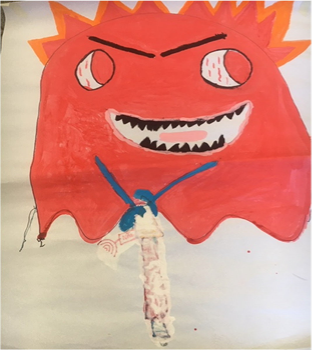
While planning what could be drawn, a different conversation took place. New vocabularies sprouted from a much more collaborative mother-son relationship: “Is it a monster or a ghost? It’s quite big, so it needs a larger paper. It has a skirt, and many teeth in the mouth; the hair is spiked.” Daniel started to see the image of the problem: “Mom, the monster will be red, because red is the color of anger.” The boy, encouraged by the change of direction of the conversation, busied himself in coloring with care and the mother patiently accompanied him in the dance of the brushes. By photographing with paints and brushstrokes, the problem takes on form: “Wow! It’s nice! Mom, you look mean!”


Ghost of Fury

Satisfied with the reproduction, Daniel says: “It is a giant of Fury that torments a lot, attacks the head, and keeps hitting it.” The part of the conversation below illustrates the dialogue that is being woven around the externalized problem (the acronyms T, D, and A, refer respectively to Therapist, Daniel, and Aurora):
 

T: I think he has a jackhammer in his hands and drills holes in your head to get in! (I paint a tool in the hands of the giant). Could we come up with something to let you know when he’s turning on the jackhammer? (I paint a radar that says “No,” when it notices that the giant is approaching).

D: No… it crosses your mind… It’s a ghost.

T: Oh! We are getting to know him better! He looked like a giant, but he’s a ghost!

D: Yeah, he doesn’t drill holes; it goes through the head (erases jackhammer drawing with white paint).  
 

I understand that this attitude of Daniel concerns his authorship, and he gradually builds on his relationship with the problem. It’s like he’s saying, “Hey! This is my problem!” There is a significant change in how he relates to exploring the difficulties that brought him to therapy.

The separation between the person’s identity and that of the problem does not exempt them from facing the damage that this has brought to their lives. According to Michael White, it enables them to assume this responsibility, and, in this way, they are encouraged to establish a more clearly defined relationship, in which a range of alternative possibilities becomes possible. And continuing…

T: And does he take advantage of some “little windows” to get inside your head?

A: I think it’s when he gets jealous of his brother and when we go against him.

An alternative way of talking about the difficulties that permeate family relationships is under construction without, however, pointing out the child’s deficits, and blaming him. Externalizing conversations, by objectifying the problem, offers an antidote to internal and essential understandings of an individual.   

Building an Identity for the Problem

The problem, now named Ghost of Fury, is gradually discovered through a curious investigation where I learn from the clients about their experience. The Ghost of Fury is 1,000 years old and lives in every child’s house for one year. It arrived when the family moved from the city where they lived two years ago, leaving the loving paternal grandparents. He feeds on people’s anger and his favorite food is “rage burger.” He lives in hell and other evil ghosts also live there.

Upon hearing Daniel’s vibrant description, Aurora reported that the parents and children lost their friends. The children separated from their schoolmates, from the playground in the old house, and from the paternal grandparents’ beach house. She says: “Daniel always says it was my fault we moved here. He doesn't like it here.”

D: Yeah, we had to come here because she got a job here…(notices the mother’s tears) Mom, are you crying??!!!!  

T: I think you were all very sad to have moved to another city. Nothing happened as you expected…

A: He says I'm not a good mother, I feel very guilty. I do everything for them, I can hardly even work…

T: Yeah… one of these evil ghosts’ tricks is to make mothers feel guilty. They disrupt the whole family’s life.

D: Not my father’s life! He works and comes home late and just sits on the couch watching TV, right mom? (Aurora laughs).  

Looking for the influence that the problem has on the life of Daniel and his family, I highlight the following excerpt:

T: What does he want for your life?

D: That I become evil? He wants me to be mean!!! (His eyes are wide open, pointed at his mother).

It is important to note here the change in the child’s expression that seems to reflect on the influence the problem has on his life and suddenly discovering his real purpose. And continuing:  

T: And what does he want for your family?

D: He wants us to fight, stay in front of the TV alone, without talking to our mother, without playing… He doesn’t just disturb the family; he also goes to my (maternal) grandparents’ house. The most nervous is my grandfather. He drives my grandfather crazy.

D: Mom, grandpa needs to come here too!  

Michael White says that this type of conversation, through influencing questions, compares to investigative journalism and its first objective is “to develop an exposition of the corruption associated with abuses of power and privileges,” imposed by the problem. Like investigative journalists, therapists are not involved in the domains of problem-solving or engaging in conflict, but, again referring to White, “Rather, their actions usually reflect a relatively ‘cool’ engagement.” In contrast, clients also assume an investigative reporter position, reflect on their experience, and contribute to exposing the character of the problem. They denounce its objectives, purposes, and activities.

This posture reveals the importance of the narrative therapist’s decentered position. It paves the way for the clients to identify and build other plans for their lives, what they value, and contradict the threatening voices of the problem. In other words, externalizing conversations offer a shared island of safety for people to engage in the reauthoring of their lives.

A Story About the Externalized Problem Inspired by the Idea of Poetic Documentation

For White and Epston, the written word is an ideal path for discoveries made during therapy which, like documents, can be evoked, read, and recreated. Written tradition, through “making visible,” highlights extraordinary events, giving prestige to an alternative narrative (9). Still, according to Campillo Rodriguez (1), writing as a therapeutic resource opens up many paths through which people can see themselves through the eyes of the other.

During clinical consultations, therapeutic poems build, in a special way, an opening to new stories, which play with the imagination and give clients the freedom to experience their own images, sensations, and new meanings.

Discussing the usefulness of therapeutic poems in her work, Sanni Paljakka (2) writes:
 

Due to their unusual form (the lack of requirement for the shiny completeness of sentences and ideas in prose text), these poems have opened up a unique way for me to play with ideas. Writing in poetry form allows me to pit the horrors and hauntings of a problem story against a confection of possible counter-story ideas with no regard to orderly sequencing of life experiences or the flow of a therapy conversation.


So, at the opening of the session following the revelation of the Ghost of Fury, I asked Daniel and his mother to sit down comfortably and listen to a text that I wanted to present to them (Although the authors point out that poetic documents should be written exclusively with the words expressed by the client, I took this therapeutic tool as an inspiration, adding a personal way of narrating, to what I preferred to name therapeutic chronicles.):  

It was a problem and it was a gigantic

A giant that was so gigantic, it tormented everyone

It tormented the boy even more
The boy was a child

And he did the worst for the child Just for the kid, he had a jackhammer

He made little holes
In the boy’s head

When he was a child and the boy was a child

Clever
Thoughtful
Observer
And the boy had an artist mother
The child boy had an artist mother!!!
The smart boy and the artist mother took a picture of the giant
Click, Click, Click
Red he was
With funny hair and there was the jackhammer Making holes in the head
And making everyone nervous and quarrelsome and then… Sad
And found out the giant was all Rage Aha!!!
Now we know you!!!

And the smart boy and the artist mother didn’t notice…

The Giant of Rage, that was his name, was very intelligent

In a brush step, zas!!!
Changed to Ghost of Fury
What the hell!!!
Ghosts don't need little holes to get into the heads and families of smart boys and nice moms

Ghosts walk through walls

The smart boy figured out the trick. He found that the ghost goes through his head

And lo and behold! He knows many tricks to do bad things

He is 1,000 years old.  


I recited the chronicle, dramatizing it in such a way that the emphasis fell on the resources and extraordinary events subjugated by the problem (the boy was a child; he was smart, thoughtful and observant; the child had an artist mother; the smart boy and the mother artist took a picture of the giant), as well as the perverse purposes fueled by the problem (the giant that especially affects the boy, who is a child; his evils are preferably directed at him; a very intelligent giant, who magically transforms into a ghost to cross heads). 

As an externalizing conversation, listening to your experiences coming from another person, written in a poetic way, promotes a sense of legitimacy and centers authorship on the person. Afterward, Daniel said he liked it and thought it was funny: “He doesn’t even look that bad!” He still prefers to maintain his version of the problem as a ghost that enters his head without making small holes: “Hey tía, he doesn’t have a jackhammer.” Aurora was touched by the understanding that her son is “just a child” and that, due to so many turbulences in the family, her impatience could be harming him, in addition to expecting him to know how to renounce his place in the family in favor of his younger brother.

It was surprising to her to be perceived as an artist and she reported other craft skills, inherited from her mother. Daniel praised his maternal grandmother’s skills, attentive and creative, and discovered that his mother resembles her. The externalized problem, re-narrated, allowed the emergence of a narrative not subdued by the history of conflicts in the period between the meetings. Aurora says:

A: The giant isn’t showing up much there… he’s only showing up with strength when he’s with his brother. They fight, Leo gets in the way, and Daniel loses his temper (the words giant and ghost will alternate during the course of therapy, as meanings of an entity/problem separate from the child).

T: I think it’s the Giant of Fury’s tricks to keep taking advantage of the fights in your family.

A: He (Daniel) is better than me, calmer than me, he obeys when I speak.  

Despite the influence of the problem having diminished in the family, this meeting addressed many conflicting moments between siblings and between mother and children. Daniel suggests painting the Giant/Ghost again. Very excited, he announces:

D: Now I’m going to do it! It will have two colors. Half angry and half calm.”

The new image of the problem in metamorphosis was made with four hands, and the child tried to reproduce with his own lines the first form almost entirely created by Aurora (the Giant of Fury). This was explored in its finest details within a loving and respectful dialogue, mostly coming from the child. Everyone looked proud at the end.


Ghost of Fury in Transformation

The letters C and A were added to signify the initials for Calm and Angry, English vocabulary learned by the boy at school. Descriptions and facts previously mitigated by the problem populate the conversations, allowing the child to be perceived through his resources (learns another language, likes to paint, collaborates with the mother). Immersed in a dialogical and horizontal relationship, instigated by conversations fueled by painting, I outlined Daniel’s hands on a blank piece of paper, with the letters F (Fury) and C (Calm) to be taken home. They could help them remember that when they manage to stay calm, the Giant weakens.


Drawings of Daniel’s Hands as signalers of emotions in the house

The session that followed this one focused on efforts to distinguish the influences of the Giant/Ghost in the family’s life and the family’s in the Giant's life. The rage attacks are less intense; frustrations are expressed with lamentations. Aurora says:

A: Daniel is more loving, more understanding, helping me to calm down faster. It was a lot of just complaining, now it’s like this, more smiling. Sometimes he is more patient with his brother.

D: I didn’t get angry with Leo crying. I say: ‘Caaaalm down, Leo’.

A: We put the Hands in the room. In a place where everyone can see.

T: If the house is calmer, how is the family?

A: I bought paints, they are painting.

T: It’s a family of artists!  

At this time, they review the contributions of their maternal grandmother, skilled in manual arts. Daniel speaks proudly of his grandmother who draws house plans for engineers. Aurora has the opportunity to reframe her relationship with her parents, with whom she feels hurt by for not receiving the expected support: “My parents are very active, they have a life of their own…”

Daniel is attentive and praises his grandmother’s kindness but claims that his grandfather is very nervous: “The ghost must be living there now.” and continues… “Hey tía, I think next time the Giant of Fury will be all blue!”

From these conversations, another poetic document was presented to them at the next meeting.
It was a giant
Giant?
Not anymore

It wasn’t even a giant. It shrunk

And in its shrinking, OH! Would it also be changing color?
And the giant asked for help

Help! Somebody help me!

I’m shrinking and I’m not even red! Help!
And nobody listens

The artist mother and the smart boy continue their task of transforming him

Now the little giant is red and blue
Half bad, half good. Half angry, Half calm

The smart-mother and the artist-boy continue their work of painting the new little giant red and blue

The Giant of Fury is sneaking out

It no longer fits in that room. It no longer fits in those lives

At the door, already saying goodbye, he looks back and takes with him an image that bothers him. He sees the boy-artist calmly walking around the room, talking to his smart-mother, deciding together on the last brushstrokes.

The image has changed. And the Giant of Fury, sad, decides to leave in search of another place to live.  


“The Fired Ghost of Fury,” Made by an Artist Upon my Request

When presented with the new image, this time taken by me, the mother laughs at the ghost and its “Fired” sign. Daniel says: “Poor guy,” and, “Mom, we’re firing him from home too!”

With a social constructionist sensibility, narrative therapy assumes that the self is relational. Within the plasticity of relationships, we build reciprocal identities, shaped by contextually-situated linguistic descriptions. Thus, Daniel’s interest and initiative, in a safe and inclusive environment, transform him into a boy-artist, now accompanied by a smart mother who, less confused by her feelings of incompetence and guilt, becomes someone who knows how to take action (welcoming, encouraging, believing, hoping). Therefore, the Giant who abandons that relationship is one of misunderstanding, impotence, and pain.

The self-confident artist-boy prepares to paint another ghost: “I do. It will be all blue. Blue is the color of calmness, right mom?” 


Ghost of Calmness

Since we were at that moment on the verge of social isolation due to COVID-19, we suspended face-to-face meetings and sought to build communication via WhatsApp, through messages and audio, since the video camera sessions proved to be unproductive for the participation of the children. Contacts were more frequently aimed at supporting Aurora’s concerns regarding Daniel’s growing lack of interest in online classes. Still, mother and son agreed that the Ghost of Fury was still diminishing. In this period of confinement, the interaction between the two children deteriorated, slipping easily into conflict. I suggested that Brother Leo be invited to participate in a face-to-face meeting, and we all committed to this meeting, respecting the health standards for disease prevention.

The dialogue below illustrates a remarkable moment from this meeting, where many disputes took place, with Daniel asking for his mother’s interference to calm down and hold his brother who “only gets in the way” an

Looking Beyond Trauma: A Neurodivergent Therapist Shifts Her Clinical Focus

As a therapist, I often find myself navigating the complex layers of my clients’ lives, working to untangle the web of trauma and its aftermath. In my years of practice, I have had the privilege of helping many individuals heal from deep traumatic wounds. I never planned on this, but my first job laid it in my lap, and I’ve loved every minute of it since. The hardships that I’ve seen people go through and be able to heal themselves are nothing short of impeccable. It’s almost indescribable. However, one particular case has profoundly impacted my perspective and approach: the story of an 18-year-old biracial male recently diagnosed with Autism, whom I initially treated for PTSD and trauma-related attachment symptoms. I referred him for an ADOS evaluation and looked at the report. I was glad that this assessment lent clarity but frustrated at myself that I didn’t see it sooner.

Like what you are reading? For more stimulating stories, thought-provoking articles and new video announcements, sign up for our monthly newsletter.

Missing the Autism Tree for the Forest of Trauma

Alex came to me with a history marked by significant trauma; he witnessed domestic violence most of his childhood, was abused by a daycare worker, and did not have any relationship with his biological father. His experiences had left him struggling with severe PTSD, anger outbursts, and disengagement from school. He had relational problems with his mother and would not often communicate.

My initial sessions were focused on addressing these urgent, debilitating symptoms — the depression and the outbursts. My training and instincts as a trauma-focused therapist kicked in, and I dedicated myself to creating a safe space for him to process and heal. We did a lot of experiential work, along with play and gaming therapy. We worked on externalizing all that had been internalized — bringing it out and releasing the frustration of not having a relationship with his father, anger towards his mother, anger towards the men who abused her, and fear. We also spent some time deepening the relationships between the sibling and mother.

However, as weeks turned into months, something nagged at the back of my mind. There were aspects of Alex’s behavior that didn’t entirely fit within the framework of PTSD. After moving through the trauma work and no longer meeting criteria for PTSD, he still did not engage in effective two-way communication with me — his answers were often short, and he remained hyper focused on his hobbies.

My focus on his trauma had been so all-encompassing because of my own hyper focusing, that I missed the autism, which in retrospect, had been masked beneath the trauma only to surface afterwards. I saw this a lot in my practice and experienced it myself. And it’s not as if I could have “treated” the autism, but perhaps I could have been more helpful had I helped Alex to better understand himself, and not pathologize himself.

It wasn't until I embarked on my own journey of self-discovery, guided by insights from other autistic providers, that the pieces began to fall into place. I realized that my training and the field’s emphasis on trauma had not adequately prepared me to see neurodivergence, especially in individuals whose trauma symptoms were so pronounced. This is a common question I get from students, “why are we not prepared for neurodivergence?” I have a few theories, but this is just where we are. We need to listen to the autistic and other neurodivergent communities, their narratives, their stories, because our research and clinical training can’t keep up. This realization was both humbling and enlightening.

My work with Alex prompted me to seek further education and collaboration with autistic and neurodivergent colleagues. Their perspectives and experiences have been invaluable in reshaping my approach to therapy. I now understand that trauma can sometimes overshadow neurodivergent traits, making them harder to recognize. This has reinforced the importance of a nuanced, multifaceted approach to therapy. I have read that some do not agree with this concept, but I have seen this over and over in my practice. I’ve also witnessed narratives of where once their ADHD is managed the autism pops its head out, surprise!

In sharing Alex’s story and my journey, I hope to encourage other therapists to broaden their perspectives, as I have mine. I have come to value the necessity of being vigilant and open to the possibility that neurodivergence might be present even in the most trauma-affected clients. By doing so, I believe that I have been able to provide more comprehensive and compassionate care. I have also come to value the importance of ongoing learning and self-reflection — not just for me but for the entire field. Alex’s story is a testament to the importance of this mindset. As a neurodivergent therapist, I hope to continue in my commitment to being informed and adaptive, ensuring that I do not miss the vital aspects of my clients’ identities and experiences. Through this commitment, I can better help my clients to heal and thrive.

Postscript

Once Alex received the autism diagnosis, the mother and I met to review what this all means for her and her almost adult child. We’ve spent a lot of time talking about transitioning into adulthood and the challenges and strengths that Alex has. This diagnosis hopefully opened the door for more supportive services, and it opened up the pathway for the mother to start examining herself in a new light. As she and I talked, she started to look at herself through a neurodivergent lens and her experiences made more sense to her. We also talked about how not knowing has impacted her and Alex’s relationship negatively in the past but now they have a new perspective on things they can connect in a different manner. They have internalized ableism within her parental expectations, which often led to highly intense conflict. But now, they see themselves as a nervous system responding within the context of each other rather than blaming one another. This opened up space for compassion, understanding, and empathy.   

Questions for Reflection and Discussion

How might you have worked with this client?

What are some of the gifts a neurodivergent therapist might bring to therapy?

In what ways might a neurodivergent therapist struggle with particular clients?  

Breaking Down Obsessive-Compulsive Disorder: The Heart of the OCD

The Legacy of OCD

When I was in third grade, I was gripped by the fear that my mother would be killed if I didn’t follow orders. From whom and where these orders were coming wasn’t entirely clear, but I quickly learned to obey. Like the main character, John Nash, in the movie, A Beautiful Mind, I was being watched, and everything I thought was monitored for loyalty to the sinister totalitarian state of which I had now become a new citizen. There was no way out.

Every day at the religious school I attended, it whispered in my ear, “She’ll be dead when you arrive home if you think something bad.”

Living each day with a pure heart became a new curse it threw in my face, a way to trap and punish me in the most painful way imaginable. It would take away the person I loved and needed most in the world: the single mother who protected me and the flame of sensitivity within me which the world seemed all too eager to snuff out.  

When the neighborhood kids dared me to throw away my Winnie the Pooh bear all too soon, I foolishly gave in and was heartbroken. The next night, Paddington Bear in his blue duffle coat and red bucket hat appeared on my bed. When we returned from the movies, my mother asked about the hopes and fears of the characters because she could see it still percolating in me. Like a music conductor, she’d encourage me to allow every section of the orchestra of my mind and heart to play out just a little louder, strengthening a confidence in an invisible capacity I could not yet name.

I adored my mother and knew that without her, my sensitivity would be swept away. So, as Abraham did with God in the story of Sodom and Gomorrah, I negotiated with the amorphous all-powerful entity controlling my fate. If I read every word in the prayer book, it might be appeased. If I had an evil thought, I could cancel it out, and if done right, the entity might be mollified, but in the end, the charges kept returning. No sooner was I absolved of a crime I didn’t know I committed when a new trial restarted. The world was full of impossible binds. Death and doubt resurfaced at every turn.

It wasn’t surprising that I developed OCD. My mother had an identical fear of losing her mother at the same age and struggled with contamination OCD, opening doors with tissues and ever ready with rubbing alcohol. “It’s just my craziness,” she’d confess.

One day, a red futon tied to the roof of our car fell while driving along the highway. Pulling over to the side of the road, 10-year-old me peered into my mother’s eyes expecting to find terror there.  

“This stuff, Michael, the big stuff doesn’t scare me. It’s the little things that get me, remember?”

And with a smile, I helped reattach our precious cargo.

My mother was familiar with living an existence as paper-thin as the tissues she carried with her everywhere to ward off germs. Her parents’ marriage fell apart shortly after their arrival in New York from the Middle East via Panama, when her mom — my grandmother — became the main breadwinner and caretaker of the family of four young children. Sensing her fragility, my mother stepped in to minister to her. A highly educated woman now working behind the counter at a department store to make ends meet, and my mother easily noticed the pain — the unspoken sadness, longing, and fear that others hardly detected. Even my mother’s siblings mistook their mother’s desire to have joyful holiday dinners as just another form of control, instead of what it really was: a cry for help. Please eat and show me, not only that you love me, but that somehow God hasn’t abandoned me like my husband. 

My mother stayed close to home, learning to fear rather than crave independence. Without the freedom to disagree or feel anger, her sensitivity became the emotional suture for a constantly bleeding family. In doing so, she lost much of the thread holding herself together. She doubted her own instincts and confidence, even though she had a sixth sense of empathy few recognized as her hidden superpower. English professors noticed it and called on her regularly for her insights in class, but in the real world, she felt unmoored.

OCD emerged as an expression of how precarious the world felt to her. It offered her a blameless way of seeking the boundaries and guidance she couldn’t ask for directly. When OCD dictates something — when it says, “please tell me everything is going to be okay, please wash your hands, please help me right now!” — it allows for an aggressive urgency that’s otherwise forbidden.  

Sound and Fury

As a psychologist, I’ve treated individuals struggling with OCD since my graduate school days. Then, you could find me on the streets of Manhattan touching tissues to doors and diluting them before doing exposure exercises with clients. You’d find me in the library turning over every stone in my dissertation research on what did and didn’t work for OCD.

These days, I get calls and emails from clients around the world who fail OCD treatment and say they’re not encouraged to talk — even with their own therapists — about the deep feeling and fire they experience within their OCD. To attribute any meaning to OCD, they’ve been taught, is to enable reassurance. To envision OCD as anything other than a bio-behavioral glitch is dangerous and foolish. “It takes seventeen years on average to arrive at appropriate OCD treatment, why would you jeopardize that,” say their therapists. But what if, instead, we listened to what burns so brightly inside OCD?

My perspective on OCD is likely to be dismissed as misguided and anachronistic, even taboo. In the OCD community, talk therapy is believed to be unhelpful at best and regressive at worst. A widely circulating meme in the recovery world echoes the mainstream view, inspired from a passage in Macbeth: OCD is “just sound and fury, signifying nothing.” But what if the meaning at the heart of OCD is there and we’re just not talking about it? What if these clients aren’t failing treatment but treatment is failing them?   

OCD is as much about feeling as it is about thought, as much about meaningful self-expression as distracting noise. Hardwired by nature and stoked by nurture, our brains repeatedly throw an unsolvable dilemma that’s trying to communicate something valuable. OCD is both friend and enemy, but we tend to view it only as an enemy because by the time people get help for it, it’s a five-alarm fire. If you look at it with the right eyes — ones attuned to the sparks of sensitivity within it — you see raw potential in it that’s inspiring, sensible, and bold.

I’ve long been one of the few therapists who espouses this unpopular view. When I questioned CBT orthodoxy in training and experimented with integrating meaning-centered approaches, I was asked to turn in my badge. When I suggested that OCD had an upside in a recent Christmas blog — and foolishly called it a superpower — I was as welcome as the Grinch. Recently, though, I’ve been heartened by two exciting developments: Internal Family Systems as a new OCD treatment and John Green’s book, Turtles All the Way Down, an OCD-inspired story recently made into a movie by the same name.   

Meaning Matters

Internal Family Systems is an evidence-based therapy that helps sufferers befriend their OCD protectors. These parts nurture the sides of the self that have been cut off due to trauma like my mother’s or the intergenerational trauma I inherited. The overactive OCD mind perpetually anticipates dangers and buffers feelings of rejection, hurt, sadness, and terror. If these managers don’t succeed, firefighters take over with compulsions. Running the gamut from checking, washing, counting, or reassurance, compulsions provide visceral instant gratification. They comfort with a cost; repetition is the only way to satisfy, though not for long. Any satisfaction you achieve doesn’t last, and it’s never enough.

My mother’s compulsions to wash her hands were frequently triggered after being recruited into carrying too much of other’s emotional mess. With no relationship to help verbalize her profound empathy and disgust for being placed in such an impossible role, her protectors took over. My own terrors were touched off by the adult world coming for my bear again, only this time it replaced the bear with my mother. I’ve worked with clients whose OCD took away their freedom to sing, to take the subway, or to trust their own goodness. Each of them found unexpected ways to link their OCD to a fuller, more coherent story.

In Green’s book, one of the characters questions a scientist who has given a detailed history of earth and life on it. She insists that the entire world is resting on the back of a giant turtle. When he challenges her about what that turtle is standing on, she replies “it’s on another.” Flummoxed about what that turtle is standing on, she replies, “Sir, you don’t understand. It’s turtles all the way down.” This image doesn’t just capture the repetitive and elusive nature of OCD, it speaks to a hopeful afterimage. What if everything you think of as the random chaos of OCD is held up in more creative ways than you ever imagined?

In recovery from OCD himself, Green crafted Turtles All the Way Down to showcase OCD’s characteristic thought spirals and the methodically masterful ways it wears down its main inhabitants and robs them of their agency. OCD is a nuisance to be rid of, not exalted. As an OCD advocate, Green wants us to feel that. And yet, his characters tell another story, centering OCD around its existential heart, a profound sensitivity hardly ever discussed. 

Teenage protagonist Aza Holmes is haunted by the sudden death of her father from a heart attack and OCD jumps in to protect her — IFS style — from overwhelming fears over the precariousness of life. Is Aza really just a fictional character without any volition of her own? Is the 50 percent of the bacterial microbiome that makes up the human body in true control of her? Aza constantly digs her thumbnail into her middle finger to see if she really exists. But no sooner than she is found, she is lost again, spiraling about the possible infection she’s now unleashed.

Aza’s OCD finds an ingenious way of expressing her existential dilemma. Her scab is a brilliant metaphor of the ever-present wound of her father’s death and all of our deaths. Like my own childhood terrors, the relentless question — to be or not be — constantly buzzes in the OCD sufferer’s ear, a fly always just out of reach. As for Hamlet, a broken heart — not a worried mind — is at the center of OCD. Or as Aza puts it: “When you lose someone, you realize you’ll lose everyone. And once you know, you can never forget it.” A broken heart — not a worried mind — is at the center of OCD.


***

It’s been more than 15 years since my worst nightmare came true and I lost my mother to cancer. And yet, in the aftermath, something shocked me in ways my early fears never prepared me for: instead of falling to pieces, I discovered something new in conversations with my mother in my dreams.

I finally get what you meant that day on the side of the highway. Like those turtles, you were carrying the world on your back. The big stuff. You saw that I could do it too and protected that power every step of the way. You knew how to celebrate it as a gift never to be taken or lost. I realized that gift was life itself, and it was the mysterious heart of OCD. It was holding me up better than any of those turtles ever could, and with it, I could carry everything.

Questions for Thought and Discussion

What methods have you found to be most effective in addressing OCD with your clients?

How have you used metaphors in the treatment of OCD?

What do you find to be the greatest challenge in working with OCD?  

The Healing Power of Therapeutic Presence

I was driving to my therapist’s office and listening to an audiobook when I started to cry. I wasn’t even sure why I was crying. Once in my twenties, I went several years without shedding a tear, but now, in middle age, two years since becoming a therapist, one year since starting psychoanalysis, I was doing this weekly.

Like what you are reading? For more stimulating stories, thought-provoking articles and new video announcements, sign up for our monthly newsletter.

“What were you listening to?” Laura asked once I sat down in her office.

“It’s actually a children’s book. It’s this scene where nobody believes this girl, and she feels all alone. But then her brother,”—and now I felt the tears again welling up—“her brother tells her that he believes her. And she’s not alone anymore. It’s not even a sad scene,” I sniffled. “I don’t know why it gets to me.”

The Power of a Therapist’s Self Awareness

Earlier that week, I had been in my own office, sitting across from my own client. Rachel, a 10-year-old girl, who had started meeting with me to process her father’s alcoholism. She had been vivacious and funny during our first several sessions, causing me to wonder whether she even needed therapy. I kept listening, asking about her father’s drinking but not pushing too hard for her to talk. And then the previous day, seemingly out of the blue, she started recounting some painful memories of her father, one in which he called her mother some horrible names and blamed her for ruining his life.

Rachel had always had a manufactured exterior, a smile usually on her face, but as she shared these memories, I could see tears filling her big blue eyes. “When he blamed your mom for ruining his life,” I said, “I wonder if you thought he was maybe talking about you.” She slowly nodded and then bit her lower lip as though hoping this would stanch her tears.

I felt at that moment inadequate as her therapist. I didn’t know what to say. I wanted to tell her that everything would be okay, but I didn’t know if that was true and didn’t want to lie to her. I tried recalling some clinical vignettes I’d read in different psychotherapy textbooks, trying to remember the life-altering words that those master clinicians had spoken in similar situations. Nothing came to me.   

I realized that I was matching Rachel’s pained expression with one of my own. “It’s good that you’re talking about these things,” I finally said. “I wish that talking would make them better.” She kept looking at me. “But that’s not how it works.” I again tried to imagine what a master clinician would say. My mind again drew a blank.

I suddenly flashed to a time in my early thirties when my paternal grandmother had unexpectedly died. I immediately called my mother, and as soon as I began telling her what had happened, I started to cry. She drove over to my apartment and sat with me for several hours. I don’t remember her saying anything especially profound, but she made me feel less alone, and that was what I most needed.

Now sitting in Laura’s office, having told her about the audiobook, I started to talk about my session with Rachel and my flashback to that day with my mother. “Part of me felt I was giving Rachel what she needed, but another part kept thinking there was something I should be saying to her. I felt like such a failure.”   

I then told Laura that when I’d been listening to the audiobook, she herself had come to mind. “This probably doesn’t make sense, but as I think about it now, it’s like I suddenly realized that you’ve been here all along. It’s like I’ve in some sense, not recognized your full humanness and presence in these sessions. I’ve always respected your skills as a clinician, but I think I’ve seen you as this impersonal instrument or tool that I could use to learn how to gain personal insight.”

The tears were again coming. “But you’re not a tool. You’re a person who listens to me and cares about me. When I’m sad, you feel sad with me. When I’m happy, you’re excited for me. You’ve been here all along, and I think I’ve been afraid to truly acknowledge that.”

Laura and I talked some more, and I eventually thought back to Rachel. There would be times when the words I spoke to her would matter, when I would need to ask the right question or make the right interpretation, but I now saw that I had not failed her during that last session. I had been there with her, allowing her to share her pain and feeling her pain with her. I had given her what my mom had given me that day years earlier and what Laura was now giving me every week. I had given Rachel my full humanness and presence, and that had been what she most needed.   

Effects of Social Media on Child Development: Healthy Strategies

Positive Effects of Social Media on Child Development

As a marriage and family therapist, I have found it essential to recognize the positive — and negative — effects of social media on child development in my therapeutic work with families. Social media platforms offer opportunities for young clients to connect with peers, access educational resources, and explore diverse perspectives. Through online interactions, they can develop social skills, empathy, and cultural understandings, enriching their social development.

Additionally, social media provides a platform for creative expression and self-discovery, allowing them to explore their interests and talents. By engaging with educational content and participating in online communities, children and teens can enhance their knowledge and skills in various areas, fostering intellectual growth and curiosity.

Furthermore, social media can facilitate communication and connection within families, especially in today’s fast-paced world. Platforms such as Facebook and WhatsApp enable families to stay connected, share experiences, and support one another across distances. For families undergoing transitions or facing other challenges that put distance, both physical and emotional, between members social media can serve as a valuable tool for maintaining bonds and strengthening relationships.

By acknowledging these positive aspects of social media, I have successfully incorporated them into my therapeutic work with families, leveraging digital resources to promote healthy development and resilience. Through psychoeducation, communication skills training, and family interventions, I have helped to empower families to harness the benefits of social media while mitigating potential risks.

Here are a few practical strategies I have found to be highly useful:

  • Digital storytelling- encouraging families to use social media platforms as a tool for sharing their stories and experiences. By creating digital narratives, families can express their thoughts, emotions, and challenges in a creative and engaging format. This process can foster self-expression, promote empathy, and strengthen family bonds.
  • Psychoeducational resources- sharing informative articles, videos, and infographics on social media platforms to educate families about child development can provide parenting strategies, and useful mental health guidance and information. Providing accessible and relevant information can empower families to make informed decisions and adopt healthy practices in their daily lives.
  • Online support groups- facilitating virtual support groups or forums on social media platforms can help parents to support their children’s connection with peers, the sharing of experiences, and receipt of support. These online communities provide a safe space for families to discuss challenges, seek advice, and build solidarity in navigating the complexities of parenthood and family life.
  • Collaborative goal-setting- using social media platforms to engage families in collaborative goal-setting exercises and activities can encourage them to set specific, measurable, achievable, relevant, and time-bound (SMART) goals related to their parenting practices, family dynamics, and child development goals. By sharing their progress and achievements on social media, families can celebrate their successes and inspire others to pursue their goals.
  • Digital mindfulness practices- integrating digital mindfulness practices into therapy sessions can help families cultivate awareness and intentionality in their social media usage. Encouraging families to practice digital detoxes is a powerful process that includes setting screen time limits and engaging in activities that promote offline connection and presence. By fostering a mindful approach to social media usage, families can develop healthier relationships with technology and prioritize meaningful interactions with each other.

By incorporating these practical strategies into therapeutic practice, I have helped families to harness the positive potential of social media to support them in productively impacting their child’s or children’s development. Through collaboration, education, and mindful engagement, I have empowered families to navigate the digital landscape with intentionality, resilience, and well-being.

Negative Effects of Social Media on Child Development

While social media offers various benefits, it also presents significant challenges and risks to child development, necessitating careful consideration and intervention in my therapeutic work with families. Research has consistently shown that excessive use of social media is associated with increased rates of anxiety, depression, and low self-esteem among children. The pressure to maintain a curated online persona and the constant comparison with peers can contribute to feelings of inadequacy and insecurity.

Moreover, social media platforms can serve as breeding grounds for cyberbullying and online harassment, posing serious threats to children’s emotional and psychological health. Children may experience harassment, ridicule, or exclusion from their peers, leading to significant distress and trauma. Additionally, exposure to harmful content such as violent imagery, explicit material, and misinformation can negatively influence children’s attitudes, beliefs, and behaviors.

Furthermore, social media can contribute to the erosion of face-to-face interactions and family dynamics within households. Excessive screen time and digital distractions can disrupt communication and bonding among family members, leading to feelings of disconnection and isolation. In some cases, parents may struggle to set boundaries around screen time and monitor their children’s online activities, further exacerbating these issues.

To effectively address these negative effects of social media on their child’s or children’s development, I have implemented targeted strategies and interventions with them. These strategies include:

  • Psychoeducation- providing families with information about the potential risks of social media and how it can impact child development.
  • Communication skills training- helping families develop effective communication strategies for discussing social media use and setting boundaries around screen time.
  • Family interventions- facilitating family sessions to address issues related to social media usage, cyberbullying, and online safety.
  • Collaborative goal-setting- working with families to establish clear goals and guidelines for healthy social media usage within the household.
  • Referral to specialized services- connecting families with additional support resources, such as mental health professionals or digital wellness programs, when necessary.

Strategies for Supporting Healthy Social Media Usage

I have also found it essential to equip myself with practical strategies for supporting healthy social media usage among my clients. These have included:

  • Promoting digital mindfulness practices- integrating digital mindfulness practices into therapy sessions to help families cultivate awareness and intentionality in their social media usage. Teaching mindfulness techniques such as breath awareness, body scans, and mindful scrolling has helped my clients develop a balanced and mindful approach to technology use. By practicing digital mindfulness, they have enhanced their ability to regulate their emotions, manage stress, and maintain healthy boundaries with technology.
  • Encouraging offline activities and face-to-face interactions- emphasizing the importance of offline activities and face-to-face interactions in promoting family bonding and well-being. I typically encourage families to prioritize offline activities such as outdoor play, family meals, and creative projects that foster connection and presence. By balancing screen time with offline experiences, relationships have been strengthened and resilience has been cultivated in the face of digital distractions.
  • Modeling healthy social media usage- leading by example by modeling healthy social media usage in my own professional and personal life. I demonstrate responsible online behavior, such as respectful communication, thoughtful content sharing, and mindful engagement with social media platforms. By modeling healthy habits, I have hoped to inspire families to adopt similar practices and create a positive digital environment within their own households.
  • Providing ongoing support and guidance- offering ongoing support and guidance to families as they navigate the challenges of social media usage. I am available to address concerns, answer questions, and provide resources to help families navigate difficult situations online. By offering personalized support and guidance, I have empowered families to overcome obstacles and thrive in the digital age.

Case Application

Recently, I had the privilege of working with a family who were grappling with the challenges of social media use in their household. James and Keisha, the parents, expressed concerns about their teenage daughter, Jasmine, spending excessive time on TikTok and the toll it was taking on her mental well-being. Jasmine, like many teenagers, was drawn to TikTok for entertainment and connection, but often found herself feeling anxious and inadequate after scrolling through her feed.

During our therapy sessions, we delved into the ways TikTok was shaping Jasmine’s thoughts, emotions, and behaviors. We discussed the importance of digital literacy and critical thinking in evaluating online content, especially on platforms like TikTok where trends and challenges can quickly go viral. Together, we established clear guidelines for healthy TikTok use within the household, including designated screen-free times and open discussions about online experiences.

As part of our therapeutic work, we integrated digital mindfulness practices into our sessions to help Jasmine and her family develop a more mindful approach to TikTok usage. We practiced techniques such as mindful scrolling, deep breathing, and engaging in offline activities to promote presence and connection within the family.

In addition to their digital mindfulness practices, the family began implementing a weekly family game night as a routine offline activity. They set aside one evening each week to gather and play board games, card games, or engage in other fun activities that didn’t involve screens. This allowed them to bond as a family, laugh together, and create cherished memories outside of the digital world.

Over time, I witnessed significant progress within the family as they implemented the strategies and interventions we discussed in therapy. Jasmine became more mindful of her TikTok usage, learning to recognize when she needed to take breaks and engage in offline activities. James and Keisha became more involved in their daughter’s online experiences, providing guidance and support as she navigated the complexities of social media.

During one of our therapy sessions, Jasmine shared a digital story she had created about her journey to finding balance with TikTok. Through a series of videos, photos, and captions, Jasmine expressed her thoughts, emotions, and reflections on her relationship with TikTok and the impact it had on her life. It was a powerful moment of self-expression and growth for Jasmine and her family, as they realized the importance of open communication, empathy, and mindfulness in navigating the challenges of the digital age.

As we concluded our therapy work together, I felt grateful to have had the opportunity to support the Thompson family in their journey towards healthier TikTok usage. Through collaboration, education, and support, we were able to empower them to navigate the digital landscape with confidence, compassion, and resilience. It was a testament to the transformative power of therapy and the positive impact it can have on families in today’s digital world.

***

As a marriage and family therapist, I have found it crucial to advocate for positive digital citizenship and support healthy child development. I have also remained vigilant in educating families about the risks and benefits of social media, while providing them with the tools and resources needed to navigate this complex terrain.

Questions for Thought and Discussion

In what ways do you (or don’t you) resonate with the author’s experiences?

How do you address this issue in your clinical work with teens and families?

Can you think of one particular clinical experience around social media that challenged you?

How to Be Successful in Child Therapy: Lessons From 5 Decades of Practice

The insights I value the most came from direct work with children, adolescents, and families who taught me what is most important and helpful in the work that we do. I learned from children that what is most essential is that we do not give up on them. Embracing unwavering faith in children as they go through the worst times of their lives may prove to be far more important than any technique or intervention we employ.

The Importance of Therapeutic Presence with Children

Repeatedly, my former child clients tell me this when they come back to visit 10, 20, or even 30 years later as they establish themselves in their adult lives. Surprising to me is the fact that at the time I was seeing these former child or adolescent clients, I did not feel that I was particularly helpful. The crises that brought them to therapy were so intense that I was unable to appreciate the power of therapeutic presence and commitment.

One of the most important insights that emerged from my private supervision with the late Walter Bonime, MD, senior training psychoanalyst, has helped sustain me during the most challenging moments of my 55-year career as a clinical psychologist working with children and families. Dr. Bonime taught me that no matter how frustrated, discouraged, angry, hopeless, or impotent the therapist may feel, it cannot begin to match the depth of the same feelings in the child.

Children taught me that sometimes “more is less.” In certain moments what is most important is that we be a caring presence, a trusted witness. The temptation is for therapists to shower intense moments with words that can diminish the transformative potential of a deep encounter with a child.

I’ve met many a “fawn in gorilla suit” during my career. The analogy suggests that the “fawn” as the core self is highly vulnerable — has been hurt too many times! The aggression (putting on the gorilla suit) is intended to protect that vulnerable fawn by keeping people at a safe distance. Yet, the longing for connection burns deeply within.

Another important understanding gained from the decades of work with children is that whenever a youth says, “I don’t care!” we should assume they once cared a lot, but it simply hurts too much, it is too great a risk to care anymore.

I’ve always told my interns and young clinicians, “when you don’t know what else to do, just treat children and families with profound respect and dignity.” They are surprised how far that goes.

Children carry within them powerful narratives that all too often no one takes the time to elicit or hear. The youth, as much as they might avoid it, long to unburden.

The therapist’s willingness to risk themselves in the therapy encounter, and sometimes be wrong, is a “gift” to children by creating a safer context for the child to express what is difficult to put into words.

An 8-year-old boy asked me to explain the initials after my name. This led the boy to say, “Well, you don’t look that smart!” I told him my family tells me the same thing. It reminded me of how important a sense of humility is in working with children. To connect with children, we must be willing to look like fools sometimes. Otherwise, we are no fun at all. Children will only feel free to talk when they feel free to not talk.

Our goal is to honor strengths without trivializing suffering. This is a delicate operation. The work we do is rewarding. We get paid in the currency of the heart. Some of the moments we share with children and families are precious and priceless. But our work is hard. There is an undeniable emotional toll exacted from caring for children with deeply wounded spirits.

Can we hear the hard stories without the hardening of our heart? To do so requires diligent and disciplined efforts to take adequate care of the instrument of healing — our self. As much attention in our field has been paid to the importance of self-care, each child therapist will need to reflect and honestly assess to what degree it is a priority. If we short-change ourselves, it is likely that we are also stiffing our families, and perhaps the children and families we treat as well.

[Editor’s Note: David and I are colleagues and friends, and we are honored to offer his reflection here, which is not about “what to do” with children and teens in therapy, but, “how to be.”]

Questions for Thought and Discussion 

  • In what ways is the author’s orientation to child therapy Similar to your own?
  • What have you found to be the most effective ways to intervene with children and teens?
  • What have you found to be some of the greatest challenges in working with young clients?