The Challenge of Therapy During War: Psychotherapy in Ukraine

The Emotional Ravages of War

The ongoing crisis in Ukraine has placed immense psychological strain on its population, creating a heightened need for mental health support amidst war, displacement, and uncertainty. Therapists working in Ukraine face unique challenges requiring resilience, adaptability, and innovative approaches. The war has caused massive, widespread trauma with millions displaced and exposed to violence. Therapists working either face-to-face or remotely with their clients encounter acute and chronic PTSD symptoms, anxiety, depression, and grief due to loss of loved ones, homes, and stability. There is also considerable intergenerational trauma in families with histories of oppression.

While Ukrainians have a history of resilience, the impact of intergenerational trauma and mental health stigma persists. Many of my clients attempt to minimize emotional distress or express it through physical symptoms. They have historically hesitated in seeking help, viewing it as a sign of weakness. However, online therapeutic platforms like Soul Space, the one through which I work, offer easily accessible and safe resources for support and self-help tools that empower these individuals.

The Challenge of Therapy During War

Therapists, such as myself, often face secondary traumatic stress (STS) from absorbing clients’ pain, leading to symptoms similar to PTSD. High caseloads also contribute to burnout and emotional exhaustion. Therapists often work with limited supervision, professional development opportunities, or access to private therapy spaces. Displaced populations pose additional logistical challenges to on-ground clinicians. Balancing professional neutrality with personal feelings about the war, while addressing clients’ immediate needs and maintaining a therapeutic frame, are frequent concerns that challenge clinicians under these circumstances.

While teletherapy has been invaluable to Ukraninans under seige, and has allowed me to support more clients than had I been on the ground, power outages, poor internet connections, and client inexperience with technology often impede its effectiveness. It has also been critical for me to prioritize self-care, emotional hygiene, peer support groups, and supervision to process my own emotional experiences as I serve those devastated by the war. I have also found it useful to limit daily trauma-focused sessions to prevent emotional fatigue. Techniques like grounding and meditation have helped me to maintain strength and clinical endurance.

I have learned to respect clients’ cultural coping mechanisms in order to build trust and support empowerment, resilience, and self-efficacy. I have relied on trauma-informed approaches that begin with safety and stabilization techniques such as grounding exercises and psychoeducation about trauma, while also processing with practical problem-solving to meet clients’ immediate needs. Soul Space provides psychoeducational workshops to maximize reach, provide structured, and self-guided mental health resources.

Case Example

A displaced family of four sought therapy after relocating from a war-affected region. The parents reported anxiety, irritability, and hypervigilance; while the children displayed regressive behaviors and nightmares. My approach required the establishment of safety and routine in therapy, psychoeducation to normalize trauma responses, and activities that built resilience and mutual support. Nighttime relaxation rituals helped the family with wartime-related sleeplessness, while gradually igniting bonds of trust and security due to invasive interruptions of regular routines. The parents practiced simple grounding techniques to contend with their own anxieties.

The parents learned about trauma responses in adults and children, and were increasingly able to reframe the children’s behaviors as survival mechanisms instead of simply seeing them as defiance. Several grounding exercises were also introduced to the children utilizing sensory modalities by asking them to say five things they see, hear, or touch when feeling overwhelmed.

To strengthen family bonds, I introduced therapeutic play and storytelling to allow the children to articulate issues of fear in a safe and imaginative way. The parents were given the chance to have planned conversations to foster emotional conversations and model healthy expressions for fear and grief. We also created a “Family Strengths Tree” where they could record examples of salvaged resilience to remind themselves of their survival capacities.

The family finally began processing their experiences. The children created a storybook representing their journey, necessitating a shift in the focus from fear to resilience. The parents explored their guilt and grief using cognitive processing techniques, reframing self-blame into self-compassion. Throughout the intervention with this family, and as with other wartime displaced clients, I integrated formal online training available through Soul Space with my direct face-to-face work.

During our work together, the family experienced reduced anxiety, improved communication, and renewed hope. The mother’s panic attacks became less frequent, and the father started to emotionally reconnect with his children. The daughter began socializing again, and the son had a drastic decrease in nightmares and bedwetting. Coping mechanisms and family bonds improved. Working with this family, as with others, I have come to rely upon additional training courses in trauma-informed interventions, networking, and the importance of adapting my therapeutic techniques to meet the realities of life in conflict zones, including shorter sessions or combining therapy with referral for humanitarian aid.

Questions for Thought and Discussion

Whether or not you’ve worked with clients in war-torn areas, how do you resonate with the author’s sentiments?

Which of the challenges raised by the author are similar or different from those you have experienced with traumatized clients?

What are some of the core techniques that you have found successful in working with traumatized clients?

The Pros and Cons of Remote Therapy: A Clinician’s Dilemma

The classic image of a therapy session is a therapist, a patient, perhaps on a couch, in a small room with a box of tissues between them. But COVID-19 changed all of that. Now, more often, therapists and patients are on screens, each logging on from different locations. As COVID-19 restrictions ease in medical environments, it is time to ask if therapists and their patients need to be in the same room for therapy to be beneficial? 

Like what you are reading? For more stimulating stories, thought-provoking articles and new video announcements, sign up for our monthly newsletter.

Changing Perspectives on Teletherapy

Prior to the pandemic, the thought of working remotely never occurred to me. Even if remote work had occurred to me, the fact that insurance only reimbursed for in-person sessions would have provided a significant deterrent. Four years later, I find myself of two minds when it comes to evaluating the pros and cons of remote therapy — for patients as well as for myself.

Rather than just relying on my personal feelings, I did some research into the effectiveness of remote versus in person therapy. To my surprise, I learned that patients prefer remote sessions more than therapists. As one patient said when I asked her why she prefers remote versus in-person sessions, she commented, “It’s like the difference between TV and live theater. TV is available when I want it, and live theater takes more effort — you have to get the tickets, find parking, etc.” 

I appreciated the many benefits of being back in my office but most of my patients chose to stay remote. The convenience outweighed their desire to travel to my office, and they felt no discernible difference in the quality of the work. This created a dilemma for me as I weighed the cost of leasing my office and the ease of working from home against my personal preference for in-person sessions. Recently I made the difficult decision not to renew my office lease for financial reasons. Adapting to remote therapy has meant changing some aspects of how I practice.

In my mind, the greatest deficit of remote therapy is the lack of a physical presence in a shared space. When I was able to watch my patients walk from the waiting room into my office, I noticed how they carried themselves, their attire, and the mood they exuded. No longer having that opportunity online, I learned to be more specific in my questions about how people were feeling, and I look more closely for changes in appearance. Still, the intimacy of a therapy session cannot be replicated on a screen. Watching someone cry is not the same as being in the presence of someone crying. Nonetheless, I have found, to my surprise, some patients prefer sessions to be less intimate and find it easier to open up as a result. This may mean that the availability of remote therapy is capturing a new clientele for therapy.

But some patients are acutely aware of being alone, and thus find it harder to allow themselves to fully express their emotions during a remote session. I miss mirroring someone’s breath and using my steady gaze to offer comfort in person. Instead of being able to offer a tissue, I now wait as they go off-screen to retrieve one. I literally try to lean into my screen to provide a perception of being closer.

Being apart means many patients struggle to find a safe and private space like my office. Often patients are surrounded by distractions from their home, office, car, or wherever they are having their session. They find it is more difficult to shut out the world when we are not together in my office with cell phones off. Encouraging patients to make the effort to create a private space is part of the work of doing remote therapy.

Furthermore, patients tend to squeeze sessions in between other commitments, diluting the work. No longer having to take the time to get to my office, patients fail to prepare for their sessions or give themselves time to think about the session afterward. I encourage patients to build a buffer into their schedules, but realistically it rarely happens. I am guilty of this too; when I turn off my computer, I am home and no longer have my commute to process the day before resuming my personal life. I have changed my routines, so I have a clearer boundary between being at work and being at home.

Embracing the Future of Teletherapy

Despite these limitations there are important advantages to offering therapy remotely. The most significant gain from the availability of remote therapy is improved access to therapy for more people. Insurance coverage changed during the pandemic to include online sessions, which improved the possibility of finding a therapist. Initially this change suspended the need for the patient and therapist to be in the same state, furthering the potential pool of therapists. (That requirement has since been reinstated.) Finally, patients living in rural areas could find a therapist and have choices similar to those available to people in urban areas. Unfortunately, during the pandemic, demand was so high many people still suffered due to long wait lists. But over time, there is the opportunity for greater access and equity.  

In my own practice, during the pandemic I began work with a woman in her early 80s with physical limitations who could not access my office. The opportunity to meet with me over Zoom made it possible for her to do some significant grief work after losing her husband to COVID-19. Increased access to psychotherapy for a broader clientele is a plus for everyone.

Continuity of care can also improve when weather or travel are no longer impediments to having a session. Prior to remote work, patients had to cancel sessions when they traveled for business or had to attend to a sick child at home. I have found the ability to offer remote sessions particularly helpful with the new mothers in my practice who were experiencing or at risk for postpartum depression.

Some therapists have required patients to come back in person, while others, like me, have gone fully remote. Increasingly, therapists are working for companies which only provide remote sessions; they never establish an office. It behooves graduate school programs to adapt to this reality in their training of new therapists. It is also important that as a profession we do not create a two-tiered system, preferencing one form of delivery over another based solely on personal opinion.

As we live more of our lives online, the limitations of screens may not be felt as acutely by either therapist or patient going forward. New modalities of therapy may even emerge from this change in venue. But it is critical that the effectiveness and limitations of remote versus in-person therapy be studied. For example, people with social anxiety may request remote sessions when in fact in-person work would be more beneficial. When screening new patients, I take into account why they express a willingness/desire to be remote.

The key to a good therapy relationship has always been about fit. This equation used to be construed as the fit between the therapist and patient, but now perhaps we need to expand that idea to the room(s) where it happens. 

How to Use Structured Writing to Help Clients Unclutter

The clock struck three and Mary was calling me on Zoom. Before I could say “Hi,” she was reading from a crumpled paper held in clenched fists. This was her weekly list of the topics that she wanted to bring to therapy. Her timing gained momentum until her words reached a breakneck pace. It seemed that I was witnessing a contest. Mary was like a game show contestant, reaching for the top prize that came with climbing to the top of her list of priorities.

Mary: The Gravitational Pull of Lifelong Habits

I waited until Mary finished reading, and then after taking a few deep breaths, began the arduous task of adding some modicum of structure to her list — rating the topics, determining their priority, and then talking out the prioritized topics in a bit more detail than she originally planned. Mary dutifully and enthusiastically jotted down notes corresponding to the topic at hand.

While rapport came easy with Mary and our conversations typically flowed, a seemingly interminable pause — you know, those that are unique to online therapy — Mary proclaimed, “I know, I know. I’m not ready to give up being the rescuer.”

“You think?!”

Before continuing, she gave me her usual comedic smirk and said, “But this is all real. I have a vitamin company that I’m running solo because…Um, well. It just happened. Sort of. Slowly.”

Knowing the answer, I asked in jest if Mary was still office manager at the commercial real estate company where she began working 15 years ago. Mary nodded. We turned back to her list. There were a few items that Mary also described as having “just happened.” These included volunteering to cook Thanksgiving dinner for her husband’s family and letting her sister-in-law stay with them for a long visit with an end date that was “to be determined.”  

Prior to that session, Mary had been angry that her daughter had forgotten to place an order for groceries, making it necessary for Mary to stop and bring home dinner for the family on a very cold night after leaving the office. Initially, Mary regarded her anger as a simple and logical reaction to her daughter’s forgetfulness, but because there was already a template in place from an earlier clustering of items on her list, she finally seemed ready to identify another significant pattern of behavior she very much wanted to address, and hopefully change.

“My mother was always angry. She was the Lone Ranger, always putting out fires that we all set. My siblings and father, that is; not me! I did what I was supposed to. At some point, I became everyone’s helper. I guess I learned to do this when my mother became depressed.”

We eventually got to a point in Mary’s processing where she saw that there was a historical satisfaction she received from maintaining order by handling everything around her, instead of accepting the risks that came with engaging, or directly asking for the help of others. When others failed, as they invariably did, Mary felt anger. It wasn’t anger; however, at the perpetrator, but at herself because of her intractable belief that she had to then pick up the slack and failed to do so — and instead, outsourced. This rescue theme permeated all facets of her life.

Mary was circling items on her list that felt optional when she put her face in her hands. After some minimal silence, Mary described how she felt the first time she noticed her mother’s depression. “The sadder she looked, the busier I became. The busier I became, the less my brothers and father were doing. No chores or help around the house in any way.”

Through writing lists and seeing reality in print, right in front of her, Mary was able to appreciate the wide scope of her expectations of herself, and her role in continuing to be the rescuer to prevent the potential for disappointment from others.

Terry: Therapeutic Lessons in Self-Advocacy through Writing

Terry, aged 35, presented in a very warm wool blazer over a buttoned-up Oxford shirt that looked uncomfortable. His mannerisms seemed almost choregraphed corporate professional in such a way that made me think that he was working too hard at appearing polished. I believed that still waters ran deep with Terry, but I delayed my full impressions.

“I just can’t take my life anymore! Oh, no, not like that. I mean, I’m fine. Well, no, thanks to them, I am not fine. Or thanks to me, maybe. I could just leave, but then they need me, and I’m committed to seeing these changes through. I made a commitment. And I need the money. This is a huge opportunity. And, at the same time, this is no way to run a company and no way to treat a human being.”

Terry paused, looking at me almost apologetically. Wanting to normalize his expressive shouting, I nodded as if we were already in a working alliance and immediately went into establishing the presenting problem, before moving carefully into recent history. Terry’s upbringing seemed complex, and his expanded HR role at work which included dispute resolutions and public relations, seemed to mirror those early-life experiences.  

In describing his days, Terry painted a picture that felt very much like a Pollock painting — taking meetings, picking up prescriptions for his uncle, being too tired to enjoy a weekend party, listening to a manipulative employee with a treacherous track record fabricate a story about discrimination, and finally, feeling financially burdened, depressed, alone, and coping with “a heart that feels like it’s doing summersaults inside my chest.”

As he frenetically laid out the complex intertwining of work and family-of-origin demands, once again, I had trouble catching my breath. Like a sports referee, I motioned for time-out, nodding slightly to offer Terry assurance that I wanted to understand everything, and to do so, I needed separation and space between each different subject. Granted, that’s not the effect that Pollock was aiming for, nor would we want to break down and bring order to his works, as chaos seemed to be the goal. But I explained to Terry that while the head-spinning menagerie of topics he was tossing onto the canvas of our session gave us a lot to work with, it would otherwise be helpful if we could indeed structure his topics and disassemble the inner chaos.

I’ve found that one of the many ironies in therapy is that the more issues are linked together, the more important it is to first separate them out. I’ve had good clinical luck by establishing traction with one issue at a time, usually the most current “hot topic.” The high voltage of that topic usually complicates and obscures other issues, regardless of when they arose in the client’s life. Without separating, wires cross, and I have frequently sat in an electrical storm of past and current issues as they collided in a dazzling and confusing Pollock-ian explosion.

Terry’s past did clearly contain some currency. He described being alone most of the time as a child, until his parents rented their basement apartment to his aunt and uncle. His uncle became his mentor. Terry emulated his uncle and grew up having two role models — his father and his uncle. Terry empathically described the contrast between his parents’ old fashioned work ethic of long hours and constant worry about the business, and his uncle’s more creative and impulsive risk taking. His uncle had a wild ride of achieving financial success after living for a time in the basement apartment, moving out and buying an enormous house on a fancy street in Brooklyn, only to lose everything 10 years later and wind up back in the basement, divorced, and working for Terry’s brother.   

Terry’s formative years were spent being caught in a tug-of-war between his father and his uncle. His father wanted to hand the restaurant over to his son and his uncle wanted Terry to go to college. Terry did both, but through the years, he became the go-between for the two men. Unconsciously, he feared rejection from his father and carried this with a constant state of nervous energy and anxiety attacks, somatic digestive symptoms, and an obsessive monitoring of his health. His present work environment had some shared features of his family of origin homelife and ongoing sense of family-based obligations.

Terry was getting visibly angry within three minutes of our second session. He wanted to alleviate the sting from his recent reprimand at work, yet at the same time, he knew that he was in the right, and that his supervisor’s issues of paperwork falling through the cracks was 90 percent due to lack of administrative support and maybe 10 percent human error. Terry needed to fight back with professional decorum, but first, he needed to calm down. My suggestion was to disentangle the different items and then respond to each one — to himself — on paper, as preparation for communicating with his supervisor.  

At first, Terry was irked, reluctantly pulling his laptop open and making a few nominal clicks. As we talked and Terry clicked, we created separate headings for each action item that was part of his entire merging of multiple job receptibilities. This master list with heading included multiple separate jobs that he had been unofficially asked to cover, without any new prospects for hire. Terry was pleased, and I was proud of him. As he gained clarity in the organization of his responsibilities, he also increased his personal conviction — his inner authority. Eventually, through his writing, Terry became fully prepared to meet with his supervisor. The meeting was without the previous subject of Terry being a remedial employee and failing to live up to expectations. Rather, this meeting was direct, goal-oriented, and successful.

The Positive Impact of Therapeutic Writing

In my experience with clients like Mary and Terry, I’ve found that when a client states facts on paper, they are also asserting the following:

1. They have the authority to interpret and define the facts
2. This authority is not subject to permission or approval from another
3. They have custody over the facts, as they are
4. They have the right to communicate these facts to another person, and doing so is not a betrayal or violation

Writing as a means of expressing feelings is well known, but the use of technical, terse writing can also be a valuable therapeutic tool. The tracking done in REBT and CBT therapy fits with clients when they are at a point of delving into activating events, beliefs, and consequences, but so often they also want to fully describe all the different scenarios they live out week to week. They want to take their therapist through a deep dive into the details of what transpired. This can often result in a confusion of ideas, goals, and plans, much like Mary and Terry initially experienced.

Technical writing can also be an effective means of helping a client work through the struggles of day-to-day life, including communication with others. Writing between sessions gives a client the opportunity for greater insight while deciding in advance of session time what is important to focus on. Sometimes, clients uncover a theme for the week as a direct result of writing. Whether a laundry list format or paragraphs, writing can fit easily within sessions on an impromptu basis. While the undesired feelings (dissatisfaction, grief or anger, or irritating tasks such as administrative responsibilities) do not get resolved through pen to paper or typing in a device, there is clarity through organization. This is similar to how balancing books doesn't make the red go to black, but often results in a feeling of ease.

Getting Organized: The Pre-Therapy Phase

After getting a baseline history and general understanding of the client’s concerns, there is a pre-therapy phase, akin to treatment planning. This phase begins by sifting through past and present to hit on the main problem of this moment. What is being experienced now that is problematic? Why is this problematic? What are the consequences? Is any of this problem optional? Could there be any benefits — even the kind of benefits that have more consequences later, such as avoidance? At about this point, I ask my clients to write down the words “Secondary Gains.” Some immediately Google it and some tell me the definition, as if on cue.

Once the main problem is identified, then the work of uncovering the various aspects within the problem becomes the next step. Technical writing is an ideal tool for this phase and can be a useful complement for therapy throughout the process.

The Top Card

My clients are accustomed to me saying that there is only one card at the top of each deck. Before selecting the top problem, it often helps to sort out problems into two basic categories.

In therapy, a problem is not always a separate entity, such as struggling with a recent promotion at work or difficulty adjusting to a new city. Rather, problems are sometimes complex and long standing, such as pervasive anxiety or depression or life patterns stemming from a background of trauma.

Often this pattern results in multiple struggles, where each struggle may seem like an independent problem, but each problem is part of a cluster of circumstances spurred on by the damaging pattern. In session, we take a sheet of paper and draw a line down the center. At the top of the page, we write a title on each side. On the left side is Problem Group A — Discrete Problems, and on the right side is Problem Group B — Overarching Patterns.

Problem Group A, for example, may be difficulty accepting a recent job loss, and Problem Group B typically shows up as a cluster of events or consequences linked to a combination of undesired habits, such as isolation, anxiety, and an endless state of resentment.

Problems from either category require teasing out and separating the different aspects. Aspects often include finding meaning in the problem and uncovering the types of environments and circumstances when the problem feels more present. There is often overlap between the discrete situation problems and the overarching pattern problems. But, even with this overlap, there is ultimately one card at the top of the deck and one situation or state of mind to home in on before delving into the others.

While this strategy may seem formulaic and concrete, I have found it very useful for clients like Mary and Terry, as they have tried, and successfully disentangled, prioritized, and addressed the problems that have plagued them. Doing so has also helped me to breathe a bit easier with clients who might otherwise pull me in the Pollock-like paintings of their lives. 

Virtual Treatment of Eating Disorders and the Importance of Human Connection

Be the person you needed when you were younger

-Ayesha Siddiqi

The Virtual World

I could never comprehend the idea of virtual eating disorder treatment. It would be so easy for clients to hide their food or engage in disordered behaviors behind a screen. How could I really connect? Especially with my young clients, I imagine them secretly watching Netflix behind the computer screen while I try and explore their deepest fears.

Cut to Covid! The world shut down, and my ideas on virtual treatment shifted as this became the new reality for all therapists. I have always worked with eating-disordered clients in one way or another since before I even completed graduate school. After working with eating disorders in community mental health, I started to burn out with the lack of support and knowledge in the field. As a recovered clinician, eating disorders are my passion and the reason I became a therapist. This is the population I want to work with, but this is also the most complex population which requires a complete treatment team and effective provider collaboration.

For my professional sanity — and to continue this career without burning out — I needed to shift gears and investigate a more supportive environment in which to treat eating disorders. The thing is: I live in a place where you must travel at least an hour to get to any eating disorder treatment center, which would mean I would have to travel at least an hour to work at one. While I was offered a position at one of these centers, I saw myself continuing the burn out with the commute and two young children at home.

As fate would have it, the treatment center connected me with their virtual eating disorder partial hospitalization program, which, as it just so happened, was hiring. I was still very hesitant but wanted to keep my mind open. I’d been through many treatment centers as a young teen — I know ALL the tricks. How could I help anyone, virtually? It was during my interview process that I came to the realization that there are many places where treatment is unavailable. What if this is the only treatment available to some individuals due to lack of transportation, living distances, or family circumstances? Would it have helped me as a teen if it were my only option? I must give this a shot. I must explore how I can best support this population virtually, because this is the only thing available to some individuals.

So, I made my decision to hop on the virtual train. It took some adjusting, soundproofing, and office plants to make the switch manageable — at least on my end.

The Young Anorexic Client

The sound machine is roaring.

Two boxes appear on my screen.

One screen showing my face, the other showing that of a new, adolescent client.

She is starting our program today after being discharged from a residential treatment center. I am meeting with her to introduce myself and complete a risk assessment. She admits that she is not thrilled to be on virtual, but that there are no other options near her. Her parents and treatment team are forcing her to complete this program. She admits to knowing that she needs it, and she is a minor, so her parents have leverage. She presents guarded, as teens usually do, waiting to see if I pass the obligatory therapist “vibe check.” I appreciate the honesty but notice the apathy in her voice. This is going to be a difficult client to connect with. I must learn how to connect with her.

Finding Connection

If I’ve learned anything about the virtual world, it is the importance of finding the ability to connect. Yes, it is more difficult virtually than when you are in person, but still doable. In fact, some people open up more through a virtual encounter because they feel safety in distance. New research has shown that the brain neuropathways activate more with in-person interactions. Which means I have to be more creative about forging a meaningful connection. (1)

Because the individual on the other side of the screen can’t get a sense of my “vibe,” and because a digital image of myself elicits different responses from neuropathways, I must rely on building rapport quickly.

I’ve learned the hard way, through moments of uncomfortable silence, that this sometimes requires talking about random teen trivia to get young clients to feel safe with me. My clients are experts in their life. I am merely a guest. The more my clients let me into their world, the more I can show them tools that will appropriately work for them. I have to meet my clients where they are at.

I find the best way to build trust is to find out their interests and build on that. That doesn’t mean I just pretend that I want to know about their interests. I mean taking the time to learn about them and ask deep questions. This helps me understand my clients and what treatment approach works best for them. My job is not to heal my clients. My job is to help them learn the tools to heal themselves.

Only with trust can a client effectively “buy-in” to what I am talking about regarding treatment. Why would anyone talk to me if I don’t feel safe? Building connections and creating a therapeutic alliance is about helping clients understand that you are a safe person.

Young teens are my favorite clients to work with. The most important part of effectively working with teens is to teach them to build connections that are stronger and safer than their eating disorder. The first safe connection might be with their therapist. The eating disorder is my client’s safest and most secure relationship. Which is why it is so difficult to recover from — it works.

The eating disorder becomes an entity of its own that protects the clients from trauma, rejection, fear, and most importantly has the capacity to numb. For clients with significant trauma or poor attachments, the predictability of this disorder is comforting. Ironically, it is providing them a mental refuge while slowly killing them. Accepting and understanding that the eating disorder has served a function for my clients is the most important starting point towards genuine connection. The eating disorder is my client’s biggest and most secure connection.

The Young Adolescent Client

The session starts the same.

Two screens.

Sound machine whirring.

I will call this client Abby.

Abby is hunched down on the floor with her laptop facing her. She is anxious and having difficulty sitting still as evidenced by a bouncing leg. This is not her first time in treatment. She has already told me she does not prefer virtual but has no other options at this time. By this point in our sessions together, we have discussed the usual eating disorder behaviors and worked on increasing Abby’s ability to talk back to the eating disorder voice. The ability to assist her in calling out the eating disorder is crucial. That means knowing how the eating disorder talks. Hint: it’s sneaky and insidious.

Since working together, what stands out about Abby is her increasing discomfort with the present moment. It is more than the eating disorder; I know the look of unresolved trauma. Abby is living in fight or flight. Her eating disorder being taken from her is forcing her to confront difficult traumatic experiences.

Abby started Cognitive Processing Therapy while in residential care but stopped it when the therapist realized she was not benefiting from the therapeutic intervention. So, what can I do here now virtually?

New research has shown that treating PTSD and the eating disorder at the same time yields better results for both. (2, 3) This is contrary to what was first taught to professionals about only treating one at a time.

I worked with Abby for some time, but Abby’s mother’s insurance eventually changed, and her parents no longer wanted her to participate in our program for understandable financial reasons (This is another aspect of eating disorder treatment that is complicated).

Abby will need long term therapeutic intervention for her complex trauma and the increasing severity of the eating disorder. Her motivation for recovery continues to wax and wane.

Let me explain what we were able to do virtually and how.

My work with Abby explored relationship patterns, boundaries, and the impact her trauma has had on her eating disorder relapse and recovery process. Abby learned evidence based therapeutic interventions to effectively talk back to cognitive distortions and her eating disorder voice.

And while all of this work was pivotal, I want to emphasize what got us there…

Soccer!

I know you are thinking. What is she talking about?

Hear me out. Gaining trust from my adolescent clients must come first.

The connection I made with Abby was as simple as soccer. Soccer was Abby’s motivation for recovery, soccer made her feel confident and alive. Soccer activated neuropathways in Abby that allowed her to feel seen by me.

All of the in-depth work that needed to be done started and ended with soccer. Ultimately all of the work that was done on a virtual platform started and ended with my ability to see my client and connect. In the end, my initial reluctance about working virtually with eating-disordered teens was largely unfounded. I would likely have encountered similar challenges had I worked face-to-face with Abby. It was the connection that built the bridge and soccer that reinforced it.

References

(1) Neuroscience News. (2023). Zoom conversations vs in-person: Brain activity tells a different tale. Neuroscience News, 27 Oct.

(2) Perlman, M. D. (2023). Concurrent treatment of eating disorders and PTSD leads to long-term recovery.” Psychiatric Times, Times, 17 Oct.

(3) Brewerton, Timothy. D. (2007). Eating disorders, trauma, and comorbidity: Focus on PTSD. The Journal of Treatment & Prevention. 15(4). 285-304.

Do Clients Really Read Session Notes? The Truth Might Surprise You

“I’m old school, my job is to focus on what my client brings to me,” said my friend and colleague Joan, a social worker of over 35 years.

Having worked for decades in the public school system with some of the most challenging clients, many of whom were entangled in the state’s labyrinthine bureaucracy, Joan was familiar with the multiple levels and layers of accountability, and the importance of writing notes and sharing records. She also knew that there would always be eyes watching — eyes without faces, and faces without names, all looking to make sure that her T’s were crossed and her I's dotted.

Like what you are reading? For more stimulating stories, thought-provoking articles and new video announcements, sign up for our monthly newsletter.

Joan also appreciated the necessity of assigning an accurate diagnosis, and that doing so in a clinically and ethically correct manner meant taking time to get to know the client, their personal challenges, and their system of support. But Joan had also always believed that “my notes have never been problem-oriented,” and that “I want my notes to be about more than a diagnosis; something that actually helps my client.” Joan made it her policy to not be the one to initiate conversations with her clients about diagnostic impressions or diagnoses, current or past. For her, a diagnostic note was a clinical tool, much like mental status data, clinical impressions, or assessment results — and not within her clinical province to “bring up.” Doing so, she believed, would invariably shift the focus from what the client needed to what she needed to do as part of her job.

Discussing Diagnoses and Clinical Notes with Clients

So, it came as a resounding shock to Joan — now a teletherapist — when, at the start of their second online session together, her client proclaimed, “I read the document about my diagnosis of ‘adjustment disorder with mixed emotional features’ and it was right on!” Joan recalled thinking, “what the hell?!” She vaguely recalled the contract she signed with the teletherapy company specifying that clients could review their notes at any time. But after reviewing the contract following the revelation by her client, she could not find anything that specified the mechanism through which clients were alerted to the location of their notes on the platform, or whether they received some kind of alert when a new note was uploaded by the therapist, or if the actual diagnosis was available to them. She added, “Had I known that the company was sending an alert of some sort, especially about the notes from the initial session with the diagnosis I was mandated to provide for insurance purposes, I would have introduced and explained the process and my diagnosis with the client.” It was soon after that Joan wondered if her previous one-session-only clients never made it back for a second visit because they received her notes from that first meeting with a diagnosis or diagnostic impression that didn’t sit well with them.

It’s not that Joan was worried about how her notes — which were written in SOAP form — or even her diagnostic impression would be received, but that for those clients who read their notes and never addressed them in session, her observations and diagnosis would be the elephant in the room, and perhaps her responsibility to address if the client did not.

For Joan, it was always important that her clients “have someone who likes them, someone who finds them interesting, someone who can look beyond a diagnosis, someone who is willing to see their daily struggles and who could see them as a human being either caught in a moment of distress or battling demons that left them feeling ‘less than, unlikeable, unliked.’” She was concerned that by turning the conversation to one of diagnosis and notes that she would “no longer be talking with them, but about them.”

Toward the end of our conversation, I asked Joan how this scenario might impact her work with clients moving forward, particularly around discussions around notes and diagnoses. She reiterated that, “I am old school…I simply don’t want, nor do I feel it is important to ‘bring it up’ with clients.” But she added that she would give it some thought.

***

Joan later recalled a client with whom she worked for only one session and gave a diagnosis that included anxiety and depression. That client, through some mechanism unknown to her, then saw a psychiatrist who worked for the same teletherapy company as Joan did. She found out that the client had been subsequently diagnosed her with borderline personality disorder and prescribed medication after one visit.

Joan promised me that she would share her impressions of that scenario in a later conversation.

Current Developments in Clinical Suicidology and Mental Health Crisis Management

* If you or someone you know is struggling or in crisis, help is available. Call or text 988 or chat 988lifeline.org. Text MHA to 741741 to connect with a trained Crisis Counselor from Crisis Text Line. 

There are significant developments in the world, the United States, and our field in recent years that are significantly impacting contemporary clinical suicide prevention. The Covid-19 worldwide pandemic, the launch of the 3-digit 988 Suicide and Crisis Line in the U.S., and recent SAMHSA and Centers for Disease Control data are all examples of major forces that are fundamentally transforming the field of clinical suicidology. Many of these contemporary developments are spawning necessary and overdue changes and adaptations as to how mental health providers can more effectively work with suicidal risk. And to this end, I will explore these major developments and their impact on clinical suicidology.

Telehealth Care and Suicidal Risk

An impressive development in response to the coronavirus outbreak was the remarkably rapid embrace of telehealth to deliver mental health care. As the worldwide pandemic spread rapidly in early 2020 there was an initial hesitation of widespread use of telehealth with people who were suicidal. Indeed, there were certain large healthcare systems who moved, suspended, and even discontinued screening for suicidal risk with patients online because of a flawed presumption that one can only work with a person who is suicidal face-to-face. In other words, if you cannot tackle the patient at risk who is fleeing your office to take their life it is better not to ask! In response to this naive notion, certain leaders in the field of suicide prevention made significant efforts to identify key adaptations to working with suicide risk remotely. These adaptations mostly involve using informed consent carefully, identifying third parties who could intervene in case of an acute emergency, and anticipating issues such as a poor Wi-Fi connection and what to do in such an event (e.g., having a phone number to call if online connectivity is an issue).

Like what you are reading? For more stimulating stories, thought-provoking articles and new video announcements, sign up for our monthly newsletter.

As we were all collectively compelled to learn to provide care online perforce, many unexpected developments followed. For example, telehealth now offers a genuine opportunity to democratize the delivery of care to rural, frontier, and potentially more diverse populations. Another development in psychology was the advent of PSYPAC which enables providers to increase clinical care across state lines. Another notable Covid-based development was the common practice of instructing people who are acutely suicidal to go to their nearest emergency department for care.

With emergency departments brimming with coronavirus patients, such a recommendation became ethically and clinically dubious. Common reliance on inpatient care similarly posed the increased risk of patients contracting Covid during the pandemic's height. As the developer of the Collaborative Assessment and Management of Suicidality (CAMS), I have long been a vocal advocate of keeping patients who are at risk of suicide out of hospital emergency departments and inpatient care (if at all possible) by providing proven suicide-focused care supported by randomized controlled trials (RCTs). In response to the early stages of the pandemic, our training company CAMS-care converted the training and delivery of CAMS to online modalities (including the use of CAMS in three RCTs). We soon discovered that both training and clinical care can be effectively rendered online, and this development is helping to transform clinical care for those at risk for suicide.

The 988 Suicide and Crisis Line

In July of 2022, a major federal law was put into effect that is profoundly transforming how we must think about suicide risk and mental health crises. The “National Suicide Hotline Improvement Act of 2018” is one of the most significant legislative developments in the history of U.S. mental health care. Suddenly, we have an easy-to-remember 3-digit number that connects callers who are suicidal or otherwise in a mental health crisis to crisis professionals who are ready and able to effectively deal with them. With the knowledge that the pre-existing Lifeline was already having capacity issues, millions of dollars were subsequently allocated to help better support the new 988 mental health crisis line.

While all of this is very encouraging, the launch of 988 has created some growing pains and posed various challenges to policymakers, systems of care, and clinical providers. For example, how well do Americans know the difference between calling 911 and 988? There is a need to educate the public as to how to re-think emergencies that would have previously prompted calls to 911. There are significant issues related to “wellness checks” or “safety checks” that are primarily conducted by law enforcement officers who may have limited to no training as to how to deal effectively with mental health care crisis. For a person of color, having a police officer show up uninvited to protect you from yourself has inherent issues. 988 also brings a major focus to our existing healthcare model that is overly reliant on emergency departments and inpatient hospitalizations that too often may not be altogether therapeutic.

Fortunately, alternative models of crisis response are emerging. For example, “The Hope Institute” in Perrysburg, Ohio, provides intensive outpatient suicide-focused care using next day appointments (NDAs) wherein either CAMS or Dialectical Behavior Therapy (or both) can be provided up to four times a week to help stabilize a person who is suicidal as they await weeks — sometimes months — `to engage in available outpatient care. Within this model, adults are stabilized in six weeks while youth at risk are stabilized in just over five weeks. This is but one promising model that is re-imagining working with suicidal crises. Other promising approaches include mobile crisis response, respite care, retreat centers, certain crises-oriented technologies, and extensive use of peer support which can help reshape crisis responses.

Recent Trends in Suicide-Related Data

Over the last several years there have been notable developments in suicide-related phenomena. While we were initially encouraged when suicide rates declined a bit in 2019 and 2020, this decline was erased by an increase in 2021 (the most recent data reported by CDC). And with Covid-19 becoming a leading killer, suicide is no longer a top ten leading cause of death with 48,183 lives lost to suicide in 2021. But what has preoccupied my attention has been steady increases in the number of Americans who report having “serious thoughts of suicide” within 30 days of a survey completed by SAMHSA. Indeed, in 2021 this amounted to 12,300,000 adults and another 3,300,000 teens, altogether a whopping 15,600,000 Americans with serious suicidal thoughts! This number is over 300 times greater than the number who died by suicide in 2021.

While we grieve the loss of Americans to suicide, I would argue that we must do a much better job of identifying, assessing, and treating millions of those who suffer such that they seriously consider suicide. In truth, the suicide problem we have in the U.S. is a suicidal ideation problem — by a lot. It therefore behooves all mental health professionals to learn proven interventions like Dialectical Behavior Therapy (DBT), suicide focused cognitive behavioral therapy (CT-SP and BCBT), CAMS, or Attachment-Based Family Therapy (ABFT) to name a few of the rigorously proven interventions for suicide risk. Moreover, there have been other demographic developments of note. As suicide rates among white males have decreased, we have seen in recent CDC data that suicide ideation and behavior is on the increase among young people, particularly those of color. We certainly know the pandemic has been tough on all of us with clear increases in depression, anxiety, substance abuse, and suicidal ideation.

***

Given these recent developments in our world, I would assert that it is critical for mental health providers to become a part of the solution to suicidal suffering. We are uniquely positioned to make a life-saving difference and help decrease suicide-related suffering by keeping abreast of major developments in the field and learning to use evidence-based approaches to suicidal risk.

Questions for Thought and Discussion

In what ways did this article impact you personally and professionally?

How have you modified your own approach to suicidality in recent years?

How have you collaborated with colleagues in and around the mental health community to improve your services to suicidal clients?  

Thomas Insel on Science, Zip Code, and Future-Proofing Psychotherapy

Return on Investment

Lawrence Rubin: Hello, Dr. Insel; it’s an honor to be with you, the former director of NIMH, the leading federal agency on research into mental health and illness and author of the recently-published Healing: Our Path from Mental Illness to Mental Health. It’s a rare opportunity for our readers, largely practicing nonmedical therapists, to gain a glimpse into some of the critical issues impacting the assessment and treatment of those with behavioral and mental health challenges. Thank you so much for joining us.
Thomas Insel: It’s a pleasure to be here, and I’m glad that we’ll have a chance to talk about some of the nonmedical aspects of mental health care, which have not received enough attention.
LR: Why do you think that’s the case?
TI:
we have bought into a medical model for how we think about mental disorders broadly
There are two parts to that. I think the first part is that we have bought into a medical model for how we think about mental disorders broadly. And the second part is that the medical model is part of a large healthcare industry, at least in the United States. I don’t know if this is true in other places, but in the United States, healthcare is a massive business, a $3.5 trillion business.

A lot of that business is driven by a particular model which says that illness is due to a singular, often simple cause, whether that’s a bug or a gene or a particular endocrine factor, and that the solution is a relatively simple intervention, often a drug. And that has proven to be really a good business model for the pharmaceutical industry and, to some extent, the medical industry, which has done pretty well over the last four or five decades.

And I must say that for a lot of people with medical problems, this has worked pretty well. I think if you had gotten HIV in the 90s, you certainly were better off than if you got it in the 80s. And if you have cardiovascular disease today, you’re certainly much better off than you would have been 30 years ago. And that’s true now, fortunately, for some forms of cancer as well, where we’re seeing remarkable progress with new diagnostics and new treatments.

the simple bug-simple drug model that has been so effective in the world of infectious disease is really not so effective for the millions of people who have a mental disorder
I just don’t see the same sort of breakthroughs and the same opportunities yet for people who have PTSD, depression, OCD, a range of mental disorders. It feels to me like that medical model has helped some but not enough in the mental health field. Part of why I wrote the book was to try to understand why we haven’t made more progress. And part of that “why” goes right to that issue that the simple bug-simple drug model that has been so effective in the world of infectious disease is really not so effective for the millions of people who have a mental disorder.

A Crisis of Care

LR: You began your time at NIMH shortly after the end of the decade of the brain, when so much research funding was going into genomics and neuroscience. Do you think that we got the bang for our therapeutic buck under your stewardship there?
TI: In some ways! It’s a mixed bag. I think that we learned an enormous amount, but I would say that it’s still very much in process. I don’t think we’ve fully gotten the return on the investment. I think we will, and that science is going to be really critical for us in trying to go deeper into understanding these disorders.

The problem for me was that—and this is just a personal reflection and is not in any way an indictment of the NIMH—but when I look at this state of care and what’s happening for most people, particularly those with severe mental illness, with schizophrenia, bipolar illness, severe depression, severe PTSD, it’s not a scientific problem these people face.

They face incarceration. They face homelessness. They face this massive injustice in a kind of crisis-driven system that actually leads them out of the care system and into these other pathways that are often deadly and certainly unfair, generally punitive, and not compassionate. So, that’s not a NIMH problem.

what we are seeing is this egregious set of policies that lead to people with mental illness going everywhere except into compassionate care because there’s no capacity for that
For me, so much of the sorts of public health problems that we’re facing aren’t really about genes or neuroimaging or the science. It’s more of an almost, and I loath to use the term, but really a social justice issue. And what we are seeing is this egregious set of policies that lead to people with mental illness going everywhere except into compassionate care because there’s no capacity for that.

So it actually had nothing to do with NIMH. I left NIMH and kind of never went back because if you want to address those issues, you’ve got to go someplace else with a very different army. And it’s not the army of neuroscientists and those who are brilliant in the fields of genomics and data sciences. It’s an army that is really willing to take on those big social problems and begin to deal with them.

And I think we know what to do. I think we know how to do that, and that’s beginning to happen. But my goodness, it’s not going to happen through NIMH funding. It’s just not their job. That’s something very different from the world that they’re focused on.
LR: Is that why you said in your book that “there’s a crisis of care for the mentally ill in this country?”
TI: That’s right. A crisis of care. It’s not really a crisis of science. It’s not because we don’t have good research or that we’re not spending the research dollars correctly. I argue, actually, that we probably need more research, more science, more funding for NIMH.

You know, we always need better treatments; we always need new diagnostics. But let’s get real here. We haven’t been implementing the things that we discovered 30 years ago. NIMH spent a huge amount of money in the 80s and 90s on the Nurse Home Visitation Program. I write about this a lot in my book because I think it was just a brilliant investment.

But it’s not a research question anymore. We don’t need to put a lot more NIMH dollars into that. We need to implement this for millions and millions of families who are disadvantaged and who need that kind of support, because we know it works.

At some point, you have to try to solve the problem and not just study it
I don’t want to see us get caught up in this academic cycle of “let’s keep studying this problem.” At some point, you have to try to solve the problem and not just study it, and that was what led me moving from this kind of research career to a career that was much more about advocacy, policy change, about making sure that we were starting to invest in the kinds of services and broad social supports that we need and sadly lack in this country.
LR: Is that related in part to what you also said in the book that for therapists, whether researchers or applied clinicians, that zip code is more important than genetic code?
TI: Yeah, exactly. I think where I ended up, and it’s so interesting when you write a book like this; you think you know what you’re doing, but you have no idea. You usually end up someplace very far away from where you started, and that was exactly the case here.

I started this book when I was working at Google, where I was trying to develop really interesting ways of digital phenotyping. I was convinced that technology was really going to transform mental health care, and I still think that’s probably true. But I ended the book by realizing that the problems that we’re focusing on are really problems of mental health. That’s very different from mental health care. And I have to say, I don’t think I understood that.

When I started the book, every conversation I had about health or mental health was about health care or mental health care. And it wasn’t until I was two-thirds of the way through this, and in this odyssey that I took around the state of California to try to understand why we hadn’t seen more improvements in public health measures like morbidity and mortality, that I began to realize, like, wait a minute, this is not a health care problem.

All this stuff, incarceration, homelessness, poverty, health disparities, is happening way outside of healthcare. It’s actually something very different. We could probably fix healthcare. We could probably do so much better on health care, but barely move the needle for morbidity and mortality.

most of the disparity in race- and gender-based mortality in this instance is really about your zip code
As an example, I was just looking at this over the weekend: the chances of turning 70 years old or living to 70 in terms of life expectancy are at about 82% for White females and about 54% for Black males in the United States. That 82% to 54% disparity is not really a function of what medications they’re on or how many clinic visits they have, or even what health insurance they have. That contributes a little bit, we think it accounts for maybe 10% or 20% of that disparity. But most of the disparity in race- and gender-based mortality in this instance is really about your zip code. It’s about your lifestyle, your exposure, your environment. It’s about a lot of other stuff that’s not really in the healthcare system.

I guess the really hard question to ask, and the one that I’ve been thinking a lot about lately since the book came out is, do we need to rethink what we mean by health care? And specifically, do we need to rethink what we mean by mental health care? Is it really just about medication and psychological treatments and maybe some rehabilitative care? Or is there something more essential that has to do with recovery, has to do with thriving, has to do with wellness? Does that need to come into focus, and does that need to be within the scope of what we mean by healthcare?

Making Psychotherapy Better

LR: Within this context of health care, certain models of psychotherapy have been proven empirically to be effective. So why is there such a disparity between what we know and what we do?
TI: I struggled with that in the book. I start from a perspective that psychotherapy is a really powerful intervention and that we have specific, skill-based therapies that have been demonstrated to work. I also understand that outcomes may depend more on the therapist and the therapy, and that’s always a challenge in any kind of randomized clinical trial that one does on these interventions. But the evidence is pretty compelling for both the safety and ultimately the effectiveness, which is quite different from the efficacy of psychotherapy.

we need to look closely at the training of psychotherapists, how we do it, where we do it, and also when we do it
So the question is, with a treatment that’s so powerful, why have we seen this gap, and why has it become so difficult to actually get it delivered in the way that it should be? I think there are a couple of things. One is, we need to look closely at the training of psychotherapists, how we do it, where we do it, and also when we do it. We’ve had this notion that you train, and then you have supervision for a period after graduate school, and then you’re kind of on your own until your next licensure comes up.

I think we want to look more carefully at how we make sure people get the kinds of skills and the feedback to get better and better. I’ve been fascinated by a company with which I have no connection but am really intrigued by, called IESO. It’s not in the United States, it’s just in the UK, but they’ve really focused on, how do we help our therapists who are online to get better and better?

They’ve built this natural language processing engine so that every interaction between therapist and client is captured. It goes through this engine, and they have a dashboard that shows them levels of therapeutic rapport, levels of effectiveness of their comments, and also the state of play for the client; better, worse, what’s the emotional tone in the interaction? It’s really fascinating to watch.

But what’s amazing about it is that by getting this kind of real-time feedback, therapists have gotten better and better. And when you look at outcomes, they went from 49% recovery to 67% recovery just by providing this real-time feedback, not just to patients and clients, but to therapists themselves. It was actually more useful for the therapist than the client. But ultimately, the clients enjoyed that impact.

So I think part of what we need to do is to think about how we help our therapists to navigate and to improve what they do. The other part is we have to ask, what do we pay for? Are we paying for a number of hours spent, or are we paying for outcomes? Basically, are providers being rewarded for how long somebody stays in treatment, or for getting people out of treatment and getting them well? We need to begin to look at the incentives that are built into the system and ask, are we incentivizing for the right things?
LR: Does this IESO program also include biological markers embedded in the therapist/client interaction, like heart rate, blood pressure, and brain wave activities, to get a complete picture of the reciprocal impact of the interaction? Or is it a glorified electronic satisfaction survey?
TI: No, it’s neither. There’s nothing biological here. It’s really taking language and decoding it. If you think about what we do in psychotherapy, it’s listening, it’s observing, it’s communicating. And through that, we hope that there’s understanding and trust and change ultimately through the relationship.

That process of using language to communicate is a process which has really been revolutionized by artificial intelligence and very good data science through this thing called natural language processing, which was created to try to understand how words got glued together and what coherence looks like in language.

But over time, it’s been used to measure sentiment, like mood, and is now being used to measure how well people are connecting and if they’re communicating effectively. This is a multi-billion dollar industry that’s been taken over largely from the call centers. Call centers are now far better than they were five years ago because of the ability in real-time to decode the communication between two people.

Let’s provide objective evidence about how a therapist and client are communicating and relating and actually literally measure things like trust and measure therapeutic alliance
What IESO has done is to take that same kind of effort and said, “Let’s provide objective evidence about how a therapist and client are communicating and relating and actually literally measure things like trust and measure therapeutic alliance.” And they found ways to define that, which I think are really interesting.

It may not be for everybody, but it is fascinating to me that by capturing that kind of data objectively, they have been able to provide a source of feedback that actually helps people do what they’re trying to do, which is create trust, create the therapeutic alliance, build that rapport. Who would have thought that you would actually do that through technology?

And yet, they’ve demonstrated that this can work without any burden on either the provider or the client. It doesn’t take any extra time. It’s kind of like the speedometer in your car, you know, it’s a part of the dashboard, it tells you as you go how fast you’re going and how you’re driving.
LR: There is extensive research on what we call common factors in therapy, those aspects of the therapeutic relationship that contribute to a positive outcome. This process that you’re talking about sounds like it’s algorithmically mediated. Rather than just asking the client, was trust built or how safe did you feel or how effective do you think your therapist was, you’re interjecting elements of AI into it to give more specific data beyond just the self-report of the client.
TI:  It is. I guess I would just push back with the word “just,” because I think we need both. We need both that subjective experience, like, how was this for you? And then, you know, the objective readout of what does the algorithm say? And it may be in the gap between those two that there’s a lot we can learn.

There’s this really interesting new science that is just beginning to shine a light on our behavior, and particularly on our language in a way that I think will revolutionize psychotherapy
There’s this really interesting new science that is just beginning to shine a light on our behavior, and particularly on our language in a way that I think will revolutionize psychotherapy; it will revolutionize the study of mood, behavior, and cognition. I really think we’re just beginning to see that happen.

One kind of untapped example of this, which I’ve been so intrigued by but haven’t yet seen really developed, is that you can use this natural language processing approach to measure the coherence of speech, because every two words have a vector that attaches them. So if I use the word “dog,” it’s not unlikely that the word “bone,” or the word “cat,” or the word “food” would come up in the same phrase, right?

But the word “algorithm” or the word “church” may not be as easily associated as that. And so by measuring what we call semantic coherence, the likelihood that words could come together or maybe wouldn’t be found together, you get a sense of how people are thinking and how things get put together. In contrast, great poetry often has longer vectors, less coherence.

But as people become psychotic, for example, this is a very sensitive way of picking up thought disorder. And you could say, “Well, yeah, but you could just listen to them and know that’s happening.” Maybe, but how helpful would it be to be able to say, “Well, their coherence moved from 0.6 to 0.74.” Or to be able to provide a tool so that a nurse in an emergency room in a rural community, who really isn’t trained to do a lot of the assessment of thought disorder, would be able to say, “Well, according to this tool, this person’s semantic coherence is about 0.68.”

In understanding thought disorder and psychosis, for example, it provides an objectivity that we’ve come to expect for assessing diabetes or hypertension. It gives us a number which is reproducible and which ties back to something that’s truly actionable because based on that number, you might decide “this person is, in fact, currently psychotic and needs to be treated along this pathway,” versus “this person is a very good poet who tends to put ideas together that are very creative and that are different, but this is not necessarily pathological.” So I think we’re at the beginning of a revolution in our ability to add objective measures to what we are currently and have traditionally done just subjectively.
LR: I can see how that can really be useful in working with people with serious mental illness, like schizophrenia and other disorders with psychotic features. But what about with what we might call more garden variety emotional, mental, or behavioral problems, or even subclinical presentations, where the person is not going to necessarily come to the attention of an emergency room clinician or an algorithm?
TI: Actually, the subjective experience may be what really counts or is far more important. But that’s why I brought up the IESO example, because I think there is an opportunity for technology to improve the quality of what we provide in the psychotherapeutic relationship.

there is an opportunity for technology to improve the quality of what we provide in the psychotherapeutic relationship
It may turn out that we don’t need that. But I think the data would suggest that there’s room for improvement. And, to be fair, there are people who are just naturally gifted as clinicians and who just have the ability to do this without a huge amount of training and without needing many years of experience and probably won’t need that kind of a tool.

But there are a lot of us whom I think would benefit from getting that continual feedback in a way that’s passive and ecological, because it’s done within the hour. It’s not, you know, in a supervisory hour. And it gives you a sense of something that is probably fundamental to the treatment process, which is the development of a therapeutic alliance.

People, Place, & Purpose

LR: This focus on strengthening the therapeutic alliance sounds fascinating and important, but I wonder how, in the shadow of the expanding medicalization of mental disorders, these two pathways can work in parallel. Can they coexist?
TI: I think that’s a really key question, and it’s one that I also struggled with in working on the book. I’ve spent four decades making the argument that these emotional and behavioral problems are medical problems. And I ended up in the book saying, yeah, these are medical problems, these are brain problems, and they deserve the same reimbursement, the same rigor, the same science that we would expect for any other medical problem.

But the solutions are much broader and much different. The solutions are relational, they’re environmental, they’re political. We have to really widen the lens here if we want to begin to have the impact that I think all of us care about, particularly at a population level, and the medical model just isn’t really built for that.

the recovery model, to me, is really defined by these three P’s that I talk a lot about in the book: people, place, and purpose
I talk a lot in the book about—and to be fair, you’re right, this is more about serious mental illness—but I talk a lot about recovery. And I have to say, I was not the person pushing the recovery model. I sort of see there’s a medical model and a more recovery relational model. I think we need them both, but the recovery model, to me, is really defined by these three P’s that I talk a lot about in the book: people, place, and purpose.

If we really want to think beyond just symptom relief and we want to see people thrive, we want to see them recover, we want to see them have a life, then we have to be thinking about more than the medical model. We have to be thinking about, how does someone with a mental illness have a shot at getting the things that all of us want? Social support—that’s the people, a safe environment—that’s the place, and a purpose—a reason to recover, something that they wake up for, something that they see as a mission.

We don’t do that in the medical model. That is not what we mean by mental health care in 2022. And what I’m arguing for in the book and in trying to start this kind of new social movement around mental health is that we just take on a broader perspective that says, actually, we should reframe what we mean by care, and the care should include the three P’s, that providers ought to be able to write a prescription for housing, and we ought to expect Medicaid to pay for a clubhouse which provides the three P’s every day for people with serious mental illness.

We need to think about how we get beyond this simple idea that there’s a magic bullet intervention
We need to think about how we get beyond this simple idea that there’s a magic bullet intervention, that if we get just the right pill to just the right molecular target in just the right patient, we’ll solve this problem, because that’s probably not ultimately the way we solve this problem. It’s going to be actually from multiplexing the problem or thinking about people, place, and purpose and providing a much broader range of care, not a more narrow focus on medication.

Best of Both Worlds

LR: So the medical model doesn’t necessarily, in your thinking, preclude interventions that are social and even moral. You can spend money doing research on biomedical markers and the neuroscientific basis of mental disorders, but you can’t let that steer the car to treatment necessarily. Because if you don’t provide people with these three P’s, then it doesn’t matter what part of their brain or what part of their genome has been somehow disrupted. It won’t matter.
TI: I guess the argument is we need both. I think about psychotherapy as learning to play the violin. You’re learning a skill. It takes time, it takes practice, and it often usually takes a really good teacher. But that’s really hard to do if you have a bad tremor. So, I’d start by treating the tremor so somebody has a decent opportunity to be able to actually learn how to play the violin, but I wouldn’t stop with treating the tremor. I think that is a part of it. You need both, and you need to be able to do both over a long period of time.

our field has been, unfortunately, very fragmented between medical approaches and psychological approaches
And I guess what I feel really strongly about is two things. One is that our field has been, unfortunately, very fragmented between medical approaches and psychological approaches. The science says that the two of them together are better than either one alone. And yet in practice, we rarely see them combined in a way that’s most effective for patients or clients. I think that’s something we need to fix.

But the second part of that is, we often don’t pay for this in a way that it merits. There’s a tendency, I think, by both public and private payers to undervalue the treatments. It often is easier to pay for the medication because, by the way, they’re almost all generic, super cheap, it’s easy to write a prescription, and payers are very comfortable with that. It’s harder to require the combination and to be able to pay for the combination.

It’s so funny, I was just in a conversation about the use of psychedelics. And if there’s one area today where everybody is thinking, “Oh, this is the new…” you know, it’s very hyped. “This is the new magic bullet,” that psychedelics are really going to matter. Again, it’s just one more pill that you can take, and you’ll be able to play the violin.

And yet, what’s so interesting is when you talk to people in that space, they talk about psychedelic-assisted psychotherapy. It’s so refreshing. It’s the first time in 40 years I’ve heard people committed to combining medical and psychological approaches in a way that’s really thoughtful and potentially very impactful. It’s such a paradox, with all the hype around taking the magic pill. That is actually the place where we may find and understand the importance of combining the two therapies.
LR: You said in your book that the term “psychotherapy” is a misnomer.
TI:
the process of change is also a process of neuroplasticity
I don’t remember saying that, but one of the things that I tried to convey in the book is that the process of change is also a process of neuroplasticity. And the idea that there are medical treatments that affect the brain, and then there’s psychotherapy that affects behavior, is really probably grossly simplifying. It’s very likely that the change that occurs with medical treatments partly relates to opening people up to behaving in different ways and exposing them in new ways.
LR: Which changes the brain.
TI: Which changes the brain. And likewise, that going at this from a psychological perspective also changes the way people think, changes the way they behave, which also changes the brain.

behavior and the brain are inextricably linked together in ways that we can’t often see, but we have to accept
To go back to my violin analogy, when you learn to play the violin, you wire your temporal cortex. There’s no way around that. We have to begin to think a little more mechanistically about what actually happens with behavior change and to realize that behavior and the brain are inextricably linked together in ways that we can’t often see, but we have to accept.
LR: So when we consider both the biomedical bases for and psychosocial treatment of mental illness, the brain inevitably changes, hopefully for the better, which then starts the cycle all over again. Complex, yet simple at the same time.
TI: I like that idea, Lawrence. We have to get out of our sort of tribal approach to this. It’s so frustrating, and I kind of understand it, you know, it’s where people come from, it’s their identity, but what if we flip the narrative and say, “What’s most helpful?” What actually helps a 14-year-old with anxiety or a 24-year-old with psychosis? It’s not about our role. It’s not about our skill set, necessarily. I mean, we have to think much more broadly about putting all of the tools in the toolkit together in a way that serves that person in a way they will want and accept it.

Only about 50% of people who should be in care or could be in care and would benefit are actually buying what we sell
We haven’t been very good at that. I mean, even the very fact that we built a care system that’s really built for payers, to some extent, for providers, but not for the consumer. And it’s one of the reasons why I think we get very low engagement. Only about 50% of people who should be in care or could be in care and would benefit are actually buying what we sell.

Bridging the Divide

I think the next decade is an opportunity to say, “Can we meet them where they are?” Particularly for young people. They’re not likely to show up at a brick-and-mortar office. They are likely to be on TikTok or Discord, or now maybe even Twitch. I mean, there are lots of places where you find them. Is there a way to meet them there? Should we rethink the mental health care that we want to deliver so that it’s much more person-centered, more culturally sensitive and adapted, and begin to understand that what we’ve been doing hasn’t really worked for a lot of what we had hoped it would? Yeah, we have great treatments, we have great skills, we have something that really is useful, but it’s not getting the people in the way they want it. Particularly, I would say, for communities of color, LGBTQ communities, I mean, there are just lots of people who feel on the outside and who see mental health care as we built it as not friendly and not matched to what they’re looking for.

This is a place where I think technology can make a big difference. It can help us to democratize care and give people choices that they haven’t had, particularly people who are in rural areas and underserved communities. People who feel that, for whatever reason, they’re part of a small niche in society that’s been underserved. I think now is the time we can say, can we create a different platform, meet people where they are in the ways that they would want to be engaged, and give them something useful?

I guess in some ways, helping people with mental illness is a little bit like what we learned with COVID, where there was this gap between creating vaccines and delivering vaccinations
I guess in some ways, helping people with mental illness is a little bit like what we learned with COVID, where there was this gap between creating vaccines and delivering vaccinations. I think NIMH and others have done a spectacular job of creating the equivalent of vaccines for psychological treatments, for medical treatments, and for people who struggle with emotional and psychological issues. We haven’t been so good at delivering the vaccination part, actually delivering these in a way that people want them and can use them and can benefit. I think that is the challenge for the next decade.
LR: Some psychotherapists work in private practices while others work in community mental health centers. How can psychotherapists, irrespective of where they’re delivering service, be part of this movement you envision over the next decade?
TI:  I think it’s already happening. In my career, I’ve never seen the kinds of transformations we’re now witnessing—and I don’t think that’s too strong of a word, it really is a transformation of this workforce and care system. You have the aggregation of large numbers of private practice psychotherapists into these massive groups, and there are companies that have gotten very wealthy through doing this. Lifestance and Uplift Health are doing a piece of this in several states. It’s very interesting. It’s changing the culture of how people practice. It ultimately will provide them with resources, as they get in group practices that will make their jobs in some ways more effective and hopefully easier.

You also have the advent of teletherapy on a big scale. Last year $5.1 billion was being invested in mental health startups. How amazing is that? You’ve got hundreds of new companies starting off. Eight of them are already unicorns, meaning they’re valued at over $1 billion. You have a company that I find really interesting, Cerebral, that’s a little more than two years old. It started at the beginning of the pandemic. It’s arguably one of the largest mental health care providers in the United States today. They have many, many thousands of providers. They talk about having served 350,000 clients in the last two years.

So, we’re going through this massive change. I don’t know where it’s going to end up, but I would imagine many of the people who are listening, who are in private practice, are thinking about, should I (and maybe they already do) work for Talkspace or Cerebral or Lyra or Ginger or Modern or Better Help. I mean, there’s so many of them that are hiring. In a way, it’s sort of an invitation to a new economy, a gig economy, just like we saw for Uber. People are having opportunities. They have a lot more possibilities of what they can do and how they can spend their time and work.

I don’t know how this is going to end up, but I guess the question I’m asking myself, again, going back to what does this mean for the 14-year-old with anxiety or the 24-year-old—
LR: The kid of color who’s struggling with sexual or gender identity issues, or the suicidal Native American. We have to reach them.
TI: So, are they better off or worse off at the end of this? Or is there no change? I do know that there are now startups that are just for African American male therapists so that African American male clients who are looking for that can find it.

this whole transformation of mental healthcare delivery is probably a play in five acts, and we’re in Act 1
So I think it’s early. I always say this, Lawrence, this whole transformation of mental healthcare delivery is probably a play in five acts, and we’re in Act 1. In Act 1, we’re getting to see who the main characters are; we’re trying to solve the problem of access. And by the way, we’re starting to address some of the conflicts and some of the problems that are coming up.

I think Act 2 is going to be really interesting. I think it’s going to be more about improving quality and starting to find ways of measuring outcomes and all of that. We’re not there yet. It’ll be really interesting to see how that works out.

But what a fascinating time to be in this field! It’s all changing very quickly. In 2027, you know, five years from now, I think we’ll be having a really different conversation. I think the access issue may be largely fixed through the democratization of care and through the fact that it doesn’t matter where you live or what your race or ethnicity or zip code might be, you’ll be able to find someone who can help or someone who has at least signed on to help who looks and talks and maybe even understands you in a way that might be hard to do today. The question will be, can they teach you to play the violin? Do they have the skills and the experience to be able to do this well?
LR: It seems that in order for this revolution, as you describe it, to take hold, to democratize access to care, to reach people technologically, you’d require funding on a massive scale that only seems possible at the federal level. So do you envision that the NIMH 20 years from now will be dedicating itself to this parallel track of implementing what medical science has told us?
TI: Well, the NIMH in 1970 or 1980 would have done that. But in 1990 or 1991, there was a fissure and the federal government created SAMHSA, the Substance Abuse Mental Health Services Agency, and they said to NIMH, “Going forward, you’re like any other NIH Institute. You’re just like NIAID or NINDS. Your job is science. You’re a research agency. We don’t want you to get involved in service delivery. You shouldn’t be thinking about that. That’s SAMHSA’s job.”

The reality is that SAMHSA is still a fairly small agency. The federal government still, it’s changing a little bit, but largely has delegated to states and counties the provision of mental health services. So what you get for mental health care is going to be very different depending on where you live, what state, which county—
LR:  Politics, huh?
TI:
I look at what we’re doing here in California, with $4.4 billion now dedicated to youth mental health
Yeah, but there’s still a large investment. I look at what we’re doing here in California, with $4.4 billion now dedicated to youth mental health, the transformation of the Medicaid system, the development of the Mental Health Services Act—it’s this millionaire’s tax that pays for mental health care. This year that will generate about $3.7 billion for mental health care in the public sector. There’s a lot of stuff you can do and a lot of stuff that’s happening.

I wouldn’t lay this on NIMH. Really none of this is their job. On top of all that government spending, last year we had $5.1 billion coming from the venture capital industry invested in startups. That’s two and a half times the size of the NIMH budget.

So there’s a lot of investment, a lot of money being pushed into the system right now. We just need to make sure it’s going to the right things and that we’re holding funders and beneficiaries accountable for results. So that it’s not just pouring money in and not actually seeing changes in outcomes, which, at the end of the day, that’s what we care about. We want to make sure that, in fact, the rate of suicide is coming down, the rate of employment is going up, kids are finishing their education. It’s not just measuring PHQ-9s [a depression questionnaire]. It’s actually knowing that people are beginning to recover and function in a way that we haven’t been measuring and we certainly haven’t seen over the last 30 years.
LR: As we close, I’d like to know, if such a thing even exists, what do you want your plaque in the NIMH Hall of Directors to say?
TI: Gosh, I have to think about this for a moment. It probably should say something like, “He Served in the Golden Age,” because this was just an extraordinary moment to be leading this research effort and to see where the science could take us in terms of understanding the brain and health and disease.
LR: Thanks so much for sharing your time, experience, and insights with our readers, Dr. Insel.

That Tipsy Session: The Power of Self-Disclosure

“This is the first time in years that I am feeling proud of myself,” Chris announces with a timid smile. His eyes are unusually bright, his pale face beaming with a new energy.
He has not been drinking for a month, his longest stretch without alcohol in almost a decade. His words trigger the memory of a year-old incident that still sends waves of shame through my body.

A Sudden Loss

That day, Paris was just opening after its very strict first lockdown, and I had lunch with a friend. We sat at the newly-created terrace of a restaurant just behind the Palais Royal. My beautiful friend had already ordered drinks. “Just one glass,” I thought to myself. We sipped the crisp white wine, a well-deserved celebration under the shining sun of that spring as she recited her lockdown poems.

Two hours later, I was back to my office, covered with sweat and dreading the session to come. With a bitter taste in my mouth, I was appreciating the particular irony of the situation: getting tipsy just before the session with Chris, my alcoholic client. As his familiar face appeared on my screen, a fleeting thought popped into my mind about one advantage of online therapy—at least he could not smell the alcohol on my breath.

“I hate being stuck in this place,” he offered immediately, skipping the usual icebreaker about the weather with which my British clients often begin their sessions.

His company had switched to remote work, and Chris had fled London for his parents’ home in Spain. They had acquired the house a couple of years earlier. Their move to Spain had been hastily decided without consulting their son; seemingly out of the blue, they had swiftly sold their home in England, along with almost every belonging that had been part of Chris’s childhood.

“Why did they have to go?” Chris had wondered many times, struggling with this sudden loss. His parents’ decision had seemed senseless at the time, inexplicable. Chris’s previously unremarkable drinking then spiralled out of control. Freshly graduated from college, unemployed, and lonely, Chris had simultaneously lost his home and his family following the crazy self-exile of his parents. At that point, his life seemed to come to a halt; his drinking slowly but surely replaced everything that he was missing—friends, career, and any challenge that could have given him an opportunity to feel good about himself.

Locked-down in Spain, Chris complained: “It is so weird to be here, locked down in this dreadful villa… it feels surreal.” Every time he spoke about his parents, he looked confused, his grey eyes wandering, slipping away from my gaze. Chris was spending all of his time with his parents, something that had not happened since he had left home for college. Outside and all around the otherwise beautiful Spanish villa-turned-prison, there was a foreign town, blindingly bright under the scolding sun, a town in which he knew no one.

“In the evening they just sit in front of the television, staring at some random Spanish talk show… I feel like an idiot. I have no clue what it is about,” he grumbled, more puzzled than ever.

“Do your parents speak Spanish?”

“No, they don’t, apart from a few basic words. This freaks me out… I simply feel like I am playing a part in a bad movie,” he shared, his eyes filled with loss.

“Is this feeling something you have experienced being around your parents before?”

“I am not sure… I don’t have much recollection of my childhood… at least not about my feelings… my parents were working a lot. I was spending most of the time at school, or at my friends’ places.”

In our previous sessions we had tried to make some sense of his confusion, but something seemed to be missing, a piece of information without which we could not move forward. We stumbled, and Chris was drinking in his usual solitary and well-controlled manner.

“I think I am fine,” he reassured me (or himself) every time I inquired about the approximate amount of alcohol he had drunk during the week.

“Fine? What do you mean by ‘fine’?” I would stubbornly ask, reminding him that at the age of thirty-two he had no close friends, no experience of romantic relationships, and no exciting career, despite his reasonably successful studies.

After a year of weekly conversations, we were stuck in a dynamic that had left us both steaming with frustration. This is when that dreadful “tipsy session” happened.

That Tipsy Session

I was sitting in front of my screen, fighting the dizziness from my drink at the Palais Royal, when Chris delivered the piece of information we had been missing: “My father spilled everything out,” he announced without noticing my discomfort.

The previous evening, his mother had been down with a migraine, and his father had brought him to a nearby recently-reopened eatery. He had ordered a bottle of wine and emptied his glass immediately. Then he explained: back in the UK, Chris’s mother had had an affair with the local pub landlord. This was the only reason for their sudden decision to expatriate. This had been his ultimatum, and the only way they felt they could keep their relationship together.

As I was doing my very best to focus on Chris’s words, his face magnified by my screen, I was painfully aware of failing him. I knew that his father’s telling this difficult truth might open a window for Chris to share his own. But could he use it? After all, shame had been keeping him silent. The window of possibility was closing quickly, as Chris’s return to London was planned for a few days later.

“How do you feel about what your father has disclosed to you?”

“I didn’t know what to say… I couldn’t imagine anything like this was going on… they are too old for that!”

“This must have been difficult for your father to open up about…”

“So awkward… We sat there, drinking and trying to avoid each other’s eyes… He never told me anything this private before,” Chris admitted, fidgeting uneasily in his chair.

“So, you were not the only one withholding something important from your family?” My own allusion to his drinking resonated with an obvious irony.

“What do you mean?” he hissed, pretending that he had no idea about what I was speaking about.

“Maybe this was an opportunity for you to talk to your father openly about your struggles with alcohol?” I made another desperate push.

Chris shook his head with resolve. He had been keeping his drinking problem for himself for years, and the shame he had accumulated in the process was an obstacle he could not overcome. Not yet.

I sighed and let him go with a certain relief. Even if I made it through the session without a major blow, by the end of it I was exhausted and, for the first time, wished to be elsewhere, not in front of my screen with Chris.

For the full week following that session, Chris stayed on my mind. To tell or not to tell? I was not sure whether a self-disclosure would break the brittle trust we had both worked hard to establish. The next time Chris appeared on my screen, I plunged in first.

“Before we start, I have to share something with you,” I announced, and his face dropped in response, preparing for bad news. “During our last session… you may have noticed that I was not fully present,” I stumbled forward, and he nodded. “I thought you were distracted for some reason… but it was ok,” he added generously.

“No, it wasn’t ok,” I sighed and stumbled further. “Just before our session, at lunch, I had a glass of wine. It was a mistake, and I have to apologize.”

“So, you were drunk?” he giggled, and I could not figure out whether there was more confusion or relief in his voice.

“Well, a little tipsy, I guess,” I nodded, trying not to avoid his eyes.
We stayed silent for a minute before he asked, perplexed, “Why are you telling me this today? You didn’t have to…”

“No, I didn’t… but I value our relationship, and owe it to you to be honest… but I was too ashamed to tell you last time,” I shared, hoping that we could capitalize on this example of self-disclosure.

“I know what you mean…” he sighed and looked sideways.
From that point on, Chris finally started opening up. Instead of endlessly complaining about his mother’s misstep and other misfortunes, he now talked honestly about himself.

“I actually know exactly when this whole ridiculous affair started… I got really drunk one evening at the pub, and the landlord had to call my parents to fetch me. My mother came, and this is when they took it off…”

Chris’s discovery that his drinking was somehow at the root of what he saw as his family’s downfall added a new dimension to the shame he was constantly feeling about his unfulfilled life. It took us much longer, of course, to realize that his mother had other reasons to cheat on her husband which had nothing to do with her son but rather with her husband’s very quiet but steady drinking, which had been going on unnoticed for years.

“This was probably his one and only way to relax…” Chris had always seen his father returning from work and pouring himself a large glass of whisky, calling it his “medicine.”

***

Through our increasingly honest conversations, Chris was slowly learning the power of vulnerability. After several months he became strong enough to tell his parents about his own struggle with alcohol. Initially, his father met his honesty with defiance. Chris’s admission put him in an uncomfortable place where he had to face his own addiction. In the weeks that followed that confrontation, from a distance I witnessed their family stumbling through an uneasy change of dynamics. They talked more openly about the drinking issue that had run in the family for a few generations, and Chris eventually opened up about his therapy work. The change was slow, but with each passing week, he felt stronger about his decision to quit alcohol and soon started experimenting with sober days, then weeks… Today he has not had a drink in a month.

“I am really proud of you today, what a journey,” I say, and then I finally ask the burning question that has been on my mind since that dreadful session: “Did my telling you about that drink I had before our session play any role in your recovery?”

“I was first shocked that you would tell me… then I felt angry about it… but somehow this helped me feel less ashamed about my own drinking… I remember thinking that if you didn’t die from shame when you told me, then I wouldn’t die either if I told my parents,” he admitted.

Through his further conversations with his mother, we have now learned that her affair had been a desperate attempt to recover the intimacy she had lost with her husband. My turning up tipsy for the session was probably a similar kind of act. That incident, or rather what we were able to make out of it, strengthened our therapeutic bond. On a more immediate level, by self-disclosing, I demonstrated to Chris in the here-and-now of the session that shame does not kill you.

Thinking back, I am still bewildered by that shameful drink, which fortunately became a step on Chris’s path towards pride.

Unlocked: Online Therapy Stories

Laila

Riyadh, Saudi Arabia

Laila is very good at hiding. This is the first time we meet, and as her unveiled face appears on my screen, I can barely distinguish her features hidden by the thick darkness of the room.

From her initial email, I know that Laila is in her late 30s, unmarried and, as a result of these circumstances, is living in her parents’ house in a very conservative Middle Eastern country. She warns me straightaway that it has been a difficult and risky decision for her to engage in therapy, especially online and with a Western therapist. It is also her only option if she wants to keep it away from her family and confidential.

Privacy is an issue. Her parents’ house is vast and has many rooms, but her nine siblings come and go as they wish, following the rhythms of their prayers, meals and social obligations. Some of them are married, and their young children are constantly running around the house, untamed and loud.

Connecting with Laila for our first session, I automatically become an accomplice in her rule-breaking behaviour. Starting as partners-in-crime results in an immediate intimacy and a strange sense of kinship that usually takes time to create in therapy.

“Where are you now? Is this your room?”

“Yes, it is my room, and fortunately the door is locked.”

I overhear children’s voices and some music resonating from the bowels of the house. By contrast, her room is very quiet, and from the little I can see of it, rather spartan.

“I told them I was having a migraine and had to lie down.”

“Do you have migraines often?” She smiles sadly: “Yes, I do.”

As we would realise later, this was the only excuse she had found as a child to isolate herself and get some personal space. Nevertheless, Laila’s migraines’ ‘purpose’ does not make them any less real or painful. They can last for days, and self-isolating in a dark room has become a habit that her family accepts as another bothersome part of her character, alongside the irritating stubbornness that she displays on certain occasions. The recently installed lock on her door, which has caused many heated conversations with her father, is also the welcome consequence of her ‘condition’.

“I am not sure therapy can help me. Something terrible is about to happen …”

Before she can finish, we are interrupted by a strong knock on the door. Shaken by its invasive forcefulness and Laila’s abrupt backing away, I do not have time to fully realise what is happening, and she is gone. My screen suddenly goes blank.

For several days, I can’t stop thinking about this aborted session, worrying for Laila and wondering whether she will ever make it back to my virtual therapy room. In the meantime, Paris empties as a result of the lockdown. Bewildered Parisians watch its deserted streets from their windows or balconies. Their screens become the only way of maintaining a connection with others. The fleeting conversation with Laila is nearly forgotten when an email from her arrives. This time she is resolved to start working with me, as soon as I am free. We arranged to reconnect the following evening.

As Laila joins the video call, her face instantly fills my screen in an unexpected close-up. She is wearing a dark purple hijab neatly framing the beautifully defined features of her face. A fierce energy emanates from her. No distance or screen dampens that down.

Laila tells me that she has been postponing therapy for years, unsure of how to proceed. It started with her parents insisting that she consult a local psychiatrist, perplexed as they were by her moodiness and unwillingness to engage in any discussions about marriage plans. Laila hated it. One of her older brothers, chosen to drive her to the appointment (as she was obviously not allowed to drive), would wait for her in the corridor. She could feel his presence behind the door and his annoyance at what was just another time-consuming task for him.

***

The psychiatrist did not unveil anything (nor did Laila unveil her face in his presence). He did not seem very interested in her concerns and promptly prescribed antidepressants and a break from work. It convinced Laila not to come back to this or any other local doctor. Taking a pill would not make her problems go away. The risk of being forced to leave her job scared her.

She works as a nurse in the maternity ward of a large hospital and, strangely enough, her work has become her most cherished space in finding some privacy. There, she is valued for her skills, away from her father’s constant scrutiny.

“How do you feel about talking with me, a Western woman living thousands of miles away?”

“I do not know if I can trust you. But I have no choice.”

I tell her that confidentiality is the very basis of therapy, but I don’t know if my words are enough to reassure her.

So here we are – two women sitting in front of their computers in two opposite parts of the world – talking with each other through a screen, in a language that is neither one’s mother tongue. Having grown up in an autocratic state, I know too well that a foreign language can turn into a space of freedom, a boundary and a safety blanket, unavailable in one’s mother tongue.

Laila has to talk in a hushed voice. Her family members are constantly passing by her room, and sometimes I clearly distinguish their voices resonating in the tiled corridors of her parents’ vast house, approaching and vanishing again.

Do they speak English? Yes, a bit, but not as well as her. Laila has been passionate about learning English since her teens. She has always felt that this language offered her a space for free thinking and privacy, which she considers unattainable to her in Arabic. Her father has always scolded her for spending too much time reading in English or watching American films, but since she has had to study English for her nursing degree and, later on, to work at the international hospital, he has grudgingly conceded her this ‘frivolousness’.

Since her late teens, Laila has been avidly using social media, where she now has the majority of her meaningful social connections, her ‘online friends,’ as she calls these virtual bonds. In this parallel world, women are able to befriend men; friends can exchange unveiled pictures of each other, discuss intimate topics and even share their religious doubts.

“Last time we spoke, you said that something terrible was about to happen. What did you mean?”

Laila shoots a quick look towards the door as if to check that nobody is there to intrude her space, but the house is silent.

“My parents received another marriage proposal for me … they know that this is maybe the last chance to get rid of me.”

“Do you know this man?”

“No, but his mother is coming tomorrow to look at me.”

Laila lowers her head and slips away from the camera, so that only a part of her forehead, covered by the hijab, stays visible.

The marriage hunt started when she was eighteen, and her parents’ attempts to find her a suitable husband have become ever more determined and desperate. First Laila could highlight the flaws in the aspiring grooms that would make good deal-breakers: lack of a respectable career, a physical defect or, even more convincing for her parents, lack of religious fervour. As time went by, the suitors grew older, their flaws became more obvious, but her parents’ desire to finally settle their insubordinate daughter also became more urgent.

This time, it is an older cousin who is already married and is now considering taking a second wife.
“I am getting too old to be a first wife … but not old enough to be left in peace.” Laila’s voice cracks and she is close to tears.

That evening I find it hard to join in the conversation over the now-traditional online aperitif with friends. The mundane topics around COVID symptoms, current government strategy and facemasks feel far removed from what I am still struggling with: the prospect of a forced marriage on Laila.

This is one of those times when I almost physically stumble on the limits of what I am able to offer to a client; therapy can be an empowering force, but certain brute realities of existence can have a stronger adverse effect. I desperately want Laila to be free, and the intensity of my yearning is only a distant pale echo of what she is probably feeling, trying to get to sleep in her lonely room. The laughter of my friends and the jazz in the background are making Laila’s isolation even more blatant in my mind.

I grew up as an only child and, at bedtime, my desolate condition would usually feel cruel. I would lie in bed for hours, fantasising about potential siblings, little doll-like brothers and sisters to dress and feed. Laila, on the contrary, has many siblings but this did not make her any less lonely; none of them understood her stubborn rebellion against the family rules or arranged marriage. I imagine her sitting on her lonely bed, scrolling through on her laptop her online friends’ intimate messages. Would she be able to act on what we had plotted, maybe foolishly, together?

That night I dream that I am lost in a strange place – maybe an abandoned hotel or a school – unable to get out of its intricate staircases, endless corridors, and vast empty rooms. I am pacing through the rooms as a lonely ghost, unable to find an exit or someone to ask for directions. Rescued by the morning alarm, I have to lie down for a few seconds, trying to distinguish the harrowing dream from the nightmarish reality of another lockdown day.

During the day I find myself checking emails between sessions, hoping to hear from Laila, but she keeps silent. Or is she kept silent? In my current monotonous reality, Laila’s story starts to resemble a television drama with weekly episodes on my computer screen. I do not need Netflix, as my clients’ real-life stories are filling the void left by the lockdown which has robbed me of many of my daily joys. Laila’s distress washes me away in a powerful emotional wave that I am unable or unwilling to control; I find myself washed out on the shore of my balcony, covered with the debris of my own frustration, hurt and with a deep feeling of loss. I stand there contemplating the grey field of Parisian rooftops with hundreds of red chimneys erected in a frozen dance; birds are swirling in the still air, oblivious to the lockdown. For the first time I regret not smoking, as a cigarette would probably have been a good kick right now. My tea has become cold and tasteless. I go to the kitchen and pour myself a large glass of crisp white Burgundy.

By the time I go to bed – later with every passing day – Laila’s email is waiting for me in my inbox: “I barricaded myself in the room as planned. Did not come out when the man’s mother came. I don’t know what happened there. Have to go now, as my father wants to talk. Will write later.”

My heart starts racing; I know I should not be checking my emails at this time, but the lockdown seems to have altered many rules. I know that I have to do something. I go to the bathroom and wash my face with cold water. I look in the mirror and dislike what I see – an ageing woman with unkempt hair and puffy eyes. Since hairdressers shut down, my usually dark curls are showing more and more grey. I open the drawer, fetch the scissors and start cutting, methodically, until the sink is filled with hair. As I cut, I think about my husband telling me that he really prefers women with long hair; all the things I could not say no to come over me like a big wave. My own anger takes me by surprise; how can I have all this inside, after all these years of therapy, trying to heal? Then I realise that this is not just about me, but also about Laila. I am outraged and rebelling on her behalf.

***

Next time we meet online, the connection takes a while to settle, like the surface of a lake disturbed by the stone thrown by a child, and her bright face appears. She looks at me in bewilderment and I start thinking that something has gone wrong. But before I can utter a word, Laila takes her hijab off in a resolute gesture. This is the first time I see her head uncovered – she looks like a little girl, and her hair is even shorter than mine, she is almost bald. We stare at each other in amazement and the mirroring effect of our screen encounter becomes even more striking. She is the first to talk.

“I cut my hair. You did too?”

“Yes, I did.”

“If my father finds out, he will be really mad.”

“Do you want him to see it?”

She keeps silent for a moment, playing with her hijab, which is lying on her lap like a little dead animal.

“In a way I do, even if I am scared he may kill me.”

“Kill you?”

“I mean … I don’t know. I never did anything like this before.”

She looks directly into the camera; in her wide-open eyes I see a mixture of excitement and defiance.

Now it is my turn to feel scared.

“But does he really need to know?”

“No, maybe not yet.”

With her naked head she looks so young and vulnerable that I want to protect her, to make sure she is safe. But I have to remind myself that she came to me in search of empowerment. Trusting me, she took a risk, and it is now my turn to trust her. I feel like the parent of a toddler who is climbing a jungle gym for the first time, realising that the child could fall and hurt themselves, but also has to learn this new skill in order to eventually master it.

“My father called me yesterday after he learnt I did not show up in the guest room. He was very upset.”

“Is this over now or will she return?”

“Anyway, not before the lockdown is over.”

“Oh, good. This gives us a few weeks to figure something out.”

“Yes. I do not want to marry, ever.”

She stares at me with her intense dark eyes and I desperately look for words to reassure her, but I stumble as I am not certain that we can fight against her father’s will, the omnipotent power over his daughter given to him by his country’s tradition and law.

“Can you talk about it with your mother?”

“I tried. She keeps repeating that I have to marry and have children, otherwise I will never be happy. She does not know any other way.”

“What about your older sisters?”

“They all wanted to get married. Now they think I should too.”

“What about your online friends?”

“Yes, they understand. We talked about the ways out. They advise me to get ill or to lose a lot of weight. Just to gain some time.”

Laila shows me her room. It looks like a prison cell, although the bare necessities for a reasonably comfortable life are there. The only objects Laila cherishes are a few books on a shelf and a television. But even those tend to attract the unwanted attention from her family – why doesn’t she watch television in the common room? Why does she need all these American books?

The electric light is always on, even though the bright Middle East sun shines outside nearly all year around.

“We are strong on privacy here,” Laila explains.

The shutters are closed all the time, to prevent neighbours getting a glimpse of the women of the house. As a result, Laila has no access to the outside world. Before the lockdown, almost her only outings consisted in commuting to her workplace in her brother’s car, with tinted windows for the same reasons of privacy, making everything outside look bleak and slightly unreal. Laila recognises that often she feels like a ghost, as the familiar world turns into an uncanny copy of what reality is supposed to be. The days go by in a sort of depleted way, a succession of small familiar tasks, starting with making coffee for her father, ending with the evening prayer. Only then, as she finally locks her door behind her, taking off her hijab, does Laila feel that she is still alive.

After our session I gasp for fresh air. The balcony is not enough; I also feel a terrible itch to be moving. I put my running shoes on and venture outside after signing the compulsory ‘attestation de déplacement dérogatoire’ (‘self-declaration form for travel’). I feel rebellious again and, as I start running, I take my mask off my face and shove it into my pocket. The prospect of a police patrol stopping me only heightens my resolve.

The riverbanks are closed, but I ignore the warning sign as I sprint down to calm and vast Seine. As I follow the river, very close to the edge, I can smell its slightly rotten water, finally free of pollution. The water carries a sense of calm power, vague possibility and quiet hope. But Laila lives in a desert. I have not run properly for weeks and the air soon starts hurting my lungs. I ignore the pain and keep pushing towards the Eiffel Tower, looking ghostly and slightly out of place in the middle of the empty city.

***

The next time I connect for the session with Laila, it is with a palpable sense of dread in my stomach. I realise that Laila is late, which is unusual. I open Telegram, our prearranged back-up option, only to find a message from her asking to chat here instead. Of course, we can. This is not the time for worrying about strict boundaries.

“My father found out that I’d cut my hair and confiscated my computer. He thinks that it is all because of the American films.”

“How did he find out?”

“I think my mother told him. She tells him everything.”

“How are you doing?”

“It does not make such a difference to me. It is just that my door is locked on the other side.”

Using a chat room adds the option of staying hidden. Laila seems comfortable with this new set up; I am less used to sudden restrictions. She is so accustomed to things being taken away from her that it does not seem to throw her out of balance.

“For how long will you be punished?”

“I don’t know. It depends on his mood.”

“Has it happened before?”

“Yes. When I was a teenager I spent a lot of time in here, but I actually liked it. It gave me some peace … this is when I studied English.”

The language that she learnt whilst imprisoned has eventually become her space of freedom. Ironically, we use English for a therapy session, both being in breach of her country’s expectations. As we are chatting with our respective doors locked, it feels like two teenagers secretly communicating behind their parents’ backs.

“As a teen, did you have friends to talk with?”

“No. Not really. I did not have social media back then.”

Laila is sounding distant. Is she typing something to her friends simultaneously?

“Can I ask you about something?”

I am glad that she asks, whatever the question may be.

“Do you think about me sometimes?”

If she only knew how much I have, she would probably feel uncomfortable.

“I do. I worry for you. And sometimes I wonder how much I am really helping you.”

“You don’t know how much you have been helping me.”

I am regretting that this conversation is taking place by chat, but again, we have to settle for what we have. I would prefer to see her eyes, even if the screen turns eye contact into a weird imagination game. Doing with less, turning things around: these are lockdown lessons that Laila has had to master well before many of us.

***

It is the sixth week of lockdown and I am lying in bed at midnight, unable to calm down the frenetic flow of my thoughts. All the little things that my life ‘before’ was made of are spinning in my mind – a coffee with a friend in the nearby café, a chat with the friendly waiter at the bistro where I stop by for lunch, a stroll to an art museum, a quick drive to the seaside for a lunch of oysters, outside under the pale Normandy sun – all things made impossible by the need to keep away from others. In the end, life’s pleasures are a lot about being with or at least near others.

As I am quietly mourning all things lost, my phone buzzes, announcing a Telegram call. Before picking up, I notice that the screen displays an international number with a prefix I cannot place.

“It’s Laila.”

Her now familiar voice is filled with a mixture of dread and excitement; I suddenly feel completely awake, with a jolt of adrenalin rushing into my blood.

“Where are you, are you ok?”

“I am in Bangkok … at the airport. I ran away.”
“Are you alone? Does your family know where you are?”

“I don’t know. I am so scared … if they find me, they will kill me.”

Her voice is that of a little girl; the kind of voice my daughter would have when waking up from a horrible nightmare in the middle of the night.

“How can I help you?”

“You cannot. It is too dangerous. My online friends are helping.”

She keeps silent for a moment; I am waiting for her to reassure me that everything is ok, that she will be fine somehow. My heart is pounding heavily in my chest.

“Laila …? Are you there?”

“I have to go now! I just wanted to say goodbye and … thank you.”

Before I am able to respond, she is gone, her voice abruptly replaced by the long beep of a dead line. As I put down the phone, I suddenly understand all that I have been missing. Everything clicks into place. Laila had been preparing her escape all along. I feel betrayed, like an object that fulfilled its purpose and can now be discarded. After a few moments the hurt gives way to anxiety: what will happen to Laila now? I pick up my phone again and start scrolling the international news. No mention of a Saudi girl on the run. Not yet.

The next time the phone comes alive in my hands, it is past midnight. Laila sounds different, she talks with a new urgency that makes me sit up in bed, alert.

“Why didn’t you tell me about your plan?”

“I couldn’t. It was too dangerous.”

I can now hear some muffled male voices and a noise as if somebody is banging on a door.

“Where are you now? What is happening there?”

“I am in a hotel room, still at the airport. Look at the news.”

Laila disconnects or maybe the call drops out.

I return to the live news page still open on my phone screen: this time Laila is there. I recognise her frail silhouette in the slightly blurred images. A short video shows her walking through a dark corridor flanked by several men in uniform – Thai police most probably. They escort her somewhere. With her black t-shirt, a red backpack and an uncovered head, Laila could easily pass for a normal teenager were it not for the policemen with watchful looks surrounding her in a tight circle. She looks vulnerable but proud.

This time I call her back; she responds in a second.

“What is your plan?”

“To ask for asylum. I am not leaving this room until I see somebody from the United Nations.”

As we talk, I can hear the banging on the door and the voices getting closer again; something smashes loudly on the floor.

“They are trying to get me to unlock the door.”

“Are you sure they cannot break in and harm you?”

“I don’t know. I barricaded it with all the furniture that I had in here.” Her voice is trembling; I can sense her terror almost physically.

“Do you want us to stay on the phone? Is this helpful?”

She keeps silent for a second; I can hear her heavy breathing.

“Yes, please.”

I grab my dressing gown and, headphones in my ears, I go to the kitchen and make some coffee. I have to keep my hands busy to keep the anxiety at bay. The futile routine of making coffee contrasts with the mayhem in a Bangkok hotel room on the other end of the line; it is surreal. But Laila’s voice confirms that this is not just a bad dream of mine.

As we sit and talk, her online friends are rushing to attract as much attention as possible to her case. After just a few hours, social media is buzzing with her story, but it is still not enough to reach a high-ranking UN official. She keeps silent for a long moment and I can hear her tapping on her phone, fast and furious. I just stay there, listening to the noises from yet one more room where she has had to lock herself in. I hope this is the last time she has to do that.

Then Laila starts talking. She tells me all about how she has planned for this since the very first day of the lockdown. Her family was scheduled to have a holiday in Turkey and when it was cancelled, she managed to keep the travel authorisation signed by her father. The household was shaken by the lockdown, and the usually steady routine was disrupted as all family members had more time on their hands. With Ramadan starting a few days before, Laila knew that this was the right time for her to attempt the escape. The impending marriage, which now seemed inescapable, had left her with no other option than to act before the end of the quarantine.

“You have helped me to feel stronger, I have had hope again.”

***

That night, those who know Laila are not sleeping. After a few hours of social media frenzy, she finally receives a message from a French journalist.

“He wants me to record a video and post it on social media. To attract more attention.”

I see his point. The only images of Laila that are circulating online are blurred and vague; her scream for help has no face yet. But I also know what showing her uncovered face to the whole world would mean for her. Her family would never get over the shame; they would be unforgiving.

“Are you prepared to do this?”

She stays silent for a long moment. I listen to her accelerated breathing; she is hyperventilating.

“Laila, let’s try to breathe more slowly, breathe with me.”

For a few minutes we are inhaling and exhaling together, finding a shared rhythm.

“I am so scared,” she whispers.

“I know you are. I am scared for you too.”

“They will kill me.”

“Let’s make sure they cannot. Do you remember the first time you showed me your face?”

“Yes …”

“You did it then, even though it was risky.”

“I did.”

A few seconds pass and I finally hear her voice, trembling but clear. Laila tells the world about who she is and why she has barricaded herself in this room. She asks for asylum. As soon as she is done, the video of her talking to the camera appears in my Twitter feed. Then we both observe how her video makes a storm; it is also taken by this storm and propelled further and further around the virtual world. To watch this happening is fascinating. There is no way back for Laila after this, we both know it.

I suddenly feel exhausted; outside the sun is coming out from behind the sleepy buildings. Paris is waking up, oblivious to what has been happening to Laila that night. I make myself another coffee and take it to the balcony. As I watch the sunrise, Laila is crying, at the other end of the world.

I use my phone again, this time to photograph the sky and the rooftops, bathing in the pink light of pale morning sunshine. As she receives my picture, both of us already know that she will make it.

“I have to go and unlock the door … There is somebody from the United Nations here. Thank you for staying with me.”

“Yes, the world is waiting for you outside.”

We hang up, and back on my computer screen I watch her march out of the room under the glare of the waiting cameras, towards a future in which she will probably still have to hide for a while. As I contemplate my city slowly returning from a deep and troubled sleep, I hope that the days of locked rooms are over for Laila.

***

Unlocked: Online Therapy Stories was published by Confer Books on 20th January 2022 and can be found online at Amazon UK, Amazon US, and Karnac Bookshop.
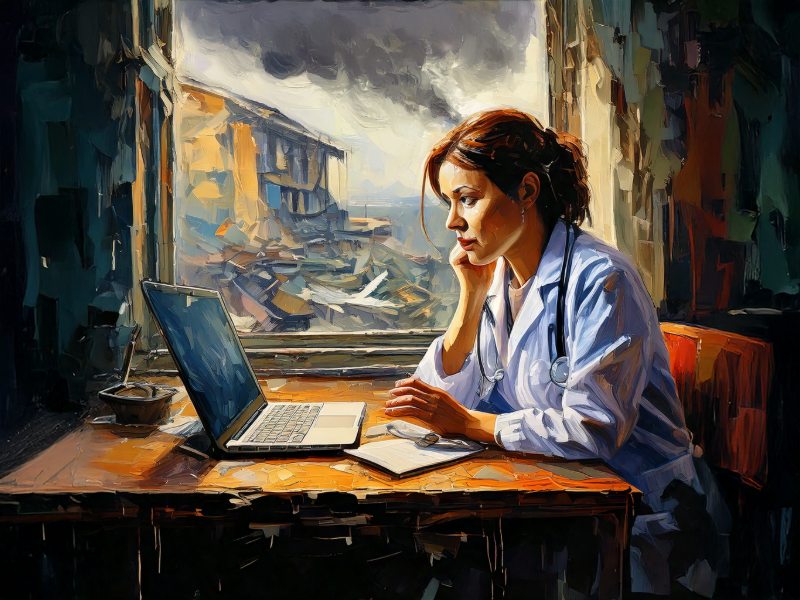
 

Costumed Authenticity: Building Trust in LGBTQ+ Telehealth

He was the kind of client who liked to sneak in jokes to relieve his own anxiety. A deflector. The kind of client who is openly gay, but emotionally closed. In telehealth sessions he rarely looked at the camera, or even the screen. His thoughts were off in the distance. He had a lot to say, but it was going unsaid. Or, more accurately, he had a lot to share, but it wasn’t being verbalized.

Social camouflage can be a powerful survival mechanism. While it can lead to compartmentalizing social identities, it’s important to value a client’s need for safety. In fact, if there’s anything I’ve learned from my LGBTQ+ clients, it’s how multifaceted identities open up progressively through tiers of trust. Codeswitching is common, as is reserving whole aspects of personal identity for those who actually appreciate it. This can make it hard to trust anyone, especially a mental health professional.

Like what you are reading? For more stimulating stories, thought-provoking articles and new video announcements, sign up for our monthly newsletter.

Even amongst the LGBTQ+ community there is no guarantee of acceptance, requiring camouflage just as much within the rainbow as outside of it. Pansexuals and omnisexuals may tell people they’re bi because it’s more commonly understood and socially accepted, just as bisexuals may tell people they’re gay. Genderqueer, genderfluid, and agender people may generalize themselves as queer or nonbinary rather than get into the specifics of their actual identity. Likewise, there are many nuanced facets to being a transgender person, but there’s no chance of talking about that with someone who’s unfamiliar with even the most basic Trans 101 terms. Yes, a client may talk about their sexuality or gender identity with a therapist, but at what level is the conversation? Tier one? Tier two? Tier ten?

In the back of my mind, I found myself relating to his bemused smile and his coy silence. But how could I, as his counselor, create enough safety in a telehealth session for him to share more of his unspoken authenticity? Or, at the very least, another side of himself?

I’ll be the first to say that telehealth has more than a few problems, yet having a small window into the client’s home is a game changer. I’ve had some clients proudly take me on a video tour of their house, and others who actively hid their home environment. Getting to see someone’s sanctum of comfort, or playground of self-expression, is an honor that should not be taken lightly. Yet when a client doesn’t know how to talk about themselves, a little curiosity about their external environment can go a long way.

In the background of his bedroom was a sewing mannequin. When I asked if he sewed, he laughed and said he was better with a hot glue gun. Then, when I asked what he’d been working on, there was a second of hesitation. A second of hope, mottled with the fear of rejection. The natural prelude to authenticity.

No, he wasn’t a Drag Queen. He was a Drag Cosplayer, who spent a small fortune every year transforming himself into sci-fi and fantasy characters to attend massive conventions. And he walked a fine line, in heels no less. He didn’t fit in with Drag Ball Culture, and he was sure most Queens would call him a nerd. On the flip side, not every conventioneer appreciates a cross-dressing cosplayer. Here was courage and shame in the same costume. Here was cognitive dissonance. He kept all his social media accounts private but had hundreds of people take pictures with him at every event. He was an anonymous celebrity.

This disclosure segued into a conversation about his favorite anime characters and, most importantly, why they were his favorite. People are drawn to certain fandoms for key archetypal reasons, because they resonate with a specific character, or universe, or story arc. Fortunately, I happened to grow up in the height of America’s anime revival, so I recognized not only his characters, but also his attention to detail. After that, I was updated on the status of his latest costume for the next two months. It turned out he had a soft spot for manic female antiheroes who are vibrant, loud, and completely over the top.

It takes time to build rapport. As therapists, we are outsiders, approaching each tier of privacy like a gate. It’s not enough to say friend or foe. For this client, I had to not only know the password to be let in, but I also had to speak the language. It’s because of this that I encourage therapists to take an active interest in their client’s media. Dive into their music scene, or favorite book series, or television show, or movie fandom, or video game community, because there you will learn a hidden language.

So I asked him if, in our next telehealth session, he would be willing to show up in character, and he laughed, and cringed, and said he’d have to think about it.

My next session was with Haruko Haruhara, from the spastic anime masterpiece FLCL.

My next session was with my client’s shadow, imagination, and feminine inspiration, and this time, they looked right into the camera.