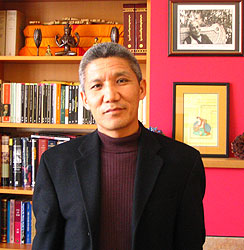
Allan Schore on the Science of the Art of Psychotherapy

David Bullard: Allan, you are known for integrating psychological and biological models of emotional and social development across the lifespan. You’ve done a great deal of research and writing suggesting that the early developing, emotion-processing right brain represents the psychobiological substrate of the human unconscious described by Freud. Your work has been an important catalyst in the ongoing “emotional revolution” now occurring across clinical and scientific disciplines.

I’ve been watching my own process while getting ready for this interview, with a lot of left-brain work: reading, taking copious notes and thinking, and anxiously trying to figure out the structure for this interview. After all, it isn’t everyday one gets to interview a person called “the American Bowlby,” and whom the American Psychoanalytic Association has described as “a monumental figure in psychoanalytic and neuropsychoanalytic studies!” But essentially, this will be a conversation, and
I’d like to begin with a quote attributed to Jung, involving a graduate student who went to him, inquiring as to what he could do to become the best therapist possible. Jung said, —loosely translated—“Well, go to the library and read and study everything good that’s ever been written about the art and science of psychotherapy, and then forget it all before you sit down to peer into the human soul.”

It occurs to me, having followed your work for a while—most recently your writing about right brain communication in psychotherapy—that Jung’s quote may be partly what you’re writing about.
Allan Schore: Absolutely. The title of my book, The Science of the Art of Psychotherapy (2012), attempts to more clearly understand the relationship between the two, because on the one hand, as so much clinically relevant research now shows us, there is a science that underlies the clinical domain. And there is a certain amount of information and knowledge that we as clinicians must have in order to succeed in the particular area of expertise that we’re in—psychotherapeutic change processes.

Yet, at the same time it’s also an art, something that is extremely subjective and personal. For most of the last century it was thought that subjectivity was outside the purview of science. But we now understand psychotherapy changes more than overt behavior and language—it also acts on subjectivity and emotion. As you know, the left hemisphere is dominant for language and overt behavior; the right for emotion and subjectivity. This dichotomy fits nicely with left versus right brain functions. The two cerebral hemispheres process information from the outside—and inside—world in different ways: one from an objective stance, the other from a more subjective perspective. The two brains use different ways of perceiving the world and of being in the world.

Neuroscience has legitimized subjectivity in psychology and in therapy.
Neuroscience has legitimized subjectivity in psychology and in therapy. Both science and clinical theory agree that psychotherapy is basically relational and emotional, and so we now think that emotionally and intersubjectively being with the patient is more important than rationally explaining the patient’s behavior to himself. The core self system is relational and emotional, and lateralized to the right hemisphere, and not the analytical left brain. As we empathically “follow the affect” and facilitate the patient experiencing a “heightened affective moment,” we’re intuitively inhibiting the dominance of the left and “leaning right.”
DB: Can you speak more about how neuroscience is changing our understanding of the art of psychotherapy?
AS: Let me try to give a broad overview. In the critical moments of any session the patient must sense that we’re empathically with them. Research shows a difference between the left brain understanding of cognitive empathy and right brain bodily-based emotional empathy. In other words, we’re experiencing and sharing the patient’s right brain emotional subjective states, being with the patient rather than doing to the patient. In this therapeutic context we have to also be in the right brain to make therapeutic contact, and for the patient to make contact with her deeper emotions. Later we may engage our left brains to more cognitively understand the emotional state, but while we’re attempting to “listen beneath the words” in order to “reach the affect” and work with the affect we must, as Reik said, abandon “sweet reason” and “rigidly rational consciousness” and “abandon yourself” to intuitive hunches that emerge from the unconscious.

Intuition and empathy are right brain functions, and both operate at levels beneath conscious awareness. Bion said we must leave conscious expectation behind in order to really hear the whole patient. So getting back to Jung, he also said “Man’s task is to become conscious of the contents that press upward from the unconscious.”

These two different brains, the conscious mind and the unconscious mind, must work together. As my colleague Iain McGilchrist has shown, we are currently out of hemispheric balance. I think psychology has placed too great an emphasis on the conscious mind, and we are now challenging the long-held idea that reason must overcome bodily-based emotion. That the conscious mind needs to control and suppress the unconscious mind, that science and art are always in conflict, and that they would never mesh together. As I’ve written, with the ongoing interdisciplinary paradigm shift our perspective has changed, and not incidentally the gap between the practice and the theory of psychotherapy has really collapsed in the last two decades.

Getting back to your Jung citation, at the very beginning of our clinical education we’re learning techniques, and we’re learning the psychological science of psychotherapy. But as we learn our craft and gain clinical experience, ultimately the bulk of our learning comes from being with and learning from our patients—about them as well as self-knowledge. As I see it, our growing clinical expertise expands within the psychotherapeutic relationships we share with our patients. It’s what our patients are teaching us, if we are open to it. It’s not just about them and the deeper psychological realms within them. It’s at the same time becoming more familiar with the deeper core of our own self system. Being psychodynamically focused, this involves the use of both our conscious left and especially the unconscious “right mind.”

I believe that we’ve overvalued the analytic left mind. So lately I’ve looked more carefully at the neuroscience for the overt and subtle difference between the left and right brain/mind. This has shifted my clinical focus from the explicit to the implicit, from cognitive mental content to affective psychobiological process. I now see the change mechanism acting beneath the words—in process more than content. We now have a better idea what this process is about, and how relational interactions literally can change that process and thereby change character structure.

My idea about science is that we need to update ourselves about what is objectively known about the brain and what is known about the body, as well as “knowing” more about our own subjectivity. And that’s a continual journey. Fundamentally, our psychotherapeutic exploration of somebody else’s subjectivity, which is bodily-based subjectivity, is also an exploration of our own subjectivity. So, there are two types of knowledge here that really underlie psychotherapy change processes: the explicit knowledge of the broader biological and psychological scientific theories, and the “implicit relational knowledge of self and other.”
DB: Before we go any further, as a psychodynamic therapist, even a “neuropsychoanalytic” one, what might you say about your work to therapists who are using more directive methods, such as CBT and EMDR?
AS: The neurobiologically informed psychodynamic perspective that I use emphasizes a clinical focus on not only explicit conscious but implicit unconscious processes. All schools of psychotherapy are now interested in these essential functions that take place beneath awareness. And all are accessing attachment internal working models, which Bowlby said operate at unconscious levels and can be changed by therapy. So I’m interested in not only the patient’s overt behavior, but also her internal world, what cognitive scientists call internal schemas.

My work is fundamentally about how to work with affect, and so clinically I’m exploring with the patient not only conscious but unconscious cognition and, importantly, unconscious affect. The patient may have no awareness of what neuroscience is now describing as “unconscious negative emotion.” Research has now established that fear isn’t necessarily conscious; you can experience it without being aware that you’re experiencing it. So how do we detect these unconscious affects?

And then there’s the matter of the communication of emotions within the therapeutic alliance that are so rapid that they occur beneath conscious awareness. The alliance is a central mechanism in not only psychodynamic therapy but CBT, EMDR, experiential, body psychotherapy, etc. This gets to what used to be called the common factors that impact all forms of treatment. I’m interested in the change mechanisms that occur in all psychotherapeutic modalities, but especially in the right brain, which is dominant for emotional and social functions and stress regulation.
DB: But let me get in a question for the people who may not have had much exposure to the kind of neuroscience and the neuropsychoanalytic approach that you’ve written so much about over the last two decades. At basic levels, you say that right brain development is much more rapid in the newborn, or in the developing fetus even. Can you address those implications?
AS: Let me just go wide for a second and then we can kind of dive in here, because the truth of it is that the last two decades have been remarkable in terms of the changes in the field of psychology across the board. I’m thinking about the early ‘90s when there was a huge split between researchers and clinicians, where there were divisions within the different schools of psychotherapy, and where the focus was very much on verbal content of the session. Although there were breaks away from classical psychoanalytic theory, the focus was still on undoing repression, making the unconscious conscious, and with interpretations being the major vectors of the treatment. Emotion really had not come into the forefront. But that’s the key to the change.

Over the ‘70s we had been moving into a behavioral psychology and from that to a behavioral psychotherapy. Then it transitioned into a cognitive psychology where suddenly, we went beyond just overt behavior and into covert cognition, which became a legitimate field of study. Out of that came cognitive behavioral therapy and then in the ‘90s the emotional revolution, as it’s been called, began, which posited that affect is primary, as well as affect regulation. And that’s where my studies really began, in the early 1990’s.

The Reemergence of Psychoanalysis

DB: Did you have much contact with psychoanalysts Joe Weiss and Hal Sampson in San Francisco who founded a psychotherapy research group and developed Control Mastery Theory?
AS: Not contact, but I was well aware of them and I’m pretty sure they were aware of me.
DB: They were.
AS: Their work has held up, and its impact continues. There’s now an intense interest in gaining a deeper understanding of what used to be called the non-specific mechanisms of change, in all forms of psychotherapy. They were onto that really early.

My first book, Affect Regulation and the Origin of the Self, tied together the social-emotional change processes in early development and in psychotherapy. This was in 1994 and, incidentally, the term “self” was not being used that much back then. Psychodynamic people were still more or less using the term “ego” rather than “self.” As I’m sure you’re well aware, Jung had put his money on “self” and was much closer to describing the core system than Freud’s “ego.”

The early developmental models of the time were dominated by the cognitive models of Piaget.
Everyone had been attempting to try to squeeze Piaget into a psychotherapeutic mechanism. It proved to be kind of an awkward fit.
Everyone had been attempting to try to squeeze Piaget into a psychotherapeutic mechanism. It proved to be kind of an awkward fit. Emotion was the key to attachment.

And so the subtitle of my book was The Neurobiology of Early Emotional Development. That same year Antonio Damasio had come out with his book Descartes' Error, and the whole idea of emotion, which had been ignored by science, began to come out of the closet.

Twenty years later it’s well established that emotion is primary in early human development, that affect dysregulation lies at the core of psychopathology, and that affective communications are essential in all forms of psychotherapy.

The second area of basic change is the matter of the interpersonal neurobiology of attachment—a shift from the intrapsychic to the interpersonal. Many people had been looking at attachment theory, but even attachment theory was hard to anchor clinical process in. That had to be worked out: other than the “strange situation” and the AAI [Adult Attachment Interview], how were clinicians going to use Bowlby’s attachment theory and information about early development? That has been a remarkable change. Now just about every clinician has some understanding of the centrality of early development and how that interpersonal developmental mechanism plays out in the therapeutic relationship.

Indeed, early development really has come into the fore in all forms of psychotherapy, with all patient populations.
Interpersonal neurobiology—how early relationships shape the brain—has transformed attachment theory.
Interpersonal neurobiology—how early relationships shape the brain—has transformed attachment theory. This transformation from what I call “classical attachment theory” to “modern attachment theory” focuses on not only regulation but also dysregulation and ideas of psychopathogenesis, which have also been major themes of my work. My efforts have been to generate a more integrated theory of mind and body, of psychology and biology. In essence I’ve attempted to synthesize these fields in order to create a coherent psychobiological model of how the self develops, how dysregulation and disorders evolve, and then ultimately how to treat these disorders.

A couple of other things to mention: another change over the last two decades has been the reemergence of psychodynamic theory and the revitalization of psychoanalysis, the science of unconscious processes. It took a while, because as you know, classical psychoanalysis was seen as apart from science, and was cast out of academia for a long period of time.

But this reemergence has paradoxically been fostered by neuroscience, and its interest in rapid implicit processes. Neuroimaging research has established that most essential adaptive processes are so rapid that they take place beneath conscious awareness. I’ve suggested that the self system is located in the right brain, the biological substrate of the human unconscious. This differs from Freud’s dynamic unconscious, which mainly contains repressed material, banished from consciousness. At any rate there is now great interest in implicit unconscious processes, and I think we’re now coming back to a modern expression of psychodynamic theory. Indeed all forms of therapy are now looking at right brain to right brain transference and countertransference communications, and how these are expressed in the therapeutic alliance, beneath the words.
All forms of therapy are now looking at right brain to right brain transference and countertransference communications, and how these are expressed in the therapeutic alliance, beneath the words.


One other major change has been the rediscovery of brain lateralization, and the appreciation of the different structural organizations of the right and left brain. Each has different critical periods and growth spurts, and ultimately different specialized functions. For me the terra incognita literally has always been the early developing right brain, the unconscious. More so than the surface conscious mind my interest has been in deeper early forming nonverbal bodily-based survival processes. I became especially interested in how we could bring these survival processes into the open, and how these could be studied. As a clinician-scientist, everything that I’ve authored has had to be clinically relevant. It has to fit the way that I work with my patients, as well as scientifically grounded. My theories are heuristic, and not only open to research but able to generate experimental hypotheses that can be tested.

Hemisphericity

DB: You’ve spoken of the left brain being verbal, rational, and logical, but of the right brain actually having verbal aspects also. How would you describe the verbal capacities of the right brain?
AS: The first person to bring up the idea that all language is not only in the left hemisphere, just for the record, was Freud in 1891 in On Aphasia, which still is studied by neurologists.
Right hemispheric language creates the intimate feeling of “being with.”
But the idea that everything that is verbal has to, by definition, reside in the left brain is still held by many people. Current neuroscience shows this is not the case. The right also has language. The right stores our own names, and processes emotional words. Prosody, the emotional tone of the voice, is right lateralized, as well as novel metaphors, and making thematic inferences. So when a patient all of a sudden is in an emotional state and is using an emotional word, the right is tracking that also. Right hemispheric language creates the intimate feeling of “being with.”
DB: And humor is known to be more right brain?
AS: Absolutely!
DB: And it kind of “wakes up” our left brain with recognition?
AS: Yes. Because the processing of what is familiar is left and the processing of novelty is right. Essentially we’re looking for, not the bottom line preexisting truth, but for the ability to process novelty, especially novelty in social emotional interactions. And for many patients intimacy is novelty. So, yes, anything that is new pops into the right brain first, and you actually get bursts of noradrenaline in the right hemisphere, the hemisphere that is dominant for attention. In fact, I’m now citing studies which indicate that the highest levels of human cognition—the “aha” moment of insight, intuition, creativity, indeed love, are all expressions of the right and not left brain.
DB: It’s in the right, but we don’t know about it until it shows up in the left. The right brain lets us know what’s actually going on, especially in the body, and in the deeper core of the self.
AS: Correct. Essentially, the left has the illusion that it has just discovered something new, but the truth of it is the right has discovered it, and now the left is putting into words what the right just found out about the self, especially in relation to other self systems. My colleague Darcia Narvaez is showing that morality is also a very high right brain process. A body of research indicates that the right is dominant for affiliation, the left for power.

This gets into some of the matters that Jung and others were talking about— these very high symbolic mechanisms are in the right hemisphere. Here’s another example of how neuroscience has changed our ideas about the human experience. It used to be thought that all symbolic processes are a product of the verbal left brain, so the goal was to get the patient to use words, and once there was conscious verbalization, then the patient can understand, and then the unconscious becomes conscious and change occurs. We’re now saying that’s not quite the case. The ultimate expression of the right brain is a conscious emotion. The ultimate expression of the left brain is a conscious thought.
Becoming aware of our bodily-based emotions is more essential than becoming aware of our thoughts.

The right brain and the unconscious mind are more connected into the visceral body. As you know the body has been rediscovered in the last couple of decades. And that’s been an enormous change for psychology and psychiatry.

Trauma and Development

DB: Would you say that has been driven through the clinical work, research and writing on trauma?
AS: Partly that. But also the developmental work on attachment theory and attachment trauma. Clearly, modern trauma theory, which did not really exist until around the late ‘90s, has also been one of the important transformations of the last two decades—the idea that “the body keeps the score,” as Bessel van der Kolk put it. But even beyond that, I would suggest it’s the re-discovery of the autonomic nervous system that is the major player here. It’s now an accepted principle that in order to understand the human experience it’s not just the voluntary behavior of the central nervous system, but also the involuntary behavior of the autonomic nervous system—mind and body. And that’s why much of my bodily-based attachment model involves the autonomic nervous system. The mother is literally a regulator of crescendos and de-crescendos of the baby’s developing autonomic nervous system.

These same bodily-based processes are also involved in the therapist’s right brain psychobiological attunement to and regulation of the patient’s emotional states. So the body has now embedded itself into the core of models of subjectivity—an embodied subjectivity which is not just an abstraction of the left brain, but right brain processes. The body is now seen as essential to right brain to right brain intersubjectivity. In my own work I’ve argued that this conceptual advance has impacted clinical models, such as somatic countertransference—the therapists’ own bodily reactions to patients’ conscious and especially unconscious communications. Also, there is the idea that a major function of the therapist is to regulate the patient’s autonomic arousal, a clinical concept that has challenged the older idea of neutrality, and that expands the previous concept of containment. This perspective attends more to right brain unconscious process than left brain conscious content. Once again, these scientific advances have transformed our clinical models.
DB: Wouldn’t another major transformation be what I heard you saying in a recent workshop: that the very disruptions of intensive therapy allow the repressed traumatic developmental relational issues to come to the surface, and if they’re dealt with properly, there then is healing?
AS: Absolutely the case. Except not “repressed,” but dissociated. There’s also been a shift in defenses, from an earlier clinical model that emphasized insight and the undoing of repression, a model of therapeutic action based on bringing to the patient’s consciousness repressed unconscious material.
Trauma theory emphasizes working with the deadening of affective consciousness by this other bodily-based survival defense, dissociation.
Trauma theory emphasizes working with the deadening of affective consciousness by this other bodily-based survival defense, dissociation. Clinicians are learning to differentiate the two and recognize the latter.

But, yes, the idea about disruptions and repairs came out of the developmental data and was incorporated into my modern attachment theory. My writings emphasize that rupture and repair, both in the developmental and psychotherapeutic contexts, involve important opportunities for interactive regulation of dysregulated affective states.

At the most fundamental level I’m interested in the mechanisms of change, especially in the early developing right brain self system. To use an earlier language, what I’m exploring is how the object relational sequences between the mother and the infant shape emerging psychic structure. In more modern terms these are investigations of interpersonal neurobiology. An interpersonal neurobiology of human development enables us to understand that the structure and function of the mind and brain are shaped by experiences, especially those involving emotional relationships, and to understand how brains align their neural activities in social interactions.

The tie in from my developmental work to my clinical work is that the same right brain to right brain social emotional processes that are setting up between the mother and the infant later play out in the therapeutic alliance. The model links the right brain growth in early development with later changes in the social/emotional context. And as you pointed out rupture and repair are potential contexts of emotional growth. So I’ve paid attention to the work of other developmental psychoanalytic researchers like Beatrice Beebe and Ed Tronick and Karlen Lyons-Ruth, who are also studying ruptures and repairs.

In my most recent writings I’ve focused on the essential role of these repairs in re-enactments of attachment trauma, which really is at the heart of the therapeutic change mechanism. I’m describing how both patient and therapist co-construct both the rupture and the repair, and that these ruptures are not technical mistakes, but literally—
DB: —the universal disappointments that are part of human relationships, and the repairs being the paths of healing?
AS: Beautifully put. Enactments represent communications of previous ruptures that triggered negative affects so intense and so painful that they were dissociated and banished from consciousness. As the therapy progresses and the attachment bond in the therapeutic alliance strengthens, there is enough safety for the patient to dis-assemble the dissociative defenses and let the affects come online more frequently. And then, what has been buried and packed down underneath dissociation surges into bodily awareness in the presence of a regulating other, now offering a possibility of interactive repair.
What has been buried and packed down underneath dissociation surges into bodily awareness in the presence of a regulating other, now offering a possibility of interactive repair.
Jung, who studied dissociation, described how the enduring emotional impact of childhood trauma “remains hidden all along from the patient, so that not reaching consciousness, the emotion never wears itself out, it is never used up.” He also stated the trauma may suddenly return: “it forces itself tyrannically upon the conscious mind. The explosion of affect is a complete invasion of the individual. It pounces upon him like an enemy or a wild animal.”

In my model of “relational trauma” I’ve suggested that it’s not just misattunements that lead to the traumatic predisposition. It’s also the lack of the repair, and that repair and interactive regulation requires a very personal, authentic response on the part of the therapist. Attachment trauma was originally relational, and so the healing must be relational, a mutual process. In Sullivan’s words, the therapist is not neutral and detached, but a “participant observer.”

Love, Repair, and Deepening Love

DB: Okay, can you take what we are talking about and even apply it beyond therapy to other intimate relationships? Could you actually say to a couple that it’s in the very upsets that they have that, if they could approach it in the right way, they’ll have a window into learning about some of their earlier wounds or traumas, and be able to heal them?
AS: Obviously the original context of attachment trauma was a very intimate context. I mean the relationship between the mother and the infant defined an intimate context. Her ability to down regulate negative affect in rupture and repair and up-regulate positive affect in mutual play shaped the attachment bond and the infant’s developing right brain. In a secure attachment the intimate context is characterized by mutual love, and over the course of my studies I’m increasingly using the term love to describe the intensity of the emotional bond. This is more than just pleasant affect. This is intense emotion.

And that love, incidentally, between the mother and the infant also is the mother’s ability to pick up communications that are not only joy but also distress and to be able to hold and to feel that in herself, and then to regulate that and communicate back to the baby.

The idea about being able to hold the pleasure and the pain really is the key to this. In the cases of other intimate dyads, this also applies. A number of clinicians are now focusing on the same right brain psychobiological mechanisms in couple’s work. The couples’ therapist who is working with attachment is able to hold the dyad, to regulate each member of the dyad. She’s also facilitating and reading nonverbal emotional communications within the dyad, and bringing to awareness affective moments in which they are engaging and disengaging, and switching between various emotional states.

The therapeutic action with couples is to allow each member to become more aware of these rapid automatic processes, and how each is communicating or blocking transmissions from the other. As always the clinical principle is to follow the affect, especially authentic affect, whether positive or negative. And again, rupture and repair are important contexts for right brain development and emotional growth. But even beyond couples therapy, interpersonal neurobiology and affective neuroscience are now being incorporated into group psychotherapy. The focus is on what group members are communicating beneath the words, at conscious and unconscious levels, and how right brain emotional communications and regulatory transactions are occurring in the group relational context.

So, although the emotional contact between humans originates in the mother-infant dyad, it ultimately becomes the way in which individual human beings communicate with other human beings. These deeper communications and miscommunications have little to do with left-brain language functions. They have more to do with right-brain abilities to nonconsciously read the spontaneous facial expression, tone of voice, and gestures of other humans.

Self-Regulation, Co-Regulation, and Buddhism

DB: Are Buddhist ideas of the self/nonself of interest to you? Or do you get all you need from psychoanalytic thought and neuroscience?
AS: Most of my ideas about the self come from neuroscience and psychoanalysis, including Jung and others. But the idea of self/nonself and multiple self states have been a focus. In current relational psychoanalytic writings the concept that comes closest to my own is Philip Bromberg’s idea about multiplicity of self-states: that we all have a variety of self states associated with different affects and motivations. Some of these are operating on a conscious level, others of these on unconscious levels. He calls these latter states “not-me” states as opposed to “me” states (a concept he borrowed from Harry Stack Sullivan).

Depending upon context we nonconsciously switch through these states. Each of these self states is tied into a motivational system (fear, aggression, shame, depression, joy etc.). In other words, when threatened, the fear motivational system is triggered. My right brain is attending to and tracking the external threat outside. In that self state noradrenaline and adrenaline is higher, cortisol is elevated, the physiology and attentional systems are altered. The memory system is also altered. When the threat passes or I’ve regulated and coped with it, I become relieved and switch into another self state, say a quiet alert state or a positively valenced exploratory state. So due to self regulating mechanisms we switch through these self-states. Resilience and flexibility is the adaptive ability to fluidly switch depending upon what is occurring in the context and what is meaningful at that point in time.

On the matter of Buddhism’s concept of self—that self state of consciousness that is associated with meditation, as I understand the concept, aims to control and still the fluctuations of the mind. The self (mind, awareness) identifies itself with fluctuating patterns of consciousness. Yoga, for example, is a form of mastering or eliminating such fluctuations and the attainment of stable concentration of attention and non-attachment to sensory experiences. With practice a change from evaluative to non-evaluative self-monitoring occurs during meditation. That said, neuroscience studies show that “compassionate meditation” does have more of a right brain, limbic focus.

I’ve written that self regulation can take two forms: interactive regulation in affiliative interconnected contexts, and autoregulation in autonomous contexts. In yoga the meditating self is acting as an autoregulatory system. My interests in development and in psychotherapy are relational, so I’ve been more interested in interactive regulation that occurs between human beings.

That said, the key is being able to switch between these two modes of self regulation. Both of these derive from the early interactive regulation of the attachment relationship. Going inward to control emotion is different from reaching outwards to others at moments of loss or joy. The inability to emotionally connect with others is at the core of any relational affect focused psychotherapy.
As I look at the significant problems of the larger world I’m convinced that we need more connection, not separation and autonomy.
As I look at the significant problems of the larger world I’m convinced that we need more connection, not separation and autonomy. For me, where we are in this world right now, really what we desperately need, what’s being thinned down on a daily basis, is this capacity for interactive regulation.

We also have the problem that the US and Western cultures emphasize the value of autonomous and independent personalities; they are highly valued over interdependent ones. As I mentioned, the left hemisphere is associated with power and competitiveness, the right with affiliation and pro-social motivations. So, again, that’s the reason why I’ve been more interested in the higher right hemisphere, which processes not only emotional states and higher cognitive functions, but spiritual and moral experiences. It is here in the right where the self is transcended, where the self becomes larger and expanded. In these states the grandiosity of the self literally is collapsed down and there is some understanding that one is part of a much larger organism, a much larger sense of being alive. This sounds like the Buddhist autoregulatory self state.

But let me repeat, interactive regulation is the key to the therapeutic alliance. There is now a push into the relational trend in all forms of psychotherapy. Actually in psychoanalysis the relational emphasis has always been there. I’m thinking of Ferenzci, Jung, Kohut and more recently relational intersubjective psychoanalysis. This relational trend now is coming into mainstream psychology, and is seen as the central mechanism of psychotherapy.

I point this out because psychologists on the one hand can be teaching meditative skills, but can also be accessing relational expertise in the therapeutic alliance.
DB: But they better also have those mindfulness skills themselves so they can be present to receive all of what’s coming in the interaction rather than kind of stereotypically looking through these variety of theories or thinking of what to do next or how to be.
AS: Right. But I suggested that a certain form of mindfulness, including a bodily awareness, must take place in a relational context. The idea being that there are certain parts of the self that cannot be discovered, that cannot come into awareness, unless they are being mirrored by another human being.
DB: Ah! So it’s not just that the relational trauma that gets dissociated can be healed through the relational—there’s a Yiddish term "fargin" that means, “joining someone’s joy.” I love that concept.
AS: That’s a great cultural metaphor—sharing someone’s joy as well as pain.

A Third Subjectivity

DB: So there may be feelings that you are not going to fully experience until you see them mirrored in a reciprocal emotional interaction.
AS: Exactly. One of the central concepts that I’ve written about is resonance. In physics, a property of resonance is the tendency of one resonance system to enlarge and amplify through matching the resonance frequency pattern of another resonance system.
It’s more than mirroring, it’s an intensification of positive arousal and thereby an energetic mechanism, which is a form of interactive regulation.
In psychology, a state of resonance exists when one person’s subjectivity is empathically attuned to another’s inner state, and this resonance then interactively amplifies, in both intensity and duration, the affective state in both members of the dyad. This resonance can occur rapidly at levels beneath conscious awareness, and it generates what has been called “a third subjectivity.” For example, in mutual play states dyadic resonance ultimately permits the inter-coordination of positive affective brain states, shared joy, which increase curiosity and exploration.
DB: What you just described might also be related to what my Zen friends call “one mind.” There’s a great quote sometimes attributed to e.e. cummings about this: "We do not believe in ourselves until someone reveals that something deep inside us is valuable, worth listening to, worthy of our trust, sacred to our touch. Once we believe in ourselves we can risk curiosity, wonder, spontaneous delight or any experience that reveals the human spirit.”
AS: Yes, again, it’s more than mirroring, it’s an intensification of positive arousal and thereby an energetic mechanism, which is a form of interactive regulation.
DB: And it’s also accounting for my increasing enjoyment of this interview versus a little bit of anticipatory anxiety about talking with you in the very beginning. But it quickly became exceedingly enjoyable.

Can you discuss the variability of people in terms of quiet versus very active internal experiences—either auditory and verbal, some other form of thought, or visually active consciousness in contrast to people who have a naturally occurring or developed quiet mind?
AS: Sure. The first thing that comes to mind is what has been termed as “the quiet alert state.” This is the flexible state that the mother accesses to pick up her infant’s varying emotional expressions. It’s associated with a state of autonomic balance between the energy expending sympathetic and energy conserving parasympathetic branches of the autonomic nervous system. Within attachment communications the caregiver sets the ranges of arousal, the set points of the infant’s resting quiet alert state. It’s relationally tuned, and later affects the individual brain’s default state. In other words, regulation is the key to the quiet mind.

But I’m also thinking about right and left hemispheric balance, and individual differences in “hemisphericity.”
There are individuals for whom that chatter is always so intense, so continuous, and even so loud they cannot quietly be with themselves. They can’t tolerate internal silence, and so they can’t monitor what’s coming from the body and from deeper strata of the unconscious.
For example, in a resting state greater right hemisphericity is associated with a history of more frequent negative affect, lower self esteem and difficulties in affect regulation. Greater left hemisphericity, on the other hand, is associated with heavy inhibition of the right brain, repression of emotions, and over-regulation of disturbances. Consciousness is dominated by continuous left brain chatter, and thereby an inability to be emotionally present, to be “in the moment.” There are individuals for whom that chatter is always so intense, so continuous, and even so loud they cannot quietly be with themselves. They can’t tolerate internal silence, and so they can’t monitor what’s coming from the body and from deeper strata of the unconscious. They’re always in a state of “doing” rather than “being.”
DB: And they have difficulty experiencing their bodies and can’t even tell you what they’re sensing, or maybe even how they’re feeling because it’s just pure thought.
AS: Right. When it comes to emotion and emotion dysregulation, for a long time people were thinking only about under-regulation, that the emotions are so powerful and so strong that they interfere with the logical and rational capacities of the left hemisphere. But there is also another problematic state—where it’s over-regulated. In that case the person is habitually packing down emotions, out of awareness, and whose left hemisphere is so dominant that it’s always “in control.” They “live in the left,” and use words to move away from affect. They’re talking about rather than experiencing emotion, from the other side of the callosal divide, not actually allowing themselves to disinhibit the right and to feel what is in the body. And yet, “the body keeps the score.” In the most extreme cases they’re dissociative and alexithymic.

These are patients who use words in order not to feel; they are over-inhibited and susceptible to over-regulation disturbances. Think about overly rational, insecure, avoidant personalities who overemphasize verbal cognition and dismiss emotion. Returning to our earlier discussions of recent changes in the science of affect, dysregulation can be either under-regulation or over-regulation, an avoidance strategy versus an anxious strategy.

Imagery

DB: Coincidental with that, I’ve noticed there are people, such as myself, who are minimally or not at all visual in their memory. Aldous Huxley described this about himself in Doors of Perception. If I were trying to visualize my living room, I would say it’s like 10% clear.

Other people I know are eidetic or photographic in their imagery. People who have that kind of visual memory can also have vivid imagery intrusively interfere in the present, where a person would be walking downtown and, instead of having a thought or worry that a bus might hit a particular woman, he would see the bus hitting her. Or he would visualize a building falling down—all-intruding upon his peace of mind, as you can imagine.
AS: A few things come to mind from your observations. The classical idea of brain laterality is that the right processes visual and spatial images while the left is involved in language.

But when it comes to imagery, the truth is we forget much of the time that imagery can be in any modality. We usually think about the visual image, as in your example of someone having an image of a bus hitting a pedestrian, or a building falling. Or a patient will come up with metaphors that are loaded with visual images. Also think of visual images of faces, especially emotionally expressive faces. But imagery can also be auditory—as when our consciousness becomes aware of a song melody or olfactory images, of an emotionally evocative smell or odor.

So, for those of us who are highly auditory, like both of us, we used to think that was verbal. But as you know, there are nonverbal auditory cues. Aside from the verbal content the voice itself is communicating essential information, even more important in an intimate moment than the verbal. Most psychotherapists are highly auditory and attuned and very sensitive to even slight changes in the prosodic tone of voice of the patient. It’s at that point where we will lean in, so to speak. But we also use our voice as a regulatory tool. In a well-timed moment we intuitively and spontaneously express our calming and soothing voice, or at other times we’ll come in with a more energizing voice, or even a limit-setting voice. Or we’re expressing an auditory metaphorical image.

So I think that when we talk about imagery, especially emotional imagery, we’re usually thinking of visual images. But there also are tactile images. As in an image of what it feels like at this moment, including what it feels like in your body and in my body, because I can pick this up and put that together with another’s facial expression.

But also there’s a difference between implicit visual recognition and explicit visual recall. I may not be able to have a conscious memory of a visual representation. But if there’s a subtle change in an emotional expression on a patient’s face, I can pick it up quickly. And let’s remember that when it comes to processing the meaning of nonverbal facial and auditory expressions, this is not occurring at conscious awareness. These interpersonal cues that denote changes in affects and subjectivity are detected and tracked by the right amygdala, at levels beneath awareness. Again, we’re listening beneath the words, and these signals are triggering unconscious memory systems of various sensory modalities—auditory and tactile, as well as vision.
DB: Hmmm, it just struck me that I often say that I’m not visual. But I must be visual in my right hemisphere because I have these wonderful, clear, visual dreams.
AS: I agree. Remember with the right brain, you’re talking about not only long-term visual memory, but also ultra-short working memory, what has been called the visuo-spatial sketchpad. We hold a momentary image in consciousness long enough to see if it matches with our memory of affectively charged personally meaningful experiences. At a reunion, when you emotionally see your daughter’s face your right brain can immediately detect that there’s something wrong, or that she’s experiencing shame or joy. That right brain function is essential to our ability to be in close relationships. Someone who is mind-blind to facial expressions will have problems with intimacy.

Alone in the Presence of Another

DB: I think back to your former student and couples therapist Stan Tatkin, who has made the point that our partner often knows things about us by looking at our face before we’re aware of what we are feeling, which brings us back to the reasonableness of trying to grow with affect co-regulation versus only self-soothing and all of that through meditation. But is there a name for something that would be like co-meditating? I know we’re talking about co-regulation.
AS: Well now I’m thinking about Winnicott’s idea about being alone in the presence of the other. Remember?
DB: No!
AS: Winnicott talked about the child in the second year achieving a complex developmental advance—the adaptive ability to be alone, and the creation of true autonomy. That is, to be separate, to be processing one’s own individuality and one’s own self system in the presence of another. The other is a background presence, so it doesn’t get swept into the child. But they’re literally both individuating in their presence together. And this is a kind of silent being together without having a need to take care of the other or support the other, of literally that kind of comfort.

So, on the one hand there is the joining of joy, which would be more active so to speak. And on the other hand there is this idea about being alone in the presence of the other, which is more passive. The self-system has stability at that point in time. It can shift out of that state if it needs to, but again, I would suggest to you that comes close to what you’re talking about. And that gets into the importance of solitude, the importance of privacy, which in this day and age is being completely forgotten. The poet Rilke said so eloquently, “For one human being to love another, that is perhaps the most difficult of all our tasks, the ultimate, the last test and proof, the work for which all other is but preparation. I hold this to be the highest task for a bond between two people: that each protects the solitude of the other.”

Repair in Relationship, and Returning to the Matter of Love

DB: I wonder if you would agree with a quote from Kierkegaard when he said "perfect love is learning to love the very one that has made you unhappy.” Does that resonate with you at all?
AS: Absolutely the case.
DB: Anything that you would modify?
AS: In my recent lectures I’m describing the interpersonal neurobiological emergence of mutual love between the mother and infant. Studies on the functional neuroanatomy of maternal love document that the loving mother is capable of empathizing and feeling in her own body what the baby feels in his body, whether it be a joy state as well as a pain state. When the securely attached mother is in the fMRI scanner viewing emotional videos of her infant in a joy state or in a cry state, positive emotions such as love and motherly feeling coexisted with negative ones such as anxious feeling and worry in the mother herself.

Other studies show that insecure dismissive-avoidant mothers cannot hold the distressed baby’s painful negative states. The narcissistic mother only stays connected when the baby is mirroring back a positive state, and is unable to tolerate and repair shame states. So this ability to hold onto both positive and negative affect, and not engage in splitting is essential. In fact, in developmental studies, Ed Tronick has shown that even the secure mother is only attuned about 30 percent of the time. The key is not only the misattunement, but the interactive repair. These misattunements are common—my colleague Philip Bromberg describes frequent collisions of subjectivities within an intimate dyad.

Returning to our earlier discussion, it’s the ability to interactively repair these collisions that allows for the strengthening of an emotional connection between an intimate couple. Clinically, it’s the emerging ability of the therapeutic dyad to co-create and co-regulate ruptures that allows us to tolerate the negative transference and strengthen the positive transference—to move together from positive to negative and back to positive affective states. That really strengthens the bond and it leads to resilience. For me that’s what Kierkegaard’s intuition is describing.
DB: Ah.
AS: But while the moments of emotional connection are important, so are the moments of shared solitude, of being alone in the presence of the other, moments of shared silence. It’s very limiting to think that everything has to be filled with words or interpretations.
For some therapists, when there’s too much silence they’ll start to fill it up with words, for their own regulatory needs.
For some therapists, when there’s too much silence they’ll start to fill it up with words, for their own regulatory needs.You know, for some therapists, when there’s too much silence they’ll start to fill it up with words, for their own regulatory needs. The matter that I’m raising here is that attachment is about the capacity for intimacy. Are intimacy and the capacity for mutual love expanded in long-term psychotherapy? Can patients use what they’ve experienced in therapy to expand the abilities for forming close and personally meaningful bonds with others, as in deep friendships and long term romantic relationships? Can they use these relationships as a source of more intense brain/mind body interactive regulation and autoregulation, and therefore have both interdependence and autonomy?

Both clinical theory and interpersonal neurobiology agree that in optimal social emotional environments the self-system evolves to more and more complexity. Not only the growth of the left brain conscious mind but also the right brain unconscious mind can be enriched and expanded in deep psychotherapy. By emotionally interacting with other right brains, a secure right brain self can continue to grow and develop to more complexity over the later Eriksonian stages of the life span. The secure self is not a static end state but a continuously expanding dynamic system that is capable of both stability and change.

Freud said that, in the end, therapy, and indeed life, was about love and work. Today we might think about that in terms of the expression of the development of the affiliative right and agentic left brains. My work has been an exploration of the primacy of the emotional development of the right brain, over the life span. In The Art of Loving, Eric Fromm described the intense emotional experience of love as “the experience of union with another being” and proposed that “beloved people can be incorporated into the self.” Here’s an example of self expansion that occurs within and between two people.
DB: Well, that’s all a lovely way to end. I’ll respect your own need for solitude by finishing up this conversation, but I would like to close with asking about your current activities. You’re still meeting in several cities with students?
AS: Yes. For almost two decades I’ve continued to meet with study groups here in Los Angeles. I also have ongoing groups in Berkeley-Alameda, as well as Boulder, and in the Northwest.
DB: In Seattle?
AS: Yes, I Skype with clinicians and researchers in Seattle, Vancouver, and Portland. I’m about to start a Skype group in Australia, also.
DB: Well, all of this time with you, at both a personal and professional level has been delightful. So, thank you so much. I’m sure people are going to enjoy what you brought to today’s discussion.
AS: Same on my side, and thanks for today, David. I also greatly enjoyed this back and forth dialogue. As you said at the beginning the key was to have a spontaneous conversation.


What Remains: The Aftermath of Patient Suicide

Note: Clinical material in this article is taken across various venues and years of treatments. Identities are disguised to protect confidentiality. References used in writing this article, as well as resources for clinicians, can be found at the bottom of this page.

Silent Mourners

The memory is quite clear: several years ago, early one morning checking my voicemail, two messages in I came upon a message from my patient, Jill. The message was date-stamped the evening before. She said she would miss today’s session due to a need to find new housing; she thanked me for our work thus far (as she frequently did, sometimes out of social politeness or her fears of abandonment, other times out of sincere heartfelt gratitude, something we frequently explored). This time her gratitude sounded heartfelt in tone. Her message also left me perplexed, as we had not talked of housing, and I saved it. Another message, left moments before I checked my voicemail, was from Jill’s psychiatrist, Brian, asking me to give him a call when I got in the office. Brian and I spoke frequently of Jill, her ongoing medical decline at a relatively young age, and her persistent depression and posttraumatic stress. We followed her carefully, exchanged perspectives, and possessed mutual respect for one another’s clinical skills.

I called him immediately. “Are you in your office?” he asked, his voice ominous.

“Yes,” I replied, feeling my stomach tightening.

“Are you aware of the events related to Jill?”

“No,” my heart now pounded from my chest into my throat.

“Jill killed herself by handgun . . . “

I do not remember what he said next, just that he was still talking. I gasped, crying, while simultaneously attempting to hide my upset.

“Margaret, there was nothing, nothing you could have done to prevent this,” Brian continued, his voice clear and emphatic, speaking from his decades of experience, his knowledge of Jill, and his knowledge of our work together.

We talked for some time, and I could feel myself wanting to hang up the phone and be alone, but Brian insistently kept me on the line, wisely, for forty-five minutes. That was enough time for both of us to begin feeling the immensity of Jill’s death, and to begin the longer process of inquiry and reflection into her suicide and its after-effects. It was a process that would continue for a few months between us, and for more than a year for me.

Clinicians who lose patients to suicide are sometimes referred to as “silent mourners.” Some describe this kind of grief as disenfranchised. For me, I think of this grief as a kind of lived experience that catapults you into another environment which is foreign and therefore scary; a kind of grief that is uniquely solitary to bear and therefore devoid of larger community to bear it with you; a kind of grief that is intensely intertwined with shame; and a traumatic grief that possesses all the hallmarks of interpersonal trauma, whose impacts often continue reverberating long after the initial shattering experience has occurred. All of these facets and more underscore the particular experience of clinicians grieving suicide loss.

The differences are rather key in understanding how to be with our selves and also how to respond to colleagues who experience this kind of loss personally or professionally. My hope in writing this article is to buoy understanding, widen the circles of support for clinicians who have experienced suicide loss, and to offer some guideposts along the way of grieving. This topic and these aims are one of my life-long passions in my career. I have had the unfortunate experience of surviving two siblings’ suicides, the sudden death of a third sibling that suggested passive suicide, and the deaths of both parents from organic causes that were informed by these traumatic losses. My terrain of grief and traumatic loss was quite familiar to me by the time I met Jill, having traversed its intricacies in feeling, thought, and body using psychotherapy, meditation, long-distance hiking, body work, and writing, for many years. My experience served me well in working with Jill while she was alive, as well as holding what remained after her death. I was and am, after all, a wounded healer, meeting her suffering in life and in death.

Our Privileged Intimacy, Our Private Mourning

By its very nature, psychotherapy is a privileged space. The therapeutic relationship is characterized by a unique emotional intimacy with each patient. As therapists we are honored by our patients’ presence, the trust that is hard won, and the growing capacities through the course of psychotherapy we witness. We accompany and guide, inquire and curiously explore in a most particular way with each patient. With each patient, a slightly different relationship forms. We are slightly different therapists with each patient we encounter.

The extent to which we as therapists may deny the singular relationship with and presence of our patients in our lives contributes to the complications of grieving their departure in any form—from treatment termination to physical death. In her article, “Necessary and unnecessary losses: the analyst’s mourning” (2000) Sandra Buechler reflects that, because our work asks us to cultivate objectivity, and objectivity is often (over) emphasized in the work (and in training), it becomes a norm without critical thinking or reflection. This clinical cultural norm may also encourage a sense that we can (or should, perhaps) simply “move-on” when a patient departs. A therapist’s stance of distance may additionally complicate the grieving picture, especially in the case of loss by suicide. That stance may feed defenses of denial, encourage guilt, and amplify feelings of shame.

The great Jungian, James Hillman, stated that the suicide of patients is a “wrenching agony of therapeutic practice.” It is also a reality of practice that we fantasize will not touch us, despite the statistics. Depending upon the research reviewed, approximately fifty per cent of psychiatrists and thirty per cent of psychologists experience patient suicide. The statistics are incomplete and varied, often reflective of response rates to inquiry. Further, we do not, to my knowledge, have statistics on the numbers of mental health professionals who have experienced suicide loss within their personal circles of close family-friend relations, but it is fair to consider the percentages may be slightly higher if these were included.

For clinicians, suicide challenges every value we place in the therapeutic endeavor. It can raise fears of litigation, cloud clinical decision-making, and spark feelings of professional isolation. Suicide of a patient can challenge personal and professional identities, career trajectory, and sense of professional security. In its wake, patient suicide can leave posttraumatic stress symptoms behind as well as complicated grief. Interestingly, in my work with therapists who have experienced suicide loss of family or other close relations, they experience similar dilemmas. The sense that as a clinician he or she did not serve their family member or friend well, the questioning of clinical acumen, the guilt of feeling as though he or she should have done something to be of help and more, are common. As clinicians, suicide loss in any arena of our lives is experienced through the lens of our clinical knowledge, expertise, and experience.

There is little personal discussion on how therapists weather such a loss. Lay survivors of suicide are in an unknown country, inhabiting a strange landscape. Therapists surviving the suicide of a patient are in a similar land and yet there are important differences: there is no institutionalized ritual, no community of mourners, no one, really, who knew the patient as the clinician knew the patient. There is no one who witnessed first-hand (as best anyone can) the relationship between a certain patient and a certain therapist, yet the specific dyadic relationship is never to be experienced again. It is never to be remembered by anyone else but the therapist. In specific ways, we are the only one who holds our patient in mind. Even in the case of Jill, Brian held one particular relationship with her, and I another. Although Jill sometimes spoke of us to one another, the bulk of our memories of her are solitary, and the texture of our relationship with her singular.

Therapists are usually left alone with what remains in the aftermath of patient suicide. These remnants include all that was unsaid, unprocessed within the therapeutic relationship—both the regrets of what was not named and processed that are possibly linked to the suicide, and certainly all that had no chance to be felt and spoken of together that more time would have provided. Additionally, all that the therapist retains of his or her patient remains inside the therapist’s memory.

Further, who the therapist was with this particular patient is lost. This leaves open the question of who we are as therapist now. The process of mourning for therapist-survivors asks that we delve into the question of who we are now that our patient has left in this self-destructive way. And who are we, as therapist, the one here to facilitate healing—to engender life, if we have that kind of perspective—in the face of chosen death?

It can be alluring as the therapist-survivor for all these reasons to move far from the confusing thicket of feelings left by patient suicide. The cultural context and identity as therapist can encourage this moving away from honest reflection and processing too. Yet as we know with our patients, moving away from the real experience of the here and now can lead to a dulling of living, a numbing. In our work, moving away from our feelings can feed psychotherapeutic cynicism, burnout, and depression. It can also lead to problematic clinical decision-making and ethical lapses in judgment.

Our willingness to open, receive, and make contact with our patients within the therapeutic work is an offering toward healing—if we choose to risk it. From a relational perspective, certainly, our willingness in these ways is a vital vehicle in the process of transformation found within the therapeutic endeavor. Upon the suicide of a patient, it is tempting to shut down in response to profound relational loss and loss of the therapeutic framework upon which we rely.

Being with Groundlessness

“The dead leave us starving with mouths full of love,” the poet Anne Michaels writes. Jill left me starving and full. Her message to me left me full. The timing of her departure left me starving, questioning. She left me loving her, yes, but also left me with a myriad of other feelings including meaninglessness, impotence, frustration, and raw sadness. I was, because of my life experiences, immediately aware that I needed to take seriously the particular kind of loss I was experiencing—the loss of an incomplete, torn-apart relationship, the loss of who Jill was to me, a loss of clinical voice, and the loss of who I was as a psychotherapist with Jill.

There is ineffability—an unspoken quality— in this kind of traumatic loss. Psychoanalyst Ghislaine Boulanger distinguishes between child and adult onset trauma, noting how core self experience and self-in-relation experiences are undermined. Adult onset trauma shatters illusions of omnipotent control, ever-shaking the normative expectation of personal agency and healthful denial of omnipresent mortality. The suicide of a patient shatters illusions of therapist omnipotence, shaking expectations of potential positive influence upon patients, and calls into question core identity as well as identity-in-relationship to other patients and colleagues.

Western psychology rests within a worldview of personal agency. It is a worldview imbued with Euro-American, individualistic, educated, and moneyed values—all of which are crushed in the face of adult onset trauma. It is the very nature of this kind of traumatic loss that it rocks our assumptive world as therapists: questioning whether our endeavors are life giving, whether our efforts possess meaning and influence; and whether our chosen profession is worthwhile.

There was Todd, a patient-therapist in my practice who came to me after his long-term patient completed suicide. Todd had fifteen years of clinical experience and before that eight as a university professor. He was well versed in suicide prevention and intervention. “After his patient’s death, he refused to ever work with a patient again who even mentioned suicidal feeling states; he would refer them.” His stance is maintained to this day, six years later. His way of coping is not unusual among therapist-patients in my practice or across the profession. Whenever I present a paper on this topic, I hear stories of mental health professionals at all levels responding similarly. So understandably haunted, they desire to avoid any chance of experiencing a suicide loss again; some believe they can no longer objectively assess risk; and others feel traumatized, unable to clinically engage with a patient experiencing suicidal ideation or self-harm.

There are some other common coping approaches among therapist-survivors. They include all the ways we may become vigilant in our practice: taking numerous, even if repetitive, trainings on ethics and suicide prevention; developing a rigid stance in responding to patients expressing suicidal thoughts or intent; and intervening in overly-conservative ways that communicate anxiety to the patient rather than clinical engagement. In her essay for the collection, The Therapist in Mourning: From the Faraway Nearby (2013), Catherine Anderson describes these kinds of responses as part of the working through process with “a desperate need to understand what had happened and a magical wish to protect [oneself] against any future vulnerability.”

Another common response is to avoid examining clinical missed opportunities and errors, to defend against the pain, shame, and perhaps guilt that are simmering. Gina, a patient-clinician of mine, experienced a patient suicide after two sessions. When the patient did not show to the third session, Gina called. Subsequently, the patient’s father contacted Gina. He told her his son killed himself the day after the second session. It was excruciating for Gina to slowly begin to examine her state of mind during the sessions. She came to realize that she was, due to many factors, defending against making genuine a connection with this patient, and was more distant than usual. Her past clinical experience told her that when she has that kind of response, she hesitates exploring avenues that would be productive, and that she overlooks what later, when less defensive, was there all along. That was her missed opportunity. Of course, there is no telling if Gina had been less defended if that would have made a difference—given her a vital piece of clinical information that she could capitalize upon to then help the patient. It was crucially important, however, to Gina’s healing process to bring into consciousness what she already actually knew about herself in her brief work with the patient.

The ground of my being was continually moving beneath me after Jill’s suicide. Because of my life history and my working with it in therapeutic ways, I knew my footing could be regained, but I questioned when that would happen. I returned to writings that reminded me about how vulnerable groundlessness really is and how inevitable it is as well. Pema Chodron, in When Things Fall Apart, writes:

“[T]hings don’t really get solved. They come together and they fall apart. Then they come together again and fall apart again. It's just like that. The healing comes from letting there be room for all of this to happen: room for grief, for relief, for misery, for joy."

Her perspective, for me, reflects what I believe and practice in my private and professional life, but can easily forget in times of great tumult. It is a kind of perspective that provides me refuge.

I knew from my history that if I refused to directly experience what was present within me I would only harden my heart. Cutting myself off by armoring my heart would negatively impact my relationships with other patients, let alone the relationships in my personal circle and my relationship to life itself.

The practice of mindfulness meditation is one way I engage my direct experience, and it had been a practice of mine for many years before I began my clinical work. I returned to intensive practice after sustaining the many family deaths in quick succession aforementioned; I spent a month on a silent meditation retreat as well. The amount of silence offered was an integral experience for my body, heart, and mind to begin having room to feel through those traumatic losses. With Jill’s death, I returned to steady meditation practice again, in order to create room inside myself for the range of feelings I was experiencing. It sounds, perhaps, so simple, so easy, and yet it is not. Silently meditating twice daily confronted me with every vulnerability, every feeling, body sensation, and thought I possessed. Profound shame, futility, anger, banality, and sorrow as well as heartache and headache were some of the many storms I weathered sitting quietly on my meditation cushion. Yet it was the silence and the generous observing accompaniment to myself that were central in my finding footing again.

Ritual as Scaffolding

James Hillman suggests that in the face of patient suicide the clinician go into the context of the death—not to stay on the surface. His advice speaks to delving into our interior world, and grieving, but also something more. He suggests lending all of our knowledge of our patient to the endeavor as well, exploring as thoroughly as possible nuances of our patient’s suicide.

With Jill, intuitively I knew I needed rituals as a frame in my quest to deeply understand her suicide to the best of my abilities, as well as to mourn her death and all of the losses accompanying it. One ritual that was obvious was the therapy itself. There are the set days and times of sessions; the usual pattern of entering and exiting sessions with some of their inevitable variability; the parameters of the relationship.

Keenly aware of how groundless I felt, I longed for grounding in the ritual of my sessions with Jill. “I could not fathom scheduling another patient in Jill’s session times. I realized what I wanted was to keep my appointment with Jill. So I did just that: I kept my appointments with Jill for one year.” Sometimes I went to a meditation space near my office for the appointment; sometimes I was in a natural setting. Other times, I spent it in my office. Wherever I chose to spend the sessions, I also was with Jill. Sometimes reading a book of poetry that evoked Jill, or intentionally recollecting parts of sessions.

By the second week of appointments with Jill, I began writing during the time. I used poetry as a companion. Sometimes I wrote to Jill, sometimes extemporaneously to the Reader with a capital R. An excerpt follows of one of my writings:

I reviewed notes on Jill I came across; process notes. Notes when Brian spoke with me several weeks ago. There is much that remains unsolved in my heart. And it’s in my heart, especially, that time takes its own rhythm, a time that doesn’t match up with the clocks and the calendars.

It’s sorrow or poignancy, both, being touched by Jill—I’m feeling right now. Knowing I’m not alone, really, in such an experience ultimately—like anyone grieving anything how universal and connected to the everyday human experience this actually is. Paradoxically how alone and singular I feel. Alien among colleagues who have not experienced such a violent loss. A lone mourner.

Jill suffered in body and mind, physical and emotional pain. Her physicality used to be a route to survival as a child and a young adult. Her physicality was already failing her. The grief she felt was so layered and frequently linked to all the losses felt trans-generationally across her family history. And even this doesn’t say all she felt and lived with.

I can and do write circles of theory or case formulation but that is not what I’m desiring here. I feel almost desperate to continue delving into this process with her in this kind of way, unsure of where it is leading.

Strange, I guess, to feel the shock, still, that she is dead. I just know the only way to move with this, through this, to be with it all, is to do what I’m doing. Let it come in words or feelings. Let it come through me, in silence.

Of course, the questions remaining in the aftermath of suicide usually cannot be fully answered, but answering all the questions is not the point of such a process. If there is an aim, it is the recognition that the clinician continues in relationship without her (or his) partner in the dyad. Feeling and thinking alongside that recognition is the heart of the process. Psychologist Robert Gaines would call this the stitching together of continuity our relationship to the dead. Finding a relational home once again. Finding one’s clinical and human voice again.

Other rituals also occurred to me related to mourning, whether a formal memorial or an informal honoring, as well as creating continuity. By the end of the second week of appointments with the spirit of Jill, I realized I needed two additional things: to visit where she died, and to create some kind of memorial. There was no funeral service for Jill; she had no family or close community. Something of our process together needed representation. Something of her treasured symbols shared with me needed representation. And something of our relationship needed representation too.

Brian drew me a virtual map in verbal description as to where she died. Over the next four appointments with the spirit of Jill, I developed a memorial. A colleague accompanied me on the day that I set, and we drove to the place close to where Brian described. We walked the remainder of the way. Although Jill chose a place where she surely would be discovered, it was not an overly exposed public place. When I got there, I wept. I wept not because of her death in that moment but because of the purposefulness of the place. I recognized it, immediately, based on our work together. Based on what Jill shared with me. I could see how Jill, with her particular perspective, felt beauty in this place. The place fit into the story of her life, the story she shared with me. The story we made sense of together. The place symbolized what she would frequently discuss and feel, the existentials of existence, and the evolution of her life.

The ritual included flowers, some writing I read to commemorate Jill, and a prayer combined with poetry I put together to reflect our relationship. My colleague and I sat in silence afterward, listening to the sounds around us. I felt close to Jill in the moment. Through the scaffolding of this ritual, as well as the ritual of appointments with her, I began to understand some meanings in her death, and I regained my voice once again.

Jill genuinely affected me—her life as well as her death. Destruction, and particularly self-destruction, surrounded her in the history of her life yet she developed into a highly deliberate, aesthetically-minded, symbolically-attuned woman who struggled with looming thoughts that dragged her into familiar mire she was accustomed to escaping by vigorously and creatively using her body, no longer available to her. Her suicide was equally aesthetically minded—if you forgive the stretch of the word in this context but rather feel into the contour of its meaning. I noticed this in numerous ways from the evidence she left behind, the chosen place of her death, the timing of her death, to her message left for me.

I was acutely aware in working with Jill of my family standing with me, for they are there, always, in the background of my mind and heart, like a luminous shawl. How the experience of their tragic, violent, and sorrowful deaths created, initially, a nuclear-sized crater within me that since healed—and continues to evolve in healing—with scarred but incredibly strong layers. Layers of capacity and depth for ambiguity, curiosity, and love in the face of enormous challenge, rejection, and destruction. I never revealed to Jill my personal history, yet I felt it was these very experiences and my working with them, through them, that enabled me to meet Jill in the dark and light of her psyche without collapsing. All of these details and their meaning that I came to understand over time enabled me to continue to serve fully in my life in all ways professionally and personally with openness.

Relational Home for One Another

Clinician-survivors come in contact with the real attachment felt for the person who died in the process of mourning. Regardless of theoretical orientation or therapeutic stance, there was (and is) a relationship. The basis of the relationship is connection, care, and likely love. Therapists may have difficulty admitting they love their patients; some secretly do so with shame as if caring were untoward. When working in my practice with therapists mourning a suicide, moving through the shame of caring to the healing and human quality of caring is vital.

Clinician-survivors ask me to be their therapist initially because they find my contact information from the American Association of Suicidology’s website. There, among numerous resources, is a link to resources for clinician-survivors. Clinicians who contact me often gingerly express their desire for support, understandably fearing an amplification of shame they already are carrying. Shame demolishes a person’s sense of self. Shame isolates and evicts us from our relational home.

Some studies have explored the ubiquitousness with which clinician-survivors are met with judgment and shaming from colleagues. It has been found that clinicians who have not experienced a suicide loss professionally or personally are more likely to assume that there must have been something the treating clinician had done wrong. One way to understand this is to consider the nature of trauma. People involved in the traumatic event, either directly or indirectly (hearing of it, etc.), hold parts of the experience and defend against the emotional enormity of it. Blame, shame, grandiosity, omnipotence, and guilt are often convoluted in the mix. Unbearable feelings are projected or disavowed. Most of us “know” this, but when we are in the midst of it ourselves we can forget.

Before I entered my contact information on the clinician-survivor network, I carefully considered this act—a public acknowledgment of an aspect of my history. Before I agreed to write this article, which is drawn from a public presentation I gave to two different professional organizations, I considered how my history in print felt quite different than speaking it. I sensed the risk I felt in both instances. For me the risk is primarily located in relationship to colleagues unfamiliar with suicide loss. My feeling of risk among the professional community is not singular—it is cited repeatedly as a way that therapists feel shame for their grief in relation to patients generally, and most especially the shame felt when a patient completes suicide.

Coming out, so to speak, on the website and in this article are acts of advocacy for other therapists in a direct way, and ultimately also, I believe, advocacy for patients. Coming out in these ways are antidotes to shame as well, although revealing oneself carries with it a chance of being judged or shamed. Hiding when feeling shame, after all, is a protective solution to those risks—albeit risks that are generalized. Two anecdotes may elucidate.

When a psychologist-colleague found out that I publicly acknowledged my identity as a suicide survivor, he questioned me. He wondered if I were exposing something that “should” be hidden. His sense of hiding was initially justified by the importance of neutral stance and limited self-disclosure. With further exploration between us, however, my colleague came to realize that he felt anxious and even dissociated when hearing about my experiences. His shaming reaction toward me was a coping mechanism for his anxieties.

Another colleague responded quite differently to finding out about my public acknowledgment as a suicide survivor. Her response: There but before the grace of God go I. She too felt anxious hearing my experience, but she remained in communion with me. She shared her anxiety and her wishful fantasy that she would never experience this kind of trauma. Through our discussion, we created a relational home for one another.

In therapy, we create, with our patients, a relational home. While this home is focused on the patient’s needs, it is irrevocably the particular home we live in with our patient. That home continues to live inside of the therapist-survivor after the patient dies. In Trauma and Human Existence: Autobiographical, Psychoanalytic, and Philosophical Reflections (2007), Robert Stolorow writes, “The mangling and the darkness can be enduringly borne, not in solitude, but in relational contexts of deep emotional attunement and understanding.” The loss of a patient or a loved one by suicide is unfathomable, though we know it happens. It is nothing short of a cataclysmic trauma, one that is enormous to digest. The impact of it on clinicians has been compared to the traumatic loss of a parent. It is a leveling experience for it takes us out of our protected role as therapist and throws us into the most humble, bare experience of our own humanity.

Brian, the psychiatrist, only learned of my family history after Jill’s death. He wondered, “Perhaps there is some unconscious way Jill knew you could make meaning of and bear her death.” It is curious whatever Jill may have implicitly known of me—but ultimately that is something I will never know. Importantly, it was not lost on me, her therapist, the relevance of the place she chose to die. What it meant to her, what she communicated to me in her final message, and what she communicated in her choice of place. It was not lost on me, her therapist, the layered meanings in the timing of death. The curious exploration of these among other unspoken aspects of our work together was what I gave voice to in my year of kept appointments. A year of rediscovering meaning. A year of regaining clarity, ground, and clinical voice. A year of examining the soul of the process between us, and what lived on within me.

***

Following is a list of readings and resources for clinicians and clinician-survivors who wish to learn more about, and seek support for, the grief of losing a client to suicide.

The clinician-survivor network of the American Association of Suicidiology provides consultation, resources, support, and education to mental health professionals in the aftermath of suicide loss, personally and/or professionally. The website includes nationwide clinicians available as resources, as well as an extensive bibliography.

Anderson, C. (2013). "When what we have to offer isn’t enough" in Malawista, K. and Adelmari, A., Eds. The therapist in mourning: from the faraway nearby. New York: Columbia University.

Boulanger, G. (2002). Wounded by Reality: understanding and treating adult onset trauma. New Jersey: Analytic Press.

Buechler, S. (2000). "Necessary and unnecessary losses: the analyst’s mourning." Contemporary Psychoanalysis 36: 77-90.

Chodron, P. (2000). When things fall apart: heart advice for difficult times. Boston: Shambhala Publications.

DeYoung, P., (2015). Understanding and treating chronic shame: a relational/neurobiological approach. New York: Routledge.

Gaines, R. (1997). "Detachment and continuity: the two tasks of mourning." Contemporary Psychoanalysis 33(4): 549-571.

Hillman, J. (1997). Suicide and the soul. Connecticut: Spring Publications.

Michaels, A. (1997). Memoriam in The Weight of Oranges / Miner’s Pond. Toronto: McClelland & Stewart.

Plakun, E. & Tillman, J. (2005). "Responding to clinicians after loss of a patient to suicide." Retrieved December 2013 from http://www.austenriggs.org.

Stolorow, R. (2011). "Portkeys, eternal recurrence, and the phenomenology of traumatic temporality." International Journal of Psychoanalytic Self Psychology, 6:433-436.

Stolorow, R. (2007). Trauma and human existence: autobiographical, psychoanalytic, and philosophical reflections. New York: Routledge.

Tillman, J. (2006). "When a patient commits suicide: an empirical study of psychoanalytic clinicians." The International Journal of Psychoanalysis, 87(1), 159-177.


Je Taime…Me Neither

This couple therapy session was the last chance before Anna and Guy’s upcoming wedding in Paris. They had reached out to me for a premarital counselling session via Skype, knowing that I was working with mixed couples.

Their situation, as Anna exposed it to me in her short email, needed to be addressed with some urgency: they were due to get married in the town hall of Guy’s native Paris within two weeks, and Anna still had serious doubts about her final “yes.”

Their two faces appeared on my screen, one next to each other, cramped into the frame of the Skype window. From the start, I mentioned one of our challenges: neither of us was using our native language here. Anna is Polish, Guy is French, and I am Russian. From my experience, this multilingual field would be played out at some point during this session, but how?

Their respective English was fluent, even though Guy had a strong French accent, which made him sound like an odd TV-series character. In the first minutes, I learnt that they had started dating online, and now Anna had finally moved in with Guy in Paris. Since then, their respective lifestyles had been drastically altered: Anna had an 8-years old daughter from her first marriage, and Guy had an autistic sister who lived in the same building. Those two were constantly challenging their shared existence. They were their respective “burdens,” as Guy shared.

When he pronounced this word, Anna’s face hardened with pain. She was clearly hurt by the reference to her daughter as a “burden,” and was getting defensive. Their typical argument then started to unfold. These fights happened on a daily basis, leading inevitably to door- slamming and painful silences.

Now their faces were flushing with all kinds of emotions.

“You are so slow and uninterested!” she stated, bitterly.

“You always sound so aggressive and impatient!” he responded, defensively.

I could clearly see what both of them meant. Anna did sound irritated; her aggressive facade seemed to hide a deep insecurity. Guy did come out as a bit slow and detached. He was carefully looking for his words, avoiding eye contact, and every time, before speaking, he would make a pause, recollecting and revaluating his thoughts. This habit of his could be easily taken for a lack of interest or passion. In Anna’s view he simply did not feel enough love for her, or enough acceptance for her daughter, to become a good husband and father.

And yet, they were really willing to look at their relationship, ready to fight for its survival, avoid its ending. I was starting to wonder how I could be of any use, when I heard the sound of a distant doorbell. They both jumped on their chairs. Anna smiled badly; Guy shivered and disappeared from my sight.

“See?! This is what happens. She comes in and out when she wants, uninvited.”

I understood that Anna was talking about Guy’s sister, and I invited her to pause and wait for Guy’s return.

Such interruptions of the sessions are frequent in my online practice. They are somehow an unexpected gift of this particular setting. I always endeavour to make the most of them. In this virtual space, silences are tougher to tolerate, even for the psychotherapist.

Anna and I were staring at each other, hearing their voices at a distance, and I could sense her disappointment and growing anger. She looked lonely and lost, with the other half of my screen left empty by Guy’s absence.

When he finally came back, she had that look of resignation. They are not going to make it, I thought.

Guy, clearly shaken by this sudden illustration of “his side of the problem,” muttered some excuses in French (he knew I understand it well). In his native language, he sounded surprisingly fast and emotional.

We had only half an hour left in the session, and a few days until the big day, so I decided to risk something, and suggested an experiment: would Guy be willing to repeat what he had said earlier about their “respective burdens” in French? I knew Anna could understand most of it.

Je t’aime…”—this is how Guy started his difficult speech. He talked about sharing their respective pains and responsibilities: his sister but also her daughter. He talked passionately. His body animated (at least the upper part which I could see). He seemed to almost forget about me.

Anna was listening, and this time she did not seem impatient.

That was the midpoint of the session, and such a precious opening! I felt blessed.

We then explored how using his native French had changed their common experience. Guy was finding it difficult to understand all the details when Anna spoke English quickly (which she did naturally). So his mind wandered, he looked uninterested. It reminded Anna of her first husband, who was distant and absorbed by his own activities.

As for Guy, he would see his role as a protector of his autistic sister. In his speech in French he said something valuable, which became an anchor for the rest of our session:

"Elles vont être maintenant notre fille et notre sœur."

I made sure Anna understood this: “they will now be our daughter and our sister.”

That felt manageable for both, and Guy was here to protect them all. It switched the whole perspective.

I cannot know for sure whether Anna and Guy will stay together, but I know that they did try hard to understand each other better…

Losing the Couch: Finding the “Sacred Place” in Online Therapy

I clearly remember my very first visit to my British psychotherapist. She used to receive her patients in her conservatory. Her dogs sometimes got impatient and produced considerable clatter, which I could clearly hear from inside the house. The front door would be unlocked. Clients just had to push the gate to get through an unkempt garden into the peculiar therapy room. She would be already comfortably sitting there in the same old chair, and a flowery cup of tea would be ready; weak for her, and strong for me. When I was late, my tea was cold. Maybe it was her subtle way of punishing me…

I actually loved this place. Years later I can still recall its particular smell of wet dogs and a damp garden. That therapy room had become an anchor for me, which safely attached me to the Island that was then my temporary home; I was in the midst of yet another international move.

Now that I use the online setting for my psychotherapy practice, I sometimes wonder what my clients will remember of our encounters. No particular smell of madeleines will ever be attached to a virtual space.

Any therapist, myself included, hopes that his therapy room can become some sort of “sacred place” to his clients, a place for individual growth. We all work towards this goal, creating small rituals and paying careful attention to the boundaries of the therapeutic relationship.

With the current expansion of online counseling, therapists and their clients are seeing this sacred element of therapy being taken away. Our cherished therapy rooms are disappearing, replaced by a simple desk and a computer.

I have kept a traditional face-to-face practice in Madrid, on top of my online work, so when I connect with a client on Skype, he can always spot behind me the background of a traditional therapy room decorum: two large armchairs, a box of Kleenex, a smiling Buddha statue… a pale reminder of the physical space where our encounter would have had to take place just a few years ago.

A couch, a bookshelf, and a coffee table… we have been familiar with these traditional attributes of a therapy room for ages. Anybody coming to a therapist for the first time knew what to expect, and rarely got surprised. In a space, tightly bound by walls, boundaries tended to be clear: the therapist had his own chair, the client might have a choice between two chairs and a couch. In this place both the therapist and the client felt safe. This space seemed eternal… until the online option emerged, bringing confusion.

Now online therapy is practiced within a no-place space. The couch is gone. And each of us therapists responds to this loss in different ways, which vary as in any grief—from denial and anger to acceptance.

During an online session, two people stare at their respective computer screens, without sharing a common place. This becomes an opportunity to build their own space together. It is very much like coming to a new empty area, and building from a green field a house here or there, then eventually a village.

In my experience, this lack of a physical place actually fosters creativity.

Many people I meet in my practice live very mobile lives, geographically unsettled; so the perceived neutrality of the no-place becomes a real asset in addressing the displacement-related issues.

Amélie’s story is one such case. She was back to Paris after 10 years in Korea for her husband’s career. There, Amélie had felt isolated and disoriented in her vast house, while her husband was travelling extensively. She had had to leave behind her music teacher job, and after several years of this expatriate life, she was feeling lost. Now back to her native Paris, she was feeling depressed. Her first panic attack happened in a shopping mall. She did not know where she was and was not able to get out of this unfamiliar place crowded with strangers. She was struck by an acute sense of derealisation. She reached out to me, in addition to her local psychiatrist.

“How is it for you to tell me your story here, online?” I asked.

Actually, Amélie felt safe, her anxiety was stepping back. She was relieved, as she could meet with me from the only place that still felt familiar—her parents’ Parisian flat. Driving to a therapist’s office would have been too much for her at that point. The online space we shared became in this case a way of dealing with her confusion without re-introduction of another different place.

Every time I connect with a client, especially for the first time, I am ready to get surprised. Those who seek therapy online generally use and abuse the flexibility allowed by the technology, so I “meet” them (virtually) in their holiday house, hotel room, office, kitchen, or lounge.

Without moving from my desk, I am then able to spot small samples of their physical realm. I always feel touched by the trust involved in this “letting me in.”

The whole situation has now been reversed: it is not the therapist who lets his client in, but the client who is choosing which of his sceneries to share with his therapist.
These “unexpected gifts” somehow make up for the lost couch.

In any successful therapy there is a time when the client ends up internalising the reparative relationship with his therapist, creating the “safe place” within, that anchoring gift I received from my first therapist. When this happens, the concrete place does not matter as much as the “virtual” place discovered. And the person is able to go anywhere, feeling safe enough to further explore the world.

As in the case of Amélie, the placeless reality of the online setting accelerates this natural shift from place towards relationship.

I enjoy both my online and my face-to-face practices. When connecting with a client, I always attempt to recreate the ever-important “sacred place” of a therapy room, together with my client, in this ethereal space offered to us by technology.

Ronald Siegel on Integrating Mindfulness into Psychotherapy

Mindfulness is an Attitude Toward Experience

Deb Kory: Ronald Siegel, you’re an assistant professor of psychology at Harvard Medical School, a longtime student and teacher of mindfulness meditation, on the faculty of the Institute for Psychotherapy and Meditation and in private practice as a psychotherapist. You’ve done a great deal of work in bringing mindfulness to chronic pain patients and co-wrote a book called Back Sense: A Revolutionary Approach to Halting the Cycle of Chronic Back Pain as well as one for therapists, Sitting Together: Essential Skills for Mindfulness-based Psychotherapy. Most exciting of all—for us at least—you are the star of a new video we produced and are releasing this month called Integrating Mindfulness into Counseling and Psychotherapy, which features you doing mindfulness-based psychotherapy with real clients. In it, you go into great detail about the theory and practice of mindfulness-based psychotherapy, and also do four different therapy sessions with clients each presenting different issues. For our readers who haven’t yet had a chance to watch it, let’s start with the basics: What is mindfulness?
Ronald D. Siegel:
Mindfulness is an attitude toward experience—approaching any moment of our lives with both awareness and acceptance.
Mindfulness is an attitude toward experience—approaching any moment of our lives with both awareness and acceptance. Many people mistake mindfulness for mindfulness meditation, which is actually an umbrella term for many different practices that are designed to cultivate mindfulness, some of which involve following an object of awareness, like the breath, others of which involve things like loving kindness practice or equanimity practices. Those are practices designed to cultivate mindfulness, but mindfulness itself is an attitude toward moment-to-moment experience.
DK: Is it possible to practice mindfulness without having some experience with meditation?
RS: Absolutely. We all have moments in which we’re mindful, in which our minds and bodies show up for an experience. In fact, you might take a minute just now, while reading this, to think of a meaningful moment you’ve had. People will often say, the birth of a child or a graduation or getting married or a particular sunset or a conversation with a friend—all of those moments are essentially moments in which our attention is in the present. We’re accepting of what’s happening and we’re not lost in fantasies of the past that we call memories, nor fantasies of the future. We’re actually present.

We have many moments of this kind of mindful presence in the course of our lives, it’s just that once we start to be attentive to various states of consciousness, we notice that they’re the exception, rather than the rule. They’re relatively rare. So we do mindfulness practices to cultivate more of these moments in our lives.
DK: A sunset or being with a loved one—those are positive experiences. Do we tend to be more mindful in positive moments?
RS: I think instinctually we are, because when we’re experiencing painful moments, we recoil from them. We try to change them or get them to stop, and it takes some practice to open to unpleasant experiences as well. That is a central part of mindfulness practices, particularly in the therapeutic arena, where we understand one aspect of psychopathology as a tendency to resist experience, to try to make it stop.
DK: You are considered a mindfulness expert of sorts and you’re also a psychologist. Have you always brought mindfulness into your psychotherapy practice?
RS: Well, I’d like to challenge that designation first. I’m certainly not a poster child for the practice, given my experience with my own unruly mind. However, I first started practicing mindfulness back in high school, so I have been at it for some time and the principles associated with mindfulness have always infused my psychotherapy practice. In fact, when I learned more conventional psychotherapeutic techniques like cognitive behavior therapy, psychodynamic techniques, systems techniques, humanistic psychological techniques, it was always against the backdrop of Buddhist psychology, which is really the ground out of which mindfulness practices grew.

Our Relentless Tendency Toward "Selfing"

DK: How do therapists actually bring mindfulness into therapy?
RS:
Experienced psychotherapists are perfectly capable of having a full session, making reflective comments, insightful interpretations, all while planning a 12-course meal and having our attention quite divided.
Mindfulness can infuse psychotherapy on many different levels. It can infuse psychotherapy simply on the level of the practicing psychotherapist—what happens to us as the tool or instrument of treatment when we start practicing ourselves. For example, we start to actually show up in the room more fully. Experienced psychotherapists are perfectly capable of having a full session, making reflective comments, insightful interpretations, all while planning a 12-course meal and having our attention quite divided.
DK: Shhhh, that’s supposed to be a secret!
RS: Yeah, don’t tell people outside of the field! But the more we practice mindfulness, the more we’re able to be present. The other thing that happens is our capacity to be with and bear difficult emotions increases a great deal as we take up these practices. As therapists, we tend to hear about painful matters all day long, and sometimes it feels like too much, so we start to shut down our feelings; that can get in the way of being present. Mindfulness practices can help us to remain open in a fresh way to those painful feelings.

At the next level, there’s what we might call mindfulness-informed psychotherapy, which involves gaining insights into how the mind creates suffering for itself—through our own mindfulness practice and through the experience of longtime practitioners. As we gain some of those insights, we start to see certain patterns of mind that begin to inform our models of psychotherapy. For example, our relentless tendency toward “selfing”— creating narratives in our minds, starring me. These narratives are often quite distorted and create a tremendous amount of tension and suffering as we try to hold on to one self image and abort another.

As we see this through our own mindfulness practice, we start to notice that our clients or patients seem to be struggling with the same thing and we can help them with that by drawing upon our own insights and practices. Similarly, noticing the tendency to resist experience and how that multiplies difficulty. In psychotherapy, regardless of what sort of treatment we’re doing, we try to help people move toward, rather than away from, painful experience. To be more present, rather than to be lost in the thought stream involving narratives about the past and the future. That’s a mindfulness-informed psychotherapy.

Finally, there’s the option that comes out of our own experience of doing meditation and realizing that it helps us be more present, clear, have greater affect tolerance, more perspective, and more wisdom in on our lives, as well as more compassion for others. We think, “Hmm, maybe this could help my clients or patients to do this same. Perhaps I’ll teach it to some of them.” I should underscore that it’s about teaching it to some of them and having a map or an understanding of what sort of people might respond well to which sorts of mindfulness practices, at what stages in treatment or stages in life development. It’s not a one-size-fits-all practice.

When Mindfulness is Contraindicated

DK: Isn’t it actually contraindicated for some people?
RS: It’s absolutely contraindicated for many people. For example, for folks who have a lot of unresolved trauma, meaning they’ve experienced painful events in their lives that were too difficult to fully let into awareness at the time, so some aspect of them has been blocked. Maybe it’s the narrative historical memory of the event that’s blocked, maybe it’s the affect associated with the experience that’s blocked, but in some way, the experience has been disavowed. Folks like that, if they start doing certain mindfulness practices, such as spending time following the breath, tend to become quite overwhelmed with the rush of previously blocked material that comes into awareness.

The most problematic adverse effect is due to “derepression,” or the rushing into awareness of things which defensively have been held out of awareness.
A colleague of mine at Brown University named Willoughby Britain is doing a large study on the adverse effects of mindfulness practices, and the most problematic adverse effect is due to what she calls “derepression,” which is this rushing into awareness of things which defensively have been held out of awareness up until the start of mindfulness practices. So, much as we wouldn’t in psychotherapy start talking about material in a vivid way that someone’s not ready to talk about, we don’t want to start doing mindfulness practices that might be premature for various people.
DK: Is Britton against using mindfulness at all in psychotherapy?
RS: No, she’s a mindfulness practitioner herself, a research psychologist who is very enthusiastic about these things and is trying to map this territory. What many meditation teachers know from observation is that these adverse effects are much more likely when somebody attends an intensive silent retreat over the course of many days. But I’ve lead countless groups of psychotherapists through mindfulness practices that are as short as 20-30 minutes and it’s not unusual for one or two members of the group to become overwhelmed by the experience, either by the emotions that comes up or by bodily sensations that they tend to keep out of awareness with constant activity and entertainment. Many, many people are vulnerable to reconnecting with split-off contents.
DK: Let’s say someone comes in to see you for psychotherapy and they haven’t done much psychotherapy and they seem somewhat fragile in this way. How might you work with them?
RS: What’s interesting is there are many mindfulness practices that actually help to create a sense of safety, that create a sense of holding, as Winnicott would say. There are mindfulness practices that are akin to guided imagery or have aspects that feel like hypnosis, and if they’re done in the context of a trusting therapeutic relationship, bring the safety of the therapeutic alliance into the experience of the mindfulness practice.

There are also practices that ground us in the safe aspects of moment-to-moment experience. Walking meditation, where we’re feeling the sensations of the feet touching the ground, or listening meditation, where we’re listening to the sounds of nature or the ambient sounds in the city. Or nature meditation, where we’re looking at clouds and trees and sky. Those objects, since they tend to be safe for most people and bring our awareness away from the core of the body—away from where we tend to identify emotion as happening and toward a safe outer environment—can be very stabilizing. In fact, many of those practices are conventionally in trauma treatment called “grounding” practices because they create safety.

A Transtheoretical Mechanism

DK: It seems to me like everybody in our profession is talking about mindfulness these days. And approaches that I would assume are kind of strange bedfellows—CBT and mindfulness, psychoanalysis and mindfulness—are being paired together. If you go to Psychology Today and look at the profiles of psychotherapists, mindfulness is now a little bullet-point you can select as an orientation. I often wonder if most practitioners actually know what they’re talking about when they claim to work within a mindfulness framework. Like, are they saying that because they’ve been to a one-day meditation retreat or are they actually genuinely skilled in this approach?
RS: Well, I think it’s the same as with any psychotherapeutic model, theory or treatment system—people have very variable levels of understanding of what they’re doing. There are some people who have a great deal of wisdom, compassion and knowledge, who are saying that they’re doing mindfulness-oriented treatments, and there are other people who have a much more cursory exposure to it and may not have much depth of personal experience, but are intrigued by the idea or see it as a useful concept to identify with because other people may be interested in it and looking for a therapist who has some expertise.

But I do think that the field is still in its infancy in terms of really understanding the psychological, as well as the neurobiological, effects of these practices.
The field is still in its infancy in terms of really understanding the psychological, as well as the neurobiological, effects of these practices.
It’s quite a complex field, with many different practices, each one affecting the mind, the brain and the body in different ways and in different ways for different individuals. So while we can make some generalizations and have some guidelines, I think clinicians are best served to see it as very complex.

To the other point that you made about various forms of treatment being incongruent with mindfulness, I actually don’t think most are. I think of mindfulness as a transtheoretical mechanism that is operating in virtually any effective psychotherapy, because virtually any effective psychotherapy is going to help people step out of irrational, unhelpful cognitive patterns. Virtually any effective psychotherapy is going to help people connect with, feel and embrace an increasingly wide range of emotions. Virtually any psychotherapy is going to try to help people to engage more fully moment-to-moment in their lives. Since these are cardinal features of mindfulness practice, you can see them as being helpful in virtually any form of treatment.
DK: So you don’t see it as its own model or approach, but more an attitude and set of practices that are brought into all approaches.
RS: Very much so. While we might choose to actually teach a mindfulness practice to a given client or a patient in a given psychotherapy, that could be done within the context of a cognitive behavioral treatment, a systemic treatment, a humanistic treatment, a psychodynamic treatment and many others as well.

When graduate students come to me and say, “I want to get trained as a mindfulness therapist. Where should I go to school? What kind of training should I have?” I tend to implore them, “Please don’t get trained as a mindfulness therapist. Please get trained as a therapist, first and foremost. Have some understanding of the complexities of the human mind and body, some understanding of the myriad forms of psychopathology that we can get stuck in, a good introspective understanding of your own issues and conflicts and how they get in the way of relating to other people, and get supervision from people who’ve been working with troubled folks for a long time; once you develop that foundation, then integrate mindfulness practices into psychotherapy.”
When graduate students come to me and say, “I want to get trained as a mindfulness therapist. Where should I go to school? What kind of training should I have?” I tend to implore them, “Please don’t get trained as a mindfulness therapist.”


Of course it’s very valuable all along in your training to be doing your own mindfulness practice, to maybe even have a meditation teacher that you turn to for advice. Extremely useful. But if I had a friend who was struggling psychologically and I had the choice of either sending them to a brilliant mindfulness practitioner with very limited clinical training or a reasonably good clinician with reasonably good training as a clinician, but who’d never heard of mindfulness, I would send that person to the clinician in a heartbeat.

We Are Hardwired for Misery

DK: That’s an interesting point. I live in the Bay Area, and there are a lot of people who are really into Buddhism and mindfulness practices, who kind of eschew psychotherapy for more spiritual practices of meditation and yoga. But at the same time, I know that the Buddhist teachers around here are often imploring people to get therapy, to not do the “spiritual bypass” thing and avoid the work of getting into the muck of our psyches and how they impact our relationships and lives.
RS: Yes, absolutely. Jack Kornfield, who teaches at Spirit Rock in the Bay Area and has written many books on the subject of integrating psychology and Buddhism, recently wrote an article about highly experienced mindfulness meditation teachers, Buddhist teachers, who needed to go into psychotherapy. Ultimately, it’s not that one is better than the other—they are both pathways toward sanity. There are so many pathways to insanity that we actually need a variety of tools to work toward sanity.

I would argue that our natural evolutionarily determined predilection is to be quite nuts and quite miserable.
I would argue that our natural evolutionarily determined predilection is to be quite nuts and quite miserable. As Rick Hanson, who wrote Buddha’s Brain: The Practical Neuroscience of Happiness, Love & Wisdom, puts it, “Our brains are like velcro for bad experiences and teflon for good ones.” It’s a total setup for human misery, not to mention the hardwired tendency toward self-preservation that makes us concerned with how we rank compared to the other primates in our troop, which results in endless self-esteem concerns.

We are hardwired for misery. It is a good thing that we have both Western psychotherapeutic techniques that can help us untangle our narratives and get in touch with our feelings and do that in a healing, interpersonal context, and also have access to mindfulness and compassion practices that can help us transcend our personal story to see existential reality, to face the reality of change and death, to face the reality of sickness and old age, and develop sanity through those practices as well.
DK: As mindfulness practices are becoming more mainstream in the psychotherapy community and the medical community, it’s also becoming more secularized. People might go to their primary care physician and be prescribed a mindfulness-based stress reduction (MBSR) class for high blood pressure, and never even hear the word “Buddhism.” Is there a downside to that?
RS: Let me talk about the upside first and then the downside. The Dalai Lama was talking to a group of clinicians and researchers at Emory University about depression, and toward the end of the conference, I remember being quite moved when he said, “If you folks discover that some elements of Buddhist meditation practices are useful for alleviating depression, I really have only one request for you: please, please don’t tell people that it comes from Buddhism. My tradition is about alleviating suffering, and if you tell people that these are Buddhist practices, you’re going to miss huge numbers of people whose suffering could be alleviated. Don’t get hung up on that. Express this in whatever form is going to be useful in alleviating suffering.”

So my inclination is to tailor our psychotherapy practices to the cultural background, needs, and proclivities of whoever we’re working with. There’s no need to present mindfulness in a way that is going to be alienating. Not only do you not need to mention Buddhism, you don’t need to mention meditation. These practices can be presented simply as attentional control training. When we train our attention differently, we have very different psychological experiences and it helps us both gain insight and cut through all sorts of forms of suffering.

The first rule of psychotherapy is to meet the client or patient where he or she is, and this should not be forced upon people as some alien cultural system, and nor should people be forced to consider the implications of these practices for developing wisdom and compassion if all they’re hoping for at the moment is a little bit less anxiety. That may come later down the road, but we can help them with that anxiety first.

That being said, there are potentials to these practices that are very deep, very wide, and very rich. If a clinician learns mindfulness-based stress reduction and sees these practices primarily as a tool for helping people to relax, they will miss some of the depth and some of the breadth of what these practices can offer. I think it’s useful for clinicians to practice with some intensity themselves, so they can see personally how transformative these practices can be, in a way that goes far, far beyond any benefits that come from relaxation training. It can be very useful for clinicians to learn about Buddhist psychology. It is a very profound and helpful way to understand the mind and how we get caught in suffering.
DK: I think that there’s a lot of mystery and mystification around what mindfulness is, and one of the great things about this new video with you we’re releasing is that we get to see you doing meditation with clients, and modulating it to the specific needs of each client. In real life you don’t do meditation with everyone, but this gives psychotherapists a chance to see what it looks like to bring it into a session.

I think a lot of people are kind of scared to do it and I know that when I first started doing it in my therapy sessions—and I only do it occasionally—I was actually surprised at how profound an experience it was for people and that it had the capacity to stir up some really intense memories. It’s a powerful tool that we have to learn how to use. Can you say a little bit about how you modulate and decide to use meditation in therapy sessions?
RS: First I’d like to pick up on one thing you said.
Many people in our society are involved in states of distraction all day long. Google says we check our cell phone on average 125 times a day.
Many people in our society are involved in states of distraction all day long. Google says we check our cell phone on average 125 times a day. We spend hours watching television. We spend a lot of time chatting with friends. There’s nothing with that—all of these things can have wholesome aspects to them and can make for a rich and interesting life, but for many of us, they keep us from really noticing what’s happening in our minds and in our hearts in each moment. They help to insulate us from the hundreds of micro-traumas that most of us experience just going through the day. The little disappointments, the “I wonder what she meant by that,” the “I didn’t do that as skillfully as I would have,” or “I haven’t quite achieved what I wanted in my life.” Endless, endless reflections, each of which has a bit of pain in it and each of which we want to distract ourselves from with various forms of entertainment and engagement. When people start taking up these practices, all of the pain of those micro-traumas start to come into awareness, and they can indeed be unsettling. Of course they also offer the opportunity to integrate all of that, which is a wonderful potential. So I think we have to be very judicious about it.

My main criteria for whether to actually teach mindfulness practice in a session are twofold; one is, what’s the person’s cultural background and how weird are they going to think it is to choose an object of attention and bring attention to that and return to that object when the mind wanders? Because for some people, it’s like, “forget it, man, that’s not me.”
DK: Yeah, on of the clients in the video, Julia, is a bit like that.
RS: For folks like that, I’m going to be very judicious about it, but one can bring mindfulness into psychotherapy in many, many ways that don’t involve teaching meditation. I already spoke about the shift in our attitude and our capacity for presence as psychotherapists that occurs, as well as the shifts in our models for psychopathology and for what might help people out of psychopathology that might come from our own practice.

Let’s say we’re sitting with somebody and it’s clear that some feeling got triggered. The conventional way to respond to that in therapy is, “What are you feeling now?” A slightly different way to ask the question might be, “what did you notice happening in the body and the mind right now?” That little shift in phrasing starts to shift the conversation from the normal narrative about “my life starring me,” to an observational stance—to what the CBT folks would call “metacognitive awareness,” or what the analysts would call “observing ego.”

To begin to watch and to identify a little bit with awareness itself, rather than the contents of the process. Of course it might be skillful or it might be unskillful in any given moment. For one person at one moment, what they need is to feel your empathic connection to them and saying, “What were you feeling at that moment?” might feel more empathically connected. But for somebody else, they might need to develop some of this observing ego or metacognitive awareness, and if we’re phrasing it in a slightly more objective way, it might serve that purpose. That begins to develop a little bit of mindfulness, even though we’re not doing anything that looks like meditation.

The second criterion I use is, “What’s their capacity to be with their experience?” If they have very little capacity to be with their experience, I want to start with very small doses and very non-threatening contents. If they have more capacity to be with their experience, we can dive into larger doses and get at whatever arises in consciousness right now. It really depends on the person.

Lighten Up

DK: You mentioned CBT and metacognition and it seems like a lot of what’s happening in mindfulness interventions is “noticing.” In CBT, I tend to think of it more as not just noticing, but blocking or counteracting thoughts. Is there also a methodology within mindfulness training where you’re being more directive with the material that comes up in the brain, or is that off limits?
RS: That’s a very interesting question. Let me correct one thing. There’s noticing, and there’s also feeling in a wholehearted way. I think one mistake people make is they assume that this is a very cognitive kind of endeavor and that’s only one part of it. The other part is really opening to what’s happening on a heart level, in terms of really feeling feelings, as well as noticing what’s happening in the interpersonal field and our relationships and connecting in an alive and juicy way to experience. So I just want to mention that first.

Secondly, CBT folks have described it as the third wave of behavior therapy. The first wave was Skinner on one hand and Pavlov and Watson on the other hand. Operant and classical conditioning and working with modifying behavior. Then came the very important insight that human beings, unlike other laboratory animals, think a lot and our thoughts have tremendous impact on both our emotions and on our behavior. So maybe what we should be doing is using behavioral principles, learning theory, to modify thoughts.

The third wave is coming from a different direction:
What if we start to see all thought as essentially fluid, suspect, unreliable, and based on emotion?
What if we start to see all thought as essentially fluid, suspect, unreliable, and based on emotion? These acceptance and mindfulness-based approaches are all about lightening up in relation to thought, rather than trying to get rid of the bad and hold onto the good.

In my experience, that can be quite powerful, but it takes a while. It’s a much more subtle and in some ways sophisticated way to work with the mind than just replacing maladaptive irrational thoughts with adaptive rational ones. After all, one person’s adaptive, rational thought, is another person’s insanity. We all may agree about our zip code and whether it’s raining at the moment, but as soon as we get into more complex matters, humans differ a great deal and I think we’d do better to have a more relativistic approach toward different thoughts.
DK: So the third wave basically posits that we are all insane.
RS: Yes, we’re all insane. This is a little bit of a bold summary, but my impression of the last 15 or 20 years of advances in cognitive science is basically the realization that all the processes that we’ve thought of as rational are irrational, that bias, desire, cultural proclivity, those kinds of factors are really what determine how and what we think. The idea that we are rational organisms analyzing data for positive goals—yeah, occasionally, but that’s not mostly how we tick. So if we can lighten up generally in our approach to thinking, I think that’s quite helpful.
DK: That is a perfect place to end. Thank you so much for sharing the insights of your otherwise unruly mind.
RS: It’s been a pleasure.

Thupten Jinpa on Fearless Compassion

A Fearless Heart

David Bullard: I am so pleased and honored to meet you and to have this opportunity to talk a little bit. I’m also looking forward to seeing you when you come out to the Bay Area next month on your book tour for A Fearless Heart: How the Courage to Be Compassionate Can Transform Our Lives and for some talks and workshops. I just read the book and I couldn’t put it down. It’s fantastic. And to prepare for this interview and to learn more about your work, I also bought and am reading your first book based on your Cambridge PhD dissertation, Self, Reality and Reason in Tibetan Philosophy (2002).
Thupten Jinpa: Oh yeah, that was a heavy-duty undertaking.
DB: Heavy duty reading, too! It will require further slow reading! But the new book is very accessible. I even feel calmness in talking with a revered and accomplished person like you right now because of all the compassion I felt from the book for all of us.
TJ: That’s great.
DB: Those first 100 pages impact the reader at the intellectual level, because of the all of the research, and all you bring to bear from Western science. But you integrate feelings so well with stories from your own life, many wonderful quotations, and the suggested meditation activities from the compassion training you helped develop at Stanford. It’s going to help many, many people.
TJ: Thank you. That was the motivation for writing it.
DB: How did you decide to make compassion the central point of your work in this book?
TJ: As someone who grew up with refugee parents in a refugee community, the impact of compassion was real on a day-to-day basis. The schools that we went to, the clothes that we received all were donated from around the world.
From a very early age I knew that almost everything for the development of our refugee community was made possible thanks to other people’s generosity.
From a very early age I knew that almost everything for the development of our refugee community was made possible thanks to other people’s generosity. I think that probably was a very important fact in my life.

The second thing is, because of being brought up in a traditional Tibetan society, compassion is probably the highest spiritual value and is very present in the religious and spiritual consciousness of the Tibetan people. Starting from the Tibetan symbol of the Dalai Lama being a kind of manifestation of the Buddha of compassion….being an embodiment of compassion. Then there is the everyday mantra that we recite, “Om mani padme om,” being a symbol of compassion. So compassion is very, very present in the everyday religious and spiritual life of a Tibetan person.

Also the work that I continue to do for His Holiness is very much around compassion. Because if there is one thing that His Holiness promotes everywhere, in addition to peace, it’s compassion. The bottom line of his message, wherever he travels, is really about compassion. I’ve done a lot of that service for him, which is a service to the promotion of compassion.
DB: Both in what you lived by experiencing it as refugees, and in the whole teaching that’s infused your culture for thousands of years.
TJ: Yes, exactly. I remember when I was growing up and I was in a boarding school, and once in a while the school would arrange for some of us children whose parents were working on road constructions in the local Simla area to be driven there for a couple of days. My parents were moving from camp to camp in these tents as the roads were progressing, and every morning, I remember waking up in a tent full of smoke and steam from Tibetan tea being made, and my mother chanting the Four Immeasurables prayer: “May all beings be free of suffering and its causes.” These are things that I grew up with. Of course, as a kid, you know, words are words— they may not mean much. But the sound of these prayers and these lines were deeply imprinted in me.
DB: I understand what you mean by, “words are words” for children, but I have to share with you, a friend has a wonderful granddaughter who, when she was three-and-a-half or four years old, said, “Loving people is so much fun!” Which I think also could have been one of the chapter titles of your book!
TJ: That's so!
DB: You have such wonderful quotes beginning each chapter of the book, pairing up East and West: A Tibetan saying with one by W.H. Auden, the First Panchen Lama and Charles Darwin, Gandhi and Aristotle, and even a quote by Tsongkhapa with (revealing Canada as your adopted home!) one by the writer Alice Munroe.

Your first chapter “The Best Kept Secret of Happiness: Compassion” is introduced by a comment attributed to the Buddha: “What is that one thing, which when you possess, you have all the other virtues? It’s compassion.” This is paired with Jean Jacques Rousseau “What wisdom can you find that is greater than kindness?” These are beautifully chosen. And you also point out that when we are being compassionate and being kind, the paradox is it helps us all feel better.
TJ: Definitely.
Compassion and empathy—and an instinct for these—are very natural, and they are a deeply ingrained part of our psyche.
We are living in a very scientific age, and science carries a kind of weight at the societal level. But despite all of this, if we look at our own personal experience, on a day-to-day level if we try to remember when we were most happy, when we felt most full and complete, most of the time we will find that this was in the context of some kind of healthy relationship—something where we felt deeply connected; something where we felt deeply open and free in our interaction with someone. These are all expressions of compassion. One of the key points I try to argue in this book is that compassion and empathy—and an instinct for these—are very natural, and they are a deeply ingrained part of our psyche. We can make the choice to live as much as possible from that place, and if we are able to do that, then at the end of the day, we ourselves stand to gain more. It does sound kind of paradoxical. It’s almost like using a self-interest logic to advocate compassion.
DB: But you point out it’s more of a side effect than a motivation.
TJ: Exactly.

Compassion Cultivation Training

DB: I’m remembering when reading the book that I was not at all surprised to see that you are friends with Paul Gilbert, PhD, from the University at Derby, UK, who came last year to speak with us at UCSF and Stanford. The first thing he said to us was, “You know, your brain is a mess.” He waited, and then he said, “Because it’s hard-wired for fight or flight. Anger or fear. And you have to cultivate self-compassion,” which is what your book is all about—cultivating self-compassion and compassion for others, and understanding why it’s so important; but also how to do it. Which brings me to my next question. Can you tell us about the Compassion Cultivation Training (CCT) at The Center for Compassion and Altruism Research and Education (CCARE) program at Stanford.”
TJ: My work at Stanford gave me an opportunity to really bring a much more systematic structure to what can be brought consciously into a secular environment. I took inspiration from the amazing success of the mindfulness movement, where a group of people—individually and later collectively—decided to look into the Buddhist contemplative sources to see what are the specific types of contemplative practices that can be brought out of the traditional context into the wider world, for the benefit of helping people. The focus was on overcoming problems and suffering, promoting a greater sense of well-being. Along with that came science and research. Ordinary people and secular-minded people can begin to look at these things and see if they work for them.

I thought that we could do something similar with compassion. One of the powers of mindfulness is it teaches us the skills to disengage. When we over-identify with our problems and thoughts, and start to believe the contents of thoughts as reality, mindfulness practice shows us that we can actually disengage and observe what’s occurring in us so that we don’t get swept away by the story we’re telling about ourselves.
DB: You’ve probably seen the bumper sticker that says, “Don’t believe everything you think.”
TJ: No, I haven’t seen it. That’s funny! And true!
DB: You’ve got several research articles, with Kelly McGonigal and others, showing that the compassion training decreased fear of compassion and increased self-compassion. How do you conceptualize compassion itself?
TJ: We’ve identified four components: An awareness of suffering which is cognitive; an affective sympathetic concern related to being emotionally moved by suffering; a wish to see the relief of that suffering, which is an intention; and a responsiveness or readiness to help relieve that suffering—a motivational component.

Our most recent article in the Journal of Positive Psychology, “A wandering mind is a less caring mind: Daily experience sampling during compassion meditation training,” found decreased mind wandering to neutral topics and increased caring behaviors for oneself and others.

We are also collaborating with psychologist and neuroscientist, Dr. Brian Knutson, researching the neural correlates of components of compassion in Buddhist adepts and novices. Together with many other researchers, there is quite a range of activities at CCARE deepening and broadening our awareness of the benefits of compassion and how best to cultivate it in people.

And the beauty I see is that, in a sense, compassion training is the next chapter in this very interesting cultural phenomenon. What compassion brings is, to use vernacular language, the “wet stuff”—our emotion and experience. And also, compassion is part of our motivation system: empathy, a sense of love and connection. Compassion plays a powerful role, if we allow it, as part of our motivation system.

Compassion also has an important role in shaping our intention. If we can bring conscious cultivation of compassion to help us shape our intention, we bring a more enlightened content to our motivation and intention. When combined with mindfulness, then it can create something that can lead to real personal transformation.

Those were the kinds of ideas behind the Stanford program, and then I sat down to develop an eight-week training and sought the help of some other colleagues to refine it. We developed the program in such a way that it does not rely entirely on quiet, formal sitting practices alone.
DB: Beyond meditation alone, or “just” being present….
TJ: We have interactive exercises. Many of them are dyadic. But also, there’s psychological education that allows people to observe, based upon their own experience, how attitudes and thoughts shape the way we experience the world, and how that affects how we behave, and that has a kind of a loop-back effect. So we come to recognize that there’s a complex dynamic relationship between our perception of the world, what we bring to the world, and how we experience the world.

And then, of course, we have one of the central elements—the contemplative practice—which includes a series of guided meditations. We also have what we call informal practices, taken from the Tibetan mind-training teachings, where the instruction is, “Whatever you may encounter, bring them right now into your practice.” It’s a beautiful line in the mind-training practice.

Throughout the eight week course, whatever specific topic we are focusing on, we advise the course participants to use that particular week to try to see if they can find, in their everyday life, moments when they can actually use their experience as an informal practice.

We were surprised when we started the compassion cultivation work that we couldn’t start with the traditional Buddhist compassion meditations, because the first step is based on an understanding that self-care and self-compassion are instinctual. But we found that many of our Western students needed additional help to learn to have self-compassion; they couldn’t start with this as step one!

Perhaps a Tibetan quote from my book illustrates this: “Envy toward the above, competitiveness toward the equal, and contempt toward the lower.” These often lie at the root of dissatisfaction and unhappiness.

DB: I’ve heard people ask, “What if you’re mindful and present, and you’re feeling really bad about yourself and your situation?” That’s why you’re bringing it to this next level, so that when you are mindful, you can be mindful with compassion for yourself and others, even if you’re suffering with painful thoughts, situations, feelings or attitudes.
TJ: Exactly. Yes. For example, I don’t have any expertise in parenting—other than having parented my own two daughters. And having lived most of my life as a monk, I probably would be the last person to claim such expertise! But on the other hand, I do believe that one of the key dimensions of compassion is a sense of connectedness, which is the active ingredient of a relationship. Increasingly, modern research on happiness is pointing out that one of the major sources of happiness for ordinary folks like us is our intimate relationships, the important relationships in our lives.

Compassion and loving-kindness are very social emotions; they are sentiments and states of mind. My hope is that therapists like yourself will look into compassion training as a resource to incorporate into your own practice, so that you can better help people who are in difficult relationships, where something has broken down in the line of communication and in their relationship dynamic. If both sides are able to somehow return to their base, to what connected them in the first place, which is where there’s a genuine recognition of each other as individuals, but also there is a shared kind of affinity and identification with each other. It’s here that compassion training, and greater awareness of feelings and thoughts about compassion really have some resources to offer.

Attachment and Non-Attachment

DB: I’m eager to understand more from your book about how to integrate that with my own work with couples, for example. You have sections on why we fear compassion, breaking through resistance to compassion, turning intention into motivation, the benefits of focused awareness, “escaping the prison of excessive self-involvement,” expanding our circle of concern, how compassion makes us healthy and strong, and the way to a more compassionate world.

So let me ask about the question of non-attachment, which is such an important concept in Buddhism. In the Western sense, for child-rearing and marital and relationship issues, we talk about secure attachment. I have some ideas about the differences between the two and how they are actually compatible, even though on the surface they sound like they’re not. Can you share any thoughts on that particular point?
TJ: I think it’s a very important question.
Quite often, people get the wrong impression about Buddhist teachings on non-attachment and equanimity…. and think that compassion and equanimity from a Buddhist perspective means that we shouldn’t be favoring our own children.
Quite often, people get the wrong impression about Buddhist teachings on non-attachment, and also about equanimity. I have consciously avoided over-emphasizing the equanimity step in this compassion training, which is the first step in the Tibetan tradition, in which you view three different people, and then you even out your emotional reaction to all of them, and then build on that.

Sometimes people take the wrong message out of this and think that compassion and equanimity from a Buddhist perspective means that we shouldn’t be favoring our own children—that we shouldn’t love them more than a stranger’s kids. I don’t think that’s the correct interpretation.

Instead the message is that you should train your mind and heart to a point where you would be able to love the stranger’s children as much as you love your own. But sometimes the message is taken in the opposite direction, as a sort of a license to disregard your responsibility as parents.

Similarly with attachment, what the Buddhist teachings are asking is actually quite subtle. It’s asking us to have the kind of passion and the dedication that normally comes with attachment, and engagement, and focus and commitment, without that stickiness that generally comes with self-referential thinking. You know, “I care for this person because this person is my spouse.” Attachment, in the Buddhist sense, has that self-referential component. But trying to convey that in the English word “attachment” is very complicated. So, that’s why in this book I try to avoid even getting into that kind of confusion.
DB: One thing I get from the book, but also get from the experience of being with many people in couples therapy who are working on forgiveness and trying to reconnect, is the idea that you can take another person’s feelings seriously… but you don’t have to take their feelings personally.
TJ: That’s right. And that would be one way to reconcile the nonattachment versus secure attachment issue. To not be attached to the part of their feelings that you would react to as if you were being blamed, but at the same time to be attached in a caring way.

The Secular Approach

DB: Your book is very secular. Could you say something about what secular means to you? Particularly for people who assume Buddhism is a religion.
TJ: The way I use the word secular is how His Holiness the Dalai Lama uses it. It’s meant to be a perspective that is inclusive of all possible perspectives, including religious ones. In a sense, it’s a perspective grounded on a certain understanding of human nature and human condition that does not presuppose a particular religious orientation. So, for example, to bring in the Buddhist idea of successive lives would be to bring a very specific cultural perspective—but we don’t need to reference such beliefs. When we talk about compassion and its role in our life, and how it’s part of our innate nature, none of this requires subscribing to, nor is it contradictory with, a belief in rebirth, or in believing in some form of theistic understanding of the evolution of human life. That is the beauty of secular language. It’s a much more, I suppose, basic language—a basic way of talking about these things. Because in the end, regardless of all the differences of culture and language and religion, when it comes to everyday human experience and the human condition, we’re all the same, you know?

We are happy when someone loves us. We feel angry when someone threatens us. We are afraid when we are confronted with a danger. And we are sad when we experience loss. At this basic level, there’s nothing to differentiate us.
We are happy when someone loves us. We feel angry when someone threatens us. We are afraid when we are confronted with a danger. And we are sad when we experience loss. At this basic level, there’s nothing to differentiate us. It’s just the reality of the human condition. There must be a perspective and way of talking about the human experience that can address our condition at that fundamental level, and that’s the kind of language I was striving for.
DB: So let me come back to a fundamental issue with resistance to compassion. At dinner recently, one friend asked, “How can you be compassionate when you’re really angry at somebody?” And I said, “Well, maybe that’s why Jinpa titled the book A Fearless Heart.
TJ: Yes.

Compassion is Not Compliance

DB: Our anger is one of the resistances to being compassionate. We have difficulty being compassionate if we’re angry. One mistake we make is to think that compassion and compliance are one and the same. “If I really understand how upset you are, I’ll have to do what you want so you won’t be upset.”

But if we think of how we deal with a child who’s really upset—“I don’t want to go to bed. You’re a jerk, Daddy, for making me go to bed!” I can be compassionate and say, “I know, it’s really hard to be young sometimes… you see the grownups are staying up later and you think you’ll be missing out. Name-calling is not OK, but I know you don’t want to go to bed now. It’s really hard, but… you’re going to bed now!”
TJ: Yeah, exactly. That’s true. I love the way you put it. Compassion and compliance are not the same things. And there is confusion about this for a lot of people. Somehow, when they think of compassion, they think of “giving in” and just letting the other person do what he or she wants. That’s not really what compassion is all about. Compassion is being in a position, or being in a state of mind that understands the other person’s situation—not from your own perspective, but from the perspective of the other person—but at the same time, being able to bear in mind what is the best thing for you to do in that situation to help that other person. That may require firmness sometimes.
DB: And we also often live in an illusion or “paradigm of blame,” as if it’s a zero-sum game. So that, if we’re not blaming the other, we’re afraid the blame will come back at us and make it our own fault. The Buddhist ideas of dependent origination have something to say about that
TJ: I also think that one of the interesting things about Western culture is that—and maybe it has something with the Judeo-Christian heritage—justice is a very powerful concept, as is accountability for something that has happened. When you have accountability needs, you want someone to be responsible. When something has happened, someone has to be responsible. And if no one is responsible, then you feel something’s quite wrong.

There’s almost a terror that everything’s going to fall apart. And this is where, even in a personal relationship, you want to blame someone, or you want to take the blame upon yourself. Because it’s very difficult for a lot of people to try to understand, “Well, actually we are both responsible. And also there were certain things which are beyond our control.” That kind of nuanced approach, for a lot of people, is like explaining it away. It’s almost like not doing justice to the actual problem, and not taking it seriously. And this is one area where I think in the West, we do need to work a bit harder.

"I've Never Met a Stranger"

DB: I appreciate so much the gift of this time together and remember what you were saying earlier: The Dalai Lama’s comment that he has never met a stranger…
TJ: Yes…
DB: I think that the readers of this interview, as I now do, will feel that we have met you. So, I deeply thank you for this opportunity.
TJ: Thank you very much, David, and I look forward to seeing you in May in San Francisco.

NOTE: For information about A Fearless Heart book tour please see sacredstream.org or find him on Facebook.

**This interview was completed just a few days before the devastating earthquake which took thousands of lives in Nepal and also caused death and injuries in Tibet and India (where Jinpa was at the time the earthquake struck). If so moved, he recommends any donations can be sent to one of the below organizations.

The American Red Cross

UNHCR (UN refugee agency)

Heather Clague on Psychiatry, Psychotherapy and Working with Society’s Most Marginalized Populations

Deb Kory: One of the reasons that I wanted to interview you for Psychotherapy.net is that you’re one of the only psychiatrists I know who both works in a hospital setting and also sees private clients as a psychotherapist. You are the medication-dispensing therapist that so many of my clients wish I were—though I’m so grateful not to have prescribing privileges. It would freak me out.

Since we’re releasing a video this month about working in hospitals and treatment centers, I thought you would be a great person to shed some light on that world. You are in private practice in Oakland, California, and you also you work at John George psychiatric hospital. What is your job there?
Heather Clague: John George is a public psychiatric hospital in San Leandro, California, and I’m an attending psychiatrist in the psychiatric emergency room (PES). It’s the 5150 [California law allowing involuntary psychiatric hold] receiving facility for Alameda County, so anyone who is put on a psychiatric hold in our county will come to us to be assessed for that 5150.

Our model is known as the “Alameda Model,” and it’s a way to reduce the length of stay for psychiatric patients in emergency rooms. In other counties that don’t have psychiatric emergency services like we do, people with psychiatric emergencies are taken to medical emergency rooms and then await an inpatient bed somewhere.
Methamphetamine accounts for a shocking amount of our services. Meth makes you really, really crazy.
And since there are so few psychiatric inpatient beds, they can wait days and days, often strapped to a gurney, ignored in a corner. Medical ER boarding times are significantly shorter in our county than those without a PES like ours, because as soon as the patient is medically cleared they can send the patient to us.

“We have just allowed ourselves not to see them”

DK: Dr. Heather Clague, thanks so much for taking the time to speak to me and our Psychotherapy.net readers today. Truth in advertising: you were my supervisor at Berkeley Primary Care, a community health clinic, where I did a practicum my third year of graduate school at the Wright Institute. These days we sometimes share clients and we also did improvisational theater together for a while. We’re both believers in the therapeutic value of improv
HC: Indeed.
DK: Let’s say someone is having a psychotic break and they go to a regular medical hospital and they get discharged to John George—what then happens to them?
HC: Then they come into our facility and they get an evaluation.
DK: Would you do that evaluation?
HC: I would, yes. We have a doctor-centered model where each patient will get seen by a physician once or twice, or sometimes even three times, and an assessment is made. The idea being that it should be a rapid assessment, that patients are not supposed to be held there more than 24 hours, at which point they will either be admitted to the hospital or released to the community.

But the reality is that our service can become overrun. There can be long delays and patients often still have to wait days and days to get an inpatient bed—although they are at least waiting in a psychiatric emergency room as opposed to a medical emergency room.
DK: Feeling hope and joy in this work really matters.
HC: It matters to me and I think it matters to the people that I work with. I also think there’s something about midlife where one has to reconcile reality with ideals.
DK: It’s humbling, isn’t it? Finding peace in our little slice of the pie, much smaller than we might have once hoped.
HC: But without becoming cynical.
DK: Is that why you only work there one day a week?
HC: For me it’s the threshold. Below a certain amount, I have a very good sense of gallows humor about it. The people I see who work there full time struggle a lot more with the despair and a very grim feeling that comes from working in a dysfunctional system.

The other way the system is broken is that there is a population of maybe 100, maybe up to 500 high users, people who are chronically calling 911. If they were given apartments, free taxi vouchers—just find out what they want and give it to them—it would cost vastly less than the impact that they have on the medical system. And I’m not just talking about the financial cost, but the burnout and wear-and-tear on the people who work in the system. I think there’s pretty good data on this.

If you need to go to an emergency room and you wait a long time, that is a direct result of this problem.

“The overwhelming burden of the radical not-enough-ness”

DK: You would have to retain some sense of hope to do this work. Both of us, really, but I’m quite comfortable in my cozy, private psychotherapy office, whereas you are much more in the trenches of human suffering, where I think hope is often in short supply.
HC: Or, less charitably, I think I’ve got strong internal boundaries. When I was working at Berkeley Primary Care, where you and I met, I had a population of patients that I saw as part of my ongoing caseload, and I ultimately left that environment because it was too dispiriting for me. I followed those patients long term and I think I felt too responsible for them, just this overwhelming burden of the radical not enough-ness. At least in emergency room settings what I’m supposed to do is so tiny, I can do that tiny piece really well and cheerfully and with compassion and humanity so that I don’t have solve everyone’s problems. If I can give them a moment of feeling seen as a human being, that works for me. I think it would be grandiose to suggest it really has a radically long-term effect on the patients that I see, but it allows me to sustain and feel hopeful and to enjoy what I do.
DK: That must be awfully dispiriting.
HC: Well, I can handle it when I work there one day a week.
DK: Wait, so you’re basically also a homeless shelter?
HC: We’re basically also a homeless shelter. And we are emblematic of societal dysfunction. If Alameda county would invest some money in opening up some shelters, the number of patients coming to us and medical emergency rooms would drop. There is no drop-in women’s shelter in Alameda County. There is one drop-in men’s shelter in Alameda County and it costs $5 a night, which is $150 a month, which most people can panhandle if they’ve got the wherewithal to panhandle $5 a night, but that’s a giant chunk of what General Assistance [Alameda county aid program for indigent adults and emancipated minors] gives you.
DK: Because our culture has become immune to it?
HC: Yeah, happy to ignore psychotic people. We have just allowed ourselves to not see them.

We have a large population of homeless people who use us a shelter. And almost all of them are also using drugs, but some of them will just come in and know that if they say the magic words—that they’re suicidal and hearing voices—they’ll get to spend the night. Some of them first present to the nearest medical emergency room, which amps up the expense because there are ambulances involved and there is a medical ER evaluation involved.
DK: So part of your role then is educating them about the dangers of meth?
HC: We do a little scaring them straight. “There are dangerous consequences to continued use, you could lose your teeth”—that type of thing.
DK: Is it?
HC: It’s like Altoid’s, strangely addictive.
DK: Otherwise you’re kind of on automatic pilot?
HC: Well the productivity expectations have gone up and up and up. When I started in 2001, if we had 20 people it was off the hook. Now, if we come in and there’s fewer than 50 we’re like, “easy day!” At the peak this weekend we had 86. I’m just waiting for us to hit 100. It just keeps escalating, and the population of Alameda County has not grown that much.
I think what we’re witnessing is the degradation of the mental health system—the ongoing defunding of the community mental health system and the social system.

They just keep slashing money from community mental health, caseloads go up, there are fewer case managers and fewer psychiatrists. Services are getting cut or just not growing proportionate to the need.
DK: Wow. I had no idea there were so few shelters around.
HC: There are some other shelters around, but none that you can access on a drop-in basis. It’s an appalling lack of care that our county pays for through the nose, but those who pay for it are not necessarily in charge of fixing it, and so the problem doesn’t get fixed.
DK: Say more about that.
HC: It’s a high-energy place—there’s always a lot of work to get done. It’s very satisfying. There’s all these people that need to get seen and you make a lot of people happy because you send them home.
DK: Do you feel a special affinity with your colleagues there?
HC: Absolutely. The nurses and social workers who work there are fantastic. The people who survive in that environment develop certain social skills and have a certain philosophy of life—
DK: A sense of humor would be paramount.
HC: It’s so important. If we aren’t overwhelmed with patients one day, one of our social workers will say, “Well, we had a mental health outbreak today!”

Also, there’s no calls, there’s no voicemail.
DK: You get to leave it behind when you go home?
HC: Exactly. I have a very intense experience when I’m there and then when I’m done I can let it go.
DK: And do you?
HC: Yeah. I would say I do. Actually, I find it important not to let it go too quickly. Part of the problem of working there is it’s so fast-paced, it’s easy to do it a little mindlessly. So when I’m working in the hospital, it’s actually good for me to tell my husband some of the stories of the day so that I can actually take in that, “Wow, I just had a brush with someone who is having a much deeper, more complicated experience, and I got to bear witness to a small piece of a much bigger story.” It’s important to be able to sit back and reflect on what that story likely looked like.

It’s easy to let my impressions of people fall into stereotypical typologies, so it’s important to pull back from that and realize that there’s a very interesting three-dimensional person behind what looks like “just another meth addict.” This person had a mother, this person came from somewhere, they have a very specific story that brought them to this point.
DK: There’s obviously a deep level of dehumanization that has brought them to this point, and I think you’re saying that it’s difficult to yourself not become dehumanized in that environment.
HC: Exactly.
DK: So you have to find creative ways to stay present and to rehumanize these people.
HC: And oneself.

“People don’t have beds to sleep in”

DK: One thing that’s very noticeable about the Bay Area when you move here are the number of mentally ill people living on the streets. Do these folks make their way to you?
HC:
In our culture, you have to be pretty smelly or lying in the middle of the street or obviously bothering people with your lack of self-care before anyone will really take action.

There are people with chronic psychotic illnesses who become agitated or have such radically poor self-care that they come to attention of the people around them. In our culture, that has to be pretty radical—you have to be pretty smelly or lying in the middle of the street or obviously bothering people with your lack of self-care before anyone will really take action.
DK: Do you see a lot of addicts at the psych ER?
HC: Substance abuse is huge. My impressions aren’t necessarily accurate, but it feels like at least 20% of the people we see are having paranoid delusions because of methamphetamine use. Methamphetamine accounts for a shocking amount of our services; methamphetamine makes you really, really crazy.
DK: It sure does.
HC: And very aggressive.
DK: So what would you do with a meth addict who came in?
HC: Give some Ativan. Let them sleep. Feed them.
DK: Detox?
HC: We can refer to a detox facility that’s right near us, though there are shockingly few detox facilities available.

I think there should be a public health announcement in the Latino community because I see these higher functioning men working two jobs to support their families, who start using methamphetamines to increase their productivity, and then they get psychotic. I don’t think they know how dangerous it is.
DK: That people don’t have beds to sleep in and aren’t being properly treated for their addictions and poverty-related problems?
HC: People don’t have beds to sleep in, which is an easily solvable problem that would not cost that much money. It also would not cost that much money to give some intensive case management to this particular high-using group. Perhaps they are a fairly cynical, seemingly undeserving group, but it’s a funny kind of justice that would create a system like ours to punish them in the way we do. There’s this feeling that if we give those people taxi vouchers, then other people are going to learn that if they spend all their time in emergency rooms pretending to be suicidal, they’ll get taxi vouchers too. But I don’t think the population of people willing to spend all their time at the hospital pretending to be suicidal is that high.

“Well, it is fun”

DK: That’s a really good point. So if you’ve had to keep your workload down to one day to stay sane, why do you work in the psychiatric ER at all?
HC: Well, it is fun.
DK: How long is a typical stay for a patient there?
HC: I’m not sure what the average is, but it’s probably too long. It can range anywhere from a half hour—we get a quick evaluation and realize you don’t need to be there—to 18 to 36 hours. So, a night or two.

If we’re backed up on beds, or there is a placement issue, patients can stay for a number of days. That’s not ideal and everybody in the system tries to keep that from happening.
DK: Why?
HC: Because it’s a rough experience for the patients. It’s a hard place to have to hang out, especially if you’re in psychiatric distress. We have nurses and doctors rotating every shift. We are able to make some limited interventions—start medications, family meetings, have patients participate in some group therapy, but it’s primarily a facility designed to collect observations, make a decision, and move on. It’s clearly a giant step above waiting for days in a medical emergency room, but it is not equal to a good inpatient experience.
DK: Say more about the types of people you see.
HC: The 5150 is applied for danger to self—someone who is acutely suicidal; danger to others—so someone may be homicidal; and grave disability—someone who is unable to provide food, clothing, and shelter for themselves. We see people with chronic psychotic illnesses having a decompensation, people with bipolar disorder who have become manic, people who have a depressive illness and have become acutely suicidal. We’ll see people who aren’t necessarily mentally ill but they just had a breakup and have became suicidal and texted someone they were going to kill themselves.
DK: Are you only involved in the initial assessment, or are you involved in ongoing care?
HC: My general schedule is to work one day a week, so normally I would just do a one-time assessment and would see them over the course of the day if they have needs during that day. Sometimes I’ll work two days in a row and if a patient is still there then I see them again. I can do small interventions, but we’re not an inpatient service.

Bringing Grit to the Comfortable Place

DK: Without becoming cynical, right. Do you feel like your ER psychiatrist role is a separate identity from your role as a psychotherapist in your private practice Oakland?
HC: Yeah, I do.
DK: In a never-the-twain-shall-meet kind of way?
HC: Well, not entirely. I’m me. I’m the same person. But, my role is quite different. They are two ends of a spectrum: Long-term/short-term, higher-functioning/lower-functioning. But obviously the two inform each other. I think it’s good to bring some grit into the comfortable space and compassion into the gritty space. And I definitely feel like using my empathic skills in the emergency room is effective and incredibly rewarding.
DK: Speaking of which, psychiatrists are not often thought of as empathic. It’s all anecdotal, but I’ve not had many people come into my office reporting positive experiences with psychiatrists. Why do you think that is? And why don’t more psychiatrists do therapy?
HC: Well, it’s not as lucrative. If you see three medication patients per hour, you can make a lot more money than seeing one therapy patient per hour.
DK: So it’s purely financial?
HC: Well, also, in order to do learn to do therapy well, you have to feel safe and have time to empathize and mentalize, and I don’t think the medical model facilitates mentalizing.
DK: Because doctors are trying to squeeze in as many patients as possible?
HC: You’re not trying to form a model of the patient’s inner experience, you’re trying to make a diagnostic categorization and then select a medication.
If I can give them a moment of feeling seen as a human being, that works for me.
I think skillful pharmacologists obviously do need to understand the target symptoms, what the side effects are, what a particular person’s concerns about taking medication are. Obviously having empathic skills helps with prescribing medication, but I think it’s treated as icing on the cake. I think that’s true in most medical settings.
DK: When you went through UCSF Medical School, were you given any proper therapy training?
HC: UCSF did a reasonable job of training people how to communicate effectively with patients. I also went to UCSF for residency and that program was very strong in training. But I think that’s not typical for psychiatric residencies. They tend to be more biologically oriented, and I personally feel a bit skeptical about the biological approach of psychiatry. There are obviously illnesses like schizophrenia and bipolar disorder and severe depression that look like medical illnesses. They look very biological. But the human condition does not want to easily fit itself into DSM V diagnostic categories, and there’s a lot of politics behind why we shoehorn them in there.
DK: Our last interview was with Gary Greenberg, who recently wrote The Book of Woe: The DSM and the Unmaking of Psychiatry, and in it he talks a lot about how inappropriate the medical model is for maladies of the mind. How do you use the DSM? How do you view diagnosis?
HC: I hold it lightly. I have to put some code down there, and I choose from a handful of codes.
DK: Do you have a favorite?
HC: Well at the hospital, we’re allowed to use more of the bullshitty codes, the “NOS” codes. Of course, we can’t put substance abuse as a primary diagnosis because we don’t get paid.
DK: Why not?
HC: I don’t know, actually. The stigmatization of substance abuse? Insurance companies don’t want to pay for addicts who end up in the ER? Perhaps it’s viewed as an issue of volition rather than biology?
DK: Though there’s plenty of evidence for a genetic predisposition toward addiction.
HC: Well, the reason we call it volition is that we don’t have great treatments for it, so it’s blamed on the patient.

But the DSM doesn’t turn me on. I do what I have to do. Probably the biggest diagnostic question that I face is, “is this unipolar depression or bipolar depression?” I don’t want to give a bipolar patient an antidepressant and cause a manic episode, so that is an important practical diagnostic question.

Or “does this person have OCD as opposed to other forms of anxiety?” because that has treatment implications. With OCD, we’ll want to use higher doses of SSRIs and encourage therapies such as exposure and response prevention.

There is No Truth

DK: Well, if I were struggling with the Bipolar 1 or Bipolar 2 question, I’d just send them over to you to figure out.
HC: And I would tell you that there is no truth.
DK: And that would be annoying.
HC: Do you want to hear my rant about bipolar disorder?
DK: Yes, please.
HC: Bipolar got really trendy right around the time that Lamotrigine was being marketed.
DK: Which is Lamictal.
HC: Right. And the evidence for its efficacy is actually pretty weak.
Bipolar got really trendy right around the time that Lamotrigine was being marketed.
People who responded to Lamotrigine who went off of it were more likely to have a depressive relapse than people who stayed on it, but there is no control trial of people having acute depressive episodes on Lamotrigine doing better than people who took placebo. And there are all sorts of methodological issues around discontinuation studies. Even the data on lithium and Depakote is actually quite thin. And if you really want to get paranoid about it, the reproducibility of psychiatric trials is also quite weak.
DK: Because it’s too hard to control for variables? Or is it just that the nature of the mind is still so mysterious? It’s not like measuring the size of a tumor or drawing blood to see if a disease is still present.
HC: Well, we take a cluster of symptoms and we describe them and we put a label on them. Some people are probably very obsessively good at asking really detailed questions—“How many days did that last?” But I can tell you in practice I don’t have the time or the interest to go through it with that fine grain a comb. I screen for things that sound like classical bipolar symptoms, but what is ultra-rapid cycling bipolar disorder and how does it differ from the psychiatric effects of trauma? I mean, does pediatric bipolar actually exist? Kids who are beaten and raped and emotionally abused are going to have rage outbursts and sleep problems.

I saw this young man last week who was put in foster care at age 4, so who knows what kind of horror show was happening in his life before age 4. He’s been in and out of foster care. He’s been in juvenile justice since age 12, and he’s been shooting methamphetamine, and he’s telling me he has bipolar disorder. You grow up that way you’re going to be traumatized. Maybe there are people who have resiliency factors who don’t become mentally ill, but he didn’t look like he had bipolar disorder to me. He looked like someone very, very traumatized, but I’m going to giving him Zyprexa?! That just did not feel like the right solution.

The next guy who comes in, I ask, “Have you ever made a suicide attempt?”

“Oh, yeah, a bunch of times.”

“Oh, what have you done?”

“Well, I swallowed glass and I swallowed razor blades. I drank bleach.”

“When was the last time?”

“Five or six months ago.”

He’s got scars all up and down his arm and all up and down his neck. This patient did not want to talk to me about what happened to him when he was young, but in my mind, his diagnosis is trauma until proven otherwise. But this guy is not carrying a trauma diagnosis, even as a rule-out. He’s only carrying a psychotic disorder diagnosis. That just feels very wrong to me.

I’m partly on a kick because I saw Bessel van der Kolk at a conference, and what he says makes so much sense to me. He put together a diagnosis called “developmental trauma disorder,” which is obviously a trauma-based diagnosis, and one of the major cons of including developmental trauma disorder into the DSM is that it would wipe out a bunch of other diagnoses. It wipes out a lot of ADHD. It wipes out oppositional defiant disorder, borderline personality disorder, a lot of bipolar disorder.
DK: So it wipes out a lot of money?
HC: It wipes out a lot of things that people want to treat with medication. There’s compelling epigenetic research about the way that experience and trauma gets incorporated into your biology and passed on to your offspring, and it doesn’t necessarily mean that the primary solution should be to take a pill.

I’m not anti-medication. I think there’s definitely a role for pills, but the fact that psychiatry has put all of its eggs in that basket is appalling to me, especially when there’s a lot of exciting research about non-pharmacological treatments, such as EMDR, neurofeedback, hypnosis, and paradoxical motivational techiques.

How is it that we help our patients? How do we train ourselves as therapists to be highly effective on a kind of session-by-session basis? What did I do in session today that was actually effective? I think we should be collecting a lot more data, both as a profession and also individually. Our impressions are so misleading.
DK: Scott Miller has done a lot of research on what works in psychotherapy and what doesn’t. I think he reported that something like 75% of therapists think they’re better than average, which is, of course, statistically impossible.
HC: That is healthy narcissism. I would want to know what is up with the 25% that thinks they’re below average. I wouldn’t want to see them. I think it’s okay to think you’re somewhat more effective than you are.

Does pediatric bipolar actually exist? Kids who are beaten and raped and emotionally abused are going to have rage outbursts and sleep problems.
But we also need to be willing to take that confidence in ourselves to the next level, so that we can look at ourselves critically and separate out what we do that is effective from what isn’t. I was really intrigued when van der Kolk talked about doing EMDR with a patient who was very hostile toward him. He was asking the patient to be with this traumatic memory and he says, “So tell me what’s going on.” And the patient says, “It’s none of your fucking business.” And van der Kolk says, “OK, go with that,” and he completes the session and the guy tells him nothing about what he was thinking about, but at the end says, “Thank you, that was very helpful.”

So it’s not always clear how the patient liking or attaching to us predicts the kinds of changes they want or that we think they should want. I’m not saying we should encourage our patients to hate us, but I think a lot of us think we’re more effective than we are.
DK: We just recently interviewed Bessel van der Kolk as well as Francine Shapiro, the originator of EMDR, so you are in good company here. They are both big researchers and into collecting data on the efficacy of their work. Do you collect data from your clients?
HC: I’ve started to. I’m training in the David Burns TEAM model of cognitive therapy, and it asks the patient to complete a symptom rating scare before and after every session. So after every session they fill out a feedback form and they evaluate you based on how well you empathized with them, how well they felt that they were able to talk about what was important to them, whether they learned new skills and whether they’re going to do their homework, and then it lets them give a little narrative write up.

It’s very, very humbling. And it has transformed my therapy practice. You have a session you thought was great and then learn that patient didn’t think so! You’re able to come back to the person and say, “You know, it sounds like I wasn’t really getting this. Can you fill me in? How was I off track?” It’s an incredibly therapeutic moment. We’re inviting patients to criticize us and then taking that non-defensively. How many people have that in their lives where they get to actually say to someone, “that kind of sucked,” and to have that received that lovingly and non-defensively?
DK: And with curiosity.
HC: It’s incredibly hard to do. And we’re only human. But I think that having the right kind of training can make it possible.
There is a lot of narcissistic support built into our field for embracing failure.
Allowing ourselves as therapists to really take pride in our failures is what allows us to be non-defensive and to receive critical feedback from patients in an open-hearted way. For example, it turns out my grandparents were right, I really do talk too fast. I’ve heard that on enough feedback forms. That’s humbling, but at least I know I have that tendency, and when it comes up I can validate the patient’s experience. And actually, now that I think about it, I haven’t gotten that feedback as much lately, so maybe I’m actually doing better at slowing down!

To Prescribe or Not to Prescribe?

DK: Do you generally try to do psychotherapy first for a while before prescribing?
HC: So much depends on what the patient comes in expecting and wanting. It’s really interesting, because some people are very clear: “I don’t have the time and energy for CBT. I want a relatively straightforward, easy solution to my chronic anxiety, and I’m willing to take the risks that come from medication. And I only have to see you every six months if I’m stable.” And that works for me. CBT is hard work. Actually, most psychotherapy is hard work and that doesn’t fit for everybody.

And then other people feel like, “I don’t want to take a pill. I don’t want to take medication. I don’t want to be labeled and stigmatized and reduced to that. I want to explore and understand.” It’s a tremendous privilege as a clinician to be able to work with people in such a broad way. The danger is that I’m a little jack-of-all-trades, master-of-none. I’m not the most hotshot psychopharmacologist. I’m not up to date on all the latest meds. But I’m really good at SSRIs.
DK: Speaking of SSRIs, given that they work slightly better than placebo, do you tend to psychoeducate people about that, about all the risk, the fact that we don’t even really know why they work?
HC: No. I don’t. Because I want to maximize the placebo response. I give them every testimonial I can. Because they’re not just getting the pill, they’re getting me prescribing the pill. They’re getting the experience of having a relationship with me and so to whatever extent taking that pill is internalizing me, I want that to be a positive experience.

Now, I’m not going to shine them on and say that SSRIs always work or are completely benign, but as drugs go—certainly compared to the mood stabilizers or heavens, antipsychotic medications—I think they’re relatively benign. They’re not so benign for people who might be bipolar, since they can bring on severe agitation or even manic episodes, so I have to be careful there, but otherwise they are relatively benign.
DK: If somebody is clearly suffering with chronic depression, they are in therapy, and they’re open to getting pharmacological help, how many SSRIs are you willing to try on a person before you give up?
HC: The data shows that the chance of it working goes down with every trial. But, again, they’re not getting a pill, they’re getting the experience of paying a fair amount of money to come sit in my nice office, to sit across from me, and have me listen to their story, and then to have a conversation with me about what it means to take medication. And then to have customized dosing.
DK: So it may be that they’re getting the therapeutic effect of seeing you rather than from the pill.
HC: Right. I had a client some time ago with a lot of trauma who had bad experiences with antidepressants, and we shifted him to Prozac and it was going well and I remember him saying to me in session that he was feeling much better, but also sometimes feeling really sad and that it was scary for him.
The expectations of psychiatrists are so low….I get a lot of credit for having kind of average social skills.
I was able to tell him that the fact that the sadness came up right when he was feeling better made me think that maybe his body was realizing it was safe to feel his feelings. I pointed out that he’d had a lot of trauma in his life and lives in a high-pressure culture with a high-pressure career as a high functioning person and that it’s easy to become phobic about feeling sad. And I said, “What do you think about the idea of just allowing the sadness?” And he was so visibly relieved by that.

I think there’s something very powerful about having your prescriber license your sadness instead of pathologizing it. Of course your therapist can do the same thing, but some of what I do is help support therapists whose clients I share. They want to know that they’ve done everything they can in the therapy setting and I can validate that and help them feel less alone in their treatments.
DK: It makes everybody feel more confident, including the clients who feel like, “I have a team working with me.”
HC: Which is why the current model of overburdened, non-psychologically-oriented psychiatrists handing out pills and not calling back therapists probably isn’t the most effective. The expectations of psychiatrists are so low.
DK: No kidding.
HC: I can walk on water because I return phone calls. I get a lot of credit for having kind of average social skills. Very privileged place for me to be in. I will not complain.
DK: Because you’re not a complete weirdo.
HC: There are a lot of very weird therapists out there, too, though.
DK: We are a strange subculture. Or maybe everyone is strange but the standards are higher for us because we’re supposed to be helping people with problems in living?
HC: Well, when you’re vulnerable and need help, you’re really sensitive to the weirdness.
DK: Well, on that note, I want to thank your only modestly weird self for participating in this interview.
HC: It’s been a pleasure.

Creative Writing as Psychotherapy

“An interesting fusion.” That’s what my project Wild Words was once called by a fellow psychotherapist, and yes, he was looking down his nose at me. But I’ve discovered a huge demand for the fusion of body-based, nature-based, and narrative therapy, via which I help people to find creative flow in their lives. Here’s one recent example.

A stooped 17 year-old man came to me. He had a mop of black hair and smelled of spirits. There were tensions in the family, and his father thought “that some poetry tuition might help relax him.” As I’ve seen many times, my authority as a university creative writing tutor allowed the family to ask for help, without having to admit to themselves or others that what they were really seeking was psychotherapeutic support.

Jed told me that all he wanted to do was to be a poet, but “nothing comes out right.” He didn’t care about my qualifications, but he liked the concept of writing “Wild Words.” He said it would be nice to feel like a wild animal when he wrote, but instead, he usually felt more like his little brother’s hamster, going round and round on its wheel.

As we talked, he asked me crossly why I hadn’t yet asked to see his writing, and motioned to the groaning backpack sitting at his feet. But I didn’t need to look at his writing to understand what was going on, I only had to look at his body. His skin was sickly white. His hands were blue with cold, even though the room was warm. Sometimes, when he told me about the subject of his poetry, color rose in his cheeks, but it was quickly followed by a deflation of his body, and a draining of color. And then, of course, there was the smell of alcohol.

He asked me, even more angrily, why I hadn’t asked him for the reasons for his “writer’s block,” the reason he couldn’t write well. I said that I was sure he already knew the reason, and that he’d probably already thought through it a thousand times to no avail. I was going to try a different approach. He looked skeptical. He told me the reason anyway. Apparently, his father was a well-known poet. “I’m scared that I will never write like my father,” he said. “And it’s ceasing me up.”

I asked him then to remember a time when he did write well, when the words flowed. He told me about a writing competition he had won when he was twelve. I invited him to close his eyes, to remember that experience, and to see how it felt in his body. He told me he felt a warmth, a relaxation spreading from his chest out through his limbs.

Next, I asked him to think about a time when he sat down to write but felt blocked. Where in his body was that physical sense of block? He told me it was in his stomach. At this point he started telling me again about his fears of not matching up to his father’s success. I told him not to think, but to just stay with his bodily experience. If he scanned his body, despite the feeling of block in his chest, was there a place where he still felt the warmth or movement from the writing competition experience? He said yes, there was. It was in his hand. I then got him to move his attention back and forth between his stomach and his hand, touching into the block, and then back again to a place of relaxation.

Through doing this in the session, and by practicing it at home, he gradually found that he could pick away at the edges of the feeling of block his stomach, and integrate it with the feeling of flow in his hand. Eventually that enabled him to find flow in the whole of his body. This process led spontaneously to writing ideas flowing from his body on to the paper. He was an unblocked writer.

The day this happened, he called me immediately. He was excited and laughing, but also confused. He told me, “I’m writing, the words won’t stop coming, but now I have another problem, I’m writing a comedy screenplay, not poetry. That’s not what I want to write. I’ve always wanted to be a poet’.

The psychotherapist Peter Levine has a saying: ‘The body knows.”

This is what I told him. Your body knows what it needs to say. From then, my work with Jed, which lasted six sessions, became about helping him to find his own voice rather than meeting his father’s expectations or trying to follow in his footsteps. He found a creative flow in his life, as well as in his words, and the tensions within the family lessened considerably.

Creatures of a Day

The following is excerpted from Irvin Yalom's new book, Creatures of a Day: And Other Tales of Psychotherapy, with permission from the author. Available from Amazon.

All of us are creatures of a day; the rememberer and the remembered alike. All is ephemeral—both memory and the object of memory. The time is at hand when you will have forgotten everything; and the time is at hand when all will have forgotten you. Always reflect that soon you will be no one, and nowhere.

—Marcus Aurelius, "The Meditations"

The Crooked Cure

Dr. Yalom, I would like a consultation. I’ve read your novel, When Nietzsche Wept, and wonder if you’d be willing to see a fellow writer with a writing block.

—Paul Andrews

No doubt Paul Andrews sought to pique my interest in his email. And he succeeded: I’d never turn away a fellow writer. As for the writing block, I feel blessed by not having been visited by one of those creatures, and I was keen to help him tackle it. Ten days later Paul arrived for his appointment. I was startled by his appearance. Somehow I had expected a frisky, tormented, middle-aged writer, yet entering my office was a wizened old man, so stooped over that he appeared to be scrutinizing the floor. As he inched slowly through my doorway, I wondered how he had possibly made it to my office at the top of Russian Hill. Almost able to hear his joints creaking, I took his heavy battered briefcase, held his arm and guided him to his chair.

“Thankee, thankee, young man. And how old are you?

“Eighty years old,” I answered.

“Ahhh, to be eighty again.”

“And you? How many years do you have?”

“Eighty-four. Yes, that’s right, eighty-four. I know that startles you. Most folks guess I’m in my thirties.”

I took a good look at him and, for a moment, our gazes locked. I felt charmed by his elfish eyes and the wisp of a smile playing on his lips. As we sat in silence for a few moments looking at one another, I imagined we basked in a glow of elder comradeship, as though we were travelers on a ship who, one cold foggy night, fell into conversation on the deck and discovered we had grown up in the same neighborhood. We instantly knew one another: our parents had suffered through the great depression, we had witnessed those legendary duels between DiMaggio and Ted Williams, and remembered rationing cards for butter and gasoline, and VE day, and Steinbeck’s Grapes of Wrath, and Farrell’s Studs Lonigan. No need to speak of any of this: we shared it all and our bond felt secure. Now it was time to get to work.

“So Paul, if we may use first names—”

He nodded, “Of course.”

“All I know about you comes from your short email. You wrote that you were a fellow writer, you’ve read my Nietzsche novel, and you have a writing block.”

“Yes, and I’m requesting a single consultation. That’s all. I’m on a fixed income and can’t afford more.”

“I’ll do what I can. Let’s start immediately and be as efficient as possible. Tell me what I should know about the block.”

“If it’s all right with you, I’ll give you some personal history.”

“That’s fine.”

“I have to go back to my grad school days. I was in philosophy at Princeton writing my doctorate on the incompatibility between Nietzsche’s ideas on determinism and his espousal of self-transformation. But I couldn’t finish. I kept getting distracted by such things as Nietzsche’s extraordinary correspondence, especially by his letters to his friends and fellow writers like Strindberg. Gradually I lost interest altogether in his philosophy and valued him more as an artist. I came to regard Nietzsche as a poet with the most powerful voice in history, a voice so majestic that it eclipsed his ideas and soon there was nothing for me to do but to switch departments and do my doctorate in literature rather than philosophy. The years went by, my research progressed well, but I simply could not write. Finally I arrived at the position that it was only through art that an artist could be illuminated and I abandoned the dissertation project entirely and decided instead to write a novel on Nietzsche. But the writing block was neither fooled nor deterred by my changing projects. It remained as powerful and unmovable as a granite mountain. No progress was possible. And so it has continued until this very day.”

I was stunned. Paul was eighty-four now. He must have begun working on his dissertation in his mid twenties, sixty years ago. I had heard of professional students before, but sixty years? His life on hold for sixty years? No, I hoped not. It couldn’t be.

“Paul, fill me in about your life since those college days.”

“Not much to tell. Of course the university eventually decided I had stayed overtime, rang the bell and terminated my student status. But books were in my blood and I never strayed far from them. I took a job as a librarian at a state university where I stayed put until retirement trying, unsuccessfully, to write all these years. That’s it. That’s my life. Period.”

“Tell me more. Your family? The people in your life?”

Paul seemed impatient and spat his words out quickly, “No siblings. Married twice. Divorced twice. Mercifully short marriages. No children, thank God.”

This is getting very odd, I thought. So affable at first, Paul now seemed intent on giving me as little information as possible. What’s going on?

I persevered. “Your plan was to write a novel about Nietzsche and your email mentioned that you had read my novel, When Nietzsche Wept. Can you say some more about that?”

“I don’t understand your question.”

“What feelings did you have about my novel?”

“A bit slow going at first, but it gathered steam. Despite the stilted language and the stylized, improbable dialogue, it was, overall, not an unengrossing read.”

“No, no, what I meant was your reaction to that novel appearing while you, yourself, were striving to write a novel about Nietzsche. Some feelings about that must have arisen.”

Paul shook his head as though he did not wish to be bothered with that question. Not knowing what else to do, I continued on.

“Tell me, how did you get to me? Was my novel the reason you selected me for a consultation?”

“Well, whatever the reason, we’re here now.”

Things grow stranger by the minute, I thought. But if I were to offer him a useful consultation, I absolutely had to learn more about him. I turned to ‘old reliable,’ a question that never fails to provide heaps of information: “I need to know more about you, Paul. I believe it would help our work today if you’d take me through, in detail, a typical 24-hour day in your life. Pick a day earlier this week and let’s start with your waking in the morning.” I almost always ask this question in a consultation as it provides invaluable information about so many areas of the patient’s life. Sleep, dreams, eating and work patterns, but most of all I learn how the patient’s life is peopled.

Failing to share my investigative enthusiasm, Paul merely shook his head slightly as though to brush my question away. “There’s something more important for us to discuss. For many years I had a long correspondence with my dissertation director, Professor Claude Mueller. You know his work?”

“Well, I’m familiar with his biography of Nietzsche. It’s quite wonderful.”

“Good. Very good, I’m exceptionally glad you think that,” Paul said, as he reached into his briefcase and extracted a ponderous binder. “Well, I’ve brought that correspondence with me and I’d like you to read it.”

“When? You mean now?”

“Yes, there is nothing more important that we could do in this consultation.”

I looked at my watch. “But we have only this one session and reading this would take an hour or two and it is so much more important that we—”

“Dr. Yalom, trust me, I know what I’m asking. Make a start. Please.”

I was flummoxed. What to do? He is absolutely determined. I’ve reminded him of our time constraints and he is fully aware he has only this one meeting. On the other hand, perhaps Paul knows what he is doing. Perhaps he believes that this correspondence would supply all the information about him that I needed. Yes, yes, the more I think about it the more certain I am: this must be it.

“Paul, I gather you’re saying that this correspondence provides the necessary information about you?”

“If that assumption is necessary for you to read it, then the answer is ‘yes.’”

Most unusual. An intimate dialog is my profession, my home territory. It’s where I am always comfortable and yet in this dialog everything feels askew, out of joint. “Maybe I should stop trying so hard and just go with the flow. After all, it’s his hour. He’s paying for my time.” I felt a bit dizzy but acquiesced and held out my hand to accept the manuscript he proffered.

As Paul passed me the massive three-ring binder, he told me the correspondence extended over forty-five years and ended with Professor Mueller’s death in 2002. I began by flipping the pages to familiarize myself with the project. Much care had gone into this binder. It seemed that Paul had saved, indexed, and dated everything that passed between them, both short casual notes and long discursive letters. Professor Mueller’s letters were neatly typed with his small exquisitely fashioned closing signature, while Paul’s letters—both the early carbon copies and the latter photocopies—ended simply with the letter ‘P.'

Paul nodded toward me, “Please start.”

I read the first several letters and saw that this was a most urbane and engaging correspondence. Though Prof Mueller obviously had great respect for Paul, he chided him for his infatuation with wordplay. In the very first letter he said, “I see that you’re in love with words, Mr. Andrews. You enjoy waltzing with them. But words are just the notes. It’s the ideas that form the melody. It’s the ideas that give our life structure.”

“I plead guilty,” retorted Paul in the ensuing letter. “I don’t ingest and metabolize words, I love to dance with them. I greatly hope to be always guilty of this offense.” A few letters later, despite the roles and the half-century dividing them, they had dropped formal titles of Mister and Professor and used their first names, Paul and Claude.

In another letter, my eye fell on an important statement written by Paul: “I never fail to perplex my companions.” So, I had company. Paul continued, “Hence, I shall always embrace solitude. I know I make the error of assuming that others share my passion for great words. I know I inflict my passions onto them. You can only imagine how all creatures flee and scatter when I approach them.” That sounds important, I thought. ‘Embracing solitude’ is a nice cosmetic touch and puts a poetic spin on it, but I imagine he is a very lonely old man.

And then, a couple of letters later, I had an ‘aha’ moment when I came upon a passage that possibly offered the key to understanding this entire surreal consultation. Paul wrote, “So you see, Claude, what is there left for me but to look for the nimblest and noblest mind I can find. I need a mind likely to appreciate my sensibilities, my love of poetry, a mind incisive and bold enough to join me in dialog? Do any of my words quicken your pulse, Claude? I need a light-footed partner for this dance. Would you do me the honor?”

A thunderclap of understanding burst in my mind. Now I knew why Paul insisted I read the correspondence. It’s so obvious. How had I missed it? Professor Mueller died fifteen years ago and Paul is now trolling for another dance partner! That’s where my novel about Nietzsche comes in! No wonder I was so confused. I thought I was interviewing him whereas, in reality, he was interviewing me. That must be what is going on.

I looked at the ceiling for a moment wondering how to express this clarifying insight when Paul interrupted my reverie by pointing to his watch and remarking, “Please Dr. Yalom, our time passes. Please continue reading.” I followed his wishes. The letters were compelling and I gladly dived back into them.

In the first dozen letters there seemed a clear student-teacher relationship. Claude often suggested assignments, for example, “Paul, I’d like you to write a piece on comparing Nietzsche’ misogyny with Strindberg’s misogyny.” I assumed Paul completed such assignments but saw no further mention of them in the correspondence. They must have discussed his assignments face to face. But gradually, halfway through the year, the teacher-student roles began to dissolve. There was little mention of assignments and, at times, it was difficult to discern who was the teacher and who the pupil. Claude submitted several of his own poems seeking Paul’s commentary and Paul’s responses were anything but deferential as he urged Claude to turn off his intellect and pay attention to his inner rush of feelings. Claude, on the other hand critiqued Paul’s poems for having passion but no intelligible content.

Their relationship grew more intimate and more intense with each exchange of letters. I wondered if I held in my hands the ashes of the great love, perhaps the only love, of Paul’s life. Maybe Paul is suffering from chronic unresolved grief. Yes, yes—certainly that’s it. That’s what he’s trying to tell me by asking me to read these letters to the dead.

As time went on I entertained one hypothesis after another but, in the end, none offered the full explanation I sought. The more I read, the more my questions multiplied. Why had Paul come to see me? He labeled a writing block as his major problem, yet why did he show no interest whatsoever in exploring his writing block? Why did he refuse to give me details of his life? And why this singular insistence that I spend all our time together reading these letters of long ago? We needed to make sense of it. I resolved to broach all these issues with Paul before we parted.

Then I saw an exchange of letters that gave me pause. “Paul, your excessive glorification of sheer experience is veering in a dangerous direction. I must remind you, once again, of Socrates’s admonition that the unexamined life is not worth living.”

‘Good going, Claude!’ I silently rooted. ‘My point exactly. I identify entirely with your pressing Paul to examine his life.’

But Paul retorted sharply in his next letter, “Given the choice between living and examining, I’ll choose living any day. I eschew the malady of explanation and urge you to do likewise. The drive to explain is an epidemic in modern thought and its major carriers are contemporary therapists: every shrink I have ever seen suffers from this malady, and it is addictive and contagious. Explanation is an illusion, a mirage, a construct, a soothing lullaby. Explanation has no existence. Let’s call it by its proper name, a coward’s defense against the white-knuckled, knee-knocking terror of the precariousness, indifference and capriciousness of sheer existence.” I read this passage a second and third time and felt destabilized. My resolve to posit any of the ideas fermenting in my mind wavered. I knew that there was zero chance that Paul would accept my invitation to dance.

Every once in a while I looked up and saw Paul’s eves riveted on me, taking in my every reaction, signaling me to go on reading. But, finally, when I saw there were only ten minutes left, I closed the folder and firmly took charge.

“Paul we’ve little time left and I have several things I want to discuss with you. I’m uncomfortable because we’re coming to the end of our session and I’ve not really addressed the very reason you contacted me – your major complaint, your writing block.”

“I never said that.”

“But in your email to me you said … here, I have it printed out…” I opened my folder but, before I could locate it, Paul responded:

“I know my words: I would like a consultation. I’ve read your novel, When Nietzsche Wept, and wonder if you’d be willing to see a fellow writer with a writing block.

I looked up at him expecting a grin but he was entirely serious. He had said he had a writing block but had not explicitly labeled it as the problem for which he wanted help. It was a word-trap and I fought back irritation at being trifled with. ““I’m accustomed to helping folks with problems. That’s what therapists do. So one can easily see why I made that assumption.””

“I understand entirely.”

“Well then, let’s make a fresh start, ‘tell me, how can I be of help to you?’”

“Your reflections on the correspondence?”

“Can you be more explicit? It would help me frame my comments.”

“Any and every observation would be most helpful to me.”

“All right.” I opened the notebook and flipped through the pages, “As you know, I had time to read only a small portion, but overall I was captivated by it, Paul, and found it brimming with intelligence and erudition at the highest level. I was struck by the shift in roles. At first you were the student and he the teacher. But obviously you were a very special student and within a few months this young student and this renowned professor corresponded as equals. There was no doubt he had the greatest respect for your comments and your judgments. He admired your prose, valued your critique of his work, and I can only imagine that the time and energy he gave to you must have far exceeded what he could possibly have provided the typical student. And, of course, given that the correspondence continued long after your tenure as a student, there is no doubt that you and he were immensely important to one another.”

I looked at Paul. He sat motionless, his eyes filling with tears, eagerly drinking in all that I said, obviously thirsting for yet more. Finally, finally, we had had an encounter. Finally, I had given him something. I could bear witness to an event of extraordinary importance to Paul. I, and I alone, could testify that a great man deemed Paul Andrews to be significant. But the great man had died years ago and Paul had now grown too frail to bear this fact alone. He needed a witness, someone of stature, and I had been selected to fill that role. Yes, I had no doubt of this. This explanation had the aroma of truth.

Now to convey some of these thoughts that would be of value to Paul. As I looked back on all my many insights and at the few minutes remaining to us, I was uncertain where to begin and ultimately decided to start with the most obvious: “Paul, what struck me most strongly about your correspondence was the intensity and the tenderness of the bond between you and Professor Mueller. It struck me as a deep love. His death must have been terrible for you. I wonder if that painful loss still lingers and that is the reason you desired a consultation. What do you think?”

Paul did not answer. Instead he held out his hand for the manuscript and I returned it to him. He opened his briefcase, packed the binder of correspondence away, and zippered it shut.

“Am I right, Paul?”

“I desired a consultation with you because I desired it. And now I’ve had the consultation and I obtained precisely what I wished for. You’ve been helpful, exceedingly helpful. I expected nothing less. Thank you.”

“Before you leave, Paul, one more moment, please. I’ve always found it important to understand what helps. Could you expound for a moment on what you received from me. I believe that some greater clarification of this will serve you well in the future, and might be useful for me and my future clients.”

“Irv, I regret having to leave you with so many riddles but I’m afraid our time is up.” He tottered as he tried to rise. I reached out and grabbed his elbow to steady him. Then he straightened himself, reached to shake my hand and, with an invigorated gait, strode out of my office.


Gary Greenberg on the DSM and Its Woes

The Book of Constructs

Deb Kory: Gary Greenberg, you are a psychotherapist and a writer, author of Manufacturing Depression: The Secret History of a Modern Disease and, most recently, The Book of Woe: The DSM and the Unmaking of Psychiatry, from which we’re featuring an excerpt to go along with this interview. You’ve written for Mother Jones, Harper's, Rolling Stone, The New Yorker, The Nation, and McSweeney's to name a few. In these books you've taken on the mental health industry, psychiatry, pharmaceutical companies, and the culture they have created. Let's start with your most recent book, The Book of Woe. Why did you decide take on the DSM?
Gary Greenberg: Well, I actually didn't decide. I was happily ignoring the whole thing and knew what any person scanning The New York Times would have known until I got a phone call from Wired magazine asking me if there was something about the DSM that might be worth their while. At the time I was sort of aware that there was this rebellion at the top within the American Psychiatric Association—that the guys who had done the DSM-III and the DSM-IV were really unhappy about the DSM 5—and so I started looking into it and realized that their complaints were really about the nature of psychiatric diagnosis. That interested me and I told the magazine I would write the article. I've been thinking and living in this whole set of questions for many years, and it didn't seem all that remarkable to me, but the reaction I got from people who I thought would have also seen it as old hat was pretty strong, so the decision that I made wasn't to go out after the story, but having gone after the story I decided to feed the curiosity of the people who responded to it. In particular because everybody grouches about the DSM.
DK: It’s kind of a monstrosity. Unwieldy on so many levels.
GG: Nobody likes the DSM, including, for the most part, the psychiatrists who author it—but also therapists, clinicians, researchers and academics too.
Nobody likes the DSM, including the psychiatrists who author it.
And when you look into what people object to, a lot of their objections are—I don't want to sound haughty—but they're uninformed. There's an understandable, and for the most part accurate, instinctual objection to the whole idea of it. So I thought it would be interesting to do with the DSM something like what I did with Manufacturing Depression, which was to explore it as an instance of a problematic mental health culture.
DK: It seems like sort of the same book written from a different angle, where you're deconstructing the way that we think about mental health and disease, and taking on two of its principle constructs: depression and diagnosis. One of the things I've heard you say is that the DSM is a book of constructs, not of real entities. Can you explain what you mean by that?
GG: Whether it’s correct or not, in medicine real entities are those that have a biological basis, where you can find the causes and the boundaries of a disease through biochemical means, whether that's by culturing tissue, or looking under a microscope, or doing a blood test, or whatever it is you do. The problem with mental illness, or with psychological suffering in general, is that it's very difficult to come up with those biochemical assays. In fact, I shouldn't say, “very difficult,” but rather, “at this point, impossible.”
DK: Because?
GG: Mostly because the brain is so seemingly infinitely complex and the tools that we have for understanding it are comparatively crude. And if you pay attention to neuroscience, the field changes dramatically all the time. It's a moving target.

So you don't really have the basis for understanding mental illness in terms of real entities in that respect. On the other hand, for many different reasons, there is a strong need to have those entities. From the political and ideological having to do with the authority of medicine, right to the most practical having to do with how society decides to ration its health care resources, and everything in between. The way that psychiatry has bridged that gap is by using the rhetoric of science to create a DSM without ever being able to say that those scientific sounding categories are truly scientific. In other words, you can create the construct and then build all sorts of science around it.
DK: From inside it makes perfect sense.
GG: Right. But so does schizophrenia. And this is a problem with all ideologies. If you accept their basic premise, then everything else makes sense. In scientific methodology this is known as the validity problem. None of the categories in the DSM are valid, and that becomes a problem particularly because once you use that rhetoric it is inevitable, inescapable, that the categories will become reified, meaning that people will take them as real, and they'll use them as real, and they will become the basis for all sorts of political, economic, and individual decisions based on their reality.

One of the things that you find when you talk to the people who make the DSM is they're all really smart—well most of them are really smart people—and they're quite capable of understanding and appreciating the problem that we're talking about. But they have trouble taking account of the fact that the reification is a problem for everyone, not just for the professionals.
DK: Say more about that.
GG: In other words, they're happy to say to you, “Yeah, I understand that. We all know these are just constructs,” as if their knowing it is enough. But what that really means is that they don't want everybody else to know.
DK: Because it confers power on them?
GG: Right. It's the problem of the noble lie. Actually, I think that the best example isn't really the noble lie as Plato saw it, because that's a more complex topic. It’s more like what the Grand Inquisitor presents to Ivan Karamazov [from Dostoevsky's The Brothers Karamozov], which is that, “We in the Grand Inquisitors coterie, we know this stuff and nobody else needs to know, and in fact we're using our knowledge to help people.” That's exactly the pitch that the Grand Inquisitor uses to justify what he's doing to Ivan Karamazov.
DK: That power dynamic does a lot of harm.
GG: Of course. Power unquestioned is always a problem, and the problem is always damaging to the people that don't have it.
DK: If I were to draw your work together thematically, it seems to be challenging power in its various manifestations. You’re also a journalist and have obviously written widely on a variety of topics, but because you're a psychotherapist, you’ve taken on its institutions of power.
GG:
Power unquestioned is always a problem, and the problem is always damaging to the people who don't have it.
I think that's an interesting point. I think that's true. I don't think any of that is particularly conscious. I imagine that’s why I chose these professions—they both try to unearth power relations in one way or another, and claim, anyway, that that's the truth that they're uncovering.
DK: But they reify that power at the same time that they are claiming to unearth it.
GG: In what way?
DK: I'm thinking more of psychologists and psychotherapists than journalists, though the claim could be made for them too. There is a power dynamic in the therapy relationship that I think we are often unwilling to recognize. They come to us, they pay us, they have all kinds of transference reactions to us that we help them “work through” while we choose to reveal those aspects of our internal experience we think might be helpful to them. Having gone through the medical system I think psychiatrists are much more clear about their power in relationship to “patients,” whereas many psychotherapists are not. You take on psychiatry a fair amount but haven’t necessarily gone after psychotherapists.
GG: Well, the only direct approach I make to that question is my critique of cognitive-behavioral therapy.
DK: Talk about that.
GG: Do I have to?

The Problem of Piety

DK: Well, you don’t have to but I think it might be interesting to our audience.
GG: Cognitive-behavioral therapy is an ideology of optimism that is used by therapists to induct people into a more genial understanding of their lives and their circumstances. It's in some ways the diabolical twin brother of Freudian psychoanalysis, in that it trades on optimism rather than pessimism. CBT believes in the perfectibility of the human as opposed to the depravity of the human. It posits, without saying so, a benevolent universe, which is the opposite of what Freud thought.
DK: Is it their certainty that you have a problem with? You seem to wrestle with the notion of certainty a fair amount in your writing.
GG: Well, piety is a problem. Ask the people at Charlie Hebdo. If power is the general preoccupation of my books, piousness is the specific preoccupation. Unquestioned belief. For all of his problems at the granular level, at the macro level Freud was the master of ambivalence and uncertainty, and I think that there is a connection to be drawn between understanding life as infinitely uncertain—at least mental life—and the tragic sensibility.
I think that cognitive-behavioral therapy tries to overlook, or ignore, or erase the tragic dimension of human life.
I think that cognitive-behavioral therapy tries to overlook, or ignore, or erase the tragic dimension of human life. So, to get back to your original question, why do I go easy on psychotherapy? Well, this is one way that I don’t go easy on it and, as you and I both know, CBT is the dominant theme of psychotherapy in this country right now.
DK: Along with “evidence-based” therapies.
GG: It links in with the evidence based therapy thing, which bleeds over into my second criticism of psychotherapy, which is that we're way too tied in to medicine. Regardless of what we individually, or even as institutions, believe about psychiatric drugs, that's not the issue. The issue is how do we get paid and how do we get our status and authority in society? When I pick up the phone and I call somebody and then say, “Hey, this is Dr. Greenberg,” I get a different response than I would if I called up and said, “Hey, this is Gary Greenberg.” I'm not averse to using that power, but I'm implicated in a whole web that I shouldn't be. That critique shows up in both of my books, where I repeatedly question the whole business of psychotherapy.
DK: These days almost everyone talks about therapy as a business.
GG: Well, you've got to make a living.
DK: True enough. But it’s disheartening to me, nonetheless.
GG: We're all doing it. You make your accommodation with it however you can. The problem, when it comes to the DSM and to the medical-model aspect of our practice is that it is so at odds with what we purport to do. If you start your therapy by giving a person a diagnosis that you don't believe in, there's no way that you can't see that as a contradiction of the terms of psychotherapy, because it's dishonest.

The Rhetoric of Disease

DK: That’s interesting. I recently had someone come in claiming to be bipolar, and I pulled out my DSM for the first time in quite awhile because, in my mind, bipolar is not something to dawdle around. It has a high suicide rate, and is one of those diagnoses we are taught is genetic and kind of untreatable without medication. How do you deal with something like schizophrenia or bipolar or autism where there's clearly a mental disorder of some sort happening, there’s a pretty compelling case for genetic transmission, etc. Is there some utility in using the DSM for something like bipolar disorder?
GG: Well, I don't know about the DSM, but I do know about the larger rhetoric of mental illness. The DSM is just the most obvious example. I believe that as symptoms get more severe, and as impairments get more severe, the justification for using the rhetoric becomes greater, because it is a rhetoric that is quite effective. For instance, the rhetoric would say, “Schizophrenia is a biological brain-based illness that is just the luck of the draw. Maybe you had some stressors, but you definitely had this serious predisposition and your brain's all fucked up and now you're going to have to manage this all your life. And the best way to manage it is with Geodon.” Or you can go farther with that. You can say to somebody, “You have to take responsibility for you who you are, just like I do. And who you are happens to be somebody with this vulnerability, and that means keeping yourself in situations that aren't likely to kindle your psychosis. It means recognizing the prodromal nature of it. It means taking medications when it seems to be necessary to keep you and the people around you safe.”

That whole rhetoric is very helpful. I believe at some point it makes sense. And I even would go farther and say that there are some psychiatric illnesses, mood disorders, certainly the autism spectrum, that really are the luck of the draw, in the same sense that type 1 juvenile diabetes is. So the best we're going to do is help you cope. And I think that the rhetoric is useful there.

The problem is that that's the model for everybody, and we have no way of determining who it is that we should consider that way and who we shouldn't. It's like not knowing the difference between who's got type 1 diabetes and who should just eat less sugar, and just treating them all the same way. That's a problem. And it's not a problem that's been intentionally created by psychiatrists. I'm not a Scientologist. I don't believe that that's what's happened here. But I do think that because of its blindness to its power—and I do hold psychiatry more responsible than the rest of us because you and I are just living off of their crumbs when it comes to this stuff—psychiatrists have failed to make those distinctions, have failed to start with the assumption that only a small minority of people who are suffering with mental illness, even severe mental illness, have that classic disease structure. Now it’s reasonable to say, “Let’s err on the side of caution.” We’re talking about serious stuff here, and it's a useful model.
DK: So you sometimes use it with your clients?
GG: I just had a patient go into the hospital because she was sure that laser beams were doing something to her bones. She was a howling, psychotic mess. She's in the hospital and I'm really hoping that one of the psychiatric drugs that they throw at her will work, because her brain's on fire. It’s a useful way to look at it in this instance.
DK: So you pull it out of your toolbox when you need it.
GG: Yes, but do we know when we should and when we shouldn't? Absolutely not. But to get back to your patient who came in with the bipolar diagnosis, you took out the DSM and then what? You never finished the story. Did you then get them to tell their history of manic episodes?
DK: I did. We went through all of the assessment and then I said, “Okay, according to this book”—I mean I literally said this—“you qualify, but I need to qualify that this book is also a load of B.S.”
GG: Yes! Now was this bipolar 1 or bipolar 2?
DK: It's still not clear.
GG: So my guess is, if somebody shows up in your office and they're basically okay, and they tell you they just got diagnosed with bipolar and you're thinking, “What?!” chances are that person is going to qualify for the bipolar 2 diagnosis.
DK: Right, with the less intense mania.
GG: It only requires hypo-manic episodes. And so what you have there is the diagnostic creep that I just outlined.
All of a sudden there's all these people that—sure, they’re not happy, but they are not psychotic—telling me that they're bipolar and they're on Depakote and they're on Abilify. And I'm thinking, “What in the world is going on out there?”
That diagnosis just arrived in 1994. I don't know how long you've been in practice, but I've been in practice for a long time and I remember when these people started showing up in my office with their diagnoses and their anti-psychotics and their stabilizing drugs. All of a sudden there's all these people that—sure, they’re not happy, but they are not psychotic—telling me that they're bipolar and they're on Depakote and they're on Abilify. And I'm thinking, “What in the world is going on out there?” I think there's cases where that's a totally useful and justified approach, and I think there's cases where it isn't, and that's where all the trouble lies.

The Serotonin Myth

DK: In your book, Manufacturing Depression, you say that serotonin came along and seemed to make people happier and so the drug companies had to find an illness that would make people need it, right?
GG: It's not quite that conspiratorial. In the case of depression and antidepressants and neurotransmitters, it’s like strands of a braid that came together advantageously for some patients, and many doctors, and most of all for the pharmaceutical industry, which was brilliant, clever, and lucky.

I guess that's a little cynical. I have to be fair, the cynicism in the pharmaceutical industry didn't really start until the mid-1990s, by which time scientists knew that this whole serotonin deficiency theory of depression was bullshit. They knew that it was wrong, and then they did tone down the rhetoric to some extent in their advertising. The consumer advertising started right around the same time that scientifically the serotonin myth fell apart, the late 90s, but you wouldn't know that to look at the ads. That, to me, was their most egregious move.
DK: They didn't correct for it, they just took advantage of it.
GG: Exactly. They knew that if you could sell it as that kind of disease, it was so overdetermined that it would succeed and they could not resist it. You would have to be some kind of Boddhisattva of advertising to resist that temptation.
DK: A lot of people, myself included, only recently came across this information that it's really not about serotonin deficiency. We literally have no idea why they work, and for whom they work.
GG: Right. Now you say you just came across that. You're an intelligent, well-educated person with a PhD, right?
DK: Yes, but I’ve also benefited from antidepressants, so I had a little bit of denial in the game around it. I’m one of those people with a seeming genetic predisposition for depression for whom SSRI’s just helped, with no bad side effects. I thought I understood why they were helping, but it turns out no one knows yet what they do.
GG: There's two ways to look at that question of why. One of them is, do we know neurochemically what's going on and what, if any, deleterious consequences there are? And the answer to that question is no.
DK: Well, we know a little bit.
GG: We know that you're increasing the activity at certain receptor sites, including some of the serotonin receptor sites, although these drugs aren't as precise as they are sold as. And we know that serotonin appears to be associated with increase in neurogenesis. And we know that at really high doses you can see the axonal growth that appears to be the direct result of increased serotonin activity. So there's all these things that we know, but why that changes a person's mood…
DK: There's no causal correlation.
GG: Right. In order to know that you would have to have an account of how the brain produces consciousness, and good luck with that, because that's just not going to happen. So what you're left with is to say, “Okay, well this drug makes me feel better.”
The cynicism in the pharmaceutical industry didn't really start until the mid-1990s, by which time scientists knew that this whole serotonin deficiency theory of depression was bullshit.
And I don't mean that necessarily in the same way that smoking a joint or whatever makes you feel better. It just makes you feel better, and it works, and it doesn't hurt my life in any other way, and I'm going to take it. To me, anyway, the only problem I have with that approach is the same as with any drug. It's like, “Okay, well, am I hurting myself in any way?” It's the same question I have about vaporizing nicotine. Obviously, the reason that that's become controversial isn't because we know that it's bad for you.
DK: It's because we don't know that it isn't bad.
GG: No, I think it's because we are an anti-drug society, and it just makes it really clear what's going on in smoking cigarettes. People don't smoke cigarettes to get cancer. They smoke cigarettes to get high, and the vaporizer just eliminates the middleman and delivers to people the drug that they want. And in our society, unless you're on antidepressants, or happen to be addicted to caffeine or alcohol, you can't just openly say, “I'm going to do this in order to change my consciousness.”

So I think that the controversy arises because of that, and then it is also true that we don't really know the long-term effects of using nicotine—although we know enough to know that it is not carcinogenic.
DK: And we don't know the long-term effects of taking an antidepressant.
GG: Right.
DK: So how do you deal with people who come in and seem to suffer from depression—have a family history of it and display severe depressive symptoms—who then respond really well to antidepressants?
GG: The way you do with anything that you're wondering about. You just take it as it is. You support it. “Okay. So, tell me about it.” Of course, people aren't stupid, and they tend to expect, particularly from me because of my relatively high profile, that I will disapprove. So I have to spend a little time reminding them that I really don't disapprove. If they actually read what I wrote, as opposed to listening to what people say about it, they would know that. You have to start by letting them know that, for the most part anyway, it's cool with me if this is what you decide to do. But one of the hallmarks of being mature and self-possessed is recognizing that you can't have it both ways. If you want to be on drugs, you've got be on drugs, and live with whatever that means to you and with whatever the implications are. And among the things that it means to be on antidepressants, particularly long-term, is struggling with the question of what's you and what's the drug. People have these severe doubts about their functioning and about their success. There's a whole version of the imposter syndrome that goes along with being on long term antidepressants.

Does Depression Exist?

DK: Do you think depression exists? Is it real?
GG: What does that mean?
DK: Is it an actual illness? You say that it is manufactured.
GG: No, I’m saying that I’m sure there are situations, brains, people who certainly qualify. Let's say that the ability to feel depression as it's described in the DSM is heterogeneous—in other words, there are many ways to get there, both existentially and biochemically. I'm sure that's true. And let's say that some subgroup of people who qualify for the diagnosis—which is insanely broad—
DK: It covers a large swath of American culture.
GG: —nine symptoms, five of which qualify you; there's 125 different combinations to be depressed, just for starters. But let’s say some subgroup of the people that qualify are suffering from some identifiable biological fuck up, some hiccup somewhere. Or maybe more than one. And it wouldn't matter what their circumstances were, once the depression was kindled, they're screwed. Again, I don't know who they are. Nobody knows who those people are. In the meantime, the presumption is that everybody is. And that's the problem.
DK: There's not a model for the remaining majority.
GG: Yes. And I also think that the question of, “Is it an illness? Is it real?” is, in some respects, a red herring. Because why are you asking the question? What is the importance of that question?
DK: Hmmm. That’s a good question.
GG: Why does it matter to know that it is or it isn't?
DK: I guess I’m interested in how much of our internal lives are constructed by social structures and beliefs. I listened to an amazing podcast called "Invisibilia" recently, an episode entitled “How to Become Batman” where a blind guy, blind since birth, learned to “see” by using echolocation, a clicking sound with his mouth, and because his mom let him run wild and didn’t treat him like he was blind. Let him ride bikes, climb trees, fall and get hurt, all of that. Apparently his visual cortex has actually created something like sight for him. It made me think about how we are both blinded and liberated by our beliefs. So if we had an entirely different model and way of seeing depression, it could transform the world.
GG: So the reason that you're asking the question is because you see certain shortcomings, at least potential shortcomings, to understanding it as an illness.
DK: Oh, for sure, at the very least.
GG: The advantage of seeing it as an illness is that certain social resources become available to you if you see it that way. Drugs, medical care, sympathy, understanding, none of which is to be sneezed at.
It's notable that one of the major ways of getting social resources in our society is to be sick.

But there are also disadvantages, as you just pointed out. If you see yourself as sick then you act sick, and if you're sick you're less empowered, maybe you're less active, maybe you take less responsibility for yourself. You cited an extraordinary example, but you're certainly not going to do that if what you decided to do is to live the life of a blind person. So, yes, there's something liberatory about it which is much more likely to be achieved if we understand illness as a contingence category as opposed to an absolute category. As something human-made as opposed to something scientific and medical.
DK: I’ve written extensively about psychologists’ complicity in torture at Guantanamo and other CIA black sites, and in researching what led to it, I found that the profession of psychology emerged out of war, has been funded in large part by the military in terms of training programs and research grants, and is thus inexorably linked to the American war machine. I haven’t had a chance to delve into the role that scientism plays in all of this—and I understand scientism to be viewing science as a religion, basically—but one of my speculations was that this desire for the profession to be perceived as a hard science, to be seen essentially as a “man among men,” was a big part of the problem. You wrote some about this in your article in Harper's, where you take on positive psychology guru Martin Seligman, whose own research is deeply embedded with the military and who coached the very psychologists who created the program at Guantanamo in his theory of learned helplessness. I'm wondering if you have any thoughts about the role of scientism in the militarization of psychology or if you see any connections between what you're critiquing in your work and what's happened with the psychology profession becoming kind of an arm of the military.
GG: Well, I think to start with, there's lots of psychologists like yourself who are appalled at that outcome, so it's pretty clear that it's not a necessary outcome. There are even psychologists who don't buy Marty Seligman's self-serving excuses for his own implication in these things. That conference that I wrote about in Harper’s took place in 2009 and the issue was still alive at the time, and Seligman had some very greasy responses to those questions.
DK: Yes, he claimed to have had no clue what they were intending, which wasn't very credible given where and when he delivered his lectures and the meetings he was involved with.
GG: But there are people who don't buy it and who are critical when these discoveries are made. But, having said that, I think your point is well taken. There is a kind of wish among all the medical health disciplines to be on the inside rather than on the outside. And whether you're on the inside by virtue of having a professional license or by virtue of having the authority to declare people mentally ill, or to get services for kids through special education, or to help the military figure out how to make soldiers resilient, I think this desire to be considered an insider can be problematic. And that in itself is complicated because sometimes it's simply wanting to make a living, or to make a decent living. Obviously, if we didn't have our professional licenses then we probably wouldn't make as much money as we do. If we didn't have our ability to bill insurance companies or, in my case, help people get reimbursed, then we would make less money. So some of it is just about that, but a lot of it is about wanting to be in the mainstream, because, like I said earlier, you can't have it both ways. If you're not in the mainstream, there are some severe prices to be paid.

A Foot in Each World

DK: Do you feel like an outsider in this profession?
GG: I have one foot in each world. Yes, I feel like an outsider in the sense that there's lots of things that I don't do that I would do if I wanted to be on the inside, like joining insurance panels and stuff like that. I probably feel better about that than I ought to though because it's not that important. It does restrict my access in some ways, but mostly what it does is restrict my income.
DK: Right, it can be a tough choice to side-step the whole insurance industry.
GG: Yes. But I'm clearly an insider in the sense that I described before. I pick up the phone and say, “This is Dr. Greenberg,” then I get somewhere on the phone tree.
DK: Do you do that with a smirk?
GG: No. I do it totally straightforwardly, because I'm just trying to be effective and that is the way you're effective. These questions can come down to a kind of moral anorexia—a sort of refusal to take in the goodies that are out there because we all know they're tainted. I think that in some ways you've got to be fair to yourself and to others and say that the life lived entirely outside is very, very difficult and in some ways less effective. There are people who I have helped not by virtue of my education, or my training, or my insider-ness, or my license. It is something inherent to those that have allowed me to help them, but my availability to them, even if it's not about money, just the fact that I'm out there and legally practice my trade, just the fact that I'm available to them is what made it possible for me to help them.

The Writer as Therapist or the Therapist as Writer?

DK: I also was a journalist before becoming a psychotherapist, and I tend to come at things with a critical point of view, and I often have the experience of being critical of the “profession,” of training programs, of the way that we organize—and don’t organize—around issues of justice, etc. But at the same time, I simply love the work, itself, with clients and some of my very best friends are therapists. I feel like I’ve got a real love-hate relationship with the profession that I haven’t fully worked out yet.

One of the reasons I’m so interested in your work is that you seem to be able to traverse both worlds—to be a writer, and to write honestly and critically and self-revealingly about the profession while still very much being in it. Do you see the writer in you and the psychotherapist in you as fundamentally complementary? Do they ever come at odds? Do you ever not write about things because you're worried about your clients?
GG: In both of the books that we've been talking about, I write a little bit about my actual practice, but I hate doing it. I would not be disappointed if I never did it again. I don't know if that's a principled stand—I just don't like doing it. I think it's really hard. I don't know if you ever saw the TV series “In Treatment.”
DK: Yes, I loved it. It rankled me, but I loved it.
GG: That was the most realistic handling of psychotherapy ever, that I've seen, in the mass media—and it was boring. Nothing happens.
The person that I am as a therapist is not someone that I want to write about.
I mean, it's okay with me, I was interested in it, but I don't think it did well because it's just day-to-day what goes on in therapy. It's really hard to write about. There are some people who can pull it off nicely, like Irvin Yalom, but for me anyway, the person that I am as a therapist is not someone that I want to write about.
DK: What do you mean?
GG: If someone comes into my office for therapy, I feel like it's a total breach to write about them, even if I ask for permission. Even if I disguise them. That's how I feel about it, having done it now a few times. The Book of Woe went through a very, very extensive legal review and the case material was altered to the point that it was no longer factual. It was really fiction, and if I'm going to write fiction I should write fiction. I really believe that. I don't know that a reporter has any obligation, or even ability, to be objective, but to intentionally make shit up? If you’re going to make it up, make it up. If you're not going to make it up, don't. And if you can't write about it without making it up, don't write about it.
DK: Do you feel like you have to sort of forget about your therapist self when you're writing? Are you split off in some way?
GG: I guess so. I never really thought about that. No, I would say it’s the other way around. I have to forget about my writer self when I'm doing therapy. I can't really think about myself as a writer when I'm working with people. Once in a while something so fascinating occurs, so remarkable that you picture yourself writing about it, but in general therapy is something that I go and I do, and it's a performance—and I don't mean that in a cynical way—it's a thing that I do. But the writing draws on all of me in a way that the therapy doesn't.
DK: So do you feel you are more of a writer than a therapist?
GG: I guess so. I never really thought about it before. There's something that I do as a therapist—there's a way that you use yourself, and all of you has to be available to yourself. But you also as a therapist have to bracket certain things.
You have to look at the fact that you want to write about somebody, and that has to be just as subject to scrutiny as your desire to have sex with your patient.
You have to look at the fact that you want to write about somebody, and that has to be just as subject to scrutiny as your desire to have sex with your patient. It's like, “Okay, yeah, that's something that I feel, and I've got to figure it out, and I've got to deal with it here.” But I can't take it for granted any more than I can take it for granted if I had a sexual impulse, or some strong negative reaction to somebody. Whereas with writing, that's a whole different kind of discipline, where you have to take whatever it is and transform it into words.
DK: You aren't thinking, “What if Sheila reads this?” when you write?
GG: No. I probably should, but I think if I did I wouldn't be able to maintain both disciplines, because people actually do read my writing.
DK: And they come in to talk about it sometimes?
GG: Oh yeah. Sometimes they do. I've got a relatively wide readership, but I'm certainly not a famous writer, and therefore most of the people that I work with may not even know that I have a writing career.
DK: So you don't bring it in.
GG: No. I don't bring it in at all. My books aren't in my office. I don't mention it.
DK: Do you feel like it would be an intrusion?
GG: Yeah, of course. I don't talk about the argument I just had with my son either. Actually, there are situations in which I might talk about writing, but it very much depends. I see people who are artists or writers, and with those people I do sometimes bring it in.
DK: That’s interesting. I'm struggling with my identities in a way that it sounds like you haven't and don’t. You just write, and you're not tormented about it.
GG: Well, I was doing therapy for many years before I got into writing.
DK: Well this has been a fascinating interview. Thank you so much for your time.
GG: Thank you.