Circle of Development: How Clinical Supervisors Can Help You Get to Your Growth Edge

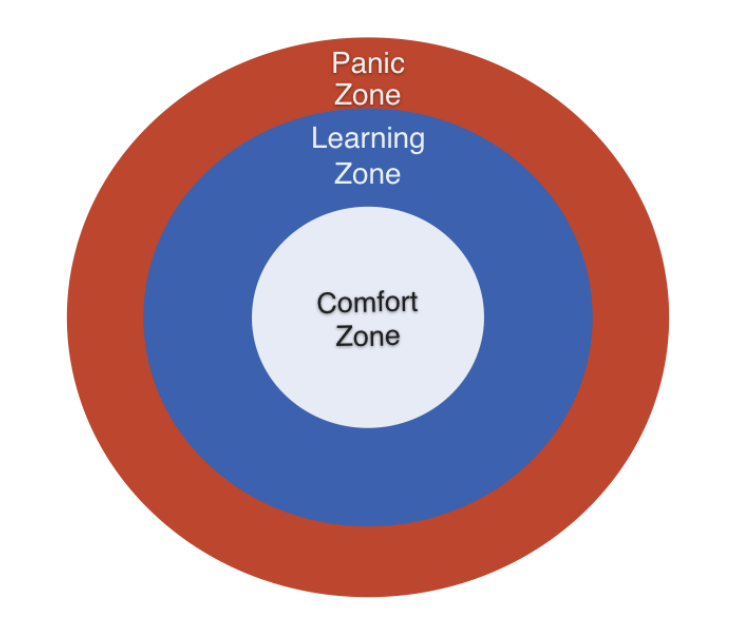
As a clinical supervisor, it is vital to help our supervisees move into their zones of proximal development, or that learning/experiential space just beyond their comfort zone (CZ)¹. But in order to do so, the supervisee’s current realm of abilities and limitations needs to be well-defined. This entails figuring out when they are at their best, how they conduct a typical session, what parts of them shines through, and how effective they are in aggregate. In other words, supervisors need to first help their supervisees figure out the bounds of their CZ so they can begin to push beyond it.

Supervisees must regularly pose questions to themselves such as, “What am I used to doing in sessions?” or “What did I do well” or even ”Was there something I did or said that stands out which might have contributed to the development of my client’s progress?”

Like what you are reading? For more stimulating stories, thought-provoking articles and new video announcements, sign up for our monthly newsletter.

We get comfortable with what we do well. Naturally so. The only problem is, if we fail to take the steps, our comfort zone can become our hell zone. What was once helpful with a particular client or type of client can become problematic or ineffectual. Think about your parents. If you were blessed with good enough parents when you were little, imagine if they used the same cuddly warmth and nurturing tendencies with you when you were a teenager. That wouldn’t have worked. You would have rebelled with angst. Past attempted and seemingly successful solutions can become today’s problems.

Here’s one of the axioms I have come to rely upon which defines the bounds of my current comfort zone (CZ): Provide clear and playful strategies to clients at the end of each session.

Over the last few years, I found myself drawn to being more playful and improvisational. This wasn’t how I used to be. I was constantly plagued with the question, “Am I doing this right?” Then I begin to realize that once I freed myself up to be more playful, I felt more flexible and less certain. This new mindset was unsettling and shook things up for me.

Other practitioners’ CZs that I’ve come across are founded in the following axioms:

“Be attentive and follow a clear treatment protocol.”
“Explore a person’s strengths and resources.”
“Develop clear treatment goals from the beginning.”
“Able to attune and empathize with my clients.”

First, and as noted above, it is critical that as supervisors, we help our supervisees to regularly ask themselves, “What did I do well?” “What stands out that I contributed to the development of my client’s progress?” This shall be your comfort zone.
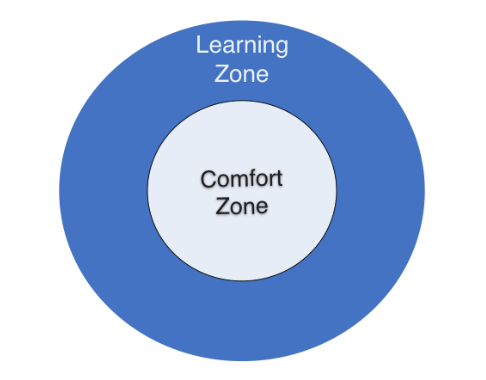
Second, we need to help our supervisees to stretch out of their comfort zones and move into a less comfortable terrain that I call the learning zone (LZ). Our field has become obsessed with figuring out the how to improve, and less on taking the time to help individual practitioners figure out the what to improve. We need to get the sequence right. Figure out the what before the how. Especially in the realm of what we call clinical supervision, the supervisor plays a critical guiding role in helping to shape and identify learning objectives that are not only personalized, but ever evolving through the professional’s development over time.

It’s important to base your supervisee’s LZ on two critical pieces of information:

1. Their overall clinical outcome data, and

2. Feedback from a coach who knows their work.

By looking at the supervisee’s aggregated outcome data, you can begin to spot any glaring patterns. For example, early in my profession, I was shocked to find out that my own clinical outcomes for clients presenting with relational issues were the poorest compared to other presenting concerns, even though I was steeped in the systemic perspectives. Your role as a supervisor is to point out what the supervisee can’t see and lead them in the right direction.

Here’s my own current LZ as a therapist: I would like to learn to help clients face the feelings that they avoid. It’s so easy to continue validating and, as a result, getting lost in the interaction with my clients, while missing the opportunity to go deeper and help them with their difficult and painful emotions.

Other common LZs that I’ve come across in clinicians include:

“I would like to learn to improve the way I start my sessions.”
“I would like to learn to improve the way I close my first sessions.”
“I would like to learn to improve the way I elicit feedback at the close of a session.”


An excellent way to think about developing your supervisee’s LZ statements is to do this sentence completion exercise with them: “As a therapist, I would like to learn to…” Take it as a given that they will be struggling with this for a while. Give them time for this. Avoid non-specific definitions like, “I want to improve my engagement skills.” Narrow down to something more concrete and workable.²

For instance, if your supervisee’s data suggests that many of their clients come only for one session and drop out after that, you may be tempted to state that their LZ is “…to improve my return rates after the first session.” I see this more as an outcome goal. That is, you want X to influence Y, and “Y” is your outcome goal. In this case, you need to specify X and work on this.

Typically, when practitioners try to identify their own learning objectives, they tend to identify theoretically specific areas to work on (e.g., how to better conduct two-chair work on the inner-critic; how to employ a solution-focused approach when working with exceptions). Meanwhile, after examining their aggregated baseline performance metrics (more on this in upcoming blogs) and watching samples of their sessions, what I often end up proposing that supervisees work on is more fundamental and maybe even less revolutionary (e.g., how they begin a session, how they develop an effective focus, how they deepen the client’s emotional experience and how they end a session).

Most therapists and supervisors I know are life-giving and affirming. However, instead of simply bolstering their esteem with praise and consolation (A common refrain that I hear supervisors give, “Well, your clients came back to see you, didn’t they?”) without actually helping them identify their learning zones, we are doing our therapists and clients a disservice.
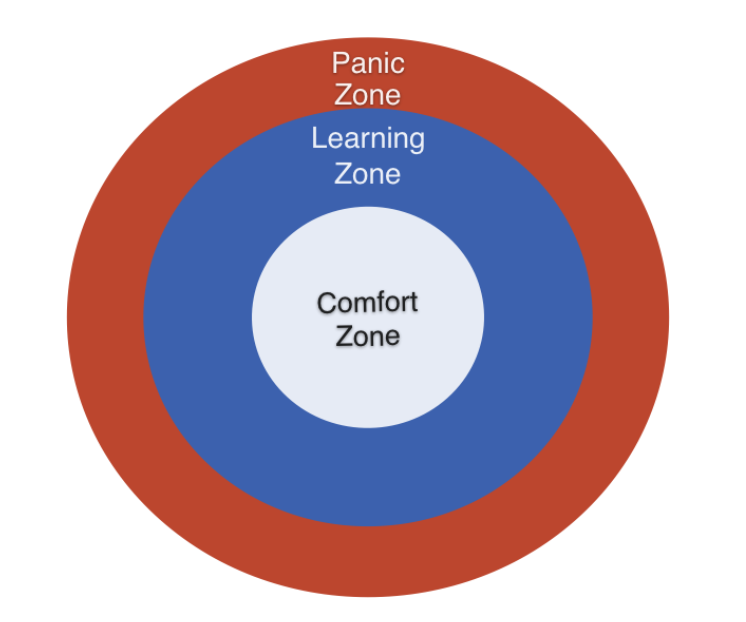
Finally, once we can identify our supervisee’s comfort zones and help them to move into their learning zones, we need to be able to guide them in articulating their panic zones (PZ). Panic zones tend to trigger feelings of being overwhelmed or may cause re-traumatization, which is not ideal for adaptive learning and personal growth. Panic zone materials are usually either too far a stretch in terms of the content to be learned, or the topic at hand might have triggered personal and/or professional ghosts of the past that have not been addressed.

Here are some common Panic Zones self-statements that I’ve encountered:

“Trying to learn what my supervisor says I should be focusing on, when I do not fully agree.”
“I know I should be working on difficult emotions like anger, but I do not feel ready at this point.”
“I tend to take critical feedback personally.”
“I just do not have the time and energy for this.”


It is important not to skip this step of helping your supervisee to identify their PZ. Doing so can help to remind them what not to do, or what not to focus on at various phases of their professional development.

Our circle of development is not static; it’s dynamic. If there is movement and directionality in the supervisee’s development, what used to be learning zone material might evolve to into the domain of the comfort zone. Likewise, what was previously panic zone materials can shapeshift into the realm of their learning zone.

The aim of helping our supervisees in figuring out their boundaries of their comfort, learning and panic zones is to clarify, magnify, and guide your supervisee’s messy and non-linear of professional development².

In the next blog post, I will address the critical value of teaching your supervisees to systematically monitor their clinical progress and how to use it beyond simply an assessment tool.

P.S.: My collaborators and I know how hard it is to figure out the key learning domains that therapists can spend their time and effort to deliberately practice. This is why we turned to what cutting edge research has to tell us, deconstructing the therapy hour, and we developed a comprehensive guide called the Taxonomy for Deliberate Practice Activities (TDPA) (Therapist’s and Supervisor’s version) (Chow & Miller, 2015). This is expanded upon in our forthcoming book, Better Results: Using Deliberate Practice to Improve Therapeutic Effectiveness (Miller, Hubble, Chow, 2020). But for now, if you are interested to receive a copy of the TDPA worksheets, drop me an email.

References

Chow, D. (2017). The practice and the practical: Pushing your clinical performance to the next level. In D. S. Prescott, C. L. Maeschalck, & S. D. Miller (Eds.), Feedback-informed treatment in clinical practice: Reaching for excellence (pp. 323-355). Washington, DC, USA: American Psychological Association.

Chow, D. (2018). The first kiss: Undoing the intake model and igniting first sessions in psychotherapy. Australia: Correlate Press. 

How to Maintain Your Therapeutic Dignity with Blood Dripping Down Your Chin

When we moved from Dallas, Texas to Fayetteville, Arkansas back in 1993, I quickly realized that any therapeutic anonymity I'd experienced in Texas was a big “not happenin,” that is unless I wanted to hole up in my house and never partake of food, fun or the festivities that went on in my lovely new hometown. The place was too small and just Southern enough where your business wasn’t just yours.

Now, after practicing 26 years in Arkansas, I'm far from reclusive so I regularly run into people I’ve seen as patients. I’ve been aware of how running into one another in public might impact their relationship with me and any work we did together, but often it was the result of simply living.

Like what you are reading? For more stimulating stories, thought-provoking articles and new video announcements, sign up for our monthly newsletter.

I'd been in Arkansas for about four years when I auditioned and earned the role of radical feminist and socialist Emma Goldman in the vaudeville musical TinTypes. I came on stage at one point in roller skates, singing raucously and playing violin…badly. I worried a bit, “Does anyone really want to see their therapist doing that?” When I played the passionate Desiree in Little Night Music, a patient told me they had to quit seeing me, “Because you kissed another man.” I explained about how kissing on stage is not really kissing, and we looked into her feelings. My son had a horrific tantrum at a toddler birthday party that violently came to a halt when his very hard head bounced off my lip, causing blood to spurt all over me and him. And of course, the story in my head became, “Hmmm…are those moms I’ve seen questioning my competence?”

It's like trying to live your real life while also retaining some amount of therapeutic professional respect and dignity—in roller skates and with blood dripping down your chin.

Since that fateful afternoon, I've taken even more risks—and hope that the ethical disclosure gods don't chew me up and spit me out. For several years, I've had a blog and a podcast and I'm quite open there as well. I respect that this isn't everyone's cup of tea. And might not, depending on your theoretical orientation, sound like good, responsible practice. But I've come to believe that we as therapists may be unintentionally enabling the silence of mental illness stigma by not being more up front about our own struggles.

Don't get me wrong. I use discretion. I go many a day without saying a word about myself. My job is to listen, to hold, to contain, to suggest, to educate, and to guide. However, I've revealed that I went through a divorce when I think it will be helpful. Actually, two divorces. But that's not the point. I've also disclosed that I have performance anxiety, panic attacks, and a history of anorexia, again, when I think it's helpful for the patient. And I reveal that I've been on both sides of the couch—as patient and psychologist.

The criteria? If it's truly helpful to the patient and not about some need I have to “share.” What I've experienced is that my openness is respected. My vulnerability and risk—helpful. People now tell me, “Your openness about your own vulnerabilities gives me more permission to do the same.”

This all came dramatically to the fore two years ago, when I presented in a local This Is My Brave show. If you don't know this organization, it was begun by Jennifer Marshall, who'd been blogging anonymously about her bipolar disorder for years. It was only when she came forward—as herself—that her blog's audience skyrocketed. And she realized that her vulnerability mattered. The organization now hosts programs both nationally and internationally, featuring people with mental illness telling their stories to a live audience.

When I agreed to do it, I thought it wouldn't be anything. I'd already been writing about my anxiety. So, what could be difficult about it? Once again, my own running narrative was ill-conceived. It was quite emotional. And hard. Yet I'm so glad I did it. I've revealed my own vulnerability, my own passions, and my own struggles. Bloody chin and all. 

A Tale of Two Cars: Interpreting Therapeutic Play

Sam came to our session with two wooden cars he had made in occupational therapy. When I asked hi how things were going, he made a few comments about not wanting to return to his father and stepmother’s home. He seemed pensive and sober, but had little more to say. Instead, he seemed to be increasingly absorbed in playing with the wooden cars—one a larger Model T, and the other a smaller “Buggy.”

Like what you are reading? For more stimulating stories, thought-provoking articles and new video announcements, sign up for our monthly newsletter.

Like many 12-year-olds, Sam was not especially fond of talking, particularly about the problems that had led to his hospitalization. I made some additional attempts to engage with him verbally, but eventually I, too, became more absorbed in what Sam and the cars were doing. Sam was steering them wildly around the top of my desk. Sometimes one or the other, or both, would come screeching to a halt, right at the edge of the desk, which seemed to be a cliff. At other times, they interacted with each other, and, on a couple of occasions, the little one pushed the big one off the cliff.

As I was drawn more deeply into the drama that Sam was playing out, I began to think about our session somewhat differently. At a minimum, Sam’s involvement with the cars seemed to reflect, among other things, the discomfort he had just displayed about discussing his problems. Maybe the best thing to do was to drop the questions and engage with Sam around the play. I started narrating what the cars were doing: “Hmm! The big one is towing the little one. . . Now they’re spinning around each other. . . Wow! They hit each other that time!”

It felt like Sam and I were more engaged now. But what, exactly, was going on here? The interplay of the cars seemed to be more than a mere resistance or fantasy about driving. What was being played out between the cars was intense—a dynamic and developing relationship of some kind. It appeared that Sam was using the cars to express something emotionally significant in the medium of play. An interpretation seemed to be called for.

Psychotherapists have had mixed feelings about interpretation throughout the history of the field. In the early days of psychoanalysis, Freud and others believed that insight gained through interpretation was the primary curative factor in psychotherapy. It was generally held that in order to be effective, an interpretation had to be accurate in all its details. However, Edward Glover later pointed out that while many of the interpretations reported by earlier authors had probably not been entirely accurate, those same interpretations had often, apparently, been quite effective. Furthermore, evidence was starting to accumulate that a good therapeutic relationship was more helpful to patients than intellectual insight gleaned through interpretation.

Nevertheless, some sessions—like the one with Sam—do seem to involve an alternate form of meaning-making in which interpretation may play a useful role. And so, in this situation I found myself pondering just what Sam might be trying to communicate to me.

Perhaps the little car was Sam and the big car was me, trying to get him to talk. But the intensity of Sam’s play suggested that the dynamics within his family were more likely to be relevant. One possibility was that the big car was Sam’s father—but most of Sam’s conflicts were with his stepmother, whom he resented for taking the place of his biological mother. Indeed, Sam and his stepmother had been colliding into each other and spinning around in circles for years. I ventured an interpretation:

“The little one and the big one are pushing against each other, kind of like you and your stepmom fighting with each other.”

“Mm-hm.”

Not very enthusiastic. Maybe I had jumped in too quickly. Or maybe the interpretation that I had ventured was off the mark. The big car might be Sam’s biological mother. She had been described as physically and verbally abusive, abandoning Sam with his father on several occasions. After custody was given to Sam’s father, Sam’s biological mother had been involved with Sam only sporadically, staying away for long periods of time and intermittently making promises to visit Sam but not following through.

More play. Now, the big car drove headlong off the cliff and crashed into the canyon below. Then, slowly, it returned up a mountain road, back to the top of the cliff.

“Gee, it drove off the cliff and then it came back!”
“No. This is another car.”
“Ahh!” I said. I had the information I needed.

“You know what I think?” I said. “I think what’s happening in your family is like what’s happening with the cars. When the big one went off the cliff, the little one was left alone, like you were left alone when your biological mom went away. Then another big one came, like your stepmom; and now you and your stepmom have to try to get along with each other and help each other, like the two cars towing each other. But it’s really hard because you still miss your biological mom. You don’t know when you’ll see her again.”

“I don’t think I’ll ever see her again.”
“Really?”
“Yeah.”
“It’s hard for a kid to lose a parent.”
“I think the more I don’t see my mom, the more mad I get.”

We talked about this. He expressed anger that when he had recently said he wanted to get in touch with his biological mother, his father and stepmother had replied that this was not a good idea. I suggested we discuss it with them in our next family meeting.

That night, Sam had his first good evening in the hospital, and over the next few days he shared, first, his anger, and then his hurt, about his biological mother’s many failures to visit him.

In the next session with his parents he called his stepmother “Mom” for the first time. At the end of that meeting he gave her the big car and said, “You can take this home.”
 

The Instant Replay: Reliving a Critical Moment

In doing psychotherapy, I sometimes feel like I am wandering with my client through a dense forest of brush and brambles, trying to find a pathway out. Often there is no clear direction or clue, and the way ahead may be difficult. However, there are also times when I have found it particularly helpful to ask my client to return with me to a salient event in his or her life and look at it once again in considerably more detail. This might involve, for example, reexamining a triggering experience or an incident that brought the client into therapy. I call this process of reexamining an earlier event—exactly as the client remembers it happening, moment by moment—the “instant replay.”

Like what you are reading? For more stimulating stories, thought-provoking articles and new video announcements, sign up for our monthly newsletter.

You might do this when the client first brings up such an experience, but often it is best not to do so right away. The event may be too raw and painful when it first comes up in therapy; and additionally, you may not yet know enough about the client to grasp the full significance of this landmark in the larger terrain of his or her life. Consider the following case.

Beth, a fifteen-year-old, had been admitted to the hospital due to explosive outbursts, depression and suicidal ideation. Her anger toward her family seemed inexplicably intense, and her worst outbursts were directed toward her mother. For example, on the day she was admitted to the hospital, she had planned to run away, and when her mother found out and tried to stop her, Beth had threatened to “deck” her mother, had refused to return home and had threatened to jump out of the car when her mother tried to bring her back. When asked about her anger in family sessions with her mother—and sometimes in individual sessions as well—Beth would withdraw into a seemingly impervious and almost catatonic silence. When she did talk about her anger, Beth expressed feeling criticized, and stated a belief that everyone in her family blamed her for all the family’s problems, including the breakup of her mother’s marriage to her stepfather, and the fact that her biological father had stopped all contact with her. She was not convinced by attempts at reassurance that her mother and stepfather had had their own marital problems and that her biological father had stopped contact not only with her, but with other family members as well.

As time went on, another side of Beth began to emerge. Her mother revealed that at times, Beth had written letters expressing unbearable remorse about her behavior and a desperate wish to change. One letter, which was four-pages long, was entitled “The Unconditional You.” It described a story from a book Beth had read about a girl who was ungrateful and cruel toward her mother until she realized with shock that her mother still loved her unconditionally. The letter went on to express Beth’s belief that she and her mother were like the girl and mother in the story. Beth’s mother voiced exhausted confusion about letters like this and the fact that her daughter could still explode into rage toward her, even after writing them. Beth’s mother seemed to have difficulty accepting that her daughter could have such seemingly contradictory feelings.

At about this time, Beth opened up, first in group and then in individual therapy, about her history with her biological father. He and her mother had separated when Beth was very young, but he had continued to visit Beth, and had remained close with her until he moved to another state when she was 11. They had promised to write each other every week. They did so for a while, but a few months later he remarried and without explanation stopped responding to her letters. Beth’s behavior worsened after this.

The day after she told me about this, I found Beth crying in her room when I came to meet with her. She had spoken to her mother on the phone and was feeling hopeless about ever returning to her family. We talked about the phone call, and then I told her that her mother had showed me the letter about the story she had read. I said that I knew how badly she wanted unconditional love but that I believed that her mother couldn’t always give her this kind of love because her mother was dealing with her own problems.

At this point, the time seemed right to do an “instant replay” of the events that had brought Beth into the hospital. I reminded her of what had happened the day of her admission—how her mother had tried to stop her from leaving, how they had argued, and how she had exploded and eventually been taken to the hospital. I asked her to tell me what they had actually said to each other and we reviewed their argument, step-by-step and word-for-word. She described how her mother had attempted to talk her into returning home. Beth had refused, and after more attempts to persuade her, her mother had finally grown exasperated and said “You can just stay [away]! I’ve tried for seven years, and I give up!” That was the moment when Beth exploded and threatened her mother.

“It sounds like it really upset you when you mother said that. It really hurt you and made you angry.”

“Yes,” she said.

“It scares you when your mother says things like that.”

“Yeah.”

“Can you say why?”

“Because I’m afraid my mother is going to leave me like my dad did.”

This was the first time Beth had ever explicitly made a connection between her behavior toward her mother and her hurt about her father.

In the next few sessions, we clarified and extended this insight. Working individually with Beth, I pointed out that when she had felt hurt by some of her mother’s actions, the hurt had been supercharged by the past pain related to her biological father’s rejection. In parent work with Beth’s mother, I explained that Beth’s battle for distance was accompanied by a fear that she would lose her mother completely, leading her to do things that forced her mother to take greater parental control, while simultaneously pushing her mother away. And in family sessions, we explored together how Beth’s feelings about both of her parents had come to be focused on her mother. As Beth said to her mother in one of these sessions, “It’s easier to get mad at the parent who is there for you.”

Somewhere within us, painful memories are frozen in time. Unexpectedly, they may leap to life, opening old wounds. But under the right conditions, we can gain the upper hand over time—revisiting and re-running those painful experiences, freeze-framing the exact moments when we gave them power, and clearing a path to healing.
 

The Shape of Hopelessness

Mr. C doesn’t say he is sad. He isn’t crying. But his face is like stone, draped in a small disconnected smile, and my own insides have turned to lead. Hopelessness clamps down like a vise. I am sitting at the foot of his hospital bed in the nursing facility where I provide psychiatric consultation. Mr. C rarely leaves his bed, around which he insists the thin pink privacy curtains remain closed to wall off the three other men who share his room. The social worker had asked me to see Mr. C because he’s due to be discharged, and she’s been worried about him. Even the air in the room feels heavy. It’s hard to move or even breathe without hope.

Mr. C is only in his early 40’s, but diabetes has taken a part of each foot, and he can no longer work as a chef or care for his mother, who has dementia. “Now I’ve got nobody. Even when I was taking care of my mother and had a job, I could barely leave the house because of my anxiety, and I let my feet rot,” he says. “I’m afraid I’m not going to do the basic things to take care of myself. There really isn’t any hope for me.”

Like what you are reading? For more stimulating stories, thought-provoking articles and new video announcements, sign up for our monthly newsletter.

My thoughts start to churn. There is no way I can help this man. His problems are not solvable. What I have to offer is too puny, and my own background too sheltered. I even notice a small spark of anger at him rising inside me. I want to leave, to retreat to the comfort of my office and sit with thoughts unmarred by unbeautiful things.

I’ve had the luck of meeting a master of empathy, a meditation teacher I met last spring on a day of silent retreat. Attempting to focus on my breath as I sat on my cushion, my mind had erupted with grief over a recent personal loss. The pain was disorienting, concentration all but impossible. My teacher’s advice was simple: let the feelings come, notice them. Her words were ordinary, but her compassion was not. She received my sadness without flinching, letting it vibrate within her as she held my gaze and smiled with warmth and calmness. I felt my connection with her creating another dimension that allowed my sadness to find the space to take its own shape; I did not have to carry the pain alone. It opened like a quilt held between us, and I could see it for what it was and only for what it was. My pain was no longer the sign of inevitable and unending suffering; it was just a feeling I was having in that moment.

Now, as I sit with Mr. C, I gently shake myself from the trance of hopelessness and the trap of my own ego that sustains it. I can’t solve this man’s problems, but that is not shameful. His problems are severe and overcoming them will require a lot of hard work from him. He may or may not be willing to do that work. I can offer him empathy, compassion, and guidance. Those things might not be enough, but then again, they just might be. As I bring myself back to this moment at the foot of his hospital bed, I recognize that within an experience that feels like a burden is a remarkable privilege: that of being close to another human being.

“You can’t see things getting any better. You don’t have your mother to take care of anymore. You won’t have your job, and you are worried that you’ll give up fighting the anxiety. You remember how hard it used to be, and it’s going to be even harder now. That must feel utterly overwhelming, and you are probably terrified and feeling intensely hopeless. Is that right?”

He nods somberly, holding my gaze, and tells me about the spells that come down on him in the afternoons when things quiet down here at the nursing home. The feeling of tunnel vision, of unreality, of feeling almost outside of his own body.

“I have such a sense of sadness as I hear you speak about this,” I tell him. “And at the same time, I am grateful that you are sharing this with me. I admire the strength it takes to be honest about what you are facing. And I can see how believing that things are hopeless might almost feel like a kind of relief. You can stop fighting so hard.”

He almost interrupts me, showing more life than I’ve seen him show to this point, “Yes! It’s so, so hard. I hate it here, but all I want to do is curl up in this bed and hide from everything!” And for the first time, he starts to cry. As his tears fall, he asks me earnestly, “What can I do? Can you help me?”

At this moment, something shifts. He isn’t falling back into hopelessness and helplessness. He is asking me for help. In fact, I have plenty to offer him. “There are powerful tools to address your anxiety,” I tell him. And gently, keeping tabs on his level of interest, I explain how avoidance locks anxiety in place, and how exposure therapy can retrain the mind to experience anxiety differently. “If you want,” I offer, “I could show you how to systematically challenge your fears. It’s very hard work, but it could open a lot of possibilities for you. Would you want to work in that direction?”

“Yes, I’d like that,” he replies.

Hopelessness is a horrible feeling; it is no wonder we flinch from it. When we welcome it between us, it becomes all of what it is, and only what it is, and there is room for something else that looks a lot like hope. 

Three Types of Knowledge Clinical Supervisors Need to Know

In my previous article, Seven Mistakes in Clinical Supervision, I highlighted common pitfalls we make in our pedagogy of choice in professional development.

In this blog post, I will provide a pathway out of the first of the seven issues, Too Much Theory-Talk, by suggesting the regular use of recording and reviewing of the supervisee’s clinical work.


Clinical supervision typically entails case discussion, case conceptualization, theoretical formulation, treatment planning/implementation and a myriad of therapist/client-related variables. Most clinical supervision sessions are constrained by a prescribed theoretical construction, dictated by both the supervisor’s and therapist’s theoretical biases. When a “stuck” case, one in which clinical progress is not forthcoming, is being reviewed, it is important that the supervision have a sound base of content knowledge of a client’s presenting concerns (e.g., depression, obsessive-compulsive disorder, complex trauma, borderline personality), a critical form of guidance related to process knowledge (i.e., the moment-by-moment engagement between client and therapist), and finally, conditional knowledge (i.e., how the supervisee/clinician may work with a client who is depressed in the context of grief, compared to someone else whose depression results from domestic violence)¹. Even in our individual pursuits as therapists, those moments spent outside of our immediate supervisory role, much of our time spent learning to become more effective clinicians is anchored in the “content knowledge” domain. While it may be necessary, this isn’t sufficient.

Like what you are reading? For more stimulating stories, thought-provoking articles and new video announcements, sign up for our monthly newsletter.

When there is a gap in the supervisee’s clinical knowledge, the supervisor can impart specific content knowledge by adopting a didactic stance and providing “just-in-time” relevant corrective information. In addition, especially for beginning practitioners, supervisors can provide relevant reading materials and resources.

However, in order for supervisors to provide relevant and useful feedback and guidance regarding process and content knowledge, those more complex and dynamic elements of the therapeutic encounter, it is not enough to simply talk about the content of the case from the removed position of clinical information-sharing. Much like other fields (music, sports), it’s important for the supervisee to record their therapy sessions so the supervisor may provide feedback about actual in-the-moment performance with particular clients, rather than feedback about a perceived performance by the supervisee. Feedback is useful when it’s based on well-defined objectives, observables, and specifics.

Take the renowned basketball coach, John Wooden. In an analysis of Wooden’s teaching practices, researchers found that 75% of his active coaching time consisted of “discrete acts of teaching . . . pure information: what to do, how to do it, [and] when to intensify an activity.” Slightly less than 7% of his time was spent dispensing compliments or disapproval².

As an aside, it is important to note that most theories are developed after the fact. As Gregory Bateson once said, “The theorist can only build his theories about what the practitioner was doing yesterday. Tomorrow the practitioner will be doing something different because of these theories.”

The field of psychotherapy is less about “specialized” technical knowledge, than it is about deep relational mastery to resolve the client’s (and occasionally, the clinician’s) emotional wounds. We need to move beyond content knowledge and design our learning to improve our process and conditional knowledge. Recall when Carl Rogers (1939) said “…A full knowledge of psychiatric and psychological information, with a brilliant intellect capable of applying this knowledge, is of itself no guarantee of therapeutic skill.”

In the next blog post, I will tackle the second issue raised in the article Seven Mistakes in Clinical Supervision, the “pat-on-the-back” phenomena in clinical supervision.

This blog post was adapted from the original titled: Three Types of Knowledge and Why This Matters in Psychotherapy.

References:

(1) Chow, D. (2017). The practice and the practical: Pushing your clinical performance to the next level. In D. S. Prescott, C. L. Maeschalck, & S. D. Miller (Eds.), Feedback-informed treatment in clinical practice: Reaching for excellence (pp. 323-355). Washington, DC, USA: American Psychological Association.

(2) Gallimore, R., & Tharp, R. (2004). What a coach can teach a teacher, 1975-2004: Reflections and reanalysis of John Wooden’s teaching practices. The Sport Psychologist, 18(2), 119-137. doi:10.1123/tsp.18.2.119 

Chocolate, Jalape

On those two nights after leaving school following back-to-back, eye-opening and unsettling experiences in my graduate counseling classes, I had a strange feeling that I had arrived at the intersection of possible culture blindness, social discomfort and the questioning of my own clinical supervisory competence.

Like what you are reading? For more stimulating stories, thought-provoking articles and new video announcements, sign up for our monthly newsletter.

I reflected back on two absolutely unrelated but clearly convergent events in two separate graduate counseling classes on back-to-back nights—ethics and psychopathology. As it was to turn out, challenging, unanticipated and enriching lessons in diversity were in the making.

Scenario one: My back was to the class as I was about to write down their responses to a question I had posed. One of my students, located in the far back right corner of the classroom had offered a verbal response, and as I turned to make eye contact I wasn’t quite sure where the voice had originated. My eyes landed on one particular African-American woman who I thought had made the comment, but quickly the student sitting next to her, also African-American, quipped “it was me, but there is a lot of chocolate in the room.”

Instantly embarrassed, I did my best to conceal the painful feeling of embarrassment and the deeper thought that, in that moment of failed echo-location, I had conveyed the message that the voices of all black people sound alike. Or, had I?

Scenario two: Occasionally, I joke with students about the snacks they bring to class. A Latina student in the back of the room offered up a bag of potato chips, across the front of which was a green elliptical design that on quick glance I thought was meant to be a jalapeño. I thanked her and said, “I don’t eat jalapeños.” Just as quickly as in the first scenario, this student shot back, partly in humor but also likely in defense, “did you assume these are jalapeño-flavored chips because you know I’m Mexican?”

Still reeling from the chocolate event of the previous night, I was once again embarrassed, thinking that I had somehow awkwardly fumbled insensitively across a cultural divide, falling flat on my face in the process.

I knew that these were learning opportunities in the making, both for myself and my counseling students, who had each taken our program’s multicultural course with Judi Bachay, an international scholar and diversity expert here at St. Thomas. But, there is nothing quite like a live-action, and as Irvin Yalom puts it¹, “here-and-now experience,” for conveying an important concept. And while I made a nominal attempt to address my concerns in class each time, I could tell that the two students were equally uncomfortable.
Was it my cultural insensitivity that provoked their humor-cloaked defensive comments, or over-sensitivity to their own racial/cultural positioning in my class…in society? In either event, I believed that as their (white) teacher, I needed to do my best to find out, for them, for myself and for the class.

I was indeed able to speak in private with each of these two students on separate occasions and discovered the following. The formative educational years of the student in the first scenario was spent alongside white peers, where a sense of racial discomfort led to concern that she would be judged primarily by her skin color, rather than the qualities of her character. Racial invisibility as Darrick Tovar-Murray suggests², was in a sense, a psychological survival strategy. During her transition to college, the student in the second scenario attended classes in a less-Latinx environment compared to earlier years. She became less comfortable with her Mexican roots, often trying to conceal her accent—a different, but no less poignant form of invisibility. She lived with the fear of being called a chola.

I felt sadness for each of these students who grew up believing they had to trade elements of their racial and cultural origin for the security, or perhaps false security, that invisibility falsely promises. I have never felt that pressure—part of my privilege, I guess. I shared with each of them the guilt I felt, perhaps white guilt, and my concern that I had contributed unknowingly to their experience of invisibility. But in retrospect, perhaps their respective protestations were statements of visibility, and refusals to remain hidden. Lessons were learned on both sides of the divide those nights.

References

(1) Yalom, I. (2017). The gift of therapy: An open letter to a new generation of therapists and their patients. New York: Harper Perennial.

(2) Tovar-Murray, D., & Tovar-Murray, M. (2012). A phenomenological analysis of the invisibility syndrome. Journal of Multicultural Counseling and Development, 40(1), 24-36. 

Money Matters in Therapy

Money is often an emotion-laden topic that triggers many associations and meanings for both the therapist and the client. As a therapist starting out in private practice, I had to stumble and fumble my way around decisions regarding setting session fees, enforcing or waiving my cancellation fees and other money matters. I am sharing with you my lessons learned—and what better way to learn than from the mistakes I made.

Mistake #1: Adhering to theory or rules, even when it feels "wrong" (i.e., not aligned with my own personal values).

Something that is ingrained in us as therapists, especially for those of us who are trained psychoanalytically, is to "keep the frame" and "set boundaries." Stating and holding clear boundaries within the therapeutic relationship creates safety for the client. This could be translated rigidly into not negotiating around our fee, or enforcing cancellation policies by the rule. However, depending on the client’s situation and their personal history, this can actually backfire. It can negatively affect the client and the therapeutic relationship, especially if it is experienced by the client as punitive, shaming, unfair/exploitative or controlling. There must be some flexibility in all matters to accommodate therapists’ own values and clients’ needs, which translates into a willingness to reconsider session frequency, waiving cancellation fees, or negotiating around the fee on a case-by-case basis.

Mistake #2: Not examining and having clarity around my own issues with money/fees.

It is important to examine and have clarity on our own internal conflicts and issues around money matters, as well as to know the limits on our flexibility (e.g., what is the lowest fee that we will be comfortable with for a particular client and their situation?), especially when trying to establish boundaries and set a framework with a client.

I had to consider several conflicting needs and values when establishing my regular rate for therapy sessions. I do value my experience, training and what I have to offer as a psychotherapist, and a therapist with a higher fee is often perceived as offering “higher quality” services. At the same time, I think therapy is quite expensive, especially since weekly (or more frequent) sessions are usually recommended. People belonging to lower socio-economic classes face more stressors, therefore making it even more necessary to offer affordable mental health services. Despite my desire to make my services affordable and accessible, I have a strong aversion to being paneled with insurance companies. With so many competing values, initially I was often riddled with guilt, resentment or doubt as I tried to establish a fee that was “just right.” I have finally found a formula (using a combination of a regular rate, sliding scale fees and offering low fee and pro-bono slots via openpathcollective.org that works well for me, embodying the maxim “No size fits all.”

Scenario

What follows is a description of a scenario from when I was just starting out in private practice that highlights both Mistake #1 and Mistake #2 mentioned above:

The client and I agreed on a fee of $120 during the initial free consultation. At the end of the next session, the client told me she’d just found out that her insurance did not cover her sessions (she had a very high deductible) and asked for a reduced fee. Since we were already at the end of session (and keeping in mind that I had already provided her with a free initial consultation), I said that she had to pay $120 for this session, and that we could work out a lower fee moving forward. She asked for a fee of $80, and I said, “That is too low.” (yes, I have to admit that I actually said that). The client wrote a check for $120 for the first session and perhaps not unsurprisingly, did not return to therapy.

What played out in the above scenario were my own unresolved issues around money, and unfortunately these negatively impacted the client.

  • I was not completely okay with having provided her with an initial free consultation—I was holding some resentment, and thinking that the client now owed me or should feel obliged to me.
  • I was unsure about how low I could or should slide my fees. I was conflicted between what I had learned about enforcing boundaries, and my own instinct to be flexible in accepting lower fees. This resulted in me responding “That is too low” to the fee suggested by the client. This was shaming to my client, especially given her history of having grown up very poor.

Mistake #3: Not taking into account a client’s culture, history/background and relationship with money.

What I have seen replayed again and again, is that a client's relationship with money and how they approach the issue of the fee is often an extension of their psychology, and therefore, a clinical issue to be examined in therapy in order to help the client navigate more skillfully around such matters. Sometimes their relationship with money is shaped by culture—I have some clients who are bent on trying to negotiate a lower fee, although they have very high incomes—they cannot imagine paying so much “just” for therapy. Sometimes it is shaped by their personal history. I had another client who requested a lower fee due to her many medical expenses and I agreed, only to learn through the course of therapy that this client is a multimillionaire with an inherited fortune. Having grown up with financial scarcity and hardship, the client found it hard to spend or truly enjoy her newfound financial abundance, and she was always looking for a “good deal” or discount. If I, as the therapist, merely see such clients as “manipulative” or if I am offended by their requests and fail to consider the client's context and subjective experience, it is a signal for me to look into what is being triggered for me. I have learned that I must be mindful and navigate such issues around money with skill and sensitivity to the client's experience. In other words, letting the client know that I am open to discussing or negotiating the fee, but that it is important for me to first understand more of their history and their subjective experiences and relationship regarding having or not having things.

Guidelines

Below are my own personal guidelines around money matters in therapy:

  • Rules (such as charging for missed sessions) are set and enforced based on clinical implications and the client's best interest, and not merely based on business considerations.
  • Own my own issues (including privilege or scarcity) around money, examine my own relationship and views around money, and gain clarity on my limits in flexibility regarding session fees, cancellation policies and other money-related issues.
  • A client’s relationship with money (their meanings and associations around money, rather than simply their income or wealth) is an important factor to take into consideration when discussing and setting fees.
  • What works well for one therapist may not work for another. Differences may be due to business goals, theoretical orientation, populations served, and personal style/values.
  • Above all, be authentic.

I would like to end this article with a scenario that was posted on an online group for therapists that I participate in, that started me thinking more on this topic and prompted me to write this article. The scenario went as follows: If a person you were working with needed time off from therapy for a couple of months due to a short-term schedule conflict, but didn't want to lose their appointment space, and they offer to pay for that space until they were able to return (you have no other available appointments), is it ethical to accept that offer? The question elicited some emotionally charged but widely differing responses from the therapist group members. How would you handle this situation?

We’d love to hear your responses. Feel free to post to our facebook page here.  

When the Clinician Becomes a Client

After my husband and I moved to our new home state, I found myself coping poorly, to put it mildly. Hundreds of miles from our friends and family, unable to find work and struggling to start a family, I found myself spending entire afternoons lying on the floor of our would-be nursery. I had no appetite, snapped at my husband over every minor annoyance, and was consumed by utter hopelessness.

Like what you are reading? For more stimulating stories, thought-provoking articles and new video announcements, sign up for our monthly newsletter.

But when my husband gently suggested that I seek professional help, my defensive glare could have sliced him in half. Me go to counseling? Had he forgotten that I was the therapist here? I knew what to do; I didn’t need anyone’s help.

But after another month of being impossible to live with, I conceded. I found a clinician who shared my therapeutic approach, swallowed my pride, and stepped into her office feeling completely powerless.

I quickly discovered that my therapist had no idea what to do with me. She also believed that I already knew everything I needed to know to cure my own symptoms, and spent most sessions starting psychoeducational sentences, then cutting herself off.

“Here is a sheet with some common types of cognitive distortions—although I’m sure you already know them…Let’s try keeping a thought record. In the first column—well, you don’t need me to explain that.”

To make matters worse, I was a horrible client. I had intentionally chosen a clinician with more education and experience than me, but the result was that every session felt like supervision with one of my old bosses. I felt the need to impress her, and struggled to discuss my symptoms honestly. When I didn’t offer her anything to work with, my therapist ended up talking shop with me, making me feel more than ever that I was in a work setting where my symptoms would be unacceptable signs of weakness.

After a few months, I stopped booking appointments. The feeling of discomfort must have been mutual, because my therapist never reached out to ask why I had stopped coming. I wondered to myself if this was a common experience, if those of us who are the most steadfast proponents of therapy and bear the emotional burdens of 20 to 30 people at a time, end up having the most difficulty accessing (or contributing to) quality treatment.

A Washington, D.C. area clinician I asked about this noted that she had long avoided counseling for the same reasons I had. “I am certain that working in this field has prevented me from seeking out treatment in times where I could have greatly used it,” she said. “I believe I didn’t seek treatment because of my own belief that I could ‘treat’ myself because ‘I know what I should do and not do.’” Another clinician, based in Massachusetts, confided that when she did seek out mental health treatment, differences in therapeutic approach between her and her therapist made her experience unsatisfying.

“[My therapist] was very approachable, patient and validating,” she recalled. “[But] what I found disappointing was that, in my work with my clients, I generally had items prepared as tools we could use to address challenges or present new perspectives and techniques, and that was not my experience in my own sessions. It had more of your stereotypical air about it where you sit on a couch and talk about your feelings, no preparation, just whatever the client brings. And my work being different, I had a harder time appreciating that and eventually discontinued my work with her.”

I only found one person who felt that being a clinician had improved her experience as a client. Mia DeCristofaro, a Florida-based LMHC, recalled seeking counseling early in her career, when concern for her clients escalated into unmanageable anxiety. “My fear of not doing a good enough job or someone getting hurt on my watch was really hard for me to manage at first,” she recounted. “But being in the field also made it easier to be a client, I think, because I knew what I expected for my own treatment, what I believed about treatment, and I knew how motivated I had to be for it to be effective.”

Perhaps if more therapists who have received mental health treatment were open about their experiences, other clinicians would not feel like professional failures for seeking counseling. Although it may be awkward to discuss, who knows how many clinicians—and their clients—could benefit from this transparency. “We take on a lot of pain in this field and, diagnosable or not, I think we need somewhere to safely manage our own feelings,” DeCristofaro said. “Even if a problem we’re going through isn’t related to our work, we should manage it so that it doesn’t impact our work.”

Maybe this shift in focus from reducing our own symptoms to better serving our clients is the cognitive key to getting more mental health professionals through a therapist’s door. But whatever your reason for going, be the brave one at work and start the conversation about your experiences; you may be surprised to find you’re in good company.

Is That a Monkey on my Back? No, It

I used to work with a guy named Tom Sullivan. Tom was an accomplished author, singer and inspirational speaker. Tom was blind and traveled the country with his various service dogs. They were seeing-eye dogs specially trained for more than a year to assist Tom in tasks like crossing the street, standing in a line and getting him through airports. These dogs were truly amazing in their devotion and their ability to keep Tom safe, and enabled him to have as independent a life as everyone else. The dogs performed very specific services and allowed Tom to travel on his own. I have also been introduced to hearing-ear animals that can detect an oncoming heart murmur or epileptic attack. These pets are amazing and crucial and are also highly trained. It is easy to state why they are necessary companions.

Like what you are reading? For more stimulating stories, thought-provoking articles and new video announcements, sign up for our monthly newsletter.

Sometimes it is too easy. At Register My Service Animal LLC, one need only confirm that the “dog or miniature horse,” or whatever, can perform a task for you. The pet does not have to be taken anywhere for a test but must be “stable, well-behaved, unobtrusive, and not pose a public hazard.” These are thin qualifications.

Now we come to the age of emotional support dogs. The airlines refer to these as comfort animals. As a psychotherapist, I believe that there are animals that bring a great sense of calm and comfort to their owners. They can quell anxiety or stress when it comes to flying. They can be the fur-ball antidote to depression. Severe extremes of these emotional issues are indeed disabilities, but let’s be real. How many of us in this profession are asked by our clients or friends to sign airline forms stating that one has a necessary service dog, when all they really want to do is get their dog across country either in the cabin avoiding the hull or just not pay the $75 or more extra to transport their pet?

Have I signed some of these forms? Yes, but only because I believed there was an honest need for that kind of assistance. Have I refused others? Yes, not because I felt they were scamming the airlines, but because there are many who just who just do not need their dogs, cats, monkeys, pigs, ducks—yes, all are permitted on the airlines—in order to get through a flight. Getting an Emotional Support Animal (ESA) letter is very easy. It states that there is a “special bond” between the owner and the snake or gerbil or whatever, and that the animal is very important in helping ease symptoms such as depression, anxiety, sleeplessness, PTSD, and more. If these animals can do all this, why do we need professional therapists or psychiatrists?

Psychiatrists can sign documents entitling one to a Psychiatric Service Dog (PSD). For some reason, no other animals are mentioned. The Americans with Disabilities Act distinguishes ESAs from PSDDs by the following: A PSD must not only respond to the owner’s request for needed for help but must be trained to recognize the need in the first place. An ESA need not be trained to perform a certain act—just have genuine therapeutic effect. A PSD is also allowed in public places most ESAs are not. Bring your PSD to a movie theater and that means there is no need to just desire popcorn. Your dog will have it ready for you as the movie begins. Clearly, I am exaggerating but there is a very thin line between emotional support and psychiatric support.

According the Department of Transportation (DOT), US passenger airlines transported an estimated 784,00 pets, 751,000 comfort animals and 281,000 service animals last year. American Airlines said it carried 48% more service/comfort animals this year from last. Has emotional need really risen that dramatically in one year?

Various “watch-dog” industries for the airlines have recommended that the DOT prohibit comfort animals and recognize only trained service dogs. The disabilities-rights groups put up a fight stating there is no distinguishing criteria. Is there really a difference between a hearing-ear cat that can alert their owner to someone trying to get their attention, and a comfort monkey who can wipe away tears of distress? I plead the 5th because the hate mail will surely come in.

What about the rights of other passengers? The Asthma and Allergy Foundation of America stated that airlines need to start enforcing new regulations that also protect these people. (According to the Centers for Disease Control, about 25 million Americans have asthma and more than 20 Million have allergies).

And what about those who are just petrified of anything with four-feet? My mother was scheduled to fly with me across the country from Philadelphia to Los Angeles. Once boarding the plane, she took one look at a German Shepherd, the size of a horse, who apparently could fit under a seat and stated she just would not get on the plane. She wasn’t kidding. There is no airline in the US that currently bans in-cabin support or service animals.

Are service animals needed? Absolutely, unless the person in need is traveling with a companion. Are emotional support animals needed? Sometimes, if the psychological issues are extreme. Must these animals be on the plane all the time? Absolutely not.

So, I figure my Mom and I are about halfway through Kansas in our drive now, thanks to the emotional support German shepherd that scared the life out of her. So, therapists, social workers, MDs and more, before you sign those emotional support letters, please really think about what your responsibilities are not just to your clients and doing a nice thing for them, but to the rest of the travelers who deserve your remote care as well.