How To Map the Toxic Impact of Social Media on Families in Therapy

Learn how to see. Realize that everything connects to everything else

— Leonardo Da Vinci

The internet in the late 1990s was exciting because you could research topics including sports, education, and entertainment and stay in contact with old friends. In retrospect, however, when working with adolescents at a local PHP and IOP, I/we ignored the impact of Myspace and other social media websites that encouraged cutting and suicide. We attributed the increase in behavior to peer influence and the impact of dysfunctional family relationships.

Today, social media’s algorithms and influencers have more of an impact on the family than we are willing to acknowledge. It has been argued that social media’s algorithms entice family members who use social media to spend more time on the app than with their own family or friends. As a clinician who works with families in private practice and schools, it has become increasingly clear to me that social media’s algorithms and influencers often occupy the “empty chair” in the family sessions.

The “Therapeutic” Power of Influencers on Family Systems of Care

It was evident to me while watching the hearings in Washington, DC a year ago that social media companies will not change their algorithms and will not share them for everyone to understand. The Netflix documentary The Social Dilemma had many former social media employees expressing eye-opening concerns. The film revealed how tech companies hire psychologists to make a persuasive algorithm to increase the appeal and use of their apps.

Unfortunately, Congress appears powerless, unwilling, or both, to make changes due to the powerful lobbying groups. Some have said that Congress is waiting for the UK’s Parliament to take the lead in regulating this industry.

Social media makes money by showing images or comments that their algorithms “say” are interesting and encourage consumers to “like,” “comment,” or “share.” Social media companies have also learned the more divisive and inflammatory the post, the more views and money there is to be made.

Well-designed apps continually boost the user’s connection by showing information, comments, or images that they have discovered are of interest. Showing an opposing view or people from a different “virtual tribe” will decrease the views/time spent on the platform and decrease money for the makers of the app. The app creates a virtually closed system that does not allow any “disliked” information or contradictory views.

If different members of a family “like” different apps, or different posts on the same app, each member of the family may conceivably align with a virtual presence against their actual brick-and-mortar kin or friend. As a result, algorithms have the power and potential to intensify the already-present pattern of conflicts within a family system or relational circle. Disconnection, chaos, conflict, and exacerbation of individual and/or family pathology may follow.

Influencers have always been present in our society. For many years, our influencers were teachers, family members, neighbors, friends, supervisors, actors, news anchors, and other people in our community. We would ask our immediate community personal and embarrassing questions. Many times, adolescents and young adults would get personal and difficult questions answered by building up the courage to approach someone face-to-face in their community.

Building up the courage to ask questions taught us how to manage our fear and anxiety. Navigating face-to-face relationships also teaches us how to manage embarrassment, frustration, anger, resentment, and rejection which is an important step in our development. Non-virtual relationships also allow us to feel emotional and physical closeness that is missing in social media/virtual relationships.

Today, our society is teaching the belief that anxiety is a bad thing that needs to be kept at bay. We in the field know that anxiety is not the problem. Arguably, anxiety is a result of the person’s core belief and/or what is going on in a relationship that will not change for the better. Because of this, adolescents and young adults are narrowing their non-virtual relationships because it is the path with the least amount of risk.

When asking intimate or difficult questions face to face, we learn how to manage proximity and closeness in our family and friend groups. We learn who in our family and friend groups has earned the privilege to be asked these intimate questions. We learn who can keep our personal life private and who may have the better answer, which builds friendships and family relationships.

Social media triangulates family and friends to find the immediate answer and connects people to a tribe that challenges them the least. Many believe decreasing their non-virtual relationship decreases their anxiety, but it actually increases their isolation from their community and increases their anxiety when meeting someone face-to-face. Also, virtual relationships give the illusion that all of these important ingredients are present on social media.

Family members are turning to influencers as if they are therapists/experts with answers (good therapy doesn’t give answers.) Or they are turning to politicians that they must blindly follow (good politicians allow debate.) We know the politicians who are at the extreme right or left posting inflammatory statements get the most views.

These influencers are making statements encouraging family members or friends to pick sides, skipping the process of face-to-face discussion with follow-up questions or reflection that occurs in non-virtual relationships. When a person stops exchanging ideas with their family members or friends, it creates a dangerous virtual closed system.

During my training at the Minuchin Center for the Family, I was always asked, “Whose shoulders is the adolescent standing on?” One year, a family I was working with agreed to meet with Dr. Minuchin for a consultation. Dr. Minuchin said to me after the consultation, “You will fail because the system of care erodes the boundaries of the family.” It became evident that each of the six members of the family relied on their own individual therapists to reinforce their view of how everyone else in the family was toxic.

This taught me the importance of understanding the family map in addition to evaluating if different family members were in coalitions with other therapists, social workers, and/or even agencies. It was an important step to understanding the map and identifying where the coalition(s) across generational boundaries occurred with the family and larger system.

In many of the sessions, other families were able to overcome their symptoms once they began to work on their relationships and change their relationships with the systems of care. It was exciting to see when the system of care noticed their triangulation with the family. Other times it was sad to see how systems of care did not see how they were triangulated against family members.

Today, influencers are present in the family session as seen by the virtual coalitions that the member(s) must maintain as if they were their closest friends in order to be a part of their tribe/team.

The Impact of Social Media on Family Relationships

Families are always ahead of the researchers and therapists, but do we listen to the pieces together as therapists? The following are the themes/symptoms families have discussed in my own family therapy sessions as well as those of colleagues in the wider clinical world. Each of these impacts adolescents, and, in turn, how they impact the adults in their home. On both sides of the relational equation, social media has a powerful impact, and not always for the good of individual and shared relationships.

When one or more family members are engaging in excess screen time from two to sometimes more than six hours a day on social media, the research shows there is an increase in symptoms of depression and/or anxiety. If someone has this much daily screentime, they are displacing healthier activities or hobbies such as walking, sleeping, drawing, painting, mindfulness, and gardening, to name but a few. And this displacement impacts the interactions in the family and community by isolating them.

Algorithms encourage constant social competition and comparison, and as such function as social currency between peers and family members. Adolescents typically feel that they are on stage competing to increase their position in the “hierarchy” with peers and/or parents. They continually compare themselves to peers at school and other families.

The algorithms that draw them in make it difficult for them to turn off the social app and get away from the stresses of adolescence. Jockeying for competition and comparing their lives to others may at times backfire, leaving them feeling poignantly and painfully alone. Again, this constant competition and comparison mirrors similar interactions in the family that can contribute to increased anxiety and depression.

The adolescents I’ve worked with discussed how they feel lonely and alone. They feel lonely when they are not supported or perceive they are not supported by family or friends, and feel alone when they have little face-to-face contact with peers like we all experienced during COVID.

The two-dimensional views people experience when using Zoom as the primary source of connection do not “feed the soul.” There is no substitute for good eye contact and close physical proximity. The irony is social media was created to decrease feeling lonely and alone but actually amplifies it. In family sessions, many, if not all, talk about how they feel lonely and hoped that social media would fill this void but were unsuccessful.

Adolescents typically think they are invisible or always on stage. These polar positions can occur on the same day for any adolescent. They think they are invisible when they are spending more time on their phones not getting enough likes and/or views, whatever that means to them.

This causes them to work harder on their online stories and identities, decreasing the proximity with their non-virtual friends. Many adolescents begin to look for the “genuine” or “real” friends, determining they are only present in social media and not in their own hometown or within the family walls. In the family, these themes are very common when there is already a pattern of disengagement (invisible) or enmeshment (always on stage).

The adolescent also thinks their peers are waiting for them to make a mistake so it can be posted online. This position makes them feel as though they are always walking into the cafeteria for the first time as a freshman in high school. Adolescents are supposed to make mistakes, struggle, learn about relationships with typical external distractions (friends, family, media, work, and politics). But does social media fill the lonely times when the adolescent and young adult are reflective and recoup?

Being invisible or always on stage prevents the adolescent from developing close connections with peers, teachers, coaches, or other family members. This results in adolescents seeking temporary relief from asking a “person” and instead getting information from social media.

Information on the app is monitored by the algorithm and is not as embarrassing or stressful as asking a family member, friend, or teacher. This is where social media begins to enter the family, impacting the adolescent development and challenging their family’s belief system.

The algorithm also motivates the adolescent to seek select information that aligns with their narrow/closed view about politics, friendship, religion, sexual identity, sexuality, gun laws, suicide, mental health, or any other hot topic.

The Atlantic, 60 Minutes, Pew Research, the New York Times, and the Wall Street Journal have done a great job discussing all the different ways social media has triangulated members of our families. The New York Times article on suicide, “Where the Despairing Log On and Learn Ways to Die,” by Megan Twohey, or The Wall Street Journal essay, “TikTok Diagnosis Videos Leave Some Teens Thinking They Have Rare Mental Disorders,” by July Jargon are exemplars.

Social media focuses on the “person” and navigating them to topics they are interested in and picking what tribe to belong to. The information is flowing into one part of the family system and not to the whole family which triangulates family members against virtual friends or influencers. This occurs if the family is already in a state of constant conflict or conflict avoidance. A recent 60 Minute piece discussed how China does not allow TikTok to bring up divisive topics to their children or adolescents.

For the adolescent to decrease feelings of anxiety and depression, they must work for the “likes” and “views.” They will be trying to affirm their sense of self, but many times they will be accused of bragging and will feel they are not good enough when comparing or competing with others.

Body image and feeling unattractive are especially amplified by social media’s filtering app. Many plastic surgeons are reporting an increase in adolescents wanting to get surgery to look like their filtered self. Current data shows that 55% of surgeons report seeing patients who request surgery to improve their appearances in selfies, up from 42% in 2015. They want fuller lips, bigger eyes, and smaller noses. “This is an alarming trend because those filtered selfies often present an unattainable look and are blurring the lines of reality and fantasy.” (1)

When I’ve met with families and these themes come up, I have encouraged them to discuss these themes which have allowed me to see the systematic position of each family member, system of care and the influencer/algorithm.

Every family has its struggles and at times feels out of control when it goes through a stage of what Monica McGoldrick calls its family life cycle. I have seen this especially when a family enters my office as it is attempting to (re)adjust to the needs of their childhood, adolescent, or young adult. Now add the influence of social media to one or all members of the family, the spiraling becomes more intense.

Crisis of Voluntary Play for Children

The importance of free and voluntary play with children to teach them how to give and take has been well documented. There is no substitute for non-virtual relationships in the early stages of childhood. Antithetical to this, algorithms require constant attention, taking the time away from connecting with others face-to-face.

Whether it is the child who requests to go on the smartphone or the parent who gives the child a cell phone in social situations (i.e., play dates, restaurants, long car rides, it decreases the opportunity to negotiate, argue, entertain themselves, compromise, and resolve conflict. This “tech choice” leads to delaying the development of the family and prevents them from moving to the next stage of a family with an adolescent.

Children Entering Adolescence Have Not Learned to Play

There comes a point in families when adolescents are told they are no longer a child, yet neither are adults. For some adolescents, not knowing the initial stages of voluntary and free play puts them into limbo looking for answers. The adolescent and family know on some level they are missing the tools for non-virtual relationships.

First, this is where the social media’s algorithm and influencers potentially intensify the family’s struggle. When the adolescent looks to social media for the answers, this intensifies conflict. Naturally, the adolescent wants to grow away from the family. They want to connect more with peers.

The adolescent in families with intense enmeshment/disengagement and different forms of coalitions struggle the most. This is where social media’s algorithms direct the adolescent to find a group. The algorithm pulls the adolescent in to spend more time on their app, resulting in the app making money and the adolescent searching for connections separate from the family.

However, virtual connections encourage the same patterns of enmeshment/disengagement and the different forms of virtual coalitions. These intense virtual connections are sometimes in opposition to the non-virtual relationships of the family and/or community.

Secondly, this social media generation has grown up learning to communicate more virtually and less in person, especially during COVID. Many adolescents have decided that they would rather communicate virtually. It is hard for some adolescents to look into someone’s eyes, read body language, and feel the energy of being in proximity because it makes them anxious. Look at any lunchroom at any local high school. If the school allows students to be on their phones during lunch, adolescents prefer to spend time on their phones working to maintain a social virtual hierarchy.

Social media offers a prime context for navigating these tasks in new, increasingly complex ways: peers are constantly available, personal information is displayed publicly and permanently, and quantifiable peers’ feedback is instantaneously provided in forms of ”likes” and ”views.” (2). Many of us who grew up before social media can only imagine if our mistakes were on a permanent record and followed us around for the rest of our lives, never allowing us to move forward.

Thirdly, the family does not have a chance to limit the adolescent’s time on the apps because the social media’s algorithm encourages constant attention, reinforces isolation from family and non-virtual friends.

Many parents have approached me saying, “The phone is their lifeline to manage their anxiety,” or, “The phone is the only way they connect with their friends.” During these moments, I have found it useful to explore how the whole family has come to the belief that the social app has become a way to maintain the homeostasis of the family.

A Non-Virtual Family Map

I often ask families about their virtual and nonvirtual family maps. I think it is important that we ask the family about their social media involvement to understand the virtual map of the family. Do families understand the impact of the social media algorithm? Do families know how to get out of the social media web? Do we ask each member of the family who they talk to virtually or non-virtually when they are struggling?

In initial evaluations, I often explore if the family is aware of how many hours they are spending on the social media apps. It is important to assess if the family is aware of how much social media raising/influencing is involved in the marriage, parenting, and sibling subsystem. Some providers want to focus on social media addiction, but the algorithm is not like any other “addiction.”

The algorithm allows many of the family members to covertly — and sometimes overtly — bring influencers into conflict with different members in the family. These virtual relationships amplify the family’s symptoms, and unfortunately today’s therapists use the medical model to diagnose the adolescent symptoms, further pathologizing and pushing the relationships in the wrong direction. This narrow view further sets the enactments, reinforcing the enmeshment, disengagement, and coalition patterns.

Non-Virtual Family Map

It is hard to shift our medical model training from a focus on the individual’s (child, parents, siblings) deficits to one that acknowledges strengths and competencies within individuals and the family system. When individual therapy does not make significant change, families often turn to family therapy as a last resort.

After experiencing this different approach, they often express frustration that they were never given the opportunity to move forward together, instead deferring to the experts for the correct intervention and diagnosis.

Structural Family Therapy was so different in the 1970s and 1980s; it was transcendent. While many new theories of family intervention have reached the mainstream, so too have many reverted to focusing on the individual. When starting individual therapy with the adolescent, I have found it important to ask the adolescent to overcome the algorithm on their own without their parents’ involvement. As family practitioners, we need systemic thinking more now than ever to approach the intense cultural impact of algorithms and influencers.

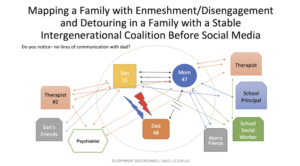
Below is a “traditional” family map that does not consider social media. It represents a compilation of families I’ve seen in therapy, rather than any one family. The symptoms include those typically seen in family practice — poor school performance, school avoidance, vaping, drinking, and using drugs.

From a system’s orientation, the symptoms are a result of the functional and dysfunctional interactions within the family system.

It’s hard for me to understand how therapists begin assessment and treatment without considering or involving the whole family. Some clinicians might say the conflict is too high, and it would only impact the adolescent negatively. Others might assume from the start that one or both parents are not willing to work or are too busy. Some might even be unaware of the importance of beginning from the position that families do not have the strength to make change.

Sometimes therapists and school staff buy into and reinforce the belief that the child or teen is the problem. In the case of this particular map, Mom “reportedly” goes to her private therapist while the son sees his own therapist. Mom and son separately complain about dad to their respective therapists and to the school staff. When mom and son voice frustration about dad and each other in the individual therapy session, disengagement with dad is reinforced. Mom and son are trying to get the type of connections from the system of care that they cannot get with Dad.

While this disengagement takes place, the son turns to his peers, attempting to pull away from mom’s enmeshment, activating her to pursue more. At home, Dad complains that his wife and son always bring up their therapist who agrees that he is unavailable and/or flawed. When this occurs, Dad becomes more distant and angrier, feeling like he is the odd person out.

When Mom gets angry at dad, she turns to her son and vents to him which activates him to challenge his father about money, drinking, and the way he treats her. At other times, the son may jump into the conversation when the parents interact about money, drinking, or the way he treats Mom.

When I attended graduate school, the common exercise was to map the triangles in the family system. Based on the above map, there are at least 24 triangles that are activated in the family-school-mental health system. The 24 triangles are:

  • The mom, son, and dad
  • The mom, son, and school social worker
  • The mom, son, and principal
  • The mom, dad, and school social worker
  • The mom, dad, and principal
  • The mom, dad, and school social worker
  • The mom, dad, and school principal
  • The mom, son, and mom’s friends
  • The mom, dad, and mom’s friends
  • The mother, dad, and dad’s friends
  • The mom, son, and son’s friends
  • The mom, son, and son’s therapist
  • The mom, son, and son’s psychiatrist
  • The mom, dad, and son’s psychiatrist
  • The mom, son’s therapist, and psychiatrist
  • The mom, dad, and son’s therapist
  • The mom, school social worker, and mom’s therapist
  • The dad, son, and son’s therapist
  • The dad, son, and son’s friends
  • The mom, son, and mom’s therapist
  • The mom, dad, and mom’s therapist
  • The son, son’s therapist, and school social worker
  • The son, son’s therapist, and psychiatrist
  • The son, school social worker, and principal

These 24 triangles are at the same time difficult for adults in the family to appreciate, even harder for an adolescent, and deeply challenging for the clinician to manage. In those triangles within the family where cross generational coalitions are activated, the symptoms in the family increase. I have often been challenged whether to discuss the impact of all these cross generational interactions with the family and whether it is important to differentiate the healthy, less healthy, and unhealthy ones from each other

On top of the above complexity, other questions arise like “where did the boundaries go?” The therapist must keep in mind how the boundary between the family and the outside world becomes invisible and the symptoms become more intense, to the point more professionals are recruited to “fix the dysfunction.”

I have also had to maintain awareness of how managed care’s enforcement and reinforcement of the medical model has influenced me and other members of the community of care, including other therapists, psychiatrists, physicians, and schools. This reinforcement has an impact on the family’s interaction with the son focusing only on his diagnosis and the correct medication, while failing to address the family relationships.

As mom turns to the school and the system of care for answers, things are not changing. She reports that her son is getting worse. Mom blames dad’s aloofness and dad blames mom’s overindulgence. Mom increases calls to the psychiatrist. The psychiatrist adjusts the medications frequently. The frequency of crises increases and the boundaries between the family and the outside world are dissolving due to the interaction between the family and the system of care.

The number of alliances increases between different family members and different professionals as more professionals/agencies are pulled into the drama. Professionals unintentionally begin to write/rewrite the individual’s and/or family’s stories, especially when utilizing the medical model.

With more stories, there are more opposing interests for each family member. This phenomenon between families and agencies is a result of a collision when both parties collaborate to uphold sociocultural trends. The goal is not only to interrupt multiple unhealthy alliances with existing professionals/agencies, but to also prevent new transactions from developing. (3)

This phenomenon was usually seen when the system of care worked with economically challenged families. We now see this also occurring with families of significant means because they can afford an individual therapist for each family member and psychiatrist(s) if needed.

As we look back at the map, it is now easier to understand that because the family has already identified what they think is the problem, it really needs to address the triangle between mom, dad, and son. It doesn’t really matter where to begin. A clinician can enter through mother-son enmeshment and coalition, father-son disengagement, or parental/marital disengagement.

It might also be useful to address the system of care coalitions between the therapist and school with the mom and son. Having the family identify how to change the interaction between the whole system allows them to move forward. It may be a challenge because getting directives from an expert, rather than looking within their own system, is what they have come to expect.

Using a Virtual Family Map to Identify Issues in Families

Before talking about the influence of social media on the family, it is important to acknowledge some of the “players” in social media. The system of social media has many parts. Social media success is dependent on an algorithm, which encourages frequent interactions by virtual and non-virtual friends.

The frequent interactions result in the shareholders receiving monetary return on their investment, the employees maintaining their jobs and bonuses, and the advertisers increasing the visibility of their product resulting in increased sales. The influencers are dependent on social media to reach as many people as possible to receive income from the app. There is a lot of pressure to have an effective algorithm to support social media.

As you next look at a map depicting the interactive nature of the family and social media, it is important to keep in mind that the 24 triangles from the non-virtual map are still present, and the family boundary is already disintegrating with the school workers, friends, and therapists to seek help with the identified patient.

Now in addition to these non-virtual professionals and friends, the family is inviting social media’s virtual friends and influencers to seek help with the identified patient. Clients (and non-clients) often turn to virtual friends and influencers to provide the same connection as non-virtual friends, but these connections are void of physical closeness. Children and adolescents believe a virtual relationship can replace a non-virtual relationship. But all virtual relationships are void of physical closeness in which touch, eye contact, and a warm smile can feed the soul.

The family can turn on a social media app at any time of the day or night and the outside world is invited into the family, increasing the number of triangles exponentially. From the clinical perspective, it is critical to examine what actions (social competition, social comparison, loneliness, etc.) in the family trigger a member(s) to invite social media into the family. The therapist must also discuss how social media algorithms are activating/triggering the member(s) of the family to turn to an app to surf or post an event. This increases the time spent on the smartphone to maintain these virtual friends, non-virtual friends, and influencer relationships.

At times, social media decreases connection with non-virtual relationships and increases the connection with virtual friends and influencers. In the therapy session with this particular family, some members discuss how they rely on virtual friends and influencers more because “they understand me more than the friends in my own town/school.”

The adolescent believes these virtual figures want to listen to them more than family and non-virtual friends. It is important to ask the family what influencers and virtual friends provide that their own family members or non-virtual friends cannot. This allows the clinician to address the patterns and interactions in the family.

In the map below, I do not draw the number of different social media apps, influencers and virtual friends who are involved with the family. However, I do recommend when meeting with families, to draw each app, virtual friend, and influencer to show the number of triangles the family is managing or attempting to manage. For simplicity’s sake, I use one (black) box to represent all the social media apps and one box for all influencers and separated mom and son’s virtual friends.
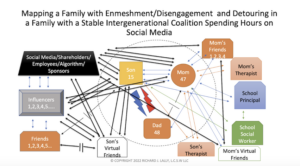
 

Husband, Wife, and Social Media Triangle

What is the impact of social media on marriage? The wife turns to social media and influencers to figure out how to “fix” her marriage. The wife tries to talk to her husband about what she has learned about marriage on social media. The husband discounts the wife’s attempts to “educate him about marriage.” She eventually gives up on the marriage and “wants to focus more” on her son. She also tries to connect with previous friends and boyfriends from past life because she feels lonely and alone “looking for a connection.”

What you will see in this triangle, and all the triangles which involve social media, is a substitution of a virtual relationship for a non-virtual relationship whose connections are full of conflict or conflict avoidance. The virtual relationships convey an illusion of meaningful connection, but the person(s) feels alone and lonely because it lacks the important ingredients for a fulfilling relationship.

Mother, Father, and Social Media Triangle

Now the wife stops working on the marriage and focuses on parenting. The husband is not aware of this decision, focusing on “making money to provide food, clothing and shelter.” The father continues to feel alienated, disconnected, and disempowered, becoming angry towards the mother and son. The mother turns to school staff, therapists, non-virtual friends, virtual friends, and influencers for ways to “fix her son.”

This fosters more of an enmeshment with son, and disengagement with Dad. The son turns to school staff, his therapist, non-virtual friends, virtual friends, and influencers. Each family member describes a feeling of disconnectedness trying to overcome the feelings of being lonely/alone. Dad voices his frustration, complaining that he is “old school,” and they are “hypnotized by that damn phone.”

Mother, School, and, Social Media Triangle

In this triangle, mom calls the teachers and guidance department for support. She has frequent phone calls with the guidance counselor because the guidance counselor “is an expert with adolescents.” As you can see, dad is left out of the interactions with the school.

After a few months, her son’s behavior is not changing, and mom is frustrated with how the school is not helping her son. Mom begins to turn to social media looking for answers. Mom spends hours on the app talking to non-virtual friends, virtual friends and reading/commenting on influencer’s posts. Mom displaces healthier activities with time spent on social media. Mom begins to complain that the school is not meeting the goals set out by the Individualized Education Plan (IEP). Mom cites information from influencers from social media and the internet. The tension rises between the school and mom.

Schools today are under tremendous pressure to perform. Schools are understaffed, and do not have the mental health training or support to bring in a countercultural systemic approach into the schools despite the money being put into schools after COVID-19.

Parents, Son, and Social Media Triangle

Mom is spending hours on social media looking for answers to why her son is struggling. She also spends time looking for connections. The son also spends hours on the app interacting with non-virtual friends, virtual friends and reading influencers’ posts.

Mom pursues the son, but he only is aligned with her to challenge dad’s limit setting. When the parents attempt to be aligned, the son acts out more. We see the son increase his conflict with parents, who struggle due to their enactment/conflict avoidance with each other on how to help their son. This results in the father leaving and the mother turning to social media to find answers or overcome feelings of loneliness.

When the family interactions are in intense conflict or conflict avoidance, many children, adolescents, and young adults get most of their answers from non-virtual friends, virtual friends and influencer’s posts. The son is seeking temporary relief by getting information and trying to affirm a sense of self.

The non virtual, virtual relationships, and influencers introduce beliefs that are the opposite of the family’s beliefs and further impact the self-esteem of the adolescent. The son discusses what he learns from social media of what “real parents are like.” The decrease in face-to-face communication with family increases his anxiety, depression, irritability, and intrusive thoughts. This also confuses the family of how their family member can “think so differently.”

Son, Non-Virtual Friends, and Social Media Triangle

The son in the session discusses constant social competition/comparison, working for social currency, and thinking he at times is invisible to his non-virtual friends. The son gradually believes his non-virtual friends “don’t understand.” He believes he cannot turn to his parents because “What do they know?!”

The son begins to engage in the same interactions with his peers as his parents and avoids turning to his peers for support. The son begins to spend more time on social media with virtual friends and influencers to seek select information that matches a narrow/closed view, hoping to avoid conflict/interaction. The son then turns more to virtual friends and influencers for answers. Again, this increases his time on his smartphone and increases the family’s sense of not being good enough for each other.

Remember, the son believes there is “less stress” getting information from a stranger, pop culture icon, or a virtual friend than an enmeshed mom, disengaged father, or face-to-face with a peer(s). However, the decrease in face-to-face communication with family and non-virtual friends increases his anxiety, depression, irritability, and intrusive thoughts.

Despite the time spent on social media, the son feels alone/lonely, looking for emotional, face-to-face and physical connection, but does not have the words to express these thoughts to each other.

Mom, Therapist(s), and Social Media Triangle

Dad continues to be absent from the triangle that involves the therapist. The mother attends her own therapy and attends her son’s sessions to discuss what new information she has seen on social media.

She reviews with both therapists what she has learned on social media about new treatment, new medication, and new diagnoses. She advocates with all providers that her son is incorrectly diagnosed, hoping that would help him with his symptoms. The quality of training of the therapist determines their response to entertaining or challenging mom’s research. This may result in mom seeing a new therapist.

The individual therapists and psychiatrists are not looking at how the parents avoid “getting on the same page.” They are reacting to reports by mom about the son’s behavior. Mom and dad are unable to interact differently because they have not figured out how to work together to decrease their son’s phone usage to increase his time with non-virtual friends. The professionals are avoiding addressing the parent’s avoidance!

Mom, Psychiatrist, and Social Media Triangle

Dad is absent from the triangle that involves the psychiatrist. Mom becomes disgruntled with the psychiatrist. She begins to challenge the psychiatrist’s diagnosis and medication recommendation. The psychiatrist recommends if mom is not satisfied with his assessment, she seek a second opinion. Mom begins to look for a psychiatrist who agrees with what she has read on social media.

Son, System of Care, and Social Media

The son is seeing his individual therapist 1-2 times a week and his psychiatrist once a month. He is also spending 2-8 hours on his social app each day. The therapist has not assessed the hours the son is spending on his phone. The app is only showing views/opinions/likes/images that interest him.

The son begins to complain that the therapist does not understand him and challenges his therapist saying, “This doesn’t help.” When the therapist explores the son’s statement, he begins to discuss information from “reliable sources” from social media and influencers. He too begins to diagnose himself and discusses medication that can help. When the system of care discusses reliable sources such as universities and professional journals, the son becomes irritated saying “I don’t want to read them.”

Son, School Staff, and Social Media

Not only does the system of care increase their sessions, but the school staff increase their time with the students. The number of triangles with the son in the school increases between the child study team, teachers, and administration.

The teachers are pursuing him to get his work done — offering to meet him before school, lunchtime, and after school to complete his work. He never shows. The son is seen in class on his phone. Some teachers ignore him, and others nag him. When a teacher challenges the time he is on his phone, he tells the teacher other instructors let him do it.

The social worker is calling him down to discuss his avoidance of work and disruptive behavior in the classroom. Only when the son becomes overwhelmed, he discusses with the school social worker his home life and that medication is not working. The vice principal is meeting with him to give him detentions. The son feels frustrated with the school stating, “They are only doing this because it is their job.”

Son, Non-virtual Friend #1, Non-virtual Friend#2 with Social Media

The son leaves school to go home to continue to work on his non-virtual relationships on social media. It becomes evident that in social media apps, the same social stressors occur online like in school. It is exhausting to navigate being included and avoid being excluded at school and online. The son and non-virtual friends are jockeying for social currency and social position, never getting time off to charge their own social battery.

The son and non-virtual friends stress about the images they post. They are anxious about what the image means to them and others. The son is trying to understand the unspoken rules for posting and the reaction by his peers regarding the image. The son worries if the image appears “authentic” and will help him maintain his position inside the social media group or if a new group be formed without them.

Son, Non-virtual Friend(s), and Virtual Friends

The son struggles connecting with his non-virtual peers. He is not getting feedback from his non-virtual friends about his art and his physical appearance and finds out they have different chat rooms that do not include him. (Remember, he does not want feedback from an overly involved mom or detached father.)

He begins to look for feedback about his art and physical appearance from virtual friends. When looking for connection outside the non-virtual friend group, he states he is looking for virtual friends who are nonjudgmental.

But as time went on, it began to mirror the non-virtual group. Some of his virtual friends on social media become competitive and attempt to increase their social currency on this platform. They do this by making fun of his physical features and his art. This mirrors some of his non-virtual friends’ behavior. The son frantically searches for another virtual peer group that he believes will not activate anxiety by not challenging his views, providing a stress-free venue.

As the son increases his time searching for virtual peers and influencers over non-virtual friends — reinforcing a closed system, increasing isolation at school, and decreasing time to sleep at home. His virtual relationships are now more important — increasing time spent on the app and continuing to strive for more likes and views.

Lack of face-to-face contact with family and non-virtual friends fosters more of a virtual enmeshment with virtual friends. He describes them as “nonjudgmental” and “more accepting.” This further increases his self-doubt and increases his feelings of loneliness and creates a virtually closed system (Virtual Enmeshment).

Son, Virtual Friends, and Influencers

The virtual group is important to maintain when avoiding contact with his parents and non-virtual friends. The son describes his virtual friends as more “authentic” and describes his non-virtual friends as “fake” and “not genuine.” However, some of his virtual friends on social media become competitive and attempt to increase their social currency.

The son frantically looks for another group that is an anxiety and stress-free venue. This further increases his self-doubt and increases his feelings of loneliness. This increases the symptoms of anxiety and depression when waiting for approval from virtual friends saying, “They are the only ones who understand me.”

As the son looks for new virtual friends, he and his virtual (and non-virtual) friends look to influencers for answers on how to portray themselves. Influencers work hard to establish and maintain their position in their virtual community. The influencers are working hard to make money and increase their viewership. The influencers often ask adolescents to agree with their beliefs and recommend products they are selling. The influencers work hard to appear on the “right side” of an issue.

As the son tries to replicate the beliefs of his preferred influencers, he looks for fellow virtual friends that have done the same “research.” They notice the more they make comments in opposition to a belief, it increases their views and likes.

As the symptoms in the family increase in intensity, the members increasingly must decide who to align themselves with in the virtual and non-virtual triangle. The therapist highlights this and encourages the family to discuss and identify the boundaries of virtual and non-virtual triangles that maintain these alliances/symptoms. This allows a family to discuss non-virtual triangles that are underutilized, which reinforce healthy boundaries that benefit the family.

Using Exploring Questions to Make Circular Statements

Much has been written about joining, unbalancing, and mapping in SFT. One of the beautiful ways Structural Family Therapy (SFT) uses language is by employing circular statements to connect the family member’s behavior in the system. When SFT enters the family, the systems therapist uses the family’s own observations to connect their interactions.

It is important today to make a circular statement to widen the lens in which the family sees how all virtual and non-virtual relationships impact the relationship in the family. Below are some examples of circular statements using the words used by each family member.

I agree with you, Mom, that as long as you do not have a voice with Dad and work together, your son will not stop posting explicit images on Snapchat

Dad, as long as you sound like a drill sergeant, Mom will not find her voice as a woman and work with you as a wife and mother of your son who will continue to believe he must mirror images on Instagram

Mom, I agree that the harder you work, the less Dad helps you with parenting your daughter— your daughter will have to turn to influencers about how a woman should look and act

Peter (son), as long as your mom is worried about the frontstage appearance, she will fight with your father who is more concerned about your backstage struggles with you and your mother

What do your virtual friends give you that you cannot get from Mom, Dad, or your non-virtual friends?

Conclusion

Many are worried about the continued increase in suicide, suicide attempts, and mental health issues in the family and how Congress is powerless to challenge these companies. Many providers are not looking at what has changed in our lives in the past 25 years.

Relationships are becoming more complicated than ever. Many families and therapists are unaware of the impact of the system of care and less aware of the impact of the ubiquitous “algorithm.” It is hard to understand how the algorithm works because it is important for these companies to keep the algorithm secret for fear of losing profit.

We must also remember that each influencer, virtual friend, and nonvirtual friend has their own family map. Just as many professionals do, influencers understand how their stories, views, and images echo in the family.

Are families aware of the alliances that occur with virtual and non-virtual friends and influencers? Are we aware that when more virtual influencers and friends enter the family, more alliances increase establishing social hierarchy, increasing social competition and social currency? Are we, the clinicians, aware that influencers and virtual friends unintentionally/intentionally begin to write/rewrite stories in the family and permanently on the internet?

We must begin to understand that with more stories, there are more opposing interests for each family member. This phenomenon between families, virtual friends, nonvirtual friends, and influencers (social media) is a result of collusion when all parties collaborate to uphold their preferred sociocultural trend.

The goal is not only to highlight and interrupt the multi-alliances with existing social media but to highlight the transactional pattern in the home that maintains this pattern. Remember, a virtually closed system impacts all family members, whether one or all are using these platforms excessively.

References

(1) Susruthi, R., Myara, Maymone, B. C. & Vashi, N. Selfies-Living in the era of filtered photographs. JAMA Facial Plastic Surgery. 2018 20:6, 443-444.

(2) Nesi, J. (2022) The impact of social media on youth mental health: Challenges and opportunities. North Carolina Medical Journal, 81(2), 116-121.

(3) Colapinto, J. (1995) Dilution of family process in social services: Implications for treatment of neglectful families. Family Process. 34:59-74.

Questions for Reflections and Discussion

How has social media influenced your personal and family life?

How does the author’s premise resonate with you and the way you practice family therapy?

How have you integrated social media and app use into family therapy?

In what ways do you agree or disagree with the role of social media in family systems?

© Psychotherapy.net 2023

Social Media Monitoring Tips for Successful Psychotherapy with Teens

Therapeutic Encounters with Two Teens

Courtney was the kind of 10th grade-client that I completely enjoyed. She was cute, clever, and motivated. So, when she began to have an issue that ballooned into a crisis, I was a bit surprised. Her parent found out that she had shared a nude selfie with a boy she knew, who then shared it with the whole school. While Courtney’s mother was a nurse who well understood the ups and downs of being a single parent and the importance of being present for her daughter, she didn’t see this looming crisis coming and was unable to comfort her daughter.

Like what you are reading? For more stimulating stories, thought-provoking articles and new video announcements, sign up for our monthly newsletter.

My clinical work with Courtney centered around understanding her own boundaries — that being a people-pleaser is not always what’s required — and giving voice to her past losses (including the tragic death of her Father), all of which were held inside too long. Throughout our work, and hopefully beyond, DBT for frustration tolerance and CBT to calm the inner critic were supportive anchors. I also made myself available for extra sessions until she stabilized. In addition, I helped her do some damage control at her school by speaking directly with the guidance counselor.

Nevertheless, Courtney landed in the hospital from sheer humiliation. And because she was so emotionally fragile, she needed time to be safe, without her devices, to regroup, process, and consolidate her experiences. While Courtney was scarred by her mistake, blamed and mortified for what another kid didn’t yet understand about privacy, she was, thankfully, able to benefit from the immediate help.

Another college-age client, who I will call Sasha, had insomnia and relied on her smartphone to fall asleep — much like scores of others her age do. Parents, Sasha’s included, often say things like, “You can take away all her devices but it won’t help.” Sasha, as it turned out, was reliving a traumatic memory that replayed in her head, and she often woke up screaming. Although I am not a sleep expert, I realized that she was in trouble because she hadn’t attended school in over a week.

My initial work with Sasha focused on the immediate presenting problem of sleep. For me, this is always an important discussion with teens. Then we moved slowly to her past trauma using breath and yoga to help her self-regulate. The incident she was reliving every night was painful, but it didn’t have to follow her into adulthood.

Adolescent Struggles with Self-Regulation

As I reflect on these two cases, which share certain digital/social media-related elements, I also appreciate their differences. Courtney was simply burnt out from the social media backlash and ongoing shame, humiliation, and guilt she felt knowing that everyone with a smart device could see her nude picture. She needed a reset.

Sasha, having had an entirely different kind of traumatic experience, was not quite as resilient as Courtney. Her body, as Bessel van der Kolk reminds us, kept the score and intruded on her sleep despite her best efforts to use a digital remedy. In the two instances, it was important for me to differentiate between depression, trauma, and anxiety, the symptoms of which often converge. Both, however, had difficulty coping with their respective crises because of their reliance, or perhaps over-reliance, on social media and digital devices.

In the cases of Courtney and Sasha, as I do with most teens with whom I work, I included the family. I offered suggestions around self-regulation for the teen, and to the parents for helping their child regulate the use of social media and digital devices. Interestingly, and perhaps not unexpectedly, because of their overreliance on their digital devices for connection during COVID, I had an uptick in patients who were convinced they were dissociating. Perhaps they were. One client said people were watching her from within the walls of her room.

Sasha accepted a few of my suggestions for learning how to re-regulate herself, but she never quite connected the dots that “the body keeps the score.” Instead, she insisted on staying online because without her friends, there was “no score at all.”

Helping Teen Clients Find Balance

While working with families like those of Sasha and Courtney, I simultaneously model calmness, generate a decision tree of steps for addressing the crisis, and calculate the practical and emotional cost of decisions they have or are thinking of making. At the same time, I try to comfort the teen that “this too shall pass,” and to provide the needed perspective they can’t yet take. The black-and-white thinking, a hallmark of adolescence, keeps them feeling there’s no way out when there usually is.

The teen’s default and refrain often remains: what will people think of me? But with time and support, their inner voice may shift to one of more self-compassion. I often say, “What would you tell a friend?” The hyper-fixation on self-image that is also the cornerstone of adolescent thinking, amplified by the social isolation of COVID and the endless resulting on-screen hours, was the perfect storm and seedbed for some of the angst and depression we have seen among adolescents. We cannot necessarily prevent social media, but we can still protect them from its potentially harmful effects.

I worked for early internet start-ups in the health and wellness space for some time, so I cannot readily cast away the benefits of the Internet or social media. Like many teen girls with whom I’ve worked, their virtual world is their true and only world. What others see of them is all that matters.

So, in Courtney’s case, the destruction of her carefully curated online image was shattering and felt like the death of part of herself. Do we now blame social media for what happened to Courtney or for Sasha’s experience? Unfortunately, we can barely ban guns, let alone phones. Schools are trying to take phones during instruction. That’s a good idea. I don’t think my daughter ever read a book in high school. There was no attention span left by the time she reached 10th grade. Joining with the teen on her journey lets her know that at least one grown-up in the world is on her team — her teen brain doesn’t have to define her.

It is so convenient for friends, family, therapists, teachers, and parents to say “social media be damned,” especially after an episode like Courtney’s. I agree with what they’re saying; after all, it’s legitimate to protect your children (and clients) from porn, abuse, catfishing, danger, and predators. My biggest parenting regret was not removing the phones from my own children’s possession by 10:00 PM like many parents do. Sleep is critical during adolescence, but too many kids simply cannot resist the allure of talking to their friends all night.

If my patient is on social media all day and night, what would be more appropriate: to scold her and instruct the parents to remove all screens, or perhaps teach her that rest is critical to development, as is exercise, diet, spirituality, creativity, and every possible other form of self-care? I often beg clients to get a hobby.

Social Media and the Benefits of Connection

One of my current clients is doing an online degree program in a special kind of painting that she posts weekly on Instagram. Because she has a significant trauma history, her present situation doesn’t allow her to visit museums or lectures or art studio classes. But she can paint and post and maybe one day sell those paintings online.

What gives her hope is the freedom to expose her work to the world without having to leave her room or open herself to bullying, intimidation, or abuse. And then there are clients who are either ill or live in a rural setting who can talk to their BFFs (and me) without having to drive. These are the many ways a young, isolated person may reframe the online world as an adaptation to her struggles, rather than the enemy.

I am not suggesting that my clients continue mind-numbing and wasteful activities like stalking their ex, trolling through others’ emails, engaging in illegal/aggressive or shameful bullying, or worse. What I say to my colleagues who work with young people is this; save your judgment and let’s figure out what the pitfalls and potential are in each situation, then help our clients to filter in what is meaningful, useful, and practical for them within their virtual (and “real”) communities and filter out what doesn’t serve them. I love working with young people because once they “get it,” they’re usually good to go.    

Should Transgender Youth Care be Guided by Beliefs or Science?

Introduction

The current American approach to transgender-identified youth and adults is strongly affirmative. Many professional organizations in the United States have endorsed the safety and efficacy of social transition, puberty-blocking hormones, cross-sex hormones, and breast, genital, and facial surgeries as the ideal treatment of gender dysphoria.
 

These prestigious decade-old endorsements have led to the development of gender specialists in over 70 US clinics where children, adolescents, and younger and older adults are seen. It also has led to affirmative care being taught in medical schools, residency training programs, and various mental health continuing educational programs. For half a century, WPATH has been the key nongovernmental organization that has gathered specialists, provided courses that promulgate clinical principles, and published standards of care. WPATH represents itself as an advocacy, policy, and scientific organization.

Its membership recognizes a great need for social change as discrimination in housing, employment, health care, intrafamilial and peer relationships, and incarceration are significant cultural sources of stress for the transgendered. WPATH considers its recommendations to be scientific, even though its author-committees recognize a need for improved scrutiny of outcomes of social, medical, and surgical interventions. While it recognizes that the quality of supportive evidence is objectively low, nonetheless, it treats affirmative care as a settled scientific matter. DSM-5-TR and ICD-11 diagnostic criteria exist, elective treatment sequences have been defined, and many clinicians and patients consider affirmative care to be life-enhancing and sometimes lifesaving. 


Affirmative care, however, is not a scientifically settled matter. There is much justifiable ferment. Affirmative care is far more fraught and uncertain than WPATH and professional associations have suggested. (1-3) It is a paradox for WPATH to portray itself as a trustworthy authoritative advocacy, policy, and scientific organization in the face of uncertainties about long-term treatment outcomes, the unexplained dramatic explosive incidence of new gender identities, and the increasing recognition of de-transition.

There is an ongoing culture war within the US about the treatment of transgender youth who are uncomfortable with their bodies. (
4) The political aspect of this culture war addresses transgender treatments as a conflict between those who support and those who oppose the civil rights of LGBTQI+ individuals. Those who question the wisdom of affirmative care are described as “anti-trans.” A medical perspective begins with a different question: Is the scientific basis for affirmative care sufficiently established? If the answers are either no or uncertain, three other questions follow.  

  • Can gender specialists separate their beliefs from what is scientifically known about etiology, incidence, psychopathology, and the long-term benefits and harms of affirmative interventions?  
  • Can these specialists provide parents and patients with the legal and ethical requirements for informed consent? (5)    
  • Can high-quality research be designed and funded to answer the current relevant clinical uncertainties?  


Usually when health is the topic the medical profession leads the way, relying first on rigorous science, and second on the values of individual patients and their families. In the arena of trans care, however, values have historically played a more important role than science. This may be summarized as eminence-based or fashion-based medicine dominating over evidence-based medicine. As has been seen with the COVID vaccine, mask mandates, the opioid epidemic, and the FDA approval of a drug for Alzheimer’s disease, trust in the medical profession is far from universal. Consequently, what individual doctors, gender care clinics, professional societies, and mental health professionals may have to say about the ideal care of trans persons may not be the most powerful force governing social policy.    


Forces Shaping Attitudes About Transgender Care

Transgender phenomena elicit intense feelings among laypersons and professionals. Such passion, which is destructive to objective scientific appraisal, derives from many personal sources. While numerous factors influence attitudes toward transgender care, their confluence makes it difficult to judge their relative contributions to how individuals and institutions regard trans healthcare.  

There are five universal potential influences.      

1. Fascination with sex change. The intriguing question, “Can sex be changed?” has long been explored in the arts, where men and women have for centuries been presented as the opposite sex in humor, drama, dance, opera, drag, and popular music. Today, it is better understood that in a basic biological sense, sex cannot be changed, but gender presentation can, with or without medical assistance. 

2. Political sensibilities. The Left may consider transgenderism the courageous pursuit of self-expression, a civil right, a movement to improve diversity in all walks of life, and a praiseworthy social movement to eliminate discrimination. Their political values lead them to view studies and clinical services with trust. The Right, on the other hand, may consider transgenderism morally wrong, threatening to societal health, and dangerous to the health and well-being of individuals and families. These assumptions lead to a skeptical approach to studies and clinical services.

3. Religious sensibilities. These value-laden thought patterns derive from theological assumptions. They may resemble the Right or the Left. In the United States, the most vocal religious institutions on this topic lean to the political Right. 

4. Sexual orientation sensibilities. Membership in the heteronormative or sexual minority communities often generates opposite responses — the former may have initial unease with, and the latter, initial comfort with trans phenomena. One’s sexual orientation, per se, does not guarantee a particular attitude any more than one’s political or religious affiliations do. However, many of the leaders who advocate trans care identify as a sexual minority.

5. Intuitive age-related sensibilities. Intuitive sensibilities are best reflected through age. Younger and older generations have different life experiences with which to be intuitive regarding attitudes toward the transgender experience. The very existence of sexual minority communities and their entitlement to civil rights are far more visible today than was the case when older persons were growing up. These generational differences reach into each group’s system of values. 

There are four influences that are unique to professionals.  

6.Personal clinical experience. The 7th edition of WPATH’s Standards of Care (SOC) downgraded the importance of a comprehensive assessment of psychiatric co-morbidities in determining the next step. 6 The process of evaluation was then pejoratively referred to as gatekeeping. Prior to 2012, adults who immediately wanted hormones or surgery were often impatient, demanding, rude or dishonest about their histories. With the 2012 guidance, adults and older adolescents were assumed to know best what should be done. Respect for Patient Autonomy became the primary ethical principle to follow. The frequency of unpleasant clinical experiences dramatically diminished. When professionals experience unpleasant patients, those with conspicuous emotional impairments, or those who deteriorate with hormonal treatment, they are more likely to be avoidant of future encounters. Positive experiences with appreciative patients and families yield more willingness to engage

7. Knowledge of clinical reports from clinical innovators. Positive outcome studies of transgender treatments typically consist of retrospective case series without control groups and without predetermined measurement instruments. Such outcome reports are numerous for each intervention. Positive results tend to be more often published than negative or uncertain outcomes. The most influential studies for minors were published in 2011 and 2014, and while they too lacked a control group, they were interpreted as establishing the concept that selected prepubertal cross-gender identified children could benefit from affirmative social, endocrine, and surgical care. (7),8 

Clinicians cannot be expected to keep up with the burgeoning literature; they trust what they read, heard about, or were taught. Such learning reflects a chain of trust that is basic to all medical education. It has become apparent that the chain of trust is not necessarily trustworthy, as positive studies are published in peer-reviewed journals only to have their conclusions criticized by knowledgeable academics. Once clinicians begin to facilitate patients’ transitions based on the studies they have seen, they believe they are facilitating happy, successful, productive lives even without having the reassuring follow-up information to verify their beliefs.


8. Scientific studies. Groups of studies demonstrate patterns that individual studies do not. Scientific data are widely assumed to dominate institutional policy. This is not necessarily so, however. For example, high desistance rates in trans children have been demonstrated in 11 of 11 studies, (9) but a committee of pediatricians created a policy of supporting the transition of grade school children. (10) As a result of these often-conflicting processes and sources of data, comprehensive evaluation and psychotherapy rather than affirmative care are increasingly being recommended

9. Source of income. With 70+ clinics in the United States, with many individuals in private practice who practice affirmative therapies, and with special units within prisons to support trans inmates, the attitudes of new-to-this-arena clinicians may be quickly determined by their work environment. In these settings, disapproval of affirmative care, which may grow with experience, as it did for many psychologists at the Tavistock Clinic, means resignation or job loss. 


Sources of Controversy about Affirmative Care

1. Morality — Conservative citizens, religious denominations, politicians at local, state, and federal levels, and some gay, lesbian, and feminist groups view affirmative care as dangerous. They ask, “What are we doing to these young people? What will be the outcome for them and their families? Do doctors really know what is best for my son or daughter? Why is it acceptable to sterilize young people? Why is the suicide rate high after completion of medical and surgical interventions?” Such questions burrow down into moral values.

Some religious groups assert that since God made male and female, this provides fundamental guidance to decision-making. However, because these groups have historically been similarly against homosexual lives, the power of this theological assumption is politically diminished for many others.

Some gay and lesbian organizations see affirmative care of feminine boys and tomboys as an attempt to eliminate gay and lesbian people. Almost all groups recognize that cross-gender identification is nothing new. What is new is its dramatically increased incidence and Medicine’s response to it. 


2. Questions Emanating from Medical Ethical Concerns

  • Are children and adolescent patients experienced enough, cognitively mature enough, to make life-altering decisions that will predispose them to known challenges such as sterility, sexual dysfunction, decades-long medical care, discrimination, and loneliness (11, 12)  
  • Do their frequent co-existing psychiatric diagnoses further impair their ability to thoughtfully consider the consequences of each of the steps of affirmative care? 
  • Are affirmative professionals knowledgeable about the limitations of their recommendations? 
  • Do they know the inadequacies of the outcome data supporting the policies of socialization of children and endocrine and surgical interventions with adolescents?
  • Do they know the fate of most patients given hormones a few years after they age out of pediatric endocrinology?
  • Are they aware of the rates of complications, physiological consequences, long term unhappiness after the surgical procedures that they recommend?
  • Are parents sufficiently informed about the limitations of outcome data?
  • Are they told of Sweden’s, Finland’s, UK’s, and France’s shifts towards psychotherapeutic-first interventions?
  • Are they informed about the social, economic, vocational, physical, and mental health problems of transgendered adults? 
  • Are they told about detransition following hormonal and surgical treatments? 
  • Are they told about the elevated suicide rates after surgical treatment of adults? 

3. Confirmation bias — When defending a particular position, authors tend to quote studies supporting their position and ignore contrary findings or glibly dismiss them as methodologically unsound. This confirmation bias creates important scientific concerns on both sides of the debate. Science advances by defining controversy and designing a study that may better answer a specific question. Independent reviews have concluded that the evidence is not convincing that puberty blockers and cross-sex hormone administration lastingly improve mental health, decrease suicidal ideation, or eliminate gender dysphoria. (13) 

The Endocrine Society acknowledges a low level or very low level of supportive evidence. Advocates, however, portray certainty that science has already demonstrated these lasting benefits without significant harm. When they list supportive studies there is no mention of the published criticisms of them. A scientific review is characterized by balance; it is not performed only by those who deliver the treatment. (
14,15) Trustworthy reviews point out the limitations of studies and ideally suggest a study design to answer the specific question.  

4. Political — Nowhere in Medicine has free speech been as limited as it has been in the trans arena. Skeptics are being institutionally suppressed. Critical letters to the editor in journals that published affirmative data are refused publication, symposia submitted for presentation at national meetings are rejected, scheduled lectures are canceled, and pressure has been exerted to get respected academics fired. A notable exception to this pattern occurred when a paper investigating the long-term mental health outcomes of trans adults (a basic unanswered question) was published in the American Journal of Psychiatry.

It, of course, had undergone a peer review process by experts in gender care. When the authors asserted in their online publication that their data supported increased access to surgeries, the editor received seven critical letters. In response, Dr. Kalin had two independent statisticians review the work. They agreed with the twelve authors of these letters to the editor that the data did not demonstrate improvement in mental health. The editor published the original article, the seven letters, and the authors’ response. The authors retracted their conclusions. (
15,16) When critical letters have been sent to other journals, they have been rejected. As a result, they are published in separate journals.

This makes it more difficult for clinician readers of the original journal to know about the critique. Unless published with open access, the original flawed article’s limitations are difficult to access in another journal. A significant paywall is often encountered to obtain articles in journals to which the professional does not subscribe. Given the well-known attacks on those who question the prevailing wisdom of affirmative care, it is not surprising that many mental health professionals avoid working with these individuals and their families for fear of being labeled as anti-trans, transphobic, or conversion therapists. 


5. Familial — The parents, siblings, and extended family members, each of whom have different relationships and responsibilities for the trans-declared person, typically have intense feelings about their relative’s gender change. Family members’ affects, attitudes, and behaviors derive from one or more of the five sources discussed above but take on a new poignancy. While parents are the only ones that professionals deal with, the intrafamilial ramifications affect everyone.

Parents have realistic, reasonable concerns. What will gender change mean for my child’s developmental future physical, social, and mental health? Their assumptions that the outcome will be negative often create an acute 
depression. This intensifies when their expectation of informing the mental health professional (MHP) about the child’s development, personality, and previous challenges.

Many parents are distressed when the MHP seems far more interested in making the diagnosis and declaring their belief in affirmative care. Parents who have not previously seen behavioral evidence or heard expressions of cross-gender identifications prior to puberty want this new identity to be taken away. Other concerns emerge over time. How will the gender change impact siblings and grandparents? How to discuss it with others? How to ensure we don’t lose our relationship? What to do with one’s anger at the child and one’s guilt of not seeing this earlier? How to find an MHP who will not quickly affirm but is willing to spend time understanding the family situation?
 

Parents who are not supportive are often described as transphobic by their child. They often learn this accusation on the Internet. A more accurate and kinder description of these parents might be trans-wary or trans-opposed. When transphobic is used, it induces some adolescent patients to behave hatefully toward their parents. While the medical profession focuses on the patient, parents are immersed in a dramatic conflict within the home. Gender specialists only gradually become aware of this when they follow the family. This is one of the reasons for an extended evaluation process. (8, 17)   


Problems Facing Transgendered Persons

There is agreement about the challenges that transgender adults as a group are facing. The medical profession has been repeatedly told that the explanations for the poor state of physical and mental health and the diverse health disparities are minority stress, discrimination, and barriers to health care. (18) There is no mention in such discussions of the possibility that the mental health of a trans person may be intrinsically compromised even though many studies have shown the poor mental health of children before the diagnosis of gender dysphoria is made. (19) 

Rather, discrimination experienced by some in healthcare settings and fear of mistreatment in health facilities by others are emphasized. Higher rates of cardiovascular diseases, obesity, cancer, sexually transmitted diseases including HIV, syphilis, hepatitis C, and papillomavirus, and shorter life spans have been noted. Higher rates of depression, anxiety, substance abuse, suicide attempts, and suicide, (
20) as well as seeking psychiatric services have been documented. 21 Gender minorities are more likely to live in poverty, be unemployed, be victimized by domestic partners, be homeless at some time, and be on disability. (20)   


Nowhere in these well-documented patterns is the suggestion that what is known about adult trans populations should create more caution about affirmative care for minors. Rather, many articles urge better medical education to promote affirmative care for young persons, (20, 22) or for medical institutions to fight against the legislative forces that are attempting to limit affirmative care to minors. (23, 24) These authors ignore the more cautious approaches developing in Europe.  
 

Affirmative Care Assumptions

The following concepts, sometimes articulated as principles of care, (6) enable the conviction that more, rather than less, affirmative care is indicated. When these ideas are presented as unproven, those who practice or support affirmative care of youth

Healing Conversations: Giving Life to the Life of a Person Who Died by Suicide*

If you or someone you know is struggling or in crisis, help is available. Call or text 988 or chat 988lifeline.org 

Rushing to work for an early start at the Shriners Hospitals for Children–Canada, I decided to listen to my messages in the event an important call had come in. I often have young people consulting me at 7 am, either because of an operation that day and a child needing help facing ‘fears’, or because a conscientious young person does not want to miss school. I knew I had one such conscientious person that morning. There was a call from the mother of a young woman I was to meet that morning. She had called late the night before.

Linda, can you call me back as soon as possible; this is an emergency.”  “Oh, no,” I thought to myself. I only gave the number to Shriners patients who talk of suicidal ideas because other calls could be screened by the hospital.

This young woman had expressed such ideas but had felt certain she would not act on them. As she was 21 years of age, and had assured me they were only ideas, not to be put into action, I had not informed her parents. We had worked out a list of people she could call if she felt unsafe, and she had said she would go to emergency if uncertain she could control such ideas. We had discussed vulnerabilities, as well as reasons to stay alive. “What could this emergency be?” I tried calling back, but there was no answer.


When I arrived at work, feeling extremely worried, I saw the young woman. She asked to speak to me immediately. “Linda, I want to give up my appointment this morning for Trevor’s parents”. She then hesitated before adding: “Trevor took his life early Sunday morning, and they really need your help”.

Trevor – Prologue

My thoughts flew back to the few consultations I had had with Trevor, a lovely and talented young man who had been so sad and disturbed about falling away from the Christian beliefs of his parents. He had just gone through an extremely complex and quite perilous chest surgery for a deformity. He had assumed such risks in order to live a better life. He was booked to see me the next day.

I was in shock and soon realized that I would have to immediately pull myself together for his parents. I urged myself on with deep breaths; “Be strong, be brave,” I instructed myself. Although I did not know Trevor’s parents, I could only imagine what they had been through these past weeks with Trevor so very despondent while not understanding what led to such despair in their son.

“They must be wondering why he had chosen to have this surgery if he had not wanted to improve his life and to live,” I thought to myself. I reminded myself to be curious about what they were thinking and feeling, to ask them how they were living through this experience and not assume that my thoughts were their thoughts.

The young woman introduced his parents to me in the waiting room. I told them how very sad and sorry I was. I asked myself, “What does one say in such a situation?” I made sure not to say that I was sorry for their loss. 

That was said to me when my sister had died, and at the time it felt very wrong, “Does that mean I can soon find her?” I had thought at the time. Little did I know that, yes, I could find her in a new re-membered way(1). I reminded myself to keep that in mind. 

I have accompanied parents through the death of a child in my work in palliative care(2,3) and also in oncology with unexpected deaths(4) but I had never accompanied parents through a death of a child by suicide. This had never happened to me.

My thoughts immediately went back to Trevor. I had helped so many other children make legacies when they knew they were dying, and I knew they were dying(2)  but I really had come to believe that Trevor was planning to live. I did not think from our conversations that he was planning to die. Yes, he had told me about feeling suicidal and even about those two weeks of desperation a month or so ago during which he made some attempts, but more recently in our sessions, he spoke so fervently about living.

He explained to me that when he tried to suicide, first by pills and alcohol, that combination made him feel terribly sick. His next attempt a week later by carbon monoxide poisoning involved driving into a garage on a cold Montreal night thinking he would just fall asleep. However, he began feeling so sick and dizzy that he abandoned his car. It was then, he informed me that he decided this was a message from God. He was fated to live!

He told his parents of his attempts and assured them that he had work to do in this world and must live. He was going to help other young people. His parents told the young woman, who had generously given up her session for them, about the suicide attempts and that was when she suggested he meet me for help.


Reading the medical notes in his file, I felt extremely sad since it was clear that he had had a very strong psychological reaction to his deformity, that had been expressed to the surgeon. This contact and discussion about his negative psychological reactions had occurred eight months prior and no one had made a referral for psychological support.

I regretted that we could not have met earlier. “If so, might he have found a way to keep on with his life?” I wondered. “Did I miss something? Did I do something wrong?” We had spent some of the first session talking about warning signs that a crisis might be developing. He talked of memories of his ex-girlfriend, who had said that she was Christian but was behaving in ways that he found immoral. He said certain smells, senses, and even songs might bring up the memory of her which could lead to suicidal thoughts.

This young woman was finding worrisome ways, according to Trevor, to secure money. Trevor was trying so hard to assist her to find another way to resolve her financial needs. He prayed at length as well as read the Bible. He told me that under these circumstances he was reluctant to consult his pastor as he might have for other matters to protect her confidentiality.


When God did not answer his prayers for a way to assist this woman, he began to doubt his God. The more he lost his faith, the sadder and more desperate he had become.

We also talked about what he had been doing to manage the thoughts recently. He mentioned running, playing video games with his best friend, watching movies, drawing and playing his guitar. I referred him to art therapy because of his interest in drawing.

At the end of that last conversation, he had stated categorically, “However, I will not try. Period! This is over”. When I asked what was over, he replied, “This trying to take my life is over.” 


He stated that he had felt very sad and hopeless after trying to bring this young woman, whom he felt in love with, to believe in Christianity in the way that he had been taught to believe in it. His decision for surgery had been because he had decided that he needed surgical correction to live and to help others, including his ex-girlfriend. 

Trevor did not know how to tell his parents that, although he still believed there was a God, he did not believe in the way they believed. “I am a theist,” he said. “There is a lot of good to follow in my previous learnings, being kind, forgiving, learning from mistakes.

Seeing the best in this world is something that I will not follow.” Trevor’s family belongs to a very close-knit religious community. He felt that leaving this faith would mean losing his family and friends. We discussed the subject of love and wondered together whether the love might be great enough to outlive a change in his beliefs. He decided it was a possibility.

Trevor did believe that he was loved. He related a story of another young man of his community who had left the faith and was still part of his family. However,
Trevor was still certain that he would disappoint his parents greatly with this loss of faith

He felt that his ‘deformity’ now with scars from the corrective surgery, (“deformity” was Trevor’s own word regarding his chest difference), would not be accepted by others. Thus, he felt with the loss of faith he also lost an accepting community regarding ‘deformities.’ We explored the possibilities that there are others in this world who accept ‘deformities’ even if they were not of his faith.

We wondered together what he might be able to do for Shriners Hospital for example, where every patient has a ‘deformity’ of some kind? We explored the implications of ‘deformity’ and how his negative feelings about having a different body from others might be culturally developed from our Canadian society and did not have to be taken for granted as true. That even the word ‘deformity’ is a culturally created word. He thought maybe he could be of help to other Shriners patients.


Regarding accepting deformity, I contemplated inviting a past colleague as an outsider witness(5) to speak with us. She is a young woman who is wheelchair bound, due to what is known colloquially as ‘brittle bone disease.’ She is currently studying to become a clinical psychologist.

As a prior Shriners’ patient and later part of our employee community, she had assisted me several times previously, telling her story of how she managed to escape from shame of deformity and fear of others’ judgements. Those consulting her had found these conversations helpful. She is such an inspiration and has many humorous stories. But now, he had died. Taking his own life. None of these ideas could be put into action. 


When Trevor and I had further conversations together we spoke at length about his plans for life and for living. We explored the idea that even with his altered faith, he was creating his own but slightly different moral code.

These discussions seemed to give him hope for finding a new life without his former religious beliefs. I had written in his notes that he had said, “I can take what I have learned and try my best to be a good person”.
When I asked how he thought he could use this new moral code he replied with, “I have to find new hopes.”

I learned that Trevor was a musician, an artist and a writer. He had planned to use his talents to promote his past faith and now he had lost his goal in life. I remembered in detail his creativity. “I was writing a book trying to get through my current life story troubles. My character had to redeem himself for mistakes he had made. That person is really me.”  “Are you thinking that you have made some mistakes for which you need redemption?” I asked. Trevor answered, “Maybe I could go and take fine arts at Concordia University.” I realize now that he did not answer the question of redemption and mistakes.

I now think that in a manner of speaking, I had been doing palliative care practices with him as might all narrative therapists in that we are always creating legacies. The book he was writing might now become a legacy that his parents could appreciate. Trevor had planned that his main character, really himself, who lived in a completely different Trevor-created world, would die. We talked of what the ending might be now that he planned to live.

He stated when he left this last session; “I have some ideas that I can use to write a new ending to this book. Do you want me to bring this to our next session?”  I replied with a hopeful, “Yes.”  Maybe I was too presumptuous. I truly expected to see him another time.


All these memories were going through my head in a whirlwind as I invited Trevor’s parents into the room. I felt that it was probably too soon to discuss legacies with his parents, even though Trevor and I had discovered resources, hopes and dreams, which could now allow him to leave legacies. He had written a book, he had his art, and he told me that he had recorded music with his guitar. There were the plans of finding a way to use these arts to help others.

However, in this beginning of our journey together with his parents, I needed to listen to their pain, listen to their story. We were challenged that morning, because at least three times there was a knock at my door. This was very unusual because when my door was closed, most of my colleagues knew I was with someone.

Finally, I answered the door since the knock was so insistent and persistent. I discovered my lovely supervisor standing just outside. She explained that she and my colleagues wanted me to know that they were there to support me at any time. This knowledge gave me strength to return to the room and have courage to start my uncharted journey with Trevor’s parents.


How does one start such a journey on the day after a child has died by suicide?

Linda and Brian – First Session

LINDA:
Again, I want you to know how sorry I am. How do you feel that I might be of help to you?

Trevor’s mother (MANDY): I need you to hear what happened. We were so sure he had decided to live. (I identified with that). He had made an appointment with you for tomorrow, and also made an appointment with the art therapist.

Trevor’s father (BRIAN), interjected: I asked him how strong the suicidal thoughts were, just Saturday morning, the day before he died. He died in the middle of the night sometime between three and four am. Trevor reassured me by saying, ‘Dad, you know I have decided to live’. And he went to the church youth group.

LINDA: It sounds like you were working really hard to be sure that he was safe. Is that so? (This felt like such a feeble response).  

However, Trevor’s dad’s answer seemed to suggest appreciation of this question:

I don’t know what else I could have done! He was sleeping in our room for the first few nights after he told us about his suicide attempts; then he asked to sleep back in his room. He had his computer set up there and he liked to play both games and his guitar late into the night, and we thought he was better. He seemed better. We had taken him to see a psychiatrist a few weeks ago and they kept him over night and then discharged him the next morning.

We figured if the psychiatrist thinks he can come home, he must be OK. Actually, two psychiatrists sent him home, first from our local hospital, they sent him home with medications, then we took him to the city psychiatric hospital, and they sent him home. We asked for a diagnosis and they said, ‘Well, here we are not big on diagnoses. They just suggested he keep seeing the psychologist.


LINDA: Would you say that you were trying your best to get professional help for him and thus thought you could relax a little and let him sleep in his own room?

BRIAN: He was almost 19 years old and had confided in us. We had to trust him at some point, though we would both wake up in the middle of the night and go down to his room and check on him. I asked him almost daily, ‘On a scale of 1 to 10…’ and every time Trevor answered with ‘Zero’. The local counseling center would call him every day and ask him how he was doing. His youth pastor contacted Trevor regularly and took him out to coffee to talk with him. I took him out a few times for coffee to talk to him outside of the home. We couldn’t keep him in our room forever.

MANDY: I woke up about three am that morning. I prayed and prayed to God to guide me in how to keep him safe. I prayed for nearly an hour. Then I got up. I thought of checking Trevor’s room and then I felt, no, he went to the church group last night, he said he was fine, so I decided not to check. In some ways I am so glad I did not check. I do not think I could have stood it, to find his room empty and know that he was dying while I was praying.

I thought it might be helpful for her to understand more about this.

LINDA: Mandy would you be willing to help me understand what it means to you that you prayed that whole time? 

MANDY paused as she considered my question, she seemed to want to think about this question: 

God was telling me that it was his time to go. Trevor had been suffering so. He could not stand it. That is what he said in his note. He told us not to blame ourselves, that we were good parents, but that he was suffering too much, so he had to go. The file where he wrote the note was called, ‘I am sorry’. I know that he is no longer in such pain, but I am in so much pain now. If only he had known how much I love him. 

I worry for my husband, Brian, who found him hanging in the garage and had to cut him down. He dropped Trevor because he was so heavy. I worry that my husband will not be alright.

BRIAN: I didn’t know how I would tell my wife. How will she stand this? She is not so strong physically and has many family members not so strong psychologically. I went to try to gently tell her and she insisted on seeing the body. She wanted to see him before we called the police. I didn’t want her to remember him like that.

MANDY: I had to see my son. I had to hold him one last time. 

LINDA: Does that mean you were showing him your motherly love or were you trying to figure out how your heart would not break, how to hold your heart together or something I totally could not even think of?

MANDY: I think it was a bit of it all. I didn’t want the police touching him and moving him but now I don’t know what to do because I cannot get that image out of my mind. That was not my son lying there on the floor. 

LINDA: Sooo that was not your son lying on the floor. What are your thoughts about what your son is like now, or where he is now?

MANDY: I know that he is with God. He is no longer in harm’s way; he is safe.

I tried to formulate my next question.

LINDA:  So, (so is a word I realized I use as I try to organize my thoughts and think of what I want to ask), if you wanted to replace the image of something that is not your son with another image that is your son, what image would you want to be thinking of?

Mandy paused and then she actually laughed. What a lovely sound for this moment. I truly felt it was not that the situation was in anyway lightened, but I could see her eyes go off to the side and she was for a moment somewhere else.

MANDY: He used to say, even sometimes recently, “Mum, look at me, see how fast I can run”. That is the image I want to hold on to. That was a bit of the Trevor that we lost when he was about 12 years old. He changed then. He withdrew from us, isolated himself in his room. Maybe something about his deformity at a time when boys care so much about their bodies. But sometimes he would come out of his room and say, “Mum watch me”. Just like that lovely little boy he used to be. That is my ‘true boy’. 

I do not know whether you know or not, but we have a lot of mental illness in my side of the family. I was especially concerned about his hatred of his brother. I thought he had experienced some trauma he was too afraid to share with us that kept him isolated and angry. He denied it when I asked him. I kept searching for anything else I could think of and asking everyone I could think of like doctors, counselors, social workers, other people who had sibling hatred in their family.

Yes, he had this deformity and I know that for teens that can be terrible. But it seemed to me to be something more. Then we found you, and I felt hope, he was coming for therapy; he was even going to start art therapy; he had seen a psychiatrist; he was going to get better. But then, it was too late.

LINDA:   If you could hold that image of that little boy, your ‘true boy’ and that young adult who is saying, “mummy watch me, see how I can run”, what difference might that make to this horrible pain that you are experiencing now, and that horrible image of something that is not your son? 

MANDY: Yes, it would make a big difference. That is what I need to remember.

LINDA: Would you be interested in having some more conversations so that we could re-member Trevor as Trevor used to be before he withdrew from you and to learn what you appreciate about him?

Mandy responded with a strong “yes.” Brian said that he felt that Mandy was the one who really needed the help.

BRIAN:  I think I will get the help that I need from my community and from my pastor.

I asked Mandy if she might want to bring some pictures, or other memories of Trevor to the next session, cautioning her to do so only if she wanted to and thought it might be helpful to her.

LINDA:    I don’t know that person who asks his mum to watch him run, your ‘true boy’, and maybe the pictures could introduce him to me.

After this session, I reviewed the chapter that Michael White(6) had written called ‘Engagements with Suicide’ to get some ideas regarding how best to work with this family. Michael stated that often the person who took his or her life could become invisible, and the suicide could be cloaked in shame. I did not want this to happen.

I thought about how I could discover from the parents the values or skills required of Trevor to both live and to take his life? What kind of decision would this have been to make? Was the suicide mindful of what Trevor gave value to throughout his life? And thereby, we could try to link his living life and the decision to take his life to what he stood for so these parents could still feel connected to Trevor.

I also remembered Michael saying that some cultures think differently than ours about death by suicide. I remember the old Japanese Samurai movies where suicide was considered an act of honour. And as Michael had suggested, perhaps it would be possible to investigate and honour the ‘insider meaning’ of suicide. 


I also wondered if a book I had co-authored with parents whose child had died of a medical condition, might provide helpful ideas for the family(7).


Trevor’s Created World

The next session, both parents arrived for our therapeutic conversation together. They wanted to know what Trevor had told me in our sessions together. Again, my thoughts went into a bit of a whirl. “Do I let them know that it was a change in faith that was troubling him? What about what he had told me about this girl who he was so worried about? They may know her.”

I decided to begin more generally and to refrain from discussing the information about the girl that Trevor did not want to tell the pastor about. I did not know whether they would have the right to read his file because we are a children’s hospital even though he had turned 18. I had given no such details. (I always work out with the adolescent I am consulting regarding what they agree can be placed in the medical file, after explaining the limits of confidentiality and the way we, at the Shriner’s Hospitals for Children, work as a team). I was conscious that this was all new to me.

I had never, even after many years of working with those who expressed suicidal ideas, experienced someone who had consulted with me end their life by suicide
. “How do I navigate this? What are Trevor’s rights? What difference does it make if I do not tell them about his change in faith? Could telling cause them potential harm?”  
 

However, I soon found out that they had read what was on Trevor’s computer. They knew about the young woman in Trevor’s life and how he felt so hurt because of decisions that she was making. They also knew that he questioned their faith. I decided to discuss the potential legacies that Trevor and I had discovered together. In particular, I thought of the book he told me he was writing. 

LINDA:   Did you find the book that he was writing, and the ‘Trevor-created new world’?

MANDY: No. We did not find that on his computer. I wonder where he put that book. I would love to read it. However, what I really want to know is what diagnosis you gave him. Did he have a mental illness?

It was evident that Mandy was interested in other things than legacies right now. In narrative therapy, we want to follow the lead of the person who is consulting us.

This question, however, produced another dilemma for me. I wondered what it meant to them to have a diagnosis.
Psychologists have the right to diagnose mental illness, but this is not my usual way of working and I had not been thinking in diagnostic terms but in therapy terms. When working with a young person I am aware of how diagnoses can make it hard to distinguish the young person from the problem(8). I wondered if a diagnosis could help these parents heal from their grief.

LINDA: What would it mean to you if there had been a mental illness? 

MANDY: Well, I have a sister who has been diagnosed with bipolar, an aunt and my grandmother had agoraphobia and my father may have had depression, so it runs in the family. Having a diagnosis would mean a lot to me because someone else who met with Trevor would have insight into his life and I so desperately want to know everything about my son, especially now that there are no new things to ever learn about him.

LINDA: Well Trevor and I named the problem ‘Trauma’. He felt that some of his experiences with his ex-girlfriend were very traumatic, and he felt that having a deformity was traumatic. When his ex-girlfriend did not want anything more to do with him after he tried so hard to help her, that felt like trauma for him. But he also told me in our last session, “It seems pretty amazing with all that ‘trauma,’ I still want to try to live”. Do you think, ‘trauma’ just got too strong for him? 

BRIAN: I think that trauma got stronger when he was playing his videogame with his best friend and the game died. His friend whom he was playing with said that the last thing Trevor said to him was that on his screen it said, ‘Fatal Error’. He then wrote a letter to the girl asking her if it was worth it not changing her life and doing wrong actions. He actually used much stronger language. That also was so unlike him.

We have another letter he wrote this girl that was just beautiful. Then he wrote us a most beautiful letter. He can write beautiful letters. In his goodbye letter he said he was only trying to survive so that he could join the military and die in battle. But he was too ‘tired of fighting’ and gave up and that is why he committed suicide. He had to have had the idea of hanging because we discovered that he had studied knots on his computer and he had a rope, so I don’t know if trauma was what it was or not?


LINDA: Might it help to think that ‘trauma’ had gotten too strong, and that the game ‘dying’, and ‘fatal error’ somehow gave trauma its hold on him and these ideas of suicide or something different?

Brian thought that this would be better than thinking he had planned suicide all along and was being devious to them all in making them believe he planned to live.

MANDY: The letter we have that he had written before is of grace and love and kindness and mercy. 

LINDA: Could it be a bit helpful to remember how he was able to write such beautiful letters? Could that be more helpful than trying to understand whether he was planning this or not? Or maybe, do you think Trevor was a ‘mindful’ young man? A ‘true boy’ of grace and love and kindness and mercy? It seems that ‘mindful’ might be a word to describe the beautiful letters and the having a rope and studying knots?

MANDY: I actually have his note here to his friend. He just said there was some sort of error. At 2:57, the game ‘died’ – I do not like that word anymore but that is what they use. At 3:08 he wrote to this girl. And at 3:21 he wrote to us. I think he was going through a spiritual battle. It was Trevor’s own will to go through with the decision of death. Yes, I think he was mindful all his life. But I think his death was really something like depression trapping much of him inside a sick mind. Maybe that was trauma caused.

LINDA: Might it be helpful to find your own term for this feeling of Trevor being trapped – trauma caused or something different?

MANDY: I woke up at three am that night and I prayed and prayed for Trevor. I prayed for angels to circle him wing to wing. Angels are ministers sent to help. I wanted them to help break the chains that bound him. I realize now that the angels were also for my benefit. The breaking of the chains I thought were to free him from pain. I just did not know that this freedom would be for him to die. I do need some help with the memory of his body and how it looked after the hanging. It haunts me.

LINDA:  Well might that be something that we can work on next session if that is something you would want? 

The Issue of Diagnosis

Mandy came to the next session with a photo book. She had created a photo book of her family every year and wanted to show me the year that Trevor changed. She also wanted me to see some of the pictures of the beginning of that year when he was the happy little, ‘watch me run mummy’ boy, her ‘true boy’.

There was a note to Mandy written by Trevor saying, ‘I love you the most in the hole world’. Written exactly like that. I discovered from Mandy that even his voice changed that year. He would speak, either in a robot voice or in a kind of baby voice when he was asking, ‘Mummy, come see me’. She discussed how she so much wanted to help her son. She had searched and searched for help. Mandy said that she and her husband had telephoned the psychiatrist from the psychiatric hospital which had kept Trevor overnight. The psychiatrist
stated that Trevor had been diagnosed with ‘major
depressive disorder’. Both Mandy and Brian seemed relieved to get such a diagnosis.  

(Trevor’s dad later explained the meaning of diagnosis for him:

Trevor’s suicide provoked not only trauma and grief, but an investigation. Suicide was not something we, in our wildest nightmares, would ever think our family would struggle with. Trevor was so talented, so full of life and self-confidence. He was the first to get a full-time job on his own, buy a car, buy his own cell phone, get a bank account.

When we got the diagnosis from the psychiatrist that he had a Major Depressive Disorder we felt that it explained so much to us. In his last weeks I saw his feelings of worthlessness and inappropriate guilt. He felt he was a failure. Suicide presents multiple layers of trauma and inquiry that are not present with a simple tragic death. 

During this session Mandy explained that she was feeling very upset having to live in this world where her son had hanged himself. She wished she had a chance to get help for him early enough. 

(Brian later recounted that he felt similarly: 

This has been hard for me too. Now that we have a diagnosis, every fatherly instinct in me craves the chance to go back in time to help him through this illness, and to explain it to him. He suffered all those years thinking he was just a jerk. He couldn’t help it. He was suffering and didn’t know it had a name. This had to play into his perception, somehow attaching to his deformity. He suffered alone, in my home, under my care, without any help. That destroys me inside. This is an added layer of severe grief in my heart, almost unbearable).

Mandy and I did some work around the image of seeing her son dead and how it made her feel that she failed because she could not save him. She also, in times of great distress, would feel that she was not loveable enough because it felt at times that Trevor did not love her. We discussed the possible relationship of this, ‘I am unlovable’ thought to her thoughts as a young child when her mother left the family for another man. 

Mandy wanted the little boy Trevor, who needed her to watch him run, to stay with her. She remembered again praying for her son during the time that he was organizing to take his life. She believed that praying was for God to protect him and to protect herself. She kept going over and over what Trevor must have done that night. But she came to the realization during our conversations, that she was praying him out of this life and into another life without pain and with God.

She stated that this realization was helping her feelings of panic reduce in intensity. She also explained that she believed it was Trevor’s responsibility to make his own decisions now that he was almost nineteen, and it was her responsibility to pray for him. 


When I arrived at work the next week, I had a telephone message from Brian. He was concerned that Mandy might have the same diagnosis as Trevor. She had been very upset that morning and wanted to climb on the roof to be closer to Trevor. Brian restrained her and asked her if she was feeling suicidal. She said that she was feeling sixty percent suicidal.

I phoned him back and suggested that Mandy might be feeling intense grief. I told him of other parents I had worked who had a child die explaining to me such very strong feelings, especially at first. It had only been a few weeks since Trevor died. I also stated after talking to Mandy, that
if either of them were worried about being suicidal they could go to the same psychiatric hospital where Trevor had been admitted. They did decide to go. 

God’s Peace

Mandy came to her next session saying that the psychiatrist told her that she was having a normal grief reaction. I was beginning to like the psychiatrists at this hospital who were not so ready to think of DSM diagnoses and medications. Mandy had been given Ativan by her family doctor after Trevor’s death and Mandy believed that maybe these medications were making her have suicidal ideas. She therefore had decided to take no medications for now and was feeling better. 


LINDA:  Mandy, are you worried for your life now?

MANDY:  No, I am not worried that I will actively do something, but I sometimes wish that I would get the Coronavirus and die. I have weak lungs and I could just die. I miss my boy so much.

LINDA:  Does that mean that you feel that you do not have reasons to live anymore?

MANDY:  That is exactly what my pastor said. He reminded me that it is not my time. That my work is not over here on earth. I have three other children and many other reasons to live. I am reminded that Mary, mother of Jesus, suffered too. She had to watch her son be tortured and to see him die tragically. I was watching my son in a different sort of torture. I just need peace. I just need God’s peace and I find that in scripture.

LINDA:  How can you live God’s peace?

MANDY:  Knowing that Trevor is in heaven with God, and I will be there with him some day, but he will be waiting so long, too long. I can read the Bible and it brings me peace. But that long time of waiting hurts me. However, I will see him again.

LINDA:  Do you believe that the time in heaven will be the same as the time on earth? Might it be that Trevor will only feel it as minutes when you feel it as years, or something at least differently than here?

MANDY:  Yesss. Time would be different. He is in heaven after all. And here I am and here I will stay, even if it will be hard to live in a world without Trevor. I know I tried. At least I do not feel guilty.

LINDA:  Do you see this as a gift, knowing that you did the best you could and tried so hard to help him?

MANDY: It IS a gift. I never thought of it that way. It is truly a gift; I tried so hard.

LINDA:  Mandy, what are some of the many ways that you think the pastor was thinking of when he told you that your work on earth is not over?

MANDY:  Well, we have decided to help others who might have problems like Trevor’s and use his life and him taking his life as an example and a message for others. We want to help parents to find help for their children. We are working on suicide prevention. Thank you for giving us that document that can be used in the youth group. We plan to have his funeral as both a homage to Trevor and as a message about youth problems and ideas for how to get help.

LINDA: Do you think this is showing some of your heart’s concern that you showed for Trevor now being used to help other young people in difficulty? Trevor wanted to help others as well.

MANDY:  Yes, I must not forget that this is my plan for life, and this was Trevor’s plan. I need to help other children to get the services that they need. 

Sun on Wood

Our fifth session started just after isolation for the coronavirus began. Mandy was having the telephone session in Trevor’s room where she could have privacy and thoughts of Trevor’s death felt very close to her heart. 


MANDY: I am having a lot of incorrect thinking. I wake up every night at the time he died. I am so sad. 

LINDA: Mandy, could you help me understand something? When ‘incorrect thinking’ tries to take over, what is it saying to you and how do you respond to it?

MANDY: It is that coronavirus idea thing. I could easily go into public and expose myself to the virus. ‘Incorrect thinking’ keeps saying, this could be good, this virus. I would probably die with my lung problems. 

LINDA: Might ‘incorrect thinking’ be kind of ‘missing Trevor’ thinking? You said last week, ‘I am here to stay’, but staying might still be pretty challenging? 

MANDY: Yes, I AM here to stay. I just don’t like a world that I have to stay in when my son died by suicide. We were looking for the book and for notes about it. We did find some little notes and a long letter. I printed them out. They are precious. That was my ‘true boy’- those notes and letters.

LINDA:    Mandy, I wonder if you would be so kind as to describe that precious ‘true boy’ for me?

MANDY:  I remember two-year-old Trevor with his red tennis shoes. He had a scooter, and he was so agile that even at that age, we put him on the scooter, and he rode in circles, his little shoes so eye catching. His bright blue eyes so sparkling. I always wanted a fair boy who looked like my side of the family, the others are dark haired. I began praying, asking God specifically if my next baby could please have blonde hair, and blue eyes, and if it weren’t too much to ask, curls on top of all that. God gave me it all!

He had a yellow and black coat. He was so happy and thoughtful then. He asked such hard questions about God. I am so blessed to have been his mum.

LINDA:  Is that one of Trevor’s legacies to you, to give you the opportunity to be so blessed to be his mum? Do you have some ideas how to get even closer to the reasons why you are so blessed to be his mum, while still living in this world that you have decided to stay in and find the precious ‘true boy’?

MANDY (very tearfully): I blogged daily, writing little stories about all my children. I was recording it for my family who were far away. They are invaluable now. I sleep with his two stuffies (soft toys) called Nache and Thunder that he always slept with. I kiss them on the nose and tell Trevor that I will take care of them for him. 

LINDA: Mandy what do the tears speak to?

MANDY:  That I forgive him. I am in his room and his smell is disappearing. That frightens me.

LINDA:   Do you have some ideas how you can keep his smell closer to your heart and soul?

MANDY:  I have no idea; it scares me. I am losing him.

LINDA:     Could you describe the Trevor smells?

MANDY:  The smell is a bit of outdoors, like sun on wood; it is warm skin, Trevor’s warm skin. Independence.

LINDA:  We are creatures of words. Would it be helpful if I write this down on a separate paper that I can give to you when we are out of this coronavirus isolation or mail to you now?

 (I always make notes during the session that usually those consulting me can take with them, but I am doing these sessions by telephone, and I wanted to write these beautiful ways of re-membering Trevor very carefully. I thought I might type or send all our re-membering in a written narrative letter 9-13 .

LINDA: Mandy, I am curious, what does independence smell like? 

MANDY:  It smells like sun on wood. That’s my ‘true boy’, independence. Oh yes, please write it all down.

LINDA: I am writing this, ‘sun on wood, a bit of outdoors, warm skin, Trevor’s skin, independence’. 

Do you think he can feel that forgiveness?

MANDY (very softly): Yes, he knows that I forgive him.

LINDA:   What do you think that would mean to Trevor to hear you saying that you will look after Nache and Thunder for him?

MANDY: He would know that there is nothing he could tell me that would make me love him any less. But it is a bit painful to think of bringing him back to hear what I am saying. I don’t want him to know that pain I feel of his loss. You know, a mother is only as happy as her saddest child.

LINDA:  You don’t want him suffering through knowing the pain that you feel. Do you believe that he is suffering now?

MANDY: No, he is at peace. His body and mind are healed, in the presence of God. HE NO LONGER IS SUFFERING. His place and his job is in heaven. But he left us with a job on earth.

LINDA: What is that job on earth?

MANDY:  My job now is, as is part of his job, to help others who suffer like him. I was reading Genesis 50:20. It is the story of Joseph. His brothers wanted to kill him, and he managed to escape and save Egypt. He said to his brothers when he saw them again, ‘You meant evil, but God meant it for good to bring this about’. 

LINDA:  Mandy, can you help me understand your meaning of Genesis 50:20?

MANDY:  Well, we are going to help others benefit from Trevor’s experience and his death. God meant it for good. I hope he knows now that what he did was not him but the illness, and we will help other young people who are suffering like he was. 

LINDA: If he were to hear you now, even though it is a bit painful as you told me, what might he think of your idea of carrying on his wish to help by helping other young people who might be suffering like he was?

MANDY: He would feel relief that he did not ruin our lives. If he could have stayed on this earth longer, he would have been able to turn around the voice of depression, he would have had more tools in the toolbox. If he only will know that his dying was not for nothing. That we are going to use his life and his way of dying to help others. He would know that he didn’t ruin our lives, and his life had meaning. He actually is going to help others live a better life than he was able to live.

LINDA:  Mandy, I can’t imagine a better legacy for Trevor than the one you plan to bring to us all. I am so curious about your ideas, how are you going to make Trevor’s life and death be helpful to other young people who are suffering. (I realized that in my role as a narrative therapist, I need to lead people to find their own legacies of their child. This was a much more powerful legacy than what I had first considered, which was the book Trevor was writing).

MANDY:  Well, we have developed this website. It is to help others find hope. We are discussing what tools he had and what tools we wish he had. We are going to give resources, where you might go. 

LINDA:  Yes, you told me about how you organized his service to be both a memorial to Trevor and a help to others. Would you be willing to describe this in a bit more detail?

MANDY:  Well, we had twelve counsellors come to be there for the young ones of our congregation. They are all so close we were concerned about them. The counsellors talked to the young ones on an individual basis and gave them ideas of where to go if they need help. We had moved here from another country and did not know what services existed.

The surgeon who did Trevor’s chest surgery asked if he could have Brian’s talk at the memorial service. Brian talked about what it was like to be a parent of someone with such problems that Trevor had suffered from. The surgeon hopes to use this in some way to help other children at the Shriners with deformities as a way to try to prevent such an outcome as happened to Trevor. 


LINDA:  Oh, I am very interested in how he might use this. I will talk to him, perhaps I can be of some assistance to your ideas and to his, in relationship to the Shriners Hospital for Children. 

What would you like to do about appointments?

MANDY: Well, I know you are so busy, Linda.

LINDA:   It is truly up to you.

MANDY:   I think I would be OK for two weeks. 

Keeping Her True Boy

Mandy called and cancelled her next session. I had planned to spend our last few sessions exploring ideas about how she and Brian could help other young people. We were still in isolation for coronavirus isolation when we began to co-write this article.

Mandy told me again about blogs when Trevor was so happy and living what she called a wonderful life. She was reading books to understand suicide and discussed them with me. She would still question the cause of Trevor’s challenges. She talked some more of all that she had done to try to find the cause when he was alive and to get help for him. With a few questions she came to the conclusion that Trevor died to protect his parents from more pain, pain that he lost his beliefs, pain that he couldn’t feel better.  

She also talked of her ‘true boy’ who could be around even later in life. For example, she mentioned how he wanted to be so independent, he wanted to pay for his own counselor. He even wrote in his ‘I’m sorry’ note that they could sell his car, perhaps to pay for his funeral.

She suggested this was his warmhearted way of showing that he did not want them to be in debt by his death. And most importantly she discussed how she believed Trevor had a healed mind and a healed body and that now he is free. She read to me his wonderful, kind letters. She told me beautiful stories of navigating the parenting journey as Trevor developed from childhood into adulthood and of walking alongside him even when he was making choices she would have preferred that he not make.

But mostly Mandy described her hopes and dreams for being of service to other youth, to follow Trevor’s hopes and dreams. She understood better what Trevor stood for. Mandy believed that God has a purpose for every life, and both her purpose and Trevor’s purpose was to call greater awareness to youth challenges and help youth with this calling. There was no more talk of catching the coronavirus and meeting Trevor sooner.

Mandy felt that she and Trevor now had a common, earthly goal that her husband and her complete congregation were getting involved with. She felt that this was keeping her ‘true boy’ in her heart and soul. Mandy requested that we do one last bit of work together when the isolation due to the Coronavirus was over.

This was to work to help her manage better some of what might be called day and night dreams of the last image of ‘her boy who was not her boy’. She planned to replace these images with her ‘true boy’ and with other young people who were living instead of dying. Finally, Mandy explained to me, that somehow, Trevor did not disappear but will live on in the helped lives of others.

Brian wrote to me when I asked him to edit this paper. In his letter he expressed words similar to those I have heard from others who have had a child die. They were so poignant and heartfelt that I wanted to honour his thoughts here. This is Brian’s perception of his particular experience of having a child die by suicide.

“I am not the man I was before February 8, 2020. When Trevor died my life changed. My wife changed. My family changed. I changed. And I’m trying to come to grips with the new me and my new world. Life has a different meaning. My faith has more gravity. My perspective on my life in this world has been elevated beyond the temporal in a way it has never been before.

When I walk beyond the curtains to grief and back into life where my heart and mind are released from the shadow of my son’s suicide, who will I see when I look in the mirror? My grief is not just grief. A transformation is occurring. A lot of people who lose children have a very difficult time getting past the loss, as if their legs have been cut off from under them, and they will never stand on their two feet again. I have been in the depths of these waters, but I will not stay there. I know that these ashes that cover me now will be redeemed by God.”

I feel so honoured to be a part of such conversations which could explore what Trevor gave value to and then to witness Mandy and Brian finding ways to use what Trevor gave value to help others. I was able to assist them to develop Trevor’s legacy and to carry it forward with their family and others who loved him. I feel that this journey that we took together was also a healing journey for me.

I got to know both parents so much more through our co-creation of this paper. I have co-written papers before with those who consult me and am always so appreciative of the experience. I am happy to add Mandy’s final remarks when she returned this final draft to me:

“I also just want to say thank you again. As I was reading through the paper as a whole, it helped to be ‘counseled’ again. In grief, your mind so quickly forgets what you've determined, or learned. Now I will have this paper to get a quick reminder of the progress and conclusions you've helped me with. Brian wants to say he really enjoyed working with you on this paper. Me too! Blessings.   

All names are changed at the request of the parents. The young man’s parents have read this version of the paper and feel comfortable for it to be published so others can learn how they managed to survive the almost unsurvivable and to carry on their son’s legacy wishes.

Reprinted with the consent and express wishes of the parents, Linda Moxley. and the editors of the Journal of Contemporary Narrative Therapy

[If you or someone you know is struggling or in crisis, help is available. Call or text 988 or chat 988lifeline.org]  

References 

(1) White, M (1988). Saying hullo again. The incorporation of the lost relationship in the   

            resolution of grief. Selected papers (pp. 37-46). Dulwich Centre Publications. 
 

(2) Moxley-Haegert, L. (2015a). Leaving a legacy. Using narrative practice in palliative care  

           with children. The International Journal of Narrative Therapy and Community Work, 2,  

           58-69. 
 

(3) Moxley-Haegert, L & Moxley Haegert, C. (2019). Little steps toward letting the legacy live: Fine traces of life to accompany families grieving the death of a child. Journal of Narrative Family Therapy, 28-53.  
 

(4) Moxley-Haegert, L. (2012), Hopework. Stories of survival from the COURAGE progamme: Families and children diagnosed with cancer. Retrieved from narrativetherapyonline.com/moodle/mod/ resource/view.php?id=577  
 

(5) White, M. (1995). ‘Reflecting teamwork as definitional ceremony.’ In M. White: Re-Authoring Lives: Interviews and essays (pp.172-198). Dulwich Centre Publications.  
 

(6) White, M. (2011). Narrative practices: Continuing the conversations. Engagements with suicide. (pp.135-148). Chapter 10. David Denborough (Ed). W.W. Norton  
 

(7) Moxley-Haegert, L. (2015b).  Petit Pas/Little Steps. www.hopitalpourenfants.com/patients-et-familles/information-pour-les-parents/petits-pas (French) and www.thechildren.com/patients-families/information-parents/little-steps (English)  
 

(8) Marsten, D; Epston, D., Markham, L. (2016). Weird science, Imagination lost. In Narrative Therapy in Wonderland; Connecting with children’s imaginative know-how. (Chapter 7, pp. 157-173). W.W. Norton & Company.  
 

(9) Bjoroy, A., Madigan, S., & Nylund, D. (2016). The practice of therapeutic letter writing in Narrative Therapy, In B. Douglas, R. Woolfe, S. Strawbridge, E. Kasket, & V. Galbraith (Eds.). Handbook of Counselling Psychology, 4th Edition. Sage Publications. 
 

(10) Epston, D., & White, M. (1992). ‘Consulting your consultants: The documentation of alternative knowledges.’ In D. Denborough (Ed.). Experience, Contradiction, Narrative and Imagination (pp. 11-26). Dulwich Centre Publications. 
 

(11) Ingamells, K., (2018) My romance with narrative letter: Counter stories through letter writing. Journal of Narrative Family Therapy, Special Release 4-19. www.journalcnt.com 
 

(12) Pilkington, S.M. (2018). Writing narrative therapeutic letters: Gathering, recording and performing lost stories. Journal of Narrative Family Therapy: Special Release 20-48.  
 

(13) Palijakka, S., (2018) A house of good words: A prologue to the practice of writing poems as therapeutic documents. Journal of Narrative Family Therapy, Special Release, 49-71. 


* Dedicated to the young man who chose to take his life and to his parents who chose to survive

his death.


Author Note: “Parents I worked with in palliative care co-wrote a resource document with me and the nurse practitioner in palliative care at the Montreal's Children's Hospital in Montreal. This might be a resource that could be added for reference if you thought it might be helpful to the readers.  


Questions for Reflection

How did this clinical narrative impact you?

What are your thoughts about the therapist’s approach?

Which techniques might you use in your own clinical work?

What about the way the therapists worked with Linda and Brian would you change? How?

What are your own strengths and challenges when working in the shadow of suicide?  

Harvesting the Fruits of Popular Culture in Psychotherapy

I heard a news report the other day about video games. It wasn’t about which new, must-have game would be flying off of the shelves during the holiday buying frenzy. Nor was it about which would be next in line for weaponization by the ladder-climbing politician du jour, a familiar trope dating back to the early 20th century around fears that radio, television, comics, and the movies would somehow pollute and derail our youth. Instead, the report offered a long view of the video game industry and the influential, mostly positive role video games have played in popular culture. It made me reflect on my work with the Popular Culture Association, my lifelong romance with popular culture, and the way I have integrated this passion into my clinical work.

Like what you are reading? For more stimulating stories, thought-provoking articles and new video announcements, sign up for our monthly newsletter.

During my editorial tenure with Psychotherapy.net, we have featured a few blogs demonstrating the creativity, resourcefulness, and appreciation for the way that the fruits of popular culture—film, comics, books, television, movies, and/or video games, could be utilized therapeutically with clients of all ages. In Watch this Movie and Call Me in the Morning, I highlighted the role that movies play in therapy and the work of South African clinician Enzo Sinisi, who created an encyclopedic website of movies related to mental health and illness. In The Queen’s Gambit and Me: The Surprising Similarity between Therapy and Chess, Vikki Stark shared her own burgeoning passion for the game and how it influenced her clinical work with a 28-year-old who hoped to make just the right move to improve her relationships. And then there is the work of the dynamic duo of Larisa Garski and Justine Mastin, who brought the fascinating world of fanfiction and its clinical application to our readers through essays such as Therapeutic Fanfiction: Rewriting Society’s Wrongs.

The children and teens with whom I’ve worked over the years have kept me tuned into the latest figures and stories of popular culture characters, particularly fictional ones. I’ve never drawn a distinction between the stories of real-life popular culture celebrities and fictional ones because their stories are often very similar, plus or minus tales of galactic apocalypse or alien origins. But even then, I have found that the most far-fetched narratives can be mined for metaphoric significance and clinical gold.

And so it was with 10-year-old Kiko, whose looming expulsion from his third-grade placement compelled his desperate parents to seek therapy for him. Kiko had a school-centered history of impulsivity, inattention, mild learning difficulties, and occasional aggressiveness—just enough to alienate peers and leave him feeling “dumb” and like an outsider. He had his gifts, but those were largely masked by the struggles he had keeping up and fitting in. And, like all such gifts, they were overshadowed.

Kiko and I spent our sessions together in the playroom, where his creativity, playfulness and intelligence were unfettered by the rigid demands of the classroom. It was in this shared space that Kiko’s passion for and encyclopedic knowledge of the Japanese anime character Naruto took center stage. In the beginning of our work, I didn’t know much manga or anime, and even less of this fictional bad boy who was orphaned at birth, mysteriously implanted with the nefarious Nine-Tailed Demon Fox who was ever ready to and often did break free, leaving mayhem in its wake, leaving Kiko that much more isolated if not feared.

In puppet play, vulnerable weaker figures were victimized by stronger predatory ones, with the latter feeling contrite after misbehaving, a reflection of their deeper desire to be liked and a part of, rather than apart from others. Anger and difficulty controlling it were clearly salient elements of not only Kiko’s inner narrative but that of his parents and their often-tumultuous, alcohol-riddled relationship. In the original Naruto story, Team 7 played a dominant role as the group of characters who shared much in common as well as many heroic adventures. Being a part of this group became important for Naruto, as did Kiko’s desperate need to feel a part of his peer group and to somehow unite his often-embattled family.

In addition to the various creative media available to Kiko in my office was a shelf of vintage lava lamps, each of which percolated at their own unique rate, and which I often used as projective tools to gauge young clients’ inner emotional states. Kiko was mesmerized by these lamps and instantly connected their various rates of flow with his own ever-changing and occasionally explosive emotionality. He even fashioned an amulet in the shape of a lava lamp, adding it to Naruto’s armamentarium to fight the inner Demon Fox, and so learned to better regulate his emotions, particularly at school.

I won’t say that Naruto saved Kiko, but this complex and compelling fictional character, whose trials and tribulations often mirrored his own, provided an unforeseeable and invaluable metaphoric therapeutic conduit for us. And the many adventures that Kiko and I shared along his own road to self-regulation and burgeoning self-awareness were a testament to the power of the rich and limitless metaphors available in the characters of popular culture.

***

As a footnote, I remember leading a workshop years ago on the use of superheroes in play therapy and counseling with children and teens. During these particular workshops, I would search the audience of clinicians for the invariable one or two clinicians whose knowledge of superheroes far exceeded my own, and who I could enlist as my sidekicks (although I often felt as if it was me who was the sidekick). During one particular sidekick search, a burly, tattooed biker in the very back row volunteered himself as my surrogate superhero expert. The man had superhero tattoos as far as the eye could see, and probably some even further than that. I asked him the seemingly simple question, “How have you harnessed superheroes and their metaphors in your own clinical work?” I was flabbergasted to learn that he had never crossed that line. He had never used superheroes in his work with children or teens.

So, I leave you with a question, what’s in your pop culture wallet, and how might you integrate its content into your own therapeutic work?

Stefani Goerlich on Becoming a Kink-Affirming Therapist

Defining Our Terms

Lawrence Rubin: Hi, Stefani. Thank you for joining me today. I’m just going to get right into it and ask you—especially for those readers who may not be fully aware—what is kink?
Stefani Goerlich:
kink is nonnormative sexual and relational expression
Kink is a very broad term, but at its most basic, simply means any sort of sexual or relational expression that falls outside of the social norm or mainstream for the people who are engaging in it. What is normal, obviously, varies from culture to culture. But kink is nonnormative sexual and relational expression.
LR: Are there certain standards for normative sexual behavior across cultures that make a place for kink?
SG: When it comes to relational models, polyamory versus monogamy here in the States for example, polyamory is considered a form of kink expression. They’re often sort of rolled in together. But if you go into parts of Europe or the Middle East, polyamory is a cultural norm. On the other hand, things like sadomasochism and sensory exchange tend to be considered somewhat atypical across the board. So there are some things that lend themselves more towards universal kinks and others that are much more culturally contextualized.
LR: For some of our readers unfamiliar with these terms, what are “sadomasochism” and “sensory exchange?”
SG: Within kink, most of what people talk about is BDSM, which actually encompasses several different, smaller sorts of acronyms. It’s a multipurpose concept that includes bondage and discipline, which is an exchange of control. Usually this means control of movement, control of behavior. Then, there’s DS—dominance and submission—which I explain as an exchange of authority between the partners. This may or may not include control of behavior. But often, authority involves decision making sort of power. S&M is sadism and masochism, which we as clinicians think about as pain, giving and receiving pain.

But pain is a very subjective term and varies widely based on the individual. When I’m training other professionals, I talk about sadism and masochism as the exchange of intense sensation. So, within kink relationships, we’ll have one or more of those three—an exchange of control, an exchange of authority, or an exchange of sensation.
LR: So, that exchange of sensation does not necessarily include sexual sensation—direct stimulation of the genitals, which is only one subset of sensory exchange or pain?
SG:
We tend to assume that kink is sexual. But kink, in its most basic, is relational
Absolutely. That’s actually true for all three. We tend to assume that kink is sexual. But kink, in its most basic, is relational. Kink can sometimes be sexual in how it’s expressed. But ultimately, it is a relational form. So you’re right that the exchange of sensation might never involve sexual contact. It could be temperature. It could be impact. It could be electrostimulation. There’s a wide variety of sensations that can be exchanged that never involve removing one’s clothing.

50 Shades of Confusion

LR: How has American pop culture impacted consumers’ (therapists included) understanding of BDSM?
SG:
I think that pop culture has definitely sexualized BDSM
I think that pop culture has definitely sexualized BDSM, but I also think that is true historically. I’m working on a new conference talk and potentially a new journal article that looks at 500 years of how BDSM practices have been portrayed in popular media. And they’ve often been conflated with deviant sexual behavior regardless of whether the people engaging in kink view it as sexual. So that lends itself to this perpetuation of kink stigma. We typically see BDSM signals or cues, like leather or somebody wearing a collar, and immediately sexualize those in a way that they perhaps might not mean for themselves and their relationship.
LR: I go immediately to my only pop culture experience with BDSM, 50 Shades of Grey. Given that therapists are certainly part of the consuming public, did the movie and book help or undermine our understanding of BDSM?
SG:
Unfortunately, the actual relationship the 50 Shades books portray is incredibly abusive
I’m deeply conflicted. I have a conference talk that I offer—or, now, in COVID times, a webinar—called “Kink Affirming Practice: What Your Clients Wish You Knew but Are Afraid You’ll Ask.” And I noticed that my rooms started becoming much fuller after the 50 Shades book and then the movie came out.

On one hand, E. L. James did a great job of bringing kink dynamics into the mainstream, where soccer moms, housewives, and school teachers were reading about this kind of relationship. It was no longer the secreted experience of buying the pulp novel from behind the counter at the adult bookstore. So from that perspective, it was fabulous.

Unfortunately, the actual relationship the 50 Shades books portray is incredibly abusive. It is not a healthy model of kink. And in fact, the only time I mention it in my intro talk is as a case example where I walk people through a case study and offer a few different scenarios. I then ask the participants to tell me if the various scenarios represent consensual kink or domestic violence. At the end, I ask them if they recognize my case study, which is 50 Shades. So, it’s done wonders for normalizing conversations about and knowledge of BDSM. But I think it’s done a lot of harm in terms of how people understand BDSM relationships to actually be.
LR: So 50 Shades sort of limited our understanding of BDSM by grabbing our focus and making it sexual and, as a result, the line that separates BDSM from intimate partner violence was blurred.
SG: And its normalized dominance as a form of coercion, as opposed to dominance as a gift that the submissive gives to their partner.
LR: This may seem like a weird analogy, but when the movie 101 Dalmatians first came out, the breeders were going wild breeding dalmatians. And around Halloween, black cats are oversold and many later abandoned or abused. Did 50 Shades of Gray drive people to the therapists’ office, partners wanting to experiment and their partners not being open to it? Did it increase your practice?
SG: I saw an increase in my conversations with members of the BDSM community who expressed frustration with an influx of people who had read these books and had decided that they wanted to explore kink, but who were coming into it with this unhealthy understanding of what kink should look like. And so a lot of my already kinky clients were very, very frustrated and upset with the sort of change in the zeitgeist of the community, and the way new dominants were expecting submissives to respond or were expecting behaviors to be okay that are not. And newly-identified people who wanted to explore their submissive side seeking out really unhealthy dynamics because they weren’t clear on what healthy kink looks like. So what I saw in my practice was long-time kinksters being very frustrated with the sort of new people that 50 Shades brought into that world.
LR: And I wonder if it also resulted in an influx of clients with already very disturbed patterns of relationships who now wanted to incorporate kink without having a sound, healthy relational foundation. I’d imagine that there needs to be a reasonably healthy pattern of communication and awareness of power dynamics before adding in kink.
SG:
the problem is when people who have never identified as kinky before start to take on a BDSM identity as a way to rationalize or contextualize their already problematic behavior
Absolutely! I think that in general, there is a lot that the BDSM community can teach the vanilla world about negotiation, about consent, about communication, about after-care. But the problem is when people who have never identified as kinky before start to take on a BDSM identity as a way to rationalize or contextualize their already problematic behavior.

When somebody who has struggled to form relationships because they have abusive patterns now decides, “Well, I’m a dominant and so the way I have a relationship with a partner who won’t leave me is to find a partner who likes being mistreated.” That sort of mindset misunderstands what it means to be submissive and also misunderstands what it means to be dominant.
LR: So this kind of person might say, “All these years, the people I’ve dated have called me abusive, but I’m really not. I’m just a dominant. And they’re not understanding. So, I need to find just the right submissive.”
SG: Exactly.

Kink-Affirming Practice

LR: Shifting gears a bit here, Stefani, what exactly is kink-affirming clinical practice?
SG:
Kink-affirming practice understands that kink is its own distinct subculture, with strengths and resources and things that we can use in clinical work with our clients
Kink-affirming practice is the understanding that kink is not just something that we need to know about. Most clinicians that I encounter will say that they are kink-aware. They know what BDSM stands for. They have a general understanding of the idea of kink. But that’s about where their knowledge ends. Kink-affirming practice understands that kink is its own distinct subculture, with strengths and resources and things that we can use in clinical work with our clients, and that we can leverage their kink identities in our treatment planning, in our intervention strategies, and really work with that in the same way that we would use any other aspect of our clients’ identities. So it’s taking it beyond “I understand this” and moving it into “This is a key part of your identity. And we are going to weave this into our work.”
LR: Just as a clinician working with any client is interested in tapping into their resources, you’re saying that a kink-aware therapist uses the person’s kink identity as potential for resources. Can you give me an example of what kind of resources for healthy relationships kink clients bring to you as a therapist?
SG: Sure, but I want to clarify—that’s what I mean when I say, “kink-affirming.” Kink aware therapists understand what kink is, but they might not necessarily have a structure for using that in their work with their clients. They just know enough about it to not cause harm or to stigmatize their clients for being kinky.

In kink-affirming practice, we would look at the use of protocols and rituals to enhance the work that we’re doing with clients perhaps with a trauma history or with a rejection dysphoria. Working daily protocols with their partner into their treatment planning can be really positive for them. If we’re working with somebody with disordered eating, for example, working with their partner—their dominant partner—to help establish rules around that so that they have accountability in their relationship in a way that doesn’t feel focused on their eating but becomes an act of service to complete a meal, can be a really healthy reframing for them.

Another great example for a dominant partner would be—I had a client who struggled with their own med management, blood pressure medication in this case. But they were very busy, and because it wasn’t a huge priority for them, their health was compromised. So we actually worked together to make it an act of service for their partner to remind them of their meds. It became, “Sir, it’s 6:00. It’s time for you to take your medication.” In another context, or one that was not kink-affirming, this reminder could have felt bossy or nagging, controlling. But we played to the strengths of their dynamic and made it something that felt like service to them. Both of these examples reflect a DS context.
LR: These two scenarios are perfect examples of how kink and BDSM are not necessarily about sexual gratification, sexual stimulation, or sexual experiences. It’s about a relational process. One aspect of which might be sexual. You brought up trauma, which is a whole other area. But it made me wonder if it might be a dog whistle to a kink-unaware or non-kink-affirming therapists to search for trauma in the history of these folks who bring their kink identities or practices into therapy?
SG:
One of the biggest misconceptions and biases is that people who identify as kinky are kinky because they have a trauma history
One of the biggest misconceptions and biases is that people who identify as kinky are kinky because they have a trauma history. Actually, when you look at the research and the data, it’s fascinating because people who identify as kinky do not have—they don’t report a trauma history any more than the general population. So trauma within the kink community is on par with trauma in the general community. Where we see a difference is that people within the kink community tend to report higher rates of PTSD than vanilla people. And what that tells me is that you don’t necessarily have more traumatized people who identify as kinky. But what you have is a group of people who have found an outlet and a cathartic modality that works for them who are then coming to kink as a way to further their own healing. So, I can understand why on the surface if you’re working with a heavy population of PTSD, you might make that corollary that, oh, kink is more prevalent in people with trauma. That’s statistically not true. But more likely, people with PTSD may be using kink as an outlet to process those feelings.
LR: What do you mean in your book when you say that consensual BDSM for trauma survivors can be an effective way of processing trauma memories?
SG:
Kink is not, in and of itself, therapy
I want to be really clear. We don’t have enough evidence to say that BDSM play is an intervention. We have some people who are doing that research. But we’re not there yet. Kink is not, in and of itself, therapy. But my background is with sexual assault and trauma survivors, and for a lot of people who have had their control taken away, who have been in situations where they have lost agency, lost autonomy, literally lost physical control over their bodies and their voices, kink can be very powerful. Being able to put themselves in a situation where they can say, “These are my limits. This is what I want. This is what I don’t,” to know with absolute certainty that if they say stop, things will stop. It can be very, very healing to put themselves in situations that offer similar sensory experiences to their trauma in a controlled, safe setting. So it works almost similarly to exposure therapy with a phobia. But it’s self-directed and self-controlled.
LR: When you talk about the healing potential of kink, I think about people who have had chronic health conditions or who have had to undergo medical procedures that have involved involuntary intense pain or submission to painful procedures.
SG:
illness and medical trauma can often be supported and processed through the use of intentional sensory experiences like BDSM
Emma Sheppard is doing some phenomenal work around using kink as an outlet for chronic pain treatment and using intentional chosen pain to offset and to recontextualize pain that perhaps we don’t choose. I know Lee Phillips, in Virginia, does a lot of work around chronic illness and BDSM. So there is a growing sort of small but strong number of voices working on exactly that—on recognizing that illness and medical trauma can often be supported and processed through the use of intentional sensory experiences like BDSM.
LR: If there’s anything I want the readers to take from this interview, it is the importance of that simple finding from research and practice that BDSM and kink in general are not necessarily about sexual gratification, which was the misconception you mentioned earlier. Are there other kink-related myths and misconceptions?
SG: I think there are a number. One of the big ones that I encounter is the idea that people who identify as sadists are intentionally or are diagnostically problematic and that we need to be vigilant around these sadistic clients because they are more likely to be offenders who are sublimating this violent urge into their relationships. Which, on one hand, if that is true for a given client, I would argue that’s exactly what we want them to be doing.

If they have a consenting partner who enjoys receiving the kind of aggressive sensation they want to be giving out, then, yay, we all win, and nobody’s consent is being violated. But we also need to recognize that there is such a thing as prosocial sadism—people who enjoy evoking these reactions in willing people who, in turn, enjoy receiving these sensations. We need to be mindful as clinicians to not assume deeper social or psychological implications here simply because our clients enjoy giving or receiving these intense sensations.
LR: I know that as a clinician, you’re also a certified sex therapist, so would assume that some clients seek you out for sex-therapy related issues, and others do not. What are some of the main concerns that clients bring to you?
SG:
people that perhaps are kink-unaware or kink-uninformed rush to assume that you’re kinky because you’re depressed, or you’re depressed because you’re kinky
I would say that even within my general mental health clients, a sizable number of them come to me because they know that they are kinky and depressed or and anxious or considering divorce. They want to work with somebody who is not going to tie threads that don’t need to be tied. So often—and this comes back to the question you asked about myths—people that perhaps are kink-unaware or kink-uninformed rush to assume that you’re kinky because you’re depressed, or you’re depressed because you’re kinky, or you’re anxious because you’re kinky, or you want to get divorced. Sometimes my clients just need a clinician who understands the way they like to have relationships or the way that they like to have sex, and that this is not necessarily connected with their mental health issues.

Another good chunk of my practice is people who are experiencing desire discrepancy between themselves and their partners, mismatched fetish interests, mismatched kink dynamic interests. I’m starting to look at those sorts of cases more as a mixed-orientation marriage than as a libido issue, because when we look at things as a desire-libido issue, we’re operating from the assumption that one person’s libido needs to be adjusted. When instead we look at it as a mixed-orientation relationship, neither person is wrong. Neither person needs to be fixed or corrected or medicated. We simply need to find the Venn-connection between their common erotic maps. So helping these couples through a mixed-orientation framework has become a big part of my practice.

And the last group is couples and individuals who are newly aware of or newly willing to discuss their interest in kink or polyamory. They’re coming to me for guidance and for a place to talk through and process these new ideas and new experiences as they start to enter into those initial sort of explorations and community engagements.
LR: So a kink-unaware therapist or a therapist who might be conflicted around their own sexuality or relational dynamics might be predisposed to see a red light flashing over the head of a client when kink comes into the room, rather than sort of hold it as just one of the other elements of the person’s identity.
SG: Exactly. There’s also just the resource knowledge. If we have a client who’s struggling with a substance use issue, if we have somebody that’s perhaps overusing alcohol, we can—most of us—have a conversation around several different treatment options for them. We can talk about AA versus Smart Recovery versus Dharma Recovery. We can talk about intensive outpatient versus going to rehab. But if you’re not kink aware or kink affirming, and a client comes to you and says, “I really want to explore this side of me and I don’t know where to start,” most of us are totally unprepared to talk about what conferences are best for somebody who’s curious about pet play versus age play versus BDSM, where somebody can go for educational content without an expectation that there’s going to be any sort of public play component versus somebody who’s interested in polyamory but maybe not swinging. Those are resources our kinky clients need to have access to. And as clinicians, we need to be able to have those conversations with them in the same way we would about any other community resource.
LR: Might there be a profile of the clinician who might be more susceptible to countertransferential responses to a kink client—a kink-practicing client?
SG:
The clinician who is more philosophically conservative and wedded to the sex addiction model is more likely to struggle when working with kinky clients and to pathologize BDSM and kink
I don’t know if I could say there’s an evidence-based profile. I can tell you anecdotally what I’ve encountered. The clinician who is more philosophically conservative and wedded to the sex addiction model is more likely they are to struggle when working with kinky clients and to pathologize BDSM and kink. I have several local colleagues who have told me, verbatim, that I’m the one they send the weird sex stuff to, which is fascinating because the weird sex stuff they send me tends to be masturbation.
LR: Oh, my! Blindness next, right?
SG: I mean I have a lot of conversations with referrals who are sent to me because they’re told they have very problematic sexual behavior. In their intakes, I’m like, “You are well within the margins of normal. Nothing you are telling me is at all concerning to me.” And I’m not saying that as a kink-affirming clinician. I am saying that just as a sex therapist.
LR: One of the things our readers will not be able to appreciate unless they look you up is that you have pink hair, you’re sitting in a pink chair with a statue of Wonder Woman next to you, and that behind you is a beautifully colored floral wreath. I don’t know if it’s macramé.
SG: Embroidered lace I brought back from Romania as we were fleeing Europe ahead of COVID.
LR: So I wonder if a therapist who is not as comfortable in displaying themselves as freely as you or who is struggling in their own relationships is going to have much more difficulty accepting kink clients.
SG:
I try very hard to be very cheerful, very colorful, very approachable, so that I don’t look like what people picture when they picture a kink specialist therapist
It’s interesting that you bring up sort of the color palette of things. Because one of the things I very intentionally try to do in my practice is to be very approachable to avoid that sort of black metal, sleek chrome look—I don’t want my office to look like a dungeon space. I want to look friendly and cheerful and approachable, partly because it’s so important to me to normalize these relationships for my clients, for my colleagues. And a huge part of that is looking normal in the work that I do. I mean the pink hair, I suppose, is maybe a little bit atypical. But I try very hard to be very cheerful, very colorful, very approachable, so that I don’t look like what people picture when they picture a kink specialist therapist.
LR: I wonder if clients who are on the verge of experimenting with or beginning to wonder what kink is, and who approach a therapist who is not particularly approachable—if the relationship will not work.
SG: I will say that every single year, I ask my accountant if I can write my hair dye off as a marketing expense because I hear from so many people that I look friendly and like somebody they could talk to because I had pink hair.
LR: Stefani, I’m going to be presumptuous here and say that I think you need to explore the power dynamics with your accountant. Perhaps you should be telling your accountant what is to be written off and push your accountant into a submissive position when it comes to that. A practice-what-you-preach sort of thing. Sorry, I couldn’t resist that one.
SG: I’ll let her know you said so.
LR: Is the therapist who has not practiced kink at any level capable of working with a client who either is kink practicing or contemplating kink practice or experimentation?
SG:
I don’t think it’s fair to ask our clients to pay us to use their therapeutic hour to teach us what we need to know to do the work with them
I think so. I think that, in the same way that I don’t necessarily have to be gay to work with a gay male couple, I simply need to be willing to educate myself and empathize with them and respect them, that other people can work with kinky clients if they’re willing to do that same work. I actually think it can sometimes be easier because when I’m doing case consultation with peers who themselves are kink-identified, that’s where I see countertransference. That’s where I see, well, the way that their relationship is set up or the way that they’re doing kink isn’t the way I think that kink should be done. And so we have to have conversations around your kinks, not their kink. But that doesn’t make their kink wrong. At times, it might actually be easier to have somebody who is very affirming, but not necessarily kinky themselves, doing that work.

I think that one caveat I would add is we need to be willing to let clients teach us about their dynamic and the way that they do kink. I do not think we should be looking to our clients to educate us about kink in general. We need to be pursuing continuing education. We need to be reading books or watching documentaries or attending conferences written by members of the kink community. We need to be educating ourselves, and then asking our clients, “What does this look like for you?” I don’t think it’s fair to ask our clients to pay us to use their therapeutic hour to teach us what we need to know to do the work with them.

Hard Places and Soft Spots

LR: When should a therapist consider referring a client who may be reconsidering their relationship style and/or sexual practices to include kink practices?
SG: I think, if it’s not something that you’re willing to—if it’s outside your scope of practice and you’re not willing to do the work of learning, then you need to refer. And it’s okay to be uncomfortable with something. I’ve worked with clients whose individual practices or particular fetishes made me uncomfortable. I’ve referred a couple of people out whom I simply know I can’t provide unconditional positive regard to. Not because there’s anything wrong with them. But because I just know where I’m at. So if you are encountering a client you are unprepared to work with and unwilling to educate yourself to do the work with, you have an ethical obligation to them to connect them with somebody who can and who will.
LR: You said that you will refer some clients and you talked about fetishes. Are there some fetishistic behaviors that go beyond your level of moral acceptance? I mean, when would a person’s fetish be such that you would need to refer them, since I’m sure you have seen and heard it all.
SG:
Moral is tricky because my clients, both kinky and non-kinky, engage in all sorts of behavior that I have moral issues with
Moral is tricky because my clients, both kinky and non-kinky, engage in all sorts of behavior that I have moral issues with. If somebody’s stealing from their employer, I have a moral issue with that. I think that we tend to ascribe socially greater moral weight to sexual things than to nonsexual things. But that doesn’t make it any more or less moral. So I don’t know that I want to define it as a moral thing.

But for me, in terms of comfort, really diving into the details of somebody’s experience, where I’m able to sit and hold space for a given narrative, people who are zoophiles—that’s something that I personally struggle with.

Thankfully, I have colleagues I can refer out to. And I do. And again, I’m not necessarily putting a moral weight on that. It’s just I can’t be what they need. I work with people who struggle with pedophilic urges. And I’m comfortable doing that. I’m a member of the Association for the Treatment of Sexual Abusers. I’m comfortable working with non-offending pedophiles. I don’t work with actively offending pedophiles. But for the most part, those are the two big ones for me. I have people that engage in a lot of niche fetishes that some of my peers struggle with, like coprophilia. So, most things I am fully capable of holding space with. For me, really, just in terms of being able to sit and hear the stories and process and be present for, those are the two that I refer out for, personally.
LR: So, like any competent clinician, you have your boundaries. What kinds of concerns around BDSM do you hear from parents who have concerns for their children and teens?
SG:
I have such a soft spot for kinky adolescents because they are completely adrift
I have such a soft spot for kinky adolescents because they are completely adrift. There are very few ethical resources available to young people who identify as kinky. And it’s tricky because when we interview kinky adults, most of them say that they first recognized an interest in kink starting around age 10, if not a little bit earlier. So, most people who are kinky knew they were kinky early.

And we have a huge population of young people who know that this is a part of how they form relationships, how they give and express affection. And yet they can’t attend kink conferences. They can’t go to BDSM events. And absolutely, we have to be aware of predators and of problematic situations. That’s because, when you’re talking about power exchange in young people, you want to make sure that they’re capable of consent. So, there are really no great answers. I think where I focus with parents is on recognizing that BDSM is a healthy relational expression, on normalizing BDSM as something that can be done in a safe, consensual way, on recontextualizing power exchange as not coercive and grooming behavior, but as a future relationship model their children may aspire to. Even though they’re not adequately able to enter into a dynamic like that now.
LR: Research tells us that children who are victimized by sexual and physical abuse are at higher likelihood of becoming abusers themselves. Is kink interest in children and teens a potential risk factor for them? Especially for trans youth, who are at even higher risk for adverse outcomes?
SG:
providing gender-affirming care to young people is so fraught and contentious that we haven’t even gotten as far as people being able to have a conversation around affirming kink identities
I honestly don’t know that I could speak to that. I don’t know that there’s been enough research. And I think right now, the conversation around simply providing gender-affirming care to young people is so fraught and contentious that we haven’t even gotten as far as people being able to have a conversation around affirming kink identities in gender nonconforming young people. I think that might cause heads to explode in ways that are not fair to young people.
LR: I’m wondering if there’s a hierarchy of kink practice and kink fetish that can be ranked in terms of likelihood of bringing ire to parents and people in general?
SG: SG: I think somebody’s gender identity is such a core aspect of who they are that that has to be supported and affirmed before any sort of relational preference or sexual expression could ever be hoped to act on. They can’t have a happy, healthy, consensual power exchange relationship or engage in a happy, healthy, sensory exchange relationship if they’re not happy and healthy in who they are as a human. And so their ability to engage in any sort of relationship model—kinky, vanilla, or otherwise—is really predicated on our first affirming them and their gender identity to start with.
LR: So healthy kink practice requires healthy personality development first.
SG:
I don’t know that we necessarily need to be rushing to include kinky young people in the broader kink community
Absolutely. As you know, the last part of the brain to develop is the area that controls cause and effect thinking, good and ethical decision making, and being able to anticipate outcomes. And all of those skills are necessary in order to truly negotiate with a potential partner and especially when it comes to BDSM and kink—in order to be able to consent to some of the things that kinky people do. So, I think that supporting young people in their identity formation, in affirming their gender identity, in teaching strong consent culture early and often and bodily autonomy and sex positivity—these are all ways that we can support kinky young people. But I don’t know that we necessarily need to be rushing to include kinky young people in the broader kink community. I think that we need to give them space to be able to have the adult conversations that kinky people have around negotiation of scenes and relationships.
LR: What might be the relationship between the age of the therapist and their capacity to embrace broader elements of identity like kink? Or is it more a matter of the developmental level of the therapist rather than their age?
SG: I don’t know that I would want to speak to that. I feel like it might be far more generational. I think that my son’s generation is so much more inclusive and eager to affirm and accept people with diverse identities and experiences in a way that my parents’ generation really struggles with. And I know that as a Gen-Xer, we try really hard to always get it right. So, I don’t know if it’s an age thing so much as it is a generational thing.

Unanticipated Outcomes

LR: That makes a lot of sense. From your own clinical experience, can you share an unanticipated success story and an unanticipated unsuccess story—I won’t call it “failure”—around working in the kink domain?
SG:
it broke my heart a little bit because they deserved to—whatever their identity was—be affirmed in that
When I first went into private practice after leaving agency settings, I was still in sex therapy supervision. And my very first gender nonconforming client was a person who had lived as a heterosexual man their entire life, who had always struggled with thoughts that perhaps they would be happier as a woman and had come to therapy to explore this. Being me, I was very, very, very excited to help explore this. And we had many wonderful conversations and I offered lots of activities and resources. One day, they came in and said, “I don’t want to do it. It’s too hard, and the payoff isn’t worth it. If I were to announce that I am a woman, I would lose my children, I would lose everything I have. I’ve been doing it this long, I can keep doing it. Sure, it would be nice. But, at the end of the day, the reward isn’t worth the risk and having these conversations is just too painful. So, I’m done.”

There was nothing I could say to that. You have to respect everybody’s process. But it broke my heart a little bit because they deserved to—whatever their identity was—be affirmed in that. Whether that was a heterosexual cis-man that just liked wearing dresses every so often, or whether that was a complete reshaping of their gender identity, I wanted them to be loved and accepted for who they were. And after having so many conversations about what it would be like if they could have that, to have them come in and say, “I just decided it’s not worth trying,” was really—it made me very sad for them.
LR: Perhaps it’s the therapist or supervisor in me that says, maybe it wasn’t really a failure. You created a space for the conversation. And they weighed the pros and cons and did what was best for them, even though you would have hoped that they could have done what was better for them, rather than just best. How about another experience from the—you’re glowing—oh, my God—this was wonderful and…
SG:
I am very much—as you might guess—not a kink-shaming person
I had a client who said that she was in a 24/7 DS relationship, but that it didn’t feel comfortable for her and she wanted to work through her feelings because her dominant was telling her that she wasn’t doing DS right. He wanted her to come to therapy to figure out how she could be a better submissive. And I am very much—as you might guess—not a kink-shaming person. But about two months into this, I paused mid-conversation and said, “I want to print something off, and I want to show it to you.” I went to my laptop and printed off the Duluth Model of Domestic Violence Wheel of Power and Control. I said, “I want you to tell me whether or not anything here looks familiar to you.” And she pointed out—I gave her a highlighter—and she started highlighting a whole bunch of things. And she said, “Well, yeah. But this says, ‘Power and Control.’ This is just what DS is.” And I said, “But how much of this did you agree to?”

I then asked her, “How much of this is okay, because not everything on here can be healthy. And sure, there are things on the Wheel of Power and Control that can be negotiated. Absolutely. Name-calling—absolutely. If that’s your thing, go for it. But there are some things like threatening to harm pets or children that are never a part of—and it seems sort of counterintuitive considering the conversation you and I have had.” Looking back on that powerful interchange, I was able to help somebody understand that they had been gaslighted by their partner into thinking that she was just a terrible submissive, and, if she was just a better submissive, they would have a great relationship. She understood at that moment that this was not kink, that this was a really abusive relationship—and that was very hard.

That was the start of about two years’ worth of work. She ended up moving out. He ended up making some threats to me. I had to have security walk me to and from my car for quite a while. And then she terminated. And I was worried about her. But last summer, out of nowhere, I got a text message saying that she had moved across the country and she had gotten her dream job and she had a new dog that she’d always wanted to have that he would never have let her have. It was a very lengthy text message. And she was just living her best life. And she told me that she would never have thought that she was capable of doing that if she hadn’t had me look at her and say, “This isn’t what kink looks like.”
LR: It is wonderful to have those kinds of memories. I could not possibly end this wonderful conversation, Stefani, without asking you the significance of the Wonder Woman action figure on your desk.
SG:
Wonder Woman originally was intended to represent a new vision of womanhood that was intended to challenge patriarchal norms
I love Wonder Woman. William Moulton Marston, the creator of Wonder Woman, not only invented the first lie detector, but he created the DISC personality profile, which is one of the first attempts to actually use the concepts of dominant and submissive. He tried to sort of codify what those personality types looked like. And Wonder Woman originally was intended to represent a new vision of womanhood that was intended to challenge patriarchal norms and to challenge relationship models and to give young people a new vision for what relationship dynamics could look like.
LR: Does Gal Gadot capture the essence of what Marston envisioned?
SG: As a Jewish woman myself, I love having a Jewish Wonder Woman. She is my favorite.
LR: There was an ad in a magazine in the ‘40s that featured Wonder Woman strapped to a lie detector. I wonder if that was a subtle domination image—not so subtle actually.
SG: Not so subtle. Golden Era Wonder Woman had some pretty overt bondage themes. Marston was in a DS relationship with his partners—a DS poly relationship with his partners.
LR: Well, we’ll leave our readers with that, and I thank you, Stefani.

Russell Ramsay on Attending to ADHD in Adulthood

Three Avenues to ADHD

Lawrence Rubin:  Hi, Russell. Can you tell us about the typical clinical presentation of someone who has either been diagnosed with or is a good candidate for the diagnosis of ADHD in adulthood?


Russell Ramsay: Well, there’s a couple of different avenues.

If there is a history of ADHD or suspected ADHD they may think, 'All right, I’d better see somebody about this for managing adult life.'
The first is exemplified by somebody who may have been diagnosed in childhood or adolescence and is seeking out continuity of care in adulthood. They may not have come to us right out of high school but are usually making a transition, when all of a sudden and with increased chronological age, there are increased demands for self-regulation and self-management. Waking up and getting to class in college, managing homework, getting to a job on time, things like that. Usually, these clients will say things like, “You know what? I struggled with the same things over several years as I am right now and I keep starting anew, but I’m not making progress.” If there is a history of ADHD or suspected ADHD, they may think, “All right, I’d better see somebody about this for managing adult life.”

This may sound much more pessimistic than I actually intend, but there’s no end of the school year in adult life. You keep going, unless you're a teacher, whereas for children and adolescents, not that it’s any easy go, but if they can hang on until summer, everything stops. And then they can start over in the fall with a fresh slate—which also keeps some people from getting diagnosed until they move into adulthood. Maybe they can hold it together until the end of the school year when they say something like, “I should probably get an assessment,” followed by, “All right, I got through. It was okay and I started off the new school year okay. So maybe it was just last year.” But that gets repeated, and it becomes a continuity of care issue, with some people saying, “Okay, I had treatment in high school, and now I need some help in college.”

For people who do not come to us until adulthood and weren’t diagnosed in childhood or adolescence, we call them late-identified, not late diagnosis. With a full and thorough evaluation, we can usually confirm that there was emergence of symptoms in childhood or adolescence, even if they weren’t diagnosed at that time. And so people will come to us saying, “I’ve tried to make changes. I’ve made adjustments.” We’ve actually had college students who quit a sports team saying, “I have more time, but I’m not getting any farther ahead.”

a client may present in adulthood with repetitive difficulties managing what previously seemed to be manageable affairs
Or a client may present in adulthood with repetitive difficulties managing what previously seemed to be manageable affairs. And it is not all or nothing. It’s not like, “I never go to class. I never hand in homework.” The frustrating thing is, it’s something within reach, or there’s some documented evidence that “I know I can do this. The admission committee let me in the school. I did well in this class or I did well through midterms, but then I lost it later on.” That consistent inconsistency.

And that sort of drives some of the self-mistrust that can develop within these individuals. So, the second avenue is people saying, “I’m not fulfilling my potential.” We could have a philosophical argument about whether there is such a thing as potential, and if we’re not reaching it, is it reachable? But usually what people mean is, “I’ve done it well, but I don’t sustain it.” There are often college-related difficulties, dropping classes due to falling behind. And it’s not necessarily due to trying to be a physics major, then just finding out you’re not wired for physics.

In managing workplace affairs, even if it’s not a performance improvement plan, people might say, as one of my colleagues so insightfully described, that they’re “working twice as hard for half as much.” Or they might say, “People think I’m so dedicated because I stay late, but that’s how long it takes.” Or they do a lot of extra work on the weekends, which we are all familiar with, but it’s not because they are trying to get ahead so much as they are saying, “No, this is not me going above and beyond. This is me trying to catch up before Monday comes.”

The third avenue, which has recently gotten more clinical and research attention, is people experiencing the effect of ADHD on relationships, be it committed romantic relationships, parenting, or just keeping up with friendships. We see this occurring a lot after college, where people lose touch with people because it takes more maintenance to keep up with friends, as does scheduling and coordination.

We really need to think about ADHD as a problem of self-regulation
From the diagnostic standpoint, ADHD, the name, is probably not going to change. It’s a brand. The A and the H of ADHD are really red herrings. A friend and colleague, Russell Barkley, who is probably a leading, if not the leading figure in ADHD and other matters, has a great line for it. He says, “Calling ADHD an attention problem is like calling Autism eye gaze disorder or saying, ‘Oh, their eye contact seems to be okay, so it’s not autism.’” Some people, whether diagnosed with Autism or ADHD, can perform well in some circumstances. We really need to think about ADHD as a problem of self-regulation. How efficiently do you do what you set out to do?

And without diving too deeply into that, these folks can function pretty well some of the time, but there are enough recurring areas of difficulty. These include difficulties following through, usually towards deferred goals that take sustained effort to reach. And this could be retirement funds, papers for school, organizing behavior across time towards these ends.
LR: So ADHD, whether first recognized as an adult disorder or a continuity of a child/adolescent disorder, is a life management disorder based in part on continuous and pervasive deficits in self-regulation and executive function.
RR:
we’re probably not treating the symptoms of ADHD, we’re treating the life problems associated with ADHD
Right. As psychologists, we understand that medication use is evidence-based and that it can be very helpful, like prescription eyeglasses. And whether we’re speaking of medication or eyeglasses, some people will say that’s all they need. This is just like cognitive therapy for depression. I’m sure this isn’t empirically accurate, but the rule of thirds applies. One-third of people do well with meds only, one-third with therapy only, one-third with combined. A lot of people can do fine with medications alone. But even with a positive medication response, many people will say, “Yeah, but I still procrastinate,” or “I still don’t look forward to reading Beowulf or working on my income taxes, so I still put it off, but I can really pay attention to the sports page or whatever I’m reading.” So we’re probably not treating the symptoms of ADHD, we’re treating the life problems associated with ADHD.

Psychiatric Comorbidities

LR: You say in your writing that psychiatric comorbidity is the rule rather than the exception. What type of psychiatric syndromes or symptoms have you noticed in your work with this population?

RR: Well, both from my noticing it, and also from what has been found in the literature, the top three in ascending order are anxiety, depression, and substance use or addiction problems. And with that, we can probably even bundle in dealing with technology as a distraction.

Now, comorbidities are always interesting because anything could be a comorbidity, really. It makes sense that among these top three, anxiety, which we often see even in subthreshold form, is number one. I think that in the DSM-IV, this particular subthreshold phenomenon was relegated to the “not otherwise specified” domain. Now, in the DSM-5, it’s “other specified” or “unspecified.” In adult-identified ADHD, this anxiety is related to that consistent inconsistency, that uncertainty which is often associated with underlying fear and risk.

uncertainty creates the apprehension, and creating uncertainty is exactly what ADHD does. “I know I can do it, but I don't know if I’m going to be able to make myself
Uncertainty creates the apprehension, and creating uncertainty is exactly what ADHD does. “I know I can do it, but I don't know if I’m going to be able to make myself. I did fine on the midterm exam, but am I going to be able to study and retain and test well enough on the final to get a decent grade or pass the course?” Domains of difficulty can be layered with that uncertainty.

In some ways, anxiety is adaptive because it makes somebody pay attention more and focus on it, like gasoline on fire. But it can also lead to avoidance. And then depression is a sense of loss, so that can lead to disappointment. And that can create a cycle of avoidance, and then comes the self-fulfilling prophecy of, “Oh, you see, it didn’t work out well.” Or, “I tried my therapy and it’s not working, so nothing works for me.” And then comes disengaging.
LR: Hopelessness?
RR: And there’s hopelessness. And then the substance use problem seems to be tied in with the need to self-medicate or self-soothe or, in other cases, it’s maybe related to early initiation due to poor impulse control.
LR: So when you see these comorbidities like anxiety, depression, or substance abuse, is it more helpful for a clinician to conceptualize those as sequelae, with ADHD as the foundational deficit? Or can depression or anxiety or substance abuse lead to symptoms that mimic ADHD? Seems to be a nuanced differential diagnostic issue.
RR: Right. Taking that last point first, absolutely! And even going back to the executive functioning model or that self-regulation model, which addresses the importance of organizing behavior across time towards a delayed goal. We all have executive functions. Going back to Walter Mischel’s marshmallow study, we saw kids who were sitting on their hands during the study so they could earn the second marshmallow—that’s self-regulation. At age eight, sitting on your hands is self-regulation. Just like if those kids had marshmallow issues later on in life, not bringing marshmallows into the house so they weren’t tempted to snack on them would be an example of how this self-regulatory skill followed them forward in life.

So, just like attention problems are ubiquitous in the psychiatric emotional disorders, they’re also a symptom of pretty much every one of the disorders. If you’re in the midst of a major depressive episode, your executive functioning will go down. In the midst of an anxiety disorder, executive functioning goes down. If you have a sleep disorder, executive functioning goes down. In tracking these generally episodic conditions, it becomes important to ask these clients if these executive functioning problems or ADHD predate their emergence?

asking people later on in life which came first, the symptoms of ADHD or the trauma, can be a very difficult discrimination for them to make
One of the tricky ones is when there’s an early childhood trauma. Asking people later on in life which came first, the symptoms of ADHD or the trauma, can be a very difficult discrimination for them to make. Problems with attention and dissociation can both look very ADHD-like. They can also coexist, or the persisting executive functioning problems can exist and endure outside of specific triggering situations or a year with a teacher who might have been abusive and not effective in working with that client when they were younger. Experiences that occurred outside of the triggering situation and outside of any other explanation would warrant further follow-up about the possibility of ADHD.

Then there’s a second conceptualization, where we are simply seeing true coincidental disorders. This would be a clinical scenario where the disorders don’t necessarily or typically overlap, like panic disorder and ADHD, or maybe obsessive-compulsive disorder and ADHD. Social anxiety is another one, because sometimes the ADHD difficulties are very public, like the uncertainty and fear accompanying being called on in class.
LR: When evaluating a client for anxiety, depression, or substance abuse, would a clinician be well advised to also consider some sort of ADHD questionnaire, just to get a sense of executive functioning capacity and the possibility of a more pervasive underlying ADHD?
RR:
there are some good screening scales in the public domain for assessing the components of ADHD
I can be very liberal with heaping more work on some hard-working therapists out there, but there are some good screening scales in the public domain for assessing the components of ADHD. It’s important to remember that screening scales are designed, both for psychological psychology and medical practice, to cast a little bit of a wider net, trying to reduce some false negatives and maybe tolerate some false positives. But in order to identify potential follow-up as a differential diagnosis, sure, they can be helpful.

ADHD as Executive Dysfunction

LR: Okay. Let me drop back a step, Russell, because you’ve used a couple of terms that a lot of therapists out there may be familiar with but haven’t really connected to other disorders. You say that ADHD is an executive dysfunction disorder and a deficit in self-regulation?
RR: Executive functions pretty much are self-regulation, and as an umbrella term within the neuropsychology literature, they generally cluster around one factor. How efficiently do you do what you set out to do? And a lot of this comes right from some of the research of Russ Barkley, Martha Denckla, Tom Brown. There are several executive functioning scales out there, and they generally cluster around goal-focused behavior, referring to goals that we want—we have skin in the game.

Executive functions include task initiation, time management, organization, problem solving, motivation, impulse control, and emotional regulation. We now know that difficulty with emotional regulation within the domain of executive functions is a core feature of ADHD, even if it’s not in the DSM. And it’s not necessarily a mood or anxiety disorder itself. It’s managing the same frustrations and stressors in day-to-day life that we all face, but they just tend to be more disruptive and distracting for individuals with ADHD. And they have a harder time rebounding from them.

I use the example of taking your car in for an oil change, finding out that you need a whole new transmission, and having to decide whether or not to get a new car. Yeah, that’s going to be a little bit distracting, but most people can say, “You know what? When I get home, I’ll talk it over with my partner, and we’ll decide.” While somebody with ADHD may be more prone to say, “I have to look up things now and figure this out now and skip class or lose half a day at work.”
LR: Along these lines of executive dysfunction, which is associated with the frontal lobe, what are the implications of calling ADHD a neurodevelopmental disorder?
RR: I think it draws on evidence, on one of the more consistent findings, that within that particular category, there is a high genetic loading for ADHD. Whether or not genetics are destiny, the unfolding of that predisposition has a lot to do with environmental influences.

there is a high heritability rate in ADHD, which is tied with several interdigitating brain networks, particularly the prefrontal cortex, where the executive functions are housed
We also know there is a high heritability rate in ADHD, which is tied with several interdigitating brain networks, particularly the prefrontal cortex, where the executive functions are housed. It’s not a matter of justifying it one way, as genetic or environmental. I think where we are going with this is that there is going to be a predisposition, and these disorders that emerge in childhood might require some form of lifetime management. This would be similar to the case of diabetes in the medical model, which requires ongoing insulin or paying attention to one’s diet.

We all do that to some degree in the event of more chronic or lifelong conditions, but with ADHD, there might be more specific domains, a little different for each person, that require ongoing, intentional management. Another term in the literature related to this discussion is that ADHD is a quantitative difference, not a qualitative difference, particularly with regard to executive functions. The difference with somebody who, for lack of a better phrase, has intact executive functions is that they have a relatively consistent baseline, while that baseline for someone with ADHD is more variable.

'Well, if you’ve seen one person with ADHD, you’ve seen one person with ADHD.'

It’s almost like the baseline for the ADHD client is a moving target, that consistent inconsistency. And there can be different domains of the executive functions, each of which has its own developmental timing and unfolding. In this sense, different people can have different rabbit holes that can pull them down. One of the lines in my field is, “Well, if you’ve seen one person with ADHD, you’ve seen one person with ADHD.”

Culture and Society

LR: Contemporary clinical practice revolves around an increasingly diverse client base. Does ADHD target any one culture, SES, or race more than it does others?
RR: From the available evidence, it seems like ADHD is equal opportunity. Wherever there are human brains, the risk factor for ADHD is probably around 1 to 3%. Now, what we will see is in terms of identifying ADHD and seeking help specifically for it, that can be where we will hear people of a certain age say, “I grew up in the ‘70s or ‘80s. We didn’t have ADHD back then.” Actually, we did, but it probably just wasn’t as recognized. Or somebody will come from a different country, culture, or family system where they say that mental health issues were not first on people’s minds in terms of looking at what could be helpful.

I think there was an international study conducted around 2001 with college students. They might have found that there were zero Italian women with ADHD, but that was probably more of a cultural difference at that time. They couldn’t determine the differences in prevalence were culturally bound or related to gender. So, I think it would be safe to say that wherever there’s a brain, or a population of people with brains, there’s probably roughly the same prevalence of ADHD. But then there is a difference in rates of help-seeking behavior.
LR: Before we shift into some questions about treatment, Maggie Jackson’s book, Distracted, came to mind. Is the prevalence of ADHD somehow related to the complex, increasingly technology-dependent, fast-moving pace of our society? Or has it always been there, just waiting to come out, as would a previously latent viral threat?
RR:
even though ADHD is not environmentally caused, it is environmentally bound
You know what? It has always been there, because we see early accounts in the literature going back to the early 1700s. Even William James talked about attention and what grabs it. Now that said, even though ADHD is not environmentally caused, it is environmentally bound.

People say, “What about the anxieties and uncertainties in hunter gatherer or farming societies,” like forgetting to close a fence or things like that. When you start looking, there are different manifestations of it. But I would say from a diagnostic standpoint, and in the past 18 months or so of COVID reactions and working from home, there may be more people who are struggling with executive functions now than in the past. And where we rely on environmental scaffolding, like something as simple as going to the office, we can otherwise spend all day not working. But there’s limitations on what we’re going to do. Actually, there’s a term for that. It’s called presenteeism.
LR: Presenteeism?
RR: You’re at work but are nonproductive. This kind of phenomenon might be part of a thorough developmental review of different levels of academic achievement. Whether somebody was valedictorian of their high school class or, on the other hand, struggled with low or mediocre grades, people might have said, “You’re not fulfilling your potential.” You might even hear the class valedictorian say, “Well, my parents had to sit with me every night, even through high school.” Or somebody might have had mediocre grades whose parents said, “You’re not fulfilling your potential,” and they responded with, “No, I can do it. I choose not to. And I can pull it together, and I know what I am doing. And I do enough to stay on my sports team.”

we’re probably going to see some research on how this access to technology affects brain functioning for kids compared with other people
Bringing this back to issues like managing technology and whatnot, you’re right. The advent of digital technology is a unique watershed event in human history, this jump—I mean, humans have always had tools, but nothing like this. And so, that is part of the assessment. And even developmentally, children now have access to smartphones and tablets early on. And I think we’re probably going to see some research on how this access to technology affects brain functioning for kids compared with other people. Going back to self-regulation, there can be a lot of distractions, so it becomes important to ask about screen time and how much they are actually getting done. On the positive side, technology can help us to be more efficient and get more done in less time.

And then, somebody might say, “Yeah, I binge watched the show, I did all this, but when I was at work, I also got all my work done. And I’m on top of things. I clean up the kitchen when I say I’m going to.” It comes down to looking at that executive function. Someone might be struggling, and it could be ADHD that pre-dated COVID. And it’s just that the pandemic kicked it over in terms of their holding it together. But even in that case, they might say things like, “You know what? It was hard enough before. I was staying at work late and all these things. And now that I’m at home and have to make sure my kids are doing classes and things like that, that was the proverbial straw that broke the camel’s back.”

Shifting Focus to Treatment

LR: Russell, I’d like to shift gears a bit and chat about treatment by asking, what is it about CBT that lends itself so well to the treatment of ADHD in adulthood?

RR:
the initial and immediate appeal of CBT was its structured orientation and focus on performance and implementation outside of the session
I think the initial and immediate appeal of CBT was its structured orientation and focus on performance and implementation outside of the session. And not that other good therapies don’t do this, but that initial appeal came from the behavioral side and then along the way, seeing the role that cognitions play. And then we found that the emotional part, anxiety or discomfort, for example, were related to that “ugh” feeling. It’s like, “Ugh, I don’t feel like doing the lawn right now.”

It became important to help these clients to put words on the emotion. The cognitive piece plays a role in follow-through and emotional management. So, I think it started with the structure and the focus on behavioral follow through, setting up the environment differently, and then it became more nuanced over the past couple decades, including expanding into focusing on strengths and making the most of those as well.
LR: In what way does CBT specifically address the cognitive and emotional components of ADHD, including cognitive schema?
RR:
From the behavioral side, CBT’s value comes in helping these clients with engagement versus avoidance, because avoidance is probably the number one problem with adult ADHD
From the behavioral side, CBT’s value comes in helping these clients with engagement versus avoidance, because avoidance is probably the number one problem with adult ADHD. It’s not from a lack of caring, but instead they might say things like, “These things are difficult. It’s easy not to do them.” Their challenges can come from feeling overwhelmed or mismanaging time. There are a lot of ways that we don’t budget ourselves and end up spreading ourselves out.

From the emotional side, there is no single theme, but I think the main emotional task is avoidance and managing discomfort. The “ugh” feeling. Addressing the discomfort is very similar to progressive exposure for anxiety. We ask them, “How can you handle the discomfort by changing your relationship with it?” And we remind them that the discomfort doesn’t have to stop them and that they can then follow through with a plan for engagement and, by engaging, have the discomfort diminish. This is the proverbial, “Once I get started, it’s not as bad.” And then, hopefully, they can access their skills.

It’s not that they can simply think themselves into it. So much of it is about things we want to do and achieve, even if it’s stuff like homework that we just want to get out of the way so we don’t have to think about it anymore. But it can also be things that we want to do, like following through on an exercise plan or being able to play a sport.

it is important to remind them that even if ADHD is not their fault, it is their responsibility
If ADHD gets in the way of these goals, it may lead to disappointments and frustrations, and those then get turned back on the self in the form of negative self-talk and low self-esteem. One of the early popular books on adult ADHD was called You Mean I’m Not Stupid, Lazy, or Crazy? I think that’s very often the attribution that people have. While it is important to help these people with this negative attribution, it is important to remind them that even if ADHD is not their fault, it is their responsibility.

So we look towards coping strategies for ADHD that include reframing the mindset. That involves an understanding of ADHD, why things were difficult, and why some of the setbacks happened, and trying to set up systems and expectations moving ahead so that people feel more efficacious. I use that term decidedly because within cognitive therapy, different disorders have different themes. In depression, the cognitive theme centers around loss—loss of esteem, loss of opportunity. With anxiety, it’s dealing with uncertainty and the threat or risk that comes from that.

I landed on the recently-deceased Albert Bandura’s notion of self efficacy, which initially seemed too general. But in going through some of his writings, I came across the concept of “self-regulatory efficacy,” which is about one’s ability to stick through with all the dirty work that you have to do for those outcomes. I’ve got to sit down, I’ve got to study. I’ve got to write the paper. I’ve got to do something I don’t feel like, and that sort of gets to that emotional “ugh” feeling. It was virtually a rewording of the executive functions, without ever using that word.

And my sense of Bandura’s writings was that this capacity is assumed to be intact for most people. If somebody’s depressed and they have problems with efficacy, it’s more at the depression level. But I saw that as more of a fundamental feature for folks with ADHD. They know at some level that “I know I can do it, but I’m not sure I can get myself to do it when I have to do it.” And I think that’s what goes into the thoughts of procrastination: “I’ll do it later, and hopefully, at that time, then I’ll be ready to do it.” Interestingly, some of my colleagues have developed an ADHD cognition scale that actually includes distorted positive thoughts which lead to avoidance.
LR: Distorted positive thoughts?!
RR: They are permission-giving beliefs. A non-ADHD example is, “You know what? I’m going to have a second scoop of ice cream, and I’ll work out twice as hard tomorrow.” And if they do it, that’s fine. But these distorted permission-giving beliefs are things like, “I know this usually sucks me in, but I’ll just do it for a minute. Being impulsive is a big part of who I am. I work best waiting until the last minute.” Or these self-justifications for not now, later. And I think it is coming from that point of, “All right, I’m not feeling up to this now, but maybe I will be later.” But later then becomes now. What did George Carlin say, “‘Now’ is the only word in the English dictionary that changes definition every time it’s used?” But there’s always that “I’ll do it a little later, a little later, a little later” that then comes back to bite them.

Intention to Action

LR: Is this why you say that one of the core elements of CBT treatment with ADHD adults is converting attention into action?
RR:
we CBT psychologists are pretty good at helping people understand how they don’t do things
People say, “I know what I need to do, but I just don’t do it.” And there’s no trade secret about the strategies. I mean, it’s useful having different reframes or different ways to approach it, but we generally know what we need to do. And so, people say, “I know exactly what I need to do. If I could do all these things, I wouldn’t need you, psychologist. So what good is talking with you going to do about it?” And my answer to that is that we CBT psychologists are pretty good at helping people understand how they don’t do things.

Almost like a reverse engineering of the executive function. If we’re talking about procrastination, I’ll tell my clients, “You know what? You really need to start earlier.” Please, sue me for malpractice. But if we look at situations, and this is cognitive behavioral therapy in general, “Let’s reverse engineer it to understand how you procrastinated, because it could be a planning issue.”

If they say, “All right, I knew I had to do it, but I never made an appointment or told myself, ‘I really should do this Saturday at 10:00,’” in this instance, it could be organization. If they say, “I had the plan, but I lost it or didn’t check it,” it could be that they had the plan but didn’t feel up to it at the time and thought themselves out of executing it. The “ugh” feeling. Or they may say, “I just didn’t feel right, it was too uncomfortable or overwhelming,” or “I saw something else that needed to be done. Tell you what, let me clean up the kitchen, then I’ll be in the mood to work on taxes.” In actuality, they probably weren’t. If they were, that’s great.

I’m a big believer in the idea that there are multiple ways to do things well, which is what I mean by helping these clients to convert intention into action
I’m a big believer in the idea that there are multiple ways to do things well, which is what I mean by helping these clients to convert intention into action, by following our grandmothers’ rule of breaking it down into manageable tasks. But it is also sitting with somebody and being able to work through it. Like, how do I do that with this task to get to the point that they can say, “I can get started with that. This is manageable. It’s some sort of bounded task. I can see the end point and then I can work from there, reach the next end point, and then do it again and again.”
LR: Is this self-regulatory efficacy or lack of self-regulatory efficacy what you might consider a core schema underlying ADHD? And how do you address such an embedded belief system that is so potentially debilitating?
RR:

Core ADHD Schema

Right—that is my clinically informed hypothesis. And with that theme, within cognitive behavioral therapy, there’s the automatic thought, so we might ask the client, “What thought went through your mind at 10:00 on Saturday that led you to go mow the lawn rather than work on homework, or whatever it may be?” That’s like Freud’s notion of the preconscious, which is that there is a flow of thoughts or self-talk that we have going through our head. And if we pay attention to it—and that was one of Aaron Beck’s revolutionary ideas—then people can catch themselves thinking in this way and change it. You know, sort of promoting efficacy.

As the field of cognitive therapy for depression went forward and we saw that some people did really well, while others who didn’t had these core beliefs, it became clear that these nonconscious beliefs were probably being encoded emotionally. We could help people to become more aware of this process and catch themselves. This might sound something like, “You know what? If I feel okay, if it feels good, I can do it. Or if it’s interesting, I can do it.” This is the conditional rule. Or another version of that rule might be, “But if it doesn’t feel good, it must be bad, or I don’t do this.”

What we’re really doing is putting words on emotions. At the level of automatic thought, it becomes more about semantics. If we say the person has self-distrust thoughts, then it is a more localized process, as opposed to the embedded schema or global belief system around the notion of self-mistrust, which is more pervasive. They are related to each other.

in two studies of schema in adult ADHD, failure was the number one schema endorsed in both
In the case of ADHD, some people may say, “Hey, I know I’m good. I know I can do it, but it’s just, I really struggle in this specific domain at work.” Here, it’s relatively circumscribed, while for others, it extends beyond the workplace and is more pervasive. These people might believe, “I’m a failure. I’m no good.” Actually, in two studies of schema in adult ADHD, failure was the number one schema endorsed in both.

This makes sense, tying in with the efficacy. All the have-tos and many of the want-tos in adult life feel like, “I haven’t achieved as I ‘should.’” But when dealing with schema, we’re recognizing them—“All right, let’s put words on the old belief or the old frame.” And very often, it could be a failure belief of, “I haven’t done, and I can’t do, what I need to do, and nothing is ever going to work out.” That may be so, but it’s only one view.

Is there evidence to the contrary? And even if you say, “Well, no, I dropped out of school, did whatever”—all right, well, what do you want to do now? With getting treatments, medications, whatever it is for ADHD, what would you like to re-approach? And is there a different view you can have that’s like, “Okay, this has been difficult for me before, but I can at least give it a try and maybe put forth a better effort now that I have these supports and see what happens.” There may not be any guarantees, but it’s worth the try.

The Power of Framing

RR: There is support for this thinking from research on the power of framing. Just having a counterpoint of, “Is there something else I’m working towards or a different way of looking at this?” Even if we don’t buy it yet. It can feel like being an actor learning lines when the other ones had a head start. But at least now you doubled your options. There’s the, if you will, the failure outcome of this. But let’s come with at least, at the very least, the possibility view and consider how to manifest that. And then, nothing convinces like experience. Emotional, cognitive, behavioral—and each of them can change the other two.
LR: I can imagine, then, that a clinician can also draw on some of the techniques of Solution Focused Brief Therapy and Narrative Therapy to help a person draw out success experiences that they’ve had as a foundation for building future successes. How did you get yourself to class? How did you get that work done?
RR:
that’s the insidious thing about ADHD. It can overgeneralize and contaminate everything
Robert Brooks and Sam Goldstein talk about islands of competence. Sometimes, that’s the insidious thing about ADHD. It can overgeneralize and contaminate everything. It might be helpful to ask somebody who is really good at getting to the gym or really good at a sport, “How do you practice all the time?” or “How do you get yourself at the gym?” Or you might point out to them, “There’s got to be plenty of days you don’t feel like doing it. Is there any way you can translate that into getting started on whatever chore it is or homework? Just as an analogy, just have that mode that you go to.” And they may respond with, “All right, here’s something I can try, and this can be like the first 10 minutes on the treadmill. Where it’s like, okay, it’s not my workout yet, but I need to break a sweat. So, I can give myself 10 minutes to break a sweat on homework or something like that.” I think the restorying that happens with narrative therapy is relevant here.

As an aside, I did my doctoral dissertation on personal narratives, so that’s near and dear to my heart. The thing about editing a story in the here-and-now is equivalent to saying, “Okay, this is sort of like there’s been a plot change, with the diagnosis of ADHD. What do I want to do with my character now?” It can be very useful to build on positives and things that might have gotten short shrift, either projects or wishes, or passions abandoned prematurely at the first sign of trouble, before the knowledge of ADHD was there. Or maybe it’s about things that somebody previously said “I can’t do.” And I might offer something like, “You know what? I can’t guarantee anything. That might be true, but is that something you’re willing to give a chance or give a try? And what does that look like, and how can you do it differently now?”
LR: As we wind down, Russ, I wonder if some of the symptomatology—the behavioral, emotional, and cognitive patterns that you described in folks with ADHD—also complicate treatment by leading to treatment resistance or avoidance or not following through outside of session?
RR:
therapeutic alliance plays a big part, because the therapist who is familiar with ADHD can validate the difficulties and setbacks, but also the successes
I think this is why we try to set up early success experiences, which also comes from the change literature and specifically the stages of change model. It’s sort of like building up momentum or getting a running start. If somebody has some big issues, like a performance improvement plan at work or getting ready for a final exam, there may be smaller examples from their day-to-day lives, like unloading a dishwasher or submitting their room application for next semester, that also have to be done. In these instances, my line for that is, “We procrastinate on the small stuff the same way we do the big stuff.” So it’s not like we have to go through every single thing, like, “Okay, here’s how you procrastinate on income taxes. Let’s talk about how you procrastinate on your local taxes.” No, we can take some of those elements and then adapt them, they can generalize to other things. And that’s similar to what we were talking about before, the solution focused, “All right, what can you use here over there for help?” So we try to have some success experiences. I think this is where the therapeutic alliance plays a big part, because the therapist who is familiar with ADHD can validate the difficulties and setbacks, but also the successes.

And it’s important that the clinician focus on normalizing by saying, for instance, “You know what? As we move ahead, there will be areas of difficulty. But that’s the name of the game.” So two things are at play which go back to the cognitions. People with ADHD tend to compare themselves unfavorably to others, thinking that everybody else has it so much easier. It becomes therapeutically important to validate that taxes and homework, especially writing assignments, can be very challenging.
LR: For everybody.
RR: Actually, writing assignments among college students, ADHD or not, are the number one procrastination target. People procrastinate on writing assignments because writing is hard. And even that reframe of, “Okay, this is hard for everybody” can be empowering, because we know that misery loves company, and we can point out that it’s a matter of degree. ADHD makes it harder, but can we get in there and then, you know, tolerate the discomfort that may be associated with that?

most people just want a clearer, more consistent sense of cause and effect. 'If I put in the effort and the time, then I’ll be able…'
And there can be this overgeneralization. “If I can’t do this, then there are other things I can’t do.” We want to ask, ”Let’s find out what you can do. And can you do this better? And it still may be difficult.” Most often, people say, “If I can just get the assignment done, if I get a B, I’ll take it.” And it gets back to that notion of efficacy, in that most people just want a clearer, more consistent sense of cause and effect. “If I put in the effort and the time, then I’ll be able…” to submit the homework, finish my classes by the end of the semester, whatever it is. It may not be “I have to be the CEO of some Fortune 500 company.”

But it’s just attending to the more immediate cause-effect relationships, like, “Okay, I did the work and I got the outcome, and now it’s gone. I did it. Now I don’t have to worry about it anymore.” And that’s just a nice starting foundation for people finding out that they can do the things that they want to do, and then maybe even start to expand beyond that more.

We can almost look at this process through a medical lens. There’s “rehabilitation,” and that is getting back to a baseline, such as rehabilitating a knee. Then there is “habilitation,” which is making the most of it with whatever resources we have. Here, someone might say, “I don’t have dyslexia or anything, but I’m just a slow reader. I have to read things a couple times.” Whatever it may be. It’s like, okay, how are you going to work with that?

So there are ways that you can play to their strengths and things like that. And my own cutesy line is “abilitation.” Like, after you take care of managing the problems with ADHD, are there some things, maybe some newfound directions that you can go in?

It’s like, “Hey, maybe I can try this.” It could be going back to school. It could be trying a new endeavor. It could be somebody saying, “No, I don’t want to go back to school and read textbooks. But if I read a biography of my favorite athlete, maybe I can get back to pleasure reading.” Whatever, however people define it. And that’s how newfound avenues get unlocked.
LR: I think that’s a good note to stop on. I want to thank you so much, Russell, for sharing your wisdom and your experience with our readers who may be struggling to succeed with their adult ADHD clients.
RR: Sure thing. You’re welcome.

Therapeutic Reflections of a Former Gang Member

A Special Niche

“What population do you work with?” is a question that often induces mild anxiety in me. It seems like a convenient excuse for therapists to exclude groups that they don’t enjoy working with. As an example, I have heard several clinicians state that they refuse to treat people with personality disorders. While we have a right to choose (no one wants to be miserable at work), I think this attitude alienates those who may need our help most.

“Blasphemy!,” you might cry out, “We can’t be everything to everyone.” I understand. However, I got into this profession to help people. I try my best to accept people unless I believe I am unable to help from an ethical standpoint. There is something to be said about advanced training for more complex disorders. Even so, I believe that the therapeutic alliance is what matters most.

To tackle my resistance to the above question, I took a deeper look at my work over the past few years and came to realize that there is no specific population I focus on. Between private practice and a local outpatient clinic, I see clients ranging in age from five to 82 who have disorders across the mental health spectrum. If I were forced into choosing a specialty, however, it would be gang-affiliated children. I have been working with self-reported gang members since 2017, and even co-founded a clinical think tank to address their mental health needs.

Despite running the think tank and conducting individual psychotherapy with this population, I don’t consider it a niche. Instead, I view it as working with children who struggle with a wide variety of mental health challenges—especially trauma. However, admittedly, there is a part of me that may be failing to fully “claim” this population because of its associated stigma. Therapists often mention “I don’t work with those people,” or “that’s not my cup of tea,” when I share my work in this area. I also sometimes get reactions from them that appear to fetishize violence. It causes me to feel alone and ashamed.

While working with gang members may not sound appealing, it has been very meaningful for me. I credit my work with these clients as the reason for most of my clinical competency. Working with children is not easy in its own right, but working with children who are marginalized due to their gang status poses an even greater challenge. Another layer of complexity is that I, too, identify as a former gang member.

I Was a Gang Member

There is a common assumption that I might have more in common with these clients than other therapists. Sometimes this is the case, but often it is not. In fact, very few of my clients are aware of my former status. Though I am a big proponent of self-disclosure when it is useful, I rarely feel the need to disclose. The main reason is that most of what they bring to sessions are age-appropriate stressors just like other children’s: video games, struggles with parents, relationship issues. Their gang membership often comes up more as a cultural identity than an area of focus. Perhaps there could also be a small part of me that does not consider myself a “real” gang-member. After all, you can’t Google what I was a part of, and it neither made the news nor even extended very far beyond my local neighborhood.

Nevertheless, my past affiliation as a member (and leader) helps me to understand some of the nuanced challenges that these children face. I have experienced them myself. There are systemic barriers that are next to impossible to overcome, such as racism, oppression, and self-hate. My clients also share complicated feelings that they grapple with, such as feeling unwanted, constant fear, and pressure. Further, there is often confusion about who they really are.

At school I was viewed as a “nice” and “honest” child who showed respect to adults and completed assignments on time. I also had a side of me that could be aggressive and intimidating when I wanted to be. Was I the aggressive kid that some of my friends knew me as? Was I the nice child that aimed to please all of his teachers? This schism resulted in frustration about who I was and how I presented myself to different groups of people. My clients struggle with the same plight.

As I reflect on my personal experience in working with gang-affiliated clients, I often feel conflicted. I am cognizant of the ugly side of being in a gang. I am also aware of some of its benefits. This may sound distorted, but there are some strong emotional needs that are met from being gang-affiliated. For instance, I have not been able to replicate the sense of nurturance that I felt from knowing that there were multiple people willing to stand up for me at any given moment. My clients experience something similar.

I also learned leadership skills that I would later use to lead multiple organizations in the future. For example, there are ways to utilize your tone of voice to get almost any message across. I also learned the power of “the look”—a way of looking at people that makes them feel like they are the only person that matters in that moment. I would be negligent if I did not highlight some of these positive attributes. One of my clients recently told me that he watches for how people “squinch their eyes” to get a sense of who they are as a person. It took me back to my past as well.

The conflict continues. Do I act as a salesman who cleverly convinces these children to desist from gangs? The media and law enforcement would certainly suggest it. I know this is inappropriate. Gangs have been around forever, and they aren’t going anywhere; they also aren’t only present in urban neighborhoods. I know that my clients would stop trusting me if I tried to dissuade them. A break in trust could result in their losing a connection with the one person who “gets” them.

Instead, I utilize my unique skill set to help promote prosocial behaviors. For instance, I can convey that I am on their side. While I personally have not been able to replicate the sense of nurturance I felt while gang-involved, I try to help these particular clients realize that they can receive nurturance and loyalty outside of their gang. I offer a sense that I am willing to take on some of their emotional burden as we collaborate to figure things out together. I can read body language to get a sense of how I am affecting them. I can utilize self-disclosure in a manner that brings me closer to them.

The big question is, does it work?

I can only use my own experience and those of the clinicians in our think tank (it is next to impossible to find therapists that positively affirm that they work with these children). If we are using the metric of “getting kids out of gangs,” then no. However, when considering helping these children to open up, look at their lives more critically, and feel accepted in a society that is intolerant of them, then yes.

Some of the things I have heard recently from my clients are: “You’re one of two people that I feel like I can talk to,” “Talking to you eases my pain,” and even “I love you.” This is significant, considering that most of my gang-affiliated clients are impacted by stereotypical masculinity.

The Case of Jay

Jay is a thirteen-year old African American boy who struggles with symptoms associated with ADHD and Oppositional Defiant Disorder. Up until this point, he has been living with his mother and two siblings. However, due to his “attitude” and problematic interactions with his older sister, he was recently sent to live with his godmother, who lives nearby. He is engaged in school but has been declining academically. Some of his interests include playing basketball and internet gaming. While Jay has a difficult time opening up to people and is very easily agitated, he comes across as bored, disengaged, and angry.

I began working with Jay in 2018. During the first session, he sat slumped in his chair and sucked his teeth for most of the time (I later learned that Jay had a long list of therapists he didn’t like). Jay was described in the notes I received as “non-communicative” and “guarded.”

At the time of that first meeting, I was freshly out of graduate school and desperate to do a good job. “How are you?” I asked. Jay gave me a look of exasperation and continued staring off into space. Uncomfortable with silence, I proceeded to introduce myself and explained that I had been assigned to work with him (dumb move, but it helped to ease some of my anxiety). Jay didn’t budge.

This went on for the majority of the first session and the next. Anything I asked was either dismissed with one-word responses or ignored entirely. Somewhat desperate, I decided to do something unorthodox towards the end of the second session. I noticed he had been wearing some trendy sneakers that matched the rest of his outfit.

If I was going to get anywhere with this client, I had to relate with him. The only issue was that I had an unwritten, self-imposed, rule that I didn’t want to sound like some kind of camp counselor (I had some insecurities about being called a “counselor,” as it can easily be confused with a non-clinical role). I was there to be a clinician. I told myself, “Forget it!” (replace “forget” with an expletive) and went with my gut.

“I see you like to get fresh,” I noted while nodding my head and pointing at his sneakers. Something interesting happened.

“You like my drip?” (slang for nice outfit), Jay replied with a slight smile, and gave me a handshake. It was progress. I felt like a fool. Why hadn’t I tried this earlier?

Fast forward a bit. Although subsequent sessions remained generally anti-climactic, Jay did begin arriving to them a little earlier. Nothing dramatic occurred, and to an outsider, it may have appeared like wasted time. Jay insisted on telling me about the latest games he had been playing and eventually started challenging me to play him as well.

Once I felt like a strong rapport had been developed, I casually asked Jay why he thought he was in counseling. He revealed that he had been in counseling for several years before and that his family did not “like” him. He mentioned his perception of how he was disciplined more harshly than his other siblings.

Now we were getting somewhere. As time went on, the sessions oscillated between video games and minor disclosures about how upset he was with his family. “I don’t care” was one of Jay’s favorite responses.

One day I asked him to draw a picture of his family. It was not a specific intervention. I just knew, by this point, that it was one of the activities that younger kids enjoyed doing. The drawing looked like a few beetles, with his mother being slightly larger than the rest. He took the picture home with him without saying anything further.

During the following session, Jay revealed how drawing the picture helped him to realize how much he did care about his family. I was annoyed. Really? After all the sophisticated interventions I learned in graduate school, this is what stuck? I was happy with the small progress but was distressed by how random the occurrence seemed to be. Was this something that could be replicated with other clients? I soon learned that this was not necessarily the case; every client was different. Jay helped me to learn that.

A big milestone for us occurred when Jay asked if he could visit with me twice weekly at the clinic. This was not possible due to insurance restrictions, but it suggested that I had been doing something right. He became much more talkative about his life and what mattered to him.

It was not a miracle. Over time, Jay continued working well with me, but he also developed habits such as daily marijuana usage and decreased engagement in school. His mother also complained about his being “influenced” by the wrong crowd. He was no longer fighting with his older sister, but he also was not actively speaking to her either.

I could relate with his feelings of being excluded by most peers but included by other teens in his neighborhood. I told him this. Jay continued working with me as he realized I was not much different from him. I “got” him.

No Fairy-Tale Ending

This case does not have a fairy-tale ending. Due to scheduling conflicts, Jay was no longer able to work with me. Admittedly, he mentioned also becoming tired with counseling, as he had been working with therapists since he was ten. I respected it.

Jay mentioned that though he no longer wanted to continue therapy, he refused to work with anyone else (his mother was insistent upon his staying). One of the things he mentioned during our last few sessions was “you helped me control my anger,” and “now I know how to ignore people” in lieu of lashing out.

As I reflect on my work with Jay, I realized that most of what I learned in graduate school did not help me connect with him. He appreciated me for being real, being on his side (when the world—including other therapists—seemed to be against him) and disclosing parts of my life when it was relevant (i.e., the fact that I often felt unwanted in many social settings as a teen).

Further, and most importantly, I approached him as a child (now teenager) before a gang member.

I am still apprehensive when asked what population I work with. However, it is getting easier, as I remind myself of the gifts that these clients have brought to me as a clinician. My work with gang-affiliated clients has made me a much stronger clinician. I know what it is like to connect with “treatment-resistant” people. That has made me much better at connecting with clients overall.

Jessica Stone on Play Therapy in the Digital Age

Crossing the Digital Divide

Lawrence Rubin: Hi, Jessica. Thanks for joining me today. How did you become interested in digital play therapy, which really is cutting-edge and somewhat controversial with children?
Jessica Stone: I kind of straddle a few worlds here. I am a licensed psychologist with a specialty in play therapy. Within it, digital play therapy has become one of those areas of interest over the last 20 years, stemming from experiences with my own kids, who had this whole portion of their world that I didn't really understand, know about, or enter into. It struck me as a little bit ironic and maybe even hypocritical that here I spend my time at work and my energy learning and doing play therapy with children and entering their world, while my own kids have this whole portion of theirs that I was putting no effort into understanding. And so, I kind of had to smack myself upside the head and say, all right, I need to learn more about this. Why is this important to them? Why are they interested in it?

Long story short, I ended up entering into an online game called Runescape that my oldest two (of four children) were both playing at the time. I am no digital native by any means, and I was not very good at these games, but the point was that I was taking interest. I was listening to them. I was asking them questions. We were having conversations about what happened in the game, what quest they were working on; things that were important to them that prior to my entering their world, I couldn't participate in or even understand. I began to see that because this co-play was so impactful with my own children, I needed to incorporate it into my work, which really opened the door to what I have been doing for all these years.
LR: So, you recognized that technology was so important and present in your kids’ life that you would be almost doing a disservice to your young clients if you didn't cross that bridge into their digital world. Tell me, what exactly is digital play therapy?
JS:
I am no digital native by any means, and I was not very good at these games, but the point was that I was taking interest
Digital play therapy is a modality that is based in speaking the client’s language through what I call the four C’s, which are competency, culture, comfort, and capability. These are basic elements of therapy in general, but digital play therapy in particular is couched within the broader context of prescriptive play therapy, which taps into what Charles Schaefer calls the therapeutic powers of play. So the point is that there is a foundation for it. It's not just, oh, let’s just jump on this bandwagon and start throwing these digital things into what we’re doing. We as clinicians need to have a very firm and solid foundation in what it is we’re doing and why we’re doing it regardless of our theoretical foundation, therapeutic modality, and interventions, or whether the platform is virtual or face-to-face. And as in all therapies, we must ground our interventions in solid case conceptualization and treatment planning.
LR: I know that Charles Schaefer co-founded the Association for Play Therapy and has written extensively on play therapy, but can you tell our readers what he means by the “therapeutic powers of play?”
JS:
it's not just, oh, let’s just jump on this bandwagon and start throwing these digital things into what we’re doing
If you can close your eyes for a minute, imagine a graph with four quadrants that represent what he calls the core agents of change. These are facilitating communication, fostering emotional wellness, increasing personal strength, and enhancing social relationships. In turn, each of those quadrants consists of the 20 therapeutic powers of the play. For instance, in the quadrant of “facilitating communication”, we have self-expression, access to the unconscious, direct and indirect teaching. In the quadrant of “enhancing social relationships,” we have the therapeutic relationship, attachment, social competence and empathy, and so on. I think what Dr. Schaefer has done is given us a really amazing foundation from which to then tailor and customize it as fit for whatever our modality and our theoretical foundation would be.
LR: So when working with children, it's important to consider their communication skills, their emotional development, their strengths, and their social connectivity, and then if you choose to work digitally with them using an app, a video game, or even a virtual reality platform, you are doing so from a solid theoretical foundation and justification for that intervention.
JS: Right, and one of the things that I wanted to add was
there are three levels of digital play therapy: at the first level, you are simply open to it, including it in the conversation, and trying to understand why it's important for that client
that there are three levels of digital play therapy. At the first level, you are simply open to it, including it in the conversation, and trying to understand why it's important for that client. The second level would be when someone brings in, for example, a YouTuber that they are interested in, or a game, and they want to show you a video of it, or together you're looking up information about it. So you're using a digital tool, but it's to learn more about it and to share in some aspects of your client’s life. The third level would be all of the above and would also include actually meeting with your client within a game (whether you are with them in the room or virtually) or using an app together. And so, in order to have digital play therapy, you don’t have to be in the Roblox game with them. You could be at level one or level two, talking about it, asking questions about it, or having your client show it to you, or taking a tour of it.

If Not for the Legend of Zelda

LR: And that becomes part of the treatment plan as well. And you may not even know which level you're going to be entering into until you know the child a little better. Can you give an example off the top of your head of a level three experience that you had with a client?
JS: Absolutely, but I’ll sanitize all over the place for obvious reasons. I had a little elementary school age guy who came in to me because he was selectively mute. He didn't speak to any adults, including his teachers. He spoke to his parents, but he didn't speak to any adults outside of his home.

We had this amazingly intricate way of playing the physical game Guess Who, not the digital version. We came up with this whole worksheet with all the different options that he could point to and we were really proud of ourselves for having gotten to that point. But then he wanted to move on and saw that I had a Nintendo Switch sitting on my shelf. He pointed to it, and I said, “Oh, yeah. You know, I have this Switch, and really the main game I have on there is Legends of Zelda.” I listed the other games I had, but the main one that the kids really wanted to play at the time was Zelda: Breath of the Wild, and so he wanted to play it. By the way, I have the “regular” Nintendo Switch, the one with the two removable handset controllers and central viewing screen that both players can see.

We each had a controller, and I said, “But what we have to do now is to figure out how we’re going to communicate, because one of the handsets controls where the person is looking, and the other one controls where the person is walking. So if we’re not communicating, we’re going to go off a cliff, or we’re going to run into an enemy, or, you know, something is going to happen because we’re not explaining to each other what our agendas are, or what our desires are.”

it was a breakthrough that I really don’t know that we would have had it were it not for Legend of Zelda
He also had a tablet that he could type on to communicate so he indicated that he would point because he was the walker, and I would be the looker. As we were playing, we came to this dangerous thing and it became this frenzied moment because we were going to be attacked. All of the sudden, he screams out at me, “Look over there!” While I had never heard his voice before, I didn’t want to make too big of a deal of it.

I was like, okay, play it cool, but inside I was so excited. Out of the corner of my eye, I see his hand fly up over his mouth, like, oh, my gosh, I can’t believe I just did that, right? And I said, “Oh, I’m so glad you said that,” and I looked where he told me, averted the danger and we went on. I said, “You really saved us. I’m so happy that you talked to me to tell me that because we would have totally been attacked.” After that pivotal moment, he would chitchat, and there weren’t any communication lapses. It was kind of like, well, the cat is out of the bag, and I didn't make it an unsafe environment for him to do so, and it was a breakthrough that I really don’t know that we would have had it were it not for Legend of Zelda, the two controllers, and the need to communicate with each other. It's amazing.

The 4 C’s of Digital Play Therapy

LR: That was a breathtaking moment. How does it capture those 4 C’s of digital play therapy you referred to earlier on?
JS: The first three—competency, culture, and comfort really culminate with the fourth, which is capability.

Competency is those core skills that derive from our theoretical beliefs, experience, and continued education, regardless of our discipline of practice. It is within the professional. It is what we bring into the therapeutic space.

Culture is very interesting to me and something that we’ve talked about for decades as being important to incorporate into our clinical work. It has blossomed and expanded from religion, race, and place of origin to include other facets of peoples’ experience, like music, food, and interests, and of course their digital involvement.

A while back, I was invited to speak at a PAX convention, which is like Comic Con but for people who enjoy gaming. There were literally thousands of people there, all of whom shared this common experience and who have historically been characterized as “other,” with all the stereotypes that go along with gamers, like spending days in their mother’s basement playing video games.
LR: They don't fit in.
JS: They don’t fit in. And while I don’t want to perpetuate any of those damaging and non-appropriate stereotypes, there I was with thousands and thousands of people and I was the “other.” I’d never felt like the other in my life, but in that moment, it really struck me that it is such a disservice to think of people who have digital interests as “others.”

First of all, it is quite hypocritical, because at any given moment, most of us have a device near us. We have a phone we don’t leave our house without. We have our computer, and millions of people play very casual games like Bejeweled or Candy Crush on their device. So, it's quite hypocritical for us to say, “Oh, those people are others,” when really, there are simply different levels of gaming. So, the culture piece is really important to me, and we can’t simply reject portions of our clients’ lives—in this case their digital interests.
LR: If technology is so significant a part of our culture, why is there still a seeming reluctance on the part of some clinicians to incorporate it into therapy, and in this case play therapy with children?
JS: That actually brings us into the next C, which is comfort, the importance of which is that we be genuine and congruent within ourselves, and that's something that I think that a lot of therapists don’t have about technology. I talk to people, and they're like, “I don't know how to get my photos off my phone. I don't know where to find them.” So first, I think it's just basic knowledge and comfort. We know that at the beginning of the pandemic, people were freaking out. They didn't know how to use a platform like Zoom or, you know, whatever it is that they're using. Where do I get the link? How do I get into the app? How do I talk to people? What if they can’t hear me? As therapists, regardless of whether we are working with adults or children, we have a lot of things to think about when we’re in session, including, how does this fit into our case conceptualization and align with our treatment goals?
LR: How do I validate it?
JS: So
when a new anything is added into that therapeutic mix, like technology, it throws everything else off kilter a little bit so that we don’t feel secure, we don’t feel congruent
when a new anything is added into that therapeutic mix, like technology, it throws everything else off kilter a little bit so that we don’t feel secure, we don’t feel congruent, and now we are not only worrying about the logistics, but also whether I am doing the right thing for my client. And so when you package all that together, it's like, oh, I don’t even want to touch that because it’s too risky. It's too scary. In my book, Digital Play Therapy, I refer to this as techno-panic. We can point to so many different points throughout history, such as Socrates saying that the written word was going to destroy the oral word. Radios are going to destroy… TV is going to destroy… Video is going to destroy…
LR: So techno-panic results in people, and perhaps in our case therapists, keeping their distance from technology because of anxiety, worry, and insecurity.
JS: Yes, I’m going to keep my distance, because that has enough in it to scare me but not enough to inform me.

And by the way, the fourth “C” is capability—something to bring the other 3 C’s together. Capability means continually striving and reaching forward throughout one's career to embrace, or at least consider new modalities, concepts, and techniques to discover, explore, and practice.

The Virtual Sandtray: Origins

LR: This conversation reminds me of an experience I had a few years back when I encouraged a fellow play therapist, Deidre Skigen, who had been using the SIMS program as a virtual sandtray, to write an article for Play Therapy magazine. Soon after it was published, a veteran sandtray therapist (and purist) sent in a 32-page paper lambasting the idea of using a simulated sand tray. According to your 4 C’s model, this veteran clinician could probably not check off any of the C’s. With that said, please tell us about your groundbreaking app, the Virtual Sandtray.
JS: Sandtray is amazing and has been around for just about 100 years.
Dr. Margaret Lowenfeld started with the World Technique in the 1920s while working with kids after the war
Dr. Margaret Lowenfeld started with the World Technique in the 1920s while working with kids after the war. She really wanted to understand more about their experience and, in particular, their resilience. She understood that the sand tray is a creative, projective way of working with people either nonverbally or verbally. Traditionally, it's a tray with a blue bottom, and depending on the clinician’s theoretical orientation, can be made in different sizes. It can be populated with various objects and figures, which when placed in the sand create a symbolic representation of the child’s external world, their unconscious conflicts, fantasies, and projections.

It can be freeform, and then it becomes the clinician’s job to understand what that client is expressing. Sometimes people will tell a story and narrate it. Sometimes they won’t. There’re so many things that will depend on where someone’s theoretical foundation is coming from with regard to sand therapies. This is the foundation and fundamental aspect of doing sandtray therapy—your client is creating a world, a microcosm right there with you.
LR: And your Virtual Sandtray app?
JS: In 2011, following a devastating tsunami in Japan, my very good friend and colleague, Dr. Akiko Ohnogi, co-founder of the Japanese Association for Play Therapy put out a plea, “Please send us materials. We have all these people.” She and her therapist-colleagues needed materials to work with people impacted by the tsunami.
no matter what you do, sand is bulky and heavy and will escape whatever you put it in, no matter what, so an alternative was needed


I got together a bunch of stuff, and I sent it over feeling quite proud of myself for contributing to all of this but then thought to myself, how are they going to do sandtray without a sand tray? While sand trays are very popular in the United States and come in many varieties, portable kits are clumsy at best, and how were we going to get all the necessary miniatures to them? No matter what you do, sand is bulky and heavy and will escape whatever you put it in, no matter what, so an alternative was needed.

As it happened, I had received an iPad for Mother’s Day that was pretty cool to have, but it wasn’t getting much use until I thought, “It should be on an iPad.” And then I started thinking about how it could be used by clinicians and interns in hospitals and schools, in crisis situations as well as in traditional therapy spaces, whether in-person or online. A virtual sand tray could be used with immunocompromised people and clients who were traumatized and would be triggered by the sensory contact with the sand. Interestingly, my husband had taught himself to program when he was a teenager. He said enthusiastically, “You know, I’m going to start that project for you.” Being married, I had of course heard that line before, but he proudly proclaimed, “Oh, that sand tray project.” It just bloomed from there.

the Virtual Sandtray started out as a touchscreen app so that you could have the kinesthetic experience of the creation of the tray
Dr. Schaefer invited me to his annual retreat/think tank, so I was able to share my thoughts and receive excellent feedback from my play therapy colleagues. And Drs. Linda Homeyer and Daniel Sweeney, who wrote the definitive book Sand Tray Therapy, offered to beta test it and provide additional feedback. So, I was very fortunate to have such amazingly educated and experienced people giving us information, knowledge, and feedback on our app.

The Virtual Sandtray started out as a touchscreen app so that you could have the kinesthetic experience of the creation of the tray. I also did a lot of research and reading into Dr. Cathy Malchiodi’s art therapy work about the inclusion of digital-art representation and symbolism and I am so proud to say that we have recently partnered with the Lowenfeld Trust, who endorsed our product and the way it has stayed faithful to the basic tenets of her original work with the sandtray.

The Virtual Sandtray: Applications

LR: So what exactly can you do with the Virtual Sandtray app, and what clients is it best suited for?
JS: So, I'll say this as a nutshell and then put it to the side. There are a lot of administrative features that we’ve built in for the therapist which are separate from the actual clinical uses. It is also important to note that the app is atheoretical, as is use of a physical sand tray. The Virtual Sandtray app is like all other materials in the playroom, a tool that is adaptable to the clinician and the client, regardless of presenting issues. It is also useful for any age, as is a physical sand tray.

You can dig in the sand. You can build up the sand. You can paint it, add grass, or water, or cobblestone, or you can have it be sand color. You can place 3D models in it, rotate the tray, and navigate at any angle. Like a physical sand tray, it is three-dimensional in every regard.

a happy-go-lucky scene of rainbows, butterflies, and unicorns can be created against a dark and foreboding background


You can make the models bigger or smaller, turn them around, move them, and knock them over. You can blow them up. You can change the background. A happy-go-lucky scene of rainbows, butterflies, and unicorns can be created against a dark and foreboding background. Congruence between the main scene and the background is relative. You can dig down in the sand, paint the inside of the tray blue so that the bottom of the tray is like water.


11 Year-Old: Safety and Security with Unicorns and Fence, but Danger (Dragons) Lurking


Adult: Castle as Calm Space/Sanctuary


You can create a multidimensionality in the sand so that, for instance, two layers would just be sand, but the third layer is liquid. So, in the happy-go-lucky scene I mentioned above, you can change the liquid layer to lava. So now we have a multilevel, multidimensional depiction of this world for this client. We also have camera filters, so you can make it look like it's snowing, or raining, or you can invert the colors. You can do night vision, like it’s seen by aliens or something like that.


9 Year-Old: Red Dragon Scene- Danger, Missing Scary, Unsafe, Trauma


Therapist Process Tray: Sadness Over Missing out On 4th of July Due To COVID

LR: Jeez.
JS: One of my current favorites is this one called “broken,” and there’s a couple different broken varieties, but if you can imagine a scene where the person has created a scene depicting their family and then they use the camera filter so it appears shattered. This might reflect how that client feels about their family.

By the way, you can save trays and load previously saved trays to work on again. The clinician can review and compare/contrast the in-person with the online sessions. In the secure, encrypted remote mode with a free client version, no personal health information is collected, and there are multiple language and accessibility features and well over 7,000 3D models available.

Sandtray with a VR Twist

LR: In your book, you talk about the virtual reality version of your sandtray app.
JS:
In VR with the Virtual Sandtray, you can be either up in what's called God mode, where you're up above the tray, looking down, or you can come down to the level of the sand tray and interact with your creation
In 2016, I started learning more and more about VR. I remember thinking, "Mental health is going to explode with virtual reality." So my husband created a version of the app for virtual reality. In VR with the Virtual Sandtray, you can be either up in what’s called God mode, where you're up above the tray, looking down, or you can come down to the level of the sand tray and interact with your creation. So imagine a child is depicting a theme in which they have been bullied at school, or an adult client is interacting with their spouse and that interaction has been traumatic. Unlike with the Virtual Sandtray app, the client can go right down to the level of the depicted scene to walk and interact within it. It is an entirely different level of immersion. You can certainly crouch down in a traditional tray and become more physically engaged—grab the items and narrate, and move them around and all of that. But in VR, you're staring them in the face. The thing is right there. It's a really powerful, amazing, immersive experience to use the virtual reality version of it, and I’m really proud of that.


Animated Bullies Looking Down on Child Who is Much Smaller/Crying


Bullied Child As He Would Like It To Be—He Is Now Bigger and Talking To Them


VR Version of Sandtray of 11 Year-Old’s Sandtray Scene From Above

LR: Readers may be familiar with the use of virtual reality in cognitive behavioral therapy, in exposure and response prevention. And this isn’t necessarily used for exposure in an anxiety or trauma reduction sense, but it's adding another level of immersion into the play.
JS:
VR could be used in an exposure play therapy format by putting a big spider in the tray or scene
VR could be used in an exposure play therapy format by putting a big spider in the tray or scene. I can make that thing enormous, and then it becomes a challenge to the client, who has to ask themselves, “How do I manage that? How do I keep myself safe? How do I titrate toward, or away, or whatever it is?” I use VR in my clinical practice for a variety of reasons. I’ve used it with adult women for empowering them. I’ve used it with all ages for identifying safe places and spaces.

I even have a job simulator. I have a kid whose life is very regimented, and she comes in, and she just destroys the whole office. She chooses the job of being an office worker, and she goes in and dumps the coffee, and throws things, and just makes this huge mess, and it's so cathartic for her to do this with no real-world consequences.

Synchronicities

LR: What’s the difference, Jessica, between synchronous and asynchronous telemental health play therapy?
JS: This conversation that we’re having right now is synchronous. We’re both here at the same time, speaking to each other, even though we’re in different locations. If you have synchronous learning, it's the educator and the student in the same place at the same time. Asynchronous is when we were emailing back and forth. Or it may be an online platform where the educator and the student are not in the same realm at the same time. In therapy, it would be the therapist and the client were not in the engagement at the same time. So when we give a client homework, or when they're going to draw something or create something, or make a list, or whatever it is, that would be asynchronous.
LR: In face-to-face (live) play therapy, the clinician has all the goodies right there in the room—the drawing materials, blocks, sand tray, clay, papier mâché, and dollhouse, to name a few. How is this done online in a synchronous format?
JS: There are just so many different things that people are doing, and it's just wonderful. The resilience of human beings is amazing. A lot of clinicians have either identified what the client has on their end and what the therapist has on their own end, and then they can each use their materials when they see each other; for example, they could play Uno. And we’re talking about, like, traditional play materials. If we’re talking about digital, there’s a way to do so many things digitally.

Other clinicians have created play therapy kits that the client can pick up or that get delivered, so both have similar materials in their respective spaces. In a sense, it’s parallel play. I’ve had a couple of clients just say, “Okay, let’s draw a whatever-it-is,” and then on my end, I do it, and on their end, they do it, and then I hold it up and they hold theirs up and we show each other. If you’re doing it digitally, you can screen share. What it boils down to is using the tools and materials that have clinical significance and relevance and that meet the needs of the client and their treatment, and that ties into your therapeutic modality of choice.

And this brings us way back to that fourth “C,” capability, because if we really understand what we’re doing and why we’re doing it, then we are able to identify those components and find alternate ways to employ them, but if we don’t have them identified, what the hell are we doing?
LR: What you're describing seems parallel to your experience at the PAX conference where there was this alternate mainstream, and you were the “other.” I imagine that there are some therapists out there who fall into this “other” category, as well as those who are curious and in need of training and exposure, and a third group that has already embraced digital play therapy.

As we come to an end, Jessica, can you name five apps that you have found most useful therapeutically with children?
JS:
I will say that the Nintendo Switch has been an amazing resource for me in therapy, whether through telehealth or in person, and the same goes for my use of virtual reality platforms
Like you said, the Virtual Sandtray would be my tippy top. I have found a lot of therapeutic value in VR programs, and that, again, can open up a whole ‘nother conversation. I will say that the Nintendo Switch has been an amazing resource for me in therapy, whether through telehealth or in person, and the same goes for my use of virtual reality platforms. Underneath that, Roblox. While I know a lot of people who let out a collective groan about Roblox for a number of reasons, I would ask techno-curious readers to watch YouTube videos. Learn more about it. Play some things yourself. It's not as scary and awful as a lot of people think it is. You have to be savvy and have some digital citizenship.
LR: Digital citizenship.
JS: There’s hundreds and hundreds of options to choose from, different varieties and genres that you can then tailor to your client’s needs and interests. It's like Disneyland, you know, for options. Then we have Uno Freak. I mean, that's really basic. We’re just going to play Uno. Like, you put a card. I put a card. You put a card. I put a card. Draw cards. You know, just really basic, fundamental. I actually like the Uno Freak version of Uno better than the card version.

There’s Board Game Arena, and there’s a couple other board game types, as well, traditional games like chess, checkers, Othello. Battleship is a good one, but there are hundreds of other games that you may never even have heard of that you can explore, and they each have little tutorials to walk you through it. So I would say those are really fundamentals that people could start with. Certainly, if people want to know more about some of the other arenas, then I’m happy to do that. Skribbl is there if you want to play something like Pictionary. You both join. You draw. You guess. You laugh. You engage. You learn a lot about people’s frustration tolerance and their coping skills and styles, as well as their interpersonal skills and styles.
LR: Maybe the greatest takeaway from this conversation, Jessica, is that, while this may be scary and new and even evoke techno-panic in those who are probably prone to techno-panic anyway, it really is worth becoming more aware of, because there’s probably not as much of a divide between digital play therapy and nondigital play therapy as people fear or think. Anyway, the real healing comes in the relationship between the therapist and the client and how we use whatever we have or whatever they bring to help them to get where they're going.
JS: I really would like people to think of it as an "and", not an "or". And that we can take all those fundamentals and use them in really powerful ways, whatever the medium is.


LR: And I think, on that note, we’ll stop. Thanks so much, Jessica, for pointing us to the bridge between the digital and non-digital world of therapy and, in particular, play therapy.

Psychotherapy and Autism

I just finished writing a book for psychotherapists on helping teenagers and young adults with autism. This topic does not get much coverage in the clinical literature on autism, as treatment books focus most often on children. This blog post will share some major points from the book. Autism is a neurobehavioral condition impacting social comprehension. It is often described as impacting “social skills,” but that is much too limiting. Autism impacts how an individual perceives the social world and interacts with that social world. Individuals with autism literally have a different way of perceiving social relationships, and they use skills they find appropriate given those perceptions. Autism makes up “who the person is” and not just “what the person does.” Having Autism makes up a major part of the answer to the all-encompassing question teenagers and young adults ask: “Who am I?” Therapists can help older clients take on this challenging question by helping them answer more specific questions like: “What does being a person with Autism mean?” “How do I want to live my life as a person with Autism”? “How important is it to have friends and what sort of friends do I want to have?” “How much am I capable of doing on my own?” “How much independence can I hope for?” “Where do I agree and disagree with my parents and teachers in terms of what they expect from me?” “How much do I care (and why do I care) about how people respond to my Autism symptoms?” Applied Behavior Analysis (ABA), the primary treatment approach used for autism, emphasizes learning skills to replace behaviors that are causing problems. ABA still plays a major role in treatment for Autism for teenagers and young adults. Using the questions listed above is an effective way of determining what skills the teenager or young adult needs to learn. So, for example, once your client has worked with you on what sort of relationships he or she wants, you can use ABA approaches to help them learn skills needed for obtaining those types of relationships. But what you are making clear is that you are not taking a “one-size-fits-all” approach to what skills to learn. You are not telling your client “You need to have friends” or “You need to do more with other people.” You are helping your clients decide what they want, even if it is different from what their parents, teachers or healthcare providers think they should want. Addressing disagreements between what young clients and their parents want from therapy can be a real barrier to progress. Everyone wanting to have the final say in what gets addressed can be more challenging with this type of therapy than any others. You have parents who are used to guiding their child’s treatment, and then the child (now a teenager or young adult) who is tired of being told what they should want or what goals they should have. This is even more of an issue with autism because childhood autism treatment requires heavy parental involvement. Backing off on this involvement, so that their child can have more say over what gets addressed, can be difficult for parents. I remember one client, a teenage girl with autism just starting the 11th grade, whose main issue was disagreements with her parents. Her goal was to interact with her peers more at school, but she was not particularly interested in more social activities outside of school. But her parents wanted her to do much more socially. They had another daughter who they described as a “social butterfly” who was often at parties and out with her friends. When they saw that their other daughter (my client) did not have much interest in parties, they determined that something was “wrong” with her and that her autism symptoms, which she dealt with all her life and had been under control for years, were causing her problems that she did not see. My client had considerable disagreements with her parents about this issue and was really starting to resent them for it. She was comfortable with her limited social activities and did not want to do much socially outside of school (but did want to do more socially in school). Her parents disagreed and we had to address this issue before deciding what direction treatment would take. This sort of disagreement is not uncommon for families of a teenager or young adult with autism. Given how intense autism in childhood can be and how involved parents often are, they may come to expect their child will not fully understand what they need from treatment. Having family sessions, where everyone is given their say but the therapist makes clear that the young client must be listened to, can help parents recognize the validity of their child’s views. It can also give the therapist the opportunity to talk with the parents about how there are different perspectives on what makes social relationships meaningful and what to expect from friendships. When I had the chance to discuss these issues with my client’s parents over two family sessions, they were more receptive to considering what their child wanted socially. They were actually initially quite angry at me for “giving in” to their child and treating her too much like an adult. It was only after we discussed these issues in depth, and everyone had the opportunity to express their views without interruption or criticism, that the parents were receptive to allowing their daughter to set the goals for therapy. Therapy for autism in the teenage and young adult years is more individualized than therapy for autism during childhood. One example of how this works out is that “social scripts” are used as opposed to “social stories.” Social scripts are based on discussions during the therapy sessions specifically addressing what the person wants in terms of social relationships and what situations they find most difficult in reaching social goals. Social stories, on the other hand, emphasize more general rules that are used across a variety of social situations. Many types of therapy approaches used effectively for treating different conditions for teenagers and young adults can also help individuals with autism. Mindfulness, cognitive-behavior therapy and relaxation therapy all have been found effective for treating anxiety, depression and anger comorbid with Autism. T client can learn how to use these skills to reach the social goals they set for themselves. Perseveration and self-stimulatory behaviors are common problems in autism that need addressed. They typically get addressed as clients identify the negative responses they get from other people because of these behaviors. Using the “Red Card/Green Card” exercise is one effective approach for this problem. Essentially it involves helping the person practice suppressing their repetitive behaviors by allowing them periods of time to talk about whatever they want (including perseverative topics) without interrupting them when the “Green Card” is up, in exchange for focusing on specific topics the therapist brings up when the “Red Card” is up. I have also found reviewing material related to the “neurodiversity movement” to be invaluable for helping determine effective ways of helping teenagers and young adults with autism. This is not a therapy orientation per se, but is a philosophical movement emphasizing that autism, along with other neurobehavioral conditions, is best thought of as a “difference” and not a “disorder”. Reading material related to this movement can give you a different perspective on helping make therapy for someone with autism as beneficial and individualized as possible. Reference: Marston, D. (2019) Autism & Independence: Assessments & Treatments to Prepare Teenagers for Adult Life. PESI Publishing & Media: Wisconsin.