Using the Filipino Practice of Shared Inner Perception in Psychotherapy

Pakikiramdam (Shared Inner Perception)

Shared Inner Perception is the essence of the Filipino core value of Pakikiramdam. It is the sensing and attunement that occurs when people interact. Although I speak of it within a Filipino cultural context, many other collectivistic cultures share a similar value. And from an ancestral anthropological viewpoint, we were all collectivistic at one point in our histories.

Like what you are reading? For more stimulating stories, thought-provoking articles and new video announcements, sign up for our monthly newsletter.

Pakikiramdam is a Filipino core value that is antithetical to the Western philosophy of directly stating what one feels or needs. The word “stating,” makes all the difference. Through Pakikiramdam, the Filipino — usually the immigrant or in the first-wave generation — is able to state or communicate far more without words than is typical or even comfortable for those solely dependent on the literal word for communicaion.

In mixed-generational or mixed-racial families, these two styles of communication often clash, leading to instances where the intent of the speaker becomes lost on the listener, while the listener feels out of touch with the speaker. In my clinical experience, this scenario often plays out in therapy with Filipino clients, leaving members of the family feeling unheard, mis-heard, or unvalued. If the therapist is not keenly attuned to the client, whether Filipino or not, the potential for miscommunication multiplies.

Shared inner perception in the therapy room starts with deep listening. It is using the therapist’s gift of intuition, attunement, collaborative projection, and co-transference. When the intuition channel of the therapist is clear, it’s like a light shone on a map that the client possesses. When the intuitive channels are unclear, ridden with ideologies and blind spots that belong to the therapist, intuition is instead like a broken compass, taking the client somewhere he intends not to be.

Pakikiramdam’s language relies on watching, listening for, and sensing non-verbal cues; paying attention to what is not said as much as to what is said. This includes paying attention to changes in vocal inflections, subtle facial and bodily movement, breathing patterns, and subvocal sounds, such as tsk, tsk, tsk.

This is not an uncommon scenario:

Ricky, a Filipino American son asked his elderly mother, “Do you want me to pass by your house before I head straight to work?” “His mother replied, “Oh no, just go right ahead.” And so the son did. A few days later, he realized that his mother experienced Tampo (having her feelings hurt, although not completely angry or upset, by someone they care about). Why?

Here’s the other part of the conversation from the mother’s perspective:

“No, just go right ahead. Oh, by the way, I remembered I have to call the plumber because I can’t flush my toilet. I had a stomachache yesterday, I guess I used too many toilet papers. Now, I don’t have a single roll. Gosh, I need to go because my neck is starting to ache holding onto the phone. Bye.”

It would’ve been more useful for the son if the mother had clearly and directly articulated her needs, even though he did repeat his request to her to stop by. Let’s explore this scenario.

Self-Soothing Versus Collective Coregulation

The “rules” for communication in individualistic and collectivistic cultures differ widely. Individuals and family members in cross-generational, or mixed cultural/racial families often experience scenarios similar to that of Ricky and his mother.

Systems of care in a particular culture are influenced, in large part, by the self-soothing strategies that are part of that culture’s value system. In America, grandparents can babysit their grandchildren but more formal out-of-home, out-of-family care, like daycare or school, provides American families with the stability and consistency of care that the parents need to manage their livelihood and parenting responsibilities.

In non-Western, collectivistic societies, cooperative care is the social norm, through which children are raised by non-family “trusted-others.” These informal resources allow primary caregivers to pursue much of the same goals parents have across cultures, that is, to pursue economic opportunities and navigate parenting with ease. In these collectivistic cultures, Filipino included, parents emphasize the importance of being part of a system, which includes relying on others and being someone to rely on.

In the Filipino culture (in the Philippines), preparing and rehearsing children to read non-verbal cues are taught almost instinctively by adults from birth. The words, iyak-iyakan (pretend crying), galit-galitan (pretend being mad), sakit-sakitan (pretend being hurt), may be used in a playful, teasing way with young children so they can read real situations when they arise.

I had the interesting experience of a being a kindergarten teacher both in the Philippines and in America. The stark difference in the use of teasing as part of the group dynamics with children and the adults was notable.

Teasing is defined as making fun of someone in the English language. While I am neither proposing or advocating for teasing, I am referring to a type of teasing where someone who is teased can tease back. In fact, this is not an uncommon strategy of parents in the Philippines to teach their children to tease back playfully when teased. In this instance, the teasing becomes a communal act, as does the soothing.

It’s also not uncommon that such teasing can be used to lighten up an embarrassing moment. For example, if a child trips in front of his friends, his friends might start laughing, not as a way to ridicule him entirely but to elicit laughter so that child does not feel embarassed. Again, rather than burdening the fallen child with soothing themself, that burden is shared by the group and soothing becomes an act of community based on that groups ability to sense or intuit that child’s distress.

Shared Inner Perception in Parenting

In the following illustration, I contrast the Filipino and American orientations to the goals of parenting.

The American parent’s goal is to teach their child to self-regulate, to be independent, and to be self-sufficient. In the individualistic, nuclear family system, there simply aren’t as many helpers that can assist in informally raising the child. A good child is one that can self-soothe, articulate their needs, and do things on their own.

The Filipino parent’s goal is to teach their child to enter group settings successfully. This means teaching children to read non-verbal cues, including watching for subtle changes in facial and bodily movement, as well as tone of breathing and voice. A good child is one who can collectively receive and give coregulation, can share their space, and do things with others.

To contrast self-regulation, coregulation, and collective coregulation (a term I made up to explain this phenomenon), I’ll use the umbrella metaphor:

In individualistic culture, it’s essential that an individual learns to build and toughen their own umbrella so that when rain comes, they won’t be drenched. This is self-regulation. When the rain turns into a storm that surpasses the umbrella’s protective capacity, the individual may seek the company of other umbrellas. After all, two umbrellas are better than one. This is coregulation.

In the therapy room, when trauma, or a client’s deepest hurt, is akin to the rain that turns to storm, deep attunement to that client’s need for the protective umbrella, so to speak, of the therapist becomes crucial. Self-regulation yields to coregulation.

Shared Inner Perception in the Therapy Room

Returning to Pakikiramdam, shared inner perception values the following for the purpose of connecting with others: Pangangapa (to grope), Pagtatantiya (to estimate), Tiyempuhan (to wait for the right time), Tiyakin (to ascertain), Pagsusuri (to investigate), Pakikibagay (to deal with), Pakikisakay (to catch/ride on), Timplahin (to blend or season to the right taste), Singhot (to smell or sniff).

It would be daunting to rely on the therapist’s intuition as a treatment plan. Intuition without a framework can put that therapist in a position of a guru who must rationalize that they were only following their intuition when they have led a client to themselves.

A useful tool is a sense of wonderment which gives way to collaborative projection. In that, the therapist’s projection is likened to a doctor who is giving an intravenous injection. The doctor has seen many veins, good and unsuitable candidates for a shot; they project based on their professional experience. When they finally choose a vein, that projection is essential, and yet they watch for a slight twitch and nuance because only the client can tell that a good vein is actually good.

The therapist who diligently engages in the practice of observing their clients can begin to wonder about the subtle unspoken reactions and changes in their client that serve as guiding cues for therapeutic involvement and intervention. This process of wonderment is not the same as interpreting, since the therapist must constantly check that their projections are in agreement with the client’s and not the other way around.

Shared inner perception is an openness to co-suffering, not just as a mere strategy for treatment but as a human experience that the suffering and the witness (therapist) are both touched by what was shared in the therapeutic relationship. As the client grows in therapy, so does the therapist and vice versa. It is a thread where the beginning and the end are indistinguishable.

It is a dance to take the experience of the client at face value, leaving space that there may or may not be more. In other words, that a no response from a client may be a camouflaged yes and a yes, a polite way of saying no. The therapist who hones their shared inner perception skills doesn’t read their clients like an x-ray, but understands that the x-ray may reveal very different results depending on how it is held.

Final Thoughts

Marco Iacaboni’s research on mirror neurons and the process of co-internalization distinguishes between the self and the other, suggesting that our neurobiology puts us “within each other.” In this vein, interpreting facial expressions and social exchanges becomes a mirroring process, a thread that connects both the therapists and the client, and not merely a strategy “done to” a client.

Although the concept of Pakikiramdam in this article was introduced through the Filipino cultural lens, its tenets are not exclusive to this culture. In addition, its therapeutic use is not reserved for this population. There are modalities in the Western culture that purport a similar framework to healing.

For example, J.L.Moreno’s work on psychodrama encourages therapist spontaneity and flexibility. The other characters in the drama can utter words that the protagonist (client) dare not speak, giving timely voice and necessary silence when appropriate.

Various other modalities rely on creative expression — the sand tray, movement, art, and music — all become powerful mediums through which to explore healing without tripping into the trappings of language that often mean different things to different people. Language in all its forms, spoken and otherwise, is at the heart of the therapeutic communication.

****

The therapist, therefore, listens deeply like a dancer listening to the rhythm of a tune for the first time, aligning her moves to the serenade of the music. Every beat counts and every beat missed becomes an opportunity to recalibrate the dancer to waltz back to the therapeutic relationship.

Makungu Akinyela on Testimony and the Mattering of Black Therapy

Lawrence Rubin: Hello, Makungu. I first became aware of your work through conversations with Drs. David Epston and Travis Heath, both of whom have worked clinically and written within the Narrative Therapy sphere. However, they've also made me aware of different approaches to narrative storytelling, including the oral tradition of West Africa, and your work. And that led me to an interest in Testimony Therapy. With that said, what is testimony therapy and what is testifying? 

Testifying and Testimony Therapy

Makungu Akinyela: Testimony Therapy is a discursive therapy, related to Solution-Focused Narrative Therapy, and any of those therapies that we think about that focus on privileging people's stories about their lives. I tell people that testimony is a narrative therapy with a small “n” because testimony and testifying come from my tradition — the Black cultural tradition, to testify. The way Black folk use it is to tell your story but also to tell the story that you want told about you, to give your testimony. It has some roots in the Black church experience. Folks who are from the South or have been to the South and maybe to a Black church, might have witnessed a testimony service or folks testifying in church where they get up and tell a story. There are parts to testifying it. Usually, a testimony starts out with what I call a doom-and-gloom story. For folks who are into Narrative Therapy, Michael White and David Epston used to call it a thin telling of the story.
testimony therapy is a discursive therapy, related to Solution-Focused Narrative Therapy, and any of those therapies that we think about that focus on privileging people's stories about their lives
So, it starts off with this real doom-and-gloom narrative that goes something like, “Well, I woke up, and the doctors told me that I had cancer and I was going to die. And I've been sick ever since and in bed and I couldn’t get up. And that’s what my life is about.” That's the doom-and-gloom telling. But then usually a testimony begins to sound like, “But if it had not been for my friend or my neighbor, who came to give me support and help…” The important thing about that testifying process — the dialogue — is in Black orality, which is that orality that we are grounded in, the oral telling of stories.
And that call and response becomes a community telling of the story. It's not just the storyteller telling the story
There's also call-and-response. As the “testifier” begins to tell that doom-and-gloom story, there is a response to the call. The “witnesses” let them know that they're listening. “Wow! Really? Well, okay. Amen. I get you.” And that call and response becomes a community telling of the story. It's not just the storyteller telling the story. The witness to the story, by engaging with the story, also helps to shape where the story goes. The testifying usually goes from doom-and-gloom to the call-and-response, and then all in the “community” begin to identify what I call the “victorious moments” in the story.

Narrative Therapy might say those victorious moments contradict the thin telling of the story. And as you get to those victorious moments — if it were in a church ceremony, as people begin to give that feedback, that response to the call — they begin to say things like, “Yeah, it wasn't so bad. It was good.” And then people might start seeing the blessings in their lives in the middle of the doom-and-gloom.

The story begins to become a little stronger and a little more positive. By the time the story finishes and all have experienced victorious moments, transformation has happened, and the testimony becomes, “This is the story that I want people to have of me. This is the story that I want.” It uses narrative ideas, and for folks who are familiar with Narrative Therapy, the preferred outcomes have replaced the doom-and-gloom, thin story.

the critique that testimony gives to narrative therapy is that all storytelling and all ways of telling stories are not grounded in the metaphor of literacy
The important thing about testimony therapy is that it is a discursive therapy. I consider it a narrative therapy in the sense that it's a storytelling therapy. I agree with the narrative therapist, that people use stories to constitute their lives, to describe and explain the meaning of their lives. The critique that testimony gives to narrative therapy is that all storytelling and all ways of telling stories are not grounded in the metaphor of literacy. Narrative therapy, the therapy that was developed by Michael White, David Epston, and that is contributed to so strongly by all those other great people — you know, Steve Madigan, Jill Combs, and Gene Freedman – all those ways of doing narrative therapy are particularly grounded in the metaphor of literacy.   
LR: Storytelling in a linear kind of way. 

Oral Culture: A Different Kind of Listening

MA: Exactly, in very linear ways, even the metaphors that are used such as “Turning over a new page, re-authoring our lives.” So, the metaphors reflect the culture that it comes out of, which is primarily a culture whose consciousness is developed through literacy. What testimony therapy says is, “What about those people who come from cultures that are predominantly oral cultures, grounded in orality?” Like the culture of Africans from West Africa, where my folk come from, the culture of so-called African Americans who, basically, trace our lineage and heritage back to West Africa?

Our cultures are primarily oral. So, the thing that shapes our thinking, the way we talk about and think about relationships is grounded in that orality. Storytelling will look different, and the meaning that's given to the story is different. And so, within testimony therapy, rather than being grounded in the metaphor of literacy, I ground it in the metaphor of orality and musicality. Does that make sense? 

LR: As a narrative therapist but also as a client-centered therapist, I would be validating. I would be using nonverbal gestures. I'd be highlighting unique outcomes. I would be listening to elements of the client’s story, which are doom-and-gloom-centered, and asking for counter-stories. What would I be doing differently if you were my therapist in this interaction and coming from that oral tradition? Now, what would we be adding as therapists in this moment? 
MA:
I'm paying attention to the rhythm and the beat of a conversation
I'm paying attention to the rhythm and the beat of a conversation. So, it's not just the words of a conversation that are important, right? It's not just listening to the words that are coming out of your mouth. It's how the words are coming out of your mouth. I'm paying particular attention to things like the relationship between bodily space and the words, the rhythm that's created through bodily space. I'm paying attention to things like the expression on your face because those are all things that also begin to define orality.

In other words, people from oral cultures don't just use the words out of their mouth. It's the tone of the word. You know, where there might be three or four ways that I can use the same word, depending on the tone, it means something different. Also, it might be even the way I might use my body. You know, sometimes people make jokes about Black women. You know, if a Black woman is talking to you and she starts snaking her neck…what's the meaning of that? So, no matter what the words are that she's using, that body motion, the way she takes up space, begins to define the rhythm of the conversation –   

LR: So, what feedback would you be giving me in the moment?  
MA: I would be getting in rhythm with you, right?  
LR: You would be mirroring? 
MA: I might be mirroring, or I might be thinking, “Wow, he's really agitated here. And I might even slow down my rhythm, and I might begin to speak more slowly. And I might even become a little more reserved, again, because I'm believing that the rhythm and the beat of our conversation is just as important as what you're saying. I might be taking note of and become curious about what the emotional content of your speech might be at that moment, and I’d bring that out.

I'm a testimony therapist whoever I'm working with, just like narrative therapists
I was talking to a couple just the other day. Now, this couple happened to be White, but I'm a testimony therapist whoever I'm working with, just like narrative therapists. A narrative therapist, whoever they work with, they're simply using their cultural understanding to engage the work. And that's what I talk about with this. I don't believe that “techniques” in themselves fix things or do things.

But with that couple, there was a conversation going on. In this case, it's a heterosexual couple. The husband listened to the wife say something, and it felt as if she was saying he was the problem. But he was his usual calm demeanor, almost a flat effect. But he began to describe how he was resentful that she was making him into the problem. Sometimes, not always but sometimes therapists are really afraid to engage emotion, particularly “negative” emotion, right?   

LR: I'm on the edge of my seat. So, how did you manage yourself with that White couple?
MA:
one of the things I point out is that oftentimes, particularly for Black people, we're encouraged to suppress our emotions
First of all, I validated what he had to say. And then I said, “You know — ” Let's call him George. Not his name. “George, I get the feeling that you are real pissed off about right now. And I'm really appreciating that. I'm really glad that you got pissed off enough to say that.” In other words, rather than running away from the emotion, to name the emotion — because I also believe that all our emotions are important. You may have read one of my articles, and one of the things I point out is that oftentimes, particularly for Black people, we're encouraged to suppress our emotions.
LR: Especially anger. Especially anger. 
MA: Right, especially anger! You're not supposed to do that. I believe that my work as a therapist is creating a space where all emotions are safe, and all emotions can be validated and understood and experienced. Because one of the things that I'm trying to do when I'm working with my clients is — and again, these are my philosophical understanding of this work — that, under conditions of oppression or suppression, people are alienated from their emotions.

A lot of the ideas that I work with come from the psychiatrist, Frantz Fanon. And Fanon talks about alienation, which comes with colonization. And when people are alienated from their emotions, they don't feel their emotions. They don't experience their emotions. So, the emotions control them rather than them being in control of their lives. And so, a lot of the work that I do is about helping people to feel their feelings, to experience their feelings, and to dis-alienate themselves from that.   

LR: So, going back to George and his wife, you highlighted what you surmised to be George's emotional reaction, his alienation from his emotions. And you helped encourage a conversation around that. How is that different from what a good Rogerian therapist or a linear narrative therapist might do? 
MA:
one of the big complaints that I often get if I am referred a Black client, who maybe has previously had a White therapist, is the cultural uncomfortability that they felt in those relationships
That's a good question. And one of the emphases that I make is that this is not about trying to find something that on the front looks like a radically different practice. It's about worldview and understanding. One of the big complaints that I often get if I am referred a Black client, who maybe has previously had a White therapist, is the cultural uncomfortability that they felt in those relationships. It's like that person just didn't seem to get them. They say, “Well, they just sat there and listened. They didn't say anything.” You know, they didn't say anything.” Sometimes they'll even say, “They didn't tell me what to do.” And I'll say, “Well, you know, I'm not going to tell you what to do either.”

But again, it's just that interaction, that responding in those conversations in oral ways as opposed to this kind of a linear conversation. I ask you a question, and then I quietly wait for a response. And then I assess that response. “Okay.” And then I ask another question. And then I wait for a response. That's that linear conversation. Even when I'm doing supervision, I don't want therapists to try to be like me. In this field, that's what a lot of people do, particularly from our generation. You know, we used to go to those demonstrations, and we would be mesmerized by the experts.

LR: Nobody could be Albert Ellis, regardless of how hard they tried.  
MA: Yeah. But, again, when I talk about Testimony Therapy, I'm talking about a conceptualization of the work that we're doing, which is grounded in a philosophy. In a very similar way, when Michael and David began to develop Narrative Therapy, for the most part, they were grounding their therapeutic work in the philosophies of Michel Foucault, in other words, a conceptualization of the meaning of the word. Does that make sense, what I'm saying?

So, you know, human interaction is human interaction whatever the culture, but there are conceptualizations that define the meaning of the interaction. There's a difference between people who come from oral cultures and, again, how stories get told and the meaning of those stories, and people who come from literary cultures.   

LR: What about when you're working with a Black client, a Black couple, a Black family who don't identify with their ancestral roots, who have no connection to the oral tradition of West Africa? Does that make a difference? 
MA:
I believe that when Black people say, “Hey, I know I'm Black. I'm Black,” that's not about having some deep sense of West African culture, because culture doesn't work like that. You see, the culture of African American people is African, I believe
I think you're asking a philosophical question. Just off the top, I say, okay, probably that couple that you're describing in that way wouldn't even be coming to see me, right? But also, I think this is about a perception of what culture is and what culture means. I believe that when Black people say, “Hey, I know I'm Black. I'm Black,” that's not about having some deep sense of West African culture, because culture doesn't work like that. You see, the culture of African American people is African, I believe.

It's African in the context of 300 years of colonization, but it's still African. And that doesn't mean that people go around every day thinking, “I'm African. I'm African.” They just are. They're being what they're being. Using Frantz Fanon once again, he once said, “A tiger doesn't have to proclaim its tiger-tude. It just is what it is.”

I described the whole idea of a Black church testimony service, right? That's African. Those are African ways of engaging. People don't name it that, but that's what it is. You know, the way that we talk, right? When we talk about Black ways of speech that we call Ebonics. I guess the more professional way is AAVE, African American Vernacular English. I'm speaking to you right now in pretty standard English. But if it wasn't you and it was somewhere else, I would be talking in Ebonics. But the thing about the way that I speak — I call it my grandmother's language — is that it’s grounded in a mixture of African and English vocabulary, but primarily West African syntax and grammar. It comes from there. 

And this gets far beyond therapy, but we've got tons of research that shows the continuities, the continuations, the relationships between the cultures of African people in the western hemisphere, who are here because of enslavement and other things, and Africans on the west coast of Africa. So, when I'm talking about culture, I'm not talking about something that's this kind of mechanical thing that is easily identifiable. I'm talking about what we understand about the nature of culture, which is constantly moving, changing, and growing. Does that make sense?  

Double Consciousness

LR: It does. Is there an implicit assumption or a presumption that an African American client, a Black client, has experienced or has internalized colonization and is living a story that really is one of adapting to those colonializing practices, whether or not they acknowledge it or feel it or resent White people?
MA:
every Black person has two souls in one dark body, an American soul, meaning White, and a Negro soul. And they're constantly fighting and struggling against each other
Absolutely. And, again, I ground my ideas in, like I said, Frantz Fanon and W. E. B. Du Bois, who was probably one of the greatest minds of the 20th Century — from the whole 20th Century because he wrote his first book in 1903, and he died in 1964. But he wrote a book called The Souls of Black Folk. In there, he defines this idea that's called double consciousness. Basically, he calls us Negros, but he says every Black person has two souls in one dark body, an American soul, meaning White, and a Negro soul. And they're constantly fighting and struggling against each other.

That's something that I could never explain probably to you because you've never been through that. But to be a Black person who is constantly doubting their Blackness but also affirming their Blackness at the same time, right? If I told you, as a little boy — we're about the same age — one of my favorite shows used to be Dennis the Menace. Remember Dennis the Menace?   

LR: I remember Dennis the Menace.  
MA: And wanting to be Dennis the Menace but also saying, “Wow. I wish I had hair like Dennis,” or, you know, “Wow. How come my mom doesn't stay home and bake cookies all the time? My mom is up working,” right? You know, “My dad doesn't wear a tie except on Sundays,” right? But it's also giving meaning to that. Or growing up — again, we're in the same age group – remember Tarzan on Sunday afternoon, the Tarzan movies?
LR: I do. Johnny Weissmuller, yep. 
MA: – and identifying with Tarzan more than the so-called natives? And, as a matter of fact, not wanting to be the native. That's the double consciousness that Du Bois talks about. Fanon calls it the zone of nonbeing.
LR: The zone of nonbeing? 
MA: And Fanon, going from Hegel's master-slave hypothesis. I don't know if you're familiar with that.
LR: Familiar only by name. 
MA: Fanon says that's about the idea of recognition and consciousness, that we become conscious of ourselves by being recognized by others. Now, that's fine, but Fanon says, in a colonial situation, the colonizer never recognizes the colonized as human, right?
LR: And the colonized don't recognize necessarily that they have been colonized. 
MA:
In the colonized relationship, the third person is always in the middle of the relationship
Sometimes. Exactly. But also, what he says, in the zone of nonbeing, the colonized is never able to have a “normal” relationship.” Because a normal relationship is this, Larry: I and thou. I see you. You see me. We recognize each other. We are conscious of each other. In the colonized relationship, the third person is always in the middle of the relationship. 

So, in describing another person, and this is using me hypothetically, I might say, “You know that guy over there? He's dark-skinned, but he's handsome.” So, in other words, there's another measuring stick to that person to help me describe that person. “You know that guy? He is really dumb for light-skinned dude.” So, there's always these relationships that are in the middle of our relationships. These are the things that affect relationships.

I'm a family therapist, right? These are the things that begin to affect relationships even when they're unspoken. And if you're not aware of the nature of those things, that's what testimony therapy brings to the forefront, that these are also things that are important to think about in these situations. When I've got a husband and wife come in, it's not just the problems they have. It's the problems they have that have been exasperated (sic) in the everyday lived experience of just being a Black person growing up in America.   

LR: Is there a presumption that all Blacks, all African Americans have this double consciousness whether they're aware of it or not? 
MA: Absolutely. Can you be Black in America and not always have this small voice in the back of your head? For Black women, the decisions about how they fix their hair is a political decision and not just a daily decision. The choice. How they do that. Decisions about how we speak and how we are heard, right? If we speak and our speech sounds too Black, or if we speak and our speech sounds too White, right?
LR: Or not white enough. 
MA: The clothes that we might choose to wear. All of those are decisions which are grounded in, “How will I be perceived?” And it's not just how I will be perceived. Also, I'm concerned about how other Black people are perceived because I'm afraid that how they're perceived also may have some effect on how I'm perceived.
LR: So, the Black person is always being evaluated. And if they're not receiving overt criticism, there is this other consciousness in which they're either comparing themselves unfavorably to other Blacks or unfavorably to Whites. So, your clients, to the one, your Black clients experience oppression whether they are conscious of it? 
MA: Even if it is not named that. There's always this question of… For instance, I was at a conference last week. And my wife and I were about to open our hotel door. I was kind of casually dressed, had a nice little jacket on. You know, my wife is super colorful and flamboyant. So, she had some colorful clothes on. There was a White family about three doors down, and I think they were locked out of their space. And we went to our door, and we opened it up, and one of the women said, “Oh, it's down here." She's telling us, “It's down here.” And we kind of looked confused. And she says, “Oh, never mind.” [laughs]
LR: They thought you were the help opening – 
MA: They thought we were the help. [laughs] You know, I wasn't dressed in any kind of uniform or anything like that. And so, now, the part of that is, you know, my wife kind of got a little… She's like, "Argh.” I said, “Look.” As I thought about it, I was like, “Wow. Why?” What was that about? Why would they assume that I was the help? What is there about me that looked like the help? I wasn't dressed like the help or anything else. But there was that quick assumption. That's what the young people call everyday microaggressions. It's like those things that make you wonder. Now, you're not quite sure, but it's, again, to always have those thoughts. It is not an unusual thing for me to have conversations with my clients, and in some way experiences like that come up in the conversation. Or ideas like that come up. And, again, this is not about people being hyper-politicized or understanding. This is the everydayness of life.
LR: Black life. 
MA: What testimony therapy is about is about having a framework to understand that and to understand the meanings of that and a framework that allows us to engage those conversations in ways that feel safe and also are not committed to having you just basically fit in. You know, our traditional training as therapists is to help people fit in. Do we really want people to fit in to that experience of life, or do we want to give them ways of challenging that and seeing themselves in more powerful ways? 

Therapy Embraces Culture

LR: Is psychotherapy with Blacks/African Americans diminished if the therapist does not take a testimony-oriented approach or that does not focus on that double consciousness?
MA:
I don't get into the wars about what approach to therapy is best
No. The reason I'm not going to say that is because I don't think just taking a testimony approach, even though I think that the things that I talk about are valid and should be dealt with, is critical because I don't get into the wars about what approach to therapy is best. But I do think that the dominant Eurocentric approaches to therapy are oppressive in that they try to force people to fit into a cultural context that is not their home. That is the subject of the book that I'm working on which is about decolonizing therapy, and that idea of decolonizing and dis-alienating the work that we do away from that kind of therapy which basically assumes Western ideas and cultural values. Eurocentric ideas are the norm and, in that context, the best way to help people's mental health is to help them better be able to fit into those norms. And so, we use those Eurocentric approaches to fit people in.
LR: I appreciate this and am very excited by this conversation, and I see how animated you’ve become — your gestures, your tone, your body movements. And I guess, if I was doing a testimony-type therapy, we would be talking about this experience between the two of us. 
MA: This is what I do in my therapy room.
LR: So, if you believe that all Black America has double consciousness, is therapy with Black folks less than good enough therapy if we don't touch on the issues of double consciousness and colonialization? Is it incomplete therapy by definition? 
MA: If we are not aware of that reality, yes! I believe that the reality of double consciousness, the zone of nonbeing, as Fanon calls it. But there has to be a consciousness of the lived experience of Blackness in the West.
LR: Living in a Black body. 
MA: – and how, as a family therapist and systemic therapist, that impacts relationships. That's always the undercurrent of relationships. Even when it's not spoken, even when it's not something that people are consciously aware of in sophisticated ways, it's impacting the way they think. 

There's always this comparison. When we talk about Black male and female gender relationships, there's always that under thing. You know, it's always racialized. When you have Black men who don't like Black women, they say specifically, “Black women ain't shit.” Black women may be thinking, “You know what? I can't stand Black men. I'm thinking about dating out of my race because these men…”

It's all of them, right? And the thing that defines them is their Blackness. That's what makes them Black. So, it defines those relationships. When people are afraid of how their kids look. “I don't want you braiding your hair like that. People are going to think you're a gangbanger or something.” 

LR: Or have “the talk” with them. 
MA: So, this lived experience shapes relationships. And, again, so th

Therapy as a Means of Balancing Loss with Acceptance

Arlene felt dismayed by the arrival of her 71st birthday. “It’s not the same as when I was young and carefree, now that I’m getting older,” she said during a psychotherapy session at a nursing home. She has a long history of schizophrenia with mild autistic features, obsessive features, social anxiety, and a chronic yet stable blood condition. Arlene mostly stays in her room, wears hospital gowns, and dresses only on rare occasions, such as when a family member takes her for a shopping and lunch outing.

Like what you are reading? For more stimulating stories, thought-provoking articles and new video announcements, sign up for our monthly newsletter.

Nurses point out to me that she sometimes refuses her meals or her medications. “I always take my medicine if I know the nurse who is giving it to me,” Arlene said. When approached by a new clinician or caregiver, she might clam up, make few or no remarks, or raise her voice and order the person to leave her room, due to paranoid thinking. Arlene clarified to me that she was not purposefully avoiding eating, and that she had no intentions of harming herself or worsening her medical condition. “I’m embarrassed to say it, Tom, but it’s my teeth. They’re broken, you see, and it can hurt if I eat something tough. I just look at the food they bring me, and right away I know if I can eat it or not,” she remarked. “Oh, no, I don’t want them to know about my problem with my teeth.”

After further discussion, though, she agreed that it might be helpful if her care providers understand the reasons for her occasional avoidance of meals. Arlene allowed me to speak with other team members at the facility, and then worked with nursing and speech therapy on the types and textures of foods she might better tolerate and enjoy, but she did not want to have dental care.

Therapy as a Road to Acceptance

In psychotherapy one day, Arlene said, “I thought I was depressed because I’m stuck in a nursing home, and that’s true. Then I thought I’d be happier if I went to a different nursing home, but then I would miss my nurse Jane and my aide Jamie, and the other people and things I like here. Even my fan on the table there, I love that fan. So, I decided to look around and notice the things I do like, and let it be good enough.” I spoke with Arlene about the wisdom of her idea, and about ways we might seek to implement that outlook in her daily life.

Arlene had touched upon a wise and simple conundrum of human life. If you substitute the words nursing home in the above quote with family, marriage, relationship, school, home, job, car, town, etc., you notice the universal applicability of the idea of letting what one has be good enough. Why is it so hard, so much of the time, for many of us to simply look at the things and people we do have in our life and let it be good enough? Is the purpose of psychotherapy always to aspire for more than one already has, or to accept more reasonably and gratefully the people and things and abilities one already has?

Many clients I work with in nursing facilities refer to the well-known Serenity Prayer, and some post it on the wall of their room, as they strive for serenity, courage, and wisdom. The ability to distinguish between what can and cannot be changed might be impacted by cognitive deficits, as well as by psychological denial, or simply the anguish of tolerating an unacceptable situation that must be borne.

Some of the clients I work with in nursing homes suffer from severe medical illnesses or major disability conditions, in addition to psychiatric and mood disorders. They might understandably wish for a return to how things once were in their lives, yet not be able to attain those wishes.

Martine, for example, asked a hundred times why she could not go home from the facility, and a hundred times staff and her husband, Mike, answered her questions with careful explanations of her current conditions and needs (dementia, incontinence, fall risks, bipolar illness, and emotional dyscontrol), yet to no avail, as she would persist in the ineffective mental loop of questions and refusals — or inability — to absorb the answers.

Psychotherapy did help Pamela come to tolerate and accept her needs for daily care at the nursing home. She initially suffered a depressive reaction to the loss of her home, her former roles, and a reduced sense of control over her life. But over time she came to recognize and reconcile to the situation as it was, rather than as she might wish it to be. “As long as I know my kids are okay, I can be okay with this place,” Pam said.

Walter, who is debilitated by the effects of Parkinson’s disease, had suffered many losses in his life and was now learning to adapt to residential care. “I’m lucky to have what I do have. It’s not as wonderful as what I did have before, but I’m still lucky,” he said.

A Requiem for All That Was Lost

Education about medical and psychiatric conditions must be balanced with emotional support to assist understanding and tolerance of the knowledge, and guidance to learn to adapt to changes and limitations.

Many clients focus intently on What This Isn’t. “Living in a nursing home, being dependent on others for daily care, isn’t what I want, what I expected at this time of life or what I can easily tolerate,” they might say. All those things, I point out in therapy, may be true, but intense and sustained attention on the disappointments might simply magnify the realistic distress associated with the situation. To help moderate some of that distress, I therapeutically suggest attending as well to What This Is. While this is not home, and the others are not family, this situation is safe, a place of shelter, with meals, medicine, nursing care, rehab, and some socializing with others.

During a recent therapy conversation with Arlene, I referred to her prior remarks about letting her situation be good enough. “Oh, I said that? I don’t remember,” she said. Progress in therapy with my clients might involve small steps towards goals, or might simply be aimed at sustaining reasonable stability, depending on the disorders and capabilities of the nursing home resident.

Therapy is sometimes provided to persons with fully intact mental and physical capabilities, yet other times psychotherapy is needed to help individuals with varied degrees of impairments and functional limitations, who still need to find ways to cope, tolerate losses and limitations, and still be themselves — even under adverse and challenging conditions.

Meaning and a sense of purpose and security are needed not only by those most self-sufficient, but by all people — even, or most particularly, those groping their way through circumstances they don’t want yet cannot overcome. Psychotherapy can provide a relationship for addressing those existential human needs.

Sometimes psychotherapy can be viewed as striving for the highest and best of human capacities. Yet it can also be a humble undertaking, joining in the depth of troubles to help someone get through a day that will be difficult for them.

Questions for Thought and Discussion

How does the author’s notion of acceptance resonate with you personally? Professionally?

What might you have said to Arlene, or the others mentioned in this essay when they expressed their losses?

How do you work with elderly clients around loss and acceptance of “what is?”   

Cognitive Reframing is the Key to Counselling High-Conflict Couples

It’s been my clinical experience that a majority of emotionally unravelled, destabilized couples present to treatment hamstrung by chronic, unresolved conflict. Some teeter precariously on the cusp of separation and/or divorce. In one recent case, the couple confessed to me, unsurprisingly, that “Our decision to come to therapy is a desperate, last-ditch effort to salvage our ‘war-torn’ relationship.” Sorrowfully, I’ve observed similar privations hovering menacingly over too many couples who come to treatment.

Being a Clinical First Responder in Couples Therapy

Often, in my efforts to help prevent the worst from unfolding, I’ve found it helpful to shoulder the exigencies of a first responder and lift the couple’s weighty emotional load by reassigning new meaning to their suffering. To do this, I’ll first administer a double dose of empathy, couched in caring authority, while delivering what I hope is a consolatory, reassuring, and reality-based perspective on the rigorous nature of the intimate relationship.

Then, if the couple appears amenable, I’ll gingerly introduce this complementary tongue-in-cheek, but important, cognitive reframe: “As painful as your emotional upheavals are, they reflect the steep price of admission to ‘intimacy land’s’ unsurpassed rewards and fulfilments, despite its topsy-turvy, rugged ride through what can sometimes be treacherous emotional terrain.”

As you might expect, my preliminary biddings at cognitive reframing often require me to periodically double back and re-apply a salve of empathy to obviate any appearance of downplaying or minimizing the couple’s suffering. Then, I’ll again underscore intimacy’s unrivalled complexities and the towering challenges that the couple surely must have wrestled with for so long and with so much accumulated frustration, dismay, confusion, and hurt.

Once the empathy appears sufficiently attuned and absorbed, I’ll ask the couple something akin to this: “Do you suspect, as I do, that your lamentable turmoil and the profound emotional pain that saturates it, are the hugely troublesome but expected outcroppings of these problematic complexities and challenges that commonly plague intimate relationships? However, notwithstanding these forbidding hurdles, here you are, willing to try to rehabilitate your relationship — I commend you!”

While the couple digests my efforts to impose new meaning on their grapples, I’ll ask them to carefully consider what they think stokes their fiery conflicts. As I weigh their responses, I’ll gently elbow them down another cognitive path by suggesting this: “Thoughtfully unpacked, your impassioned, outsized emotions can provide valuable ‘grist for the therapeutic mill’ because they expose a nexus of fundamentally valid personal needs and feelings, and importantly, your abilities to manage both.” I’ll stress, “It’s even intimacy’s ‘job,’ so to speak, to continuously unearth — throughout the countless interactions you have with one another — what your individual need management patterns or styles are like, revealing those that are well-developed, or functional and those that require further development.”

Pushing on, I’ll carefully warn the couple that despite intimacy’s tall promises of unequalled, incomparable personal fulfilments, one of its conundrums consists of a subtle but sinister “dark passenger” that is notoriously commonplace for weakening, even dismantling the individual identities of its constituents. This erosion of partner identity can easily be viewed as the direct, insidious consequence of the non or mismanagement of individual partner needs. Uncorrected, this loss of identity can gouge deeply at the core quality of the relationship.

When Couples Clients Dodge Conflicts

In many of my cases, I’ve witnessed the biting irony of partners who’ll myopically dodge even the slightest prospect of conflict and thus sacrifice themselves by under-managing or not managing their individual needs. Done with “golden intentions,” partners ofttimes deploy this misguided, potentially debilitating tactic for seemingly the “right” reasons: To be considerate of their partner’s differing needs, or to keep from rocking the interpersonal boat by avoiding the risk of conflict sparked by disparate individual needs and the regrettable upshot of painful emotional fallout.

However, I’ll point out that partners who attempt to duck, dance around, or otherwise evade their potentially conflict-generating differences — especially those who do so chronically — risk a nasty, backfiring accrual of metastasizing self and partner resentment.

I often have observed that when conflict-diffident partners opt to use this quick and easy out of conflict for the short-term gain of reducing tension, they paradoxically — and most often unwittingly — induce a downstream, longer-term escalation of couple tension. This proverbial “kick-the-can-down-the-road” pattern of conflict avoidance can diminish partner affection because it most often magnifies rather than lessens couple animosities, making them more pernicious and thus significantly harder to manage. Left untreated, unresolved conflicts create a fecund spawning ground of couple-crippling antipathy.

Conversely, well-managed needs can reduce, even eliminate long-term tensions, even though partners are often called upon to move toward rather than away from potential conflict. Further, well-managed personal needs can cleanse the emotional atmosphere of tension-preserving, lingering feeling debris by prophylactically applying the brakes to self and partner resentment that might otherwise ooze toxically into the partnership.

However, what happens when partners trend in the opposite direction and mismanage their needs by force-feeding their partners non-negotiated demands, manipulations, cajolery, or in some other manner, coerce, blame, or pressure their partners into gratifying their needs? For example, commonly, I hear partners grumble that they don’t feel heard or understood, often voiced as, “We don’t communicate,” or, “He/she never listens to me,” or some fault-finding variant on this complaint-driven, non-constructive relationship critique.

While the need to have one’s partner’s sensitive, respectful understanding is indisputably valid, when frustrated, it’s easily mismanaged with angry accusations and demands which then pulls the targeted partner’s attention away from the need’s legitimacy. Or very often because of a need’s fundamental validity, its gratification can be perilously taken for granted, meaning it’s not actively or effectively managed at all. Partners merely expect, often flutily, that their need for understanding will be met, especially when it’s perceived to be most needed.

I’ll reiterate that poorly managed or non-managed personal needs often become a couple flashpoint. For instance, a partner’s exasperated accusation, “You never listen to me!” most often immediately deploys the accused or “non-listening” partner’s defenses which can then lead to a galling and fruitless spinout in an emotional cul-de-sac of counter-attacking allegations.

Effective Need Management in Couples Counseling

By clear contrast, effective need management can look like this: “Your efforts to listen and understand me leave me feeling respected and cared for…thank you…this means so much to me…and I could sure use a dosing of it now…that is, if you have a moment.” Here, both partners are dealt an equal measure of respect. And while far less economic for time and/or energy, this investment in good need management can pay off in big emotional dividends, since it tends to pull partners toward one another.

Happily, neither partner is likely to be defensive. Instead, good need managers deliver a respectful compliment to their partners which, in turn, helps create a savory atmosphere of mutual respect. Surely, partners who respect one another are more likely to gratify each other’s needs.

Now moving ahead in a decidedly concrete fashion, I’ll encourage the couple to survey their shared history for “healthy exceptions,” that is, to search for instances when they may have effectively managed their personal needs and the feelings orbiting them. I’ll instruct the couple to meticulously and sensitively reference these noteworthy times, calling their attention to how they felt during this all-important personal obligation to themselves and the quality of their relationship, especially when it was done with little or no feather-ruffling.

I’ll encourage the couple to take a moment to reflect and comment on any residual or lasting glow of relational health they may now feel while recalling those moments of good personal need management. Equally important, I’ll ask the couple to try and identify the specific conditions which may have made these propitious partner exchanges possible for the clear therapeutic advantages of reinforcing, burnishing, or otherwise embellishing them.

Moreover, my hope is that this type of positive intervention will resuscitate at least a momentary tincture, if not more, of optimism in the couple. I’ve also discovered that periodic, well-timed infusions of hope can be an especially beneficial mode of intervention.

I’ve also found it helpful to dole out frequent reminders that effectively managing some individual needs may pose a temporary threat to the equanimity and stability of their relationship. I’ll frequently coach the couple to practice in session, with follow-ups at home, the calculated risks associated with the effective management of their needs. This entails summoning the courage to vulnerably enter the “emotional lion’s den.” I’ll promote this important step as key to effective personal need management, highlighting that it’s intimacy’s lifeblood — I risk therefore I am intimate.

Nonetheless, I’ll repeat, seemingly ad nauseam, that intimacy’s matchless portfolio of far-reaching, personally fulfilling enrichments are achieved in proportion to the couple’s efforts to acquire greater “intimacy intelligence” by intrepidly sharpening their skills of effective need management. Specifically, I’ll point out that these highly enviable rewards take their form in a gratifying uptick of self-esteem. Moreover, this uptick in self-esteem is usually accompanied by a flattering bonus — a commensurate boost in their partner’s esteem.

I’ll encouragingly describe how applying the orthodoxy of effective personal need management deepens the connection, or the integration, partners have within themselves, which is arguably a necessary precursor to a deep, meaningful connection between relating partners. I’ll be no closer to my partner than I am first close to myself. Again, I’ll stress that personal needs and feelings that are effectively managed ensure that partner identities are well-embroidered in a need-by-need, feeling-by-feeling fashion, a well-knit fabric of the self. I like to emphasize that the quality of the intimate relationship is a function of the quality of the partners who inhabit it.

As each session draws to its end, I’ll send the couple home with a small buffet of helpful maxims, like those just mentioned, “clinical love notes,” as it were. I’ll often remind the couple that the art of loving is rarely, if ever, perfected but it can be improved upon by taking on the lifelong prescription to hone the personal skills of effective need management. My intent here is to keep the work done in treatment fresh, alive, and well-practiced at home where it counts the most.

Psychotherapy With Non-Verbal Clients: Blending Empathy and Flexibility

Psychotherapy with Non-Verbal Clients

Hello, Jane.

My name is Tom.

Can you hear me? Blink once if yes, or blink twice if no.

One blink.

Is your name Jane?

One blink.

Is my name Tom?

One blink.

Is my name George?

Two blinks.

Is your name George?

Two blinks.

Jane is fully paralyzed, and can only communicate by use of eye blinks — one for yes, and two for no. Her yes/no responses had been tested by the speech therapist and were deemed to be reliable. By responding to a series of my comments and questions, she could indicate her answers, and gradually build up a conversation about her thoughts, feelings, and concerns.

Consequent to a brain stem stroke, Rachel became paralyzed from the neck down. Her brain functions are intact, and she makes facial expressions, but cannot speak or move her body or limbs. Rachel communicates with a clear plastic board with black alphabet letters and numerical digits. I hold it up and watch her eyes carefully and methodically scan the board, and then say aloud each letter she selects by looking at it, as she builds words and sentences. Rachel can have thoughtful and meaningful conversations in psychotherapy, or with others — if someone is willing to make the effort to use her method of communication. In our first conversation Rachel communicated, “We should do staff in-service training, Tom, because they don’t always use my letterboard.”

Roger sustained a severe brain injury, and he was only able to move his right thumb, yet he would lift his thumb once for yes, and twice for no, and with that method, Roger could generate basic communications.

Doris was deaf for most of her life and was a skilled signer and reader of lips. She came to the nursing facility after a stroke. I don’t know how to sign, and I wear a mask at the facility, so I would write my questions and comments, and Doris would read them and give verbal responses.

Mark had been in a persistent vegetative state after a brain injury. He eventually made a surprising recovery, regained his speech, and moved about in a wheelchair. Mark explained to me that during the period when he was outwardly unresponsive, he had been aware of others speaking around him, yet he could not let them know. During that period, he also experienced an exact recurring sequence of twelve dreams, which he was glad to now be able to share with me.

Combining Empathy, Creativity, and Flexibility in Psychotherapy

In psychotherapy, I commonly attend to the specific content of what a client is saying, as well as what may be left out or avoided, what might be hinted at or signaled indirectly. I listen to the tone and pace of a client’s speech, and to gestures and body postures that also communicate meanings. I follow the attention of the client, how one establishes or breaks contact, and if the client is speaking directly to me as they search for new understanding or might be repeating comments they have made to others, or even if they might be speaking to an internal audience more than to me. I pay attention to what the client inwardly attends to and ask questions or make comments to guide their attention to what they might overlook, minimize, or avoid. This approach becomes more critical when working with clients like these with medical or disabling conditions that affect their ability to communicate verbally.

While practicing psychotherapy in nursing facilities, I might work with a client with intact cognitive and language skills, or sometimes with someone with a brain injury or a neurological condition. The individual might even be a non-verbal communicator, which as I have learned, does not preclude meaningful, empathic communication.

Some of my clients use non-verbal methods of communicating such as gestures, or a letter board, or an electronic device for spelling or voicing their typed comments. I may need to extend my patience and concentration when working with a non-verbal client. If an individual can only offer yes/no responses, it is important to clarify and confirm the accuracy of their responses. When documenting the conversations, I might state that I said or asked this, and the client indicated or selected that to limit assumptions or misunderstandings about precise communication with the client.

When working with a non-verbal client it is, ironically, the non-verbal communication that is lessened, as the client and I are focused more on the concrete words or meanings being generated than on the manner of communicating.

Social communications are an essential human need. A reduced ability to communicate or the loss of speech can be profound, and when added to an acquired disability condition, communication can be that much more difficult, especially between therapist and client. When a person most needs to talk about their situation, they might be unable to speak, or quite limited in their ability to communicate — if others do not effectively assist their abilities with some augmentative type of communication method. A person might lose the ability to verbalize speech, yet they do not thereby lose their need to communicate. Psychotherapy with a non-verbal client is possible yet may require adaptation of methods, therapeutic approach, and attitude.

***

I have been especially moved by the challenges faced by people with one or another barrier to ordinary human communications. I feel proud of the courage these individuals display as they grapple with enormous communication problems — those that others might overlook.

Some clinicians and health care providers might think it is not effective to attempt psychotherapy with significantly disabled persons or clients with an absence or impairment of speech. But my clients have many times expressed their appreciation for being helped to develop and refine methods of communication through speech therapy and psychotherapy.

It has been important to help my clients think about and prepare ways they might more successfully communicate with others, and not only with their therapist. For example, Rachel could have a card posted in her room or attached to her wheelchair that explains her need for help to communicate, and brief instructions for how to help. Or I might coach a client to practice sharpening the point of their messages so they more quickly convey their needs or requests before a listener might lose patience and end an interaction.

Psychotherapy can still be a dialog even when it is not a typical verbal conversation. A client can still be helped to find and use their personal “voice” even if it is not a spoken one.

Reducing the Negative Impact of Reasonable Expectations on Healthy Relationships

On a daily basis, I have the pleasure of providing counseling services to couples hoping to strengthen their relationship together. Whether pre-engaged, engaged, recently married or married for decades, I help them to explore the similarities and differences between couples as well as within them.

Like what you are reading? For more stimulating stories, thought-provoking articles and new video announcements, sign up for our monthly newsletter.

Barriers to Intimacy

While intimate relationships such as marriage have the potential for great happiness and joy, there is also the risk of frustration and disappointment. To assist these couples in strengthening their sense of relationship connection, we spend time exploring various aspects of their personal and relationship history, efforts that have already been taken to resolve the barriers between them, and identifying individual and relational strengths as well as growth areas. Of the many contributing factors to the difficulties these couples experience are the challenges they experience adjusting to differences between them — a very common barrier to healthy understanding and interaction.

For several years I have spent time helping couples not only identify their similarities and differences and the significance they play in their interactions, but also reframing their understanding and experience of those similarities and differences as less inconvenient and detrimental, and more appreciated, respected, and as potential opportunities for relationship enhancement.

Differences in assertiveness can be frustrating when one partner is expecting the other to be more open and direct, while the other partner is expecting that partner to tone it down a bit. Differences in preferred methods of quality time together can lead to distance if one partner is expecting a commitment to quality time to look like daily-initiated interactions, while the other partner is content with weekly, assuming that the commitment has been fulfilled.

In these cases, and others like it, reasonable expectations that are not healthily expressed or acknowledged can be a detrimental dynamic. After all, many feel as though what they are asking for or expecting is reasonable rather than too much. This fact often exacerbates their shared or individual disappointment since it hurts on one level to not have what one wants, and it hurts on another level to believe that the person you care about most doesn’t care enough to provide your reasonable minimal standard.

To address the detriment of reasonable expectations, I have found it useful to help them:

Identify their expectations

Own their expectations

Respect others’ expectations

Identify Their Expectations

Relationship expectations come from various sources. Sometimes we’re directly taught what to expect from a relationship from our parents or other loved ones. Other times we’ve learned by watching what has been modeled for us by parents or loved ones without anyone having to say a word. And yet other times, we have simply picked things up over the years, having sifted through life’s experiences, leaving behind what we did not care to experience and holding onto the things that we would look forward to experiencing.

Own Their Expectation

Over time, we develop a set of expectations that have years of justification, validation, and support. They can be so integrated into one’s view of the world that individuals are not aware that their expectations are not indicators of the “best” experiences and ways of doing things, but rather the experiences and ways of doing things that they have come to appreciate more than others. As such, before change can occur, they need to own their expectations as their own legitimate preferences. This does not make them any less valid. Rather, it allows for the opportunity to accept others’ differing preferences as legitimate.

Respect the Other’s Expectations

Once each member of the couple identifies and expresses their expectations and acknowledges them as their personal preferences, it can become easier to appreciate and respect the other’s expectations as reasonable preferences as well. And when that other person is the most important person in their life, for whom they have committed to helping meet as many preferences as possible, the challenge transitions from, “Why does my partner have such inconvenient and unreasonable expectations?” to, “How can I better understand why my partner has these preferences and how they can benefit our relationship even if they differ at times from my preferences and expectations?” This is a very different type of conversation, which at its essence is non-conflictual. This type of conversation seems a mutual win-win, with mutual respect, consideration, and care expressed along the way.

Consider the newly married couple who dated during college, married after graduation, and are now having difficulty adjusting to life after their honeymoon. Although they shared a goal of creating a new routine that prioritized their marriage together, they soon discovered that they had different expectations of what priority looked like. She expected them to maintain a frequency of quality time similar to what they had during college, including frequent shared classes, meals together, as well as a few shared extracurricular activities. It came then as a shock to her when her new husband no longer seemed interested in spending time with her, leaving her feeling lonely and misled. It was later revealed that her husband indeed valued and prioritized his marriage so much that he committed to dedicating all his “free time” to his wife; however, different from their shared college environment and routine, “free time” was now significantly less and came after spending nine hours of each day (including work and his commute) away from home, and consequently, his wife.

What helped resolve a potential connection- and intimacy-damaging misunderstanding was the couple’s effort to identify their individual and differing expectations on what their marriage would look like. Seeing the legitimacy of their own expectations influenced by reasonable conclusions based on past experiences helped them reduce defensiveness and judgment of each other’s differing expectations. This foundation then helped them see the legitimacy of their partner’s expectations for the same reasons and express that understanding in a way that created a safe environment for them to work and in which to create new shared expectations together, with both of their needs and desires in mind.

***

Reasonable expectations are just that — reasonable. However, the fact that they may be reasonable doesn’t mean that each of our clients is entitled to them, especially when the other’s expectations conflict with theirs. My challenge in working with these couples is to help each person to identify and own their preferences with appropriate value, while also avoiding the temptation to give them more value than they deserve; as doing so can lead to unnecessary and unhelpful relationship rigidity and emotional distance and separation.

Questions for Thought and Discussion

In what ways are this author’s premise for couples counseling similar to or different from yours?

How do you address differing expectations in couples counseling?

How might you have addressed the challenges of working with the couple described in this essay?

Mommy Liked Me Best (And Why It Matters as a Gay Son)

Unconditional Love

I knew that title would get your attention — it usually does! And better still, it’s true. My mother, while not unloving with my siblings, did like me best — and, growing up, I rubbed it in at every opportunity. It gave me a sort of tangible superiority.

The superiority I felt vis-à-vis my siblings was profound. I got to flaunt my power — and, boy, did that feel good! Let me explain. I’m gay, I felt different, I was different. Convincing myself that Mommy liked me best was not only the way I managed to navigate childhood and adolescence but has since become a major area of my clinical research and work.

I didn’t just use that expression throughout my childhood; I also used it in my opening line for my TEDx talk, The Mother Factor: Acceptance Works Both Ways. I always knew this truism meant the world to me, but for a long time I couldn’t understand why. Little did I know that decades later, much of my professional work would be devoted to researching and understanding the relationships between mothers and their gay sons, not just for me, but for the world at large. This topic is both crucial and, unfortunately, overlooked. But not by someone whose mother really did love him best!

When I was growing up, I thought everybody was like me. I was raised in an upper-middle-class family in an affluent suburb in the 1960s and ‘70s. The notion of a traditional, intact family with the financial means to live well, go on family vacations in the station wagon, and enable children to get a good education was very much how we all lived.

When I was a kid, I didn’t have the vocabulary to know I was gay, but I certainly knew that I was different. Our neighborhood had lots of kids, roaming the streets and playing together after dinner and on weekends. While I always had best guy friends nearby, I gravitated toward my sister and her friends. Their activities were way more fun for me! Hopscotch with colored chalk drawn on the street, playing with Barbie dolls and their accompanying accessories… it was all an endless source of fascination.

I never got scolded by my mom for breaking in and “making outfits” for Barbie, though now she’ll claim she didn’t know. How could she not? I think she knew and was just waiting for me to understand myself. The truth is that many boys were humiliated, mocked, even physically abused for preferring dolls over baseballs. My sister had no patience for my playing with her toys — understandably — so my maternal grandmother got me a Ken doll outfitted with a khaki military suit…which did absolutely nothing for me.

My sister’s attempts to sway me away from Barbie failed! At the same time, my grandfather tried to engage me in sports, teaching me to play catch and to try and enjoy baseball. He bought me a baseball glove, and while I enjoyed the feel and scent of the new leather, I wasn’t particularly inspired. Another failed attempt.

Fortunately, my mother never tried to influence me or have me do things differently. I was fortunate, though I didn’t know it; I assumed all mothers were like her. My parents owned a woman’s clothing store, so style, fashion, and fabric were a common language for my family. My mother was always stylish and — as you can imagine — I enjoyed helping her with her outfit choices, and she relied on my skill set.

She and I also did a lot of activities together. I was the youngest of three, and even though my siblings weren’t that much older than me, I had a lot of time alone with my mom. We went skiing from when I was 6 through my college years, rode bikes, shopped, raised various household pets together, did yard projects, wallpapered (and re-wallpapered!) the house, and did most of these things enjoying each other’s company.

Growing Up Gay

What I later learned, as a therapist, is that a “good enough” mother allows her child to be who they want to be. She might not know it’s what she’s doing, but she’s safeguarding the child’s sense of well-being and mental health. I was fortunate to receive this kind of acceptance, especially because she most likely knew my “secret,” my difference from the other boys, and none of it mattered to her.

Our relationship was steady and reliable, and the fact that my mother lived up to the expectations of how a good mother raises her child (let alone a gay son) was crucial to my own mental health. Decades later, as I did research about this relationship, it became clear to me that a mother’s intrinsic awareness and support is a lifeline for so many gay boys who were humiliated or alienated in so many other settings.

When I was growing up, my mother was athletic, thin, good-looking, casual, and a little irreverent. People loved these qualities about her; for me, they defined how she was special, and how her specialness reflected on me. I was her son, and I loved how she was admired by others. It was as if I were the one getting complimented! Some would have defined this as enmeshment (not that she was enmeshed with me; it was, rather, me with her).

But during the early ‘70s, the messages mothers received from the medical and mental-health communities were that they were responsible for making their sons gay by indulging them. The very thing that we now know was essential for our well-being was exactly what was pathologized by the medical and mental-health communities. Many mothers who conformed to authority followed the advice of those communities, thereby wounding their children, while other mothers, like mine, had the strength not to conform to expectations. They just kept mothering. This simple act is more significant than anything else.

My teenage years at times were not easy, like many other gay teens. My love of style was supported by my mother with shopping trips and clothes purchased based on my likes. I was aware of feeling different, my peers were starting to make fun of me, and it continued until I graduated high school.

One of the more shameful moments was my new slate blue bell-bottom corduroy pants with a plaid fabric insert and a matching jacket I got in 8th grade (As you can see, I remember this outfit well). Just one driveway away from my house, the taunting began, because of the outfit that I was feeling like a million bucks in. This was only one time of many. To this day I can list who taunted me and it was humiliating.

I remember feeling miserable, feeling too ashamed to tell anybody about being made fun of, and wishing I could go to a private school where (hopefully/maybe) this wouldn’t happen. But I never had the courage to tell my parents about my feelings since it would only reveal my secret. Instead, I endured the pain.

Luckily, I had several friends who, throughout my high school years, turned into a large peer group that was totally close and fun. Their bonds saved me.

Aside from my friends being accepting of me, there was also my mom. We didn’t have any discussions about life, or feelings — that wasn’t anything she’d have felt comfortable with. No surprise that I later became a therapist. But what I got from my mom surpassed any conversations we might have shared. Acceptance and her good company were key.

When I was a teenager, we took day trips together, our bikes strapped to the car so we could ride around coastal towns and beautiful places. We went skiing together and did home projects that were a lot of fun. We always got along well and enjoyed our time together. She was easy to be with, and casual. It was just that simple. Imagine that such simple acts could lead to self-esteem and a healthy sense of self as an adult.

My mother got something concrete out of the relationship as well: as long as she had a son who had talents in certain domains, why not take advantage of his skills by enlisting his help in outfit selections and wallpaper designs? That she did!

Though I grew up in an upper-middle-class Jewish family where friends, neighbors, and community members embodied the stereotypes of Jewish habits and activities, everybody who knew my mom knew she had her own way of relating to the world. Oh, it passed the aesthetic tests of Jewish motherhood, but she was humorous and casual and never felt a need to conform.

Two examples of how my mom was different involved a Playgirl Magazine and her red sports car. My mother was always a collector (and still is). She knew what would be worth saving over the years — sometimes a few too many things — and somehow the year I was 12, in 1973, she got the first edition of Playgirl Magazine with TV actor Ryan MacDonald in the centerfold. The magazine sat on top of the avocado side-by-side refrigerator for years, and she pinned the centerfold in the cabana by the pool where guests changed into bathing suits. It remained pinned on the wall though my high school years; I’ll leave you to consider its impact on my level of excitement.

Then there was her sports car, a red 1974 Datsun 260Z. I wasn’t quite driving yet when she got it. Since it was a two-seater, we had many fun trips à deux. I learned to drive standard on that Datsun, and I drove it pretty much through high school when she didn’t need it. Now, in our suburban town not many mothers had a car like this, and the license plate bearing the name SUZAN was quite recognizable as well! I now own the car, with the old license plate hanging in my garage; and of course, she gave me the Playgirl Magazine as well — a sign of her acceptance of me.

Evolving into a Therapist

As I have matured and listened to so many clients’ experiences with their mothers, I realize how fortunate I’ve been. My sense of self and success as a psychotherapist is attributable to both of my parents, yet my bond with my mother has been the most important to me.

Over the years, I’ve occasionally and for various reasons asked my gay male clients to bring their mothers in for a session. I quickly learned I wasn’t the only one that was mom’s favorite, that this similar dynamic existed in many gay son/mother dyads. My interest in this dynamic prompted me to look for literature about gay sons and their mothers, and surprisingly, on the whole web, there was only one article and one short blog post. The relationships between gay sons and their mothers were obviously overlooked — and, let’s face it, this project had my name on it.

So now researching, writing, and teaching about this topic, along with establishing the nonprofit Gay Sons and Mothers is my life’s work. It is a project of passion and also a legacy.

At the start of all this, I recorded an audio file for Mother’s Day entitled “Thanks, Mom” and posted it on YouTube. I said, “I recognize how fortunate l have been to enjoy my mother’s unquestioning love throughout the years. My ordinary story is actually an extraordinary one, and I am so grateful to her.

From my mother’s love, I have had the courage to take risks and have the confidence to be myself. A successful career, a sense of style, putting myself out there, making eye contact and trusting that I am a likeable person are just the qualities of who I am today as a result.”

Sharing it with her a few years ago on Mother’s Day allowed us to have a brief but intimate conversation that synopsized our relationship. For the first time ever, she told me that I’d been a joy to raise, an easy child, and that we’d always had fun times together. She didn’t come out and say I was her favorite, but she did say the bond we shared was quite different from her experiences with her other children. I felt so good hearing this, and I’ll remember this conversation forever as something both casual — and pivotal. She refers to this Mother’s Day piece as her eulogy, and as I will undoubtedly be the one delivering a eulogy that I plan when the time comes, I know already exactly what I’ll say.

“Your love will stay with me for a lifetime. Thank you, Mom.”

How to Use Inner Processes in Play Therapy to Help Traumatized Children

I am a Safe and Sound Protocol provider (SSP.) In my clinical experience with the protocol, I have worked with children who have experienced severe trauma including physical abuse, sexual abuse, neglect, disruptive behaviors, dysregulation, and the disparities accompanying rural living. I have also worked with individual/family needs associated with neurodivergence.

In this work, I have relied heavily upon Stephen Porges’ Polyvagal Theory because I have found that looking at behavior through this particular lens provides a framework that depathologizes clients and emphasizes safe relationships. This lens also promotes an understanding from within the client and between the systems in which the client is embedded. James is one such client.

Like what you are reading? For more stimulating stories, thought-provoking articles and new video announcements, sign up for our monthly newsletter.

A Tale of Therapeutic Attunement

Seven-year-old James (a fictitious name) was referred for his disruptive and aggressive behaviors. James was being raised by his paternal grandparents as his father died by suicide when James was young, and his mother was unable to care for him due to her complications with mental illness. James’ behavior with me was often the exact opposite of what the adults in his life reported.

Outwardly, he appeared calm, engaging, sociable, and playful. What, I wondered, was going on with this seemingly cherubic child to provoke him to rage and violence against his grandmother? What might be happening within the family system — within him?

James had experienced significant losses, so anger made sense. But, in spite of his placid and seemingly sociable demeanor, he was also quite emotionally disconnected; a protective strategy that helped him to feel safe and secure amidst all of the changes and losses he experienced. For many years, it was safer for James to simply not feel the pain of all these stressors. Not until we started play therapy, that is. James and I played together almost every week for many months.

Being a client-centered therapist and a play therapist, I allowed James to guide me in and out of his world, in his own time, with his own stories, items, and creativity. I noticed how he would go into a deeper part of himself, but only after many months of building emotional safety, and then it was only for a brief “nugget” of time. As I began to learn about James’ story, his past and his present, I learned to go with and trust the “ebb and flow” of the process that unfolded for him and between us in the playroom.

I recognized the importance of matching my pace to his, which can be difficult because there is a temptation to more immediately address the disruptive behaviors. I knew how vital it was for me to regulate myself so that both he and I could “dive deep” together into that private inner world he so fiercely protected.

As I worked with James, I often calmly and patiently reflected on what he was showing me through his chosen play activities which included Sandtray-world-making, art therapy, or even video games. Over the course of a few particular sessions, I noticed what is referred to in Polyvagal theory as Polyvagal countertransference — my own physiological response to the process between myself and James as we played together.

James might, for example, briefly create a sparse scene in the sand before abruptly bouncing to another activity. As this pattern continued, I patiently tracked him, monitoring my own internal physiological state so as not to become dysregulated or distracted by the rapidity of his changing play. In one particular session, a shift occurred. He created an elaborate, deep and lengthy sandtray scene, replete with a wide variety of miniatures.

I noticed myself becoming very excited, mirroring his own physiological state, and thought, “he is finally going to ‘let out’ a large piece of his trauma story.” For a brief moment, my own inner experience bordered on fight-or-flight, not as much because I felt fear or that I was scared, but because I was excited with and for James. I recall also sensing danger arising from his play, likely a mirroring of his own fear as the trauma story became revealed.

Fully connected and engaged in that amazing moment, our nervous systems met. He brought all of him, I brought all of me. If only for a moment, it was in that sliver of spacetime that healing was happening. In that space I could say to James, I see you. I see your pain, I see your loss. I see this anger, confusion. I see all of it in this story that you just told me. I see how this big storm came and wiped out the entire town, and how your mom was swept away. How you tried to save her, and how you still want to save her.

In that magnificent moment, all of James’ heavy and painful feelings finally surfaced. I was able to contain those emotions for James because my own nervous system was responding to his. And that level of attunement was not shown with words but through and with a shared energy. The within and between.

Questions for Discussion and Thought

How have you used the work of Stephen Porges in your clinical work with children? With adults?

What about the way the therapist worked with James do you appreciate? Why?

How might you have worked differently with James?

Using Psychotherapy to Heal a Lifetime of Pain and Shame

As a child, Darlene would change to lower-watt light bulbs in the small bathroom attached to her bedroom so that the light would be dimmer. “How can you see anything in here?” her mother would ask in dismay. But Darlene preferred to brush her hair, and later apply makeup, in subdued lighting.

Like what you are reading? For more stimulating stories, thought-provoking articles and new video announcements, sign up for our monthly newsletter.

As a young adult Darlene had lived for several years in a state psychiatric facility. One day the psychiatrist and a nurse sat with her and suggested that she apply to nursing school. She thought she was in trouble when the doctor asked to speak with her, and was surprised when he spoke of her potential — and the possibility of her living outside of the hospital. Darlene became a licensed practical nurse (LPN), got an apartment, and enjoyed a career working at a state school for persons with developmental disabilities.

Darlene had weathered a very brief and turbulent marriage that ended when her husband was physically abusive to her. “I don’t know why I ever married him,” she said. “Partly, my parents thought it would be good for me, and partly I was at least hoping I’d be loved.”

Now, as an elderly woman at the nursing facility, she mostly stays in bed, and typically prefers that the shades be down. While she attends a few group activities, Darlene feels relieved when she can finally get back into her bed and the low-lit security of her room.

Therapy as Sanctuary

One day as I sat next to her in her room during a psychotherapy session, Darlene asked that I raise the shades because she could hear it was raining outside. “This is the only time when I feel good, when the weather outside matches the weather inside me," she remarked.

Dim and dreary weather conditions had always matched Darlene’s moods, and provided a sort of comfortable retreat for her, whereas sunshine and groups of people could be anxiety provoking for her. Her Poe-like melancholy was matched by an attraction to poetry, and she would recite to me verses of poems she had long memorized.

Darlene also had a lifelong struggle with bipolar illness that mostly involved depressive episodes, and rare manic periods with grand persecutory delusions (“I’m being nailed to a cross, everyone’s looking at me!”). Oh, what could be more distressing for Darlene than to be under the glaring and judging eyes of others!

As she aged, Darlen suffered from macular degeneration with progressive loss of sight. She ate meals sitting up in bed, and often felt increasingly frustrated and embarrassed by the messy results. She was helped when her meals were changed primarily to finger foods, and she could be guided by touch more than by sight.

Dignity in the Shadow of Shame

Darlene also experienced problems with bowel and bladder incontinence. The need for someone to witness and attend to her humiliating problem felt horrible and shameful to her. She inadvertently made the matter worse, though, by her ineffective effort to clean or hide the results of a bowel accident — causing a staff person to come to me stating that Darlene was “playing with her feces.” After a conversation with Darlene, I could explain her predicament and her sense of shame to the staff, and they were then more helpful with keeping her clean while protecting her dignity.

One day at the nursing facility as I was pushing Darlene in her wheelchair through the hallway, we encountered a new female resident who loudly exclaimed, “Darlene, Darlene, it’s me, it’s Ellen!” With a panicked expression, Darlene looked at me and said, “Get me out of here, now!” Darlene explained that she knew Ellen and that they had both lived at the psychiatric facility at the same time. Darlene did not want anyone to know that she had once lived there, because she felt it was yet another source of shame.

Over the course of several therapy sessions, Darlene and I explored her reactions, and her underlying thoughts, feelings, assumptions, and beliefs as they related to her encounter with an old friend who had resided along with her at a chronic care psychiatric hospital many years ago.

We focused on reframing her story of time at the hospital from one of self-perceived shameful illness to a story of triumph. We discussed ways she had achieved many significant and meaningful successes: through her trust in her psychiatric care providers while at the hospital, through her education and attainment of a nursing license, with her subsequent career providing valued care to her patients, and by living in an apartment on her own during her working career.

Darlene was praised for the many triumphs in her life story. We spoke of how others might be impressed by and applaud her achievements, rather than look poorly on them, if she might be willing to share her story, to raise the shades, and let in the light!

Questions for Thought and Discussion

In what ways does Darlene’s story resonate with you personally and professionally?

How might you have addressed Darlene’s dilemma of encountering her “old friend?”

What clinical experiences have you had with the elderly and how have they impacted you?  

How To Map the Toxic Impact of Social Media on Families in Therapy

Learn how to see. Realize that everything connects to everything else

— Leonardo Da Vinci

The internet in the late 1990s was exciting because you could research topics including sports, education, and entertainment and stay in contact with old friends. In retrospect, however, when working with adolescents at a local PHP and IOP, I/we ignored the impact of Myspace and other social media websites that encouraged cutting and suicide. We attributed the increase in behavior to peer influence and the impact of dysfunctional family relationships.

Today, social media’s algorithms and influencers have more of an impact on the family than we are willing to acknowledge. It has been argued that social media’s algorithms entice family members who use social media to spend more time on the app than with their own family or friends. As a clinician who works with families in private practice and schools, it has become increasingly clear to me that social media’s algorithms and influencers often occupy the “empty chair” in the family sessions.

The “Therapeutic” Power of Influencers on Family Systems of Care

It was evident to me while watching the hearings in Washington, DC a year ago that social media companies will not change their algorithms and will not share them for everyone to understand. The Netflix documentary The Social Dilemma had many former social media employees expressing eye-opening concerns. The film revealed how tech companies hire psychologists to make a persuasive algorithm to increase the appeal and use of their apps.

Unfortunately, Congress appears powerless, unwilling, or both, to make changes due to the powerful lobbying groups. Some have said that Congress is waiting for the UK’s Parliament to take the lead in regulating this industry.

Social media makes money by showing images or comments that their algorithms “say” are interesting and encourage consumers to “like,” “comment,” or “share.” Social media companies have also learned the more divisive and inflammatory the post, the more views and money there is to be made.

Well-designed apps continually boost the user’s connection by showing information, comments, or images that they have discovered are of interest. Showing an opposing view or people from a different “virtual tribe” will decrease the views/time spent on the platform and decrease money for the makers of the app. The app creates a virtually closed system that does not allow any “disliked” information or contradictory views.

If different members of a family “like” different apps, or different posts on the same app, each member of the family may conceivably align with a virtual presence against their actual brick-and-mortar kin or friend. As a result, algorithms have the power and potential to intensify the already-present pattern of conflicts within a family system or relational circle. Disconnection, chaos, conflict, and exacerbation of individual and/or family pathology may follow.

Influencers have always been present in our society. For many years, our influencers were teachers, family members, neighbors, friends, supervisors, actors, news anchors, and other people in our community. We would ask our immediate community personal and embarrassing questions. Many times, adolescents and young adults would get personal and difficult questions answered by building up the courage to approach someone face-to-face in their community.

Building up the courage to ask questions taught us how to manage our fear and anxiety. Navigating face-to-face relationships also teaches us how to manage embarrassment, frustration, anger, resentment, and rejection which is an important step in our development. Non-virtual relationships also allow us to feel emotional and physical closeness that is missing in social media/virtual relationships.

Today, our society is teaching the belief that anxiety is a bad thing that needs to be kept at bay. We in the field know that anxiety is not the problem. Arguably, anxiety is a result of the person’s core belief and/or what is going on in a relationship that will not change for the better. Because of this, adolescents and young adults are narrowing their non-virtual relationships because it is the path with the least amount of risk.

When asking intimate or difficult questions face to face, we learn how to manage proximity and closeness in our family and friend groups. We learn who in our family and friend groups has earned the privilege to be asked these intimate questions. We learn who can keep our personal life private and who may have the better answer, which builds friendships and family relationships.

Social media triangulates family and friends to find the immediate answer and connects people to a tribe that challenges them the least. Many believe decreasing their non-virtual relationship decreases their anxiety, but it actually increases their isolation from their community and increases their anxiety when meeting someone face-to-face. Also, virtual relationships give the illusion that all of these important ingredients are present on social media.

Family members are turning to influencers as if they are therapists/experts with answers (good therapy doesn’t give answers.) Or they are turning to politicians that they must blindly follow (good politicians allow debate.) We know the politicians who are at the extreme right or left posting inflammatory statements get the most views.

These influencers are making statements encouraging family members or friends to pick sides, skipping the process of face-to-face discussion with follow-up questions or reflection that occurs in non-virtual relationships. When a person stops exchanging ideas with their family members or friends, it creates a dangerous virtual closed system.

During my training at the Minuchin Center for the Family, I was always asked, “Whose shoulders is the adolescent standing on?” One year, a family I was working with agreed to meet with Dr. Minuchin for a consultation. Dr. Minuchin said to me after the consultation, “You will fail because the system of care erodes the boundaries of the family.” It became evident that each of the six members of the family relied on their own individual therapists to reinforce their view of how everyone else in the family was toxic.

This taught me the importance of understanding the family map in addition to evaluating if different family members were in coalitions with other therapists, social workers, and/or even agencies. It was an important step to understanding the map and identifying where the coalition(s) across generational boundaries occurred with the family and larger system.

In many of the sessions, other families were able to overcome their symptoms once they began to work on their relationships and change their relationships with the systems of care. It was exciting to see when the system of care noticed their triangulation with the family. Other times it was sad to see how systems of care did not see how they were triangulated against family members.

Today, influencers are present in the family session as seen by the virtual coalitions that the member(s) must maintain as if they were their closest friends in order to be a part of their tribe/team.

The Impact of Social Media on Family Relationships

Families are always ahead of the researchers and therapists, but do we listen to the pieces together as therapists? The following are the themes/symptoms families have discussed in my own family therapy sessions as well as those of colleagues in the wider clinical world. Each of these impacts adolescents, and, in turn, how they impact the adults in their home. On both sides of the relational equation, social media has a powerful impact, and not always for the good of individual and shared relationships.

When one or more family members are engaging in excess screen time from two to sometimes more than six hours a day on social media, the research shows there is an increase in symptoms of depression and/or anxiety. If someone has this much daily screentime, they are displacing healthier activities or hobbies such as walking, sleeping, drawing, painting, mindfulness, and gardening, to name but a few. And this displacement impacts the interactions in the family and community by isolating them.

Algorithms encourage constant social competition and comparison, and as such function as social currency between peers and family members. Adolescents typically feel that they are on stage competing to increase their position in the “hierarchy” with peers and/or parents. They continually compare themselves to peers at school and other families.

The algorithms that draw them in make it difficult for them to turn off the social app and get away from the stresses of adolescence. Jockeying for competition and comparing their lives to others may at times backfire, leaving them feeling poignantly and painfully alone. Again, this constant competition and comparison mirrors similar interactions in the family that can contribute to increased anxiety and depression.

The adolescents I’ve worked with discussed how they feel lonely and alone. They feel lonely when they are not supported or perceive they are not supported by family or friends, and feel alone when they have little face-to-face contact with peers like we all experienced during COVID.

The two-dimensional views people experience when using Zoom as the primary source of connection do not “feed the soul.” There is no substitute for good eye contact and close physical proximity. The irony is social media was created to decrease feeling lonely and alone but actually amplifies it. In family sessions, many, if not all, talk about how they feel lonely and hoped that social media would fill this void but were unsuccessful.

Adolescents typically think they are invisible or always on stage. These polar positions can occur on the same day for any adolescent. They think they are invisible when they are spending more time on their phones not getting enough likes and/or views, whatever that means to them.

This causes them to work harder on their online stories and identities, decreasing the proximity with their non-virtual friends. Many adolescents begin to look for the “genuine” or “real” friends, determining they are only present in social media and not in their own hometown or within the family walls. In the family, these themes are very common when there is already a pattern of disengagement (invisible) or enmeshment (always on stage).

The adolescent also thinks their peers are waiting for them to make a mistake so it can be posted online. This position makes them feel as though they are always walking into the cafeteria for the first time as a freshman in high school. Adolescents are supposed to make mistakes, struggle, learn about relationships with typical external distractions (friends, family, media, work, and politics). But does social media fill the lonely times when the adolescent and young adult are reflective and recoup?

Being invisible or always on stage prevents the adolescent from developing close connections with peers, teachers, coaches, or other family members. This results in adolescents seeking temporary relief from asking a “person” and instead getting information from social media.

Information on the app is monitored by the algorithm and is not as embarrassing or stressful as asking a family member, friend, or teacher. This is where social media begins to enter the family, impacting the adolescent development and challenging their family’s belief system.

The algorithm also motivates the adolescent to seek select information that aligns with their narrow/closed view about politics, friendship, religion, sexual identity, sexuality, gun laws, suicide, mental health, or any other hot topic.

The Atlantic, 60 Minutes, Pew Research, the New York Times, and the Wall Street Journal have done a great job discussing all the different ways social media has triangulated members of our families. The New York Times article on suicide, “Where the Despairing Log On and Learn Ways to Die,” by Megan Twohey, or The Wall Street Journal essay, “TikTok Diagnosis Videos Leave Some Teens Thinking They Have Rare Mental Disorders,” by July Jargon are exemplars.

Social media focuses on the “person” and navigating them to topics they are interested in and picking what tribe to belong to. The information is flowing into one part of the family system and not to the whole family which triangulates family members against virtual friends or influencers. This occurs if the family is already in a state of constant conflict or conflict avoidance. A recent 60 Minute piece discussed how China does not allow TikTok to bring up divisive topics to their children or adolescents.

For the adolescent to decrease feelings of anxiety and depression, they must work for the “likes” and “views.” They will be trying to affirm their sense of self, but many times they will be accused of bragging and will feel they are not good enough when comparing or competing with others.

Body image and feeling unattractive are especially amplified by social media’s filtering app. Many plastic surgeons are reporting an increase in adolescents wanting to get surgery to look like their filtered self. Current data shows that 55% of surgeons report seeing patients who request surgery to improve their appearances in selfies, up from 42% in 2015. They want fuller lips, bigger eyes, and smaller noses. “This is an alarming trend because those filtered selfies often present an unattainable look and are blurring the lines of reality and fantasy.” (1)

When I’ve met with families and these themes come up, I have encouraged them to discuss these themes which have allowed me to see the systematic position of each family member, system of care and the influencer/algorithm.

Every family has its struggles and at times feels out of control when it goes through a stage of what Monica McGoldrick calls its family life cycle. I have seen this especially when a family enters my office as it is attempting to (re)adjust to the needs of their childhood, adolescent, or young adult. Now add the influence of social media to one or all members of the family, the spiraling becomes more intense.

Crisis of Voluntary Play for Children

The importance of free and voluntary play with children to teach them how to give and take has been well documented. There is no substitute for non-virtual relationships in the early stages of childhood. Antithetical to this, algorithms require constant attention, taking the time away from connecting with others face-to-face.

Whether it is the child who requests to go on the smartphone or the parent who gives the child a cell phone in social situations (i.e., play dates, restaurants, long car rides, it decreases the opportunity to negotiate, argue, entertain themselves, compromise, and resolve conflict. This “tech choice” leads to delaying the development of the family and prevents them from moving to the next stage of a family with an adolescent.

Children Entering Adolescence Have Not Learned to Play

There comes a point in families when adolescents are told they are no longer a child, yet neither are adults. For some adolescents, not knowing the initial stages of voluntary and free play puts them into limbo looking for answers. The adolescent and family know on some level they are missing the tools for non-virtual relationships.

First, this is where the social media’s algorithm and influencers potentially intensify the family’s struggle. When the adolescent looks to social media for the answers, this intensifies conflict. Naturally, the adolescent wants to grow away from the family. They want to connect more with peers.

The adolescent in families with intense enmeshment/disengagement and different forms of coalitions struggle the most. This is where social media’s algorithms direct the adolescent to find a group. The algorithm pulls the adolescent in to spend more time on their app, resulting in the app making money and the adolescent searching for connections separate from the family.

However, virtual connections encourage the same patterns of enmeshment/disengagement and the different forms of virtual coalitions. These intense virtual connections are sometimes in opposition to the non-virtual relationships of the family and/or community.

Secondly, this social media generation has grown up learning to communicate more virtually and less in person, especially during COVID. Many adolescents have decided that they would rather communicate virtually. It is hard for some adolescents to look into someone’s eyes, read body language, and feel the energy of being in proximity because it makes them anxious. Look at any lunchroom at any local high school. If the school allows students to be on their phones during lunch, adolescents prefer to spend time on their phones working to maintain a social virtual hierarchy.

Social media offers a prime context for navigating these tasks in new, increasingly complex ways: peers are constantly available, personal information is displayed publicly and permanently, and quantifiable peers’ feedback is instantaneously provided in forms of ”likes” and ”views.” (2). Many of us who grew up before social media can only imagine if our mistakes were on a permanent record and followed us around for the rest of our lives, never allowing us to move forward.

Thirdly, the family does not have a chance to limit the adolescent’s time on the apps because the social media’s algorithm encourages constant attention, reinforces isolation from family and non-virtual friends.

Many parents have approached me saying, “The phone is their lifeline to manage their anxiety,” or, “The phone is the only way they connect with their friends.” During these moments, I have found it useful to explore how the whole family has come to the belief that the social app has become a way to maintain the homeostasis of the family.

A Non-Virtual Family Map

I often ask families about their virtual and nonvirtual family maps. I think it is important that we ask the family about their social media involvement to understand the virtual map of the family. Do families understand the impact of the social media algorithm? Do families know how to get out of the social media web? Do we ask each member of the family who they talk to virtually or non-virtually when they are struggling?

In initial evaluations, I often explore if the family is aware of how many hours they are spending on the social media apps. It is important to assess if the family is aware of how much social media raising/influencing is involved in the marriage, parenting, and sibling subsystem. Some providers want to focus on social media addiction, but the algorithm is not like any other “addiction.”

The algorithm allows many of the family members to covertly — and sometimes overtly — bring influencers into conflict with different members in the family. These virtual relationships amplify the family’s symptoms, and unfortunately today’s therapists use the medical model to diagnose the adolescent symptoms, further pathologizing and pushing the relationships in the wrong direction. This narrow view further sets the enactments, reinforcing the enmeshment, disengagement, and coalition patterns.

Non-Virtual Family Map

It is hard to shift our medical model training from a focus on the individual’s (child, parents, siblings) deficits to one that acknowledges strengths and competencies within individuals and the family system. When individual therapy does not make significant change, families often turn to family therapy as a last resort.

After experiencing this different approach, they often express frustration that they were never given the opportunity to move forward together, instead deferring to the experts for the correct intervention and diagnosis.

Structural Family Therapy was so different in the 1970s and 1980s; it was transcendent. While many new theories of family intervention have reached the mainstream, so too have many reverted to focusing on the individual. When starting individual therapy with the adolescent, I have found it important to ask the adolescent to overcome the algorithm on their own without their parents’ involvement. As family practitioners, we need systemic thinking more now than ever to approach the intense cultural impact of algorithms and influencers.

Below is a “traditional” family map that does not consider social media. It represents a compilation of families I’ve seen in therapy, rather than any one family. The symptoms include those typically seen in family practice — poor school performance, school avoidance, vaping, drinking, and using drugs.

From a system’s orientation, the symptoms are a result of the functional and dysfunctional interactions within the family system.

It’s hard for me to understand how therapists begin assessment and treatment without considering or involving the whole family. Some clinicians might say the conflict is too high, and it would only impact the adolescent negatively. Others might assume from the start that one or both parents are not willing to work or are too busy. Some might even be unaware of the importance of beginning from the position that families do not have the strength to make change.

Sometimes therapists and school staff buy into and reinforce the belief that the child or teen is the problem. In the case of this particular map, Mom “reportedly” goes to her private therapist while the son sees his own therapist. Mom and son separately complain about dad to their respective therapists and to the school staff. When mom and son voice frustration about dad and each other in the individual therapy session, disengagement with dad is reinforced. Mom and son are trying to get the type of connections from the system of care that they cannot get with Dad.

While this disengagement takes place, the son turns to his peers, attempting to pull away from mom’s enmeshment, activating her to pursue more. At home, Dad complains that his wife and son always bring up their therapist who agrees that he is unavailable and/or flawed. When this occurs, Dad becomes more distant and angrier, feeling like he is the odd person out.

When Mom gets angry at dad, she turns to her son and vents to him which activates him to challenge his father about money, drinking, and the way he treats her. At other times, the son may jump into the conversation when the parents interact about money, drinking, or the way he treats Mom.

When I attended graduate school, the common exercise was to map the triangles in the family system. Based on the above map, there are at least 24 triangles that are activated in the family-school-mental health system. The 24 triangles are:

  • The mom, son, and dad
  • The mom, son, and school social worker
  • The mom, son, and principal
  • The mom, dad, and school social worker
  • The mom, dad, and principal
  • The mom, dad, and school social worker
  • The mom, dad, and school principal
  • The mom, son, and mom’s friends
  • The mom, dad, and mom’s friends
  • The mother, dad, and dad’s friends
  • The mom, son, and son’s friends
  • The mom, son, and son’s therapist
  • The mom, son, and son’s psychiatrist
  • The mom, dad, and son’s psychiatrist
  • The mom, son’s therapist, and psychiatrist
  • The mom, dad, and son’s therapist
  • The mom, school social worker, and mom’s therapist
  • The dad, son, and son’s therapist
  • The dad, son, and son’s friends
  • The mom, son, and mom’s therapist
  • The mom, dad, and mom’s therapist
  • The son, son’s therapist, and school social worker
  • The son, son’s therapist, and psychiatrist
  • The son, school social worker, and principal

These 24 triangles are at the same time difficult for adults in the family to appreciate, even harder for an adolescent, and deeply challenging for the clinician to manage. In those triangles within the family where cross generational coalitions are activated, the symptoms in the family increase. I have often been challenged whether to discuss the impact of all these cross generational interactions with the family and whether it is important to differentiate the healthy, less healthy, and unhealthy ones from each other

On top of the above complexity, other questions arise like “where did the boundaries go?” The therapist must keep in mind how the boundary between the family and the outside world becomes invisible and the symptoms become more intense, to the point more professionals are recruited to “fix the dysfunction.”

I have also had to maintain awareness of how managed care’s enforcement and reinforcement of the medical model has influenced me and other members of the community of care, including other therapists, psychiatrists, physicians, and schools. This reinforcement has an impact on the family’s interaction with the son focusing only on his diagnosis and the correct medication, while failing to address the family relationships.

As mom turns to the school and the system of care for answers, things are not changing. She reports that her son is getting worse. Mom blames dad’s aloofness and dad blames mom’s overindulgence. Mom increases calls to the psychiatrist. The psychiatrist adjusts the medications frequently. The frequency of crises increases and the boundaries between the family and the outside world are dissolving due to the interaction between the family and the system of care.

The number of alliances increases between different family members and different professionals as more professionals/agencies are pulled into the drama. Professionals unintentionally begin to write/rewrite the individual’s and/or family’s stories, especially when utilizing the medical model.

With more stories, there are more opposing interests for each family member. This phenomenon between families and agencies is a result of a collision when both parties collaborate to uphold sociocultural trends. The goal is not only to interrupt multiple unhealthy alliances with existing professionals/agencies, but to also prevent new transactions from developing. (3)

This phenomenon was usually seen when the system of care worked with economically challenged families. We now see this also occurring with families of significant means because they can afford an individual therapist for each family member and psychiatrist(s) if needed.

As we look back at the map, it is now easier to understand that because the family has already identified what they think is the problem, it really needs to address the triangle between mom, dad, and son. It doesn’t really matter where to begin. A clinician can enter through mother-son enmeshment and coalition, father-son disengagement, or parental/marital disengagement.

It might also be useful to address the system of care coalitions between the therapist and school with the mom and son. Having the family identify how to change the interaction between the whole system allows them to move forward. It may be a challenge because getting directives from an expert, rather than looking within their own system, is what they have come to expect.

Using a Virtual Family Map to Identify Issues in Families

Before talking about the influence of social media on the family, it is important to acknowledge some of the “players” in social media. The system of social media has many parts. Social media success is dependent on an algorithm, which encourages frequent interactions by virtual and non-virtual friends.

The frequent interactions result in the shareholders receiving monetary return on their investment, the employees maintaining their jobs and bonuses, and the advertisers increasing the visibility of their product resulting in increased sales. The influencers are dependent on social media to reach as many people as possible to receive income from the app. There is a lot of pressure to have an effective algorithm to support social media.

As you next look at a map depicting the interactive nature of the family and social media, it is important to keep in mind that the 24 triangles from the non-virtual map are still present, and the family boundary is already disintegrating with the school workers, friends, and therapists to seek help with the identified patient.

Now in addition to these non-virtual professionals and friends, the family is inviting social media’s virtual friends and influencers to seek help with the identified patient. Clients (and non-clients) often turn to virtual friends and influencers to provide the same connection as non-virtual friends, but these connections are void of physical closeness. Children and adolescents believe a virtual relationship can replace a non-virtual relationship. But all virtual relationships are void of physical closeness in which touch, eye contact, and a warm smile can feed the soul.

The family can turn on a social media app at any time of the day or night and the outside world is invited into the family, increasing the number of triangles exponentially. From the clinical perspective, it is critical to examine what actions (social competition, social comparison, loneliness, etc.) in the family trigger a member(s) to invite social media into the family. The therapist must also discuss how social media algorithms are activating/triggering the member(s) of the family to turn to an app to surf or post an event. This increases the time spent on the smartphone to maintain these virtual friends, non-virtual friends, and influencer relationships.

At times, social media decreases connection with non-virtual relationships and increases the connection with virtual friends and influencers. In the therapy session with this particular family, some members discuss how they rely on virtual friends and influencers more because “they understand me more than the friends in my own town/school.”

The adolescent believes these virtual figures want to listen to them more than family and non-virtual friends. It is important to ask the family what influencers and virtual friends provide that their own family members or non-virtual friends cannot. This allows the clinician to address the patterns and interactions in the family.

In the map below, I do not draw the number of different social media apps, influencers and virtual friends who are involved with the family. However, I do recommend when meeting with families, to draw each app, virtual friend, and influencer to show the number of triangles the family is managing or attempting to manage. For simplicity’s sake, I use one (black) box to represent all the social media apps and one box for all influencers and separated mom and son’s virtual friends.
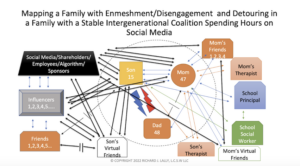
 

Husband, Wife, and Social Media Triangle

What is the impact of social media on marriage? The wife turns to social media and influencers to figure out how to “fix” her marriage. The wife tries to talk to her husband about what she has learned about marriage on social media. The husband discounts the wife’s attempts to “educate him about marriage.” She eventually gives up on the marriage and “wants to focus more” on her son. She also tries to connect with previous friends and boyfriends from past life because she feels lonely and alone “looking for a connection.”

What you will see in this triangle, and all the triangles which involve social media, is a substitution of a virtual relationship for a non-virtual relationship whose connections are full of conflict or conflict avoidance. The virtual relationships convey an illusion of meaningful connection, but the person(s) feels alone and lonely because it lacks the important ingredients for a fulfilling relationship.

Mother, Father, and Social Media Triangle

Now the wife stops working on the marriage and focuses on parenting. The husband is not aware of this decision, focusing on “making money to provide food, clothing and shelter.” The father continues to feel alienated, disconnected, and disempowered, becoming angry towards the mother and son. The mother turns to school staff, therapists, non-virtual friends, virtual friends, and influencers for ways to “fix her son.”

This fosters more of an enmeshment with son, and disengagement with Dad. The son turns to school staff, his therapist, non-virtual friends, virtual friends, and influencers. Each family member describes a feeling of disconnectedness trying to overcome the feelings of being lonely/alone. Dad voices his frustration, complaining that he is “old school,” and they are “hypnotized by that damn phone.”

Mother, School, and, Social Media Triangle

In this triangle, mom calls the teachers and guidance department for support. She has frequent phone calls with the guidance counselor because the guidance counselor “is an expert with adolescents.” As you can see, dad is left out of the interactions with the school.

After a few months, her son’s behavior is not changing, and mom is frustrated with how the school is not helping her son. Mom begins to turn to social media looking for answers. Mom spends hours on the app talking to non-virtual friends, virtual friends and reading/commenting on influencer’s posts. Mom displaces healthier activities with time spent on social media. Mom begins to complain that the school is not meeting the goals set out by the Individualized Education Plan (IEP). Mom cites information from influencers from social media and the internet. The tension rises between the school and mom.

Schools today are under tremendous pressure to perform. Schools are understaffed, and do not have the mental health training or support to bring in a countercultural systemic approach into the schools despite the money being put into schools after COVID-19.

Parents, Son, and Social Media Triangle

Mom is spending hours on social media looking for answers to why her son is struggling. She also spends time looking for connections. The son also spends hours on the app interacting with non-virtual friends, virtual friends and reading influencers’ posts.

Mom pursues the son, but he only is aligned with her to challenge dad’s limit setting. When the parents attempt to be aligned, the son acts out more. We see the son increase his conflict with parents, who struggle due to their enactment/conflict avoidance with each other on how to help their son. This results in the father leaving and the mother turning to social media to find answers or overcome feelings of loneliness.

When the family interactions are in intense conflict or conflict avoidance, many children, adolescents, and young adults get most of their answers from non-virtual friends, virtual friends and influencer’s posts. The son is seeking temporary relief by getting information and trying to affirm a sense of self.

The non virtual, virtual relationships, and influencers introduce beliefs that are the opposite of the family’s beliefs and further impact the self-esteem of the adolescent. The son discusses what he learns from social media of what “real parents are like.” The decrease in face-to-face communication with family increases his anxiety, depression, irritability, and intrusive thoughts. This also confuses the family of how their family member can “think so differently.”

Son, Non-Virtual Friends, and Social Media Triangle

The son in the session discusses constant social competition/comparison, working for social currency, and thinking he at times is invisible to his non-virtual friends. The son gradually believes his non-virtual friends “don’t understand.” He believes he cannot turn to his parents because “What do they know?!”

The son begins to engage in the same interactions with his peers as his parents and avoids turning to his peers for support. The son begins to spend more time on social media with virtual friends and influencers to seek select information that matches a narrow/closed view, hoping to avoid conflict/interaction. The son then turns more to virtual friends and influencers for answers. Again, this increases his time on his smartphone and increases the family’s sense of not being good enough for each other.

Remember, the son believes there is “less stress” getting information from a stranger, pop culture icon, or a virtual friend than an enmeshed mom, disengaged father, or face-to-face with a peer(s). However, the decrease in face-to-face communication with family and non-virtual friends increases his anxiety, depression, irritability, and intrusive thoughts.

Despite the time spent on social media, the son feels alone/lonely, looking for emotional, face-to-face and physical connection, but does not have the words to express these thoughts to each other.

Mom, Therapist(s), and Social Media Triangle

Dad continues to be absent from the triangle that involves the therapist. The mother attends her own therapy and attends her son’s sessions to discuss what new information she has seen on social media.

She reviews with both therapists what she has learned on social media about new treatment, new medication, and new diagnoses. She advocates with all providers that her son is incorrectly diagnosed, hoping that would help him with his symptoms. The quality of training of the therapist determines their response to entertaining or challenging mom’s research. This may result in mom seeing a new therapist.

The individual therapists and psychiatrists are not looking at how the parents avoid “getting on the same page.” They are reacting to reports by mom about the son’s behavior. Mom and dad are unable to interact differently because they have not figured out how to work together to decrease their son’s phone usage to increase his time with non-virtual friends. The professionals are avoiding addressing the parent’s avoidance!

Mom, Psychiatrist, and Social Media Triangle

Dad is absent from the triangle that involves the psychiatrist. Mom becomes disgruntled with the psychiatrist. She begins to challenge the psychiatrist’s diagnosis and medication recommendation. The psychiatrist recommends if mom is not satisfied with his assessment, she seek a second opinion. Mom begins to look for a psychiatrist who agrees with what she has read on social media.

Son, System of Care, and Social Media

The son is seeing his individual therapist 1-2 times a week and his psychiatrist once a month. He is also spending 2-8 hours on his social app each day. The therapist has not assessed the hours the son is spending on his phone. The app is only showing views/opinions/likes/images that interest him.

The son begins to complain that the therapist does not understand him and challenges his therapist saying, “This doesn’t help.” When the therapist explores the son’s statement, he begins to discuss information from “reliable sources” from social media and influencers. He too begins to diagnose himself and discusses medication that can help. When the system of care discusses reliable sources such as universities and professional journals, the son becomes irritated saying “I don’t want to read them.”

Son, School Staff, and Social Media

Not only does the system of care increase their sessions, but the school staff increase their time with the students. The number of triangles with the son in the school increases between the child study team, teachers, and administration.

The teachers are pursuing him to get his work done — offering to meet him before school, lunchtime, and after school to complete his work. He never shows. The son is seen in class on his phone. Some teachers ignore him, and others nag him. When a teacher challenges the time he is on his phone, he tells the teacher other instructors let him do it.

The social worker is calling him down to discuss his avoidance of work and disruptive behavior in the classroom. Only when the son becomes overwhelmed, he discusses with the school social worker his home life and that medication is not working. The vice principal is meeting with him to give him detentions. The son feels frustrated with the school stating, “They are only doing this because it is their job.”

Son, Non-virtual Friend #1, Non-virtual Friend#2 with Social Media

The son leaves school to go home to continue to work on his non-virtual relationships on social media. It becomes evident that in social media apps, the same social stressors occur online like in school. It is exhausting to navigate being included and avoid being excluded at school and online. The son and non-virtual friends are jockeying for social currency and social position, never getting time off to charge their own social battery.

The son and non-virtual friends stress about the images they post. They are anxious about what the image means to them and others. The son is trying to understand the unspoken rules for posting and the reaction by his peers regarding the image. The son worries if the image appears “authentic” and will help him maintain his position inside the social media group or if a new group be formed without them.

Son, Non-virtual Friend(s), and Virtual Friends

The son struggles connecting with his non-virtual peers. He is not getting feedback from his non-virtual friends about his art and his physical appearance and finds out they have different chat rooms that do not include him. (Remember, he does not want feedback from an overly involved mom or detached father.)

He begins to look for feedback about his art and physical appearance from virtual friends. When looking for connection outside the non-virtual friend group, he states he is looking for virtual friends who are nonjudgmental.

But as time went on, it began to mirror the non-virtual group. Some of his virtual friends on social media become competitive and attempt to increase their social currency on this platform. They do this by making fun of his physical features and his art. This mirrors some of his non-virtual friends’ behavior. The son frantically searches for another virtual peer group that he believes will not activate anxiety by not challenging his views, providing a stress-free venue.

As the son increases his time searching for virtual peers and influencers over non-virtual friends — reinforcing a closed system, increasing isolation at school, and decreasing time to sleep at home. His virtual relationships are now more important — increasing time spent on the app and continuing to strive for more likes and views.

Lack of face-to-face contact with family and non-virtual friends fosters more of a virtual enmeshment with virtual friends. He describes them as “nonjudgmental” and “more accepting.” This further increases his self-doubt and increases his feelings of loneliness and creates a virtually closed system (Virtual Enmeshment).

Son, Virtual Friends, and Influencers

The virtual group is important to maintain when avoiding contact with his parents and non-virtual friends. The son describes his virtual friends as more “authentic” and describes his non-virtual friends as “fake” and “not genuine.” However, some of his virtual friends on social media become competitive and attempt to increase their social currency.

The son frantically looks for another group that is an anxiety and stress-free venue. This further increases his self-doubt and increases his feelings of loneliness. This increases the symptoms of anxiety and depression when waiting for approval from virtual friends saying, “They are the only ones who understand me.”

As the son looks for new virtual friends, he and his virtual (and non-virtual) friends look to influencers for answers on how to portray themselves. Influencers work hard to establish and maintain their position in their virtual community. The influencers are working hard to make money and increase their viewership. The influencers often ask adolescents to agree with their beliefs and recommend products they are selling. The influencers work hard to appear on the “right side” of an issue.

As the son tries to replicate the beliefs of his preferred influencers, he looks for fellow virtual friends that have done the same “research.” They notice the more they make comments in opposition to a belief, it increases their views and likes.

As the symptoms in the family increase in intensity, the members increasingly must decide who to align themselves with in the virtual and non-virtual triangle. The therapist highlights this and encourages the family to discuss and identify the boundaries of virtual and non-virtual triangles that maintain these alliances/symptoms. This allows a family to discuss non-virtual triangles that are underutilized, which reinforce healthy boundaries that benefit the family.

Using Exploring Questions to Make Circular Statements

Much has been written about joining, unbalancing, and mapping in SFT. One of the beautiful ways Structural Family Therapy (SFT) uses language is by employing circular statements to connect the family member’s behavior in the system. When SFT enters the family, the systems therapist uses the family’s own observations to connect their interactions.

It is important today to make a circular statement to widen the lens in which the family sees how all virtual and non-virtual relationships impact the relationship in the family. Below are some examples of circular statements using the words used by each family member.

I agree with you, Mom, that as long as you do not have a voice with Dad and work together, your son will not stop posting explicit images on Snapchat

Dad, as long as you sound like a drill sergeant, Mom will not find her voice as a woman and work with you as a wife and mother of your son who will continue to believe he must mirror images on Instagram

Mom, I agree that the harder you work, the less Dad helps you with parenting your daughter— your daughter will have to turn to influencers about how a woman should look and act

Peter (son), as long as your mom is worried about the frontstage appearance, she will fight with your father who is more concerned about your backstage struggles with you and your mother

What do your virtual friends give you that you cannot get from Mom, Dad, or your non-virtual friends?

Conclusion

Many are worried about the continued increase in suicide, suicide attempts, and mental health issues in the family and how Congress is powerless to challenge these companies. Many providers are not looking at what has changed in our lives in the past 25 years.

Relationships are becoming more complicated than ever. Many families and therapists are unaware of the impact of the system of care and less aware of the impact of the ubiquitous “algorithm.” It is hard to understand how the algorithm works because it is important for these companies to keep the algorithm secret for fear of losing profit.

We must also remember that each influencer, virtual friend, and nonvirtual friend has their own family map. Just as many professionals do, influencers understand how their stories, views, and images echo in the family.

Are families aware of the alliances that occur with virtual and non-virtual friends and influencers? Are we aware that when more virtual influencers and friends enter the family, more alliances increase establishing social hierarchy, increasing social competition and social currency? Are we, the clinicians, aware that influencers and virtual friends unintentionally/intentionally begin to write/rewrite stories in the family and permanently on the internet?

We must begin to understand that with more stories, there are more opposing interests for each family member. This phenomenon between families, virtual friends, nonvirtual friends, and influencers (social media) is a result of collusion when all parties collaborate to uphold their preferred sociocultural trend.

The goal is not only to highlight and interrupt the multi-alliances with existing social media but to highlight the transactional pattern in the home that maintains this pattern. Remember, a virtually closed system impacts all family members, whether one or all are using these platforms excessively.

References

(1) Susruthi, R., Myara, Maymone, B. C. & Vashi, N. Selfies-Living in the era of filtered photographs. JAMA Facial Plastic Surgery. 2018 20:6, 443-444.

(2) Nesi, J. (2022) The impact of social media on youth mental health: Challenges and opportunities. North Carolina Medical Journal, 81(2), 116-121.

(3) Colapinto, J. (1995) Dilution of family process in social services: Implications for treatment of neglectful families. Family Process. 34:59-74.

Questions for Reflections and Discussion

How has social media influenced your personal and family life?

How does the author’s premise resonate with you and the way you practice family therapy?

How have you integrated social media and app use into family therapy?

In what ways do you agree or disagree with the role of social media in family systems?

© Psychotherapy.net 2023