Powerful Therapy Strategies for Healing Wounded Couples

I remember greeting them for the first time in the lobby of my office. At first glance, they seemed like gentle people, kind to each other and to me. As they entered the corridor leading to my office, he deferred to her, politely allowing her to go before him as they entered the room. I recall thinking to myself, “I wonder why they're here?”

Like what you are reading? For more stimulating stories, thought-provoking articles and new video announcements, sign up for our monthly newsletter.

But apparently this had been performance art, a quick bowing to public expectation. Soon after taking their seats, finding themselves safely sequestered behind closed doors and out of public earshot, those first-impression niceties vanished, and the emotional floodgates burst wide open. With what seemed like the disgorging of years of pent-up acrimony, accusations began to fly like the shrapnel of a bomb blast.

Blame and Accusations in Couples Therapy

She was first to launch her attack with the speed of a knee-jerk reflex. “He never listens to me…We don't communicate at all… I try to talk to him but it's like talking to a brick wall… I get so angry at him! I've tried everything.” Each new rendition of her complaining was an embellished and emphatic iteration of the previous one.

Notably, throughout her hair-pulling allegations, her eyes fixed solicitously upon me, as though she were expecting me to jump into the fray—once she'd fully discharged her accusations—and like a biased, one-sided arbiter, I was to join her in a corrective condemnation of her partner. Instead, probably to her great disappointment, I looked back at her with an empathic expression of heartfelt concern for her gnawing frustrations and deep hurt.

Amid her scalding allegations, her partner sat stoically, appearing inured to the barrage of insults and blaming he'd no doubt endured many times before. Then, with the first lull in her opening assault, when her “guns” appeared emptied and before she could “reload,” his defensive counter-indicting assault began with a fury matching hers, “She is always critical… She's so negative and judgmental… Nothing I do is right… I walk on eggshells all the time… It never used to be this bad… She used to be kind and loving… Now look at her… I don't know what happened.”

I've learned the hard way not to allow raw venting such as this to continue unharnessed for too long. I've found, probably as you have, that if “law and order” aren't soon imposed, the potential for a productive session soon diminishes, and can even irrevocably tip over into non or counterproductivity.

I typically jump in quickly, stop the mudslinging, and administer another dosing of empathy, followed by questions such as “Did you just give me a sample of how you talk to each other at home? If so, how do these conversations usually run their course?” As you might imagine, their answers are predictable: “Not good…We get nowhere…Things just get worse….”

Validating the Legitimate Needs Behind the Arguments

After allowing a moment for their answers to percolate, I typically find it therapeutically helpful to ask, “Do you think your upsets could be this intense were it not for the fact that each of you brings to the other important personal needs, indeed, very valid ones?” Of course, this is a therapeutically-baited question with a largely calculable answer.

But the question also flings open a window onto a wider batch of potentially therapeutic questions, like: “Wouldn't you agree the legitimacy of your needs is clearly evidenced by the strength of the emotions that attend them? And because of the importance of your needs, don't they beg for your best reasoning and problem-solving, in short, your best need management? Wouldn't this be more achievable in an emotional atmosphere of nonjudgementalism, mutual acceptance and respect?” More time for percolating.

In the case above, once we collaboratively agreed on these goals, I turned to her first and asked the seemingly obvious question: “Can you identify the basic needs at the heart of your arguments?” Her answer came swiftly: “I need him to listen to me.” I replied with a quick confirmation and a slight tweaking of her response, “Yes, your need is to be listened to, which seems perfectly reasonable to me.”

Then while my confirmation was still fresh, I turned to him and pointedly asked, “Is your wife's need to be listened to a valid one?” Put in this strategic manner, his affirming response was all but guaranteed because her need had been stripped of its biting and condemning emotional overlay, its legitimacy laid bare with plain and calculated neutrality. So, expectedly, his affirmative response was speedy and unequivocal. Then, without hesitating, I again responded with a deliberate, co-confirming, “I agree, your wife's need is valid.”

Now, in turn, I directed the same questions at him, first by asking him to clearly identify his needs. Foreseeably, he answered, “I want to be treated kindly and with respect.” Following the same protocol, I confirmed the legitimacy of his need which had just been divested of its own attention-gobbling, counterattacking emotion and was now openly “on parade” for its indisputable validity. Now, turning back to her, I asked in the same manner, “Does your husband's need for kindness and respect seem reasonable to you?” Again, you can guess her answer.

The stage was now set to bullhorn what had become increasingly obvious. Formerly vitriolic and contentious partners were questioning their use of blame and accusation and were now instead marching to the tune of mutual respect.

Moving Forward in Couples Therapy

I’ve been fortunate enough to apply this technique with relative effectiveness, so it has been my experience, and I suspect yours as well, that this purposeful trio of empathy, caring, and genuinely curious question-raising can soften these “marital combatants” to a degree that their cognitive flexibilities and problem-solving skills become more accessible.

Once this appears clear, I drive home the same critical point. “Could you be at odds with each other to this extent over needs that possess little, or no personal significance? And given the in-your-face evidence of the strength of your personal needs and the intense emotions that orbit them, what if we were to carefully examine how you manage them now, and maybe better, how you might more effectively manage them moving forward?”

The demanding work of implementing this strategy outside of therapy certainly belonged to the couple and others like them, but in my experience, these partners leave my office with a helpful set of tools, a cause for optimism, and hope for re-connection.

Questions for Thought

What is your reaction to the author’s approach to dealing with “warring” couples?

How do you address anger and blaming in your own couples work?

Can you think of a warring couple that you successfully helped? One with whom you were not successful and why?

Spitting Truth from My Soul: A Case Story of Rapping, Probation, and the Narrative Practices- Part I

The Rap That Binds

“This kid really doesn’t get it,” a clearly frustrated voice blared so loudly that I moved the phone’s speaker a couple of inches from my ear to avoid any future hearing loss.

“He just won’t take any responsibility for his actions, and he doesn't give a shit…and he has 16 more months until he’s off probation! I just don’t think he’s going to make it. I don’t even think you want this one!” I recognized this voice as that of a probation supervisor I had worked with a number of times over the years, but never had I heard frustration get the better of him in such an obvious way. “I’d be happy to see him,” I said. “Send him my way.”

When I put the phone down, I wondered if my enthusiasm might have been misplaced and I would have been wiser to tell him I was overloaded and couldn't take on any more work at this moment. No more than 24 hours later I received a phone call from Ray, a 24-year-old young man who told me his probation officer had passed on my phone number to him. I was intrigued by how polite and soft-spoken he sounded over the phone, and we set up an appointment for later in the week.

My work with people involved with the justice system, whether on probation or otherwise, began nearly 13 years ago when I was just a 22-year-old graduate student in Los Angeles, California. After years of agency work, I now operate a small private practice where probation officers, schools, and word of mouth drive young people like Ray to my door.

In community agencies I had worked in the past, I met with people twice a week as mandated by their sentences. More recently, I have started getting short-term referrals, which often allow for between 4-8 meetings with people. In the case of Ray, we ended up seeing each other 9 times. Probation assumed responsibility for payment for 5 meetings only.

After that, our time was up. However, Ray indicated that he wanted to continue to attend on his own volition. This is something that happens with a surprising number of cases. I have learned that if we call the probation officer on the case, the Department of Justice will usually pick up at least half of the cost for the remaining number of sessions, something they were willing to do for Ray.

Three days after first talking to Ray on the phone, he walked into the office wearing blue jeans, a red hoodie, and had headphones dangling around his neck. As he sat down across from me, I had an intuition that he was not a stranger to this process often called “therapy,” a fact he would confirm as we began talking.

It was as if he was bracing himself for what was to come. He sat back in his chair, both of his hands tightly grabbing on to an arm almost as if he was at the mercy of a neophyte airline pilot preparing to practice landing a massive 747 for the first time. Perhaps he was expecting a barrage of advice disguised as “psychoeducation?” Or was he steeling himself for inquiries about what might be neurochemically “wrong” with him? Everything about how he was composing himself suggested to me that this young man had heard it all before.

My first query was clearly not one he was expecting. “Do you mind if I ask what you are listening to?” gesturing to his headphones. Ray raised his head up to look me in the eyes for the first time since walking into the room, his gaze a blend of skepticism and curiosity. “Styles P and Pharoahe Monch,” he replied.

“How old are you again?” I said as a smile crept on to my face.

“Why?” he inquired.

“It’s just that most 24-year-olds I have spoken with aren’t keen to the ways of Styles P and Pharoahe Monch,” I said still smiling knowing the album he was referencing was over a decade old and was not one many young men of his age were typically in step with.

“A lot of this new shit ain’t real. I can feel what Styles and Pharoahe are saying,” Ray declared.

And with this, we were off. I had been granted the great privilege of riding shotgun in Ray’s lyrical journey. For the next forty-five minutes we listened to music on his phone and critically examined the verses he found most meaningful. What follows is an example of one such verse:

I Supreme Lord and Master (ISLAM)
But at times,
The words ring empty
When I see another homie blood splattered
Dreams get shattered
Family fractured
Ugly reputations is what give television ratings
Problem story plastered
Learn the science of our plight
These depictions keep penitentiaries packed tight
But only God can judge me
Once I fade away from life.

Yet another example:

How many Super Bowls passed
My mind’s eye showing possibility so I grasp
Of a hood block,
With no patrolling cops
No empty baggies once holding rocks
Shells from a glock
But the wisdom I've acquired allows us to question what was taught
Pause in the moment
The impulse can be stopped.

During the conversation that followed I learned that not only did Ray have an affinity for rap music, but he also wrote some rhymes of his own.

A Voice to the Voiceless

Travis: Listening to you today, Ray, I have a hunch that you and rap music have been homeboys for a long time and you both share a long and storied history together. Am I right or wrong?

Ray: Yeah, I mean, I can’t remember my life without rap. It’s like it was with me from the moment I came out of the womb. You know, I’m sure that’s not true, but that’s what it feels like.

T: Wow! Are you telling me that no one has been a friend to you longer than rap has? (He nods his assent) This seems like a really important relationship. Would it be okay with you if I tried to understand the relationship you and rap share a bit better?

R: Sure, go for it.

T: I’m curious to know if anyone has ever asked you about your relationship with rap before?

R: (pauses 10 seconds or so) I mean, not really. My homies and I cypher back-and-forth about it, but… you know… I haven’t really broken down my relationship with it if that makes any sense.

T: It does make sense. Thank you. Other than your homies, does anyone else ask you about your relationship with rap?

R: No, except for like teachers and probation and other adults throughout my whole life trying to tell me it’s violent and the music of the devil (takes his index fingers and makes horns over his head) and shit like that (laughs).

T: So, if I’m hearing you correctly, Ray, those adults don’t really ask you about your relationship with rap, but rather tell you the sort of relationship you should have with it?

R: Exactly! It’s like they don’t know shit about it but want to tell you it’s the root of all evil.

T: This is really remarkable to me, Ray! Would it be okay if I asked you a few more questions about it?

R: Oh yeah, no problem.

T: If it gets boring to you or you would rather go in another direction just tell me, okay?

R: Word (a hip-hop phrase that in this context verbalizes agreement).

T: What do you think the adults you just mentioned, like former teachers or people involved with probation, could stand to learn from your relationship with rap?

R: They would never learn anything because they won’t listen. Their minds are already done made up.

T: Do you mind if I ask what kind of headphones those are, Ray? (pointing to his neck).

R: These? Oh, man, these are Beats (a popular brand of headphones).

T: Now I heard you say that those folks wouldn’t listen, and I want you to know that I absolutely believe you. Even still, I want to invite you to imagine for a second that we could take a pair of Beats, maybe even magic Beats, and slip them on to the people that can’t or won’t hear while they were sleeping, and the message would sneak through their ears and permeate their minds whether they wanted it to or not. Imagine now that they have woken up. What education would rap have given them?

R: Man, I wish you could pick me up some of those headphones (said laughing)!

T: That would be pretty cool, right? Maybe that’s a project we can work on later (both of us laughing).

R: For real! What I think they would learn is that there are a lot of people in the world who don’t have a voice. If you are someone in the world who does have a voice, you know, that’s great. Good for you. And by voice I mean, you know, we all have like a voice box that works. What I mean when I say voice is a voice that others can hear or will really listen to. My whole life I’ve never really had that voice because I’m poor and black… except when I rap. This is true, you know, for like pretty much my whole crew in my neighborhood, too. Rap is our voice.

T: Are you of the opinion that the people who won’t listen that you referenced earlier would learn from the “magic Beats” that rap could serve as a voice for the voiceless?

R: Exactly. I mean, if everyone listens to everything you say anyway, then fine, you don’t need something like rap. (Begins rapping):

The more I wild out
Allows me to achieve that street clout
While lives are turned into tools
Did dominant narratives actually raise a bunch of fools?
Our escape from a jumpshot or a hip-hop plate?
While theirs is school?
But either one of us can lose
Trying to chase what Lupe articulated as The Cool,
White men in suits don’t have to jump
Still a thousand and one ways to lose with his shoes

R: You know, that line, “White men in suits don’t have to jump,” that’s what I’m talking about.

T: Right, there’s that old saying, “White men can’t jump,” when it comes to basketball. Did those lyrics do something clever with it?

R: For sure. White men don’t have to jump to make money and white men don’t have to rap to be heard. Don’t get me wrong, I write rhymes because I love to. Sometimes when I write it’s just about partying or females or something light. But I also write because it allows me to have a voice. You know, it’s like rap says to the world I’m going to say shit how it is whether you like it or not.

Of Protest and Freedom

It was becoming increasingly clear that Ray’s relationship with rap, and the hip-hop culture in which it resided, was one of protest, freedom, and inspiration. As our conversation continued to traverse the electrifying and winding roads of rap music, we alternated between listening to songs on Ray’s phone and discussing, almost philosophizing, at the conclusion of each. That served as inspiration for the following exchange:

T: Do you think rappers are philosophers?

R: No doubt. Rap is philosophy but without all the old white cats (said laughing).

T: Socrates is not the father or first philosopher of rap?

R: No! (Laughs harder)

T: Who do you think is?

R: Probably KRS-ONE.

T: What in your opinion is the job of a philosopher?

R: To make people think, like hold a mirror up to the world so they can see how foolish they are. (Begins rapping):

Peep the crucifix
Comes across mysterious
With I(j)ehova hanging from the partisan nails of politics
The origins
Governing men of Romans
Did agree to its means justifying capital punishment
For the minds
They despised
To keep all the sheep in line
While revolution sparked divine
Christ
But check the rhyme
What if they lynched him hanging from the branch of a tree
Then burned him half alive
Peep manipulation B
We would pray to a tree
Then human torching eventually
Fire associated with hell
Overstand irony
When a bullet burns its way into your brother's physical
Laid to rest in a wooden casket
Damned its cyclical.

T: What do you hear in these rhymes?

R: It’s like it exposes hypocrisy, you know what I mean? People believe things about God or religion or whatever without even opening up a book or thinking. They just accept a history they like or feel comfortable about or that some cat on TV tells them is right.

T: Are you of the opinion that there are multiple histories?

R: Oh yeah, no doubt. The history that you get in history books is the only one most people read, though.

T: Where do these histories come from?

R: Usually from your teacher and books in school.

T: Where does the information in those books come from?

R: I mean, that mostly comes from white people and their ancestors. You know, I took a philosophy class in college like 4 years ago and I don’t think we talked about one brother the whole time. That’s part of the reason I never fit in there.

T: And the fact that the only history that was discussed was from a white perspective, what does that mean for the other histories?

R: You see them in like Roots (a television mini-series from the 1970’s depicting the life of a black slave in the United States) and shit (laughing). We had to watch that in high school. That shit is so weak.

T: What would be a stronger portrayal?

R: You just heard one (in the previous rap). But it’s like I told you earlier, people don’t want to listen to those.

T: Do you believe you are a philosopher?

R: I never really thought about it like that. I know I’m a writer. But I guess that means I am a philosopher.

T: Do you mind if I tap into your own philosophical expertise?

R: Sure. I know what you’re go to say next (said with a wry smile). You are going to ask me about my philosophy on shit.

T: You know me too well already, Ray!

R: My philosophy is simple. It’s to see the truth even when they try and obscure it. It’s to go deeper. If you don’t, you’ll believe a lie.

T: How do you see deeper?

R: You have to do what my grandmother says: ignore the noise. You can’t believe everything you hear. You can’t even believe everything you think you see.

T: Is your grandmother a wise philosopher, too?

R: She’s the wisest person I know.

T: What has her philosophy taught you about the person you want to be?

R: She always says I didn’t raise no fool.

T: Would you say that your grandmother’s philosophy and the philosophy of KRS-ONE are similar?

R: Hmm… (pauses for 10-15 seconds) that’s crazy, bro. I never thought of it like that, but I guess so.

T: In what ways would you say they are similar?

R: Both of them are encouraging me to think in my own way. To be my own person. Basically, just be wise to the ways of the world.

T: Do you think that it would be helpful in our work to call on the ideas of great philosophers like your grandmother and also KRS-ONE as we try to navigate the situation that brought you to see me?

R: Yeah, it’s just crazy though because my grandmother hates rap. Like she thinks it “corrupts the youth” (fingers on both hands raised to make air quotes).

T: If only we had those “Magic Beats.” Do you think she would be more open to it then?

R: (Smiles and then laughs) Yeah, and maybe she would see that I’m rapping about like the same shit she’s saying but in my own way.

T: Have you ever thought that maybe the spirit of your ancestors and their struggles can be channeled through your raps? Maybe rap is like your history book?

R: I mean… that’s deep! I ain’t never thought of it quite like that, but yeah, my raps are about me, where I came from, and where my people came from.

T: Would it be okay if we cracked open your rap’s history book in our work together?

R: Yeah.

T: Do you think it might provide us with some stories that the regular history books miss?

R: Oh, no question! Stories that regular history books wouldn’t even touch!

So engrossed did we both become in the progression of this conversation that time itself seemed to melt away. Ray continued writing his own history through various rhymes and interpretations of them.

Removing the Shackles

At one point Ray could not conceal his enthusiasm for a verse he located on his phone. He said he had been listening to it for a few weeks with a great deal of frequency. It moved him so much that he immediately stopped the music after it had played and rapped the verse himself again.

With these I see
Crimson stains on this project concrete
Yellow tape barricade
Homie wrapped in white sheets
It's a struggle just to eat
So how the fuck do they rationalize judging me or my deeds
Grab a pen
Clear the phlegm
Then commence to bless the beat
Give ya'll a tour of my life
Without walking on my streets
It's my life!
Being scribbled on they college ruled pages
Escape when we cipher up
That type of freedom is amazing
My life!

I watched him intently and took a few deep breaths before breaking the silence we had both fallen into by my first query.

T: Ray, I noticed that you listened to this verse and then stopped the music and rapped it. Were you, by any chance, deepening your relationship with the lyrics by rapping it yourself?

R: I do this all the time. What I like to do is take a verse that someone else wrote and then just add my own flavor, kind of like sampling (a hip-hop term for taking an older song and mixing it with a new one) or remixing.

T: Do you mean that you take the original rhyme and add your own story?

R: Exactly.

Ray was so engaged that by the end of our conversation it was as if he were a different person than the one who walked through the door an hour before. Certainly he was a poor match for the description of the detached and uncaring young man who lacked any semblance of motivation that the probation officer had provided for me earlier in the week.

The fact there wasn’t much sand left in the hourglass of our first meeting had sneaked up on both of us. My mind was left spinning with possibilities for where our future conversations could go. With just five minutes remaining, I invited Ray to reflect with me on what had transpired which broke us both out of our enthrallment.

Travis: Would it be all right if I asked you a little bit about how our meeting today is going?

Ray: That’s cool.

T: Thank you, as I know I have asked you a lot of questions today. I appreciate you hanging in there with me. I’ve noticed that it’s very different when we are just speaking as opposed to when we invite rap to the party. Have you noticed this?

R: Yeah, for sure.

T: How do you understand this?

R: It’s like when I rhyme… I spit truth from my soul.

T: How is rapping with your soul different than talking with your mouth?

R: When I talk, I think. I thought that’s what we’re supposed to do in therapy, anyway. That’s what all those other fucking shrinks did.

T: Would it be all right if we made up our own therapy and put aside other kinds of therapy you have been through or heard about?

R: Yeah (said with a chuckle and skeptical eyes).

T: What can your soul rhyme that your mouth sometimes might have trouble saying?

R: Freedom. It’s like when I’m rapping I can feel the words come through my body. It’s natural, like I don’t have to think about it.

T: By that do you mean to say that rhymes remove the shackles that are attached to your soul?

R: Right (said turning his head to one side as if in deliberation and then nodding).

T: I saw your face light up. I wonder if inspiration is brewing in your soul this very moment? I know I am guessing so I could very well be wrong.

R: No, it’s just that I thought of a verse. (Begins rapping):

It's like we being played
When they say
Strive for a slice
Of they cake
They filthy hands holding hate
Choke out fate
But the rhyme melts the shackles
Oppression disintegrates
Even just for one moment
When we flowing on stage
It goes on and on and on…

T: Have you had shackles on your soul that rap music helps you break free from?

R: Yeah, sometimes it feels like rap is my only way to break free.

T: I notice when you rap that your whole body changes. For example, when we were just talking earlier you were kind of slumped down in your chair. But when you rap, your back straightens up, your face lights up, and your hands are active. It’s almost like I can see you breaking free right in front of me. What do you think would happen if rap made more frequent visits to your life?

R: I would feel more alive and like I have a voice, you know what I mean? Like being on probation it feels like I have no voice. I just get told what to do and it’s like they tell everyone the same thing and don’t really care what really makes someone tick. It’s like we are cattle just being pushed through the gates.

T: Do you think Rap music could be a great way for us to understand what makes you tick?

R: The best way!

T: I get the sense you have many important stories to rap about. Would you be willing to write a song between now and next time that paints the part of the picture that probation and maybe other people in your life don’t get about you?

R: (Nods affirmatively)

T: Do you know what I mean?

R: Oh yeah, for sure. I already feel a couple of ideas (pointing to his head). Like people automatically assume I’m stupid and like I’m some kind of bad person or criminal or something. They don’t even know me.

T: Might writing a rhyme about the parts they don’t know release the shackles from your soul?

R: Yeah, but not all the way.

T: It might take more than one rhyme to release them all the way?

R: Yeah.

T: Do you have many stories to tell?

R: Oh yeah!

T: I want you to know that I will support you in writing as many rhymes as it takes.

R: You’re the weirdest shrink they have ever sent me to. Not weird like bad, not bad at all, but does probation know you do this?

T: Do what? Ask people to rap?

R: Yeah!

T: They know I help people find the kinds of therapies that best work for them. Do you think this one we’ve come up with today might work for you?

R: Oh yeah, but I don’t even know if this is really therapy.

T: What would you call it?

R: It’s like a studio session where I’m making beats with my homies or something.

T: Should we have a studio session once a week together?

R: (Smiles and laughs) For sure.

Spitting From My Soul

Ray returned for our second conversation with his black New York Yankees hat turned to the side looking somewhat, but perhaps not yet completely relaxed as he sat down. He reached into his pocket and pulled out a folded piece of paper as his right leg bounced up and down. He quickly unfolded it and scanned over its content. “Here are a few lyrics,” he said quietly but with conviction as he handed the document to me. I was feeling a bit caught off guard that Ray had picked up so quickly where we left off in our last conversation.

T: Ray, I have to be honest, I feel so privileged to hold this is my hand right now. I wonder if I am holding a gift from your soul?

R: You could say that (kindly smiling at me).

T: I just had an idea and I’m curious if it would be okay if I shared it with you? (Ray nodded in the affirmative). Last week you told me that rhymes come from your soul when they are rapped. I could be wrong here, but I’m just wondering if I read the rhyme on the paper if it might lose some of its soulfulness? And the last thing I want to do is strip the rhyme of its soulfulness.

R: I’ve got a baseline for this (pointing to his phone). It’s dope (a hip-hop term that means good or of high quality) You want to hear it?

T: I would be honored, Ray.

As the music percolated through the small speakers on his phone I noticed I couldn’t help but bob my head. I looked up and Ray was doing the same. Our eyes caught and Ray smiled slightly with the left side of his mouth. In this moment I pondered whether or not I should invite him to rap, but I hesitated not wanting to make him feel uncomfortable in our second conversation. A few seconds later, Ray reached his hand out indicating he wanted the document with the lyrics on it back from me. I obliged. Ray bobbed his head a few more times and said, “This still needs a little more time in the lab, but…”

What happened next as Ray began to “spit truth” was almost like a detonation. The words rhythmically rolled off his tongue with an intensity that made me suspect something important was transpiring. I didn’t just listen to what he said, I felt it. Ray’s passion was palpable, and I could feel its infusion through my body. We now bobbed our heads in unison and for a brief time it was as if the world had shrunk and we were the only two people that now could fit in it. It was the kind of attunement and connection with another person that was equal parts mysterious and exhilarating.

Grandma said I should reconsider law school
That means I wear a suit and bend the truth and feel awful
Hell no, got a degree but what that cost you
You make a good salary just to pay Sallie Mae
That's real as ever
Ducking bill collectors like a Jehovah's witness
When they showed up at your door at Christmas
Praise God it's hard to stay spiritual
How they got these people on the TV selling miracles
You mean to tell me everything gonna be fine
If I call your hotline and pay 29.99
Well damn, why didn’t you say so
Take this check and ask God to multiply all my pesos

T: I am so captivated by what just happened, Ray! Would it be alright if I tried to understand your rhyming genius a little better?

R: For sure.

T: May I ask what is it about this rhyme that reveals a part of yourself that other people often fail to get?

R: People think that because I don’t have a college degree I’m stupid. They make that judgment up front. Now I’m not trying to say that college is always a bad thing (said looking at me knowing that I’m also a college professor), but, you know, sometimes it’s like a scam. Like, I'm a poor kid. Think about how much debt I would rack up by going to college. Dude, it’s astronomical. I tried community college for a year. Is that even a good investment? You know, I think a really good rhyme exposes the way people think. So that first part is just like a challenge. You know, just because these are the rules you play the game by doesn’t mean they are the only rules.

T: Do you think rhyming helps you create your own rules while also challenging the rules people tell you that you should follow?

R: No doubt. And sometimes you challenge rules in rhymes just to make people think.

T: Is that like what you were saying last week about rap as a philosophy (I asked Ray this very much hoping the conversation meant as much to him as it had to me).

R: Exactly, like KRS-One!

T: (Feeling relieved that we seemed to be catching up right where we left off last week, I continued) Can I tap a bit further into your rhyming knowledge here, Ray?

R: Sure.

T: Are you of the opinion that challenging rules is a good thing? (Ray nods in the affirmative) And why do you think it’s a good thing to challenge rules?

R: If no one challenges rules, shit gets stale. You know what I mean? Like people start to take things for granted. Sometimes a good rhyme is just like grabbing someone and going (pretends like he’s physically shaking someone). It’s like, wake up, yo!

T: Do you believe there are different ways to challenge rules?

R: A lot of different ways.

T: Are some ways of challenging rules more effective than others in your experience?

R: Yeah, I mean, look how I ended up here on probation.

T: How do you mean?

R: Ever since I was a kid, I would find myself in certain situations where I would get angry and step (a hip-hop term that means to challenge someone physically, often to a fight) to someone. Yeah, and it’s stupid, I know. I’ve been getting that lecture my whole life.

T: How do you understand the relationship between rap and anger?

R: When I would write rhymes, they would keep me out of trouble. Like if someone was pissing me off, I would just go home and make a beat about it. It’s like my anger would leave my mouth through my rhymes.

T: Let me see if I’m hearing you correctly, Ray, because I don’t want to get this wrong. Are you saying that rap is able to put anger in its place?

R: Yeah, I don’t end up doing something stupid.

T: Maybe this is a long shot, Ray, but do any rhymes come to mind that capture what we are talking about here?

R: No, not really… (pauses in a pensive fashion for 30 seconds or so)…actually, yeah, one does (he composes himself and then begins rapping):

References

How to Help Veterans Haunted by War Reclaim Their Humanity

“I try to not fall asleep, because then I’ll just have another nightmare.”

Rick was a sniper in the Vietnam War. He was sent on “high-low” missions in which he was taken by plane at night to a “high” altitude (above radar) where he would jump out with his rifle, and his parachute would automatically open at a “low” altitude of 1000 feet. He was given a photo of a high-level North Vietnamese commander who was his target on the mission. After completing his mission, Rick would run through the jungle, then swim down the river where he was picked up by an American patrol boat. Rick successfully completed six of these incredibly dangerous missions. He subsequently suffered recurrent nightmares in which he would see the dreadful sights in his rifle scope at the moments of successes, and then be chased through the jungle by groups of North Vietnamese soldiers.

After returning from war Rick became alcoholic, lost his marriage and relationships with his two young daughters, became homeless, and suffered degradation to his health. Now, in the nursing facility, Rick was gaunt, wheelchair-bound, with straggly hair and beard, and largely mute, rarely speaking to anyone. He did begin to speak with me after a few months of my quietly and patiently talking to him.

Rick talked of how he and his sister grew up with alcoholic and abusive parents. To escape, he would shoot tin cans for hours at a local quarry. In our therapeutic work together, Rick was willing to explore the associations with his recurrent nightmares. Even though Rick knew he had acted under the command of superior officers, had skillfully fulfilled his military duties, and was viewed as a hero, he had deep feelings of guilt and shame about his role as a sniper. In part, his guilt stemmed from fantasies he had as a teenager that involved shooting his parents as he took aim at the tin cans. Rick felt remorse over the killing of targeted enemy commanders, even though he knew they were directing their own troops to kill him and his comrades. Rick had imaginary conversations during therapy with the men he had shot.

Rick felt deeply ambivalent about being labeled a “hero.” We considered if it was heroism to jump repeatedly from a plane over enemy territory at night, or to fulfill six sniper missions, or to overcome his trauma and recover his human concern for others, or to begin communicating with others at the nursing facility, or to have a meeting with one of his now-adult and long-estranged daughters, or to reconnect lovingly with his sister.

Rick came to laugh as we speculated that maybe it should be the North Vietnamese soldiers having nightmares after an invisible American sniper jumped from the sky six times and killed their commanders then escaped unseen. As therapy continued over the next two years, Rick reported gradual reductions in the frequency of nightmares from nightly, to once weekly, to “only once in a while now.”

In working with Rick, and others who shared similar trauma, I have come to learn that war is truly hell on earth, and that while heroism surely revolves around the strength and valor to fight, it also includes the courage to reclaim one’s humanity and one’s relationships, and to regain some degree of peace within a wounded soul.

Using the Power of Play Therapy to Free a Frightened Child

Play is the child’s language and toys are their words

Garry Landreth   


Play therapy hasn't always been taken seriously in academic and clinical settings. After all, it has play in its name. However, those who regularly use it in their clinical work and/or are trained as registered play therapists fully understand its healing power. I have always been attracted to play as a natural medium for self-expression in which the child can address and work through complex and often painful feelings, conflicts, and experiences in a place of safety and security, free of judgement and pressure. I have been particularly drawn to the non-directive approach to play therapy pioneered by Virginia Axline and later Garry Landreth, which relies on building a trusting therapeutic relationship with the therapist and letting the child lead the play without adult direction.
 

Like what you are reading? For more stimulating stories, thought-provoking articles and new video announcements, sign up for our monthly newsletter.

Jasmin

Four-year-old Jasmin* was referred for play therapy to the children’s hospital outpatient clinic in Dubai, United Arab Emirates where I work. She was struggling with severe anxiety and was unable to tolerate being around other people, including family members. She experienced panic attacks if someone spoke to her and was unable to play in crowded areas. Jasmin’s mother was deeply concerned that, because her daughter had missed her chance to start school, she would not be able to live a normal life or have friends.

I gathered from her history that Jasmin’s life journey had begun in the shadow of severe separation anxiety. Her parents were immigrants from a neighboring Arab nation and had extended family living nearby, ultimately settling down in Dubai where Jasmin was born. Jasmin experienced many medical complications directly after her birth: she spent almost four months in the neonatal intensive care unit (NICU), with only one day out of 100 with skin-to-skin contact. Jasmin’s mother became highly protective of her fragile infant daughter, shielding her from other people and giving her anything she wanted. This was likely related to guilt from the experience that they shared ever since Jasmin’s birth.

In our earliest play therapy session, Jasmin’s mother was fearful and pessimistic that her daughter could be helped to overcome her — or perhaps I should say “their” anxiety and fears. Jasmin arrived for that session crying, screaming, and saying she wanted to go home while hiding her face and clutching her mother in intense fear. She did not accept any direct communication from me.

In the coming weeks I maintained a consistency in my quiet and patient presence, with hopes of reducing Jasmin’s fear and providing a predictable environment for her. Eventually her crying stopped, and Jasmin seemed more comfortable in my presence, showing a burgeoning interest in some of the toys and materials in the playroom. Perhaps the seeds of trust were being sown.

In the following five to ten sessions, she once again began hiding her face and regressed to avoiding any direct speech on my part, instead choosing to hold on to her mother. I’m not sure what changed this early course of “progress” for the better, but after a few more sessions in which I was consistent, respectful of her need to withdraw, and validating in small verbal and non-verbal ways, Jasmin once again shared eye contact with me. However, she continued to only communicate non-verbally despite this progress.

After a few dozen sessions — which may seem like a lot to those who have not relied exclusively on a non-directive approach — there was a breakthrough. Jasmin spoke! She seemed to slowly accept my presence, engaged in play, grew more visibly comfortable in our relationship. From that session onwards, she laughed, giggled, asked me to draw, commented on my drawings, and shared her toys with me. She began speaking openly about her thoughts and feelings, and at one point, even gave me a high five! Yet, while these were indeed huge steps for Jasmin, she was still speaking only through her mother, telling her what she wanted to play instead of asking me directly. It’s important to note that during the initial sessions, Jasmin used the sand tray to explore and express her thoughts and feelings.


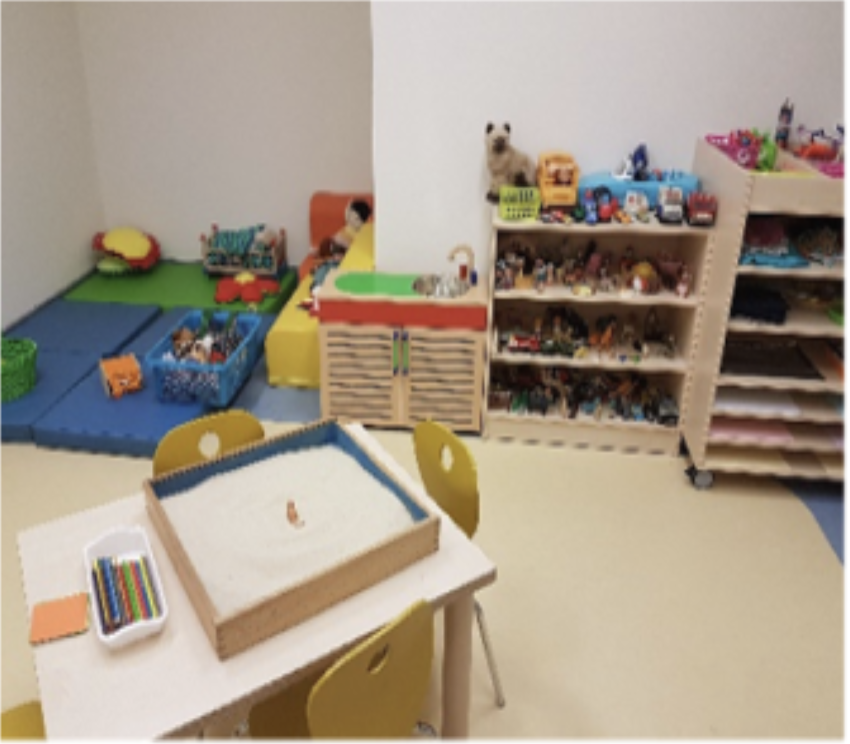
My Play Therapy Room


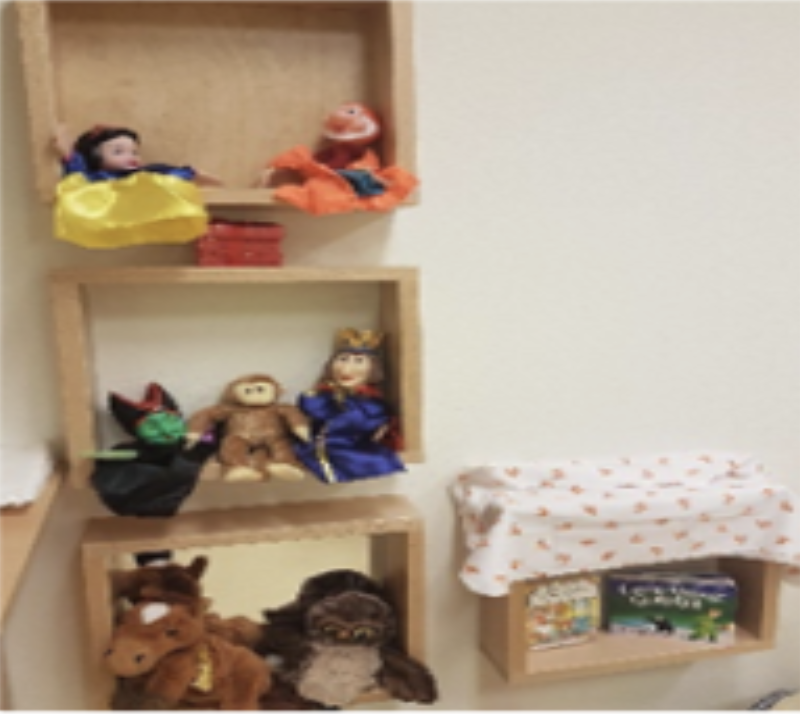
Puppets


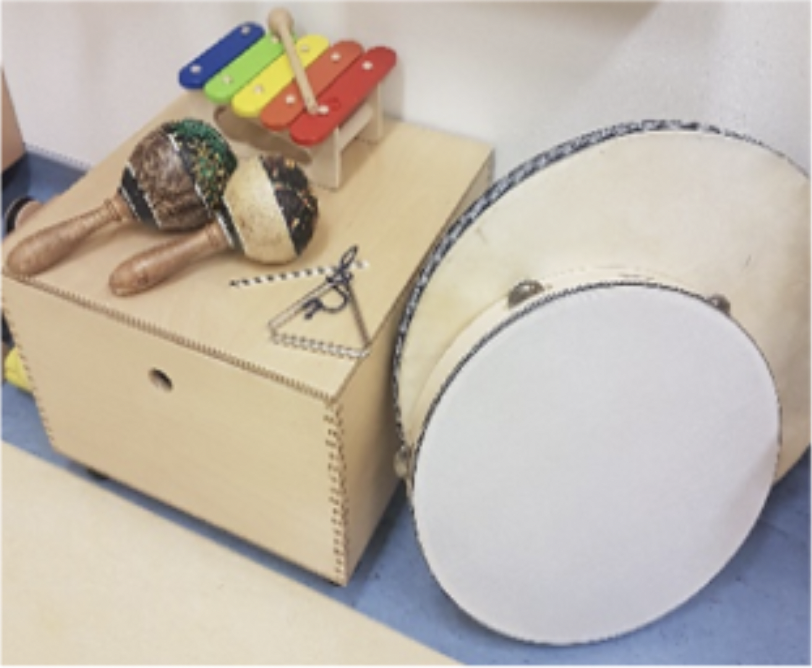
Musical Instruments

As our time together went on, Jasmin slowly solidified her confidence, using puppets to speak for her so that she might maintain a safe distance from her problems. Similarly, she became increasingly comfortable using the creative arts materials, paint, and messy play to work through the difficult feelings she was experiencing, mostly around fear. After four months of attending play therapy, Jasmin felt safe enough to physically separate from her mother and join me unaccompanied. She was testing the limits of her coping skills and taking a brave step towards a new level of security and developmentally appropriate autonomy. Towards the very end of our work together, Jasmin used the baby doll to role play the nurturing mother, while also addressing her feelings around friendships through parallel enactments of shared play in the playground/school yard.  

Jasmin now attends our sessions and often proclaims that she is the teacher, stating that “it is now time for a music lesson!” She plays the instruments, sings, dances, and performs with confidence. It has been such an incredible transformation! At the beginning of this journey, Jasmin’s mother did not think it was possible for her daughter to change or live a normal life. But with the right environment, trust in the process, and using play as a medium to bring us together, alongside clear communication and teamwork between the parent and child, such seemingly unattainable goals became achievable. 

 Testimonial

Jasmin’s mother wanted me to share some words about her experience of play therapy:

“Play therapy simply took me out of the darkness into the light. At the beginning of the journey, I was not completely sure that I would reach my goal and that my only daughter would be like the rest of the children. But I had faith in Allah that made me take the risk. In my first meeting, I saw everything that was said like a dream that was difficult to achieve. The therapist told me that in a year from now, Jasmin will be in school. I muttered to myself ‘just a dream. Allah, please help me to achieve it.’ My child was diagnosed with severe anxiety.

The next day, the journey began with the therapist, Gemma. When I looked into her eyes, my eyes filled with tears. I waited for her to confirm what the doctor had said; that the diagnosis was anxiety and not something else. Gemma greeted me with a smile that gave me hope that my daughter would be cured of that anxiety. Every day while she was assuring me that we would arrive at that goal, my patience was tested.

On our daily trip for the whole year, I saw the light coming from a small gap, and that gap started to widen more, and I saw that light growing stronger. It was a challenge getting to the sessions every day at nine in the morning, on time and in the same chair awaiting victory.

I believed in play therapy. I stuck to it, as a child clings to her mother, and I held onto it with all my strength. Gemma's whispers of confidence never left me. Her support, clarification and understanding were so important. While she was treating my child, she did not realize that she was doing so in a very culturally sensitive and experienced manner, embracing the mother and child together.

Yes, there were many challenges, with those many moments of Jasmin closing her eyes and crying when she saw Gemma (therapist), ending with her running towards Gemma. Yes, it's play therapy but don't underestimate the word. It’s a new hope for every child who is suffering.

And now, after a year, I am looking at the end, exactly as they promised me. My child is now entering her first school year. It is an amazing treatment that is not based on the use of chemical medicines, especially with such young flowers.”   

*Names have been changed for anonymity  

Healing Conversations: Giving Life to the Life of a Person Who Died by Suicide*

If you or someone you know is struggling or in crisis, help is available. Call or text 988 or chat 988lifeline.org 

Rushing to work for an early start at the Shriners Hospitals for Children–Canada, I decided to listen to my messages in the event an important call had come in. I often have young people consulting me at 7 am, either because of an operation that day and a child needing help facing ‘fears’, or because a conscientious young person does not want to miss school. I knew I had one such conscientious person that morning. There was a call from the mother of a young woman I was to meet that morning. She had called late the night before.

Linda, can you call me back as soon as possible; this is an emergency.”  “Oh, no,” I thought to myself. I only gave the number to Shriners patients who talk of suicidal ideas because other calls could be screened by the hospital.

This young woman had expressed such ideas but had felt certain she would not act on them. As she was 21 years of age, and had assured me they were only ideas, not to be put into action, I had not informed her parents. We had worked out a list of people she could call if she felt unsafe, and she had said she would go to emergency if uncertain she could control such ideas. We had discussed vulnerabilities, as well as reasons to stay alive. “What could this emergency be?” I tried calling back, but there was no answer.


When I arrived at work, feeling extremely worried, I saw the young woman. She asked to speak to me immediately. “Linda, I want to give up my appointment this morning for Trevor’s parents”. She then hesitated before adding: “Trevor took his life early Sunday morning, and they really need your help”.

Trevor – Prologue

My thoughts flew back to the few consultations I had had with Trevor, a lovely and talented young man who had been so sad and disturbed about falling away from the Christian beliefs of his parents. He had just gone through an extremely complex and quite perilous chest surgery for a deformity. He had assumed such risks in order to live a better life. He was booked to see me the next day.

I was in shock and soon realized that I would have to immediately pull myself together for his parents. I urged myself on with deep breaths; “Be strong, be brave,” I instructed myself. Although I did not know Trevor’s parents, I could only imagine what they had been through these past weeks with Trevor so very despondent while not understanding what led to such despair in their son.

“They must be wondering why he had chosen to have this surgery if he had not wanted to improve his life and to live,” I thought to myself. I reminded myself to be curious about what they were thinking and feeling, to ask them how they were living through this experience and not assume that my thoughts were their thoughts.

The young woman introduced his parents to me in the waiting room. I told them how very sad and sorry I was. I asked myself, “What does one say in such a situation?” I made sure not to say that I was sorry for their loss. 

That was said to me when my sister had died, and at the time it felt very wrong, “Does that mean I can soon find her?” I had thought at the time. Little did I know that, yes, I could find her in a new re-membered way(1). I reminded myself to keep that in mind. 

I have accompanied parents through the death of a child in my work in palliative care(2,3) and also in oncology with unexpected deaths(4) but I had never accompanied parents through a death of a child by suicide. This had never happened to me.

My thoughts immediately went back to Trevor. I had helped so many other children make legacies when they knew they were dying, and I knew they were dying(2)  but I really had come to believe that Trevor was planning to live. I did not think from our conversations that he was planning to die. Yes, he had told me about feeling suicidal and even about those two weeks of desperation a month or so ago during which he made some attempts, but more recently in our sessions, he spoke so fervently about living.

He explained to me that when he tried to suicide, first by pills and alcohol, that combination made him feel terribly sick. His next attempt a week later by carbon monoxide poisoning involved driving into a garage on a cold Montreal night thinking he would just fall asleep. However, he began feeling so sick and dizzy that he abandoned his car. It was then, he informed me that he decided this was a message from God. He was fated to live!

He told his parents of his attempts and assured them that he had work to do in this world and must live. He was going to help other young people. His parents told the young woman, who had generously given up her session for them, about the suicide attempts and that was when she suggested he meet me for help.


Reading the medical notes in his file, I felt extremely sad since it was clear that he had had a very strong psychological reaction to his deformity, that had been expressed to the surgeon. This contact and discussion about his negative psychological reactions had occurred eight months prior and no one had made a referral for psychological support.

I regretted that we could not have met earlier. “If so, might he have found a way to keep on with his life?” I wondered. “Did I miss something? Did I do something wrong?” We had spent some of the first session talking about warning signs that a crisis might be developing. He talked of memories of his ex-girlfriend, who had said that she was Christian but was behaving in ways that he found immoral. He said certain smells, senses, and even songs might bring up the memory of her which could lead to suicidal thoughts.

This young woman was finding worrisome ways, according to Trevor, to secure money. Trevor was trying so hard to assist her to find another way to resolve her financial needs. He prayed at length as well as read the Bible. He told me that under these circumstances he was reluctant to consult his pastor as he might have for other matters to protect her confidentiality.


When God did not answer his prayers for a way to assist this woman, he began to doubt his God. The more he lost his faith, the sadder and more desperate he had become.

We also talked about what he had been doing to manage the thoughts recently. He mentioned running, playing video games with his best friend, watching movies, drawing and playing his guitar. I referred him to art therapy because of his interest in drawing.

At the end of that last conversation, he had stated categorically, “However, I will not try. Period! This is over”. When I asked what was over, he replied, “This trying to take my life is over.” 


He stated that he had felt very sad and hopeless after trying to bring this young woman, whom he felt in love with, to believe in Christianity in the way that he had been taught to believe in it. His decision for surgery had been because he had decided that he needed surgical correction to live and to help others, including his ex-girlfriend. 

Trevor did not know how to tell his parents that, although he still believed there was a God, he did not believe in the way they believed. “I am a theist,” he said. “There is a lot of good to follow in my previous learnings, being kind, forgiving, learning from mistakes.

Seeing the best in this world is something that I will not follow.” Trevor’s family belongs to a very close-knit religious community. He felt that leaving this faith would mean losing his family and friends. We discussed the subject of love and wondered together whether the love might be great enough to outlive a change in his beliefs. He decided it was a possibility.

Trevor did believe that he was loved. He related a story of another young man of his community who had left the faith and was still part of his family. However,
Trevor was still certain that he would disappoint his parents greatly with this loss of faith

He felt that his ‘deformity’ now with scars from the corrective surgery, (“deformity” was Trevor’s own word regarding his chest difference), would not be accepted by others. Thus, he felt with the loss of faith he also lost an accepting community regarding ‘deformities.’ We explored the possibilities that there are others in this world who accept ‘deformities’ even if they were not of his faith.

We wondered together what he might be able to do for Shriners Hospital for example, where every patient has a ‘deformity’ of some kind? We explored the implications of ‘deformity’ and how his negative feelings about having a different body from others might be culturally developed from our Canadian society and did not have to be taken for granted as true. That even the word ‘deformity’ is a culturally created word. He thought maybe he could be of help to other Shriners patients.


Regarding accepting deformity, I contemplated inviting a past colleague as an outsider witness(5) to speak with us. She is a young woman who is wheelchair bound, due to what is known colloquially as ‘brittle bone disease.’ She is currently studying to become a clinical psychologist.

As a prior Shriners’ patient and later part of our employee community, she had assisted me several times previously, telling her story of how she managed to escape from shame of deformity and fear of others’ judgements. Those consulting her had found these conversations helpful. She is such an inspiration and has many humorous stories. But now, he had died. Taking his own life. None of these ideas could be put into action. 


When Trevor and I had further conversations together we spoke at length about his plans for life and for living. We explored the idea that even with his altered faith, he was creating his own but slightly different moral code.

These discussions seemed to give him hope for finding a new life without his former religious beliefs. I had written in his notes that he had said, “I can take what I have learned and try my best to be a good person”.
When I asked how he thought he could use this new moral code he replied with, “I have to find new hopes.”

I learned that Trevor was a musician, an artist and a writer. He had planned to use his talents to promote his past faith and now he had lost his goal in life. I remembered in detail his creativity. “I was writing a book trying to get through my current life story troubles. My character had to redeem himself for mistakes he had made. That person is really me.”  “Are you thinking that you have made some mistakes for which you need redemption?” I asked. Trevor answered, “Maybe I could go and take fine arts at Concordia University.” I realize now that he did not answer the question of redemption and mistakes.

I now think that in a manner of speaking, I had been doing palliative care practices with him as might all narrative therapists in that we are always creating legacies. The book he was writing might now become a legacy that his parents could appreciate. Trevor had planned that his main character, really himself, who lived in a completely different Trevor-created world, would die. We talked of what the ending might be now that he planned to live.

He stated when he left this last session; “I have some ideas that I can use to write a new ending to this book. Do you want me to bring this to our next session?”  I replied with a hopeful, “Yes.”  Maybe I was too presumptuous. I truly expected to see him another time.


All these memories were going through my head in a whirlwind as I invited Trevor’s parents into the room. I felt that it was probably too soon to discuss legacies with his parents, even though Trevor and I had discovered resources, hopes and dreams, which could now allow him to leave legacies. He had written a book, he had his art, and he told me that he had recorded music with his guitar. There were the plans of finding a way to use these arts to help others.

However, in this beginning of our journey together with his parents, I needed to listen to their pain, listen to their story. We were challenged that morning, because at least three times there was a knock at my door. This was very unusual because when my door was closed, most of my colleagues knew I was with someone.

Finally, I answered the door since the knock was so insistent and persistent. I discovered my lovely supervisor standing just outside. She explained that she and my colleagues wanted me to know that they were there to support me at any time. This knowledge gave me strength to return to the room and have courage to start my uncharted journey with Trevor’s parents.


How does one start such a journey on the day after a child has died by suicide?

Linda and Brian – First Session

LINDA:
Again, I want you to know how sorry I am. How do you feel that I might be of help to you?

Trevor’s mother (MANDY): I need you to hear what happened. We were so sure he had decided to live. (I identified with that). He had made an appointment with you for tomorrow, and also made an appointment with the art therapist.

Trevor’s father (BRIAN), interjected: I asked him how strong the suicidal thoughts were, just Saturday morning, the day before he died. He died in the middle of the night sometime between three and four am. Trevor reassured me by saying, ‘Dad, you know I have decided to live’. And he went to the church youth group.

LINDA: It sounds like you were working really hard to be sure that he was safe. Is that so? (This felt like such a feeble response).  

However, Trevor’s dad’s answer seemed to suggest appreciation of this question:

I don’t know what else I could have done! He was sleeping in our room for the first few nights after he told us about his suicide attempts; then he asked to sleep back in his room. He had his computer set up there and he liked to play both games and his guitar late into the night, and we thought he was better. He seemed better. We had taken him to see a psychiatrist a few weeks ago and they kept him over night and then discharged him the next morning.

We figured if the psychiatrist thinks he can come home, he must be OK. Actually, two psychiatrists sent him home, first from our local hospital, they sent him home with medications, then we took him to the city psychiatric hospital, and they sent him home. We asked for a diagnosis and they said, ‘Well, here we are not big on diagnoses. They just suggested he keep seeing the psychologist.


LINDA: Would you say that you were trying your best to get professional help for him and thus thought you could relax a little and let him sleep in his own room?

BRIAN: He was almost 19 years old and had confided in us. We had to trust him at some point, though we would both wake up in the middle of the night and go down to his room and check on him. I asked him almost daily, ‘On a scale of 1 to 10…’ and every time Trevor answered with ‘Zero’. The local counseling center would call him every day and ask him how he was doing. His youth pastor contacted Trevor regularly and took him out to coffee to talk with him. I took him out a few times for coffee to talk to him outside of the home. We couldn’t keep him in our room forever.

MANDY: I woke up about three am that morning. I prayed and prayed to God to guide me in how to keep him safe. I prayed for nearly an hour. Then I got up. I thought of checking Trevor’s room and then I felt, no, he went to the church group last night, he said he was fine, so I decided not to check. In some ways I am so glad I did not check. I do not think I could have stood it, to find his room empty and know that he was dying while I was praying.

I thought it might be helpful for her to understand more about this.

LINDA: Mandy would you be willing to help me understand what it means to you that you prayed that whole time? 

MANDY paused as she considered my question, she seemed to want to think about this question: 

God was telling me that it was his time to go. Trevor had been suffering so. He could not stand it. That is what he said in his note. He told us not to blame ourselves, that we were good parents, but that he was suffering too much, so he had to go. The file where he wrote the note was called, ‘I am sorry’. I know that he is no longer in such pain, but I am in so much pain now. If only he had known how much I love him. 

I worry for my husband, Brian, who found him hanging in the garage and had to cut him down. He dropped Trevor because he was so heavy. I worry that my husband will not be alright.

BRIAN: I didn’t know how I would tell my wife. How will she stand this? She is not so strong physically and has many family members not so strong psychologically. I went to try to gently tell her and she insisted on seeing the body. She wanted to see him before we called the police. I didn’t want her to remember him like that.

MANDY: I had to see my son. I had to hold him one last time. 

LINDA: Does that mean you were showing him your motherly love or were you trying to figure out how your heart would not break, how to hold your heart together or something I totally could not even think of?

MANDY: I think it was a bit of it all. I didn’t want the police touching him and moving him but now I don’t know what to do because I cannot get that image out of my mind. That was not my son lying there on the floor. 

LINDA: Sooo that was not your son lying on the floor. What are your thoughts about what your son is like now, or where he is now?

MANDY: I know that he is with God. He is no longer in harm’s way; he is safe.

I tried to formulate my next question.

LINDA:  So, (so is a word I realized I use as I try to organize my thoughts and think of what I want to ask), if you wanted to replace the image of something that is not your son with another image that is your son, what image would you want to be thinking of?

Mandy paused and then she actually laughed. What a lovely sound for this moment. I truly felt it was not that the situation was in anyway lightened, but I could see her eyes go off to the side and she was for a moment somewhere else.

MANDY: He used to say, even sometimes recently, “Mum, look at me, see how fast I can run”. That is the image I want to hold on to. That was a bit of the Trevor that we lost when he was about 12 years old. He changed then. He withdrew from us, isolated himself in his room. Maybe something about his deformity at a time when boys care so much about their bodies. But sometimes he would come out of his room and say, “Mum watch me”. Just like that lovely little boy he used to be. That is my ‘true boy’. 

I do not know whether you know or not, but we have a lot of mental illness in my side of the family. I was especially concerned about his hatred of his brother. I thought he had experienced some trauma he was too afraid to share with us that kept him isolated and angry. He denied it when I asked him. I kept searching for anything else I could think of and asking everyone I could think of like doctors, counselors, social workers, other people who had sibling hatred in their family.

Yes, he had this deformity and I know that for teens that can be terrible. But it seemed to me to be something more. Then we found you, and I felt hope, he was coming for therapy; he was even going to start art therapy; he had seen a psychiatrist; he was going to get better. But then, it was too late.

LINDA:   If you could hold that image of that little boy, your ‘true boy’ and that young adult who is saying, “mummy watch me, see how I can run”, what difference might that make to this horrible pain that you are experiencing now, and that horrible image of something that is not your son? 

MANDY: Yes, it would make a big difference. That is what I need to remember.

LINDA: Would you be interested in having some more conversations so that we could re-member Trevor as Trevor used to be before he withdrew from you and to learn what you appreciate about him?

Mandy responded with a strong “yes.” Brian said that he felt that Mandy was the one who really needed the help.

BRIAN:  I think I will get the help that I need from my community and from my pastor.

I asked Mandy if she might want to bring some pictures, or other memories of Trevor to the next session, cautioning her to do so only if she wanted to and thought it might be helpful to her.

LINDA:    I don’t know that person who asks his mum to watch him run, your ‘true boy’, and maybe the pictures could introduce him to me.

After this session, I reviewed the chapter that Michael White(6) had written called ‘Engagements with Suicide’ to get some ideas regarding how best to work with this family. Michael stated that often the person who took his or her life could become invisible, and the suicide could be cloaked in shame. I did not want this to happen.

I thought about how I could discover from the parents the values or skills required of Trevor to both live and to take his life? What kind of decision would this have been to make? Was the suicide mindful of what Trevor gave value to throughout his life? And thereby, we could try to link his living life and the decision to take his life to what he stood for so these parents could still feel connected to Trevor.

I also remembered Michael saying that some cultures think differently than ours about death by suicide. I remember the old Japanese Samurai movies where suicide was considered an act of honour. And as Michael had suggested, perhaps it would be possible to investigate and honour the ‘insider meaning’ of suicide. 


I also wondered if a book I had co-authored with parents whose child had died of a medical condition, might provide helpful ideas for the family(7).


Trevor’s Created World

The next session, both parents arrived for our therapeutic conversation together. They wanted to know what Trevor had told me in our sessions together. Again, my thoughts went into a bit of a whirl. “Do I let them know that it was a change in faith that was troubling him? What about what he had told me about this girl who he was so worried about? They may know her.”

I decided to begin more generally and to refrain from discussing the information about the girl that Trevor did not want to tell the pastor about. I did not know whether they would have the right to read his file because we are a children’s hospital even though he had turned 18. I had given no such details. (I always work out with the adolescent I am consulting regarding what they agree can be placed in the medical file, after explaining the limits of confidentiality and the way we, at the Shriner’s Hospitals for Children, work as a team). I was conscious that this was all new to me.

I had never, even after many years of working with those who expressed suicidal ideas, experienced someone who had consulted with me end their life by suicide
. “How do I navigate this? What are Trevor’s rights? What difference does it make if I do not tell them about his change in faith? Could telling cause them potential harm?”  
 

However, I soon found out that they had read what was on Trevor’s computer. They knew about the young woman in Trevor’s life and how he felt so hurt because of decisions that she was making. They also knew that he questioned their faith. I decided to discuss the potential legacies that Trevor and I had discovered together. In particular, I thought of the book he told me he was writing. 

LINDA:   Did you find the book that he was writing, and the ‘Trevor-created new world’?

MANDY: No. We did not find that on his computer. I wonder where he put that book. I would love to read it. However, what I really want to know is what diagnosis you gave him. Did he have a mental illness?

It was evident that Mandy was interested in other things than legacies right now. In narrative therapy, we want to follow the lead of the person who is consulting us.

This question, however, produced another dilemma for me. I wondered what it meant to them to have a diagnosis.
Psychologists have the right to diagnose mental illness, but this is not my usual way of working and I had not been thinking in diagnostic terms but in therapy terms. When working with a young person I am aware of how diagnoses can make it hard to distinguish the young person from the problem(8). I wondered if a diagnosis could help these parents heal from their grief.

LINDA: What would it mean to you if there had been a mental illness? 

MANDY: Well, I have a sister who has been diagnosed with bipolar, an aunt and my grandmother had agoraphobia and my father may have had depression, so it runs in the family. Having a diagnosis would mean a lot to me because someone else who met with Trevor would have insight into his life and I so desperately want to know everything about my son, especially now that there are no new things to ever learn about him.

LINDA: Well Trevor and I named the problem ‘Trauma’. He felt that some of his experiences with his ex-girlfriend were very traumatic, and he felt that having a deformity was traumatic. When his ex-girlfriend did not want anything more to do with him after he tried so hard to help her, that felt like trauma for him. But he also told me in our last session, “It seems pretty amazing with all that ‘trauma,’ I still want to try to live”. Do you think, ‘trauma’ just got too strong for him? 

BRIAN: I think that trauma got stronger when he was playing his videogame with his best friend and the game died. His friend whom he was playing with said that the last thing Trevor said to him was that on his screen it said, ‘Fatal Error’. He then wrote a letter to the girl asking her if it was worth it not changing her life and doing wrong actions. He actually used much stronger language. That also was so unlike him.

We have another letter he wrote this girl that was just beautiful. Then he wrote us a most beautiful letter. He can write beautiful letters. In his goodbye letter he said he was only trying to survive so that he could join the military and die in battle. But he was too ‘tired of fighting’ and gave up and that is why he committed suicide. He had to have had the idea of hanging because we discovered that he had studied knots on his computer and he had a rope, so I don’t know if trauma was what it was or not?


LINDA: Might it help to think that ‘trauma’ had gotten too strong, and that the game ‘dying’, and ‘fatal error’ somehow gave trauma its hold on him and these ideas of suicide or something different?

Brian thought that this would be better than thinking he had planned suicide all along and was being devious to them all in making them believe he planned to live.

MANDY: The letter we have that he had written before is of grace and love and kindness and mercy. 

LINDA: Could it be a bit helpful to remember how he was able to write such beautiful letters? Could that be more helpful than trying to understand whether he was planning this or not? Or maybe, do you think Trevor was a ‘mindful’ young man? A ‘true boy’ of grace and love and kindness and mercy? It seems that ‘mindful’ might be a word to describe the beautiful letters and the having a rope and studying knots?

MANDY: I actually have his note here to his friend. He just said there was some sort of error. At 2:57, the game ‘died’ – I do not like that word anymore but that is what they use. At 3:08 he wrote to this girl. And at 3:21 he wrote to us. I think he was going through a spiritual battle. It was Trevor’s own will to go through with the decision of death. Yes, I think he was mindful all his life. But I think his death was really something like depression trapping much of him inside a sick mind. Maybe that was trauma caused.

LINDA: Might it be helpful to find your own term for this feeling of Trevor being trapped – trauma caused or something different?

MANDY: I woke up at three am that night and I prayed and prayed for Trevor. I prayed for angels to circle him wing to wing. Angels are ministers sent to help. I wanted them to help break the chains that bound him. I realize now that the angels were also for my benefit. The breaking of the chains I thought were to free him from pain. I just did not know that this freedom would be for him to die. I do need some help with the memory of his body and how it looked after the hanging. It haunts me.

LINDA:  Well might that be something that we can work on next session if that is something you would want? 

The Issue of Diagnosis

Mandy came to the next session with a photo book. She had created a photo book of her family every year and wanted to show me the year that Trevor changed. She also wanted me to see some of the pictures of the beginning of that year when he was the happy little, ‘watch me run mummy’ boy, her ‘true boy’.

There was a note to Mandy written by Trevor saying, ‘I love you the most in the hole world’. Written exactly like that. I discovered from Mandy that even his voice changed that year. He would speak, either in a robot voice or in a kind of baby voice when he was asking, ‘Mummy, come see me’. She discussed how she so much wanted to help her son. She had searched and searched for help. Mandy said that she and her husband had telephoned the psychiatrist from the psychiatric hospital which had kept Trevor overnight. The psychiatrist
stated that Trevor had been diagnosed with ‘major
depressive disorder’. Both Mandy and Brian seemed relieved to get such a diagnosis.  

(Trevor’s dad later explained the meaning of diagnosis for him:

Trevor’s suicide provoked not only trauma and grief, but an investigation. Suicide was not something we, in our wildest nightmares, would ever think our family would struggle with. Trevor was so talented, so full of life and self-confidence. He was the first to get a full-time job on his own, buy a car, buy his own cell phone, get a bank account.

When we got the diagnosis from the psychiatrist that he had a Major Depressive Disorder we felt that it explained so much to us. In his last weeks I saw his feelings of worthlessness and inappropriate guilt. He felt he was a failure. Suicide presents multiple layers of trauma and inquiry that are not present with a simple tragic death. 

During this session Mandy explained that she was feeling very upset having to live in this world where her son had hanged himself. She wished she had a chance to get help for him early enough. 

(Brian later recounted that he felt similarly: 

This has been hard for me too. Now that we have a diagnosis, every fatherly instinct in me craves the chance to go back in time to help him through this illness, and to explain it to him. He suffered all those years thinking he was just a jerk. He couldn’t help it. He was suffering and didn’t know it had a name. This had to play into his perception, somehow attaching to his deformity. He suffered alone, in my home, under my care, without any help. That destroys me inside. This is an added layer of severe grief in my heart, almost unbearable).

Mandy and I did some work around the image of seeing her son dead and how it made her feel that she failed because she could not save him. She also, in times of great distress, would feel that she was not loveable enough because it felt at times that Trevor did not love her. We discussed the possible relationship of this, ‘I am unlovable’ thought to her thoughts as a young child when her mother left the family for another man. 

Mandy wanted the little boy Trevor, who needed her to watch him run, to stay with her. She remembered again praying for her son during the time that he was organizing to take his life. She believed that praying was for God to protect him and to protect herself. She kept going over and over what Trevor must have done that night. But she came to the realization during our conversations, that she was praying him out of this life and into another life without pain and with God.

She stated that this realization was helping her feelings of panic reduce in intensity. She also explained that she believed it was Trevor’s responsibility to make his own decisions now that he was almost nineteen, and it was her responsibility to pray for him. 


When I arrived at work the next week, I had a telephone message from Brian. He was concerned that Mandy might have the same diagnosis as Trevor. She had been very upset that morning and wanted to climb on the roof to be closer to Trevor. Brian restrained her and asked her if she was feeling suicidal. She said that she was feeling sixty percent suicidal.

I phoned him back and suggested that Mandy might be feeling intense grief. I told him of other parents I had worked who had a child die explaining to me such very strong feelings, especially at first. It had only been a few weeks since Trevor died. I also stated after talking to Mandy, that
if either of them were worried about being suicidal they could go to the same psychiatric hospital where Trevor had been admitted. They did decide to go. 

God’s Peace

Mandy came to her next session saying that the psychiatrist told her that she was having a normal grief reaction. I was beginning to like the psychiatrists at this hospital who were not so ready to think of DSM diagnoses and medications. Mandy had been given Ativan by her family doctor after Trevor’s death and Mandy believed that maybe these medications were making her have suicidal ideas. She therefore had decided to take no medications for now and was feeling better. 


LINDA:  Mandy, are you worried for your life now?

MANDY:  No, I am not worried that I will actively do something, but I sometimes wish that I would get the Coronavirus and die. I have weak lungs and I could just die. I miss my boy so much.

LINDA:  Does that mean that you feel that you do not have reasons to live anymore?

MANDY:  That is exactly what my pastor said. He reminded me that it is not my time. That my work is not over here on earth. I have three other children and many other reasons to live. I am reminded that Mary, mother of Jesus, suffered too. She had to watch her son be tortured and to see him die tragically. I was watching my son in a different sort of torture. I just need peace. I just need God’s peace and I find that in scripture.

LINDA:  How can you live God’s peace?

MANDY:  Knowing that Trevor is in heaven with God, and I will be there with him some day, but he will be waiting so long, too long. I can read the Bible and it brings me peace. But that long time of waiting hurts me. However, I will see him again.

LINDA:  Do you believe that the time in heaven will be the same as the time on earth? Might it be that Trevor will only feel it as minutes when you feel it as years, or something at least differently than here?

MANDY:  Yesss. Time would be different. He is in heaven after all. And here I am and here I will stay, even if it will be hard to live in a world without Trevor. I know I tried. At least I do not feel guilty.

LINDA:  Do you see this as a gift, knowing that you did the best you could and tried so hard to help him?

MANDY: It IS a gift. I never thought of it that way. It is truly a gift; I tried so hard.

LINDA:  Mandy, what are some of the many ways that you think the pastor was thinking of when he told you that your work on earth is not over?

MANDY:  Well, we have decided to help others who might have problems like Trevor’s and use his life and him taking his life as an example and a message for others. We want to help parents to find help for their children. We are working on suicide prevention. Thank you for giving us that document that can be used in the youth group. We plan to have his funeral as both a homage to Trevor and as a message about youth problems and ideas for how to get help.

LINDA: Do you think this is showing some of your heart’s concern that you showed for Trevor now being used to help other young people in difficulty? Trevor wanted to help others as well.

MANDY:  Yes, I must not forget that this is my plan for life, and this was Trevor’s plan. I need to help other children to get the services that they need. 

Sun on Wood

Our fifth session started just after isolation for the coronavirus began. Mandy was having the telephone session in Trevor’s room where she could have privacy and thoughts of Trevor’s death felt very close to her heart. 


MANDY: I am having a lot of incorrect thinking. I wake up every night at the time he died. I am so sad. 

LINDA: Mandy, could you help me understand something? When ‘incorrect thinking’ tries to take over, what is it saying to you and how do you respond to it?

MANDY: It is that coronavirus idea thing. I could easily go into public and expose myself to the virus. ‘Incorrect thinking’ keeps saying, this could be good, this virus. I would probably die with my lung problems. 

LINDA: Might ‘incorrect thinking’ be kind of ‘missing Trevor’ thinking? You said last week, ‘I am here to stay’, but staying might still be pretty challenging? 

MANDY: Yes, I AM here to stay. I just don’t like a world that I have to stay in when my son died by suicide. We were looking for the book and for notes about it. We did find some little notes and a long letter. I printed them out. They are precious. That was my ‘true boy’- those notes and letters.

LINDA:    Mandy, I wonder if you would be so kind as to describe that precious ‘true boy’ for me?

MANDY:  I remember two-year-old Trevor with his red tennis shoes. He had a scooter, and he was so agile that even at that age, we put him on the scooter, and he rode in circles, his little shoes so eye catching. His bright blue eyes so sparkling. I always wanted a fair boy who looked like my side of the family, the others are dark haired. I began praying, asking God specifically if my next baby could please have blonde hair, and blue eyes, and if it weren’t too much to ask, curls on top of all that. God gave me it all!

He had a yellow and black coat. He was so happy and thoughtful then. He asked such hard questions about God. I am so blessed to have been his mum.

LINDA:  Is that one of Trevor’s legacies to you, to give you the opportunity to be so blessed to be his mum? Do you have some ideas how to get even closer to the reasons why you are so blessed to be his mum, while still living in this world that you have decided to stay in and find the precious ‘true boy’?

MANDY (very tearfully): I blogged daily, writing little stories about all my children. I was recording it for my family who were far away. They are invaluable now. I sleep with his two stuffies (soft toys) called Nache and Thunder that he always slept with. I kiss them on the nose and tell Trevor that I will take care of them for him. 

LINDA: Mandy what do the tears speak to?

MANDY:  That I forgive him. I am in his room and his smell is disappearing. That frightens me.

LINDA:   Do you have some ideas how you can keep his smell closer to your heart and soul?

MANDY:  I have no idea; it scares me. I am losing him.

LINDA:     Could you describe the Trevor smells?

MANDY:  The smell is a bit of outdoors, like sun on wood; it is warm skin, Trevor’s warm skin. Independence.

LINDA:  We are creatures of words. Would it be helpful if I write this down on a separate paper that I can give to you when we are out of this coronavirus isolation or mail to you now?

 (I always make notes during the session that usually those consulting me can take with them, but I am doing these sessions by telephone, and I wanted to write these beautiful ways of re-membering Trevor very carefully. I thought I might type or send all our re-membering in a written narrative letter 9-13 .

LINDA: Mandy, I am curious, what does independence smell like? 

MANDY:  It smells like sun on wood. That’s my ‘true boy’, independence. Oh yes, please write it all down.

LINDA: I am writing this, ‘sun on wood, a bit of outdoors, warm skin, Trevor’s skin, independence’. 

Do you think he can feel that forgiveness?

MANDY (very softly): Yes, he knows that I forgive him.

LINDA:   What do you think that would mean to Trevor to hear you saying that you will look after Nache and Thunder for him?

MANDY: He would know that there is nothing he could tell me that would make me love him any less. But it is a bit painful to think of bringing him back to hear what I am saying. I don’t want him to know that pain I feel of his loss. You know, a mother is only as happy as her saddest child.

LINDA:  You don’t want him suffering through knowing the pain that you feel. Do you believe that he is suffering now?

MANDY: No, he is at peace. His body and mind are healed, in the presence of God. HE NO LONGER IS SUFFERING. His place and his job is in heaven. But he left us with a job on earth.

LINDA: What is that job on earth?

MANDY:  My job now is, as is part of his job, to help others who suffer like him. I was reading Genesis 50:20. It is the story of Joseph. His brothers wanted to kill him, and he managed to escape and save Egypt. He said to his brothers when he saw them again, ‘You meant evil, but God meant it for good to bring this about’. 

LINDA:  Mandy, can you help me understand your meaning of Genesis 50:20?

MANDY:  Well, we are going to help others benefit from Trevor’s experience and his death. God meant it for good. I hope he knows now that what he did was not him but the illness, and we will help other young people who are suffering like he was. 

LINDA: If he were to hear you now, even though it is a bit painful as you told me, what might he think of your idea of carrying on his wish to help by helping other young people who might be suffering like he was?

MANDY: He would feel relief that he did not ruin our lives. If he could have stayed on this earth longer, he would have been able to turn around the voice of depression, he would have had more tools in the toolbox. If he only will know that his dying was not for nothing. That we are going to use his life and his way of dying to help others. He would know that he didn’t ruin our lives, and his life had meaning. He actually is going to help others live a better life than he was able to live.

LINDA:  Mandy, I can’t imagine a better legacy for Trevor than the one you plan to bring to us all. I am so curious about your ideas, how are you going to make Trevor’s life and death be helpful to other young people who are suffering. (I realized that in my role as a narrative therapist, I need to lead people to find their own legacies of their child. This was a much more powerful legacy than what I had first considered, which was the book Trevor was writing).

MANDY:  Well, we have developed this website. It is to help others find hope. We are discussing what tools he had and what tools we wish he had. We are going to give resources, where you might go. 

LINDA:  Yes, you told me about how you organized his service to be both a memorial to Trevor and a help to others. Would you be willing to describe this in a bit more detail?

MANDY:  Well, we had twelve counsellors come to be there for the young ones of our congregation. They are all so close we were concerned about them. The counsellors talked to the young ones on an individual basis and gave them ideas of where to go if they need help. We had moved here from another country and did not know what services existed.

The surgeon who did Trevor’s chest surgery asked if he could have Brian’s talk at the memorial service. Brian talked about what it was like to be a parent of someone with such problems that Trevor had suffered from. The surgeon hopes to use this in some way to help other children at the Shriners with deformities as a way to try to prevent such an outcome as happened to Trevor. 


LINDA:  Oh, I am very interested in how he might use this. I will talk to him, perhaps I can be of some assistance to your ideas and to his, in relationship to the Shriners Hospital for Children. 

What would you like to do about appointments?

MANDY: Well, I know you are so busy, Linda.

LINDA:   It is truly up to you.

MANDY:   I think I would be OK for two weeks. 

Keeping Her True Boy

Mandy called and cancelled her next session. I had planned to spend our last few sessions exploring ideas about how she and Brian could help other young people. We were still in isolation for coronavirus isolation when we began to co-write this article.

Mandy told me again about blogs when Trevor was so happy and living what she called a wonderful life. She was reading books to understand suicide and discussed them with me. She would still question the cause of Trevor’s challenges. She talked some more of all that she had done to try to find the cause when he was alive and to get help for him. With a few questions she came to the conclusion that Trevor died to protect his parents from more pain, pain that he lost his beliefs, pain that he couldn’t feel better.  

She also talked of her ‘true boy’ who could be around even later in life. For example, she mentioned how he wanted to be so independent, he wanted to pay for his own counselor. He even wrote in his ‘I’m sorry’ note that they could sell his car, perhaps to pay for his funeral.

She suggested this was his warmhearted way of showing that he did not want them to be in debt by his death. And most importantly she discussed how she believed Trevor had a healed mind and a healed body and that now he is free. She read to me his wonderful, kind letters. She told me beautiful stories of navigating the parenting journey as Trevor developed from childhood into adulthood and of walking alongside him even when he was making choices she would have preferred that he not make.

But mostly Mandy described her hopes and dreams for being of service to other youth, to follow Trevor’s hopes and dreams. She understood better what Trevor stood for. Mandy believed that God has a purpose for every life, and both her purpose and Trevor’s purpose was to call greater awareness to youth challenges and help youth with this calling. There was no more talk of catching the coronavirus and meeting Trevor sooner.

Mandy felt that she and Trevor now had a common, earthly goal that her husband and her complete congregation were getting involved with. She felt that this was keeping her ‘true boy’ in her heart and soul. Mandy requested that we do one last bit of work together when the isolation due to the Coronavirus was over.

This was to work to help her manage better some of what might be called day and night dreams of the last image of ‘her boy who was not her boy’. She planned to replace these images with her ‘true boy’ and with other young people who were living instead of dying. Finally, Mandy explained to me, that somehow, Trevor did not disappear but will live on in the helped lives of others.

Brian wrote to me when I asked him to edit this paper. In his letter he expressed words similar to those I have heard from others who have had a child die. They were so poignant and heartfelt that I wanted to honour his thoughts here. This is Brian’s perception of his particular experience of having a child die by suicide.

“I am not the man I was before February 8, 2020. When Trevor died my life changed. My wife changed. My family changed. I changed. And I’m trying to come to grips with the new me and my new world. Life has a different meaning. My faith has more gravity. My perspective on my life in this world has been elevated beyond the temporal in a way it has never been before.

When I walk beyond the curtains to grief and back into life where my heart and mind are released from the shadow of my son’s suicide, who will I see when I look in the mirror? My grief is not just grief. A transformation is occurring. A lot of people who lose children have a very difficult time getting past the loss, as if their legs have been cut off from under them, and they will never stand on their two feet again. I have been in the depths of these waters, but I will not stay there. I know that these ashes that cover me now will be redeemed by God.”

I feel so honoured to be a part of such conversations which could explore what Trevor gave value to and then to witness Mandy and Brian finding ways to use what Trevor gave value to help others. I was able to assist them to develop Trevor’s legacy and to carry it forward with their family and others who loved him. I feel that this journey that we took together was also a healing journey for me.

I got to know both parents so much more through our co-creation of this paper. I have co-written papers before with those who consult me and am always so appreciative of the experience. I am happy to add Mandy’s final remarks when she returned this final draft to me:

“I also just want to say thank you again. As I was reading through the paper as a whole, it helped to be ‘counseled’ again. In grief, your mind so quickly forgets what you've determined, or learned. Now I will have this paper to get a quick reminder of the progress and conclusions you've helped me with. Brian wants to say he really enjoyed working with you on this paper. Me too! Blessings.   

All names are changed at the request of the parents. The young man’s parents have read this version of the paper and feel comfortable for it to be published so others can learn how they managed to survive the almost unsurvivable and to carry on their son’s legacy wishes.

Reprinted with the consent and express wishes of the parents, Linda Moxley. and the editors of the Journal of Contemporary Narrative Therapy

[If you or someone you know is struggling or in crisis, help is available. Call or text 988 or chat 988lifeline.org]  

References 

(1) White, M (1988). Saying hullo again. The incorporation of the lost relationship in the   

            resolution of grief. Selected papers (pp. 37-46). Dulwich Centre Publications. 
 

(2) Moxley-Haegert, L. (2015a). Leaving a legacy. Using narrative practice in palliative care  

           with children. The International Journal of Narrative Therapy and Community Work, 2,  

           58-69. 
 

(3) Moxley-Haegert, L & Moxley Haegert, C. (2019). Little steps toward letting the legacy live: Fine traces of life to accompany families grieving the death of a child. Journal of Narrative Family Therapy, 28-53.  
 

(4) Moxley-Haegert, L. (2012), Hopework. Stories of survival from the COURAGE progamme: Families and children diagnosed with cancer. Retrieved from narrativetherapyonline.com/moodle/mod/ resource/view.php?id=577  
 

(5) White, M. (1995). ‘Reflecting teamwork as definitional ceremony.’ In M. White: Re-Authoring Lives: Interviews and essays (pp.172-198). Dulwich Centre Publications.  
 

(6) White, M. (2011). Narrative practices: Continuing the conversations. Engagements with suicide. (pp.135-148). Chapter 10. David Denborough (Ed). W.W. Norton  
 

(7) Moxley-Haegert, L. (2015b).  Petit Pas/Little Steps. www.hopitalpourenfants.com/patients-et-familles/information-pour-les-parents/petits-pas (French) and www.thechildren.com/patients-families/information-parents/little-steps (English)  
 

(8) Marsten, D; Epston, D., Markham, L. (2016). Weird science, Imagination lost. In Narrative Therapy in Wonderland; Connecting with children’s imaginative know-how. (Chapter 7, pp. 157-173). W.W. Norton & Company.  
 

(9) Bjoroy, A., Madigan, S., & Nylund, D. (2016). The practice of therapeutic letter writing in Narrative Therapy, In B. Douglas, R. Woolfe, S. Strawbridge, E. Kasket, & V. Galbraith (Eds.). Handbook of Counselling Psychology, 4th Edition. Sage Publications. 
 

(10) Epston, D., & White, M. (1992). ‘Consulting your consultants: The documentation of alternative knowledges.’ In D. Denborough (Ed.). Experience, Contradiction, Narrative and Imagination (pp. 11-26). Dulwich Centre Publications. 
 

(11) Ingamells, K., (2018) My romance with narrative letter: Counter stories through letter writing. Journal of Narrative Family Therapy, Special Release 4-19. www.journalcnt.com 
 

(12) Pilkington, S.M. (2018). Writing narrative therapeutic letters: Gathering, recording and performing lost stories. Journal of Narrative Family Therapy: Special Release 20-48.  
 

(13) Palijakka, S., (2018) A house of good words: A prologue to the practice of writing poems as therapeutic documents. Journal of Narrative Family Therapy, Special Release, 49-71. 


* Dedicated to the young man who chose to take his life and to his parents who chose to survive

his death.


Author Note: “Parents I worked with in palliative care co-wrote a resource document with me and the nurse practitioner in palliative care at the Montreal's Children's Hospital in Montreal. This might be a resource that could be added for reference if you thought it might be helpful to the readers.  


Questions for Reflection

How did this clinical narrative impact you?

What are your thoughts about the therapist’s approach?

Which techniques might you use in your own clinical work?

What about the way the therapists worked with Linda and Brian would you change? How?

What are your own strengths and challenges when working in the shadow of suicide?  

The Existential Importance of the Penis: A Guide to Understanding Male Sexuality – Daniel N. Watter, EdD

Existential Sex Therapy in Practice

The practice of sex therapy and psychotherapy can be done utilizing many different modes and theoretical orientations. Yalom reminds us that existential psychotherapy does not represent a standard set of techniques, styles, or protocols. The concepts of existential therapy can be best understood as a lens or guide by which psychotherapy is practiced. Practitioners of all theoretical philosophies can bring an existential perspective to their treatment process. 

When I treat my male sex therapy patients, I follow a similar pattern with all as a starting point. Whether I am treating an individual male or a couple, I like to begin by asking about what brings them in to see me and allow the story to unfold in whatever manner they choose. I am particularly interested in the description of the problem, the conditions under which the problem manifests itself, and the timeline regarding when the symptom first presented. My goal is to begin to get an understanding of the meaning and protective/adaptive purpose the sexual difficulty may represent. Typically, men will present with little to no insight as to the reason for their sexual shutdown. They often describe a generally satisfying relationship with a partner they find attractive. Most of the men I treat, especially those experiencing erectile difficulties, will report relative ease at attaining penile tumescence, and engorgement will be maintained through extended periods of sexual foreplay. But the erection fades as intercourse approaches or shortly after penetration occurs. Typically, these men reveal a current history of satisfying and frequent masturbation. They will often express a vague notion of being anxious about sexual function and a firm belief that their penile difficulties have some medical basis. However, they are at a loss to explain how a physical or medical issue allows for erections that are fully functional during masturbation but not penetrative sex. Their partners are similarly stymied. 

Following the initial consultation, I will focus on family and developmental history. If I’m treating a couple, I will ask to do three individual sessions with each before resuming couples’ work. It is important to me to develop a good understanding of each person’s experience in his or her family of origin and to identify any patterns of trauma that might be getting triggered in the current relationship. I want to learn about the personalities of family members, their relationship with each of them, and their relationship with each other. I want to know if this was a family that was able to communicate about and/or demonstrate emotions, or if theirs was a family of secrets and repressed suffering. I want to know if there was any presence of substance abuse or domestic violence and/or parental neglect/over-involvement. In essence, I am looking to gain an appreciation for any family dynamic that may have felt threatening that could be reenacting itself in the current relationship and, thereby, creating a threat to the man’s existence and well-being.

Many highly regarded sex therapists will spend a great deal of time taking an in-depth sexual history. I do not, as I find much of the information in a standard sex history to be irrelevant, particularly in those men who have had a prior history of good sexual functioning. Through an existential lens, the sexual “problem” is often not about how the man feels about sex per se. The sexual problem is more typically understood as an attempt for the man’s penis to communicate some deep anxiety, concern, and existential threat to his existence. Therefore, to more fully comprehend the message the penis is sending, a comprehensive developmental/family-of-origin/ relational history will be of greater value. Let’s consider the case of Russ from the perspective of an existentially oriented sex therapist. 

The Case of Russ

Fifty-one-year-old Russ came to see me shortly after his wedding to Sarah. This was a first marriage for Russ and the second for Sarah. Both had come from traumatic families of origin, and Sarah’s first marriage was to a man who regularly abused her. Russ’s primary complaint was a lifelong inability to ejaculate. I began by asking Russ for a timeline regarding his ejaculatory difficulties. I have found that the time of onset of problematic sexual symptoms is often of great significance in understanding what may be triggering the current inhibition. While most men presenting with this complaint have their ejaculatory difficulty limited to their time with a partner and have little to no difficulty ejaculating during masturbation, Russ reported that Sarah was his first sexual partner, and ejaculation during masturbation was problematic as well, although it would occur on occasion. Given the unusualness of this situation, I asked if Russ had consulted a urologist or other physician, and he indicated that it was his urologist who provided him the referral to me. His urologist did not detect any medical explanation for Russ’s ejaculation problem. 

We next began to talk about Russ’s upbringing and family of origin. Russ came from a family with two professionally educated parents, both of whom enjoyed great professional success and respect. They also were rather puritanical and punitive. Russ was the oldest of four children, and the siblings all have minimal interaction with each other. Despite the fine professional reputation his parents possessed, Russ recalls them as constantly fighting, explosively angry, sleeping in separate rooms, engaging in multiple infidelities, and hardly being civil to each other. Neither had much to do with the children, his father due to excessive alcohol use and his mother using her work to avoid being at home. He recalls his mother telling him in a fit of rage that she never wanted to be a mother and blamed his father for forcing parenthood on her.

Russ also reported that laughter, enjoyment, and pleasure were not only absent in his home but were considered sinful and to be averted at all costs. Any expressions of joy were severely reprimanded and punished. As a result, Russ learned as a young boy to repress any feelings or demonstrations of delight, joyfulness, and pleasure. He recalled that to the present day, if he is enjoying a television show or a musical piece, he will turn it off. He does not enjoy comedians or most other forms of entertainment. His free time is spent reading serious, nonfiction books and tinkering with electronic devices. Regarding the specifics of sex, he reports a strong libido and easy arousal, but he begins to panic as he approaches ejaculation and, thus, ceases all stimulation. In addition to shutting down all sensations of pleasure, Russ reports learning to be exquisitely attuned to the displeasure of his parents. He was constantly scanning the home environment to head off any actions or commotions that would rouse the ire of his chronically unhappy and volatile parents. Russ grew up a very lonely child. Despite having three siblings, the home was minimally interactive, and Russ did all he could to avoid other family members. He spent a great deal of time alone in his bedroom or in the local branch library. He recalls few friendships with schoolmates, as his parents discouraged such contacts. His activities were primarily solo, and this pattern continued through college and his career. In high school, Russ discovered a love of the sciences, and he decided to pursue a career in medicine. While he enjoyed his studies, he found his clinical rotations to be laborious. For a time, Russ thought he had made a poor career choice until he discovered the field of pathology. Pathology afforded him the solitude he found comforting as well as the opportunity to pursue his interest in lab sciences. In addition, being a pathologist required minimal interaction with colleagues, offered steady, predictable hours, and relieved Russ of the burden of having to deal directly with patients. He had a reputation at work as a hardworking and dependable physician but also as a loner who showed little interest in the lives of his co-workers. Oddly, his workplace was where he met the person who would dramatically alter his life’s course, Sarah.

Sarah was a pathologist in the same lab as Russ. She was also a serious- minded and reserved person, but she was more social and outgoing than was Russ. She found Russ to be appealing for several reasons. She liked that he was smart, hardworking, and seemingly uninterested in office gossip and politics. She also discovered Russ’s dry, witty sense of humor as being particularly self-effacing and clever. She decided to ask him to join her for dinner one evening, and Russ, to his surprise, accepted.

Russ did not date and reports no prior relationships before meeting Sarah. He was quite taken aback when Sarah invited him to dinner, as no other women had ever pursued him. He liked Sarah, thought she was beautiful, and found her laugh to be quite charming. She always seemed to genuinely enjoy her conversations with him, and this was a most unfamiliar experience. Russ recalls being nervous before the date but also excited to go. He reported they had a surprisingly nice evening, and he felt a lightness that was both strange and pleasing. He very much wanted to continue dating Sarah. Fortunately, Sarah, too, recalled enjoying her evening with Russ, and the two began to spend a considerable amount of nonworking time together. Sex proceeded slowly, which was fine for them both. Russ was unable to ejaculate during intercourse and soon began to develop erectile difficulties. Russ found erections fairly easy to achieve and maintain until it was time for vaginal penetration. Russ would then begin to lose tumescence. Sarah was unflustered and patient, but Russ was frustrated. He wanted to be able to fully experience sex with Sarah, mostly because he did not want her to feel bad or worry that he wasn’t attracted to/interested in her.

It seemed readily apparent to me that Russ’s traumatic upbringing was affecting his sexual functioning. His penis was speaking to him and cautioning him against allowing himself to be vulnerable to others. We spent a good deal of time discussing his family of origin and how his penis might be trying to send him a message of prudence. Existentially, Russ suffered from fears of mortality and isolation. Specifically, Russ found his existence threatened by his feelings of vulnerability with Sarah. His past relationships with family left him vigilant against allowing others to get close and potentially harm him. He had spent most of his life as a loner, and this allowed him to feel protected and safe. However, meeting Sarah made him aware of the depth of his loneliness, and he longed for companionship and love. While his conscious mind was telling him how wonderful life with Sarah would be, his protective unconscious was alerting him to the peril and fragility of his existence should he allow himself to be exposed and laid bare to another. The threat of hurt, rejection, and grief was palpable as Russ continued to deepen his affection and connection to Sarah.

In addition to the threat of annihilation, Russ also was becoming increasingly aware of his isolation from self. His perpetual scanning of his childhood home environment and vigilance for any signs of upset from his parents made him unaware of what his own needs were. That, combined with the family’s disdain for anything pleasurable, left Russ in a constant state of anxiety during partnered sex. When in sexual situations with Sarah, Russ was so preoccupied with whether Sarah was responding positively that he was oblivious to his own sense of sexual arousal. Psychotherapy focused on Russ allowing himself to become comfortable with experiencing nonsexual pleasure and then moving to sexual pleasure during solo masturbation. A combination of dealing with the trauma of his childhood environment along with some directed behavioral suggestions allowed this to be accomplished over a period of several months.

Allowing himself to ejaculate during his time with Sarah proved more challenging, and improvements came about in small, inconsistent increments. Russ’s ability to fully let go when in the presence of another was (not surprisingly) difficult to overcome. Russ’s childhood home taught him to self-protectively be on guard against the ire of his warring parents. Hypervigilance in the presence of others became his lifelong strategy for survival. Overcoming the trauma of his childhood took considerable work in psychotherapy, but eventually, Russ was able to ejaculate in Sarah’s presence. First, he was able to ejaculate in her presence via solo masturbation. This then progressed to Sarah being able to bring Russ to ejaculation using her hand, and eventually, Russ was able to ejaculate during sexual intercourse. Each of these successive advances occurred inconsistently for quite some time but gradually became easier and easier to achieve. During times of emotional stress/dysregulation on either of their parts, Russ will regress, but such regressions are temporary and typically resolve in a matter of days to weeks. Both Russ and Sarah are pleased with their movement, and treatment is ongoing.

Russ and Sarah’s story illustrates many of the seminal points in existential sex therapy. Note the existential concerns of a threatened existence and the penis speaking through a self-protective shutdown of sexual functioning. Russ feared his existence would be snuffed out if he allowed himself to be emotionally close to Sarah or allow himself to feel joy/ pleasure. In addition, Russ became increasingly aware of his isolation from himself. When with Sarah, he was so consumed with scanning her reactions that he completely lost sight of his own desires. Russ’s anxiety about displeasing another meant that the only time he felt sexually comfortable was during solo sexual activity, when he could focus exclusively on himself with no distraction.

Russ was a man who was deeply untrusting of others, and this, along with his isolation from self, negatively affected his budding relationship with Sarah. While what makes psychotherapy work is always somewhat mysterious, it seems clear to me that a significant aspect of Russ’s improvement was the quality of the therapeutic relationship built between the two of us. Over time, Russ came to trust that my interest in him and his well-being was genuine. As his comfort with me increased, Russ was able to take more risks in therapy and reveal more and more of himself. In addition, he was able to venture into unexplored territory as he began to learn more about himself, his feelings, his fears, and his desires. Existential sex therapy, like existential psychotherapy, is rooted in the depth of the therapeutic relationship. The elements of connection, genuineness, compassion, and safety are the most potent tools available to the practicing sex therapist.

I am often asked if behavioral sex therapy exercises have a place in existential sex therapy. While I tend to use them sparingly, they certainly have an important place in providing some immediate relief of symptoms and encouraging patients to take risks and move forward. However, I believe that a therapy that was primarily based in behavioral exercises would have been ultimately ineffective for Russ. Russ had suffered so much damage from his family of origin that without doing deep trauma work with an existential lens, he would not have allowed himself to move toward tolerating the experience of pleasure. In addition, exercises that focused directly on the functioning of his penis would have been of little value until Russ better understood the messages of anxiety and trauma being communicated to him through his penis. Frankl’s process of dereflection allowed Russ to focus on triggering of childhood trauma and allow his protective unconscious to loosen its grip. Still, behavioral suggestions clearly had a place in Russ’s treatment, as merely working through the trauma of childhood would not have given him the sexual skills he required. I am often reminded of one of Yalom’s most important axioms: “Insight without action is merely interesting.” All good therapy needs to move the patient beyond the point of insight to take the necessary emotional risks to make use of such insights and awarenesses. As a result, even though the bulk of my therapy focuses on deep reflection and insight to assist the man in better understanding the message his penis is sending him, I often find behavioral exercises or suggestions to be of great value.

Let’s examine another case that illustrates the principles and process of existential sex therapy. 

The Case of Ascher

Ascher was a 44-year-old man who had been married for 21 years to Marcie. Both reported a generally satisfying relationship that had recently become distressed due to Marcie’s discovery of Asher’s many infidelities. Ascher admitted to frequent use of pornography, chatrooms, and sex workers. Marcie discovered Ascher’s transgressions after being diagnosed with a sexually transmitted infection at a routine GYN exam. 

Both Ascher and Marcie were religiously observant, and sexual intercourse was not attempted until after marriage. Sex seemed to proceed smoothly with little complication for the first 12 to 24 months of marriage. Both reported a high level of sexual satisfaction during this time. However, Ascher began to pull away from Marcie sexually, and their sexual frequency quickly diminished. When Marcie questioned Ascher about his apparent sexual avoidance, he offered some vague explanations and vowed to increase the frequency of his sexual initiations. Ascher did begin to initiate sex more often, but then he often would experience erectile loss just prior to vaginal penetration. Both Ascher and Marcie found this distressing, but Ascher was reluctant to consult his physician and instead just drifted further away from Marcie sexually. Marcie was troubled by Ascher’s lack of interest in pursuing an answer to this conundrum, and the two began to fight repeatedly. It was later discovered that Ascher’s reluctance to consult his physician was due to his awareness that his erectile difficulties did not occur during solo masturbation or inter- actions with sex workers. Had Marcie not been diagnosed with an STI, this cycle of sexual avoidance may have continued indefinitely, as divorce was not a consideration for either of them.

Ascher agreed to begin psychotherapy and consulted a “sex addiction specialist.” Sex addiction therapy proceeded for about a year, but improvement was minimal. Therapy focused primarily on behavioral interventions designed to control Ascher’s urges to sexually “act out,” as well as regular attendance at a 12-step sex addiction group. Ascher reported enjoying both the individual therapy and the group meetings and found the support he received from both to be very meaningful. However, Ascher felt that his issues were not being adequately identified and addressed, and change was negligible. Both Ascher and Marcie were frustrated by the lack of progress, and they were referred to me for an alternative approach to the problem.

My initial meeting was with both Ascher and Marcie, but their wish was for Ascher to receive individual psychotherapy. Marcie attended the session to be supportive and offer to be helpful in any way she was needed. However, Ascher felt he needed to “confront his inner demons” and wanted to do this via individual treatment. I agreed, as I thought Ascher’s difficulties preceded and were separate from his relationship with Marcie, and we agreed to begin individual therapy with the idea of bringing Marcie into the therapy at a later point if necessary.

Ascher and I began by discussing the onset of his problematic behavior. He reported that he had never felt sexually conflicted or compulsive prior to his marriage to Marcie. He reported loving Marcie and thought she was an outstanding wife, mother, and friend. He found his behavior puzzling, as he found her sexually attractive and enjoyed sex with her greatly. We also discussed his prior psychotherapy and what he found helpful and not helpful about it. Ascher recalled liking his therapist and felt great relief at being able to discuss what he had been keeping hidden for so long. He also enjoyed the support and camaraderie of the 12-step group but had a nagging sense that as inconceivable as it was to him, his problem was not really about sex, which was the sole focus of his prior therapy and the 12-step group. I asked him if his problem was not about sex, what did he think it was about, but he had no answer and found his situation to be quite puzzling.

We next began to talk about Ascher’s family of origin and childhood memories. Ascher was the oldest of five boys born to a religiously observant mother and father. He reports a generally happy home environment in which the laws and rituals of Judaism were practiced, celebrated, and enforced. Ascher was educated in Jewish day schools, where he received both secular and nonsecular education. He recalls enjoying school and being a very good and popular student. Ascher was very much committed to his religious teachings and practices but recollects always fighting a desire to rebel. He didn’t mind or object to any of his religious obligations but always felt an objection to being “controlled.” Ascher described himself as being an intensely curious youngster who frequently questioned the absoluteness of rabbinic authority and wanted to know what the “forbidden” experiences would be like. He had questions about the laws of kashrut (the requirement to keep a kosher diet) and often felt a strong urge to sample non-kosher food and, on occasion, did secretly indulge. As an adolescent, Ascher experienced the expected sexual urges and desires and would occasionally allow himself to masturbate. These transgressions left him feeling guilty but pleased by his displays of autonomy and independence. Again, it was not that Ascher felt forced into a life of religious observance that he did not want, but Ascher abjured feeling controlled, stifled, and limited.

Ascher reported that while he was eager to marry Marcie, he felt rather quickly like marriage was “suffocating.” This feeling was quite surprising to him, since he believed he enjoyed being with Marcie a great deal. Nevertheless, marriage quickly felt confining, limiting, and controlling. Since Ascher did not engage in premarital sex, he did not know how he would have behaved sexually in another relationship with someone besides Marcie, but he suspects he may have felt suffocated in any relationship that removed his ability to feel as if he had choices.

It was becoming increasingly clear that Ascher was reacting to feelings of being controlled (losing his autonomy) and suffocated. Existentially, this would correspond to Yalom’s dilemmas of freedom and mortality. Ascher’s problematic sexual behavior was likely his response to these internal and unacknowledged conflicts, much like his desire to sneak non-kosher foods when a young boy.

When I mentioned this to Ascher, he responded immediately and enthusiastically that this conceptualization resonated strongly. Ascher then described the strong obligation he felt to not disappoint his parents or to be a poor role model for his brothers. Throughout his life, he felt both proud of and burdened with these responsibilities. The combination of family and religious obligation often made Ascher feel as if his life was not his own, and he struggled with his desires for freedom and autonomy against the perceived constraints imbedded in so much of his life. He reported never having expressed these feelings to anyone before, and this was never explored in his prior therapy. As our discussion continued over the weeks and months, it became increasingly clear to Ascher why he was behaving as he was, and he felt that now that he had a substantially greater insight into the meaning behind his actions, he would have an easier time dealing with them. It was now time to ask Marcie to rejoin the therapy.

Marcie was pleased to participate in the therapy, and she had been doing important work on herself in individual therapy. She reported being pleased with Ascher’s new understandings and insights but found herself struggling with issues of trust. Her existence now also felt threatened, as she saw Ascher as not only someone she loved but also as someone who had the ability to do her great harm and destroy the life that she loved. It was determined that they would be best served by another psychotherapist for couples’ therapy, since Ascher wished to continue his individual therapy and growth with me. Both Ascher and Marcie agreed that this was the best way to go, and I referred them to one of my colleagues who did couples’ work. At the time of this writing, Ascher continues a productive individual psychotherapy with me, and the two of them are doing well in couples’ therapy, having recently begun resuming their sexual relationship.

The case of Ascher again highlights how the penis speaks for distressed men. Ascher shut down sexually when he began feeling suffocated and constrained. First, he pulled away sexually from Marcie. This was of great concern for her, and she began to push Ascher for an explanation. Since Ascher felt unable to express his feelings for fear of acknowledging his “less than pure” urges, he subordinated his emotions and tried to bypass them. He then tried to accede to Marcie’s wishes and continue to interact sexually with her, but his protective unconscious would not let his penis function, and the sexual shutdown took a much harder-to-explain path. All of this was further complicated by Ascher’s frequent use of pornography and sex workers. These outlets, while making Ascher feel extremely guilty, also provided him with the “reassurance” that he was not being controlled and still possessed the autonomy to rebel against expectations. Given the internal conflicts Ascher was battling, it is little wonder that a therapy primarily focused on behavioral exercises designed to increase sexual interest and improve erectile functioning fell short. Ascher’s protective unconscious would thwart all efforts to move into territory that created an existential threat to him. Until those unacknowledged and unexpressed conflicts had been exposed, Ascher was unable to understand, and therefore change, any of his problematic behaviors.

Oftentimes, behavioral sex therapy’s treatment failures alert us to the possibility that something else is going on, and it is in these cases that an exploration of existential issues may be most helpful. In the case of Ascher and Marcie, we see that once again, the penis speaks and, according to well-known psychologist and sex therapist Kathryn S.K. Hall [with whom I had personal communication, sometimes it yells!

***
 

In this chapter, we have explored many of the most salient features of existential sex therapy and how sex therapy with an existential lens differs from most traditional forms of sex therapy. Ascher’s case provides us with an excellent transition to our next chapter, hypersexuality, or what is often referred to as sex addiction. Many of the patients we see in sex therapy practice are not suffering from a sexual shutdown but what appears to be quite the opposite — a pattern of sexual behavior that they find difficult to control and manage. The existential issues in cases of hypersexuality are often most closely aligned with fears of death and mortality. Let&

5 Simple Questions to Improve Your Work with Elderly Clients

In the long-term care setting where I work, residents have a far greater amount of life experience than they do control and influence. This might contribute to many of them losing their sense of worth and appearing frail, or even foolish, to the younger workers entrusted with their care. Wisdom is the distillation of lessons learned from life experiences and evidenced in fleeting comments or responses rather than in detailed and articulate expressions. This wisdom, however, may be lost or obscured by cognitive impairment or language problems.  The idea for our Wisdom Project arose in the course of uncounted hours of psychotherapy, during which I was privileged to hear the lessons and insights derived from the long and often quite challenging life experiences of the residents with whom I have worked. I’ve found that all too often, these residents have feared that their invaluable life experience has gone to waste because they are no longer in what most would consider to be an active stage of life. Or that a young staff person might overlook the depth of background and knowledge still present in an otherwise faltering and frail man or woman under their care.  I developed a simple questionnaire for select residents—those who seemed most able to verbalize responses. I believed that gathering their thoughts would provide them with a sense of validation and empathy, which would, in turn, provide workers with a glimpse of the wisdom that is all too often obscured by their physical and cognitive frailty. The following are some of the questions I developed, and several select responses.  What have you learned from your life experience? I’ve learned to be more patient. I’ve learned to be quiet and listen to other people. It helps me to not be selfish. At the time you don’t think things matter, but they do. The choices you make are more important than you think. So, make good choices. I’ve learned to communicate with people. I was too shy and reserved and passive. I should have more strongly pursued my dream to sing. I learned to love. I think it is very important to have a good marriage. My ability to love has grown as I’ve gotten older. Hold close, but not too close, the ones you love. I learned that the important things in life are marriage, children, friends, and an active life. Those are the things that teach you appreciation of life. I learned how valuable it is to have a loving, caring family. Everything else comes second. I have learned that life is brutal; it is hard on your soul and body and mind. It is hard to comprehend why life must include illness and death, but life still has its bowls of cherries. You can’t answer the questions of life with simple answers; you need heart.  What does illness teach you?   Illness teaches you that you have to be strong. I try to understand the meaning of illness, medically and spiritually. It has made me stronger. I had to learn to rely on others. Before, I thought leaning on others was cowardly. When there is illness, you want to help, to remove suffering. But you cannot always do that. I should just talk to myself, and just turn my feelings around the other way. Learn to take better care of yourself. But you cannot rely only on yourself. You sometimes need others. Even when you are ill you can still help yourself, to a certain degree. Don’t expect people to do everything for you just because you are ill. Illness has taught me a lot about caring, about understanding, and soul searching. You learn how a person can endure the trials of illness. You learn that you don’t give up. Illness teaches you that you shouldn’t try to take on too much at one time.  Who taught you important lessons in life, and what did you learn from them? I lost my mother when I was 4 years old. I had to rely on my father and we became close. He taught me what to expect from life. He taught me not to believe everything you hear; you have to experience it for yourself to know if something is true or right. I had a doctor who pulled me through a bad part of my life. He taught me to take one day at a time. To deal only with today’s problems today. That helped me to not be overwhelmed by the problems I had then. My mother taught me that it is important to be honest and kind. To be kind and try to help; that is what matters. To be honest no matter how much it hurts: but it pays. My sister taught me to stand up for myself. My father loved us. He put his arms around us and provided and protected us. He taught me honesty and responsibility, and to be kind to others. I worked for someone once who taught me to keep going despite pain and problems. My mother taught me to work hard on my education and to prepare to take care of myself, and to take care of my appearance. My brother and I helped each other through hard times. That taught me a lot. My father taught me to always reach higher.  What would you like to teach others? Patience is one thing. You’ve got to have patience. You will be able to do many things if you believe in what you really like, and really put your mind to it. Have more faith in yourself. Don’t be afraid to ask for help; there’s always more available than you know. Learn all about finances and how to manage money. Be honest and don’t lie. It’s very important not to lie. To be kinder. Staff people should be kinder because your attitude toward a resident is noticeable, and it really influences how I feel. You should mix in with others. Get involved and stay active. If you take a job, follow through with it. Don’t drop short or give up on it. I would like to teach people how to listen to others. How to care and be kind and gentle.  What lessons or advice would you like to offer to the workers at the nursing home? Be more patient. Get in bed and try being a patient for a while. I want to tell the young women to not give away yourself too easily to men. It will lower your self-esteem. There are too many pregnancies and too few marriages for young women now. That means there are too many irresponsible and immature men. Don’t go sleeping around when you are young. Hold out for a better man. It is important to have a good marriage. Life is about more than their boyfriends, and cigarettes, and time off and on at work. I’m here as a patient. Do what you can for me. Just pay attention to me and do what you can for me. Make sure this work is what you want to do, being around sick people. If you just want it because there’s no other job, forget it. Have patience with the residents. Don’t always say I’m too busy. Listen more closely. Make time for individuals. If you’ve had a divorce don’t jump quick into many relationships. Stay within limits with your money. Buy a house or a car and save your money. Be more content with what you already have. 

**** 

In the course of developing and implementing the Wisdom Project, I have learned how important it is to see the individual resident not just in their symptoms of today, but also in the story of their full life, and to help her or him find and affirm the lessons in that story. It is important to look respectfully at all a person may have been prior to the needfulness of now, and to be open to learning from the painfully acquired wisdom of each person. 

How to Successfully Navigate Cultural Challenges with Filipino Clients

Linda came into the office with an anguished look on her face, lamenting that her mother had given her the “cold shoulder.” The reason: Linda hadn’t taken her children to see their lola (grandmother in Filipino) for weeks. Through a wrinkled brow she continued, “my mom thinks I owe her a visit even though we’re trying not to catch COVID. I know she took care of the kids when they were younger, but she makes me feel like my obligation is a string that is never to be broken. I’m grateful to her, but…” 

In Filipino culture, the sense that a past or recent good deed or favor must be remembered (and repaid) is called utang na loob. Utang is “debt” and loob is “inner self.” Filipinos are collectivistic in nature. The physical proximity that exists (the bubble) between two people is so much closer than is customary in American culture. The young American child is taught to articulate her needs and to orient herself within her own space. That child is taught to say, “Johnny, I got this toy first. Wait your turn.” On the other hand, the Filipinx child’s orientation is to empathize, which may or may not result in her sharing the toy with Johnny. But if sharing takes place (“Here’s the toy, Johnny”), positive reinforcement is given. The adult smiles approvingly at the behavior of the mabait na bata (kind kid). Often, the adult in Filipino culture also teaches the child empathy by narrating non-verbal cues and gestures: “Look at Johnny, he’s very sad. He wants to play with the toy too.” 

The Filipino American in Session

One of the challenges to the Filipinx American is to reconcile cultural opposites. I remember when I first immigrated to America, I saw a popular Filipina student from my school soften her otherwise deep, bright, red lipstick in the school bus each time we were on our way home. I later realized that she was struggling to bridge the cultural divide, attempting to appear American to the outside world and Filipina inside her home—a daunting task, especially for a young adult who is trying to make her way in the social realm. 

It might be easy to assume that a Filipino has assimilated into the American culture once they have learned the language—most are bilingual. However, this bilingualism also creates myriad possibilities for miscommunication, not just in the therapy room but in the Filipino home. While a born-and-raised Filipinx American client may be more comfortable with English, their older relatives may not. Such was the case with Linda’s mother, her grandmother and her uncle. To help Linda in her familial struggles around utang na loob in the therapy room, I had to make space for the conflicted familial energy that came with the linguistic and cultural divide separating the generations.

A Westen-trained therapist might immediately focus on supporting a client like Linda by assisting her in setting boundaries and helping her to assert herself in the face of what she regarded as her mother’s unrealistic demands. While doing so might be a reasonable route to take later in therapy with her, it could very well backfire while working within her collectivistic familial system. Borrowing from Emotional-Focused Therapy, discovering our loved ones’ emotional longing can transform how we respond to them. However, this can be tricky because it’s important not to put your clients in a position where they carry the burden of changing the familial system by accommodating and flexing their emotional muscle at the expense of their own psychological well-being. I didn’t want to do that with Linda and her family. 

The Linearity of the English Language

To help Linda set boundaries with her mother and other family members, it was important for me to further explore the concept of utang na loob with her. As a debt, utang is typically a quantifiable exchange, such as a defined amount of money that both parties agree upon. In contrast, although it is inextricably linked to external exchange, or debt, loob describes the inner workings of the Filipinx psyche, an unquantifiable. The phrase lakas ng loob roughly translates as persistence on the inside.” But the word “inside” gets lost in translation. Sensing (pakiramdam in Filipino) is a core value rarely explored in Filipino American psychology. Pakiramdam is to sense someone beyond their verbal assertion and articulation.

In Filipino culture child-rearing, there is rehearsing that occurs between caregiver and child, which teaches the child that communication relies not solely on explicit language, but also, and deeply, on bodily movements such as the motion of the eyebrows, the breathing pattern, and bodily posture. Trained in Western notions of communication, a therapist might initially be curious as to why their client can’t just speak directly to mitigate misunderstanding—in this case, Linda with her mother. The assumption that verbal assertion trumps all other types of communication is the equivalent of seeing the world from a particular cultural perspective that in this case does not represent the Filipinx worldview or practice.

The history of the Philippines is complex. It ancestral roots were embedded in the rites of animism prior to colonization by the Spaniards. I believe that a history of oppression teaches the colonized to communicate implicitly with each other to maintain freedom of expression and to avoid imprisonment, both literal and emotional. Jose Rizal, the national hero of the Philippines spoke in codes through his literary manuscripts because it was safer to do so during its colonialization by Spain. Executed at 35 by firing squad, his work is studied to date by students who learn to decode his writings for their true underlying meanings. Speaking in code was a functional way to adapt to psychological threats, real and perceived. But it’s also a way to speak when people are in closer proximity. Despite Filipinxs’ bilingualism, concepts that aim to be translatable into English—in this case, utang na loob—can, and very often do, lose their meaning. 

Lost in Translation

A debt can be paid with a simple, explicit transaction, often, at least from a Western perspective, by a transfer of money. While utang literally translates to “debt” in Filipino, the word used in the native language rarely means “to pay” but to tanaw. Tanaw in Filipino means “to glimpse back on, to look back and not forget.” Regarding the immigrant who leaves the motherland in search of greener pastures, the young Filipinx American often carries a sense of obligation or burden to repay favors done for them by their elders. And because loob is the unquantifiable sense of the otherwise measurable utang, immigrants often bring with them and carry the unsettling feeling of not knowing the extent of the debt—how much and how long they need to pay for it, or what the repayment was—when they didn’t ask for or agree to the loan in the first place. They are simply expected to remember that they are in debt, and despite their gratitude and wish to honor their parents, struggle with the indeterminate nature of that debt.

It is as if upon leaving the motherland, the immigrant is given a rope with which they can metaphorically climb the steep mountain ahead of them. The rope is securely tied to the parent, who hopes their child will use it to the best of their abilities in the new land by striving for the highest goals, perhaps in the form of receiving straight A’s in their new schools. This rope is the bond between parent and child, and in essence ties the child to the parent in debt, utang na loob. This binding translates, so to speak, into an honoring through appreciation; a thank you and even a showcasing and sharing of one’s financial accomplishments.

This can be a deeply unsettling experience for the immigrant or Filipinx American who views this material—and sometimes immaterial and unmeasurable—tabulation as superficial. However, it’s important to remember what the material transaction represents. It allows the immigrant to satisfy their emotional needs (the sense of honoring the debt to the parent) and to feel like a hero in the parent’s eyes. When, on the other hand, the parent, who is still holding tightly to the rope feels forgotten or their generosity or sacrifice diminished, they often become sour, passively resentful, and pull out a lengthy list of all they’ve done for their child who is now successful in their new life and the new world because of what they provided. In turn, the now-grown child feels confused and attacked. 

The Shadow Side of Utang Na Loob

I’ve found that there are many reasons for the giving of favors. While kagandahang-loob (a Filipino core value of inner goodness shared with others) stands out, it is not always the case that favors are altruistic. I have seen generosity through giving favors used as emotional and financial investment (“You owe me money or gratitude for what I have given you or sacrificed for you”), a means of controlling the recipient, and as an ensnaring that keeps someone close at all costs. When the recipient of a favor is perceived by the giver (usually a parent or other close relative) as being successful in navigating the American culture by virtue of a stable job or possessions, including home ownership, that “giver” may expect something in return, either materially/financially or emotionally, such as in dependence or a never-ending thanks and the return of favors or satisfaction of demands or expectations. 

In general, Filipino immigrants learn to self-soothe through connection, as opposed to Americans, who seem to do so through independence and materiality. When an immigrant learns to navigate the American culture through self-care and self-soothing strategies, they can, in turn, better assist their own children in exploring their own worlds, rather than fostering in those children a sense of indebtedness or a thirsting for parental attention and affection. When, however, that parent begins to experience disconnection from their now independent-thinking child, they may invoke utang na loob to counter that sense of emotional distancing. They may, in turn, come to rely on their children to define their own happiness, in essence putting all their emotional eggs in one basket, and fear that the independence of their children may mean an empty emotional basket. 

In Linda’s case, any “sensed” or “felt” lack of appreciation by her mother was experienced as resentment, typically passive in nature. In all likelihood, Linda’s mother felt forgotten when COVID separated her from her child and grandchildren. For the mother, Linda’s disconnection (actually because of COVID) was felt as a personal rejection, and she reacted with resentment toward her daughter for a lack of gratitude. Verbally appreciating her mother and telling her how much her help meant went a long way in bridging the gap that had developed between Linda and her mother. Repetition of and consistency in communicating her appreciation became that much more important in shoring the rift. In a culture where politeness and kindness towards the debt holder supersede directness and self-assertion, repetition is critical and interpreted as sincerity. 

Because Linda hadn’t shown this “gratitude with sincerity” in a while, she decided to give it a shot, although she knew it was not likely that her mother would readily or eagerly accept it. She was more likely to give Linda a hard time following the first few attempts. It was also likely that when she called home, her mother would sound aloof and even sarcastic, so it was up to Linda to reach out with consistency to give her mother and the relationship the chance to pivot. Oftentimes, this is all that is necessary for Filipinx clients in a comparable situation. 

It’s possible that despite her consistency and expression of affection, Linda and her mother had become trapped in a negative emotional cycle from which it became difficult to escape. At the point when Linda came to see me, I believed that it was important to give her a gentle nudge in the direction of exploring the setting of healthy boundaries while discussing utang na loob with her. 

Final Thoughts

The concept and evocation of utang na loob has evolved over time; however, Filipinos may continue to use it in attempt to reel someone in or collect an explicit or implicit material or emotional debt in the name of a cultural or familial norm. However, from the depths of its ancestral roots and its connection to the culturally derived, deep unspoken sensing of “the other” (pakiramdam), it has also served the purpose of helping to maintain the integrity and survival of the Filipinx cultural ecosystem across the diaspora. In the process, this deeply-rooted belief and practice, despite the familial tension it can engender (as it did in Linda’s case), also encourages the child to give without concern about exchange or debt—with the faith that doing so will be remembered in one form or another today or into the future, keeping family members connected.

Author Note: Articulating the nuances of utang na loob for a clinical audience has been a feat. I tried to provide service to my fellow-practitioners/healers but am also mindful that my description of this dynamic concept continues to breathe and change with and for each Filipinx American client and their family.

How to Focus on Emotions to Help Volatile Couples Reconnect

Suggested Tips for Practice

  • Develop flexible hypotheses for understanding family dynamics
  • Collaborate with each family member around therapeutic goals
  • Explore your countertransference around complex dynamics in family work.  
Camille and Lance had been married for about seven years when I first met them. Their daughter, Hannah, was four at the time. I typically saw Camille and Lance twice monthly for about nine months. Their central goal for therapy revolved around managing anger during conflict and responding without reacting with defensiveness, criticism, or emotional withdrawal. They each expressed that empathy, or an ability to hear, identify with, and validate each other, was lacking in their attempts to express and resolve conflict.

Conflict occurred for them in vicious, seemingly unavoidable, and endless cycles of attack and withdrawal. Neither Camille nor Lance experienced their relationship as supportive or safe, and both seemed to have little understanding of the cause of their conflicts or dynamics that kept them apart. Lance and Camille regularly experienced hurt and rejection, unable on their own to engage constructively with one another during moments or episodes of volatility. They reported a desire to grow in their marriage by experiencing togetherness, as well as understanding, in the midst of conflict. However, their pattern made it almost impossible to break or heal from these cycles, leaving each of them stuck in perpetual states of defensiveness, criticality, and ultimately the experience of rejection. Almost always, Lance and Camille seemed to be just a disagreement or wound away from their next blowout.  

Assessing the Problem

Camille often expressed her emotion through anger, criticism, or a vigilant effort to draw out an empathetic emotional response from Lance, while his go-to responses were anger, defensiveness, or withdrawal. They described a mutual experience of “hopelessness” regarding navigating and resolving conflict.

Adding to their pain was Camille’s and Lance’s disconnect from social support, as they lived a considerable distance from both of their families and had struggled to build social connections as a couple. There were also pressures related to both finances and Lance’s work schedule.

Camille, having close ties with her family, described her childhood as one in which she was nurtured and supported. Lance, who had very little contact with his own family, characterized relations with them as chaotic and he described a childhood in which he was left on his own for almost everything, including meal and school preparation and doing homework.

A Working Hypothesis

The more Camille and Lance were able to communicate vulnerably with each other about their own emotional hurt—which we distilled down as feeling “misunderstood, unsupported, and unappreciated” — the more they would experience love and mutuality (that is, feeling understood, supported, and appreciated) during conflict and in their marriage in general.

It was clear that Camille’s and Lance’s emotional experiencing during heated conflict occurred at a secondary, reactive level (anger or withdrawal) rather than out of the more vulnerable, primary dimension of their emotion (simply feeling misunderstood, unsupported, or unappreciated). How they expressed their needs for closeness or identity in their relationship determined the ensuing cycles of emotion by which closeness or identity was negotiated.

While it was likely that their current emotional styles and patterns of conflict response were rooted in past experiences, my therapeutic approach was focused primarily on the ways in which they expressed their hurt to each other in the here-and-now of their marriage, especially during conflict.

Clarifying a Goal for Therapy

The central goal of therapy for Camille and Lance was to reach a place where they could begin to experience mutuality and togetherness, as well as understanding and acceptance around their differences, especially regarding their experience of conflict management.

In reporting on goals, the couple agreed that they would “like to be able to set goals and boundaries together,” as they had prior difficulty in meeting common ground. They said of themselves, “we fight mean,” and “we can both be Dr. Jekyll and Mr. Hyde.”

To optimize chances for therapeutic success, every session and intervention would need to be grounded in the goal of facilitating more satisfying emotional experiencing between them, particularly during conflict. The work of therapy would involve increasing expressions of vulnerability in place of reactive expressions of defensiveness and criticism during conflict.

This change was to facilitate the delay of gratification in their individual desires to experience immediate validation, and in its place to nurture the development of a more meaningful and effective way of processing emotion and staying connected through hurt and nurturing intimacy.

Clinical Reasoning

An emotion-focused approach theorizes that couples experiencing difficulties in their relationship often are hiding and or repressing emotions such as fear or a need for attachment, and instead expressing emotions that may be defensive or coercive — primary” and “secondary reactive” emotions.

When these negative interactions solidify into patterns, couples often experience a loss of trust or a heightening of fear in their relationship, therefore further burying the primary emotions.

I theorized that Camille’s and Lance’s pattern of becoming angry or emotionally withdrawn during conflict was a pattern of conditioned defense, covering up primary emotions, cravings for understanding and support buried below the surface of their experiencing.

Clients with whom I have worked typically have internal resources for repair and growth in relationships. Their negative interactional patterns, which often are adaptive, coping styles can therefore be transformed into positive and healthy interactions. In these cases, couples counseling that focuses on emotions can result in transformative experiences.

As a therapist, I don’t see myself as an intrusive mechanic who fixes couples. Rather, accepting and validating clients’ self-experience is a key element in my therapeutic approach. Empathic attunement with couples also involves taking care to provide appropriate validation to one person without marginalizing or invalidating the experience of their spouse. It is a balancing act.

With Camille and Lance, I attempted to provide empathy and safety, as well as to engage in our relationship in a way that was collaborative and in which roles and expectations were clearly defined. Through many challenging and white-knuckled therapeutic hours with conflicted and often disconnected couples like Camille and Lance, I have found that a clinical environment marked by empathy, safety, and occasional structured directives provides the opportunity to build corrective emotional experiences and reconnection. By working in the here-and-now with them, and by integrating their at-home experiences into our in-session work, Camille and Lance became increasingly able to reflect on both their respective inner and relationship experiences in a far more adaptive way.

Intervention and Therapy Process

The family therapist Carl Whitaker advocated a nonrational, spontaneous, and creative experiential presence with clients as a means of engaging them at the hidden symbolic dimensions of their awareness. He said that for real change to occur, insight won’t do the trick. We need to engage each other emotionally.

While encouraging the spontaneous and creative side of therapy, Whitaker also understood the importance of providing focus and structure, “the experience of our being firm,” as he called it. With Camille and Lance, I attempted to use in-session directives that would drive the client-centered and emotion-focused processes in therapy. I also labored to redirect from more-of-the-same conflict cycles to processing the experience of emotion in their relationship.

If they were tempted to explain why they were angry, I let them know that they could choose between carrying on explaining, remaining in the safe position of knowing what they already knew, or exploring how they experienced anger, taking them to what they did not yet know. This was effective with Lance and Camille in facilitating a shift between defending, criticizing, or debating facts to sharing emotional experiences by exploring their own internal processes.

The following is an overview of the therapeutic process.

Sessions 1 & 2  

My hope for these early sessions was to establish a working relationship with Camille and Lance, to open up the space for them to tell their story, to nurture understanding and relationship with them by listening empathically, and to begin to establish a therapeutic vision. At this time, I was focused on noticing and stirring curiosity about emotional experiencing in their marriage.

Camille and Lance described their reason for coming to counseling as “conflict.” They described the early family contexts that shaped them and theorized about their problems in marriage. They described their cycle of conflict as erupting when Lance experienced Camille as being “nagging, preachy, or undermining.” Camille compared Lance to her father many times, which frustrated him. She said she wished, in some ways, that he were more like her father.

Camille and Lance had, in these sessions and in sessions thereafter, described successful experiences of empathy during conflict. Early on, they communicated that when they experienced feeling heard or understood, they felt closer with each other and experienced more successful conflict. I hoped to begin to interact with and facilitate experiences of empathy between them, not merely by talking about these successful experiences of conflict but enacting them in-session.

Session 3 & 4 

My approach during these sessions was to facilitate in-session interaction with their emotions in conflict. During the third session, Camille and Lance reported having a “not-so-good last couple of weeks.” They found themselves frequently getting into heated arguments around Camille, forcing Lance to have conversations with her about subjects that he did not want to talk about.

Lance described feeling “like my whole life is ‘I’m sorry,’” because Camille always “nagged” him about the things that she thought he should be doing. Lance described the conflict as being over “small things,” while Camille argued that they were over “bigger things.”

Lance frequently felt overwhelmed when Camille approached him about multiple concerns at once. Lance said he needed “time and space to breathe and think.” Camille said she wanted to process through these issues immediately.

A large portion of the third session was spent negotiating between them a way of giving mutually satisfying time, space, and understanding while in the heat of conflict. Between sessions three and four, I had them work together on a list of “rules for fair fighting,” which was used as a way of engaging them to establish boundaries and appropriate responses for conflict, a goal that they expressed early on.

Camille and Lance came to our fourth session still emotionally charged from a fight. Both described not feeling heard. I coached them to listen actively, and they reported feeling more heard by the end of session as a result of a slower, less reactive style of communicating around feelings.

Session 5 & 6

A goal during these sessions was to provide in-session experiences of communication between Camille and Lance, exploring and interacting with their emotional processes through emotion coaching strategies. Camille and Lance talked about the patterns of their fights and how they escalated quickly and got “off subject.” I facilitated the practice of active listening in an attempt to promote understanding and slow down arguments.

Session 7 & 8 

During these sessions, we focused on the pattern of conflict between Camille and Lance.

Together we explored body language and other forms of meta-communication. Camille said, “He feels threatened by my body language, and I feel threatened by his.” Lance reported that he was frustrated and felt disconnected. He reported that when conflict is present, “I don’t want to talk about it.” During the conflict, Lance experienced “tiredness, numbness, deadness.”

During session seven, Camille and Lance reported having a conflict around finances after a trip to a wholesale store, where Camille spent a lot of money on things that Lance did not think they needed. During the session, I encouraged active listening and communication between the two of them as a way of assessing and intervening in their emotional processes during conflict.

During session eight, they described “hopelessness” as a common experience during conflict. Camille communicated that she experienced hope and safety when Lance looked at her in the eyes when she wanted to talk to him about something, rather than tuning her out. Lance communicated that he experienced hope and safety when he was given emotional and physical space to sit in the disagreement and then communicate about it again later.

They reported that they had experienced some dramatic and disappointing conflicts as well as “breakthroughs” in the past couple of weeks. During “breakthroughs,” they felt mutually understood and supported. At the end of the seventh session, Camille noted that she kept a record of Lance’s wrongs. I suggested that during the following week she keep a record of Lance’s “rights.”  

Session 9 & 10 

During these sessions, we explored how their personality differences affected their conflicts. Lance expressed difficulty in developing close friendships right now and in speaking up in groups, including with acquaintances and with coworkers. He also expressed being overwhelmed right now in his life, being busy with work, marriage, and parenting, among other things. I shared similar experiences of my own to normalize his experiences.

I noticed a lighter interaction between Camille and Lance during these sessions, which I pointed out. Even while discussing conflict, their conversation was more introspective and less frustrating. Previous conversations, especially about conflict, were less thoughtful and more reactive. I noticed a fresh team-based attitude in their in-session interactions and shared my observations. I also had a brief opportunity to observe both of them with Hannah, who had been waiting in the lobby during our session. They seemed gracious and loving with her.

Session 11  

My hope for this session was to re-join with Camille and Lance after over a month’s break from therapy. Lance reported having begun taking medication for depression and social anxiety after communicating with his family doctor about his concerns. He originally began taking one medication but switched to another shortly after he began experiencing negative side-effects.

Camille and Lance reported having an argument while Lance was feeling “numb” from his medication. During the argument, Lance had not felt attacked by Camille. Feeling unattacked, he had been able to support and validate her, which turned out to be a meaningful experience for her. He reported that it was not meaningful to him because he felt “out of it.”

I explored the differences in the quality of their interactions during that conflict that created a more successful outcome. Camille identified that Lance’s non-defensive stance disarmed her reactive emotions, and they were both able to communicate more thoughtfully and vulnerably.

We explored the difference between primary emotions, such as hurt, sadness, or feeling misunderstood and unsupported, and secondary reactive emotions, such as frustration, anger, feeling “pissed off,” or feeling emotionally numb and withdrawn. After drawing a diagram of these dimensions of emotion, I explored the effects of communicating out of each dimension during conflict.

When one of them communicated out of anger or refused to communicate out of emotional withdrawal, the other either became frustrated or emotionally withdrew as well. During this sort of interaction, they mutually felt misunderstood and unsupported.

We then explored the possibilities of communicating vulnerably and honestly out of the oftentimes buried, primary emotion of feeling hurt or sad. When one of them chose to communicate non-defensively about an experience of feeling misunderstood or unsupported, the resulting mutual experience tended to be feeling “joined together” and “heard.”

Utilizing emotion-coaching and other experiential interventions, I hoped that they would begin to experience a restructuring of their patterns of interaction and of their experience of intimacy based on new understandings and meanings.  

Session 12 

Lance and Camille had a fight immediately before this session. Lance had been feeling exhausted and overwhelmed earlier in the day. When Camille brought him coffee as a gesture of love and support, Lance told her, “That’s the last thing I need right now.” This started an escalation, in which Lance quickly distanced himself and became emotionally withdrawn.

As I attempted to coach Lance to explore his own emotional process of wanting space, he seemed to become increasingly short in his responses and visibly uncomfortable. I found myself compelled to press for responses from Lance, almost demanding cooperation.

At some point, I began to come back to reality, noticing what had been a parallel process between my own experience of interaction and Lance and Camille’s. Changing course, I began to speak with Camille in a reflective way about what Lance may have wanted to say to her.

By the end of session, Lance began to speak for himself, became more engaged in dialogue around emotion, expressed regret for his own behavior, and was verbally supportive of Camille.

Session 13  

Lance and Camille had canceled three sessions since we had met two months prior.

At the beginning of this session, I invited Lance and Camille into a dialogue concerning their commitment to counseling. This carefully initiated confrontation carried a message with it: that they, the couple, were responsible for their investment in counseling, and that I was committed to being invested with them only as long as they were themselves invested.

It was clear that they had discussed this concern among themselves and were already considering termination due to both of their work schedules. I noticed myself feeling proud of my own investment in their therapy and, in retrospect, my own sense of disappointment at their shortage of attendance distanced me from the reality of the two persons before me. And so, I did not expect the explanation Lance would give.

He began to reflect on their experience in therapy over the last year, telling stories of how they had become more capable of engaging with each other in satisfying ways despite disagreement. Having more positive experiences with each other around personal differences and beginning to develop more meaningful social relationships, Lance and Camille expressed feeling less energy towards counseling and more energy in life itself and with each other.

Lance commented, “Before we came in today, I told Camille we might be in a place where it would be better just to sit down with each other over coffee and discuss our relationship by ourselves.” Even though they continued to experience conflict—in fact, they reported having a significant fight earlier in the day—they were becoming more able to be with each other in such a way that was growth-inducing, having developed an increasing ability to self-soothe and remain nonreactively present with one another, rather than growth-inhibiting, reacting defensively to one another out of anxiety experienced in the moment.

At the end of the session, after talking about their progress and increasing sense of responsibility and capability in their marriage, they chose together to terminate counseling immediately. I celebrated with them by discussing their exciting future.  

Reflections on Case Outcome

Camille and Lance, like so many other couples with whom I’ve worked, struggle in knowing how to manage the intense reactive emotions that they feel in the midst of conflict. They became better able to increase their capacities for emotional management and self-direction. They learned that they were not necessarily determined or defined by their impulses.

As Lance and Camille allowed me to sit with them in the midst of their anxiety, anger, and pain to search for bits of hope and seeds of change, I began to see a new paradigm evolving into being in their marriage: one marked by acceptance and stability and driven by intentionality.

Over the course of therapy, as we delved deeper into the intricacies of their emotional experiencing during conflict, Camille and Lance consolidated new positions, attitudes, and cycles of attachment behavior and began experiencing conflict in a more satisfying, growth-oriented way.

Lance and Camille began to take ownership of their own emotions and reactions. As Lance began to acknowledge and understand the ways that he withdrew from Camille at the whim of momentary anxiety, he began to act despite his anxiety, remaining engaged with Camille in an honoring way. As he did, he became more confident and less volatile.

As Camille began to acknowledge and understand the ways that she pressed for resolution on issues of difference, she began to make peace with anxieties that drove her behavior in the relationship. As she did, she became more confident and less volatile.

As intentionality increased little by little over time, confidence increased. As confidence increased, security, rather than anxiety, increased. As this security increased, Lance and Camille experienced an increasingly satisfying and loving relationship.  

Questions for Thought

  • What about the case of Camille and Lance challenged you?
  • What did you think about the therapist’s approach to working with them?
  • What are your own strengths and challenges when working with volatile couples?
  • What night you have done differently than the therapist in this case?
  • Did this case make you want to learn more or less about emotion focused therapy? 

Psychotherapy Behind Prison Walls. Does it Really Help?

Despite working in the field of corrections for the past seven years and in mental health for ten, there are still aspects of this work that I find jarring. One of the most distressing elements of my work is when working with individuals who have been diagnosed with Autism or some form of neurodevelopmental disorder in which their thinking and relating is impaired. Oftentimes, these clients present as adults but function at a prepubescent to early adolescent level, all while being confined to an environment with other adults whose intellectual functioning remains age-appropriate. This is the equivalent of placing a juvenile with an incarcerated adult.

Like what you are reading? For more stimulating stories, thought-provoking articles and new video announcements, sign up for our monthly newsletter.

I wish that I could say that my experience in working with these individuals has been limited, but the sad reality is that this is an area in which I have unfortunately become well-versed. Not understanding social norms, the criteria for healthy relationships, the importance of consent, and boundaries have been the most common characteristics shared by these particular clients. The challenge of working with these neuro-atypical individuals within the prison setting centers around discussing and helping them address issues of sexuality, not only their own, but as they impact relationships with other inmates who are often far more sophisticated, opportunistic, and at times predatory.

I’ll never forget the day I met Ronald (a fictitious name) because my immediate thought was, “How did we get here?” Ronald functioned much lower intellectually than his stated age, and as a result entered the penal system after misunderstanding social and relational cues. Ronald was then admitted for more specialized treatment after he was taken advantage of while housed in the general population setting. This is not uncommon when impaired individuals like Ronald live side-by-side, day-to-day with others whose primary interests are their own needs, oftentimes sexual. Ronald would often parrot the phrases he heard from other residents, even when they were racially charged or otherwise provocative. He didn’t do these things because he was prejudiced, but because doing so was a symptom of his condition and something that he often did when he felt uncertain of how to fit in. He would then begin emulating those around him that he perceived to be “cool.” In a correctional environment, this is particularly dangerous because it often results in the neurodivergent individual’s being either severely assaulted or deliberately used as a pawn to antagonize someone else or a group of individuals.

Another challenge I’ve noticed with these individuals is when they openly discuss or share their money or possessions without making sure that either or both are returned or made good on in some fashion. Ronald struggled immensely in this domain, as he would often buy things for others who would never return the favor and who wanted to take as much from him as possible. Fortunately for Ronald, staff members became aware that this was occurring, and he was moved to a smaller pod with a focus on psychiatric well-being.

In this regard, the best that neurodivergent individuals entering correctional environments can hope for is attentive staff members and genuine peers who look out for them and help protect them from becoming victimized or taken advantage of. Unfortunately, these helpers are not omnipresent, leaving these residents vulnerable for no other reason than their difficulty interpreting social cues and relating to others who would intentionally hurt them.

I remember talking with Ronald about how he came to the psychiatric unit, and wondering aloud about his understanding of the situation. Ronald was not at all aware of the risks that existed in his peer interactions while in the general population, but did understand quite quickly that he felt more comfortable in a smaller, more specialized, protective unit. Treatment of Ronald has included basic social skills, education around the topic of consent, and continuously openly discussing what a healthy versus unhealthy relationship looks like. Ronald was very clear that he had never before had such discussions, which solidified for me the importance of ensuring that people who are neurodivergent are not left out of conversations that have to do with sexuality. Therapists in the carceral system can be life-altering for these individuals when they take the time to go over the “basics.” It is critical that we put our own egos aside and look at the ways we can be most effective with these particular clients, rather than quibble over which therapy or technique is more effective than the other. When I have opened myself to creative treatment interventions that addressed the developmental needs of my clients, I have done some of my best work and influenced these clients in unexpected and at times very wonderful and rewarding ways.

The treatment unit where I work strives to provide a close knit, therapeutic milieu that allows for individuals with major mental illness and neurodivergence to feel safe, cared for, and to receive the highest possible quality of care. And this has happened when I haven’t been afraid to step outside of the box.