When the Therapist Shares Too Much 

Claire was working on her licensure, and she asked that I supervise her throughout the process. I’ve been lucky to have strong clinical mentors across my career, and so it felt like an honor to be asked for help. I was surprised to receive a text message from her first thing on Monday morning, “Can we touch base soon? I think I really messed up.” 

My stomach tightened. I wondered how badly things could have really gone. Claire was a new therapist, but she had strong clinical skills. I hadn’t expected the urgency of this request. Soon after, she came into my office holding back tears. “I’m too close to one of my clients,” she spoke in low volume. “I don’t know how it happened. It’s not romantic, but I’ve told him about my family and my own problems. Now when we talk… it feels like a friendship. He’s been giving me advice. I screwed up and I don’t know what to do.” 

I took a breath, “You made the right choice.”  

“I know,” she said. She mistook my response for sarcasm. “I don’t know how I let this happen.”  

“No. That’s not what I meant. You had a choice between embarrassment or secrecy. To share this with me or keep it to yourself. It’s a hard choice, but you made the right one.” 

We explored the reasons why the relationship with her client had changed and what to do next. Her willingness to feel embarrassed, and to admit her mistake, was the first step towards repair. It was the first of many such conversations I’ve had since, both with new therapists and advanced ones, too. It’s also a conversation I’ve had with myself. 

Leaving Our Post: Why Unskillful Self Disclosure Occurs 

Unskillful self-disclosure is common; probably more common than we think when considering how many clinicians choose the path of secrecy over embarrassment. Choosing embarrassment by admitting our mistakes means walking against the wind, and so many therapists choose to have the wind at their back.  

But how does this happen? Despite our good intentions, why do we leave our therapeutic post? There are probably many reasons, but the first is that the rules of healthy relationships are broken in good therapy. These are the rules of give-and-take, or reciprocity. When reciprocity is absent in our personal relationships, we tend to conclude these relationships aren’t desirable. Whether giving without receiving, or receiving without giving, these are usually signs that something has gone terribly wrong. If someone talks about themselves but never asks a question in return, we notice it. Somewhere in the back of our mind there’s an accountant who keeps tabs. And if this accountant doesn’t count every penny, they help us determine if our relationships are in general balance. 

In therapy, our job is to fire the accountant. While reciprocity is beneficial in personal relationships, in therapy it undermines our ability to maintain focus on a client’s problem. So, we learn new conversational habits. We temporarily adopt a non-reciprocal style of relating to help our clients. It’s strange to acknowledge, but dysfunctional behavior outside of therapy is useful behavior within it. 

Of course, some therapeutic approaches do emphasize mutuality and appropriate therapist disclosure. But even within these frameworks, disclosure serves therapeutic goals, not the therapist’s emotional needs. This distinction matters. If good therapy requires temporarily implementing this imbalanced dynamic, it shouldn’t be surprising that we struggle to make this adjustment. We’re asked to do something that, at its core, just feels wrong. Our inner accountant balks.  

A second reason unskillful self-disclosure occurs is connected to the first, and it can relate to the problem of therapist loneliness. We are not like other professionals and therapy is not like other jobs. While our individual temperaments vary, most of us become therapists because we’re drawn to people for one reason or another. This draw towards others might seem like a good fit for a career in therapy, and sometimes it is, but other times, therapy can be a lonely place. Back-to-back appointments in empty office buildings or remote work from available bedrooms can bring with it a great silence. 

And this silence isn’t only environmental. In our conversations with clients, we’re required to strategically deprioritize many of our reactions. This doesn’t mean these relationships are insincere, but that large parts of ourselves don’t participate in our discussions. When personal reactions aren’t in service to a client’s goals, we do our best to restrain them. We ask them to hide. 

While we all have a strong interest in human connection, we’re met with more environmental and relational silence than expected. Loneliness is what happens when longing meets absence, and in therapy, there can be a great amount of both. 

Returning to Our Post: The Art of Repairing Unskillful Self Disclosure 

Understanding how unskillful self-disclosure happens is only half the task. The harder part is knowing how to return to the therapeutic framework without damaging the relationship. Once we’ve come to the realization that a clinical relationship has lost its professional shape, what can be done? This problem is difficult because while solving it, we simultaneously introduce three new risks into the therapy. 

The first is that many clients enjoy having insider knowledge about their therapist. They may feel this is the basis of their rapport. To have insider knowledge is to feel special, and to lose access means losing this feeling of specialness. With open doors now closed, the sound of turning locks can create feelings of rejection. Feeling pushed away can damage the therapy, even while we’re trying to repair it. 

Another risk is introduced when clients are more comfortable with the reciprocal dynamic. They may prefer to share the spotlight rather than feel its bright circle pointed at them alone. Reducing self-disclosure will increase the number of empty spaces in the conversation. There will be more silence, and with more silence, more discomfort. When we start walking back to our clinical post, new intensity emerges. 

The last risk is that a client might decide that they’re to blame. They might conclude there’s something uniquely wrong with them if their therapist behaves differently with them than with other clients. Sensing that they lie at the center of their therapist’s dilemma, they might experience shame. It’s a shame that tells them that somehow, they’ve hurt their helper. 

Whatever steps allow us to walk back to our clinical post, it’s important to think about managing the risks of rejection, new intensity, and shame. There’s no perfect script for this conversation, each therapeutic relationship requires its own approach, but one framework I’ve found useful centers around four steps: 

Step 1: “I haven’t done a great job protecting your therapy…” 

Expressing this step demonstrates that our aim is to protect their therapy, and to implicate ourselves at the heart of the problem. To name that we’ve failed to guard their therapy lessens the chances the client will blame themselves. 

Step 2: “and so I’m going to pull back on how much I talk about myself…” 

This signals the incoming adjustment. This statement is directive in nature as we’re not asking the client for permission with this new course of action. We’re telling them it’s happening. This is the first act of stepping away from the reciprocal dynamic, and instead, returning to the clinically imbalanced one. 

Step 3: “but I want to let you know how to interpret this change.” 

This step is particularly important because it helps reduce, though not eliminate, the new intensity that can emerge in the therapy. The client is being prepared to understand what new interactions mean, but also what they don’t. 

Step 4:  “The truth is that my enjoyment of our work hasn’t decreased, but my investment needs to increase.” 

This final phrase reiterates that our adjustment reflects a stronger commitment to the client, not a weakened one. We’re disengaging in the wrong areas and reengaging in the right ones. We’re subtracting non-clinical interactions to deepen the clinical purpose. By expressing that our enjoyment hasn’t lessened, we maintain the appropriate degree of specialness that exists in every meaningful relationship. 

Conclusion: The Ongoing Practice of Returning 

Addressing unskillful self-disclosure isn’t a single moment but an ongoing practice. After we’ve initiated the repair, it’s important to continue monitoring our own pulls toward reciprocity. The loneliness that may have contributed to the initial drift doesn’t disappear simply because we’ve named the problem. 

This is where consultation, supervision, and our own personal relationships become essential. We need spaces where we can acknowledge our humanity: our loneliness, our need for connection, our own vulnerability to unskillful self-disclosure. When Claire came into my office, she made the right choice because bringing it forward made the repair possible. 

I’ve learned that therapeutic work isn’t about being perfect. It’s about being honest enough to recognize when we’ve drifted and courageous enough to find our way back. Every time we effectively manage our need for reciprocity and our loneliness, we strengthen our capacity to help our clients. Even when we don’t prevent unskillful self-disclosure, if we practice repair, we remind ourselves that while we may fail at our post, we’re still worthy of returning to it. 

Rewriting the Drinking Story: Four Pillars for Empowered Sobriety

“You really need to drink less.”

That’s what people kept telling me toward the end of my drinking career. The truth was I completely agreed but just didn’t know how. At age 26, I was diagnosed with Alcohol Use Disorder. Intuitively, I knew drinking was only the surface. The deeper questions—what’s underneath, and how do I address it?—eventually drove me to graduate training in Clinical Psychology.

Through both my own journey and my ongoing clinical work with clients, I began to notice a hidden loop and four forces that fueled drinking cycle:

  • Universal Needs: Alcohol often serves a purpose—to relax, connect, or have fun.
  • Learned Beliefs: People come to see alcohol as a shortcut to those needs.
  • Habit Loops: When alcohol ‘works,’ the brain reaches for it again.
  • Fixed Mindset: Stories like “I can’t have fun/relax/connect with others without drinking” keep clients stuck.

If the drinking cycle is fueled by more than drinking alone, breaking it requires more than “drink less.” Over time, I identified four pillars to help clients interrupt this loop and build an empowered alcohol-free life.

The Four Pillars

Pillar 1: Value Alignment

The first pillar is value alignment. I use value exploration to help a client tap into their intrinsic motivations, and replace behavior-based goals with emotion-based goals that allow them to bridge values and behaviors.

For example, working with a 67-year-old retiree and former lawyer, we uncovered that her core value was intellect. She noticed she drank more on evenings when she felt intellectually understimulated. We explored ways for her to feel more engaged and challenged. Instead of setting a goal around reducing her drinking time at night, we set an emotional goal: increasing the time she spent reading subjects that stimulated her mind.

Within weeks, she was 200 pages into The Satanic Verses and had rediscovered her passion for reading. As a side effect, she sometimes skipped her evening drink to stay sharp for her book.

Of course, not every client’s struggle is solved by picking up a good book, which leads us to the second pillar: Belief Reconstruction.   

Pillar 2: Belief Reconstruction

This pillar focuses on identifying, deconstructing, and reconstructing alcohol-related beliefs that fuel desire. At its core, this work helps clients become informed consumers through psychoeducation. In a culture that glorifies alcohol, many people have been sold on its exaggerated benefits while the harms remain obscured. One of my favorite “myth busters” is that while one drink creates a desirable buzz, additional drinks don’t actually make the experience better.

A successful entrepreneur in his early 30s shared that he enjoyed nights out on weekends, but struggled to keep his drinking within limits. Together, we uncovered the hidden beliefs: alcohol makes things more fun and if one beer feels good, five must feel better.

After guiding him to reflect on his own experience after the third drink, I introduced the science of alcohol’s biphasic effect: the first drink gives a brief buzz, but subsequent drinks bring diminishing returns as depressant effects take over. The result is an exhausting cycle of chasing the buzz, but never catching it.

He was struck by this realization. In the weeks that followed, he reported less urge for a third or fourth drink, becoming more mindful of how each one actually affected him—and recognizing that his experience confirmed the science.

While psychoeducation can shift expectations quickly, it alone is rarely enough for clients who rely on alcohol to cope. This leads to the third pillar: Skill Expansion.  

Pillar 3: Skill Expansion

The third pillar moves into behavior change. Informed by habit science and Dialectical Behavior Therapy (DBT) principles, I help clients see that breaking a well-worn drinking loop isn’t about simply removing alcohol, but about replacing it with empowering skills.

This work is highly individualized, based on the purpose alcohol serves in a client’s life. For example, I worked with a young woman in her 20s who used alcohol as “liquid courage” when confronting family members who treated her poorly. Together, we recognized alcohol was numbing her fear so she could set boundaries. What she truly needed wasn’t another drink, but stronger communication and assertiveness skills.

Skill expansion reframes alcohol as a signpost pointing to the abilities a client most needs to strengthen. Because mastering new skills takes time, this naturally leads to the final pillar: Mindset Upgrading.  

Pillar 4 Mindset Upgrading

The final pillar, mindset upgrading, is often overlooked. Many clients believe they should be able to quit overnight if their willpower is strong enough. When they struggle with cravings or slips, they quickly feel ashamed, assuming something is wrong with them. Subconsciously, they get stuck in self-defeating questions like, Why can’t I…?

One client in her late 20s, after quitting drinking, struggled to enjoy socializing without alcohol’s boost of confidence. She asked me, “What’s wrong with me? Why can’t I just make conversation like everyone else?”

What she didn’t realize was that thriving alcohol-free isn’t just not drinking, it’s about building new skills, which takes time and practice. To illustrate this, I shared the analogy of learning to ride a bicycle: falling after removing the training wheels is expected, not proof of failure. Similarly, slipping after removing alcohol is part of growth.

I encouraged her to shift from Why can’t I…? to How can I…? Instead of dwelling on limits, she began asking, How can I start conversations more easily? This reframing opened space for problem-solving and creativity. She even began experimenting with small talk tips as healthier ways to build her confidence.  

Sobriety as an Empowered Choice

Now, nearly six years into my own sobriety, I see it not as recovery but as discovery: a journey to reconnect with what truly matters, to become an informed consumer, to build confidence without alcohol’s crutch, and to embrace setbacks as growth opportunities.

My hope is that by mapping out these Four Pillars, I can continue to offer my clients a more concrete roadmap to outgrow drinking routines that no longer serve them, and to rediscover an empowered, alcohol-free life.

Jennifer Baggerly on Disaster Response Play Therapy: Shelter from the Storm

Lawrence Rubin: I’m here with Jennifer Baggerly, Professor of Counseling at the University of North Texas, Dallas, a licensed professional counselor supervisor, and a registered play therapist supervisor. As an award-winning and distinguished leader in the field, she has trained thousands of graduate students to be competent counselors and play therapists. We will be speaking with her today about her work at the site of natural disasters. Welcome, Jennifer.


Jennifer Baggerly: Thank you. It’s wonderful to be here with you, Larry.


Navigating the Terrain


LR: It’s great to be here with you too. Some of our readers may be familiar with play therapy, some not. So, I’ll start by asking about your particular orientation to play therapy, and how it lends itself to working at the scene of a natural disaster?
JB: Typically, when I’m working with children in private practice in the United States who have experienced trauma, I use a child centered play therapy approach in which I’m allowing the child to direct the play. In this non-directive approach to play therapy, I’m trusting their self-actualizing potential. I’m providing a protocol of therapeutic responses during their play and trusting that through the therapy, the therapeutic relationship, and their play, I can facilitate self-understanding that promotes their emotional understanding and eventually their healing.

Along with this child-centered, or in a broader sense, this person-centered play therapy approach, I will sometimes add some psychoeducation in the form of children’s books that may be relevant to their particular presenting problem or to something else that they may need. So that’s typical in my private practice in the United States.

Disasters, and natural disasters in particular; however, require a different therapeutic approach. There, I work from a disaster response therapy perspective, which is a trauma-informed disaster response/play therapy perspective. There’s a whole protocol for this that is reflected in some of my earlier work around preparing play therapists for disaster response and cultural adaptations for play therapy after Hurricane Maria in Puerto Rico. Just recently, the Association for Play Therapy has developed disaster response guidelines for play therapists.

That’s very helpful because it takes into account the particular setting and scene of a disaster. There are many different types of protocols you must follow. For example, the number one protocol is you do not go to disaster to provide disaster response for children unless you have been invited by a particular organization. When you get that invitation, you’re going to be following the incident command structure, depending on whether it’s been a very recent event such as a hurricane that just happened.

Many families will be staying in shelters. You also need to be able quickly oriented to the particular culture that you’re working with which means that you need to work closely with the contact person on the ground who is helping you to understand the social and political issues that are occurring. And from there, it is important to be able to adapt your clinical approach.

That’s the preparation stage of the work. And then when you get there, the primary goal is to do no harm. We’re not going to do a big assessment looking into their past traumas and such. We’re just focused right there, at that time, and that’s where child-centered play therapy really fits well.

We’re just looking at that child in the moment and giving them a safe place to play. We also have to be aware that every child comes with a family who may need some help and guidance while the child is in their play session. Sometimes they need a little bit more structure, or perhaps they need some psychoeducation about typical responses after a disaster. Sometimes they need coping strategies to calm themselves down and get themselves back into the window of tolerance of being able to emotionally self-regulate. We provide that as well as opportunities to play. It’s a much bigger picture in disaster response that you have to navigate compared to the work you do in an office.
The Very Serious Work of Play
LR: Non-directive play therapy focuses on allowing the child to guide the play, to choose the objects to, and to play out whatever theme is important to them. The therapist is a supportive guide and reflective presence. Is the therapist more directive and directing at the site of a natural disaster?
JB: We’re using the child-centered play therapy within the trauma informed disaster response. So we provide a lot more structure leading up to the actual play sessions. But when we do provide the sessions, we often take a mobile play therapy kit in a suitcase which we’ll have available for a local response.

For example, I did some responding after the tornadoes in Oklahoma and Texas. If the events are local, I can bring more equipment. Like I might bring the bop bag, often known as Bobo. What you bring depends on the setting you’re going into, and I prefer to be in a setting that is a little bit more contained like a school or a place of worship where they have rooms and there’s not a lot of people going back and forth. That way you can set up a play area, particularly for the child and provide privacy.

However, sometimes you have to be very, very flexible. For example, I’ve done disaster work in shelters where I’ve just had the corner of a room, where we set up chairs to make a boundary for the therapy space from the people walking by. In those spaces, our typical play kit will have the aggressive release toys and nurturing toys, as well as toys and materials for creative expression.

One time, we were using dart guns which upset some of the parents and disaster shelter folks, so we had to put them away. It was the same with the bop bag, or Bobo doll. While we knew therapeutically that these kids were releasing some aggression and gaining a sense of power and control, we had to respect the others around. After Hurricane Katrina, I was working with some children in Louisiana who were playing in a classroom with the dart gun. In that instance, people were not walking by, so we had a bit more freedom. A boy grabbed the dart gun and jumped up on the table, “okay, we’re going to shoot the monster that’s coming toward us.” He was referring, of course, to the hurricane. They played out what we would call a trauma reenactment.

They were, in a sense, shooting this monster hurricane that had impacted their community. That particular child had been at the Superdome where he had witnessed actual shootings. Had that play occurred in the corner of busy shelter rather than a private room, that group would not have been able to play out that particular scene out of concern for re-traumatizing others in the immediate vicinity. That’s why understanding and working within context is critical.

LR: that pretend play gave them a sense of power and control; a sense of mastery over this terrible thing that they had experiencedIs the play of children who have been traumatized by natural disasters different from the play of children who have not been similarly traumatized?

JB: Sometimes, yes but it a lot of it depends on the exposure they had to the particular incident and their history. Important factors include whether they were impacted by the death of somebody that they knew, being close to that person as they were dying, their own resilience, and their own history of trauma.

Many times, you will see more direct reenactment of the incident through what we call traumatic play. For example, I was working with a group of children in Florida after a major hurricane. There, because of the setting, it was not possible to have individual sessions. On their own, this particular group of children decided to make a circle and then have one kid in the middle pretend to be the hurricane. The kid would spin around while going around the group which worked together to push the hurricane back. Those kids loved that game that they created and eagerly took turns being the hurricane. That pretend play gave them a sense of power and control; a sense of mastery over this terrible thing that they had experienced.

LR: In that instance, you witnessed what I might call resilience-oriented play where the kids were working through the trauma creatively, spontaneously, and in their own way. What do you look for in kids’ play that suggests resilience and healing?
JB: For example, if the monster is coming at them and they’re shooting or something like that, I’m looking to see if they have a sense of resolution. Can they overcome this? Many times, kids will play good versus bad, kind of a cops-and-robbers type of idea. But then maybe, they will play the bad guy or the bad thing, in this case the hurricane and will get to the point where they are the superhero that comes in to rescue everyone. And so, I often look for the rescue to happen as a sign that they are working through the trauma in a healthier way.

LR: When it’s time to leave the community, how do you ensure that treatment or healing can or will continue? In other words, what seeds are you planting both with the children and within the community?

JB: That’s why disaster response play therapy often includes a group session where we teach some coping strategies like deep breathing, some self-soothing, or distraction through a song of resilience like, “I am safe, I am strong.” We teach those coping strategies so that the child feels a sense of empowerment which is a more directive approach as opposed to typical non-directive, child-centered play therapy. That . We have to give the kids actual coping strategies along with psychoeducation about what they can expect, it’s part of the trauma informed disaster response play therapy protocol. And we want them to know that they will be OK.

We also want to extend that to the families, many of whom need a more direct psychological first aid approach to help them de-escalate, to become more emotionally regulated. Some parents are just not able at that particular time to provide the care and nurturing for their children. After Hurricane Katrina, there were displaced families I saw at a shelter––people who didn’t know where they were going or how they were going to survive. I respected the fact that the parents were in survival mode; fight, flight, or freeze! They simply couldn’t attend to their children in that state.

That’s when disaster mental health responders can be helpful to their children by providing them support the parents can’t. After Hurricane Maria in Puerto Rico, in spite of the fact that some time had passed since the storm, many people were still struggling. We went to a place of worship where families came together. There was a sense of community. The church leader gathered the parents around in a circle where they held hands and prayed. I thought that was a great example of using the community structure and its own built-in sense of resilience and support.

After we worked with children whose parents were most severely impacted, we went back to those parents or caregivers to give them a debrief about the progress their child(ren) made. We were giving a warm handoff back to the parents and providing them with some support. Sometimes those parents just need to talk and get that comfort from the play therapist. But we were also carefully watching those children for signs of serious trauma so we could refer them to local counselors and mental health professionals in that area. For example, I worked with one mom whose daughter was in a community that had been hit by a tornado. It seemed that the child was okay as there were signs of resilience. But the mom was really struggling because she had been on the phone with her older daughter when the phone went dead. She was terrified that her daughter had died. While it turned out that she was okay, they were out of contact for about 24 hours. That mom needed some extra help which we were able to provide. We were also saying to that mom that she would benefit from having someone else in her community to work through this trauma. In that instance, the child was more stable than the mom.
LR: These disasters bring death, so grief is an ongoing process that transcends your presence there. Have you had the opportunity to use the play to create a death scenario or mourning activity?
JB: Yes. Many of the portable play therapy kits that we bring have a sandtray the size of a laptop computer, maybe a bit bigger, that can accommodate the miniatures kids like to place in there. That’s where a lot of kids will play out death scenes. I’ve had kids create scenes in the sand that are knocked down by a hurricane. In those scenarios there may be a burial. Some of the kids do it quite quickly, while others are almost in a trance type state while they are doing it. That’s where the play therapist comes in, so that they can process that scene with the child by reflecting their feelings and helping them to understand their beliefs through reflective feedback.


The Stress of Deployment

LR: Shifting a little bit to the clinician, what are some of the challenges you’ve witnessed to the therapist at the site of natural disasters?
JB: I’ll back up a bit to the preparation phase of deployment because we anticipate there will be challenges for the clinician. And because we know that each person will feel overwhelmed at some point, each play therapist has to do an inventory of how they will cope and what their self-care plan is; emotionally, physically, relationally, and spiritually. That is an essential part of the protocol. Before my team took off to Puerto Rico after Hurricane Maria, we talked about what each person needs to do when they become dysregulated.

If, for example, somebody says, “well, my back’s been acting up,” or that, “I’ve got a problem with my diabetes,” or “I have difficulty with some other ailment,” then that’s also not the time to go. Someone may have had a recent death in the family or be experiencing family issues, so those are also reasons for not going. And we also have to think financially, because deployment is not remunerated, and some people can’t afford to take the time away from work. And that reminds me of another disaster response protocol which is that you never go alone; you always go with the team.

At the scene, some people may get a little snappy, some people just may withdraw. Some people may just cry. So, we identify what dysregulation means for each member of the team and then the team will intervene and help the person develop what we call a “NAP” or non-anxious presence. That’s just basically getting yourself into your window of tolerance, de-escalating, getting yourself back, emotional regulation, and/or implementing your strategies. One person may say, “Look, I just was really overwhelmed by this one kid’s story of death,” so the team debriefing cuts down that sense of isolation and despair that often comes in the presence of death and dying.

LR: Eliana Gill and I wrote an article about countertransference play, or how clinicians can use the play materials to work through their own countertransference response. Have the clinicians you’ve worked with found it useful to play in order to work through the stress of being there?

JB: That’s a great point and very helpful. To the extent possible, many play therapists will do a sandtray or an expressive arts activity. One such activity is drawing a circle with words expressing feeling overwhelmed on one side of a piece of paper. On the other side of the paper, the therapist draws a circle with words through it suggesting hope or resilience. The circle provides a sense of containment for the feelings evoked by the words within it. It can even be a group play activity, where the therapists stand in a circle and hit a ball back and forth. Or it can be as simple as enjoying a meal together.
LR: One of the themes that’s run through our conversation is the importance of working through play within the cultural context. In Puerto Rico, for example, were there any indigenous healing rituals that you were able to tap into?


JB: Well, there there’s a real sense of Puerto Rican pride which was a beautiful thing to witness. There’s that deep sense of shared identity—we are Puerto Rican; we are a strong people. We would often see signs like that in peoples’ yards or common areas. Another thing that we did with a group of children was to sing songs about being safe and strong, which was similar to one of their own songs about a chicken. All across the island, there was singing, dancing, and the sharing of food.

LR: Jennifer, as we wrap up, can you offer any particular resources or organizations that child therapists or play therapists can visit to learn more about this process and perhaps how to get involved?

JB: Absolutely. As I mentioned, the Association for Play Therapy just came out with their practice briefs on disaster response for play therapists. I think that’s a very important document to see. They make it very clear that APT is not in the business of deploying people. So, for that part, therapists who are interested in disaster mental health and disaster response play therapy would need to link themselves with other entities. 

he American Red Cross would be another resource, as well as many other non-governmental organization. I also did a couple videos, one of which is called Disaster Response Play Therapy. So, there are opportunities, but the play therapist needs to be intentional in making those network connections prior to the incident. 

LR: Jennifer, thanks so much for sharing your expertise and experiences with our readers and for the incredible work you and your teams have done at the sites of these natural disasters. It’s been a pleasure.

JB: Thanks Larry. I enjoyed this time with you.

©2025, Psychotherapy.net

Bio

Jennifer Baggerly, PhD, LPC-S, RPT-S, is a professor of Counseling at the University of North Texas at Dallas. She is a Licensed Professional Counselor Supervisor and a Registered Play Therapist Supervisor with over 25 years of play therapy experience. Dr. Baggerly provides counseling and play therapy at Kaleidoscope Behavioral Health in Flower Mound Texas. She served as Chair of the Board of Directors for the Association for Play Therapy from 2013-2014 and was a member of the board from 2009-2015. She has over 70 publications and is recognized as a prominent expert in children’s crisis intervention and play therapy.

References

Baggerly, J. (2018). Children and adolescents in disasters: Promoting recovery and resilience. In J. Webber & B. Mascari’s (Eds.), Disaster mental health counseling: A guide to preparing & responding (4th ed., pp. 149–164). American Counseling Association.

Baggerly, J. N. (2013). Trauma Informed Child Centered Play Therapy. (Video). Microtraining Associates and Alexander Street Press.

Baggerly, J. N. (2006a). Disaster Mental Health and Crisis Stabilization for Children. (Video). Microtraining Associates and Alexander Street Press.

Baggerly, J. N., & Green, E. (2015). The mass trauma of natural disasters: Interventions for children, adolescents, and families. In N. Boyd-Webb’s (Ed.), Play therapy with children and adolescents in crisis (4th ed., pp. 315–333). Guildford Press  

Reflections on How to Live with Hardships in Life

The central question of my latest book, Shh…it Happens: So What? Reflections on How to Live with Hardships in Life is: How do we go on when life refuses to grant us peace? Some pain lingers like an old debt; some wounds never fully heal. Perhaps wisdom lies not in overcoming, but in learning to carry what cannot be undone.

Pain Isn’t Meant to Teach Us Anything

I’m not sure how this idea could serve as a therapeutic tool. But through my work with Holocaust survivors, and others who have endured severe trauma, this perspective has gradually become something I deeply believe in.

Shh…it happens is often all we can say when life falls apart, and when we recognize that some things defy response. There is no clever comeback to death, no simple answer to betrayal, no quick fix for what breaks us. Shit happens—and not just once, but again and again, in forms both visible and hidden, personal and global, trivial and devastating. No one is immune. No life is spared from it.

Our culture doesn’t like that. It wants action and solutions. There’s a constant stream of advice: stay strong, be positive, find the silver lining. But what if we can’t? What if we’re not ready to move on, let go, or come to terms with it? What if all we can do is sit with it?

This is not a call for despair. It’s a call for honesty.

For decades, I’ve sat with people in pain—clients, friends, family, and myself. I’ve witnessed how quickly we rush to make sense of the senseless. We reach for explanations, spiritual frameworks, psychological theories, anything to tame the chaos. We want to believe that suffering has a purpose. That it fits into some larger arc of redemption.

But what if it doesn’t? What if some pain isn’t meant to teach us anything? What if the most human, most courageous thing we can do is to stay with the discomfort, without turning it into something else?

That’s the heart of what I’ve come to call a “so what?” philosophy. Not as resignation, and certainly not as indifference. It’s not a shrug—it’s an act of quiet resistance. A refusal to force meaning where there is none. A willingness to sit in the shadow of what has happened and say: This is real. I don’t understand it. But I’m still here.

Lessons from Experts in Survival

We are meaning-making creatures, but not everything in life offers us meaning. Some events simply are: A child dies. A diagnosis lands. A future dissolves. No explanation makes it right. There’s only the living with it.

And in that living, there’s something else—not healing, perhaps, but presence. A kind of dignity that doesn’t come from overcoming pain, but from carrying it honestly.

The “so what?” stance is not about dismissing what matters. It’s about letting go of the pressure to be wise, composed, or productive in the face of grief or absurdity. It’s about recognizing that we don’t have to justify our sadness or spin our suffering into virtue. We can just sit with it. Let it be part of our story without needing it to be the whole story—or the final word.

There is no clean arc to follow. No perfect lesson to extract. There are only fragments—of reflection, of feeling, of thought—offered here as a kind of companionship. No system. No stages. Just a shared recognition that life gets messy, and sometimes the best we can do is to pause, to breathe, and to say quietly: So what?

Because that’s where we begin again—not by solving the pain, but by making space for it.

While working at The Israeli Center for Mental Health and Social Support for Holocaust Survivors and the Second Generation (AMCHA)—a treatment center for Holocaust survivors and their families—I was granted a unique opportunity to learn from the very experts of survival. These were individuals who had endured the unimaginable, who had lived through horrors that seemed to defy the capacity of the human spirit to endure. It was, in many ways, a privilege—a rare chance to ask the question I had long pondered: How did they do it? How did they manage to survive the unspeakable, to continue living in the face of such loss, such devastation? What I learned, however, was that survival did not come without its own unrelenting cost.

The survivors I encountered—each with their own story, and their own scars—made every effort to continue their lives without being constantly haunted by the atrocities of the past. And yet, the memories had a way of returning, uninvited and unavoidable. They surfaced with all their accompanying emotions—grief, anger, fear—relentless in their return, like waves crashing against the shores of their minds. These memories could not be erased; they lingered, embedded deeply, despite all efforts to forget them.

Most survivors, however, showed an unusual degree of psychic strength, overcoming the effects of their harrowing experiences, their losses, and their exile. Yet, there was a minority, a clinical minority, whose wounds—those invisible scars—remained raw, continuing to affect them for years, even decades, after the war. The weight of those emotional scars lingered beyond what anyone might have expected. I tried to capture these findings, these complex realities, in my 2009 book, Holocaust Trauma—a humble attempt to summarize what I had witnessed, and what I had come to understand.

Perhaps the most telling description of endurance during the war happened during the death marches of the Holocaust. Prisoners were forced to march from one camp to another under brutal conditions, knowing that those who fell behind—too weak or too exhausted—would be shot on the spot. Every step they took was an act of defiance against a fate that seemed inevitable. The advice to “take one step at a time” finds its most literal and harrowing expression here. It’s a mantra we often hear when life feels unbearable: “Take it one day at a time.” It urges us to confront today’s pain, today’s hardship, without being consumed by the unknowable weight of tomorrow.

These aren’t stories with happy endings. They don’t offer neat resolutions or triumphs to celebrate. They are about enduring the unendurable—about surviving not because there is light at the end of the tunnel, but because continuing is the only option left.

I used to visit an elderly woman who had survived the Holocaust and once asked her gently, “And how are you today, dear?”

“Oh, you know,” she replied, her voice tinged with weariness. “Ups and downs, as always.” She paused. “I had hoped to put it all behind me, to find some peace. But it seems the past refuses to let go. It haunts my dreams, a persistent shadow.”

Her words, simple yet profound, laid bare the depth of her emotional turmoil. I had heard her recount her experiences during the war countless times, and there was no need to articulate what weighed on her mind. The past, an unrelenting burden, had etched itself into her being—a scar that even time could not heal. And yet, we must continue to live with what cannot be changed, carrying the weight of the scars as we navigate forward. It’s not about fixing or erasing the pain but learning to coexist with it.

Some shit doesn’t pass. It lingers, not as trauma in the clinical sense, but as residue. A faint tension in the body. A change in tone. A silence that settles into the corners of a room. We move on, but something in us stays behind.

We learn to live with this residue, not by resolving it, but by tolerating its presence. That doesn’t mean being passive. It means not turning away.

There’s a common belief that pain must be processed, worked through, or healed. And sometimes that’s true. But more often, we simply carry it better. We learn to contain what cannot be erased.

Containment isn’t control. It’s not about suppressing emotion. It’s about holding what’s there, without being overwhelmed by it. Like sitting with someone crying—not trying to stop them, not analyzing—just staying present. That’s what we do with our own pain, too.

To “come to terms” with suffering doesn’t mean to conquer it. It means to walk alongside it, to acknowledge its presence without letting it consume us. Perhaps then, we may slowly release our futile struggle to control the uncontrollable and begin to find peace in the messiness of life. As painful as it is to admit, this struggle isn’t separate from life. It is life. Suffering forces us to confront something deeper: who we are, how we endure, and the meaning we choose to create in the shadow of the unbearable. Some people rebuild. Some collapse. Most of us do something in between. We adapt. We patch. We find new ways to carry the same weight.

That’s what I mean by recycling shit—not transforming suffering into something beautiful, but giving it a new function. Letting it fertilize something else, even if we never asked for it.

Pain leaves a mark. But it also leaves material. Emotional scraps, memories, truths we didn’t want but now can’t ignore. If we’re lucky, we find a way to use them. That doesn’t mean we’re grateful for the suffering. It means we don’t waste it.

Some people make art. Others grow more tender. Some become fierce protectors of others who suffer. Some just endure—and that’s enough. Repurposing doesn’t have to be dramatic. It can be as quiet as waking up and doing the dishes.

I’ve seen people repurpose pain into humor, into music, into silence, into stubborn survival. Not because they’re brave, but because the alternative was to fall apart. Pain, when recycled, becomes part of who we are—not a scar to hide, but a seam in the story.

There is no promise here. No redemption arc. Just a reminder: pain changes us. And in that change, something new may form—not because the shit was good, but because we lived through it.

Recycling is not erasing. It’s carrying forward what cannot be undone, in a way that no longer poisons everything it touches. It’s not transformation. It’s a continuation.

The Contained Mess

We often speak of recovery as if it were a return, but most of us don’t return. We don’t go back to who we were before the shit happened. That version of us is gone. What we do instead is re-cover—layer over the wounds, stitch the fabric of life back together, however unevenly.

This is the heart of what I’ve come to believe: we don’t get over things. We don’t transcend. We carry, adapt, and make space. We contain, not in the clinical sense, not in the tight management of emotions, but in the old sense of the word: to hold. We become the container for the life we didn’t ask for. We hold the brokenness, the anger, the absurdity, the beauty. Sometimes it leaks. Sometimes it’s too much. But somehow, we stay upright.

For me, writing has been an exercise in containment. I’ve tried to reflect, not resolve. To stay with the mess long enough to see what it might become. And yet I wonder whether the act of writing is its own attempt at control—a way of taming the chaos with sentences.

Maybe this, too, is part of my own shit.

Still, I believe in the value of sitting with it. In not turning away. In saying, even when no answers come, I am here. This happened. I’m still breathing.

The world doesn’t need more advice. It needs more truth and more people willing to say: I don’t know what to do with this pain. But I’m willing to hold it.

That’s where these reflections end. Not with clarity or healing. With a container of shit, and the quiet hope that it holds.

This essay is a condensed version of the full book: Shh…it Happens: So What? Reflections on How to Live with Hardships in Life. The full version explores each of these ideas in depth, with stories, personal examples, cultural reflections, and philosophical insights. It’s not a manual, but a companion. A place to pause, to reflect, and to feel less alone in the shit we all face.

Ben Yalom on Narrative Therapy, Theater, and Writing with my Father

An Intellectual Heir to my Father?

Lawrence Rubin: I’m here today with Ben Yalom psychotherapist, theater-maker, and author. His book, Hour of the Heart, which he wrote along with his father, Irvin Yalom, explores the complexities of human relationships and personal transformation based on one-hour consultations between the senior Yalom and his clients. In addition to his therapeutic work, Ben is the founder and artistic director emeritus of fools FURY Theater Company in San Francisco, where he directed numerous acclaimed productions.

You’ve now written a book with your father, as his light is fading. I wonder if you consider yourself to be his intellectual heir.


Ben Yalom: I think I am “an” intellectual heir to my father [Irvin Yalom] to the extent that there are some things that I can do that he has done, and others that I can’t. I could never be my father’s full intellectual heir because I would have 40 or 50 years of reading to catch up on first!

But there are many things that we’ve experienced together, beginning when I was growing up. My parents were further along in their careers, and at that point, there was only one of me because my three siblings were already grown. So, I imagine that their dinner table conversations were a little different from the ones I had with my parents, which were definitely weighted towards their interests. So, almost by osmosis, I probably gathered a lot of knowledge in the humanities. I imagine my siblings did as well, but I think I probably was more exposed in many ways. That’s just in my DNA, or what might pass for my foundational upbringing.

I have done some thinking lately because I’m working on some essays and a book proposal, on what it would mean to sort of take up the mantle of some of my father’s and my mother’s intellectual work and writings. As I say, I don’t think I can ever really be my father’s heir or equal in the sense of having that deep wealth of knowledge about philosophy and therapy and the humanities that went into his writing.

But another very important aspect of his writing that resonates with therapists and students of therapy is that he’s extremely open and honest about himself and his flaws, as well as in the sharing of his ideas. And those are things I very much can do in my writing. In that regard I think I can deliver on his way of being and his way of sharing and his way of teaching.

I’ve certainly reached a place in my life which is quite relevant to the book we just completed, Hour of the Heart. I’ve reached a place in my life where I’m very willing to be quite transparent about most things in my life with my readers and with people who come to ask me for help, I am already finding that this is helpful, much in the way that my father describes in his work. One other aspect that I’m trying to bring into my work, both as a writer and a therapist, is my background in theater.

While that background and foundation does not come from mountains of books that I have not read, I do have something analogous to that in my 25 years in making theater. Particularly in doing types of theater that are deeply engaged in mining the richness of the actors’ lives, rather than the psychology of characters that comes from a script written by someone else. My experience in theater centers around working with peoples’ experiences and psychologies and stories, and in understanding how the body can be used along with the connections between the bodies and emotions in storytelling for character development.

This knowledge is quite real and substantive and can be very powerful for a lot of people. It has taken me some time to understand how to use it therapeutically. I’ve been trying to find my way to weaving these things together in a deep and compelling way to help people, and I’m now starting to see real results, which is exciting.


LR: You’re speaking of the FoolsFURY Theater Company. What was your role in it?
BY: I founded and led the company for most of its existence. I first went to the Iowa Writers Workshop for graduate school, to write fiction. But when I got out, I learned very quickly that I didn’t like sitting alone in a room writing. And all along I’d had a parallel passion which was doing theater.

But I found that I was not that interested, or satisfied, by the theater I was seeing produced. Even in a pretty interesting and experimental place like San Francisco, much of the mainstream work was very traditional American theater. That is, a script was given, people performed on a stage, and it was almost like in many ways, putting a movie on the stage. That’s a vast oversimplification, but to some extent it’s true.

I became really interested in ideas and concepts that could be expressed in metaphor and movement, and that tackled deep themes. I was much less interested in realism. What I really wanted to explore was “What could be unique about the experience of live theater?” which was completely different from trying to put realism on stage. So, I started exploring and meeting people in theater companies in the Bay area, trying to get them to hire me to direct plays. But I found quite quickly that people were interested in working with me, but nobody was going to hand over the keys of their theater company to let me create my sort of experimental vision. Finally, my mentor came to me and said, “Okay, well, I guess that means it’s time for you to start your own company.” So, I started a company to produce one play at the time, and when it came time to actually put it on stage, I was told I needed to have a company name.

You asked earlier about the name foolsFURY. I dreamt this up as a collision of fool – our absurd and comic human position in the universe – and fury at the injustices we do to one another. I meant only to do one or two plays in order to put my name on the map. Then it became a 20-year endeavor, because we got to do the things that I wanted to do artistically that nobody else was ever going to hire us to do––to raise complex questions and be deeply curious. It was a place of experimentation and research, and ultimately a place where we hosted many other companies and nurtured their creative visions, all working in this sort of space between somebody delivering a script versus the actors and the designers and the directors creating original plays.

What I wanted was people who could do powerful realist scenes but also explode the stage, do everything that was possible to create an experience that one had to be involved with live, and that could mean the type of immersive theater that we’re seeing very strongly now, 25 years later. It might mean acrobatics. It might mean dance. It might mean breaking out of realism into some sort of crazy imagination, stylized work, and then back into realism.

At the time, most of American theater, and definitely most of the mainstream theater that was happening in the Bay Area, as well as what all the major conservatories were teaching, were variations on realist acting and was psychologically driven from the top down. I had to become an expert in things that moved from the outside to enter the bottom up; start with the body, get to the mind as opposed to starting with the mind and getting to the body. So, my expertise is very much in a number of contemporary forms that are bodily-oriented, driven by impulses in the body, or understanding a feeling in the body and how that might come out, or how a certain use of the body might generate an emotion as opposed to the inverse.


Beyond Thought and Language

LR: How have you made the transition from the theater to the therapy space?
BY: I am trying to bring this “bottom up” orientation into some of my therapeutic work. This means developing ways of getting people to find or explore—if we think about Narrative Therapy—stories of self, not verbally, but through exercises that are more physically oriented. And my feeling is that one of the challenges of traditional talk therapy is that it’s so talk heavy; this works really well for some people, but not for others. The discursive, rational language that we use isn’t the easiest way for some clients to explore themselves, or to express what they find when they do. So, I’m trying to build some tools that go with narrative and existential therapies, but which help people explore and express themselves in a less language-centered way.

LR: It’s interesting that we started the conversation around the question of whether you are ‘the’ or ‘an’ intellectual heir to your parents’ careers, particularly your father’s and specifically with regard to therapy and your understanding of the human condition. But it sounds like your work in the theater, and how you’re integrating it into therapy is almost anti-intellectual or contra intellectualism.

BY: I’m not going to disagree, but I’d say it’s more a different angle than an anti-intellectual one. The first thing that comes to mind when I’m asked about my theory of change is that peoples’ living understanding of what is meaningful for them is critical. That might look like identifying their “quest in life” or their search for meaning in the universe, and then living in ways that are more aligned with those meanings or ethics. To me, that’s a very existentialist approach through which I’m saying, “What do you find truly important in your life at a deep level?” This is inherent in my father’s work, but I don’t know that all people can answer that solely through thought and language. I think meaning exists within the framework of all the other existential questions, but I don’t think that peoples’ understanding of what is meaningful for them is always easy to articulate verbally.

LR: How do you use movement or poetry or other experiential types of explorations to help your clients make sense of some of the larger existential questions?

BY: I’m doing it based on many, many years of experience with certain theatrical forms. I also have a great network of mentors that I’ve met over the decades that have guided me in explorations or exercises that allow people to go to deeper places within themselves both individually or within a group. Often, they come out with words on the other end, but the theatrical and dramatic and dance work is usually inspired by the internal work they’ve done or are doing.

Over the decades I’ve watched some of the best theater makers and dance makers I know do this kind of deep work, and I’m constantly reminded how powerful their experiences have been. My goal has been to use these highly developed skills and expertise to help therapy clients reach those deeper, meaningful places within themselves, and between themselves and others.

An Embodied, Experiential Journey

LR: Can you give me an example of a client who you helped to bridge that divide between word and experience?

BY: Right now I’m doing this work in groups. Maybe someday we’ll get to a point where I’ll bring it into individual sessions.

One person I was working with lived with a great deal of shame. She was a Middle Eastern woman battling the shaming cultural practices that came from being a woman and from her parents. Her constant pattern in life was to hide from her parents and then dig her way out and do the things that her parents then disapproved of. None of them were particularly bad things, but those things didn’t fit the culture.

Sometimes before group sessions, I will do what I call a “mission interview.” This is a format Tom Carlson, Garret Rutz, and I are working on which is basically a very short, intense, Narrative Therapy-based re-authoring exercise, in which I would say something like, “How did you decide that you wanted to become a therapist?” or, “Can you tell me a story about a moment where you made that decision by going down one path?” or, “What were the things you were fighting against in your life that then led you to take up the mantle of fighting against that?” The mission that she developed, should she become a therapist, was to provide a place where people could come to put down their shame and be treated with love, and that she would be the person to greet them with love and offer them a place of safety. So essentially, what I created in that hour for her was the opportunity to think about a story about where she came from, the practices she was up against in her life, what she was doing to combat those practices, and the solution or power or passion that she pursued to fight against those shame-inducing practices.

She understood the mission you jointly articulated for her, at which point I said something like, “We can do this verbally, or we can do it non-verbally where you can get into their body.” She picked, and we continued working together. I offered her some guidance, asking “As you reflect on what you’re really up against in your life, see what that feels like in your body? What is the power, the thing that’s driven you to keep fighting on it against this?” So, we work either way. We identify where they came from, what her big challenges in life are, and hopefully determine what are the strengths and skills or hopes and dreams that she has to fight against this.

Okay, that’s the conceptual background. Then I’ll get them into their bodies and teach them quickly what it is to make a gesture, because it’s the smallest building block of a dance. That seems to be much easier for people to instead of me saying, “go make a dance,” which can be very intimidating. For example , I can say, “Larry, make three gestures, and then let’s put them together.” You just created a little dance!

So then we’d do an exercise where they really get into a meditative space where they spend about 15 minutes just letting their body move, really articulating it and that becomes a bit of a meditation in its own right. I’ll ask them to follow one part of their body which may have begun as an impulse, and I ask them to start paying attention, trying to let their mind and body work together. At that point, I start to bring in the image of the thing that they’re up against in their life. I’ll ask, “How does that feel when you bring that into your story, into your body? Where does it go?” Usually, they’ll go on a little internal journey that’s physical and emotional.

From there, I’ll ask them to bring in the thing that they use to fight against that or to overcome that which takes the meditation in a different direction. I might ask them to just notice at some point and pull a couple of gestures that come up out of those two sides—the thing they’re up against and how they stand up to it. So here they are building a little vocabulary of movement related to their specific stories

Two more steps! They can then do something that’s called a “container exercise” where I ask them what it feels like if they’re inside a container or something that’s holding them in and feeling what that’s like. At some point I’ll say, “I want you to start finding your way out using your specific strengths and skills. And then go back into the container and force your way out again. Then I might say, “The thing that you identified as your challenge in life is that container…that’s the thing that’s forcing you when you go through that…so, how do you use your skills to get out and what does it feel like to get out?” They do it over and over again, and I ask them what they learned from that experience. (And just to note the lineage here, this is a modification of an exercise I learned from the brilliant teacher Steven Wangh, and which he in turn modified from work with the great Polish theater maker and theoretician Jerzy Grotowski.)

I ask them to focus on any gestures or thoughts or words that came out of that such as poetic or metaphorical words or sounds. Next, I might say, “I want you to start on one side of the room in your ‘up against’ state, or the place where you’re fighting against or being contained, and then to move to the other side of the room using all of these gestures that we’ve created, and while going from there to there, somewhere in the middle, there’s going to be a transition, (which in narrative terms is like an agentive turn) where you shift into taking control of this thing. Sometimes people have to go back and forth—but eventually we help them move through to this side. And so they’re getting a very embodied, experiential sense of this inner journey, This is the bottom-up process!

Writing with My Father

LR: I always considered traditional Narrative Therapy to be a very literary, intellectual type of clinical venture, but it sounds like your orientation is to the non-literary or anti-literary, sort of in the way that your divergence from your father’s work led you to an anti-intellectual, experiential place.

BY: One of the things that I saw in Narrative Therapy, at least in the readings, were ideas about ritual ceremonies. Those really caught my attention,. And now, in addition to traditional sessions, I do these experiential exercises in group format that can run six-hours long, and even multiple day intensives.

LR: So, because of your background in theater, interest in Narrative Therapy, and willingness to depart from the written word, you’re no longer committed to that traditional template of one-hour talk therapy. It’s interesting, however, that you just finished co-authoring a book with your father called, Hour of the Heart, where the explicit purpose was to highlight his commitment to continuing his therapeutic career in the shadow of some limitations by offering one-hour sessions with people around the world. Can you share what that experience was like for you?

BY: Strangely, not difficult because my understanding of therapy goes way back to my first exposure through my father’s vision, our dinner table conversations, and later his writings, particularly Love’s Executioner. I read those stories in draft and gave him feedback on those. I did the same on pretty much every book after that so I understood his thinking about therapy and his desire to make a literary form that incorporated therapy, and featured the clinician reflecting on his own thought process and the therapeutic encounter. So, my formation was not only as a therapist but as a writer.


LR: So, it was a natural progression for you?


BY: We had worked together in the past. I had edited a book called The Yalom Reader years ago which was the first big omnibus of his work. In more recent years, I had given very significant feedback on a number of his books.

I did, however, decide that it was just too demanding for both of us to work together until the mountain of stories for Hour of the Heart grew and his memory began to decay. Eventually the manuscript grew to be between 45 or 50 stories, and it was too challenging for him to put them side by side while holding onto the threads that were going on between them.

Some of the stories were sort of repetitive of one another. It’s not because he wasn’t interested in the process or fully invested in each one of those stories, but because he had forgotten what he had written. For example, story 40 may have covered some of the themes already covered in story number 12. At a certain point, we agreed that in order to help him pull it all together, he needed somebody to work with who knew him well enough, knew his way of writing well enough, felt confident enough, and had enough of his confidence to really revise and rewrite. So that’s the work that I undertook.
Embodied writing


LR: From a Narrative Therapy perspective, what do you think your dad values in you that led him to invite you into this project, even though you have a challenging history of working with him.
BY: That’s an excellent Narrative Therapy question. I can only speculate. I think we have a pretty powerful bond and it’s different for all the children. But I am the one who was most engaged in writing. As I went through grad school and after, when I wrote plays and some fiction, I certainly always shared my work with him, and we would discuss it. Likewise, he would share his work with me, and we would discuss that.

We’re certainly not the same writer, and we have different strengths. I found at some point in my 30’s by the time I had children, that it wasn’t always easy for us to collaborate because he is an anxious, and often impatient, person. And for me, working with an anxious collaborator who would often send me a draft, and then call the very next morning saying , “Do you have the edits yet? was challenging. I would come back with “I have it, I haven’t read it yet, I’m trying to get it!” I had three kids to get off to school and whatnot. While we eventually decided not to write together often, we did co-author a column for Inc. magazine for a year, and I’ve edited chapters of many of his books.

But I understood his work well enough to be able to try to write like him in a way, and not to stick things into the stories that sounded out of place. That might have come from my way of thinking but at the same time, we had spoken enough about therapy over the years that I think there was a lot of trust there as well.

It really helped that I had turned the page in my life and decided to pick up the family business and had started my education as a therapist and started seeing clients. So, the questions I was asking were really informed by some experience, as opposed to purely from the writer’s perspective. The other aspect is that I had suffered with depression back in my 20s and 30s, and we had very long talks about that. And similarly, he has had periods of anxiety, and particularly in the years since my mother died. And we had some very long talks about that. So, I think there was a certain amount of trust in one another. And for him, in my psychological acuity and compassion.


Lessons Learned

LR: In his words, “fellow travelers.” Did the nature of your collaborative efforts change from the beginning to the end of the project?

BY: Absolutely it did, and it was really interesting. At the beginning of the book, I would say my father was more concerned about me being interested in doing this, but little by little, he gave me more rope, if you will. I would bring back suggestions that he liked, and he became more and more willing to trust me as a writer. At the same time, I think there was the process of him becoming a little bit less invested in the book, or a little less interested in the book, as time went on because with his clock ticking, and realizing that he doesn’t have that much time left on the planet, there were other things he wanted to be doing and paying attention to.

Those two things allowed him to give me more and more freedom. We also moved from really looking at pages together at the beginning, to more of my doing the work and coming back to him in a Zoom session and saying, “Hey, I’ve got some questions about therapy for you.”

After a certain point, which was quite a bit later, he couldn’t even really remember the individual stories. And sometimes he would reread a story and then we’d talk about it, but often it would be me. I might say, “I’ve written the story. I feel good about it, but I’m not sure about this particular therapeutic dialog in here or this intervention here.” So, I would go back to him and say something like, “Hey, is this something you would say or does this feel right?” I might ask him to imagine he was in this situation with a client, so he didn’t have to remember all the details of the particular interaction in the story.

For instance, if one of the stories was about suicidal ideation, I would ask him how he would address that. It got to a point where what we were having was almost supervision conversations where I was saying, “Does this feel like the right therapeutic move?” and he would say, “Yeah, that that would be good,” or “Here’s a problem with that approach.”

LR: Your father has written and worked around death, dying, grief, and, of course, he lost his wife, your mother, just a few years ago, and now his memory is diminished. What have you learned as a person, as a therapist, and as an author, about death, dying, and mortality that you want to bring into your own life, as well as your therapeutic work? You know, staring at your own sun.

BY: Yeah, it’s been really powerful. Thank you for asking that. I can’t separate it from my particular stage in life. These things are definitely affecting me as a 56-year-old man with young kids. There’s been a certain awakening on my part to the time that I have left. But I’m not coming from zero because I’ve always been having these existential thoughts, because they were part of the air I breathed as a child where the idea of how we confront death was always a common topic around the table.

So, I think now it has made me look at my life, my kids, and my wife and thinking, yeah, I have X amount of time, and I really want to make the most of it. So that is helping me say “no” to things in a way that I probably didn’t before, and also say “yes” to other things and to other people and their needs, in ways that maybe I didn’t before. I think it has helped me in my mission to be a kinder person. Because we all have frailty.

It’s been difficult watching my father diminish to the extent that he has, not only because he’s my father, and that I think it’s difficult for anyone, but also because there’s this the air of the great man being diminished. Because I’m in the field, and because I’m managing his Facebook page, I’m constantly responding to people about the emotional impact on them of his decline. Everybody wants a little piece of him and wants him to know that they wish him well.

That this book itself deals with the aging question and the memory question means that these were very direct topics of conversation for us. We were often looking specifically at, “What it’s like for you to be having these memories slip away?” And “Sometimes we disagree about something that happened in your past.” But then we can’t just sort of let it go sometimes because it’s actually relevant to the story that we’re writing, so we had to stay with those things that were uncomfortable, linger over them together, and decide how to address them, both in life, and in our writing.

LR: We started the conversation around the issue of whether you are your father’s intellectual heir. But as we move to the very end of the conversation, I see you as more of the existential heir. Would this book be one that beginning clinicians could pick up?

BY: I took on the mission of making this an accessible book to a broad range of readers. I think many of his central therapeutic ideas are laid out well enough that one could pick this up as their first book during training. My guess, however, and given that most people who are beginning their journeys as therapists are much younger, is that some of the questions about aging which do make up a lot of this book, are probably not as relevant. I think picking up the Gift of Therapy or one of the books of stories is probably a better place to start. But I don’t think you would go wrong if you began with this one.

LR: I agree, Ben, and on that note, I’ll say thanks for this deep and powerful sharing, and good luck with the book.

BY: Thanks Larry. I enjoyed it as well.

©2025, Psychotherapy.net

References

Yalom, I. & Yalom, B. (2024). Hour of the heart: Connecting in the here and now. Harper Collins.

Yalom, I. (2002). The gift of therapy: An open letter to a new generation of therapists and their patients. Harper Collins.


The Anxiety Disorder Game

The Anxiety Disorder Game

What causes someone to commit so strongly to the need to avoid doubt and distress?

Imagine a man standing in front of an audience and suddenly being unable to think clearly enough to speak his next sentence, finally stumbling through, putting a quick death to his speech and walking out of the room in humiliation. It would be expected that he would worry about how bad the next time might be, even envisioning himself in a repeat performance. Picture a woman on a bumpy flight, unexpectedly becoming terrified of deadly danger, and not being able to calm herself until the turbulence ended. It would be no surprise if she avoided future flights anytime the weather seemed less than ideal. Consider a father suffering from obsessive-compulsive images of choking his infant daughter. That graphic horror would compel any loving parent to avoid being alone with his child.

An almost instinctive reaction to these traumatic events is adaptation, however not all adaptation is psychologically healthy. Unhealthy adaptation could include exaggerated worries, anxiety, and inhibition of the capacity to act on their environment in an attempt to create a feeling of safety or avoid these threats in the future. If these maladaptive responses continue then the person will develop an anxiety disorder. If we look more closely, it seems that many of these same people begin to develop a general maladaptive framework for operating in the world. Safety becomes of paramount importance. The person with an anxiety disorder believes that losing control of their feelings or circumstances can come quickly and easily. Given that belief, avoidance is an easily adopted strategy. When the person with an anxiety disorder avoids, vigilance becomes their primary safety behavior. Once they recognize a potentially troubling situation, they want to end it immediately. If their heart starts racing and their head gets woozy, they fight to get rid of that discomfort as fast as they can. If the discomfort cannot be stopped by escaping, then they begin what they think is a problem-solving process, however this is not problem-solving but only excessive worry.

The goals of worry make perfectly good sense given the crippling anxiety people have experienced. The problem is that this strategy only serves to increase the problems that they are designed to prevent. When we resist the physical symptoms of anxiety, we ensure that anxiety will continue. The adrenals secrete that muscle-tensing, heart-racing epinephrine through the body, the brain matches it, and we will become more anxious.

Using worry to solve problems will backfire. Worry is a problem-generating process since it causes people to think more about how things might go wrong than about how to correct difficulties. “The human mind is built to worry. Worry helps us to prioritize our tasks, and provides us drive to get each task done by kick-starting the problem-solving process.” People who are prone to anxiety doubt that they have the inner resources to manage their problems, so they use worry to brace for the worst outcome in an erroneous belief that they are productively preparing for the negative event.

Two other tendencies contribute to their struggles. Anxious people don’t want to make mistakes, believing they will have dire consequences. They also don’t want to feel any distress, and the goal of the worry is to stop or avoid uncomfortable symptoms as soon as they arise. That message—“don’t get tense!”—is a sure way to create a self-fulfilling prophecy.

All these tactics together become a powerful force structured within a powerful fortress that drives the decisions of anxious people. They follow a belief system—a schema—that tells them how they should respond to doubt and distress. The belief systems of some clients are so strong that they ride roughshod over the therapeutic strategies we employ. No matter what instructions and techniques we give clients, their overriding unconscious and usually conscious, goals are to end the doubt and distress.

Much of my understanding of these drives, to avoid discomfort and seek certainty at all costs, grew out of years of failures. If I began treatment by teaching someone brief relaxation skills, they would incorporate those skills into their strategy of trying to keep the anxiety at bay. If I offered assignments counter to their defensive belief system, clients would not follow-up on the homework, or they would become confused after leaving a session. If I were especially effective in persuading them of the importance of practicing skills, they would simply drop out of treatment.

For over twenty-five years I have gradually modified cognitive-behavioral treatment that included relaxation training, breathing skills, cognitive restructuring and exposure strategies, to address the special issues created by anxiety disorders. By 1992, for instance, I drew on dozens of discrete techniques, some old standards along with some new procedures, to help my panic disorder clients alleviate distress. But as the years passed, I felt that technique alone was insufficient. My experience taught me that if we focus on techniques without first challenging their beliefs, then their fear-based schema will overpower our suggestions.

Personifying Anxiety

Anxiety disorders have a clear strategy to dominate. They condition the person to three contexts: the situation that stimulated their fear, the fear reaction itself, and their use of avoidance as a coping mechanism. The person creates a defensive relationship with each of these: to become doubtful and anxious when approaching that situation, to feel threatened by their anxiety and want to get rid of it, and to avoid when necessary to stay in control. These strategies are incorporated both into the neurology and the belief system of the person. Each interpretation and behavior in response to anxiety is directly linked to this frame of reference. I use a cognitive approach in which most of the therapeutic time is spent addressing clients’ relationship towards the anxiety, not the anxiety itself. My goal is to teach clients therapeutic principles powerful enough to offset their faulty beliefs that they must battle anxiety and must become relaxed again quickly. Clients learn to mentally step back, away from a poor quality interpretation of the situation (“this is a threat”) and a failing strategy to respond to it (“I must stop it”).

In most ways, this approach matches the standard cognitive-behavioral protocol. However, this is also where I begin to diverge from some standard CBT strategies. To win over fearful anxiety, I believe the therapeutic strategy must meet the following conditions.

1. It must be able to compete with the power of fear and distress. This includes creating an emotional shift that is strong enough to match the drama of anxiety.

2. It needs to have a simple frame of reference that makes sense to the client. My most consistent task with anxiety clients is to keep a clear-cut message at the heart of our discussions. The sharper I am about a few points, and the more emphatic I am about using them as guiding principles, the more successful I am at influencing the client’s point of view.

3. It needs to provide a clear system to follow, with simple rules that guide their actions during fearful anxiety. Otherwise, consciousness gets swallowed up by the fortress of conditioning.

4. It needs to permanently influence neurology or, said another way, their physiological reaction to anxiety.

5. It needs to involve tasks that they feel are within their skill set.

6. It needs to help them feel in control instead of out-of-control. Anxious people regard themselves as victims of the anxiety condition. I want clients to feel in charge, to see themselves as the subject, not the object.

7. It needs to be simple enough and available enough for them to utilize during a confusing, anxiety-provoking situation.

Shifting the Client’s Game Plan

Anxiety disorders play a mental game and they create a game board with rules stacked in their favor. Anxiety wants to distract us by getting us to focus on the content and then to attempt to prevent problems being solved within that content area. For instance, in OCD the content is the possibility of causing harm to self or others through carelessness. In generalized anxiety disorder, it is worry about health concerns, money, relationships or work performance. In social anxiety it is the fear of criticism or rejection from others. This is a clever misdirection, since the true nature of the game is the struggle with the generic themes of doubt and distress. The end result is that the actual problems and solutions to the problems that drive the anxiety are not clear to the client.

The disorder only wins if clients continue to play their expected role. If instead they can see the pragmatic opportunities for viewing their anxiety as a mental game, then we can begin to generate a framework to manipulate. Early in treatment I want to accomplish two goals. First, I want clients to recognize this distinction between the content they have been focusing on and the actual issues of doubt and distress that they must address. Second, I want them to take a mental stance and take actions in the world that are the opposite of what anxiety expects of them. “Anxiety wins when clients seek certainty and comfort. “My goal is to persuade clients to go out into the world and purposely look for opportunities to get uncertain and anxious in their threatening arenas.

For instance, learning the skills of relaxation can be a great asset to recovery. But in training to win against anxiety, it is counter-productive to try to stay relaxed. It is best to seek out discomfort. This is one of the biggest early struggles for clients in treatment: to honestly take the stance of wanting to face the symptoms.

Fortunately, I wasn’t alone in creating such a new strategy. In addition to Eastern philosophy and principles of Zen Buddhism, my guides were Victor Frankl’s paradoxical intention, Paul Watzlawick’s reframing, which stems from the Mental Research Institute’s concept of second order change, and Milton Erickson’s fractionation and pattern disruption. Frankl’s work encourages the client to generate the physical symptoms he most avoids. Watzlawick and his colleagues were the first to define reframing as altering the perception of the problem, the solutions and client resources in such a way as to reinforce therapeutic interventions. Erickson’s fractional approach and pattern disruption aim to make small changes in the pattern of client behavior and the external circumstances instead of opposing the behavior and circumstances.

The Moves of the Game

There is an existential game to learn when dealing with anxiety symptoms. People make a judgment that the symptoms of anxiety are unwanted intruders and threatening enemies and they want the trouble to end. They keep hoping that one day they won’t experience any of these symptoms. Thus, they become trapped by their expectations. Existentially, there is no need for such judgment. The symptoms of anxiety disorders can simply exist, without being deemed good or bad. The anxiety disorder wins when clients judge the symptoms to be wrong and to be banished. In order to win over anxiety, they need to start by stepping back from their current experience, observing it and labeling it as acceptable to them in the present moment. Sounds simple enough in theory, and in the end, clients who recover will master this skill. They learn to stop playing the game by anxiety’s rules. But initially it takes all the clever persuasion a therapist can muster to unhinge clients from their old frames of reference.

In Chart 1 you will see some possible responses to the symptoms of doubt and distress. Clients enter treatment in the position of resistance. In their most resistant position they say, ‘This is horrible. I’ll lose if this happens.” Even the stance of “I don’t want this to happen” gives anxiety the upper hand, because the mind and body will move into battle mode. Ideally, if clients can respond by saying “yes” to the encounter, and accept exactly what they are experiencing in that moment then they will be back in control.

But for many, the anxiety disorder has become so dominant that the client cannot make such a shift directly. As they attempt to accept their doubt and distress, they do so in order for that discomfort to go away. They are still oriented in their natural position of resisting the symptoms. They are more likely to say, “Let me try relaxing into this situation, and I hope this works, because I’ve got to get rid of this feeling.” The skills associated with permitting the symptoms to exist often allow the client to slide right back into resisting.

For those cases, the game takes a different tact. We re-direct the attention of clients away from fighting the symptoms and purposely toward encouraging them. They choose to act as though the symptoms are good instead of bad, and something to be held onto, even encouraged instead of rejected. As clients master this game and learn its lessons, they develop the insights needed to shift toward a non-attached relationship. If they can endure the discomfort, they can learn. I created this framework of a game to help them endure and to teach them three overarching goals.

1) Step back and identify it as a game
The first critical move is to step away from the drama, observe the event and name it. In meditation and in moments of relative quiet mindfulness, when the struggle isn’t great, you simply “step back.” You let go of your attachment to the thoughts. With anxiety disorders, in order to step back, clients must be able to label the event as one in which the anxiety is trying to dominate their mind. During threatening times, the drama is often too enticing to easily drop. They have already generated an automatic and rigid label that identifies the situation as one in which they should become aroused and worried, for example, “This is a true threat to me.” I encourage them to replace this with any message resembling: “OK, the game’s on: anxiety’s trying to get me to fight or avoid now.”

This is one of the advantages of the game. By training clients in a specific protocol and by strongly reinforcing that protocol, they begin to look for opportunities to practice and they become more astute observers of these moments.

2) Stand down 

Once they step back, they need to engage in a strategy to convey to their mind that it is time to “stand down.” The body and mind need help in backing away from the fight-flight mode. If, in the face of a threatening situation, they attempt to say, “I want this experience,” then the mind begins to have a choice other than battle stations.

Clients also need to stand down from the ego’s archetypal win-lose predisposition—winning by domination—and replace it by a more paradoxical strategy of winning by manipulating the challenger’s moves instead of blocking them.
Chart 2 details this next set of moves in the game. Resisting will play right into anxiety’s hands as the expected move. Instead, clients begin the process of standing down by using one of two strategies. Each move is designed to embrace doubt and distress instead of pushing them away.

Standing Down–The Permissive Skills

The first level of the game is to allow the anxiety to continue instead of trying to stop it.

This is manifested in the supportive statements, “It’s OK that I’m anxious,” “I can handle these feelings” and “I can manage this situation.” This approach has a paradoxical flair to it that people often miss. You take actions to manipulate the symptoms while simultaneously permitting the symptoms to exist. With physical symptoms you are saying, “It’s OK that I am anxious right now. I’m going to take some Calming Breaths and see if I settle down. If I do, then great. But if I stay anxious, that’s OK with me too.” We attempt to modify the symptoms without becoming attached to the need to accomplish the task. This is a critical juncture in the work and the therapist must track closely the client’s expected move of, “I’m going to apply these relaxation skills because I need to relax in this situation.” No! While it is fine to relax in an anxiety-provoking situation, it is not OK to insist that you relax. That’s how anxiety wins.We reverse a common American catchphrase by saying, in the face of anxiety, “Don’t just do something, stand there!” When enough epinephrine pumps through the body then the brain yells, “Run!” Consciously overriding this impulsive message takes great courage, but pays great dividends. It differs from desensitization where we help the client gradually approach the feared situation under relaxed conditions. Here we confront their instinct to seek out comfort and encourage them to remain physically anxious and mentally as calm as possible. Instead of believing that there is something broken, they simply accept the status quo.

Going Toward–The Provocative Skills

Many people consider acceptance a weak strategy in the face of the fortress of fear that has been built in the mind. They need to shift from the permissive stance (“It’s OK this is happening”) to the provocative stance (“I want more of this discomfort!”). Here they learn to encourage the symptoms instead of just accepting them. This strategy is extreme and can be thought of as fighting fire with fire. Fear is intense and acceptance is soft. Fear will trump calmness and acceptance every time. I help clients shift to an attitude of provocation that is equally as powerful as, and can compete with, fear. I teach them to use their willpower and conscious intention to seek out an even more rapid heartbeat, to encourage their feeling of contamination to grow even stronger, or to hope someone will notice their hands shaking.

Why this line of attack? Because we want to interrupt the dysfunctional pattern in the most effcient way possible. The straightforward way, using acceptance, is not necessarily the most effcient way because it tends to be susceptible to the clients’ dominant paradigm of resistance, for example, “Let me try to relax here and I hope this works, because if I panic that will be awful!” Consciousness only has so much attention at any given moment. During an anxious moment, I encourage clients to commit themselves to play the game, and to focus their limited attention on following the rules: try to get anxious on purpose by encouraging symptoms. If they will bring their attention to the task of encouraging, even cajoling symptoms to become more uncomfortable, or for doubt to grow exponentially, then they automatically withdraw attention from their fearful goal of ending the doubt and distress.

When I suggest homework activities to clients, I use expressions like, “how about playing with this move?” and “perhaps you can fool around with these responses.” I imply that these strategies are malleable and temporary: “What do you think about just experimenting a few times with this move and see what happens? We can talk about it next time.” For some, we will literally play a game in which they score points for various types of responses to their worry or anxiety, or they will have to pay a consequence when they avoid or engage in some ritual to help themselves feel safe instead of threatened. An example of this strategy can be seen in the case of Samuel. One of Samuel’s fears was that he might unknowingly have cuts around his fingernails and cuticles that would expose him to the AIDS virus while shaking hands at work. Throughout the workday he conducted brief checks of his ?ngers. I gave him the following assignment:

  • Go to the bank and get 40 fresh one-dollar bills.
  • As you leave home in the morning, fold them and place them in your left pocket.
  • Each time at work that you compulsively check your fingers you are to move a bill from your left to your right pocket.

This is a simple intervention, but I gave it to someone who was already oriented to the game. He knew that the only way to keep those dollars in his left pocket was to go toward his distress of not knowing if he was being exposed to AIDS. As he began the game, a typical email from him would say, “By the end of the day, I only had $10 in my right pocket!” There was something about adding that “game” that refocused his attention just enough to lower his struggle and raise his success rate.

I hear this from clients time and again: when they focus on scoring points, or avoiding a therapeutic consequence that we create together, they notice that they become less attentive to fighting the symptoms. When they disrupt their on-going relationship with anxiety by struggling to play the game, they spontaneously become more tolerant of the situation and their distress diminishes. Over time, as they learn the surprise benefits of this pattern disruption, they can congruently adopt the permissive style.

As you might imagine, these people are not easily persuaded to really want this experience. However, this is not the point of the exercise. The point is that they try to associate themselves to the task even if their initial attempts are clumsy. Clients can be encouraged to pretend to want their anxiety, like a role in acting class. This is a cognitive skill, so the work is directed to what they are mentally saying during practice. As they try to subvocalize as if they want to increase their doubt or discomfort, they will automatically dissociate from their typical negative interpretations.

If a client has trouble encouraging the physical symptoms, for example, “I can never want my hands to sweat,” then I suggest a minor shift in their focus. Instead of directly requesting physical symptoms to increase, I ask them to request that the anxiety disorder make the symptoms stronger. Instead of saying, “Come on! I really want to faint right now!,” they say, “please, anxiety, make me more dizzy.” This seems to be just enough misdirection and dissociation to make it tolerable to them, and accomplishes the same goal of competing with their resistance.

The central strategy of the game is for clients to want to embrace whatever the anxiety disorders want them to resist. One of the primary ways I convey the logic behind this wanting is by first defining the process of habituation: prolonged exposure to a feared situation, bringing about a significant decrease in fear.

Wanting Habituation

Habituation requires three elements: frequency, intensity and duration. You have to expose yourself to your feared situation often enough or you won’t progress. When you practice, you need to get up to a moderate level of distress. Practicing while you try to keep yourself calm actually slows your progress. Practicing between 45 to 90 minutes seems to be the ideal amount of time according to the research. These three components of habituation guide all homework assignments.

I think there is a fourth element missing: the spirit of wanting to experience what you need to experience. Clients progress much more rapidly when they desire to have the habituation experience. Unless they are seeking and wanting frequency, intensity and duration as they go toward fear, then by default, they will be trying to do the opposite. They hope they don’t get anxious, that the symptoms don’t get very strong and distress doesn’t last very long. This makes no logical sense to me. If frequency, intensity and duration of exposure to distress and doubt are needed for me to get better, then I want to stumble upon a situation which stimulates my anxiety. I want to do that often, and I want my distress to last, and I want the sensations to be strong. These elements create habituation and habituation is my ticket out the door away from suffering.

Cognitive-behavioral therapy does not teach this specific orientation to clients, although I think it should. If it did, it would alter clients’ disposition toward the problem, help to guide their practice, give them motivation and I’ll bet that it would alter neurochemistry as well. Analogously, if we are receiving chemotherapy for cancer treatment, it would be poor therapeutic form to go to each appointment dreading it, despite the fact that the side effects can truly be dreadful. Instead, you should see the chemotherapy as your friend, augmenting your body’s natural ability to heal. That’s good placebo.

The most important benefit of applying the skill of wanting is that it speeds healing by truncating the habituation process. Clients learn rather quickly that if they invest in the stance of wanting, it returns to them the gift of a rapid reduction in their anxiety. They gain insight sooner in the process, after fewer practices and after fewer minutes within each practice. When they apply the skills of the game during practice, they actually have quite a hard time keeping their distress high (try as they might) or having it linger around for those 45 minutes. By paradoxically applying the orientation of wanting, clients have an “aha” experience during practice that brings freedom.

3) Master the skills of the game through applying technique and practicing (or being a “good student of the work”)
I discuss with my clients the idea of “being a good student of the work.” Good students, of course, are clients who commit to following through on a homework assignment, and then work hard to keep their commitment.

One of Moira’s many OCD compulsions involved her needlepoint work. Frequently she felt compelled to tug on the thread ten times as she tightened a stitch. I offered her a new ritual to adopt. Each time she tugged more than once, on that next stitch she was to tug ten-plus-two times (12). The next stitch she had to subtract three to the number, tugging nine times. Ten on the next stitch, add two, and so forth, until she reached one tug. Her ten-tug stitch became a ritual involving 113 tugs in the next seventeen stitches. She hated that! But she did it, because she was a good student of the work. By forcing herself to stick with our little game, she increased her conscious awareness of her thoughts, feelings and urges during the moments just prior to her compulsive action. At the moment of the urge to pull more than once, she became alert to the punishing consequence. This strengthened her ability to turn away from it. Within a week, that compulsion was of her list of troubles.

Skills Meet Challenge

Doubt relates to clients’ perception that their skills won’t match the challenges they face. If their assignment is within their skill level, then they will be more willing to go forward. This usually means we must lower the challenge and offer them a performance goal within their perceived skill level.

If I am an OCD checker, and I think I have just run someone over, I may yet have the skill to resist my urge to turn the car around and check the highway again. But how about pulling over and running around my car one time before I turn around? I can do that. And now I have interrupted the pattern, which provides me an opening for further changes. One day, as I am having the urge to check, remembering that I now must pull the car over and run around it (again), I might spontaneously decide that that is simply too much effort. At that point I will drive on, and thus experience, with little suffering, exposure to my feared outcome without engaging in my ritual.

Score Points! Win Prizes!

The assigned tasks can be so challenging, so threatening to clients’ frame of reference that they refuse to practice. Even if they do practice, their early efforts may give them only small gains. I mentioned earlier that I create a frame of reference of addressing anxiety as a game in which you can score points. For some clients I create prizes as extrinsic rewards in the early learning phase. Sometimes I offer them metaphorical images, for example, “Imagine that if you walk all the way to the back of the store and stay there 10 minutes that I will magically transfer $10,000 into your savings account. Could you do it then? Play to win, as though your life depends upon it.”

Currently, I have a large woven basket full of prizes, wrapped as gifts. In my anxiety group I bargain with clients: “Anyone who completes three practices this week can draw from the basket.” I have been hiding a $5 bill within two of the prizes as an extra incentive. Last month I rewarded the group member who earned the most points over the previous week with her choice among 12 new self-help books.

Recently I have generated a competition in the group during a several-week period. I agreed that for each member who practices at least 3 times I would contribute $5 into a weekly “pot” of money. I devised a point system to be used for every practice session. Each person decides where and how he or she will practice. Whoever scores the most points, wins the pot. The winnings can grow to be $90.

As you review Chart 3, you can see the essence of the provocative game and the weight of each type of activity. These illustrate the goals I want them to set during practice. They reflect the essence of paradoxical action in fearful situations:
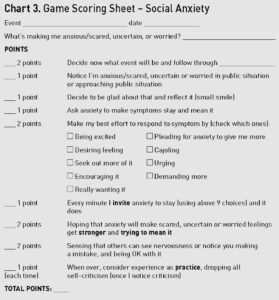


In a threatening situation, step back and become an observer of your process, not be 100% the actor in the drama. Decide to be glad about having the doubt or distress. Put a little light smile on your face or in the back of your mind to reflect it. Then, invite whatever struggle you are having, whether physical symptoms or worries, to stay. Work on trying to mean it. If possible, try to strengthen your move by intensifying your reaction. [For example, I offer nine different choices, such as the previously discussed demand that anxiety make the symptoms stronger.] No matter how strong the doubt and distress becomes, you should treat it as if it is never enough. Reward yourself for every minute you actively invite the symptoms to stay or to get stronger. Accept that other people might notice some problem you are having and for extra credit: hope that they do! Then, when you are done with the practice, learn to support yourself. Drop that critical, disappointed voice.Creating the point system has a number of benefits. The client and I establish a broad strategy together that is manifested through specific actions during practice times. But they pick the practice times to apply the skills. They answer the question, “What can I do today to create some strong uncomfortable feelings for a while?” As they act on this choice, they are empowered and feel a sense of control. Once they are in the anxiety-provoking moment, the point system directly guides them to the therapeutic action.

It is poor strategy to get into a threatening situation and then decide how to act. In that setting, they are competing with a well-habituated set of instructions (“brace, worry, and avoid if necessary.”) Clients are much more likely to regress back to their safe actions, or inactions. When they understand the rules of the game and commit themselves to follow those rules, then recall them as they face threats, they have the best chance of winning

Social Anxiety Strategies

Social anxiety disorder gives clients shaky hands, a quaking voice and worry about the critical judgments of others. Here is the role that it expects of the client: to not want the experience, to avoid it when possible, and to try to get rid of it. When choosing to play the game they ask for the opposite of what anxiety expects: they want anxiety to make their hands shake, their voice quake and their sense of threat heightened. Not only do they request those experiences, but they want them to stick around as long as possible! The clients then attempt to exaggerate their wanting of this experience, and might “desperately plead” for social anxiety to generate shaky hands, or to “cajole” the anxiety to make the experience stronger. They can increase their score by hoping that people will criticize their boring talk or question their shaky handwriting. Earn enough points, win a prize! They refuse to play the game that the anxiety disorder expects. They take charge and push that game board away and pull up their own game board of seeking out doubt and distress when anxiety wants them to defend or run.

Julie

Julie decides to practice facing her social anxiety by eating lunch out alone. She walks onto the lunchtime crowd of “Moe’s Southwest Grill” and is instantly greeted by the cooks and other staff. “Hello! Welcome to Moe’s!” they yell, and the other patrons turn to see who’s entered. Julie begins to feel the flush of red rise in her face as she smiles and nods her head in acknowledgement. Then inwardly she smiles and says to herself, “Yes! Another point.”

Here she describes the process. I’ve added my comments in brackets to her key statements.

“I was really nervous walking in there. I felt like everybody noticed that I was by myself. But that was OK, because that was the point of the whole practice. [She is listening in to her inner conversation and she is permitting her feelings instead of blocking them.] Then having to find a place to sit and making that conscious decision: Am I going to sit with my back facing everyone? Am I going to sit and actually have to look at everybody while they look at me? I made the choice to sit and look at everybody while they looked at me. [She is taking control of the situation by listening in on her process and choosing the more intimidating option.] …I reminded myself that the longer I could stay and the longer I could be nervous and be OK with it, then the better it would be for me. [She has adopted a new belief system about her goals in the fearful situation: stay anxious to win.]

“I thought about how I could make it stronger. I thought that facing everyone while I ate would keep the anxiety going. I was just trying to think of ways to keep the anxiety going. [She is actively strategizing how to provoke symptoms as a powerful way to help her stop resisting.]

“I’m not as afraid of social anxiety as a word because I’ve taken social anxiety and I’ve turned it into a person instead of a condition. It’s not a mother, it’s not a father, it’s just this person or this entity and she wants me to take care of myself. She doesn’t want me to be embarrassed. When I do something that she thinks I could not do, she is impressed. I really like that because it is not a judgmental thing. It is like someone saying, ‘You really should wear a jacket, it’s going to rain.’ But you go out there without a jacket and it doesn’t rain, and they say ‘OK, you did it; you’re still a good person.’ So that’s how I’m thinking about it. [She now comprehends that those ogres, worry and anxiety, have been in her life to help her. They just do it in a clumsy way and she has found a better way. Julie will win this game for good.]”

OCD Strategies

OCD wants the person to try to get rid of any doubts about safety and to take any actions necessary to remove distress. Many OCD clients who fear contamination really do believe that at the moment of exposure they must repeatedly wash to save their life or the life of someone they love. Personifying OCD, I emphasize how it needs them to believe the specifics of their fears. Clients who win over OCD will hold fast to the belief that this is an anxiety disorder. As such, their battle should be with the physical symptoms of anxiety and the urge to end doubt. They should by no means battle with the content of the obsessions. It is never about germs or rabies or salmonella. It is always related to the fear of feeling distressed about threat. To play the OCD game clients set the overarching goal of seeking out doubt and distress.

Eventually, everyone in OCD treatment will do exposure (of the feared stimulus) and ritual prevention, which is the standard treatment for this disorder. But modifying the ways clients obsess or how they perform the ritual is the most efficient starting point for many. Starting with small, lower-threat changes allows clients to practice their new skills and experience early success. Instead of not washing their hands at all after they feel contaminated, clients can change how they wash, where they wash, or what they are doing mentally while they wash.

Jai

Jai was living in a residential program for teens. He struggled with about a dozen different types of washing and cleaning rituals, especially when it was his turn to handle the after-meal cleanup. One ritual required that after he was finished with his (thorough) cleaning of the kitchen, he was to squeeze the sponge ten times while rinsing it under running water.

In our first treatment assignment I asked him if he would fool around with the ritual by switching hands each time he squeezed. In this case, Jai got to keep squeezing and keep counting. He simply altered hands, and switching hands was only a minor threat to him. This is what I call throwing the symptom cluster a bone. You leave in place major components of the ritual or obsession, thus lowering the threat level. However, it is still a change that begins to erode the original fortress of symptoms. He agreed to the assignment, and returned the next week to report how easy that task was. I then suggested this further revision: would he be willing to explore his ability to toss the sponge in the air and catch it with the other hand for each switch? Again, he agreed to this small, silly shift and returned the next week reporting no problems with the task. The following week, he simply squeezed one time and set the sponge down without struggle.

Jai’s playful approach to modifying his ritual became a relatively painless means to arrive at exposure and ritual prevention. It served as a building block for some of his more difficult later encounters with OCD.

Jordan

Jordan, a physician, feared contamination with germs that might come in contact with her clothes during the workday at her medical practice. One of her primary rituals was to spray the entire front of her body with ammoniated Windex® as she left work. She used that same Windex® throughout her home when she felt threatened by germs. Ironically, while Jordan obsessed about becoming sick, her husband, who was also a physician in her practice, was developing serious respiratory problems from inhaling the ammonia. Over months, Jordan worked hard to tolerate switching the Windex® to vinegar-based, then to dilute it to a 50% solution and finally to a 33% solution. Each of these steps increased her doubt just enough that she could tolerate it and experiment with the change. Once she implemented the change, she incorporated it into her routine without much struggle.

But we could progress no further with this or the other safety rituals she performed. Jordan was stuck on the content of her obsession: things had to be clean enough. I failed to persuade her that her attention actually needed to be focused on the strategy of confronting doubt and uncertainty.

Vann

Vann came into treatment struggling with OCD checking rituals that lasted up to five hours a day. Often his concern was that he had missed seeing something he should have noticed: new scratches or dents on the trash can, dust particles under the telephone, an inappropriate item in the basement. Other times he checked as a way to prevent a disaster: an electrical cord will be wrapped around the trash can; his son will trip over some item on his bedroom floor; a fire will start in the kitchen or a flood will occur in the basement. Some days Vann would check a particular item over a hundred times.

Our first ploys involved gently modifying his relationship with his symptoms. For instance, he would check the trash can, but only in slow motion, ever so gradually picking it up and unhurriedly rotating it in his vision. Or he would study the telephone, but not allow himself to touch it. These were his first playful explorations into uncertainty and distress. By the sixth session we added a strategy of postponing. OCD would give him the impulse to check the basement immediately. He would choose to wait thirty minutes before he acted on that urge, again learning to tolerate his discomfort. Through this gradual exposure to the principles, by session nine he was able to avoid locking his house for five days.

Here is how he described his progress by session 10:

“In the past I would pull out the backseat of the car, and if there were dirt there, I would have to clean it up. If a bolt was there I would look at it and get stuck on the backseat, focused on that bolt. Now I do this intentionally. I lift up the backseat and try to make something really bother me, try to feel anxious. I feel that anxiety, replace the backseat, shut the back door of the car and walk away.

When I first started walking away I felt really anxious. I wanted to go back and look at something under that seat again. I felt as though I didn’t look at it hard enough and I’d want to look at it again. I would sweat a little bit, my heart would beat faster, I’d become very irritable and I felt very compulsive. I wanted to go check again! But I just decided I wasn’t going to do it. Sure enough, about two hours later the desire went away.”

Vann completed his treatment in eleven sessions over 5 1/2 months. In a follow-up twelve years later, he remained symptom-free and medication-free.

Conclusion

I began this conversation saying that when I work with anxious clients, I keep my points broad and simple and I focus on them repeatedly. My goal is to influence clients’ perspectives and shift their orientation. I encourage you to try the same.

Help clients to turn away from the content of their fears whenever possible. You cannot always ignore content, because clients will be wrapped up in it. But get past content as soon as you can and move into the core themes of people with anxiety disorders: their struggle with doubt and distress.

The central strategy is for them to want to embrace whatever the anxiety disorders want them to resist. They have two choices. They can “stand down” by choosing to let go of their fearful attention and accept the reality of the current situation. This is the permissive approach. When they have completed treatment, this will be their most common response: to say, “I can handle this situation” and to allow their body and mind to become quieter. The other option is to choose to stay aroused on purpose and actually encourage anxiety to dish them more trouble. This provocative choice is an excellent option during treatment, because choice number one is so difficult to embrace during early encounters. Conditioning and a set of false beliefs are calling the shots; they cannot simply relax on cue. Some treatment protocols will suggest that you help them expose themselves to the fearful stimulus and learn that they can tolerate it. I am suggesting that you put a twist on that set of instructions. Help them to take actions in the world that are opposite of what anxiety expects of them. Persuade them to go out into the world and seek out opportunities to get uncertain and anxious in their threatening arenas. This is a shift in attitude, not behavior. The behavioral practice is not to learn to tolerate doubt and distress, it is to reinforce the attitude of wanting them.

Our ultimate goal is to teach clients a simple therapeutic orientation that they can manifest in most fearful circumstances. Early in treatment, however, you will also need to provide a specific system to follow, with simple rules that guide their interactions with fearful anxiety. Using behavioral practice, encourage them to repeat this new interaction again and again, in all their fearful situations.

You can assume that one of the biggest obstacles to success will be poor planning just moments before the encounter. Whenever they wait until they are scared before deciding the best course of action, then conditioning and faulty beliefs will dictate that they struggle or avoid. In that setting, they are trained by fear to mindlessly seek safety and comfort. Before they enter any situation that is potentially threatening, they should review their objectives and remind themselves of their intended responses.

Thinking of their relationship with anxiety as a mental game offers both a broad therapeutic point of reference and specific actions that manifest it. Initially, your skills of persuasion and their belief in you will push them to challenge their faulty beliefs. After that, experience will be their greatest teacher. Once they have acted on these beliefs and gotten feedback during the fear-inducing event, that learning will put the power in their new orientation and it will be self-sustaining. They will then have a set of instructions, such as “anxiety, please give me more” or “I’m looking for opportunities to get distressed” that will point them toward simple choices during difficult times. And they will have a skill set (that I laid out in Charts 2 and 3) that they believe will match the challenge of the situation.

Practicing Philosophy on the Frontlines of Suicide Prevention

Philosophy begins in wonder. And, at the end, when philosophic thought has done its best, the wonder remains.
— Alfred North Whitehead

From as early as I can remember, I was haunted by questions others found inconvenient: why does anything exist at all, what does it mean to be free, why do we suffer? I wasn’t trying to be difficult. I was just wired for inquiry, a child tugging at the loose threads of meaning, compelled to see what might unravel.

Long before I read Socrates, I was unknowingly walking his path: questioning what others accepted, resisting the comfort of simple answers, and learning to live in the company of uncertainty.

Philosophy didn’t save me. It found me.

In college, I wasn’t pursuing a career path. I was chasing something I couldn’t yet name—a kind of metaphysical resonance. Philosophy gave me a language for that longing. But what began as an intellectual exercise eventually evolved into something else: a practice. A kind of internal activism. A spiritual discipline rooted in presence, curiosity, and the courage to stay with the unresolvable.

Today, I work as a 988 Suicide & Crisis Lifeline counselor, and it’s here, more than anywhere else, that my philosophical training feels most alive.

Sitting with the Void

Since its rollout in 2022, the 988 Lifeline has radically reshaped how we respond to mental health crises in the United States. With phone, text, and chat options, people in acute distress now have access to real-time support 24/7. It’s a public health victory, but on the ground, it’s something more intimate: a space where people can speak the unspeakable.

As a counselor, I don’t pathologize in these moments. I listen. I co-regulate. I hold. I stay.

It strikes me often how deeply philosophical this work is. Each call is a miniature encounter with what Martin Heidegger called Being-toward-death—the raw awareness of our own impermanence, vulnerability, and aloneness. But in that awareness, something else emerges: the possibility of connection.

When someone in crisis reaches out, they’re not always asking to be “fixed.” Often, they just want someone to witness their pain without flinching. To reflect it back without trying to erase it. That’s not just counseling. It’s the praxis of phenomenology. It’s existential accompaniment.

Myth-Busting as Moral Work

Many of us in the field are familiar with the myths surrounding suicide, but part of our task, especially those of us working outside traditional therapy offices, is to actively dismantle them:

  • “Suicide is selfish.” This myth misunderstands the psyche in pain. Most callers believe their death would be a relief to others.
  • “Talking about suicide encourages it.” We know the opposite is true: silence kills. Dialogue saves.
  • “Only the mentally ill die by suicide.” Suicide is a crisis of meaning as much as a crisis of mind. It stems from loss, trauma, disconnection, and despair, all deeply human experiences.
  • “Once suicidal, always suicidal.” Suicidal ideation is often transient. With connection and care, people do recover.

To engage with these misconceptions isn’t just educational. It’s ethical. Every time I resist reductive narratives, I expand the space for people to see themselves differently. To imagine a future again.

Philosophy in a Clinical World

In my early years, I often felt that philosophical inquiry was dismissed as irrelevant to real-world problems. People would ask, “But what can you do with it?”

Working in suicide prevention has given me an answer: you can show up to suffering without needing to control it. You can name the void without trying to fill it. You can ask better questions when answers fail.

I don’t carry diagnostic manuals into a crisis conversation. I carry silence. I carry questions like:

  • “What’s keeping you here, even now?”
  • “What would it mean to stay for just one more day?”
  • “What part of you wants to be heard right now?”

These aren’t philosophical riddles. They’re lifelines.

One of the most humbling aspects of this work is realizing how often people just need permission––permission to grieve, to rage, to doubt, to feel lost. Not every call ends in resolution. Some end in quiet. Some end in tears. Some end with nothing more than a single breath that wasn’t taken before.

And that’s enough.

Philosophy asks us to live with paradox. Psychotherapy invites us to do the same. The intersection, I believe, is where some of the most sacred work happens between presence and uncertainty, holding on and letting go.

As therapists, social workers, peer supporters, and crisis responders, we are often taught to do. But what I’ve learned from both philosophy, and the hotline, is that our greatest power lies in our capacity to be, to sit still inside someone’s unraveling and trust that staying is in itself a form of intervention.

A Final Note

In a time when anti-intellectualism is rising, when nuance is collapsed into binary thinking, and when complexity is mistaken for elitism, practicing philosophy—practicing psychotherapy—is a quiet act of rebellion. It resists the machinery of numbness. It says: We are not here to obey. We are here to awaken.

If you or someone you know is struggling, the 988 Suicide & Crisis Lifeline is free, confidential, and available 24/7 via phone, text, or chat.

And if you’re a clinician on the verge of burnout, compassion fatigue, or existential dread, you’re not alone either. This work changes us. Let it.

A Neurodivergent Clinicians’ Personal and Professional Journey of Self-Discovery

My journey of self-discovery is probably similar to those of many others, with the exception that becoming a therapist, at least to me, is unlike any other career. The things I witness, hear, and experience, have no comparison. For the sake of myself and my clients I must continue to evolve, grow, and remain a lifelong learner. The space of shared stories and experiences is the one from which therapeutic connections can, and have, been made; where I join fully as a human being, and can bring together the various intersectional elements of my own identity. And just like my clients, I have my own story.

Recently, a student asked me about working with neurodivergent clients who have not experienced trauma. I thought it was a great question. In my experience as a neurodiverse therapist and citizen of the world, society is not set up for neurodivergent people and this binary of trauma or no trauma must yield to a more fluid, continuum-based way of thinking. Simply existing can feel traumatic for those who are neuroatypical.

In researching this topic through the scientific lens of my academic identity, I’ve simply not been able to keep pace. There is so much! Through another lens at the intersection of my identities, that of practicing clinician and neurodivergent, I have come to recognize the limitations of purely empirical investigation and have begun visiting social media sites in order to better understand the autistic and neurodivergent community through the lens of experience. I learned more from direct, and very personal narratives, than I did from any textbook or any clinical training.

Working with Bee: An Answer Deferred

Years ago, I worked with an older teenager, Bee, in a rural community who identified as queer. She initially came to see me because her gender fluidity and sexual orientation created conflict with her mother and her mother’s belief system. I want to emphasize the conflict was not between her and her mother, per se, but with the mother’s religious beliefs. This is not an uncommon experience where I practiced. While Bee had social anxiety and low self-esteem, she did have a good support system with her family and friends.

I worked individually with Bee and did some relational work with the family as well. Throughout our time together, she was able to build self-confidence and find employment. By her senior year, she was doing all kinds of things including taking on leadership roles as she fully embraced the trajectory into adulthood. It was for all intents and purposes, an effective therapeutic relationship in which we met the goals of treatment, individual symptomatology diminished, and her relationships improved, as did her attachment experiences and communication skills.

I remember one point during our time together when Bee asked me if she “could have ADHD or be autistic?” I said I wasn’t sure, so I did an ADHD screener, which was diagnostically inconclusive, after which we had several discussions about the results. I even talked about referring for a more comprehensive psychological evaluation, but did not really see the need for it. I talked about some traits but nothing within the clinical range. To support this, I pointed out to Bee that she was doing well socially, involved with extracurricular activities, had friends, and an active social life. At that point, we ended our work.

Through some happenstance around 2-3 years later, Bee’s family reconnected with me to share all the positive things that had occurred in their lives. I met this invitation with openness and curiosity. After the update of Bee going to college and studying a topic of her choice, I immediately shared my need to apologize. Bee asked what I meant. I remember asking, “do you remember when you asked me if you were neurodivergent and I said I really do not think so?” She quickly replied affirmatively.

I went on to tell Bee that I had spent the last several years learning about autism and ADHD, and that in retrospect, she was right. I admitted to her that I was neurodivergent, and that, “I believe you are too.” We shared a laugh about the experience. I was glad she was not angry and that she didn’t feel dismissed but said that “it would have been okay if you had been upset with me.” She knew back then that I genuinely did not think she was on the spectrum, but she was personally unsure. She knew I was not trying to dismiss her and reminded her of my recommendation for a comprehensive evaluation. But those evaluations were not as accessible or affordable as they later became. This was where the field was at that time, and it is where I was along my own path of self-discovery. Statements like the one I made back then, “You have some traits but don’t really meet criteria,” were likely very common before the idea of spectrum was more fully embraced. A few observable traits no longer mean that deeper pathology is being masked, awaiting a full assessment followed by a definitive diagnosis. Neurodivergence means just that…divergence, or variation on a theme. And that variation extends to race, gender, culture, and age.

I am glad I could repair, at least from my perspective, what I considered a therapeutic rupture, although Bee did not experience that rupture in a traditional way to the point that therapy hits an impasse or ends abruptly. The version of myself that spoke with Bee that day knew that she presented with all the “usual” observable symptoms that accompany autism, and that had I dug deeper, the diagnosis would have been clear. I missed or perhaps had resisted the diagnosis because I had not yet found a place for that label in my own identity. I could have let Bee’s narrative lead the way rather than the dictates of my formal training and that of impersonal scholarly investigations. Just as I now have a far clearer understanding of the complexity of my own intersectionality, I now more fully embrace the importance of honoring my clients’ narratives.

Postscript

Quite a while after my work with Bee and her family, I had taken my son at age 7 for an ASD evaluation. The psychiatric resident looked at him and said, “he is not autistic, you see this is the autistic bible––” he slapped his book on his desk––“I can tell by looking that he is not autistic.” My son returned to the room with blue cupcake icing on his face. I felt flooded with embarrassment and rage. I wanted someone to tell me why my son was struggling in so many ways in his life. I firmly said, “I want to see my attending physician.” She subsequently met me with compassion and kindness; however, not even an ADOS was performed.

The irony, or better yet, outrage I felt was because my son had classic symptoms of autism–– hand flapping, lining up toys, and a host of other stereotypical stuff for most of his early childhood, some of which reduced somewhat by age 7. Maybe the resident, and my attending, thought he was too old to be first considered for the diagnosis. But then again, I really don’t know the basis for their preemptory conclusion. I do know that the experience left me angry, feeling rejected, and dismissed, and like there was no help.

To have personally attended a state university that provided evaluations, only for the doctor to not even ask me any questions about my son was so disturbing, if not insulting. I am sure the progress note read something like, “Mother was emotionally unstable and reactive.”

I knew from that moment on I never wanted anyone else to feel that way. At the time of that visit with my son, I had been working on my PhD which paved the way for my own self-study and re-orientation to the whole experience of autism and neurodivergence. The research is clear, at least to me, as a citizen, parent, and clinician.

The field is failing neurodivergent people––kids, teens, adults, families, and couples. Social media has become a substitute, or perhaps a primary place for validation because they can’t receive it from the professional world. When clinicians and the medical community correct clients and dismiss the importance and validity of self-diagnosis, what can be expected? I view this very differently since social media was the source of my own self-discovery of neurodivergence, and a tool for assisting my clients on their own journeys. The entire experience, from my work with Bee to the evaluation of my son to my own self-acceptance, has awakened a deeper awareness that has highlighted the importance of embracing and advocating for the evolution of the professional landscape.

Therapy as a Rehearsal Ground of Courage

“I just don’t know if I can say it,” a client whispered in session the other day, eyes darting toward the door as if the world outside might overhear. Moments like this are becoming increasingly familiar to me. In a society saturated with political conflict, social media outrage, and a nonstop news cycle, clients struggle to trust that therapy is a truly nonjudgmental space. In a country that prides itself on freedom, fear has taken root so deeply that honesty may be perceived as dangerous. This is the world many of my clients now inhabit—a world shaped by social media outrage, relentless news cycles, and political extremism.

They come in carrying the weight of public scrutiny before they even open their mouths. They judge me, assuming I hold beliefs or biases that may harm them. They expect I know every misstep they’ve ever made. And they sit there, waiting for judgment—even when I have never met them before. Social media has changed the rules—it has made people hyper-aware of how they are seen, feared, and judged by the world.

The Collision of Social Media, News and Psychotherapy

These fears have intensified post-pandemic. Many of my clients enter the room with palpable anxiety—not just about their personal lives, but about the world at large. They recount violent events, ideological extremism, and tragedies they have seen on their social media feeds. They speak of a constant fear: “What if saying what I really think could get me hurt?” And they do not mean hurt in a metaphorical sense—they mean physically. In this climate, self-expression can feel like a risk too high to take.

As a clinician, these dynamics add yet another challenge to my practice. Real growth in therapy requires honesty, yet fear can paralyze even the most willing client. And how can I fault them? Everywhere they look, there are examples of people punished for their beliefs. Even I, trained in the ethics and boundaries around the therapeutic space, feel the need to tread carefully in daily life.

Yet this fear also underscores the vital role of counseling. Therapy is uniquely positioned to provide a safe place for my clients to explore their values, confront their fears, and consider alternative ways to cope with anger and frustration. For those on the edge—clients who feel tempted toward harmful behavior, therapy offers a way to process intense emotions without causing harm. It is a space where honesty is not punished, and curiosity is welcomed.

Every day, I watch as Americans relinquish freedom—not through law, but through fear. Fear of judgment, fear of reprisal, fear of being misunderstood––therapy can counteract that fear. It can teach clients that differences in opinion do not have to lead to conflict or violence. It can empower them to embrace their values and navigate the world safely, with empathy for others and themselves.

Case Illustration from the Front Lines of Therapy

A client once shared with me, “I want to tell him how I feel, but I also need a job. I want to tell my mom how I feel about her comments about my parenting, but I need all the help I can get. I want to tell my landscaper I am not happy, but he is the only one I have hired that has shown up. I have so much I keep burying deeper and deeper because I am scared to be abandoned when I need help most—even if what they are doing is not to my liking and even hurts me.”

Fear was ever-present in this client’s life. Fear existed for her in the realities of the world—fear that speaking openly about her beliefs or setting boundaries might result in rejection, loss of resources, or even emotional harm.

As her counselor, I did not dismiss these fears as irrational; instead, I acknowledged their legitimacy while also helping her see where she could exercise agency. Together we carefully distinguished between relationships where safety was truly at risk and those where her voice could be tested. In our sessions, I offered space to rehearse language, weigh possible outcomes, and build confidence in her ability to respond if conflict arose. Therapy became both a sacred shelter for her buried truths and a rehearsal ground for courage, allowing her to honor her feelings while navigating a world that sometimes punishes vulnerability.

A Call to Action

I offer these reflections as a call to action for my mental health colleagues. Share your work with your community. Let people know that therapy is more than a conversation—it is a protective space where they can confront fear, unpack judgment, and reclaim agency in their lives. Let those struggling with violent thoughts know they can explore these feelings without harming themselves or others. Encourage the vulnerable to uncover what they value most and find constructive ways to live it out.

America celebrates freedom, yet fear threatens it every day. Mental health professionals are in a unique position to reclaim that freedom—not through grand gestures, but through quiet, consistent, ethical, and compassionate work. Our expertise allows us to illuminate the power of difference, foster understanding, and help clients navigate fear without being consumed by it.

Nonjudgmental spaces are not just ideals…they are lifelines. And in times of division, outrage, and uncertainty, the work we do matters more than ever.

We counselors are uniquely positioned to educate, model, and empower communities during politically discordant times. By combining advocacy, education, and skillful facilitation of communication, we can help communities navigate change with empathy, respect, and informed action. In the last few years, I have learned to accept that political leadership and policies will continue to evolve, and communities may face challenges as a result.

With my clients, I have had to emphasize resilience, informed decision-making, and equitable engagement to help communities thrive despite adversity. I model active listening and authentic sharing, emphasizing the importance of validating each person’s voice. I strategically infuse examples from counseling, such as couples in disagreement, to illustrate how respectful dialogue can bridge differences. I work with clients using social cognitive learning to help others recognize that small, intentional steps in promoting understanding and respectful communication can lead to broader good. I spend extra attention guiding individuals on how to validate what they hear or see before responding, ensuring their perspectives are shared constructively.

During times of political discord, we are called into action as advocates. I find myself in these times desperately seeking others to join me with advertising our space as a lifeline for everyone.

Shaped by Experience: What a Brain Bleed Taught Me About Therapy, Grief, and Presence

From the Ashes of Crisis

Alone in the ICU, tethered to machines and unable to see my family due to COVID protocols, I realized I was about to learn lessons no textbook could teach. I never imagined that a single medical crisis could teach me more about therapy than years of clinical training––surviving a brain bleed during my final semester of internship turned the ICU into the most intense classroom of my life.

Some nurses became my anchors; others showed me what I never wanted to become. I learned lessons about presence, compassion, and patience that no textbook could offer. My neurosurgeon was like a balm for my fears. Some nurses offered calm steadiness when everything felt terrifying. Others were brusque or cold, teaching me just as powerfully what I want to avoid in my work.

Even months into recovery, lingering symptoms—burning headaches, balance issues, heightened sensitivity—forced me to slow down. I had to set limits. As my internist said bluntly, “Focus on yourself.” This is advice we all need to hear sometimes—especially when life feels overwhelming. That process of slowing became a gift: I learned how to sit fully in stillness, tolerate uncertainty, and meet suffering without rushing to fix it. And humor? It can diffuse suffering. I realized it can be a quiet lifeline, reminding us of our shared humanity even in the darkest moments. The following lessons about presence and patience became especially relevant in my work with clients navigating profound loss.

Sitting with Grief: Aaron’s Story

Aaron came to therapy shortly after losing his partner in a sudden and tragic accident. The shock and anguish he carried were crushing. In the early months, he found ways to honor his partner’s memory through personal rituals that gave him small moments of connection, purpose, and meaning.

I drew on my own experience with vulnerability and life-altering uncertainty to simply sit with him, without judgment or pressure to “fix” his grief. Sometimes, just being present felt like the only thing that mattered. Over time, we explored the idea of growing around grief, which lifted some of the pressure to “get over it” within a certain timeframe—pressure that Aaron sometimes felt from his family, who were anxious for him to move on. Healing, we discovered, doesn’t erase loss—it expands around it, letting life continue alongside the grief.

Slowly, Aaron began to imagine a future where his partner’s memory stayed with him, while leaving room for new relationships, moments of joy, and perhaps one day having children—a future shaped by both love and remembrance.

Shared Vulnerability: Duncan’s Story

Another client, a young adult in their twenties, came to therapy struggling to access emotions after a loved one had died about a year and a half earlier. At first, they couldn’t cry and often felt numb, as if the grief had shut down their ability to feel. Over time, they learned to open to vulnerability, explore deep questions about life, and celebrate meaningful milestones.

Later, a sudden and tragic medical crisis, similar in intensity to my own brain bleed, involving a close family member shook them to the core. Sitting with their grief stirred my own memories of helplessness and survivor guilt. In the past, I might have redirected those feelings in the name of “professionalism,” but now I could simply bear witness—being fully present alongside their suffering.

Silence became a space where emotions could surface. Through that silence, Duncan was able to access feelings that had previously felt blocked. For me, as the therapist, the long bouts of silence were challenging, yet holding that discomfort became part of supporting him. For this client, it allowed grief to breathe, tested trust, and revealed the quiet power of shared human vulnerability. My steady presence, sometimes wordless, reinforced that being truly present can matter more than saying the “right” thing.

Takeaways for Readers

  • Presence is powerful: Sometimes simply being there matters more than advice or solutions.
  • Grief has no timeline: Healing is nonlinear, and growth can happen around, not just after, loss.
  • Shared vulnerability fosters connection: Authentic empathy strengthens bonds, both in therapy and everyday life.
  • Humor can coexist with hardship: A gentle laugh can remind us of resilience and shared humanity.

Just as I learned to sit in the stillness of an ICU room, tethered to machines yet alive, I now witness grief and healing unfold—messy, nonlinear, and profoundly human. In therapy, and in life, the greatest gift we can offer one another is simply to be present.

Therapy, for me, is about ensuring no one feels alone in their suffering. My ICU experience didn’t just shape my approach—it deepened it. I show up with attunement, patience, and care rooted in lived experience, creating space where clients can meet their own pain with courage, curiosity, and even a little laughter.