Finally Getting Sober

The email from my former client arrived on a recent Wednesday morning.

I smiled as I read it, “Just thought you would like to know that I’m celebrating my first year of sobriety and with no slips! Thanks again for all your help.”

Pausing to reflect on our work together over a three-year period of regular and very challenging therapy sessions, I marveled at his present sobriety, given how severe his drinking had become. When he had arrived at my office in early 2016, he was consuming up to two bottles of wine a night and was often experiencing blackouts.

Like what you are reading? For more stimulating stories, thought-provoking articles and new video announcements, sign up for our monthly newsletter.

As with all my clients who struggle with substance abuse and related issues, we had started our work by examining the criteria for a substance use disorder, and in his situation, an alcohol use disorder. He had met 6 of the 11 criteria, including some of the most common issues I look for including tolerance and experiencing regular cravings for alcohol. It had helped my client build his motivation to change when he realized that his drinking habit was actually a diagnosable disorder, and it had allowed him to puncture some of the denial he was experiencing about the severity and destructive nature of his alcohol use.

Once we had established that he did indeed have an alcohol use disorder, I had asked about his drinking goals. I have learned that it is important to not assume a client wants to get sober. In fact, most clients, even those with severe substance issues, generally want to strive for moderation rather than abstinence. If they sense I have an agenda for them to quit, they often withdraw from therapy prematurely. Thankfully, my client had recognized that he was unable to drink moderately and was committed to finally getting sober–complete abstinence.

We had started our work with the goal of gradually reducing his drinking, with the idea that if he was unable to significantly alter his intake through individual therapy, we would consider outpatient treatment centers to further support his recovery. We aimed to reduce his drinking by 25% each week, as this would be sufficiently challenging while not overwhelming. I had asked him about his daily drinking patterns, and we paid special attention to his triggers. For him, fights with his partner would leave him feeling frustrated, angry and alone, and would inevitably lead to heavy drinking that night. He would also associate arriving home from work with going directly to the fridge to pour a sizable glass of wine, often before he had even removed his coat. Another potent trigger was social functions associated with his job—he would often drink too much and not remember much from the previous night.

“The key to getting sober is to anticipate which evenings will be threatening to your sobriety and then develop a concrete plan to get through them,” I had told him.

Each week, we spent time talking about upcoming events that worried him because there would be alcohol present. We worked out how many drinks he could have based on our reduction goals. We also reduced the window of time where he would be out of the house, thereby giving him less time and opportunity to drink. He would arrive late to the various events and leave early. We also discussed some effective strategies he could use, such as having a big glass of water between each drink, eating a meal before going out to slow the absorption of the alcohol, and only bringing the necessary cash to buy our predetermined number of drinks—he would leave his cards at home to reduce temptation.

At the beginning of each session, we would review how the previous week had transpired and we would adjust our goals or strategies accordingly. I would often remind my client that getting sober is not a linear process, there will be inevitable slips and even potentially full relapses. I assured him that this was normal and reminded him to not be too critical of himself if he drank too much one night. He just needed to continue moving forward, learning from his slips and applying that knowledge to the next experience.

My client had struggled in those initial months to meet our goals for reducing his drinking, so we had agreed that he would also start attending Smart Recovery, a weekly support and psycho-education group. This additional support was what he needed, and we began to see a steady decline in his overall drinking.

Several months into our work, I recall him arriving at our session one morning and he was beaming. He sat down, stared at me and waited for me to ask, “How did it go this week?”

“I didn’t drink a thing,” he reported through a smile. “I can’t believe I actually did it.” My client was ready in every possible way to change his relationship with alcohol and worked diligently toward that goal.

I was brought back to the present moment with the sound of my kids demanding something from upstairs. I quickly reread his email, felt quietly proud for his recovery, and continued with my day, a bit lighter. 

Advanced Harm Reduction: Managing Intoxicated Clients

First there was abstinence, then it was abstinence versus harm reduction. Now, “it appears that intoxication management is becoming a necessary skill for therapists”. With the ubiquity of alcohol use and its presence as an increasingly high-end activity, the growing legalization of marijuana, mini-dosing, psychedelic therapy and the ever-growing use of psychiatric drugs at younger ages … what’s a therapist to do?

The Goal of Abstinence

Abstinence has traditionally been the goal of treatment for substance use disorders. And while many therapists, particularly those with 12-step backgrounds, continue to tout abstinence, several factors have challenged its once hallowed position at the top of the treatment goal hierarchy.

Abstinence supporters and opponents alternately argue on the following grounds (supporters in plain type, opponents in italics):

  • Abstinence provides a clear and unambiguous target
  • People will refuse treatment altogether if they must quit entirely
  • In order to participate constructively in therapy, the mind and body must be clear of intoxicants
  • While living in a monastery or being in rehab encourages abstaining, living in the real world requires some substance exposure and use
  • Some drugs create such an intense rush that users must dissociate themselves in order to recalibrate their pleasure responses
  • Those on antidepressants, as well as medications for bipolar and other prescribed medications who encounter problems with using the drug, on the other hand, court lethargy and possibly intolerable dysphoria by quitting
  • While avoiding one substance may be called for, there may be little cross tolerance or susceptibility to problems with use of another
  • Giving in to the urge to use one drug reduces overall willpower strength, according to Roy Baumeister and John Tierney’s best seller on the topic

A Self-Labeled Alcoholic

Joyce drank heavily as a teenager, quitting in her early 20s. She attended AA, remade herself, and moved far away from her home state. Over the years, she smoked pot, and took medication as indicated for pain or sleep or anxiety, but with a wary eye on her penchant for addiction. She succeeded in not using anything excessively or addictively.

Along the way, Joyce developed severe depression, which antidepressants relieved. Eventually, she worried that she had become dependent on the medication, which caused her to stop. But, “when Joyce renewed use of the drug, she had a frightening suicide-ideation reaction”. She has been terrified of that medical category of drug since then. Joyce is prescribed and occasionally takes anti-anxiety medication, which she uses sparingly due to her fear of addiction. She has found opiates very helpful for her moods but understands that they should not be used that way and mindfully avoids traveling too far down that road when prescribed opioids for pain. She continues to consider reintroducing a depression medication into her life if she can get past her fear of them.

Although some cannabis advocates would say that she is using marijuana therapeutically, Joyce views her use of that drug as strictly recreational and restricts her use to evenings. Using the drug in this way doesn’t interfere with her work or other life functions, and she feels she can take the drug or leave it on any given night depending on her mood and what she’s doing. Keep in mind that Joyce remains completely “sober” with regards to alcohol, per her AA experience, though she occasionally uses Nyquil or cooks with alcohol. Many people in her current social group drink moderately, so that Joyce understands such drinking is readily possible.

Drug Use by the Formerly Addicted

An acknowledged “recovering” alcoholic, Joyce is far from being sober by strict 12-step standards. According to her former AA cohort, Joyce is living in dangerous territory. She uses mood-altering substances for fun, and she continues to take a variety of psychoactive medications. She also no longer attends meetings. Yet she is solid in her conviction that she is now a sober individual, and proud of it.

Joyce is in many ways a prototype of the modern American polydrug user. Her life calls into question the meaning of the terms abstinence, sobriety, and recovery. Of course, even the most hard-core abstinence proponents often don’t include cigarettes and coffee in their sobriety calculus, although both are addictive and can have serious negative health consequences. “There is still heated debate among 12-step adherents about taking medications”—their allegiance to abstinence precepts ranges from scorning all medication including not even taking an aspirin under any circumstances, to accepting prescribed medications, to believing use of anything that isn’t your drug of choice is okay (like Joyce’s easy use of cannabis). And this is before even considering the modern harm-reduction movement’s scope, including moderate use of a formerly abused substance, substituting a safer version of an addictive drug like taking suboxone or methadone in place of heroin and even continuing addictive or binge use under safe conditions (e.g., using heroin with clean needles or in a supervised consumption site).

Here are what we believe to be the underlying, fundamental guidelines for discussing continued substance use with people who have been diagnosed with or who themselves believe, as Joyce does regarding alcohol, that they have a substance use disorder:

  • Be open minded and willing to consider all substance use options: abstinence, substitution or replacement with other substances, moderation, safer use, occasional or regulated addictive or intense use.
  • Remain mindful of—and review—experienced outcomes with clients (this opposes the idea of “denial,” taken to mean that clients cannot accurately report their substance-use experiences).
  • Measure the success of treatments against actual life functions—work, family and friends, and especially subjective client feelings.
  • Avoid labeling the client or his or her substance use pejoratively as addictive, bad, or equally as harmful in all forms or methods of use.
  • Consider first and foremost client values and preferences by using motivational techniques in use decision-making.
  • Change is part of the process—the person, their situation, and the interchange between them are always in flux. There is no permanent solution.
We are in a sense in the new frontier of almost infinitely available substance use, considering that illicit opiates and other drugs can be ordered over the “Dark Web.” It does no good to regret or bemoan this reality. “In a sense, we are at the final societal stage of what therapists should regard as the goal in all therapy”—realizing the clients’ agency and freedom of choice in devising their best selves.

Rethinking Non-Problematic Substance Use

The 12 steps can be seen as one expression of American temperance attitudes that consider all forms of intoxicant use and intoxication to be bad or wrong—or, in modern terms, problematic, disordered, or addictive.

Consider Mary, who LOVES to smoke pot. She smokes it all day long, whenever she can, and she always strives to have a supply available. She also drinks, not heavily, but she likes to go out and get a little fuzzy and sparkly with alcohol once or twice a week. Do you think Mary has a substance problem? On the face of it, she uses substances regularly, heavily, and possibly dependently or addictively in the case of marijuana.

Mary owns and manages a local restaurant where she is beloved by workers and customers alike. She is responsible for its financial success as much as the hands-on and the public-facing part of the business. Mary also organizes large rallies and fundraisers for community causes. She is a good citizen. She is strong-willed and plain-spoken. She has a positive marriage. And she is happy with her lifestyle as it is, thank you very much.

“Mary knows something about addiction”. She used to do cocaine heavily, with terrible consequences for her and her husband’s lives. But that was many years in the past. Today, she seems dependent on pot, while her drinking is generally moderate and she doesn’t overdo her use of any other substance, including occasionally prescribed medications. Yet she rejects and is alarmed by destructive substance use, as occurred in her own life with cocaine.

Mary, like Joyce, expresses several contemporary trends in substance use attitudes and practices. She doesn’t accept standard substance use disorder definitions and recommended usage levels. She accepts, even welcomes, mood modification—a.k.a. intoxication when substances aren’t prescribed for therapeutic purposes. And she doesn’t feel limited by her intensely negative, i.e. addictive, former use of cocaine.

Consider Greg. He was a heroin addict in the late ‘60s, long before so much awareness and availability of opioids use had developed. He shot up, lived on the streets, the whole nine yards of addiction. He was lucky because he had a strong family (parents and siblings), and after many years of addiction, he went to a TC (therapeutic community) and finally quit heroin.

Those communities, at that time, allowed clients to reintroduce moderate drinking after a period of abstinence. That idea worked for many TC adherents, although Greg’s idea of moderation seriously exceeded recommended amounts for safe use. Greg drank to intoxication, specifically, two nights a week, although he never touched any other drug. He was positive that if he ever smoked a joint that he would go right back to heroin, and cocaine was just not his thing. But Greg put alcohol in a completely different category.

As he aged, Greg continued to drink two nights a week, but much less heavily. In many ways he followed a typical pathway of natural recovery with alcohol, even as he was a fully recovered heroin addict. And, we should also note, Greg identified personal emotional issues, made substantial changes to his life and created a life he could better live with than when he had been addicted to heroin.

Regarding Greg’s dual pathways to sobriety—one with opioids, one with alcohol—”do we really think that someone who has, for instance, kicked a 10-year heroin habit has relapsed if they have a beer on a hot summer day?” Greg didn’t fit this mold. He was a heavy and, for a time, potentially harmful drinker. But what if a formerly addicted person gets drunk at a class reunion every year? Should we perform an intervention? Or are these simply life events, rather than cases requiring a clinical consult?

We as Americans think use of some substances is more acceptable than others: antidepressants are consumed in enormous amounts, along with Adderall, sedatives, and anti-anxiety drugs (benzodiazepines) and other psychiatric medications. What about coffee, colas, and energy drinks? Now marijuana, depending on your residence, is used both recreationally and as medicine.

As for painkillers, we love them and we hate them. Americans have a strong urge to eradicate pain. It is normal to seek relief from pain. Yet we now have become overwhelmed by our quest for pain relief, including, seemingly, relief from the mental and emotional distress of daily life. We need to look seriously at what this need for escape says about society, particularly in areas characterized by little education, high unemployment, and so-called crises of despair.

Empowering People to Find Purpose

Allowing people to feel safe in openly discussing their lives with their counselors and providers, to convey what it is they think they are doing rather than what their counselor thinks they are or should be doing, increases trust and allows for a collaborative therapeutic relationship. This open process must include acknowledgment of and handling intoxicant use.

Such a therapeutic alliance encourages the client’s sense of agency. “A path of empowerment by clients’ self-identification of their individual values and goals is the ultimate objective” in this conception of therapy and helping. It is not a therapist’s job to identify how someone should live, but rather to explore and to help illuminate what is their best way in life, their unique purpose, with and without regard to their substance use profile.

Perhaps we should celebrate the availability of a modern cornucopia of substances for driving this point home.  

Janelle Johnson on College Counseling

The Clinical Landscape

Lawrence Rubin: You’ve dedicated your career to college counseling, working with students who appear to experience many of the same problems clinicians encounter in outpatient clinics, crisis centers, and substance abuse facilities. Are college counseling centers microcosms for the clinical world outside of the campus?
Janelle Johnson: I would definitely say what we’re seeing at community colleges and at universities around the United States is reflective of what’s going on in the nation
LR: Can you give me some examples?
JJ: There has been a trend where colleges have been able to provide more support services so students can attend. In the past, these students were not able to attend because of a diagnosis or not having the right medication. They couldn’t perform in college. But now we see a lot of students coming that have schizophrenia or bipolar disorder and we have disability accessibility services to help them. Here at our college,
one third of the students we see are diagnosed with a mental health disability rather than a physical or learning disability
one third of the students we see are diagnosed with a mental health disability rather than a physical or learning disability.
LR: So, they come in with previously diagnosed mental health conditions which may run the gamut from adjustment and anxiety disorders all the way out to schizophrenia?
JJ: Absolutely. We see students every day that may have a lifelong diagnosis, who are able to come to college now, but they need resources around their diagnosis. Student counseling services often try to work with their outside providers because we see ourselves as providing supportive counseling. At larger universities, there is access to medical providers to help with monitoring medications. It depends on what your setting is at your school. If a college center does not have a medical provider, then we obtain a release, so we can actually work with a psychiatrist or a therapist that’s not on the campus, especially when it comes to monitoring medications for more serious diagnoses.

Emerging Adults

LR: So, these students that you’re seeing who have come with diagnoses are accustomed to being in treatment, are they open to being referred back into the community, even after they’re in a college counseling setting, or do they hope the counseling center will give them all they need?
  
JJ: That’s a very interesting question. It depends on their maturity level and how they’ve worked with medications in the past. Even with a seemingly simple diagnosis like ADHD students will often say, “I had these accommodations in high school. They sent me to a counselor.” Perhaps they had more of a medical professional do an assessment. But they come to college with the idea “well I’m in college now, I don’t need any of this.” I think most colleges experience students who come to college and try to maintain, but whatever their diagnosis is we also know that this is an age where certain mental illnesses start to show up.

Sometimes there’s an incident that brings a student like this to the counseling center where, depending upon its size, they may be able to receive an assessment. Large schools like the University of North Carolina has around 30 people on staff with psychiatrists, licensed psychologists and licensed counselors. But in a smaller private school or community college, we send them out into the community for some type of assessment or we refer them back to professionals they may have seen in the past

LR: So, a third of the students who visit the counseling center come with a previous diagnosis and may be accustomed to treatment, and they may be receptive to referrals back out into the community. What about the other two thirds? The ones who come to you and may not realize that they’re struggling or may have an emergent psychiatric disorder. How do you hook them?
JJ: What we see, especially with younger students, is emerging adulthood—that transition where they’re starting to be responsible for themselves. We try to talk to them about how they want to live their lives and how they want to express themselves as adults. In the past, when there have been mental health issues, a lot of that push either came from the parents or the school. Whereas in college, I think one of the mental health hooks that we offer them is saying, “you know, these are decisions you can make yourself. How do you want to be?” We give them some options as compared to the past where they were told what to do.

I’ve met a lot of students who were actually on medications for ADHD or who were taking antidepressants. Their parents said to them, “oh, you don’t need this anymore” and took them off. They were in that gray area of not functioning that well but having that parental oversight to get things done. And

then they come to college, and without their medications or follow up, the parents just expect them to do well, but they don’t
then they come to college, and without their medications or follow up, the parents just expect them to do well, but they don’t.
LR: So, these are emerging adults with whom you try to work developmentally around taking responsibility and seeking resources, which sometimes helps them to reach out for and effectively use treatment.
JJ: Yes, and at the community college level, we try to partner with community agencies so oftentimes, we can make those referrals right in our office with the student sitting here. We can put the student on the phone and facilitate appointments.

Getting Them Hooked

LR: So, you may actually be the frontline for these kids. Do you find that some of these students are resistant to the services that you provide? Or resistant to being referred out for more serious problems that they may not even think they have?
JJ: Yes, I think that we do see some resistance. The BITs (behavior intervention teams) or campus care teams sometimes need to intervene when students become disruptive in the classroom learning setting. We talk to them and try to engage them in counseling. Faculty and other students try to be patient, but I think when a student becomes disruptive, we try to figure out what’s going because we tell them that they are jeopardizing their ability to be on campus.
LR: It sounds like you have to be a little more heavy-handed or hope that the campus support teams can build enough of a relationship with the student and walk them over to the counseling center.
JJ: That’s absolutely true. You know, some people are very compliant. Other people are interested in finding out what’s going on with them because they may have that feeling like, “I don’t want to keep living like this. I don’t feel good.” But, then other students have a hard time recognizing that their behavior is disruptive or that there’s any issue. It really depends on how they’re supported when they’re at home and then how they’re treated. Sometimes I find students with very high intellectual functioning have their own unique mental health issues. It’s really difficult with some of those students because you can talk to them very intellectually and they can process what you’re saying, but
they feel like treatment is going to somehow interfere with their creativity or their ability to perform in school
they feel like treatment is going to somehow interfere with their creativity or their ability to perform in school.
LR: Is there a specific student that comes to mind?
JJ: A young male student I recently spoke with had a bipolar-one diagnosis and had recently received an ADHD diagnosis. He was watching his peers advancing on to their master’s degrees while he was struggling to complete school—but having this very fatalistic attitude about himself and about his ability to complete. But when you speak to him, when you look at his courses and grades, he’s got As. Schoolwork is not an issue but he lives in this sort of fatalistic place. “Why am I doing this? I’ll never amount to anything. I always fail at everything. Look what all my peers have already done.”

I think oftentimes a student feels overwhelmed on the campus and sort of wanders into our area hoping that someone will speak with them. What we usually do in that case is to obtain a release. We try to follow up to let the outside providers know that perhaps the student is in a downward spiral and perhaps he needs his medications checked.

That’s also where Cognitive Behavioral Therapy (CBT) comes in. It helps the students to look at thoughts that really aren’t helpful—the misconceptions that they have about themselves which sometimes can be very challenging. 

LR: Do you get a sense, at least on your campus, that there’s a stigma associated with going to the counseling center or being seen coming out of the counseling center? And if so, how do you address that on campus?
JJ: I have a sense of that most campuses are working really hard with different kinds of programs to remove that stigma around coming to the counseling center. We see different initiatives like the JED and Active Minds programs and peer support groups. I could give an example like suicide prevention. Some campuses do things where they lay out backpacks in the quad for how many students have been lost. And then they have a place where you can come out to honor somebody you’ve lost or write something about yourself—some kind of thing where you can participate. I feel like there is increasing recognition of mental health on campuses and getting help if you need it.

On our campus, in particular, and I think on a lot of campuses, we do classroom outreach. We appeal to students to refer other students to us. Sometimes we find that’s even better than faculty referring students. Staff bring students over. But we find sometimes if your peer, another student says to you, “Oh my gosh, you’re just going through a horrible time. You know there are counseling services here on campus? You know, let me walk you over there or let me show where that’s at.” We find that’s really beneficial. 

Challenges of Dual Enrollment

LR: Yours is a two-year college. But there are also high school students on campus. Do you find that these young people have unique clinical problems and challenges?
JJ: We’re seeing a lot of early admission, college dual-credit high schools on campuses. And at Santa Fe Community College we do have a high school right on our campus. It’s even happening at some four-year schools where there’s a high school house. They have some high school teachers and some high school curriculum, but almost immediately students are being placed into college-level classes. What you see happening is
they’re graduating from high schools one day and then receiving either a certificate or an associate’s degree the next
they’re graduating from high schools one day and then receiving either a certificate or an associate’s degree the next.

Regarding the mental health of these particular students, some are very high functioning, very motivated, but some of these students are in this fast-track program because they’ve not done well in the traditional public high school. They’ve had conduct problems or social interaction problems. The parents think, “we’ll take you over here to our college so you’ll be able to take college classes and you’ll be in this high school but it’ll be a lot more flexible for you.” But these students who haven’t performed well in the past may have an inability to follow through and can’t really manage themselves in college. One of our counselors in particular had a student with a very high level of ADHD who didn’t come to the counseling appointments on time. This sort of high school/college program can actually create more anxiety and more unmanageability and adjustment disorders for students.

LR: So, these kids may not be in an appropriate fit for college life just yet?
JJ: Perhaps, but it’s hard to say. What schools are doing with this early college high school programs are really a positive move for a lot of students because I think high school has let a lot of them down. I think high school is a really difficult time for a lot of students because of pressures around social media and bullying. So, being on a college campus really helps them be with other college students who are motivated to get a degree. But there is always the question of whether they are developmentally ready or mentally ready. And while there is a high school counselor here for those particular students, they are spending a lot of time on other things like scheduling and achievement testing.

Addressing Suicide on Campus

LR: Suicide rates are very high in the college-age demographic. How are college counseling centers set up to address that? 
JJ: I think a lot of college counseling centers are trying to address that with different kinds of programming. The JED foundation, for example, offers programming for college campuses. Active Minds is another one that offer all kinds of wellness programming for campuses that also addresses suicide prevention. Also the American Foundation on Suicide Prevention in New York.

Suicide is the second-highest cause of death for our demographic.
Suicide is the second-highest cause of death for our demographic. Even if you go up in age a little bit, which is the demographic for a lot of community colleges, then suicide is the third-highest cause of death. So, I think on most campuses we are all actively working with programming and bringing support.

At Santa Fe Community College we actually have a certified faculty member do Mental Health First Aid Training. Mental Health First Aid is a program that originally came out of Australia that has been embraced in the United States. It’s a day-long program for people in the community who are not mental health professionals. Here at Santa Fe, it would be our campus community—our faculty, staff, other students who take the training. 

LR: So, when it comes to the more serious disorders, and suicide in particular, it’s critical that college counseling centers work in conjunction with community agencies and have programs on campus so that students are never alone. And neither are college counselors alone because they’re always linked to other resources?
JJ: Right. College counselors work with these different available resources, create their own programming or belong to these organizations that provide free programming.
The idea is to eliminate the stigma, raise awareness and have people participate.
The idea is to eliminate the stigma, raise awareness and have people participate. The campus is a community and we encourage students to participate in these suicide prevention programs and to be part of a campus community that supports helping students reach out. People need to recognize the signs and to be comfortable approaching people.

Disconnected from Families

LR: On a related note, we know that LGBT youth are at particularly high risk for suicide. How do you address the needs of these students?
JJ: A lot of campuses are looking to find ways to support students who are in the process of self-identifying or have someone on their staff assigned to programming in that area who works on removing stigma. In New Mexico, which is a very Catholic state with a lot of immigrants, some of these families persist in saying to their children, “your religion doesn’t accept this. You can’t do this. If you do this, you can’t live with us.” So, we try to work on that by asking these students, “How can you speak with your family? How do you want to live your life?” These students still recognize their religious teachings but don’t want that being used against their identity.
LR: So, you try to work within their families and with the cultural issues that impact their emerging LGBT identities?
JJ: Campuses will either look for programming or design their own programming around supporting these students, and then work with them on these issues in counseling.
A lot of these students actually feel safer on campus than they do at home.
LR: Speaking of unique challenges, what about first-generation college students.
JJ: I do believe they have unique clinical challenges because many of them do not have a history of going to college. Additionally, many of these young people also have to help out financially in their homes. So they live at home, come to college but also work to help pay the rent, the utilities and the car payments. And then there are issues around their transition to adulthood. We help them speak to their parents about what they need to be a successful college student.

Some of them will say “my parents are making me feel like I’m crazy because I need more time to study and I can’t take care of my little brother or pick him up from school every day.” It’s an interesting dynamic that plays into their mental health because when they don’t feel supported or understood at home, they experience anxiety, depression and acting out behaviors. It’s not that families don’t support going to college—they absolutely do. But they don’t know what that means or what it looks like.

Raising Awareness

LR: There’s a lot of research into the short and long-term effects of adverse early childhood experiences and the need for trauma-informed education. The idea is that some of these kids are coming to school with such a heavy trauma burden that they can’t concentrate, can’t relate and are at high risk for drinking or self-harm. Have you seen this on your campus and how do you deal with that?
JJ: There are different kinds of trauma. Here
in New Mexico, we have a lot of Native Americans, so we talk about historical trauma
in New Mexico, we have a lot of Native Americans, so we talk about historical trauma. In addition to these historical events, some of our students come from a background of trauma in their home or in their childhoods. In the college counseling setting, we work with these students around issues of safety, peer support and collaboration—empowering the student to have a voice while they are exploring their issues. We are not dismissing what has happened to them but we’re looking at how the therapy works for them, helping them to move forward with that trauma and not to feel re-traumatized by being in our college setting.
LR: Are drinking and substance abuse significant problems on college campuses?
JJ: We’re not seeing it as much on commuter campuses like ours that do not have housing, although I do think it is a presenting problem in our counseling centers. It’s different on residential campuses, and particularly in the dorms. But we do see students coming to campus who are inebriated, or who have problems that other students are reporting. They may be coming to class and they sound like they’re drunk or other students can smell it on them.

I do think it is an issue that is hard issue to address. College counseling centers try to work with students on maintaining their sobriety. I think if they’re actively using or they can’t even function then it is critical to refer them to treatment center. Another student may binge drink only on weekends and otherwise be high functioning, but it also starts to catch up with them. They may not be getting proper nutrition, or may be having problems with sleep, hygiene or relationships. These effects of drinking begin to interfere with their functioning in the college setting. With these students, we try to talk more about responsible drinking and help them to understand how their drinking interferes with their learning and progress and help them explore how they can be more responsible. 

Serving our Veterans

LR: You had mentioned that you have a veteran’s program on campus? Are there unique clinical needs for these students?
JJ: Often college campuses have veteran support centers which provide resources for veterans and their families. These resources include counseling services. Although we are not housed with the veteran’s service center on our campus, veterans know about our counseling services. We also have a veteran’s hospital in Albuquerque, New Mexico, which is about 60 miles away and a veteran's counseling center in Santa Fe.

Our veteran’s center also brings counselors onto our campus about once a week to meet with the veterans. This is not to say that some of the veterans don’t come to our regular college counseling center. Having served first and then coming to college can be a challenge and clinical needs depend on whether or not they are a combat veteran. The

combat veterans may feel that there is a stigma around coming to the regular college counselor
combat veterans may feel that there is a stigma around coming to the regular college counselor who hasn’t experienced what they have or have a military background. Larger campuses actually hire counselors who have served in the military. This can be helpful because veterans have trauma about reintegrating. They’re used to following authority and a more established and structured day. Sometimes they have difficulty with younger students who aren’t respectful. 
LR: Or knowledgeable!
JJ: Sometimes, these younger, less sensitive or aware students don’t conduct themselves very well in class which is very troubling for veterans. And then of course, we do have veterans that have PTSD or depression; situations that require more treatment. But a lot of times, I think it is more about adjustment, depending on how long they served and the college program they’re in.

CBT and Beyond

LR: We’ve been talking about various treatment needs of college students and I know that CBT and other empirically supported treatments are the rage these days. I’m wondering if it also dominates the college counseling landscape.
JJ: I think there is a lot of support on college campuses to use research-supported therapy modalities. CBT has a lot of related therapies including DBT, solution focused and even positive psychology. The reason it works in our setting is because we’re tasked to triage students that come in. There can be a high need for services and students oftentimes wait to get in to see a counselor or a mental health provider. So, I think we want to use therapies that we know can assist with more immediate behavior change.

We don’t have the luxury for long-term care with students.
We don’t have the luxury—and I don’t know if it is a luxury—for long-term care with students. So, those kinds of therapies can really be useful. You can give the student homework and worksheets—something they can hold onto so that they can feel like they’re moving forward and like they’ve accomplished something. I’ve even had students with whom I’ve suggested a reward system to help when they were struggling with something and want to see improvement. Larger campuses can even incorporate these kinds of therapies into a group setting and can direct students to be part of therapy groups.
LR: Would you say that college counselors are pressured to use these proven methods and not encouraged to use creative-expressive modalities that incorporate art, play and music? 
JJ: We’re not forced to do that—it would depend on the counseling center and how many staff members they have. I do see the creative going on as well. In New Mexico, Southwestern College offers a master’s degree in art therapy and I’ve had interns from there on my campus who have done art therapy with our students and they’ve really liked that.

There is some room for creativity, but you have to be working to move the student forward especially because you’re working in a limited timeframe; a college semester or a college quarter and then there’s a break and they go home. I am at a community college where we are looking toward a goal-oriented type of therapy. If they bring in extreme trauma or are in an abusive relationship or are fighting an addiction, treatment is better is referred to a community partner. We use whatever modality is supportive of their counseling and helps them to meet their goals.

And for most of them, their goal is to complete college, find a career and move forward. So, we try to facilitate that. If there is a major mental illness diagnosis, we make sure that they have a community provider who may be doing something like DBT groups. I don’t feel like college counseling can replace that.

College Counseling Competencies

LR: With regard to the provision of treatment, what are some the unique competencies that a college counselor should possess?
JJ: At the university level, a lot of schools hire licensed doctoral-level clinical directors. The counseling staff is sometimes made up of licensed counselors. In New Mexico, I’m a licensed clinical mental health counselor. Some college centers hire licensed clinical social workers who are in clinical practice. That’s is the more traditional set up. Our organization, the American College Counseling Association expects that any counselors working in a college setting be licensed.

What we see in California is an interesting example where most of the universities are using doctoral level licensed psychologists in their counseling centers. In their community colleges, they are using master’s level clinicians. But they don’t have licensure at that level. It’s hard for me to talk across the board, however the American Counseling Association has been working on licensure portability along with licensure accountability.

I would say that if you’re going to work in a college setting, you should be licensed in the same manner that you would to work in a private practice or at any other clinical facility—you need the degree and the experience that comes from practicum and internship to do this work. Unless, that is, you’re in a college where they’re calling you a counselor and you’re doing academic advising or something like that. If you’re in a college mental health counseling center, you’re doing the same kind of work anybody would be doing as a mental health professional anywhere else. The scope of your practice may be limited in that you have to do more community resource referrals. But, your knowledge and ability including understanding the DSM, various diagnoses and treatment modalities fully impacts your work every day. You need to be able to do it.

LR: Do college counselors need to like teenagers and emerging adults? Wouldn’t that be a prerequisite?
JJ: I think that you want to be able to work with that population. Three years ago, I started an internship program here at Santa Fe Communi

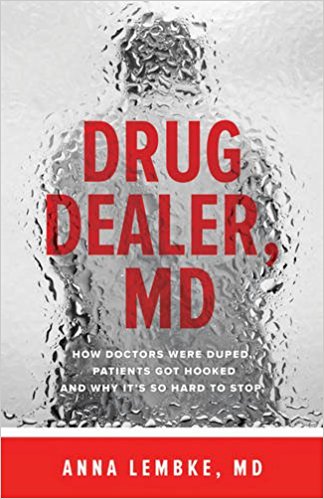
Drug Dealer, MD: How Doctors Were Duped, Patients Got Hooked, and Why It’s So Hard to Stop

Editor's Note: The following is an adapted excerpt taken from Drug Dealer, MD: How Doctors Were Duped, Patients Got Hooked, and Why It’s So Hard to Stop, by Anna Lembke. Published by Johns Hopkins University Press © 2016.  Reprinted by permission of the publisher.

Neuroscientists speculate that brain changes that occur after continuous heavy use of addictive substances can cause damage that does not resolve even after years of abstinence. One of the ways these irreversible changes can manifest is that the brain is primed to relapse to addictive physiology even after a single exposure to the addictive substance. This is called “reinstatement” by neurobiologists, and “relapse” by those who are addicted.

Reinstatement is not triggered solely by the substance that the individual was previously addicted to. Reinstatement can occur with any addictive substance because all addictive drugs work on the same brain reward pathway. For example, animals repeatedly exposed to the addictive component of marijuana (tetrahydrocannabinol, or THC) and then not given THC for a period of time become addicted to morphine more quickly than animals not previously exposed to THC. This phenomenon is called cross-sensitization, or cross-addiction.

Although a history of addiction increases the risk of becoming addicted to opioid painkillers prescribed by a doctor, many people with no addiction history can become addicted to opioid painkillers in the course of routine medical treatment. Furthermore, they can become addicted quickly, in a matter of days to weeks. This is contrary to what doctors were told in the 1980s, 1990s, and early 2000s, when a pro-opioid movement in the medical pain community encouraged doctors to prescribe opioids more liberally and reassured them, based on false evidence, that the risk of becoming addicted to prescription opioids among patients being treated for pain was less than 1 percent. More recent studies reveal that as many as 56 percent of patients receiving long-term prescription opioid painkillers for low back pain, for example, progress to addictive opioid use, including patients with no prior history of addiction.

The gateway hypothesis of addiction posits that using cigarettes and alcohol, which are legal drugs, leads to experimentation with other, “harder” drugs, like cocaine and heroin. Whether this progression is due simply to opportunity costs and ease of access, or to some more fundamental biological mechanism based on the chemical composition of the drug itself, is still being debated.

In today’s world easy access to “harder” drugs through a doctor’s prescription has turned the gateway hypothesis on its head. For increasing numbers of people, especially young people, prescription drugs are the first exposure to addictive substances and the first stepping-stone to future addictive use. My patient Justin’s story provides an example of how a potent and addictive drug prescribed by a doctor can become a gateway to addiction.

Vicodin: A Gateway Drug

Justin had none of the classic risk factors of nature or nurture that we typically associate with increased risk of addiction. The only child of educated upper-middle-class Jewish parents, neither of whom smoked, drank, or used drugs, and with no family history of addiction, he seemed at average risk. (A prevailing misconception is that Jewish people are at lower risk than other ethnic groups for substance use disorders. As told so well by Rabbi Shais Taub in the introduction of his excellent book, God of Our Understanding: Jewish Spirituality and Recovery from Addiction, there are no data to support this stereotype.)

Justin’s childhood was also without trauma. His parents were loving, kind, and devoted to his well-being. He was in good physical health. Sometimes he was teased about his weight—he’d always been pudgy—but he never felt bullied. He had friends. He was neither impulsive nor prone to excessive emotionality. If anything his emotional expressions were muted. He was smart and schoolwork came easily to him. He especially liked science. He fondly remembers dissecting a cow’s eye, and mixing cornstarch and water to make “oobleck,” in the fourth grade. Anything having to do with computers was always of interest, in particular building computers and playing video games. He grew up in his parents’ single-family home in a white middle-class suburb of San Francisco.

The risk factor that Justin encountered, contributing to his later development of addiction, had everything to do with neighborhood, and not neighborhood in the strict sense of geography, but neighborhood in the sense of context, culture, and technology. Justin, like many teens today, especially compared with previous generations, had early exposure to scheduled drugs (opioids) through a doctor’s prescription, thereby developing a “taste” for them, followed by virtually unlimited access to drugs through peers at school and on the Internet.

During his sophomore year in high school, Justin went to the dentist to get his wisdom teeth removed. He lay back in the dentist’s chair, the bright white lights slowly fading into blackness as he lost consciousness from the concoction of drugs the dentist had given him. When he awoke, it took him a moment to realize where he was. He heard the high-pitched whine of the drill and smelled the pungent odor of burnt enamel, and then he remembered: wisdom teeth. “Despite his mouth being pulled apart by several sets of hands and a metal drill spinning near his flesh, he felt good—incredibly good, like no kind of good he could remember ever having felt before.” He soon floated back into unconsciousness.

In the waiting room after the procedure was over and the drugs had mostly worn off, Justin felt nauseated, and his mouth was sore. Through a residual haze of the drugs’ effect, he saw the dentist write out a prescription for Vicodin for pain relief. The dentist explained that Justin should take one pill every four to eight hours as needed for pain.

Once Justin and his mother arrived home, he took one pill and put the rest on his bedside table. He immediately felt relief from the pain in his mouth—and something else—an echo of that good feeling, that better-than-normal-for-him feeling. He lay in bed and again drifted off to sleep.

In the days that followed, Justin took one Vicodin every four hours. On the surface of things, his life had returned to normal. He was back at school, going through the motions of being an average high school student at the average California public high school in the mid-2000s. But inside, under the influence of Vicodin, he felt energized, worry free, and completely at ease with himself. He recalled the man who had visited their third-grade classroom to talk to them about the dangers of drugs and alcohol—part of the DARE project.* The man had told them that people took drugs to alter mood, to “feel good.” Justin knew the man had meant it as a warning, but thinking about it now, the idea sounded like pure genius.

Justin began doubling up on the Vicodin, seeking to maintain the good feelings that had started to wear off with repeated use. “When he ran out of his prescription, he asked his mother to take him back to the dentist to get more, telling her he still had pain.” (His pain was mild and tolerable. What he was really looking for was a way to extend that sense of well-being that Vicodin provided.) His mother took him back to see the dentist, and the dentist readily prescribed Justin another month’s supply. It surprised Justin how easy it was to get a refill and that no one questioned his motives.

An Epidemic of Overprescribing

The prescription drug epidemic is first and foremost an epidemic of overprescribing. Potions and elixirs have always been part of a doctor’s trade, but today the extent to which doctors rely on prescription drugs, especially scheduled drugs, to treat their patients for even routine, non-life-threatening medical conditions is unprecedented.

“In 2012, some 493,000 individuals aged 12 or older misused a prescription drug for the first time within the past twelve months, an average of 1,350 initiatives per day.” Of those who became addicted to any drug in the previous year, a quarter started out using a prescription medication: 17 percent began with opioid pain relievers, 5 percent with sedative-hypnotics, and 4 percent with stimulants. Prescription drugs now rank fourth among the most-misused substances in America, behind alcohol, tobacco, and marijuana; and they rank second among teens.

Teens are especially vulnerable to the increased access to prescription drugs. Adolescence is a time when the rapidly growing brain is more plastic, and therefore more vulnerable on a neurological level, to potentially irreversible brain changes caused by chronic drug exposure. Teens are more vulnerable to social contagion pressures to experiment with drugs. Also, most importantly, ready access to heroin and methamphetamine equivalents in pill form has blurred the lines between soft and hard drugs for today’s youth.

When the second refill ran out, Justin was reluctant to ask for more. But despite daily use for more than a month, he didn’t suffer any acute physical opioid withdrawal. However, that single exposure to opioid painkillers set him on a new course. He began experimenting with a variety of prescription pharmaceuticals, which was normative among his peers, who generally viewed prescription pills as safer than illegal drugs. He obtained all his pills from school friends, mostly for free, but sometimes for cash. His friends got pills from a combination of doctors, relatives, and drug dealers. Justin liked prescription opioid painkillers best of all.

Justin ingested drugs almost exclusively during school hours, so by the time he went home, the effects had worn off and his parents didn’t notice. Amazingly, neither did his teachers. One day in the middle of class, Justin took SOMA, a potent muscle relaxant. As he began to feel its effects, he had an uncontrollable desire to stretch out and extend his muscles. Sitting at the back of the class, he began gyrating in circles with his upper body, leaning far over his desk, to the right, then the left, then backward, almost sliding off his chair in the process. As he remembers it, no one noticed, or at least no one commented. Either way, it’s disconcerting to think such behavior can go unremarked.

“Justin was slated to graduate from high school in 2006, but he failed an English class his senior year, and never got around to making it up.” Instead he spent the next couple of years hanging out with friends and using drugs, mostly cannabis, alcohol, and whatever pills they could easily get from one another. He took a couple of classes at the community college, but didn’t really apply himself. He finally took and passed his GED in 2009.

His parents weren’t sure what to make of his desultory lifestyle in those years after high school. Justin believes they knew about the marijuana, which they were okay with because his dad had used pot on weekends in his youth; but they were oblivious to Justin’s use of other drugs and to the extent of the pot use, and they were unaware that the pot Justin smoked was much more potent than anything his dad had access to in the 1970s.

It’s easy in retrospect to condemn parents who seem not to notice that their kids are using drugs, but I’ve met too many caring parents over the years to stand in judgment. Kids using drugs go to great lengths to conceal their use, and even watchful parents can miss the signs.

Cyberpharmacies

After high school, Justin gradually lost contact with his drug-sourcing high school friends and thereby lost a ready supply of pot and pills. Being risk-averse by nature, he was reluctant to seek out drug dealers, try to get drugs from doctors by feigning illness (doctor shop), or do anything else overtly illegal to get drugs. Instead, he discovered a new source that was convenient, cheap, and didn’t require him to leave the safety and comfort of his own home: the Internet.

Justin’s parents were both at work, and though he was supposed to be spending time online looking at courses to enroll in the local community college, or looking for a job, he was instead typing “Vicodin,” still his drug of choice, into Google. That query pulled up links for online pharmaceutical companies. He clicked on Top Ten Meds Online, which looked like a legitimate pharmaceutical company, but just to be sure, he googled it on SafeorScam.com, an online resource that would tell him whether this site was some kind of sting operation or scam. It checked out, so he went back and searched for Vicodin. None was available. Next, he typed in “opioids” and found codeine as a cough medicine. He put it in his cart. He typed in “tranquilizer/hypnotic” and put Valium and Xanax in his cart. Just before heading to checkout, he added the dissociative anesthetic ketamine. He entered his credit card information and clicked the purchase button. “Within the week, his “medications” were shipped to his house, delivered by FedEx, no prescription required.”

Law enforcement agencies first became aware of online pharmacies selling controlled substances without a prescription in the mid-1990s, coinciding with reports on the rapid increase in prescription opioid abuse and misuse and prescription opioid–related overdoses, especially among young people. These websites conduct business in the United States in direct violation of the United States Controlled Substance Act (CSA).

Despite operating in violation of the CSA, websites that sell controlled medications without a prescription are difficult for law enforcement to monitor or prosecute. As described in the article by Forman and coauthors, “The Internet as a Source of Drugs of Abuse,” the web page for such a site may be physically located in Uzbekistan, the business address in Mexico City, money generated from purchases deposited in a bank in the Cayman Islands, the drugs themselves shipped from India, while the owner of the site is living in Florida. Law enforcement from multiple countries would have to collaborate to enforce and prosecute the owner of a single site, and the entire operation can be dismantled, erased, and reestablished elsewhere in a single day. Furthermore, marketing techniques used by the sites make it difficult to find them. Some of these no-prescription online sites camouflage themselves as something other than a drug-selling site. One such site went by the name “Christian Site for the Whole Family,” with links to “bible study group” and “Easter Drugs Sale: Buy Codeine without a Prescription.”

The international nature of the drug trade today gives the old opium wars a new twist, wherein cyberpharmacists are drug dealers for the modern age. Support for this claim comes from a report out of Columbia University, which gathered data showing that 11 percent of the prescriptions filled in 2006 by traditional (brick and mortar) pharmacies were for controlled (scheduled) substances, whereas 95 percent of the prescriptions filled by online pharmacies in the same year were for controlled substances.

The Internet is not merely a passive portal for controlled prescription drugs. Once Justin, for example, has purchased drugs online, the site remembers him and may send unsolicited e-mails alerting him to new products or special deals. This aspect makes it especially difficult for addicted individuals to stop using drugs. Short of changing his e-mail address or utilizing filtering software, Justin cannot avoid being found and targeted once again for drug use by Internet sellers.

Initially Justin looked only for prescription drugs through online pharmacies, but gradually he became interested in new and experimental drugs in the pharmaceutical pipeline, often sold as “research chemicals.” He learned about new drugs by spending time on the website Pipemania.com, a splinter group of Lifetheuniverseandeverything.com. Pipemania, one of many Internet communities like it, is a forum where users talk about what drugs they are using and what those drugs feel like, including lots of newly synthesized drugs and newer drug combinations. People using these sites refer to themselves as “researchers” and to their drug use experiences as “research findings.”

Examples of newer synthetic drugs include Methoxetamine, or MXE, an analog of the drug ketamine, labeled as a “research chemical product” and taken for its hallucinogenic and dissociative effects. Purple Drank, or Lean, another popular new mixture consumed primarily by young people, combines Sprite, Jolly Ranchers, and codeine (an opioid). If prescription codeine is unavailable, DM (dextromethorphan) cough syrup is often substituted.

The buying and selling of illegal drugs, outside of online pharmacies, occurs primarily in the “deep web,” a term used to refer to a clandestine part of the network where online activity can be kept anonymous. Most of these drug-selling underground sites use Bitcoin as their only currency, providing customers with anonymous access to drugs from all over the world, without even a pretense at legality. One such site, now dismantled, was Silk Road, allegedly operated by 30-year-old Ross W. Ulbricht, who went by the pseudonym Dread Pirate Roberts, a character from the movie The Princess Bride. Mr. Ulbricht was recently convicted of narcotics trafficking, computer hacking, and money laundering.

Heroin—the New Vicodin

In 2012, despite engaging in daily, now mostly solitary, drug use, Justin attended community college and got a job at Oracle in the shipping department. With his new job, he was suddenly in possession of cash, and much more than he had become accustomed to with his parents’ allowance. One night in the summer of that year, he went to a small get-together at a friend’s house, where he met someone whose brother knew a heroin dealer. Justin had never tried heroin before; he had always shied away from illegal so-called street drugs and from drug dealers. But he was curious, and eager to use opioids, which were increasingly difficult to obtain online in any form. Through friends he met Sean, the man who would become his heroin dealer, his business partner, and his housemate. Justin bought a gram of heroin, telling himself it was no big deal; it was just an experiment, and he could handle it.

Heroin was originally synthesized in 1874 by C. R. Alder Wright, an English chemist working at St. Mary’s Hospital Medical School in London. Wright added two acetyl groups to morphine to form di-acetylated morphine, which was largely forgotten until twenty-three years later, when it was independently synthesized by Felix Hoffmann in Germany. Hoffmann, working at what is today the Bayer Group’s Pharmaceutical Division, was instructed to find a less addictive alternative to morphine. Di-acetylated morphine was marketed by Bayer alongside aspirin from 1898 to 1910 as a non addictive morphine substitute and cough suppressant, as well as a cure for morphine addiction. Bayer named di- acetylated morphine “heroin,” based on the German “heroisch,” which means “heroic” or “strong.” Strong it certainly was. By the early 1900s an epidemic of heroin addiction raged in the United States, prompting passage of the Harrison Narcotic Act of 1914 to control the sale and distribution of heroin and other opioids. Today in the United States, heroin is considered a schedule I drug, meaning it is considered highly addictive and is not approved for any medical purpose.

Justin intended to use his heroin sparingly, just now and then. Instead he used it daily for two months, not stopping till he had run through the entire $1,600 he had earned and saved from his job at Oracle. He lost his job and quit school, unable to meet the demands of either. Then he went into acute heroin withdrawal. He remembers heroin withdrawal as “the most horrible feeling in the world, like you’re gonna die.” Elaborating further, “I wouldn’t wish it on anyone, not my worst enemy.”

“The number of Americans aged 12 and older who used heroin in the past month rose from 281,000 to 335,000 between 2011 and 2013, a significant increase from the 166,000 using heroin in 2002.” According to the Centers for Disease Control and Prevention, heroin-related overdose deaths also rose in that time frame, with a 39 percent increase between 2012 and 2013 alone. The majority of new heroin users cite prescription opioids as their first exposure to opioids, a clear generational shift. In the 1960s, 80 percent of opioid users reported that their first exposure to opioids was in the form of heroin. In the 2000s, 75 percent of opioid users reported that their first exposure to opioids was in the form of prescription painkillers. Increases in heroin use have been driven mostly by 18–25 year olds.

Justin went to Sean and told him he was out of money, but desperate for heroin. Sean offered Justin an arrangement in which Justin would work for Sean, and in exchange, get cheap access to heroin for his services. Sean wanted Justin to sell for him, but Justin wasn’t willing. As an alternative, Sean offered that Justin could work in “his lab,” an offer which Justin accepted.

For the next nine months, Justin spent most of his time at Sean’s house, running Sean’s lab. Sean lived in a rundown house in a rundown neighborhood in East Oakland, a place with hardly any furniture besides a TV, a plastic kitchen table with plastic chairs, and a couple of worn mattresses. Justin had dropped out of school, unable to keep up with his courses while strung out on heroin. He told his parents he was “staying with a friend,” and he returned home every two or three days for a visit, just to reassure them all was well.

On a typical day during those nine months between the summer of 2012, when Justin first tried heroin, and spring of 2013, when he would first attempt to quit, Sean and Justin would wake up around one in the afternoon and share a light breakfast. This breakfast did not consist of food; it consisted of heroin. They both preferred snorting to injecting. They lined the heroin up on a smooth, clean surface and passed it between them till they were sated, just as if they were passing a basket of rolls. Sometimes they “chased the dragon,” a way of ingesting heroin that requires putting the heroin on a bit of tin foil, putting a source of heat—a match or a lighter—below the foil, and inhaling the vaporized powder. The term “chasing the dragon” refers to the plume of smoke that rises up off the foil, like a mythical dragon’s tail, as well as the high that addicted persons seek, as elusive as the mythical creature whose name it bears.

“Justin recalls that he was never hungry when he was using heroin. In fact, he didn’t want anything. He didn’t want to eat, read, bathe, exercise, watch TV, or even play his beloved video games.” He was living in a “dump” with no furniture, no food in the refrigerator, no family, no job, and no prospects for the future, and despite the ever-present threat of legal consequences from dealing in illegal drugs, he felt “complete.”

He spent his days cooking heroin from morphine, and when the stink of the chemicals made his eyes burn, he joined Sean on the porch. Every hour or two they snorted heroin. “Because we were distributors, we didn’t even wait till we were feeling sick to use. We’d use to get even higher than we already were.”

The First Step to Recovery

One day in the spring of 2013, Justin was sitting in Sean’s house filling balloon bags of heroin for later sale, when he realized that he had been using heroin daily for exactly nine months. “I was thinking in my head, ‘Wow, it’s been almost a year. If I let this year go by, it’s going to be five years, ten years, maybe my whole life.’” At that moment he decided to quit. He also recognized that he would not be able to act on his decision without help, primarily due to the physiologic withdrawal associated with stopping opioids.

Again he turned to the Internet. While the latest batch of heroin was still cooking in the oven, Justin looked up treatment for heroin addiction on his laptop. He found a website for BAART (Bay Area Addiction Research and Treatment), a methadone maintenance treatment clinic in Oakland, and immediately set up an appointment. Justin recalls that BAART required their clients to be in active withdrawal when initiating methadone, so he stopped using in the hours before his appointment and was plenty sick when he went in and received his first dose of methadone.

Justin also decided to tell his parents. He realized he’d have to be living at home again, and traveling every morning to Oakland to get his methadone dose, and there was all the paperwork he needed to fill out. There was no way he could hide it from them any longer.

The same day he started on methadone, Justin told his parents that heroin was something he’d always wanted to try and thought he could handle. He said he’d been sucked in, and he blamed no one but himself. He knew his parents felt guilty anyway, as if they had failed him. Justin almost cried remembering their conversation. “They were very supportive,” he said. “They’ve always been very supportive.”

Justin did well on methadone. He enrolled at the community college again, made new non using friends, and joined a study group. When he did relapse six months after being in the BAART program, he relapsed hard—which is common—and was smoking crack at the same time he was using heroin. He dropped out of the methadone program at BAART, but bought methadone on the street to ease his comedowns. “For months he managed to use crack and heroin on the weekends and methadone to get through his classes during the week.” One day, unable to reach his methadone source, he started to go into withdrawal. “I realized ‘I’m at the whim of my dealer.’” He bought some Suboxone, a medication with similarities to methadone, also used to treat opioid addiction, from a friend, and used that the same way he had used methadone, that is, to tide him over when he couldn’t get heroin.

But Justin was getting tired. Tired of chasing down heroin, methadone, and Suboxone. Tired of feeling anxious and sick, wondering if he’d have enough drug to keep going. Tired of lying and living the double life—pretending, as he says, “to be sober, but having this second actual life where you’re keeping secrets from everybody, lying, and having to keep track of all the lies. It’s all just so hard to keep up.”

Again he looked on the Internet, this time for someone to prescribe Suboxone, which is how he found me. When he told me his story, I agreed that Suboxone made sense, given the severity of his opioid addiction. But Suboxone treatment requires close monitoring, including regular clinic visits and urine toxicology screens to test for the presence of other drugs. If other drugs are detected, I explained, ongoing Suboxone treatment might be compromised. I also encouraged him to seek some kind of psychosocial intervention to treat his addiction as well.

Justin agreed to Suboxone treatment and monitoring and to a Narcotics Anonymous (NA) meeting. He did not find twelve-step groups helpful; they just weren’t for him. He quit going after a few weeks. But Justin came to appointments regularly and never tested positive for other drugs, except for a couple of small slipups with benzodiazepines, the most recent when, while cleaning his room, he came across an old stash of Valium pressed between his bed and the wall. He took the Valium for sleep for the next several weeks, then stopped. He felt guilty about it. A year later, he is still doing well.

Justin ascribes his year of recovery from addiction to Suboxone, his relationship with his parents, and interactive role-playing tabletop games. “Suboxone stops the cravings and I can feel normal. I don’t lie anymore. Role-playing games help by giving me the escape and excitement that I would usually get from that whole street life.”

Today, Justin spends most of his weekdays studying. On the weekends, he spends some time on the computer, but he no longer visits online pharmacies or spends nearly the amount of time he used to playing video games. Instead, with some sweet irony, he is much more likely to be on a site called Penandpaper.com. There he is able to interact with other players of so-called tabletop, or role-player games. Tabletop games simulate the quest story lines so popular among video gamers, but without the video. There is often an online version of the role-player games, but Justin much prefers the face-to-face version. He claims the story is richer that way.

On a typical Saturday, Justin’s five tabletop teammates, now a stable crew he meets with on a regular basis for gaming, come to his house around eleven o’clock to spend the day playing. Collaborative storytelling is the essence of the game. They sit around a table, sometimes for as long as eight hours at a time, and together describe the world their characters will inhabit and what will happen to them in that world. Sometimes they may even act out a scene or engage in a small role-play, as if creating theater, though none of them would ever describe themselves as actors.

They are currently playing ShadowRun, set in a futuristic world populated by magical beings and cyborgs. Justin’s character is an Ork, a troll-like creature with robotic enhancements and cybernetic abilities named “J-Rez.” Their latest story line bears an uncanny resemblance to Justin’s own life—and it can be read as the narrative of Justin’s alter ego.

J-Rez has just heard from his female crime boss that his next mission is to travel to Seattle to obtain a new synthetic drug called Novacoke. In Seattle, J-Rez meets up with the other members of the organized crime ring, and together they venture into a high-crime neighborhood to deliver a package of research chemicals needed to make Novacoke. In exchange, they get a sample of the drug to take back to their boss. However, right after getting the package they came for, they are nearly killed by a detonated bomb, saved only by J-Rez’s robotic enhancements. The team then combs the neighborhood and, through diligent detective work, including deciphering a tattoo, identifies their would-be killer—a man who has eluded them because he has the ability to turn into a dragon. J-Rez and his gang embark on their next assignment: chasing the dragon.

Justin continues to chase mythical creatures, but for now, not through the medium of addictive drugs.

The Gateway Now a Runway

Young people today don’t just experiment with cigarettes, alcohol, and marijuana. They try everything, especially if it comes in the form of a pill. They even try chemicals newly synthesized in a laboratory without any idea of what these chemicals might do to them. They obtain these drugs from friends at school, from the Internet, from their own home chemistry kits. The gateway, in other words, has become a runway, telescoping the progression from recreational to addictive use. That first prescription for opioids, stimulants, or sedatives is the boarding pass, in some cases, to a lifelong struggle with addiction.

*The unintended consequences of drug use education are salient here. Drug Abuse Resistance Education (DARE) was a school-based prevention program, adopted throughout the United States in the late 1990s and early 2000s, in which police officers provided information on the dangers of drug use to students in the classroom. In retrospect, DARE was ineffective at preventing or even delaying drug use, and in some cases it may even have promoted use, as exemplified by Justin’s experience. DARE illustrates the broader challenge of using didactic and mass media educational campaigns to target drug use.
 

Anna Lembke on the Opioid Epidemic

The Problem of Access

Deb Kory: Dr. Lembke, you’re the program director for the Stanford University Addiction Medicine Fellowship and chief of the Stanford Addiction Medicine Dual Diagnosis Clinic. You recently published a book, Drug Dealer, MD: How Doctors Were Duped, Patients Got Hooked and Why It’s So Hard to Stop, which focuses on people who have become addicted to opioids as a result of having them prescribed by doctors. It’s a shocking book, to say the least, but very informative and also deeply compassionate toward addicts of all kinds.

Let me begin with some startling statistics from the book: From 2000-2014, almost half a million people died from drug overdoses. And between 1999 and 2013, 175,000 people died specifically from prescription opioid overdoses. That’s an enormous number of people and my sense is that it’s rising very quickly every year, with prescription opioids being the lead killer, is that right?
Anna Lembke: Right. In 2016, somewhere between 50,000 and 60,000 people died of a drug overdose, and of those, 50-75% were attributable to opioids. And about half of those opioids were prescriptions. But I think it’s important to recognize that what began as a prescription opioid epidemic has greatly expanded the number of people using heroin as well.
DK: Heroin addiction has become more mainstream because of prescription opioids. Can you explain why?
AL:
In 2016, somewhere between 50,000 and 60,000 people died of a drug overdose, and of those, 50-75% were attributable to opioids. And about half of those opioids were prescriptions.
Well there are so many opioids out there in the community because of the over-prescribing problem and that access alone has meant that many more people have taken opioids. From teenagers taking it out of their parents’ or their grandparents’ medicine cabinets, to kids trading pills at school, to having it prescribed by your doctor for some minor procedure—this has normalized opioid use and made it relatively easy to obtain.

People are getting exposure through a prescription—either their own or somebody else’s—and, particularly for young people, transitioning to heroin isn’t that big a leap. They want more and it is easy and cheaper to go to heroin.

The big spikes in heroin use that we’ve seen in the last five years or so have mostly been among the 18 to 25-year-olds, and I think some of that is driven by a cultural phenomenon in which young people aren’t as afraid of heroin as the older generation. People in their 40s, 50s and 60s, for them to go to heroin would be crossing some kind of line that doesn’t fit with their identity.

On the other side, in the last five years or so there’s been a crackdown on opioid prescribing, and some people who had been receiving very high doses for a very long time all of a sudden have found themselves unable to get the opioids that their body and brain had gotten used to. Some of those people then turn to heroin.
DK: These are the older generation folks?
AL: Yes, they are.
DK: The depth of the agony kind of drives them there.
AL: Right.
DK: From reading your book I got the sense that doctors are finally beginning to understand the enormity of the epidemic and there has been a crackdown in the last few years which, as you said, can push people to seek opioids elsewhere. Were you at all afraid that there would be a crackdown in response to this book?
AL:
Young people aren’t as afraid of heroin as the older generation.
Unfortunately that has happened. In trying to highlight the dangers of over-prescribing, one of the unintended consequences is that the pendulum swings too far in the other direction. Doctors decide they’re not going to treat pain patients or prescribe opioids for anyone anymore. It’s unfortunate. A lot of my professional time right now is taken up with educating physicians about the “middle path”—prescribing judiciously while not enabling an addiction, and not reacting or retaliating in a way that means people aren’t getting the care that they need.
DK: Having gone through a PsyD program, I was shocked at how little training in addiction there was. I am someone who struggled with a prescription opioid addiction when I was younger and I found recovery in a twelve-step program, which was really transformative for me. I had been introduced to prescription opioids young because my mother had terrible rheumatoid arthritis and was herself hooked on pain killers, so in many ways I match the description of people in your book. Yet all through graduate school addicts were talked about as “others”—as if there couldn’t possibly be addicts “among us.” Thankfully there was a teacher who’d been in a twelve-step program for years and was very open about it, but that was really the exception. There was no specific class on addiction and it would just come up here and there in other classes or case conference.

One of the things I appreciate most about your book is how it destigmatizes addiction. It’s obviously an enormous problem and one that the medical establishment has played a big role in escalating. I think the book will make it easier for people struggling with addiction to ask for help and, hopefully, for clinicians like me with a history of addiction to be able to be more transparent about it with each other and with clients when they are struggling with addiction issues.
AL: Thank you so much for saying that. It means a lot to me. And thanks for your openness about your own struggles.
DK: I actually think there is a lot of addiction among mental health practitioners, but many feel too ashamed or embarrassed to get help because we are “professionals,” healers. We’re not supposed to have problems ourselves. I feel like this is a small way that I can help destigmatize it.

My understanding is that medical doctors get even less training in addiction than psychologists. Is that true?
AL: You can say that again. I went through medical school in the 1990s, and the extent of my addiction training was being instructed to attend one AA meeting. Honestly, it hasn’t gotten much better.
DK: It’s so surprising given how many people are struggling with addiction.
AL:
I’m so embarrassed when I look back at the kind of doctor I was.
I’m so embarrassed when I look back at the kind of doctor I was. I mean, I’m a psychiatrist. Here I was purportedly wanting to help people struggling with mental illness, yet I really did not consider addiction an illness of any kind, and I didn’t think it was in my purview to treat people with addiction. I thought that was somebody else’s problem.
DK: Whose problem did you think it was?
AL: I don’t even know. Just not me. What’s so fascinating is that my dad was probably, in retrospect, a functional alcoholic. He was a surgeon, and he was a very serious binge drinker. He was never professionally diagnosed or treated but he had a serious drinking problem, so part of my rejection of this patient population came out of a negative transference—“I’m not going to deal with those people.”

We all have a story like that. Whether it’s our own addiction or somebody in the family, we don’t want to look at that piece of ourselves or that part of our family history, and our patients suffer because of it. And we’re in a system that to a large extent still doesn’t view it as an illness but rather as a form of moral corruption or a weakness of will. It makes it hard for us to look at our own stuff.
DK: It strikes me that there is basically no way to have a therapy practice that totally excludes addiction. Even if you tried really hard, you often get clients who present a certain way when they come in, or might even really believe they don’t have a problem, but then over time as the relationship develops, you learn that they drink to blackout 4 nights a week or smoke pot first thing in the morning, all day and last thing at night every single day. These things aren’t often part of the initial intake.
AL:
We know at least 50% of people who show up in the emergency room with severe trauma have been using substances.
It’s such an exercise in denial for psychiatrists to think that they could make a complete diagnostic evaluation and not ask about substance use, but that happens more often than not. And it’s not just psychiatrists, but other types of physicians, too. We know at least 50% of people who show up in the emergency room with severe trauma have been using substances. Primary care doctors and oncologists see addiction problems. People with cancer get the big C-card pass, but I know a lot of people with cancer who have serious substance use problems. So we all need to be asking those questions of our patients right from the start.

We're Not Asking the Questions

DK: Since our readers are primarily mental health clinicians, I’m wondering how those of us who see patients in therapy and other non-medical settings can help with this and also interface with doctors who may be enabling our clients’ addictions?
AL: Psychotherapists and other non-prescribers in the mental health care field can play an absolutely vital role. In many instances, doctors today are so pressed for time and often don’t have the kind of trust that counselors have built up over time seeing patients regularly. You guys hear the real stuff that I, as an MD, often don’t. But I would also say that in my experience, even in the limited time I have with patients, on some level they’re dying to talk about it. All you have to do is just ask the question, and they will tell you, and they’ll be so relieved to be able to share it.

The bigger problem is that we’re not asking the questions. All of us, including psychologists and non-prescribers, need to ask about substance use, including prescription drug misuse. Then the vital role you can play is—with the patient’s permission—call the prescriber. In most cases, if it’s done with a reasonable amount of humility, the prescriber will be grateful and even thrilled.

Let me just give you an example from my clinic just today. I had a man come in, and he is in recovery from an alcohol and cannabis use disorder, has been in recovery for many years. He also has Attention Deficit Disorder. He went to see a psychiatrist at Kaiser who prescribed him 30 milligrams of Adderall. He stayed at 30 milligrams for about six months, and slowly the dose was creeping up. And now he’s at 90 milligrams a day, running out two weeks early, having to white-knuckle it until he goes back and sees the psychiatrist, who then fills his prescription for Adderall.

How about if I call your doctor right now while you're here?
I asked him, “Have you talked about this with your psychiatrist?” And he said, “No, I haven’t. I know I should. I just haven’t been able to get up the courage to tell her that I’ve essentially relapsed on the pills that she’s prescribing.” And then I said to him, “Well, now that you’ve told us about it, would you be willing to talk with her and let her know?” He said, “Yeah. I really need to. I really want to. I would be willing.” But there was some hesitation in his voice. And then I said to him, “Well, how about if I were to call her? Would you be comfortable with that?” And he said, “That would be so great. If you could just call her and tell her that—because I’m not sure if by the time I get to my appointment I’ll be able to do it.”

And then I said to him, “Well, how about if I called her right now while you’re here? Would you be okay with that?” He said, “That would be great. I would love it if you would do that.” So I called her up, and I said, “Hey, I want to let you know patient X is here and he’s really appreciated your care, and he feels so much shame and embarrassment, but this is what happened, and he wants you to know.” And then I said, “This is my name, this is my number. Please call me. We want to help.” It’s not, “You’re so dumb that you missed this. You’re a bad doctor and I’m good doctor.” I’ve been duped a million times. I’m not a mind reader.

Of course, it’s not that every patient every time will say, “Oh, yes. Please call.” Many times they’ll say, “Oh, no. That’s okay, don’t tell my doctor. I’ll take care of it.” But the truth is, sometimes they will say, “Yes, I’m ready. Please help me with that.” And if you don’t ask and you don’t offer to interface, then they won’t suggest it.
DK: So much of what keeps addicts in their addiction is a deep sense of shame, and what I like about your approach is that you’re cutting right through it. You’re giving them an opening and also modeling a total lack of judgment. You’re just very business-as-usual about it.
AL: Let me tell you something else that I’ve learned to do over the years regarding this whole issue of shame. I have a patient who had been in recovery from her alcohol addiction for six years, and just relapsed in the last six months, and she gets sober for a week and relapses, back and forth. She had been sober for about a month and then I just heard that she relapsed again. She left a message and just said, “I relapsed and I’m not going to come in today because I need to go to rehab.”

Somebody who has the disease of addiction and relapses is exactly the same as somebody who has cancer that was in remission and gets a recurrence of their tumor.
One of the things I’ve learned is when you get that kind of message, don’t just be okay with them saying, “I’m not coming in. I’m going to rehab.” What that actually means is, “I’m going to sit at home drinking until somehow, by some miracle, I get into rehab.” So I said to my residents, “Call her. Tell her we need to see her at her appointment, and tell her to bring her family.” So she showed up at her appointment and she brought her family and the first thing that I did when I walked in the door was to give her a big hug, and I said, “I’m so sorry. I’m so sorry.” Because to me—and this is the key take-home message—somebody who has the disease of addiction and relapses is exactly the same as somebody who has cancer that was in remission and gets a recurrence of their tumor.

What would you do if you walked into the office and somebody had a recurrence of their cancer? You would say, “I am so sorry,” and you would give them a big hug. And that’s exactly what we need to do with addicted patients, because that’s exactly how it is for them. It’s exactly like that. And they’re so appreciative. “Oh, my God,” she said, “Thank you, thank you,” and she was crying. She was devastated, absolutely devastated that she’s relapsed. She’s not going, “Oh goody, I relapsed. I got to get high.” It’s not like that.

A "Cunning and Baffling" Disease

DK: That’s such a beautiful story. It can be really disheartening and challenging for clinicians to work with addicts because relapses can be so devastating and all the shame around it leads to lying and coming in and out of treatment. Do you have any advice for therapists around dealing with the pain and frustration that brings up?
AL: Conceptualizing it as a disease is a really helpful way to maintain a compassionate frame of reference. And then the other piece of it is just being really transparent with patients. “If you lie then I can’t really help you. At least tell me the truth about what you’re doing, and let’s talk about some strategies or what we might do.” In general I find that if patients show up, they’re happy to talk about it.

Compassion can also open up a sense of awe. It’s like, “Oh, my God. What a horrible disease. You really don’t want to be doing this, and yet here you are.” As they say in AA, the disease is “cunning and baffling.” And it is. Awe may not be the right word, but to really recognize the power of addiction, the grip it can have on people.
DK: I like the word awe. Addiction is kind of the grand leveler. It can destroy the hopes and dreams of people from every walk of life.
AL: Yes. And it’s important to be able to really witness the tragedy of that.
DK: Are you able to predict at all who will be able to recover and who won’t?
AL: You know, the more I’m in this strange profession that we’re in—it’s kind of a wonderful and weird job—the more convinced I am that I have no idea who’s going to get better. When I was younger I thought I could tell, but I’ve had too many experiences where someone comes in and I totally identify with them and think, “Oh, a slam dunk. I know exactly what to do. They’re going to be better in a month.” Those have been some of my worst outcomes.

And then I get people who walk in my door and I just think, “Train wreck.” And I literally pray for them. I don’t know what you do; I pray to God. I’m like, “Please, God, help me, because I don’t think I’m going to be able to help this person.” They’re telling me their story and wanting me to help them, and I’m thinking to myself, “I have no idea how I’m going to help this person.” Can you relate to that?
DK: Oh, of course.
AL: Sometimes those people are the ones who get better. It’s so unpredictable.
DK: As a recovering addict myself, I tend to pick up on addiction issues pretty quickly, but I’ve heard from so many people that they were addicted for years without their therapists picking up on it, or in some cases the therapist just didn’t think it was a big deal. Do you feel like it’s incumbent upon mental health professionals of all sorts to have more training and expertise in this area?
AL: Oh, absolutely. Addicts will often see psychiatrists and therapists and talk about everything under the sun—every last thing their mother or father ever did, every dream they’ve had—but they won’t talk about their substance use. People who are shooting up heroin. It happens so often. It’s not a minor issue.

Across the country, medical schools are working hard to try to revamp their curriculum to incorporate more addiction training. We’re certainly doing that here at Stanford, working very hard to at least get the basics to our medical students so they can go out and not harm patients because of ignorance.

That’s the state we’re in right now: Patients are actually being harmed.
But that’s the state we’re in right now: Patients are actually being harmed. Not because most doctors are bad people, but because most doctors are very ignorant about this disease and so, inadvertently, cause harm by ignoring it—or worse yet, aiding and abetting it by prescribing in a way that’s not safe for the patient.

The former director of the Office of National Drug Control Policy, Michael Botticelli, is in recovery. I went to a symposium at the White House where he was one of the main speakers, and he said something along the lines of, “I look forward to the day when I, as somebody in recovery, don’t have to explain to my doctor what recovery is and how he or she should treat me.” I thought that was eloquently said.

Evolving Conceptions of Pain

DK: It’s very common for people in recovery to go to the doctor and say, “I’m in recovery. Please do not prescribe me any narcotics.” And, literally against their wishes, they’ll come out of some procedure and they are prescribed Vicodin. Many hard drug users end up relapsing after having some kind of surgery where opioids are prescribed.

You describe in your book how these prescriptions became heavily incentivized in healthcare. Or, rather, you would be penalized for not treating pain. The Joint Commission, which accredits healthcare organizations, announced that pain was “the fifth vital sign,” and made reimbursement funds contingent upon asking about and treating pain in every patient. Of course, the primary treatment of pain was opioid prescriptions so those skyrocketed. Given what we know now, is the conception of pain and how to treat it beginning to change?
AL: No.
DK: No?
AL:
This new ethos of people being fragile and pain being dangerous has really helped drive the over-prescribing of all kinds of potentially addictive drugs, from benzodiazepines to opioid analgesics.
I mean, pain has gone through a fascinating evolution in the history of medicine. Prior to 1850 or so—which is also prior to anesthesia and convenient forms of analgesia or pain relief outside of drinking some whiskey—doctors actually believed that pain was healthy for the body, that experiencing some degree of pain, let’s say during a surgical procedure, would boost the cardiovascular system, the immune response. And there was a very prevalent idea that, on a spiritual level, pain had benefits for people. This idea that “what doesn’t kill you makes you stronger.” Over the course of the last century and a half or so, that has really changed, not just in medical culture but in society as well. We now consider pain to be a dangerous phenomenon in part because, well, it’s painful in the moment. But there’s also a widespread idea that we’re very fragile creatures, and that if we experience pain in the moment it will set us up for future pain.

The quintessential example of that is Post-Traumatic Stress Disorder (PTSD). It’s based around the idea that if we have some kind of emotional distress, it will leave a psychic wound that will cause emotional distress and suffering in the future. I think it’s important to recognize that that is a very modern idea. Prior to about a hundred years ago, people never thought about emotional distress and pain in this way. I’m not saying they didn’t have plenty of traumatic experiences but it wasn’t conceived of as “trauma.” They dealt with it in different ways and it may even have been kind of a badge of honor to be a wounded warrior.

But that is not at all how we think of it now, and I think that this new ethos of people being fragile and pain being dangerous has really helped drive the over-prescribing of all kinds of potentially addictive drugs, from benzodiazepines to opioid analgesics. This idea that we have to eliminate all pain and we have to do it immediately and, especially as healthcare providers, that we are remiss in our duties if we don’t. Not all healthcare providers agree with that mentality, but it is so dominant and pervasive in medicine, and especially in the mental healthcare field, where, if we’re causing them to feel distress or suffer in some way, then we’re not doing our job.
DK: I wonder how this relates to the rise of positive psychology and our cultural obsession with happiness. Pain seems like something that falls outside the realm of happiness.
AL: Absolutely. And yet, these paradigms are dialectics. The pendulums swings one way, and things don’t quite work, and then they swing back. Dialectical Behavioral Therapy (DBT)—speaking of dialectics—has been enormously helpful for certain types of patients, in part because what it teaches is distress tolerance.

It’s not just people with mental illness who need distress tolerance, though, it’s all of us.
We’re so insulated from any kind of painful or distressing experience that we’re deficient in distress tolerance.
We’re so insulated from any kind of painful or distressing experience that we’re deficient in distress tolerance. DBT puts it front and center and says: We’re going to teach you distress tolerance. When you’re suffering physically or emotionally we want you to sit there. Sit in that moment. Or we want to have you stick your hands or your face in an ice bucket to distract yourself. This is a fascinating movement and a potential antidote to this idea that all pain needs to be eliminated.

There's No Magic Pill

DK: What is a good comprehensive course of treatment for someone struggling with addiction? I know that there are a lot of different modalities that you use for various kinds of patients, but I’m assuming there’s an intake process and then you make decisions about treatment based on people’s financial resources, emotional resources, the severity of the addiction, whether to send them to a rehab or to 12 Step programs. How do you make decisions about where to send people, and is there some kind of standard treatment that you see as the most beneficial?
AL: Great question. Thanks for setting it up that way, too, because there’s no one-size-fits-all treatment. Having access to a bunch of different modalities is the ideal situation, because what works for one person is not going to work for someone else. AA may be the secret to recovery for one person and be an absolutely terrible fit for another.

A lot of patients will come in and want some kind of magic pill. We do use pharmacotherapy medications to treat addiction—although they’re generally underutilized by healthcare providers and should be utilized more—but there is no magic pill.
DK: When you say pharmacotherapy, do you mean drugs like methadone?
AL: Not just that. Also Antabuse, Vivitrol, Suboxone, Naltrexone, Campral for alcohol use disorders, nicotine replacement and other modalities for nicotine use disorders. These medications are underutilized, but they are not magic pills.

We have to talk a lot about how addiction is a biopsychosocial disease, and that the best treatment for the biological part is abstaining—not using the drug of choice for a period of time or maybe forever, depending upon the person, so that the brain can reset itself. And then the psychosocial piece, the long-term psychological and social interventions that are really the most important pieces.

We’re moving increasingly away from recommending that people go to 30-day rehabs.
We’re moving increasingly away from recommending that people go to 30-day rehabs. There’s definitely a time and a place for that, but we’re emphasizing, “Can we find a way to help you not use addictively in your regular life?” If we remove you and put you in a residential facility, you might do great during that time, but when you get out you have to return to the real world and your life. So initially, and also for the long term, we're looking for how to help people change their lives while they’re still in their lives.

That requires a lot of creativity from patients, too. So much of their substance use is ingrained in their daily living and so the key is to figure out, “How can I change my routine, my environment, the people I connect with? How can I change my internal life, my external life, on a very deep level?”
DK: So let’s say I’m a middle-aged patient who got hooked on Oxycontin for a pain disorder. I come in, and I tell you, “No way will I ever come off pain medication. It’s too painful, and I’m not going to a stupid 12-Step program.” Where would you go with me?
AL: For someone like that who doesn’t necessarily self-identify as having an addiction but who strongly self-identifies as having a pain disorder, and who has been on opioids for a long time, prescribed by a physician, I probably would go to buprenorphine, which is a special opioid that we can use for pain. It’s FDA-approved for the treatment of pain, and also FDA-approved for the treatment of an opioid use disorder.
DK: Are there people for whom long-term opioid use is an appropriate treatment?
AL:
For some people, the risk of relapse is just too high when they try to go off of opioids.
Yes. Absolutely. Because, number one, the data are convincing that, for some people, the risk of relapse is just too high when they try to go off of opioids. And from a biochemical or neurological point of view, it just makes sense that after years of exposure to opioids, that the brain, no matter how much time off of drugs you give it, is not going to reset itself. And those are people for whom opioids is the only way that they can feel normal in the world.
DK: What about for pain?
AL: Well, for pain theoretically, too, if you have the right kind of opioid. Both buprenorphine and methadone have unique properties, but the problem with methadone prescribed in pill form is that it has a really high overdose risk, so it’s not safe. It’s only safe when prescribed from a methadone maintenance clinic. But buprenorphine is a really unique drug, which makes it pretty good for pain, though many people develop a tolerance and end up needing more and more. And there may be—God forbid I say this—some people for whom chronic opioids for pain work. I don’t see those people, but I believe they’re out there.
DK: What do you think about the “stages of change” model for addiction?
AL:
If we waited until every pain patient on opioids was ready to change, we’d have even more people dying.
I don’t want to throw the baby out with the bath water. I think the "stages of change” idea can be very helpful for clinicians as well as patients, but I think it can also inadvertently provide an excuse not to get in there and move toward treatment. There’s no actual evidence that the stage of change that somebody is in predicts their engagement in treatment or their outcome. When people are mandated or forced for one reason or another to engage in treatment, even if they’re in a pre-contemplation stage, they don’t necessarily do any worse than people who are in an action stage.
DK: Oh, that’s interesting.
AL: Isn’t it? it’s a fallacy that people have to be “ready for change.” I mean, if we waited until every pain patient on opioids was ready to change, we’d have even more people dying.

One of my great mentors in the addiction field felt that one of the most important things that he could do when he walked into the room with a patient was to shake them up. Get them off balance instead of agreeing with them and throwing soft balls. He’d be like, “You know what? That’s just ridiculous.” Often he would just leave, and they would be angry at him. But that’s the kind of unsettling experience that sometimes—if it’s done empathically, obviously—can make a big difference.

Big Pharma and Institutional Denial

DK: Since we’re focusing on the opioid epidemic, how does treatment for prescription pain pill addiction differ from alcoholism?
AL:
About a quarter of patients who are prescribed an opioid for more than three months, even for a bona fide medical condition, will develop some type of prescription opioid misuse problem.
One of the big differences is that in many instances, patients have been getting their heroin equivalent from a doctor, so it’s very hard for them to shift from self-identifying as a pain patient who is getting treatment to somebody who’s become addicted. The way that I work with that is to really normalize the process and just say, “Hey, I totally get that you have pain, and this was started by a doctor for a real medical condition, but it happens that this is also a very addictive medication. And what we’re seeing now is that many people—even when receiving this from a doctor—have gotten addicted.” And then I always emphasize that it’s nothing to be ashamed of, that it’s not their fault and that they’re not alone.

Big Pharma did a good job teaching doctors something that wasn’t true, which is that the risk of getting addicted was less than one percent, as long as it was prescribed by a doctor. Now we know that’s not true. Probably about a quarter of patients who are prescribed an opioid for more than three months, even for a bona fide medical condition, will develop some type of prescription opioid misuse problem.
DK: Wow.
AL: Yeah. Twenty to thirty percent of people prescribed opioids daily for more than three months will develop some kind of opioid misuse problem. The longer it’s prescribed and the higher the dose, the more likely they are to develop a problem.
DK: So you’re saying that the primary difference in treatment between prescription opioid addicts and alcoholics is of self-awareness around having an addiction. You think alcoholics are more likely to identify as such?
AL: Well, not always. That element of denial is part and parcel of addiction. I think the difference is that the opioid epidemic has involved institutional denial. Now things are shifting as we realize that people can get addicted to opioids even if the doctor prescribed it. On the other hand, alcohol really has not ever been considered medicinal, except in rare instances.

We have the same problem now with cannabis.
Because we have medical marijuana, someone will come in, a young person with no identifiable, objectively verifiable disease process, telling you that their 12-times-a-day cannabis use is “medicinal.”
Because we have medical marijuana, someone will come in, a young person with no identifiable, objectively verifiable disease process, telling you that their 12-times-a-day cannabis use is “medicinal.” It’s very hard to combat that narrative because it’s a prevalent narrative in our culture. This is where this biopsychosocial model of addiction is so interesting and important. None of us lives in a vacuum. We live in the world, and our autobiographical narratives about our lives and why we do things are informed by the culture and the economics and the time in which we live. And we live in a time in which we believe in better living through chemistry. Whether it’s a medicine that a doctor prescribes or a medicine that I get from my friend in my study group at college, we have this idea that using chemicals to change the way you feel is perfectly okay.
DK: That’s an interesting point. Most people don’t believe that it’s possible to become addicted to pot or that it much matters if you do.
AL: Very true. But every day in my clinic, I see many examples of people who do get addicted to pot and who realize it and are coming in for help.

Twelve-Step Programs

DK: I noticed on your website you talked about bringing a spiritual approach to your work, and I wanted to ask you your thoughts on twelve-step programs. There’s a lot of division in the mental health field about their effectiveness and I’ve encountered a fair amount of contempt among clinicians for twelve-step programs, usually among people who have never really interfaced with them. There’s a common critique that they require you to believe in God, that it’s a cult, that the steps are irrelevant, etc.

I appreciate your emphasis on spirituality because many clinicians are afraid to use that word. The drive in the last couple of decades has been toward “evidence-based approaches,” and these are often touted as the counterpoint to twelve-step programs. There have been lots of articles lately about how twelve-step programs don’t really work but such and such evidence-based therapy does. What are your thoughts about this?
AL: I think it’s important to recognize that we’re in an era of twelve-step bashing. It’s very clear that twelve steps is down and getting kicked. The program came into being in part because the medical profession wasn’t doing anything to help people with addiction. People had to figure it out for themselves and it turns out that the AA movement is one of the most remarkable social movements in modern history. It’s really an incredible, incredible movement. You can go to an AA meeting pretty much in any country in the world. How many things can you say that about? It’s absolutely amazing.

But I think this sort of one-size-fits-all dogmatic approach to problems of addiction is what caused this quite vituperative backlash toward AA, and as a result, people are throwing the baby out with the bath water. The truth is that for people who actively participate in AA—AA in particular, but other twelve-step programs probably as well—they have very good outcomes. Their outcomes are better long-term than engaging in individual psychotherapy or group psychotherapy or really any professionally mediated treatment you can identify. So it’s a very robust phenomenon for those who actively participate—and that’s a key feature because not everybody does.

If someone goes to three AA meetings and then doesn’t go anymore and says, “AA doesn’t work,” that’s a misrepresentation because that person hasn’t actually engaged in the program. Those who engage have better outcomes. I’m always thrilled if I have a patient who’s actively engaged in AA because I know already the culture that they’ve been immersed in, the learning that they’ve done. It’s so helpful for me as an addiction specialist to be able to tag onto that and dovetail with that and reinforce that.
I’m not in recovery myself, but I’ve personally worked the twelve steps in part to understand what they’re all about, and in part because I think they’re really useful for a lot of different problems.

So I can converse with my patients on a pretty good level for somebody who’s not in recovery about what step they’re on, if they’re working with their sponsor, how that relationship is going, how meetings are going. I think it’s really important to be able to do that. It creates continuity between their twelve-step life and their professionally mediated addiction treatment.

Do I think twelve step works for everybody? Absolutely not. But another great advantage of twelve steps, which I think is underappreciated, is that it has incredible access. It’s everywhere and it’s free. And you can go when you’re intoxicated. There aren’t many clinicians who can say that. I also say to patients, “If you get yourself a good sponsor, that’s somebody you can call at midnight. Can you call me at midnight? No. I’m not going to pick up, and I’m probably not going to respond until later the next day. You call your sponsor at midnight, and they will be there for you.” That’s pretty amazing. There’s so much wisdom in the twelve steps—the cumulative wisdom of people in recovery, it’s awe-inspiring, really.
DK: I agree and I really appreciate your take on it. Also that you’re not forcing it down anyone’s throat.
AL: Right. I can’t. If I could, I probably would. But I can’t.
DK: That doesn’t work. Anyone who has ever encountered serious addiction knows that. It seems to me like the big lesson here is that there are many effective roads to treating addiction.
AL: Many roads to the top of the mountain. And we should really appreciate what each one has to offer.
DK: Well, you are a gift to the world and I have no doubt that you are helping save so many lives. Aside from reading your book, are there any other tips for people to get educated and get training?
AL: I put together a free online CME course through Stanford, which talks about the neurobiology of addiction and the prescription drug epidemic. That might be helpful. And then we’re making a course now that should be coming out soon about how to taper patients off of opioids, benzos and really anything that’s habit forming. It’s focused on the psychological aspects of preparing patients for it and I think even non-prescribers might find that helpful.

Also, the California Society of Addiction Medicine (CSAM) is a great resource for learning more about addiction. We have an annual conference every fall. This year it’s in San Francisco in August. For any practitioner, PhD, MD, MFT, etc., who wants to learn, it’s a three-and-a-half-day blitz course on addiction. It’s a great resource and taught me a lot about addiction treatment.

DK: Well thank you so much for taking the time to tell us about your important work.


* Read an excerpt from Drug Dealer, MD: How Doctors Were Duped, Patients Got Hooked, and Why It’s So Hard to Stop here.
AL: It was a pleasure.

Alcoholics Anonymous Founder Bill Wilson’s Long-Lost Treatment Paradigm

When I gear up to read a blog I invariably have the same thought: Tell me something I don’t know. In this blog I am going to fulfill that promise for my readers since I have never encountered a psychotherapist or addiction counselor who knows what I am about to share. (If you are the one in a million exception, please accept my apology.) So make yourself comfortable and let’s get this party started. Let’s begin with something you do know. In the summer of 1935 Bill W (aka Bill Wilson) and Dr. Bob (actually Dr. Bob Smith, birth name Robert Holbrook) conducted the first Alcoholics Anonymous or AA group. Since this initial meeting AA has helped more individuals than any group on record. Make no mistake about it. Bill Wilson loved AA and he believed in it with every fiber in his body. But two key factors prohibited this from being the end of the story. First, although AA helped Bill W deal with his alcoholism, it did nothing to curb his anxiety and depression. Second, as powerful as AA was it didn’t work for everybody. Now fast forward from 1935 to the year 1960. Bill Wilson decided to attend a parapsychology conference in New York City. It was there that the famed British Writer and AA supporter, Aldous Huxley, introduced Wilson to two esteemed psychiatrists, Abram Hoffer and Humphrey Osmond. These psychiatrists shared with Wilson a promising new treatment for alcoholics and schizophrenics dubbed vitamin B3 or niacin therapy. He was fascinated by their research. Wilson began ingesting a bomber’s load of the nutrient, 3 grams daily, only to report that his lifelong battle with depression and anxiety lifted in just 14 days! Is that amazing or what? I mean, seriously, it sounds like something right out of an infomercial airing at 2 AM after the one for Tony Robbins’ self-improvement materials. Here was an ordinary over-the -counter vitamin that when ingested in the proper dosage was a fast acting remedy for alcoholism, depression, anxiety, and schizophrenia. And, as a side effect it helped lower the so-called bad cholesterol. Wilson took immediate action and prescribed his miracle like intervention to AA friends who were described as educated. Others were said to be celebrities. According to Wilson, the results were nothing short of amazing. Wilson was brimming with enthusiasm and forged on to share his knowledge with the doctors of AA. These were physicians who were alcoholics and therefore attending AA groups. But here is where the gauntlet began to fall and nothing was ever quite powerful enough to reverse the pattern. The International Organization of AA, despite the fact that the members were appointed by Bill W, and he considered them friends, were not happy campers. Wilson, as they pointed out, was not a licensed physician and thus had no business extolling the virtues of vitamin therapy. Bill Wilson spent the last eleven years of his life spreading the word about vitamin B3 therapy as a treatment option or supplement to AA groups. Wilson tried to rally the troops by creating three powerful booklets over the years to AA physicians, but it fell on deaf ears. So who killed vitamin B3 or niacin therapy? Why was AA embraced by millions, while B3 niacin therapy never made it out of the starting blocks? Certainly, I don’t pretend to have the answer. Scores of reasons could be cited, but here are a few that just seem to make sense. Also keep in mind that nearly everybody is a great Monday morning quarterback. Had I been in Bill W’s shoes at the time I might have done exactly what he did.

Who killed vitamin B 3 niacin therapy?

The niacin flush. Unlike the tiny amount of B3 included in a typical multiple vitamin supplement, in order to import a clinical impact, the dose of niacin (also known as nicotinic acid) generally has to be high enough to induce a flush replete with itching and profound warmth. The effect is so pronounced that individuals taking niacin often mistake these symptoms for a heart attack or stroke and end up in the ER or an acute care facility. In all fairness, a very small percentage of the population finds the experience pleasurable. AA traditions. Tradition six suggests AA won’t endorse, finance, or lend the AA name to any outside enterprise or facility. Tradition ten suggests that AA has no opinions on outside issues, hence AA cannot become involved in a public controversy. The American Psychiatric Association. In 1973 the organization revealed they could not duplicate Dr. Hoffer’s data and therefore could not promote niacin therapy. Rumors surfaced that large doses of niacin caused liver problems. Hoffer, who boasted he took more B3 than anybody on the planet, remained healthy until he passed away at age 91. He denied all claims that niacin was responsible for liver difficulties and went as far as to say it promoted longevity. Before he passed away he discovered a Canadian woman named Mary MacIsaac who took massive doses of B3 for 42 years. She practiced cross country skiing at age 110 and lived until age 112! Okay, I think I’ll have what she was taking. Yes, it’s clearly N=1 data, but I think it’s safe to say that most supercentenarians don’t spend the better part of the day on a ski slope. Morbid fears related to the practice of orthomolecular psychiatry. Orthomolecular psychiatry (I’ll pause while you Google it), a term coined by two time Nobel Prize recipient, Dr. Linus Pauling in 1968, is basically individualized mega-vitamin/nutrient therapy. B3 or niacin therapy fit neatly into this treatment category. The idea that patients might be diagnosing themselves and then heading for the nearest pharmacy or health food store to buy niacin on a BOGO sale just didn’t sit well with mainstream psychiatrists. To be sure, the pharmaceutical companies marketing psychiatric medicinals were not overly thrilled either. Forget the doctors of AA, Bill Wilson should have taken his message to the masses. I am thoroughly convinced that Bill W pitched his ideas to the wrong population. In my humble opinion if he had penned a self-help book on the topic B3 niacin therapy might well have become a household word. This was the 1960s and early 1970s for gosh sakes and titles like I’m O.K.—You’re O.K., How to be Your Own Best Friend, and Born to Win were shaping American culture, not to mention the landscape of mental health. Today, vestiges of niacin treatment live on in the minds of longevity seekers, the alternative health movement, and nutritionally minded cardiologists hell bent on shaving another silly little point off your LDL cholesterol score using straight niacin or a modern slow release version which may or may not eliminate flushing. Had Bill W been successful in his mission to incorporate vitamin B3 niacin therapy into AA the entire face of addiction and mental health treatment might have looked very different today. The story goes that before Bill Wilson passed away he was asked what he would like to be remembered for in the history books. Much to the chagrin of experts and those who have benefited from 12-step groups he chose niacin therapy over AA. Who knew?

Cathy Cole on Motivational Interviewing

Talking About Change

Victor Yalom: I think a good place to start would be to define and describe exactly what Motivational Interviewing is.
Cathy Cole: Motivational Interviewing is a counseling approach that has a very specific goal, which is to allow the client to explore ambivalence around making a change in a particular target behavior. In Motivational Interviewing, the counselor is working to have clients talk about their own particular reasons for change and, more importantly, talk about how they might strengthen that motivation for change and what way making that change will work for them. It’s a way for the counselor to guide a conversation toward the client’s goals, making the choices that are going to work for a particular person.
VY: I know the founder of this, Bill Miller, started in the field of addictions, where, at least for many counselors, there is a very different model of change, which is that the counselor needs to somehow break through the client’s resistance or denial about their drinking problem. In that context, MI has a very different philosophy.
CC: We really wouldn’t view that as resistance. In Motivational Interviewing, we’re listening very closely to what the client says and, more importantly, how the client is saying it. We’re listening for two kinds of language with clients: either sustain talk or change talk. What we might have considered resistance or what had been called denial in the past would actually just be consider sustain talk—reasons not to do something different, like reasons why stopping drinking would not be important, or reasons why, even if it’s considered important, the client doesn’t think they’re capable, or reasons why the client says, “I’m not ready to do this.”
VY: So in traditional alcohol counseling, for example, reasons why they don’t want to change are seen as resistance or denial.
CC: That was considered denial in the past. And it was viewed as the client not having paid enough attention yet to what the professional said they need to take a look at.
VY: So the professional is really the expert.
CC: That’s right. And in Motivational Interviewing, the client is considered the expert.
VY: Miller gives a lot of credit to Carl Rogers’s person-centered therapy in that regard.
CC: He does, and the basic conversational methods that are used in Motivational Interviewing came out of some of the client-centered work, particularly the use of reflective listening. When Bill Miller began to discuss this, he talked about the client being the expert. The clients are the ones who know themselves better than anyone else. The clients have strengths and capabilities, and clients have the ability to decide if making a change is important to them and why, and what would work best for them in terms of going about that change.

This is quite different from the traditional model of, “Here’s your problem. Here’s what you need to do. And if you don’t do it, that’s your problem, too.”

Of course, the counselor has an important role with this, because sometimes clients want to make change but they don’t really know how. So if, after fully exploring clients’ ideas about making change and what would work for them, the client still feels lost, we’re able to come in and provide some ideas for them to consider—things that we know have been helpful to other people or specific ways of approaching, say, stopping drinking. But ultimately, the clients are the ones who decide what they’re going to do. So this was quite different from the traditional model of, “Here’s your problem. Here’s what you need to do. And if you don’t do it, that’s your problem, too.”

VY: That’s the underlying philosophy of it, and then there are a lot of specific techniques. It’s very strategic, from my understanding. You mentioned one idea of sustain talk, and that is the clients telling you why they want to sustain or continue what they’ve currently been doing.
CC: Right. They’re telling you why they’re not going to do something different.
VY: When you’re hearing sustain talk, your goal is not to try to argue them out of it. You’re not trying to show them that they have some irrational thinking or beliefs. What’s your goal in listening to sustain talk?
CC: To me, there are two goals in listening to sustain talk. The first goal is for me to listen so that I really understand the client’s perspective and of why they are where they are with this particular behavior, and what might be interfering with them considering making a change. So I want to first really work on understanding that. And the way that I’m going to convey that I’m understanding that is by the use of reflection. The next thing that I want to do is to use various kinds of open questions to help the client completely explore the sustain talk, again, toward the goal of the client being able to make an informed choice about whether or not they’re going to change.
VY: And the other type of talk, to call it that, is change talk. That’s a really interesting idea, I think, especially for therapists. What is change talk?
CC: Change talk is when the client begins to shift and say that perhaps making change is important, or perhaps they are able to do it, or perhaps they are ready to do it. They begin to shift away from the reasons not to and they move into the direction of the reasons to make change, or the capability of making change, or that readiness to make change. And that change talk can be very subtle; it can be something that we have to really listen for. It may not be the dramatic, “Yes, I have changed my mind. Now I am definitely going to start losing weight or stop drinking or making a change in my drinking.” It could be as subtle as, “Maybe I should start thinking about that.” And the moment that that occurs, we want to then change what we’re doing in relation to that change talk.
VY: I know that Motivational Interviewing is used in a wide variety of settings, from addictions to healthcare, medicine, the criminal justice system. But just to keep things simple for now, let’s use the example of addictions, where it started. Can you give me an example of someone is struggling with drinking and give an example of sustain talk and change talk, and how you might listen for the change talk, and what you might do with it?
CC: The sustain talk might be something like, “My drinking is no worse than any of the other people I hang around with. In fact, sometimes I don’t think I drink as much as they do.” So that’s saying this is no big deal.A shift of that might be, “Well, when I think about it, I realize that some of the people I drink with actually do say ‘I’ve had enough’ and they quit. And I don’t always do that. Even if I feel like I’ve had enough, I just keep on drinking.” Many people might not hear that as change talk, but I hear that as change talk because the person is beginning to take a look at this and the drinking in a different way. I would really want to attend to that very carefully, and then help the client expand on that.

VY: How do you help them expand on it when you first hear that subtle shift?
CC: Continuing this example, my first response would be to do a reflection. I might say, “You’re beginning to pay attention to how your drinking pattern is not the same and realizing that there could be some pretty important differences.” I’m reinforcing the beginning of the client looking at this in a different way. By doing the reflection, that then provides the opportunity for the client to expand on what he’s beginning to think about.
VY: But you’re not jumping on it.
CC: No, I’m not jumping on it like, “Okay, so you really want to do something different,” because I’m just hearing the beginning of it. Again, MI is very client-centric, so I am helping the client move forward just a little bit, and I’m letting him now expand on this little bit of daylight that has started to show up here in terms of him thinking, “Maybe this is something I could look at in somewhat of a different way.” I want to help him move that along. But if I get too far ahead by saying, “Okay, so you realize that you have a problem,” the client will probably immediately push back to sustain talk because I will have gotten ahead of the client or really created some discord in the relationship at that point. So it’s very strategic in terms of how far ahead I’ll actually move.
VY: I know it’s a really important concept in Motivational Interviewing, for the therapist or counselor not to be the one arguing for change.
CC: Absolutely. The clients are always the ones that argue for change. We set the stage for them to be able to do that, should they want to, but they always present the argument for change.
VY: What is the rationale behind that?
CC: The rationale is if we have decided on our own that making a change is important, we’re far more likely to do it. And it’s also human nature that if someone else tells us that we have to make a change, even if we know we need to do that, we argue against it. We push back.
VY: So with this hypothetical client, say you reflect back the early change talk. How might it progress from there?
CC: Then the client says, “Yeah. I realize that if we go out drinking on the weekends, my other friends know that maybe they can drink a little bit more on a Saturday night, but when it comes to Sunday that they need to cut back and maybe not drink at all, or just have one drink. And they go to work on Mondays. I often don’t really slow it down. I continue to drink just as much on Sunday, sometimes maybe even a little more. And I sometimes don’t end up going to work. So I’m a little bit different than they are with my drinking.”To that, I might actually say a reflection back: “Your drinking takes on a life of its own. It actually gets ahead of you.”

VY: Okay, you summarize what they’re saying. You say you don’t want to get too far ahead of the client, but sometimes you might amplify their reflection?
CC: I’ll amplify that a little bit more. I took a little bit more of a step out this time, a little bit more of a risk, because the client actually started giving me more information. He started to have a different perspective. So I edged it out a little bit and really did a metaphor: “Your drinking has a life of its own, and sometimes it moves ahead of you.” I started to help the client really compare and contrast his drinking with other people’s drinking and just expanded, really, on what the client has said.
VY: It’s really a conversation between the two of you. The therapist does a lot of reflection and trusts that ultimately it’s the client’s decision whether they’re going to stop drinking, start exercising, manage their diabetes better, or whatever the behavior is. Does this tend to go on for a long period of time throughout a course of counseling? Is it very focused on a specific behavior?
CC: Motivational Interviewing the way that we’re using it is focused on a particular target behavior. It’s something that the client is talking about with a sense of, “I need to figure out how to deal with this.” Motivational Interviewing is actually considered a somewhat brief way of working with people in that the person is deciding whether they’re going to do something and then what they’re going to do.Let’s say the drinking from our earlier example is the target behavior. The client decides over the course of a couple interviews that this is a bigger deal in life than he had looked at before, so he’s saying, “Now I’m going to do something about this.” Now we’re getting a clear message of, “Yes, I want to move ahead.” So we begin to take a look at how capable the client feels of doing something about this and what it is he wants to do.

Let’s say I’m an outpatient therapist and doing a specific alcohol treatment is not necessarily my strong suit, but I have this client who comes in and that’s what the client wants to explore. It could be that in the course of that conversation, the client decides, “I’m going to do something about this. I’m going to go to a specific center or perhaps even an inpatient program that deals with alcohol problems.” Or let’s say that it’s a brief intervention to help the client get to the place of saying, “Yes. Now I’m going to do something about it,” and then he moves into planning how he’s going to do something about it. That might mean that the person moves away from me and that I’m not working with him any longer.

But let’s say that I am comfortable working with an alcohol problem. So now we have resolved that initial ambivalence. We’ve moved toward, “Yes, this is what we’re going to work on together.” At this point, we’re going to be working with whatever the client needs to take a look at: for instance, is he planning to try to moderate, or is he planning to try to stop altogether? If he’s going to stop altogether, what do we need to address with that? What might be barriers for him in continuing to maintain abstinence once he’s established it? So we’re not into the nuts and bolts of how he’s going to do it. I’m still not telling him what to do, but I’ve shifted away from that first part of Motivational Interviewing, which is just to resolve that ambivalence about doing it in the first place.

But let’s say that client is continuing along in therapy and with this change plan, and couple of months down the line, the client now says, “I don’t know. Maybe I don’t really need to continue to do this any longer.” So now we’re just going to explore that again. I’m always listening for where the client might become uncertain about continuing to work on this particular behavior. Then we’re going to come back and use Motivational Interviewing to work with that ambivalence.

Stages of Change: Importance, Ambivalence, Confidence

VY: Coinciding with this interview, we’ve just completed a series of Motivational Interviewing videos with you. The first one lays out the general principles, and then the next three address different stages in the change process. It’s an interesting way of thinking about the process of change in general. The first one deals with the idea of increasing importance. Can you just state briefly what is meant by that?
CC: When we talk about increasing importance, we are basically talking about the client’s buy-in around making change. The client has to decide, “Why is this an important issue for me in the first place? Why is it important for me to take a look at the role of drinking in my life? In what ways might it be creating problems for me? In what ways would taking a look at this and making some changes enhance, perhaps, parts of my life or what difference does it make for me to actually control my diabetes when I’m going to have it forever anyway? Why would I stop smoking? Why would that be important?” That’s the first thing when we’re talking about making a change. First, we have to believe that making the change is important, because if we don’t believe that it’s important to make a change, then we’re really not going to do anything.
VY: So first the client has to at least consider that it is important for them to change. And even when they consider it’s important, the idea that they might change is often counterbalanced by inertia or sustain talk—they still might be ambivalent about actually going ahead with it.
CC: Exactly. If we think about it, probably one of the most common questions that the majority of people deal with is, “Is it important that I eat in a certain way so that I maintain the health that I currently have? Is it important that I have a regular exercise routine?” And a lot of times, clients don’t actually realize that it is important for them to make a change.Let’s take an example of a client who has had a yearly physical with routine screenings, lab tests, things like that. The doctor points out that some of her lab values are off. Let’s say liver enzymes are off or cholesterol is high. The client has really not even considered that she needs to make any kind of a change, and now the doctor is saying, “These are indicators to me that you should take a look at these things in your life—that you should take a look at your diet, you should take a look at your drinking, you should take a look at the use of exercise to have an impact on these particular health issues that I have a concern about.”

VY: So this is all new information to the client. For the first time, she thinks, “Gee, maybe it’s important that I make some lifestyle changes.”
CC: Exactly. And other times clients have sought counseling about something that they think might be important, but they’re not sure yet. So they’ve come to sort that out for themselves. Or perhaps someone is saying, “I’ve really always identified myself as a person who speaks my mind. I want to express myself honestly, but I’m beginning to get some feedback at work from my boss that that is really not going to help me advance in my career. So I’m thinking maybe I should take a look at that, but I’m not so sure.” So he’s trying to figure out if changing something about the basic way that he has been interacting is important for him to work on.Or perhaps a young mother has been following the ways that female relatives have been telling her she needs to be dealing with her newborn baby, but she’s read some literature that maybe that’s not quite the right thing. So she wants to talk to the baby’s pediatrician about whether or not she should do something different, because she’s getting conflicting information.

VY: We’re moving into territory where the client is aware that there’s some potential need to change, reason to change, but they’re ambivalent. There might also be a reason not to change.
CC: Right. It’s so much easier to do things the way that we’ve been doing them all along. In the case of the young mother, it could be that going against the grain of what she’s being told by these other significant people in her life is something that, while she might think it’s important, maybe she doesn’t think she can pull it off. Maybe she thinks she’s not really capable of standing up to them and saying, “I’m going to bring my child up in a different way,” so it’s easier for her to say, “No, I don’t think it’s that important.”
VY: Throughout the course of counseling, assume you resolve this ambivalence in one way or other and the client decides, “Yes, I do want to cut back on my drinking,” or, “I want to quit my drinking,” or, “I want to lose some weight.” Then you move into the territory of whether they have the confidence to make that change.
CC: Exactly—whether they feel that this is something that they’re capable of actually doing. And if we look at, say, people who have decided that they want to stop smoking, many, many people can say, “I know it’s important not to smoke, but I have tried and failed so many times to stop smoking that I’m just not sure that I can actually do it. So maybe I should just keep on smoking because I really don’t want to fail again.” Now we’re now helping them take a look at the issue of confidence and capability.
VY: What is MI bringing to the table there? How do you help increase someone’s confidence or likelihood of making that change?
CC: One of the things that I would do is explore with these people any past attempts that they’ve had. If they’ve had any success at all, even if it’s just been for a day, I’d like to find out what helped them, or what happened that they were able to be successful even for a short period of time. I’d also want to explore with the person other areas in their lives where they have actually tackled some sort of challenge or made a change successfully, and help them talk about what helped them be successful at that time. Perhaps it was outside support from another person, or it was buddying up with a person to be able to pull off an exercise routine.I also help them determine what natural traits and characteristics they possess that help them tackle things in life that could be difficult, and how could they use those particular traits to help them in this particular area.

Another thing that helps with confidence is actually giving people sufficient information about how they might go about making this change, and helping them explore whether or not they think that would work for them.

Most of us are not going to step out into making a change unless we think we can pull it off, so to actually have an idea of how to go about it can be very helpful.

Offering Advice and Information

VY: As I said, Motivational Interviewing is widely used in healthcare and medicine, although our audience for this interview is mainly counselors and therapists. I think it’s just important to note that, say, in a medical setting, a healthcare provider might have very specific information about managing diabetes or quitting smoking. But also in counseling, if we have particular expertise in addictions, again, we might not tell them what to do, but we might say, “Based on our experience, this is going to be more likely to be successful than this.”
CC: If a person is saying, “I want to do this, I just don’t know how, and therefore I’m not confident,” we might say, “If it’s okay, I can give you some information on what has been helpful to other people, and from there we can see what you think about that in terms of it being useful for you.” I might present two to three ideas, then stop and go back to the client and explore again. “What do you think about that?” And see how they would work with that.So in addictions, I might say, “Some people find it helpful to do things like 12-step recovery and others find it helpful to go to specific treatment kinds of programs, while still others use things like web-based programs to help them deal with establishing abstinence and getting support. Other people have turned toward their faith, if that’s been something that’s important. So I’m just wondering, out of some ideas that I’ve presented, what ideas that brings up for you or what other questions that you might have.”

I’m always coming back to the client and checking in again, because ultimately the client is the one who’s going to decide.

VY: That again, is quite different from an approach where you say, “You really need to go into an inpatient program.”
CC: It’s very different from a prescriptive approach. I want to make sure, though, that folks listening to this don’t misunderstand: the counselor can actually provide specific recommendations, but it’s done in a way that ultimately our clients still know that they are the one making the choice. We’re reinforcing our clients’ autonomy.Let’s say that I have done an assessment with someone in relationship to drinking patterns and what kind of impact drinking has had in this person’s life. And let’s say that the client is now trying to decide whether or not he wants to do some harm reduction, or whether he wants to be completely abstinent. The client might ask me what I think, and it’s perfectly okay for me to give my point of view, but I would say it perhaps in this way: “Ultimately, you’re the one that’s going to make your choice. But from my review of your history and from what I hear about you trying to do moderation in your past attempts, it looks for me like going for abstinence is the right thing for you to do, certainly at this time. That’s my professional recommendation based on what I learned from your history. But again, I want to know what you think about that. Ultimately, you have to make the decision.”

What’s New About MI?

VY: It sounds very consistent with how a lot of therapists work in general. We generally don’t tell the client what to do. We think that we’re listening to them and being supportive. For the therapist who wants to integrate this into their general work with clients, what’s most new about this? When you are training counselors, what do you find really stands out for them about this approach?
CC: Particularly with seasoned counselors, what stands out as new for them is listening for when the client becomes uncertain again about addressing their target behavior—when they begin to shift and begin to have some doubt, perhaps, that they are capable of doing this or that it. It remains important to listen for that and realize that when we begin to hear that, we now need to shift and start to explore that uncertainty again and not act as if we’re continuing to move forward, because then we’re not really in sync with the client any longer.
VY: By that, you mean the client has been exploring the possibility of change but then hit a roadblock and start to get stuck back into ambivalence.
CC: Yes. They go backwards. They shift directions and move back into sustain talk. Let’s stay with the drinking example: say your client has decided that he wants to establish abstinence and he’s done that, and he’s been abstinent for three months and continued to work on possible barriers in supporting that.Then he comes in one session and says, “I’m doing really well with this, but I’m beginning to think that I just needed a break. I just needed to stop for a little while. I could probably go back to drinking again.” So he’s shifted directions. He’s said, “I’m thinking about this in a different way” which means that we have to now shift and begin to explore what’s happened and see where they want to go with this. Perhaps he has decided that the break is what he’s had and now he would like to try harm reduction or moderation. So now we’re attending to this in a new way.

VY: And the therapist needs to watch out for that tendency to want to kind of jump on the client, saying, “But you already decided this.”
CC: That’s exactly right.The temptation is to come in and try to convince the client, “You’ve made this decision. You shouldn’t turn back. You should keep going with this decision.” But then we will have moved into a position with the client where we’re not partnering with him any longer. We’ve decided that we’re the expert and we’re going to tell him what to do.

The other thing I think is new, in terms of really attending to it, is this difference between sustain talk and change talk. Motivational Interviewing really emphasizes that in a way that other counseling approaches doesn’t, and we’re really explicit about this. I find that this is new territory for counselors, to think about client language in this way.

In the years that I have been doing training, I have found that it’s challenging for people to pick up on change talk and to reinforce it. Counselors have to really start to tune the ear to pick up on change talk, to notice when that occurs and then shift direction and actually start to reinforce that change talk. Counselors often know the good client-centered skills, as you have mentioned. But listening for that change talk and beginning to reinforce that is often novel.

I think there’s something about us as therapists, and I think it’s our desire to know, and to know more detail. We get really seduced by the detail. We want to keep hearing more about the why-nots that are on the side of sustain talk. Our curiosity about knowing everything on that side of the world gets us in trouble sometimes, because when that change talk occurs, we really need to abandon everything that has occurred up until that time that has to do with sustain talk, and move ahead. It doesn’t mean that we don’t come back later and explore some of the barriers that the person might have talked about. But we do that once we’ve moved ahead and we’re saying yes to change. Now we may look at what gets in the way. But actually hearing the change talk and, when we hear it, immediately moving with it, can be a challenge.

VY: One way I’m hearing what you’re saying is, as therapists, we often like to look at people’s struggles and how they get stuck. It reminds me of an interview we did with Martin Seligman on positive psychology and psychotherapy, where he said that most traditional psychology is focused excessively on pathology and not giving equal focus on positive factors, on our strengths. So I’m thinking of it in that light, that therapists may get stuck on wanting to explore people’s challenges and problems and not give equal weight to hearing about people’s motivations for change and exploring that equally.
CC: I think you’re absolutely right. And in some ways, I think our initial training may have set us in that direction. To look at the positive side of this for us, we are really good at sitting with the struggles that a client has, at being able to understand it. And sometimes I think that strong capability that we have in that area might get in the way of us hearing those subtle changes of, “I don’t want to struggle this way any longer.” So we have to be very tuned into that.
VY: And sometimes therapists think, “Well, if you’re moving into just supporting them to change, that could be superficial.” I’ve seen you work, and I’ve seen videos of Bill Miller as well. And what strikes me is it sounds simple, but to do it well it’s really very nuanced. It’s very subtle and very strategic.
CC: Yes, very strategic. And there’s nothing more exciting to me than to have a client begin to embrace the changes possible and begin to believe in the capability that they can have in making that change and just watching that deepen. That, to me, is an extremely exciting thing to see happen. And I’ve equally seen the same thing when a client is with a counselor and they have started to say, “I’m really tired of talking about why I wouldn’t change. Now I would like to talk about why I would change and what I’d like to do about it.” When the counselor doesn’t listen to it, the light goes out of the client and the interview. It’s like the client gives up. So it’s a very special way of working with people, to reinforce client autonomy and to realize the extremely valuable role that the therapist has in guiding this process. If clients already knew what to do to make change, they wouldn’t be sitting in our offices in the first place.It’s very rewarding to work in this way and to watch clients become excited about themselves and what they can do. They often will say, “Thank you so much for telling me what to do,” when we’ve not said anything about what to do. They’ve come up with those ideas themselves, but they kind of think that we have. It’s a very fascinating thing for me to watch, and I often will say, “No, you’re the one that came up with that. I didn’t tell you what to do at all. You came up with that idea.” But they appreciate the process.

VY: Again, the counselor or the therapist has expertise in the process of change but they’re not the experts on clients’ lives and what clients should do to live their lives.
CC: That’s exactly right. Our role is to help our clients figure that out and to put words to that, so that they can really solidify that and deepen it.

MI with PTSD

VY: You work in the VA, where of course they’re very concerned about treatment being effective and using empirically validated approaches. I know there’s been a lot of research on Motivational Interviewing. Are you familiar with the research?
CC: I’m familiar with the research on Motivational Interviewing. There’s lots of evidence that clients make more changes in whatever the target behavior is when Motivational Interviewing approach is used rather than some other standard approach. Motivational Interviewing has a specific niche, and that niche is resolving ambivalence to change. I can give a brief example of how I use that in my work.I work with folks who often have had long histories of problems related to trauma, particularly sexual trauma in my line of work. They have posttraumatic stress disorder and have developed a number of behaviors, primarily avoidant behaviors, to help themselves feel safe in the world. And at some point in time they’ve come to my office, either self-selected or by a referral from someone else in the hospital, because they’ve screened positive on a PTSD score or they’ve said something to their doctor, and the doctor has encouraged them to see me. So now they’re in my office and we’ve done some history. We’re now at the place of the client deciding, “Am I going to do something about it?” The target behavior is this avoidance behavior, perhaps, that’s come from the PTSD, and clients now have to consider, “How important is it for me to actually do something about this? What’s that going to mean for me and my life? Am I willing to go through what might be a painful process to address this? Am I willing to face these fears in order to make some changes in my behavior?”

I’m using Motivational Interviewing at that point toward clients letting me know yes or no. “Am I going to work with this or am I not going to work with this?” That’s the engaging, the focusing, and the evoking part of Motivational Interviewing processes that we use.

Let’s say a client comes to a clear yes: “I really need to get on top of this because my 25-year-old son is saying to me, ‘I won’t leave home until you are less fearful,’ and it’s not okay for me to hold my son up in his life.” So the importance is not based so much on what the client wants for herself; it’s based on what the client wants for that son. It’s a clear value issue around the son. The client is now saying, “Okay, I’m willing to do this because it would benefit my son. And perhaps I’ll get some benefits, too, but it’s really so I don’t hold my son up in life.”

Now I have a clear yes, and we’re going to move into talking about the possible ways that this client can actually go about doing this work. And that’s where I can then present the evidence-based therapies that are available, either through me or through our institution, so that the client can then decide which of those evidence-based therapies she will use. So I have done the first task of Motivational Interviewing, which is resolving ambivalence, and now the person moves into some other specific form of therapy.

VY: Which you might provide or someone else might provide.
CC: Exactly. I can then review what we currently offer. I’m still using Motivational Interviewing because I’m letting her know the possibilities, and then she can decide from those possibilities which one do she thinks she would like to try, what might work best for her.
VY: It’s a nice example because it shows how you can integrate MI into a traditional course of therapy and also shows how you can use it with a problem. It’s not as circumscribed as a drinking problem or a specific healthcare issue. It’s a psychological problem that results from PTSD and fear. But it’s circumscribed enough that you can use MI to decide whether or not a client wants to tackle it or not.
CC: Right. So then the client has made a clear, informed decision. I continue to talk about Motivational Interviewing as informed consent. The client is thoroughly exploring the issue and making the decision, and that’s informed consent.

Teaching MI Skills

VY: Another thing that’s impressed me about it from what I’ve heard primarily from you, Cathy, is the training in Motivational Interviewing is very detailed. A lot of training in our field is more theoretical or overview focused, but from what I understand, to be certified in MI or as a trainer, people really look at your work and you get very specific feedback.
CC: Right. I always speak to the certification issue. There’s no particular certification process for people learning Motivational Interviewing, but many people go through training with folks like myself who provide training in MI. And it’s not just coming and sitting through a lecture; it very much involves practicing all the parts of Motivational Interviewing. Then, working with a person who can provide feedback and coaching by actually listening to interviews is what increases trainees’ competency in using Motivational Interviewing.
VY: When you’re listening to someone’s interview, what are you listening for?
CC: Actually, there’s a particular scoring guide that many of us use who provide coaching and feedback. I’m listening for whether or not the person is using what we call MI-adherent behaviors, using open-ended questions, using a higher reflection-to-question ratio, avoiding telling the client what to do, working fully to understand what’s happening with the client’s point of view.We’re listening for whether or not the therapist is keeping the focus on the direction in the interview; focusing on the target behavior, helping the client fully explore and understand the current issue, allowing the client to explore their own ideas about change, and helping the client deepen the meaning of making change.

There are many counselors who are very good at guiding the direction of an interview. They can keep a client on target. But they don’t necessarily do very well at exploring the client’s understanding, exploring the client’s own ideas for change, really validating. They might hear a client’s idea and immediately say, “Yeah, that’s a good idea, but let me tell you a better one.” That statement is completely non-adherent.

We’re listening for all of those things in an interview and providing very direct feedback on what the counselor’s doing. We know that the only way to really develop skill in Motivational Interviewing is to get feedback.

VY: I think we’ve really covered a lot of material here, at least to introduce people to some of the core concepts of MI. If folks are interested in learning more, where would you direct them?
CC: There’s the Motivational Interviewing website, and trainings are listed there. I certainly provide training myself. The trainings that I provide throughout the year are all listed on my website. There are a number of trainers who provide workshops throughout the United States. It’s also possible to engage a trainer to come to an area and provide a two- to three-day training for a group of people that someone organizes locally. So there are a variety of ways to go about getting training.
VY: You’ve been training therapists and counselors in MI for a long time. How have you evolved personally in your understanding and skills?
CC: Yes, I’ve been practicing Motivational Interviewing since 1992 or so, and I’ve been training since 1995. It’s changed me as a therapist very much in terms of my ability to listen, to not judge the client, to really be accepting of the client and the struggle that the client is bringing to the table. Again, that’s basic Rogerian counseling, and it sounds simple. You can spell out the principles in a couple sentences. But it’s very subtle and it’s not easy to do.
VY: Are there gradations in that ability to accept clients where they’re at? Do you see yourself doing that more, better, deeper now than you did 10 or 15 years ago?
CC: Yeah, I do. I think that when I became aware of Motivational Interviewing and I began to learn the very specific ways to have a conversation with a client using MI methods, I became even more aware of the strengths that clients bring to the table, and I became even more appreciative of clients knowing what is right for them, when it’s right for them, and accepting choices that clients make, whether or not I thought they were the right choices for the client or not.

I feel calmer as a therapist working in this way. I’m not disengaged from the process or detached from it at all, but I’m fully appreciative that responsibility for change lies with the client and that I have a very important role to help that client fully explore this possibility, but that ultimately, I’m there to respect the decision the client makes. It’s a very refreshing and calming way to work. I think the feedback from clients really reinforces that for me. It’s not a struggle.

John Arden on Brain-Based Therapy

Why Brain-Based?

Rebecca Aponte: Why did you call your book Brain-Based Therapy? What does “brain-based therapy" mean?
John B. Arden: I've got to say that the actual title of the book was chosen by Wiley, the publisher. The earlier title had something to do with neuroscience—I forget, actually, what it was. But when this one was chosen, my initial reaction was, "Geez, that sounds so reductionist."
RA: That’s what I thought, too.
JA: And there's so much out there about neuroscience. A good friend of mine, Lou Cozolino, wrote a book called The Neuroscience of Psychotherapy, so maybe it was too close to his title. But from my point of view, it doesn't have anything to do with reductionism. I still regard Jung's analysis of culture and fairy tales and religion to be fascinating. In fact, I spent a lot of time sitting in yoga ashrams in different parts of the world meditating, and those parts of my development are still with me. I'm still interested in all of that, but I want to integrate it all. And it has to be integrated from a nondualistic perspective. It seems to me that for many years we were in what I call the Cartesian era.

RA: The separation of the body and the mind.
JA: Right. Between 1890 and about 1980, we were in the Cartesian era with no scientific grounding for this view whatsoever because, despite the fact that Freud was a neurologist and wrote a hundred articles in neurophysiology, on such things as the neurophysiology of the crayfish, we didn't really know much about the brain at the time. So the schools of psychotherapy just splintered all over the place—everything from primal scream all the way to radical behaviorism—because there was no common language, no common integrative core.

The picture changed around 1979 to 1981 due to the convergence of a number of different factors. For one thing, the DSM-III—the third Book of Bad Names—developed. And it was a whole lot better than DSM-II and DSM-I, because you didn't have a lot of terms like "neurosis." Even homosexuality, believe it or not, was in the DSM-I. Finally, in 1974, when the DSM-II came out, millions of Americans and Europeans became cured of their disorder. That's why people get really caught up with the diagnostic terms. So DSM-III came about, and there was a whole lot more science to it. People were saying, "Wow, geez, this is so much better. This makes a little bit more sense."

Also, up until about 1980, the efficacy studies for psychotherapy were pathetic. Way back to Hans Eysenck, the mere passage of time was as effective as psychotherapy. Before Timothy Leary went to Harvard, he actually worked for us as a chief psychologist at Kaiser Oakland. He was a pretty bright guy before he started taking acid and flipping out. And he did a study there where he found that people on the waitlist did as well as people in psychotherapy. So imagine all that.
RA: A huge crisis for the field to go through.
JA:

The Age of Pax Medica

Exactly, until the Smith and Glass studies, which came out in 1979 or 1980. I was at University of New Mexico at the time, and we were pretty excited because this big meta-analysis found that, actually, psychotherapy worked. "Oh, my god. What we're studying and what we're doing really makes sense. We're helping people. Thank God!" Then, too, the development of these SSRIs in the '80s was a major factor in the development of what we call Pax Medica.
RA: Can you elaborate on that term?
JA: Pax Romana was a term used to describe the Roman world roughly 2,000 years ago. You could travel anywhere in the Roman world, and as long as you didn't insult Roman gods and Roman law, everything was cool. Similarly, since 1980, as long as you recognize that that psychiatry is in charge and that the number one factor is psychotropic medication, everything's going to be cool. That's why we call it Pax Medica. We've been operating in Pax Medica roughly since 1980. I think we're ready to leave it.
RA: Yet you recently said in a lecture that, in some ways, Pax Medica benefitted mental health.
JA: Because it got us all on the same page. We were all over the place. We were talking about interjected self-objects on one side and behavioral reinforcement paradigms on the other. We didn’t have a common language.

But Pax Medica’s page is extremely one-dimensional. In fact, the common language that we began to use is rather clunky and presumptuous. So we became a medicalized group, and the psychotherapy world became medicalized psychotherapy. And instead of being called “psychotherapists,” we became “clinicians.” “Now, you’re talking.”
RA: “Now you sound medical.”
JA: Now you’re clinically speaking, but what were you speaking before? Is this a new language or something? I’ve sat around in these big meetings where people say, “So what’s the diagnostic picture here?” In other words, they want a name quick, from the Book of Bad Names. And then they say, “What’s medically necessary?” Medically necessary, what? The guy just had a divorce. He’s really bummed out. “Medically necessary” sounds kind of silly.
RA: It sounds you're saying there's a fundamental disagreement about what the role of the therapist is.
JA: Yeah, and I think that the disagreement resulted in a compromised agreement. And the compromised agreement became the clinical role. And the clinical role is, I think, very antiseptic and one-dimensional, and in some ways very subservient to the so-called "principal treatment," which was medication.

Now we know the efficacy studies for antidepressants are rather suspect. The negative studies outnumber the positive studies by 12 times. So the pillars of Pax Medica are actually falling apart in major studies in JAMA and New England Journal of Medicine and other places.
RA: Within the Pax Medica frame, what do you think has been the cumulative effect of the outcome studies that focus on a specific treatment for a specific problem?
JA: Another part of Pax Medica was evidence-based practice. From roughly the early '80s on, various CBT-oriented therapists were the ones doing a lot of the studies on specific methods. David Barlow and others were showing that specific approaches to panic or OCD were more efficacious, and that dovetailed really nicely with the Pax Medica model, whereby you had a diagnosis and you had a prescribed treatment for the diagnosis. There was a positive part of that, because, come on, now—a person with a panic disorder, you want to sit around and analyze their feelings about their mother endlessly? No, you want to get them doing interoceptive exposure and other approaches that have been found for the last 35 years to be much more efficacious than sitting around analyzing archetypes and other things that, even though I find them intellectually stimulating, are a waste of time with somebody with a panic disorder.

So there's a lot more science in Pax Medica, and that's a good thing. But I think we're ready to integrate many strata of science now, to emerge out of the one-dimensionality. Evidence-based practice is still going to be part of the picture, despite the knowledge that the outcome management people have provided us, which is that there are diffuse boundaries between these psychotherapeutic schools.

I'm arguing that we don't need any more gurus.
I'm arguing that we don't need any more gurus. I certainly don't want to be anybody's guru. We don't need another school. I'm not suggesting brain-based therapy is a school and now everybody's got to be an Ardenian. Oh, what a terrible burden it would be to be one of these gurus—and a hollow experience, at that.

Rather, I think we have the opportunity to integrate evidence-based practice—which still is part of the picture for anxiety disorders and depression—with a better look, for instance, at the building of the alliance. The Adult Attachment Inventory and things like that give us insight into the various types of relationships we have been taught to develop, that are going to be replicated in the therapeutic encounter anyway. So why not include that as part of the overall picture? And we know that certain types of brain dynamics and temperament are associated with relationships—neuroscience is a big part of this new equation, as well.
RA: The brain is a popular topic right now, but do you feel that we’re really there yet with the science backing biological theories about how the brain works?
JA: More than we ever have been. I’m also convinced that in five years, I’ll be looking back at what I’m saying to you right now and thinking, “God, John, you had such a limited understanding of what’s going on.” And I think that’s a good thing. So, yes, I think that we can begin to have a dialogue about neuroscience, but are we there yet? No. I don’t think we’re ever going to be totally there. There is no “there.” But we’re going to be far more enlightened about what’s going on. And certainly, not everybody’s brain is exactly the same, but we know that there are psychological syndromes, like anxiety and depression, that have some commonality across people. We ought to be talking about that among ourselves as therapists, and also in therapy with our clients. I’m always talking about the brain with my clients.
RA: A lot of people feel that there’s been an overemphasis on the brain and that therapy has really moved away from focusing on emotions and the human experience. Related to what we were talking about with Pax Medica, there’s a concern that overfocusing on biology closely ties in with overfocusing on pharmaceutical therapy.
JA: I think otherwise. In fact, I think it's an opportunity to focus less on psychopharmacology. Out of the 2,000 of us in the Kaiser system, I'm among the people who refer my clients less for medication evaluations, because I want to work with emotion. That's our province. So how do you work with emotion? Well, if you have people narcotized, you're not going to have access. And certainly with people who have anxiety disorders, anybody on a benzo I'm trying to get off of benzos as quickly as possible.

SSRIs I'm less concerned about, but I only go there when I exhaust all other avenues, including diet, which I'm always talking about at length. Exercise is the most effective biochemical boost that there is—as effective as psychotherapy. Exercise is as good as psychotherapy in alleviating depression. We ought to be doing that and psychotherapy together.

Including all these biophysiological dimensions that don't include the drug cartels is a good thing. Now, the reductionism to a specific neuron—no, I don't go there. Remember, I'm a guy steeped in psychodynamic theory, and I still love all the allure associated with it and all these characters that are battling with one another. It's fun, and it's enlightening in many ways. I think the new psychodynamic perspectives are quite a bit more advanced than the original psychoanalysis.
RA: So you see the new role of the therapist incorporating biology, traditional psychology, but also sleep hygiene, exercise, and nutrition.
JA: Absolutely. I'm not suggesting that we don't pay attention to the alliance. In fact, that's one of the principal effective agents. And we know that from psychotherapy research; the outcome management people have shown that to be pretty powerful. But why not pay attention to those parts of the brain that make that possible mirror neurons, the anterior cingulate, the orbital frontal cortex, the insula, the spindle cells? It's interesting for us to know that some people, if they've had a poor attachment history, have underdeveloped areas like the ones I just mentioned.
RA: You mentioned that you can see this information as a opportunity to teach clients about what may be happening in their brains. How does that help?
JA: Let me give a fairly common example. Say you have a client who says to you, "I just don't know why in the first part of the day, when I lie there in bed, I get so overwhelmed and I get paralyzed with this totality of anxiety. I don't know what's going on there. I get anxious and depressed. What am I going to do?"

Well, we know now from all these affective symmetry studies that people who get hyperactive right prefrontal cortex plus underactive left prefrontal cortex get more anxious and more depressed. And what kindles the right prefrontal side are withdrawal and avoidant behaviors. So when she gets into the withdraw-avoidant behavioral response, she's kindling up the right prefrontal cortex.

Now, how to get out of that? You've got to do what are called approach behaviors. The CBT people have known this a long time—it's called behavior activation. What do you do with depressed clients? Do you sit around and analyze things to death? No, you get them doing stuff. And you get them doing it quick. As soon as you start to feel overwhelmed, it's time to do something, because that kindles the left prefrontal cortex, which is about approach behaviors. But you do it incrementally, because it's always very overwhelming to do big, big projects.

We're not talking about the left hemisphere as being the new cool one now and the right hemisphere as passé, where it was the right hemisphere that was the cool one before. No, we're going to be talking about a relative activation of the two hemispheres. In fact, we know, too, that if you get the right prefrontal cortex knocked out, you lose your sense of humor. What's that about? Well, you want to have a sense of humor, right? A sense of humor is about plays on words, metaphors, juxtapositions, and all of that. You want to have that larger picture.
RA: So all of that also really speaks to how behavior changes the brain.
JA: Absolutely.
Behavior changes the brain and the brain changes behavior. It’s a bidirectional flow of information. It’s not one way or the other.
Behavior changes the brain and the brain changes behavior. It’s a bidirectional flow of information. It’s not one way or the other. Pax Medica had it one way: “Brain changes behavior. All you’ve got to do is tweak up some neurotransmitter system like serotonin, and everything’s going to be fine.”
RA: “Because you have a chemical imbalance.”
JA: "Chemical imbalance" is so American, isn't it? "Okay, let's just go in there and change that chemical imbalance. I want to fix it quick, will you, Doc?"

Come Together

RA: Where do you think we are in the grand scheme of integration?
JA: I think it's slowly developing. There will always be tidal pools that pull back. For example, you mentioned earlier that some people are saying, "Oh, neuroscience. What's the big deal? Neuroscience isn't going to be part of the picture. Get over it." It's going to be, but how is the bigger picture? I think that there are a lot of people jumping in the bandwagon who aren't paying attention to the science in neuroscience. I'm not going to get into names, but some people make it rather New-Agey, and that kind of turns my stomach.

Science is a good thing. We ought to be paying attention to how the research actually shows this or that instead of, "Well, that's kind of a cool thing. Why don't you just talk about the so-called limbic system?"
How we incorporate neuroscience, I think, is going to be a big part of how we advance toward the future. And it's not going to be reductionistic. It's going to be a part of the picture. We're still going to talk about the relationship and pay very close attention to the alliance. And as I said earlier, it works both ways, because there are parts of the brain and parts of our nervous system that respond to close relationships, and that's something we ought to be paying attention to.

The psychological theories and all the alphabet-soup therapists—EMDR, EFT, CBT—the advances in some of those areas, I think, are going to be part of the picture. But I think the allegiance to the schools is going to be increasingly less of an issue.

Reshaping Memories

RA: I think a lot of people in the field really hope that your view is right. What evidence do you see that indicates the field is moving in this direction?
JA: It seems to me that the studies that show actual change in the brain resulting from psychotherapy are what will convince everybody that we’re moving in the right direction. And there’s a wealth of information out there that’s developing and will become stronger and stronger, and it’ll be undeniable that there’s an intersection here. Again, it’s all not reductionism: it’s integration. And memory is a major part of the picture here.
RA: Say more about that.
JA: Understanding memory and the complexities of our various memory systems, including the various types of implicit and explicit memory and how those systems work together to make us who we are, and how we, as therapists, interact with these memory systems—that, to me, is the foundation of therapy. Our job is to help people reconsolidate memory in a much more adaptive and effective way, because there is no such thing as a memory encapsulated in some sealed-off portion of time, where you go back in and you pull it up. That's where the early psychodynamic theorists had it all wrong. Every time we bring up a memory, we change the memory.

That's what we do for a living: we bring up memories in the new context and help people re-adapt in a much more effective way.
That's what we do for a living: we bring up memories in the new context and help people re-adapt in a much more effective way. I regard memory as one of the major foundational aspects to psychotherapy in this unfolding sea change—not a paradigm shift, but actually a sea change—that's occurring in mental health.
RA: You’ve said that it really seems like we’re moving beyond brand-name therapies, but do you think we’ve just substituted techniques? You mentioned CBT. I’m not completely clear on what the theory behind CBT is, other than that it seems very removed from things like memory and emotional experience.
JA: Actually, it does incorporate them. If you think in terms of anxiety, for example, it's quite clear that avoidant behaviors make anxiety worse even though, over the short term, they make it feel less severe.

Let's say I'm a socialphobe and I walk into a room. I feel better for the first minute, and then I feel terrible, and my amygdala gets hyperactive as a result. In other words, I'm painting myself into a corner. Exposure is the antidote—the therapeutic direction that we ought to be working in. And that goes back to Joseph Wolpe, who doesn't get enough credit now, even in the CBT community. The whole idea of incremental exposure is critically important in psychotherapy for people with anxiety disorders. So the CBT people are talking about the brain even though they're not using the brain in their dialogue. They're not mentioning the brain because they haven't been really incorporating it into their understanding. But they are changing the brain, because exposure actually changes the brain. It could make the anxiety worse by flooding too quickly, but incremental change could make it much more resilient and adaptive.
RA: Let me see if I’ve got this right. It sounds like you’re expecting that there would be a much more integrated theory about how psychotherapy works, because it’s going to include neuroscience. And because we have more technology now, we’re going to be able to actually see these changes and understand it, and we’ll continue to see even more levels of complexity.
JA: We are seeing these changes. And in fact, with psychodynamic theory, the whole concept of working through is the same thing as incremental exposure. A book that I like to recommend that's now 20 years old is Psychodynamics in Cognition, by Mardi Horowitz. I really like that book. It was Horowitz's attempt by to talk about the overlap between psychodynamic theorists and cognitive theorists-maybe they aren't talking about something so different. Let's talk about how defense mechanisms and schemata have an overlap. That's what I'm talking about: finding the overlap between these therapy types. Just because they use different language doesn't necessarily mean that they're not talking about the same thing. Where there is an overlap, I get excited about it.

RA: So neuroscience is going to be what shows us that we’re all talking about the same thing.
JA: Neuroscience, and a look at these therapeutic styles. Defensive maneuvers are still relevant, and we can look at them from a cognitive perspective, and from this whole affective symmetry dynamic, as well. In other words, we could look at them from a number of different vantage points, and if all those vantage points have a cohesive quality to them, then I feel much more confident about it.

So we’re not just talking neuroscience or just talking psychodynamic or just talking CBT or memory, but rather how these all can overlap and say the same thing to give us a much more robust understanding of what goes on in psychotherapy and what goes on in our own heads.
RA: Do you believe this integrationist’s frame of reference changes the way that you work with clients?
JA: Absolutely. I've been in the mental health world for 35 years, and when I first started, I was part of this whole the institutionalization movement—we were creating alternatives to hospitals in San Francisco, and then wrote a bill for the New Mexico state legislature in 1980 to do the same thing. What I thought was going on back then is quite a bit different from what I think about what's going on now.

Even in 1976, when I was working with autistic kids—God, we had a stupid understanding of what was going on with those kids back then, because we didn't understand what was happening in their brains. We thought it had to do with these really cold mothers. Bettelheim was our popular hero. My God, what a dumb, dumb way of understanding.

It didn't mean, though, that what we were trying to do, in terms of developing a good relationship with the kids, wasn't a good thing to do. We called it reparenting, but nowadays we'd think about it as being helpful to the kids so they could acquire better social skills and develop a better ability to have human relationships.
RA: This makes me think about some of the preliminary studies in the news now about sudden-onset OCD in children after they have strep infections.
JA: And that has helped us to understand the role of the striatum very well, because that’s the area of the brain that gets attacked viciously in these kids during the infection. And we know that the front part of the striatum is kind of like a spam filter. In people with OCD, unfortunately, that striatum doesn’t work like a spam filter, and the orbital frontal cortex gets flooded with all this nuisance information: “This is wrong, this is wrong, we’ve got to do something, wash your hands, wash your hands,” or whatever it is. Baxter’s group down at UCLA showed very clearly the orbital frontal cortex being flooded with all this nuisance information, and that what can help alleviate the OCD is to “rescue” the orbital frontal cortex with the dorsal lateral prefrontal cortex (which has a lot to do with working memory) via CBT with a mindfulness approach. In these imaging studies, you could see OCD patients before and after the treatment. And the strep infection material was supports the idea that OCD involves this “gate” that is left open in the striatum.

But How Does It Work?

RA: Let's walk through a hypothetical. I come to see you because I feel depressed and generally anxious, and this has been going on for some months now. Where would you start to look for the cause of my feelings and some relief?
JA: It's interesting that you say depressed and anxious, because under Pax Medica, if you were depressed and anxious together we would have two diagnoses on Axis I—a comorbid problem. Well, you're one person. Are these two genetic disorders you have? What a silly idea. And the prescribed pharmacological agents actually work against one another. These stupid benzos, which are really a nuisance in the mental health world, would actually contribute not only to addiction, tolerance, and withdrawal problems, but also to depression. And then you'd toss in an SSRI or something like that, so you'd have this weird cocktail.

There is an interesting neurochemistry that occurs with anxiety and depression. For example, for 90 minutes after you experience a severe stressful incident, your levels of dopamine, norepinephrine, and serotonin will be down. Let's say that you've just found out that you can't get into school. All the PhD programs have turned you down. That's a pretty big blow, right?

So you're going to get a downregulation of all those neurotransmitter systems, and you're going to withdraw a little bit. But it's what you do with that neurochemistry and those neurodynamics that can tumble you into more anxiety and more depression, or get you out of it. If you do things that kindle up the same systems that would get you more anxious and depressed, you'll get more anxious and depressed.

Now, we're going to have bumps in the road. It's what you do in response—it's that resiliency. Some of the positive psychology spinoffs are paying attention to that, and of course the counseling psychologists have long done that.
RA: So, if I were your client, would you want me to tell you about something stressful that happened and what I did afterwards?
JA: I often do that, just to get an idea of how people react to certain events in their lives—to get a characteristic description. I'm also paying attention to the way they describe them to me, because that interaction between us is so important. It replicates other relationships they're having that might have great continuity with the earlier attachment-based relationships. It tells me a lot about how I can intervene, because I don't want to create more resistance. I do like Milton Erickson a lot—that indirect approach. I'm not going to want to shut you down and have you screen me off, but rather do some motivational interviewing to some degree—which is very Rogerian, in fact. Bill Miller was a Rogerian from the school that I came from.
RA: Out of curiosity, did you study with him at UNM?
JA: No, I didn't. In fact, I didn't know about him until after I left. I don't know if he was there then—that was 30 years ago. But had he been there and I missed him, I would have been disappointed, because I really like his contribution to the substance abuse community.

Addiction: A Sliding Scale?

RA: And substance abuse is one thing that we haven't really touched much on in terms of what neuroscience is really teaching us. There's big debate about whether addiction is a genetic disorder.
JA: There is some literature to suggest that if you have two alcoholic parents, your vulnerability to become an alcoholic is heightened. But let's say the concordance rate is 50 percent. Well, what about the other 50 percent? It isn't a one-and-one factor.

In a discussion I had with Fred Blume, one of the pushers of the alcohol gene concept, I asked, "How about an acquired disease? You guys are really into this disease concept." AA's really into it. AA and NA are the most powerful self-help groups in the world, in my opinion. My sister-in-law's life was saved as a result. Fantastic groups. I love their little jingles and all that. But they're too into this disease concept. It's useful in early recovery, but you could create a disease. It's bidirectional. The more I drink alcohol, the more I feel like I need alcohol, because my biology changes. I downregulate various neurotransmitter systems, so now I feel like I need to mellow out because now I'm downregulating the synthesis of GABA. That means I need more GABA-like effect because I'm always dampening down glutamate.

What I think therapists ought to be paying attention to is how these various substance abuse habits, if you want to call it that, create psychological symptomatology. “I see all sorts of people here in the North Bay who are suffering from anxiety and/or depression, and I find out they're just drinking a glass or two of wine at night.”
RA: That’s a lot of wine, though.
JA: I think it’s a lot of wine. I drink a glass every week or two. It would be nice if you could have two glasses of wine a night, but my sleep gets all messed up. You get the mid-sleep-cycle awakening and all that. And that’s a small snapshot. What about the next week? These are subtle effects, but when I used to do neuropsychological testing and psychological testing, and then later teach it, we used to say, “Don’t test a wet brain for up to three months after your last drink.” There are all sorts of artifacts to subtle alcohol consumption.

And red wine isn’t that cool, you know. It’s the resveratrol in the skin of the red grape. You can drink Welch’s grape juice and still get the same effect. You don’t need the alcohol.
RA: And what about other drugs? I haven’t heard too many therapists saying that they necessarily ask their clients, “Do you smoke pot?”
JA: Everybody here does. And pot is one that I really pay close attention to in the North Bay, because of all these people on medical marijuana cards. They have a sore back. Well, give me a break. So do I, but I don’t smoke marijuana now. I did 40 some years ago as a young hipster, but I’m glad I stopped 40 years ago, because otherwise I’d be muddled and kind of down. THC is chemically structured like a neuromodulator called anandamide, which is Sanskrit for “bliss.” It orchestrates the activity of a number of neurotransmitters, so when you’re stoned you get what we call virtual novelty. “Look at this cup! God, that is so incredible. Look at the way it’s shaped, and the colors! This is amazing.” Then the next day you get what we would call in the ’60s “jelly brain,” because everything’s downregulated now. And you never get the same high.

So now what we see are all these people smoking medical marijuana who have low-grade depression. They can’t remember much, because they downregulate the acetylcholine release in their hippocampus and have symptoms very much like ADD. God, I get people with ADD evals all the time who are smoking marijuana.

So with regard to substance abuse, psychotherapists should perform a full analysis of everything the clients are doing, instead of saying such things as, “Do you abuse alcohol?” I want to know what they’re consuming rather than ask blanket questions.
RA: Well, what’s abuse? “Yeah, I have five beers a night, but I’m fine.”
JA: Exactly. But if somebody’s drinking two, I’m concerned about that, especially if she’s anxious or depressed. Or if somebody’s taking a toke of marijuana a night, and he’s coming in with this low-grade depression, muddled thinking, and attentional problems, I’m concerned about that.

Defining Therapeutic Success

RA: In the way that you’re visualizing therapy, how do you define therapeutic success?
JA: We're always a little too symptom focused. I still think we ought to be paying attention to symptoms—that's an important part of the picture—but we also ought to pay attention to what clients are telling us about their overall improvement and their perspective in life: "I'm feeling so much more hopeful and so much more resilient and I'm not as easily stressed." And we're getting more of that from the outcome management process, instead of, "You originally came in with these panic symptoms. How's the panic doing?" "Oh, I don't have those panic symptoms anymore." Well, that's good. That's only part of the picture, though. There's got to be a larger look at things: is the relationship improved, for instance?

Therapists: The Next Generation

RA: As a mental health training director for Northern California for Kaiser, you work constantly with the next generation of therapists. What do you see in their training that concerns you?
JA: What got me intensely concerned and preceded the development of Brain-Based Therapy was typified by an answer to the question, "What do you want to do in the next year?" In the Kaiser Northern California, we have 60 postdocs in 20 medical centers, and another 50 interns. When I interview a postdoc and ask, "What do you want to do over the next year?" they say, "I really want to find my theoretical home." You want to what? We're certainly not going to be helping you find your theoretical home. In fact, I want to dissolve those theoretical homes into a grand unified area. So that's a concern.

And a lot of young therapists come out of these schools too young and inexperienced—they haven't had to go out in the world and learn business and all this, to augment their academic understanding. Between undergraduate and graduate, I spent a year in Asia and the Middle East, and I just kept circling the globe. I was gone for a year, and I don't know how many countries I visited. What an incredible education. I matured so much during that period.

Life experience is critically important. Having to deal with some stressful events can really help a therapist. Just being pumped out of all these professional schools with all these fancy degrees and all that, boy, that's such a limited area. I get a little concerned about too-young therapists being plopped out and wanting to be Dr. Somebody-or-other.
RA: That seems to address my next question: do your intern therapists seem to come with a broad base of knowledge about other aspects of the human condition—literature and art and history?
JA: That's a pretty interesting question. I remember when I was being interviewed for my PhD program, that was a question in the interview. I was in the Counseling Psych department, even though I later got involved in both departments. I was really into talking about Dostoevsky and D. H. Lawrence, and that perked up the interest of the interviewers. Contrast this with the clinical program applicants—I call them the GREs. All they got was a high GRE score and a good GPA. Big deal!
RA: In the next generation, are you seeing much of that?
JA: If you immediately go from a bachelor's to a master's and, usually, especially the professional schools, straight to a PhD program, I see a lot of that. And physicians, unfortunately, hardly read at all. It's just shocking that the educational system kills the quest for reading in diverse areas. It's amazing.

Therapists don't read enough. And when they do read, unfortunately, they read in their own little clubhouse. Where you get more cognitive reserve, if you will, is where you step out of your own zone of comfort. I particularly like to step out of all these mental health areas completely and pay attention to what other scientists are doing.

Particularly, I love complexity theory. When I'm back in Santa Fe, I like to go to the Santa Fe Institute. This place is incredible—founded by three Nobel laureates, two physicists, and an economist. And then there are biologists and computer scientists and archaeologists, all talking about the change in complex systems. Well, aren't we a complex system?

So I think we don't read enough, and not only of another psychotherapeutic school, but, also another area of science. It would be really good for us to do that on a regular basis. I'm perpetually advocating for that.
RA: There are some people who are advocating for academia to do something similar to what you’re saying psychotherapy should do, arguing that there really shouldn’t be such big walls in between each department.
JA: Yeah. In fact, in the Sonoma State University, there’s the Hutchins School, which is very much like St. John’s College in Santa Fe, whereby you have more of an interdisciplinary approach. At St. John’s it’s more of a classics approach, but at Hutchins, you have a department with anthropologists and biologists and other people all there. It’s that interdisciplinary approach that I think is so valuable.

Inside Kaiser

RA: Do you think, working at a large health maintenance organization, that this move toward integration will also eventually break down some of the barriers for clinicians to be able to determine what kind of treatment they want to give to a particular client? Right now, HMOs rely very heavily on CBT because there are so many studies of a specific symptom with a specific treatment.
JA: I don’t necessarily see Kaiser as being a CBT mental-health dispensary. I’d look around at all my colleagues, and one person might be into EMDR, another person CBT, another person steeped in psychodynamic or narrative. But we do pay attention to evidence-based practice. In fact, we have a whole administrative structure just for that. But we also have an administrative structure just for outcome management. The convergence of the two is pretty important.
RA: I’m sure that you’ve heard some of the recent complaints about Kaiser that people have a difficult time getting timely access to mental health care.
JA: That's kind of old news—20 years old. All departments are graded for access right now. I was hired during the Model of Care, which was 20 years ago, where we tripled or quadrupled the size of many departments because it was all about access. Every department now is graded on how quickly a client can come to see someone. If you call in right now, we've got to give you an appointment within two weeks. That's called initial access for the new, and there's a seen-to-seen that we're being graded in, too. We've improved dramatically in the last 20 years.
RA: There is a recent report that union leaders and employees were asking for an investigation to make sure that it was happening in a timely manner. Do you feel like the treatment model that you’re describing can fit well into an organization like Kaiser?
JA: Kaiser's in a difficult position because it's swimming in this vast sea of other medical providers, and it's trying to survive at the same time as thrive—to use that term. So I know what those folks are saying, and we're not immune from any criticism. There are always these concerns about improving, and that's a good thing.
RA: And people having access.
JA: Absolutely. Access is critically important. I know that we're trying to do whatever we can. I'm in meeting after meeting about improving access. We're always talking about improving access, while at the same time we're talking about hiring new people. But where are you going to get the money to hire the new people unless the membership rates go up? It's a complex situation.
RA: You obviously have a very expansive knowledge base that you're integrating. What wisdom do you hope the clinicians that you're training will take away from it?
JA: That there is this exciting sea change occurring in mental health, if you pay close attention to it and if you read voraciously. Just because you’re out of graduate school, we don’t want you to stop reading. We don’t want you to get rigor mortis. In fact, we want you to now read more than you read before, and go to more workshops in areas that you don’t even have any interest in initially. That’s where you get the best change, really, is if you go, “I have no idea what that person is going to be presenting over there.” Those are the ones you want to go to, rather than, “Yeah, I’m really into that kind of therapy.” How many more times are you going to hear that particular frame with a little bit of a twist to it here and there? In fact, you get more neuroplasticity if you get into an area you have no knowledge about at all. What we want to do for this next generation of therapists is to be integrators and to be active consumers of diverse areas of science.
RA: What are your hopes and concerns about the future?
JA: I'm concerned about the economy affecting mental healthcare and, again, as somebody who in the '70s and '80s was helping people who were chronically mentally ill and homeless, I'm really concerned about mental healthcare for the poor. Here I'm in Kaiser right now, and who are the Kaiser members? Well, they're people with jobs. So I'm really concerned about the disadvantaged groups, and that has a political component, too, because if we go Tea Party zone, you're talking about massive cuts in the safety net, and it's pretty primitive.

Into the more advantaged stratum, I'm concerned that, even though I think there's a sea change going on, it could go the other way—the continued focus on these clubhouses. But I'm heartened that things are going to change eventually. I'm totally convinced that they will, because of these converging fields. When it will happen is another thing. It might be more in your generation and in my son's generation who, like you, is applying for graduate schools right now, than my generation. I think for quite a while, we're still going to have the gurus out there. But hopefully they will be talking in more integrative ways and less about themselves, so to speak.

Alan Marlatt on Harm Reduction Therapy

Harm Reduction Defined

Victor Yalom: We're here to interview you today about your work with addictions, and specifically your contributions to the field of harm reduction. Just to get started, the name harm reduction gives a hint of what your approach is about, but maybe you could say a few words to introduce the concept.
G. Alan Marlatt: We are basically trying to support people that have addiction problems. If they want to quit, we'll help them do that. That's our relapse prevention program. If they would like to be able to reduce their drinking or drug use-harm reduction—we want to support them there too.

Many people with alcohol and drug problems are not getting any help, and I think part of the problem is they don't want to identify as drug users, or if they're using illegal drugs, they're afraid they're going to be arrested and put in jail or something like that. They're holding out. But if you talk about moderation, many people say that's an enabling strategy.
VY: Many professionals.
GM: And others. So it’s a very controversial topic, but basically my position is, “We’ll help you, whatever your goal is. You want to quit, we’ll help you. You want to cut back, we’ll help you. We’re not going to shut you out.”
A lot of the traditional treatment programs are saying, “Unless you’re totally committed to abstinence, we’re not going to work with you.”
Rebecca Aponte: If somebody wants help cutting back, is that something that they can work on with a harm reduction therapist for life?
G. Alan Marlatt: With some people it's for life. Let me give you an example of a case. This is a woman that was being treated by a psychiatrist for depression at the University of Washington. The therapist called me up and said, "I've been seeing her for about three months, and today I found out that she has this drinking problem. So, I said to her, 'I can't really help you or continue to treat you unless you go into alcoholism treatment, and I don't know how to do that.'"

VY: He doesn't know how to do alcohol addiction treatment.
GM: Right. Most psychiatrists don’t know how to do that; it’s not part of their training. So he wanted me to do an evaluation of her. When she came in to see me, she’d already been to the alcohol treatment center that the psychiatrist referred her to. I said, “How it’s going?” She said, “Everybody’s telling me something different. The psychiatrist said I was probably drinking a lot to kind of self-medicate my depression.” And that was partly true.

Then, when she went to the alcohol treatment center in Seattle, they said, “No, your alcoholism is causing your depression. Unless you are into our abstinence-based program, it’s just going to continue. Are you ready?” She said, “No, I’m not ready. This is the only thing that works for me and I know it’s causing other problems, but I’m not ready to give it up.”

So she was stuck in the middle. For a lot of these kinds of people, harm reduction therapy is the best alternative. So I said, “Let’s do harm reduction therapy. I can help you keep track of your drinking, and see what’s going on.” So she agreed to do that. A lot of people at that point will drop out. If all they have are abstinence-based alternatives, they’re not going to do it.

But she agreed to do it. She worked with me for three months and we kept track of her drinking. She reduced her drinking significantly.
VY: What was her goal?
GM: Her goal was to drink more moderately and to figure out what was going on in her marriage about drinking, because her husband said, "You're a chronic alcoholic and unless you stop drinking altogether, I'm going to leave you." That made her more angry and depressed. She tried to stop drinking, and then when he would go out of town, she would get loaded—this kind of thing.

We finally figured out there was a lot going on in terms of the marriage and her anger. Then I taught her meditation, which was the most helpful strategy for her. Then, one day she was going shopping and she saw her husband in a car embracing another woman and it just made her start drinking again. She said, "I can't do this anymore."

She went to a meditation retreat center in France—Plum village, the Thich Nhat Hanh Center. You go there, you take these precepts. One of them is no use of intoxicants while you're here. She said, "I took that and I thought, 'That's it. I'm never going to drink again.'" She's been now abstinent for five years.

So harm reduction was the bridge to get her there. If you say, "You've got to stop now," a lot of people go, "I can't stop now." But if you start getting them into a harm reduction program and they realize they can reduce their drinking and begin to figure out what their triggers are, they feel a lot more confident that if they want, they could quit. That's what happens a lot of the time.
VY: Getting back to the basics of it, what do you mean by harm reduction and how did it originate?
GM: I did a sabbatical at Amsterdam in the early '80s. That's where harm reduction originally developed, because they were the first country to realize that injecting drugs can increase HIV and AIDS—so why doesn't the government provide needle exchange instead of [the addicts] sharing needles, which spreads HIV much more readily? This was when HIV and AIDS really broke out and a huge number of people died. So they said, "If people are going to use, we want to help them stay alive. We want to reduce the harm." The needle exchange program was really the first type of that.

In Vancouver, Canada, where I grew up, there are many homeless people living in the lower east side that are injection drug users, and a lot of them are overdosing and dying.

What did the mayor's office do? After some persuasion from harm reduction specialists, they opened a safe injection center. This is where, instead of shooting up in the alley and not knowing what you're getting, you can go to this site. They'll give you clean needles. They'll allow you to shoot up there. There are nurses and doctors available if they need help. Since they opened that, the fatality rate has dropped. Of course, many people say, "Why is this happening? You're just enabling them to continue using."
VY: Right. "This is illegal and the government is helping them do something illegal."
GM: Exactly. The second program in Vancouver that just started and is also having good results is basically prescription heroin from doctors. Of course, that started in England years ago. Physicians there called it the medicalization approach. If they were dealing with a heroin addict, they could say, "Look, we'll prescribe you heroin while you're doing treatment because we don't want you to overdose from buying it on the street where you don't know how potent it is." These are harm-reduction kinds of approaches.

Another example is methadone treatment; that's harm reduction because you're reducing the rate of potential for overdose fatalities.

The Bar Lab

I was interested in applying it to alcohol problems, which means moderate drinking. Mainly we’ve been working with college students who are binge drinkers, because the NIH report has been showing about 1,400 to 1,500 college students die every year from alcohol-related problems—overdose drinking, car crashes.
 
At the University of Washington, there was a recent case of a student who died. A 19-year-old freshman was living in a dormitory, and a woman that was his friend just turned 21. What do you do when you turn 21? You want to have a party because you can drink legally—even though her friends were 19 or underage. So they go, “Where can we go and not be caught by the dormitory advisors and things like that?” If you catch you drinking and you’re under 21, you could lose your room. So one guy said, “Hey, there’s a balcony on the seventh floor. Let’s bring all our alcohol up here.”
 
 So they took their vodka and rum and everything else up. There were six of them. They said, “We’ve got to drink quickly just in case—otherwise we’ll get caught.” They all got loaded pretty fast, and the guy who died was sitting on the edge of the balcony telling a funny story, lost his balance—head-first down in the cement, killed on impact. His blood alcohol level was 0.26. In Washington state, 0.08 is the legal limit. He was triple that.
 
 We found out from his family and friends that he wasn’t a big drinker in high school. Once he got to college and all of his friends were drinking, he just went overboard.
 
 So harm reduction for college students means we’ve got to train you how to drink more safely, even if you’re underage—that’s when the highest risk occurs. We developed a program called BASICS—Brief Alcohol Screening and Intervention for College Students.
We’re teaching them, “Just like safe driving, this is safe drinking.”
We’re teaching them, “Just like safe driving, this is safe drinking.” Your blood alcohol levels, what’s going on, how alcohol affects you—we teach them all that. We bring them into our bar. We have an experimental bar on campus called Bar Lab. We give them drinks.
VY: This is like John Gottman's Love Lab.
GM: Yeah. This is the Bar Lab. It's a cocktail lounge on the second floor of the psych building. What we do there is bring students in and give them drinks. They can drink anything they want for an hour—usually about 12 to 15 students. They're usually getting pretty loose and playing drinking games. Then we tell them, "Guess what? None of the drinks that you had had any alcohol in them whatsoever. They're just placebos." They go, "What?"

We tell them, "Look, when you go drinking, three things are happening: what your actual drink is, number one; what the setting is, like a bar, there's music or whatever; and most importantly, what your set is—your expectancy about how alcohol's going to affect you. Those things make for big placebo."

So, people who go through this—we call it the "drinking challenge"—end up drinking about 30% less after they go through that particular program.
VY: How do you get them to agree to do the program?
GM: They get paid for follow-ups and assessments over a four-year period—only about $200, but still. We had an abstinence-based alcohol awareness program on our campus, and they would show car crashes and things like that—people who get killed. And they were trying to say to people, "You can't drink legally until you're 21." Who showed up for that program? Hardly anybody—maybe 2% of the students.

But if we go into the fraternities and the sororities and the dormitories and others and say, "Would you be interested in a program that would help reduce your hangovers and your driving, sexual problems and things like that?" They all go, "Yeah." So you bring them in.

So harm reduction is typically user-friendly. It's not saying, "You've got to stop or we won't talk to you." People with addictive behaviors—there's so much shame and blame and stigma. They don't want to show up. Instead, we're saying, "We're going to meet you where you are. We're not asking you to quit right away. We're just saying let's talk about what your drinking or drug use is like and see what you might want to do. We'll try and help you, whatever your goal is"—rather than confronting them and saying, "you've got to quit."

Moral Objections

VY: Why do you think there's such vociferous objection to the harm reduction approach?
GM: Many people buy into the moral model of drug abuse, the war on drugs—it's called a black-and-white model. Either you're abstinent or you're using. You're an addict. There's nothing in between. So the door is pretty tight. Kurt Olkowski, the new drug czar that we just got under Obama, said that the war on drugs has failed. Thank God, because the previous administrations under Bush and Nixon said, "Lock them up. If they're using illegal drugs, punish them." We now have 2.3 million people locked up in this country, which is more per capita than any country in the history of the world. Sixty percent of them are there either directly or indirectly incarcerated because of drug or alcohol problems.
VY: It's clear you take issue with the moralistic approach.
GM: Yeah.
VY: Is harm reduction a countervailing philosophy?
GM: It’s a public health approach.
VY: Is it a more scientific, research-based approach?
GM: Yes, it is based on research, and there are more and more studies coming out that show that it is really helpful. It's working. Our BASICS program for college students is now listed on the national registry for evidence-based practices. We've got about 2,000 universities that are now using it. That's really working. People don't like to call it harm reduction. They would call it an alcohol skills training program or something.

Alan Leshner, who's the director of the National Institute on Drug Abuse, published an article last year saying, "Drop the term 'harm reduction' because it creates so much controversy. Let's call it something else"—sort of like the word "communism" or something. Up until recently, if you were presenting a paper at the APA or any other conference where there was sponsorship from NIH, if you used harm reduction in the title, it was eliminated. They said, "No, we won't let you talk about it."

I've run into this a lot. I've given talks about harm reduction where half the people walk out of the room while I'm talking. Huge resistance.
VY: Why do you think that is?
GM: They're from the moral perspective and they think all the harm reduction technique is doing is enabling people. I received an award yesterday, and one of the people that gave me the award told me he remembered when I was first talking about harm reduction and people claimed I was murdering alcoholics and allowing them to die.
…when I was first talking about harm reduction…people claimed I was murdering alcoholics and allowing them to die.


What we’re doing, like in Housing First, is trying to keep these people alive. That’s what the research has shown. So I think harm reduction is going to take off under the new administration. Ninety percent of the people who have alcohol and drug problems aren’t getting any treatment unless they’re busted for something. How are we going to bring them in? We’ve got to allow harm reduction to be a middle way. 
VY: You're not against abstinence as a goal.
GM: No. We’re for both. We’re just trying to get more people in the door.
VY: You're for both abstinence and moderation.
GM: We’re for whatever your goals are. We’re going to help you do that.
VY: If someone has a goal of moderation, but is unable—some people apparently can't control their drinking—
GM: You’ve got to put them through a program, and then they finally get to realize that they can’t do it even though they’ve had the best program. If it’s not working, they’re much more willing to consider abstinence. You’ve got to try something.
VY: Do you agree with this idea that there is a subset of addicts that just can't do moderation?
GM: It depends on the moderation program. Now there are more pharmacology treatments coming in to help people moderate drinking, and many more cognitive behavioral skills training programs. A lot of people can't achieve moderation if they just try and do it on their own. If they get into a good program that teaches them the skills, like how to use a blood alcohol level chart—if you're a male or a female, how many drinks over how many hours, what your blood alcohol level is going to be—what are you going to do instead of drinking? You want to keep your BAL lower. A lot of the young people that we work with that do binge drinking—they drink two beers in 15 minutes. They don't feel anything so they drink two more, and things like that. We tell them to slow down. Drink two beers and wait half an hour. Then they can actually feel the effects of these two beers. "I don't really need any more," this kind of thing.

We're not telling them that it's all bad. We're just telling them it can be harmful.
Alcohol is biphasic. The initial effects are euphoric, but if you keep drinking, it gets dysphoric.
Alcohol is biphasic. The initial effects are euphoric, but if you keep drinking, it gets dysphoric.You start losing your coordination. You have blackouts and other kinds of problems. What is your limit here, where one more drink is not going to make you feel any better? You learn that. You stick with it. That's been working very well.
RA: Do you see a lot of parallels between the opposition to the harm reduction approach and the opposition to anything other than abstinence-only sex education?
GM: Totally, yes. It's the same issue because they're saying, "If you teach people about safe sex and condoms and things like that, that will enable higher amounts of sexual activity, so we should promote abstinence." But those programs are not working.

It's just like the DARE program—the drug abuse resistance education—totally abstinence-oriented. Now they're finding that kids who went through the DARE program in school are doing worse in terms of alcohol and drug use. Harm reduction applies, I would think, to what we call the 3 Ds of adolescence-the three dangerous drives—drinking/drug use, dating (sexual behaviors), and driving. So if you teach people how to do those things more safely, whether it's sex, driving or drugs, you're going to reduce harm. There's plenty of research to show that it's true, but the political resistance has been amazing.

For example, one of the big harm reduction programs we have done in Seattle is for homeless alcoholics, people living on the streets who are drinking. We worked with the Downtown Emergency Services Center, which provides housing for homeless people. There was a program in Canada called Housing First where they give people housing and let them drink in their housing if they want. Compare that to what they tried in New York, in which people had to quit drinking or they wouldn't get the housing, so almost everybody got expelled or kicked out because they couldn't give up drinking.

So the Seattle program, which we received a big grant on, basically asked, "What's going on?" We wanted to compare people who got housing right away with the people who were under waitlist control. The people we looked at were selected by the King County and Seattle government; they were people that had the highest health costs over the last year. These were very sick people; the average life expectancy for them is about 42 years. So the government referred these people, who either got the housing right away or were on the waitlist. In our program, they were allowed to drink in the public housing and the opposition in the media was huge. "What? We're using taxpayers' money and letting them drink? What is that all about? You're just enabling them."

One year later, we found that the people who got the housing had reduced their drinking. For many of them, having housing gave them more reason to live. As we published in the Journal of the American Medical Association, the most important thing was the health cost savings of four million dollars over the first year. All of a sudden, people said, "Maybe harm reduction saves money compared to what we were doing before." We keep getting these flips in terms of reactions to harm reduction.
RA: I've heard you mention before that therapists can unwittingly enable their clients' addictive behaviors by ignoring the addictions that are going on: treating the emotional issues that they bring into their sessions, but not talking about their alcohol or cocaine use.
GM: Yeah. A lot of people do have both kinds of problems, and they’re using alcohol or cocaine or whatever it is to self-medicate when they’re depressed or when they’re anxious. That’s still a big split between the mental health and the addictions fields, even though many people have both kinds of problems. How are we going to approach them and teach more mental health folks to think, “Hey, there are alternatives here”?

Harm reduction is one of them, and brief interventions have become very popular now. For example, Tom McLellan, who is the associate drug czar/psychologist that everybody knows, was saying we should train primary health care physicians at general hospitals, so that when people come in with whatever their medical problem is, if they have an alcohol, smoking or drug problem, do a brief intervention. It doesn’t mean confront them, but just say, “Hey, have you thought about doing something about this? I have some information for you. Try it out. See if it works.”

They include harm reduction programs to cut back as well as programs to stop. That is very radical, but it has been happening in trauma centers around the country. In the Seattle trauma center, if people are brought in from a car crash that involved drinking or something, Larry Gentilello, a physician there, would do a brief intervention, meet with the person once their medical care is handled. “Hey, there are some programs that could help you cut back or quit drinking. Are you interested?” A lot of them said, “Yeah.” The trauma center would give them the information, and provide the referral. That turned out so well that now all trauma centers around the country have to show that they utilize brief interventions in order to get their license. That includes harm reduction.

I think we’re going to see more of it because, first of all, it works.
The research is very strong. It saves lives. It saves money.
The research is very strong. It saves lives. It saves money.It gets more people on board.

Right now, most people with these problems are just staying out. They go, “All there is is Alcoholics Anonymous. I went one time. I don’t like it, and there’s nothing else that I know about.”

Harm Reduction in Psychotherapy

VY: Let's get into the nitty-gritty of how a typical psychotherapist, who doesn't specialize in drug and alcohol use, may deal with a patient struggling with an addiction. How do you start applying these principles in the course of counseling and therapy?
GM: First of all, you’re going to ask the person what’s going on in terms of their alcohol or drug use. What are the risk factors? We adopt a bio-psycho-social model. Biologically, you want to know maybe the family history and alcohol or drug problems. You want to know about whether that’s going to increase their risk. Then you would go on to psychological issues, what we call psychological dependency on alcohol or drugs. Why do they think it’s helpful, and what are their outcome expectancies about drinking or drug use?
VY: So you ask why they think it's helpful.
GM: Or harmful. We want to look at both sides. We want to meet them where they’re at, enter their world. We use a lot of motivational interviewing.
VY: Yes, it seems very similar to motivational interviewing.
GM: So we're trying to figure out whether this person is in pre-contemplation stages of change or contemplation, or looking at possible plans of action—and matching our intervention with that. You can determine that pretty easily. Have they thought of doing anything about this? What do they think of the pros and the cons [of their drug or alcohol use]?
VY: Can you give an example of how you match an intervention to where they are?
GM: If they're in pre-contemplation, we're just going to try to talk about, "Did you know that the amount of smoking that you're doing is going to increase your risk of lung cancer and emphysema? Are you aware of this?" We try and enhance awareness of the risks. And then if they're in contemplation—
VY: Which would mean they're contemplating quitting?
GM: Or they don't know quite what to do. They're going between the pros and the cons: "Maybe I could quit, but I don't know what's the best way to quit. Maybe this isn't the right thing to do." That's when we meet them and help them look at the reasons why they like drinking and what some of their concerns are about it, and then try and move them on to the preparation and action stage.

In the BASICS program with college students, we just meet with them twice, one on one. In the first session, we give them feedback about their risks. They've filled out all these questionnaires so we know about family history and expectancies. We know about their cultural factors. We give them feedback in a friendly way. We could say, "Hey, you said that 80% of the students at this university drink more than you—actually, you drink more than 75% of the students."
VY: You're giving them some data.
GM: Giving them feedback, but in a friendly way. So they're getting a lot of feedback and awareness. And in the second session, it's the action plan. "What are we going to do about this?" We don't tell them what to do. We collaborate with them. What have you thought about doing? One young woman said, "In my sorority we usually drink and get drunk Thursday, Friday and Saturday nights. I was thinking of maybe not doing it Thursday night." We would support that—something that they come up with.
RA: Although it's not something that's necessarily spoken to directly, it sounds like this approach has a high sensitivity to the shame around addiction.
GM: Oh, yeah—shame, blame, guilt, stigma, moral issues. We're trying to let people know what their level is, how many other people have this kind of problem, and what kinds of things could help them. If they would like to quit, we'll say, "Great, we can put you in an abstinence-based program." Most of them are saying they just want to cut back. They're very positive about these kinds of skills we teach them. After we bring them in a bar lab and give them placebo drinks, then we teach them about blood alcohol levels and give them charts. We have them keep track of their drinking for two weeks so that we can see which days and what situations, whether they drink by themselves—which is more dangerous than social drinking—things like that.
We just give them a lot of feedback, but not in a punitive moralistic way: "What can you do to change? We'll try and help you."
VY: You're not coming at it from a moralistic way, but you do have some stance. You have an idea that if people are drinking in a way that you define or you think is destructive, you would like them to change that.
GM: Sure, yeah. It’s pragmatic. That’s where we’re coming from. It’s not moralistic.
VY: One thing I noticed in the video I saw of you with this black male, you got into really nitty-gritty details. He said he wanted to quit, but you really drilled down into, "What does that mean, to quit? What's your first step?" He said, "I'd go to the program." "What do you have to do to go to the program?"
GM: Right—break it all down into different steps. Also, we found that what triggered his relapses was, whenever he had cash, he'd go down to "buy a pack of cigarettes," and, "There's my beer"—these kinds of things. We're trying to teach people cognitive behavioral strategies around things that can set you up for relapse. Whether you're doing harm reduction or abstinence, there can be occasions where you just do way too much. What are the steps that lead up to that? We're using a lot of mindfulness and meditation to get people more aware of their choices.

Victor Frankl wrote this saying: "Between every stimulus and response, there's a space. In that space is our power to choose our response."So we use this idea in our work, and it's turning out to be very helpful, especially for people trying to stay on the wagon.
VY: How have you integrated mindfulness? It seems like a hot topic that's integrated into many approaches these days.
GM: Yes, mindfulness-based stress reduction—Jon Kabat-Zinn's work inspired us. I'm a good friend of his. Zindel Segal's mindfulness-based cognitive therapy for depression is very effective. Ours is mindfulness-based relapse prevention. All these programs are group-based, outpatient weekly programs for eight weeks.

We've gotten funding from the National Institute of Drug Abuse to evaluate the program, and we're finding that it's working pretty well for people with chronic alcohol and mental health problems. Of course, it's voluntary, so if people don't want to do it, that's fine, but a lot of people, once they talk to their friends who have gone through it, they go, "Hey, I'd like to do that." It's relaxing. It's stress reduction. It also gives you a different perspective on craving.

In the last study, we found that people in the control group, the more depressed they were, the more their craving went up—this was in an abstinence-based program—but if they went through mindfulness when they were more depressed, craving did not go up. The depression and craving was kind of disassociated. We're very enthusiastic about that.
VY: How do you explain that?
GM: Because mindfulness gives you a little bit of a different perspective, so you don't over-identify with situations like when you're depressed or feeling like you have to self-medicate to feel better. It gives people more of a choice. It doesn't mean they always do it, but a lot of times they do.

If you think of addiction treatment, the 12-step program, which is very popular, is basically Christian-based. The word God shows up in six of the steps, although they say the higher power could be anything. But a lot of people don't connect with that. The mindfulness program is more based on Buddhist psychology. It's a whole different approach. It's also very consistent with harm reduction—the middle way and things like that. It basically tells people there is another way. Instead of the 12-step program, you could do the eightfold path in Buddhism—right mindfulness, right activity, all that kind of stuff. So I think it's an alternative.

Carl Jung originally said that a lot of people with addiction problems are kind of like frustrated mystics. They're looking for an altered state.
Carl Jung originally said that a lot of people with addiction problems are kind of like frustrated mystics. They're looking for an altered state. Many of them are hooked in the spirits in the bottle, where they're really looking for another spiritual approach. I think mindfulness is another pathway. A lot of people relate to that pretty well.

The Disease Model of Addiction

RA: Do you have a problem with the disease model, from the standpoint that it classifies a person as an addict in a way that integrates into their self-identity?
GM: Yes. Phillip Brickman identified four models: the moral model, the disease model, the spiritual model and the cognitive behavioral model.

The disease model says, "You have a disease and it's due to factors beyond your control: your genetics and your physiology and it's all the same disease for everybody, so we're not going to give you any individualized treatment. We're going to put you in a 12-step program"—which also buys into the disease model. The theory is that there is no cure whatsoever. All you can do is arrest the development of the disease by maintaining abstinence. If you have one drink, it's a relapse. In AA, you have to go back to the beginning again.

In harm reduction, we take the attitude, "Hey, lots of people have slips. Let's look at what happened. You made a mistake. How can you learn from it?" We're not saying, "You've got to go back to the beginning."
RA: That's very shaming.
GM: It's very shaming, yeah. I asked a lot of the disease model people, "Why do you say that there's no cure?" They said, "If there was a cure, people could go back to drinking. We don't want them to do that."

Even though the research at NIAAA—the National Institute in Alcohol Abuse—shows that quite a large percentage of people who have what we would call alcohol dependence, alcoholism, later moderate their drinking and do fine.
… a large percentage of people who have what we would call alcohol dependence, alcoholism, later moderate their drinking and do fine.
They don't want to say that. The disease model says that's enabling. I'm much more in the cognitive behavioral model.
VY: So you don't buy into the disease model at all.
GM: I don't want to put people in jail and say that they're moral failures. Sure, they have a problem—but for me, the disease model is: if you're a heavy smoker or a heavy drinker, there are potential disease consequences. You could develop cancer. You could develop cirrhosis. Is what you're doing a disease?
VY: Is the act of reaching your hand out and picking up a drink caused by a disease?
GM: It's a habit with potential disease consequences. In one of my most recent books, The Complete Idiot's Guide to Changing Old Habits for Good, we talk about changing old habits for good. Habits are what's driving this. It has disease consequences, totally. We're talking a huge health problem. But just to say the whole thing is a disease—what's the point?
VY: You haven't convinced everyone, obviously.
GM: No, of course not. But we’re out there. There are more and more people coming over to the cognitive behavioral model because, treatment-wise, that’s what is most effective.
VY: So you consider your approach consistent with the cognitive behavioral model?
GM: Oh, yeah. Many people call mindfulness a meta-cognitive coping skill, so it’s consistent with the cognitive behavioral approach. Plus lots of research shows that it’s stress reducing.

The biggest trigger of relapse is negative emotional states. People are upset. They’re angry. They’re depressed. They’re anxious. They want help from the drug. So meditation is an alternative way of giving them stress reduction. That’s what a lot of the patients that we’re working with are saying: “Wow, this is really helping. I’m meditating and giving myself a choice instead of giving into my cravings.” We’re showing a big reduction, as I mentioned before, between negative emotions and craving for relapse risk.

Consumer Choices

VY: I know back in the days, they tried to study and come up with an alcoholic personality or an addictive personality, and it seemed like there wasn't too much success with that.
GM: The main kinds of personality factors that keep coming up are sensation seeking—people that crave the high, altered state—and self-medicating—what they call coping. Those are the two main personality traits. Some people have both. That does increase the risk.

There are personality models. Right now, NIDA and other people are saying, "Addiction is a brain disease. It doesn't matter what drug you're using—it's all releasing dopamine in the brain. The pleasure centers are lighting up. We need pharmacotherapies that can reduce the effects of these different drugs or replace them, whether we're talking about methadone or any of these other kinds of things."
VY: What do you think of that?
GM: It may be helpful. Some of the medications do reduce craving on the short run. I think if we combine that with mindfulness, maybe the two of them would work together.
My position is, if you think something is going to work for you, try it.
My position is, if you think something is going to work for you, try it.It could be a pharmacotherapy. It could be psychotherapy.

In the addiction treatment field, there was Project Match that came up a few years ago. They were saying therapists should match patients with a particular type of therapy that the therapist thinks would work. In Project Match, they assigned hundreds of alcoholics to get Alcoholics Anonymous, cognitive behavioral therapy, or motivational enhancement interviewing. Those were the three groups. They followed everybody up for two years. They found—guess what?—there was no difference. All three groups did equally well.

What really worked the best was therapeutic alliance: if there was a good relationship between the therapist and the client, it worked.
VY: This has been the finding in all of psychotherapy research.
GM: Yeah. So I think instead of doing treatment matching, we should switch to consumer choice. People come in: “Hey, I’m interested in getting some help. What have you got?” There are some programs that are saying, “We’ve got a lot of different programs here. I’ll show you some videos. Here’s what’s happening with 12-step programs. Here’s a cognitive behavioral program. Here’s something on moderation management. Take a look and see what you think might work for you and have a backup.” Give people a choice of pathways.
VY: Back to being pragmatic.
GM: Back to being pragmatic. "If the thing you're trying doesn't work, there are other things you can try. Don't give up." The average number of serious attempts that smokers make to quit before they are successful is twelve. Twelve attempts! So people that have tried to quit smoking and say, "I can't do it. I've tried it three times"—I tell them, "You're not even there yet. Each time you learn something."

Therapeutic Mistakes

VY: What do you think are some of the typical mistakes that therapists make if they don't specialize in working with addicts?
GM: Like the psychiatrist I was telling you about earlier, a lot of them say, “I can’t handle this so I’m going to refer you to alcohol treatment. Until you get that under control, I’m not going to see you anymore.” That happens so much. It’s the wrong thing to do. People just get stranded. They get caught. They don’t know where to go.
VY: What would you tell the therapist to do?
GM: Integrative approach: look at addictive behaviors like any other behavior issue. Read about it, get some training, take some courses and things like that; don’t leave these people stranded.
VY: If someone's having problems with anxiety, you don't say, "I don't treat anxiety. You've got to go to an anxiety program." You integrate that into the treatment
GM: Not being able to see how the addictive behavior and the mental health problem relate to each other—thinking they're separate diseases. In reality, they're often extremely interactive. One is relating to the other—like the person with depression is trying to self-medicate and he gets caught in between. I think that is the main thing.

Sometime after that psychiatrist called me, I asked him, "How much training in alcohol and drug problems did you get when you were in medical school?" He said, "One half day." Christ. Of course they don't know anything about it.
VY: That's amazing.
GM: Yeah. That's the biggest issue—even in psychology. When I was a graduate student in the late '60s, I said to my professor at Indiana University, "People are studying behavioral therapy and they're doing all this kind of work with different behavioral problems. What about drinking as a behavior problem?' He said, "You don't want to get into that field." I said, "Why not?" He said, "The addictions field is very low prestige. Why don't you get yourself a real problem like snake phobias?" That's what was going on then.
VY: As a social policy health problem, there are a lot more people with problem drinking than with snake phobias, let alone snake bites.
GM: I said to my professor, “I don’t know anybody with a snake phobia, but I’ve got a lot of people in my family with heavy drinking problems. Why can’t we do something about that?”

The disease model didn’t really look at drinking as a behavior or as a habit. The big shift was to try to move it from strictly genetic into habits. “Smoking is a habit. It’s not a disease in itself, but it causes diseases.”
VY: That is changing, that field.
GM: It’s gradually changing. When I got into the field, people were saying, “Stay out.”

I Like to Drink

RA: There are some addictions that are considered controversial, like sex addiction. From your perspective, is it the object of the person's desire that is addictive, or is it the relationship between the person and what they're going after that's addictive?
GM: The new DSM-IV revisions have been including other kinds of addictive behaviors, like gambling, sexual addictions, shopaholism, things like that. From a cognitive behavioral perspective, there are a lot of similarities. There’s a lot of craving, whether it’s sex or gambling. There are differences in terms of the effects, of course, but I see there being lots of common issues.

One of the biggest things is the problem of immediate gratification. We call it the pig problem. “I want to hit the jackpot. I want to have a sexual experience. I want to get drunk.” All these kinds of things are very similar in terms of the neuroscience of what’s going on.

So I’m totally open to talking about addictive behaviors as including ones that don’t involve drug or alcohol use.
VY: You've been doing this for a few decades now, and addictions has been a career-long interest for you. What are some things you've learned that have made you a better therapist?
GM: I think having these experiences myself. I like to drink. I have drinking problems in my family. I wouldn’t consider myself an alcoholic. Many people in the addiction treatment field are in recovery so they’re saying, “Don’t use at all.” I’m much more user-friendly to these people because I do it myself. I’m helping to teach them that there are better ways to do this.

Since I’ve been more of a Buddhist psychologist, I took the bodhisattva vow, which is to reduce suffering in people that have these kinds of problems. If I can relate to them and identify with them rather than saying, “I am abstinent and you’re using,” it works a lot better.
VY: Thanks for taking the time to meet with us.
GM: You’re welcome. It’s been a pleasure.

Stephanie Brown on Treating Addictions in Psychotherapy

What happens when people stop drinking?

Randall C. Wyatt: How did you first get into working with people with all different kinds of addictions?
Stephanie Brown: Oh my (laughs), you jump right into it. Okay (sighs). I got in because of my own personal experience with alcoholism and recovery. I come from a family with two alcoholic parents. So I was born and bred in a family of alcoholism and therefore extremely interested in the subject because of my own personal experience.
RW: What experience was that?
SB: I grew up thinking about my parents' alcoholism and worried about them. As a teenager and then as a young adult I got to live out my own addiction and eventually entered recovery. Then I really looked around and asked what's going to happen to me now that I've stopped drinking. I began asking research questions when I was in graduate school in the early 1970s and in my doctoral thesis I asked questions about what happens to the individual who stops drinking.

RW: What kinds of questions did you ask?
SB: I asked: What happens to the children of alcoholics? How do we understand their development? Living with addiction, growing up with addiction, what happens to their normal developmental tasks? What's the impact on them of growing up with addicted parents? What is it like to be psychologically addicted? And then finally, I asked, what's the process of recovery for the alcoholic family, the addicted family, the one in which the alcoholic parent stops drinking?

I entered my own recovery in 1971. I've been very interested in the developmental process that occurs for people once they stop drinking. I developed the Dynamic Model of Active Addiction and Recovery through my doctoral research, which was finished in 1977.
RW: We’ll get back to that in a minute. When you started looking at your own addiction, did that affect your relationship with your parents and their drinking?
SB: Yes, it did. My recovery certainly had an impact on my relationship with my family. It was perhaps the caliber of a seven-point earthquake! There was a breach in my relationship with my family from that point on. I entered my own recovery when my family was still drinking and both my parents were severe alcoholics. My brother was an alcoholic. He's not drinking any longer but both of my parents died drinking. Not quite true. My mother stopped drinking in 2000 when she was 86 years old.
RW: Did you tell them you were going to stop drinking?
SB: When I stopped drinking, I told them what I was doing. They were supportive of me, which was really quite wonderful, especially my father. I think he knew something intuitively and he couldn't articulate it consciously; he knew, even though he couldn't get it for himself.

But what I felt was this radical breach because alcoholism for me and my family was the glue of attachment. It was the umbilical cord for my relationships with all of my family and extended family members. I felt like an orphan and I was treated like one.
But what I felt was this radical breach because alcoholism for me and my family was the glue of attachment. It was the umbilical cord for my relationships with all of my family and extended family members. I felt like an orphan and I was treated like one. Nobody knew how to relate to me since I was no longer drinking; it was the currency of relationship exchange; everybody drank together. Emotionally I was still connected with my parents and cared deeply about them but the bond was severed through my choice to be abstinent. My father died suddenly when I had nine months of abstinence; it was a real trauma for me, the loss of my father.
RW: How difficult it must have been to stop in a system that reinforces drinking and doesn’t encourage stopping.
SB: There was never any acknowledgement in the family that anyone else had any problem with alcohol;
I entered a different reality when I recognized my own alcoholism. Then, my entire world and my reality, the way I looked at myself and others, changed.
I entered a different reality when I recognized my own alcoholism. Then, my entire world and my reality, the way I looked at myself and others, changed. Everything I've written about for all these years has a very central focus on reality and what is reality. In the actively addicted person and family, there is such a distortion about what's real.

The Addiction Accounting System

RW: What do you mean by distortion of reality?
SB: There's a distortion about what's real in relationship to drinking, and therefore everything else. The family needs to protect the drinking in order to be able to maintain and sustain it. So when I stepped out of my family and determined that I was an alcoholic, I entered a different reality and have lived in a different reality for 36 years, in the sense that I could love my parents, I always did, but not share their world anymore. I needed to make that breach in order to survive and progress with my own development and my recovery.
Victor Yalom: You said that by implicitly supporting your abstinence your father had some awareness that his drinking and the family’s drinking was a problem.
Stephanie Brown: I did conclude that. It was never verbalized. I could indeed feel the connection with him and feel the support and later he encouraged me to seek support, to seek help and to stay close to my sobriety support networks.
VY: I think that’s often something that’s confusing to most therapists who don’t come from a background of addiction – that there’s a different reality for alcoholics. Like your father who had some awareness that he had a problem yet did not change.
SB: Correct. That's correct.
VY: So it’s not an either/or situation in the addicted person’s mind.
SB: Oh, that's right. Actually, for years I've taught the concept of "doubling" where you live with two different realities. Doubling is different than denial where you block out one part of reality. Here you live with opposing realities. "I have a problem with alcohol and I don't have a problem with alcohol. I'm fine living with both those identities and realities." And that's what makes working, living, and relating to people who are addicts or alcoholics crazy-making! It's crazy-making because the alcoholic is simultaneously saying,
"Yeah, I probably drink too much, but I'm not out of control and I don't have a problem with drinking."
RW: It seems like there’s a tendency of alcoholics and drug addicts to say, “Well, I have somewhat of a problem, I can handle it, and I’m not an addict since others are worse than me,” and there usually is somebody worse.
SB: Right. I think of it as an accounting system. Every alcoholic has a definition of what it would mean for me to think, "I am an alcoholic."
RW: For example?
SB: For example, an alcoholic is somebody who drinks before five o'clock in the afternoon; many people have that definition to this day. Well, I don't drink before five so therefore I'm not an alcoholic. There are others who say, "Well you know, an addict is somebody who gets admitted to the psych ward; I've never been admitted to the psych ward, I'm perfectly sane so I'm not an addict!"
RW: “I drink beer but I don’t drink hard stuff.” Or, “I drink wine only.”
SB: Exactly! Yet almost every single person on the planet of a certain age knows what an alcoholic or an addict is. Every year I teach elementary age kids and eighth graders and I say,
"What's an addict?" All the kids' hands go up and they say, "You've lost control, and you can't stop." They know what craving is, everybody knows what's an alcoholic and it's "not what I do."
RW: What else do the kids say? Sometimes kids speak the truth in simplest terms.
SB: Yes, the kids say, "You can't stop, you've lost control, you've got to do it over and over again." I ask them, "Who here has had a craving?" All the hands go up. "I crave Coke (the soda) and chocolate." I ask them, "What does craving feel like?" and they say, "It hurts." I say, "Is craving painful?" "Yes! It hurts physically because you've got to have it."
RW: And even though you know the alcohol and the drug is messing up your life, ruining your relationships, and hurting your job, you keep doing it.
SB: Correct. You keep doing it. What is, is! You really don't want to do it but you have to do it and you tell yourself that you like it. You tell yourself that you're choosing to drink, that it tastes good, that you love it, that the drugs help you. You tell yourself that it makes you funnier, wittier, sexier, more charming; they keep you going. You keep reminding yourself and telling yourself that you don't have a problem, that you can stop any time, when the reality is that you can't. That's what addiction is.
RW: It’s really not as complicated as we often make it out to be.
SB: And everybody knows it and everybody will tell you why it doesn't apply to them.
In my technical definition, the addicted person denies that he or she has any problem with a substance and then explains why he or she needs it in a way that allows them to maintain the use. You deny, you explain, so that you can maintain using, so you don't have to stop.
VY: So for you, that’s the hallmark of an addict, the loss of control.
SB: The hallmark is the loss of control.

Binge Drinking

VY: So how do you think about situations like college binge drinking? I don’t know the figures but a high percentage of college students go through a period where they exhibit a loss of control of their drinking and it causes problems for them. So by that definition, these people are addicts and alcoholics and yet most of them don’t become chronic alcoholics.
SB: What we're seeing is epidemic numbers of college kids and younger who are out of control.
In many young people, there is no inner mechanism in place to moderate their drinking and they're ending up with the most severe advanced consequences of alcoholism at a young age.
In many young people, there is no inner mechanism in place to moderate their drinking and they're ending up with the most severe advanced consequences of alcoholism at a young age. Not only are they binge drinking but there's so many other drugs on board that tend to create more severe consequences sooner.
VY: But not for all of them.
SB: Not for all of them, correct. So what happened? Why is that?
VY: Well, I guess that is my challenge to you. It seems that in some recovery circles the idea is once someone is out of control with drinking he is an alcoholic. And once an alcoholic, always an alcoholic. But I’ve certainly worked with a lot of patients who report to me that in their college, or younger days, they were drinking excessively. They were binge drinking and they may have frequently drank to an excess in their early 20’s, but they’ve grown up in their late 30’s and 40’s and aren’t alcoholics.
SB: Yep, I've seen it too and I think there are a number of ways to explain it. Some people merge with what others are doing around them, into the social norm like eating, smoking, drinking or drugging and the situation triggers them.
RW: It’s a social thing for some people.
SB: Yes, but it's as if it's a social merger phenomenon. There are patterns, in relationships you watch this, where a partner will say "Well, I never used to drink at all but my partner was drinking and I started drinking to keep up. It was going to be drinking with him or get a divorce." So that person becomes addicted out of a need to join with the other. Yet, when the one partner dies of addiction and the survivor stops drinking then that points to it being more social. But just the same they were drinking or using addictively that entire time.
RW: It seems that there is a gradation from a person who is a social drinker, a problem drinker and then an alcoholic. Some kind of 1 to 10 scale. Do you have any thought processes like that?
SB: By the time they are seeking help for it, by the time it's been identified as a problem they are way over the line. Are there gradations? Yes, there are beginning, middle, and late advanced stages and phases and signs and symptoms of alcoholism that have been identified for 75 years. Yet, a lot of what I might be able to identify as a problem with alcohol, most people would say, "That's not a problem, everybody drinks that way."
RW: What is an okay way in your mind for people to drink alcohol that would not be considered alcoholism?
SB: For me, well again, alcoholism is the loss of control so I am not so much into the exact number of drinks as a determining factor. Rather, I look for the signs of people becoming out of control. I look at what people's relationship is to alcohol. Alcoholism is a key primary attachment to the drug, more important than any other attachment the individual has.

If you watch a person's focus on alcohol they turn psychologically, emotionally towards the attachment to the substance. People talk about alcohol as their best friend; people take it to bed with them. They have their primary relationship with their bottle, with their Jack Daniels, with their Jim Beam. Alcohol becomes the central organizing principle for the alcoholic and then it operates in the same way for the family or friends. Getting it, having it, drinking together, sharing it, stopping it, starting it again, and so on.
RW: It’s a way of life.
SB: It's a way of life.
Sometimes you can recognize alcoholics by watching their attachment to the glass in hand. Then it's possible to identify alcoholism before some of the more obvious signs become visible.
VY: We live in the Bay Area where wine is such a big thing. How would you distinguish between someone who really loves and appreciates wine from an alcoholic? There are certainly a lot of wine connoisseurs who enjoy wine that are not alcoholics.
SB: That I believe is true, it may be true. What I find, actually, is that sometimes being a wine connoisseur is a wonderful cover for alcoholism. Many people who love wine and have wine collections come in to my office. Do I say that if you're a wine connoisseur, it means you are an alcoholic? Absolutely not! But there is the strong attachment to the alcohol and organizing your life around tasting and having alcohol and socializing with alcohol. So you're going to have a much higher likelihood statistically of alcoholism in a group that is organized around it.

Addiction to Drugs, Prescription Meds, Food, Gambling

RW: I want to ask a few questions about drugs. In what way are drug addictions similar? Take speed for example, or heroin. Do you think of yourself as treating all addictions in a similar manner, or do your ideas just apply to alcoholism?
SB: Everything, absolutely everything. All addictions. In fact, I don't use the word alcoholism as much anymore as I do addiction.
Addiction is substances, behaviors, and relationships. The addiction is behavioral addiction, the loss of control in relation to substances of all kinds.
Addiction is substances, behaviors, and relationships. The addiction is behavioral addiction, the loss of control in relation to substances of all kinds. Legal, which is alcohol or prescription medications; illegal, which are many others such as speed, cocaine, heroine, pot. Legal and illegal drugs can be used together, increasing the dangers of overdose.

Prescription medication is both legal and illegal actually because you're supposed to have prescriptions for them but they are available illegally on the streets, over the internet, on school and college campuses. For many people, OxyContin and Vicodin have become drugs of choice. People are ending up in emergency rooms with dangerous overdoses.

Tobacco is an addictive substance. The behaviors: gambling, out of control sexual behaviors, specific kinds of sexual addictions to pornography and the internet are all kinds of loss of control.
RW: An excessive psychological attachment to these things is an addiction, which is like a relationship. And it becomes bigger than the other things in life.
SB: Correct. It becomes bigger than the other things. You've got to have it. You can't stop. It's repetitive, it becomes a compulsion that drives it and you repeatedly seek the substance or the behavior, the gambling, the pornography, the sexuality, the food and eating behavior that gets out of control. At a certain point addiction becomes almost normative in the culture.

Sentenced Treatments and Addiction Outcomes

RW: Recently California passed a law that said people with drug and alcohol related legal problems can, should, or must undergo treatment before going to jail; do you think that has an impact for the good?
SB: I love intervention at the judicial system level that first focuses on treatment. I think that's excellent, it's outstanding. As far as I know, the programs have been very successful in these first five to eight years. You especially see success when the Justices are on board and have educated themselves. Some of the Justices in Santa Clara County are phenomenal. They're intervening right there with the addicted person and the family and children.
VY: How are the outcomes looking?
SB: In the beginnings of this it would be its own revolving door and the treatment was not particularly informed or sophisticated. It's gotten better. The longer the treatment is the better the outcomes. You're seeing very good outcomes now.
RW: You used the word “sentenced” to treatment but usually in psychologically based therapy we think if the person is involuntary and isn’t motivated, it’s not going to be very useful. How does that affect treatment of substance abusers?
SB: I used to take a stance against anybody being sentenced to anything, but now I'm a convert. I have been converted.
RW: You have had a conversion experience!
SB: Well, because our culture is out of control. They're coming in every door, usually massive numbers of young people coming in through juvenile justice. But so many more people are having criminal contact first because of illegal drug use or the damage and consequences of use. I see that for many people it's the sentencing that speaks the loudest, that carries the biggest stick. If the consequences and the sentences are severe enough, this gives people time in treatment to find their own motivation, and many people do.

More people are coming in my door who are out of control. They're dominated by impulse disorders and they're not functional anymore. Their lives are falling apart and they are trying to get their lives back.
VY: What’s an example of that?
SB: Their everyday lives are so dominated by needing to drink, needing to use drugs, where the compulsion is overwhelming to them 24 hours a day. They may still be working in good jobs but they are careening to the bottom much faster than we've ever seen before. They've got stimulants on board, depressants on board. They have so many medications and they are often prescribed. They're using alcohol and they're out of control. I see people in their 40's, 50's who have up to eight medications and they're drinking. They've got medications to wake them up in the morning, medications to go to sleep at night.
These are people who have lost any sense of who they are apart from their addiction. They have lost any kind of a center of their self that is not connected to their compulsive and impulsive driven behavior.
These are people who have lost any sense of who they are apart from their addiction. They have lost any kind of a center of their self that is not connected to their compulsive and impulsive driven behavior. It's a phenomenon.

What do therapists who don’t specialize in addictions need to know?

VY: As a psychologist and a therapist who doesn’t specialize in addictions, just hearing that sounds overwhelming. What are some basic things that therapists who don’t specialize in addictions need to know?
SB: Well to start, I don't use the term "problem drinking." People often use the term "problem drinking" as the biggest defense. Many therapists who are undereducated about addiction actually collude with their clients. If therapists take a drinking history they will often conclude, "Oh, this person is a social drinker. This person doesn't have a problem with alcohol, this person drinks like I do, maybe a bit too much and needs to cut back some."
There's a long-standing joke in the therapist community that the definition of an alcoholic is someone who drinks more than I do.

The therapist says, "Okay, how much do you drink?" and the person says, "I have a couple of glasses of wine a day." I always put down a "couple of glasses of wine" in quotes because that is everybody's favorite quote.
RW: Or everybody says “a couple of beers,” “couple of martinis” and so on. But one has to distinguish between those that really have a couple and those that have more.
SB: Certainly, but let me give an example. A patient comes in and says, "I have a couple of glasses of wine." I ask, "When do you have that?", and they say "With dinner, I have it to wind down, to relax." The typical therapist makes a note on alcohol, "no problem."

Does the therapist say, "Tell me some more about how you drink, tell me some more about these couple of glasses of wine, how do you think about it, what's been your history with alcohol" and begin to use that first question as a starting point for a much more in-depth assessment of attachment? What you want to find is not just how much the person drinks but what their relationship to alcohol is.
VY: Can you say more about what you mean by attachment to alcohol and how one can discern this in therapy?
SB: Very few therapists will understand that you're looking for the attachment rather than the amounts. What you're going to be listening for are the ways in which the individual focuses on alcohol day to day. Let me play it out here in a conversation so you can see what I mean.

A client comes in one day saying "Jeez, I'm late today" or "I was late to work."

Therapist: Well what made you late?
Client: Oh, I overslept.
Therapist: How come you did that? Is that typical for you?
Client: Well I had a big weekend.
Therapist: Oh, what happened?
Client: Well we partied.

But don't stop there!

Therapist: Tell me more, what do you mean partied?

And later, Therapist: Give me a sense of a day in your life.

Now watch as the addicted client will eventually begin to include alcohol or drugs or whatever their addiction is in their daily activities and way of thinking. People who have an attachment to alcohol tell stories to friends and families about their lives that include alcohol, hoping to see if anyone wants to join them.
VY: Okay, let’s say the person comes in and it’s clear that they have a problem with drinking. There’s enough data that it can’t be hidden. What are some other common mistakes or deficiencies therapists have when moving forward in treatment with addicted clients?
SB: Therapists tend to think, "If I recognize that this person has a problem with alcohol or other substances, that this person is alcoholic then I have to do something about it and I don't have a clue what I as a therapist can do." Most therapists come to me for consultation asking, "How do I make this person stop drinking?" That's the wrong question, the codependence stance, and it makes the therapist want to turn away from the addiction or person. What if you say to this person, "I think you have a problem with alcohol. What do you think about that?" and the person may say, "Well, I'm not coming back here anymore, thank you very much."

So we'll collude together here, agreeing that there is no problem with alcohol and we'll have a very fine psychotherapy and avoid the tough issues.
VY: Again, say we have gotten past this point. The therapist is savvy enough to see that the patient does have a problem but does not have a great deal of training in addictions. Obviously you can’t do an in-depth training in this interview, but what are some pointers that you can share?
SB: On a similar thread, therapists have mistaken beliefs about what the role of the therapist is, the responsibility, or the terrible word, the obligation. And most of the errors occur around that mistaken view that that you're supposed to do something about it once it's diagnosed. You do want to have an awareness about the addiction in the room together. And yet you don't have to make the person do anything.

The therapist's job is to keep the focus on the reality of the addiction and what the person wants to do about it.
The therapist's job is to keep the focus on the reality of the addiction and what the person wants to do about it. How your patient feels about it, sees it, what that person wants to do about it, what is most frightening. Often times a person's family history comes in at this point: "Well, I hate to see myself as an alcoholic, I don't want to be one, and I don't want to go to AA. I'm not going to stop drinking because that would make me like my father."
VY: Okay, then how does the therapist work with this type of client? What do we do when resistance to change inevitably comes up?
SB: In good intensive psychodynamic therapy mode you notice resistance at many levels. The client may resist the identity of being an alcoholic: "Okay I know I have a problem with alcohol, I should stop, I don't want to. I don't want to be an alcoholic." People show resistance to action: "I know I am an alcoholic, but I'm not ready to do anything about it." Then there is the resistance to changing behavior: "Okay, I'm an alcoholic but I'll take care of it myself, and I don't really want to stop, I want to be able to drink now and then." Getting through these resistances one by one to get to abstinence is a process that may take some time in psychotherapy. Now, there are many people, particularly in San Francisco, at the heart of Harm Reduction School who think about this differently.

Brown on Harm Reduction Recovery Models

RW: What are your thoughts on Harm Reduction models of recovery?
SB: Harm Reduction is great; it is an intervention that works in the active addiction stage. My model is the Developmental Model of Addiction and Recovery – that is recovery based on abstinence and abstinence only. So my theories are based on people who belong to AA, who have total abstinence and total sobriety, who are not drinking or using anything, so it's a much longer developmental process. Harm Reduction is an intervention in active addiction that is helping people who are continuing to use. It's a completely different theory, a completely different treatment and it can also be incredibly useful and helpful to people.
RW: Can you describe, basically, what Harm Reduction is, since it has become much more popular than in past years in the recovery world?
SB: Harm Reduction is intervening in a way to help people, with all kinds of drugs including alcohol, but it started with methadone maintenance. It aims to help somebody change the level of substance use but not become totally abstinent. You're going to substitute something else that will reduce the harm and enable people to function, to perhaps get off the street, to be in better communities. Many people who have been in Harm Reduction have also used 12-steps, which is inconsistent—they are contradictory, but that is the real world people live in. They are using less of their substances. In a sense, they are reducing the harm; they're reducing the self-destruction, the harm to themselves and others. It's really a terrific help on the way for many people to full abstinence and a 12-step recovery, yet for many people it's not on the way.
RW: It’s where they’re going to stay.
SB: It's where they're going to stay but it's helpful and how could I be against it? I absolutely am an advocate for all of the different kinds of recovery. Now, my definition of recovery includes the 12-step recovery model.
RW: It’s my sense that Harm Reduction could be of use to help some people become social drinkers or less self-destructive drinkers. But for others with chronic alcoholism, in my experience, the Harm Reduction route is just tantamount to pouring the drink for them. It seems like for some people that are in the chronic stage of addiction, their health is affected and their brains are deteriorating, or their life is just so messed up – it just seems like a cycle. It seems like part of that game of addiction.
SB: Well, that's the dilemma for the helper and the person seeking help for anybody at any time in any model.
RW: Good point. That can apply for Harm Reduction or your abstinence model in the real world of people with complex lives.
SB: Absolutely. And the helper at any point should be asking "Am I helping, am I contributing?" In my model, the psychotherapist is always asking, "Am I colluding with the denial here, should I be more challenging?" The therapist is always in the position of not knowing.
We don't get to know whether our particular point of view and our particular intervention is going to be beneficial or not for the person in front of us. We just don't get to know in the moment.
We don't get to know whether our particular point of view and our particular intervention is going to be beneficial or not for the person in front of us. We just don't get to know in the moment. So we have to be maintaining integrity by being willing to ask, "For this particular person, am I helping or harming them?"

The Developmental Model of Addiction and Recovery

RW: Well said, let’s go to AA now. For you, psychotherapy with an addict seems to naturally involve a recommendation for the patient to be in an AA or a 12-step group of some kind. Can you explain the rationale for that?
SB: My developmental model is a theory of how people change, what happens to people who belong to a 12-step program.
VY: It would be very helpful to briefly state what your developmental model is.
SB:
The Developmental Model of Addiction and Recovery is a model of transformational change. It's a model of radical change.
The Developmental Model of Addiction and Recovery is a model of transformational change. It's a model of radical change. The individual comes to recognize "I have lost control," and that recognition is at a deep level. We can call it an emotional level; we can call it a psychological level of knowledge, an epistemological sense of knowing the self or spiritual experience. The person comes to know, "I have lost control" and simultaneously if all goes well, the person says, "I'm an alcoholic."

If those experiences happen, the person may very well be moved via that experience into asking for help. It is the asking for help, reaching outside of the self, no longer saying "I've got to get control of myself" or "I've got to learn how to drink."
The person says, "I can't stop, I need help." It is in the actions of accepting loss of control – I can't stop – and then reaching out for help that the change process begins.
RW: Is this what people refer to as hitting bottom, or surrendering somehow?
SB: That's the first experience – to hit bottom, to surrender, and to reach outside the self. So people seek help, they go to 12-steps. They then shift their object attachment from alcohol to a 12-step group, or to a treatment or mission- based center. They shift to whatever substitute will take the place so that they are still taking in, they still have an attachment. They begin to go to meetings; they'll get a sponsor. They begin to take in the new object replacement for the substance.
VY: Why do you think this shift is so crucial to recovery?
SB: It is important so that you are not asked to give up your substance for nothing. The recognition is that you need a substitute attachment, so you get it. When you reach out for help, you're going to reach out for a new object that represents recovery. It represents abstinence in the 12-step model and so the process of transformational change is under way with the shifted object attachment and the substitute new behaviors. What are the new behaviors? Going to the meetings, reaching for the phone, being in action to substitute something that represents recovery.
RW: How much does it matter what that attachment is?
SB: I now see a lot of people going into treatment for addiction who are taking so many legal medications. They're making their object attachment to the medication, instead of, "I have hit bottom. I am attaching to recovery." These people are struggling in AA and NA. They're sitting at meetings thinking about, "How's my level of medications, should I up my antidepressants?" They're talking all about the new object attachment to their medications.
RW: Well, I recall that in years past, many in psychology and psychiatry and the AA world would say, “Keep psychiatric drug use in recovery to a minimum and only when necessary,” and it used to be discouraged and used only in particular cases with caution. Now only-when-necessary seems to be almost-all-the-time.
SB: The addiction treatment centers by and large have been wary of medications from day one. And often when somebody enters a formal treatment center, mostly private, they will be taken off as many of the psychiatric medications as possible. Most patients entering any addiction treatments are already on multiple medications. They've been prescribed by psychiatrists, by internists, by family physicians. That's what we see as normative.
RW: Why do they do take patients off their medications in treatment centers?
SB: Because they want to see who's there in the person. They want to start with removal of all mind-altering substances. Then the person will be taken through a medical detoxification, which may or may not include some detoxification medicines. And they go through the assessment process and may be prescribed medication at that point if indicated.

Understanding Therapist Impatience and Frustration in Addiction Work

RW: Most therapists get very impatient with a patient who goes back and forth between quitting alcohol or drugs and using again. How does the psychodynamic, existential or CBT therapist with some training in addictions deal with the impatience and frustration inherent in this work?
SB: I think that, as you said, many therapists get impatient with addictions. This is one of the reasons why therapists would often rather not see people with addictions. Therapists think they have to do something once they diagnose it, but also therapists many times really look down on addicts for their lack of self control or they may simply not understand what is happening.

Therapists, then, may tend to get impatient because they really do sense that the client is shining them on, and it's true that many clients will be in denial and distort and deceive. The therapist needs to look at what is going on in the patient and not act it out in a countertransferential way.
A therapist will get mad at the addicted patient, confront the patient, yell at the patient; tell them to stop doing it, which is an over-reactive countertransferenece response.
VY: What should they say instead?
SB: I might say something like, "I can hear your deception. Can you hear it? I hear it day after day. You want me to agree with you. I don't agree. You want me to say, " Yeah there's no problem here.' I hear the problem. You've got so much invested in not seeing what you're doing. You're drinking yourself to death. I'm wondering, what's in the way of your getting this? That you're going to want to do something?" And then I might say, "Here we are looking at it and you don't want to see it; what's it going to take for you to want to deal with it?"
RW: Where is the therapeutic alliance in all of this? How does that play into the work?
SB: This is a therapist who is confronting within a therapeutic alliance. "I am not going to collude with you. I am going to confront you." I'm not going to bash your head in and scream at you, but I am going to challenge you. I'm going to tell you that I'm impatient. I sit here and I hear you being so self-destructive and I hear your deception, your distortion and you want me to go along with it? Can't do it! Not getting on board with it. I'm worried about you. What's it going to take?"

And that's the way in which the therapist maintains the alliance while working with someone who is conning and deceptive and manipulative. If the patient keeps coming to you, that person wants help. Let me add, there are many people who are not conning, deceptive or manipulative. Many people want help and can't see clearly what is wrong and what to do. They need support for seeing clearly and guidance in the next steps. They have to feel safe enough to recognize their loss of control.
RW: So the therapist is confronting by coming alongside the patient by giving the message that “I am for you, yet I’m not going to go along with your self-destructive behaviors and self deceptions and say nothing.”
SB: Exactly. With many people you're dealing with resistance and defense. And the defenses are the thinking distortions, the self-deceptions. The way a person with an addiction says, "I don't have a problem with alcohol, I can stop any time I want, I don't drink before five, and I'm perfectly fine. My problem is my wife, my problem is you, and every time I come in here and every week you want to talk about alcohol. You're my problem."

And I say, "Yep, I'm your problem alright because I'm going to keep talking about alcohol. I think it's your main attachment. I think it's the center of your life. You don't want to see it that way, but I hear it and I see it."

Psychotherapy, AA and Spirituality

RW: Do you think psychotherapy alone can help the person get out of a strong addiction to drugs or alcohol? Or do you think they need a group, AA, or something like that to get attached to?
SB: Therapy alone can help a person make a determination.
Psychotherapy is in fact terrific because people will come through the therapy office door sooner than they will go to AA or go to treatment.
Psychotherapy is in fact terrific because people will come through the therapy office door sooner than they will go to AA or go to treatment. All therapists should be able to help that person coming in the door recognize, "I am an alcoholic. I've got a problem with alcohol." Therapy alone can be incredibly helpful to the person making the decision to stop. I recommend to all people that they use AA, Al-Anon, NA, all the 12-step programs.
RW: What do you value so much about AA?
SB: AA has something that psychotherapy doesn't have. It has the most fundamental shared experience of equality. I think there is nothing like AA for an experience of an equal and shared humanity.
RW: So more in real or everyday terms, what does that mean?
SB: When you come to AA, you find you are an alcoholic amongst other alcoholics, addicts. There is no hierarchy, there's no governing force, there's nothing. You walk in the door and you belong, you walk out the door, you come back. You can attend meetings worldwide. And within that framework, equality is absolutely astounding.

In psychotherapy it's an unequal structure. It's not equal, we're not peers. In any kind of help-seeking framework with the exception of peer counseling there is still the helper and the "helpee", as I call it. Within AA, every single person sitting together is both a helper and a helpee at the same time. You get to experience yourself as being the dependent person needing the help of others and the one who shares your experiences to help others in the same moment.
RW: Now, a lot of people object to AA and they have their reasons; “It’s too public, it’s too religious,” and so forth. But also it seems a certain group of people don’t do well in a group setting like AA where it’s so uncomfortable for them; not just resistance, but they say it doesn’t meet with their mindset, their worldview, or their way of relating in the world. What about those people who it doesn’t seem to work with?
SB: Well, you know what, you said it like most people who are skeptics say it. I hear researchers say, "Well, AA or 12-steps doesn't work for everyone." I want to say, "Wait a minute, it is possible." AA doesn't see itself as trying to be a fit for everyone. It's not AA's job. AA sits there waiting for people to find a way to let AA work for them and it does in fact. It's everywhere in the world. AA is working who can become engaged in allowing it to work for them. So I ask people to reframe the way they think about it. What's in the way for this particular person? What is the individual's resistance to AA?

I tell patients that people are not standing in line waiting to get into AA. No one wants to go to AA. So then how is it that millions of people have found a way to let AA work for them? It's in the individual; it's not in AA.
RW: I would agree with you, I could say much the same thing to that resistance. But at the same time, I think certain people who go to AA hear other people’s stories and it triggers their wanting to drink. If they don’t go, then it doesn’t trigger it. The therapist would be wise to notice these triggers.
SB: I let people know that there are all kinds of meetings and some that just work on steps where no stories are told. I teach people how to use AA. I suggest that everyone has difficulties. I suggest that they go to a meeting, sit by the door and if they can't tolerate it, they should leave. But then come back. It's like desensitization. Come back again and leave when you can't tolerate it. It's recommended that you come in early and stay after because that's how people start to talk to one another. But if you can't do that, don't do it. And as you're sitting in a meeting, listen for what fits for you. Pick out the people that you liked, what they said and don't take anything else. And then go to many different meetings and you're going to sit in a meeting and say, "Well this one feels right," or "I really like that person but I didn't like that meeting."
RW: Some people object to the question of a higher power, some people object because there is a God. And some people say the opposite, that they feel others demean God by saying it’s a door handle, you must have heard that one, but I doubt many people see their God as a door handle.
SB: Yeah, I have heard that one. Let me give you the theoretical view about transformational change and why and how it works. Let me step back a bit to make this clearer.

I define spirituality as dependence; that's what it is to me within the framework of thinking about addiction and recovery. Spirituality is dependence, and the god of the addict is the alcohol. The dependence, the spirituality, is invested in the attachment to alcohol. When that person comes in to AA, the dependency, the attachment is changed to the meeting, to a new sponsor, to the people of AA, to the ideas espoused in AA, to the books and readings. The dependence is transferred to a new object representing recovery.
RW: How does a person’s sense of attachment and spirituality change over the course of their recovery in this model?
SB: Dependency is gratified; spirituality is gratified for you right away. Over the course of the stages of recovery the longer people are in recovery, they move in their development through concrete object representation into much more abstract substituted object relationships. Through working with the steps, perhaps through being in psychotherapy, a lot of people in recovery begin to develop a more abstract concept about what a higher power will mean for them.

So that dependency moves over time, developmentally from concrete object representation to abstract concepts of God. And it's a developmental process.
AA based recovery is organized by the individual at a pace that works for them. All under the control of the alcoholic in recovery. There is no defined God, there is no set scripture, and there is no theology in AA.
AA based recovery is organized by the individual at a pace that works for them. All under the control of the alcoholic in recovery. There is no defined God, there is no set scripture, and there is no theology in AA. There is nothing but the concept of God as the person defines God. It is paradoxically the most control and autonomy possible for most people in the world.
RW: “Academic psychology has believed in the power of self, the power of the ego, the will.”
SB: In terms of the profession of psychology and psychotherapy and spirituality, Freud said religion is an illusion, Skinner and Ellis said belief in a higher power is a neurosis and irrational, and humanists basically said that humans are God in full control of their own destiny, though there is some room for a person to freely choose to believe or not believe. Basically, the three major psychologies have traditionally been highly critical of spirituality and criticize any traditional semblance of a higher power in general.
RW: In terms of the profession of psychology and psychotherapy and spirituality, Freud said religion is an illusion, Skinner and Ellis said belief in a higher power is a neurosis and irrational, and humanists basically said that humans are God in full control of their own destiny, though there is some room for a person to freely choose to believe or not believe. Basically, the three major psychologies have traditionally been highly critical of spirituality and criticize any traditional semblance of a higher power in general.
SB: Absolutely, psychology as a mental health discipline has been more anti-AA than any discipline across the board for the last 50 years. Psychology in the past has worked very hard to disprove and to challenge AA. Nowadays many more of the academic people would like to understand AA and bridge the gap. In my opinion, academic psychology has believed in the power of elevating the ego, elevating the self, the human, to be the ultimate source of power.
RW: Beyond other people, community, and family, let alone spirituality or a God.
SB: Academic psychology has believed in the power of self, the power of the ego, the will. And therefore any human being ought to be able to control their own drinking and that's what academic psychology and psychotherapy have supported.
I look at the addict as the ultimate leveler for all of humanity because addiction says we have limits. Psychology basically has said that human beings don't have any limits. The God of academic psychology is the self.
RW: “You are the captain of your own ship. Chart your own course. Do it yourself with will power.” It is as if therapists and psychologists become do-it-yourself motivational speakers.
SB: That's right! And we will teach you how. So there is a terrific egotism that has grown up within psychology that believes in the elevation of the self and ego as the ultimate change agent.

Integrating Addiction and Psychotherapeutic Work

VY: Well one nice thing about your work and an important one is that you try to bridge the gap between psychologists, psychotherapists and the 12-step world. And you have offered some ideas about what therapists can learn from the addictions world. In that regard, I think it’s also fair to say that a lot of addiction counselors in treatment programs have not taken advantage of the teachings and skills that psychotherapists have developed. What do you think addictions counselors can learn from psychotherapists?
SB: I've said for 35 years, I have a foot in both fields; one foot in psychology as a mental health professional and one foot in the addiction community as an addiction professional. So I live and breathe both and I have tried to be the interpreter back and forth because I believe the fields have been antagonistic when they didn't need to be. For many years in the 70's and 80's the addiction counselors had no training at all and were simply using their own experiences to become counselors. There was a lot of animosity in the 70's and 80's against psychotherapy.

They were right, in many cases, but that has changed dramatically. Addictions counselors, starting in the 80's and 90's, now have to have academic training. There are addictions certification programs that are very solid and based on a lot of mental health training as well as addiction training. They're becoming psychologists and marriage family therapists. So, we're getting a larger and larger group of people who wear both hats.

Yet, where psychology has been willing to say, "Why don't the addiction counselors want to know more about psychology, we'll teach them" – would psychotherapists go to a residency and treatment program for a week to learn about recovery? No, I don't think so.
RW: I think another element to this issue is how therapists view the differences in working with addicted and non-addicted populations. For example, take a neurotic person, or person who is not addicted to anything but is anxious or depressed. They don’t have impulse problems, but they may be overly self-critical and self-conscious and act punitively against themselves, or they may worry too much or be worn down by life. Therapists are used to seeing these types of clients. Whereas the addict is often a person who has impulse control problems and is acting out into the world, is blaming, can be deceptive, destructive and so forth. So for the therapist this is a different world. One requires soothing, comfort and explanation, insight, perhaps transference work, and the other may need confrontation, boundaries, reality work, and direction. They are two very different ways of doing therapy.
SB: That is so well put! That's just a gem the way you stated it. Really nicely put. (I would venture to tell you that you're seeing less and less of that neurotic that you just described coming into anybody's door since the culture is so out of control.) The way you describe it is so useful, that therapists are used to seeing people who are more self-destructive but the addict is acting out externally. Being addicted is the highway of destruction.
RW: The typical psychotherapist knows something about addictions but tends to think that working with people with addictions is very different.
SB: You know what, it's really not that much different. Therapists may think so. If the person has an addiction and some capacity for self-reflection, I'm going to be working in the psychotherapeutic frame and I can work very similar to how you might work with the anxious or depressed person. The same reflection, what it means, how you think about it, what's going on for you; it's the same frame.

With every single person, no matter how out of control they are, I'm sitting they're saying, "What's that about, what do you think is going on?" I never leave the frame of listening and trying to make sense of what is happening in the room. Now, with a particular person who walks in my door, there may be more issues of containment and boundary setting. You have to come back to the addiction if they don't. You have to wonder how it serves them. I may say, "You're drinking the way you're drinking because it's helpful to you in some way. What does it do for you? How does it function for you?"

It's a very similar type of frame to most therapies, but often the countertransference, as I noted, is quite different in the therapist.

The Most Rewarding Part of Addictions Work

RW: We have time for a few more questions only since we know you must get to a dinner. In your experience, do people coming in with addictions to alcohol or drugs get better?
SB: Through these doorways, yes it works. My job and any therapist's job is to recognize when it's not working, when the person is so out of control that they can no longer utilize psychotherapy, which requires the capacity to reflect. Sometimes people are so impulse disordered that there's no reflection, then you can't use psychotherapy anymore, certainly not without more support and structure. Then you have to up for a more intensive level of treatment very quickly. You have to have interventions like treatments programs or through the justice system.
RW: What’s the most rewarding thing to you about working with people who are addicted?
SB: (big sigh, long pause)
RW: Did I shock you with the question?
SB: Yeah (tears up).
RW: Well, I’d like to know.
SB: I'll tell you in a sec. I'm not sure if I have just one thing.
RW: One or more if you like.
SB: This is just the most profound gift for me to work with somebody who wants to change so deeply and is willing to take the steps despite the difficulties. I am moved over and over and over again that anybody ever gets in the door (tears up again). I believe anyone coming in this door wants help and it's my job to not get in their way. So the best gift to me is when they find in themselves the desire and the willingness to take the next step even though they don't know where it's going.

It's all steps of faith and trust and not knowing. You just don't know every single step you take where you're going. I tell you, these people take these steps and are willing. People get well and they trust in me and I always feel moved by that trust. And staying with them to hold the space where they can find it in themselves is just profound.
RW: That is truly profound, and reminds me of what you called the radical transformation.
VY: We wish we could go into more depth into all of your works, but another day, thank you so much for sharing your work and yourself with us.
SB: This has been an amazing conversation, thank you.
VY: Thank you. You have tremendous passion.
SB: I always say I'm the luckiest person in the world.
RW: I can see why.