Stephen Schueller on the Power and Promise of Mental Health Apps

Mental Health Apps 101

Lawrence Rubin: Thanks for joining me today, Stephen. I first became familiar with your work when I took a deeper dive into mental health apps and came across your work with One Mind PsyberGuide, a system for evaluating these tools. For those of our readers who may not yet be familiar with or worked with them personally or professionally, can you define a mental health app?
Stephen Schueller: A mental health app is essentially a software program that can support people in their mental health journeys. There are various kinds of mental health apps, with estimates suggesting that there are somewhere between 10,000 to 20,000 of them out there. Some of them are intended to be used on their own, so a consumer might use a product to self-manage facets of their own condition, like anxiety, depression, or trauma. And others are really meant to be used in conjunction with standard therapy.
So, for example, the Veterans Administration and the Department of Defense have developed a suite of different apps that are designed as adjuncts to standard evidence-based treatment. For example, CPT Coach for cognitive processing therapy. PTSD Coach for PTSD treatment. PE Coach for prolonged exposure. These are meant to be tools that help support a therapist and a client who are engaged in a specific type of treatment, like prolonged exposure or cognitive processing therapy.
LR:  Are the apps themselves subjected to the same type of empirical validation standards as the therapies they are adjunctive to?
SS: I think it is an appropriate question to ask. To consider what level of evaluation is needed depends on the type of product, the type of app. Those apps that are meant to be therapy adjuncts for example, are designed to replace worksheets or other supplemental content that would go along with an established evidenced-based treatments. Cognitive Processing Therapy Coach, developed by the VA and DOD, is meant to support cognitive processing therapy. Its various homework assignments, tracking components, and capacity to record the actual sessions so that clients can listen to them later and do some of the exposure exercises, all get done in the context of the app. And so, to the same degree that you probably don’t need to evaluate every new version of a worksheet associated with an established treatment protocol, you don’t need to undergo the same types of rigorous evaluations as you would do to the treatment itself.As opposed to apps that are therapeutic adjuncts, there are those that are meant to be more treatments unto themselves. And if they’re not some type of formal treatment like the ones I mentioned, they might be like self-help or self-management products, which opens some interesting questions. Like if these are replacing the self-help books of the past, do we need an evaluation of every single self-help book out there? Or is it sufficient that a self-help book aligns with evidence-based treatments and evidence-based principles if it does not have a formal evaluation?

And so, I think for these adjunctive apps, it’s important to distinguish between direct and indirect evidence. Direct evidence would entail an evaluation of the app itself that explores whether it has been subjected to clinical research studies that show effectiveness for the target condition or goal that that app is trying to change. Indirect research would be based off a pre-existing evidence-based practice, where we would be looking for fidelity of the app to that evidence-based practice.

In this latter case, the app would be evidence-informed rather than evidence-based. An app like that might be a digital CBT tool, that has some fidelity to Cognitive Behavioral Therapy principles. And I would argue that there are various levels of evidence that we should be looking at for with these apps. Obviously, I would love it if every app out there had a clinical trial showing its benefit, but I will tell you that’s not the case. Research suggests that about only 1 to 3 percent of mental health apps have any direct scientific evidence behind them. But I think if it doesn’t, an app that is evidence-informed is probably better than an app that is not based on evidence-based treatment. I think, again, it’s degrees of evidence, and that’s one of the things that we explore at One Mind PsyberGuide, is trying to look at the various degrees of evidence that are supporting various products.

LR: So, what you’re saying is that just as there is a hierarchy of what are considered highest levels of empirically backed treatment research, from randomized control trials down to anecdotal evidence, there are different levels of scientific evaluation that apps can be subjected to.
SS: That’s right. And I think I would add one other point, which is that in a lot of places we see that when treatments are adapted to new mediums, they often maintain their effectiveness. So, Cognitive Behavioral Therapy for depression has evidence that it works in person. It also works via teletherapy, in a group therapy format, as well as through self-help books. And so, to some degree, to continue to conduct the same level of studies as we move to new mediums may not be the most efficient use of our resources.When we’re taking something to new mediums and apps, is this really a new treatment, or a new practice that’s being developed through this technology? Or is it taking something that’s worked before and packaging it in a new way? And so, I think that’s the thinking around the evaluation of indirect evidence. That an established intervention already works in various realities and formats gives a lot of confidence that it would likely work in this digital delivery format, as long as it shows fidelity to those evidence-based principles that that treatment involves.

LR: We briefly mentioned self-help books. John Norcross, as an example, has done treatment outcome research at the highest empirical levels, but he has also written self-help books based on the same principles that drive his research. So that’s what you mean when you say if a therapeutic modality is robust and valid, we shouldn’t be that concerned with the transition into a different medium, such as digital technologies and apps.
SS: That’s right. Or at least we should be less concerned. The situations I worry most about are where new, innovative treatments are made possible using technology. I think those do need to meet really high standards of evidence to support their benefits.
LR: What would be an example of this?
SS: I think there’s a lot of work to do around chatbot apps, where you would interact with the app as if you’re chatting with a person, or potentially a therapist. Although they’re often based on evidence-based principles, I have some questions about the benefit of chatting with a computer program

And similarly, I’m also curious about some of these virtual care platforms using text message-based interactions with a therapist. Does that work? And what is the benefit someone gets from text-messaging back and forth with someone, even if they don’t have credentials? How do we distill evidence-based psychotherapy practices into these very brief back-and-forth interchanges?

So, I think there’s a lot of places where we do need new evidence to suggest that these things are beneficial. And I think that there is some promising evidence supporting both chatbots and text message-based interactions as potentially being clinically efficacious. But I do think these are places where we need more research to support these practices.

LR: Are these chatbot apps like virtual assistants, driven by artificial intelligence programs designed to provide human-type responses?
SS: There definitely are products like that. Three examples would be Woebot, Youper, and Wysa. All of these are apps where a user who downloads the app would be able to message back and forth with this virtual agent that is going to provide back full-text answers. Again, they’re often based on therapeutic principles. But I think that these are types of things that were not possible just a brief time ago. This is not like taking a self-help book and digitizing it. This is a very new type of thing that is possible because we have computer programs and software that can do these types of interactions.
LR: Would these types of virtual assistants be programmed with keywords that might be sent off to a therapist if the person is simultaneously working with a “live” therapist, or are they completely asynchronous standalone surrogates for therapy?
SS: It’s a little of both. You couldn’t take this program and bring it to your therapist and say, “Okay, I’m going to use this on the side, and it’s going to reach out to you if these certain words come up.” Some of the programs are designed to communicate directly with a therapist. Or they are a gateway. One way to think about these is as a low-intensity first step that can then introduce or connect someone to a therapist if necessary. And some of these programs do have that model, where if there is need for a therapist, they can step up to that higher level of care. But these aren’t the types of things where you as a client would say, “Okay, I’m going to use this in conjunction with a therapist I’m seeing.”
LR: I know that there are apps for medical care. For instance, those that monitor cardiovascular activity and then send that data to a physician or a physician’s assistant. Are there ways for some of these apps to communicate directly with a therapist, who then would respond to the client?
SS: There definitely are some apps that try to digitize measurement-based care, to allow some communication or transmission of data based on symptom tracking or logging, or other types of things that people would be doing or as part of the treatment that they’re receiving and feeding that information back to their therapist.

The Wild Frontier

LR: In the “old days,” people crowded the self-help aisles at Barnes & Noble or other bookstores. Today, in contrast, e-consumers routinely scroll through platforms like Amazon. How do folks who may not be ready or interested in taking the step into therapy find their way through this labyrinth of 10,000 to 20,000 apps? Is there some sort of roadmap, or a central directory?
SS: I think it’s hard. And I’ll say that there’s no one centralized hub. But I think most consumers go to the app stores and they put in keywords like depression, anxiety, or stress, or whatever they’re struggling with. But I think that the app stores do a very poor job differentiating these products, because most of the search results bring up apps that have four-and-a-half to five stars. That doesn’t really provide a lot of information about the difference between these apps, or which are the evidence-based ones. Relatedly, a lot of people hope or think that the FDA is going to solve this problem. I will say that the FDA has cleared some mental and behavioral health apps, starting with Reset back in 2017, which was an app focused on substance use disorders. But since then, there’s only about a handful of mental health apps, about 10, that have been cleared by the FDA. But that’s 10 out of 10,000 to 20,000 over a period of about five years, which is about two products per year that are being evaluated and cleared.

There is a class of products about which the FDA has said that “they are exercising enforcement discretion,” which means, “We probably could regulate these, but given our assessment of the risk-benefit ratio, we’ve decided not to.” Examples of apps in that category are those that allow consumers with diagnosed mental health conditions to self-manage their own symptoms, such as by providing a tool of the day or different behavioral coping skills. A lot of people think that the FDA regulation shows that something is efficacious or effective, but in actuality the FDA is mostly concerned about safety. They’re looking at the risk profile of these products, and then clearing it based on that. This is all to say that FDA is not really doing much or has not done much in this space. At the beginning of the pandemic, they paused their review of products in this space given the potential need for digital services to help support mental health problems in the pandemic. So, this is a space that’s been traditionally messy and has gotten even more so over the past couple of years.

I think a couple of places that I would point to as being better able to provide more information for consumers are the Veterans Administration and the Department of Defense. While they are mostly focused on veterans, their apps and evaluation procedures are also useful to diverse consumers, especially for therapists who are providing some of these evidence-based practices. And my project, One Mind PsyberGuide, which really tries to collect and provide some of this information for consumers to help them make informed decisions.

LR: So, with the exception of the small handful of apps the FDA and the VA and DOD have approved, publishers of mental health apps do not have to post any black box warnings.
SS: That’s exactly right. There’s little regulation of this space outside of the area that the FDA decided that they’re going to regulate, which, as you mentioned, is quite small.
LR: What are some of the criteria that a consumer should be looking at when they go to the app store?
SS: I think there are three main buckets of elements that are important to consider when searching for a mental health app. Credibility or evidence base, user experience, and then safety, especially related to privacy and data security.Credibility or evidence base goes back to the conversation we were having earlier around the evaluation of the evidence behind these products. Is there either direct (evidence-based) or indirect (evidence informed) support of the app’s effectiveness?

User experience, which is subjective, is about whether the app is easy to use, easy to learn, aesthetically pleasing, free of technical glitches, engaging, something you would come back to? Based upon this criterion, users can narrow down a set of apps to a selection of three to four and then try each of them out to see which works better for their needs.

Lastly, safety and security issues are related to data security and privacy. What is their privacy policy? What do they do with your data? Who is it accessible to? A few years back, we did a review of security policies on 120 depression apps and found that about half didn’t have any policy whatsoever, so they told you nothing about what they did with your data, which was a major red flag to us. And of the half that did have data security and privacy policies, using our scale that we developed at One Mind PsyberGuide, half of these were deemed unacceptable. These apps didn’t provide their data security and privacy policies until after you already put in information about yourself. So, for example, you would create a user profile by putting in your personal information, only after which the app would tell you, “Okay, now we’ll tell you what we do with our data.” That would be a pretty easy red flag for a consumer.

LR: In this Wild West of the internet, what entities might data be shared with?
SS: Often, it’s back to some of the big tech companies—the Googles and the Facebooks, where one’s data might be used for advertising or other marketing purposes. That would make me a little uncomfortable with mental health apps, although, honestly, I do use products that are associated with those worlds. With some of these apps, consumers just won’t know.I talk a lot about the importance of transactional value for data in this space. So, what do I get back, and does that align with what I’m using the data for? With Google Maps, for example, I’m sharing my location information, but in return, it’s helping me navigate to somewhere based on my location. That’s the transactional value, but it feels a little bit different when it comes to mental health apps. Why do they need to know my location?

LR: And since the FDA has only regulated a very small percentage of the apps, I imagine the potential for consumer deception is very great.
SS: That’s right. I think another thing is that sometimes there is a misconception where some people assume that if there’s data present, these apps must be regulated under HIPAA. But it’s important to realize that HIPAA is related to data that’s coming from covered entities, which in our case would be traditional health care providers. If an app is sharing information with a health care provider like your therapist, it should be, and hopefully is, following HIPAA regulations. But if there’s not a covered entity, then a lot of these apps are not regulated by HIPAA regulations, and they can change their terms of services or privacy policies without having to get approval from you. I’m much more comfortable with apps that are not collecting or sharing data, like a lot of the VA and DOD ones that don’t collect or share your information.

LR: I would also imagine that if a therapist assigns or recommends a particular app to a client, there’s the issue of potential vicarious liability. It would therefore behoove the clinician to become aware of all these different elements of the apps, particularly their privacy policies.
SS: That’s exactly right.
LR: Have you found that there are particular mental health conditions or client types that are more amenable to the use of mental health apps?
SS: There’s a lot of evidence to support the use of these tools for depression and anxiety. That doesn’t necessarily mean that these conditions are more amenable to apps. It’s more a reflection of where the research started and what information has accumulated. What I often say is that everything that has been treated with a psychosocial intervention has a digital tool or app that might be useful.

LR: And relatedly, some of the most effective treatments for anxiety and depression are cognitive behavioral. Have you also found some useful trans-theoretical mental health apps or those that capitalize on other types of interventions like Gestalt, or Psychoanalytic, or Existential?
SS: A lot of the apps out there are based on Cognitive Behavioral Therapy principles, but I do think there are some that could be amenable to some of the other treatments like you mentioned. Especially if we think about some of the general aspects of some of these apps. For example, you might be interested in tracking your mood or your symptoms, or different goals or values you have over time. You could imagine an app like that could be useful in a variety of different treatments.It has more to do with the theoretically aligned goals that you’re trying to achieve in those treatments and what products might support those goals that you’re trying to accomplish. But you’re right in suggesting that a lot of the tools out there are CBT-based. We recently did a study in which we reviewed apps with different features of thought records for Cognitive Behavioral Therapy. Traditionally, a therapist using CBT would give their client paper thought records to keep between sessions.

Since there are now all these digital tools that are promising or promoting that they can do this, we went back to see how faithful they were to traditional paper-and-pencil thought records. What we found is that although the set of apps we reviewed all had some elements of thought records, very few had all the elements. So, I think this is an important call for, if you’re a therapist or if you’re a consumer, to look under the hood of the app and to see what’s present in it. Pilot it, so you know what’s there. Just because it says it’s a cognitive behavioral therapy app doesn’t mean it has all the elements that you would want to be using, either as a provider or as a consumer.

LR: Have you found that to be an “optimal consumer” profile for users of mental health apps, defined by a certain set of characteristics?
SS: I think we see that people who are young, tech-savvy, and motivated tend to do better with these apps, especially on their own. In my own experience, older clients or those with less digital literacy might be a little bit more challenging to onboard. If you can train them and work with them, essentially providing a little bit of digital literacy training, these particular clients become most excited and engaged in using one of these tools. And for some of these clients, some basic digital literacy training or support can be useful in other areas of their life. I often tell clinicians to do some sort of assessment of their clients regarding their digital literacy skills, their interests, their previous experiences using apps, and health apps specifically. That information would help clinicians guide clients to the most appropriate and useful digital tool.

If they’re interested and willing to learn and excited to do so, that person might become a client who would be a good fit for a mental health app. I don’t think these tools are for everyone, and I would never, nor should a clinician ever force them on anyone. These should simply be a tool in the toolbox. It’s not the only thing we have available. But don’t assume if someone doesn’t fit the perfect profile, that there might not be some other ways to support them in using these tools. They might eventually end up being a very great fit and a very great client for it.

Challenges

LR: So, young, motivated, tech-savvy—got it! What about marginalized clients? Those that have been and/or continue to be disenfranchised, whether due to SES, education, race, culture, age?
SS: Yeah, well, I’ll say this is a place that I think the field has really failed so far. There’s a lot of promise, and a lot of dialogue like, “Oh, we’ll build these technologies, and we’ll reach people who haven’t been reached otherwise. And we’ll expand access.” The reality of the situation currently is that a lot of these products are made for White majority individuals, in terms of the language (English), the imagery, and the style of the dialogue that’s present.I think that’s shifting a little bit. I think there definitely are developers and entrepreneurs who are creating products that are tailored for traditionally marginalized and underserved groups. And I think that’s important. It’s something we’ve seen in both research studies and in our experience talking to consumers. Products that are tailored to specific populations are more effective and engaging, and those consumers see them as more appealing. But I think the reality of the situation is if you try to find a Spanish-language app or one tailored to another underserved group, there are far fewer out there. So, I think it’s a place where it’s an unfulfilled promise right now in this space, and more work needs to be done.

LR: Sort of the digital equivalent of the finding that specialized populations need specialized services by professionals who are most familiar with their needs?
SS: I think that’s exactly right, despite there being a lot of rhetoric of like, “Oh, we’ll have these products, and it gets around this problem, because we don’t have to rely on the provider. We’ve got technologies. But you still have to design it. It’s not technology—the apps must be able to meet the needs of these distinct groups. It’s not just going to be a one-size-fits-all and we can create a product without consideration of racial, ethnic, and cultural diversity.
LR: And availability is a self-limiting issue, because not everybody has an iPhone. Not everybody who has an iPhone knows what to do with it. And not everybody has a computer. If they do, it may just be for simple functioning. I don’t know if I’m overstating it when I suggest that mental health apps and digital technology like this really favors the educated, the employed, the informed, the digitally familiar.
SS:  I don’t think it’s overstated. Even if we look at research studies, the most common participants are middle-aged White women. So, I think that’s the group we know a lot about who these tools work for.
LR: What role do you see mental health apps playing in working with suicidal clients or those in crisis?
SS: I think there’s a couple places where these tools can be useful. I think one is having these apps be collections of crisis resources. I know, for example, in the case of PTSD Coach that there was a safety planning tool and crisis support services tool directly in that app. And it was such a popular feature that they developed a standalone version of that containing provider resources. So, I think some of it is putting the resources in the pockets of people at the places and time that they need them the most and that they can save lives. I’ve been part of a team that has done a little bit of work in using these tools while a person is undergoing acute treatment. We were working with people who were on an inpatient unit, learning Dialectical Behavior Therapy skills, who used this app or got the app after leaving the setting as a reminder to use the tools.We often talk about these tools as being on-ramps and off-ramps to mental health care. On-ramps to introduce people to what is this whole therapy thing about, and what are some of the things I’m going to be learning in therapy? So, not replacing treatment, but getting someone ready so that they might be more willing to go and have started learning some of those skills. And then off-ramps being the booster sessions, or the reinforcement of the skills. And I think the same thing applies to individuals who are dealing with suicidal ideation or who have been through a suicide attempt, in that these tools might be ways to provide them reinforcement of some of the skills that might be able to help support some of the things that they learned.

LR: So, mental health apps can have a wide range of usages for suicidal clients and other clients in crisis, but not as standalone resources.
SS: I think that’s exactly right. And a great point, and I think that’s something I should really emphasize and just say directly. I don’t think that these apps are replacements for therapists. But I also don’t think this is an either/or. This is a yes/and. I think that these tools can be useful in the toolboxes of therapists, as well as in toolboxes to provide mental health services broadly. And that we must think about ways in which technologies can really augment and support therapists to give them skills. Or give them resources to do things that they weren’t able to do before. But in all, I think that putting resources in the hands of clients at the times they need them is one of the biggest potentials of these tools.
LR: There’s a wide body of research that examines the impact of therapeutic relational variables on treatment outcome. When it comes to apps, that relational connection is absent. How might mental health apps, especially those that are asynchronous or not connected to a therapist, take the place of relationship? Or is it, again, not an either/or, but a yes/and?
SS:Yeah, I think it is a yes/and. We’ve done a little bit of research, as have others, looking at relational variables or therapeutic alliance to these products specifically. And we find that people do form relationships to products—in this case, apps. I think that people have attachments to their phones. It’s something I do often during in-person talks. I might say, “Everyone, hold up your phone,” and everyone whips their phone out of their pockets and shows like, hey, everyone has one of these. And I’m like, “Okay, now pass it to the person on your left.” And everyone looks at me like, “Why would I do that? I’m not giving up my phone. I’m not letting someone else touch it.” We can form attachments or feelings… I mean, not the same that we would to a therapist, but there are relational aspects that occur. I think sometimes with these apps, it’s to the authority or the sense of who developed this, and do we trust them? There are various aspects that come up. So, I think that’s one aspect.

I think another aspect, and this applies more to the products that do have some sort of human support or human component to it, is that having the smaller interactions sometimes can actually create a sense of connection or relationship. There was a study that a colleague of mine did where they had someone reach out to people. And they referred to this as mobile hovering. It was a daily text message from a person—not a therapist, not their therapist, but just someone who checked in—and would start out with three questions. Did you take your medication today? Have you had any side effects? And how are things going for you? And those were the three messages they got every day, and they got a response back. This was what was called mobile hovering. They had their therapist and their psychiatrist as well. And at the end of the study, they asked about relational variables, and the person felt most connected to the person sending them those three text messages every day, because they felt like they were really invested in them, and they were checking up on them. We’ve also done some work with automated text messaging — just pushing notifications to people every day. And clients will respond to them. And they’ll say, “Thank you.” We’ll tell them, “Hey, no one’s monitoring this. This is automatic.” Like, “Yeah, I just felt like I had to respond.” So, I do think it’s not the same. But there are relational things that come up, even with automated programs.

LR: What about mental health apps for children and teens?
SS: Some research suggests that a lot of teens have used these types of tools. There was a nationally representative survey of folks 14 to 22, and about two-thirds had used a health app. And a lot of those were focused on mental health conditions, stress, anxiety, substance use, or were apps that used interventions that related to mental health, like mindfulness. Interestingly, if you looked at those with elevated levels of depression, those who met clinical cutoffs on standard measures, three-fourths of those teens had used a help app.So, we find that they’re using these types of tools. I think one thing that is disappointing to me is that there aren’t a lot of apps that are really tailored for teens. And this goes back to some of the conversation we had earlier around traditionally underserved or marginalized populations. And I think the same thing occurs for teens, which is that a lot of the products that have been developed were developed for adults. And we typically youthify it by adding different images without really designing it with teens in mind.

we need to develop more products that are specifically designed for teens, with teens

So, I think it’s a place where there’s a lot of promise, and there’s a lot of potential. You mentioned some of them. Teens are on their phones often. They’re digital natives. They’re comfortable using technology. But we need to develop more products that are specifically designed for teens, with teens, in ways to make them better fits for that population.

Evaluation

LR: Circling back to the early part of this discussion when we addressed the evaluation of mental health apps, can you describe what One Mind PsyberGuide does?
SS: I can refer to One Mind PsyberGuide like a Consumer Reports or Wirecutter of digital mental health products. We identify, evaluate, and disseminate information about these products to help consumers make informed decisions. And we operate a website that posts all the reviews that we’ve done on them. We evaluate them on three dimensions related to the categories I mentioned earlier. We look at their credibility, user experience, and transparency around data security and privacy. And we say “transparency,” not “data security and privacy,” because we don’t do a technical audit of the app. We review their privacy policies. So, for example, if an app says that their data is safe and it’s encrypted, we don’t try to hack into their system so we can say, “Is it really encrypted?” We say, “Okay, we’ll take that at face value.” Our guide is designed to be mostly consumer-focused, geared toward people looking to use those products themselves. But we also know that a lot of clinicians turn to our product to be able to better understand what the evidence is base behind these tools.We also provide professional reviews for some of the products that we review, by which I mean we have a professional in the field use the product, review the product, and write up a short narrative review about what are some of the pros and cons, and how might you use this tool in your practice or your life. That’s like a user guide or a user manual for these tools, because a lot of these apps don’t come with instructions like, “Well, this is how you might be able to use it to help benefit clients or yourselves.” So, we provide some of that information. And that’s one of the more popular sections of our website — those professional reviews around specific products.

LR: Like what the Buros Mental Measurement Yearbook provides for psychological instruments.
SS: That’s right.
LR: I know the APA, the American Psychiatric Association, has its App Advisor. Is that similar or equivalent to One Mind PsyberGuide’s system?
SS: Yeah, I think it’s similar. The difference between the App Advisor at APA and what we do at One Mind PsyberGuide is the App Advisor is a framework that talks about the different areas you should be considering when you are evaluating an app. At One Mind PsyberGuide, we’re doing some of the evaluation and providing scores. The two systems can be quite complementary. What I often recommend for clinicians and providers is that you might use One Mind PsyberGuide as a narrowing tool, to be able to go from those 10,000 to 20,000 to a smaller subset that might be reasonable for you to look at. And then you could use the APA’s framework, to pilot and evaluate them yourselves.

As I mentioned, or as we’ve talked about, there’s a lot of ways these are like self-help books. And I wouldn’t recommend a clinician to give out a self-help book if they hadn’t read it or at least looked at it. So, I think the American Psychiatric Association’s framework is a good way to think about when you’re evaluating and looking at these apps, to identify the different features that you should be considering in your own review and evaluation of it.

LR: As we close, Stephen, I recall your saying that you were working on and had just submitted a grant to SAMSHA. Are you at liberty to share what the grant was about?
SS: It’s loosely related to mental health apps, although it will be more exciting if we get the grant. SAMSHA is starting a Center of Excellence on social media and mental well-being. So, effectively, developing a clearinghouse to help summarize the research and the evidence-based practices that might help protect children and youth who are using social media and support them in being empowered and resilient in using those tools effectively. And providing technical assistance to youth and parents and caregivers and mental health professionals around what they might be able to do around children and youth and social media.I think that it will be a great resource to help better understand what risks that social media plays, and how we might better help kids navigate that space. Because I do think that it’s an interesting challenge that was not present in my youth, in terms of the dangers, but also the opportunities that social media presents.

LR: What are you most excited about now in this whole area of mental health apps? What really gets your blood flowing?
SS:One thing I’m really interested in is how we can better use these tools to empower people who are not professionals to be able to support people in evidence-based ways. Or to embed them with extra skills that they don’t have. So, something that I’m really interested in is, as we’ve seen a lot of peer certifications programs develop across the country, how we might be able to better empower peers to connect or use mental health apps or digital products in their support of other people to bring evidence-based practices into the work that they’re doing.

So, how do we really scale with technology? Because I think that the current technologies we have, the most effective ones are those that have some form of human support. Although there’s a promise of scalability in technology, it’s not currently actual. That’s one aspect that I think is really exciting.

And another aspect that just kind of touches on the place that we’ve talked about a couple times is, how do we develop better products for different populations? For ethnic and racial minorities, for youth, for LGBTQ individuals? And I think that there are a lot of really exciting groups that are supporting that. The Upswing Fund, Headstream, different funding, and innovation platforms that are really trying to empower people from these groups to develop and evaluate products to show their benefit. Hopefully in a couple of years, I won’t have to say this is an unmet promise of this field.

LR: In a related vein, is venture capitalism something that might really boost mental health apps to the whole next level? Or is it something that might undermine the quality of mental health apps?
SS: That’s a great question. Venture capital funding in this space has grown exponentially over the past decade. So, I am excited to see people excited. And excited to see people investing money in this space. But I think ultimately it will be determined whether this is going to lead to more effective resources for those in need.
LR: Stephen, I appreciate your time. But even more, your incredible breadth of knowledge and passion in this burgeoning field. I’m going to close by thanking you.
SS: I appreciate your interest in the area.

Working Therapeutically with Generational Conflict

Conflict between generations in a family is normal and even within bounds, healthy. But strife between loved ones can be painful and distressing, damaging not only some of our most important relationships, but also the self-esteem and sense of well-being of everyone involved. When it occurs between adult clients and their older parents, therapists and clients are sometimes in danger of simply repeating old stories about how the parents failed, disappointed, or abused their children. But it can sometimes be far more therapeutic to use this time to re-evaluate this thinking from a new perspective.

My own non-scientific data gathering from clients, supervisees, students, and colleagues meshes with the results reported in a 2020 article entitled “The Psychology of Family Dynamics Amid the COVID-19 Pandemic” in the Chicago School of Professional Psychology’s Insight magazine. There, the author notes that COVID’s global outbreak, with its accompanying lockdowns, significantly, and often adversely, impacted family relations. Political differences and social anxiety are also impacting families, such that intrafamily responses to COVID and to politics are widening gaps between generations in families all over the world. So much so that there has been a call to expand public health services to address the intergenerational issues with which families increasingly struggle. This was highlighted in a 2020 article entitled “We’re in This Together: Intergenerational Health Policies as an Emerging Public Health Necessity” in Frontiers in Human Dynamics.

A Family in Crisis

Julie* is a married teacher in her late fifties. Her parents are in their eighties. I had worked with Julie when she was much younger to help her deal with a mix of depression and anxiety that she had been struggling with since graduating from college. During our work, her symptoms had improved, she had met the man whom she later married, and she made several important career moves. She came back into therapy for help with some issues related to her teenage son, but before too long, it became clear that she also needed help dealing with her aging parents.

“My dad was a great athlete,” Julie told me. “I learned to respect and care for my own body from him. Mom wasn’t much for exercise, but she was always working in the garden and taking walks. And she cooked healthy meals for us throughout my childhood. But now, Dad just sits in a chair and watches TV all day and orders my mom around. And although she still cooks, it’s mainly mac and cheese, brownies and ice cream—stuff she knows he’ll eat. They’re both overweight now, they both have heart disease, and I can’t see this going anywhere but downhill.”

Julie had tried bringing her concerns to her parents, but each time she did, they both got mad at her. Her dad told her that he was an old man, that he knew he was going to die one of these days, and he was “goddammned going to do what he wanted to do for the first time in his life.” Her mother said Julie should leave him alone—she didn’t want him to get upset and have a heart attack. As was true for many families, Julie’s struggles with her parents escalated during COVID.

“They had a hard time self-isolating during the pandemic,” Julie told me. “Now they’re vaccinated, but I’m afraid they’re not being safe. I’m frightened for them. I kept telling them that if they got sick, what were we going to do? I couldn’t take care of them, because I’d worry about infecting my kids, because we didn’t have a vaccine for teens yet. I was frustrated and angry with them. As usual, they weren’t thinking about anyone but themselves. I kept wanting to shout, ‘What about me? Don’t I count? Don’t I matter to you?’”

A fair amount of our earlier work together had centered around Julie’s childhood relationship with her parents. Initially, she spoke of her parents’ marriage as ideal. “I had a wonderful childhood,” she told me. “So whatever difficulties I’m having now don’t stem from problems growing up.”

She described her father as “bigger than life, a big man, physically, but he was also beloved at work and in the community. When he retired from his job, people giving tributes cried as they talked about how important he was to them personally, how he had helped them move forward in their careers, how he had always been there when they messed up and helped them figure out how to correct a mistake and use it for their own growth, and sometimes for the company’s, too.” After his retirement, he volunteered to coach local football and soccer teams. When she came back to therapy, she still saw him as a special person, telling me that “the kids he coached and their parents all adored him. He played pick-up basketball in the gym with much younger guys up until the minute they shut the gym down because of COVID. He had a weekly coffee klatch with some buddies. He was a busy, active man.”

But Julie’s image of her father changed over the course of our earlier work together. One of the areas that we opened up in that work was her anger at both of her parents. As she told me during that time, “My mom was too docile for him. He was so big, so loud, so stubborn, he needed someone to push back at him. I felt protective of her, and mad at him, so I would stand up to him. We had some pretty big fights. My mom was always trying to get me to back off, leave him alone.”

We could say that much of the work of therapy is, in some ways, about helping clients tell us their life stories, and then helping them understand how their life stories impact who they are, how they live their current lives, and what they struggle with. Most of us have what Esther Perel has called our “go-to-stories,” that is, a story that explains something about us that we go back to over and over again. These stories, which can be as simple as “I was always a go-getter,” or as complex as “I was neglected by my parents my entire life,” can motivate us, give us hope, or leave us feeling helpless and hopeless. In therapy, as Roy Schafer wrote many years ago, we help clients learn how they construct their personal version of their own history, and then we help them start to reconstruct it.

Julie’s go-to-story of a perfect family and a bigger than life dad shifted over the course of her therapy to a more realistic version that she had kept out of her conscious awareness. But unfortunately, as happens perhaps more often than we like to acknowledge, therapy gave her a new go-to-story in which her parents had failed her. Julie’s story about herself changed significantly, so that she was able to move forward as a young adult with a greater sense of agency and self-confidence. She was also able to tap into her anger with less guilt and anxiety. But now that she and her parents were all older, that story was ready to go through another reconstruction.

Rewriting “Go-To” Stories

In the early days of therapy in particular, clients want sympathy for their feelings and their point of view much more than they want to think about what anyone else might be thinking or feeling. But years ago, as I gathered information for my book Daydreaming, I discovered that the stories people were telling me through their daydreams were ways of reflecting on themselves and on other people. Today I see those stories as a form of what Fonagy and other attachment theorists call “mentalizing.” Mentalizing is a process in which a client works to put into words what they imagine another person might be feeling. Children, even adult children, often have difficulty separating their own needs and feelings from what we imagine our parents are thinking and feeling, which can make it difficult to mentalize.

When clients bring in conflicts, I ask them to tell me as much as they can about their ideas about themselves and about other people, including their parents. Following Harry Stack Sullivan’s idea that important truths reside in tiny details, I ask for all of the smallest details they can tell me. At one point, Julie was talking about her teenage daughter’s fights with her dad. I asked her to tell me about one of their arguments. After going into it in great detail, she said, “It’s kind of funny. I’m watching my daughter and my husband struggle to come to grips with the fact that she no longer sees him as having all the answers. I can’t tell who’s suffering more—my husband, who has fallen off of a very high pedestal, or my daughter, who doesn’t know how to think about him as just a person.”

She was silent for a little while, and then she said, “She’s lucky, although she doesn’t know it. My husband is sad, and he’s hurt, but he’s also just proud of her for standing up for herself. I never thought about it this way before, but I wonder if some of that is what went on with my dad. He didn’t have the psychological understanding to talk about any of this, but I did get the feeling that he was proud of me for standing up to him. He’s always made comments about my being more like him than like my mother, but until just now I never thought of that as pride.”

The realization that some of their old conflicts could be seen from a different perspective led Julie to rethink some of her current struggles with her parents. “My dad has always been so strong, so vital. It must be horrible for both of them to see him feeling helpless…and hopeless. No wonder they’re doing stuff they shouldn’t be doing. No wonder they’re eating stuff they shouldn’t be eating. It’s their attempt to get themselves out of this difficult place—and maybe not just the one we’ve all been in during the pandemic. Maybe it’s also about getting older. They would never be able to talk about it, at least not to me. But maybe they’re a little scared about the future. Do they worry about being dependent? Do they hate thinking that my siblings and I will need to take care of them?”

In his classic paper “The Waning of the Oedipus Complex,” Hans Loewald wrote about the difficulty of this change for both parent and child, both of whom lose something as their mutual adoration dissipates in the face of separation and individuation. But, he says, something important is gained by both participants, who can become connected in a different way because of the changes they also mourn. This balance is a fragile one, Loewald tells us, and needs to constantly be negotiated and renegotiated. Therapists can help by encouraging clients to revisit old “go-to-stories” to see if they still hold true, or if they might be revised in any ways based on a client’s changing perspectives on his or her own life.

One day after Julie had begun to consider the struggles with her parents from this new point of view, she said, “I started to think about the fact that they’re in their eighties, they had been expecting life to unfold in a certain way, and suddenly it took a different turn. What were they supposed to do with that, I asked myself? What would I have done in their shoes? And suddenly I realized that they had handled these difficult times really well! Better than some of my friends, even. They’re still together, still talking to each other—more than that, they seem to really love and enjoy one another. That’s pretty amazing all by itself.”

***

Both relationships and identity are, according to the psychoanalyst Stephen Mitchell, an ongoing and ever-changing process. Therapists can help with this process by opening up space for clients to tell their story, and then for them to retell it and revise it as time goes on and they develop into new versions or new variations of themselves. During these shifts, parents, children, friends, and other important people in a client’s life also change; and part of the healing work involves learning and forgetting and learning again that all of us are, as Sullivan once put it, “far more human than otherwise.”

What Root Canal Surgery Taught Me About Being a Therapist

Although I don’t have a full blown case of dental phobia, suffice it to say that I wasn’t looking forward to my root canal surgery that morning. I maturely prepared for the morning’s activity by queuing up a psychotherapy podcast, thinking that listening to it would distract me from the unpleasant sounds and smells of the offending tooth being drilled. While the endodontist had previously assured me that I would feel no pain, my eternal skepticism left me in doubt.

Like what you are reading? For more stimulating stories, thought-provoking articles and new video announcements, sign up for our monthly newsletter.

As the procedure progressed, I found it increasingly difficult to relax—if relaxation is even possible during a root canal. My garbled responses and feeble hand gestures were futile attempts to communicate with the surgery team, and it quickly became clear that my brilliant distract-by-podcast plan wasn’t quite as practical or effective as I had hoped.

So I removed my AirPods, and without a conscious choice, found myself turning my attention inward, focusing on my bodily sensations, and trying to relax as deeply as I could. Although I consider myself fairly attuned to my somatic being—and I use that attunement in my therapeutic work—the length of the procedure and its intensity motivated me to increase and deepen my level of focus.

I first tuned into my breathing, and then into what I can best describe as “energy flow”—although as I write this I worry it will sound a little too “woo-woo.” But whatever one wants to call it, it is something I regularly experience quite viscerally: the sense of energy flowing through my body, often stopping or disappearing at certain locations, such as my waist or hips when seated, but at other times like a creek which goes underground only to resurface later, reappearing in my calves or ankles.

I attended to this current of energy, noticing its ebbs and flows, and its associated sensations: pleasure, tension, openness or closedness, as well as the degree to which I was fully immersed in the experience. Then I began to have images and associations, most particularly related to table tennis, a sport which I’ve been playing for a few years (switching from tennis after developing tennis elbow) and had just played the previous evening at a local club. I’ve been getting coaching from an elderly Salvadoran man who played on his national team half a century ago, and am struggling to take the nice, relaxed forehand topspin shots that I can occasionally execute during our practice sessions and bring them into the matches at our club, only to find myself tightening up during my stroke and hitting the balls into the net. Yet as much as I tell myself that the stakes couldn’t possibly be any lower—what difference does it make if I win or lose one of these matches?—I find it extremely hard to change these habits. And there I was, in that chair, trying to do pretty much the same thing at the receiving end of the endodontist’s drills, picks, and pokes—focus, relax, let it happen.

And here my mind goes off in a number of directions. First, how hard it is to make any changes, and how the essence of who we are is so embodied. Think of anyone you know, and then how they move, whether it’s walking, dancing, or doing one sport or activity. If you see them again 10 or 20 years later, you can probably recognize them just by these movements alone.

And then I think about how we as therapists receive just about zero training in attending to the body, both our own and those of our clients. Sure, we may have been taught at one point how to lead a client in a relaxation or body-focused mindfulness exercise, but that’s likely about it. That’s barely scratching the surface. I realize that in recent years I’m much more attuned to my own bodily sensations when I am doing therapy. Sometimes it’s in the form of an emotional response in my heart or chest or throat, which I assume to be some form of empathic resonance. Often I share it with my client, not as a definitive statement, but merely as an observation, often with a question such as “I notice I feel some emotion swelling up in my chest; am I picking something up from you?” Other times I don’t share it but make a mental note for later consideration. This may take the form of something like, “Hmm, I find myself feeling ___________ (fill in the blank: softer, more vulnerable, tired or restless) with this client and wonder what might be happening between the two of us.”

There are indeed various somatic-oriented “approaches”—but these are far from mainstream, or from being taught in most of the grad programs which focus on “evidence-based” therapies. But there is no firewall between mind and body, and it’s patently absurd that therapeutic approaches should be Balkanized into separate fiefdoms: cognitive vs. emotionally focused vs. somatic. One hears about integration and flexibility as being hallmarks of mental health; if so, we therapists and our battles between theoretical schools aren’t doing a very good job of modeling this.

As I finish this blog a few days later while waiting in the San Francisco airport for our flight to depart after a four-hour delay due to leaking hydraulic fluid, I am grateful that this glitch was discovered on the runway before takeoff. I check into my body and feel the impending relaxation that comes with vacation, despite the false start on the runway. My shoulders are relaxed, my ankles warm, and I feel the energy flowing despite a slight constriction in my crossed legs. I notice a slight sadness, or perhaps melancholy, but am not sure what that’s about. Maybe I’ll sit with that a bit and see what I discover. Or maybe it will just fade away and remain a mystery.

An Existential-Spiritual Journey During COVID-19

A Place of Uncertainty

As we approach the second anniversary of the first detection of COVID-19, we are no longer in the acute stages of the pandemic. However, neither do we find ourselves squarely in a post-pandemic world, as new variants continue to evolve and spread rapidly, sparking fear and halting daily life. A heightened sense of self-doubt, vulnerability, and anxiety can occur in this “limbo-like” state, particularly for clients experiencing life-threatening medical conditions. Feeling threatened for prolonged periods may increase both the client’s and therapist’s need for certainty and diminish our ability to tolerate ambiguity. In the case of COVID-19, when safety and normalcy are in question, life’s uncertainties may be harder to endure.

Existential approaches are particularly well-suited for addressing concerns provoked by the COVID-19 pandemic such as encountering the fragility of life and the unpredictable nature of events, as well as uncertainty about when (or if) the pandemic will end. For Yalom, the aim of psychotherapy is to help clients fully experience and accept the existential anxieties associated with the “givens of existence,” including death, isolation, freedom, and meaninglessness. As a result of facing death, individuals may experience a sense of urgency to revise life priorities that can lead to improved meaning.

Existential therapists generally suggest that anxiety and existential guilt need to be experienced in an open and honest manner and, when directly encountered, can become a source of vitality, creativity, and purpose. Rollo May and Paul Tillich believed that courage and determination are fostered when anxiety, adversity, and life’s dilemmas are faced. In other words, when we accept our limitations, we also commit ourselves to living fully.

Victor Frankl’s recent series of posthumously published papers does this by shifting emphasis away from the question of “What can one expect from life?” to “What does life expect from us?” Thus, he suggests that it is life itself that asks questions about meaning. While we may feel challenged and forced to face discomfort when we ask ourselves what life expects from us, French philosopher Gabriel Marcel posited that such pain and suffering offer the only pathway to real insight and spiritual growth. Perhaps through these challenging questions that place uncertainty, obstacles, and suffering before us, we discover our meaning and purpose.

Clinical Vignette

The clinical vignette presented below highlights the challenges of how a therapist-client dyad worked through their mutual feelings of “not knowing” and uncertainty by processing their own existential anxieties and fears. A series of dreams of the client and therapist, as well as the use of creativity as a spiritual intervention, are described to demonstrate the complexity, practicality, and depth of the existential approach. In particular, the vignette highlights how dream interpretation can be used in enhancing problem-solving and conflict resolution, mastering trauma, exploring unknown possibilities and paths not chosen in life, wish fulfillment, compensation, communication with the therapist, and integration of self.

Initial Phase: An Exploration of Death and Social Anxiety in the Context of COVID-19

Steven is a 63-year-old man who presented for individual psychotherapy approximately six months after the resection of a non-malignant brain tumor. He experienced one generalized tonic-clonic seizure immediately after his tumor resection, which had a significant impact on his social and emotional functioning.

In terms of constitution, Steven had always been shy and sensitive. He had maintained a group of close friends since high school. Although he never married, he had had two long-term relationships since graduating from college. At the time of his surgery, he had been retired for two years from his career as a special education teacher and had reportedly been adjusting well to his life transition. Steven valued his level of independence, intellectual curiosity, and work ethic. His numerous interests included photography, hiking, reading history, and political activism. After the onset of his neurological condition, however, he became quite withdrawn and fearful about leaving his apartment. Although his seizures were well controlled with medication, the onset of his condition and the implied risks amplified his social anxieties and fear of death. Whenever he did leave his apartment, he felt self-conscious about his word-finding difficulty and occasional stutter, which exacerbated his fear of being ridiculed and shamed. After experiencing months of social isolation and increasing depression, he reached out for therapy at the encouragement of his physician and close friends. He hoped to regain self-confidence, be able to connect with old friends, and resume his recreational interests.

Steven’s comments about his own mortality were interspersed throughout the early sessions and were delivered in an intellectualized and affectively neutral manner. He recalled his experience of waking up from surgery and having a seizure in a vivid but emotionally detached manner, leaving me feeling highly anxious. I felt that he would have been frightened and overwhelmed if this had happened to him. These sessions felt more as if Steven was reporting about his life, rather than experiencing his life.

Given the news of the spread of COVID-19 in New York City during his third month of therapy, Steven agreed to continue sessions via telehealth. On top of the feelings of death and social anxiety and uncertainty secondary to his brain tumor and seizures, he felt the virus was exacerbating his lack of control over his life. Steven had a mindset that his medical condition and COVID were unsolvable problems leaving him trapped in his apartment with no escape.

In the first few telehealth sessions, there was a noticeable shift in Steven’s mood, focus, and communication style. Where previously he would speak at length about his negative interactions with the public in the local supermarket or in the elevator of his building in a detached fashion, his conversation in the context of the pandemic became more emotionally laden, his mood palpably more depressed, and his focus turned inward. While he had already worked through diminished control over his health and restrictions imposed by his physician and medications, COVID-19 surfaced additional fears of brain cancer and not being able to get help if he were to have another seizure.

The threat of COVID-19 increased the reality of his mortality due to his medical condition, and he could no longer speak about it indifferently. Instead, this emotional intensity filled the content of his thoughts and treatment sessions such that he grew more removed from the people and activities that had filled his time with meaning, purpose, and pleasure before his brain tumor. His increased level of avoidance, which had started after his surgery and was exacerbated by COVID-19, further impacted his sense of identity and agency in the world. For instance, Steven expressed that he was afraid of dying alone and nobody finding him. He did not have any religious affiliation but felt that he was a spiritual person when walking in nature or helping others who were vulnerable.

In the second month of treatment, Steven had reported a dream where he “was traversing over a deep canyon. As [he] cautiously walked across a wide rope with railings, it swayed back and forth. [He] saw a dark, shiny mountain across the cavern, but the rope was not attached to the mountain. [He] was unable to look down and felt paralyzed to take an additional step forward. [He] tried to scream out for help, but no words came out.” He woke up sweating and frightened. In session, Steven was asked to tell the dream in the present tense to promote a sense of presence and agency. When asked about the predominant feelings he had in the dream, Steven responded that he was overwhelmed with the anxiety of and fear of falling into the cavern that had no bottom. When asked how he would want the dream to end, he responded by wanting the rope to continue to the mountain so that he could feel safe with his feet firmly on the ground.

During the next few months of therapy, questions that had been previously effective with helping other clients with medical conditions and high levels of anxiety to gain a sense of meaning or agency (e.g., “What are some things that you can control now?” “What are your feelings of fear and anxiety trying to teach you?” and “What do you feel most passionate about in your life?”) were dismissed as unhelpful. Steven emphatically stated that he needed definitive answers to the questions that preoccupied his entire day, such as “Will my tumor grow back and become cancerous?” “If I exert myself through exercise or go to social events with my friends, will I get COVID or a seizure and die?” and “Is the government deliberately giving us misinformation regarding COVID-19?” I felt increasingly anxious and was unable to give a clear answer to any of these questions. As Steven’s therapist, my own experience of “not knowing” was overwhelming, since we were both experiencing our own feelings of anxiety, fear, and uncertainty about getting or spreading the virus. Steven tended to repetitively ask questions with no clear answers and would spend hours searching through social media sites for elucidation. Over time, he noted that the therapy was not helpful, even indicating that he felt more frustrated and withdrawn in both his sessions and his personal life.

Middle Phase: A Shift in the Therapist’s Approach

After consulting with several colleagues, I decided to focus on active listening, patience, tolerating silence, and providing space for Steven to find the words for his feelings. The decision to shift my therapeutic style with Steven was motivated in part by my experience of feeling alone in the room and that my words were not being heard; any interpretations or interventions offered were readily dismissed, as though batted away with a tennis racket. My reactions were further complicated by the difficulty of picking up nonverbal cues on the Zoom telecommunication platform. Ultimately, my countertransference reactions yielded a deeper appreciation for Steven’s emotional life, including his profound sense of isolation, powerlessness, and feeling invisible in the world. I was then able to provide Steven with titrated reflections of this loneliness and helplessness, contextualized within the uncertainty of the pandemic and his medical condition.

Shortly after I shared this particular self-disclosure and processed his reactions, I experienced a dream where “I was dragging a dead body of a man in a trash bag down a busy avenue in Manhattan. The bag was heavy, and it took a great effort to pull the bag toward Macy’s on 34th Street. I struggled to pull the bag toward the holiday window at Macy’s when the dream ended.” I understood the dream to be an indication that I was trying too hard and doing too much of the therapeutic work, and that Steven needed to take more responsibility and ownership of the course of the treatment. I also wondered about the meaning of the Macy’s holiday window scenes of families celebrating together, children playing, and religious scenes, and whether some creativity or spirituality needed to be part of the therapy in order to bring Steven to live more fully again.

This internal shift in my perspective led to a new phase in treatment where Steven was able to gradually mourn his loss of identity, direction, and purpose in life related to his medical condition and COVID-19. We began to explore his regrets in life. Steven was able to recall that he had always wanted to be a professional photographer but had not had the confidence to pursue this wish. He had always wanted to have children but felt that his career in special education partially fulfilled this desire. Shortly after, Steven recalled a dream where “[he] was in his parent’s country house in [his] room looking at a wall of his photographs from one of [his] high school classes. [He] noticed the subtleties of lightness and darkness in the scenes of Manhattan and started to experience a sense of pride and accomplishment. At that moment, [he] overheard [his] parents and other relatives laughing in another room, and [he] felt a sense of humiliation and shame that they were making fun of [his] photographs.” He awoke feeling a sense of hope about his creative abilities and a sense that he now had the time to act on it. He also felt that he did not trust his desires when he was younger and was more concerned about what others would say about his artistic ability. When asked of his associations to the dream, Steven mentioned that the night before he had watched a film of someone who spent years walking every street in the five boroughs of New York. Steven regretfully said that he wished he had the courage and confidence to pursue his deeply-buried artistic dreams.

Working Though Phase: The Use of Creativity as a Spiritual Intervention

After a period of medical improvement, including being seizure-free, Steven started going out of his apartment a few days a week to take black and white photographs in Central Park. During the early morning hours, he experienced a sense of awe, wonder, and adventure in not knowing where his walks would lead in the park. He took black and white pictures of statues, lights filtering through leaves on the trees, animals resting in the zoo, and a formation of geese flying over a pond. Steven experienced a greater sense of freedom, calm, and centeredness during these occasions. His rediscovered artistic passions, which resulted in increased flexibility and confidence in taking risks in other aspects of his life, including contacting friends and colleagues with whom he had lost contact. These photographs activated something on a deeper level in Steven and enabled sharing these photographs with his older friends. He initiated contact with his former school and volunteered to teach photography in a small group setting, which provided a sense of purpose and direction in life.

As Steven’s level of anxiety and medical symptoms improved, he was able to shift his focus from internal preoccupations with not knowing what his future would be like to existential concepts of meaning, values, and priorities. He thought more about his future, making peace with external things that he did not have control over. Steven shifted his position from the passenger seat to taking a more active approach in life. He became curious about how he wanted to lead his life and pursue his social and recreational interests. I facilitated this process by open-ended questions, such as “What has sustained you in dealing with your medical issues?” “Where do you think you found your strength?” and “If you were to imagine your life one year from now, looking back on how you dealt with your medical recovery, what would you think about how you handled things?” In addition, I asked, “If you had not had your neurological condition, would you be dealing with the pandemic any differently (and vice versa)?”

Steven realized that when he began treatment he had been feeling sorry for himself and angry at the unfairness and injustice of having a medical condition after being a good person who devoted his life to helping others. He realized that he was fearful of taking risks and failing, and that he had more to give to others despite his limitations. Steven acknowledged the importance of his friendships and of continuing to develop his personal values and traits. He gradually came to realize his own power to choose how he wanted to view and respond to life’s major challenges. Furthermore, he started to become aware of ways in which his medical condition had made him stronger, including being able to face his mortality and tolerating not knowing and uncertainty. He was eventually able to acknowledge that his courage, determination, and creativity enabled him to cope with his multiple challenges and that he had more to live for.

Concluding Thoughts

Existential approaches are uniquely suited to address prominent themes in the COVID-19 pandemic, including anxiety surrounding death, uncertainty, isolation, and vulnerability. Existential therapy provides an important opportunity for clients and their therapists together to face these challenges and discover meaning throughout. Through the process, they are able to live life with greater intention, purpose, self-reflection, and presence, to accept and learn from feelings of not knowing, uncertainty, and anxiety, and to value the benefits of choosing one’s attitude toward adversity.

This case vignette highlights the benefits for both the client and therapist in experiencing, accepting, and learning from feelings of uncertainty. Asking open-ended questions about Steven’s dreams, values, attitudes, and meaning in life enabled him to be more curious and flexible. Incorporating creativity as a spiritual intervention provided an opportunity for a heightened degree of engagement, self-reflection, intensity, hope, and passion. In a parallel manner, my therapeutic shift to slowing down the pace and focusing on the process, tolerating moments of silence, utilizing countertransference reactions, and reflecting on his and my own dreams enabled me to let go of the need to appear as an expert with all of the answers and be more of a “fellow traveler.”

There are moments when clients need their therapists to feel the depths of their powerlessness, loss, vulnerability, and despair in order to find and describe their feelings and to feel understood and emotionally held. There are healing moments when the most important gift that we bring to another person is the silence within us, the kind that is a source of peace, acceptance, and allows the transitional space to be.

Finding a New Normal in the Era of COVID

As I scrolled through the cartoons on our website, an image flashed through my mind. A therapist sits pensively across from their patient, framed by a newspaper caption on the wall behind which proclaims, “The pandemic is receding!” The therapist says to the patient, “OK, let’s talk about your new normal,” to which the patient laments, “But Doc, I didn’t even have an old normal.”

Like what you are reading? For more stimulating stories, thought-provoking articles and new video announcements, sign up for our monthly newsletter.

I am fully aware of the dangers and COVID-related challenges that linger, so am not proclaiming the pandemic’s recession, nor its end. However, I have directly experienced and am aware of the many ways in which the world is attempting to right and re-balance itself—from individuals to institutions to cities, states, and countries. People seem desperate to throw off the oppressive cloak of darkness and fear that the pandemic ushered in, as well as the emerging threats on all fronts, both medical and non. At the same time, people seem a bit less resistant to feeling their way down unfamiliar corridors, both public and private, even in the shadow of lingering uncertainties and elusive futures. We seem to be at an inflection point, or perhaps a liminality—a time of existential crisis on scales both small and large, not just for our patients and trainees, but also for ourselves as healers.

In a recent blog entitled Fellow Travelers During the Coronavirus Pandemic, Victor Yalom wrote, “There is nothing like a pandemic to put us on equal footing with our clients! To even pretend otherwise, to not acknowledge to our clients that we are living on the same planet, that we are going through this epic crisis along with them, seems to me entirely disingenuous.” He couched this statement in the context of his father, Irvin Yalom’s notion that we, along with our patients, are fellow travelers. And as fellow travelers, I think that we have a two-fold obligation to find our way to a new normal, whether or not we or our patients had a firm grasp on an old one.

I like the idea that we and our patients are fellow travelers; however, the roads we travel may be very different from theirs, especially so for those who struggle day-to-day around the basics and don’t enjoy the privileges familiar to many of us and our professional colleagues. I have no doubt that COVID has been merciless for many of us and our colleagues, requiring adaptation and forcing upon us losses at many levels. But, as Roberta Satow said in The Uneven Effects of the Pandemic, “there is a great divide in this country in terms of race and class that has been exacerbated by the coronavirus…[and] as therapists, we must keep sight of the unevenness of the effects of the pandemic, empathizing with those who are suffering and encouraging those who are thriving (even ourselves) to not feel guilty.” So, as we return to a previous normal or attempt to construct a new one both for ourselves and our patients, I think it important to take this opportunity to explore deeply exactly what that means.

One of the more common return-to-normal phenomena that clinicians face is how to re-balance their therapeutic relationships between face-to-face and virtual interactions. From the perspective of the clinician, Matthew Martin’s The I-Thou Relationship in the Age of Telehealth- Part II suggests that “teletherapy holds the potential for new horizons for therapeutic gain. However, client and therapist must both be willing to cultivate the process of being together in authentic relation for these gains to find fruition.” Here, Martin addresses the seeming inevitability of telehealth as a newly-ubiquitous mode of psychotherapy delivery, and how, perhaps, it can evolve into a meaningful bridge for connection with our clients despite the geographic separation. This directly challenges the fear (or concern) therapists have historically and more recently voiced about telehealth’s inability to create real connection with clients or, as Lori Gottleib described it, of “doing therapy with a condom on.”

From the other side of the couch, Martin, in The Quarantine Void: A Reminder of the Central Role of Being, asks us to consider how COVID has forced many of his clients to reconsider the balance between “being” and “doing.” He says, “How my clients and I choose to respond to this new normal has the power to restore the centrality of being, along with our shared humanity, or bring us back into the dizzying energy of a doing-centered world.” Will we, as citizens both of the world and shepherds of our patients’ well-being, consider that balance alongside our clients as the shroud of COVID slowly lifts?

And what of our patients who entered the pandemic already struggling for balance in their lives, such as those whose lifelong relationship with introversion in a society that values its opposite left them feeling alone, different, alienated? While they may have struggled less than extroverts during the pandemic, many may have and are still struggling for the new balance that accompanies re-entry. In Pandemic Lessons for Introverts (and their Therapists), F. Diane Barth reflected on her clinical work with Melissa and shared, “the gradual ending of the isolation resulting from the pandemic has brought on some concerns, including what Melissa and several other clients call ‘fear of re-entry,’ that is, fears about returning situations in which interpersonal interactions stir up discomfort and anxiety.” How will we help those Melissas out there whose pre-pandemic normals were elusive?

Then there are clients whose pathologies and challenges were more unsettling and disruptive, not only for themselves, as they struggled for balance and normality, but for their intimates, who were often at a loss in the turbulent wake of their loved one’s personal battle. In a thought-provoking essay by Dana Harron, Eating Disorders, Couples, and COVID-19, we met Jamie, who had long struggled with Anorexia, and her partner Lyndon, who had become increasingly aware of Jamie’s disordered eating because of the forced isolation. With the aid of couples therapy, Lyndon became better “able to notice, and to share with Jamie, how out of control and alone he felt [and, with therapeutic support] became much better able to sit with his vulnerability [which] made him able to sit with Jamie’s vulnerability, too, and ask her about her feelings and experiences when he noticed her having difficulty with food.” In this case, it took a village to help Jamie and Lyndon wrestle a new normal from COPVID’s grip.

***

For some of us and our patients who have been fortunate, or perhaps privileged, enough to sidestep COVID’s unswerving trajectory, we have experienced an unavoidable and involuntary inflection point. Whether this inflection point was or has become an opportunity for growth, self-awareness and change certainly depends upon the way it has landed in our and their lives. Whether for better or worse, new normals await…hopefully!

Laurie Helgoe on the Power and Challenges of Introversion

An Inner Laboratory

Lawrence Rubin: How would you, as a person, a clinician, a researcher, and a writer, define introversion?
Laurie Helgoe:
if you think of where you do your processing, where you work things out, where your laboratory is—it’s internal for an introvert
Introversion at its simplest is an inward orientation. If you think of where you do your processing, where you work things out, where your laboratory is—it’s internal for an introvert. In contrast, the extrovert’s laboratory is more external, and this difference translates to a lot of things. Introverts go inward to think things through. If there’s a question to be answered, like the one you just asked me, I might pause and kind of go inside myself to try to work out the answer before I speak. An extrovert might do that work interactively by giving you a partial answer and then engaging you in a back-and-forth until that answer is fully worked out. There’s not one “right” way, but the challenge for an introvert is if there’s not that space to go inside.

So, there’s a lot that goes with that. Many introverts talk about feeling energized through solitude. Part of that is just because they don’t have anything intruding on their thought process and kind of relax into it more easily.
LR: Being energized through solitude is interesting because we seem to live in a society in which we’re taught, or encouraged, or modeled, to seek energizing through connection, through activity, through accomplishment, through the immediacy of social media. So does that inherently place introverts against the current in our society?
LH: I think so, and that is why many introverts end up feeling bad about themselves or feeling that there’s something wrong, because we have these portrayals of the fun in life, the energizing aspects of life, as being social. I remember when one of the major phone carriers had this “friends and family” ad where one person was surrounded by this mob of people. That just sold me because it did just the opposite of what it intended because that looked like hell to me. Somehow, having that easy connection with this mob of friends and family was supposed to be what people wanted. And then when I think of the sitcom Friends, which just had a reunion show, there was the idea that people could just randomly pop into my space and I would always enjoy having them on the couch.

I think there are a lot of ways that introverts wonder things like, “Why aren’t I having fun at this party?” and “Why can’t I wait to get home and have what is considered fun for me?”
None of that fit for me, so I think there are a lot of ways that introverts wonder things like, “Why aren’t I having fun at this party?” and “Why can’t I wait to get home and have what is considered fun for me?” And in their case, that would mean getting back to a great book, or walking their dog, or just reading with space around them.
LR: I go back to that interesting analogy you made of the introvert having this internal laboratory. Is that contrasted with the extrovert, whose laboratory is the stage rather than a private enclave, and if so, does the introvert shy away from the public stage because that’s not where they process and how they process?
LH: Right. That’s an interesting question, because I happen to enjoy acting and I’m an introvert. But I think, and this is what reveals the complexity of introverts and extroverts, is that each may have different aspects, different ways in which people are introverted or extroverted. For example, public speaking is a common fear that is not confined to introverts. There are many extroverts who are terrified of public speaking despite the interest in and programming for obtaining external rewards—to get those smiles, to get those responses from others. In fact, there are dopaminergic pathways that reinforce external rewards, and these light up for the extrovert when they are socially stimulated.

I think introverts like me who enjoy the stage like teaching, acting, and performing in front of others, and particularly like the fact that they can do it in a structured way
There are fMRI findings and studies which show that introverts respond pretty much the same to images of flowers or people, whereas extroverts are very much more responsive to people-related stimuli. But while these positive, people-related stimuli can engage extroverts, they can also distract them from seeing the whole picture. Extroverts can in a way distort reality toward the positive because they really like these people-related rewards. It would be an extroverted kind of characteristic for someone to like the stage. That said, I think introverts like me who enjoy the stage like teaching, acting, and performing in front of others, and particularly like the fact that they can do it in a structured way, one that they planned and practiced for as opposed to being put on the spot. This is because when introverts are put on the spot, they don’t have time to go to their laboratory.

Misconceptions

LR: I’m fascinated by the notion of the inner laboratory—it has almost an Eastern sound to it. This makes me wonder if the so-called “extrovert ideal” is more of the dominant Western narrative, and that the benefits of introversion have only recently been recognized along with mindfulness practice and the integration of Buddhism into the clinical landscape.
LH:
in Eastern cultures, it can be the opposite, where extroverts are seen as a little weird or really out there
It’s so interesting you raise that, because there has been a lot of research suggesting just what you’re saying, which is that there is a very strong bias toward happiness in our culture—but a specific kind of happiness. Even the studies that have shown extroverts to be happier only tend to look at one facet of happiness, which is a high arousal-positive affect. But the research doesn’t look at low arousal-positive affect such as feeling tranquil and at peace, the chill feelings that are more valued by introverts. And so, you have this kind of culture-personality mismatch, which can lead introverts to feeling badly about themselves. In Eastern cultures, it can be the opposite, where extroverts are seen as a little weird or really out there. And there’s a puzzlement about this so-called American (extrovert) personality. So yes, I think there is some balance that is slowly being introduced as we look toward and value more contemplative practice in our society.
LR: Since we are this doing-connecting-running-accomplishing-externalizing type of culture, what misconceptions do clinicians need to know surrounding introversion and the introvert, such as the introvert and the schizoid personality are similar?
LH: I’m sure you were attuned to this when the DSM-5 was in development, but there was a proposal on the table to include the term “introversion” in a number of diagnostic categories as an indicator, as a symptom. But there was a loud outcry to that because what really was being referred to in the DSM was a kind of disengagement, and the problem with seeing introversion as disengagement is that it’s actually just the opposite. A healthy introvert may be quiet in a conversation, although not all introverts are disengaged. There is a continuum. Oftentimes, the reason why introverts are quiet is because we ARE engaged, because we’re processing, because we’re trying to make sense of what the other person is saying rather than the opposite, which is disengagement. We may put on good poker faces so that it seems that we’re kind of schizoid or not there. And sometimes introverts do need to make the point of narrating our process. Saying “Yeah, I’m thinking about this, just give me a second.”

so this idea that introversion is a pathological indicator is extremely problematic
So this idea that introversion is a pathological indicator is extremely problematic. I think most people who study introversion and extroversion see them as neutral categories and that there can be problems associated with either. If we look at mental health disorders, some of the impulse control disorders like substance use are more prevalent in extroverts, whereas for introverts, the internalizing disorders like depression and anxiety can be more prevalent.
LR: I am reminded of the Achenbach scales, which suggest that the externalizing disorders are more typically relegated to men and the internalizing disorders, like depression and anxiety, are more common among women. So, I wonder if there is a gender line that also contributes to the introversion/extroversion schism?
LH:
women have a harder time getting permission to be introverted
The gender differences aren’t as great as you might think. While I don’t have those figures right in front of me, one thing that’s notable is that women have a harder time getting permission to be introverted. We tend to think of the man as the strong, silent type, whereas a woman might just be considered the B-word or a snob if she’s not engaged. We have a lot of expectations on women to be the social kind of glue in our society. I think actually men are a little bit more prevalent in terms of the numbers, but they are not that different.
LR: I think I might have jumped ahead of myself. Can we go back and discuss other misconceptions around introversion?
LH: So, I think one is that there’s some kind of pathological disengagement. Another one is that introverts are shy, which is probably the most common misconception. While introverts can indeed be shy, so too can extroverts. The way that introversion is classically understood is that we are internally oriented, and our social way of engaging may be a bit different. We like a little more space in our interactions. We probably like fewer people. But all of that comes back to the level of stimulation. And I think of Hans Eysenck's level of cortical arousal and the idea that the sweet spot for everyone is in the middle, where we’re not too stimulated and we’re not bored. But extroverts tend to get cortically bored. They tend to crave more stimulation, so they’re trying to move in the direction of more stimulation to get to their middle, whereas introverts are trying to tone things down more to get to their middle.

So, for example, I’m at a party and I’m with a shy person. I, being pretty socially introverted, might be hanging on the sidelines because I kind of like being there. And there’s probably somebody there who’s a little quieter who I might want to talk to. I might really enjoy observing or just taking a break. A shy extrovert standing next to me might really, really want to be in there and just doesn’t know how. There might be a lot of self-consciousness and that kind of thing. Now again, these variables can overlap, but I think it’s much more helpful to see them as separate.
LR: This may be the pushy extroversive side of me, Laurie, but can you think of any others before we move?
LH:
there’s even a misconception or assumption that introverts really don’t have a personality—you know, that they’re kind of bland
Another one is that introverts are snobs. And this again might be due to the poker face. In the U.S., we love smile emojis, and we expect this very exuberant, outward-oriented evidence that a person is engaged, or present, or responsive. And if we don’t get that, the readiness is to assume that that person maybe doesn’t like me or is non-approving and stuck up. There’s even a misconception or assumption that introverts really don’t have a personality—you know, that they’re kind of bland. But if you just took a peek inside the laboratory, you’d find otherwise.
LR: I don’t know if this is a misconception, but there’s been a little bit of buzz in the literature about the overlap in some ways between introversion and autism. Is that a dangerous connection to make clinically?
LH: I know there has been talk that introversion is like [what used to be called] Asperger’s. I think if it helps us understand the autism spectrum in a different way, it may be useful. But I don’t know that it is the case and honestly, I haven’t gone that direction myself because we’re trying to link something up that may not be helpful and could be quite the opposite.

I’m all for the direction of us de-pathologizing most things, right? I think there is agreement around communication difficulties associated with autism spectrum disorders and there may also be some for some introverts. There may be some ways in which the spectrum would explain some aspects of their behavior.

LR: I can see what you’re saying in terms of this societal tendency to pathologize anything that’s considered different. We just tend to “other” the hell out of each other, so clinicians need to be very wary of looking for or building connections between introversion and pathology or problematic issues based upon misconceptions.

Introverts and COVID

LR: How did introverts fare during the isolation and social distancing of the COVID pandemic—heaven or hell?
LH: In fact, I was just looking at some recent findings on that, and introverts did for the most part thrive, although there certainly are variations. While extroverts had a hard time, with reported deterioration in their mental health, there were certain challenges that isolation created for introverts. Surprisingly, there was a time in history where all of a sudden, introverts were being asked, “How do you do this? How do you manage being alone? How do you manage this?” So, if nothing else, I think there was a sense that what we have is valued and has survival value—because we did. We all were safer because people stayed in their zones because they were able to socially distance themselves and to spend more time alone.
LR:
so, during this time of forced isolation, those who have historically been quite fine with solitary and internal lives became the experts in teaching the rest of society
So, during this time of forced isolation, those who have historically been quite fine with solitary and internal lives became the experts in teaching the rest of society. You mentioned the word “thrive,” and that introverts were called upon for their expertise.
LH: I can use myself as an example. I am still mostly working from home, where I teach and work with a lot of students. In my traditional face-to-face classrooms, we have an open office plan, which does not necessarily work well at all for having conversations and is overstimulating for introverts. But what is paradoxically true for me and others of my colleagues is that from home, I now engage better because I can have a conversation on-screen with a student or a colleague from the quiet of my home office. I don’t have to worry about privacy or having to find a special room because of that open floor plan. From home, I can be in a place that reflects me—we might even talk about my paintings that are sitting behind me or the view outside the student’s window, which might be snow, while I’m in Barbados. We get to connect in a more personal way because we have this home-to-home kind of connection. So I have actually found that this forced isolation has enhanced my relationships, because they have become a little more contained and kind of safe in cyberspace.
LR: Is safety a concern for introverts? And as I even ask the question, I wonder if some clinicians out there are wondering if this need for safety suggests some kind of earlier trauma.
LH:
introverts tend to be more guardians of privacy
What I mean by safety is the freedom from bombardment and overstimulation, but it can also mean the protection of privacy. Introverts tend to be more guardians of privacy, both for themselves and in relationships.
LR: Prior to COVID, I had a strict closed-door policy for that very reason, while other colleagues whose doors were always open seemed to spend far more time gabbing than working. Did you find any other differences in the ways that introverts and extroverts fared during the pandemic?
LH: One thing I know from academia is that there’s evidence that everybody’s working more since we’ve gone online. Introducing new platforms and having a lot of Zoom meetings can definitely result in social fatigue when you’re constantly on screen.

the introverts I know who have struggled the most are the ones who have extroverted family members at home
But the introverts I know who have struggled the most are the ones who have extroverted family members at home, or kids that they are locked in with and from whom they normally get a break from. I know I’ve missed some of my introvert haunts, like the coffee shop I go to work and the movie theater. I like places in the world where I can be quiet and where I can view, you know, kind of be a flâneur (I wish we had an English word equivalent). I like the idea of the passionate observer who is out and about, but not engaged in a direct way—I do get energized by that. So, I think there definitely are ways in which introverts have missed out. And certainly, we have close relationships, so it’s been very hard to be separated from family and friends, because introverts are not necessarily loners. I’ve talked to introverts who have grieved a loved one who they described as their “comfortable person.” For introverts, it’s hard work to do small talk, so we rely more on our comfortable people.

LR: And I would imagine that older people who have historically been accustomed to face-to-face contact don’t find the same level of comfort on the screen.

In Therapy

LR: I don’t imagine that people come to therapy because they are suffering from introversion. And while I was initially going to begin by asking about the challenges that introverts bring to therapy, I’d like instead to ask how therapy can tap into the strengths and resources that introverts possess?
LH:
analysis was a space where I could sort out the fact that I was at odds with the way my lifestyle was set up and how it wasn’t working for me
The first thing that came to mind when you said, “Introverts aren’t necessarily going to come in and say I’m suffering from introversion,” was that they might in some way say, “I’m suffering from society,” which is what was going on for me when I went through psychoanalysis. I talk about it in my book and how it really was the starting point for the book and for a lot of healing for me. Analysis was a space where I could sort out the fact that I was at odds with the way my lifestyle was set up and how it wasn’t working for me. It was important to finally put a name to it—that I was an introvert. I realized that I needed things that my life wasn’t providing, so I started to make some radical changes in my life.

So in therapy, you might have people saying things like they are getting hassled at work because they’re not outgoing enough, or who feel bad about themselves because they are at odds with society. It can be very, very helpful for clients to be able to put a name to it. I can point to so many people who have talked about that transformative moment when they said, “Ah, I’m an introvert. That’s why. Okay.” But, I think it typically depends on how that’s delivered.

That’s the beauty of a Myers-Briggs Type indicator, although some have criticized its psychometric properties. It really does describe each personality type in a strengths-oriented way, so people then can see themselves mirrored in that positive way. Instead of thinking that they are the problem that needs to be fixed, they have permission instead to engage in their lives in a way that works better for them.
LR: Do you ever feel compelled to point out to a client that they are introverted, or is that not always necessary?
LH: I would, and it may not even be that the word “introversion” is necessary. But I think it does help because there are a lot of characteristics that come with somebody who’s an internal processor. They might not think on their feet so well or they need space in conversations. If they have a spouse that always wants to do things or who always wants to talk, the introvert may wonder, “Why don’t I love my spouse or my partner because I don’t want to talk or do things all the time, and sometimes I want space for myself?” I might tell them, “Well, it sounds like you’re an introvert,” and they might say, “Oh, what’s that?” While most people know, I’m surprised that some people haven’t or don’t really reflect on being an introvert. I didn’t, and I’m a psychologist who didn’t really reflect on what that meant about me until well into my practice years.
LR: Do you find that it’s liberating for these clients once you tell them or suggest to them that they are introverted?
LH:
I get letters from readers all the time that say, “All I needed to know is that there really isn’t anything wrong with me, and there are other people like me.”
It’s tremendously liberating. I get letters from readers all the time that say, “All I needed to know is that there really isn’t anything wrong with me, and there are other people like me.” And there are people in our society who believe that the introvert is the rare person, kind of sitting down in the basement avoiding people, when in any given room introverts make up about half of the people in that room. So I think that knowing does shift a person’s thinking. They may finally understand, “That’s why I prefer to send an email than speaking my thoughts,” or “That might be why, after a meeting, I really feel like I need a break to think through what happened and write down some notes.” We get so much mirroring of what it means to be an extrovert, but don’t get that much about what it means to be an introvert.
LR: Would you necessarily treat a depressed, anxious or perhaps substance-abusing introvert differently than you would treat a non-introvert with similar symptomatology?
LH: I think a lot of the treatments apply well to both. But I think that for introverts, part of our treatment is to help them align their lives with what gives them joy, even though we need to be very careful about ascribing to them what we think that would be. That would be like the parent saying to the child, “You need to go out more to be with your friends,” when maybe that child simply relishes reading a book and living in this wonderful imaginative space. The parent would end up trying to pull that child out of that comfortable and happy place and telling them what their definition of happiness is. Similarly, we have to be very careful as therapists to not impose what we think the introvert’s happiness should be.
LR: I could see an overzealous introverted therapist trying to impose their expectations or beliefs on a client; sort of introversion-based countertransference?
LH:
introverts tend to be quite versatile because we bend and have to be psychologically bilingual, which is actually a strength
If the therapist had some kind of mission, that could definitely be a trap, because we do know that introverts can gain a good feeling through social engagement. Even acting like an extrovert can give you a lift. I think the difference with introverts is that it can be helpful for them to know about their introversion without feeling like they have to change who they are. Introverts tend to be quite versatile because we bend and have to be psychologically bilingual, which is actually a strength. It’s easier for introverts to act like extroverts in general than it is for extroverts to act like introverts. We saw this with COVID. It was not easy for those extroverts to flex in the introverted direction, while introverts have had to do it all their lives. Through my book and my activism, I have wanted to simply reinforce the idea that introversion is a viable option. That’s not to say that introverts have to be introverted all the time or that they won’t benefit, but the problem is that many haven’t gotten permission to be who they are in the first place. So, if you’re not who you are in the first place, how do you transcend that?
LR: Are there any other challenges or issues that introverts are more likely to bring to therapy?
LH:
maybe we introverts are entitled to a little bit of that juice that the extroverts are drinking
I think introverts, for better and for worse, can be self-scrutinizers. We are reflective. We think about our conversations. We reflect on events. And so, that may give us a more realistic view of things, and it also can induce anxiety and depression. I think this is where mindfulness techniques are so helpful—we can do that reflection without getting so attached to those thoughts and, as a result, can come back to the present. And at times, we can deliberately seek those joyful experiences and do what extroverts do. Maybe we introverts are entitled to a little bit of that juice that the extroverts are drinking.
LR: In addition to mindfulness, are there particular modalities of therapy that introverts might be more drawn to?
LH:
a very extroverted therapist who really wants a back-and-forth kind of dialogue may lose an introverted client
As an introvert myself, I always gravitated toward the psychodynamic psychotherapies in part because they provide so much space for the internal life. As number nine in a family of ten who was constantly overstimulated, I relished the luxury of having a person listen to me in a place where I got to lay back on the couch and just let my mind take up the whole room. In terms of space, that was a wonderful thing.

Not all introverts would necessarily like that. Some introverts do actually appreciate some structure or inquisitiveness from a therapist. I think that a general rule is that when working therapeutically with an introvert, there needs to be a certain level of patience to let the client consult with their inner laboratory and find out what they’re thinking. A very extroverted therapist who really wants a back-and-forth kind of dialogue may lose an introverted client.
LR: What about the opposite situation in which an introverted therapist has a very extroverted, performative, gregarious, energetic, over-stimulating client?
LH: I’ve actually had to contend with that because for me and a lot of introverts, interrupting is taboo. But some extroverts expect to be interrupted. They kind of like just letting go and knowing that you’re going to get your word in whether you want or not. Some extroverts love talking to introverts because the introvert gives the full space. But the introverted therapist may also have to be more active than they prefer with that type of client.
LR: I closed my physical practice a few years ago. It was so highly personalized, and some might argue overstimulating. If you were to be a consultant for designing therapy spaces for introverts, what tips might you offer?
LH: I love that question, because I think it’s a neglected one. One thing is that introverts are already likely coming into your office over-stimulated. If you have bright lights and a lot of clutter in your office, you’re probably not going to have somebody who’s going to be very able to settle into the space. I am very attentive to lighting so have a softly lit space, and because some introverts may not always want to make eye contact because they have to think and because sometimes our eyes will distract them, I do have some things that allow the patient or client to look away from me. They want to be oriented towards you. Introverts tend to be very absorbent of what’s going on around them. And so, they almost need to close themselves off. So, not facing the chair directly at them is helpful—kind of fanning them out so that the client can look off and go inside instead of always looking at you but can also easily enough look over at you. That kind of thing can really make an introvert feel more comfortable and open in this space.
LR: Maybe we can go into the office setup-for-introverts feng shui business.
LH: Love it.

Introverts at Home

LR: Do introverted parents bring unique challenges to therapy?
LH:
parents don’t often give permission and encouragement to help their child develop solitude skills
I do think parents feel a lot of pressure, from the whole playdate revolution, to having the most fun birthday party. I remember, and say this with a little bit of shame, but I was always relieved after Halloween was done because there was this pressure to create the best costume. One thing that I always note is that parents feel such a responsibility to help their child develop social skills, and certainly that is an important coping mechanism. But parents don’t often give permission and encouragement to help their child develop solitude skills. We can’t always entertain them. And if we are, we are developing a child who doesn’t have much resilience, because the reality is, we’re going to be alone for a good part of our lives. So, I think that it is important to help both introverted and extroverted parents foster that quiet space for their child(ren).

I remember the psychotherapy theorist, I think it was Fred Pine, who talked about the importance of quiet pleasures. Winnicott also talked about that. I like the idea that the child and you can be doing parallel things in this quiet space, and that child internalizes the ability to be alone, because they learn that they can be alone together. They learn that there is a sense of somebody who can tolerate their aloneness, which I think is such a beautiful but rare thing in parenting. That we can just do nothing together?

I was just watching the movie Christopher Robin. I love the way that Christopher Robin and Pooh talk about doing nothing because when you do nothing, something happens. I love when somebody asks me what I’m doing, and I say nothing, and then I do it. It is the idea of the generative, the fertile void. The way that boredom is a precursor to creativity. So I always ask, are we allowing kids boredom? If parents took some pressure off themselves to stop entertaining kids, kids might paradoxically end up being more self-entertained.
LR: I just wrote the introduction to a friend’s book on nature-based play therapy, and as we chat, Richard Louv’s work on the importance of nature in child development rings so loudly in my ears. I think kids (and adults) need to be in nature where there is quiet, and there is awe, and there is, like you said, an external space where they can be internal.
LH: Yes. I find for myself that having an evening walk when things are quiet is when I do feel that the laboratory is wide and vast, and I don’t have to tuck it away.
LR: Moving from parenting to relationships, what challenges have you found working with couples who are mismatched temperamentally?
LH:
an introvert/extrovert couple are going to have more conflict if they are going to be close, because they need to negotiate
I think there are a lot of introvert/extrovert couples that do quite well. But knowing from experience, an introvert/extrovert couple are going to have more conflict if they are going to be close, because they need to negotiate. So, if the extrovert wants to go out and be with friends, how often will the introvert be willing to do that? The introvert may indeed want to go to a movie or just have a quiet dinner or just stay at home and read together, which is a legitimate date, in my opinion.

There can be real advantages to that, because we might appreciate at times being pulled out of ourselves. Or pulled in, pulled back from ourselves. And so a couple that represents both those functions can become flexible in that way. What I notice is that there may be more of an ease in introvert/introvert couples. But that may also come with a lesser growth curve. The other thing can happen, though, is like with systems therapy, where one plays more of the function of introvert or extrovert. So, you have all different variations on the theme. But I think that naming this process becomes important in clinical work with couples, especially if their temperaments put them at odds. It took my husband and I twenty-five years and the writing of my book to discover that when I’m quiet, I’m not telling him he needs to explain things more.
LR: Or that you’re not withholding something from him or pushing him away.
LH: Instead, that he has been understood, and that I’m not telling him that I am disengaged. I’m actually thinking about what he says. So now when I’m quiet, he’ll say, “Oh, you’re thinking about it, right?” And I’m like, yes.
LR: So, your book in part was a marriage survival guide for yourself?
LH: Yeah, it’s very interesting to me that after writing the book, I found applications in my own life that I hadn’t yet discovered.
LR: Well, you probably were aware of those, but not consciously because you’re an introvert. They were bubbling up in some beaker deep in the back of your laboratory.
LH: There you go.
LR: As we come to an end, Laurie, what would you leave those clinicians out there who haven’t yet given too much thought to this whole introversion/extroversion area with?
LH: I think that we all benefit from having a richer world. And we have a richer world when we can embrace the internal and the external. I think too often we don’t, and we aren’t curious enough, or wait long enough to find out. I find in teaching interviewing skills to medical students that if they wait just a little bit longer, they’re going to find the story, the punchline, the meaning that, if they had spoken two seconds sooner, would have been missed. So keep in mind that the world is vast and wonderful out there. But it’s also vast and wonderful in there.
LR: If there are any questions that I wasn’t clear on, can I reach out to you after we finish today?
LH: Absolutely, because as an introvert, sometimes things get clearer later on.

Pandemic Lessons for Introverts (and their Therapists)

Melissa* is a professional in her early thirties. She is married and has two dogs and a cat. She is also a self-described introvert. “What that means,” she said when we first started working together “is that I like people, but I don’t like socializing. I’m happiest when I’m at home with my husband and my pets. I prefer working in my garden to being around other people.”

Melissa is one of many self-described introverts for whom the COVID-19 pandemic has provided a surprising and often welcome respite from the difficult demands of everyday interactions with others. The concept of “introversion,” popularized by Carl Jung, is often described as a reserved or shy person who enjoys spending time alone. As with most descriptions of personality, introversion and extroversion exist on a continuum, with most of us experiencing a mix of these characteristics, and many people who consider themselves more on the introverted side of the extrovert-introvert continuum have still had difficulties during the pandemic. But, as a recent New York Times article suggested, forced separation from their hectic lives has given some people the opportunity to see just how hectic those pre-pandemic lives were (1). After reading the article, Melissa resonated with the example of Josh Bernoff, a public speaker and author who lives in Arlington, Massachusetts, who acknowledged how stressed he had been prior to the pandemic as he was constantly traveling, planning his next on-the-go meal, and forced into socially awkward conversation with veritable strangers.

“That’s exactly how I felt,” she told me. “I hadn’t thought about how hard I work all the time to do social stuff that other people find so simple.”

Years ago, individuals who were quiet and reserved were often admired, but today, at least in the United States, according to Susan Cain, author of Quiet: The Power of Introverts in a World That Can't Stop Talking, introversion and its often-associated characteristics of sensitivity and shyness has become synonymous with some type of personality flaw (2).

Melissa, who had grown up in a world that admires the outgoing extrovert, spent much of her life feeling ashamed of herself for preferring solitude to social interaction. “I’ve always thought there was something wrong with me,” she told me early in our work together. “So, I’ve worked hard to be more outgoing, even though it’s never been comfortable.”

The reality for Melissa, as for many self-proclaimed introverts, was not quite as black and white as it might have appeared at first. During the pandemic, even as she was enjoying her time alone, she found herself thinking that it might be nice to spend a little time with one friend or another. But as the world has begun to open, Melissa is taking stock of some of the lessons she has learned about herself during the pandemic.

“I don’t want to get caught back up in that crazy social schedule I had before,” she said. “I want to be able to find time for myself, to read, listen to music, go for long solitary walks. But I also want some time with people I care about.”

I asked her to talk to me about what appealed to her about spending time with those people. “That’s a really interesting question,” she said. “I don’t think I’ve ever taken the time to think about what I like about being with them, because I’m always so busy either forcing myself to spend time with someone when I don’t want to or pushing people away because they want to spend time with me when I want—need—to be alone.”

I asked her to tell me about what she liked about being with friends and family she cared about, and as she tried to explain it to me, she realized that she actually enjoyed her time with other people when it was her choice to be with them.

I said, “You need more quiet time than some of your friends and family, and more time alone. But it’s not that you don’t like being with people at all.”

“You’re right,” she said. “I just realized that one of the things I’ve really liked about the pandemic—and I hate that so many people are suffering from it, and I kind of feel guilty about the fact that I’m enjoying anything about it—but one of the things I do enjoy is that when I talk to a friend or my sister or my mother or a colleague on Zoom, it’s for a limited time. Most of us just can’t stay on Zoom forever, so it has a natural limit that’s probably much more like my own personal limit.”

We were both silent for a minute, digesting this idea. I was wondering if there was a way to carry this new information about herself into the world as it opened up and had just started to ask her that question when she said, “I’m trying to figure out if there’s a way I can use that knowledge about myself moving forward. I have to go back to work, and I have to start seeing my friends and my family again. But can I set some kind of limits with them? Or will I just fall into the same habits as before, going along with what seems right to them and then fighting to find my time and space?”

As the apparent slowing down of the pandemic leads businesses to re-open and social life to ramp up, Melissa, like other clients who have enjoyed the time on their own, faces an interesting dilemma. She put it this way in one of our discussions: “I’ve learned a lot about myself during this time,” she said to me. “Now I want to see if I can incorporate my sense of peace about myself as a less outgoing person with my desire to be connected—but on my own terms.”

Many clients who do not consider themselves introverted at all have also told me that they learned to appreciate time on their own more than ever before. As another client put it, “It seems like some of the activity in my life was doing stuff because I was afraid of feeling left out. It felt really good to slow down, to be on my own, and to do things that I wanted to be doing, not because I was driven to be part of the crowd.”

The gradual ending of the isolation resulting from the pandemic has brought on some concerns, including what Melissa and several other clients call “fear of re-entry,” that is, fears about returning situations in which interpersonal interactions stir up discomfort and anxiety. But one important takeaway for therapists and clients has been to pay attention to and respect what they have learned about themselves during this time. We therapists can help clients recognize and respect their own needs and shift away from always pushing themselves to engage in social activities. Recognizing the “power of introverts” can lead to acknowledgement that it can be useful to respect their own qualities, even if they do not meet the demands of an extroverted culture. And many clients might also discover for themselves what Melissa recently told me: “As I allow myself to take the time alone when I need it, I find that I’m able to engage in the social interactions that I want to engage in much more easily.”

*Names and identifying information changed to protect privacy

References

(1) Richtel, M. (2021) The U.S. is opening up. For the anxious, that comes with a cost. Retrieved from https://www.nytimes.com/2021/03/17/health/US-reopening-anxiety-ocd.html?action=click&module=RelatedLinks&pgtype=Article.

(2) Cain, S. (2013) Quiet: The power of introverts in a world that can't stop talking. Crown.

Additional Writings on Introversion

Buelow, B. and the Introvert Entrepreneur. (2012) Insight: reflections on the gift of being an introvert. Introvert Entrepreneur.

Dembling, S. (2012). An introvert's way: Living a quiet life in a noisy world. Penguin Books.

Helgoe, L. (2012) Introvert power: Why your inner life is your hidden strength. Sourcebooks. 

Emergent Anxiety: Facing a Post-COVID Life

A New Normal

During the past year, therapists and patients alike have become habituated to the familiar routines of telehealth sessions, new grocery shopping habits, Zoom school for the kids, figuring out what to watch on Netflix, and (re)discovering pastimes and hobbies. At the time, we were faced with the Herculean task of tending to our patients while taking care of ourselves and our families as we adapted to a world filled with COVID-related anxiety.

Here we are at another crossroads. There’s not going to be a singular event that demarcates the age of COVID and the post-COVID era. It will be a gradual process, and it will generate excitement and relief. In fact, there will be a lot of jubilation as we move to this next phase. Hugging grandchildren, going to movies, seeing friends (in person!), and attending special events such as weddings and graduations will take on a special meaning, and many, if not most of us, will feel a deep sense of appreciation for what we used to take for granted.

But there will be a cross-current that we will be facing with our patients—an uncertain future, which includes how to live as they transition to the New Normal.

The term “emergent anxiety” describes the phenomenon of anxiety following the initiation of a psychotropic medication. I believe it should be repurposed to describe the upcoming post-COVID adjustment period. In fact, the irony of an increase in anxiety during the introduction of a medication whose purpose is to alleviate anxiety has an unmistakable parallel to the future uptick in anxiety around the vaccine, reduction in cases, and ultimately, a return to normal life.

It is important to consider that “COVID and the upcoming emergence of related anxieties is one of those rare occurrences where we are having a shared experience with our patients”. We have been providing treatment to those suffering from depression, anxiety, and unwanted behaviors such as overeating, drinking, and screen time while we have been attempting to manage our lives.

Emergent Worries and Concerns

As I listen to my patients’ concerns, these are some of the many questions that are emerging:

  • Once I'm vaccinated, how do I handle people in my life who refuse to do so?
  • How long will immunity last?
  • Will the vaccine cover the variants? When will boosters become available?
  • Will there even be a “Post-COVID” age? Will we always be social distancing and wearing masks?
  • When can I safely visit my children, grandchildren, and friends? At what point can I hug and hold them?
  • When can I start going to movies again? A museum? A restaurant? Should I only dine outside?
  • When can I schedule routine doctor visits and obtain tests (mammograms, colonoscopies, etc.)? When should I resume going to the dentist? My barber/hairdresser?
  • When can I begin to travel safely? Will airlines, hotels, trains, and cruise ships require people to be vaccinated? Will I need to obtain a digital vaccine passport?

From discussions with colleagues, additional questions are emerging about the future of therapy:

  • When will I go back to seeing people in person? Should I wait for herd immunity to go back to the office?
  • Will I continue to provide telehealth full-time, part-time, or not at all after herd immunity? What will my patients want to do?
  • If there’s a shared waiting room, how will we make it safer for everyone?
  • When I start treating patients face-to-face again, can I legally ask them if they have been vaccinated?
  • Can I treat vaccinated patients face-to-face and unvaccinated patients (including those who refuse to be vaccinated due to a disability) through telehealth – thus creating a two-tier system – without inadvertently running afoul of laws that prohibit discrimination against people with disabilities?
  • Will we wear masks during the therapy hour even though the threat of infection is lower?
  • How is the ventilation in my office? Will I be buying an air purifier? Will that help?

Understanding Emergent Anxiety

In general, a certain amount of anxiety is necessary to help us survive in our day-to-day lives. As a species, we wouldn’t be here if not for the capacity for the fight-flight-freeze response.

Yet anxiety can become too much of a good thing. Our minds have been adapting to the stresses related to COVID, and just because the threat decreases, it doesn’t mean that we will snap back to feeling normal.

In fact, the new adjustment may make some people more anxious. During the course of the pandemic, our reactions seemed completely rational. Like a lion in front of our foreparents’ caves long ago, COVID and its related anxieties—a racing heart, sweaty palms, discombobulation, and panicky feelings—made sense to us. Once the threat of the “lion” (COVID) has gone away, continued physiological and psychological responses will be inexplicable. That is, the residual symptoms will no longer make sense to us.

This post-trauma phenomenon reminds me of what happened when we emerged from the worst of the AIDS crisis. As new medications reduced the chances of horrible illness and death, it was assumed that people with AIDS would feel relieved and happy.

Many if not most of my patients with AIDS weren’t simply happy or relieved that new medications would save them. Actually, it threw many of them into a tizzy, especially those who had resigned themselves in one way or another to the probability that their lives would soon be ending.

The parallel I’m drawing here highlights the disconnect between the intellect and our emotional responses to being “saved” from COVID. Once the major threat of COVID has passed, we will not be one happy, relieved, functional family. It’s far more likely we’ll be witnessing a concomitant increase in anxiety and confusion, and our services will be required more than ever (as is already happening, as many of us have full practices).

Related Conditions

It’s important to be on the lookout not only for anxiety, but a kind of post-pandemic depression. Symptoms may include avoiding others, agoraphobia, other fears and phobias developing in otherwise healthy patients, and a rise in panic attacks and full-blown panic disorder. Social anxiety will also be on the rise. Some younger children and adults will have a new or reemerging separation anxiety as well as “stranger danger” as they continue to skirt around people when in public places.

Other maladaptive strategies that we’ll be treating more often will run the gamut from increased phone/internet/video game use, compulsive gambling, substance abuse and drug addictions, overeating, and other dependencies and compulsions.

Regarding relationships, many couples are holding it together for fear of moving out during the pandemic. Other couples are hanging on by a thread. Expect a post-COVID “divorce boom” and an epidemic of relationship break ups, as well as couples trying to save their relationships.

Post-COVID reactions are also going to include a unique brand of PTS(D),including unpleasant reactions to being in social situations and public places, an increased vigilance about health, COVID-related nightmares, constant vigilance for symptoms of COVID, an over-reaction to catching a cold or another minor bug, and not wanting to return to the workplace.

Many children have been regressing—wetting the bed after months or years of not doing so, refusing to play with friends, and wanting to crawl into bed at night with a parent due to insecurity and fear. But children aren’t the only ones who are regressing. Adults regress as well, and many of us are reverting to old coping strategies, becoming more quick-tempered, and fighting and bickering with our partners more often.

Treating Emergent Anxiety

My personal philosophy about mental illness is that heredity, biology, and brain chemistry cause many types of mental illness (schizophrenia, autism, ADHD, etc.), but more often we develop “mental illnesses” not because the brain gets sick, but because it adapts. The main illnesses I’m referring to are depression, anxiety, addictions, and PTSD. The following are some of the techniques I have found useful with my clients around emergent anxiety.

  • Normalize their experience. Developing post-COVID anxiety will be a normal response to a highly abnormal situation. So the first intervention is to normalize your patients’ responses and reassure them that their coping strategies—which picked them (we do not choose our coping strategies)—are the natural backwash to a major tsunami.
  • Self-disclose more often. In the past year, I have been more disclosive than pre-pandemic. I have told several patients that I have to watch my diet more closely, for example, and I share some of my concerns and fears about the future (not to heighten their anxiety, but to remind them they are not alone).
  • Be a witness. Every trauma victim needs a witness. Part of our role is to be a container and a holder of memory. I listen carefully when a patient describes the pain associated with COVID, and I make sure that every important milestone (including deaths of loved ones, when they got their vaccines, how this has impacted their jobs) will be remembered and commented on in the future.
  • Look for delayed grief. Be on the lookout for delayed grief reactions, not just to lost loved ones but to a lost year (and counting), whether it has been a career/job, socializing with friends and family, a lost school year—basically all routine life. As we have been focused on our day-to-day survival, many have not had the “luxury” to grieve. Much of our work will be on helping patients to heal from their buried grief.
  • Interrupt the “anxiety process.” I have a particular way of treating anxiety, and emergent anxiety can be treated this way as well. I see anxiety as a process as well as a state. We develop one or more feelings that are highly uncomfortable. Over time they get bunched up (very technical, but it’s how I describe the process to my patients) and it can become overwhelming.
  • Help with Meaning-Making. During this time, a lot of existential questions have surfaced. Just because COVID becomes a manageable disease, it doesn’t mean that we should squander the opportunity to help make meaning out of this “lost year.”

Over several sessions, we break down anxiety into its component emotional parts, and we usually find that the emotions that turn into anxiety are particularly difficult for the patient to tolerate (which varies by individual). Next we find ways to better cope through emotional regulation. Once we identify their emotions, I help the patient to understand and modulate their response.

The “No Wonder” goal is a way for patients to eventually be able to say, “It’s no wonder I experience a lot of uncertainty about the future and feel so helpless to do anything about it.” The No Wonder goal—which can be achieved over several sessions for patients to make sense of their anxiety—can help to reduce patients’ anxiety about being anxious.

I also explain to my patients that when they have anxiety, their bodies are engaging in natural processes to keep them alive—such as increasing their heart rate, moving blood away from the abdomen, and heightening the senses in order to flee if necessary, among others. With enough effort and trial-and-error, they can tell themselves that their bodies are becoming more alive and alert (rather than shutting down) while a bout of anxiety or a panic attack is occurring.

***


My hope is that this article can assist my fellow clinicians by providing some new tools to help your patients and motivate you to think about and discuss what will surely be in our future. We will be an even more integral part of our patients’ lives as we help to prepare them for emerging into a post-COVID world.
 

Existential-Humanistic Therapy in the Age of COVID-19 in Vulnerable Populations

Challenges

COVID-19 has been a sudden, unexpected, and existentially shattering experience for many individuals, resulting in their questioning their sense of safety and security in the world. Whether facing actual illness or loss, fear of getting sick or infecting others, forced isolation, lack of personal space, or economic hardship, people have now been facing unprecedented stressors for close to a year. With a second wave upon us and new variants emerging, there may be a sense that anyone is vulnerable. While vaccine distribution offers promise for individual immunity, there is protracted uncertainty about the duration of the crisis and its psychological, economic, political, and societal consequences.

These COVID-19 phenomena may exacerbate challenges for individuals with a history of chronic medical conditions and trauma, including feelings of vulnerability, stigma, and lack of control. Having previously confronted and accepted existential truths such as life’s uncertainty, the random nature of events, and the inevitability of death, these individuals may, at the same time, be better equipped to cope with aspects of the pandemic (Gordon, 2020). Existential-Humanistic (E-H) therapy can provide effective therapeutic interventions to aid vulnerable populations in optimizing adjustment, coping, and quality of life during the COVID-19 pandemic.

Existential-Humanistic Therapy

Developed in the 1960s, E-H therapy consolidates central ideas from European existential philosophy—the power of self-reflection, taking responsibility for decisions, and confronting freedom and death—with the American tradition of spontaneity, pragmatism, and optimism (Schneider & Krug, 2017). E-H therapists emphasize several core aims that enable patients and therapists to become more present in the moment: increasing awareness of self-protective patterns that block and restrict presence and personal agency; taking personal responsibility for the construction of one’s life and self-narratives; and choosing or actualizing ways of being in the world that are consistent with values. E-H therapy strives to be a catalyst for individuals to develop their level of curiosity, generate experience that is felt to be enriching, and expand their capacity for personal agency, commitment, and action.

The model emphasizes the “whole-bodied” (e.g., cognitive-affective-kinesthetic) ability to choose, within limits, who one will become, and that fundamental change takes place through experiential learning. Bugental (1987) depicted resistance as analogous to wearing a spacesuit which helps sustain life but also narrows one’s experience of the world. E-H therapists believe that when life-constricting protections are reduced, more meaning, purpose, and joy can emerge. E-H therapists focus on the here-and-now experience of the past as manifested in the present moment, including the patient’s body posture, level and quality of presence, tone or voice, and self-protective patterns.

Viktor Frankl (1992), an Austrian psychiatrist and Holocaust survivor, observed that we do not get to choose our difficulties and challenges, but do have the ability to select our attitudes and responses, decide what we make of them, and maintain a sense of dignity. Rollo May (1985) believed that it takes courage to move forward in life despite adversity.

An E-H theme developed by Irvin Yalom (1980) is the idea that individuals have a basic need to construct meaning through tolerating uncertainty, a passionate engagement in life, and living in the moment. He describes existential anxiety as the result of the confrontation with the givens of existence, including death, freedom, isolation, and meaninglessness. Existential anxiety occurs because of the conflict between these challenges and a desire for its opposite. These universal conflicts include the awareness of death and the desire for immortality, a sense of groundlessness and the wish for structure to provide safety and security, feeling of isolation and the need for connection, and the awareness of meaninglessness of life and the need to construct meaning. As a result of facing death, individuals experience the urgency of time and setting priorities. For Yalom, psychotherapy during times of crisis can heighten existential awareness and help clients put current and ongoing life crises into perspective.

Yalom incorporates the concept of “rippling” into his many writings on existential therapy. This is the notion that we pass parts of our self onto others, even to others we never met, much like the ripples caused by a pebble in a pond—whether a personality trait, an act of kindness, a quote or saying, the impact of our work—which tempers the pain of transiency. Along related lines, Hoffman (2021), guided by the work of Rollo May, discussed the existential guilt that accompanies failure to live up to one’s potential or taking responsibility, while in contrast finding that meaning can transform pain. And finding this meaning, according to Remen (2000), does not require us to live differently, but instead to see our lives differently.

It is in this context of seeing life differently that I ask you, as we might ask our clients, to imagine the consequences of living in a house with only one window. For all intents and purposes, the view from that window will define your reality. Only by experiencing the view from a new window, built perhaps on the other side of the house, will you gradually internalize a degree of perspective and relativity, a sense that vision and meaning involve choice and agency. And with that, I now offer the case of Michael.

The Case of Michael

Michael is a 35-year-old aspiring artist who was referred to me for psychotherapy to develop effective coping skills in his adjustment to his recent diagnosis of Multiple Sclerosis (MS). MS is an autoimmune disease that attacks the central nervous system, which can cause a variety of symptoms, including numbness, fatigue, vision loss, and walking difficulty. He was living with his grandmother and mother and had a strained relationship with his father, whom he had never lived with. He entered therapy three months before COVID-19 rattled the city and shut down services.

At the beginning of treatment, “Michael reported multiple symptoms, frequent incidents of falling and losing his balance, a long-standing history of anxiety and panic attacks, and inhibitions in his ability to commit himself to intimate relationships and professional goals”. Since his adolescence, his anxiety had often resulted in shortness of breath that triggered fears of a heart attack and impending death. He was particularly worried that his physical symptoms would continue to get worse and that he would be totally dependent on others for his physical care.

During his initial sessions, he expressed a great deal of frustration that it took a number of years to get a definitive diagnosis of MS. He felt his family and friends thought he was exaggerating his symptoms to avoid pursuing his educational and vocational goals, which resulted in lack of confidence and trust in expressing his own feelings, needs, and opinions. Even when he was given a definitive diagnosis six months before entering treatment, he experienced others as not fully understanding the impact of his “hidden disability.” He was angry that he developed his medical condition at such an early age, started to doubt his belief that “bad things do not happen to good people,” and felt that he was being punished for his lack of motivation and accomplishments.

Capitalizing on meaning-centered and post-traumatic growth perspectives, therapy began by exploring his strengths—deep-seated values and qualities that did not change due to his medical condition—in order to help him feel more empowered. He identified his compassion for others, creativity, and a sense of humor that could help him cope with his multiple challenges. The only moments when he felt passion in life were when painting or taking pictures of landscapes and city architecture.

In these initial sessions, “Michael was able to express a deep sense of loss and sadness over his physical functioning, as he felt his athleticism had formed a core component of his identity during his adolescence and young adulthood”. He grieved the loss of not being able to play sports with his children, if he became a father in the future. These feelings of sadness triggered memories of his paternal grandfather, who had died of cancer during his adolescence. He was one of the few figures in his life who had confidence in Michael’s talent as an athlete and that he would succeed in the future. Michael identified his grandfather’s resiliency and perseverance in the face of his terminal illness as two of his special qualities. The sessions involved asking Michael open-ended questions, including “What advice would your grandfather give you right now in how to handle your MS?” and “How are you similar to your grandfather?” Michael became more aware of feelings of gratitude toward his grandfather and that he too was a survivor and a determined individual.

When the news of the spread of COVID-19 in March 2020 caused a city-wide lock down, Michael agreed to continue sessions via telehealth. At that time, now on top of his anxiety, panic, and fears of dependency resulting from his medical condition, “he identified the virus as compounding his fears of dying or becoming totally dependent on others”. Shortly after, Michael recalled a series of unsettling dreams. He reported that since his diagnosis of MS approximately nine months before, he had a recurring dream where “Martians shot people and then placed them in upright coffins. They had blank faces and appeared as if in an altered state and could only move their hands in front of them.” Michael’s associations to the dreams were fears of not being able to move, ending up in a wheelchair, and being totally dependent on others. He was asked to retell the dream in the present tense and how he would want the dream to end in order to develop a sense of agency. He said he wanted to be able to fight the Martians like his grandfather had fought his cancer and scare them away.

Two weeks later, Michael reported another frightening dream where he was “trapped in a glass cube in [his] home that was invaded by bad guys who were pumping gas into the cube, and [he] had no way out.” He said he felt terrified of dying and feeling helpless. He was asked to visualize and re-experience how he felt in the dream. He recalled that he felt trapped, his lungs were burning, and he was going to suffocate to death. Michael then spontaneously recalled a memory of escaping from the scene of the World Trade Center Attack. He was at breakfast in a diner across the street and saw the plane hit the building. Michael was numb and could not process what had happened. He was paralyzed by fear, but eventually ran down the street when told to leave by a security guard. He did not remember what happened next, but eventually arrived home covered in ashes and debris, and had difficulty breathing and sleeping for several days. He had not thought about this traumatic event in years.

During this phase of treatment, Michael became more aware of how this traumatic confrontation with the possibility of dying, which occurred shortly after his grandfather’s death, contributed to his panic attacks and fears of dying during his adolescence, which in turn impacted his ability to pursue his educational, vocational, and interpersonal goals. Michael became more aware that his strong needs for safety, security, and protection inhibited his pursuit of taking risks in many aspects of his life. Michael further realized that his avoidance of taking chances and exposing himself to failure and rejection was, as Bugental reminded us, analogous to wearing a spacesuit which is life-affirming but also narrows and inhibits one’s experience of the world.

A major focus of the middle phase of therapy involved his fears of dying and what was meaningful in his life. “Michael acknowledged that part of his death anxiety was that he had wasted many years avoiding pursuing his goals of being an artist and having close relationships”. When asked to project himself a year from now and what new regrets he might accumulate, Michael tearfully stated, “Not completing my college degree and becoming an art teacher, and not living up to Grandfather’s belief in my potential.”

This was a pivotal point in Michael’s treatment, which brought him to enroll in a local college, where he took and succeeded in a number of online courses. He continued to realize on a more experiential level that he had been fearful of taking risks and failing since his adolescence, but that he was paying a significant price for pursuing his strong need for security. When asked “What have you discovered about yourself through the challenge of the pandemic?” Michael reflected that, while the pandemic had added new layers of anxiety, it also had provided him with the space to step back and evaluate what really mattered to him. Rather than continuing his past patterns of avoidance, self-doubt, and comparing himself unfavorably to others, he was determined to focus on his creativity and having an impact on others through teaching. He also realized that his previous contemplation of death anxiety and perseverance in coping with his MS served as protective factors in dealing with COVID-19.

Within a few months, Michael transitioned from feeling overwhelmed and vulnerable in the storm of his MS symptoms and COVID-19 threat to feeling more focused, determined, and resilient. Although he had to maintain cautiousness due to his medical condition and COVID-19, he was able to take the initial steps in pursuing a meaningful career that was consistent with his values and identification with his grandfather. Through the therapeutic process, he came to recognize his own power to choose how he wanted to view and respond to life’s major challenges, including his MS.

Concluding Thoughts

This essay describes my flexible application of E-H approach to psychotherapy when working with a patient with a chronic medical condition and a history of trauma during COVID-19. The case vignette highlights different aspects of the E-H approaches, including cultivating presence in the moment, choosing one’s attitude toward challenge and adversity, increasing awareness of what is most meaningful in life, living in manner consistent with one’s values, and expressing gratitude toward others.

For patients who have chronic and life-threatening medical conditions and a history of trauma, COVID-19 may increase their level of anxiety, fear, vulnerability, and social isolation. On the other hand, “these individuals may have developed a degree of psychological protection and resiliency in having already experienced a prolonged sense of insecurity and uncertainty” involving fears of body integrity and mortality.

In my therapeutic work, E-H therapy provides a safe place for patients to reflect on how COVID-19, while frightening and potentially traumatic, is changing them in unanticipated positive ways, including living life with greater meaning, purpose, and sense of urgency. It is my hope that in reading this, that you may experience this new context as an opportunity to explore existential issues such as uncertainty, vulnerability, meaning in life, and death anxiety with patients in deeper ways than before.

References

Bugental, J. F. T. (1987). The art of the psychotherapist. Norton. https://doi.org/10.1037/h0085349

Frankl, V. (1992). Man’s search for meaning (4th Ed.). Beacon Press.

Gordon, R. M., Dahan, J. F., Wolfson, J. B., Fults, E., Lee, Y. S. C., Smith-Wexler, L., Liberta, T. A., & McGiffin, J. N. (2020). Existential-humanistic and relational psychotherapy during COVID-19 with patients with preexisting conditions. Journal of Humanistic Psychology. Published online: November 2020, https://doi.org/10.1177/0022167820973890

Hoffman. L. (2021). Existential-Humanistic therapy and disaster response: Lessons from the COVID-19 pandemic. Journal of Humanistic Psychology, 61, 33-54. http://doi.org/10.1177/0022167820931987

May, R. (1985). The courage to create. Bantam Books.

Remen, R. N. (2000). My grandfather’s blessings: Stories of strength, refuge, and belonging. Riverhead Books.

Schneider, K. J. & Krug, O. T. (2017). Existential-humanistic therapy (2nd Edition). American Psychological Association. http://dx.doi.org/10.1037/0000042-000

Yalom, I. D. (1980). Existential psychotherapy. Basic Books. 

Addressing Common (and Reasonable) Myths About Exposure-Based Therapy for Child Anxiety

Despite prevailing evidence that exposures are an effective (if not, the most effective) component of treatment for child anxiety disorders¹, therapists might reasonably feel reluctant to implement this therapeutic strategy in their practice. “By design, and simply stated, exposures make children with anxiety feel more anxious”. How, then, can they be used to treat anxiety? This seems counterintuitive. I certainly thought so when I first started my training as a doctoral student in clinical psychology, and as a child-anxiety therapist. However, through my training, I learned more about the rationale that underlies the efficacy of exposures, and continuously witnessed the benefits of exposures firsthand through my own clinical work. Through this process, I transitioned from an exposure-skeptic to a strong believer.

Exposures, Anxiety & Children

“Exposures” are clinically created and controlled scenarios that involve introducing an anxiety-evoking image or experience in a graded fashion so that individuals can learn how to regulate and manage their anxiety response to a feared stimulus or situation. For example, if a child has a fear of the dark, then an “exposure” would involve having the child sit in a dark room. Exposures are effective because they allow anxious children the opportunity to learn through their own experience that what they fear will happen (e.g., a monster will pop out from a dark corner) does not actually happen. After repeated practice experiencing the feared event or image while building coping responses, the child learns that the feared situation (e.g., dark room) is no longer associated with danger (e.g., because a monster never popped out of the corner). Some children learn this after only one or two exposures, other children require more practice. Additionally, exposures allow children the opportunity to “sit in” their anxious feelings and learn how to tolerate them by letting uncomfortable, anxious feelings come and go. Many children initially think that if they confront a feared situation, their anxiety levels will skyrocket and never come back down. Exposures allow children the opportunity to learn that although their fear levels will likely increase when confronting a feared situation, over time (i.e., as they learn that nothing “bad” or “dangerous” is happening), their fear levels will eventually come back down—and usually within a few minutes.

In my clinical experience, exposures work best when they are implemented gradually. I wouldn’t have the child sit in a pitch-black room by himself for 20 minutes at the second or third treatment session. This is called “flooding” and may have detrimental effects. Instead, I might start with having the child sit in a room with dim lighting for 30 seconds, and then gradually move up in time and darkness level week-by-week until the child reaches his treatment goal (which in this case, might be to fall asleep alone at night with the lights off).

Exposures should also be planned in advance and agreed upon by all parties. The child (and parent) should know what’s coming and should play a collaborative role in planning the exposures. This is often done by creating a “fear ladder” wherein the child, parent, and clinician determine a treatment goal (e.g., to be able to fall asleep alone with the lights off) which is at the top of the ladder, and then plan “steps” to reach that goal (in the form of gradual exposures).

Example fear ladder that I created:
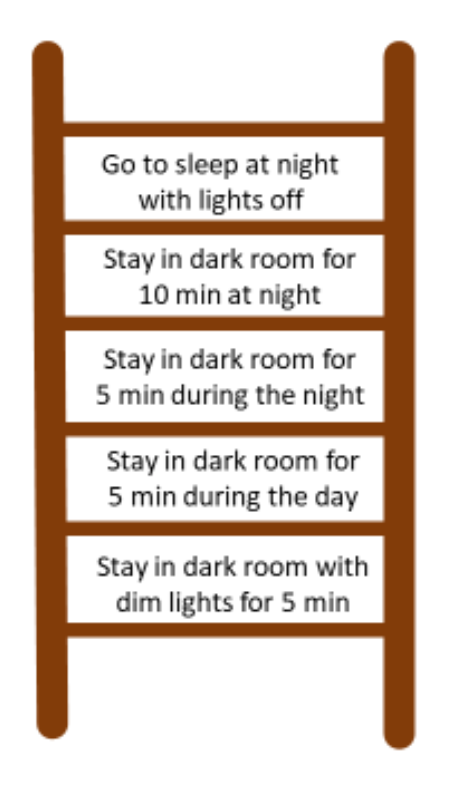
In addition to being gradual and planned, exposures should be frequently practiced. The more practice the child has with exposures, the easier (i.e., less scary) the exposures will get. More practice with the exposures allows for more opportunities to realize that the feared situation is not truly dangerous. Therefore, exposures should ideally be conducted both in-session and at-home as “therapy homework.”

Furthermore, given that one of the main purposes of anxiety treatment is to improve the child’s use of coping skills when facing feared events, exposures should be taught and delivered alongside active coping skills. Other coping skills include relaxation strategies (e.g., slow, controlled breathing; progressive muscle relaxation) and thought switching (i.e., identifying negative, anxious thoughts and switching them to neutral or positive thoughts). These skills should be practiced before and during the exposures, and are meant to facilitate the regulation of the child’s fears as s/he sits through the exposure. Coping skills teach the child that “I have some control of my scary feelings” and exposures teach the child that “Nothing bad happened, even though I thought it would.” Together, these practices work to reduce anxiety in children.

Common (and Reasonable) Myths

The prospect of conducting exposures in treatment sessions can be daunting for therapists, particularly beginning clinicians. At first, I, too, had reservations. What if these exposures make my patients’ anxiety worse? What if my patients despise me for putting them through distress and they never return again? How am I supposed to convince children that confronting the things they’re extremely afraid of will actually help them?

To my relief, I am not alone in having experienced these concerns, as other therapists, according to Stephen Whiteside and his colleagues², have reported feeling reluctant about exposures for similar reasons. Over time, however, I have come to learn that although these concerns are shared and understandable, they are actually myths, or perhaps in the lingo of practice, irrational thoughts.

Myth #1: Exposures Make Anxiety Worse

The proper delivery of exposures involves the following three steps:

  1. The child confronts a feared situation (increase in anxiety)
  2. Nothing “bad” or “dangerous” happens (decrease in anxiety)
  3. The child realizes that what s/he was afraid was going to happen did not end up happening (return to zero anxiety)

Given that proper exposure delivery involves steps 2 and 3, exposures do not make anxiety worse. Rather, exposures help children learn that the feared situation is not associated with real danger, which leads to reductions in anxiety, and often a sense of pride and accomplishment for successfully facing their fears. A potential concern might then be, “Well, what if something bad does happen during the exposure?” This is an understandable concern (one I admittedly had), but perhaps not a reasonable one. For example, let’s say the child with the dark phobia hears a noise while he is in the dark room. At first, he may interpret this as something “scary” happening, which one might reason would lead to an increase in anxiety during the exposure and subsequent maintenance of the dark phobia. However, upon examining the situation more closely, the therapist can guide the child into realizing that even though the child perceived the noise as something “scary” or “bad” happening, nothing bad actually happened. Did the noise itself cause the child any danger? What other (non-scary) thing could the noise have been?

Another important lesson here is that even though something dangerous happening during an exposure is possible, that does not mean that it is probable (this is also a lesson that we teach our patients!). Just like it is possible for us to get into a car accident any time we get into a car, it is not highly probable; therefore, we should not let the possibility of a car accident prevent us from ever getting into a car. This is because the benefits of car transportation (i.e., the ability to get around to wherever we want, whenever we want) outweigh the slight risk involved. Similarly, we should not let the possibility of something bad happening during an exposure prevent us from delivering exposures to our patients. There is a much stronger likelihood that the exposure will be successful, which will lead to major anxiety reductions in our patients. The benefits here outweigh the risk.

Another potential counterargument may then be, “Well, why can’t I just continue to do what I do (e.g., teach relaxation skills and/or teach children to focus on “positive” thoughts), given that these strategies are less risky and are also beneficial to my patients?” This is a great point. Relaxation and other strategies (e.g., changing anxious thoughts to positive thoughts) are important coping tools for anxious children. However, to maximize the effectiveness of our therapeutic work, these strategies should be taught alongside exposures. This allows children to practice such coping tools in real-time while they are doing an exposure during the treatment session. Therefore, instead of telling our patient to “practice slow breathing the next time you are anxious,” we get to witness the patient practicing slow breathing in real time while s/he is anxious. This allows us to provide live feedback on the child’s use of the skills (e.g., “try breathing even slower”) while they are in an anxiety-provoking situation. By receiving such feedback while they are in an anxiety-provoking situation, the skill is more likely to generalize to when they confront anxiety-provoking situations outside of the session (compared to practicing the skills in-session while they are calm/not anxious).

Myth #2: Exposures Damage the Therapeutic Relationship

This one was a big concern for me. I feared that if I pushed children into confronting distressing situations, they would resent me, hate coming to therapy sessions, and then convince their parents to take them out of therapy. However, after conducting hundreds of exposures with my patients, this has never happened. Not even once. In fact, by the end of treatment, many of my patients have reported that they are happy that they completed exposures as part of treatment. They say that they are proud of themselves for completing the exposures, and have reported “feeling brave” after the sessions. I’ve even heard patients say, “I didn’t think I could do it, but I did, and it wasn’t so bad!”

This is not to say that I have never been met with resistance when planning or bringing up the idea of exposures. Usually that is addressed by patiently re-explaining the purpose of why we’re doing the exposures, in a way the child understands. But overall, based on my experience, I believe that as long as the therapist conveys empathy/understanding towards the patient’s fears (e.g., “I understand how scary this might feel for you”), remains consistent in encouraging the patient to face his/her fears (e.g., “It’s okay if that was too hard this time, let’s talk about it and then see if we can try again”) and demonstrates a sense of pride when the patient attempts or successfully completes an exposure (e.g., “Nice job facing your fear! That was so brave!”), the therapeutic relationship tends to stay intact.

But don’t just take my word for it. Research also shows that “introducing exposures into treatment does not damage the therapeutic relationship”³.

Myth #3: Children Are Unable to Foresee the Benefits of Exposures

A third major concern that I had was whether younger children (i.e., as young as 6 or 7 years old) would be able to understand the purpose and rationale for doing exposures. I worried that children would consider therapy a “scary” place and wouldn’t understand why I was asking them to confront their fears.

Contrary to my initial belief, most children can grasp the concept if explained in a developmentally appropriate manner. For example, for younger children, I give an example of a girl named Andrea who is very scared of puppies (first I make sure the child is not scared of dogs or puppies). I ask the kids,
“If Andrea is really, really scared of puppies, will she want to play with puppies, or stay away from them?”

Most will say “Stay away from them.”

“But are puppies actually scary?”

“No!”

“What will probably happen if Andrea goes up to a puppy?”

“I don’t know, maybe it will lick her and want to play.”

“Yes, that’s right, the puppy probably just wants to play. But if Andrea is scared of puppies, what does Andrea think will happen if she goes up to one?”

“She probably thinks it will bark at her or bite her, maybe.”

“Yes that’s probably exactly what she’s thinking! But will it?”

“Probably not.”

“Okay, so let’s say Andrea practices being brave one day, and goes up to a puppy. Like we just talked about, the puppy just licks her on the hand a couple times and maybe brings her a toy. Makes sense, right?”

“Right.”

“So, once Andrea realizes that the puppy didn’t bite her or bark at her, will this make her feel more scared of puppies next time or less scared?”

“Less scared.”

“Yes, less scared! Now Andrea is less scared of puppies. So, the way Andrea became less scared of puppies was by facing her fears, going up to the puppy, and seeing that nothing bad happened (even though she thought the puppy would bark or bite). Does that make sense?”

“Yeah.”

“So in the same way, the work we will be doing together will involve being brave, facing our fears, and learning (like Andrea did) that even though we think something bad will happen, it actually won’t. But we’re going to do this in a slow, step-by-step way to make sure it’s not too scary.”

After this, I present a rationale for why we do it step-by-step, and let the child know that s/he plays a role in deciding which exposures to do. Most of the time, this rationale and an explanation of the up-and-down nature of fearful feelings are enough to help children understand the purpose of exposures.

Tips on Delivering Exposures

There is a right and wrong way to deliver exposures, so here are some (research-supported) techniques on how to reduce the chances of exposures going wrong:

Prior to beginning exposures:

  • Ensure that the child and parent understand the rationale behind exposures

Just like therapists need to know how and why exposures work in order to feel comfortable delivering them, children need to know how and why exposures work so they can feel more comfortable practicing them. See the example above on how to explain the rationale for exposures. Keep in mind that the type of explanation should match the child’s developmental level.

  • Seek child and/or parent input during the construction of the fear ladder

The child and parent should be a part of the treatment planning process. Allowing child and parent input can make exposures seem less intimidating, and allow children a sense of control over their treatment. Work together to determine a treatment goal and ensure that the exposures gradually move toward and reach that goal. “Remind children and parents that the exposures should ideally elicit a moderate amount of fear” (not too little, and not too much).

During exposures:

  •  Track the child’s fear ratings immediately before, during, and immediately after the exposures

Tracking the child’s fears can be done by obtaining a number from a scale of 0-10 of how scared the child is feeling. There are multiple benefits to tracking the child’s fear ratings throughout the exposures. From the therapist’s perspective, tracking the child’s fear ratings can provide helpful insight into whether the exposures are “too easy” or “too difficult.” Fear monitoring can also provide insight into whether the fear is moving in the anticipated direction (with fear ratings highest before the exposure and lowest after the exposure). From the child’s perspective, fear monitoring can provide “evidence” that the anticipation of the exposure tends to make him/her feel more scared than the exposure itself.

  • Try to minimize distractions

In order to maximize the effectiveness of exposures, the child should enter the exposure with some level of fear and anticipation that something negative/dangerous will happen. While in the exposure, the child should still experience some fear and think about what it is s/he is afraid will happen. After the exposure, the child should realize that the feared outcome did not happen.

If the child is distracted during the exposure (i.e., doing anything that would prevent him/her from realizing and s/he is scared and fearful of some outcome), then the effectiveness of the exposure goes down. It is better for the child to confront the anxious feelings and realize that “I was scared and thought something bad would happen, but everything still turned out okay” versus “I wasn’t scared because I was distracted, but yes, nothing bad happened”.

After exposures:

  • Praise the child’s efforts

Given that exposures can be temporarily distressing to children, it is important to “acknowledge the child’s bravery for attempting to face his/her fears”. Praise should be given when the child successfully completes an assigned exposure, or when the child makes any effort to complete the exposure (even if completion of the exposure is unsuccessful). Praising the child allows the child to feel a sense of accomplishment, reinforces continued practice of exposures, and can also aid in maintaining the therapeutic relationship.

  •  Help the child articulate what s/he learned from doing the exposure (i.e., that what s/he feared was going to happen, did not happen)

For exposures to be successful, the child should be able to articulate that the feared outcome did not occur. Therapists can facilitate this conclusion by explicitly asking, “What did you learn from this practice?” For younger children, the question can be framed as, “What did you think was going to happen before you went into the dark room?” “Did that end up happening?” “What actually happened?”

Stephanie’s Messy Hair

Stephanie (name and identifying details changed) was a 10-year old girl who had previously been diagnosed with social anxiety disorder. At the start of treatment, Stephanie and her mother reported that Stephanie avoided asking or answering questions in class, initiating or joining in peer conversations, and speaking to adults (e.g., waiters) because of excessive fear of appearing “stupid” or “weird”. Stephanie’s mother also reported that she took 30 minutes to fix her hair in the morning, which often resulted in arriving late to school and her mother arriving late to work. Stephanie reported that the reason she spent 30 minutes on her hair was because she was afraid other people would make fun of her if her hair was messy.

Stephanie’s main treatment goal was to be able to initiate and join conversations with other kids in school and extracurricular activities. Stephanie and her mother reported that a secondary treatment goal was to decrease the amount of time it took Stephanie to get ready in the morning, so that she and her mother were no longer late to school and work. Stephanie was on board with doing exposures to achieve her treatment goals (although she would initially try to avoid doing them), and demonstrated a good understanding of why we were doing exposures. I devised a “fear ladder” jointly with Stephanie and her mother. The first few weeks of exposure practice involved situations such as Stephanie saying “hello” and introducing herself to another adult and child in the clinic, asking questions to the front desk staff (e.g., “Can I borrow a pen?” and “What time is it?”), ordering for herself at restaurants, and saying “hi” to peers at school. Stephanie also practiced doing presentations in front of an audience of 3-4 people and engaging in back-and-forth conversations with other people for at least 5 minutes. By the ninth session, after completing several steps on the ladder, it was time for her to practice going out in public with messy hair. Here’s how the exposure went:

Therapist (Me): “Alright Stephanie, do you remember what was next up on the ladder for this week?”

Stephanie: “Yes, going outside with messy hair”.

Therapist: “That’s right. And how are you feeling about practicing that today?”

Stephanie: “Do we have to?”

Therapist: Smiles. “What do you think?”

Stephanie: Smiles and looks down. “Ok, I’ll try…”

Therapist: “Ok, wonderful! That’s all I care about, remember? That you try. So, going outside with your hair kind of messy: what makes that scary for you? What do you think will happen?”

Stephanie: “Wait. How messy is my hair going to be?”

Therapist: “We can decide that together. I was thinking of putting your hair in braids and having some hair falling out and sticking out in different places, because your mom told me about how you don’t like that. What do you think?”

Stephanie takes a deep breath and I notice her start to blush.

Stephanie: “Okay…”

Therapist: “I like how you just took a deep breath when you started to notice your fear go up. So now, back to my previous question: what makes this scary for you? What do you think will happen when we go outside?”

Stephanie: “Everyone will stare at me and come up to me and say, ‘Why is your hair so messed up?’”

Therapist: “Has that ever happened before, when your hair has been messed up?”

Stephanie: “No.”

Therapist: “Okay, so what do you think the chances are of that happening today?”

Stephanie: “I don’t know. I’m still scared it will happen.”

Therapist: “Okay, so as always, this will be our experiment. It’s never happened before, but let’s see if it happens this time.”

Stephanie nods.

Therapist: “So what’s your fear rating right now?”

Stephanie: “Seven.”

Therapist: “Ok, and what are some coping skills we can do to prepare us for this practice?”

Stephanie: “Deep breaths and positive thoughts.”

Therapist: “Exactly. What’s a positive thought you can tell yourself to feel more brave?”

Stephanie: “I’ve done this before and nothing’s happened.”

Therapist: “Great! And what if someone does stare at you? What did we talk about last time that you can tell yourself?”

Stephanie: “That I should say to myself, ‘So what?’”

Therapist: “Yes! You can ask yourself, ‘So what if they stare? Will it matter tomorrow that a random person stared?’ And will it?”

Stephanie: “No.”

Therapist: “Alright, let’s go.”

While we walked outside, Stephanie initially walked close behind me, hiding her face. After the first person walked by, I asked Stephanie, “Did that person stare at you?”

Stephanie: “No.”

Therapist: “Okay. Let’s keep experimenting and see what happens.”

As we walked around outside the therapy building, I asked a couple more times if she caught anyone staring. Stephanie reported that her fear rating decreased to a 4 in about 45 seconds. After another minute passed by, Stephanie reported that her fear rating was 2. Once we returned to the therapy room:

Therapist: “You did it! You walked around for 5 whole minutes with your hair messy, even though there were other people around. You stayed in the situation the whole time (even though you didn’t want to do it at first), and I even noticed that you moved from behind me to next to me! How did that feel for you?”

Stephanie: “Good. I was scared at first, but that wasn’t as bad as I thought it’d be.”

Therapist: “Great. So, what are the results from our experiment? Did anyone stare at you or ask you why your hair looked like that?”

Stephanie: “No, nothing bad happened.”

Therapist: “Yes, nothing bad happened. And what did you learn from today’s practice?”

Stephanie: “If I go outside with messy hair, people might not stare at me or come up to me.”

Therapist: “Great. And how do you feel knowing that you just faced your fear on something that was really scary, and stayed with it the whole time? You were at a 7!”

Stephanie: “I feel good, proud.”

Therapist: “Glad to hear it. I feel good and proud, too.”

Closing Comment

At first, I was intimidated by conducting exposures. I worried that exposures might make my patients’ anxiety worse, rupture the therapeutic relationship, and that I would not be able to effectively explain the purpose of exposures to children. Despite these fears, my training experiences have led me to become a strong believer in their effectiveness in treating child anxiety.

Once I “exposed” myself to the delivery of exposures with children and adolescents, I quickly learned that what I was afraid was going to happen (e.g., their anxiety will get worse, the therapeutic relationship will be damaged) did not actually happen. After continuously conducting exposures in treatment sessions with my patients, I learned that exposures do not tend to have negative or dangerous consequences. (It also helps that decades of strong research evidence show exposures do not have negative consequences). So, for any therapists out there who treat children (or adults) with anxiety disorders, especially those new to the field, I encourage you to confront any fears, myths or preconceptions you might have about exposures (gradually, if you must) and join me in this beneficial and therapeutic practice.

Resources

1. Chorpita, B. F., Daleiden, E. L., Ebesutani, C., Young, J., Becker, K. D., Nakamura, B. J., … & Smith, R. L. (2011). Evidence?based treatments for children and adolescents: An updated review of indicators of efficacy and effectiveness. Clinical Psychology: Science and Practice, 18(2), 154-172.

2. Whiteside, S. P., Deacon, B. J., Benito, K., & Stewart, E. (2016). Factors associated with practitioners’ use of exposure therapy for childhood anxiety disorders. Journal of Anxiety disorders, 40, 29-36. https://www.ncbi.nlm.nih.gov/pmc/articles/PMC4868775/

3. Kendall, P. C., Comer, J. S., Marker, C. D., Creed, T. A., Puliafico, A. C., Hughes, A. A., . . . Hudson, J. (2009). In-session exposure tasks and therapeutic alliance across the treatment of childhood anxiety disorders. Journal of Consulting and Clinical Psychology, 77(3), 517-525. doi:10.1037/a0013686.