Addressing Common (and Reasonable) Myths About Exposure-Based Therapy for Child Anxiety

Despite prevailing evidence that exposures are an effective (if not, the most effective) component of treatment for child anxiety disorders¹, therapists might reasonably feel reluctant to implement this therapeutic strategy in their practice. “By design, and simply stated, exposures make children with anxiety feel more anxious”. How, then, can they be used to treat anxiety? This seems counterintuitive. I certainly thought so when I first started my training as a doctoral student in clinical psychology, and as a child-anxiety therapist. However, through my training, I learned more about the rationale that underlies the efficacy of exposures, and continuously witnessed the benefits of exposures firsthand through my own clinical work. Through this process, I transitioned from an exposure-skeptic to a strong believer.

Exposures, Anxiety & Children

“Exposures” are clinically created and controlled scenarios that involve introducing an anxiety-evoking image or experience in a graded fashion so that individuals can learn how to regulate and manage their anxiety response to a feared stimulus or situation. For example, if a child has a fear of the dark, then an “exposure” would involve having the child sit in a dark room. Exposures are effective because they allow anxious children the opportunity to learn through their own experience that what they fear will happen (e.g., a monster will pop out from a dark corner) does not actually happen. After repeated practice experiencing the feared event or image while building coping responses, the child learns that the feared situation (e.g., dark room) is no longer associated with danger (e.g., because a monster never popped out of the corner). Some children learn this after only one or two exposures, other children require more practice. Additionally, exposures allow children the opportunity to “sit in” their anxious feelings and learn how to tolerate them by letting uncomfortable, anxious feelings come and go. Many children initially think that if they confront a feared situation, their anxiety levels will skyrocket and never come back down. Exposures allow children the opportunity to learn that although their fear levels will likely increase when confronting a feared situation, over time (i.e., as they learn that nothing “bad” or “dangerous” is happening), their fear levels will eventually come back down—and usually within a few minutes.

In my clinical experience, exposures work best when they are implemented gradually. I wouldn’t have the child sit in a pitch-black room by himself for 20 minutes at the second or third treatment session. This is called “flooding” and may have detrimental effects. Instead, I might start with having the child sit in a room with dim lighting for 30 seconds, and then gradually move up in time and darkness level week-by-week until the child reaches his treatment goal (which in this case, might be to fall asleep alone at night with the lights off).

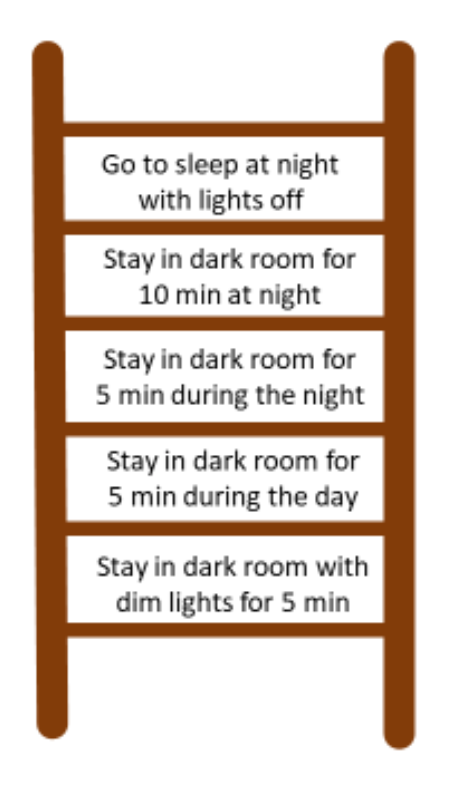
Exposures should also be planned in advance and agreed upon by all parties. The child (and parent) should know what’s coming and should play a collaborative role in planning the exposures. This is often done by creating a “fear ladder” wherein the child, parent, and clinician determine a treatment goal (e.g., to be able to fall asleep alone with the lights off) which is at the top of the ladder, and then plan “steps” to reach that goal (in the form of gradual exposures).

Example fear ladder that I created:
In addition to being gradual and planned, exposures should be frequently practiced. The more practice the child has with exposures, the easier (i.e., less scary) the exposures will get. More practice with the exposures allows for more opportunities to realize that the feared situation is not truly dangerous. Therefore, exposures should ideally be conducted both in-session and at-home as “therapy homework.”

Furthermore, given that one of the main purposes of anxiety treatment is to improve the child’s use of coping skills when facing feared events, exposures should be taught and delivered alongside active coping skills. Other coping skills include relaxation strategies (e.g., slow, controlled breathing; progressive muscle relaxation) and thought switching (i.e., identifying negative, anxious thoughts and switching them to neutral or positive thoughts). These skills should be practiced before and during the exposures, and are meant to facilitate the regulation of the child’s fears as s/he sits through the exposure. Coping skills teach the child that “I have some control of my scary feelings” and exposures teach the child that “Nothing bad happened, even though I thought it would.” Together, these practices work to reduce anxiety in children.

Common (and Reasonable) Myths

The prospect of conducting exposures in treatment sessions can be daunting for therapists, particularly beginning clinicians. At first, I, too, had reservations. What if these exposures make my patients’ anxiety worse? What if my patients despise me for putting them through distress and they never return again? How am I supposed to convince children that confronting the things they’re extremely afraid of will actually help them?

To my relief, I am not alone in having experienced these concerns, as other therapists, according to Stephen Whiteside and his colleagues², have reported feeling reluctant about exposures for similar reasons. Over time, however, I have come to learn that although these concerns are shared and understandable, they are actually myths, or perhaps in the lingo of practice, irrational thoughts.

Myth #1: Exposures Make Anxiety Worse

The proper delivery of exposures involves the following three steps:

  1. The child confronts a feared situation (increase in anxiety)
  2. Nothing “bad” or “dangerous” happens (decrease in anxiety)
  3. The child realizes that what s/he was afraid was going to happen did not end up happening (return to zero anxiety)

Given that proper exposure delivery involves steps 2 and 3, exposures do not make anxiety worse. Rather, exposures help children learn that the feared situation is not associated with real danger, which leads to reductions in anxiety, and often a sense of pride and accomplishment for successfully facing their fears. A potential concern might then be, “Well, what if something bad does happen during the exposure?” This is an understandable concern (one I admittedly had), but perhaps not a reasonable one. For example, let’s say the child with the dark phobia hears a noise while he is in the dark room. At first, he may interpret this as something “scary” happening, which one might reason would lead to an increase in anxiety during the exposure and subsequent maintenance of the dark phobia. However, upon examining the situation more closely, the therapist can guide the child into realizing that even though the child perceived the noise as something “scary” or “bad” happening, nothing bad actually happened. Did the noise itself cause the child any danger? What other (non-scary) thing could the noise have been?

Another important lesson here is that even though something dangerous happening during an exposure is possible, that does not mean that it is probable (this is also a lesson that we teach our patients!). Just like it is possible for us to get into a car accident any time we get into a car, it is not highly probable; therefore, we should not let the possibility of a car accident prevent us from ever getting into a car. This is because the benefits of car transportation (i.e., the ability to get around to wherever we want, whenever we want) outweigh the slight risk involved. Similarly, we should not let the possibility of something bad happening during an exposure prevent us from delivering exposures to our patients. There is a much stronger likelihood that the exposure will be successful, which will lead to major anxiety reductions in our patients. The benefits here outweigh the risk.

Another potential counterargument may then be, “Well, why can’t I just continue to do what I do (e.g., teach relaxation skills and/or teach children to focus on “positive” thoughts), given that these strategies are less risky and are also beneficial to my patients?” This is a great point. Relaxation and other strategies (e.g., changing anxious thoughts to positive thoughts) are important coping tools for anxious children. However, to maximize the effectiveness of our therapeutic work, these strategies should be taught alongside exposures. This allows children to practice such coping tools in real-time while they are doing an exposure during the treatment session. Therefore, instead of telling our patient to “practice slow breathing the next time you are anxious,” we get to witness the patient practicing slow breathing in real time while s/he is anxious. This allows us to provide live feedback on the child’s use of the skills (e.g., “try breathing even slower”) while they are in an anxiety-provoking situation. By receiving such feedback while they are in an anxiety-provoking situation, the skill is more likely to generalize to when they confront anxiety-provoking situations outside of the session (compared to practicing the skills in-session while they are calm/not anxious).

Myth #2: Exposures Damage the Therapeutic Relationship

This one was a big concern for me. I feared that if I pushed children into confronting distressing situations, they would resent me, hate coming to therapy sessions, and then convince their parents to take them out of therapy. However, after conducting hundreds of exposures with my patients, this has never happened. Not even once. In fact, by the end of treatment, many of my patients have reported that they are happy that they completed exposures as part of treatment. They say that they are proud of themselves for completing the exposures, and have reported “feeling brave” after the sessions. I’ve even heard patients say, “I didn’t think I could do it, but I did, and it wasn’t so bad!”

This is not to say that I have never been met with resistance when planning or bringing up the idea of exposures. Usually that is addressed by patiently re-explaining the purpose of why we’re doing the exposures, in a way the child understands. But overall, based on my experience, I believe that as long as the therapist conveys empathy/understanding towards the patient’s fears (e.g., “I understand how scary this might feel for you”), remains consistent in encouraging the patient to face his/her fears (e.g., “It’s okay if that was too hard this time, let’s talk about it and then see if we can try again”) and demonstrates a sense of pride when the patient attempts or successfully completes an exposure (e.g., “Nice job facing your fear! That was so brave!”), the therapeutic relationship tends to stay intact.

But don’t just take my word for it. Research also shows that “introducing exposures into treatment does not damage the therapeutic relationship”³.

Myth #3: Children Are Unable to Foresee the Benefits of Exposures

A third major concern that I had was whether younger children (i.e., as young as 6 or 7 years old) would be able to understand the purpose and rationale for doing exposures. I worried that children would consider therapy a “scary” place and wouldn’t understand why I was asking them to confront their fears.

Contrary to my initial belief, most children can grasp the concept if explained in a developmentally appropriate manner. For example, for younger children, I give an example of a girl named Andrea who is very scared of puppies (first I make sure the child is not scared of dogs or puppies). I ask the kids,
“If Andrea is really, really scared of puppies, will she want to play with puppies, or stay away from them?”

Most will say “Stay away from them.”

“But are puppies actually scary?”

“No!”

“What will probably happen if Andrea goes up to a puppy?”

“I don’t know, maybe it will lick her and want to play.”

“Yes, that’s right, the puppy probably just wants to play. But if Andrea is scared of puppies, what does Andrea think will happen if she goes up to one?”

“She probably thinks it will bark at her or bite her, maybe.”

“Yes that’s probably exactly what she’s thinking! But will it?”

“Probably not.”

“Okay, so let’s say Andrea practices being brave one day, and goes up to a puppy. Like we just talked about, the puppy just licks her on the hand a couple times and maybe brings her a toy. Makes sense, right?”

“Right.”

“So, once Andrea realizes that the puppy didn’t bite her or bark at her, will this make her feel more scared of puppies next time or less scared?”

“Less scared.”

“Yes, less scared! Now Andrea is less scared of puppies. So, the way Andrea became less scared of puppies was by facing her fears, going up to the puppy, and seeing that nothing bad happened (even though she thought the puppy would bark or bite). Does that make sense?”

“Yeah.”

“So in the same way, the work we will be doing together will involve being brave, facing our fears, and learning (like Andrea did) that even though we think something bad will happen, it actually won’t. But we’re going to do this in a slow, step-by-step way to make sure it’s not too scary.”

After this, I present a rationale for why we do it step-by-step, and let the child know that s/he plays a role in deciding which exposures to do. Most of the time, this rationale and an explanation of the up-and-down nature of fearful feelings are enough to help children understand the purpose of exposures.

Tips on Delivering Exposures

There is a right and wrong way to deliver exposures, so here are some (research-supported) techniques on how to reduce the chances of exposures going wrong:

Prior to beginning exposures:

  • Ensure that the child and parent understand the rationale behind exposures

Just like therapists need to know how and why exposures work in order to feel comfortable delivering them, children need to know how and why exposures work so they can feel more comfortable practicing them. See the example above on how to explain the rationale for exposures. Keep in mind that the type of explanation should match the child’s developmental level.

  • Seek child and/or parent input during the construction of the fear ladder

The child and parent should be a part of the treatment planning process. Allowing child and parent input can make exposures seem less intimidating, and allow children a sense of control over their treatment. Work together to determine a treatment goal and ensure that the exposures gradually move toward and reach that goal. “Remind children and parents that the exposures should ideally elicit a moderate amount of fear” (not too little, and not too much).

During exposures:

  •  Track the child’s fear ratings immediately before, during, and immediately after the exposures

Tracking the child’s fears can be done by obtaining a number from a scale of 0-10 of how scared the child is feeling. There are multiple benefits to tracking the child’s fear ratings throughout the exposures. From the therapist’s perspective, tracking the child’s fear ratings can provide helpful insight into whether the exposures are “too easy” or “too difficult.” Fear monitoring can also provide insight into whether the fear is moving in the anticipated direction (with fear ratings highest before the exposure and lowest after the exposure). From the child’s perspective, fear monitoring can provide “evidence” that the anticipation of the exposure tends to make him/her feel more scared than the exposure itself.

  • Try to minimize distractions

In order to maximize the effectiveness of exposures, the child should enter the exposure with some level of fear and anticipation that something negative/dangerous will happen. While in the exposure, the child should still experience some fear and think about what it is s/he is afraid will happen. After the exposure, the child should realize that the feared outcome did not happen.

If the child is distracted during the exposure (i.e., doing anything that would prevent him/her from realizing and s/he is scared and fearful of some outcome), then the effectiveness of the exposure goes down. It is better for the child to confront the anxious feelings and realize that “I was scared and thought something bad would happen, but everything still turned out okay” versus “I wasn’t scared because I was distracted, but yes, nothing bad happened”.

After exposures:

  • Praise the child’s efforts

Given that exposures can be temporarily distressing to children, it is important to “acknowledge the child’s bravery for attempting to face his/her fears”. Praise should be given when the child successfully completes an assigned exposure, or when the child makes any effort to complete the exposure (even if completion of the exposure is unsuccessful). Praising the child allows the child to feel a sense of accomplishment, reinforces continued practice of exposures, and can also aid in maintaining the therapeutic relationship.

  •  Help the child articulate what s/he learned from doing the exposure (i.e., that what s/he feared was going to happen, did not happen)

For exposures to be successful, the child should be able to articulate that the feared outcome did not occur. Therapists can facilitate this conclusion by explicitly asking, “What did you learn from this practice?” For younger children, the question can be framed as, “What did you think was going to happen before you went into the dark room?” “Did that end up happening?” “What actually happened?”

Stephanie’s Messy Hair

Stephanie (name and identifying details changed) was a 10-year old girl who had previously been diagnosed with social anxiety disorder. At the start of treatment, Stephanie and her mother reported that Stephanie avoided asking or answering questions in class, initiating or joining in peer conversations, and speaking to adults (e.g., waiters) because of excessive fear of appearing “stupid” or “weird”. Stephanie’s mother also reported that she took 30 minutes to fix her hair in the morning, which often resulted in arriving late to school and her mother arriving late to work. Stephanie reported that the reason she spent 30 minutes on her hair was because she was afraid other people would make fun of her if her hair was messy.

Stephanie’s main treatment goal was to be able to initiate and join conversations with other kids in school and extracurricular activities. Stephanie and her mother reported that a secondary treatment goal was to decrease the amount of time it took Stephanie to get ready in the morning, so that she and her mother were no longer late to school and work. Stephanie was on board with doing exposures to achieve her treatment goals (although she would initially try to avoid doing them), and demonstrated a good understanding of why we were doing exposures. I devised a “fear ladder” jointly with Stephanie and her mother. The first few weeks of exposure practice involved situations such as Stephanie saying “hello” and introducing herself to another adult and child in the clinic, asking questions to the front desk staff (e.g., “Can I borrow a pen?” and “What time is it?”), ordering for herself at restaurants, and saying “hi” to peers at school. Stephanie also practiced doing presentations in front of an audience of 3-4 people and engaging in back-and-forth conversations with other people for at least 5 minutes. By the ninth session, after completing several steps on the ladder, it was time for her to practice going out in public with messy hair. Here’s how the exposure went:

Therapist (Me): “Alright Stephanie, do you remember what was next up on the ladder for this week?”

Stephanie: “Yes, going outside with messy hair”.

Therapist: “That’s right. And how are you feeling about practicing that today?”

Stephanie: “Do we have to?”

Therapist: Smiles. “What do you think?”

Stephanie: Smiles and looks down. “Ok, I’ll try…”

Therapist: “Ok, wonderful! That’s all I care about, remember? That you try. So, going outside with your hair kind of messy: what makes that scary for you? What do you think will happen?”

Stephanie: “Wait. How messy is my hair going to be?”

Therapist: “We can decide that together. I was thinking of putting your hair in braids and having some hair falling out and sticking out in different places, because your mom told me about how you don’t like that. What do you think?”

Stephanie takes a deep breath and I notice her start to blush.

Stephanie: “Okay…”

Therapist: “I like how you just took a deep breath when you started to notice your fear go up. So now, back to my previous question: what makes this scary for you? What do you think will happen when we go outside?”

Stephanie: “Everyone will stare at me and come up to me and say, ‘Why is your hair so messed up?’”

Therapist: “Has that ever happened before, when your hair has been messed up?”

Stephanie: “No.”

Therapist: “Okay, so what do you think the chances are of that happening today?”

Stephanie: “I don’t know. I’m still scared it will happen.”

Therapist: “Okay, so as always, this will be our experiment. It’s never happened before, but let’s see if it happens this time.”

Stephanie nods.

Therapist: “So what’s your fear rating right now?”

Stephanie: “Seven.”

Therapist: “Ok, and what are some coping skills we can do to prepare us for this practice?”

Stephanie: “Deep breaths and positive thoughts.”

Therapist: “Exactly. What’s a positive thought you can tell yourself to feel more brave?”

Stephanie: “I’ve done this before and nothing’s happened.”

Therapist: “Great! And what if someone does stare at you? What did we talk about last time that you can tell yourself?”

Stephanie: “That I should say to myself, ‘So what?’”

Therapist: “Yes! You can ask yourself, ‘So what if they stare? Will it matter tomorrow that a random person stared?’ And will it?”

Stephanie: “No.”

Therapist: “Alright, let’s go.”

While we walked outside, Stephanie initially walked close behind me, hiding her face. After the first person walked by, I asked Stephanie, “Did that person stare at you?”

Stephanie: “No.”

Therapist: “Okay. Let’s keep experimenting and see what happens.”

As we walked around outside the therapy building, I asked a couple more times if she caught anyone staring. Stephanie reported that her fear rating decreased to a 4 in about 45 seconds. After another minute passed by, Stephanie reported that her fear rating was 2. Once we returned to the therapy room:

Therapist: “You did it! You walked around for 5 whole minutes with your hair messy, even though there were other people around. You stayed in the situation the whole time (even though you didn’t want to do it at first), and I even noticed that you moved from behind me to next to me! How did that feel for you?”

Stephanie: “Good. I was scared at first, but that wasn’t as bad as I thought it’d be.”

Therapist: “Great. So, what are the results from our experiment? Did anyone stare at you or ask you why your hair looked like that?”

Stephanie: “No, nothing bad happened.”

Therapist: “Yes, nothing bad happened. And what did you learn from today’s practice?”

Stephanie: “If I go outside with messy hair, people might not stare at me or come up to me.”

Therapist: “Great. And how do you feel knowing that you just faced your fear on something that was really scary, and stayed with it the whole time? You were at a 7!”

Stephanie: “I feel good, proud.”

Therapist: “Glad to hear it. I feel good and proud, too.”

Closing Comment

At first, I was intimidated by conducting exposures. I worried that exposures might make my patients’ anxiety worse, rupture the therapeutic relationship, and that I would not be able to effectively explain the purpose of exposures to children. Despite these fears, my training experiences have led me to become a strong believer in their effectiveness in treating child anxiety.

Once I “exposed” myself to the delivery of exposures with children and adolescents, I quickly learned that what I was afraid was going to happen (e.g., their anxiety will get worse, the therapeutic relationship will be damaged) did not actually happen. After continuously conducting exposures in treatment sessions with my patients, I learned that exposures do not tend to have negative or dangerous consequences. (It also helps that decades of strong research evidence show exposures do not have negative consequences). So, for any therapists out there who treat children (or adults) with anxiety disorders, especially those new to the field, I encourage you to confront any fears, myths or preconceptions you might have about exposures (gradually, if you must) and join me in this beneficial and therapeutic practice.

Resources

1. Chorpita, B. F., Daleiden, E. L., Ebesutani, C., Young, J., Becker, K. D., Nakamura, B. J., … & Smith, R. L. (2011). Evidence?based treatments for children and adolescents: An updated review of indicators of efficacy and effectiveness. Clinical Psychology: Science and Practice, 18(2), 154-172.

2. Whiteside, S. P., Deacon, B. J., Benito, K., & Stewart, E. (2016). Factors associated with practitioners’ use of exposure therapy for childhood anxiety disorders. Journal of Anxiety disorders, 40, 29-36. https://www.ncbi.nlm.nih.gov/pmc/articles/PMC4868775/

3. Kendall, P. C., Comer, J. S., Marker, C. D., Creed, T. A., Puliafico, A. C., Hughes, A. A., . . . Hudson, J. (2009). In-session exposure tasks and therapeutic alliance across the treatment of childhood anxiety disorders. Journal of Consulting and Clinical Psychology, 77(3), 517-525. doi:10.1037/a0013686.  

Tips for Working with Vegan Clients

What do you do when a potential new client calls and asks if you work with vegan clients? Perhaps you say no because you never have before (or didn’t know you had) and don’t know much, if anything, about veganism. Maybe you say yes but are not sure what working with a vegan client might entail and figure you’ll wing it and hope for the best. And then it’s highly possible that no one has ever asked you that question. I think it’s fair to say that most of us don’t have experience working with every issue nor with every population that contacts us. However, as veganism continues to grow, it’s increasingly likely that we’ll be finding more vegans reaching out to us.

Like what you are reading? For more stimulating stories, thought-provoking articles and new video announcements, sign up for our monthly newsletter.

The one question I am continuously asked is, does eating a diet free of animal products in itself make a person vegan? The short answer is no. The longer answer is eating plant-based is a major part of being vegan, but veganism isn’t just about what people eat; it’s about the way one views and treats all animals, human and non-human. People following a vegan lifestyle can’t help thinking about the exploitation of animals because they’re continuously confronted with it. Sitting next to people eating meat, walking behind someone wearing fur or leather, or overhearing conversations about hunting and fishing trips or visits to circuses and zoos, are all constant reminders. In my clinical experience, the thought of institutionalized animal exploitation is what prompts many vegans with whom I have worked to seek therapy for depression, anxiety, relationship issues and sometimes, trauma. How these issues may manifest in a session can be illustrated in my work with Tessa, a former client.

When 32 year-old Tessa contacted me, she announced that she was vegan and had been searching for either a vegan therapist or, she quipped, one who was “vegan-friendly, like a restaurant.” Consequently, I had a hunch her issue(s) would be vegan-related. However, I had worked with individuals requesting a vegan-friendly therapist where that wasn’t the focus-?they just wanted assurance I would be supportive, if the issue came up. And it did come up with Tessa. Parenthetically, my therapeutic style is direct and eclectic. I have been influenced by various therapeutic approaches, including psychodynamic, Somatic Experiencing, hypnotherapy, cognitive/behavioral, ecotherapy, Internal Family Systems, and Existentialism. I believe we must look not only inside ourselves for what ails us but also to our relationship with the world around us. In this context, I work with individuals who are grappling with a wide variety of issues including, but not limited to relationships, life transitions, animal bereavement and ethical veganism, which is both a mindset and lifestyle practiced by people who care deeply about all animals and oppose harming them in any way.

Tessa smiled weakly as she slumped onto my couch, silent for a few moments. She had been feeling “very low, very anxious. My heart races or my stomach feels like someone’s on a trampoline.” Her difficulties began after watching two videos detailing animal exploitation–she used the words, “animal abuse.” She transitioned to a vegan lifestyle after seeing the second video. Tessa felt immense guilt “that she had been part of the problem,” chastised herself for “not knowing sooner,” and felt “hopeless about the situation.” When confronted with the frequent images of animal abuse on social media, she’d break down. Often these images would spontaneously pop into her mind.

When discussing this subject with family and friends, responses were dismissive of her and/or the issue: “there are more important things to worry about”, “you’re being way too sensitive”, “get a life!”

Before reaching out to me, she had been seeing another therapist. While the “person was very nice,” her questions repeatedly intimated that the root of Tessa’s problems lay elsewhere. Consistently feeling misunderstood, Tessa ultimately decided to find a therapist “who got that someone could be depressed thinking about all the abused animals in the world.”

In working with Tessa, I took a three-prong approach. My first goal was validation that sensitivity to animal exploitation could lead to depression and anxiety. She also needed to trust I could handle her intense emotions, without judgment.

My next objective was helping her find effective ways to calm herself when triggered by disturbing images, thoughts, or conversations. I used various techniques, including several from somatic experiencing and hypnotherapy. For example, I helped her transform distressing images into ones less fraught. Intrusive thoughts about animal abuse were attenuated by both diverse breathing techniques and anxiety-reducing visualization exercises. To recharge and reset, she created a mental image of a special place, one filled with calming images, sounds, and smells. Formerly a meditator, I suggested she resume her practice to help let go of unwelcome thoughts. Reducing her time on social media was also discussed.

The third prong was to address her hopelessness by exploring options for helping animals. Because everyone has different talents, interests, and time constraints it was important that whatever actions we came up with were realistic. Being a “people person”, she decided to research animal welfare groups whose focus was public outreach. Tessa loved planning and hosting parties so organizing fund-raising events for animal organizations sounded appealing.

Within a few months, Tessa began feeling better. She now had tools for calming her mind and nervous system and strategies for advocating for animals. Perhaps most importantly, she felt she had been understood.

As you can see, the techniques for working with vegan clients are the same we’d use with anyone else. So with this newfound knowledge and an open mind, the next time someone calls and asks if you know anything about working with vegans, you can say, absolutely!  

Anxiety Management: It

Les relâches is a winter break that every Swiss public-school system takes in February, though the actual dates vary from canton (state) to canton. In French, “la relâche” means “rest,” but as this week usually involves skiing in Switzerland, it is the least restful week of my year! Personally, I call it anxiety management week. It is the one week every year that this psychotherapist becomes her own private client. I set a goal each time to try to keep up with my family on the trails for at least a couple of hours during the week. Sometimes I succeed, but, mostly, I just keep trying.

Like what you are reading? For more stimulating stories, thought-provoking articles and new video announcements, sign up for our monthly newsletter.

During ski week, my empathy skyrockets for past and current clients who combat anxiety on a daily and sometimes hourly basis. I join their ranks in that need for anxiety management anytime my personal context intersects with a few notable laws of physics that involve speed and momentum. I employ copious doses of the cognitive, behavioral, and affect regulation strategies I often prescribe to the people I work with. These strategies become my lifelines on those steep mountains, which are crowded with other skiers who could literally carve laps around my effort-filled descents. My five-and-a-half-year-old daughter and my eight-year-old son are two of them.

I recognize that real danger is inherent in practicing a sport in which momentum is needed to perform accurately, and where the physical environment often includes steep, rock-and-tree-filled obstacles, much less the human-made ones. Learning to ski involves mitigating the risks of navigating changing terrain and conditions, avoiding falls and collisions with stable objects or other skiers, and maintaining one’s personal equilibrium within the bounds of one’s own ability and limits, all while attempting not to become the obstacle in other skiers’ paths! (From this angle, it actually sounds a lot like practicing therapy!)

This constant processing of rapidly evolving environmental data can frankly be quite physically and mentally exhausting! However, the rewards of learning to synchronize with oneself, with nature, and with others can also be quite rewarding, sometimes comical, and usually humbling.

My daughter and I had the makings of a beautiful mother-daughter moment together one afternoon on a blue trail when she decided to ski beside me, about three feet away. She excitedly exclaimed, “Mommy, you’re going fast now!” Her broad smile showed me that she meant this as a compliment and was proud of the progress I had made through the daily lessons I had been taking during the week. Several thoughts traversed my mind in rapid succession as I processed her spontaneous and heartfelt gesture and as my anxiety welled:

“Why are you looking at me and not straight ahead where you are going?”
“How on Earth do you ski without looking where you are going?!”
“How do you manage to get so close to others and not veer into their path?”
“Oh Heavens, you are close!”

As much as I was in awe of her ability to remain calm, cool, collected, and courageous in her posture (as we were speeding downhill, nonetheless), I began to have palpable concerns for her safety in skiing so close to me. Instead of relishing that beautiful mother-daughter moment she created, my thoughts raced, my anxiety overflowed, and I awkwardly blurted out, “Honey, please ski a little further away (so that if I crash and burn with the newfound awareness your astute speed observation evokes, I won’t be able to take you down with me)! I need a little more room to turn here.” She shrugged, then proceeded full speed down the mountain, making perfect “S” turns with her skis in parallel, catching up easily with her brother and father below.

My speed on skis, and my ability to go with the flow of it (instead of fighting it), is usually a great source of vexation for me and my family. My “pilates” approach to finishing a trail involves turning with intention, methodically repeating to myself, “Up… turn… down,” and mechanically pacing my breath to the piston-like movements I consciously will my knees to make. My family is greatly annoyed about the mid-trail wait times this entails for them, especially when we agree to stay together.

When in difficulty, staying together comprises part of the rules and common-courtesy practices that skiers adhere to for safety, along with signaling dangers to others and calling for or providing help. For the most part, I have been on the receiving end of those practices. But, with a few more ski weeks and the mental and emotional strategies I employ to stave off full-blown panic attacks, I may someday be able to help others as they have helped me on the trails. Until then, skiing with anxiety will continue to be downhill all the way.

Helping clients manage their anxiety through a caring counseling relationship allows them to see that they, too, can benefit from employing strategies discussed in session on their own slippery slopes. We can help them to categorize situations like ski trails to understand how steep the slope (and the learning curve) feels for them: blue for low anxiety, red for mounting anxiety, or black for high anxiety. We can accompany them in using their available and developing resources to recognize the thoughts that make their slopes feel dangerous to them and to process how their body captures, holds, and releases their anxiety, much like skiers must do to evaluate how their skis react to shifting environmental conditions throughout the day. We can urge them to consider how their anxiety affects them and their loved ones, and to call upon those loved ones for support when needed. With time and practice, they will hopefully learn to navigate those more difficult trails with greater agility, crossing their own finish lines in their own time and on their own two skis.

Combatting Anxiety,

It occurred to me the other day that I was laughing with a client because I completely and utterly understood where she was coming from. And then it hit me. No wonder I've been so busy helping my young adult clients overcome anxiety—wait for it—I “have it”, or should I say, “it has me” too!

Of course, I have known this for many decades, but that day I had a kind of breakthrough. I can laugh at the insanity of it all. I've been there and done that on almost every occasion. My client Elsa said she was afraid of driving over bridges. Hmm, I don’t have that one. But I do have the one where my husband is driving too fast and I think I’m going to fall into the Hudson River. Then there’s the one where I’m going on a job interview and I think to myself, “OMG, I have gained so much weight since I had kids!” Or my mind goes blank and I forget everything I ever accomplished. Then there was the time my puppy ran across the highway and I had a panic attack. The worst is ruminating. Although I teach clients all day about fight or flight or freeze, I forget that I myself need to take a break from overthinking. When my kids started driving, I gained a new and paralyzing dread that someone would run into them. Add to that health and money worries, and sirens passing by while I’m quietly doing paperwork at home—catastrophizing is my specialty.

Like what you are reading? For more stimulating stories, thought-provoking articles and new video announcements, sign up for our monthly newsletter.

Self-care is our therapy buzz-word and it works wonders. My friend, a fellow therapist, said I need a spa day. “Do it!” My patient debated the whole day if she should take a “mental health day” from her demanding teaching schedule. “Do it!” Another patient wondered if she should take up journaling again. “Do it!” And the very process of pushing through your fears is instructive; it combats avoidance. My client was afraid to call her doctor for some results. “No problem, do it in my office.” My client was terrified to sleep over at his Dad’s new apartment. “Build up to it.” Once, many years ago, when my mother was dying of cancer, a kind and wonderful boss at Disney.com handed me a laptop and said, “I’ll see you when you’re ready.” Ask for help. Take a small step. All the clichés stacked up to the sky, or, as Annie Lamott says, “Bird by Bird.” The simple catchphrase, “Do it” flows so easily from my mouth—it just doesn’t quite make it to my ears and into my brain.

Clients often ask me, “How I can begin to trust my inner voice when all I know is worry.” And I tell them “For one thing, you have a choice. It’s your life. Own it. Take care of it.” It seems to me that people in other countries get more time off to recharge. Only here do we grind ourselves until there’s no more fuel.

And, let’s see if we are mislabeling anxiety as something else? If it’s not anxiety then what is it?

1. Anxiety from the past may be triggering a fear of abandonment. My client Mary wants to marry her boyfriend but thinks he might be cheating. She stalks him on Facebook, Instagram and Twitter on an hourly basis, based on her "hunch." She finds nothing but cannot stop her obsession. This is no longer a gut feeling, it's a bad habit, a self-destructive, relationship-bombing behavior that is sure to drive someone away. In this case, although there is no evidence whatsoever that he's a cheater, Mary continues to rely on her false "gut feeling" which only serves to create more anxiety and self-sabotage. Go back to where it’s coming from and try to counter the fear with a more realistic appraisal.

2. Anxiety masks as fear of the unknown. My client Joya wants to go out with a boy from her fraternity, but he is a “player.” When he finally asks her out, she says no based on what her friends have said. The information she has obtained is from the past, and unproven, especially since Joya really likes him. She continues to rely on second-hand information instead of living her own life. She is more afraid of the unknown than finding out the truth about him by using her own judgment. Unknown fears need to be faced, not avoided. Sometimes when I’m driving to a new place, I make it a habit to stop somewhere en route to pick up a treat or run an errand. This makes the unknown into a little adventure.

3. Anxiety is not the same as intuition. Jessica thinks her boyfriend is simultaneously dating someone else. Her so-called intuition is based on patterns and evidence that she has directly observed—he's always late, keeps his phone locked away and acts sneakily. Intuition tells her from observed experience that he is hiding something. Anxiety, fueled by insecurity misguides her into convincing herself that he is doing something wrong and that he will inevitably leave her, instead of leading her to confront him directly. As psychologist David Barlow warns us, “don’t believe everything you think.” “Ask him what's going on instead of making up stories in your head,” I suggest. Test the intuition with objective observation. Your anxiety may have something to tell you.

If this sounds tricky, it is.

Intuition can be considered a neutral and unemotional experience, whereas fear is highly emotionally charged. Reliable intuition feels right, it has a compassionate, affirming tone to it. It confirms that you are on target, without having an overly positive or negative feel to it. Fear is often anxious, dark or heavy.

Take a step back and breathe deeply for a moment. What's the worst that can happen? What part is objective and what part has no business in the present? If it belongs in the past look at what happened. It's over. You are safe now. The only way to separate from rumination is to pause. My last client of the evening recounted her fight with her ex-girlfriend over text. “Please Hannah,” I said, “unplug for just five minutes. Then assess how you feel. You are only feeding the attention-seeking behavior of your ex. Can you step back? What will happen if you just sit quietly?”

Can a therapist, this therapist, heal herself? The phone rings, the news blares, and real tragedy rings into our consciousness, implanting itself in vivid living color from a smart TV into our visual field whether we want it or not. I can help my clients not because I’m master of my anxiety and of my fate, but because I’m continuously right there with them. My friend calls and says “Let’s take a walk.” “Yes, I say. Let’s do it, everything else can wait.”  

The Value of Evidence-Based Treatment That Fails

In CBT I Trust

I became a psychotherapist because I wanted to help people feel better. I’m sure all therapists share that motivation. In my master’s program, I learned about cognitive behavioral therapy (CBT), and that no other type of therapy had as much research evidence to support it. I was drawn to its promise of rapid relief from suffering.

I sought out a doctoral program where I could receive specialized training in CBT for depression and anxiety. During my training, I saw firsthand how a few weeks of treatment could lead to big improvements in symptoms—not for everyone, but for many.

As an assistant professor I joined a leading center for the treatment of PTSD and OCD, and I witnessed the power of CBT to reopen lives that had been completely subverted by these conditions. When I found that cognitive and behavioral techniques weren’t always effective, I sought training in mindfulness and acceptance-based approaches. I wanted to be equipped to help everyone who came to me. Just as when I began this journey, I wanted to be a healer.

Later, I added CBT for insomnia so I could treat the frequent sleeping problems I encountered in my work. I began writing about the power of CBT to relieve suffering, first on my blog, then through a co-authored account of recovery from OCD, and then in two self-directed books on CBT techniques. I developed a blog and a podcast under a label that captures cognitive, behavioral and mindfulness-based approaches: “Think Act Be.” I was fully immersed in the evidence-based model, and I continued to be inspired by the successes I witnessed.

And yet I often remembered best the people I couldn’t help—the ones who came to me for a few sessions, or for many months, and never experienced lasting progress. They seemed to feel just as depressed, just as anxious, just as gripped by constant worries or obsessions as they did on the day I first met them. Some felt worse. My inability to help them weighed on me as I felt I’d let them down. Sometimes, when they left my office in obvious emotional pain, I cried at my desk.

Another Form of Healing

My work with Evan comes to mind (details changed to protect his identity). Evan was in his fifties and had been dealing with anxiety, depression, and obsessional thinking for his entire adult life. I introduced the standard CBT and mindfulness-based strategies, which Evan struggled to use. He experienced some relief from the meditations I led him in, but otherwise continued to have debilitatingly severe anxiety and depression. I could have blamed his lack of progress on his infrequent practice between sessions, but I didn’t believe that was the whole story, or even most of it. Whatever the reason, I couldn’t help him find relief.

And yet Evan often expressed his gratitude for everything I did for him. Like what?, I often wondered to myself. On one occasion when he thanked me “for everything,” I told him I wished I could do more to take away his pain. He expressed how much relief he found in our meetings, and particularly in the meditations I led him in and which he diligently recorded for listening between our sessions. “And you listen to me,” he said, “and you don’t give up on me. And I can tell sometimes when we’re talking that you’re feeling what I feel. And that’s huge.”

Many other names and faces stand out from over the years, people whose symptoms I seemed unable to touch. No one ever yelled at me or demanded that I do more to help them. Some expressed frustration at their continued suffering, occasionally directed at me, but most were entirely gracious, even grateful despite our lack of progress. Some even referred their friends or family members to me. It took me several years to realize that some of the deepest work I’ve done as a therapist has been with individuals whose symptoms didn’t improve.

This realization didn’t come until a few years ago as I sat with my friend Jim at his kitchen table. Jim had been battling an aggressive form of cancer for two years and had just learned it had returned. I didn’t realize as we sat there that it was the last time I would see him; Jim died two months later.

What surprised me in our final conversation was the gratitude Jim expressed for his treatment team. I expected he would be disappointed in them; after all, he was receiving the most state-of-the-art cancer treatment in the world, and yet it hadn’t kept his cancer away. I could imagine being bitter if I were in his shoes, and not at all happy to have to return for treatment.

Quite the contrary, Jim described how grateful he was for the care he’d received over the past two years. He noted that his medical team had extended his life, giving him time to put his things in order. He had been given more time with his family than he would have had without treatment. He was dying, and yet he was thankful to those who had done all they could to help him.

And more than the cutting edge care they provided, Jim seemed to appreciate that they cared. Jim wasn’t treated as a cancer case, or a research trial number. He was a complete human being, with a family, with hopes and fears, and likely a foreshortened future. The professionals with whom he worked provided compassionate care right until the end.

When I went through my own debilitating illness—much less severe than Jim’s, I learned what it meant to receive compassionate care. By my count, I saw 13 specialists over a 4-year period, and none of them was able to completely resolve my health problems. And yet most of them provided another form of healing—not of the body and mind, but perhaps of the spirit. I would leave their offices feeling a little less alone, a bit less afraid.

A True Presence

When I was in my late thirties, I was diagnosed with open-angle glaucoma. My optometrist who detected it reassured me that I wasn’t “guaranteed to lose my vision,” but the prospect of going blind hadn’t occurred to me until his reassurance. I didn’t ever want to not be able to see my kids.

The ophthalmologist I was referred to treated me with two rounds of laser surgery in each eye. The first involved boring a hole in the iris, making a tiny second pupil to decrease the dangerously high pressure inside the eye that could destroy the optic nerve. The second was meant to dissolve the blockage in the eye’s drainage ducts, allowing the pressure to return to normal. Unless it wouldn’t!

I learned through my own research that these procedures are effective in about seventy-five percent of patients. Thankfully, mine were successful and my pressures have been in a healthy range for the past few years. But I was struck by the failure rate of this treatment, given how directly it seems to target the root of the problem. Examples like this one abound across medical specialties; whatever the medication or procedure, the success rate of evidence-based interventions is significantly less than one hundred percent.

In light of the limitations of modern medicine, we shouldn’t be surprised at our limits as therapists. And yet many of us are quick to assign blame when a client isn’t showing obvious improvement. Often, we’ll blame the client, assuming there must be personality pathology or that they “don’t want to get better.” We may assume the symptoms bring secondary gain. We might prefer to believe that the treatment is effective, but the client just isn’t ready for change. These factors may be present, but they also have the convenient effect of letting us off the hook. It’s not us, it’s them.

The danger that I found in my own reaction to ineffective treatment was running ahead of the client, as it were, and trying to pull them along. This tendency showed up in things like assigning homework that I knew they weren’t going to complete, so at least I could feel like I was “doing something.” My conscience could be clear. Except it wasn’t, because I knew on a deep level that I wasn’t meeting the person where they were. They needed me to walk alongside them, to sit down with them when they sat to rest. They needed my true presence.

Our presence is what matters most. Otherwise, we would dispense therapy techniques from vending machines, or in fortune cookies. Even self-guided CBT books are written with a personal and encouraging tone. It’s crucial to feel that the guidance is coming not only from someone who is supposedly an authority, but from someone who wants the best for us, who’s in it with us. The relationship with an author matters.

Lessons Learned

I suspect I’m not alone in finding that my eagerness to help is actually unhelpful at times. For example, when Rick told me he felt like his life “hadn’t even been a prelude to anything,” I immediately jumped into cognitive therapist mode. My knee-jerk assumption was that this belief was exaggerated; after all, Rick had done many things in his life–graduated at the top of his high school and college classes, worked abroad, completed law school.

“Is that true?” I asked with skepticism. Immediately I knew I’d missed the mark. Rick wasn’t asking me to change his mind, especially not before he felt I’d really heard him. The truth was that his life hadn’t turned out the way he’d imagined. He’d come close to getting married twice, but never tied the knot, and he never had children. And despite his intelligence and education, his major struggles with anxiety and depression had left him unable to work since a year after he got his law degree. His life consisted mostly of tending to his garden, reading the news, and occasionally seeing a friend.

While I may have been on the lookout for distorted cognitions, on an unconscious emotional level I was motivated to look away from the deep pain expressed in Rick’s statement. It would have been much easier if I could have fixed his thinking and taken away his unhappiness. “See! It’s not that bad,” I wanted to say. But maybe it was. And the life Rick had lived wasn’t a problem I could solve.

As a therapist, I have come to appreciate the importance of remaining with and tolerating my discomfort and feelings of inadequacy, if I am going to serve as a full human being to those I treat. I must make peace with what I can’t change. Otherwise, I run the risk of compelling my clients to fight on two fronts, as they must contend not only with their suffering but with my expectations that there must be a solution.

All of this probably seems patently obvious to many therapists, perhaps especially those from a more psychodynamic background. Maybe my tendencies are specific to CBT, or to me. I do suspect CBT fosters some of the expectation about taking away symptoms, but I imagine some form of that expectation lives in all of us in the healing professions.

Sometimes life-changing work gets done while the symptoms are unchanged. For some that might mean connecting with the strength they have to meet their challenges. Others may discover the life that’s possible even through ongoing struggles. Still others will have their experience validated after a lifetime of being told what they felt wasn’t real or will simply feel less alone.

A Broader Lens

Hopefully it goes without saying that I still want to help people reduce their symptoms, and I want to offer each person all the tools that might be useful. Accepting the limits of my abilities and the value of our presence doesn’t mean I must stop trying to reduce suffering in any way I can. It’s also not a way to settle for less than optimal outcomes for my clients. And it certainly doesn’t mean that I have secret insights into what my clients really came to treatment for and that MY job is somehow to get them there.

I still want everyone I treat to experience less anxiety, better sleep, fewer OCD compulsions, or whatever else they came to me for. I provide referrals when I don’t feel that I have the expertise a person needs. At the same time, I’m trying to use a broader lens through which I see a person’s experience. As physician Rachel Naomi Remen suggests, there is a difference between fixing and healing. This stance isn’t a cop out, as I used to believe—a way to make myself feel better about my lack of skill. Rather, it’s a recognition of the reality that there is pain I cannot take away, and that “treatment success” is a bigger concept than can be easily captured in data from a randomized clinical trial, or from a well-validated self-report measure.

Therapy is as complex as any human relationship, with effects that potentially penetrate much more deeply than the apparent symptoms. The best we can do for anyone is to provide compassionate care until the end, whether that means a triumphant recovery, ruinous tragedy or the wide expanse in between.

I’ve also come to recognize that the end of our time together is not the end of the person’s road to healing. For some the time we spend together will be transformational, while for others there will be no obvious effect. For many others, the work we do together will plant seeds that grow only later, well after therapy has ended. It’s easy for me now to recognize the hubris in believing that the evidence-based therapy I offered was the person’s last hope. Now I know that I’m only ever part of a longer journey.  

What Am I Going to Do with all This Stuff?

“I’ve always had trouble throwing things away. Magazines, newspapers, old clothes. What if I need them one day? I don’t want to risk throwing something out that might be valuable. The large piles of stuff in our house keep growing so it’s difficult to move around and sit or eat together as a family.”

“My husband is upset and embarrassed, and we get into horrible fights. I’m scared when he threatens to leave me. My children won’t invite friends over, and I feel guilty that the clutter makes them cry. But I get so anxious when I try to throw anything away. I don’t know what’s wrong with me, and I don’t know what to do.”

These statements are typical of clients with whom I have worked who suffer from what the DSM-5 calls Hoarding Disorder (300.5), a variant of Obsessive-Compulsive Disorder. Hoarding is a disorder that may be present on its own or as a symptom of another disorder. The other disorders most often associated with hoarding are obsessive-compulsive personality disorder (OCPD), obsessive-compulsive disorder (OCD), attention-deficit/hyperactivity disorder (ADHD), and depression. Less frequently hoarding may also be associated with an eating disorder, pica (eating non-food materials), Prader-Willi syndrome (a genetic disorder), psychosis or dementia.

Like what you are reading? For more stimulating stories, thought-provoking articles and new video announcements, sign up for our monthly newsletter.

These clients have extreme difficulty parting with common everyday objects such as magazines, newspapers, used cups, household supplies, foodstuffs and various forms of waste material. They may also compulsively acquire and then accumulate other items and commodities including clothing, mechanical parts, toiletries, CDs, DVDs and toys. There really is no limit, and each hoarder and the objects they hoard are unique.
Hoarding is not the same as collecting, as collectors tend to look for specific items and often organize and display them in well-maintained settings. Collectors also express a sense of pride about their possessions, enthusiastically talk about them, feel satisfied when adding to their collection(s), and can budget their time and money.

Individuals with hoarding disorder often experience severe distress at the thought of getting rid of their possessions. This results in their homes filling with clutter that disrupts their and others’ ability to use and, when severe, navigate living and working spaces. Individuals may engage in hoarding behavior for sentimental reasons. They not only feel, but deeply and intractably believe, that an item is unique, irreplaceable, or serves as a reminder of a cherished memory. Others attribute their hoarding behavior to instrumental reasons, clinging to the belief that one day these items will be useful. The psychological and physical burdens of hoarding may lead to unhealthy and dangerous living conditions, as hoarders are often reluctant to allow people into their homes to clear safe paths, remove contaminated or dirty items or to fix broken heating systems and appliances. Unlivable conditions such as these can lead to divorce, eviction, or loss of child custody.

Hoarding typically develops over the course of many years, sometimes beginning at a very young age and continuing throughout an individual’s life. Generally, in individuals living alone, the hoarding tends to develop more quickly and intensely than for those living with others. However, significant time must generally pass before the hoarder’s condition becomes very severe and impairing. It is the secretive and insidiously progressive exacerbation of the disorder that prevents those on the outside from immediately recognizing the hoarder’s issues and symptoms, and from facilitating the required intervention for the hoarder.

My work in hoarding arose through my interest in OCD, when a man once came to see me, reporting extreme concern for his children who didn’t have a bed to sleep on as the home was in disarray. The father was prominent in the community and was therefore expected to regularly invite guests to his home, which he was never able to do. Meeting the children was terribly sad as I learned firsthand about their isolation and the conditions in which they were living. My heart truly went out to the children and my memories of those interactions drove my future desire to treat and research hoarding. Upon meeting the wife who was the hoarder, it was evident that she was very socially presentable and an active member of the community. If you had met her outside of her home without knowledge of her home’s condition and clutter, you would’ve had no indication that she was a hoarder. This is very typical of most hoarders, and sadly perpetuates the hoarder’s resistance to treatment.

Many hoarders ultimately agree to seek therapy in order to avoid eviction or other negative consequences. When clinical intervention has been facilitated, which is often coordinated by those in the life of the hoarder, cognitive-behavioral therapy (CBT) has been demonstrated to have good efficacy. In such cases, it may be appropriate for the therapist to first specifically focus on helping the patient achieve greater insight into their personal situation, symptom severity, and necessity for change. Successful treatment is much more likely to be achieved and continued when the patient maintains awareness in these areas, and seriously engages in their intervention work.

Hoarders who are not determined to develop and exercise coping skills often don’t sufficiently engage in treatment to the point where they achieve long-lasting and sustainable progress, rendering them vulnerable to resuming their hoarding behavior. When CBT protocol intervention is appropriate, it focuses on four domains: information processing, emotional attachment to possessions, beliefs about possessions, and behavioral avoidance. The therapist will perform techniques such as cognitive restructuring and exposure therapy in order to challenge the patient’s beliefs about maintaining their possessions and the strong sentimental value placed on the hoarded belongings. Furthermore, the therapist will engage the patient in talking about commonly avoided and experienced situations related to hoarding that are intended to provoke anxiety, while allowing for the development of more adaptive coping techniques.

It is long and hard work to help the hoarder emotionally and cognitively disabuse themselves of their attachment to the things with which they’ve surrounded themselves, but quite rewarding to all impacted when the symptoms relent, and the stuff recedes from their lives.  

Janelle Johnson on College Counseling

The Clinical Landscape

Lawrence Rubin: You’ve dedicated your career to college counseling, working with students who appear to experience many of the same problems clinicians encounter in outpatient clinics, crisis centers, and substance abuse facilities. Are college counseling centers microcosms for the clinical world outside of the campus?
Janelle Johnson: I would definitely say what we’re seeing at community colleges and at universities around the United States is reflective of what’s going on in the nation
LR: Can you give me some examples?
JJ: There has been a trend where colleges have been able to provide more support services so students can attend. In the past, these students were not able to attend because of a diagnosis or not having the right medication. They couldn’t perform in college. But now we see a lot of students coming that have schizophrenia or bipolar disorder and we have disability accessibility services to help them. Here at our college,
one third of the students we see are diagnosed with a mental health disability rather than a physical or learning disability
one third of the students we see are diagnosed with a mental health disability rather than a physical or learning disability.
LR: So, they come in with previously diagnosed mental health conditions which may run the gamut from adjustment and anxiety disorders all the way out to schizophrenia?
JJ: Absolutely. We see students every day that may have a lifelong diagnosis, who are able to come to college now, but they need resources around their diagnosis. Student counseling services often try to work with their outside providers because we see ourselves as providing supportive counseling. At larger universities, there is access to medical providers to help with monitoring medications. It depends on what your setting is at your school. If a college center does not have a medical provider, then we obtain a release, so we can actually work with a psychiatrist or a therapist that’s not on the campus, especially when it comes to monitoring medications for more serious diagnoses.

Emerging Adults

LR: So, these students that you’re seeing who have come with diagnoses are accustomed to being in treatment, are they open to being referred back into the community, even after they’re in a college counseling setting, or do they hope the counseling center will give them all they need?
  
JJ: That’s a very interesting question. It depends on their maturity level and how they’ve worked with medications in the past. Even with a seemingly simple diagnosis like ADHD students will often say, “I had these accommodations in high school. They sent me to a counselor.” Perhaps they had more of a medical professional do an assessment. But they come to college with the idea “well I’m in college now, I don’t need any of this.” I think most colleges experience students who come to college and try to maintain, but whatever their diagnosis is we also know that this is an age where certain mental illnesses start to show up.

Sometimes there’s an incident that brings a student like this to the counseling center where, depending upon its size, they may be able to receive an assessment. Large schools like the University of North Carolina has around 30 people on staff with psychiatrists, licensed psychologists and licensed counselors. But in a smaller private school or community college, we send them out into the community for some type of assessment or we refer them back to professionals they may have seen in the past

LR: So, a third of the students who visit the counseling center come with a previous diagnosis and may be accustomed to treatment, and they may be receptive to referrals back out into the community. What about the other two thirds? The ones who come to you and may not realize that they’re struggling or may have an emergent psychiatric disorder. How do you hook them?
JJ: What we see, especially with younger students, is emerging adulthood—that transition where they’re starting to be responsible for themselves. We try to talk to them about how they want to live their lives and how they want to express themselves as adults. In the past, when there have been mental health issues, a lot of that push either came from the parents or the school. Whereas in college, I think one of the mental health hooks that we offer them is saying, “you know, these are decisions you can make yourself. How do you want to be?” We give them some options as compared to the past where they were told what to do.

I’ve met a lot of students who were actually on medications for ADHD or who were taking antidepressants. Their parents said to them, “oh, you don’t need this anymore” and took them off. They were in that gray area of not functioning that well but having that parental oversight to get things done. And

then they come to college, and without their medications or follow up, the parents just expect them to do well, but they don’t
then they come to college, and without their medications or follow up, the parents just expect them to do well, but they don’t.
LR: So, these are emerging adults with whom you try to work developmentally around taking responsibility and seeking resources, which sometimes helps them to reach out for and effectively use treatment.
JJ: Yes, and at the community college level, we try to partner with community agencies so oftentimes, we can make those referrals right in our office with the student sitting here. We can put the student on the phone and facilitate appointments.

Getting Them Hooked

LR: So, you may actually be the frontline for these kids. Do you find that some of these students are resistant to the services that you provide? Or resistant to being referred out for more serious problems that they may not even think they have?
JJ: Yes, I think that we do see some resistance. The BITs (behavior intervention teams) or campus care teams sometimes need to intervene when students become disruptive in the classroom learning setting. We talk to them and try to engage them in counseling. Faculty and other students try to be patient, but I think when a student becomes disruptive, we try to figure out what’s going because we tell them that they are jeopardizing their ability to be on campus.
LR: It sounds like you have to be a little more heavy-handed or hope that the campus support teams can build enough of a relationship with the student and walk them over to the counseling center.
JJ: That’s absolutely true. You know, some people are very compliant. Other people are interested in finding out what’s going on with them because they may have that feeling like, “I don’t want to keep living like this. I don’t feel good.” But, then other students have a hard time recognizing that their behavior is disruptive or that there’s any issue. It really depends on how they’re supported when they’re at home and then how they’re treated. Sometimes I find students with very high intellectual functioning have their own unique mental health issues. It’s really difficult with some of those students because you can talk to them very intellectually and they can process what you’re saying, but
they feel like treatment is going to somehow interfere with their creativity or their ability to perform in school
they feel like treatment is going to somehow interfere with their creativity or their ability to perform in school.
LR: Is there a specific student that comes to mind?
JJ: A young male student I recently spoke with had a bipolar-one diagnosis and had recently received an ADHD diagnosis. He was watching his peers advancing on to their master’s degrees while he was struggling to complete school—but having this very fatalistic attitude about himself and about his ability to complete. But when you speak to him, when you look at his courses and grades, he’s got As. Schoolwork is not an issue but he lives in this sort of fatalistic place. “Why am I doing this? I’ll never amount to anything. I always fail at everything. Look what all my peers have already done.”

I think oftentimes a student feels overwhelmed on the campus and sort of wanders into our area hoping that someone will speak with them. What we usually do in that case is to obtain a release. We try to follow up to let the outside providers know that perhaps the student is in a downward spiral and perhaps he needs his medications checked.

That’s also where Cognitive Behavioral Therapy (CBT) comes in. It helps the students to look at thoughts that really aren’t helpful—the misconceptions that they have about themselves which sometimes can be very challenging. 

LR: Do you get a sense, at least on your campus, that there’s a stigma associated with going to the counseling center or being seen coming out of the counseling center? And if so, how do you address that on campus?
JJ: I have a sense of that most campuses are working really hard with different kinds of programs to remove that stigma around coming to the counseling center. We see different initiatives like the JED and Active Minds programs and peer support groups. I could give an example like suicide prevention. Some campuses do things where they lay out backpacks in the quad for how many students have been lost. And then they have a place where you can come out to honor somebody you’ve lost or write something about yourself—some kind of thing where you can participate. I feel like there is increasing recognition of mental health on campuses and getting help if you need it.

On our campus, in particular, and I think on a lot of campuses, we do classroom outreach. We appeal to students to refer other students to us. Sometimes we find that’s even better than faculty referring students. Staff bring students over. But we find sometimes if your peer, another student says to you, “Oh my gosh, you’re just going through a horrible time. You know there are counseling services here on campus? You know, let me walk you over there or let me show where that’s at.” We find that’s really beneficial. 

Challenges of Dual Enrollment

LR: Yours is a two-year college. But there are also high school students on campus. Do you find that these young people have unique clinical problems and challenges?
JJ: We’re seeing a lot of early admission, college dual-credit high schools on campuses. And at Santa Fe Community College we do have a high school right on our campus. It’s even happening at some four-year schools where there’s a high school house. They have some high school teachers and some high school curriculum, but almost immediately students are being placed into college-level classes. What you see happening is
they’re graduating from high schools one day and then receiving either a certificate or an associate’s degree the next
they’re graduating from high schools one day and then receiving either a certificate or an associate’s degree the next.

Regarding the mental health of these particular students, some are very high functioning, very motivated, but some of these students are in this fast-track program because they’ve not done well in the traditional public high school. They’ve had conduct problems or social interaction problems. The parents think, “we’ll take you over here to our college so you’ll be able to take college classes and you’ll be in this high school but it’ll be a lot more flexible for you.” But these students who haven’t performed well in the past may have an inability to follow through and can’t really manage themselves in college. One of our counselors in particular had a student with a very high level of ADHD who didn’t come to the counseling appointments on time. This sort of high school/college program can actually create more anxiety and more unmanageability and adjustment disorders for students.

LR: So, these kids may not be in an appropriate fit for college life just yet?
JJ: Perhaps, but it’s hard to say. What schools are doing with this early college high school programs are really a positive move for a lot of students because I think high school has let a lot of them down. I think high school is a really difficult time for a lot of students because of pressures around social media and bullying. So, being on a college campus really helps them be with other college students who are motivated to get a degree. But there is always the question of whether they are developmentally ready or mentally ready. And while there is a high school counselor here for those particular students, they are spending a lot of time on other things like scheduling and achievement testing.

Addressing Suicide on Campus

LR: Suicide rates are very high in the college-age demographic. How are college counseling centers set up to address that? 
JJ: I think a lot of college counseling centers are trying to address that with different kinds of programming. The JED foundation, for example, offers programming for college campuses. Active Minds is another one that offer all kinds of wellness programming for campuses that also addresses suicide prevention. Also the American Foundation on Suicide Prevention in New York.

Suicide is the second-highest cause of death for our demographic.
Suicide is the second-highest cause of death for our demographic. Even if you go up in age a little bit, which is the demographic for a lot of community colleges, then suicide is the third-highest cause of death. So, I think on most campuses we are all actively working with programming and bringing support.

At Santa Fe Community College we actually have a certified faculty member do Mental Health First Aid Training. Mental Health First Aid is a program that originally came out of Australia that has been embraced in the United States. It’s a day-long program for people in the community who are not mental health professionals. Here at Santa Fe, it would be our campus community—our faculty, staff, other students who take the training. 

LR: So, when it comes to the more serious disorders, and suicide in particular, it’s critical that college counseling centers work in conjunction with community agencies and have programs on campus so that students are never alone. And neither are college counselors alone because they’re always linked to other resources?
JJ: Right. College counselors work with these different available resources, create their own programming or belong to these organizations that provide free programming.
The idea is to eliminate the stigma, raise awareness and have people participate.
The idea is to eliminate the stigma, raise awareness and have people participate. The campus is a community and we encourage students to participate in these suicide prevention programs and to be part of a campus community that supports helping students reach out. People need to recognize the signs and to be comfortable approaching people.

Disconnected from Families

LR: On a related note, we know that LGBT youth are at particularly high risk for suicide. How do you address the needs of these students?
JJ: A lot of campuses are looking to find ways to support students who are in the process of self-identifying or have someone on their staff assigned to programming in that area who works on removing stigma. In New Mexico, which is a very Catholic state with a lot of immigrants, some of these families persist in saying to their children, “your religion doesn’t accept this. You can’t do this. If you do this, you can’t live with us.” So, we try to work on that by asking these students, “How can you speak with your family? How do you want to live your life?” These students still recognize their religious teachings but don’t want that being used against their identity.
LR: So, you try to work within their families and with the cultural issues that impact their emerging LGBT identities?
JJ: Campuses will either look for programming or design their own programming around supporting these students, and then work with them on these issues in counseling.
A lot of these students actually feel safer on campus than they do at home.
LR: Speaking of unique challenges, what about first-generation college students.
JJ: I do believe they have unique clinical challenges because many of them do not have a history of going to college. Additionally, many of these young people also have to help out financially in their homes. So they live at home, come to college but also work to help pay the rent, the utilities and the car payments. And then there are issues around their transition to adulthood. We help them speak to their parents about what they need to be a successful college student.

Some of them will say “my parents are making me feel like I’m crazy because I need more time to study and I can’t take care of my little brother or pick him up from school every day.” It’s an interesting dynamic that plays into their mental health because when they don’t feel supported or understood at home, they experience anxiety, depression and acting out behaviors. It’s not that families don’t support going to college—they absolutely do. But they don’t know what that means or what it looks like.

Raising Awareness

LR: There’s a lot of research into the short and long-term effects of adverse early childhood experiences and the need for trauma-informed education. The idea is that some of these kids are coming to school with such a heavy trauma burden that they can’t concentrate, can’t relate and are at high risk for drinking or self-harm. Have you seen this on your campus and how do you deal with that?
JJ: There are different kinds of trauma. Here
in New Mexico, we have a lot of Native Americans, so we talk about historical trauma
in New Mexico, we have a lot of Native Americans, so we talk about historical trauma. In addition to these historical events, some of our students come from a background of trauma in their home or in their childhoods. In the college counseling setting, we work with these students around issues of safety, peer support and collaboration—empowering the student to have a voice while they are exploring their issues. We are not dismissing what has happened to them but we’re looking at how the therapy works for them, helping them to move forward with that trauma and not to feel re-traumatized by being in our college setting.
LR: Are drinking and substance abuse significant problems on college campuses?
JJ: We’re not seeing it as much on commuter campuses like ours that do not have housing, although I do think it is a presenting problem in our counseling centers. It’s different on residential campuses, and particularly in the dorms. But we do see students coming to campus who are inebriated, or who have problems that other students are reporting. They may be coming to class and they sound like they’re drunk or other students can smell it on them.

I do think it is an issue that is hard issue to address. College counseling centers try to work with students on maintaining their sobriety. I think if they’re actively using or they can’t even function then it is critical to refer them to treatment center. Another student may binge drink only on weekends and otherwise be high functioning, but it also starts to catch up with them. They may not be getting proper nutrition, or may be having problems with sleep, hygiene or relationships. These effects of drinking begin to interfere with their functioning in the college setting. With these students, we try to talk more about responsible drinking and help them to understand how their drinking interferes with their learning and progress and help them explore how they can be more responsible. 

Serving our Veterans

LR: You had mentioned that you have a veteran’s program on campus? Are there unique clinical needs for these students?
JJ: Often college campuses have veteran support centers which provide resources for veterans and their families. These resources include counseling services. Although we are not housed with the veteran’s service center on our campus, veterans know about our counseling services. We also have a veteran’s hospital in Albuquerque, New Mexico, which is about 60 miles away and a veteran's counseling center in Santa Fe.

Our veteran’s center also brings counselors onto our campus about once a week to meet with the veterans. This is not to say that some of the veterans don’t come to our regular college counseling center. Having served first and then coming to college can be a challenge and clinical needs depend on whether or not they are a combat veteran. The

combat veterans may feel that there is a stigma around coming to the regular college counselor
combat veterans may feel that there is a stigma around coming to the regular college counselor who hasn’t experienced what they have or have a military background. Larger campuses actually hire counselors who have served in the military. This can be helpful because veterans have trauma about reintegrating. They’re used to following authority and a more established and structured day. Sometimes they have difficulty with younger students who aren’t respectful. 
LR: Or knowledgeable!
JJ: Sometimes, these younger, less sensitive or aware students don’t conduct themselves very well in class which is very troubling for veterans. And then of course, we do have veterans that have PTSD or depression; situations that require more treatment. But a lot of times, I think it is more about adjustment, depending on how long they served and the college program they’re in.

CBT and Beyond

LR: We’ve been talking about various treatment needs of college students and I know that CBT and other empirically supported treatments are the rage these days. I’m wondering if it also dominates the college counseling landscape.
JJ: I think there is a lot of support on college campuses to use research-supported therapy modalities. CBT has a lot of related therapies including DBT, solution focused and even positive psychology. The reason it works in our setting is because we’re tasked to triage students that come in. There can be a high need for services and students oftentimes wait to get in to see a counselor or a mental health provider. So, I think we want to use therapies that we know can assist with more immediate behavior change.

We don’t have the luxury for long-term care with students.
We don’t have the luxury—and I don’t know if it is a luxury—for long-term care with students. So, those kinds of therapies can really be useful. You can give the student homework and worksheets—something they can hold onto so that they can feel like they’re moving forward and like they’ve accomplished something. I’ve even had students with whom I’ve suggested a reward system to help when they were struggling with something and want to see improvement. Larger campuses can even incorporate these kinds of therapies into a group setting and can direct students to be part of therapy groups.
LR: Would you say that college counselors are pressured to use these proven methods and not encouraged to use creative-expressive modalities that incorporate art, play and music? 
JJ: We’re not forced to do that—it would depend on the counseling center and how many staff members they have. I do see the creative going on as well. In New Mexico, Southwestern College offers a master’s degree in art therapy and I’ve had interns from there on my campus who have done art therapy with our students and they’ve really liked that.

There is some room for creativity, but you have to be working to move the student forward especially because you’re working in a limited timeframe; a college semester or a college quarter and then there’s a break and they go home. I am at a community college where we are looking toward a goal-oriented type of therapy. If they bring in extreme trauma or are in an abusive relationship or are fighting an addiction, treatment is better is referred to a community partner. We use whatever modality is supportive of their counseling and helps them to meet their goals.

And for most of them, their goal is to complete college, find a career and move forward. So, we try to facilitate that. If there is a major mental illness diagnosis, we make sure that they have a community provider who may be doing something like DBT groups. I don’t feel like college counseling can replace that.

College Counseling Competencies

LR: With regard to the provision of treatment, what are some the unique competencies that a college counselor should possess?
JJ: At the university level, a lot of schools hire licensed doctoral-level clinical directors. The counseling staff is sometimes made up of licensed counselors. In New Mexico, I’m a licensed clinical mental health counselor. Some college centers hire licensed clinical social workers who are in clinical practice. That’s is the more traditional set up. Our organization, the American College Counseling Association expects that any counselors working in a college setting be licensed.

What we see in California is an interesting example where most of the universities are using doctoral level licensed psychologists in their counseling centers. In their community colleges, they are using master’s level clinicians. But they don’t have licensure at that level. It’s hard for me to talk across the board, however the American Counseling Association has been working on licensure portability along with licensure accountability.

I would say that if you’re going to work in a college setting, you should be licensed in the same manner that you would to work in a private practice or at any other clinical facility—you need the degree and the experience that comes from practicum and internship to do this work. Unless, that is, you’re in a college where they’re calling you a counselor and you’re doing academic advising or something like that. If you’re in a college mental health counseling center, you’re doing the same kind of work anybody would be doing as a mental health professional anywhere else. The scope of your practice may be limited in that you have to do more community resource referrals. But, your knowledge and ability including understanding the DSM, various diagnoses and treatment modalities fully impacts your work every day. You need to be able to do it.

LR: Do college counselors need to like teenagers and emerging adults? Wouldn’t that be a prerequisite?
JJ: I think that you want to be able to work with that population. Three years ago, I started an internship program here at Santa Fe Communi

Might Physical Activity be an Effective Antidepressant?

The well-known recommendation to exercise in order to relieve and /or improve a wide variety of health problems may sometimes seem exaggerated. One might ask whether going to the gym or chopping wood will truly improve sleep, cognition, fragile bones, cholesterol levels, high blood pressure, and decrease vulnerability to developing diabetes, obesity, heart disease, cancer and Alzheimer’s disease. That is a lot to ask of a daily bout of physical activity. However, many studies over the past several decades have confirmed these positive relationships. Exercise is not going to prevent us from eventually exiting this world but engaging in physical activity may make us healthier while we are still in it.

Relieving depression should be added to the long list of benefits of physical activity-depressed patients may benefit as much from routine exercise as they do by taking antidepressants. Several years ago, an extensive review on the effects of an exercise program on clinical depression strongly indicated that physical activity may effectively reduce stress, anxiety, and depressed mood.

Like what you are reading? For more stimulating stories, thought-provoking articles and new video announcements, sign up for our monthly newsletter.

A woman came to me for weight loss counseling because she had gained about 27 pounds while being treated with an antidepressant. With the consent of her therapist, she decided to stop taking the drug and instead signed up for a four-month exercise program with a personal trainer. After several weeks she not only lost weight but her depression went into remission. Her personal experience reflects that described in many studies in which depressed patients enrolled in programs of frequent physical activity such as walking, resistance training or a combination of both show improvement in their mood. Indeed, in another study, patients receiving medication (sertraline), exercise and the medication, or just exercise had the same rates of remission.

However, if exercise is to be treated like any other therapeutic intervention, do we know the most effective program? Should the exercise be mild or intense? Is it better to exercise outside in the fresh air and sunlight or does it not matter? Might yoga or other group exercise be more beneficial than solitary workouts or a walk because exercise classes diminish social isolation? Is there some way of identifying patients at the onset of their depression who might benefit from exercise rather than antidepressants therapy? How long should it take for an exercise program to produce a lessening of depressive symptoms? Many antidepressants take several weeks before they seem to have an effect. Should the patient wait the same amount of time to see if exercise relieves their symptoms?

These are questions that can be answered fairly easily with additional studies. What is more difficult is how to translate these findings to the real world. To begin with, who is going to treat these patients? Therapists are rarely, if ever, trained as exercise physiologists. And exercise physiologists may not have any training or experience working with depressed clients. Do these professionals even communicate with each other? A therapist may be able to refer a patient to a physical therapist for an initial consultation as to what kind of exercise the patient can do without injury or pain. But how should the patient follow up? Where will she exercise? Does he have to join a gym or a local Y to exercise? Who will determine the type of exercise program? What oversight is available to make sure the exercise program is carried out effectively and without injury or pain from overused muscles? Who will help /motivate the depressed patient to participate over several weeks rather than dropping out? And finally, even if exercise can be as effective as medication for depression, who will pay for it? Now visits to a therapist and medication may be paid for in their entirety, or at least in part, by health insurance. Therapeutic visits with an exercise physiologist rather than a prescription for an antidepressant is probably not covered under billing codes for mental illness and thus may be an out-of-pocket expense.

And yet, exercise should not be overlooked or discarded as an effective way of managing depression. Its value in increasing general health, sleep efficacy, and increased physical fitness in addition to relieving the symptoms of depression without the side effects of drugs cannot be overstated or overestimated. Isn’t it about time to figure out how to apply this knowledge?  

David Barlow on Transdiagnostic Treatment of Emotional Disorders

Lawrence Rubin: Before we begin, Dr. Barlow, I'd like to congratulate you on being honored by the American Psychological Association with its Gold Medal Award for Lifetime Achievement in the Practice of Psychology. It's well deserved, and I applaud you. We often hear lifetime Award recipients say, "I'm not dead yet. I don’t need a Lifetime Award. I still have work ahead." So, is there any irony in receiving the Lifetime Award, over and above the gratitude that you have?
David Barlow: Well, you do have in the back of your head the notion that maybe they're trying to tell you something. But actually you know, I'm just about at the 50th anniversary of getting my Ph.D., so I certainly have been very blessed with a long and thoroughly enjoyable career. As I've said several times in talks of late, in all those years, I can never ever remember being bored for even an hour. 

Early Anxiety Research

LR: Your most recent work involves the development and testing of the Unified Protocol for the Transdiagnostic Treatment of Emotional Disorders, which primarily addresses anxiety and related disorders. And since anxiety is perhaps what you're most well-known for, I thought we could begin our conversation with anxiety and your work at Boston University’s Center for Anxiety and Related Disorders (CARD). You have dedicated your long career to the study and treatment of anxiety. What drew you in this direction and what's been enlightening and sustaining for you along the way?
DB: When I came on the scene in graduate school, I had the opportunity one summer to work in Boston with Joe Cautela, and also the South African psychiatrist Joseph Wolpe. People were very intrigued by what he was doing. He had developed an approach called systematic desensitization, the theoretical rationale for which turned out to be incorrect, but nevertheless it drove some of his work. What he did was take somebody with a phobia and have them gradually imagine being closer and closer to the phobic object or situation while in a very relaxed state. And he did it very gradually, because in those days we all thought, whether we were behavioral or psychoanalytic, that too much anxiety all at once was a very dangerous state of affairs that might lead to a psychotic break of some kind. So, this procedure turned out to be successful and people did seem to recover from their phobias. But of course in hindsight, it was not nearly as successful as it seemed to be at the time. That's often the case with new approaches. They seem more impressive at first than they turn out to be later.

Nevertheless, in those days, when we had very little in the way of more structured interventions, it was something people were intrigued with. And I trained with him, and so it was very natural when I went on to then do my doctoral work that I began to do my research on that technique and on its anxiety-reducing and phobic-behavior-reducing properties.

LR: So, you were entranced by Cautela’s and Wolpe's work. You saw it as a successful effort to address anxiety in a practical and effective way. What kept you in the anxiety game? For those therapists out there who search for specialties or search for an area that really grabs them, what was it about anxiety – it's ideology and its treatment – that really caught you and kept you?
DB: Well, I think there were several things.
First of all, anxiety is ubiquitous
First of all, anxiety is ubiquitous, as we now know. Everybody experiences anxiety. But in those days, we knew very little about it. We had not yet recognized that experiencing a panic attack was in some way unique and different from the more general background anxiety we all face. We had not yet really delineated the differences between anxiety and the day-to-day stress we all find ourselves under when we're challenged by one thing or another. So, it was very vague. People had not operationalized, as we say now in the game, the concepts of anxiety.

There was also very little connection with what we now call emotion science. In the old days, there used to be courses in motivation and emotion, but by the late '60s and early '70s, they began to fade away. And there was a long period of time when the basic field of studying emotion and motivation was under-emphasized and was often not taught in schools. So, it was such a common problem that we knew so little about. When we began to scratch the surface of it with Wolpe's early procedures which directly targeted the emotional symptoms of anxiety, we began to find out there was something there, but it did not work for the reasons Wolpe thought it did. He had a fancy kind of physiological theory about why it might work that was disproven rather quickly. And it was not as generally applicable as it would seem. And so, what was it about that procedure that at least benefited some people some of the time? Those are the kind of questions that we began to ask.

And, of course, to accomplish that, the other thing we did in the late '70s was to begin to study this in a real systematic way. I did my dissertation, as did many of my colleagues in those days, on female college sophomore who were afraid of snakes. And so did everybody else including my colleague Jerry Davidson. Why did we do that? Well, because it was so easy to find young women who were afraid of snakes. We'd just need to measure their fear. How afraid were they on a scale of zero to 10, and how close could they get to a snake in a cage? And we could then try different aspects of the treatment and look at the effects.

It wasn't too many years before we found out that that was all well and good, but it had very little to do with the kinds of patients we were seeing in real life, it did not transfer to the clinic, and to really find out something more important and more substantive, we had to begin working with patients. So, we established one of the first specialty clinics for people with anxiety disorders.

In those days, in clinical psychology and psychiatry, unlike medicine, we did not have specialty clinics that focused on a specific problem. Psychotherapy was kind of a general approach to a variety of problems people might have. But because we developed and then publicized this focus, we created a real niche. And it wasn't long before people were flocking to the clinic when we began to talk about what it was we were treating and began educating the public, often through the media, on what anxiety was, that panic was as a separate phenomenon, and the sorts of things we were beginning to do for it. And so, we had no shortage of patients, and that turned out to be a big reason for expanding research into the causes and treatment of these emotional disorders – much bigger than we thought it would be – in terms of playing into our training and research goals. 

LR: So, you saw a real need, not so much in the general, non-clinical population where anxiety was a day-to-day experience, but in clients who were struggling with anxiety at a level significantly higher and different than the average person, and that need caught your attention and just never let go.
DB: That's exactly right. And we found out that the simple, straightforward procedures like systematic desensitization, which were effective with less severe forms of emotional disturbance, often did not work with the more complex patients. Something was working, but we were not really sure exactly what was resulting in the positive changes we were seeing. What were we doing? What were the specific mechanisms or procedures we were using that seemed to be having an effect? And that started our program of research on really developing comprehensive treatments that had more general positive effects.
LR: So, you've always been interested in developing a real pragmatic, useful, and effective way to address, in this instance, an anxiety problem that's very, very common, that really didn't exist before beyond psychoanalysis, which had its own notions of anxiety as an overflow from unstable defenses.
DB: Yeah. We certainly shared with psychoanalysis that desire to come upon a set of principles that would be effective for anxiety disorders more generally. We also, in a separate but related line of research, began focusing on the nature of anxiety. You know, what was it that actually contributed to the development of really severe anxiety in people? What kind of personality characteristics? What kind of situational characteristics? What kind of early learning experiences contributed to this? Psychoanalysis, of course, had its hypotheses and theories, and then there were other theories coming out of attachment theory and the basic learning approaches in the laboratory. And we began another line of research which focused on, "How do these things all relate to each other? How do they come together?" And that was a very interesting parallel line of research.

Also, when the DSM came out, it had some similarities with previous versions, and also with the International Classification Disease schema that separated out the anxiety disorders. There were phobic neuroses — social phobia, and generalized kinds of neurotic symptoms. And so, people would separate out these things. And often it was not based on a reliable way of identifying disorders or problems. It was relatively vague. Two clinicians looking at the same patient couldn't agree on what was said. So, we began another project to attempt to delineate the different presentations of anxiety and determine "how do they differ?" but also, "what do they have in common?" And over the decades, you know, in the '80s, we all focused on how they differed, and this resulted in a greater and greater number of disorders and treatments to address them. And then, in the late '80s and '90s, I began to think many of these things are very similar, and many of the treatments that we'd developed for these individual disorders such as panic disorder or obsessive-compulsive disorder or phobias, they really were very similar in many ways.

Maybe there were some common kinds of approaches underlying all of them that were really responsible for success.

The Unified Protocol

LR: David, there is a symphonic piece by Bedrich Smetana called The Moldau which starts slowly and softly by depicting a small little rivulet at the top of a mountain, and then as that rivulet flows down, it joins others, and the music builds and builds. And by the end of it, there's a magnificent crescendo of this massive flowing river. As you're talking, my sense is that the Unified Protocol is something that wasn't born fully made. It's something that evolved from all your work and all your observations. And it just made sense that it should evolve, because your research determined that there are common factors underlying many anxiety disorders, and, therefore, why not look at a common set of treatments and treatment components to address those underlying common factors?

So, on the heels of that, can you describe the Unified Protocol for the Transdiagnostic Treatment of Emotional Disorders for those of our readers who probably have never heard of it? They've heard of CBT, they've heard of behavior therapy, but not the Unified Protocol

DB: Sure. I'd be happy to. And let me say, I think that's a very apt description about things coming together and forming a symphony, in some ways. But it's also important to add that it's not done yet. I think every month, every several months, the community of people doing clinical research and the community of people doing clinical work are getting their heads together and coming up with new issues that need to be added to this river to make it more comprehensive. But as it stands now we conceptualize what we are doing rather differently than we used to. We now approach these problems from the point of view of the overarching personality dimensions that are shared by these people.
Whether they have generalized anxiety disorder or depression or panic disorder or social anxiety disorder- they all share a personality trait or temperament called neuroticism
Whether they have generalized anxiety disorder or depression or panic disorder or social anxiety disorder- they all share a personality trait or temperament called neuroticism. Now clearly they had some other things going on that, in fact, define their disorders but we think that the basic overarching concept that actually has to be addressed is the neurotic temperament.And that neurotic temperament, as most everybody knows, has to do with a tendency to experience frequent out-of-control negative emotion and to be very reactive to that emotional experience because it seems out of one's control, it seems beyond one's ability to cope. And so, the Unified Protocol addresses this in what are now five core modules.

The first one would be making people more aware of their emotional life. People in the personality area and psychodynamic area talk of alexithymia or the difficulty in really recognizing or experiencing intense emotion. And so,

one of the things we do is help people to experience their emotion more fully
one of the things we do is help people to experience their emotion more fully. We have exercises to do that. We call them mindful awareness exercises, but they're a means to an end.

A second component would be helping them to recognize what kinds of attributions and appraisals they're making about their emotions. Not about the situation that provokes their emotions, but about the emotions themselves. And there's a lot that's very much like Beckian cognitive therapy in that approach.

Then, a third module helps people to focus on some of the somatic components of their emotional responses, of which they are often unaware. And so, we provoke, we examine, we evaluate the kinds of somatic symptoms that, for these people, signal the beginnings of intense emotion. For some, it's rapid breathing, kind of a hyperventilation. For others, it might be heart rate increases or decreases. Others may just have some feelings or sensations of unreality, some dissociation. And so, there's a variety of these somatic sensations that become important.

And then, we work on a fourth component, the tendency to avoid all emotional experience. And the avoidance obviously has long been recognized as a major part of all of the anxiety disorders, but the focus has been on the situations that are avoided, like a social situation or a crowded shopping mall for somebody with agoraphobia, or certain triggers or obsessions in somebody with OCD. But what we're focusing on is the avoidance of the emotion itself, which we think is what all these people have in common. And so, we work on identifying all the various subtle kinds of strategies our patients use to avoid experiencing any kind of intense emotion which, because of their temperament they feel, if it occurs, is out of their control and dangerous.

And then in a fifth module, finally, we put all these together into what we call emotion exposure exercises, where we have them experience intense emotions, often in context. We work with them in a collaborative fashion to provoke these emotions, and have them begin to experience these emotions in what ultimately would be a non-threatening way, as something that is a natural part of all of our existence, all of our behavior, and not something to be avoided at all costs.

if one does practice a greater awareness and acceptance of these kinds of emotional experiences, then they will repair naturally
And if one does practice a greater awareness and acceptance of these kinds of emotional experiences, then, in the lingo of the emotion theorists, they will repair naturally. They will diminish more quickly. 
LR: So, these are five core modules based on the underlying factors in the neurotic temperament that give rise to the various anxiety disorders, and then the actual specific techniques flow from these five core modules.
DB: That's correct. That's how we go about it now.

Whither the Dodo Effect

LR: There are numerous interventions for anxiety and related disorders, from psychoanalysis to somatic therapies, but there are those like John Norcross, Bruce Wampold and Michael Lambert who have proven through their research that all treatments are equally successful. And I don't know if that sends hackles down your back. But my question is, what is it about anxiety that lends itself so well to CBT? And conversely, what is it about the marriage of CBT and anxiety that's such a perfect union compared to these other treatments which these other folks say work just about the same?
DB: First of all, we do not agree with my good colleagues and friends John Norcross and Bruce Wampold that all treatments work the same. We think that's a gross oversimplification of the research literature. We think that there's irrefutable evidence that some psychological procedures and interventions work better than others– they're not all CBT by the way. I think we're getting away from schools of therapy. As we're beginning to identify actual components of mechanisms of action of various therapies, we're finding that all therapies, to some degree, may have, more or less, some of these components.

However, if we look around the world at the various health care policy making organizations that make these decisions, such as the National Health Service in the U.K., the Veterans Administration Health Care system, and others – there are people who just look at whether there are some treatments that are better than others and should be first-line treatments, and they find that there are and then write them in the clinic practice guidelines. And these are continually being updated and revised based on the evidence, and they are not limited to CBT, by any means.

Having said that, it's very clear that the so called "common factors" of all therapies are very active in themselves and very important. Nobody would disagree, certainly not the CBT folks, that alliance and things like client/patient expectancies contribute to outcomes in therapy. What we would say, and I think what a lot of people in the psychotherapy field are now beginning to say, is that,

given that we know some of these "common factors" are important, maybe it's time we did some research on how we could make them even more powerful
given that we know some of these "common factors" are important, maybe it's time we did some research on how we could make them even more powerful.

Rather than simply doing one's psychotherapy and waiting for the expectancies to develop, we know that the social psychologists have spent a lot of time determining how we could really enhance expectancies. How could we shape expectancies among patients and clients and whomever we're working with so that they will be maximally effective? We think that those are important. They do contribute. They're not the sole determining factor; they're not the only factor. But they should, to the extent that they are useful, be enhanced. 

LR: Are you seeing the field moving in a way that utilizes CBT to enhance some of these common factors? Or could other therapeutic approaches also build on expectancy, alliance and rupture repair and those other relational variables? Or is it CBT that has the greatest promise for building on those factors?
DB: Well, if we look at, let's say, the anxiety disorders – and really I'm talking about the emotional disorders now, the depression and the various dissociative disorders and trauma-related disorders – we know there are some very powerful psychological procedures that, if used properly, are just as powerful as medications and have more enduring effects. One of them would be organizing, in a therapeutically beneficial way, exposure to anxiety- and panic-provoking cues. Without that kind of exposure, nothing we know of any substance is going to happen.

Now, if you look at the varieties of psychotherapy, you'll see that CBT focuses rather explicitly on that in the treatment of anxiety disorders, and it's proven time and time again to be powerful. But other approaches also tend to incorporate basic exposure, whether it's through narrative exposure or another approach. But to the extent that these therapies are different it may be that some of the CBT approaches have structured the exposure exercises in a more efficient and parsimonious kind of way. Another important mechanism that has been demonstrated time and again in both clinical and basic laboratories is altering the individual's attributions and appraisals of their own emotional experience and the context in which it occurs. And we all know cognitive therapy does that, but there are also other therapies that approach that in some ways.

So, we think there are some fundamental psychological strategies that are responsible for improvement in anxiety disorders. And these strategies can be enhanced by, let's say, focusing on expectancies and the alliance. So, for example, patients are going to be less cooperative with what, at times, is a difficult kind of exposure exercise if they have a therapist they don’t like telling them to do it. I mean, it's just as simple as that. Or requesting that they do it or working through it with them in some way. And similarly, if they have very little hope that these procedures are going to do anything worthwhile, then we know they probably won't.

LR: Based on our conversation, it's interesting that the notion of a “unified protocol” suggests more than just CBT, because you really are taking into account the research on common factors and relationship, and integrating those into a unified approach, recognizing that without a good relationship, without an attempt to directly address alliance and repairing ruptures, that none of these techniques, whether they be CBT-oriented or otherwise, will be effective. So, the unification of the protocol seems to now be grabbing on to these other common factors, and even more inclusively than I originally thought when I read your book on the Unified Protocol.
DB: Well, I think that's fair. Again, our emphasis would be that it's the psychological factors that are most central, and that the so called "common factors" of alliance and expectancy then contribute to the efficacy of those. You're just not going to have one without the other. Many people now see much of the future of behavioral health care, given the overwhelming needs in the population – even in our country, let alone underdeveloped countries – as focusing on different ways of delivering services. It's like tele-health, web-based interactive therapies, all the new apps that are able to reach so many more people.

A New Care Continuum

LR: Do you see those newer forms of service delivery, whether it's tele-health or apps, being a useful adjunct or component of the Unified Protocol as it evolves?
DB: I think they’re a useful component of all protocols to the extent that they're structured.
They are considered by many to be a new, more efficient way of reaching many, many more people than we would ever reach by individual doctor-level kind of therapy, small office therapy, one-on-one kind of therapy.
We need to develop some ways to be more efficient
We need to develop some ways to be more efficient.

Again, what I'm saying is, right now, it seems to be the case that when you approach the severe cases, you still need to have the therapist involved. But for the bottom half of the distribution of severity, it looks like this may be a much more efficient way to help people deal with their problems initially. So, it's a stepped care kind of approach. So, initiall we can implement self-help procedures, followed by maybe therapist-assisted procedures, and only for those who don’t benefit from those would you step up to the full therapeutic thing. 

LR: So, you don’t think that therapy through apps and telehealth are a threat to service delivery, but part of the growing continuum of connecting with clients based on severity and accessibility; that
these other delivery mechanisms can be part of a continuum of care rather than something that's sort of inimical to face-to-face care
these other delivery mechanisms can be part of a continuum of care rather than something that's sort of inimical to face-to-face care.
DB: I think not only can it be a part, but I think that it will be a part, given the overwhelming needs of people in society for the kinds of programs we have for them.
LR: On that note, how can the Unified Protocol be adapted to everyday practice, the line worker in the trenches in a community mental health center or a private practitioner who may not have the time or take the time to become familiar with or train in it?
DB: One of our hopes is that the Unified Protocol, containing as it does kind of five core modules, will be much more easily disseminated to our frontline clinicians working in the trenches. As we continue to distil these five protocols clinicians will see that they are not too awfully different from what almost most of them are already doing. The protocol would help them organize their approach in a more structured way and offer some quick and hopefully easily utilized assessment devices to incorporate into their practice. It saves them from learning one treatment for panic disorder, another treatment for OCD, a different treatment for depression.

A Few Remaining Issues

LR: Changing direction just a bit; kids seem to be epidemiologically at a much higher risk level for anxiety disorders. What are your recommendations with regard to applying the Unified Protocol or components of it with them?
DB: Certainly the
kids with internalizing disorders are at risk to develop more severe anxiety disorders later in life
kids with internalizing disorders are at risk to develop more severe anxiety disorders later in life even if they have mild kinds of internalizing symptoms. So, one of our colleagues, Jill Ehrenreich at the University of Miami, has developed the Unified Protocol for children and adolescents. There are slightly different versions for kids four to 10 or 11, versus adolescents, maybe 12 to 17/18, but they have the same principles.
LR: You suggest in your Unified Protocol training video that patients can continue medication throughout the protocol. Can you say a few words about the place of medication in the administration of the Unified Protocol?
DB: Well, the approach we learned to take decades ago is that it's obviously difficult to discontinue people from medication, and we find that, with these protocols, there's no need to. They wouldn't come to us unless they were continuing to suffer from their disorder. So, clearly medication, while perhaps benefiting them a little bit, has not mitigated the disorder to the extent that they don’t need any help. And we find that we can administer the protocol, and we simply tell them that they can keep taking their medication if they like.
We find that 40 to 50 percent begin cutting back on or discontinuing their medications anyway
We find that 40 to 50 percent, as the treatment progresses and they find they're getting better, begin cutting back on or discontinuing their medications anyway. For those people who do not feel that they can totally discontinue their medications but would like to, we can add on a few extra sessions to help them do that and we are also working with their internist or their prescriber. And then, for the minority of people who really seem to be very much addicted, as is often the case with the high-potency benzodiazepines, we have a few extra modules that are in a separate program that we recommend.
LR: Okay. So, you're not averse to medication. You respect the client's relationship with medication, and your program is not forcing clients/patients to make choices between talk therapy and medication therapy.
DB: That's exactly right.
LR: Let's say that you have a time machine and you're propelled into the future by 25 years, and it's the next generation of researchers and clinicians who have taken up your mantle on the Unified Prot

Reflections of a Psychology Resident in Trauma and Acute Care

“I can’t believe this is happening right now! I need to pinch myself” is a thought that has passed through my mind multiple times during my residency in trauma psychology at a level 1 trauma center. I knew it would be different from typical outpatient psychotherapy and assessment, but I still hadn’t anticipated the intensity and intricacies involved, or the adjustment required to my clinical approach. In traditional settings, we tend to encounter people months or years after major medical crises and life-changing injuries are sustained. “The cases I now faced in the trauma center were acute, often causing visceral reactions that weighed on my heart in ways I hadn’t experienced before”, and they stretched and sometimes fell beyond the schemas provided by my graduate training.

The Intensity: Extreme Presenting Problems

Most of the patients I saw were admitted for treatment of injuries following vehicle collisions, falls, gunshot or stab wounds, pedestrian or bicycle vs. auto accidents, self-inflicted incidents, and periodically complex and life-threatening medical problems. The range of stories and circumstances I encountered on a regular basis were like the far-removed scenarios portrayed in entertainment or reported on the evening news, including brutal suicide attempts, physical and sexual assaults, attempted murder, hostage situations, home invasions, drownings, and almost stunt-like accidents. Some of the most disturbing, though, were the most seemingly innocuous accidents that resulted in unfathomable and devastating consequences.

“It’s no surprise that returning daily to a workplace like this one would have a personal, cumulative effect.” I noticed that I drove a bit more carefully. I evaluated my own financial situation while envisioning my own hypothetical future in which I or my spouse was in the hospital under circumstances similar to those of my patients. I imagined how I might feel, pacing the hallways, gazing at a loved one in a hospital bed, or being delivered painful news. The flip-side of being empathetic, a trait so many clinicians possess, is that we can see ourselves in the suffering of others. So, seeing the look in the eyes of those who are told they will never be independent again (e.g., due to complete SCIs-spinal cord injuries), or who are grappling with the reality that a loved one’s injuries are not or were not survivable, or when they learn they were the cause of another’s death, was profoundly painful on a human level. The mirror neurons facilitating our shared humanity fire, and someone else’s current predicament and threat of mortality became my existential discomfort and personal grief as well.

The Intricacies: Working in Medicine

In anticipation of encounters with our clients, we therapists typically wonder, “Will Sarah show up for her appointment today?” or “I wonder if Frank remembered his homework?” Questions I often found myself wondering in the trauma center went something like, “Is Jennifer in surgery again?”, “Has David been extubated yet, so we can converse?” or “What is Joe’s GCS (Glasgow Coma Scale) and/or Rancho score, and is it high enough to permit engagement in meaningful conversation?” Moreover, privacy was minimal, and I had to grow accustomed to visits with patients being interrupted by other essential (trauma surgeons) and often also comparatively non-essential (custodians) staff. I learned to discern when and how to defend our time and request, “Could you come back in 15-20 minutes?” while taking patient priorities into consideration.

Discernment was also required for determining the level of engagement with a patient and/or family based on their location in the stages of acuity. Was the patient just admitted? Is the family in the midst of the most acute stage of shock or grief? Is the patient really needing mental health triage? For some, answering questions posed by a relaxed professional is reassuring and distracting; for others, it may feel insensitive. “My initial visits typically involved collecting a brief psychosocial history, but doing so is simply not appropriate with, for example, families grieving the anticipated passing of a loved one.” In those cases, I simply helped the family to become aware of available support.

Often in trauma cases, physical recovery must make headway first, but sometimes emotional needs are salient from the get-go. Once, I visited a woman the morning after a terrible car accident. She asked her family to leave the room, allowing us to visit for the next hour or so. She had questions about pre-existing anxiety, acute stress, psychotropic medication, psychotherapy, faith, and how to overcome grief associated with another’s death from the same accident. It was perhaps one of my most memorable visits with a patient, and one of those therapeutic encounters in which what we have to offer and what the patient needs align perfectly.

I have often joked, “Which has more acronyms, the field of psychology or the military?” I think the military takes the cake on that one, but medical jargon is nearly as unfamiliar to a professional outsider without formal medical training. Terms used regularly during our morning multidisciplinary “dispo” meetings were often totally foreign: NG tubes, pigtails, cannulation, fasciotomies, TPN, rhabdomyolysis, dysphagia, Miami j collars, to name a few. What I found particularly entertaining and surprising was the assumption on the part of the medical staff that I understood what they were talking about when providing me with updates about a patient or explaining medical procedures and their complicating factors with technical language. Other concepts were easier to understand, such as “we sucked peas out of his lungs.” The first task entailed learning what many of these terms meant.

The second task was to determine if and how medical concepts might have significance for my work with the patients. Sure enough, many did. Ventilator weaning and “high flow” trials have particular significance in spinal-cord-injured patients, as these processes often elicit substantial anxiety due to uncomfortable physical sensations and often subsequent, though inaccurate, fears of suffocation. This anxiety can stall or slow progress towards independence from life support and therefore potentially shift discharge plans such as whether to consider short-term rehabilitation or long-term care. Other medical conditions also have clinical implications. Proximity of amputations (e.g., foot vs. leg) has bearing on functional outcomes and emotional adjustment. Fistulas, such as gastrointestinal fistulas, are abnormal openings between or within internal organs and other structures, often resulting as collateral damage from surgery. They are difficult to repair and complicate or substantially delay discharge plans, demoralizing many patients afflicted by them. Ostomy bags, which may be necessary for patients with fistulas, are another cause of maladaptive adjustment, especially for younger patients. Perhaps one of the most severe situations is the need for a patient’s placement on the ECMO (extracorporeal membrane oxygenation machine), a “hail Mary” medical effort to save a patient’s life. The ECMO machine functions as total life support, providing cardiac and respiratory functions, and is intended to be a bridge to other treatment. Psychological support is provided every time a patient is expected to be an ECMO candidate.

Communication with medical staff in the trauma center is not entirely dissimilar to the communication with medical staff in primary care settings which many mental health professionals are more familiar with. However, determining what is useful for them to know in the trauma surgery department strikes me as much more difficult. Conversations are not about outpatient weight loss, smoking cessation, and medication compliance, but about behavioral, psychological, and emotional factors that happen to be deeply embedded in a unique and intense medical system. “Life and death issues are more often at the forefront.” Much of what we discussed with patients’ treatment teams was problem-solving patient-specific challenges that might require increasing patient morale or adapting the environment to fit a patient’s needs. It goes without saying that we were asked to evaluate patients when apparent psychological comorbidities were interfering with treatment progress or even when ambiguous patient behaviors left their treatment teams puzzled (e.g., reported the loss of sensation or movement in limbs with no apparent medical evidence to support such deficits).

The Adjustment: Clinical Work

The sights, smells, and sounds in the hospital are unparalleled elsewhere. Gnarly bruises and X-fixes, splashes of blood on the floor, bloodshot eyes, genitalia, unidentifiable bodily fluids collecting in clear containers hooked on the end of hospital beds, the occasional stench of excrements in hallways, beeping alarms of bedside machines, images of damaged body parts from post-explosive incidents, a deceased child’s body. Once I visited a man after an assault. His eyelids were sutured closed because of the nature of the injuries his face sustained. While we were talking, he coughed, and the pressure immediately caused blood to stream from his eyes. He commented, “I think my eyes are watering…” I paused before responding. I didn’t want him to panic, but I knew my subsequent departure to get help would probably sound the alarm anyway. “Actually, I’m afraid you’re bleeding a bit. I’m going to get your nurse,” I said. He started whimpering, the panic rising. “Don’t worry; we’ll take care of you right away! Take a couple deep breaths.”

As is the case in some other settings, our clients or patients were not always seeking mental health services. While some had requested it, patients in the trauma center typically are not looking for mental health care and occasionally are not very receptive to it. Normalizing talking to a psychologist right off the bat is important. So, after introducing myself and with a sincere but wry smile on my face, I tended to say something along the lines of, “Most people don’t plan on coming to the hospital, let alone the ICU. It’s pretty overwhelming. While everyone else’s job here is to take care of you physically, I’m here to check in to make sure you’re doing okay otherwise–to make sure that your time here is as smooth as possible.” The goal is to make interacting with a psychologist seem routine (as it often is) and easy, in part because there is not always much time to build rapport.

Understandably, many of the conversations center around the cause for hospitalization and related injuries and treatment. Follow-up questions will entail quality and amount of sleep, pain levels, appetite, and mood. The mode of interacting with patients, at times, differs substantially from what happens in traditional psychotherapeutic settings. Unless there is a glaring reason not to, I responded with a hug when prompted, asking no questions. “And I cried with grieving families when sincerely felt waves of emotion welled up, though I made sure to not cry more than they did!” While sitting in one family meeting in which the trauma surgeon described clearly how he had exhausted all options to save the teenage boy’s life after falling ill suddenly just several days earlier, the family broke down in tears. The patient’s nurse, my practicum student, and I could not help but also freely shed tears with them. Due to the intensity of patients’ medical circumstances and threats to life, withholding expressions of genuine emotion appears cold and overly clinical, practically inhuman.

Clinical Interventions

A state mandate requires psychological care for brain and spinal cord injured patients. In addition to those patients, we evaluated and treated patients experiencing psychological symptoms that are affecting treatment or having trouble with general coping while hospitalized. These included generalized or situational anxiety, depression, acute stress and adjustment difficulties, grief/loss (life, limb, or function), and suicidality/risk (specifically if there is a need to place a patient under suicide watch and pursue involuntary psychiatric hospitalization). Additionally, we screened patients for psychiatry services and evaluate for capacity in medical decision-making. Occasionally, particularly unique cases would come up, such as when a treatment team cannot determine a medical cause for a patient’s altered mental status. Lastly, we were consulted to provide family support when needed and to authorize child visits to loved ones in the ICU-when they were younger than 13 years old.

Due to the constraints of the setting (limited privacy, limited time per visit and number of visits, physical limitations and particular focus of stressors), many of the interventions were supportive and patient-centered. Donald Winnicott’s notion of providing a holding or “containing space” for whatever a patient needs comes to mind. Interventions frequently involved psychoeducation and coping skills development, such as relaxation strategies (deep breathing and visual guided imagery) that serve multiple purposes, from facilitation of sleep to anxiety and pain management. The monitors showing a patient’s heart rate provided accessible biofeedback to assess impact. Naturally, and unfortunately, deep breathing is not possible for intubated/ventilated patients. I encouraged patients to identify other coping skills. For example, one patient described how much she loved music, so we discussed how incorporating periods of time to listen to her favorite music each day would help to improve her mood. Also, I occasionally suggested patients utilize affective labeling1, either privately or in conversation with others, to reduce emotional distress.

It was particularly rewarding to find ways of adapting traditional psychotherapy techniques and concepts into concisely-packaged interventions in this setting. Basic cognitive-behavioral concepts could be explained to patients in ways that are easily understandable and immediately applicable. Unpleasant circumstances could be positively reframed. The relationship between automatic thoughts and emotional and behavioral consequences could be briefly outlined, and even cognitive distortions could be gently pointed out with the purpose of promoting more adaptive adjustment while under inpatient care. I might say to a patient, “You are absolutely faced with objectively legitimate physical challenges right now. That said, sometimes the particular ways in which we react to our circumstances can actually create additional obstacles that we just don’t need to deal with as well. Let me describe a bit more about what I mean, and you can tell me what you think.”

Since this was a trauma environment, and nearly all the patients we saw had undergone major traumatic events, “I got particularly excited to find ways of packaging evidence-based trauma treatment interventions or concepts for accessible use” – Cognitive Processing Therapy (CPT), being a particular favorite. After providing basic psychoeducation about acute stress and normalization of such responses, I liked to use a variety of analogies to further illustrate what acute stress responses are and how one might consider responding to them with the goal of healing in mind.

To illustrate why re-experiencing symptoms occur:

  • Our lives are generally like flat lines, stable and constant, with occasional blips (reflecting moderate stressors such as interpersonal conflicts and illnesses), and traumatic events are a major blip on that line. (This is consistent with the phenomenon of flash-bulb memories.)
  • A file folder (traumatic event) remains outside of the filing cabinet (narrative of one’s life, full of other experiences) until it can be adequately sorted and placed (This is an analogy borrowed from the CPT manual materials.)

To illustrate why avoiding avoidance and emotional processing are important:
  • Physical wounds require tending (cleaning, stitching, ointment) because, without this, they can become infected or heal improperly. Emotional wounds are similar, needing attention and care, in the form of emotional processing, for the sake of closure.
  • As children, when we learn to ride bikes, we often fall off, maybe skin a knee or bruise a thigh. If not coaxed into getting back on, fear of riding a bike will maintain or even increase. But if the fear is managed and overcome, the new skill is mastered, and the fear dissipates. (This is especially so for patients after car accidents, for instance.)

On several occasions, I noticed that maladaptive automatic thoughts-or cognitive distortions had already developed in the wake of a major trauma. From a CPT framework, these are called “stuck points” and are either “assimilated” (past-focused, typically on traumatic incident) or “over-accommodated” (present/future-oriented statements). These are problematic because they will likely interfere with healthy post-trauma adjustment. The major themes of trauma are often apparent and include control, responsibility, intimacy, trust, and safety. I recall a few instances of talking to husbands of female patients who blamed themselves for vehicular accidents that were entirely due to extenuating, external factors. Their self-concepts, characterized by competence and accomplishment, paired with immense love for their spouses, meant they pinned the blame squarely on their own shoulders, despite intellectually understanding otherwise. Emotional reasoning at its finest. I hoped that outlining some of these cognitive and emotional responses and challenging these stuck points empathically planted seeds for greater self-awareness and supported progress on a more adaptive, long-term trajectory.

Of important note, conversations about trauma in the acute phase such as this are not the same as structured crisis incident stress debriefings that are largely unsupported or even contraindicated in the literature. Patients and family members are left to determine whether or not they want to discuss the traumatizing incident, and emotional reactions are rarely therapeutically explored in significant depth. While conducting a mental status assessment, I would ask patients if they recall the incident, while informing them I am not asking them to tell me about it, though they can do so should they choose. This provides them with more control and a greater sense of security when discussing their mental health status.

Other psychotherapy skills we learn as clinicians were relevant in this setting, including:

  • recognizing the time and place for silence
  • identifying and therapeutically pointing out avoidance (or when the molehill is the cover for the mountain)
  • utilizing empathy without becoming consumed by it
  • consulting when faced with ambiguity and ethical quandaries
  • getting creative in efforts to connect with others from different walks of life
  • permitting oneself to not have all the answers
  • being resourceful in clinical problem-solving, particularly in a multidisciplinary setting

In Closing, For Now

The trauma, acute care setting left me with a resounding sense of gratitude (which I also find is a terrific inoculator against anxiety and apprehension). In observing the enormity of human suffering, I was humbled when counting my blessings and reflecting on the dedication and compassion displayed by so many members of the medical teams. Friedrich Nietzsche famously stated, “He who has a why to live for can bear almost any how.” The existential significance of this work was not lost on me. What amazed me is not just that people find a way to face another day under truly dire circumstances, but that so many do. I have come to accept that, in this context, I may not always have been able to treat the diagnosis and cure all the symptoms. The environment and physical conditions provided ever-present limitations. But I developed a tremendously deep appreciation for the resilience of the human spirit and appreciated the significance, and perhaps inherently healing effect, of sitting with others during their darkest moments.

Related References
Kircanski, K., Lieberman, M. D., & Craske, M. G. (2012). Feelings into words. Psychological Science, 23(10), 1086-1091. 
Resick, P. A., Monson, C. M., & Chard, K. M. (2014). Cognitive processing therapy: Veteran/military version: Therapist and patient materials manual. Washington, D.C.: Department of Veteran Affairs