Fellow Therapists: Do You Work With Sex Offenders?

I have had a career-long commitment, or understanding, primarily with myself, but also with insurance companies, that I choose to not work with child-abusers. It is not that I can’t see redemptive possibilities. It is just that I know I have a strong bias and am not willing to forge a pathway to empathy for those who molest children. It is a boundary I set when deciding whom and who not to treat. My thoughts about this dilemma came to the forefront very recently.

Like what you are reading? For more stimulating stories, thought-provoking articles and new video announcements, sign up for our monthly newsletter.

Yesterday, a man who had been on my therapy waiting list finally arrived at my office. On his intake he noted a recent breakup with his girlfriend of several months. He stated he experienced depression and needed help to “get over the relationship.” It was only in session that the rest of his concerns emerged. At the beginning of their relationship, he told her that he had been married and had several children, but lost custody of them in the divorce. At that time, he was in deep financial trouble, having lost his then recently-purchased home, cars, and his wife to her drug addiction. Nevertheless, the Department of Children and Families (DCF) had determined that neither he nor his ex-wife were capable of raising their children, who were subsequently placed into foster care.

The divorce and subsequent foster placement of the children occurred several years prior to my meeting with him. Several of the children had since reached the age of majority. For a seemingly inexplicable reason, the foster parent who later became the adoptive parent of several of the children took it upon herself to contact my client’s girlfriend (I have no idea how she learned about her) in order to warn her that my client had been accused by his then young daughter of inappropriately touching her. True? Not true?

My client vehemently denied that this ever happened and maintains that position to date. According to him, there had been no legal proceedings, and instead, four hours of reported verbal assault by the local police. He was then purportedly presented with paperwork which he signed without reading. Why? As it turned out, he could not read. He only recently discovered that the paperwork was an affirmation of his guilt, precipitating removal of his contact privileges with his children. The most important sentence, that he could not read and was not read to him, was that he was (and possibly still is) forbidden to be around all children under a certain age. He was later told by his ex-wife that he had been placed on the state Registry of Sex Offenders. Boundary alert! But there was something about this man that compelled me to search a bit deeper.

It was easy for me to confirm that he had never been placed on that Registry through a simple request form and a phone call to the state. But what about the other accusations? I suggested he engage an attorney to find out whatever he could from the DCF offices in his state. As stated, he and his wife had been deemed unfit and the children were placed in foster care, from which they were eventually adopted. He has not seen these children since.

If he was and still is a concerned parent, I wondered why would he not have fought this and tried for all these years to see his children? He did admit that one of his older children had recently contacted him and said that the child abuse was a fiction delivered to DCF by his mother, no doubt out of anger and rooted in her addiction. This child, now an adult, refuses to make a legal statement.

As it turns out, DCF initially denied him access to any of the historical paperwork, reportedly stating that it was too late that they could not find electronic versions of it. As the children were no longer “his,” no documents could or would be turned over to him. Nevertheless, his newly-retained attorney persisted and indicated that there was indeed a document my client is not aware of indicating only that in saying goodbye to his children he was “observed hugging his daughter tightly.” This seemed appropriate to me, as he was saying goodbye to her for an indeterminable length of time. As per the attorney’s suggestion, I have not disclosed the existence of the document to my client. There may be more information forthcoming, and while I trust my intuition and am fairly accurate in “reading” my clients, I would be profoundly sad to learn that these accusations of child abuse against this man are true. It will be up to his attorney to share any “new” findings of legal significance. For now, my client is very relieved to know that he is not listed on his state’s offender registry.

Given that he has recently lost another relationship, I believe that my job at this point is to help this man try and understand why that relationship ended and to move forward if possible. His only response in this context thus far is that he just feels more broken. In light of my long-term and deeply-held conviction to not treat child abusers, I question whether I am comfortable treating him. Or, I wonder, am I too far in right now to bow out should more information come forth indicating that the charges of child abuse were indeed valid? As a parent, I intellectually appreciate how the trauma and drama of those events converged in a legal mess for this naïve, then-illiterate man who struggles to date, but am disturbed by his seeming inability or lack of initiative to have fought for custody and have found a way to hold on to his children.

***
 

As a therapist, I have asked myself new questions about how to set professional boundaries as to who I do and do not choose to treat. Do I believe everyone deserves a second chance? No—not when it comes to abusing a child. But this is not a matter of another shot at life. This is partly a story of a man who carries with him the stigma of assuming he was listed as a sex offender in the state for all these years. That was simply not true. A victim of a vicious ex-wife, a potentially inept police team, the inability to read, and the lack of good legal counsel at the time, conspired to trap this man, holding him hostage for wrongs not committed. Had he been found to be an abuser, DCF would have reported him to the state and he would have been on their list. That was never the case. And what about when these boundary lines become blurred? How do I (re)define my role in order to help a client like this one to establish new goals in the center of a complicated and lingering legal morass that may never be resolved? I have decided, at least for now, to continue to meet with him. But what if information does indeed emerge that implicates him? Do I search for redemption or reestablish my professional boundaries? I do not have that answer, at least at this moment in time.
 

Costumed Authenticity: Building Trust in LGBTQ+ Telehealth

He was the kind of client who liked to sneak in jokes to relieve his own anxiety. A deflector. The kind of client who is openly gay, but emotionally closed. In telehealth sessions he rarely looked at the camera, or even the screen. His thoughts were off in the distance. He had a lot to say, but it was going unsaid. Or, more accurately, he had a lot to share, but it wasn’t being verbalized.

Social camouflage can be a powerful survival mechanism. While it can lead to compartmentalizing social identities, it’s important to value a client’s need for safety. In fact, if there’s anything I’ve learned from my LGBTQ+ clients, it’s how multifaceted identities open up progressively through tiers of trust. Codeswitching is common, as is reserving whole aspects of personal identity for those who actually appreciate it. This can make it hard to trust anyone, especially a mental health professional.

Like what you are reading? For more stimulating stories, thought-provoking articles and new video announcements, sign up for our monthly newsletter.

Even amongst the LGBTQ+ community there is no guarantee of acceptance, requiring camouflage just as much within the rainbow as outside of it. Pansexuals and omnisexuals may tell people they’re bi because it’s more commonly understood and socially accepted, just as bisexuals may tell people they’re gay. Genderqueer, genderfluid, and agender people may generalize themselves as queer or nonbinary rather than get into the specifics of their actual identity. Likewise, there are many nuanced facets to being a transgender person, but there’s no chance of talking about that with someone who’s unfamiliar with even the most basic Trans 101 terms. Yes, a client may talk about their sexuality or gender identity with a therapist, but at what level is the conversation? Tier one? Tier two? Tier ten?

In the back of my mind, I found myself relating to his bemused smile and his coy silence. But how could I, as his counselor, create enough safety in a telehealth session for him to share more of his unspoken authenticity? Or, at the very least, another side of himself?

I’ll be the first to say that telehealth has more than a few problems, yet having a small window into the client’s home is a game changer. I’ve had some clients proudly take me on a video tour of their house, and others who actively hid their home environment. Getting to see someone’s sanctum of comfort, or playground of self-expression, is an honor that should not be taken lightly. Yet when a client doesn’t know how to talk about themselves, a little curiosity about their external environment can go a long way.

In the background of his bedroom was a sewing mannequin. When I asked if he sewed, he laughed and said he was better with a hot glue gun. Then, when I asked what he’d been working on, there was a second of hesitation. A second of hope, mottled with the fear of rejection. The natural prelude to authenticity.

No, he wasn’t a Drag Queen. He was a Drag Cosplayer, who spent a small fortune every year transforming himself into sci-fi and fantasy characters to attend massive conventions. And he walked a fine line, in heels no less. He didn’t fit in with Drag Ball Culture, and he was sure most Queens would call him a nerd. On the flip side, not every conventioneer appreciates a cross-dressing cosplayer. Here was courage and shame in the same costume. Here was cognitive dissonance. He kept all his social media accounts private but had hundreds of people take pictures with him at every event. He was an anonymous celebrity.

This disclosure segued into a conversation about his favorite anime characters and, most importantly, why they were his favorite. People are drawn to certain fandoms for key archetypal reasons, because they resonate with a specific character, or universe, or story arc. Fortunately, I happened to grow up in the height of America’s anime revival, so I recognized not only his characters, but also his attention to detail. After that, I was updated on the status of his latest costume for the next two months. It turned out he had a soft spot for manic female antiheroes who are vibrant, loud, and completely over the top.

It takes time to build rapport. As therapists, we are outsiders, approaching each tier of privacy like a gate. It’s not enough to say friend or foe. For this client, I had to not only know the password to be let in, but I also had to speak the language. It’s because of this that I encourage therapists to take an active interest in their client’s media. Dive into their music scene, or favorite book series, or television show, or movie fandom, or video game community, because there you will learn a hidden language.

So I asked him if, in our next telehealth session, he would be willing to show up in character, and he laughed, and cringed, and said he’d have to think about it.

My next session was with Haruko Haruhara, from the spastic anime masterpiece FLCL.

My next session was with my client’s shadow, imagination, and feminine inspiration, and this time, they looked right into the camera.

Psychodermatology: Understanding the Mental Health Component of Skin Conditions

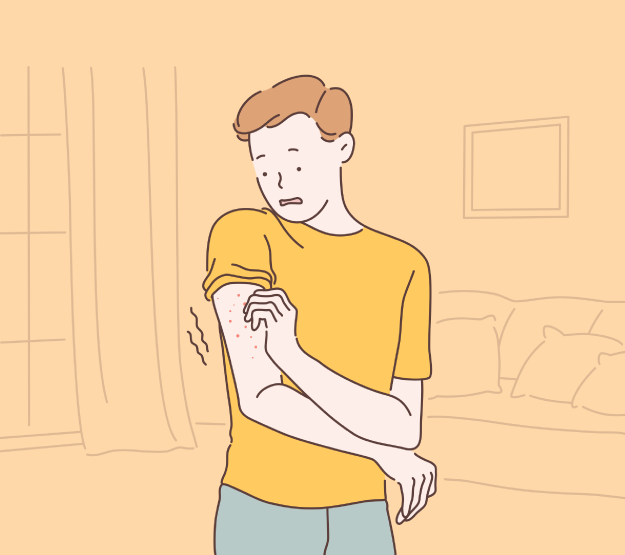
There is a relatively new subspecialty within dermatology that is of interest to therapists. Psychodermatology, the study of the connection between the “mind” and the skin—or an understanding of the psychosocial context of skin diseases—is giving many patients a new lease on life. While we’ve always known that there is a connection between mental health and certain skin conditions, we’re now finding that this connection runs much deeper than scientists first believed. For example:

  • Among patients with disfiguring, chronic skin conditions, the prevalence of psychiatric disorders is 30% to 40%.¹
  • Significant stress and anxiety have been reported in 44% of patients before the initial flare of psoriasis, and recurrent flares have been attributed to stress in up to 80% of individuals.²
  • The prevalence of psychiatric disorders among patients with skin conditions is greater than in patients with brain disorders, cancer, and heart issues combined.³
So, what can psychotherapists do to recognize patients who could benefit from seeing a psychodermatologist or drawing connections between their skin conditions and their mental health? Continue reading for tips to guide your recognition and treatment of psychodermatologic conditions. How to Identify and Treat the Symptoms Symptoms to look for in patients include any skin condition, including severe acne, eczema, pruritus (itching), psoriasis, vitiligo, and others, that may arise at the same time as particular mental health challenges. If you notice a skin condition, ask your patient to tell you about it. Find out what makes it worse or better and when they notice flare-ups. You have to become a bit of a detective at first until you can teach your patient how to start connecting dots for themselves. Certain patterns may be obvious, while others will require further investigation. But once you discover a connection between the brain and skin, you can dig deeper to better understand the nature of the connection. The goals of psychodermatology are:
  • To investigate the emotional impacts of a patient’s skin condition,
  • To help the patient work through these emotional impacts,
  • To reduce the threats posed by these emotional impacts,
  • To help the patient develop coping mechanisms for if and when a recurrence occurs
With patient-centered approaches to explore the patient’s feelings, concerns, and experience regarding the impact of their condition and with cognitive behavioral therapy, you can begin to reveal a clearer picture of what stimuli and stressors contribute to the physical manifestations of a patient’s emotional condition. For example, suppose you have a patient who you’re treating for depression and social anxiety. During one therapy session, you notice eczema on the back of your patient’s hands. You enquire—just as you would when assessing any physical behavior. Your patient discloses that ever since they started a new job, their eczema has gotten worse. Armed with this new information, you can have your patient jot down when flare-ups occur and bring their notes to sessions with you. Together, you can collaborate to spot patterns, which can help you create a timeline. From here, it’s time to focus on healing from the inside out. Working with Other Health Professionals While many conditions can be eliminated through psychotherapy alone, patients experiencing any of the above symptoms often benefit from an interdisciplinary approach. Many dermatologists understand that while they can treat the physical manifestations of a patient’s mental health condition, patients often also need mental health professionals, like psychologists, psychiatrists, or psychiatric mental health nurse practitioners, to target the source of the skin condition. One good strategy may be for therapists to seek out partnerships with dermatologists in the know.? Also, if you see patients who suffer from compulsions or skin conditions, such as skin picking or hair pulling, which you know have a psychological component, referring them to a psychodermatologist can be especially productive. While any dermatologist can prescribe drugs to treat the physical skin condition, working with someone who understands the deeper connection can be the ticket to deeper healing for particular patients. Ultimately, psychodermatology is all about improving quality of life by healing the skin condition and enhancing the patient’s emotional state. When we give our clients the tools they need to find true healing from the inside out, we show them that the journey to healthy skin and mental stability is a path they can walk. Case Application Glenda, a 21-year-old-woman, was referred to my office by her dermatologist because of anxiety that heightened when asked questions about her visibly red, scaly and raw-appearing rash on her hands and forearms. She insisted that she must be allergic to the soap she had been using and possibly the prescription cream that her primary care physician (PCP) had prescribed. Glenda had been examined by her PCP for her rash three times over the past few months and diagnosed with contact dermatitis, allergic dermatitis, and possibly eczema. Her PCP also prescribed a steroid cream and instructed to wash her hands with hypoallergenic soap and apply Aquaphor healing ointment daily. Glenda’s dermatologist took a thorough medical history and asked her about having repetitive thoughts that may be causing her distress. Glenda started to talk about the stress she has been experiencing over the past year due to COVID. She talked about staying up late at night worrying about getting infected with COVID and spreading it to others. She began to wash her hands multiple times a day. She shared that she had always frequently washed her hands, but now felt compelled to carry out a hand washing ritual—hand washing, turning the cold water on and off four times, then washing her hands, scrubbing until she counted to 30, turning the cold water on and off four more times, then applying hand sanitizer and rubbing it into her skin for 30 seconds. Lately she had been washing her hands every half hour and had been applying extra hand sanitizer to make sure her hands were clean, since washing her hands made her feel less anxious about getting COVID. She believed that carrying out this ritual had the additional benefit of protecting her family. At that point, the dermatologist explained that her skin rash and anxiety were interconnected, prescribed a hand ointment that promoted healing, and referred her to my outpatient mental health practice for an evaluation. After taking her medical and psychological history, I asked Glenda “What is your story?” to provide her with an opportunity to construct her personal narrative and share her experiences and beliefs about her current psychosocial circumstances. She opened up about her repetitive hand washing behaviors and worries about COVID that “hijacked” her brain. As a first-line intervention, cognitive behavior therapy for OCD directed at her behavior (compulsions) and cognitions (obsessions) made good sense. Sessions with Glenda included cognitive restructuring, psychoeducation, imagery exposure, self-monitoring, relaxation training, coping skills development, and self-care to alleviate her OCD-related distress. Relapse prevention was used to reduce the occurrence of initial lapses and to prevent any lapses that might escalate into a full-blown relapse. For homework, journaling was used to help Glenda identify harmful patterns of thoughts, emotions and actions and to develop techniques to help her better cope with uncomfortable feelings.

***

The collaboration between two specialties, dermatology and mental health, enabled this patient to have her psychological and physical needs treated holistically and simultaneously.  References: 1.  Goldin, D. (2020). Concepts in Psychodermatology: An overview for primary care providers. The Journal for Nurse Practitioners, 17(1), 93-97. 2.  Jafferany M. (2007).Psychodermatology: A guide to understanding common psychocutaneous disorders. Prim Care Companion J Clin Psychiatry, 9(3), 203-13. 3.  Ghosh S, Behere R.V., Sharma P, & Sreejayan K. (2013). Psychiatric evaluation in dermatology: An overview. Indian J Dermatol., Jan;58(1), 39-43. 4.  Azambuja R. D. (2017). The need of dermatologists, psychiatrists and psychologists joint care in psychodermatology. Anais brasileiros de dermatologia, 92(1), 63–71.

Jude Austin on Wisdom for Counseling Students and Educators

Into the Wilderness

Lawrence Rubin: Why did you entitle your latest book “Surviving and Thriving in Your Counseling Program?” It sounds like you’re sending them out into the wilderness with a backpack and a knife and saying, “Good luck. Let me know how you’re doing in three years.”
Jude Austin: When my brother Julius, who is also my writing partner, and I were thinking about the title for this book, that’s the image we had in our minds. You get equipped in graduate school with these different tools, skills, and attitudes and then go off and get your Ph.D., and you think you’re prepared.

But when you’re sitting in that first session unsupervised, you just feel this sense of, “I need an adult and a Swiss Army knife of some type.” So, that’s kind of what we wanted this book to be—a Swiss Army knife for counseling students and counselor educators who were reading it and feeling out of touch with their students like, “Hey, this is what they’re going through!" So yeah, we wanted it to come across as if this was your guide to surviving but also thriving in your counseling program.
LR: Sort of a field guide to counselor educators and counseling students and an army knife with different utilities. Can graduate counseling programs ever adequately prepare students for what’s to come?
JA:  
when you’re sitting in that first session unsupervised, you just feel this sense of, “I need an adult
That’s the million-dollar question. It depends on the type of program—and there are different types. You have programs that train clinicians, and then you have programs that train people who become clinicians. The counseling program that I teach in at the University of Mary Hardin Baylor focuses on the person of the therapist.

When beginning therapists (interns) are out there in the clinical wilderness, and all their practiced techniques fail, we want them to fall back on themselves as the tool. If a counseling program focuses on developing the person, their attitudes, awareness, and then helps them to develop some skills along the way, then I think that person has something solid to fall back on.
LR: What happens when you have a counselor educator who understands the importance of building self, self-esteem, and relational, not just technical, skills, paired with a student who thinks that they’re the finished product? Or perhaps an older student whose cup is already too full or a younger one who hasn’t yet been put in a position where they’ve been tested either interpersonally or emotionally?
JA: I struggle with that sometimes. We get students who come in with already-filled cups because they’ve had a successful career or currently have many competing obligations including family. They may feel like, “I know this. All I really need is for you to give me that paper at the end of this, and I’ll be fine.

I see that as an invitation to build a relationship with that student so that we can model the relationship we want them to have with clients
I see that as an invitation to build a relationship with that student so that we can model the relationship we want them to have with clients. I don’t see that confidence or arrogance as a threat, and I don’t want to humble them. I feel like that’s what a lot of counselor educators tend to do anyway; something like “We’ve got to do something that will break them down.”
LR: Drop them to their knees.
JA: Yeah, drop them to their knees! I feel like a better approach—or at least one that’s helpful for me, is to help that student understand what they do know and what they don’t know. It’s not about bringing them down to where they can sit humbly with a client. It’s about saying, “Okay, what do you have that works for you? And what do you have that doesn’t work? And how can we work around that and use it to build a better counselor?”

Getting What They Need

LR: Have you encountered such students or those who are clearly trying to work through their own issues either early on in training or while they are actually providing therapy?
JA: That’s OK, because it gives us an opportunity to help the student learn boundaries, because counseling is like that. I mean we get the clients we need, and so this isn’t going to be the first time they’re going through these kinds of issues and those issues come up. So, our job, or my job as the counselor educator, is to help that student understand that boundary.

That counseling student is actually in a good position to use the issues that they have experienced or are currently experiencing to build a better relationship with a client. And when the student is at that boundary and it is hindering the therapeutic relationship, the teaching moment is right there in front of them, as is the teaching tool for their supervisor. What you don’t want to do is set the stage where a student feels like, “I’ve got to get my shit together, or I can’t do this.” That’s just not sustainable.
LR: I like the idea that we help students understand that sometimes they get the clients they need. Try as I might to selectively place interns in facilities where they’re not going to be thrown to the lions, they invariably end up not only with clients they need but also with those who are very complex and well-beyond their skill and experience levels.
JA:
what you don’t want to do is set the stage where a student feels like, “I’ve got to get my shit together, or I can’t do this”
As far as I do it in supervision, it’s really just helping them navigate those multiple and often complex relationships. I try to do my best to encourage students to chew on things before they swallow it. We start them in practicum at our free, university-based community clinic before sending them on to internship at an outside site.

During internship, we tell them something like, “Hey, you’re going to be hearing some stuff and be asked to do some things at the site that may run counter to what we said or what we’ve trained you to do. And so, you’re out there in the world.” And so, they begin to learn, “How do I integrate some of the things I learned in school with what I’ll learn here and not allow it to negatively impact my development as a counselor?” I think the key is helping students recognize and take ownership over their own development, so they can’t be manipulated or pushed or pulled when a supervisor asks them to do something different from what they have been taught or experienced while in school.
I’ve seen many a student who goes off into a site with a supervisor who is overwhelmed or unprepared or not trained to be a supervisor because they are first and foremost a clinician. And so, students lose confidence and get set back. We as clinical educators have to help them take ownership over and protect their own personal and professional development.
LR: And we have to protect students from supervisors who might be overwhelmed, overwhelming, and/or incompetent.
JA:
we as clinical educators have to help them take ownership over and protect their own personal and professional development
Up to a point, I don’t want to rob them of the learning experience of being next to somebody who may be incompetent, unavailable, unhealthy, or who may be just not be a good role model. I want them to learn that. It’s kind of like when my son is climbing up stairs for the first time, I don’t want to be next to him and holding his hand. I want him to struggle and wait for him to ask for help.

Similarly, it’s about teaching that student when they need to come and tell me that something is beyond their capabilities, especially when they’re in internship. Because when they’re in internship, we need to make sure that they know how to strike that balance between knowing when it is necessary to ask for help and when it is not. Otherwise, they won’t build strong roots.
LR: They have to have their own immune system.
JA: Yeah, exactly.
LR: So, being a clinical educator/supervisor requires that we also strike a balance; between protecting and…
JA: …letting them struggle.
LR: Just like the APA Code of Ethics says…promoting autonomy while also making sure that they’re not a danger to themselves or others.
JA: I’ve had many supervision sessions where we’re just like, “This sucks.” You also have to build a relationship with their site supervisor. Sort of like co-parenting.

Rising or Falling

LR: If you were called on by the ACA to write a formula for predicting failure of a graduate counseling student, what would go into that equation?
JA: I had two thoughts but will share my second one first, which is about counselor educators. I’m a big believer that oftentimes our limitations as counselor educators can then become our student’s limitations. And so, if a student is failing—or failing to thrive—for some reason, then I merely have to look inward and be congruent and be healthy about the responsibility I take in that student’s failure and think, “Wow, is this a support issue? Maybe I didn’t prepare them enough. Maybe we didn’t have a big enough informed consent around what this would mean for them,” right?
LR: So, the second part of your answer, which comes first, is that if a student is on a track to fail or is failing to thrive, then it is the counselor educator’s job to look within to ask, as a parent might, “How have I failed to support this student’s thriving?”
JA:
our limitations as counselor educators can then become our student’s limitations
Yes. What are my limitations here?
LR: What’s the other part of your answer?
JA: I think sometimes they can’t be helped. And sometimes students come in not expecting how challenging the program is, not giving the challenge of this enough respect. If I were to create a formula for predicting a counseling student’s failure, I would probably say it has something to do with lack of awareness or acknowledgement of how challenging this program is, plus maybe a lack of support. They know it’s going to be hard, because it’s graduate school. But I don’t think they know how hard graduate counseling is, graduate psychology is. It asks a bunch of questions of you that, if you aren’t prepared to answer, it can have a domino effect in your relationships and your mental health and your ability to process things.
LR: Conversely, what do you think are some of the characteristics of the counseling graduate student who will thrive not only in graduate school but in their career, in their personhood, in their lives?
JA: The #1 characteristic for me is humility.
LR: Yeah, amen.
JA: And not just humility in the sense of self-deprecation. I mean this humbleness around the idea that maybe their reality isn’t the correct reality, and their willingness to allow their client’s reality to be correct for that client. It’s about cultural humility, to be able to come in and say, “Oh, man. There are some things that I don’t know. There are some things that I don’t perceive about the world like everyone else does, but I’m willing to learn.”

it’s not like people who are wounded or hurting can’t do this work. It’s just they have to work on the stuff that they need to work on
I think that’s the humility that I’m talking about, to be able to say, “Okay. Here’s my stuff. I’m going to work on my stuff.” And I think that’s the clear thing. It’s not like people who are wounded or hurting can’t do this work. It’s just they have to work on the stuff that they need to work on. And when students are aware of that and they’re doing that parallel kind of process, then it’s a beautiful thing. I feel like that’s when students can be successful.

So humility, for me, is the thing that we’re trying to foster in counseling students. And to be honest with you, a lot of the students that we accept are already good at this. We just give them skills and tools in the hopes that when they get to internship, they’ll remember who they were when they first started the program. And then when they remember that person, they can be that person with some skills and attitudes and knowledge. And so, if you can go through that process humbly, I feel like you can stay grounded and remember who you are. That’s kind of my perspective.
LR: So, it’s the counselor educator’s job to teach counseling students to hold onto who they are and maybe shave off or trim those parts of themselves that are going to get in the way, so they can become more psychologically lean but hopefully learn to become the person who is a counselor, not a counselor who is not sure who they are as a person.
JA: Yeah. Now, that sounds easier said than done. And I think that also means that as counselor educators, we have to do that too. We have to model that for students. We have to let them into our experience and our journey of becoming, step-by-step, more and more ourselves in supervision, in class. Let them into that process and show appreciation. One of the things that I say after each class is, “Thank you for letting me be myself.” And I invite students to do the same. When I mess up, when I forget my keys and I have to walk back to my car or when it’s just like it’s not a good lecture, owning that and showing them that this is what we want you to do in session.

Healer, Heal Thyself

LR: In the context of this piece of the conversation, what are your thoughts about counseling as a mandatory part of counseling training?
JA: You know, it’s strongly suggested in our program, strongly suggested. I feel like we build a culture of support in the sense that we have alumni who are now working in the field who kind of understand a little bit of what students are going through. And so we try our best to refer them out to clinicians in the area that can help. But mandatory? If I could make it mandatory, I think I would be at least a couple sessions. Just so you can see how it feels.

But making it mandatory? I feel it could be detrimental for students who aren’t ready to process their stuff. I mean if they’re not ready, it doesn’t mean that they can’t be good counselors, but here’s the thing. If you’re not working on your stuff, if you don’t go to counseling, you may become a really good technician but not a clinician. You can go and do skills, you can go and do theories, you can go in and do techniques and activities. But can you really connect with somebody? Can you have a therapeutic presence that allows that client to feel pulled toward you and can you evoke your client’s awareness? I don’t know if you can do that without working.

one of the things that I say after each class is, “Thank you for letting me be myself.” And I invite students to do the same
Yeah, it’s a dilemma. In a lot of ways, it’s safer to do rather than be, right? How can you cultivate a therapeutic environment where you feel safe enough to be? Most counseling students are going to graduate and feel like, “I know some stuff now.” But I think what makes our program special is that we really focus on training students to be, but not every student is ready for that, and that, too, is a dilemma. I notice it sometimes in clients with whom I am trying to connect on a deeper level, and they don’t want it.

They want… “Give me the coping skills. I don’t want to talk about…” And so, you have to meet that client where they are. And it’s the same thing with students and the same thing with the field, like allowing students to hear, “Hey. This is where the field is. This is what we’re trying to get you to do. We’re trying to find a balance between doing and being.”
LR: So if a student is not ready for internship for emotional, psychological reasons, what do they do instead? How do you work with a student who just is not ready for internship by all your standards but is insistent or demanding or even litigious about it?
JA: We go through this a lot. We have a couple of different options. This is not like a plug for our program, because I think most programs have this. By the time they get to internship, we want them to have a really good idea about how we feel about their potential to succeed or fail. We don’t want it to be a surprise. And so, by the time they get to internship, we’ve had that conversation where it’s like, “Hey. There’s a lot of things that you… There’s a lot of hang-ups. There’s a lot of things that could limit your success there. If you want to do it, we can’t stop you, but it may behoove you to take some time and then come back and start internship.” And if students are like, “No. I’m good. I want to do internship,” then we help them find an internship and a supervisor that could support that student’s limitations.

So, sometimes we’ll have students who are veterans, and maybe they experienced a TBI and they struggle with death work. And they acknowledge it, they know it. And so, we work with them to say, “Okay. What kind of work can you do? Where can you serve your community?" And so we try to guide them into the place where they could be most successful. But sometimes, rarely perhaps, I have students who are not ready to integrate it, and we just have to kind of let them survive… or not, you know? And when they don’t, we’re there to support them.

The Right to Fail

LR: I had a supervisor once, a very wise older woman who loved the metaphor of a safari guide. Her idea was that “As we walk through the terrain, I’ll point out the quicksand. I’ll point out the thickets and the brambles. If you choose to go into the quicksand, I’ll be waiting on the edge if I can help you.”
JA: Absolutely. And students have a right to fail. They very much have a right. And I think that’s the thing that we try to get students to understand. It’s like they’re not paying for this degree, they’re paying for an opportunity to get a degree. And if they destroy that opportunity because they go into an internship site when they’re not prepared to do so, there’s nothing that we can do about it. Those internship sites can hire you and fire you. If you get fired, there’s consequences. We’re very open about that.
LR: Do you ever experience transference/countertransference relationships with your students?
JA: I think I can answer this question in a way that’s most favorable for me [smiling]. I just genuinely care about the students and their success. When we accept a student into our program, when I’m working with a student, I see the impact they can have in their community, the ripple effect that they can have. And all I want for them is to be successful.

watching them struggle is the hardest part
And so it’s triggering because it’s like watching someone doing something that is going to hurt them but allowing them to get hurt so they learn the lesson. I think that’s the hardest part about being a counselor educator. I think that’s the countertransference, especially because I’m a relatively new dad of a two-year-old and a four-month-old. It’s like that same process of watching them go through it and identifying with that struggle.

So you just have this sense of ownership over that person’s development. And then when they get to internship, you’re letting it go and that ownership transitions to someone else—their site supervisor. And so, watching them struggle is the hardest part. And we go through that every year, because there isn’t an internship cohort that doesn’t have one or two students who is realizing at that moment like, “Oh, crap,” as they fall behind. It’s brutal because they have to watch their cohort members move forward.
LR: You clearly have a heart for your students and want them to succeed, but I want to push you on this one. What about those counseling students that you don’t like? You know, the ones that burrow under your skin or those that you simply don’t care about or like?
JA: I just try to put obstacles in their way, which means that I have to have that conversation that I don’t want to have but I know I need to have with that student earlier than other students. Like with that student that is burrowing under your skin, I very much experience a parallel process where I’m saying, “If this person is affecting me this way, they’re probably going to affect clients this way as well.”

that’s what I mean by obstacles, like slowing down their process so that they can gain awareness of how they affect other people
And so, before they even get to apply techniques, which is the second semester where they first learn how to do mock sessions, we need to have a conversation. We need to have that talk like, “Hey, you know that thing that you do in class? That’s annoying, man.” And what I try to do is say, “Whenever you…” Like if a student has a loud laugh, that’s saying like, “Pay attention to me,” right? What I try to get them to do is, “When you laugh, pay attention to everyone else’s reaction. Pay attention. Feel how you affect other people.” That’s what I mean by obstacles, like slowing down their process so that they can gain awareness of how they affect other people. Because if they’re affecting me, they’re going to affect other people.
LR: So, what you’re trying to do is not simply model empathy or pray to God that they sort it out through osmosis or some other way. Sometimes, you have to really just actively teach them what it means to be empathetic because in therapy, the audience is watching. The audience is listening
JA: Worst-case scenario, you’re doing it live in class and the student does something and you have to say, “Hey, pay attention to how everyone is feeling around you. Would anybody like to share how this person is affecting you right now?" And then sometimes I may say something like, “This is how I’m experiencing you right now. You don’t have to respond to it. This is just how I’m experiencing it. Do you want to be experienced in that way? Is that what you’re trying to get me to experience you?" And I think that’s kind of the learning that we need them to get.
LR: So, counselor educators need to manage their triggers so they can be most present for their counseling students, just as we ask counseling students to have those qualities with their clients.
JA: Exactly.

Straddling Two Worlds

LR: How do you balance on that tightrope separating the supervisory and therapeutic aspects of your role as a counselor educator?
JA: I straddle that line as carefully as possible, because that’s probably one of the most unexpected challenges my doctoral program prepared me for. And they can’t really prepare you for that. So, the way that I keep a boundary around it is that when I’m with a student, I’m always thinking about learning opportunities. I’m always thinking about teachable moments. And so, there’s times when I go there with a student, especially when we’re processing deep stuff. But there is a stopping point when it gets to, “Okay. We’ve got to stop because I feel like this is what you need to process in therapy. This is what’s affecting the client, that you need to process that in therapy.”

I’m always thinking about teachable moments
But when I can cultivate a relationship with the student or supervisee that is safe, then sometimes in supervision I may feel like being open about, “Okay. We need to work through this so that you can better work with clients,” then, “Here’s where we’re going to work, and here’s where we’re going to stop.” Does that make sense? It’s almost like an instinctual knowing of when I’m going too far, when we’re getting too deep. And I can feel that with students. I may see them becoming uncomfortable. So, I want it to be a wisdom-based engine, and I don’t want that engine to spoil over into fear, because then they’ll push away.
LR: In this context, many counselor educators are also practicing clinicians, and I wonder if that is beneficial or detrimental.
JA: I have a small private practice here in Temple, and I don’t know how I would be able to do this job without seeing a client or two a week. And it’s mainly because sometimes when I haven’t worked with clients and I’m in front of the class with the alphabet behind my name, I feel like I am The Guy. And then I go into a session, and I’m humbled and reminded, “Oh, yeah. I don’t know what the hell I’m doing,” or, “This session got away from me.”

I feel like it becomes hard to manage whenever my practice hinders my health, when I’m scheduling, managing things when it’s overwhelming, when I’m burnt out, and my students become a secondary priority. That’s when I know, okay, something’s going on. But, yeah, I work with individuals, couples, families. And I usually have about four or five clients that I’m seeing in a semester.

Lifespan Issues

LR: How, as a parent to young children and also in a sense a parent to young, evolving clinicians, do you teach them about the uncertainty and our limited ability to influence others?
JA: I think you put them in situations intentionally where it’s grey and uncertain and watch them go through it. What we try to do is have a healthy balance between safety and ambiguity. We want clinical trainees to feel safe enough to be able to feel okay floating in the wilderness somewhere. We know where they’re at. They may not know where they’re at, but we want them to feel safe to be lost a little bit.

we want clinical trainees to feel safe enough to be able to feel okay floating in the wilderness somewhere
And so, I think that’s how you train them. It’s like you intentionally scaffold and build into your program situations, places, activities where students can get a healthy dose of “I’m just going to go with it, and I’m okay because I know I have a healthy attachment to my faculty.” It’s the same thing as a new parent. It’s like I know my relationship is strong when my son can play independently and then come back and check in and then play independently and then come back and check in.

It’s like he knows that he can wander and it’s safe to come back. Same thing with students, right? We want them to go off and explore a theory, a technique or try this out or bring this into session or bring this into practice and then come back and say, “I don’t know what I did.” You know what I mean? So yeah, building that in intentionally.
LR: You’re in a unique position, Jude, because you’re learning what it means to be a parent while you are shepherding counseling students into their professional identities. It makes me wonder—what are some of the challenges that clinical educators have who are later on in their life, who are no longer dealing with raising young children but perhaps launching teenagers, or have children who are getting married, or are dealing with their own mortality? How do counselor educators separate or merge the challenges in their own personal lives with what it is their students need in theirs?
JA: I feel like the challenges that the more-experienced clinician or the counselor educator may have are the same issues that the students may have who come in as they begin a second career. It’s arrogance, you know? It’s that idea that you know everything. You don’t see yourself as a student anymore. And I think that is the downfall of a good counselor educator, is when they feel like they know all there is to know.

I think the way that they can combat that is integrating the experiences that they have but not relying solely on those experiences. I think that’s the difference—if you’re integrating them, you say, “Gosh. I remember what it was like when my kid was two or when my kid was four. I remember when my kid was 13.” That’s the emotional age of some of these students. What did I do when my kid was 13, and what did I want to do that I didn’t do that I wish I could’ve done and I can do now with this student? I feel like those are the ways that you can kind of integrate those experiences into raising students.
LR: So, it goes back to sort of a thread that’s woven its way through this interview, which is that we as counselor educators/clinicians have to continue to evolve, to look inside. We have to impose that challenge on our counseling students. We can expect no less from our counseling students than we can for ourselves.
JA:
we as counselor educators/clinicians have to continue to evolve, to look inside
And we’ve got to have the courage to let them into our journey with that. You know, we’ve got to have the courage to say, “This is life. I’m tired. I’m exhausted.” We don’t have to put on that front. Because then students will do that, and then the clients will do that, and there’d be that butterfly effect where nobody’s really being themselves.
LR: Do clinical educators get the students they need?
JA: It’s that butterfly effect, right? It’s like this parallel process where my relationship to my supervisee will impact my supervisee’s relationship to their client, which will then impact that client’s relationship to their environment. And so, a lot of the times when I’m in supervision and we’re having that come-to-Jesus moment like, “Why do you have this client,” I also have to ask myself, “Why do I need this supervisee to have that client?”

And then I may start thinking, “What do I need to do in my life in order to be able to better support this student so that they can better support this client?” That becomes the question, right? But then the beauty of supervision is that you can outwardly process that with a student so that they can learn how to do that for themselves with a client. You can say, “Gosh, man. When you’re working with this client, this is what it brings up for me. This is my hang-up, and this is where I struggle to support you. Where in your life do you feel like this client is kind of poking?" This processing and processing is a beautiful thing when it’s done right. In a lot of ways, it can feel like inception. Sometimes you’re in supervision like trying to spin a top asking, “Are we in reality, or is this a dream?”

True Cultural Awareness

LR: This next question could probably stand as its own interview, but I can’t help but ask. What are the challenges that counselor educators face in really effectively teaching these students what cultural awareness means?
JA: The first thing that comes to my mind is that we’ve got to be mindful of our fragility as counselor educators and be willing to address things that make us uncomfortable talking about, things that make us squeamish. I feel like we’ve got to be aware of that. We’ve got to be aware of our political stances and how that influences our work and how it influences our teaching. We’ve got to be aware of our perspective, our biases, our thoughts, our perceptions of individuals who don’t look like us, don’t like the same people we like, don’t pray like we pray.

we’ve got to be mindful of our fragility as counselor educators
I think the key to fostering culturally humble students and clinicians is for us as counselor educators to be humble, to be mindful of our fragility, and be courageous enough to have those conversations in class. Each diversity class that I teach feels like Thanksgiving, because a lot of people’s families are uncomfortable around that Thanksgiving table. That’s what diversity class feels like.

I feel like what we have to do is to foster this atmosphere of openness around these discussions and safety in the classrooms. What we don’t want is for students to feel the tension or the discomfort, and that hinders their ability to go there. We need them to go there. And so, we have to be aware. We have to be humble. We have to be courageous. I think those three qualities can really help develop culturally-competent students.
LR: We recently released a three-video series, Counseling African American Men, featuring Darrick Tovar-Murray from DePaul University. In the conversations between Darrick and Victor Yalom, Psychotherapy.net’s founder, the idea came up that counselors need to learn to be comfortable with discomfort, which sounds like exactly what you’re talking about.
JA: Yeah. Yeah. Yeah. We’ve got it steeped in our program. We’ve got it steeped in security and safety with a little bit of ambiguity and discomfort. It has to be equal measures. We have to steep the students in there for two years and two semesters, you know?
LR: I’ve heard of the notion of “White Fragility.” What did you mean by fragility?
JA: You know, like those developmental stages. Like whether or not you’re in the early stages of identity development. Then you’re experiencing a lot of anger, right? Because that’s fragility too, right? We talk about this in diversity class. Sometimes, as a man of color, as an African American male, I have anger toward White men, White people, especially when I feel unsafe.

sometimes we can give off the impression as counselor educators that if you are a White counselor, then you can’t do culturally sensitive work
And so, when clients come in, sometimes that anger leeches into the therapeutic relationship. And I think that’s what I mean by fragility. It’s not that you can’t be angry. It’s that you have to be mindful of “How is this going to impact my therapeutic relationship, my work, my relationship with my peers, my relationship with my supervisor? What do I need to do to work through that?
LR: When I started at the university 32 years ago, the student body was White, and I have learned to be more aware of the privilege that comes with whiteness. And I have been put in very uncomfortable situations with my students. So, this idea of a counselor educator being comfortable with discomfort and modeling it is very important.
JA: Absolutely! And a lot of that has to do with just acknowledging when “This is uncomfortable.” Like, look around the room. What have we done as a program, as an organization? What have you done individually as a student to perpetuate this sameness? Let’s have that discussion. Because I think sometimes we can give off the impression as counselor educators that if you are a White counselor, then you can’t do culturally sensitive work.

I feel like that impression is dangerous, especially for White students. There’s so much opportunity for corrective emotional experiences for clients. If we train White counselor educators well, they can go out into their communities into the field and build strong relationships and repair relationships with clients. I mean, speaking for myself as a supervisor, it meant a lot to me to work with a supervisor, like when I was a student, who was White but who came into the relationship humble, aware, willing to acknowledge things. It was kind of like, oh, okay. Okay, we can do this. And it was even more impactful sometimes when that happened.
LR: Yeah. Do you think there’s an implicit expectation that, because you are a Black man, that you have a deeper sensitivity to cultural oppression and unfairness?
JA: Yeah. Yeah. Yeah. Yeah. That’s the work we don’t get paid for. That’s fine with me, you know? That’s the stuff that they don’t add to the tenure packet. They don’t have a box for that on your year-end evaluation. It’s how many times you’re stopped in the hall and, “Hey. I’m trying to do this diversity thing.” It’s like, I’m going to Google it just as you, just as much as you.

sometimes it’s just hard. It’s like, “Man, I don’t have the bandwidth to do this when I also have to do other things”
You know, it’s that extra work that you do to support a community, the calls you get, the students that you’re supporting, the organizations you’re connected with. Sometimes you do have a deeper understanding of these diversity issues, because you have to. But sometimes it’s just hard. It’s like, “Man, I don’t have the bandwidth to do this when I also have to do other things.”

I feel like what I love the most about my faculty is that we all take equal responsibility in having those conversations. So, it doesn’t just feel like it relies on one person. But I’m blessed. My program is diverse. We have two White men, and the rest of the faculty are people of color, women of color.
We very much match our student population demographics. But, yeah, that’s the stuff you don’t get paid for. And that expectation gets you voluntold to be on committees. And I’m just like, “Gosh, man. I’m struggling too, you know?”
LR: I think we’ll stop there Jude. I want to thank you so much for sharing your wisdom and experiences from the trenches of graduate school.
JA: I hope this was meaningful for students or for whoever’s reading it.


Overcoming the Pernicious Chronicle

Therapy stagnates when patients doggedly chronicle the events that have occurred since their last session or when they use all their therapy time to recite their grievances, bewail the injustice of their situation, and air their resentments. The therapy, in short, fails to fulfill a treatment plan. The misuse of these sessions can lead to “interminable” outcomes, where patients continue to catalog their problems but do not modify or alter how they deal with them. The therapist can be caught up in this paradigm, resigned to listening and sympathizing without making any meaningful headway in helping these patients recover.

Like what you are reading? For more stimulating stories, thought-provoking articles and new video announcements, sign up for our monthly newsletter.

Worse yet, the therapist may become comfortable with this covert contract: “If you tell me your troubles and adventures, I’ll listen and make occasional wise remarks, I’ll even offer you some advice, but little will change in your life due to our therapy. You’ll be comforted, and I’ll be compensated.” This arrangement can go on for years, even decades, and only end if the patient can no longer pay, by the death of either party, or by the therapist’s retirement. A colleague of mine used to refer to these patients as “psychiatric annuities.” To him, they were an income stream providing steady payments that would support his earnings “forever.” The patient will never reach the therapy’s goals (if indeed there ever were therapy goals!) and instead become so dependent on the therapist that their lives will be diminished instead of enhanced by their treatment.

Some therapists feel comfortable with this long-term arrangement. Sessions with these patients are predictable and require little or no effort. They might even grow fond of this long-suffering patient and wouldn’t want to trade for a new case with all its uncertainties and hard work. And they’re getting paid for little or no work. If asked, these therapists might argue that they are providing “Supportive Therapy.” This rationalization adds insult to injury: The patient is incapable of change? Are they so damaged they need a weekly boost from a therapist to tell them how to live their life? Does the therapist need a therapy-dependent patient, hanging onto every word, to boost his or her own self-esteem? What is being supported? The status quo?

A real regard for the patient’s benefit, not to mention simple professional ethics, requires that all of us resist the siren’s call of these cases and, instead, interrupt the chronicle, reinstate active treatment, and forego the insidious pleasure of these unworkable, so-called supportive arrangements.

A Matter of Death and Life

Excerpted from A Matter of Death and Life by Irvin D. Yalom and Marilyn Yalom, published by Stanford University Press, ©2021 by Irvin D. Yalom and Marilyn Yalom. All Rights Reserved.

Numbness, 50 Days After

Numbness persists. My children visit. We take walks in the neighborhood, cook together, play chess, and watch movies on TV. Yet I remain numb. I feel uninvolved in the chess games with my sons. Winning or losing has lost significance.

Yesterday evening there was a neighborhood poker game, and my son Reid and I both played. It was the first time I’ve ever played together with one of my sons in a game of adults. I’ve always loved poker but at this game, at this time, I could not shuck the numbness. Sounds like depression, I know, but still I took pleasure in seeing Reid’s happiness about winning thirty dollars. As I walked back to my home, I imagined how good it would have felt to arrive home, be greeted by Marilyn, and tell her about our son’s winning night at poker.

The following night I try an experiment and place the portrait of Marilyn in plain view in the room while my son, his wife, and I watch a movie on TV. But, after a few minutes, I feel so much tightness in my chest that I again put Marilyn’s portrait out of sight. The numbness persists as the film proceeds. After about a half hour, I realize that Marilyn and I had seen this movie several months before. I lose interest in seeing it again but remembering that Marilyn had enjoyed it a great deal, I honor the bizarre notion that I owe it to her to watch the entire film.

“I notice that the numbness recedes the first few hours of the day when I am immersed in writing this book and also when I work as a therapist”. Today, a woman in her late twenties enters my office for a consultation. She presents her dilemma. “I’m in love with two men, my husband and another man I’ve been involved with for the last year. I don’t know which is the real love. When I’m with one of them, I feel that he’s my real love. And then the next day or so I feel the same way about the other man. It’s as though I want someone to tell me which one is the real love.”

She discusses her dilemma at length. Midway through the session, she notes the time and mentions that she had seen my wife’s obituary. She thanks me for being willing to see her at this difficult time. “I worry” she says, “about burdening you with my issues when you’re suffering such a huge loss.”

“Thank you for those words,” I reply, “but some time has gone by, and I find that it helps me if I’m engaged in helping others. And also, there are times when issues arising from my grief enable me to help others.”

“How does that work?” she asks. “Are you thinking of something that may be helpful to me?”

“I’m not clear about that. Let me just ramble for a minute. Let’s see . . . I know that getting involved in your life in this session temporarily diverts me from my own. I’m thinking, too, of your comment that you don’t know your real self and that you cannot know which of these two men the real you really wants. I keep thinking about your use of real. I feel this may be tangential, but I’ll just trust my instincts and tell you what our discussion stirs up in me.

“For a very long time I’ve felt that an event often felt ‘real’ only after I shared it with my wife. But now, weeks after my wife’s death, I have this very strange experience of something happening and my feeling I must tell my wife about this. It’s as though things don’t become ‘real’ until my wife knows about them. And, of course, that is entirely irrational because my wife no longer exists. I don’t know how to put this in a way that will be helpful but here it is: I, and only I, have to take full responsibility for determining reality. Tell me, does this have any meaning for you?”

She seems deep in thought and then looks up and says, “That does speak to me. You’re right if you’re implying that I cannot trust my sense of reality and that I want others—perhaps one of my two men, perhaps you—to identify reality. My husband is weak and always defers to my observations, to my sense of reality. And the other man is stronger, very successful in business, very sure of himself, and I feel safer and more protected and trust his sense of reality. Yet I also know that he’s a long-term addict who is now in AA and has now been sober for only a few weeks. I think the truth is that I mustn’t trust either of them to define reality for me. Your words make me realize that it’s my job to define reality—my job and my responsibility.”

Toward the end of our hour together, I suggest that she is not ready to make a decision and should tackle this in depth in continued therapy. I give her the names of two excellent therapists and ask that she email me a few weeks from now to let me know how she is doing. She is deeply touched by my sharing so much with her and says that this hour has been so meaningful that she didn’t want to leave.

The Pygmalion Effect and Treating Incarcerated Individuals with Severe and Persistent Mental Illness

For as long as I can remember, I’ve always been fascinated by locked doors; what does society do with the individuals it tucks, or perhaps sends away, and why are they sent away to begin with? Prisons and psychiatric hospitals were always talked about so ominously, and as a young child I remember thinking, “I need to know what goes on in there.” Fast forward to the year 2015, when I signed an offer to begin working as a correctional social worker. I had spent the last year working in a correctional facility as an intern and made the decision that working in corrections was where I needed to be. I’ve always had a passion for mental health, and when I was offered a position in a psychiatric correctional unit, I knew I had to take it.

Like what you are reading? For more stimulating stories, thought-provoking articles and new video announcements, sign up for our monthly newsletter.

Upon walking onto the psychiatric unit that first day, I knew instantly that I’d found my place. This place, this “unit” was just the opposite of what I expected it to be and believed as a child they were. It was painted with bright colors, residents’ art was on the walls, groups were running, and security and mental health staff members were working together to provide treatment to the men on the unit. The air on the unit was lighter—residents were able to joke with staff and clearly felt safe in this niche of the prison. I had always hoped a program like this could exist in corrections, and somehow I was lucky enough to stumble into this in one.

***

“I never thought it would work,” Melvin* said. This is a line I’ve heard Melvin repeat time and time again in our clinical sessions as he reflected on the birth and development of an innovative psychiatric unit where he resides inside a correctional facility. Melvin is a long-standing community member in the unit, and his role is anything but benign. He and a few other permanent residents serve as institutional memory—not only do they keep the mission of the unit alive, but they also keep the cultural expectations and norms of the unit thriving.

It may be tempting to think the culture of a unit inside a correctional facility to be harsh, ruthless, and violent; but with the right balance of residents and staff, the most astounding transformations can be seen—just ask Melvin. Melvin, an individual living with psychotic illness who walked onto the unit upon its inception, will be the first to tell you he never thought a structured mental health unit would survive in corrections. Having lived a life riddled by poverty, substance use, abandonment, dual-diagnosis, and trauma, it is not surprising Melvin ended up in an institutional setting. When he first arrived onto the unit, he appeared hardened and unreachable and had just returned from a hospital trip due to an injury inflicted during the throes of a psychotic episode. “Ya, I used to sit in the corner over there (referencing the group treatment room) and just stay silent all group, purposefully choosing to stay uninvolved.” Melvin is honest in his reflections that he didn’t think a unit could exist inside a correctional facility without strong-arming, victimization, and prison politics. He didn’t know then the power of the Pygmalion Effect.

The “Pygmalion Effect”¹ describes the way individuals present themselves in a manner akin to the expectations set before them, whether they are positive or negative. The psychiatric unit where Melvin resides was able to cultivate the expectation that individuals residing on the unit would drop behaviors typically seen in the prison culture (intimidation, bullying, violence) and promote ideals such as asking staff for help, utilizing town halls to address community issues within the unit, and speaking honestly about their lives in group treatment. The vulnerability and effort to curb well-developed criminal tendencies it took residents like Melvin to exhibit was extraordinary, and over time the unit has become what Melvin describes as a “safe place” and “my family.” Although staff may have initially brought forth these ideals and stayed dedicated and consistent to the mission of providing treatment rather than simple stabilization, the therapeutic and pro-social culture of the unit now comes directly from Melvin and other long-term residents. The “Pygmalion Effect” tends to be cyclical in nature and is seen daily in this psychiatric unit. The staff members show unconditional positive regard and a belief that typical prison behavior and defenses can be dropped in the unit because the residents are much more than their prison sentence or mental illness. The residents, in turn, begin to believe themselves to be individuals who are worthy and can contribute to the world through human connection. This spreads amongst the men through groups and psychotherapy, and eventually, the entire unit is finding positive ways to support one another along their journeys with mental illness, recovery, and imprisonment. The “Pygmalion Effect” has allowed for something uncommon to occur in a correctional environment—people are actually getting well, not just stabilized.

****


Here we are in 2021, and I now hold my doctorate in social work and am the director of this unit in which I whole-heartedly believe. The evolution of the unit has been extraordinary to watch. In an interesting way, we’ve grown together. I started working in the unit as a conditionally licensed professional, left and explored other avenues of corrections, and then returned as a fully licensed professional completing a doctorate program. As I’ve gained my clinical footing and found my stride, I’ve watched the men on the unit do the same. The residents who have been on the unit since its inception, such as Melvin, have gone from being acutely ill to now being peer mentors on the unit. Throughout these years on the unit these men have developed self-esteem and practiced being able to trust; skills they struggled with for most of their lives. If this is what happens in six years’ time, I cannot wait to see the growth that occurs within the next six.

1. Chang, J. (2011). A case study of the “Pygmalion Effect”: Teacher expectations and student achievement. International Education Studies, 4(1), 198–201.

Relief or Change? Which is the Most Meaningful?

Jack, a forty-three-year-old insurance executive, was referred to me by his family doctor for help with severe panic attacks that had suddenly begun for reasons that were completely unclear to both of them. Jack's symptoms were disabling and resulted in his missing work for several days before his initial appointment with me.

In the first session, I listened to him describe his difficult breathing, chest pains, sleeplessness, occasional choking episodes, along with his fear of losing complete control and “going crazy.” He told me that he has always been an anxious person and had contemplated entering psychotherapy for several years, but never actually did…until now.

Like what you are reading? For more stimulating stories, thought-provoking articles and new video announcements, sign up for our monthly newsletter.

The initial consultation with Jack was, in my view, a mixed success. According to Jack however, it was “an unbelievable success.” We were able to quickly identify the sources of his current anxiety symptoms, which almost immediately provided him with some much-needed relief. We began to outline some of the likely goals of the ongoing therapy he was “very happy to be starting, finally,” and for which he eagerly arranged his next appointment with me.

As the session wore on, I began to feel concerned that the initial and speedy benefits of this first session might have implications for Jack's ability to fully engage in the challenging, ongoing work of psychotherapy, something I believed he needed and from which he could derive greater benefit than immediate symptom relief only. I became especially concerned when Jack described his first session as “maybe the best hour of my life!” and described me as “undoubtedly, the best therapist in America!” That's when I thought, I probably will never see Jack again.

As it turned out, Jack did attend his second session, and a third, and described the continuing benefits of the work thus far. He was hardly symptomatic, felt “great,” no longer thought that he was “losing it,” and was wondering whether or not he really needed therapy after all. Somewhat surprisingly, he asked me to tell him what I thought he should do. In order to help Jack figure this out for himself as much as possible, I did what any therapist worth their stripes would likely do as a first response to such a question: I asked Jack to try and decide independently of my input, so that we could both learn something about his attitudes, thoughts, and feelings, rather than have him simply react to mine. My input followed and consisted of my ideas about the differences between relief and change, with the latter, obviously, being the more ambitious pursuit and perhaps the more durable. I also was mindful, as always, that for some people, relief may be all they want or need. Not everyone wishes to or has the wherewithal to undertake a full course of psychotherapy, especially if they are not in active distress.

After a meaningful conversation about his dilemma, i.e. to stay or to go, Jack decided that he was quite happy with what had occurred and chose not to pursue further therapy at the time. He asked for and received assurance that my door would always be open, and we both acknowledged that we may or may not ever see each other again. He left describing himself as the “three-session wonder.” I later heard from his physician that he was doing quite well, with no further panic attacks. It led me to wonder whether or not I should revise my thinking to include the fact that sometimes and for some people, relief is change, and not necessarily something less or less meaningful.

Redesign Your Mind in an Instant

Wouldn’t it be lovely if you were able to help clients make real, significant, lasting changes right on the spot, just by providing them with a certain frame and by inviting them to do a little on-the-spot visualizing? I have. You can.

Philosophers from Marcus Aurelius to the Buddha concerned themselves with the idea that “you are what you think.” Nowadays, this age-old notion is typically explored using ideas and techniques from cognitive-behavioral therapy. These ideas have resonated for many of my clients and have been quite useful in our therapeutic work. But there is an important next step to take.

Like what you are reading? For more stimulating stories, thought-provoking articles and new video announcements, sign up for our monthly newsletter.

By providing clients with the metaphor of “the room that is your mind,” I have helped them visualize “the place where they think”—really, “the place where they live”—and help them instantly change and upgrade that “place.” This simple metaphoric frame has created powerful, on-the-spot results.

In a very few words, I explain to my client that it is in their power to redesign and redecorate the room that is their mind. Then I move right onto giving some examples of what that redesigning might look like: adding windows so that a breeze can blow through, reducing inner claustrophobia; adding a calmness switch, producing immediate calm; adding an exit door, out of which repetitive, obsessive thoughts can be scooted; or repainting the walls a bright color, so as to reduce the experience of sadness.

What is rather amazing is that my clients “get” this idea instantly. They have often said that no one had ever invited them to picture their mind room before and that, without knowing it, they had been waiting for this invitation.

I was recently chatting with an interviewer about my forthcoming book, Redesign Your Mind, in which this technique is described. Even as we were speaking—even as he was asking me questions and I was answering them—he was doing this redesign work. I could tell. Then, suddenly, he smiled and said, “I’ve just repainted the walls in my mind room and I can feel the difference.” The brain is brilliant at this sort of thing, if it is presented with the invitation and offered even just the briefest of explanations.

A few days later I wrote to the interviewer, whom we’ll call John, and asked him to share his experience. What had that felt like, spontaneously doing that work right on the spot? How was it that he had done that work without my hinting or suggesting that he do it—had his own brain instantly “decided” that it was imperative that he try out the idea and paint those walls a new, bright color? Did the change that occurred feel real and significant, even fundamental? Had the change lasted?

John replied:

“The effects I experienced when you began to explain this to me were quite profound and instantaneous. It was straightforward. You told me I could put anything into the ‘room that is my mind’ such as a ‘calmness switch’ that could be flipped whenever I needed it. I pictured a red light switch, and when I flipped it, I immediately became calm, and felt it both mentally and in my body.

“You helped me construct my ideal living room, and when I painted the walls, I immediately began to experience pleasure in the color. I put large, clean windows in the room, some open so that the breeze from the beach made the flowing white curtains dance. I felt calm and joy and peace in my body, as well as my mind. And it’s not just about calm. There's a breastplate in the corner that I can don to immediately feel courageous and ready to take on the tasks I need to.

“There's also a free speech platform I can mount when I want to privately engage in any thought exercise. And there’s a back door to exit the room. As a person diagnosed with PTSD, I can utilize this to help reframe my perceptions of past events, heal, and press on with the tasks associated with my goals in life. Thank you. Thank you.”

Clients immediately brighten up when I discuss this with them. There is something amazingly invigorating about the idea of redesigning one’s mind. Maybe it puts folks in mind of magazine ads of beautiful rooms that have stirred them and moved them. Maybe the metaphor strikes them as achingly right. Maybe their “inner architect” or “inner designer” is suddenly engaged. Or maybe it simply matches their felt experience, that there is a place where they go and that they can change the look of that place—and their experience of that place.

Rather than having to arm-wrestle negative thoughts to the ground, dream up thought substitutes, or do any of the blocking, disputing, reframing, substituting, or other heavy lifting techniques from cognitive-behavioral therapy, a client gets to smile a little and laugh a little as she zips right off to her mind room. There she can change the furniture, replace her usual bed of nails with an easy chair, install a pressure release valve for immediate stress relief, or do something else quick, brilliant, and useful.

I have found this “redesign your mind” technique very helpful in addressing many challenges clients bring to our work. For the client who lacks confidence and who is having trouble speaking up, she can be invited to create a Speaker’s Corner (like the famous one in Hyde Park in London) where she can practice saying important, dangerous-feeling things in complete safety. Whether the issue is depression, anxiety, addiction, procrastination, healing from trauma, or loneliness—whatever the issue may be—there is bound to be some simple subtraction or addition she can make to her mind room that will immediately change the thoughts she thinks and her experience of life.

I invite you to look into this technique, and perhaps into your own mind room, and even, perhaps, the one you inhabit with your clients.

Less Treatment, More Therapy

"Yo, call me back ASAP!,” read the text message from Carl, a 20-year-old man who has self-identified as a gang member for the past seven years and who has struggled with anxiety and depressive symptoms, alongside antisocial personality traits.

I had an impulse to explain boundaries to Carl but decided against it. I knew that a dispassionate instructional ACA-type lecture would be distancing—especially via text.

Carl has been in counseling with me for three years as a requirement of his probation. He is a member of a local gang who has mentioned how his affiliation got him into trouble while growing up. He also shared his initial fear of telling me he was in a gang because of how I might “react” to him. I maintained a neutral position.

Like what you are reading? For more stimulating stories, thought-provoking articles and new video announcements, sign up for our monthly newsletter.

Gangs were part of the social fabric of Carl’s youth—I, too, was gang affiliated. Thus, I was personally familiar with that life, but I believe that it was because I have historically been the only Black male therapist in most of the psychiatric settings in which I worked that I was often given complex and challenging cases. This often meant working with male gang members and other males who had been charged with sex offenses (perhaps a story for another time).

I returned Carl's call because I was concerned that he had done something inappropriate with which I could help him. I was also mindful of my own insecurity. I felt as though little progress had been made in our work. Carl was also inconsistent with taking medication prescribed by his psychiatrist and in attending sessions with me. Yet he constantly told me how much he “appreciated” working with me. I viewed his text as a plea that might allow me to do something meaningful with him. I hadn’t gotten his message quite yet.

Carl answered the phone on the first ring. “I am sorry about the capital letters in my text, I don't want you to worry about me. Do you have time to talk?”

He went on to say, “I need some therapy right now.” Carl mentioned that after a domestic dispute with his girlfriend, she had been considering leaving him. “I don't know why I'm so angry” and “I wish I could get over this anger,” Carl cried.

This was refreshing and far different from Carl's usual sessions, which he tended to begin with a detached, “I'm doing good. I am safe and in good health.” Eventually, I came to realize that after being in both penal and psychiatric institutions, he was used to giving knee-jerk responses to risk assessment questionnaires. After his pleasantries, there was always a laborious discussion of his video game adventures. Today was different, although I did not understand how at that exact point.

Instead, I felt anxious in that moment. This may have been my own internal reaction to Carl's sense of anxiety. However, I also felt a strong inclination to capitalize on Carl's plea for help and felt as if I needed to come up with a clever “intervention.” I had to strike while the iron was hot. Should I use CBT? I could re-emphasize the cognitive model to Carl and how his distorted thinking contributed to his ongoing patterns of anger. No. Carl had already admonished me in the past for using “big words,” referring to clinical jargon.

Maybe, EMDR?! Could some eye movements mollify his intensity? While I am trained in both interventions—and believe they have some merit—I thought it might be better to just shut up and let Carl talk.

After a while of silent sobbing, Carl exclaimed, “I think I know what this is.” He paused.

“I used to be soft” in grade school, he went on, and after years of bullying he stood up for himself. “That's when I learned that I could fight,” said Carl, his voice cracking as he held back more tears. Carl mentioned that after a while, he learned to become the aggressor as a preemptive way of sending a message that he was a formidable opponent.

I felt stuck. Was now the time for an intervention? I fought against the impulse. Instead, I simply asked, “How do you feel now?” Carl shared that he had felt a little better and that he was glad that he could “get this off my chest.” Ironically enough, almost immediately after this revelation, the call dropped. The call dropping likely saved me from myself. I had an urge to say, “I just want you to know that you're not that little boy anymore.” I probably heard this line somewhere from a supervisor in the past. I do not actually believe it. Carl knows full well that he is not the little child who was bullied, although he might still feel like it.

I wish I could say that Carl no longer expresses anger in an unhealthy manner. I believe that it will take more than one 45-minute session for that. However, I do trust that the session was meaningful to him (and in retrospect, to me as well). He appreciated that I listened to him. I appreciated that the session felt like real therapy. It involved all of the ingredients that make therapy special: attunement, minimal encouragers, brief re-statements, warmth, empathy, compassion, the list goes on.

While still a relatively new clinician, I find myself frustrated and impatient with the mental health industry. In my brief time practicing, I have noticed that I am encouraged to quickly create and implement rigid and concrete treatment plans with goals and objectives that might say things like “decrease frequency of anger by 30% by such and such date.” I am not saying we should abandon these measures. They have a place. However, it creates a false sense of urgency to “do” something in sessions in lieu of “being” myself.

I have been in my own therapy for a few years. A secret that I have not shared is that I would cringe if my own therapist held rigidly to one treatment modality. I appreciate that she is flexible and willing to meet me where I am. However, the issues I often bring to counseling pertain to deeper questions I have about the contradictory elements of life. I do not know if the cognitive model can get me through that.

It is seductive and somewhat satisfying to have a ready list of tools and interventions that I can provide to clients. It makes me feel smart and prepared. It is not as sexy to promote the tried-and-true skills that have been empirically validated. As a disclaimer, I am not saying I reject these treatment modalities. If that were the case, I would not have spent 80+ hours learning them after graduate school—I think. I am simply saying that I should not disregard the elements of psychotherapy that have, time after time, proven themselves effective in my work with clients.

I founded a clinical think tank centered on helping gang-affiliated adolescents. It began in New York and expanded to Denver. Over the four-year course of mobilizing clinicians to research evidence-based interventions to help this population (there are none), what keeps coming up are the same principles that work with Carl.

I am reminded of how fascinating it is when I ask clients what they find helpful about working with me. I almost never hear anything about a specific intervention. What I do hear is that I am “kind,” I am “engaging,” I “relate well” with them, I am there for them during difficult times, I am “real,” and other similar sentiments.

As I look back at my three years with Carl, I can see that I have been unfairly critical of myself. I had viewed our relationship as ineffectual up to that moment I discussed at the outset of this essay. I focused on select symptoms (i.e., anger) and his inconsistency in coming to sessions (I told myself that if I were a better therapist, he would not miss sessions and he would be less angry). However, I mistakenly dismissed the fact that he often expressed his appreciation for me and had adamantly refused to work with anyone else in the past. I also ignored the fact that someone who defines themselves as “solid as concrete” is capable of being vulnerable with me.

Carl appreciates me because I strive to connect with him. For the past three years, he has known he has at least one person who doesn't view him as just a gang member or someone who is antisocial. He can look forward to my showing a genuine interest in him as a person as opposed to probing for tendencies that may deviate from the norms of society.
It is my hope that fellow therapists seek to be human with their clients prior to employing so-called standardized interventions in a reactive, knee-jerk fashion. Perhaps more of a focus on therapy and less on treatment protocols will allow for the true healing power that comes with the relationship, which I thoroughly believe is the element that heals.