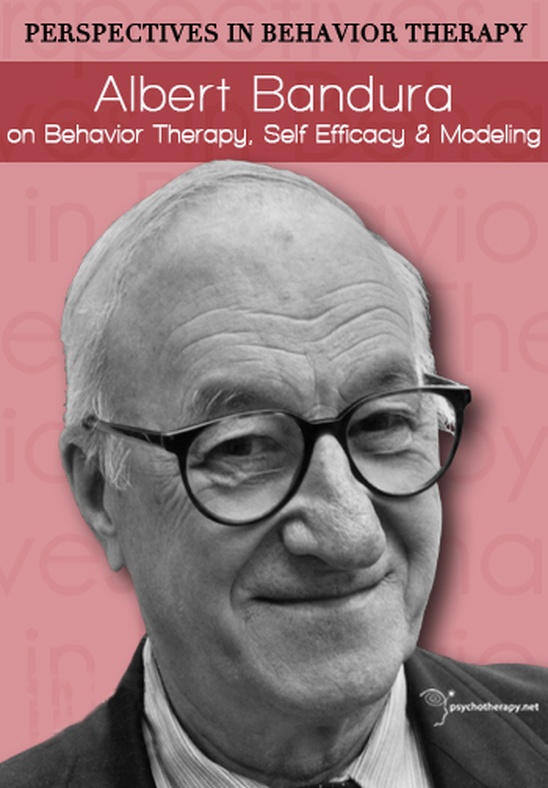
Albert Bandura on Behavior Therapy, Self Efficacy & Modeling
Video
with
Albert Bandura, PhD
Video

Albert Bandura on Behavior Therapy, Self Efficacy & Modeling

In this enlightening conversation with one of the most prolific and influential psychologists of all time, Dr. Albert Bandura relates the breakthrough moments leading to the development of social cognitive theory and his theories of social learning, guided mastery, and self-efficacy. Video length: 54m
Buy a Membership
COURSE DETAILS

Overview

In this engaging interview, the founder of social cognitive theory and the theory of self-efficacy reveals his early fascination with the wide-ranging effects of behavior modification. The “spillover” effect from one behavior to other areas of functioning made it possible to radically improve people’s lives with relatively small changes in behavior. Believing that there must be more instances of this phenomenon, he set out to find them, compiling and distilling what he learned into his first article on the uses of learning theory for therapy.

In this conversation with Toni Zeiss, Bandura also examines the contributions of behavioral insight for psychotherapy, including the significance of social environments in shaping personality and behavior, the ability to conduct more rigorous clinical research, and the extended purview of therapy to include prevention work. He argues that while important, these contributions were not adequate, as “I was also marshaling a lot of evidence that these conditioning processes were, in fact, cognitively mediated.” By then outlining the conceptual model and process of guided mastery, Bandura provides a very useful clinical tool that therapists of any orientation can easily integrate in their practice.

Not only was he instrumental in developing groundbreaking theories about how we learn, Bandura also worked to apply his theories to pressing social issues on a global scale. Before social justice became widely acknowledged as a critical aspect of applied psychology, Bandura was involved in a project broadcasting soap operas in developing nations in which women were portrayed exercising control over their reproductive health. From his famous Bobo doll experiment all the way through his recent work in societal change processes, Bandura describes the evolution of his theories and their application through vivid stories of his breakthrough moments.


About the Experts

Albert Bandura, PhD
Expert

Albert Bandura, PhD

Albert Bandura is the David Starr Jordan Professor Emeritus of Social Science in Psychology at Stanford University and the author of ten books, including Self-efficacy: The Exercise of Control and Social Foundations of Thought and Action: A Social Cognitive Theory. For nearly six decades, he has been responsible for contributions to many fields of psychology, including social cognitive theory, therapy, personality psychology, self-efficacy, and was also influential in the transition between behaviorism and cognitive psychology. It was during his studies on adolescent aggression…

View full profile

Disclosures

Albert Bandura was compensated for his/her/their contribution. None of his/her/their books or additional offerings are required for any of the Psychotherapy.net content. Should such materials be referenced, it is as an additional resource.

This Disclosure Statement has been designed to meet accreditation standards; Psychotherapy.net does its best to mitigate potential conflicts of interest and eliminate bias in all areas of content. Psychotherapy.net offers training for cost but has no financial or other relationships to disclose. Additionally, there is no commercial support for this activity. None of the planners or any employee at Psychotherapy.net who has worked on this educational activity has relevant financial relationship(s) to disclose with ineligible companies.

Psychotherapy.net defines ineligible companies as those whose primary business is producing, marketing, selling, re-selling, or distributing healthcare products used by or on patients. There is no minimum financial threshold; individuals must disclose all financial relationships, regardless of the amount, with ineligible companies. We ask that all contributors disclose any and all financial relationships they have with any ineligible companies whether the individual views them as relevant to the education or not. Each experts’ specific disclosures can be found in their biography.

Living Adoption: Gay Parents Speak
  • Video

Living Adoption: Gay Parents Speak

  • Premium
Masterclass in Advanced Psychotherapy Skills, Volume 1: Deepening Client Self-Discovery
  • Course

Masterclass in Advanced Psychotherapy Skills, Volume 1: Deepening Client Self-Discovery

Dance Therapy and Authentic Movement
  • Video

Dance Therapy and Authentic Movement

Do Not Go Gently
  • Video

Do Not Go Gently

Irvin Yalom on Grief, Loss, and Growing Old
  • Video

Irvin Yalom on Grief, Loss, and Growing Old