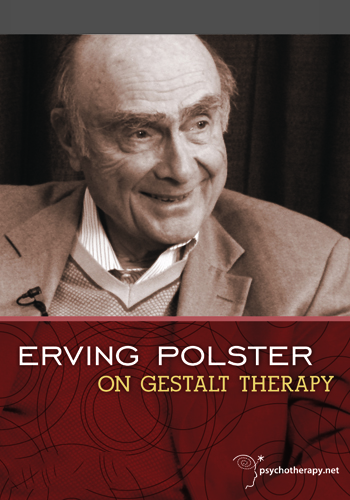
Erving Polster on Gestalt Therapy
Video
with
Erving Polster, PhD
Video

Erving Polster on Gestalt Therapy

In this in-depth interview, you’ll get to know Polster’s unique take on Gestalt therapy and see for yourself how he boldly elevates ordinary conversations into life-affirming encounters.
  Video length: 1h
Buy a Membership
COURSE DETAILS

Overview

In the psychotherapy profession, there are many experts, but few true masters, and Erving Polster is certainly one of the latter. Weaving together stories from his formative experiences with Fritz and Laura Perls, and significant lessons from his five decades as a psychotherapist, Polster offers in this interview timeless wisdom for new and seasoned therapists alike.

Join Polster in this intimate conversation with psychotherapist Rafal Mietkiewicz as he explores fundamental Gestalt principles such as the paradoxical theory of change and the importance of the therapeutic relationship, while learning the pitfalls of being a new therapist, such as the dangers of imitating the masters. Enjoy the spontaneous role-play, which highlights Polster’s exceptional skill in bringing freshness and aliveness to a session with a highly self-critical client.

With surprising revelations such as, “I don’t concentrate on the here and now,” “I’m not interested in changing anything,” and, “I am there to create conflicts,” viewers will gain insight into the nuanced perspective of a brilliant, innovative, and free-thinking therapist, while getting a clear understanding of the essence of Gestalt therapy. Most importantly, you’ll get a sense of Erv Polster, the person—fully vital in his eighties—and how he brings his full self into his therapeutic work.

About the Experts

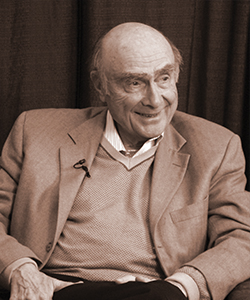
Erving Polster, PhD
Expert

Erving Polster, PhD

Erving Polster, PhD (1922-2024) was the Director of The Gestalt Institute of San Diego, and the author of several important books, including Gestalt Therapy Integrated, Every Person's Life is Worth a Novel, and From the Radical Center: The Heart of Gestalt Therapy, as well as dozens of articles and chapters.

View full profile

Disclosures

Erving Polster was compensated for his/her/their contribution. None of his/her/their books or additional offerings are required for any of the Psychotherapy.net content. Should such materials be references, it is as an additional resource.

This Disclosure Statement has been designed to meet accreditation standards; Psychotherapy.net does its best to mitigate potential conflicts of interest and eliminate bias in all areas of content. Psychotherapy.net offers training for cost but has no financial or other relationships to disclose. Additionally, there is no commercial support for this activity. None of the planners or any employee at Psychotherapy.net who has worked on this educational activity has relevant financial relationship(s) to disclose with ineligible companies.

Psychotherapy.net defines ineligible companies as those whose primary business is producing, marketing, selling, re-selling, or distributing healthcare products used by or on patients. There is no minimum financial threshold; individuals must disclose all financial relationships, regardless of the amount, with ineligible companies. We ask that all contributors disclose any and all financial relationships they have with any ineligible companies whether the individual views them as relevant to the education or not. Each experts’ specific disclosures can be found in their biography.

Interpersonal Psychotherapy: A Case of Postpartum Depression
  • Video

Interpersonal Psychotherapy: A Case of Postpartum Depression

Social Workers Effecting Change: Legislative Advocacy
  • Video

Social Workers Effecting Change: Legislative Advocacy

Imago Couples Therapy
  • Video

Imago Couples Therapy

Irvin Yalom on Psychotherapy and Writing
  • Video

Irvin Yalom on Psychotherapy and Writing

Down Every Year: A Demonstration of Depth Oriented Brief Therapy
  • Video

Down Every Year: A Demonstration of Depth Oriented Brief Therapy