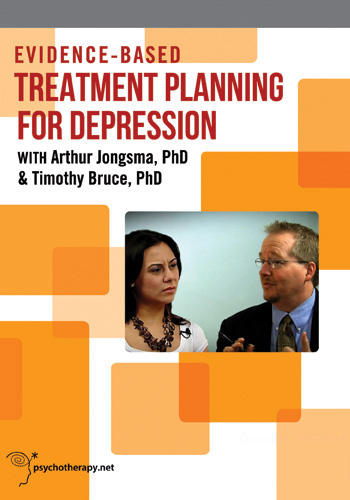
Today’s clinicians are increasingly required to submit clear, standardized treatment plans for clients’ presenting problems—but what these plans actually look like hasn’t been as clearly defined. If you’ve been wondering what, exactly, comprises such a plan or have searched for resources on the empirically supported treatments on which these plans are based, you’ll find answers in this new video with Drs. Timothy Bruce and Arthur Jongsma. Here, the two seasoned clinicians focus on depression as they offer the essential elements of evidence-based treatment planning.
Bruce and Jongsma begin with a clinical review of depression and the features of a major depressive episode (MDE), as outlined in the DSM. Moving at a fast clip, they distinguish between the four major types of mood episodes, expand on the relationship between mood episodes and mood disorders, and offer tools for distinguishing and remembering the criteria of an MDE. You’ll also gain a solid understanding of their six-step treatment planning process, with an emphasis on building a plan informed by the latest empirically supported treatments (ESTs).
Theories, approaches, and interventions abound as the clinicians outline both the “well-established” and “probably efficacious” treatments, describing six of the former in detail. A brief history of the EST movement provides further clinical context.
You’ll find sample treatment plans here, along with expert commentary on the most researched ESTs. Through a series of live demonstrations with a depressed woman named Maria, you’ll watch her therapist bring her to new insights and adaptive behaviors using cognitive restructuring, interpersonal skills training, behavioral activation, and other proven interventions. Definitions, goals, and relapse prevention are covered, too—but as Bruce and Jongsma show, the methods are only effective within the context of an empathic therapeutic relationship.
Look no further than this new video for a comprehensive education that you can immediately use to support client growth, satisfy professional requirements, and build clinical confidence.
This video is part of the 12-video series, Evidence-Based Treatment Planning. Titles in this series include:
- Evidence-Based Treatment Planning for Anger Control Problems
- Evidence-Based Treatment Planning for Bipolar Disorder
- Evidence-Based Treatment Planning for Depression
- Evidence-Based Treatment Planning for Eating Disorders and Obesity
- Evidence-Based Treatment Planning for Panic Disorder
- Evidence-Based Treatment Planning for Post-Traumatic Stress Disorder
- Evidence-Based Treatment Planning for Social Anxiety Disorder
- Evidence-Based Treatment Planning for Disruptive Child and Adolescent Behavior
- Evidence-Based Treatment Planning for Obsessive Compulsive Disorder
- Evidence-Based Treatment Planning for Substance Use Disorders
- Evidence-Based Psychotherapy Treatment Planning
- Evidence-Based Treatment Planning for Generalized Anxiety Disorder