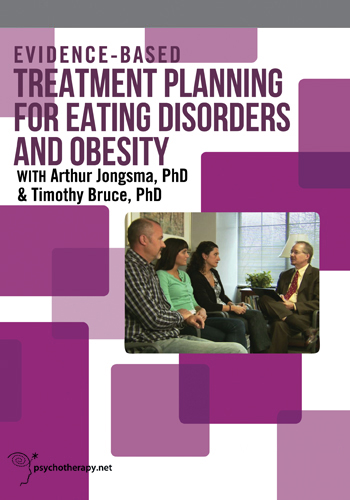
Evidence-Based Treatment Planning for Eating Disorders and Obesity
Video
with
Timothy Bruce, PhD, Arthur Jongsma, Jr., PhD
Video

Evidence-Based Treatment Planning for Eating Disorders and Obesity

Eating disorders have the highest mortality rate of any mental illness and pose immense challenges to clinicians, family members and, most of all, clients. Learn how to create a clear, well-developed treatment plan to sustain your efforts and maximize your chances for a successful outcome in this comprehensive video.
Video length: 1h 20m
COURSE DETAILS

Overview

Eating disorders present a complex array of features that require nuanced assessment, focused interventions, and detailed treatment planning. Expert clinicians Drs. Timothy Bruce and Arthur Jongsma cover each of these areas at length in this comprehensive video, giving practitioners a solid empirical foundation on which to build evidence-based treatment plans. With thorough descriptions of symptoms and thoughtful commentary on case vignettes, Bruce and Jongsma have made this essential clinical process easier to understand and implement.

Noting that treatment plans aren’t created in a vacuum, but rather tailored to each client within the context of an authentic, empathic relationship, Bruce and Jongsma present an overview of three eating disorders (anorexia nervosa, bulimia nervosa, and binge eating disorder) and their respective DSM features, along with a description of obesity and its psychologically informed elements that may be responsive to clinical treatment. The two clinicians anchor this information with a six-step treatment planning process for eating disorders and obesity, geared toward building a plan consistent with empirically supported treatments (ESTs). A brief history of the EST movement provides further context.

You’ll find sample treatment plans here, along with the clinicians’ expert commentary on the most researched ESTs for eating disorders. Through a series of live demonstrations with clients and their family members, you’ll watch therapists incorporate skillful interventions (including psychoeducation, cognitive restructuring, parental involvement, and “surfing the urge”) based on the approaches of Family-Based Therapy, Cognitive-Behavioral Therapy, Interpersonal Therapy, and the LEARN model. Definitions, goals, and relapse prevention are covered, too, for a well-rounded set of tools you can start using immediately to support your clients’ improvement while meeting increasingly stringent professional standards.

If you’ve been searching for resources on eating disorders or need to know how to create evidence-based treatment plans with confidence, look no further than this comprehensive video.

This video is part of the 12-video series, Evidence-Based Treatment Planning. Titles in this series include:

  • Evidence-Based Treatment Planning for Anger Control Problems
  • Evidence-Based Treatment Planning for Bipolar Disorder
  • Evidence-Based Treatment Planning for Depression
  • Evidence-Based Treatment Planning for Eating Disorders and Obesity
  • Evidence-Based Treatment Planning for Panic Disorder
  • Evidence-Based Treatment Planning for Post-Traumatic Stress Disorder
  • Evidence-Based Treatment Planning for Social Anxiety Disorder
  • Evidence-Based Treatment Planning for Disruptive Child and Adolescent Behavior
  • Evidence-Based Treatment Planning for Obsessive Compulsive Disorder
  • Evidence-Based Treatment Planning for Substance Use Disorders
  • Evidence-Based Psychotherapy Treatment Planning
  • Evidence-Based Treatment Planning for Generalized Anxiety Disorder

About the Experts

Timothy Bruce, PhD
Expert

Timothy Bruce, PhD

Timothy Bruce, PhD, is Professor and Associate Chair of the Department of Psychiatry and Behavioral Medicine. A summa cum laude graduate of the honors program curriculum at Indiana State University, Bruce received his Ph.D. in Clinical Psychology from The University at Albany-State University of New York under the mentorship of Dr. David Barlow. He completed his residency training at Wilford Hall USAF Medical Center under the direction of Dr. Robert Klepac. Bruce is active in the clinical, educational, and scholarship missions…

View full profile
Arthur Jongsma, Jr., PhD
Expert

Arthur Jongsma, Jr., PhD

Arthur Jongsma, Jr., PhD, is Series Editor for the bestselling PracticePlanners® . Since 1971, he has provided professional mental health services to both inpatient and outpatient clients. He managed a group private practice for twenty-five years and is now the Executive Director of Life Guidance Services in Grand Rapids, Michigan.

View full profile

Disclosures

Timothy Bruce and Arthur Jongsma, Jr. were compensated for their contribution. None of their books or additional offerings are required for any of the Psychotherapy.net content. Should such materials be referenced, it is as an additional resource.

This Disclosure Statement has been designed to meet accreditation standards; Psychotherapy.net does its best to mitigate potential conflicts of interest and eliminate bias in all areas of content. Psychotherapy.net offers training for cost but has no financial or other relationships to disclose. Additionally, there is no commercial support for this activity. None of the planners or any employee at Psychotherapy.net who has worked on this educational activity has relevant financial relationship(s) to disclose with ineligible companies.

Psychotherapy.net defines ineligible companies as those whose primary business is producing, marketing, selling, re-selling, or distributing healthcare products used by or on patients. There is no minimum financial threshold; individuals must disclose all financial relationships, regardless of the amount, with ineligible companies. We ask that all contributors disclose any and all financial relationships they have with any ineligible companies whether the individual views them as relevant to the education or not. Each experts’ specific disclosures can be found in their biography.

The Therapeutic Community, Volume I: The Therapeutic Community Perspective
  • Video

The Therapeutic Community, Volume I: The Therapeutic Community Perspective

“I’d Hear Laughter”: Finding Solutions for the Family
  • Video

“I’d Hear Laughter”: Finding Solutions for the Family

Experiential Techniques for Moving Beyond “How Do You Feel?” Hamed: Prompting Self-Discovery
  • Video

Experiential Techniques for Moving Beyond “How Do You Feel?” Hamed: Prompting Self-Discovery

Gestalt Art Therapy Class: A Personal Mythology Perspective
  • Video

Gestalt Art Therapy Class: A Personal Mythology Perspective

Healing Incest and Complex Childhood Trauma with Couples: A Collaborative Change Model
  • Course

Healing Incest and Complex Childhood Trauma with Couples: A Collaborative Change Model