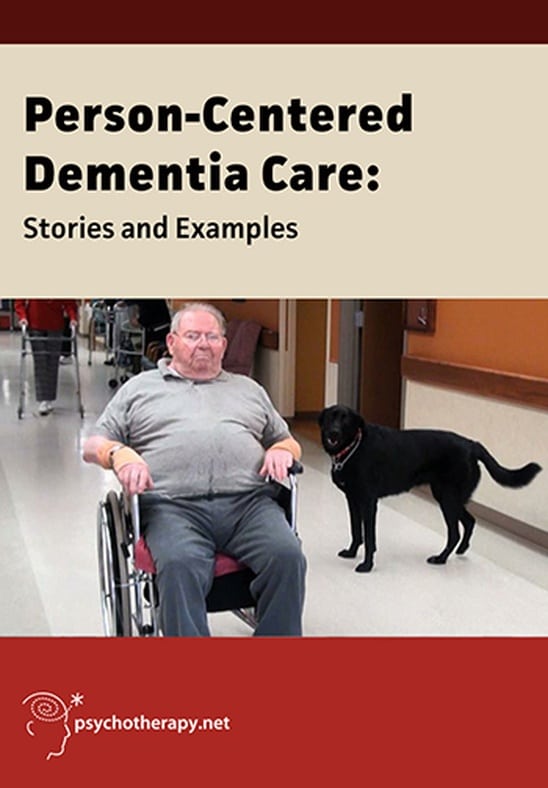
Person-Centered Dementia Care: Stories and Examples
Video
with
Terra Nova Films
Video

Person-Centered Dementia Care: Stories and Examples

This video explores a residential facility that celebrates older people with dementia and aids the viewer in learning to connect with people who have lost the connection to themselves.   Video length: 31m
COURSE DETAILS

Overview

In this video, spend a day in a residence that cares for older people who are living with dementia. In a world that values youth and vigor, doing and ability, it’s easy to forget the life-affirmations that can be present in the elderly, even those whose minds stop them from being fully independent.

Deb Greiner, the Director of Alzheimer’s services at a rehabilitation and nursing center, does an incredible job taking us through her thirty years’ experience of working with people with dementia. She reminds us that the person can still “care and feel” even if their mind is not what it was—something that can be easy to forget. It’s not uncommon for relatives and friends to distance themselves from a loved one with dementia, but Greiner shows us how to stay connected.

The video does not shy away from the indignity and heartbreak of a patient like Elaine who spends hours trying to “escape,” going so far as to try to throw her walker out her window to get to her family and home. Ms. Greiner talks about how she sits with Elaine, and how sometimes very little can be done by the worker beyond being a calm presence making sure the client remains safe. The video reminds us of the importance of the main skill that social workers and other mental health professionals excel at: forming relationships. While we are often taught several great techniques to encourage people to open up and talk about their history and their feelings, in this video you’ll witness how simply serving a meal in a dignified manner can be healing.

About the Experts

Disclosures

Terra Nova Films was compensated for their contribution. None of their books or additional offerings are required for any of the Psychotherapy.net content. Should such materials be references, it is as an additional resource.

This Disclosure Statement has been designed to meet accreditation standards; Psychotherapy.net does its best to mitigate potential conflicts of interest and eliminate bias in all areas of content. Psychotherapy.net offers training for cost but has no financial or other relationships to disclose. Additionally, there is no commercial support for this activity. None of the planners or any employee at Psychotherapy.net who has worked on this educational activity has relevant financial relationship(s) to disclose with ineligible companies.

Psychotherapy.net defines ineligible companies as those whose primary business is producing, marketing, selling, re-selling, or distributing healthcare products used by or on patients. There is no minimum financial threshold; individuals must disclose all financial relationships, regardless of the amount, with ineligible companies. We ask that all contributors disclose any and all financial relationships they have with any ineligible companies whether the individual views them as relevant to the education or not. Each experts’ specific disclosures can be found in their biography.

Integrating the Arts in Therapy: Learning from the Pioneers
  • Video

Integrating the Arts in Therapy: Learning from the Pioneers

John Bowlby on Attachment and Psychotherapy
  • Video

John Bowlby on Attachment and Psychotherapy

Multicultural Competence in Counseling & Psychotherapy
  • Video

Multicultural Competence in Counseling & Psychotherapy

Solution-Focused Techniques with a Child
  • Video

Solution-Focused Techniques with a Child

Couples: Two Art Evaluations
  • Video

Couples: Two Art Evaluations