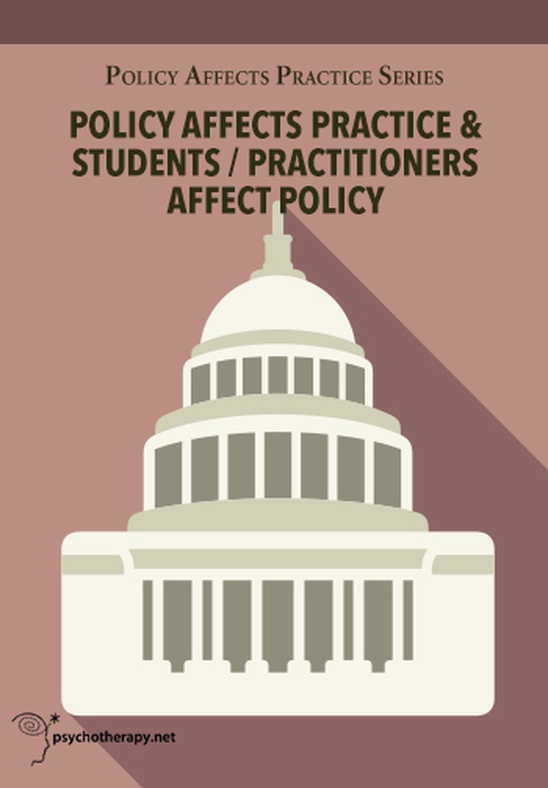
Policy Affects Practice & Students/Practitioners Affect Policy
Video
with
Influencing Social Policy
Video

Policy Affects Practice & Students/Practitioners Affect Policy

Does the thought of becoming active in the policy-making process fill you with dread? This video will help lessen your fears and give you specific tools to help you be a more effective advocate.   Video length: 19m
COURSE DETAILS

Overview

Many social work students enter the field with one thought in their mind: how can I help people? But even students whose focus isn’t direct practice often feel powerless or anxious when it comes to calling their congressperson or testifying at a committee meeting.

This video, the third in the series, Policy Affects Practice, is intended to educate and inspire students (as well as faculty and other practitioners) to participate in their state legislative and decision-making processes. Featuring students, BSWs, MSWs, and PhDs, this video shows how inspiring policy making can be, and why it is required by the National Association of Social Worker’s Code of Ethics.

Ready to affect your practice through policy? Included in the video are concrete steps students at any level can begin to take right away. The fear is real, but not a sufficient reason to stay on the sidelines—let these students show you the way.

After watching this series you’ll be able to:

  • Describe how a budget is formed.
  • Understand the legislative process and describe the steps for enacting legislation.
  • Understand the importance of building coalitions with other social workers and learn how to do this effectively.
  • Explain how direct practice experience can be an effective tool when advocating on the macro level.
  • Illustrate the ethical dimensions of lobbying Congress for social workers using the National Association of Social Worker’s Code of Ethics.

This video is part of the 6-video series, Policy Affects Practice. Other self-study videos in this series include:

  • Creating Change: Building a Legislative Coalition
  • Social Workers Effecting Change: Legislative Advocacy
  • Making a Difference: Influencing State Policy
  • Social Work Advocacy: The State Budget
  • Policy Affects Practice & Students/Practitioners Affect Policy
  • Social Work: Practicing in a Century of Change

About the Experts

Influencing Social Policy
Expert

Influencing Social Policy

ISP is the only national membership organization dedicated exclusively to promoting social work’s involvement in policy and policy practice. Now a 501(c)3, it was created in 1997—in the wake of welfare reform–to address concerns about devolution. Comprised of social work educators, students, and practitioners, its expanded mission seeks to increase social work efficacy in influencing policy at all levels of government by educating students in policy and policy practice, and engaging students and faculty in the policy-making and political processes.…

View full profile

Disclosures

Influencing Social Policy was compensated for their contribution. None of their books or additional offerings are required for any of the Psychotherapy.net content. Should such materials be references, it is as an additional resource.

This Disclosure Statement has been designed to meet accreditation standards; Psychotherapy.net does its best to mitigate potential conflicts of interest and eliminate bias in all areas of content. Psychotherapy.net offers training for cost but has no financial or other relationships to disclose. Additionally, there is no commercial support for this activity. None of the planners or any employee at Psychotherapy.net who has worked on this educational activity has relevant financial relationship(s) to disclose with ineligible companies.

Psychotherapy.net defines ineligible companies as those whose primary business is producing, marketing, selling, re-selling, or distributing healthcare products used by or on patients. There is no minimum financial threshold; individuals must disclose all financial relationships, regardless of the amount, with ineligible companies. We ask that all contributors disclose any and all financial relationships they have with any ineligible companies whether the individual views them as relevant to the education or not. Each experts’ specific disclosures can be found in their biography.

The 7 Skills for Addiction-Free Living: Behavioral Self-Control
  • Video

The 7 Skills for Addiction-Free Living: Behavioral Self-Control

Stages of Change for Addictions
  • Video

Stages of Change for Addictions

Experiential Techniques for Moving Beyond “How Do You Feel?” Hamed: Prompting Self-Discovery
  • Video

Experiential Techniques for Moving Beyond “How Do You Feel?” Hamed: Prompting Self-Discovery

James Hillman on Archetypal Psychotherapy
  • Video

James Hillman on Archetypal Psychotherapy

Phenomenological Art Therapy Same Client at Ages 10 and 15
  • Video

Phenomenological Art Therapy Same Client at Ages 10 and 15