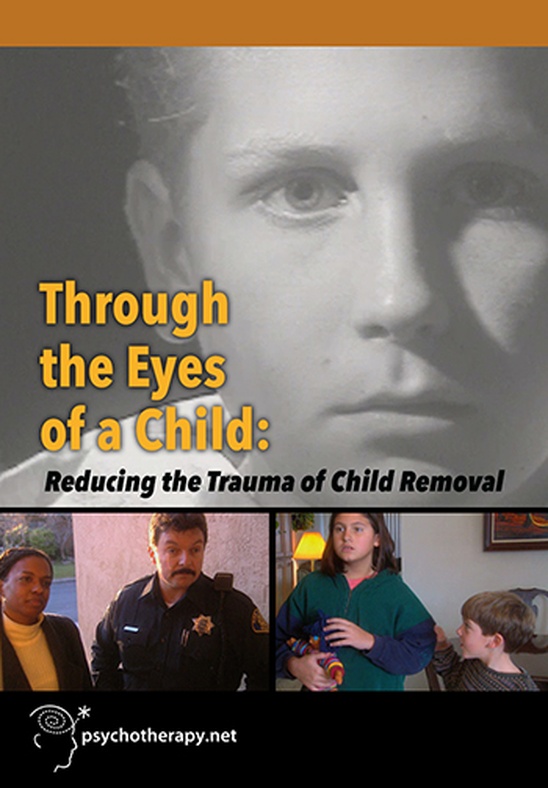
Through the Eyes of a Child: Reducing the Trauma of Child Removal
Video
with
Tam Communications
Video

Through the Eyes of a Child: Reducing the Trauma of Child Removal

Through the Eyes of a Child addresses the delicate circumstances that arise when child endangerment is serious enough to warrant removal from the home. It emphasizes the traumatic impact children feel from being removed from their families and why the decision must be a last resort only when children are in immediate danger. The video explains, through experts' findings, the lasting psychological trauma removal causes children.   Video length: 22m  
COURSE DETAILS

Overview

Social workers, child welfare workers, and law enforcement officers are generally trained to handle reports of child abuse. But even these skilled professionals are not always adequately trained in how to properly remove children from their homes in severe cases.

The video reenacts a case handled by a social worker and a police officer in which two children must be removed from their home due to abuse by their mother. It walks viewers through every aspect of this process, from how to prepare before going to a home to the actual removal.
The scenes are narrated with straightforward tips and techniques, and interviews with child welfare and law enforcement experts are interspersed between the reenactments. This insightful training tool reminds viewers to handle each step of the process in a highly sensitive manner, as if seen through the eyes of a child.

The video answers important questions professionals may ask themselves before handling such challenging cases, including what to say to parents, what to say to children, and where to bring a child once removal has occurred. The video stresses the benefits of family cooperation and relatives taking in children, so as to make the process less traumatic for the child. Common situations encountered by caseworkers are reenacted, including how to handle the emotional reactions of children and families.

About the Experts

Disclosures

Tam Communications was compensated for his/her/their contribution. None of his/her/their books or additional offerings are required for any of the Psychotherapy.net content. Should such materials be references, it is as an additional resource.
This Disclosure Statement has been designed to meet accreditation standards; Psychotherapy.net does its best to mitigate potential conflicts of interest and eliminate bias in all areas of content. Psychotherapy.net offers training for cost but has no financial or other relationships to disclose. Additionally, there is no commercial support for this activity. None of the planners or any employee at Psychotherapy.net who has worked on this educational activity has relevant financial relationship(s) to disclose with ineligible companies.

Psychotherapy.net defines ineligible companies as those whose primary business is producing, marketing, selling, re-selling, or distributing healthcare products used by or on patients. There is no minimum financial threshold; individuals must disclose all financial relationships, regardless of the amount, with ineligible companies. We ask that all contributors disclose any and all financial relationships they have with any ineligible companies whether the individual views them as relevant to the education or not. Each experts’ specific disclosures can be found in their biography.

Art as Therapy for Older Adults
  • Video

Art as Therapy for Older Adults

Wheel Art: An Inspired Idea
  • Video

Wheel Art: An Inspired Idea

Experiential Family Therapy
  • Video

Experiential Family Therapy

Artists Facing Cancer by Making Art
  • Video

Artists Facing Cancer by Making Art

Rollo May on Existential Psychotherapy
  • Video

Rollo May on Existential Psychotherapy