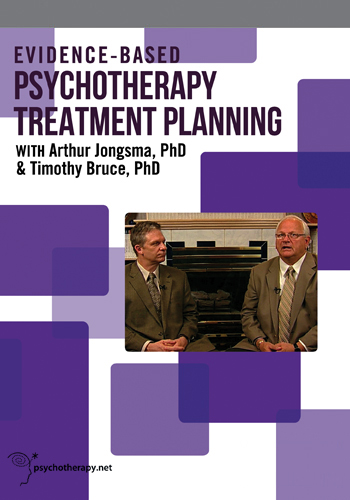
Given the vast array of clinical approaches at our disposal, what makes one treatment more viable than another? As we work with our clients, what guidelines inform our interventions, and how do we measure progress? Regardless of your theoretical orientation, you’ll find valuable takeaways in this video with Drs. Timothy Bruce and Arthur Jongsma. As an introduction to a rich series on evidence-based treatment planning for a host of clinical conditions, this video offers fresh information on the history of empirically supported treatments (ESTs), along with tools for building a successful practice informed by the latest research.
Topics covered include the history of the movement to identify empirically supported treatments and their growth over time, the principles of evidence-based practice (EBP), the advantages and limitations of ESTs, and the essential elements of treatment planning, including how to empirically inform them. You’ll learn about the key role of APA Division 12 in evaluating different approaches, what constitutes “well-established” and “probably efficacious” treatment (with definitions, examples, comparisons and contrasts), and you’ll get useful resources for further exploration.
Bruce and Jongsma’s combined decades of clinical and teaching experience makes for important commentary, and they offer insights on the value of the therapeutic relationship as an asset to treatment beyond the content of an EST. Within this context, they describe their six-step treatment planning process—complete with a sample treatment plan—with the goal of helping you design plans consistent with ESTs and integrate them into a broader evidence-based practice.
If you’re looking for a comprehensive introduction to evidence-based treatment planning, look no further. With this video, Bruce and Jongsma offer a solid rationale for taking a scientist-practitioner, hypothesis-testing approach to treatment planning, and they provide an illustrated, easy-to-understand method to do so with confidence.
This video is part of the 12-video series, Evidence-Based Treatment Planning. Titles in this series include:
- Evidence-Based Treatment Planning for Anger Control Problems
- Evidence-Based Treatment Planning for Bipolar Disorder
- Evidence-Based Treatment Planning for Depression
- Evidence-Based Treatment Planning for Eating Disorders and Obesity
- Evidence-Based Treatment Planning for Panic Disorder
- Evidence-Based Treatment Planning for Post-Traumatic Stress Disorder
- Evidence-Based Treatment Planning for Social Anxiety Disorder
- Evidence-Based Treatment Planning for Disruptive Child and Adolescent Behavior
- Evidence-Based Treatment Planning for Obsessive Compulsive Disorder
- Evidence-Based Treatment Planning for Substance Use Disorders
- Evidence-Based Psychotherapy Treatment Planning
- Evidence-Based Treatment Planning for Generalized Anxiety Disorder