Finding Healing Through Art: A Case Study in Art Therapy

Art Therapy is a powerful form of psychotherapy that uses creative expression to help individuals explore emotions, process trauma, and find pathways to healing. Unlike traditional talk therapy, Art Therapy offers a non-verbal outlet, allowing clients to express feelings that may be difficult to articulate. By tapping into the subconscious, art can reveal hidden emotions, facilitating self-discovery and growth. In this case study, I’ll explore how art therapy transformed the life of Julia, a young woman struggling with anxiety and self-doubt.

Julia’s Journey to Art Therapy

Julia, a 28-year-old woman, came to therapy seeking help for anxiety. She described herself as “constantly on edge,” plagued by feelings of inadequacy and fear of judgment. She had tried various coping mechanisms, but none provided lasting relief. When talk therapy didn’t yield the progress she hoped for, Julia decided to explore art therapy as an alternative. Although Julia had no formal art background, she had always been creative. As a child, she enjoyed drawing and painting but had abandoned these hobbies as her responsibilities grew. During our initial session, Julia was open but hesitant. She expressed concerns about her lack of artistic skill, unsure if she could convey her feelings through art. I reassured her that Art Therapy wasn’t about creating “good” art, but rather, about expressing oneself freely and authentically. Together, we embarked on a journey to explore her inner world through colors, shapes, and symbols.

Session One: Laying the Foundation

To ease Julia into the process, I introduced her to a simple exercise called “Art for Emotion.” She was given a set of colored pencils and paper, and I asked her to draw how she felt at that moment. Julia chose dark, muted colors—black, gray, and navy. She created a swirling, chaotic pattern, which she described as a “storm” in her mind. This storm, she said, represented the anxiety that constantly loomed over her, making it difficult to focus and connect with others. As we discussed the drawing, Julia began to open up about the ways anxiety affected her life. She described feeling as though she were “drowning” in her responsibilities and unable to meet her own high standards. She admitted that she was often overly critical of herself, which only fueled her feelings of inadequacy. Together, we explored how these swirling emotions manifested in her daily life, from her job to her relationships.

Session Two: Exploring Symbols

In the second session, I introduced Julia to clay. Working with clay allows clients to engage with tactile sensations, which can be grounding and soothing. I encouraged her to create a symbol that represented her anxiety. After some thought, she molded the clay into a small, tightly-wound spiral. The spiral, she explained, was a representation of her tendency to overthink and get trapped in cycles of self-doubt. As we discussed her creation, Julia had an insight: she often felt like she was “spiraling” out of control when faced with uncertainty. By externalizing this feeling through clay, she was able to examine it more objectively. We talked about how anxiety is a natural response, but when it becomes too intense, it can feel like being caught in a relentless loop. Julia began to see her anxiety not as a personal failing, but as a reaction to stressors in her environment.

Session Three: Redefining the Self

By the third session, Julia seemed more comfortable with the process. She was starting to embrace the therapeutic benefits of creative expression, and her initial reluctance had faded. This time, I suggested a self-portrait exercise, asking her to draw herself as she currently saw herself. Julia spent a long time working on this piece. When she was finished, she showed me a drawing of a woman standing on a cliff, looking out over a vast, empty sea. The woman appeared small and vulnerable, dwarfed by the landscape. Julia described the scene as representing her feelings of isolation and uncertainty. The cliff, she explained, symbolized the constant pressure she felt to maintain control and avoid falling into despair. Through this self-portrait, Julia was able to articulate her fear of failure and the pressure to keep up appearances. She expressed how exhausting it was to always be “on guard” and how much she longed for peace. In our discussion, we explored the symbolism of the cliff and the sea. Julia admitted that the sea, while initially representing emptiness, also held a sense of possibility. She recognized that the vastness of the ocean could symbolize potential rather than just fear. This shift in perspective marked a significant turning point. For the first time, Julia began to see her anxiety not as an insurmountable obstacle, but as something she could navigate and overcome.

Session Four: Reclaiming Inner Strength

By this session, Julia had begun to show a marked improvement. She appeared more relaxed, and there was a newfound sense of confidence in her demeanor. For this session, I introduced a collage exercise. Julia was provided with magazines, scissors, glue, and a canvas. I asked her to create a collage that represented her ideal self—a version of herself free from anxiety and self-doubt. Julia took her time with this exercise, carefully selecting images that resonated with her. Her final piece was vibrant, filled with images of nature, people laughing, and symbols of strength like lions and mountains. She explained that the collage represented the qualities she wished to embody: resilience, joy, and courage. We discussed each element of the collage, and Julia shared how creating it made her feel empowered. By envisioning her ideal self, she began to see her potential beyond the limitations of her anxiety. She acknowledged that while she might always face challenges, she could choose how to respond to them. This realization helped Julia redefine her relationship with anxiety, no longer seeing it as a defining characteristic, but as one part of her broader experience.

Session Five: Reflecting and Moving Forward

In our final session, Julia and I revisited her earlier pieces. We discussed her journey through the Art Therapy process, from the initial storm of emotions to the empowered collage. Julia reflected on how far she had come, expressing gratitude for the opportunity to explore her feelings in such a unique and transformative way. She described how the process helped her develop a greater sense of self-compassion, allowing her to accept her imperfections without judgment. Through art therapy, Julia found a new way to manage her relationship with anxiety, one that didn’t involve fighting or suppressing her emotions. Instead, she learned to embrace her feelings, understanding that they were a natural part of her experience. She left therapy with a renewed sense of self, ready to face the challenges ahead with resilience and creativity.

***

Art Therapy offers a unique path to healing, one that goes beyond words and taps into the power of the creative mind. For Julia, the process of expressing herself through art provided insights that traditional talk therapy hadn’t been able to access. By working with symbols, colors, and textures, Julia was able to confront her anxiety in a safe and supportive environment, ultimately reclaiming her inner strength. Her journey is a testament to the transformative power of art and the human spirit’s capacity for growth and healing. [Editor’s Note: Please see our interview with Judith Rubin, Bringing (Art) Therapy to Life: An Interview with Judith Rubin, the preeminent pioneer in the field of Art Therapy.] 

Creative Writing as Psychotherapy

“An interesting fusion.” That’s what my project Wild Words was once called by a fellow psychotherapist, and yes, he was looking down his nose at me. But I’ve discovered a huge demand for the fusion of body-based, nature-based, and narrative therapy, via which I help people to find creative flow in their lives. Here’s one recent example.

A stooped 17 year-old man came to me. He had a mop of black hair and smelled of spirits. There were tensions in the family, and his father thought “that some poetry tuition might help relax him.” As I’ve seen many times, my authority as a university creative writing tutor allowed the family to ask for help, without having to admit to themselves or others that what they were really seeking was psychotherapeutic support.

Jed told me that all he wanted to do was to be a poet, but “nothing comes out right.” He didn’t care about my qualifications, but he liked the concept of writing “Wild Words.” He said it would be nice to feel like a wild animal when he wrote, but instead, he usually felt more like his little brother’s hamster, going round and round on its wheel.

As we talked, he asked me crossly why I hadn’t yet asked to see his writing, and motioned to the groaning backpack sitting at his feet. But I didn’t need to look at his writing to understand what was going on, I only had to look at his body. His skin was sickly white. His hands were blue with cold, even though the room was warm. Sometimes, when he told me about the subject of his poetry, color rose in his cheeks, but it was quickly followed by a deflation of his body, and a draining of color. And then, of course, there was the smell of alcohol.

He asked me, even more angrily, why I hadn’t asked him for the reasons for his “writer’s block,” the reason he couldn’t write well. I said that I was sure he already knew the reason, and that he’d probably already thought through it a thousand times to no avail. I was going to try a different approach. He looked skeptical. He told me the reason anyway. Apparently, his father was a well-known poet. “I’m scared that I will never write like my father,” he said. “And it’s ceasing me up.”

I asked him then to remember a time when he did write well, when the words flowed. He told me about a writing competition he had won when he was twelve. I invited him to close his eyes, to remember that experience, and to see how it felt in his body. He told me he felt a warmth, a relaxation spreading from his chest out through his limbs.

Next, I asked him to think about a time when he sat down to write but felt blocked. Where in his body was that physical sense of block? He told me it was in his stomach. At this point he started telling me again about his fears of not matching up to his father’s success. I told him not to think, but to just stay with his bodily experience. If he scanned his body, despite the feeling of block in his chest, was there a place where he still felt the warmth or movement from the writing competition experience? He said yes, there was. It was in his hand. I then got him to move his attention back and forth between his stomach and his hand, touching into the block, and then back again to a place of relaxation.

Through doing this in the session, and by practicing it at home, he gradually found that he could pick away at the edges of the feeling of block his stomach, and integrate it with the feeling of flow in his hand. Eventually that enabled him to find flow in the whole of his body. This process led spontaneously to writing ideas flowing from his body on to the paper. He was an unblocked writer.

The day this happened, he called me immediately. He was excited and laughing, but also confused. He told me, “I’m writing, the words won’t stop coming, but now I have another problem, I’m writing a comedy screenplay, not poetry. That’s not what I want to write. I’ve always wanted to be a poet’.

The psychotherapist Peter Levine has a saying: ‘The body knows.”

This is what I told him. Your body knows what it needs to say. From then, my work with Jed, which lasted six sessions, became about helping him to find his own voice rather than meeting his father’s expectations or trying to follow in his footsteps. He found a creative flow in his life, as well as in his words, and the tensions within the family lessened considerably.

The Healing Power of Writing

I’ve been a writer longer then I’ve been a therapist, and so it comes to me as no surprise that writing, and narrative, have seeped into my work. What I want to share with you are some thoughts on how you can encourage clients to tap into the healing power of writing and narrative, and some good reasons (in my humble opinion) for doing so. Many clients may already be keeping a journal even before they come into therapy, but I find that people often limit themselves in journal writing to either venting their emotions, or simply recording the day’s events.

There is nothing wrong with venting feelings or recording events, and either of these uses of writing can be therapeutic. What I’m interested in, though, is helping clients to “shift their story” through writing. What do I mean by this? Many people, by the time they finally decide to seek therapy, are often in crisis and “stuck in their stories.” In the tradition of narrative therapy, I like to pay attention to what people tell me when I meet with them for the first time, and I’m very interested in how they “story” their lives. Usually it goes something like this: “I’m a horrible loser, and I keep doing the same thing over and over and I don’t want to but I can’t stop.” They usually tell the worst version of their life story.

The interesting thing is that these “stuck” stories that clients express are usually true! They simply aren’t the whole story. I often think that I wouldn’t want someone to write a story about my life with only the negative parts, and leave out any of my strengths. This is precisely what someone stuck in depression or addiction usually does—express a somewhat factual but only partial account of their lives. What I find is that when someone who is stuck like this keeps a journal, it usually only serves to reinforce their “stuckness” and goes something like this: “Well, I messed up again today. That’s no surprise, given that a loser I am.” (This would NOT be a therapeutic use of writing!)

If a client expresses that they have an interest or willingness to try writing in a journal, I will ask them to imagine the blank page as a safe space where they can try out new ideas and new stories about themselves without being judged. And this is where I feel that writing can be most therapeutic. I will ask clients to write about a success that they had during the week, no matter how small that success is, and write about it in great detail. Additionally, it can be useful to ask a client to explore who they would be if they didn’t feel so stuck in their problem. Most important, I ask the client to imagine themselves as being on a journey, where they can travel away from their current story about themselves and end up somewhere else. And through writing, they can explore that “somewhere else” in a safe manner. No one else ever has to see what they write.

More important than any particular writing technique or style is the power of allowing a blank page to become much more than a blank page. When a person truly allows a piece of paper (or blank screen) to become a safe space for exploring dreams, wishes, hidden strengths and values, an amazing transformation occurs. Suddenly the horrible story of being stuck is revealed to be just that, a story. And since stories are written, they can be revised, especially if we are the ones who wrote the story in the first place. Writing then becomes an empowering act that sparks the client’s creativity and imagination.
 

Who Cares About Creativity?

“Who cares about creativity? I have real problems to deal with!” This is a common reply that I get from clients (and sometimes from colleagues!) when I bring up the topic of creativity. However, the more I have a chance to write and reflect on the subject of creativity, the more convinced I become that creativity is an essential part of the healing process.

I recently had an opportunity to interview Dennis Palumbo, a therapist and writer in private practice in Los Angeles, CA. Dennis brings a unique perspective to therapy, as a former Hollywood screenwriter (he was a staff writer for “Welcome Back Kotter” and wrote the film “My Favorite Year”) and now therapist to up-and-coming and established writers, artists and Hollywood executives. The topic that came up was the connection between creativity and anxiety. Dennis mentioned that his clients will often say the following: “If only I could get rid of my anxiety and self-doubt and depression, then I could finally write!” To which Dennis invariably replies:” Write about what?”

The clients I work with often don’t see themselves as creative, but they certainly also express the wish to get rid of all the things that they see as “bad”—their anxieties, sadness and losses—and sometimes express the hope that I can “fix” them. And certainly, an important part of the work that we do is helping clients achieve symptom reduction. However, there are some things in life that can’t be “fixed” or “reduced,” such as the loss of a loved one, or a chronic illness, or the anxiety that we all face knowing that we are finite beings. And sometimes, the only thing there is left to do, beyond accepting the situation, is to “use it.”

“Using it” is a term I’ve heard many times in theatre, as a direction to actors who are facing various feelings that may be coming up in their lives. So, if an actor has an angry breakup with his girlfriend prior to getting onstage to play Hamlet, he can use his anger or sadness and allow it to inform his performance. However, in my experience, clients don’t need to be actors or writers to creatively transform their painful emotions. For example, a client who loses a child to a drunk driver, and then reaches out to other parents to form a support group is using the power of creativity to transform their feelings of grief into empathy and social action. It is my experience that people aren’t satisfied with symptom reduction. Their depression or anxiety may get them into the room but the question remains: What am I going to do with myself, with this person that I am, with all of my strengths and weaknesses?

In this way, anxiety and depression become more than symptoms to be reduced. Instead, they become an invitation into the creative process, an opportunity for a client to create a new and more satisfying life. I am always interested in questions that stimulate the client’s imagination, asking them to imagine who they would be without their problem, or what message they think their problem might be sending them. And I firmly believe that if we, as therapists, care about creativity, our clients will come to value it as well.
 

Emotional Healing Through Creativity (Or: How Creativity Got a Bad Name and What We Can Do About It)

As a therapist and theatre instructor, I hear many stories about creativity. It usually goes something like this: Creativity is something you either have or don’t have, and if you have it, you’re probably manic, anxious and neurotic. Certainly, very few clients come to me complaining that they don’t have enough creativity in their lives. However, I’ve come to experience that healthy creativity (and yes, I believe that this exists!) can help in the process of emotional healing.

For the past several years, I’ve hosted an internet radio show about creativity and healing, and this has deeply informed my therapy practice. The stories that my guests have shared go against the narrative that creativity is associated with madness and neuroticism. One guest who continues to inspire me is Ray Johnston, and I’ll share his story to illustrate the power of creativity.

Ray Johnston grew up with one dream: to play professional basketball. However, he went to a small college, was not drafted or even scouted by an NBA team, and eventually graduated from college and found himself working in real estate. However, Ray was living in the Dallas area, and would get tickets to see the Dallas Mavericks. As he began attending games as a fan, he started connecting with former NBA athletes, who encouraged Ray to try out for the Dallas Mavericks summer league. Ray did try out and was eventually chosen to be on the summer league.

If that were the end of the story, it would be remarkable enough, but that’s not where the story ends. Soon after being chosen to play on the summer league, Ray was playing a pickup game of basketball with some friends and banged his shin. The next morning, Ray woke up and his shin was swollen to twice its normal size. Ray went to the hospital and as he recalls, “It was July 2004, and I passed out in the emergency room. When I woke up, I was in a hospital bed and George Bush had just beaten John Kerry for the Presidency of the United States.”

Ray was horrified when he learned that he had been in a coma due to leukemia. He was even more horrified to learn that seven of his toes had been amputated and that he would never play basketball ever again. Ray fell into a deep depression, and wondered what he would do now that his only dream had been taking away from him. Ray could have stayed in that depression, but as he lay in his hospital bed, he decided that he was going to create a new life for himself, given his new circumstances and conditions. Ray decided that he was going to pursue his only other passion—music—and decided to start a band. His doctors and friends told Ray that the stress of creating a band and touring would be too much for his body, and they urged him to stay home and rest.

But Ray did not stay home. He went out and started a band, created music and began touring. As he did this, his depression began to lift. Ray felt like he had a new purpose and mission in his life. He began donating a portion of his proceeds towards leukemia research. And much to the dismay of his doctors, he is still very much alive and touring with his band, the Ray Johnston Band, and working towards his dream of playing in the Dallas American Airlines Center. He has been able to overcome his depression and lives a life of joy, meaning and purpose.

To me, Ray’s story illustrates the power of creativity to overcome emotional pain. Ray made a choice to create, rather than to stay stuck in his depression. Whether or not he becomes a famous singer, he is already successful. Likewise, in my work with clients, I want to know more not only about their symptoms, but also about their hobbies, their dreams and their creative interests. And for all the people who have told me they are “not creative,” I’ve yet to meet a human being who does not possess the ability to be creative in some way.

As therapists, we can be advocates for creativity, and pay attention to the ways in which our clients are already creative. We can hold the possibility of creativity as an asset that helps our clients thrive, instead of as a burden that they need to live with. Finally, we can see the therapeutic process itself as a creative practice, something which I’ll write further about in future posts!

Maria Gonzalez-Blue on Person-Centered Expressive Arts Therapy

Formula for Compassion

Victor Yalom: Maria, as I understand it you’re a person-centered expressive arts therapist. A good place to begin would be to ask you, what is person-centered expressive arts therapy?
Maria Gonzalez-Blue: I'll start with what the person-centered approach is, because that's the foundation. Expressive arts then becomes a tool that's been integrated into the person-centered approach, which was, of course, defined by Carl Rogers. The person-centered approach is based on the humanistic principle that, within every organism, there is an innate movement that will always move that organism towards it greatest potential, if it's given a nurturing environment where that potential can grow. The nurturing environment was defined by Carl Rogers as one that includes the elements of empathy, congruence, and unconditional positive regard.
VY: Carl Rogers is certainly well known by our readers and he's had an enduring influence in our field and in many fields to this day. We’ve just been doing some work with Sue Johnson in emotionally focused therapy, and she gives a lot of credit to Carl Rogers. We’ve also just been filming some videos on motivational interviewing, which also has strong Rogerian roots. What, for you, are the essential components of Rogers’s person-centered approach that you hold near and dear to your heart as you teach and as you work with clients?
MG: I see his emphasis on empathy and unconditional positive regard as a formula for compassion. It requires therapists to consider those things any time they sit before clients, students, or other individuals. If I enter a session knowing that I want to bring these elements in, it forces me to bring them home to myself, as well. I have found that it becomes a way of life and makes you a better person, because you're always conscious of when you're not being empathic or when you're being judgmental.

In my work, what I've seen is that when you listen to someone truly carefully, instead of listening to your own ideas and expectations—when you set all judgments aside, incredible things happen. People contact information that's long been repressed. It seems a simple thing, but I find it has a profound effect on an individual to be listened to with such caring. 

The Intention of Tolerance

VY: Coinciding with the publication of this interview, we’re releasing on video an interview that Carl Rogers did in the ’80s. When discussing these concepts, he clarified his conception of unconditional positive regard. He said something along the lines of, “It’s not that we can always achieve unconditional positive regard, but it’s fortunate when we can have that with our clients.”
MG: Right. And that's what I tell my students all the time: what's important is to hold that intention. Certainly we're human beings—we're judgmental. If we can simply go into an environment with that intention, that is far reaching.
VY: I think that’s an important clarification, because otherwise, people can hear that and think it’s Pollyannaish. It’s an impossible ideal to attain. As you say, we’re human. We have our judgments. We have different feelings for our clients and for different people in our lives.
MG: We have to start with tolerance. I think this is why I am so dedicated to this process, because I feel we need this so much in the world. You can at least start with tolerance.
I don't think it's necessary to accept or condone everything and everyone you meet in a session. But you can keep in mind that somewhere in that organism, there is a desire towards growth.
I don't think it's necessary to accept or condone everything and everyone you meet in a session. But if you can keep in mind that somewhere in that organism, there is a desire towards growth, then that's the part that we as person-centered therapists hold: that seed in there that wants to move towards wholeness. Accepting that that is there requires trust and faith on the part of the therapist. And if the therapist can hold trust and faith, then that can affect how clients feel about themselves. If you as a therapist aren't judging them, then maybe their own self-judgments can start falling away.

Not Just Parroting Back: Reflecting as Witnessing

VY: Another one of the core techniques of this person-centered approach that I think has had a vast influence but also been misunderstood is this idea of reflection—repeating back what the client says. Some people have made fun of this as parroting or being too mechanical. What are your thoughts on that?
MG: That mirroring back of language, for people who haven’t really experienced it or been part of it, is often seen as mocking the individual. But that’s really not the case. Reflecting back the language that a client is using can also be useful, but we don’t always use the same exact words. Often, as clients are rattling off issues, problems, and feelings, they’ll say something that they’ve never said before; in their sharing, they’re coming to insights, they’re making connections without knowing they’re making connections. If you, as a therapist, can reflect back what you’re hearing, then those connections that are being made come to consciousness. Clients are speaking from a kind of flow of consciousness, and
I like to see myself as a mirror that’s reflecting back the wholeness that I see in them.
I like to see myself as a mirror that’s reflecting back the wholeness that I see in them. So that reflection is really important.

What’s also important is that you want to understand. Part of being empathic in Carl Rogers’s process is to see clients’ experience from their own worldviews. If you can really hold that idea that you want to understand, it’s also a way of saying, “Is this what I’m hearing you say?” And that gives them a chance to say, “No, that’s not it.” But, if they realize that that’s not it, then that gives them a frame of reference of what might it be. It’s a stepping stone.
VY: Right; as clients talk, they'll say things they didn't even know existed inside them. And of course, that's always the goal in any kind of therapy—that people will discover new things about themselves. If they're repeating things that they already know, then not much new is happening.
MG: Exactly. It’s like the therapist is walking through the woods side by side with the client, discovering things together. There’s something about that witnessing that can ground those new discoveries in a way that people can’t really do on their own.
VY: That’s a nice image. I’ve seen videos of Carl work and, of course, many other master therapists from different orientations. And what comes through is not his technique or the words he utters. Instead, you get a such strong sense of him really being with clients, listening deeply, committed to hearing and understanding them. I think it’s the intention. It’s the spirit of it, rather than the words that come out, that really is profound.
MG: And for many people, this has never happened. Even your best friends, and particularly family members, have all kinds of biases. They know you as this certain person. Sometimes your best friends want to help you, so they give you advice that may have worked for them, but may not work for you. But when you want to hear your clients, when you want to really see their worldviews and understand them, something shifts.

The Blank Page: Exploring the Unknown with Art

VY: Tell me about the expressive art component and how that is integrated into the person-centered approach.
MG: We just talked about a client discovering buried material, stepping into unknown material that strikes a surface, which is a good segue. Often, clients who enter therapy are approaching unknown territory. Either they’ve left a job or a relationship, or their life doesn’t feel right anymore, so they know what’s not working, but they don’t know what’s ahead.

The blank page, whether it’s in visual art or movement, is a great way to enter this unknown material. Art is really the language of the unconscious; it allows symbols to come forth. People make discoveries of potential and understanding, which become new resources to enter this unknown material. I believe that there’s a time and place for everything, so I’m not critical of any therapies. But talk therapy has its limits; art does not. It can be limitless. It can also be contained.
VY: I should add at this point that person-centered expressive arts therapy was developed by Natalie Rogers, Carl's daughter, who's a psychologist and psychotherapist in her own right, as well as an artist. And I know you've worked and trained with her professionally over many decades.
MG: Yes, we've worked substantially together, we've taught together, and we've played together. And what Natalie really brought in to weave those two things together was what she came to call the "Creative Connection." It's actually an intermodal process where we work with different modalities in sequence. A person might be exploring an issue through a visual arts piece. We don't diagnose or interpret art; instead, we ask the artist to explain what came through as a feeling, what is in the art that he or she wants to discuss.
The art doesn't have to be analyzed or intepreted. It's an image that has its own language.
The art doesn't have to be analyzed or intepreted. It's an image that has its own language. So the work is processed through listening, really respecting what the artist has to say about it. If the client wants reflections that a therapist might have, I might add something that I sense in the art without trying to analyze it—maybe noting the energy or the color, the person's body language in the making of it. I like to observe body language; sometimes you can tell energy is moving through.
VY: When you say artist, of course, you’re just referring to a client who’s engaged in the expressive arts process.
MG: The person who made the art.
VY: Yes. I don’t want to our readers to think that only artists can be involved in expressive art therapy.
MG:
We are all artists of our own lives.
We are all artists of our own lives. Expressive arts therapy is not looking for an end product, necessarily. It's really about the process and what comes through in doing the art.

Introducing Expressive Arts into Sessions

VY: Can you say how you use art? As you said, people are often going through changes. They're talking about concerns in their lives, some situational issue or an emotional reaction to that, feeling depressed or anxious. How do you go about introducing the expressive arts into a session?
MG: Pretty early on, I observe the client. I bring my intuition into my sessions. I watch body language. Let's say I have a client who is really kinesthetic, moving a lot while she's talking, making certain gestures—for example, she's talking about an issue, and she keeps putting her hand on her heart or keeps holding a part of her body. I might ask her if she'd be open to movement work. And whenever I introduce anything, I do it with a lot of asking permission, asking how it feels, so she doesn't feel like they're being directed. But she's given the opportunity, the invitation, to explore something.
VY: One of the other names of the Rogerian approach is non-directive therapy.
MG: Exactly. And what's important about that is that it makes clients ultimately responsible for their own processes. So I might ask if she would feel comfortable just holding that posture for a bit. Often what happens is the client may hold that gesture, perhaps holding her heart. And then I see more come into it—maybe her shoulders lift up, her facial expression might change. So I say, "If it feels right, why don't you go with that movement and see if there's more there?" And that's a subtle invitation to enter a movement process.
VY: And how might that evolve? A client might get up and move around or dance?
MG: She might get up and move around. She might move where she’s sitting. And if a client feels shy, sometimes I say, “Would you feel more comfortable if I move with you?” Because the body has its own wisdom. What’s happening here is that we’re tapping the body’s wisdom to help inform the person, maybe of something that’s repressed, or something that really wants to come alive. Then I just might check in and say, “What’s going on? What do you want to share about that movement?” At that point, people can easily start describing what they’re feeling, what they’re understanding. Sometimes they have their whole stories come forth. It’s like opening a door into the body.
VY: So, in this case, movement might in turn elicit some emotional reaction or some image or ideas that then they’ll go back and process verbally?
MG: That gives them better understanding. They might process it verbally. If there's time, they could do some freewriting. And I might suggest making some quick "I am" statements to see what comes. It also could go into some art—whatever the client is feeling. I'll usually have chalk pastels and oil pastels. I'll ask, "Would you like to take a color and see if you can draw that shape, or just see what comes through?"

There's so much happening when you tap this deeper language. Using pastels has been a really successful way to draw shapes, draw feelings. Sometimes I start my workshops by having people draw their breath going in and out, and it's such a abstract concept that no one has to feel that there's a right or wrong way to do it.
VY: I’ve seen Natalie say, “Would you like to work with color?” And my sense is that that’s a way of de-emphasizing that this has to be some artistic creation. It’s more just an experience of taking some colors and playing with them.
MG: Yes, it’s very much a meditation. In fact, I use the word “scribble” a lot. I tell people, “When we’re done, you can just throw this away. It doesn’t have to be put up in an art gallery somewhere.” It’s really about what’s happening when clients go into the stillness to just be with themselves in the process, but with me as a witness.
VY: Just so our readers can get a better idea, can you give an example of how this is used in individual therapy?
MG: I have a new client, and this client is an artist. It's funny; I work with all people that are creative, and people come from all different walks of life. But I typically don't work with artists. We talked for a while; she's had some major changes in her life, and she was feeling a block from her artwork.

I talk with clients, too. It's not like it's all expressive arts. In fact, in some cases I may not bring the arts into it if it doesn't feel relevant at the moment, or if it doesn't feel in the flow. But in this case, I asked her if she would like to do some artwork before she went further to her issues. I had her work with pastels. I had her, first of all, just look at the colors and see if there was a color that she was attracted to start with. I let her know, "This does not have to be an art piece. This is a process." I always try to make that clear.

And what unfolded was that she drew aspects of her life in very basic, rudimentary forms. And there were some surprises already, in what she saw there. This was after she came with the issue of block in her artwork. Then we turned to process a little bit more, her sharing her story, which I won't go into. I listened to her carefully. As she talked, she was able to make some discoveries of elements of her life connecting to ongoing issues that she was aware of.

I had her do a second piece towards the end, and the interesting thing was that she was drawn to all the same colors, but this time in her drawing, everything seemed connected, whereas before they had seemed to be these small, disconnected pieces on the paper. Now there seemed to be flow—all the same colors, but everything seemed integrated. You could see movement. A change had happened, and it's not something that's easy to articulate. But using the arts, she could see it. And she could feel it in her body.
It's not something you can read in a book. You can explain details, but until you feel the changes firsthand, you don't get it fully.


Like you say, it's hard to articulate a lot of this because so much is happening at the cellular level, the emotional level. I think all of us who facilitate the person-centered approach have felt like it's not something you can read in a book. You can explain details, but until you actually live it, experience it, and feel the changes firsthand, you don't get it fully.
VY: Coinciding with this interview, we’re publishing a video (LINK) of Natalie working with a client for two sessions. Having a chance to watch that, I certainly got a clear sense of the power of this approach, and how shifts can happen in a short amount of time.
MG: And what I have noticed is that the shifts tend to stick. I'm still in touch with students I had long ago from our training program, or past clients. Person-centered therapy can help to build that self-trust and the trust in the natural movement towards growth. I really try to encourage my clients to know this, and I think that it helps life changes to be healthy ones.

Using Art in Groups

VY: Natalie's first book on this topic was The Creative Connection, and I know she just recently published a follow-up to that, The Creative Connection For Groups. I know you also work with groups. Do any examples of work you've done recently pop to mind?
MG: There's a group process that really stays in my mind, where I saw the profound effect of person-centered and expressive arts therapy. I was doing a seven-day training program. What we like to do is invite feedback every day. It always feels like a bit of a risk to open yourself to feedback, but I find that it's really important because people need to feel that they're safe and that whatever they're feeling or going through is okay and a process.

So I was doing a training, and during a morning feedback session on our second or third day, something arose between two women. It was something about a transportation conflict; one of them was very upset that the other hadn't waited for her at the airport. I said, "Let's go ahead and take some time," and asked people to say how they felt, without blaming, if they could. That's not always possible.

But the people in the training were versed enough in the person-centered approach that they were open to hearing whatever needed to be said. Both these people spoke, and then a couple other people started speaking. The conversation got quite heated. I let it go for a little bit, and then I intervened and said, "I'd like to make a group agreement, because many people are not involved in this conversation. It's important for you to express how you're feeling. But I know there are people who also want to do some work. So can we put a time limit on it?"

So we compromised, and the conversation continued about transportation and what one person said and the other person said. At some point I said, "Okay. The time is up. Do you want to keep going, or shall we do some art?" And, of course, all the other people said, "Let's just do art." So I laid out a huge mural sheet and put on some music that was kind of driven, because I could tell there was a lot of heat in the conversation. We got out paint, and people started just drawing on this mural.

And as a witness of this process, I could see the energy shifting. At first, the drawing people were doing was kind of intense and stark, big. But by the end, people were starting to write poems, affirmations about themselves and their desires. Some spontaneous singing started happening. By the end of that process, I could feel that everything had shifted.

Ultimately, what I know is that in a process like that, those surface feelings that come up are not about the people themselves, but about inner issues that people are grappling with. And to give it space to be there is really, really important.

Collectively, we like to hide that negativity, hide our anger, come to the table with a smile. But something really beautiful happens in the community when people are allowed to be "negative" in a group and have that held—when you see that that's okay and no one's judging you for having those feelings.

The next morning when we had our check-in, it was totally different. People were sharing personal feelings about their woundings and discoveries, but it had nothing to do with the group anymore. So it's really very amazing to see.
VY: Are you suggesting that people may have an easier time expressing some negative feelings through expressive arts than they might be able to put into words?
MG: Yes, because a lot of times the words can be hurtful, or the words aren't even there. It's just this strong energy moving through the body. If you can put that into some artwork, it becomes a creative fire. You can move that strong energy through and see what's underneath it. And that's exactly what happened with that group process.

Building Bridges: Art in International Group Work

VY: You've trained a lot internationally and you've cofounded an expressive center. Is it in Argentina?
MG: That’s right, in Buenos Aires. We have person-centered programs now in many countries.
VY: Any thoughts or comments about doing this work internationally?
MG: The beauty of the person-centered approach is that it lends itself to meet any group, any culture, exactly where it is. You design any program you do towards who you're working with. I don't go in with a structured program. I have a sense of where we might go, but it's always fluid. So with every culture, first I get to know the culture. I hear from them. I hear what they might need.

In Argentina, I knew a little bit about the background of a violent dictatorship in the '70s. So I went into that culture with a lot of humility. What I found was that the culture needed a very tight structure in the beginning. Everything needed to be on time. I needed to be perhaps more directive than I usually am. That just meant that if we were working with a certain modality, I would try to keep everybody with a certain modality, whereas working in an environment where there's already a lot of trust, I might just say, "Whatever modality you want to work with, you can."

But, what I found in Argentina was I needed to hold a tighter structure at first to develop trust. It's a culture that hasn't been able to trust their government in the past, so self-trust then comes into question. The beauty was that their hearts were so tender and beautiful that by the end of the ten-day program, everyone wanted to come back. Everyone wanted to go deeper into the work.

The person-centered approach really has a potential to bring great things into our planet, to bridge cultures.
The biggest thing that I want to underline in working with other cultures is that I think the person-centered approach really has a potential to bring great things into our planet, to bridge cultures. I think it's really important as a way of being with cultures that's accepting, that can bridge us into healthier places.
VY: It seems the arts are an international language. Have you had a chance much to work with groups of people from different cultures in the same group?
MG: Yes. In fact, CIIS (California Institute of Integral Studies) is very multicultural. The art becomes the universal language then. A closeness happens with these groups. What happens in group process is it’s almost like they start dreaming together when the art images start to appear. After the group has been together for a while, these same symbols end up appearing within the group as if they’ve just had the same dream. It’s a wonderful bridge.

The Whole Truth: Coping Creatively with the Dark Side of Therapeutic Practice

We are sitting down to dinner, like we do every night. My oldest son, home briefly from college, has reclaimed his seat to the left of me. Across from me sit my other two children, sweaty and satisfied by their after-school sports practices. The four of us chirp out a collective, “Thank you,” to my husband, the cook, for such a good dinner. We eat and talk and wind down our day.

Only moments before, I was finishing up one of those long, intense days, hour after hour filled with client struggle and crisis and touching connection. I had silently shooed my last client out the door, my thoughts becoming a bit frantic when I thought she was going to stop at the bathroom, further delaying my departure. I swooped out—lights off, sound machine off, alarm set—hurrying to get on the road that would take me to my daughter’s soccer practice just in time to pick her up.

Most days are like this. I dive deeply into my commitment to healing and helping clients. I work with their internal worlds, and willingly make contact with some of the most painful aspects of life. And, just as quickly, I rush up from the depths, back into daily living.

Today was more difficult than average. A long-term client came in with the news that she’d been diagnosed with an aggressive form of cancer. A 15-year-old who had been successfully using art as an alternative to self-harm arrived to session with a freshly cut X in her shoulder. I struggled to engage a new client—a sullen, depressed teen. I listened patiently to a client tell a different version of the same story about her frustrating husband. And I hosted a culminating art show (both celebration and termination) with the work done in treatment by my client, a recovering addict, for her and her large extended family.

Yet when I sit at dinner now with my own amazing family, there is nothing to say in reply to my kids’ inquiries: “How was your day, Mom?” I can’t give them details; everything is confidential. Besides, it feels impossible to convey the depth of pain and joy that my job delivers. And while I think they are actually asking, “How are you, Mom?” I haven’t even had the time to figure that out. Between racing out of the office to soccer practice pickup, and then home for dinner, there hasn’t been an ounce of room for self-reflection. And if I use the time at dinner to really see how I am, I know I will come up with confusing and disparate adjectives: drained, energized, discouraged, overwhelmed, fascinated, curious, amazed, sad. The truth is I’m full of joy and gratitude for the opportunity to midwife significant changes in so many clients’ lives. At the same time, I also have my fill of others’ pain, their traumatic stories, and the experience of feeling helpless in the face of intransigent symptoms. I know too well that, if I’m not careful, this visceral awareness of human tragedy can lead me to disconnect from even the most basic dinner conversation, or worse, cause burnout at work and alienation from family and friends.

Confronting the Dark Side

I’ve come to learn that what I once held true about my profession is in fact not the whole truth. Being a therapist is not only about being effective at helping clients reach their goals. Aspiring to help clients make significant changes, achieve their treatment goals, and improve their functioning is a worthy pursuit that requires a lifetime of work and experience, but effectiveness is only part of the story.

In 2009, psychologists David Orlinsky and Michael Ronnestad studied over 5,000 therapists’ experience and careers, and brought to light the double-edged nature that psychotherapeutic work embodies. They found that, while over half of the therapists studied feel they have effective practices that yield feelings of competence, positive relational interactions, and flow states, another quarter have what the researchers deemed a challenging practice. The therapists studied were equally likely to experience this stress across orientations, career levels, and licenses. But what is fascinating is that those therapists with challenging practices—who experienced professional self-doubt, frustrations, and difficult feelings—still reported high engagement and positive relational interactions. This challenges what therapists might assume to be true: either you feel good because you’re doing your job well, or you feel bad because you are not helping your clients effectively enough. In fact, it offers an alternate view of our work: that there really is a way to experience difficulty without being inadequate, a way to hold self-doubt without feeling incompetent. Orlinsky and Ronnestad’s research reveals that while it is important to increase effectiveness for the therapist’s sense of healing involvement and for the client’s satisfaction with the services offered, effectiveness alone will not mitigate the stress of the profession. “If we do pursue ideal effectiveness as our one and only buffer for professional stress, it seems we are setting ourselves up for burnout.”

When I started seeing therapists as individual clients, I began to hear how easily this stressful involvement can easily turn into shame. If we don’t figure out ways to cope with the difficult feelings that accompany our work, burnout and self-doubt can begin to interfere with our well being and cause emotional disconnection from our therapeutic relationship with clients.

I’ve heard the narrative many times. It goes something like this: “I’m a therapist; I’m supposed to be emotionally healthy. But every single day, hour after hour, I have the chance to feel like a failure. Whether or not I succeed in empathizing with my clients, I feel struggle and pain and tragedy. I’m supposed to be healthy enough to withstand it. If I don’t feel emotionally resilient and instead feel bored and unconnected, or dread seeing my clients, I am a failure. But I can’t be a failure, so I will cover it all up and live with shame.” It’s a closed narrative that doesn’t provide alternative reactions to feeling stress and uncertainty.

Orlinskey and Ronnestad’s study identified a dual coping strategy as the key to therapists’ ability to sustain themselves and to stay engaged in their work. Besides the development of clinical skills, the other aspect of coping had to do with self-reflection. In order to tolerate difficulties such as the distress of feeling powerless to affect a client’s tragic life situation, or needing to regulate intense feelings in order to establish the one-way intimacy of a therapeutic relationship, therapists need to use their creativity to see the problem differently and to “give themselves permission” to experience disturbing or difficult feelings.

When I was an intern twenty-odd years ago, my supervisors coached me to practice good boundaries, and they implied that any struggles I did have with my role as therapist or career choice were due to my lack of experience, my unresolved personal issues, or the fact that I wasn’t seasoned enough and didn’t know how to “leave it at the office.” In his book, A Perilous Calling: The Hazards of Psychotherapy Practice, Michael Sussman suggests that the original blank-screen approach to the therapeutic task has dangerously infiltrated modern practice: “Throughout the history of psychotherapy, the personhood of the practitioner has been all but ignored. Successive generations of therapist have received and, in turn, passed along a professional culture that often leaves little room for the clinician’s humanity.” My own experience as an intern mirrors Sussman’s warning: “I didn’t feel I was allowed to have personal feelings about my professional work as a therapist, but these feelings didn’t stop rising to the surface.” Yet, because I didn’t have a safe place to bring them or a way to work through them, I also couldn’t let myself acknowledge their looming presence.

According to psychologists John Norcross and James Guy, 75% of therapists complain that work issues spill over into their family lives. Norcross and Guy highlight the fact that increased work stress is related to decreased marital satisfaction: the emotional exhaustion of our work can leave us too tired to engage in family relationships. One might think that we therapists could just share our work drama and download to our spouses like any other stressed professional would. But confidentiality rules prevent this from happening. Besides, if we don’t understand that powerlessness and uncertainty are difficult feelings that we need to learn to allow, and instead feel inadequate for having these feelings, we are even less likely to be able to share with family or colleagues how very hard our work is.

Having weathered two decades of this amazing vocation, it’s only now that I am able to turn and look without shame or inadequacy at the shadow side of this work: the part that is painful and dark and that can become toxic, breeding isolation and disillusionment. I’ve been down that path where ineffectiveness led to powerlessness and shame, where the mask of clinical expertise and emotional stability prevented me from connecting to what was true for me, where I bought into the idea that difficult feelings were a sign of inadequacy. At one time, I thought that feeling effective was a true salve against this shadow side. I was so set on being helpful, I was willing to sacrifice almost anything. I didn’t know how to use self-reflection to process the trauma and intense emotion being poured into the core of me again and again. This is the side of my work that I don’t really want to share with my family, and the side that so few of my colleagues readily admit to experiencing.

Finding Support

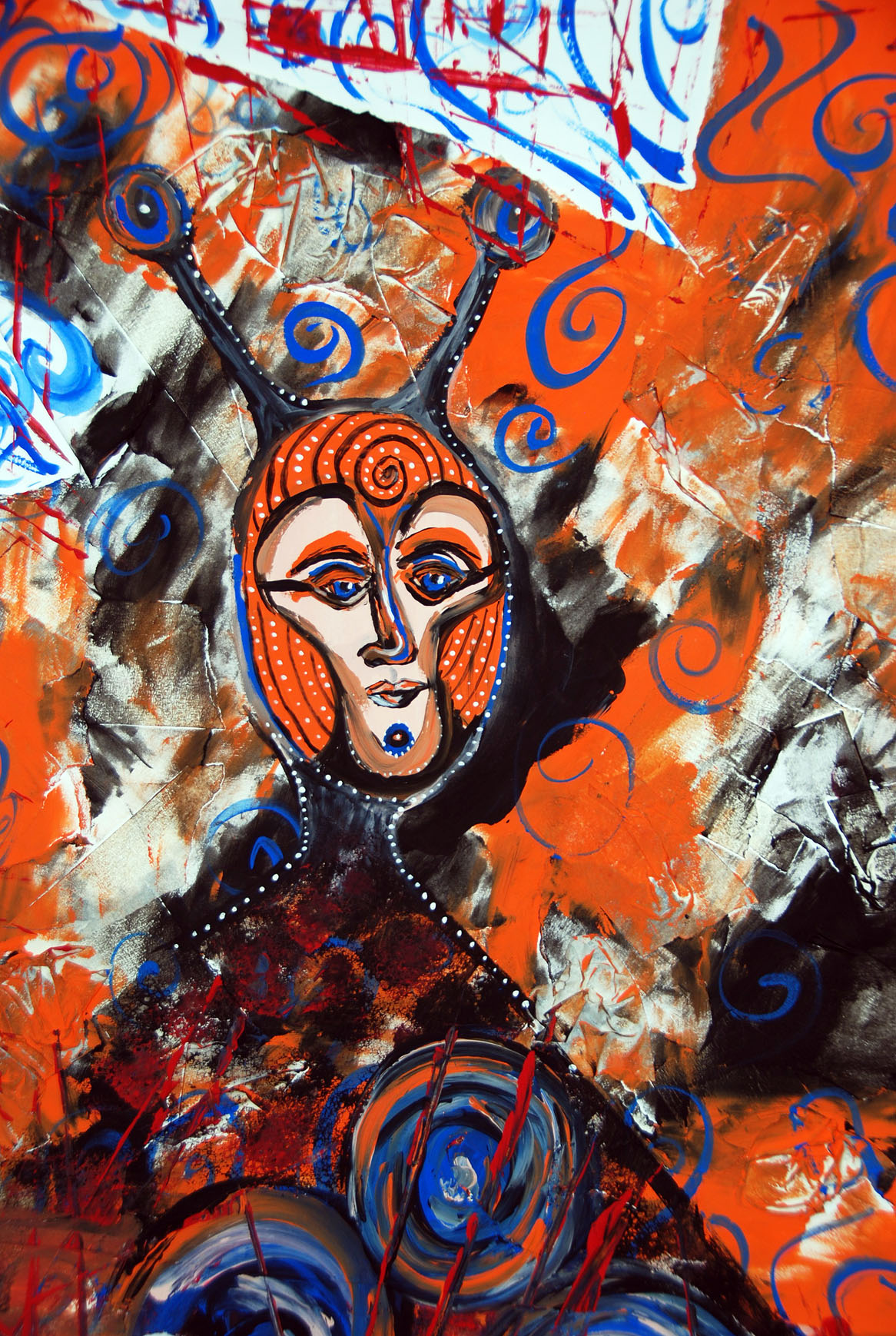
Externalizing: Painting by Lisa MitchellRonnestad and Orlinksy found that quality of the work setting and available peer support are crucial in assisting therapists to cope with isolation and the sense of helplessness. This seems to be an obvious solution: a work setting in which supervision and peer support groups invite discussions about these issues. Given that the researchers found many therapists to value personal therapy as a tool that helps them engage constructively with clients and feel they are thriving in their work, it would seem like validating these messier and darker inner-world experiences should be a regular work practice among colleagues as well—not just one hidden away in the private realm of individual therapy.

Certainly, there has to be a time and place for this kind of activity. When working directly with clients, we need to exercise appropriate boundaries. We don’t want to be processing our internal experience to the exclusion of tending to our clients’ experiences. But even when I invite fellow therapists to talk about and reveal their inner worlds in a safe non-clinical setting, they have a hard time doing it without relating it back to some kind of analysis of countertransference. We are so good at trying to understand our clients that even the act of excavating our inner experience of being a therapist becomes another avenue for more insight about our clients. So often I hear therapists report a feeling like irritation, and then immediately justify their irritation with a countertranference explanation about how their client reminds them of a mother-in-law, for instance. I have to ask: when can your inner experience of irritation simply be a by-product of being a therapist?

If, as Ronnestad and Orlinsky’s research suggests, nearly half of therapists feel pressured, overwhelmed, anxious, and trapped at least occasionally in session, why don’t we take these feelings more seriously? Why can’t we be open about them with ourselves and with colleagues—collectively honoring both the light and dark of our profession? Can we allow our knee-jerk therapeutic use of self-analysis to slow down just a little so that we can look at ourselves without wearing our therapist masks?

Taking Off the Mask

Just last week, in an altered book workshop that I was facilitating, I saw how sharing this inner world and this double-edged experience can benefit all who participate. The group was mixed: therapists who had been in practice for decades, a few interns, and one trainee. I invited them each to make collages that represented what they carry for themselves and for clients in their hearts. It’s always amazing to me the level of depth therapists are willing to bring to this kind of nonverbal self-reflection. The heart images were powerful and raw. One woman made a weaving that juxtaposed operating room images with strips of wholesome nature scenes. Another took large nails and screws and attached them as if they were impaling the walls of her heart. Many had innocent images of children: smooth skin, wide eyes, swaddling cloth.

Embodied: Painting by Lisa MitchellIn the course of the workshop, I coached these therapists about the creative process. The start of any artistic activity is always fraught with some level of fear. Sometimes the fear is so high, especially for people new to art making in adulthood, that they may have difficulty starting because they are not familiar with this line between stressful involvement and full engagement. But it often just takes a nudge to begin. I like to remind folks that they don’t have to know how it will turn out; they just have to start with a color or a brushstroke.

For the therapists I have encountered in my workshops, the first step in an art-making activity can be hard for this reason, and yet the process mirrors one all therapists are familiar with. Beginning without knowing where our efforts will end up is much like beginning a relationship with a new client, or starting a session and finding that the treatment plan has taken an entirely different direction, and things are no longer as they seemed.

Even for experienced artists, this starting can sometimes be hard, but it is also exhilarating at the most passionate level. Artists know, when they start, that if they plan too much, the process is going to be stifled, boring, and probably not very creative. If that exhilarating feeling of anxiety before the unknown is present—better call the feeling “anticipation”—it is an indicator of newness and risk, which will inevitably bring discovery of the highest order.

During the training, when we shared our images, there was a collective sigh of relief. One therapist said, “Sometimes there is a jolt of pain in my heart—the sheer rawness of it all. Who do you share this with? I could never go home and show this image to my husband. He wouldn’t understand. It’s so hard to express it honestly for yourself. But then to show it other people—I have so much gratitude that there are others who can see this, hold this, and still not judge me as inadequate.”

The opportunity to view others’ experience in a visceral way normalized the more difficult feelings that the group members carried as therapists. Hearing everybody talk about their art and the experiences that it represented allowed participants to stop pathologizing these feelings. “Seeing others’ openness made the darker side of being a therapist feel more okay in a very powerful way.”

In another activity, I invited the group members to make art that represented the gifts that clients had given them. They first had to get past the fear of admitting that they did actually benefit from client relationships. Then, when they were able to see how much each person’s life had been touched and changed as a result of real, concrete lessons or ideas clients had taught them, they cried. They were so relieved to see that things were actually coming in rather than just going out. One therapist would never have pursued her dream of being a professor if her client hadn’t showed her that it was possible. Another therapist credits her client with the fact that she survived cancer due to an alternative treatment approach that her client mentioned. I credit one particular teen client for teaching me how to show teens respect, and I use it every day with my own children and with all of my other teenage clients.

At the end of the workshop, after they had all made art and reflected honestly about how the profession affects their lives positively and negatively, one of the interns said that it had been an amazing gift to hear that even the most successful and seasoned therapists have difficulties in their work. She hadn’t heard about the difficulties, hadn’t seen others struggling, and hadn’t been well informed about what to expect and how to cope. The older therapists talked about the sense of validation and belongingness that the honest art expressions and discussions had allowed.

When therapists collectively allow there to be a dual experience of light and dark, abundance and depletion, there is a sigh of relief—an acceptance of the whole truth. And self-blame, inadequacy, and shame simply dissipate.

The Therapist as Artist

In the course of my trainings and also my own personal and creative life, the analogy of therapist as artist continues to take on richer, more profound meaning. Not only do therapists have amazing inner worlds that they are constantly mining for ideas, inspiration, and sustenance; to be creative, therapists have to know that anxiety, overwhelm, and uncertainty are all necessary aspects of making their art. This speaks to the idea that therapists can experience growth and depletion concurrently in their work. Just as for an artist, the therapist’s main objective becomes hanging in despite uncertainty, treating the unexpected as opportunity, seeing things from new and different perspectives, and maintaining involvement even when things get stressful. In other words, staying in flow feelings, maintaining a relational manner, and employing effective clinical skills even in the presence of stressful involvement are the ticket to being a creative therapist and staving off burnout.

Operating from the artist’s perspective, therapists can recognize that stressful involvement doesn’t have to block healing involvement. Rather, it is simply a necessary accompaniment to any creative endeavor. As Carl Rogers pointed out, constructive creativity requires openness to experience and tolerance for ambiguity: “It means the ability to receive much conflicting information without forcing closure.” The process of absorption or being wholly involved is characterized by Rollo May as “intensity of awareness and a heightened consciousness.” With this creative encounter come neurological changes—quickened heartbeat, narrowed vision, diminished appetite, loss of time awareness—that mirror physiological reactions to anxiety and fear. May suggests, however, that the artist doesn’t experience this arousal response as negative, but rather as joyful. In the creative process, flow feelings and arousal—whether experienced as anxiety or pleasure—go hand in hand. They are a result of engaging in a creative process. One without the other is impossible. The goal is not to eliminate the anxiety, but to make sure that it doesn’t block the flow.

When therapists see that their work is truly creative in nature and realize that the act of working with clients requires all the same components of any creative act, there is a built-in context for coping. How else do artists and other creatives endure their daily grind? Who else but the most creative know how to hold disparate experiences and make something of them? “Just like an artist, a therapist must hold the experience of being fully, heartfully engaged to painful experiences.” A therapist has to strive to connect on a vulnerable and intimate level with the client, yet maintain a professional boundary so as not to become merged in the relationship. And, despite scary or frustrating situations, a therapist must maintain engagement and strive to stay in contact with the relationship at hand.

As therapists then, we must stay creative: flexible, engaged, committed, willing to hang out in the unknown and greet newness and possibility as it comes. Be open to the process. This is not a passive state—it requires active exploration, self-reflection, sharing, curiosity, fearlessness to look at the unknown, risk taking to express that which is ugly, negative, or difficult. This commitment to staying creative must start with finding a way to communicate that inner-world experience to people who get it—to express these feelings without having to stay in the role of therapist, and to be in the presence of peers who understand that this kind of expression—can be the very key to sustaining self in our work. And because the creative process teaches us to welcome anxiety and other difficult feelings, doing art with other therapists can be a source of continual renewal.

At the End of the Day

If the creative process brings us freedom and new possibilities, it also brings us beauty. So when things aren’t seeming that beautiful around the office, when high healing involvement is giving way to self-doubt, frustration, and boredom, I’m remind myself that stress and flow are not mutually exclusive. I keep up a dialogue with myself on a daily basis. The question that I constantly ask is one that author Michael Ventura asks: “Where is the beauty in my work? Where is the beauty in this client?”

The other day, while sitting with a new teen client, I found myself melting into that beauty. She was reading a poem that she’d written as part of her therapy homework assignment. I instantly saw past her self-harm and angry outbursts, and said a deep thank you for the beauty that my work allows me to see. It’s been a long haul—from those days of meticulously monitoring client numbers and celebrating results to stepping into the quiet, reflective relationship between authentic self and work. I think I’m finally embracing that long, beautiful journey—no shell around my heart needed.

In my work with other therapists, I continue to emphasize what Jeffrey Kottler says in his wise book, On Being a Therapist: “[As therapists] we are touched by [our clients’] goodness and the joy and privilege we feel in being allowed to get so close to a human soul. And we are harmed by their malicious and destructive energy.” Having that focus, and the creative means with which to process all that comes with our work, will allow me to sustain myself and others for the long haul.

So the next time I’m sitting at dinner struggling to cross the bridge between my personal and professional lives, I’m going to consider that “How was your day, Mom?” as an invitation to take stock of my inner canvas. I’ll remember that my work is a creative process and feel more freedom in my reply. If it was one of those days, I think I will tell the kids all those disparate adjectives—drained, energized, discouraged, overwhelmed, fascinated, curious, amazed, sad—without feeling bad about my work. And then I will simply say, with a smile on my face, ”It’s great to be home.”

Suggested Activity

Individually, or with a group of safe colleagues, get together to create a representation of ‘Your Doorway to Therapeutic Presence.” You can do this by using magazine images and computer paper. As you prepare, think, write, and talk about the transition that you make when you begin work in session—from the moment that marks the transition between being alone in your office to your first encounter with your client in the waiting room. Consider what you leave behind as you transition—thoughts of other clients, preoccupation with family issues, plans for the weekend, etc. And consider what you welcome—awareness, presence, compassion, openness to the unknown. We do this transition over and over again, all day long. Some days we do it without effort. Other days our responses to disturbing material in client sessions or personal tragedy cause the transition to be arduous.

As you consider your internal experience of this transition and the state of being on either side of that doorway of therapeutic presence, find collage pictures that represent your experience. For most, the feeling of being present with a client comes with pictures of broad landscape, nature, the representation of awe and the feeling of being at peace with the world. And, depending on the current life situations, the experience outside of therapeutic presence ranges from blissful faces of children to painful images that depict life challenges such as illness, death, and other real struggles.

When you are finished with your doorway, share it. Really—go ahead. This opportunity to allow yourself to be seen outside of your role as therapist by other therapists is the very thing that we are conditioned not to do. This is also one of the most important coping strategies that so many of the researchers suggest. Allow difficulties to be there, honor the intense experience, increase knowledge of self and the therapeutic process, and embrace therapy as a creative process.

References

Kottler, J. (2010). On being a therapist. Jossey-Bass.
Kottler, J. (2005). The client who changed me: Stories of therapist personal transformation (p. 1). New York: Routledge.
May, Rollo. (1959). The nature of creativity. In Anderson, H. (Ed.).Creativity and its cultivation (pp. 55-68). New York, NY: Harper and Brothers.
Norcross, J., & Guy, J. (2009, August 19). Leaving it at the office: Taking care of yourself.
Orlinsky, D., & Ronnestad, M. (2009).How psychotherapists develop: A study of therapeutic work and professional growth. Washington, DC: American Psychological Association.
Rogers, Carl, R. (1954). Toward a theory of creativity. In Anderson, H. (Ed.) Creativity and its cultivation (pp.69-82). New York, NY: Harper and Brothers. 
Sussman, M. (Ed.). (1995). A perilous calling: The hazards of psychotherapy practice. New York: John Wiley and Sons, Inc.
Ventura, M. Beauty resurrected: Awakening wonder in the consulting room.


Violet Oaklander on Gestalt Therapy with Children

An Unorthodox Notion

Rafal Mietkiewicz: Violet, what makes me curious is that you are trained as a Gestalt therapist and people connect you with Gestalt therapy, but Gestalt therapy was mainly considered, at least here in Europe, to work primarily with adults. How did you find your way to do Gestalt therapy with the kids?
Violet Oaklander: I was already working with emotionally disturbed children in the schools when I got interested in Gestalt therapy. One of my children became very ill and died. I was very depressed. My friend was going to Esalen Institute to be in a group for a week with Jim Simkin, so I went with him, and I was so impressed with what happened to me. It made such a difference for me that when I came back, I started training in the Los Angeles Gestalt Therapy Institute, and while I was training, I thought, “How could I apply this to children?”It seemed very organic to me. Fritz Perls talked about the body and senses and all of that. I found that it fit my work with children and child development. And of course, over the years, I started using a lot of creative media, like drawing and clay and puppets and music, because that’s the only way it would interest children. But behind that, the basis of my work was Gestalt therapy theory and philosophy. And I developed it more and more as time went by. That’s how it got started.

RM: That’s what you wrote in your book—that children already know, but they are wearing special glasses, so you just take the glasses off?
VO: Yeah. I have many stories working with kids. I’m trying to think of when I first started. When I first began, I was working in the schools with maybe a group of 12 children. And they were older—maybe 12 and 13 years old, all boys. These were kids that didn’t make good contact; they didn’t connect very well with other children.I started doing things that were sort of different. I would have them finger paint. I’d line up the desks so it was like a table, and they’d stand around the table finger painting. At first, they didn’t want to do it. “It’s for babies.” But while they were finger painting, they would talk to each other, make really good contact. And of course it was important to establish boundaries—what they could not do and what they could do. So that was very clear.

Another thing I started doing was bringing in wood, and they would build things. These were children who weren’t allowed to hold a hammer or a saw because they were very disturbed children—it was dangerous. But I saw other classes had wood and got to build things, so I got that. And they had rules: they couldn’t swing the saw or the hammer, or else they had to sit down that day.

I wouldn’t let them build guns, but they could build boxes and birdhouses, and they would work together because they had to share the tools. You would not believe they were emotionally disturbed children. They were making such good contact and really enjoying this. I did many things like that.

RM: You look like you really enjoy your work.
VO: Oh, yeah. I even had the old empty chair. I had two chairs in the front of the room, and when a kid would get really upset and angry, I would have him sit in the chair and talk to the empty chair.And the child that he was angry at might be in the room there, but he would be talking to the empty chair. And then I’d have him switch and say, “Well, what do you think he would say back to you?” and it was so amazing because he would realize that he was projecting. They didn’t know that word—they didn’t have that insight. But they could see that they were projecting their own stuff on the other boy.

It would be so amazing. They would come into the room and say, “I need the chairs.” They would talk to a teacher who had yelled at them outside. They would talk to that teacher, and then they would begin to see that the reason the teacher yelled at them is because they did something they weren’t supposed to do. They knew this, but when they sat in the empty chair, they’d say, “Well, I yelled at you because you hit this other boy!” And then I’d say, “Now, what do you say to that?” They’d say, “Yeah, I guess I did. I did do that, yeah.” It was just little things like that that I began to do, to experiment with some of the techniques.

After I left teaching and I was in private practice, I thought a lot about what I was doing, and I started developing a therapeutic process that was based on Gestalt therapy, beginning with the “I-thou” relationship, and looking at how the child made contact, and then building his sense of self and helping him to express his emotion.

RM: It seems like you combine a bunch of techniques and approaches in your work—like expressive art therapy or child group therapy.
VO: Yeah. We do a lot of sensory work. I mentioned finger painting—anything they can touch. Clay is incredibly sensory and evocative. If it seems like they need to do some movement, we do that. Sometimes we play creative dramatics—charades—because to show something, you have to really be in touch with your body. We might start with fingers: “What am I doing? Now, you do something.” And they think of something and they have to use fingers to act it out.And then maybe we do a sport—they have to show with their body what sport they’re playing, and I have to guess. It might be obvious, but they enjoy doing that anyway—maybe catching a ball or hitting with a bat or tennis racquet. They have to get in touch with their body to do that.

The projective work with drawings and the clay is also very important, because this is how they can project what’s inside of them and then own it. One example is a boy who had a lot of anger but he kept it inside. He presented himself as just very nice and sweet, and nothing was wrong with his life. It was only after I asked him to make something, anything—I usually say, “Close your eyes and just make something, and then you can finish it with your eyes open”—he made a whale, and told a whole story about how the whale had a family—a mother and a father and sister.

What I always do after they tell the story is try to bring it back, so I said, “Well, does that fit for you? Do you have a family like that?” He said, “No, my father lives far away because he and my mother don’t live together. I never see him.” “Well, how do you feel about that?” And then we started talking about his father, which he would never have mentioned, and all this feeling came up. It’s very powerful.

The First Session

RM: How do you approach the first session with a child?
VO: I always meet, if possible, with the parents and the child the first session, because I want the child to hear whatever the parents tell me. I don’t want the parents to tell me things and have the child not know what they told me.Even if the parents are saying bad things about the child, the child needs to hear what I hear from the parents.

Usually in the first session, I have a checklist, and very often I would put it on a clipboard. First I would say, “Why are you here?” and all that. Then I would ask the child these questions. “Do you have a good appetite? Do you have bad dreams?” A whole list of questions.

Sometimes the parent would chime in, but mostly it’s to the child. It was a way of really making a connection with the child. Of course, if they were very, very young, four years old, maybe I’d still ask these questions, but not everything—and use language they could understand.

That’s always pretty much the first session. But if there are no parents involved—because I saw many kids who were in foster homes or group homes—the first session is an important one to establish some kind of connection or relationship. Sometimes I’d ask the child to draw a picture on that first session. I’d ask them to draw a house-tree-person. But I wouldn’t interpret it. It’s not for interpretation. It was to say to them when they were done, “Well, this picture tells me that you keep a lot of things to yourself. Does that fit for you?”—because maybe they wouldn’t draw many windows. And they usually would say “yes.” Or, “This picture tells me that you have a lot of anger inside of you. Does that fit for you?” If they’d say, “No, I’m not angry,” I’d say, “Oh, okay. I just need to check out what I think it tells me,” and we would have that kind of a session.

I did that once with a very resistant 16-year-old girl who at first said she wouldn’t speak to me. And when we finished, she wanted her sister and her mother to come in and do that drawing. So it’s a way of connecting.

But we don’t always do that. If it’s a child who is very frightened—I had a girl, for instance, who was very severely sexually abused for many years, and it finally came out when she was about 11, and she was removed from the home. So she was in a foster home, but the foster mother was very devoted to her and came in, too.

But she was very, very frightened and didn’t want to talk to me. So in the beginning we would take a coloring book, and we’d both color in the book. And we wouldn’t really talk about anything. I’d say to her, “Should I use red for this bird? What do you think?” and just begin to connect with her that way. Pretty soon I was asking her, “Well, what do you think the bird would say if it could talk?”—that kind of thing.

Pay Attention

RM: It’s my guess that you don’t really diagnose kids in clinical terms.
VO: No. I mean, sometimes I would have to for an insurance company. But it’s a matter of seeing where they’re at, where they’re blocked. I had one boy who walked very stiffly all the time. He was 11 years old. And I thought, “Maybe we need to do something to help him loosen up before we even talk about his feelings”—that kind of diagnosis.
RM: So, you don’t find clinical diagnosis useful in therapy?
VO: Not very much, no.
RM: You trust in what you see and what you feel about the kid.
VO: What I see, yeah.If, for example, the child has a lot of difficulty making a relationship with me, that’s what we have to focus on, because I can’t do anything unless we have that relationship. Sometimes children have been very hurt and damaged so early, they have trouble making a relationship. So we have to figure out how we could do that.

I used to see a lot of adolescents who were arrested by the police because they had committed a crime. I was involved in a program where they would send these children to counseling. It was a special program they were trying. So this one girl came in. She had to come—she had no choice. She was 14. She wouldn’t look at me, she wouldn’t talk to me. She just sat there. Naturally when a child does that, it makes you have to come forward more. Well, it didn’t work. So I thought, “Maybe I cannot see this girl. Maybe I have to refer her to another person.”

I went out into the waiting room the next time she came, and she was reading a magazine. I sat down next to her and I said, “What are you reading?” She flashed the cover at me. I said, “I didn’t see it,” so she held it up.

RM: And that was the beginning of contact.
VO: Yeah. Already we were making contact. And it was a music magazine about different groups. I said, “I don’t know anything about that. Could we look at it together?” So we went into my office and looked at the magazine, and she was telling me about the different groups. It was mostly heavy metal. And she was all excited, telling me about the groups and which ones she liked.We tried to find the music on the radio because I said, “I don’t know what it sounds like.” We couldn’t find it, so she said she would bring in a tape. The next week, she brought it in and we listened together. Some of the songs were so amazing—all these feelings and anger. So we just started working with that. And we had a relationship.

But we need to do that—start with where they are. Pay attention. I wasn’t paying attention in the beginning. It was only when I thought, “What am I going to do?”

RM: So apparently the child therapist must be very in touch with his own senses. I guess it’s more important than clinical knowledge.
VO: I think you’re right. You have to know things, but that’s most important—to be in touch with yourself. It’s not easy to be a child therapist. An adult comes in and says, “This is what I want to work on,” or, “This is what’s happening.” When a child comes in, she doesn’t have a sense of what she needs to do. And you have to talk to parents, and you have to talk to teachers, and that kind of thing, too. So it’s different.
RM: Do you do something particular to help bring each session to an end—to help bring the child back to “regular life?”
VO: I think the job of the therapist is to help the child express what’s going on inside. But I notice that most children will only express what they have the strength to, and then they get resistant or they close down. They take care of themselves better than adults that way.But if they do open up a lot, we have to pay attention to what I call “grounding” them. I have a policy that children have to help me clean up whatever we’ve used. So we start cleaning up and then I’ll say, “Well, that was hard. Maybe we’ll talk some more about it next time, but where are you going now?” or “What are you having for dinner?” or “What did you have for dinner?” We talk about regular things to help them come back to ground.

RM: I know that Gestalt therapists hate “shoulds,” but using a paradox, are there any “shoulds” that a good child therapist should obey?
VO: Nothing comes immediately to mind, other than things I’ve already said. But speaking of “shoulds,” it’s worth noting that children have a lot of “shoulds.” People don’t realize that, but children are very hard on themselves. They’re split—there’s a part of them that’s very critical of themselves and then a part of them that, of course, rebels against that. Sometimes we help them understand that, especially if they are adolescents.
RM: Do you touch or hug your clients?
VO: Sometimes, but I’ll always ask them. I might say, “Can I give you a hug?” I don’t just do it. I have to ask them. Or I might put my hand on their shoulder. I can tell if they pull away that that’s not a good thing to do. Or sometimes we shake hands. We do a little bit—not a lot.

Working with Parents

RM: Do you often talk to parents?
VO: Oh, yes. This girl that I just mentioned, she lived in a foster home, and they didn’t care about her, so they weren’t interested. They just did what they had to do. But yes, parents come in. Every three or four weeks they have to come in with the child. Sometimes we just have a family session and I don’t see the child individually. It depends. You have to just decide which is the best way to go.
RM: We have agreed that it’s important for therapists to be in touch with their own feelings. What other qualities should one have to be a good child therapist?

VO:

You have to understand child development so you have a sense of if the child is not at the level she needs to be at. You have to understand the process. You have to be in touch with yourself. You need to know when your own buttons are being pressed—in psychoanalytic vocabulary, they call it transference. You have to understand when you have some countertransference, and to deal with that and work with that.

RM: In your Child Therapy Case Consultation video, a therapist is presenting a case of a child who is acting aggressively. You state at one point that kids can’t change their behavior with awareness. Is this why you often use art or have kids smash clay or other activities, versus just talk therapy?
VO: Yeah. What I mean is children don’t say, “This is what I’m doing to keep me from being happy or satisfied.” Even adults have trouble being aware of what they do to keep themselves stuck. So, with children, these drawings and clay are powerful projections. And it’s the way they can articulate what’s going on with them, without bypassing the intellect, but coming out from a deeper place. And at some point, they will own it. They will say, “Oh, yes, that fits for me.”When children feel stronger about themselves and they express what’s blocking, their behaviors change without having to force it or say anything. I mean, what makes children do what they do? All the behaviors that bring them into therapy are really ways of not being able to express what they need to express—of not being heard or not feeling good inside themselves.

RM: How do you measure progress in your work with children?
VO: It’s important to help the parents see the small changes, and not to expect complete reversal. And, of course, we have to work with the parents, too. Often the parents have a lot of difficulty with their own anger, and we have to work to help them understand how to express these feelings without hurting people around them. We can often do that in family sessions—help them to express what they’re feeling and what they’re wanting and what their sadness is about.One of the things I’ll say to parents is that I don’t fix kids. But what I do is I help them feel better about themselves. I help them express some of their deeper feelings that they’re keeping inside, and help them feel a little happier in life. We do many things to make this happen. And that’s what you have to look for. So when a parent comes in a month later and I say, “How are things going at home?” and the father says, “I think he’s a little happier,” then I know that this father has got it, and he’s seeing some progress here.

I am thinking of this was a boy of maybe 14 who was stealing, and the father wanted to send him to a military school because he couldn’t control him. There was a lot of reason the boy was like that, but that doesn’t help to understand the reason. It’s good to understand the reason why he’s like that, to help him change and be different.

So that’s how I look at progress. When they’re doing better out in life, they’re going to school and have some friends, and doing some of the things they have to do at home, and doing their schoolwork, then you’re seeing progress. They may not be altogether different, but they’re functioning in life.

The other thing that’s important is that it has to be at their level. Children can’t work everything out. They have different development levels. So the girl who was very severely sexually abused, we did a lot of work about that. But when she was 13, she had to come back into therapy for more work—things came up. They reach plateaus. They have to go out and be in life, and then maybe more things come up.

Becoming a Child Therapist

RM: Does it happen often that, when therapists work with a kid, the therapists’ trauma from childhood appears?
VO: Absolutely. That’s something one has to really know about—be in therapy, have a therapist. I have several people who come to me for supervision who are very experienced therapists, and that’s the reason they come. I think it’s really good for a child therapist to have somebody to talk to and consult with because it’s very difficult sometimes. You can’t always see what’s going on.
RM: How long does it take to be fully trained as a child therapist?
VO: Oh, gosh. For many years, I did a two-week training. People would come from all over the world. And sometimes they would get it in those two weeks, and other times they didn’t, so I don’t know. Two weeks is not enough, but it was the most that people could give of their time. Sometimes they’d come back two or three times to the training, but those were people who actually got it the most, because they were so committed to learning more.I can’t define a time. They have to have the experience of working with children first, I suppose, and understand about children. You have to have patience when you work with children. If one thing happens in a session—if they say, “I’m like that lion. I get so angry, just like that lion,” or whatever—if they say one thing, sometimes that’s it for a session. You have to be patient.

RM: What are the most frequent mistakes that therapists make when they work with kids?
VO: Usually what happens is therapists get stuck. They don’t know where to go next or what to do next.
RM: But why do they get stuck?
VO: Maybe they’re just not able to stand back and look. Sometimes, in a supervision or consultation, I’ll give a suggestion, and they’ll say, “Oh, of course, why didn’t I think of that? Of course, I know that.” They get too close to it and worry about doing the right thing. They’re afraid to make mistakes, really. I always tell them, “No matter what you do, you can’t really go wrong.”
RM: If you were to give the best advice to the young therapists about working with children, what would be this advice be?
VO: I might say if you’re working with children, you have to like children!

If you’re working with children, you have to like children!

What Keeps Me Going

RM: My last question is personal. How do you manage to keep so vital?
VO: You know, I’m 84.
RM: You don’t look it.
VO: I don’t know. I am who I am, I guess. I’m still working some. I have this foundation (The Violet Solomon Oaklander Foundation), and we’re having a conference this weekend at a retreat center, and I’m going to do a keynote. So every now and then I still do something like that, or conduct a supervision. That’s what keeps me going. I do a little writing. I read a lot.I lived in Santa Barbara, California, for 21 years. And my son, who lives in Los Angeles, decided I was getting too old to live there by myself. So he tore down his garage and he had a little cottage built, and that’s where I live now, in this little cottage behind their house.

I miss Santa Barbara. I had a lot of friends. I’d be more vital if I was back in Santa Barbara. But I am getting older, and I had a little heart attack this year—little. I’m okay. But I was in the hospital a few days. So it’s good that I’m near my son and my daughter-in-law.

RM: It is obvious for me that you, at 84, have still have so much to give to the others.
VO: Thank you very much for those nice words. I will, as long as I can.That’s what keeps me vital: just doing as much as I can, as long as I can. I just have to learn to take it easy.

The God of Hellfire Will See You Now

The Crazy World of Arthur Brown

On a number of occasions in the late 1960s, an exceptionally gangly gentleman made up in skeleton face paint would affix what has been described as a metal plate to the top of his head with a leather strap and commence singing a song called “Fire” to assembled crowds in a dark, cramped Paris nightclub. The song begins with the spoken/shouted intro, “I am the God of Hellfire and I bring you…FIRE!” The key to making this routine particularly dangerous (rather than just slightly odd) was the fact that the plate, probably more of a shallow bowl, contained gasoline, which would be set aflame as the performer took the stage. The showman in question would cavort about the stage in an approximation of a cross between a witch doctor’s contortions and the popular ’60s novelty dance, the Frug. Not surprisingly, his ill-designed headgear would tip and spill varying amounts of flaming liquid on his body and brightly-colored stage costume, turning the already smoky club even more so. Fortunately for him, his bandmates quickly became adept at performing as an ad hoc fire brigade.

While the DSM may not have a particular diagnosis for such behavior (yet), a casual observer might be forgiven for assuming that the sort of person who would behave in such a manner might be more likely to be a recipient of psychotherapy rather than a provider. The fact that in this instance the reverse is true provides one of the more interesting chapters in the annals of mental health practice. Arthur Brown, the pop singer who gave new meaning to the term “smoldering stage presence,” followed a long and unusual path from performing rock and roll in the psychedelic sixties to performing psychotherapy in the early 1990s in Texas.

Brown was born in England on June 24, 1942. Like many artistically inclined young Englishmen of his generation, Brown went away to college and ended up in a band. But unlike ersatz “art” students Mick Jagger and John Lennon, despite his keen interest in music, Brown stayed the course and graduated with a bachelor’s degree in philosophy.

Soon after, music became his full-time vocation, and his band, The Crazy World of Arthur Brown, released their eponymous debut album in 1968. Their single, the aforementioned “Fire,” reached number 1 in the UK charts and number 2 in the States. Their failure to follow up this initial success marks Brown and company as one of the benighted breed popular culture terms “One-Hit Wonders.” Despite their lack of chart success, Brown, with his band and later as a solo artist, continued to work steadily well into the 1970s. His greatest contribution to music history, however, may be the influence he wielded through his choice of material and stage persona. Brown may today be viewed as a clear link on the continuum from Screamin’ Jay Hawkins in the 1950s to artists like Alice Cooper in the 1970s and Marilyn Manson today. You may or may not have heard of Brown or his most famous song, but his Goth-before-Goth-was-cool style has influenced just about every bombastic and excessively theatrical heavy metal/progressive rock act you’ve ever seen.

By 1980, his career as a musician was at such a low ebb that Brown and his then-wife decided to make a fresh start in America. They chose as their destination “the live music capital of the world,” Austin, Texas. Willie Nelson had famously retreated there for similar reasons a decade earlier with productive results, and Brown found amiable company in a number of other expatriates from the world of rock stardom. Brown kept at the music but soon found himself working as journeyman carpenter and the proprietor of a house painting business. While the work was rewarding enough financially, it did little to satisfy the creative muse. Brown found himself ready for another change but unsure what it was to be.

From Rockstar to Masters Student

Then in 1989, Vincent Crane, former keyboardist in The Crazy World of Arthur Brown and Brown’s longtime friend and bandmate, lost his long battle with bipolar illness, committing suicide. Whether this tragedy was the catalyst for Brown’s next move is open to speculation. But not long after returning to Texas from the funeral in Britain, Brown enrolled in the Masters in Counseling program at Southwest Texas State University (today known as Texas State University).

Such an endeavor may seem to be a truly unexpected left turn in the life of an avant-garde artiste. However, there were portents aplenty in Brown’s past which indicated an interest in helping others and exploring personal growth. In a period when it seemed almost de rigueur for pop stars to explore Eastern religion, Brown took a shine to Sufism. Other religions had been a fascination as well, as he studied formally and informally with everyone from practicing Druids to priests of the Greek Orthodox Church. Moreover, Brown seems to have delved deeply into the primordial soup of the ’70s self-actualization/encounter ethos, taking a self-guided tour of the “Me” decade. A trip to Israel during the Yom Kippur War to entertain wounded soldiers (presumably he spared them the flaming hat) inspired in him a keen interest in the healing properties of music.

But perhaps the biggest giveaway to his future career was the b-side of “Fire,” a song called “Rest Cure.” While the term is now archaic, it refers to a discreet stay in a sanitarium of the sort described by Simon and Garfunkel in “Mrs. Robinson”—a getaway to nice, quiet facility to collect one’s nerves. The lyrics reveal that Brown seems even then to have seen himself as able to provide a cure for the ills of modern society.

When the world is getting you down.
And nothing is in its right place;
Your friends are letting you down.
And you can’t seem to find the right face.
All you want is me,
All you need is me to give you,
Rest cure for all your ills,
Rest cure to make the world stand still.
Rest cure and the world won’t bring you down no more.

Brown was an able and ardent non-traditional student, making the 60-mile round trip from home to school each day, and he rapidly established positive relationships with classmates and professors alike. It was at a party on campus one day at which both groups mixed that Brown performed a light-hearted impromptu tune, name-checking all present. This so impressed one of his professors that she was moved to suggest he find a way to blend his musical gifts with his newly minted learning.

Brief Atypical Music Therapy

Shortly after picking up his diploma, he set up a counseling practice with a fellow alumnus to do just that. They named their venture “Healing Songs Therapy,” and in this context Brown and his cohort introduced a new therapeutic form.

As described in various media outlets, the session began much like a normal 50-minute hour. Brown’s partner would allow the client to describe his or her concerns and issues offering feedback in the normal therapist-client interaction as Brown sat to the side of the room with notepad and guitar at hand. Following the cessation of the first portion of the session, Brown would then perform an original song in which he brought forth insights and reflection about things he believed he had heard in the client’s narrative. The client would be given an audiotape of the song and be sent on his or her way, having completed a course of what might be called Brief Atypical Music Therapy.

In 1992, not long after Healing Songs had opened up shop, a feature reporter from the Austin daily paper came to Brown and his partner ostensibly seeking help with a mild phobia of driving in rush hour highway traffic, and more to the point, for a story. Following her hour with the duo, she reported coming away with her trepidations at least somewhat alleviated, along with a personalized song on cassette which she could pop into her stereo the next time she was caught in traffic. Evidently from the snippet of lyrics she published of her seven-minute personalized “healing song,” Brown saw in her presenting problem echoes of deeper existential issues.

I have a dream that I am keeping,
And I will not let it surface,
For the fear that rules my life
Has taken me and chained me to my own
Image of reflecting everything,
That I can’t hold onto.

A certain amount of notoriety followed as the fledgling practice grew. Other news outlets across Texas began to feature stories, as did People magazine with a story entitled “The Singing Shrink.” Of these stories, the early reporter/client from Austin offered one of the few independent reviews of Brown’s new therapy technique. Most of the accounts are long on Brown’s unmistakable enthusiasm for his latest venture and favorable words from experts about the broad efficacy of more traditional forms of music therapy, but very short on any sort of objective examination of the Healing Songs modality. The rejoinder from more knowledgeable quarters (such as representatives of the duos’ alma mater) was less than favorable, however. In response to the mostly positive article in the Austin paper, a professor from the Southwest Texas counseling faculty took exception in a letter to the editor decrying the inference that the university in any way endorsed or even recognized the potential validity of Brown’s approach.

The perturbed prof seemingly didn’t need to worry so, as what might one day have developed into a new therapeutic discipline seems to have fallen by the wayside when Brown’s music career began to heat up once again, probably due in part to the sudden spate of publicity regarding his side venture. Just when Brown put aside the formal role as a budding psychotherapist is hard to ascertain. The state credentialing board offers no record of Brown ever actually obtaining licensure as a Professional Counselor or Music Therapist. However, it’s safe to assume he gave up formal counseling at some point after departing Texas for a European tour with his new band in late 1992. Given Brown’s interest in his own inner world as well as that of other human beings, it seems likely that he still, shaman-like, exerts whatever healing powers he believes are in his possession from the stage. However, office hours are a thing of the past.

In the end, one has to wonder about the great unreleased Arthur Brown album. Ballads and Poems of Fin-de-Siècle Problems of Living, it might be called, or Arthur Brown Makes Your World Not So Crazy. According to the account in People, Brown and his partner had reached a height of 20 sessions a month at the time of writing. Thus, there could well be as many as hundreds of unknown Arthur Brown compositions out there in the world. While cassette tapes are today an almost forgotten technology, surely a personalized song dealing with a deeply personal issue and written by an erstwhile rock star is the sort of thing more than just a few people might have held onto. Secreted away in junk drawers and the back of closets, they await a 21st-century John Lomax to bring them to light once more.

The Path to Wholeness: Person-Centered Expressive Arts Therapy

When art and psychotherapy are joined, the scope and depth of each can be expanded, and when working together, they are tied to the continuities of humanity’s history of healing. —Shaun McNiff, The Arts and Psychotherapy

Part of the psychotherapeutic process is to awaken the creative life-force energy. Thus, creativity and therapy overlap. What is creative is frequently therapeutic. What is therapeutic is frequently a creative process. Having integrated the creative arts into my therapeutic practice, I use the term person-centered expressive arts therapy. The terms expressive therapy or expressive arts therapy generally denote dance therapy, art therapy, and music therapy. These terms also include therapy through journal writing, poetry, imagery, meditation, and improvisational drama. Using the expressive arts to foster emotional healing, resolve inner conflict, and awaken individual creativity is an expanding field. In the chapters that follow, I hope to encourage you to add expressive arts to your personal and professional lives in ways that enhance your ability to know yourself, to cultivate deeper relationships, and to enrich your methods as an artist, therapist, and group facilitator.

What is expressive arts therapy?

Expressive arts therapy uses various arts—movement, drawing, painting, sculpting, music, writing, sound, and improvisation—in a supportive setting to facilitate growth and healing. It is a process of discovering ourselves through any art form that comes from an emotional depth. It is not creating a “pretty” picture. It is not a dance ready for the stage. It is not a poem written and rewritten to perfection.

We express inner feelings by creating outer forms. Expressive art refers to using the emotional, intuitive aspects of ourselves in various media. To use the arts expressively means going into our inner realms to discover feelings and to express them through visual art, movement, sound, writing, or drama. Talking about our feelings is also an important way to express and discover ourselves meaningfully. In the therapeutic world based on humanistic principles, the term expressive therapy has been reserved for nonverbal and/or metaphoric expression. Humanistic expressive arts therapy differs from the analytic or medical model of art therapy, in which art is used to diagnose, analyze and “treat” people.

Most of us have already discovered some aspect of expressive art as being helpful in our daily lives. You may doodle as you speak on the telephone and find it soothing. You may write a personal journal and find that as you write, your feelings and ideas change. Perhaps you write down your dreams and look for patterns and symbols. You may paint or sculpt as a hobby and realize the intensity of the experience transports you out of your everyday problems. Or perhaps you sing while you drive or go for long walks. These exemplify self-expression through movement, sound, writing, and art to alter your state of being. They are ways to release your feelings, clear your mind, raise your spirits, and bring yourself into higher states of consciousness. The process is therapeutic.

When using the arts for self-healing or therapeutic purposes, we are not concerned about the beauty of the visual art, the grammar and style of the writing, or the harmonic flow of the song. We use the arts to let go, to express, and to release. Also, we can gain insight by studying the symbolic and metaphoric messages. Our art speaks back to us if we take the time to let in those messages.

Although interesting and sometimes dramatic products emerge, we leave the aesthetics and the craftsmanship to those who wish to pursue the arts professionally. Of course, some of us get so involved in the arts as self-expression that we later choose to pursue the skills of a particular art form. Many artist-therapists shift from focusing on their therapist lives to their lives as artists. Many artists understand the healing aspects of the creative process and become artist-therapists.

Using the creative process for deep inner healing entails further steps when we work with clients. Expressive arts therapists are aware that involving the mind, the body, and the emotions brings forth the client’s intuitive, imaginative abilities as well as logical, linear thought. Since emotional states are seldom logical, the use of imagery and nonverbal modes allows the client an alternate path for self-exploration and communication. This process is a powerful integrative force.

Traditionally, psychotherapy is a verbal form of therapy, and the verbal process will always be important. However, I find I can rapidly understand the world of the client when she expresses herself through images. Color, form, and symbols are languages that speak from the unconscious and have particular meanings for each individual. As I listen to a client’s explanation of her imagery, I poignantly see the world as she views it. Or she may use movement and gesture to show how she feels. As I witness her movement, I can understand her world by empathizing kinesthetically.

The client’s self-knowledge expands as her movement, art, writing, and sound provide clues for further exploration. Using expressive arts becomes a healing process as well as a new language that speaks to both client and therapist. These arts are potent media in which to discover, experience, and accept unknown aspects of self. Verbal therapy focuses on emotional disturbances and inappropriate behavior. The expressive arts move the client into the world of emotions and add a further dimension. Incorporating the arts into psychotherapy offers the client a way to use the free-spirited parts of herself. Therapy may include joyful, lively learning on many levels: the sensory, kinesthetic, conceptual, emotional and mythic. Clients report that the expressive arts have helped them go beyond their problems to envisioning themselves taking action in the world constructively.

What Is Person-Centered?

The person-centered aspect of expressive arts therapy describes the basic philosophy underlying my work. The client-centered or person-centered approach developed by my father, Carl Rogers, emphasizes the therapist’s role as being empathic, open, honest, congruent, and caring as she listens in depth and facilitates the growth of an individual or a group. This philosophy incorporates the belief that each individual has worth, dignity, and the capacity for self-direction. Carl Rogers’s philosophy is based on a trust in an inherent impulse toward growth in every individual. I base my approach to expressive arts therapy on this very deep faith in the innate capacity of each person to reach toward her full potential.

Carl’s research into the psychotherapeutic process revealed that when a client felt accepted and understood, healing occurred. It is a rare experience to feel accepted and understood when you are feeling fear, rage, grief, or jealousy. Yet it is this very acceptance and understanding that heals. As friends and therapists, we frequently think we must have an answer or give advice. However, this overlooks a very basic truth. By genuinely hearing the depth of the emotional pain and respecting the individual’s ability to find her own answer, we are giving her the greatest gift.

Empathy and acceptance give the individual an opportunity to empower herself and discover her unique potential. This atmosphere of understanding and acceptance also allows you, your friends, or your clients to feel safe enough to try expressive arts as a path to becoming whole.

The Creative Connection

I am intrigued with what I call the creative connection: the enhancing interplay among movement, art, writing, and sound. Moving with awareness, for example, opens us to profound feelings which can then be expressed in color, line, or form. When we write immediately after the movement and art, a free flow emerges in the process, sometimes resulting in poetry. The Creative Connection process that I have developed stimulates such self-exploration. It is like the unfolding petals of a lotus blossom on a summer day. In the warm, accepting environment, the petals open to reveal the flower’s inner essence. As our feelings are tapped, they become a resource for further self-understanding and creativity. We gently allow ourselves to awaken to new possibilities. With each opening we may deepen our experience. When we reach our inner core, we find our connection to all beings. We create to connect to our inner source and to reach out to the world and the universe.

Some writers, artists and musicians are already aware of the creative connection. If you are one of those, you may say, “Of course, I always put on music and dance before I paint.” Or, as a writer, you may go for a long walk before you sit at your desk. However, you are not alone if you are one of the many in our society who say, “I’m not creative.” I hope this book entices you to try new experiences. You will surprise yourself.

I believe we are all capable of being profoundly, beautifully creative, whether we use that creativity to relate to family or to paint a picture. The seeds of much of our creativity come from the unconscious, our feelings, and our intuition. The unconscious is our deep well. Many of us have put a lid over that well. Feelings can be constructively channeled into creative ventures: into dance, music, art, or writing. When our feelings are joyful, the art form uplifts. When our feelings are violent or wrathful, we can transform them into powerful art rather than venting them on the world. Such art helps us accept that aspect of ourselves. Self-acceptance is paramount to compassion for others.

The Healing Power of Person-Centered Expressive Arts

I discovered personal healing for myself as I brought together my interests in psychotherapy, art, dance, writing, and music. Person-centered expressive therapy was born out of my personal integration of the arts and the philosophy I had inherited. Through experimentation I gained insight from my art journal. I doodled, let off steam, or played with colors without concern for the outcome. Unsure at first about introducing these methods to clients, I suggested they try things and then asked them for feedback. They said it was helpful. Their self-understanding increased rapidly and the communication between us improved immensely.

The same was true as I introduced movement, sound, and freewriting for self-expression. Clients and group participants reported a sense of “new beginnings” and freedom to be. One group member wrote: “I learned to play again, how to let go of what I ‘know’—my successes, achievements, and knowledge. I discovered the importance of being able to begin again.” Another said: “It is much easier for me to deal with some heavy emotions through expressive play than through thinking and talking about it.”

It became apparent that the Creative Connection process fosters integration. This is clearly stated by one client who said, “I discovered in exploring my feelings that I could break through inner barriers/structures that I set for myself by moving and dancing the emotions. To draw that feeling after the movement continued the process of unfolding.”
It is difficult to convey in words the depth and power of the expressive arts process. I would like to share a personal episode in which using expressive arts helped me through a difficult period. I hope that, in reading it, you will vicariously experience my process of growth through movement, art, and journal writing in an accepting environment.

The months after my father’s death were an emotional roller coaster for me. The loss felt huge, yet there was also a sense that I had been released. My inner feeling was that his passing had opened a psychic door for me as well as having brought great sorrow.

Expressive arts served me well during that time of mourning. Two artist-therapist friends invited me to spend time working with them. Connie Smith Siegel invited me to spend a week at a cottage on Bolinas Bay. I painted one black picture after another. Every time I became bored with such dark images, I would start another painting. It, too, became moody and bleak. Although Connie is primarily an artist, her therapeutic training and ability to accept my emotional state gave me permission to be authentic.

Also, I went to a weekend workshop taught by Coeleen Kiebert and spent more time sculpting and painting. This time the theme was tidal waves—and again, black pictures. One clay piece portrays a head peeking out of the underside of a huge wave. My sense of being overwhelmed by the details of emptying my parents’ home, making decisions about my father’s belongings, and responding to the hundreds of people who loved him was taking its toll. Once again, my art work gave free reign to my feelings and so yielded a sense of relief. Coeleen’s encouragement to use the art experience to release and understand my inner process was another big step. I thought I should be over my grief in a month, but these two women gave me permission to continue expressing my river of sadness. That year my expressive art shows my continued sense of loss as well as an opening to new horizons.

As is often true when someone feels deep suffering, there is also an opening to spiritual realms. Three months after my father’s death, I flew to Switzerland to cofacilitate a training group with artist-therapist Paolo Knill. It was a time when I had a heightened sense of connectedness to people, nature, and my dreams. Amazing events took place in my inner being. I experienced synchronicities, special messages, and remarkable images. One night I found myself awakened by what seemed to be the beating of many large wings in my room. The next morning I drew the experience as best I could.

One afternoon I led our group in a movement activity called “Melting and Growing.” The group divided into pairs, and each partner took turns observing the other dancing, melting, and then growing. Paolo and I participated in this activity together. He was witnessing me as I slowly melted from being very tall to collapsing completely on the floor. Later I wrote in my journal:

I loved the opportunity to melt, to let go completely. When I melted into the floor I felt myself totally relax. I surrendered! Instantaneously I experienced being struck by incredible light. Although my eyes were closed, all was radiant. Astonished, I lay quietly for a moment, then slowly started to “grow,” bringing myself to full height.

I instructed the group participants to put their movement experiences into art. All-encompassing light is difficult to paint, but I tried to capture that stunning experience in color.

Reflecting on these experiences, it seems that my heart had cracked open. This left me both vulnerable and with great inner strength and light. A few days later another wave picture emerged. This time bright blue/green water was illumined with pink/gold sky.

These vignettes are part of my inner journey. I share them for two reasons. First, I wish to illustrate the transformative power of the expressive arts. Second, I want to point out that person-centered expressive therapy is based on very specific humanistic principles. For instance, it was extremely important that I was with people who allowed me to be in my grief and tears rather than patting me on the shoulder and telling me everything would be all right. I knew that if I had something to say, I would be heard and understood. When I told Paolo that I had the sensation of being struck with light, he could have said, “That was just your imagination.” However, he not only understood, he told me he had witnessed the dramatic effect on my face.

Humanistic Principles

Since not all psychologists agree with the principles embodied in this book, it seems important to state them clearly as the foundation for all that follows:

  • All people have an innate ability to be creative.
  • The creative process is healing. The expressive product supplies important messages to the individual. However, it is the process of creation that is profoundly transformative.
  • Personal growth and higher states of consciousness are achieved through self-awareness, self-understanding, and insight.
  • Self-awareness, understanding, and insight are achieved by delving into our emotions. The feelings of grief, anger, pain, fear, joy, and ecstasy are the tunnel through which we must pass to get to the other side: to self-awareness, understanding, and wholeness.
  • Our feelings and emotions are an energy source. That energy can be channeled into the expressive arts to be released and transformed.
  • The expressive arts—including movement, art, writing, sound, music, meditation, and imagery—lead us into the unconscious. This often allows us to express previously unknown facets of ourselves, thus bringing to light new information and awareness.
  • Art modes interrelate in what I call the creative connection. When we move, it affects how we write or paint. When we write or paint, it affects how we feel and think. During the creative connection process, one art form stimulates and nurtures the other, bringing us to an inner core or essence which is our life energy.
  • A connection exists between our life-force—our inner core, or soul—and the essence of all beings.
  • Therefore, as we journey inward to discover our essence or wholeness, we discover our relatedness to the outer world. The inner and outer become one.

My approach to therapy is also based on a psychodynamic theory of individual and group process:

  • Personal growth takes place in a safe, supportive environment.
  • A safe, supportive environment is created by facilitators (teachers, therapists, group leaders, parents, colleagues) who are genuine, warm, empathic, open, honest, congruent, and caring.
  • These qualities can be learned best by first being experienced.
  • A client-therapist, teacher-student, parent-child, wife-husband, or intimate-partners relationship can be the context for experiencing these qualities.
  • Personal integration of the intellectual, emotional, physical, and spiritual dimensions occurs by taking time to reflect on and evaluate these experiences.

The accompanying figure shows the Creative Connection process and principles, using expressive arts therapy. It shows how all art forms affect each other. Our visual art is changed by our movement and body rhythm. It is also influenced when we meditate and become receptive, allowing intuition to be active. Likewise, our movement can be affected by our visual art and writing, and so forth. All the creative processes help us find our inner essence or source. And when we find that inner source, we tap into the universal energy source, or the collective unconscious, or the transcendental experience.

Come with me, if you will, on a journey of inner exploration to awaken your creativity. Perhaps you are a writer who shies away from visual art, or an artist who says,”I can’t dance,” or a therapist who would like to discover methods for enhancing the counselor-client relationship. I invite you into your own secret garden.