The Anxiety Disorder Game

The Anxiety Disorder Game

What causes someone to commit so strongly to the need to avoid doubt and distress?

Imagine a man standing in front of an audience and suddenly being unable to think clearly enough to speak his next sentence, finally stumbling through, putting a quick death to his speech and walking out of the room in humiliation. It would be expected that he would worry about how bad the next time might be, even envisioning himself in a repeat performance. Picture a woman on a bumpy flight, unexpectedly becoming terrified of deadly danger, and not being able to calm herself until the turbulence ended. It would be no surprise if she avoided future flights anytime the weather seemed less than ideal. Consider a father suffering from obsessive-compulsive images of choking his infant daughter. That graphic horror would compel any loving parent to avoid being alone with his child.

An almost instinctive reaction to these traumatic events is adaptation, however not all adaptation is psychologically healthy. Unhealthy adaptation could include exaggerated worries, anxiety, and inhibition of the capacity to act on their environment in an attempt to create a feeling of safety or avoid these threats in the future. If these maladaptive responses continue then the person will develop an anxiety disorder. If we look more closely, it seems that many of these same people begin to develop a general maladaptive framework for operating in the world. Safety becomes of paramount importance. The person with an anxiety disorder believes that losing control of their feelings or circumstances can come quickly and easily. Given that belief, avoidance is an easily adopted strategy. When the person with an anxiety disorder avoids, vigilance becomes their primary safety behavior. Once they recognize a potentially troubling situation, they want to end it immediately. If their heart starts racing and their head gets woozy, they fight to get rid of that discomfort as fast as they can. If the discomfort cannot be stopped by escaping, then they begin what they think is a problem-solving process, however this is not problem-solving but only excessive worry.

The goals of worry make perfectly good sense given the crippling anxiety people have experienced. The problem is that this strategy only serves to increase the problems that they are designed to prevent. When we resist the physical symptoms of anxiety, we ensure that anxiety will continue. The adrenals secrete that muscle-tensing, heart-racing epinephrine through the body, the brain matches it, and we will become more anxious.

Using worry to solve problems will backfire. Worry is a problem-generating process since it causes people to think more about how things might go wrong than about how to correct difficulties. “The human mind is built to worry. Worry helps us to prioritize our tasks, and provides us drive to get each task done by kick-starting the problem-solving process.” People who are prone to anxiety doubt that they have the inner resources to manage their problems, so they use worry to brace for the worst outcome in an erroneous belief that they are productively preparing for the negative event.

Two other tendencies contribute to their struggles. Anxious people don’t want to make mistakes, believing they will have dire consequences. They also don’t want to feel any distress, and the goal of the worry is to stop or avoid uncomfortable symptoms as soon as they arise. That message—“don’t get tense!”—is a sure way to create a self-fulfilling prophecy.

All these tactics together become a powerful force structured within a powerful fortress that drives the decisions of anxious people. They follow a belief system—a schema—that tells them how they should respond to doubt and distress. The belief systems of some clients are so strong that they ride roughshod over the therapeutic strategies we employ. No matter what instructions and techniques we give clients, their overriding unconscious and usually conscious, goals are to end the doubt and distress.

Much of my understanding of these drives, to avoid discomfort and seek certainty at all costs, grew out of years of failures. If I began treatment by teaching someone brief relaxation skills, they would incorporate those skills into their strategy of trying to keep the anxiety at bay. If I offered assignments counter to their defensive belief system, clients would not follow-up on the homework, or they would become confused after leaving a session. If I were especially effective in persuading them of the importance of practicing skills, they would simply drop out of treatment.

For over twenty-five years I have gradually modified cognitive-behavioral treatment that included relaxation training, breathing skills, cognitive restructuring and exposure strategies, to address the special issues created by anxiety disorders. By 1992, for instance, I drew on dozens of discrete techniques, some old standards along with some new procedures, to help my panic disorder clients alleviate distress. But as the years passed, I felt that technique alone was insufficient. My experience taught me that if we focus on techniques without first challenging their beliefs, then their fear-based schema will overpower our suggestions.

Personifying Anxiety

Anxiety disorders have a clear strategy to dominate. They condition the person to three contexts: the situation that stimulated their fear, the fear reaction itself, and their use of avoidance as a coping mechanism. The person creates a defensive relationship with each of these: to become doubtful and anxious when approaching that situation, to feel threatened by their anxiety and want to get rid of it, and to avoid when necessary to stay in control. These strategies are incorporated both into the neurology and the belief system of the person. Each interpretation and behavior in response to anxiety is directly linked to this frame of reference. I use a cognitive approach in which most of the therapeutic time is spent addressing clients’ relationship towards the anxiety, not the anxiety itself. My goal is to teach clients therapeutic principles powerful enough to offset their faulty beliefs that they must battle anxiety and must become relaxed again quickly. Clients learn to mentally step back, away from a poor quality interpretation of the situation (“this is a threat”) and a failing strategy to respond to it (“I must stop it”).

In most ways, this approach matches the standard cognitive-behavioral protocol. However, this is also where I begin to diverge from some standard CBT strategies. To win over fearful anxiety, I believe the therapeutic strategy must meet the following conditions.

1. It must be able to compete with the power of fear and distress. This includes creating an emotional shift that is strong enough to match the drama of anxiety.

2. It needs to have a simple frame of reference that makes sense to the client. My most consistent task with anxiety clients is to keep a clear-cut message at the heart of our discussions. The sharper I am about a few points, and the more emphatic I am about using them as guiding principles, the more successful I am at influencing the client’s point of view.

3. It needs to provide a clear system to follow, with simple rules that guide their actions during fearful anxiety. Otherwise, consciousness gets swallowed up by the fortress of conditioning.

4. It needs to permanently influence neurology or, said another way, their physiological reaction to anxiety.

5. It needs to involve tasks that they feel are within their skill set.

6. It needs to help them feel in control instead of out-of-control. Anxious people regard themselves as victims of the anxiety condition. I want clients to feel in charge, to see themselves as the subject, not the object.

7. It needs to be simple enough and available enough for them to utilize during a confusing, anxiety-provoking situation.

Shifting the Client’s Game Plan

Anxiety disorders play a mental game and they create a game board with rules stacked in their favor. Anxiety wants to distract us by getting us to focus on the content and then to attempt to prevent problems being solved within that content area. For instance, in OCD the content is the possibility of causing harm to self or others through carelessness. In generalized anxiety disorder, it is worry about health concerns, money, relationships or work performance. In social anxiety it is the fear of criticism or rejection from others. This is a clever misdirection, since the true nature of the game is the struggle with the generic themes of doubt and distress. The end result is that the actual problems and solutions to the problems that drive the anxiety are not clear to the client.

The disorder only wins if clients continue to play their expected role. If instead they can see the pragmatic opportunities for viewing their anxiety as a mental game, then we can begin to generate a framework to manipulate. Early in treatment I want to accomplish two goals. First, I want clients to recognize this distinction between the content they have been focusing on and the actual issues of doubt and distress that they must address. Second, I want them to take a mental stance and take actions in the world that are the opposite of what anxiety expects of them. “Anxiety wins when clients seek certainty and comfort. “My goal is to persuade clients to go out into the world and purposely look for opportunities to get uncertain and anxious in their threatening arenas.

For instance, learning the skills of relaxation can be a great asset to recovery. But in training to win against anxiety, it is counter-productive to try to stay relaxed. It is best to seek out discomfort. This is one of the biggest early struggles for clients in treatment: to honestly take the stance of wanting to face the symptoms.

Fortunately, I wasn’t alone in creating such a new strategy. In addition to Eastern philosophy and principles of Zen Buddhism, my guides were Victor Frankl’s paradoxical intention, Paul Watzlawick’s reframing, which stems from the Mental Research Institute’s concept of second order change, and Milton Erickson’s fractionation and pattern disruption. Frankl’s work encourages the client to generate the physical symptoms he most avoids. Watzlawick and his colleagues were the first to define reframing as altering the perception of the problem, the solutions and client resources in such a way as to reinforce therapeutic interventions. Erickson’s fractional approach and pattern disruption aim to make small changes in the pattern of client behavior and the external circumstances instead of opposing the behavior and circumstances.

The Moves of the Game

There is an existential game to learn when dealing with anxiety symptoms. People make a judgment that the symptoms of anxiety are unwanted intruders and threatening enemies and they want the trouble to end. They keep hoping that one day they won’t experience any of these symptoms. Thus, they become trapped by their expectations. Existentially, there is no need for such judgment. The symptoms of anxiety disorders can simply exist, without being deemed good or bad. The anxiety disorder wins when clients judge the symptoms to be wrong and to be banished. In order to win over anxiety, they need to start by stepping back from their current experience, observing it and labeling it as acceptable to them in the present moment. Sounds simple enough in theory, and in the end, clients who recover will master this skill. They learn to stop playing the game by anxiety’s rules. But initially it takes all the clever persuasion a therapist can muster to unhinge clients from their old frames of reference.

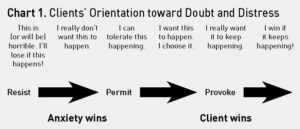
In Chart 1 you will see some possible responses to the symptoms of doubt and distress. Clients enter treatment in the position of resistance. In their most resistant position they say, ‘This is horrible. I’ll lose if this happens.” Even the stance of “I don’t want this to happen” gives anxiety the upper hand, because the mind and body will move into battle mode. Ideally, if clients can respond by saying “yes” to the encounter, and accept exactly what they are experiencing in that moment then they will be back in control.

But for many, the anxiety disorder has become so dominant that the client cannot make such a shift directly. As they attempt to accept their doubt and distress, they do so in order for that discomfort to go away. They are still oriented in their natural position of resisting the symptoms. They are more likely to say, “Let me try relaxing into this situation, and I hope this works, because I’ve got to get rid of this feeling.” The skills associated with permitting the symptoms to exist often allow the client to slide right back into resisting.

For those cases, the game takes a different tact. We re-direct the attention of clients away from fighting the symptoms and purposely toward encouraging them. They choose to act as though the symptoms are good instead of bad, and something to be held onto, even encouraged instead of rejected. As clients master this game and learn its lessons, they develop the insights needed to shift toward a non-attached relationship. If they can endure the discomfort, they can learn. I created this framework of a game to help them endure and to teach them three overarching goals.

1) Step back and identify it as a game
The first critical move is to step away from the drama, observe the event and name it. In meditation and in moments of relative quiet mindfulness, when the struggle isn’t great, you simply “step back.” You let go of your attachment to the thoughts. With anxiety disorders, in order to step back, clients must be able to label the event as one in which the anxiety is trying to dominate their mind. During threatening times, the drama is often too enticing to easily drop. They have already generated an automatic and rigid label that identifies the situation as one in which they should become aroused and worried, for example, “This is a true threat to me.” I encourage them to replace this with any message resembling: “OK, the game’s on: anxiety’s trying to get me to fight or avoid now.”

This is one of the advantages of the game. By training clients in a specific protocol and by strongly reinforcing that protocol, they begin to look for opportunities to practice and they become more astute observers of these moments.

2) Stand down 
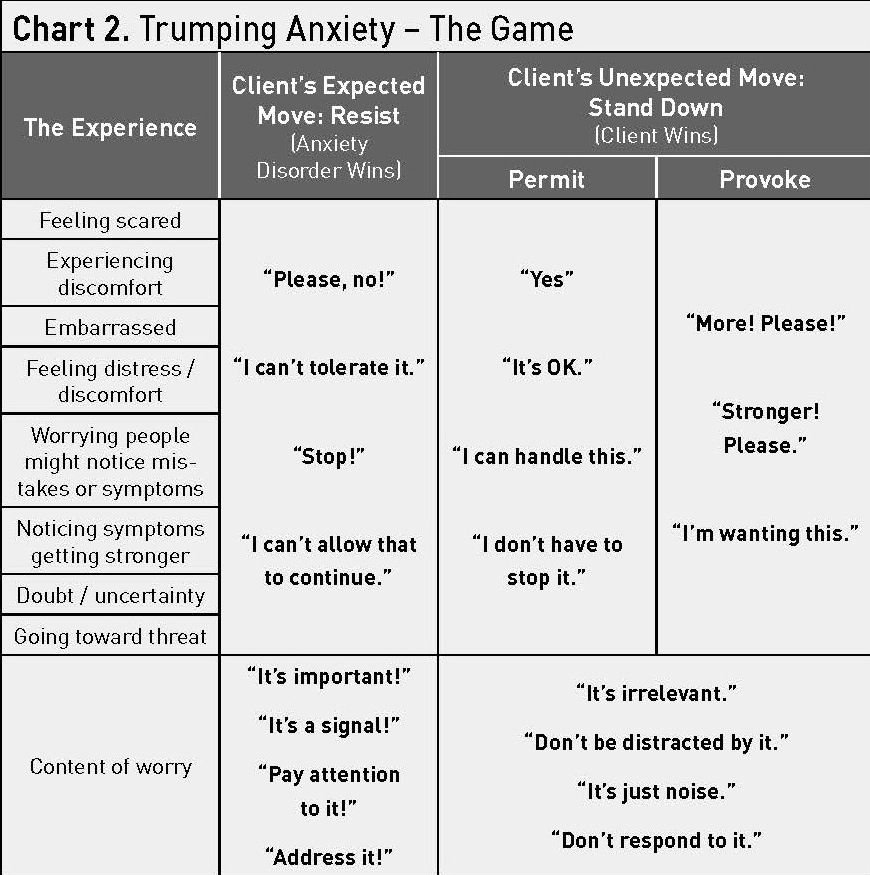
Once they step back, they need to engage in a strategy to convey to their mind that it is time to “stand down.” The body and mind need help in backing away from the fight-flight mode. If, in the face of a threatening situation, they attempt to say, “I want this experience,” then the mind begins to have a choice other than battle stations.
Clients also need to stand down from the ego’s archetypal win-lose predisposition—winning by domination—and replace it by a more paradoxical strategy of winning by manipulating the challenger’s moves instead of blocking them.
Chart 2 details this next set of moves in the game. Resisting will play right into anxiety’s hands as the expected move. Instead, clients begin the process of standing down by using one of two strategies. Each move is designed to embrace doubt and distress instead of pushing them away.

Standing Down–The Permissive Skills

The first level of the game is to allow the anxiety to continue instead of trying to stop it.

This is manifested in the supportive statements, “It’s OK that I’m anxious,” “I can handle these feelings” and “I can manage this situation.” This approach has a paradoxical flair to it that people often miss. You take actions to manipulate the symptoms while simultaneously permitting the symptoms to exist. With physical symptoms you are saying, “It’s OK that I am anxious right now. I’m going to take some Calming Breaths and see if I settle down. If I do, then great. But if I stay anxious, that’s OK with me too.” We attempt to modify the symptoms without becoming attached to the need to accomplish the task. This is a critical juncture in the work and the therapist must track closely the client’s expected move of, “I’m going to apply these relaxation skills because I need to relax in this situation.” No! While it is fine to relax in an anxiety-provoking situation, it is not OK to insist that you relax. That’s how anxiety wins.We reverse a common American catchphrase by saying, in the face of anxiety, “Don’t just do something, stand there!” When enough epinephrine pumps through the body then the brain yells, “Run!” Consciously overriding this impulsive message takes great courage, but pays great dividends. It differs from desensitization where we help the client gradually approach the feared situation under relaxed conditions. Here we confront their instinct to seek out comfort and encourage them to remain physically anxious and mentally as calm as possible. Instead of believing that there is something broken, they simply accept the status quo.

Going Toward–The Provocative Skills

Many people consider acceptance a weak strategy in the face of the fortress of fear that has been built in the mind. They need to shift from the permissive stance (“It’s OK this is happening”) to the provocative stance (“I want more of this discomfort!”). Here they learn to encourage the symptoms instead of just accepting them. This strategy is extreme and can be thought of as fighting fire with fire. Fear is intense and acceptance is soft. Fear will trump calmness and acceptance every time. I help clients shift to an attitude of provocation that is equally as powerful as, and can compete with, fear. I teach them to use their willpower and conscious intention to seek out an even more rapid heartbeat, to encourage their feeling of contamination to grow even stronger, or to hope someone will notice their hands shaking.

Why this line of attack? Because we want to interrupt the dysfunctional pattern in the most effcient way possible. The straightforward way, using acceptance, is not necessarily the most effcient way because it tends to be susceptible to the clients’ dominant paradigm of resistance, for example, “Let me try to relax here and I hope this works, because if I panic that will be awful!” Consciousness only has so much attention at any given moment. During an anxious moment, I encourage clients to commit themselves to play the game, and to focus their limited attention on following the rules: try to get anxious on purpose by encouraging symptoms. If they will bring their attention to the task of encouraging, even cajoling symptoms to become more uncomfortable, or for doubt to grow exponentially, then they automatically withdraw attention from their fearful goal of ending the doubt and distress.

When I suggest homework activities to clients, I use expressions like, “how about playing with this move?” and “perhaps you can fool around with these responses.” I imply that these strategies are malleable and temporary: “What do you think about just experimenting a few times with this move and see what happens? We can talk about it next time.” For some, we will literally play a game in which they score points for various types of responses to their worry or anxiety, or they will have to pay a consequence when they avoid or engage in some ritual to help themselves feel safe instead of threatened. An example of this strategy can be seen in the case of Samuel. One of Samuel’s fears was that he might unknowingly have cuts around his fingernails and cuticles that would expose him to the AIDS virus while shaking hands at work. Throughout the workday he conducted brief checks of his ?ngers. I gave him the following assignment:

  • Go to the bank and get 40 fresh one-dollar bills.
  • As you leave home in the morning, fold them and place them in your left pocket.
  • Each time at work that you compulsively check your fingers you are to move a bill from your left to your right pocket.

This is a simple intervention, but I gave it to someone who was already oriented to the game. He knew that the only way to keep those dollars in his left pocket was to go toward his distress of not knowing if he was being exposed to AIDS. As he began the game, a typical email from him would say, “By the end of the day, I only had $10 in my right pocket!” There was something about adding that “game” that refocused his attention just enough to lower his struggle and raise his success rate.

I hear this from clients time and again: when they focus on scoring points, or avoiding a therapeutic consequence that we create together, they notice that they become less attentive to fighting the symptoms. When they disrupt their on-going relationship with anxiety by struggling to play the game, they spontaneously become more tolerant of the situation and their distress diminishes. Over time, as they learn the surprise benefits of this pattern disruption, they can congruently adopt the permissive style.

As you might imagine, these people are not easily persuaded to really want this experience. However, this is not the point of the exercise. The point is that they try to associate themselves to the task even if their initial attempts are clumsy. Clients can be encouraged to pretend to want their anxiety, like a role in acting class. This is a cognitive skill, so the work is directed to what they are mentally saying during practice. As they try to subvocalize as if they want to increase their doubt or discomfort, they will automatically dissociate from their typical negative interpretations.

If a client has trouble encouraging the physical symptoms, for example, “I can never want my hands to sweat,” then I suggest a minor shift in their focus. Instead of directly requesting physical symptoms to increase, I ask them to request that the anxiety disorder make the symptoms stronger. Instead of saying, “Come on! I really want to faint right now!,” they say, “please, anxiety, make me more dizzy.” This seems to be just enough misdirection and dissociation to make it tolerable to them, and accomplishes the same goal of competing with their resistance.

The central strategy of the game is for clients to want to embrace whatever the anxiety disorders want them to resist. One of the primary ways I convey the logic behind this wanting is by first defining the process of habituation: prolonged exposure to a feared situation, bringing about a significant decrease in fear.

Wanting Habituation

Habituation requires three elements: frequency, intensity and duration. You have to expose yourself to your feared situation often enough or you won’t progress. When you practice, you need to get up to a moderate level of distress. Practicing while you try to keep yourself calm actually slows your progress. Practicing between 45 to 90 minutes seems to be the ideal amount of time according to the research. These three components of habituation guide all homework assignments.

I think there is a fourth element missing: the spirit of wanting to experience what you need to experience. Clients progress much more rapidly when they desire to have the habituation experience. Unless they are seeking and wanting frequency, intensity and duration as they go toward fear, then by default, they will be trying to do the opposite. They hope they don’t get anxious, that the symptoms don’t get very strong and distress doesn’t last very long. This makes no logical sense to me. If frequency, intensity and duration of exposure to distress and doubt are needed for me to get better, then I want to stumble upon a situation which stimulates my anxiety. I want to do that often, and I want my distress to last, and I want the sensations to be strong. These elements create habituation and habituation is my ticket out the door away from suffering.

Cognitive-behavioral therapy does not teach this specific orientation to clients, although I think it should. If it did, it would alter clients’ disposition toward the problem, help to guide their practice, give them motivation and I’ll bet that it would alter neurochemistry as well. Analogously, if we are receiving chemotherapy for cancer treatment, it would be poor therapeutic form to go to each appointment dreading it, despite the fact that the side effects can truly be dreadful. Instead, you should see the chemotherapy as your friend, augmenting your body’s natural ability to heal. That’s good placebo.

The most important benefit of applying the skill of wanting is that it speeds healing by truncating the habituation process. Clients learn rather quickly that if they invest in the stance of wanting, it returns to them the gift of a rapid reduction in their anxiety. They gain insight sooner in the process, after fewer practices and after fewer minutes within each practice. When they apply the skills of the game during practice, they actually have quite a hard time keeping their distress high (try as they might) or having it linger around for those 45 minutes. By paradoxically applying the orientation of wanting, clients have an “aha” experience during practice that brings freedom.

3) Master the skills of the game through applying technique and practicing (or being a “good student of the work”)
I discuss with my clients the idea of “being a good student of the work.” Good students, of course, are clients who commit to following through on a homework assignment, and then work hard to keep their commitment.

One of Moira’s many OCD compulsions involved her needlepoint work. Frequently she felt compelled to tug on the thread ten times as she tightened a stitch. I offered her a new ritual to adopt. Each time she tugged more than once, on that next stitch she was to tug ten-plus-two times (12). The next stitch she had to subtract three to the number, tugging nine times. Ten on the next stitch, add two, and so forth, until she reached one tug. Her ten-tug stitch became a ritual involving 113 tugs in the next seventeen stitches. She hated that! But she did it, because she was a good student of the work. By forcing herself to stick with our little game, she increased her conscious awareness of her thoughts, feelings and urges during the moments just prior to her compulsive action. At the moment of the urge to pull more than once, she became alert to the punishing consequence. This strengthened her ability to turn away from it. Within a week, that compulsion was of her list of troubles.

Skills Meet Challenge

Doubt relates to clients’ perception that their skills won’t match the challenges they face. If their assignment is within their skill level, then they will be more willing to go forward. This usually means we must lower the challenge and offer them a performance goal within their perceived skill level.

If I am an OCD checker, and I think I have just run someone over, I may yet have the skill to resist my urge to turn the car around and check the highway again. But how about pulling over and running around my car one time before I turn around? I can do that. And now I have interrupted the pattern, which provides me an opening for further changes. One day, as I am having the urge to check, remembering that I now must pull the car over and run around it (again), I might spontaneously decide that that is simply too much effort. At that point I will drive on, and thus experience, with little suffering, exposure to my feared outcome without engaging in my ritual.

Score Points! Win Prizes!

The assigned tasks can be so challenging, so threatening to clients’ frame of reference that they refuse to practice. Even if they do practice, their early efforts may give them only small gains. I mentioned earlier that I create a frame of reference of addressing anxiety as a game in which you can score points. For some clients I create prizes as extrinsic rewards in the early learning phase. Sometimes I offer them metaphorical images, for example, “Imagine that if you walk all the way to the back of the store and stay there 10 minutes that I will magically transfer $10,000 into your savings account. Could you do it then? Play to win, as though your life depends upon it.”

Currently, I have a large woven basket full of prizes, wrapped as gifts. In my anxiety group I bargain with clients: “Anyone who completes three practices this week can draw from the basket.” I have been hiding a $5 bill within two of the prizes as an extra incentive. Last month I rewarded the group member who earned the most points over the previous week with her choice among 12 new self-help books.

Recently I have generated a competition in the group during a several-week period. I agreed that for each member who practices at least 3 times I would contribute $5 into a weekly “pot” of money. I devised a point system to be used for every practice session. Each person decides where and how he or she will practice. Whoever scores the most points, wins the pot. The winnings can grow to be $90.
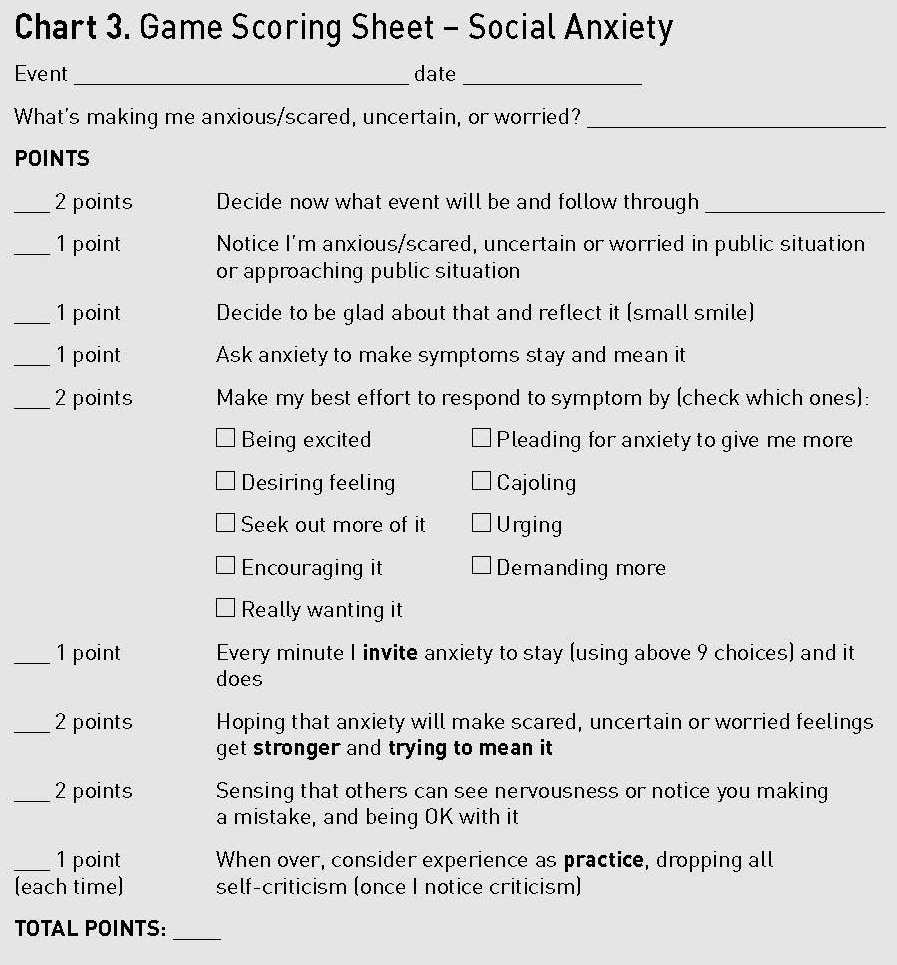
As you review Chart 3, you can see the essence of the provocative game and the weight of each type of activity. These illustrate the goals I want them to set during practice. They reflect the essence of paradoxical action in fearful situations:
In a threatening situation, step back and become an observer of your process, not be 100% the actor in the drama. Decide to be glad about having the doubt or distress. Put a little light smile on your face or in the back of your mind to reflect it. Then, invite whatever struggle you are having, whether physical symptoms or worries, to stay. Work on trying to mean it. If possible, try to strengthen your move by intensifying your reaction. [For example, I offer nine different choices, such as the previously discussed demand that anxiety make the symptoms stronger.] No matter how strong the doubt and distress becomes, you should treat it as if it is never enough. Reward yourself for every minute you actively invite the symptoms to stay or to get stronger. Accept that other people might notice some problem you are having and for extra credit: hope that they do! Then, when you are done with the practice, learn to support yourself. Drop that critical, disappointed voice.Creating the point system has a number of benefits. The client and I establish a broad strategy together that is manifested through specific actions during practice times. But they pick the practice times to apply the skills. They answer the question, “What can I do today to create some strong uncomfortable feelings for a while?” As they act on this choice, they are empowered and feel a sense of control. Once they are in the anxiety-provoking moment, the point system directly guides them to the therapeutic action.

It is poor strategy to get into a threatening situation and then decide how to act. In that setting, they are competing with a well-habituated set of instructions (“brace, worry, and avoid if necessary.”) Clients are much more likely to regress back to their safe actions, or inactions. When they understand the rules of the game and commit themselves to follow those rules, then recall them as they face threats, they have the best chance of winning

Social Anxiety Strategies

Social anxiety disorder gives clients shaky hands, a quaking voice and worry about the critical judgments of others. Here is the role that it expects of the client: to not want the experience, to avoid it when possible, and to try to get rid of it. When choosing to play the game they ask for the opposite of what anxiety expects: they want anxiety to make their hands shake, their voice quake and their sense of threat heightened. Not only do they request those experiences, but they want them to stick around as long as possible! The clients then attempt to exaggerate their wanting of this experience, and might “desperately plead” for social anxiety to generate shaky hands, or to “cajole” the anxiety to make the experience stronger. They can increase their score by hoping that people will criticize their boring talk or question their shaky handwriting. Earn enough points, win a prize! They refuse to play the game that the anxiety disorder expects. They take charge and push that game board away and pull up their own game board of seeking out doubt and distress when anxiety wants them to defend or run.

Julie

Julie decides to practice facing her social anxiety by eating lunch out alone. She walks onto the lunchtime crowd of “Moe’s Southwest Grill” and is instantly greeted by the cooks and other staff. “Hello! Welcome to Moe’s!” they yell, and the other patrons turn to see who’s entered. Julie begins to feel the flush of red rise in her face as she smiles and nods her head in acknowledgement. Then inwardly she smiles and says to herself, “Yes! Another point.”

Here she describes the process. I’ve added my comments in brackets to her key statements.

“I was really nervous walking in there. I felt like everybody noticed that I was by myself. But that was OK, because that was the point of the whole practice. [She is listening in to her inner conversation and she is permitting her feelings instead of blocking them.] Then having to find a place to sit and making that conscious decision: Am I going to sit with my back facing everyone? Am I going to sit and actually have to look at everybody while they look at me? I made the choice to sit and look at everybody while they looked at me. [She is taking control of the situation by listening in on her process and choosing the more intimidating option.] …I reminded myself that the longer I could stay and the longer I could be nervous and be OK with it, then the better it would be for me. [She has adopted a new belief system about her goals in the fearful situation: stay anxious to win.]

“I thought about how I could make it stronger. I thought that facing everyone while I ate would keep the anxiety going. I was just trying to think of ways to keep the anxiety going. [She is actively strategizing how to provoke symptoms as a powerful way to help her stop resisting.]

“I’m not as afraid of social anxiety as a word because I’ve taken social anxiety and I’ve turned it into a person instead of a condition. It’s not a mother, it’s not a father, it’s just this person or this entity and she wants me to take care of myself. She doesn’t want me to be embarrassed. When I do something that she thinks I could not do, she is impressed. I really like that because it is not a judgmental thing. It is like someone saying, ‘You really should wear a jacket, it’s going to rain.’ But you go out there without a jacket and it doesn’t rain, and they say ‘OK, you did it; you’re still a good person.’ So that’s how I’m thinking about it. [She now comprehends that those ogres, worry and anxiety, have been in her life to help her. They just do it in a clumsy way and she has found a better way. Julie will win this game for good.]”

OCD Strategies

OCD wants the person to try to get rid of any doubts about safety and to take any actions necessary to remove distress. Many OCD clients who fear contamination really do believe that at the moment of exposure they must repeatedly wash to save their life or the life of someone they love. Personifying OCD, I emphasize how it needs them to believe the specifics of their fears. Clients who win over OCD will hold fast to the belief that this is an anxiety disorder. As such, their battle should be with the physical symptoms of anxiety and the urge to end doubt. They should by no means battle with the content of the obsessions. It is never about germs or rabies or salmonella. It is always related to the fear of feeling distressed about threat. To play the OCD game clients set the overarching goal of seeking out doubt and distress.

Eventually, everyone in OCD treatment will do exposure (of the feared stimulus) and ritual prevention, which is the standard treatment for this disorder. But modifying the ways clients obsess or how they perform the ritual is the most efficient starting point for many. Starting with small, lower-threat changes allows clients to practice their new skills and experience early success. Instead of not washing their hands at all after they feel contaminated, clients can change how they wash, where they wash, or what they are doing mentally while they wash.

Jai

Jai was living in a residential program for teens. He struggled with about a dozen different types of washing and cleaning rituals, especially when it was his turn to handle the after-meal cleanup. One ritual required that after he was finished with his (thorough) cleaning of the kitchen, he was to squeeze the sponge ten times while rinsing it under running water.

In our first treatment assignment I asked him if he would fool around with the ritual by switching hands each time he squeezed. In this case, Jai got to keep squeezing and keep counting. He simply altered hands, and switching hands was only a minor threat to him. This is what I call throwing the symptom cluster a bone. You leave in place major components of the ritual or obsession, thus lowering the threat level. However, it is still a change that begins to erode the original fortress of symptoms. He agreed to the assignment, and returned the next week to report how easy that task was. I then suggested this further revision: would he be willing to explore his ability to toss the sponge in the air and catch it with the other hand for each switch? Again, he agreed to this small, silly shift and returned the next week reporting no problems with the task. The following week, he simply squeezed one time and set the sponge down without struggle.

Jai’s playful approach to modifying his ritual became a relatively painless means to arrive at exposure and ritual prevention. It served as a building block for some of his more difficult later encounters with OCD.

Jordan

Jordan, a physician, feared contamination with germs that might come in contact with her clothes during the workday at her medical practice. One of her primary rituals was to spray the entire front of her body with ammoniated Windex® as she left work. She used that same Windex® throughout her home when she felt threatened by germs. Ironically, while Jordan obsessed about becoming sick, her husband, who was also a physician in her practice, was developing serious respiratory problems from inhaling the ammonia. Over months, Jordan worked hard to tolerate switching the Windex® to vinegar-based, then to dilute it to a 50% solution and finally to a 33% solution. Each of these steps increased her doubt just enough that she could tolerate it and experiment with the change. Once she implemented the change, she incorporated it into her routine without much struggle.

But we could progress no further with this or the other safety rituals she performed. Jordan was stuck on the content of her obsession: things had to be clean enough. I failed to persuade her that her attention actually needed to be focused on the strategy of confronting doubt and uncertainty.

Vann

Vann came into treatment struggling with OCD checking rituals that lasted up to five hours a day. Often his concern was that he had missed seeing something he should have noticed: new scratches or dents on the trash can, dust particles under the telephone, an inappropriate item in the basement. Other times he checked as a way to prevent a disaster: an electrical cord will be wrapped around the trash can; his son will trip over some item on his bedroom floor; a fire will start in the kitchen or a flood will occur in the basement. Some days Vann would check a particular item over a hundred times.

Our first ploys involved gently modifying his relationship with his symptoms. For instance, he would check the trash can, but only in slow motion, ever so gradually picking it up and unhurriedly rotating it in his vision. Or he would study the telephone, but not allow himself to touch it. These were his first playful explorations into uncertainty and distress. By the sixth session we added a strategy of postponing. OCD would give him the impulse to check the basement immediately. He would choose to wait thirty minutes before he acted on that urge, again learning to tolerate his discomfort. Through this gradual exposure to the principles, by session nine he was able to avoid locking his house for five days.

Here is how he described his progress by session 10:

“In the past I would pull out the backseat of the car, and if there were dirt there, I would have to clean it up. If a bolt was there I would look at it and get stuck on the backseat, focused on that bolt. Now I do this intentionally. I lift up the backseat and try to make something really bother me, try to feel anxious. I feel that anxiety, replace the backseat, shut the back door of the car and walk away.

When I first started walking away I felt really anxious. I wanted to go back and look at something under that seat again. I felt as though I didn’t look at it hard enough and I’d want to look at it again. I would sweat a little bit, my heart would beat faster, I’d become very irritable and I felt very compulsive. I wanted to go check again! But I just decided I wasn’t going to do it. Sure enough, about two hours later the desire went away.”

Vann completed his treatment in eleven sessions over 5 1/2 months. In a follow-up twelve years later, he remained symptom-free and medication-free.

Conclusion

I began this conversation saying that when I work with anxious clients, I keep my points broad and simple and I focus on them repeatedly. My goal is to influence clients’ perspectives and shift their orientation. I encourage you to try the same.

Help clients to turn away from the content of their fears whenever possible. You cannot always ignore content, because clients will be wrapped up in it. But get past content as soon as you can and move into the core themes of people with anxiety disorders: their struggle with doubt and distress.

The central strategy is for them to want to embrace whatever the anxiety disorders want them to resist. They have two choices. They can “stand down” by choosing to let go of their fearful attention and accept the reality of the current situation. This is the permissive approach. When they have completed treatment, this will be their most common response: to say, “I can handle this situation” and to allow their body and mind to become quieter. The other option is to choose to stay aroused on purpose and actually encourage anxiety to dish them more trouble. This provocative choice is an excellent option during treatment, because choice number one is so difficult to embrace during early encounters. Conditioning and a set of false beliefs are calling the shots; they cannot simply relax on cue. Some treatment protocols will suggest that you help them expose themselves to the fearful stimulus and learn that they can tolerate it. I am suggesting that you put a twist on that set of instructions. Help them to take actions in the world that are opposite of what anxiety expects of them. Persuade them to go out into the world and seek out opportunities to get uncertain and anxious in their threatening arenas. This is a shift in attitude, not behavior. The behavioral practice is not to learn to tolerate doubt and distress, it is to reinforce the attitude of wanting them.

Our ultimate goal is to teach clients a simple therapeutic orientation that they can manifest in most fearful circumstances. Early in treatment, however, you will also need to provide a specific system to follow, with simple rules that guide their interactions with fearful anxiety. Using behavioral practice, encourage them to repeat this new interaction again and again, in all their fearful situations.

You can assume that one of the biggest obstacles to success will be poor planning just moments before the encounter. Whenever they wait until they are scared before deciding the best course of action, then conditioning and faulty beliefs will dictate that they struggle or avoid. In that setting, they are trained by fear to mindlessly seek safety and comfort. Before they enter any situation that is potentially threatening, they should review their objectives and remind themselves of their intended responses.

Thinking of their relationship with anxiety as a mental game offers both a broad therapeutic point of reference and specific actions that manifest it. Initially, your skills of persuasion and their belief in you will push them to challenge their faulty beliefs. After that, experience will be their greatest teacher. Once they have acted on these beliefs and gotten feedback during the fear-inducing event, that learning will put the power in their new orientation and it will be self-sustaining. They will then have a set of instructions, such as “anxiety, please give me more” or “I’m looking for opportunities to get distressed” that will point them toward simple choices during difficult times. And they will have a skill set (that I laid out in Charts 2 and 3) that they believe will match the challenge of the situation.


Donald Meichenbaum on Coping with Loss and Traumatic Bereavement

Lawrence Rubin: Hi, Don. Thanks so much for joining me today. You are most widely known for your foundational work in developing CBT but it is equally important that our readers know that for these last 35 years, you have been the director of research at the Melissa Institute for Violence Prevention and Treatment in Miami, Florida.
Donald Meichenbaum: (DM) Thank you for the invitation.
LR: You had previously requested that my first question be about the tragic and unexpected death of your wife, Marianne?

The Irony of a Trauma Specialist’s Tragic Loss

DM: We were married 58 years. My wife and I were vacationing in Clearwater, Florida, escaping the snows of Buffalo, where our permanent home is. My wife was tragically hit by a car at a pedestrian crossing. You know they have flashing lights, and this is sort of a warning sign. She was hypervigilant about not trusting people to stop, so obviously she would not have stepped off the curb if the vehicle had not stopped. But for whatever reason, the vehicle continued on and hit her. And in fact, she was lifted by a helicopter from Clearwater down to the trauma center in Saint Pete.I had called her on her cell phone thinking that she was late because she had a Zoom yoga meeting that she usually attended. I got a male voice, and he indicated that she had been hit and taken by helicopter down to the trauma center, but they would provide me with a police car to drive to the trauma center. I got there and the trauma physician indicated that she had already died. I asked to see her, went in and she was covered by a sheet. I pulled down the sheet, and she was pretty messed up from the accident.

I’ve worked with head injured, so I’ve been involved in seeing such incidents. Remarkably, her hand was still warm when I caressed it. There was a chaplain sitting next to us and I asked her to take a picture of me holding her hand. I actually sent that picture to my daughter-in-law who made it into a pillow. So, it was a traumatic bereavement kind of situation.

The irony is that morning I was giving a Zoom lecture for therapists in China on how to cope with traumatic bereavement and prolonged and complicated grief. And by four o’clock that afternoon, I was living my lecture. So, one of the interesting aspects of all this, and I’d be happy to discuss it with you, is what is the immediate and more long-term impact on an individual such as myself, who is in some sense is an expert on the area of interventions — having developed cognitive behavioral techniques.

Interestingly, there are hundreds of these kinds of accidents, many in Florida, of people — for whatever reason, where the driver is not complying with the pedestrian crossing. And there are multiple accidents and deaths in this particular way. So, the issue of traumatic bereavement as compared to a kind of prolonged complicated grief is an issue that I have been preoccupied with. And moreover, I’ll just add this final note before we open it up for your further questions. There are two aspects that are really quite fascinating in the aftermath of such traumatic bereavement.

One has to do with dealing with the grief. And the other aspect that is not readily discussed by clinicians is the sequelae that follow the sudden death of a loved one. And I will give both you and the readers to this presentation, a keyword that will change your life forever. This is the most important thing you should take away from our discussion. And the one word that you need, Larry, that will change your life if you do not already have it in your repertoire, is “passwords.” If you do not have the password of your significant other who died in a traumatic fashion, you are screwed.

LR: You’ll lose access to everything.
DM: Yeah, right. So, at a moment of intimate repose for your listener, they should lean over to their loved one and say, “I love you, but do you know our passwords and how to retrieve them?” So, you know I can fill you in and turn this into a kind of therapy session? And tell you the kind of trauma events, both dealing with the aftermath of the loss of my wife, but also the police reports, the autopsy reports, the life insurance, the banking, all of the credit cards — everything that goes with it.And the interesting thing is, if you are a clinician, one of the things you do in helping me is assessing, what is the lingering impact of this, what was the aftermath like? But it’s unlikely that you would have done that and asked does your social life change, and then a whole bunch of other questions that I’ve put together. In fact, the lecture that I was giving that morning to Chinese therapists, that entire 80-page handout that I provided them with is available to your listeners.

So, if they go to Google – Meichenbaum, Donald, Melissa, Institute – they will be able to download my 80-page tool plus other items on how to treat individuals who have traumatic bereavement and prolonged and complicated grief. So, if there’s anything I say that might be of help, I’m glad for that. And moreover, if there are people who want to contact me, they could do so through the Institute.

LR: I’m fascinated by the one word that you said clinicians, spouses, partners, family members should know, which is “password.” What’s the significance of imparting that piece of wisdom of knowing your partner’s password? And how did it play out in your journey?

DM: To access a number of accounts, my life was such that my wife Marianne was a wonderful wife, a very competent person. She was an actress, and she was a June Taylor dancer. She looked after all of our finances. I’m not a very competent person other than psychology. I’m a really good psychologist. I know a lot.

But when it comes to life, she was what I would characterize as my surrogate frontal lobe. And therefore, I never knew how to run appliances or bank machines or any of these kinds of things, and she looked after it. So, to gain access to that information, you really need the passwords. Fortunately, I have four wonderful children who are competent and loving and supportive, and that helped a great deal. So, we were able to, over a lengthy period of time — trust me, it took more than an entire year — to settle accounts related to adaptive functioning and financial issues and the like.

I won’t trouble you and your audience, but to highlight how unfriendly, how totally unfriendly the system is, to the 1,000,000 people who lost loved ones due to COVID. You know, the 20,000 individuals who died by interpersonal violence. You know, the incidence of mass shootings and all the other kinds of episodes, you know, the 48,000 who have to survive the suicidal death of a loved one. So, this discussion is absolutely remarkably timely, let alone the loss of natural disasters. I mean, just think of all the people at Maui whose lives are just upturned, and the many wars and the like. So, dealing with loss, grieving, traumatic bereavement, and mourning has to be on the top agenda of every clinician.

Difficult Therapeutic Conversations

LR: Working with adult children of elderly parents, clinicians have to enter conversations about what their plans are with and for them. And it seems to really behoove clinicians to engage these clients about the possibility of traumatic loss and unanticipated loss without pre-traumatizing them. How can we do that?

DM: We have to remind ourselves that what makes us effective therapists is the quality and nature of the therapeutic alliance that we establish, maintain, and monitor with our clients. So, to answer your question, I would advise clinicians to not enter that discussion without the permission of their clients. If I were in that situation, I would say something like, “I recently had a personal loss and I had a lot of lessons that I learned. And I was wondering if you would be interested or willing for me to share those.” So, my notion of being a good therapist is always to solicit permission from my clients, no matter what it is I want to ask. The third thing I would do is to say that, “you should feel free if this is not a good time or this is what we want to do, to put you in charge.” Remember that we, as therapists, need to be person-centered rather than protocol driven.

So, it sounds like, Larry, you had a whole bunch of to-do tasks that you think this elderly client or loved one should go through, right? You said you don’t want to traumatize them. Well, I agree totally. You know, so treat them with the same respect that you would want.

LR: How do we have conversations with our clients who may not even have elderly parents, but who are aware that they live in a world where there are dangers around every corner. How do you help clients prepare for the unpredictable without pre-traumatizing them?
DM: I have a kind of style of therapy, and I’ve actually highlighted this. I just put together a legacy course on what makes people expert therapists. As it turns out, 25 percent of therapists get 50 percent better results and have 50 percent fewer dropouts. So, my legacy course is, what characterizes those 25 percent of people and how can I elevate clinicians to that level? I have a kind of interpersonal style of respectful curiosity. And I really want to convey that to the client and wonder if they’re curious as well.I might say things like, we live in — how should I describe it — precarious times. With the COVID epidemic, with unpredictable violence, with multiple disasters and I must confess that I personally wondered to myself, and I wondered if you wondered to yourself about, given the unpredictability of life ever occurring, are we and our loved ones prepared for that? I mean, that’s my style of interacting. So, what I’m doing in that is actually sharing the rationale, and I’m extending an invitation.

My client might choose to take that invitation or not. And moreover, if I am going to see that person again in the future, all I want to do is plant the seed, then I will be able to follow up. I would say maybe this isn’t the right time or I’m not the right person. But as I look around, I think it might be advisable. And even something as simple as knowing the password of your loved one might be a good starting point. So that’s my way of engaging people.

LR: As simple as that. Simple, but complete.
DM: The key, or perhaps the challenge, is to deal with difficult issues in a non-traumatic engendering fashion.

Lessons on Grieving through Personal Loss

LR: In what ways, looking back, has your own clinical work and research helped you in your journey of grieving?
DM: Now that I’ve talked about the sequalae, let me take a moment and talk about the grieving thing. One of the things that’s really important for your audience to know — and there’s good research by George Bonanno and others that in the aftermath of loss — is that whether it’s due to traumatic, violent episodes like this, or whether it’s due to more prolonged, complicated grief as a result of having someone who’s been ill for a long period of time; there’s an expectation and different kinds of deaths have different kinds of impact.The bottom line is you need to recognize that most people are highly resilient. If you look at the data, most people don’t develop prolonged and complicated grief. So, the key aspect is, what distinguishes those who do versus those who don’t? And I even wrote a book called Roadmap to Resilience, that examines this and deals with it. In fact, your audience is welcome, in honor of my wife’s death, to view this and also my legacy course in her memory. So that’s one way of transforming pain into something good that will come of it.

And in fact, the Roadmap to Resilience has been downloaded for free on the Internet by 45,000 people in 138 countries. So now, let’s get to the heart of your question. In fact, George Bonanno wrote a really nice book called The Other Side of Sadness, which I recommend. It’s a nice little extrapolation on the kind of resilience engendering behavior. Therese Rando has also developed a concept that I’d like to comment on, that she calls “STUGs,” Sudden Temporary Upsurges in Grief.”

And in monitoring my own behavior, since I’m a psychologist and good observer, I’ve tracked my own STUGs. These kind of substantial or sudden kinds of upsurges of grief. And there are two kinds of STUGs in my life that I’ve discovered that have important clinical implications. The first STUGs are sort of sudden and unexpected. A song comes up, an invitation comes up to go to dinner with someone who doesn’t know about my wife’s loss. A couple walks by holding hands and lovingly convey their intimate connection.

And that hits me in an unexpected way. I’m moved to tears, and I have a sense of loss and the like. And there’s nothing wrong with that. In fact, I’ve come to believe that each tear that I experience in loss is not only a reflection of the loss and the grief and how much I miss her and the like, but it’s also a tear of appreciation. Of how lucky I was and grateful to have her in my life all these years. And then, I would have never had this career and all that without her. I’m a cognitive behavior therapist, so the whole thing is not that you cry, not that you feel losses.

It’s what is the story you tell yourself and others about that emotion? Each of us, each of your readers of this interview are not only Homo Sapiens, but they’re Homo Narrans. That we’re actually all storytellers. And the nature of the story we tell will determine — I’m going to suggest — whether you fall into the 20 percent who develop prolonged and complicated grief, or you’re part of the 70 to 80 percent who, in spite of the loss, everlasting loss, your STUG is this kind of sudden reminder.

LR: Unexpected!
DM: I sort of expect them, but they come out of the blue, right? The other kind of STUG which is interesting is something that’s a reflection of a prolonged type of routine or activity that we would have engaged in. So, I’m in Cape Cod, one of the things we would do is go down and have our sunset drink on the beach. A saxophone player would often be playing in the background from their beach house, you know, some Cape Cod song that we would have toasted to, kind of thing.Or we have our favorite restaurant, or our favorite hike or something like that. And I’m now doing those activities on my own. There’s another really interesting aspect to this, and that is, is the person who’s surviving the death, male or female? Okay, so most of my social contacts here in Cape Cod, and in other places, are a derivative of my being a partner of Marianne. So, she had a remarkable social network. She was just lovable and likable. There wasn’t anyone who didn’t fall in love with my wife.

And when she died, those social contacts sort of evaporated. People sort of give you occasional email and a “how are you doing?” But you don’t get invited to the same social occasions or dinners or other kinds of activities, so your network is really an important issue. And the important predictor here, especially among men, is loneliness. Okay, and there’s a higher incidence of husbands dying soon after the death of their wife, about 30 percent and so forth, and having other kinds of physical ailments than the other way around.

And then you need to distinguish between loneliness and isolation. Some people choose to isolate — they like being alone and so forth. Loneliness is yearning for this. And so first of all, in the aftermath of both traumatic bereavement and in terms of the mourning process, that becomes important. The other thing that your readers should take away is that there are no stages of grieving. So Kubler-Ross and Ron Kessler’s stuff about going through stages has no scientific basis for it.

And not only do you not have the five stages, but the expectation on the part of the clinician that people need to go through stages, and the failure to do so is a sign of pathology, is indeed problematic and possibly stress-engendering. So, when people don’t get angry, okay, then it’s deniable or they can’t handle their emotions. And I had a pretty good cause to be angry. This happened in Florida, okay? So, the guy who killed my wife got fined 160 dollars and lost his license for three months.

That was the total consequence. Not only that, in Florida — this is a wonderful state to live in if you’re going to retire — you don’t have to have liability insurance on your car. Okay? All you need to do is pay insurance up to 10,000 dollars. The helicopter cost of taking my wife from Clearwater to the trauma center was 68,000 dollars. So not only do I have, look, how much time do we have? You want me to go on and on? So, what am I going to do? And anger we know, gets in the way of processing trauma memories. Of all the emotions, that’s the one you don’t want to give up to. And that’s the one that clinicians should ask about in the aftermath.

So, if you go to the handout that I have, I have put together the most important diagnostic questions that clinicians should ask. Yeah, I give workshops on grief, and I actually bring my pillow and tell people. And I ask, if I’m your client, Larry, what questions do you think you should ask me? You’re a gifted clinician. What do you think are the most important questions you should ask me to see whether I’m going to develop prolonged grief disorders? Because there are now effective treatments. Shearer and others have created really good cognitive behavioral interventions, when I go on and on and review all the literature. So, I can make this a two-way street. I could ask you, what question do you think you should ask me first?

LR: What comes to mind is, how has your life changed?
DM: Wrong question!
LR: Okay, I could probably guess 20 times wrong.
DM: No, no. The first thing you should ask is, “how long ago has this occurred.” Okay, if this happened like last week or last month, that’s different than if it occurred a year ago. Okay? You know, and then there’s a whole set of questions you could ask about the circumstances, like you did at the outset. Okay, so getting to the notion of how you handle this has a kind of implied judgment on your part that I should be handling it.So, am I going to tell you how bad off I am or am I going to say oh, it’s not that bad, right? So, you have to establish a good therapeutic alliance with me, where I’m going to be open and honest. You know, I have trust engendering things, so I don’t know what your agenda is. Anyway, go to my handout.

LR: I will. I will.
DM: Please, I didn’t mean to put you on the spot.

LR: It’s refreshing and intimidating at the same time. What other guidance are you offering to clinicians who maybe are sheepish about asking the questions, or will not openly receive or seek out clients who have experienced loss? 

DM: The first thing — over and above the comment on stages — is that the field of psychotherapy is absolutely filled with bullshit. I wrote an article with Scott Lilienfeld called, How to Spot Hype in the Field of Psychotherapy. The next thing for therapists to understand is that the various therapeutic procedures are equivalent in outcome, and that there are no winners in the race. So that’s the next thing, just don’t believe the hype in these workshops where these people are saying that, “X, Y, and Z works better.”That traumatic bereavement is a common response, will lead to grief and mourning that leads to deteriorating performance is just not the case. So, the second thing that’s really important is that you need to ascertain from the client how to do therapy in a culturally and religiously, and gender-related kind of fashion. You need to ask the person — in my case, whether I’ve had other losses besides Marianne. You need to make me a consultant to you. Okay. And then you need to probe. How did I handle those? And is there anything I learned from them? So, you need to see me as a client as a resource person rather than someone you’re going to treat because you went to some workshop. Okay!

And apropos of the loss and transition website by Neimeyer and colleagues, they have a lot of techniques. Some of them are expressive. Some of these are customary activities that people engage in. So, you, the clinician, need to honor the way in which I want to cope with grief. Okay? And I recently went to a workshop by Mary Francis O’Connor who wrote a book on the grieving brain. And you need to recognize that some of the losses that people experience are natural and a reflection of love.

So don’t pathologize people’s grief or their coping techniques. If I want to avoid certain activities, I don’t go and get rid of the clothing and so forth. And there was a movie that Tom Hanks made that his wife produced called, A Man Called Otto. It’s a bit of a Hollywood version, but they did a really good job on talking at the gravesite. And doing the thing on the clothes. Here’s a wonderful thing that happens. When I cleaned out my wife’s closet, I found out that for the five years that we courted each other, we had written letters. And mind you, that was 1961. She saved all those letters. In 1961, a stamp was four cents. I read those letters as if she was present, each night I take out a couple. I’m now up to 1963, you know that stamps now cost $0.08 in 1963? Her presence, my storytelling, my doing this interview, my reading the letters, are all my own personal ways to honor her memory. The fact that I put the Roadmap to Resilience online for free in her memory.

If you go to the Melissa Institute website, if you’re interested, if you like this interview, go there and make a donation in my wife’s name. We’ve already raised 25,000 dollars for the Institute against violence prevention for her. I’m now in the midst of having done this legacy course of ten one-hour lectures on what makes someone an expert therapist, and then how to take those core principles and the transtheoretical behavior change principles and apply them to a whole host of diverse problems like grief and PTSD and anger and the like.

Each of those courses is only going to cost 150 dollars. Okay, that’s 15 dollars per CEU. All that money is going to go to the Institute in memory of Marianne. So, if you want more of what we’re talking about, track down this legacy course. If you do, there’s the likelihood you’ll be in the 25 percent group and you’ll be able to honor my wife’s memory. You get CEU’s for cheap.

The Role of Resilience in Healing through Grief

LR: You mentioned something earlier on, Don, about resilience as one of the really powerful predictors of how someone will move through their grief journey. Can you say a little bit about what a resilient griever looks like?
DM: In the aftermath of trauma or victimization, and with regard to whatever form it takes, resilience has been equivalated with notions of the ability to bounce back and with dealing with ongoing adversities. And it deals with the notion of personal growth. Margaret Stroebe and her colleagues have an interesting distinction within which people oscillate. That is, they have a variety of coping responses that are loss-oriented or restorative, and future-oriented. One of the things that’s interesting is that people can deal with it as a kind of Viktor Frankl type of observation.That people could deal with any kind of how in their life, as long as they have a kind of why in their life. Some sense of meaning, making purpose. This fits into my constructive narrative perspective that everyone is a Homo Narrans, or a storyteller. So, one of the things that becomes really interesting is how people transform their loss into some kind of effort to help others. So how did the Melissa Institute come about and my involvement therein? So, in the tragic killing of their daughter, Melissa, when she was at college in Saint Louis at Washington University, they have transformed the last 28 years – her loss — into a meaning-making activity.

You can go to the Trevor Project on suicide. You can go to Mothers Against Drunk Driving. There are numerable examples, I give multiple websites of how people have transformed their pain into something good. That doesn’t mean that you don’t continue to have an everlasting sense of grief. There’s nothing wrong with grief. It’s like any other emotion. The key is, what do people do with that emotion? Do they withdraw? Do they isolate? Do they become lonely? Do they use addictions? Do they self-medicate?

So, the key question is not, apropos of the resilience, or that people grieve. The fact that people are in touch with their grief is, in fact, a sign of resilience, right? It’s coming to, how do they honor? How do they memorialize? I deal a lot with returning soldiers. And the other kind of thing is that there are different kinds of losses. There’s loss of people, but there’s a thing called missing loss also. Like imagine people who have individuals who go missing in action. You don’t know if they’re dead right, or in Maui — you know, they haven’t found certain bodies. I mean, does that mean, is there more?

How do I, do I sort of get preoccupied and ruminate about the loss of my loved one, and how I wasn’t there? If I have guilt, shame, humiliation, if I have anger, if these kinds of negative emotions are that which drives me, then that’s the person, those are the folks who are going to be more likely to get stuck, who have hot cognitions and the like. So, you can talk about resilience being the absence of negative stuff, or resilience could be the restorative process on the other end. I don’t know if I’m getting close to your concerns, but…

LR: That resilience, and there are certain personality attributes and certain experiences that predispose people to resilient ways of being, and those people are probably in a better place to move forward in their lives after a loss.

DM: Here’s one of the things I failed to mention. The research indicates that people who have had a prior major depressive disorder are significantly more likely to develop prolonged and complicated grief. So, when I was asking the question, I ask, “Have you had similar losses in the past” and so forth? What we could do is look for vulnerability factors, okay, that are red flags as another tip. To see who would warrant evidence-based interventions, we’re pretty good.

If you look at my core task, there’s a whole way of how we, as therapists, do psychoeducation to educate people about grief. Or how do we help them develop various kinds of coping strategies? And how do we get them to follow through? The big thing is how do you get people who need help to want to come for help? And help them stay there? That’s the artistry of therapists.

LR: Is it more likely that those who have historically reached out to others for help, who have built lives that are rich in community, are just naturally predisposed?

DM: Well, a lot. There’s a fair amount of research by Camille Wortman and Roxanne Silver. Obviously, one of the building blocks for resilience is relationships. I mentioned I have four loving kids who really came to support, I have other people — professionally and others — who’ve come to support. But Wortman then really found a whole bunch of things that people do that are unproductive, that actually make people worse.

They have identified a variety of things that people provide support for, and actually make people worse. Like moving on statements. Things like, “You’re still a young, attractive, bright guy. You’ll find someone. How much longer before you die, You’ll be able to join him. This was God’s mission, He knew something.” So, there are lots of things that social support people offered, so that’s one of the questions you need to ask.

What, if anything, have people done or failed to do that you found helpful or unhelpful, right? Because you want to make sure that you, the therapist, aren’t doing something that I perceive as being unhelpful. So, if you’re a really good therapist, let your patients teach you how to do therapy. Don’t think just because you went to graduate school or took some workshop that you know how. Ask your patient, “What do you think is causing you to still have this lingering grief? And what do you think it will take to help you to move on? And what is it that I, the therapist can do to help you in that process?”

LR: You know, Bob Niemeyer suggests that therapists working in the arena of grief need to be what he calls the guide on the side, rather than the sage on the stage.

DM: Yeah. I like that. That’s a good metaphor. I like him a lot. I’ve read all his stuff. And, you know, my thing is, don’t be a surrogate frontal lobe for your patients. Don’t let the person’s emotions hijack their frontal lobe.

LR: And don’t, as the therapist, let your emotions hijack your presence in therapy. What about those therapists who themselves have had complicated losses, or unfinished business with their own children, parents, and spouses who have died?

DM: Well, I guess those therapists need to be honest with themselves and wonder how it impacts their therapeutic process. Those therapists need to be honest with themselves and decide whether, in fact, they need some therapy. That could help them deal with the issue. And the third kind of issue is, can they strategically use that self-disclosure in a way that facilitates or benefits the patient’s recovery? Rather than saying, you think you’ve got problems with your wife? You want to know what living with cancer has been like? And not only that, my father has Alzheimer’s, and now all of a sudden I have to listen to your shit, right?

So, you can judiciously, strategically say words are inadequate to describe what grief is like. I’ve been there myself. It’s not the occasion for me to share the details, but I want you to know I’ve felt the pain. Okay, I don’t know what the right words are, and you have to say it in an effective way. You can’t say, you think you got problems?

LR: In what way are you — are there any ways that you’re still practicing as a therapist now?

DM: I do a lot of consulting. I work with the head injured thing when people have cases, I train therapists who are doing supervision. I’m not seeing patients now like I did in the past, because I’m not in one place. I’m kind of a peripatetic clinician, so it’s hard to make a commitment to someone being there. I do some consultation with patients by telephone, since COVID.

LR: We could talk for hours Don and I do I hope we talk again. I appreciate your kindness and generosity.

DM: Thank you for the compliment and for inviting me on this journey.

©2024, Psychotherapy.net

Spitting Truth from My Soul: A Case Story of Rapping, Probation, and the Narrative Practices- Part II

Recapitulation

This is the second part of a two-part case story that focuses on a 24-year-old African American client named Ray who was referred to me (TH) by probation services. In this brief introduction I will try to summarize what transpired in Part I. Whenever possible, I will attempt to provide phrases or “pieces” of Ray’s language so the reader can begin to get a “feel” for him and our work.

Rap music was introduced as an entry point to our work. After our first session Ray could probably best be described as equal parts skeptical and intrigued. He enjoyed sharing rap songs that were meaningful to him as well as having the opportunity to create rhymes of his own.

We rather quickly discussed ways in which rap music was misunderstood (“Adults throughout my whole life telling me it’s violent and the music of the devil . . .”) and how others could not or were not willing to hear the important messages that can be contained within certain songs. We proposed a pair of magic headphones (“Magic Beats”) as a way to help those who would not listen begin to hear rap’s message. This idea will prove particularly important as our conversation progresses in Part II.

As our first conversation continued, we started exploring the sociopolitical implications of rap music and hip-hop culture. We framed rap as a kind of philosophy (“But without all the white cats . . .”) that served as a voice for the voiceless. We also stumbled across a connection between Ray’s grandmother and rap music (“I’m rapping about the same s**t she’s saying but in my own way . . .”). This struck him as perplexing (“That’s crazy bro . . .”) and also enlightening (“I never thought of it like that . . .”) given the disdain she had expressed for rap music throughout his youth. Our first meeting came to a close by having a conversation about our conversation.

We explored the difference between just talking and rapping, to which Ray responded, “It’s like when I rhyme . . . I spit truth from my soul.” We both agreed that inviting rap to our future meetings would be of benefit. More specifically, we discovered that rapping might serve as a pathway to liberation (“Remove the shackles from my soul . . .”). I invited Ray to consider composing a rhyme that paints the part of the picture that probation services doesn’t see. He responded enthusiastically but seemingly nervous that probation services would discover the way we were working and somehow veto it (“You’re the weirdest shrink they have ever sent me to. Not weird like bad, not bad at all, but does probation know you do this?”). We then decided that calling our work together a “studio session” was a better fit than therapy.

Ray picked up in our second meeting directly where he left off in the first. He came prepared with a rhyme that would be the foundation of a counter-story. He noted in that rhyme the importance of challenging rules (“Just because these are the rules you play the game by doesn’t mean these are the only rules . . .”). The conversation evolved into looking at whether or not Ray had found some ways of challenging rules more effectively than others. He then traced the relationship between rap and anger (“It’s like my anger would leave my mouth through my rhymes . . .”). Part I concluded with a pensive Ray searching for a rhyme that captured this most important function of rap music as an antidote to anger and aggression. The following rhyme picks up where our original story concluded.

An Antidote to Anger

Judicial system mad puzzling

DA presents two options
Jail cell or rat on my cousin
Death sentence if I’m released
Seen on the streets
All free
They’ll be like “who you dropped a dime on g’”
Obscene language make them ends
So I’m squeezing my pen
That’s mightier than the blade
Not trying to see death
Strategize and not be so impulsive
Quiet cats survive
Bullets for the ones boasting
Friday night drive on Colfax
Enjoying the madness
That was created by fascists
Reagan-nomics took our tools away it’s so savage
Regardless of politics
This my Mile High life
Shout out to my bail bonds-man.

Travis (T): What speaks to you in this verse?

Ray (R): The line, ‘So I’m squeezing my pen, that’s mightier than the blade,’ is the main one. I mean, the rhyme talks about the stress, the penitentiary, but then boom (begins rapping) So I’m squeezing my pen, that’s mightier than the blade.

T: Did you fight with your pen instead of your blade before you ended up on probation?

R: Usually, yes. But there are these times where I just lost it.

T: The pen was knocked out of your hand?

R: Yeah, you could say that.

T: What happens when the pen gets knocked out of your hand?

R: It’s like I’m a different person. I do these things I know are stupid, but I just do them, anyway. It makes no damn sense.

T: But when you have the pen?

R: I can do anything.

T: Would it be accurate to say that when you have the pen you can spit truth like you said in our last meeting and that’s when Ray The Philosopher comes out (I uttered the term Ray The Philosopher without giving it much thought and certainly without an understanding of how it would later be adopted in our work together)?

R: For sure. That’s kind of a dope name right there, brother… Ray The Philosopher (said with gusto)

T: Do many people in your life know Ray The philosopher?

R: My homies do.

T: Is there anyone else you can think of?

R: No, not really.

T: What do you think would happen if we introduced more people in your life to Ray The Philosopher and his rhymes?

R: I think it would be good, but like I said last time, nobody wants to listen. They think rap is corrupt.

T: What if we were to inform them that when you can think ahead and fight with your pen through rap it helps you avoid anger and thus probation? Do you think they know this about you?

R: Nah, they don’t know that. I still don’t know if they would hear me.

T: Even if they knew that it would help you avoid future relationships with probation, they still wouldn’t hear you?

R: (silence for 15-20 seconds) Maybe. I mean, I hope so.

T: What do you think your grandmother would think about rap as a way to fight with your pen instead of your fists? Have you spoken with her about how you and rap have this kind of relationship?

R: No. I’ve never spoken much about my rhymes at all with my grandmother. I’ve just always known how much she hates rap. Like if I bring it up, I know she’s going to roll her eyes at me.

T: Do you think the kind of rap she hates and the kind of rap you’re tight with when you’re fighting with your pen are different?

R: Oh, yeah! She thinks rap music is just about cursing, talking about hoes and drugs and shit like that.

T: If she truly knew how rap music unshackled your soul do you think she might begin to have a change of heart?

R: Yeah, I still just don’t know if she would listen, though.

T: What if we created a space in here where you could perform for her, and we constructed a marquee (points upward) that lights up and says Ray The Philosopher!?!

R: (Laughs)

T: If you rapped for her and she could feel the words instead of just hearing them, what do you think might happen?

R: I really don’t know.

T: Would you say that your grandmother’s wisdom finds its way into your rhymes?

R: Oh yeah, I know it’s in there a lot.

T: Can you think of an example in the rhyme that you shared with me at the beginning of our conversation today?

R: My grandmother has always wanted the best for me. That’s why I started out that first line with her. You know, (begins rapping) Grandma said I should reconsider law school. I was sampling from another rhyme that starts with mama instead of grandma, but it’s because I know she wants the best for me and that’s why she’s always bothering me about school.

The thing is, she also taught me to be street smart, which is why I like to challenge the whole foundation that student loans and shit are built upon. It’s like a scam for poor people. You know what I mean? I would have never thought about shit in these terms if it weren’t for her. I would have never looked deeper. And that’s what that second verse is about, too, with people on TV commercials acting like they can save your life and shit. You ever watched TV at like 2:00am?

T: I have a few times, yes.

R: Then you know what I mean, right? There’s these cats trying to sell hocus-pocus. They are saying shit like, (changes voice to that of a highly embellished television salesperson) “For 20 years now I’ve been helping people change their lives. For only three easy payments of $99.95 you can get the 7 secrets that will make you rich. Order now!”

(Both bellowing with laughter)

T: I didn’t know you were an actor, too, Ray?!

R: (Laughs)

T: In all seriousness, if I’m hearing you right, Ray, your grandmother’s wisdom is everywhere in your rhymes, and she doesn’t even know it?

R: Yeah, I guess you’re right.

T: Do you think we might be able to invite your grandmother to see, hear, and feel that rap can be a philosophy of street smarts and wisdom and not just a form of music that young people like to listen to?

R: I think so.

T: If we are successful do you think this would be sort of like putting the Magic Beats we talked about on your grandmother’s ears?

R: Yeah, but the rhymes will need to be just right.

T: Perhaps we should take some time in here to get them where you want them?

R: For sure.

Turn Up the Sound

Ray and I spent our next two conversations focused on taking the various rhymes rapped during our first two meetings and worked on creating a mega-anthology. It was a scintillating process that saw KRS-ONE, Tupac Shakur, and other artists rapping in unison through Ray’s mouth. I brought in my laptop computer to help with the process, and Ray made it do things I did not know it was capable of.

He turned my computer, and my office along with it, into a fully functioning recording studio. I even created a marquee (clearly the work of a second-rate artist) that read “Ray The Philosopher,” which always led to a hearty chuckle from Ray every time I hung it up at the beginning of our meetings.

“Yo, Travis. Turn up the sound a little bit,” Ray said as I scurried over to the computer. “Yeah, that’s good right there,” he reassured me making an ‘a-ok’ sign with the finger and thumb on his right hand. I watched, often in awe, as Ray meticulously perfected his craft. He was locked in his element, and I was an enthusiastic fellow traveler.

“Nah, we need to change up that baseline a little bit,” he said shaking his head and taking a swig of water. “It doesn’t quite pop. I need more time.”

I have had the great fortune of working on similar projects with people who had sought my counsel in the past, but this was among the most ambitious ventures I had encountered. As we started to make our way toward the end of our fourth session together, I started to wonder if perhaps we had bitten off more than we could chew. Now I knew that Ray had similar feelings. It wasn’t as though we hadn’t been aware of time but more like we had lost ourselves in it.

T: Ray, the last thing I want to do is rush you through this process.

R: But I only get to come here one more time.

T: Well, I know that’s the initial agreement you had with probation, but I can see you as many times as we think would be best.

R: What about you, though? I don’t want to be a leach?

T: What do you mean?

R: You’ve got to get paid, man. This ain’t no charity. This is your livelihood, bro.

T: I really appreciate you thinking of me, Ray. Tell you what, how about I give probation a call and tell them a bit about the situation and see if we can get some more time? In the past this is something they have often been willing to do.

R: What if they’re not?

T: Then we will see the work through to its completion anyway, Ray. As long as it takes. This is just too important. Don’t you agree? Besides, I have been thinking about something. Would it be okay if I shared it with you?

R: Of course.

T: I know your grandmother is going to come in at the conclusion of our work to celebrate with us. I was wondering what you thought about perhaps inviting other people to meet Ray The Philosopher? Is there anyone else you who you think it might be good to invite to wear the Magic Beats?

R: Hmm… I haven’t really though about it too much.

T: I’m just thinking out loud here, Ray, so stop me if this doesn’t make sense, okay?

R: Okay.

T: What do you think would happen if your probation officer were introduced to this idea of you fighting with your pen instead of your fists?

R: I mean, I’m sure he would like it. He just wants me to keep my hands clean for the next year.

T: What do you think would be the consequences of us not bringing him up to speed on this?

R: I don’t know.

T: As it stands now, do you think your PO views you as someone who is going to fight with his fists and get into trouble again or someone who is going to keep his hands clean?

R: (Laughs cynically) I damn sure don’t think he trusts me. I think he believes I’m going to be out gang-banging (a hip-hop term for engaging in violent acts as a member of a street gang), and I don’t even do that shit.

T: How has it come to be that you don’t even do that shit and yet your PO thinks you do? Do you think we should try and set the record straight and let him know how rap allows you to fight with your pen instead of your fists?

R: But he’s going to give me that same old bullshit about how I don’t take responsibility and blah, blah, blah (uses his right hand to imitate a talking mouth).

T: Do you think if you rapped for him and let him know how rap can strangle the advances of anger and aggression, he would look at you as more likely to keep your hands clean or less likely?

R: (Pauses for 10-15 seconds) More likely to keep my hands clean.

T: What do you think the consequences would be if we weren’t to set the record straight?

R: Yeah, I get what you’re saying now.

T: How do you mean?

R: Like, it’s not enough for just me to come up with this plan if he still thinks about me a certain way… like I’m a criminal.

T: Do you believe this is an opportunity for Ray The Philosopher to replace the other names that have been placed on you in the past like criminal?

R: Now that you mention it, yeah, I guess so.

T: Would you say that sometimes your PO is a tough nut to crack?

R: C’mon, now! That dude is like impossible to crack.

T: Do you think then that we might have to prove to him just how effective fighting with your pen can be?

R: Sure, but how the hell are we going to do that?

T: How long have you seen me for now, Ray?

R: (Pauses to think) Like about a month.

T: I know this is a tricky question because I’m asking you to guess what another person might be feeling, but do you have any sense for how your PO would say this last month has been for you.

R: I actually talked to him about this last week. I’ve been squeaky clean. Not one single issue, homie.

T: What do you think he would have told me about how things were going if I had talked to him prior to you coming to see me?

R: Man, he was always in my grill about shit saying I was defiant, I was going to go to jail, and this and that.

T: Fair to say then that he believes things are going better now?

R: No doubt.

T: Has one month been enough to convince him that you are on the right track?

R: Hell no! It’s like he’s just waiting for me to fuck up.

T: How many months do you think it might take to convince him that you are on the right track and ready to end your relationship with probation?

R: I mean, I still have over a year of this.

T: Do you think it will take all of that time to show him just how effective fighting with your pen can be?

R: Probably so.

T: What if we were to invite him in here, bring him up to speed on your philosophy of fighting with your pen and not your fists, and then make a commitment to this going forward?

R: I don’t know if he’ll believe it.

T: You make a good point. Like you’ve told me, he can be a bit stubborn and so can your grandmother! Even as tough as it is going to be, are you willing to fight with your pen and prove to your grandmother, your family, and your PO the true character of Ray The Philosopher? You already have one-month under your belt!

Ray paused after my question. I started to wonder if perhaps my query had pushed him a bit too far. His face remained stoic as the silence continued beyond 30 seconds. Just as I started to ponder my next move fearing I had lost him, he replied, “I’m down (a hip-hop term voicing agreement).”

After the conclusion of our fourth session Ray and I agreed that it would be good to check in with his PO together. We decided that in addition to talking about the need for more sessions, we would also let his PO know (a signed release was already in place) about how Ray had been fighting with his pen instead of his fists. The PO acknowledged that things were going better the past month, but he remained skeptical. He agreed to get payment covered for half of every session for the next month. The way the following month was structured it would afford us five more weekly meetings.

Two Different Stories

Ray seemed somewhat relieved that more sessions had been granted but also a little bit ticked that his PO was still unconvinced. He felt his PO was “playing games” and “testing me.”

Our next three meetings were spent wrestling with these feelings. Ray began discovering that restoring his reputation burned nearly as many calories as he was taking in. Instead of being consumed by anger towards his PO, Ray stayed true to his word to fight with his pen. He remixed a song by the artist Common:

We should name the block poverty
That rock stole our humanity
You hear that glock pop?
For dough we perform beastiality
“Fucking each other over
What you expect they animals”
Then act like they the ones offended
When TMZ release the audio
If life’s a game
They withhold that playbook
But playas make that scratch
We get the itch
Run your shit
This a jook
Or a lick
See that’s a stick-up if you down with my click
We starving in the darkness
Force upon us they man made eclipse
Is it a curse?
Mad poisons in our blood?
My pops tried to disinfect it
Chugging that rum
And I do the same (word?)
Like father like son.

Ray no longer waited for me to inquire about the lyrics. He would deconstruct them now almost as a natural part of our process. “See, this is what he (probation officer) doesn’t understand. I was born behind the god damn eight-ball. No father. Poor. I’ve always had to hustle to survive. He doesn’t know my pain. Does he even care to know it? But that don’t even matter. Is he testing me? I’m going to pass that test.”

Ray began rapping the second verse from this song:

To my reflection I scribed
What I be feeling inside
Can’t leave it buried in the dirt
Gotta breathe it and give it life
My neighborhood taught us no self-control
That boom-bap made us feel like it’s our right to explode
No positive role-model
The hustlers were our fathers
Rappers instructed us to spit rhymes
And don’t bother
With the life of an outlaw
It’s a trick to keep us blind
And deny our title as God
Preventing our rise
They been doing this for centuries
Stolen lands from our North and South American fam
Jews burnt
Japanese thrown in determent camps
Hatred can hide
Right in front of our eyes
But I flipped that same hate
Used it as fuel to survive
I’m of a mind that believes love will conquer hate
They be seeing black and white
While my crew is dazed by all the gray
So gather around the fire
Light it up
Continue the cipher
Cause in the darkness of nights
Our stars still shine brighter
This is my dream!

T: Ray, are there two different stories in the two beats you have shared with me today?

R: Yeah, the first one is the pain and strife. The second is what happens when I look ahead and fight with my pen.

T: Pain and strife and fighting with your pen… both of those are rhymes that you brought into our work earlier, right?

R: Yep.

T: Would it be right to say then that these last two verses are a sort of remix of all of the beats we’ve heard in here so far?

R: Pretty much.

T: Would these verses be good to share with the folks who join us for our final celebration of the work you’ve accomplished in here?

R: Yeah, but I might tweak them throw in a couple of other verses from different rhymes to get it just where I want it.

Our second to last session was a dress rehearsal. Ray came with the beats he wanted to perform and refined them. We also talked about how he wanted our final celebration to commence, what would happen, and who to invite.

He joked that it “would be kind of like a block party, but where a therapist lives in the house on the corner.” We also decided that those in attendance would have an opportunity to voice their support of Ray’s efforts over the past two months as well as hopes and dreams for the future. As this session came to a close I could detect a nervousness that was following Ray.

T: Ray, I could be wrong here, but I am wondering if some nervousness is hanging with us right now.

R: Yeah, I guess so.

T: Do you mind if I ask you what kind of nervousness it is? People I’ve worked with before have taught me that there are different kinds? Do you know what I mean?

R: You know, I’m not like a professional rapper or anything like that, but I’ve performed in my neighborhood before. It feels like that. Like, you think you have a good rhyme, but you never know for sure until you get on stage and the crowd is feelin’ it.

T: What gives you confidence that the rhyme you have created in our work together will deliver just the message you hoped it would?

R: I put my whole heart and soul into it. I didn’t leave one drop.

T: Do you think the people who are here with us next time will feel your heart and soul coming out through your lyrics?

R: (Pauses for 10 seconds or so) I really think so.

T: Do you remember when I first asked you about what would happen if you rapped for your grandmother or your probation officer?

R: Yeah, I said they wouldn’t hear it.

T: Are you saying that you feel differently about that now?

R: Yeah, I guess so.

T: What would you say has shifted?

R: These rhymes are me but just in lyrical form.

T: And you don't believe your grandmother or those who love and care about you would reject this gift that is a lyrical manifestation of you?

R: No, my grandmother always tells me that she’ll never run out of love for me.

T: Hey, something just struck me, Ray. Would it be okay if I share it with you?

R: For sure.

T: I wonder if you just discovered the Magic Beats?

R: What do you mean?

T: Do you believe that when you create a rhyme that fully represents you and comes from the deepest depths of your soul that even those who don’t prefer rap music could still hear it?

R: (A smile overwhelmed the now dwindling doubt on his face as he nodded affirmatively)

T: Ray! This is great! What an incredible discovery you have made!

Ray often tried to minimize any expressions of emotion, but even he smiled loudly at this development. In our excitement we almost instinctively exchanged daps (gesture similar to a handshake) with our right hands before giving one another a quick hug. With this we had established an unspoken agreement that we were ready for Ray’s performance and celebration next week.

A Celebration of Hope

Ray and I agreed to meet about a half an hour before everyone else to prepare the room for the celebration. As we moved tables and chairs and geared up the laptop computer everything was coming together. “Alright, I think we’ve got it,” I said looking in Ray’s direction. He then shook his head ‘no’ and looked upward to indicate to me to direct my gaze towards the ceiling. “What?” I said with a perplexed look.

He nodded upward once more. I stared skyward still trying to decipher what Ray was communicating. Then I realized that in my haste to make sure there were enough chairs for everyone I had forgotten to hang up the marquee. Like a dog with his tail between his legs I went back to my desk in the back room and removed from the top drawer the “Ray The Philosopher” marquee. I dashed back out to the main office and hung it up in its customary location. “Now we got it,” Ray asserted.

Soon, Ray’s grandmother, his sister, and a few other people from his neighborhood began making their way into the office. There was a sort of nervous excitement that filled the room. Lost in conversation, time had escaped me. I

reached into my pocket and pulled out my phone to take a quick look at the time. In doing so I noticed a message was waiting for me from Ray’s probation officer. Oh no, I thought to myself. He had left me a message stating that something had come up and he wasn’t going to be able to make it. Just as I was about to hold the phone to my ear to listen to it, he lumbered through the front door. “Sorry I’m late,” he said. “Did you get my message? I got caught up with a few things at the office.”

Relieved that everyone was now here, I looked at Ray to see if he was ready to go. Ray had asked that I start by saying a few words to give folks a sense of what today’s meeting was all about. After welcoming everyone and thanking them for attending, I began discussing a bit about Ray’s journey.

“During our two months together, Ray has reaffirmed how rap music can be an ally in helping him be the person he wants to be. He has composed a series of beats he would like to perform for you today. Ray suggested that

Spitting Truth from My Soul: A Case Story of Rapping, Probation, and the Narrative Practices- Part I

The Rap That Binds

“This kid really doesn’t get it,” a clearly frustrated voice blared so loudly that I moved the phone’s speaker a couple of inches from my ear to avoid any future hearing loss.

“He just won’t take any responsibility for his actions, and he doesn't give a shit…and he has 16 more months until he’s off probation! I just don’t think he’s going to make it. I don’t even think you want this one!” I recognized this voice as that of a probation supervisor I had worked with a number of times over the years, but never had I heard frustration get the better of him in such an obvious way. “I’d be happy to see him,” I said. “Send him my way.”

When I put the phone down, I wondered if my enthusiasm might have been misplaced and I would have been wiser to tell him I was overloaded and couldn't take on any more work at this moment. No more than 24 hours later I received a phone call from Ray, a 24-year-old young man who told me his probation officer had passed on my phone number to him. I was intrigued by how polite and soft-spoken he sounded over the phone, and we set up an appointment for later in the week.

My work with people involved with the justice system, whether on probation or otherwise, began nearly 13 years ago when I was just a 22-year-old graduate student in Los Angeles, California. After years of agency work, I now operate a small private practice where probation officers, schools, and word of mouth drive young people like Ray to my door.

In community agencies I had worked in the past, I met with people twice a week as mandated by their sentences. More recently, I have started getting short-term referrals, which often allow for between 4-8 meetings with people. In the case of Ray, we ended up seeing each other 9 times. Probation assumed responsibility for payment for 5 meetings only.

After that, our time was up. However, Ray indicated that he wanted to continue to attend on his own volition. This is something that happens with a surprising number of cases. I have learned that if we call the probation officer on the case, the Department of Justice will usually pick up at least half of the cost for the remaining number of sessions, something they were willing to do for Ray.

Three days after first talking to Ray on the phone, he walked into the office wearing blue jeans, a red hoodie, and had headphones dangling around his neck. As he sat down across from me, I had an intuition that he was not a stranger to this process often called “therapy,” a fact he would confirm as we began talking.

It was as if he was bracing himself for what was to come. He sat back in his chair, both of his hands tightly grabbing on to an arm almost as if he was at the mercy of a neophyte airline pilot preparing to practice landing a massive 747 for the first time. Perhaps he was expecting a barrage of advice disguised as “psychoeducation?” Or was he steeling himself for inquiries about what might be neurochemically “wrong” with him? Everything about how he was composing himself suggested to me that this young man had heard it all before.

My first query was clearly not one he was expecting. “Do you mind if I ask what you are listening to?” gesturing to his headphones. Ray raised his head up to look me in the eyes for the first time since walking into the room, his gaze a blend of skepticism and curiosity. “Styles P and Pharoahe Monch,” he replied.

“How old are you again?” I said as a smile crept on to my face.

“Why?” he inquired.

“It’s just that most 24-year-olds I have spoken with aren’t keen to the ways of Styles P and Pharoahe Monch,” I said still smiling knowing the album he was referencing was over a decade old and was not one many young men of his age were typically in step with.

“A lot of this new shit ain’t real. I can feel what Styles and Pharoahe are saying,” Ray declared.

And with this, we were off. I had been granted the great privilege of riding shotgun in Ray’s lyrical journey. For the next forty-five minutes we listened to music on his phone and critically examined the verses he found most meaningful. What follows is an example of one such verse:

I Supreme Lord and Master (ISLAM)
But at times,
The words ring empty
When I see another homie blood splattered
Dreams get shattered
Family fractured
Ugly reputations is what give television ratings
Problem story plastered
Learn the science of our plight
These depictions keep penitentiaries packed tight
But only God can judge me
Once I fade away from life.

Yet another example:

How many Super Bowls passed
My mind’s eye showing possibility so I grasp
Of a hood block,
With no patrolling cops
No empty baggies once holding rocks
Shells from a glock
But the wisdom I've acquired allows us to question what was taught
Pause in the moment
The impulse can be stopped.

During the conversation that followed I learned that not only did Ray have an affinity for rap music, but he also wrote some rhymes of his own.

A Voice to the Voiceless

Travis: Listening to you today, Ray, I have a hunch that you and rap music have been homeboys for a long time and you both share a long and storied history together. Am I right or wrong?

Ray: Yeah, I mean, I can’t remember my life without rap. It’s like it was with me from the moment I came out of the womb. You know, I’m sure that’s not true, but that’s what it feels like.

T: Wow! Are you telling me that no one has been a friend to you longer than rap has? (He nods his assent) This seems like a really important relationship. Would it be okay with you if I tried to understand the relationship you and rap share a bit better?

R: Sure, go for it.

T: I’m curious to know if anyone has ever asked you about your relationship with rap before?

R: (pauses 10 seconds or so) I mean, not really. My homies and I cypher back-and-forth about it, but… you know… I haven’t really broken down my relationship with it if that makes any sense.

T: It does make sense. Thank you. Other than your homies, does anyone else ask you about your relationship with rap?

R: No, except for like teachers and probation and other adults throughout my whole life trying to tell me it’s violent and the music of the devil (takes his index fingers and makes horns over his head) and shit like that (laughs).

T: So, if I’m hearing you correctly, Ray, those adults don’t really ask you about your relationship with rap, but rather tell you the sort of relationship you should have with it?

R: Exactly! It’s like they don’t know shit about it but want to tell you it’s the root of all evil.

T: This is really remarkable to me, Ray! Would it be okay if I asked you a few more questions about it?

R: Oh yeah, no problem.

T: If it gets boring to you or you would rather go in another direction just tell me, okay?

R: Word (a hip-hop phrase that in this context verbalizes agreement).

T: What do you think the adults you just mentioned, like former teachers or people involved with probation, could stand to learn from your relationship with rap?

R: They would never learn anything because they won’t listen. Their minds are already done made up.

T: Do you mind if I ask what kind of headphones those are, Ray? (pointing to his neck).

R: These? Oh, man, these are Beats (a popular brand of headphones).

T: Now I heard you say that those folks wouldn’t listen, and I want you to know that I absolutely believe you. Even still, I want to invite you to imagine for a second that we could take a pair of Beats, maybe even magic Beats, and slip them on to the people that can’t or won’t hear while they were sleeping, and the message would sneak through their ears and permeate their minds whether they wanted it to or not. Imagine now that they have woken up. What education would rap have given them?

R: Man, I wish you could pick me up some of those headphones (said laughing)!

T: That would be pretty cool, right? Maybe that’s a project we can work on later (both of us laughing).

R: For real! What I think they would learn is that there are a lot of people in the world who don’t have a voice. If you are someone in the world who does have a voice, you know, that’s great. Good for you. And by voice I mean, you know, we all have like a voice box that works. What I mean when I say voice is a voice that others can hear or will really listen to. My whole life I’ve never really had that voice because I’m poor and black… except when I rap. This is true, you know, for like pretty much my whole crew in my neighborhood, too. Rap is our voice.

T: Are you of the opinion that the people who won’t listen that you referenced earlier would learn from the “magic Beats” that rap could serve as a voice for the voiceless?

R: Exactly. I mean, if everyone listens to everything you say anyway, then fine, you don’t need something like rap. (Begins rapping):

The more I wild out
Allows me to achieve that street clout
While lives are turned into tools
Did dominant narratives actually raise a bunch of fools?
Our escape from a jumpshot or a hip-hop plate?
While theirs is school?
But either one of us can lose
Trying to chase what Lupe articulated as The Cool,
White men in suits don’t have to jump
Still a thousand and one ways to lose with his shoes

R: You know, that line, “White men in suits don’t have to jump,” that’s what I’m talking about.

T: Right, there’s that old saying, “White men can’t jump,” when it comes to basketball. Did those lyrics do something clever with it?

R: For sure. White men don’t have to jump to make money and white men don’t have to rap to be heard. Don’t get me wrong, I write rhymes because I love to. Sometimes when I write it’s just about partying or females or something light. But I also write because it allows me to have a voice. You know, it’s like rap says to the world I’m going to say shit how it is whether you like it or not.

Of Protest and Freedom

It was becoming increasingly clear that Ray’s relationship with rap, and the hip-hop culture in which it resided, was one of protest, freedom, and inspiration. As our conversation continued to traverse the electrifying and winding roads of rap music, we alternated between listening to songs on Ray’s phone and discussing, almost philosophizing, at the conclusion of each. That served as inspiration for the following exchange:

T: Do you think rappers are philosophers?

R: No doubt. Rap is philosophy but without all the old white cats (said laughing).

T: Socrates is not the father or first philosopher of rap?

R: No! (Laughs harder)

T: Who do you think is?

R: Probably KRS-ONE.

T: What in your opinion is the job of a philosopher?

R: To make people think, like hold a mirror up to the world so they can see how foolish they are. (Begins rapping):

Peep the crucifix
Comes across mysterious
With I(j)ehova hanging from the partisan nails of politics
The origins
Governing men of Romans
Did agree to its means justifying capital punishment
For the minds
They despised
To keep all the sheep in line
While revolution sparked divine
Christ
But check the rhyme
What if they lynched him hanging from the branch of a tree
Then burned him half alive
Peep manipulation B
We would pray to a tree
Then human torching eventually
Fire associated with hell
Overstand irony
When a bullet burns its way into your brother's physical
Laid to rest in a wooden casket
Damned its cyclical.

T: What do you hear in these rhymes?

R: It’s like it exposes hypocrisy, you know what I mean? People believe things about God or religion or whatever without even opening up a book or thinking. They just accept a history they like or feel comfortable about or that some cat on TV tells them is right.

T: Are you of the opinion that there are multiple histories?

R: Oh yeah, no doubt. The history that you get in history books is the only one most people read, though.

T: Where do these histories come from?

R: Usually from your teacher and books in school.

T: Where does the information in those books come from?

R: I mean, that mostly comes from white people and their ancestors. You know, I took a philosophy class in college like 4 years ago and I don’t think we talked about one brother the whole time. That’s part of the reason I never fit in there.

T: And the fact that the only history that was discussed was from a white perspective, what does that mean for the other histories?

R: You see them in like Roots (a television mini-series from the 1970’s depicting the life of a black slave in the United States) and shit (laughing). We had to watch that in high school. That shit is so weak.

T: What would be a stronger portrayal?

R: You just heard one (in the previous rap). But it’s like I told you earlier, people don’t want to listen to those.

T: Do you believe you are a philosopher?

R: I never really thought about it like that. I know I’m a writer. But I guess that means I am a philosopher.

T: Do you mind if I tap into your own philosophical expertise?

R: Sure. I know what you’re go to say next (said with a wry smile). You are going to ask me about my philosophy on shit.

T: You know me too well already, Ray!

R: My philosophy is simple. It’s to see the truth even when they try and obscure it. It’s to go deeper. If you don’t, you’ll believe a lie.

T: How do you see deeper?

R: You have to do what my grandmother says: ignore the noise. You can’t believe everything you hear. You can’t even believe everything you think you see.

T: Is your grandmother a wise philosopher, too?

R: She’s the wisest person I know.

T: What has her philosophy taught you about the person you want to be?

R: She always says I didn’t raise no fool.

T: Would you say that your grandmother’s philosophy and the philosophy of KRS-ONE are similar?

R: Hmm… (pauses for 10-15 seconds) that’s crazy, bro. I never thought of it like that, but I guess so.

T: In what ways would you say they are similar?

R: Both of them are encouraging me to think in my own way. To be my own person. Basically, just be wise to the ways of the world.

T: Do you think that it would be helpful in our work to call on the ideas of great philosophers like your grandmother and also KRS-ONE as we try to navigate the situation that brought you to see me?

R: Yeah, it’s just crazy though because my grandmother hates rap. Like she thinks it “corrupts the youth” (fingers on both hands raised to make air quotes).

T: If only we had those “Magic Beats.” Do you think she would be more open to it then?

R: (Smiles and then laughs) Yeah, and maybe she would see that I’m rapping about like the same shit she’s saying but in my own way.

T: Have you ever thought that maybe the spirit of your ancestors and their struggles can be channeled through your raps? Maybe rap is like your history book?

R: I mean… that’s deep! I ain’t never thought of it quite like that, but yeah, my raps are about me, where I came from, and where my people came from.

T: Would it be okay if we cracked open your rap’s history book in our work together?

R: Yeah.

T: Do you think it might provide us with some stories that the regular history books miss?

R: Oh, no question! Stories that regular history books wouldn’t even touch!

So engrossed did we both become in the progression of this conversation that time itself seemed to melt away. Ray continued writing his own history through various rhymes and interpretations of them.

Removing the Shackles

At one point Ray could not conceal his enthusiasm for a verse he located on his phone. He said he had been listening to it for a few weeks with a great deal of frequency. It moved him so much that he immediately stopped the music after it had played and rapped the verse himself again.

With these I see
Crimson stains on this project concrete
Yellow tape barricade
Homie wrapped in white sheets
It's a struggle just to eat
So how the fuck do they rationalize judging me or my deeds
Grab a pen
Clear the phlegm
Then commence to bless the beat
Give ya'll a tour of my life
Without walking on my streets
It's my life!
Being scribbled on they college ruled pages
Escape when we cipher up
That type of freedom is amazing
My life!

I watched him intently and took a few deep breaths before breaking the silence we had both fallen into by my first query.

T: Ray, I noticed that you listened to this verse and then stopped the music and rapped it. Were you, by any chance, deepening your relationship with the lyrics by rapping it yourself?

R: I do this all the time. What I like to do is take a verse that someone else wrote and then just add my own flavor, kind of like sampling (a hip-hop term for taking an older song and mixing it with a new one) or remixing.

T: Do you mean that you take the original rhyme and add your own story?

R: Exactly.

Ray was so engaged that by the end of our conversation it was as if he were a different person than the one who walked through the door an hour before. Certainly he was a poor match for the description of the detached and uncaring young man who lacked any semblance of motivation that the probation officer had provided for me earlier in the week.

The fact there wasn’t much sand left in the hourglass of our first meeting had sneaked up on both of us. My mind was left spinning with possibilities for where our future conversations could go. With just five minutes remaining, I invited Ray to reflect with me on what had transpired which broke us both out of our enthrallment.

Travis: Would it be all right if I asked you a little bit about how our meeting today is going?

Ray: That’s cool.

T: Thank you, as I know I have asked you a lot of questions today. I appreciate you hanging in there with me. I’ve noticed that it’s very different when we are just speaking as opposed to when we invite rap to the party. Have you noticed this?

R: Yeah, for sure.

T: How do you understand this?

R: It’s like when I rhyme… I spit truth from my soul.

T: How is rapping with your soul different than talking with your mouth?

R: When I talk, I think. I thought that’s what we’re supposed to do in therapy, anyway. That’s what all those other fucking shrinks did.

T: Would it be all right if we made up our own therapy and put aside other kinds of therapy you have been through or heard about?

R: Yeah (said with a chuckle and skeptical eyes).

T: What can your soul rhyme that your mouth sometimes might have trouble saying?

R: Freedom. It’s like when I’m rapping I can feel the words come through my body. It’s natural, like I don’t have to think about it.

T: By that do you mean to say that rhymes remove the shackles that are attached to your soul?

R: Right (said turning his head to one side as if in deliberation and then nodding).

T: I saw your face light up. I wonder if inspiration is brewing in your soul this very moment? I know I am guessing so I could very well be wrong.

R: No, it’s just that I thought of a verse. (Begins rapping):

It's like we being played
When they say
Strive for a slice
Of they cake
They filthy hands holding hate
Choke out fate
But the rhyme melts the shackles
Oppression disintegrates
Even just for one moment
When we flowing on stage
It goes on and on and on…

T: Have you had shackles on your soul that rap music helps you break free from?

R: Yeah, sometimes it feels like rap is my only way to break free.

T: I notice when you rap that your whole body changes. For example, when we were just talking earlier you were kind of slumped down in your chair. But when you rap, your back straightens up, your face lights up, and your hands are active. It’s almost like I can see you breaking free right in front of me. What do you think would happen if rap made more frequent visits to your life?

R: I would feel more alive and like I have a voice, you know what I mean? Like being on probation it feels like I have no voice. I just get told what to do and it’s like they tell everyone the same thing and don’t really care what really makes someone tick. It’s like we are cattle just being pushed through the gates.

T: Do you think Rap music could be a great way for us to understand what makes you tick?

R: The best way!

T: I get the sense you have many important stories to rap about. Would you be willing to write a song between now and next time that paints the part of the picture that probation and maybe other people in your life don’t get about you?

R: (Nods affirmatively)

T: Do you know what I mean?

R: Oh yeah, for sure. I already feel a couple of ideas (pointing to his head). Like people automatically assume I’m stupid and like I’m some kind of bad person or criminal or something. They don’t even know me.

T: Might writing a rhyme about the parts they don’t know release the shackles from your soul?

R: Yeah, but not all the way.

T: It might take more than one rhyme to release them all the way?

R: Yeah.

T: Do you have many stories to tell?

R: Oh yeah!

T: I want you to know that I will support you in writing as many rhymes as it takes.

R: You’re the weirdest shrink they have ever sent me to. Not weird like bad, not bad at all, but does probation know you do this?

T: Do what? Ask people to rap?

R: Yeah!

T: They know I help people find the kinds of therapies that best work for them. Do you think this one we’ve come up with today might work for you?

R: Oh yeah, but I don’t even know if this is really therapy.

T: What would you call it?

R: It’s like a studio session where I’m making beats with my homies or something.

T: Should we have a studio session once a week together?

R: (Smiles and laughs) For sure.

Spitting From My Soul

Ray returned for our second conversation with his black New York Yankees hat turned to the side looking somewhat, but perhaps not yet completely relaxed as he sat down. He reached into his pocket and pulled out a folded piece of paper as his right leg bounced up and down. He quickly unfolded it and scanned over its content. “Here are a few lyrics,” he said quietly but with conviction as he handed the document to me. I was feeling a bit caught off guard that Ray had picked up so quickly where we left off in our last conversation.

T: Ray, I have to be honest, I feel so privileged to hold this is my hand right now. I wonder if I am holding a gift from your soul?

R: You could say that (kindly smiling at me).

T: I just had an idea and I’m curious if it would be okay if I shared it with you? (Ray nodded in the affirmative). Last week you told me that rhymes come from your soul when they are rapped. I could be wrong here, but I’m just wondering if I read the rhyme on the paper if it might lose some of its soulfulness? And the last thing I want to do is strip the rhyme of its soulfulness.

R: I’ve got a baseline for this (pointing to his phone). It’s dope (a hip-hop term that means good or of high quality) You want to hear it?

T: I would be honored, Ray.

As the music percolated through the small speakers on his phone I noticed I couldn’t help but bob my head. I looked up and Ray was doing the same. Our eyes caught and Ray smiled slightly with the left side of his mouth. In this moment I pondered whether or not I should invite him to rap, but I hesitated not wanting to make him feel uncomfortable in our second conversation. A few seconds later, Ray reached his hand out indicating he wanted the document with the lyrics on it back from me. I obliged. Ray bobbed his head a few more times and said, “This still needs a little more time in the lab, but…”

What happened next as Ray began to “spit truth” was almost like a detonation. The words rhythmically rolled off his tongue with an intensity that made me suspect something important was transpiring. I didn’t just listen to what he said, I felt it. Ray’s passion was palpable, and I could feel its infusion through my body. We now bobbed our heads in unison and for a brief time it was as if the world had shrunk and we were the only two people that now could fit in it. It was the kind of attunement and connection with another person that was equal parts mysterious and exhilarating.

Grandma said I should reconsider law school
That means I wear a suit and bend the truth and feel awful
Hell no, got a degree but what that cost you
You make a good salary just to pay Sallie Mae
That's real as ever
Ducking bill collectors like a Jehovah's witness
When they showed up at your door at Christmas
Praise God it's hard to stay spiritual
How they got these people on the TV selling miracles
You mean to tell me everything gonna be fine
If I call your hotline and pay 29.99
Well damn, why didn’t you say so
Take this check and ask God to multiply all my pesos

T: I am so captivated by what just happened, Ray! Would it be alright if I tried to understand your rhyming genius a little better?

R: For sure.

T: May I ask what is it about this rhyme that reveals a part of yourself that other people often fail to get?

R: People think that because I don’t have a college degree I’m stupid. They make that judgment up front. Now I’m not trying to say that college is always a bad thing (said looking at me knowing that I’m also a college professor), but, you know, sometimes it’s like a scam. Like, I'm a poor kid. Think about how much debt I would rack up by going to college. Dude, it’s astronomical. I tried community college for a year. Is that even a good investment? You know, I think a really good rhyme exposes the way people think. So that first part is just like a challenge. You know, just because these are the rules you play the game by doesn’t mean they are the only rules.

T: Do you think rhyming helps you create your own rules while also challenging the rules people tell you that you should follow?

R: No doubt. And sometimes you challenge rules in rhymes just to make people think.

T: Is that like what you were saying last week about rap as a philosophy (I asked Ray this very much hoping the conversation meant as much to him as it had to me).

R: Exactly, like KRS-One!

T: (Feeling relieved that we seemed to be catching up right where we left off last week, I continued) Can I tap a bit further into your rhyming knowledge here, Ray?

R: Sure.

T: Are you of the opinion that challenging rules is a good thing? (Ray nods in the affirmative) And why do you think it’s a good thing to challenge rules?

R: If no one challenges rules, shit gets stale. You know what I mean? Like people start to take things for granted. Sometimes a good rhyme is just like grabbing someone and going (pretends like he’s physically shaking someone). It’s like, wake up, yo!

T: Do you believe there are different ways to challenge rules?

R: A lot of different ways.

T: Are some ways of challenging rules more effective than others in your experience?

R: Yeah, I mean, look how I ended up here on probation.

T: How do you mean?

R: Ever since I was a kid, I would find myself in certain situations where I would get angry and step (a hip-hop term that means to challenge someone physically, often to a fight) to someone. Yeah, and it’s stupid, I know. I’ve been getting that lecture my whole life.

T: How do you understand the relationship between rap and anger?

R: When I would write rhymes, they would keep me out of trouble. Like if someone was pissing me off, I would just go home and make a beat about it. It’s like my anger would leave my mouth through my rhymes.

T: Let me see if I’m hearing you correctly, Ray, because I don’t want to get this wrong. Are you saying that rap is able to put anger in its place?

R: Yeah, I don’t end up doing something stupid.

T: Maybe this is a long shot, Ray, but do any rhymes come to mind that capture what we are talking about here?

R: No, not really… (pauses in a pensive fashion for 30 seconds or so)…actually, yeah, one does (he composes himself and then begins rapping):

References

Travis Heath on Psychotherapy as an Act of Rebellion

An Act of Rebellion

Lawrence Rubin: Hi Travis, thanks for joining me today. I first became aware of you and your work after reading “Reimagining Narrative Therapy” that you co-edited with Tom Carlson and David Epston. There you said that therapy is, or at least should be, an act of rebellion?
Travis Heath: I wrote that, huh? It’s always interesting to reflect on one’s own words. Should it be an act of rebellion? Maybe it shouldn’t be in every case. Yet, I think there could be therapeutic advantages to therapy being an act of rebellion. What I mean is that sometimes, usually unwittingly, therapy can become an act of reinforcing normative ways of being. What we might describe as “mentally healthy” may actually be a normative societal way of behaving. So then, an act of rebellion is when people move against the norm, right? To go against the status quo. And there could be — whether it be in therapy or elsewhere — immense therapeutic value when that rebellious act is consistent with who the person most knows themselves to be. Now, I’ll say that an act of rebellion for the sake of rebellion, like a contrarian act of rebellion around every turn, may not always useful. But one that is truly consistent with who a person is can have a positive impact on one’s mental health.
LR: And sometimes people come to therapy not sure of who they are, or which story is the one that is the healthiest for them to live by. Are you suggesting that for some people a therapeutic relationship allows them to rebel against norms that are oppressing them or holding them down?
TH: I think a therapeutic relationship can help with that, although I don’t know if that is enough alone. As someone who is informed by narrative ways of working, therapeutic questions are very important to me. Most of my questions are average at best and probably don’t lead to much change in people’s lives. But all I need is one really good question. Not one that I’ve conjured up, but one that just comes up quickly in the moment from the relationship I am having with the person that I just throw out there. A good question can open up a way of living that a person hadn’t articulated in a particular way before. Maybe they felt it somewhere or tried to imagine it, but now they’ve put words to a particular direction.
LR: This may be a tough one to pull out of your hat, but can you give me an example of a client that you recently worked with, or that stands out in memory, where you came up with the right question at the right time?
TH: Yeah, that’s a good question. I was working with a women-identified person in her 40s. In our culture, there are certain ideas about bodies — how they should look, and how bodies should and shouldn’t be shaped. I think this is especially so for women. That pressure seems to be increasing for those of us who are male-identified as well, but it’s been very tough for women for some time. She was really distressed when she came to me and was talking about eating peanut butter. Like, “I’m really distressed because I’m eating peanut butter.” And I remember saying to her, “Okay, I hear you and I want to understand what’s distressing about this?”
I remember saying to her, “Can I share something with you? I eat peanut butter too sometimes.” And she kind of smiled, but added, “No, I mean I eat too much peanut butter.” And I said, “Okay, again, I hear you. Help me understand. What’s too much peanut butter?” She said, “Well, I might eat a spoonful or two spoonfuls of peanut butter.” And I said, “Hey, I won’t want to tell you how to eat or what you should or shouldn’t be eating. I’m just really trying to understand. And I wonder, is it possible that you could eat a spoonful or two spoonfuls of peanut butter and that might in some way be okay? Now, if you told me you ate the whole jar or something and you were doing this nightly, I would understand how that would be distressing. But do you suppose it might be okay that you eat a spoonful or two of peanut butter?”
With that question, she burst into tears. It was a simple question, not something you’d see in a textbook as an exemplar. But it was really just a question that in some small way, maybe larger than I initially realized, invited her to think about how she came to understand what’s too much peanut butter and what’s not enough peanut butter. The question was asking her to consider how she came to understand that eating peanut butter might begin to define her as not a good person. How did she come to understand that process? And we really had a session just about peanut butter, which sounds sort of wild, but it wasn’t initially an act of rebellion. It became an act of rebellion for her because she was resisting some of these discourses about food and about her body.
I remember asking her, “Okay, so how often do you do this?” She said once or twice a month, so I said, “All right. Let’s just say that you stopped doing that. Do you then think your body would, over time, or maybe quickly, begin to conform to this body that you’ve been told you should have?” She really thought about that and said, “No, it probably wouldn’t.” “Well, what kind of acts of torture or anything else could you put your body through to make it look like these bodies you’re telling me would make you a good person?” In that moment, with that question and the questions and answers that followed, it was essentially about, “If I looked this way, I’d be a good person.” But she couldn’t initially articulate that. It was the question about “peanut butter” which enabled her to communicate those feelings of insecurity that she constantly experienced yet couldn’t ever explain. In that way, our conversation about eating, and even just existing in her body, became an act of rebellion against normative prescriptions of what society tells women is a good body.  
LR: You know, Travis, I would imagine at one level you were very aware that you weren’t really talking about a spoonful of peanut butter. Instead, you were creating a space in which she could really question the legitimacy of her rigid thinking, and maybe even dive more deeply into a conversation about self-worth, body image, and perhaps gender with its discontents.
TH: Lawrence, I might say it just a little bit differently. Not so much her own self-talk, but the talk of the culture that she had adopted and the cultural meaning of “self-talk.”. Because when people say “self” in front of anything — self-talk, self-esteem — I get skeptical. Self-talk isn’t really her talk, although it may feel like her talk because Lord knows how long that talk has been kicking around. But she didn’t come out of the womb with that talk. That talk came from someplace, and now it’s become a part of her. So, I think that this act of rebellion you’re talking about, when it is really shining, can help people see that and say, “Oh gosh, I didn’t come out of the womb with this. Actually, these aren’t my ideas.” Then that can lead to, “And I don’t even have to subscribe to these ideas,” which can be very liberating.  

Confessions of an Anti-Manualist

LR: So, you created a space in which she was given permission to rebel against certain language that has been forced on her or force-fed to her. Shifting gears a bit, has traditional therapy’s search for the grail of evidence-based techniques enhanced or diminished the craft of psychotherapy?
TH: I like the question, and I think it’s an important one. Without trying to be too long-winded, I do think that historically the idea of “evidence-based techniques” came from a good place. By that, I mean hey, there was a time when psychotherapy was viewed in a certain kind of way—the work of charlatans. Hell, there were psychologists, not clinical psychologists, but there were psychologists — I think Cattell and some of those other folks — that weren’t necessarily huge fans of psychotherapy. And so, I think there was a time when it was important to show that there was some kind of scientific evidence base, that therapy wasn’t just akin to palm-reading. Maybe I shouldn’t dismiss that out of hand, but that’s a different conversation. The point being, there was a real reason for attempting to create psychotherapeutic techniques with evidence as their primary foundation.
At some point, this idea of evidence-based practice got tangled up with late capitalist ideas, and people discovered that you could sell a hell of a lot of workbooks. You could also bring a hell of a lot of legitimacy to what you were doing, and it helped your personal brand that was tangled up with the brand of your therapy. That’s where I think it started to become problematic. So, the idea of having evidence is not necessarily bad. But when it’s done for these sorts of capitalist reasons, I become concerned about it.
Now to your question of the art, if you will, of psychotherapy. I’ll share a quick story from a class I was teaching probably 10 years ago. It was an undergraduate intro to clinical and counseling class, and as we discussed I have never been too keen on these evidence-based models. So, I started the class by bringing in treatment manuals and handing them to everyone. “All right class let’s look these over. What do you think about them?” Most of the students, and I think this says a lot, were comforted by this. “Oh, great. I could do this. I could follow this script.”
Then one intrepid young woman who sat in the front of the class asked, “Well, what happens if you’re using this and it doesn’t work with someone?” And I said, “Well, okay, that leaves us at a bit of an impasse, doesn’t it? I personally don’t believe there are just two ways to do therapy. But let’s just look at two possibilities. So, one possibility is we use this manualized approach that we’re looking at. And it works to a certain degree for some people, maybe even most people. And you do a mediocre, good enough job, your whole career. And then, every now and again, you find someone it really doesn’t work for, and I guess you just abort mission. Or another option — it’s not the only other option — is that we learn how to do this on sort of a moment-to-moment basis. We’re really being in touch with the other person.” I said some other shit, too, but the students almost universally agreed that one sounds better, but it also sounds scarier. It sounds like a lot more work. And how do I know if I’m doing it right? They had all these questions, which were all very fair.
My worry is that somewhere, usually early on in people’s formal training, without even realizing, without even really being presented it, they’re nudged to make the choice of one manualized treatment over another. They’re nudged to go down one of these pre-determined roads — and they’re sort of nudged often. And then if you’re trained in that way, it’s hard to put the genie back in the bottle. It’s not really that one way of doing therapy is superior, but if you’ve worked with enough people, you come to understand that you aren’t going to be able to take the same damn thing and apply it to everyone who walks through the door, or even most people.  
LR: So, would you say that you are an anti-manualist, or that you practice an anti-manualized form of therapy? I know Narrative Therapy is, by definition, an anti-manualized intervention.
TH: I have never heard it put that way. I like the term. I accept the term. I don’t know if I always live up to that as much as I could. I mean look, there are certainly patterns to my work. And people who know my work well and who have watched it behind mirrors or whatever they’ve done over the years, could point to patterns in my work. I don’t know if patterns are manuals because I’m not necessarily adhering to a prescriptive one, two, three, four, this is the order of how you do things. But there’s a certain soul to the way that I work. And there are patterns in how I work. I won’t deny that. At one point, however many years ago, I said, “Well, I never do the same therapy twice.” That feels a little self-aggrandizing. Like why am I saying that? Yes, there are elements that overlap. So, to be an anti-manualist, yes. I like that idea. And, I have to acknowledge that not everything I do with every single person is completely new and creative. There are some patterns that you see.

De-Colonializing Therapy

LR: There are likely many clinicians in our audience who are really into manuals. It seems that once a therapy has an acronym, a workbook, and a “seal of approval” by some credentialing body, it becomes the stuff of grail. In this vein, and based on our conversation and my reading of your work, are we speaking about detraditionalizing therapy practice?
TH: Thanks for asking these questions. To detraditionalize, for me, is something that if it doesn’t happen, then a therapy dies. But let’s get outside of therapy for a moment. I think almost anything dies. Maybe some of the folks who would frequent this interview may not be sports fans, so excuse the sports analogy, but I’m a big basketball fan — played basketball my whole life. And people will watch the modern NBA and they’ll say, “these guys shoot too many three-point shots. Back in my day, we never shot 30-foot shots.
That may be true enough, but the game has to evolve. It must evolve. It cannot stay stagnant. Now, did it have to evolve in the way it did? Maybe not. But it must evolve, or it dies. And I think it’s the same with therapy. So, to detraditionalize, it’s not that we can’t do it with intention, we can. But I think for an approach to therapy to remain viable over the years, it must change and evolve. A lot of psychoanalytic psychodynamic approaches are probably misunderstood in the modern world. But the best practitioners I know who appreciate and look through that lens, they’re not doing the same shit Freud was doing. They might have taken some of those ideas and some of those cues, but they’ve detraditionalized them. In a way, they’ve modernized them. So, that’s the first thing I want to say.
The second is, like in my work, I think traditionally there is a healer and a person to be healed. And then the person that’s the healer is somehow supposed to have the answers or write the prescription. And to meI’ll take a line from my mentor friend and colleague David Epston — a lot of Narrative Therapy is about elevating the knowledge of the other. And so much of my practice, and a part of it that I think is maybe detraditionalized, is not to rely on psychological knowledges, or psychiatric knowledges or descriptions, but to try to elevate the knowledge of the other.
And the other doesn’t just include the person who’s in front of you. There’s a whole ancestral presence that often comes with that person who sits in front of you. Whether they realize it or not, it travels with them, it informs them with insider knowledge about how they may approach distress or problems that they’re up against in the world. And even so with therapists that would make the claim, “Well, I’m client-centered, I focus on the client.” Yes, but if you actually watch it unfold, it’s still based on a counseling prescription or a psychiatric or psychological prescription about how the session should go. It isn’t necessarily elevating the knowledge of the other. 
LR: You said something earlier, and I don’t necessarily want to skip around too much, but it seems like we’re entering a cross-conversation about multiculturalism. When we talk about “elevating the other,”, are we getting at your ideas about working with “the other,” and what you have referred to as “decolonializing” psychotherapy?
TH: The phrase I’ve liked most recently is “anti-colonialize.” De-colonialize is fine, but I don’t like post-colonial, because post-colonial implies that somehow, we’ve moved past colonial logic, which we haven’t. Anti-colonial to me just seems like a little bit of a stricter stance against past, present, and future colonial logic and colonial attempts at living. So, I’ll start with that. But de-colonial is fine. I like that word, too.
You’ve heard me use the phrase “colonial logic,” but I’d like to weave in yet another term here: “multicultural.” If we look at the term “multicultural,” and a multicultural approach to therapy or counseling, often what that is saying is, “Hey, those of you from non-European descent, you can come, we welcome you. You can come and heal in these Eurocentric mediums of healing.” On the surface of it, that’s a nice offer. But it doesn’t make a ton of sense. And really what it’s doing is replicating colonial logic in that, “Hey, these European ways of being, behaving, and these European standards of living, these are the right standards. And we’re going to help you through therapy live up to these standards and these ways of being.”
To me, an anti-colonial approach would seek to first try to find the colonial logic that’s at play. And nobody bats a thousand at that, I would argue. But because it’s so embedded in the culture, we don’t think to critique it, although that has been happening more in the last couple of years. Anti-colonial, then, talks about culturally democratic approaches to therapy. A friend of mine, Makungu Akinyela in Georgia, has a type of therapy called “Testimony Therapy” which he equates to being next of kin to narrative therapy and African-centered therapy approaches. He says that a culturally democratic approach is to invite people to speak on behalf of their own healing.
And so, if we hope to practice an anti-colonial approach, which to me is like the big umbrella term, then a culturally democratic practice seems important because people are allowed to speak on behalf of their own healing. Speak in their mother tongues. Speak through the cultural knowledges that they have come up with.
One thing about psychiatry and psychology, if we’re not careful, is we can get a little too big for our britches. We can think that healing’s only taken place in the last century-and-a-half, or whatever it’s been. No, it’s like, hey, come on, you think just because we’ve now labeled these things as depression or anxiety or PTSD, people haven’t been up against these things throughout time? 
LR: Like we invented these afflictions.
TH: Right. And did these people with depression and anxiety all just curl up in a ball and not live their lives? No, people have experience with healing. And they have knowledge about healing. It doesn’t have to exist in a Eurocentric way. And often what therapists are doing — almost always unwittingly — when they’re reproducing colonial logics in their practice is recolonizing people. And often the therapist doesn’t realize this is happening, nor does the client. And yet, this process is playing out. It’s assimilation. We talk about, should people assimilate when coming to a new country…Well, really that’s what therapy has often been doing, again unwittingly. I don’t think this has been done with malice.
LR: This is psychiatric assimilation.
TH: Right, exactly. And so traditional therapy reproduces this colonial logic, which then sometimes — again, completely unwittingly almost always — is reproducing internalized racism where people might already experience feelings of inferiority. It doesn’t always have to be around race, of course. It could be any number of other factors. So, I hope that there’s some justice to your question.
LR: So, traditional multicultural counseling, if I’m hearing you right, is, “Sure, come into my session, wear your native garb, let me learn a couple of buzzwords that are unique to your culture. And sure, tell me your story. But in the end, I’m going to lay some ACT on you.”
TH: Yeah. And again, almost never is this done with malice. But that’s some of the demanding work I think we have to do. And another thing is like, okay, I am of mixed racial background. I have the blood of the colonizer and the colonized that runs through me, which is a complicated place.
One of my colleagues out here in San Diego now, Vid Zamani, he was the first one I heard say that if we are reproducing traditional Eurocentric ways of doing therapy, then we are a de facto White. And I really appreciated that, because it was like, well, just because of my own background, that doesn’t make me immune from practicing colonial logic. And he said, of course, that makes total sense.
But if we’re not careful, then what happens is in the field’s attempt to diversify—sure, we might look diversified on the surface, but our practices aren’t that diversified—we’re still practicing the same colonial logics. The practice really isn’t changing, even if superficially the people doing the practice look different.   
LR: So, until the psychotherapist recognizes that they are colonializing their clients, until the traditional colonializing psychotherapist rebels against their own inherited narratives of what psychotherapy is, they will continue to colonialize their clients. And colonialize the psyches of their clients.
TH: Yes. And this is, I’ve found, a largely unpopular idea. Especially among folks who have been doing this for a while. I’ll share this story that I think drives home your point. I was doing a job interview. Not for the institution I’m currently at, but for a past institution. I was doing a presentation that talked about some of this stuff that we’re talking about now. And when I got to the end of it, a dude says to me — an older white man in his 60s, “Hey, I’m going to throw you a softball question.” And right away I was like, okay, yeah, what’s this guy up to? And then he says, “Well, what am I supposed to do when you tell my students that I am practicing a therapy that’s colonizing folks?” And I thought about it for about five seconds, and then respectfully I said, “Well, if I can share something with you, I can guarantee you I’m practicing in colonizing ways. And in fact, I can guarantee you I’m doing it in ways I’m not yet aware of. So, in that sense, I wouldn’t be asking you to do anything that I am not practicing myself.” But I found that there are folks that are resistant to the fact that their work could be colonizing at all.

Communities of Care

LR: In the context of this thing called multicultural practice and colonization, what do you mean when you talk about the dignification of the client? I think that was your word.
TH: No, it’s David Epston’s word, although I might have used it. What’s interesting about that, Lawrence, is that I met David in 2015, so that’s seven or so years ago. I had been out of graduate school a good six, seven years at that point. I had been practicing in the community for the same amount of time. I had been a university professor for seven or eight years. I had been around this a minute, and I had never — and I mean literally never — heard a person use the word “dignity” regarding clients in therapy. I was taken aback by the word the first time I heard it in this context. Dignification is even a little better than dignity.
When someone’s up against something, some kind of distress — I’ve worked with a decent number of people in the criminal legal system — they are often stripped of their dignity. And so, dignification is really an effort to afford the person that dignity within the conversation. And when we engage in dignification and people can feel that they have dignity, that helps to open additional stories in their lives. And maybe those stories were already there, but if they don’t feel as though they have dignity, then those stories are inaccessible to us. Even if they’re there someplace.
I noticed this with people in the penal system—it doesn’t happen after one meeting and could actually take months — but when they really started to feel dignity, and that they were living a life with dignity, and respected as a person with dignity, we would start to see a turning point in what we were doing. Because there aren’t many systems that are practicing un-dignification more than the criminal legal system. And so, it was actually a great place for me to see that juxtaposition of when people are afforded dignity. And these probation officers would ask me, “Hey, how did you get this young man to take responsibility for his actions?” And I said, “Well, first by never mentioning the term ‘personal responsibility.’ That’s probably not a great way to go, even if that’s what you’re hoping for. And secondarily, by taking them seriously. Treating them with dignity. Listening to their ideas. Taking that insider knowledge they have and really using it as something that could move us forward in a way that would make sense in their lives.
LR: Your dislike of the notion of “personal responsibility” brings me to something you said about the difference between self-care and communities of care. What is that difference?
TH: Well, it depends. What’s the goal? If the goal is to make money and sell lots of products, then we’re not moving in the wrong direction at all. I think Ronald Purser is the dude’s name, he wrote the book “McMindfulness.” He articulates this as well as anybody I’ve heard. It’s worth the read.
Look, self-care is another one of those things I feel like came from a good place. And when I talk about my issues with self-care, I preface it by saying, if you want to take a bubble bath, that could be lovely. If you want to watch a movie or do whatever, great. I’m not against that. Where I find this to be problematic, and our field has done this as much as any that I’ve seen, is a student, for example, in a master’s or doctoral training program in our field starts struggling. And often the response by those in charge has been, “Well, are you doing your self-care? What are you doing to take care of yourself?” But then you look at a PhD student. They come here, work 18 hours a day, doing all their school stuff. We don’t pay them enough to survive, we give them a small stipend. Now they have to go work another job. But we remind them “please don’t forget to take care of yourself.”
Essentially and systemically, we outsource the responsibility for the oppressiveness of the system and then turn around and say, “It’s your responsibility.” As opposed to a community of care — and this is something I try to think about in my role as chair now of an academic department — which is, “Okay, if we have faculty that are drowning or students that are drowning, what are we doing to do to help, rather than lay the responsibility on the student to adapt to a system that is rather oppressive?” So, do we need to scale back some of what we’re requiring? Do we need to change the ways that the system operates? What can we be doing, other than once a school year bringing puppies in? “Hey, that’s lovely.” Or they’ll have a little massage chair set up. Fine.
I was talking to someone this morning, and the language that she used was so passive. We say, “I’m experiencing burnout.” And my thought about that is, no, you’re being burned out. That’s not the same thing. It’s about experiencing burnout versus being burned out. Our systems are burning us out. And so,  if our systems are burning us out and we’re asking people to handle this individually while the system that’s doing this for its own gain takes no responsibility, well, then this is just going to keep repeating.
And I’ll come full circle to say that I think, not individual people, necessarily, but folks with something to sell don’t mind that. Because if the person is continually being burned out, guess what? They’re going to consume more of the product that we want. So, the system is actually set up beautifully for making money. I don’t necessarily think it’s set up good for quote-unquote “mental health.” 
LR: So, in a sense, graduate trainees, like therapy clients, are typically colonized and oppressed by structures of authority. What do you mean when you say that therapy — and graduate education in the context of this conversation — should be an act of shared humanness?
TH: Yeah, I think again, the culture that we’re in is so ruggedly individualist, that often the human experience gets defined solely within the individual. And I worry about that. And to me, therapy at its best is shared humanness. I used to do this early on when I was a therapist. I came up for my first master’s class in 2002 with all these journals under my arm. I was going to save the world by going into these communities in South Los Angeles. And it didn’t take me long to figure out that shit wasn’t going to work, and I had to do something else. I learned that quickly.
The way I think about the shared humanness now is, we can’t be doing what we’re doing right now in this conversation without shared humanness. The same goes for a therapeutic conversation. When there is shared humanness and it comes together, something exponential is possible. But I would not be able to say everything I’m saying today during our time together without your questions. Your question takes me somewhere that I couldn’t have gone just by myself. Maybe I could have generally gone there, but something about your questions and the give–and-take transports us there. And the shared humanness in therapy is exactly the same. You bring these two people together. And what we could each accomplish on our own could be fine, or even good. But what we can accomplish in this shared human way is exponential.    

Wholehearted Therapy

LR: Very similar to what Irvin Yalom refers to as the hereandnow—that the therapeutic relationship is lived in the moment the fruits of psychotherapy grow from the back and forth. Is this related to what you describe as “wholehearted therapy practice?” And what does a therapist look like when they’re practicing halfhearted therapy?
TH: I think halfhearted therapy, or quarterhearted, or two-thirdshearted could happen for a lot of different reasons. But to me, wholehearted therapy is bringing all of yourself to the practice. One of our students asked a fair question just a couple of weeks ago; “How do I know how to be in therapy relative to how and who I am out in the world?” They asked it a little differently, but basically what they were asking was based on their feeling, “I don’t know how to not bring all of who I am into the room.”
And so, I think halfhearted therapy can happen when we think that there are parts of us that somehow can’t come into the room. Now, what I’m not saying is that there are certain topics we might not talk about in the room. Now, I would even question some of those and whether they are truly off limits, and I do frequently. But obviously there would be some topics that would be off-limits for us. Therapists could decide that. But I’m not so much talking about the topics of discussion. I’m talking about how much of themselves that they’re bringing. And I fear that therapists are often taught not to bring important parts of themselves.
With regard to halfhearted therapy, they could be doing therapy in a system in which they’re chronically underpaid and overworked, and their spirits are just really sucked dry. And then they just don’t have that spirit to bring. In no way would I blame the therapist for that. But if I think about the times when I’ve engaged in halfhearted or quarterhearted, or however much hearted therapy practice, it’s often been for those reasons. Now, earlier on in my career, it was because I was asking myself, well, can I be this in the room? And of course, that’s a ludicrous question, because I am this. So, one way or another, the person that I’m in conversation with starts to deduce that anyway.
LR: In the recently released “Reimagining Narrative Therapy Through Practice, Stories, and Autoethnography,” you wrote a chapter entitled, “Maybe We Are Okay: Contemporary Narrative Therapy in the Time of Trump,” in which you narrated the therapeutic interaction you had with a person whose political views, specifically, their Republican views, clashed very dramatically with your Democratic views. So much so that the conversations about who you voted for 2016 became part of the therapeutic relationship. And in that relationship, you nicely demonstrated how you can disagree with someone’s political views, but still respect them as a person. Was that an example of wholehearted practice?
TH: It was interesting how that chapter came about. You know how therapists can get together and start talking in between seeing clients. Well, I noticed a lot of my colleagues saying something like, “Well, if Trump came to therapy, would you work with him?” I didn’t say anything when my colleagues were saying, “NO, I would never do that! Who could do that?” But then, I thought about it, and I was like, yeah, I think I’d work with him. I don’t know if he’d want to work with me. Maybe he’d tell me to get lost, but I think I’d try.
I just remember how outraged they were. And when they asked the question of how I would do that, I would say, “Well, I haven’t worked with Trump, but I’ve worked with plenty of people who have views that are very different than mine.” So, that was the inspiration for this, to try to explain shit to myself. Even after writing the chapter, I’m not sure I understand how I always engage in this work. But, to go back to bringing one’s full self into the room, we didn’t get deeper into the party politics in that chapter. But if we happened to in our sessions, I wasn’t super-enthused about voting for Hillary. I felt like a lot of people — like I have to decide between two people that I’m not really enthused about. Okay, I’ll take the one that I’m a little more enthused about. I’ll engage in a minimization-of-harm vote, is kind of how I felt.
But clearly, in the chapter you’re describing, my client and I voted for different people. When that moment came up, the question was, “Do I talk about it or do I not?” And the thing about that is, okay, I could decide not to talk about it. I could decide to do the thing as, “Oh, that’s an interesting question. I wonder why you’re asking?” But she knew. She had a sense of this, of who I voted for. And I’ve heard people say this kind of thing who haven’t read the chapter, but have said, “Well, you know, you’ve got to be careful. You’re pressing your political views on them.” But I disagree. What I’m doing in therapy is I’m simply showing up as I am, and she can show up as she is. And then we have to figure out how that meshes, and how we do the work together that we’ve been charged with doing with one another.
And that doesn’t require me being neutral. And by the way, I’m not neutral. It’s just a matter of whether I admit I’m not. I’ve seen a lot of discourse around this lately about neutrality and people debating what it means and all this kind of stuff. But to me, it’s an impossibility. We are not neutral. And so rather than try and pretend as though I am — not unsolicited would I share such a thing, but when it works its way into the session — when she brings this up, it’s like okay, let’s talk about the shit that we’re not supposed to talk about. Let’s talk about religion. Let’s talk about politics. To me, therapy seems like a great place to do that. And not just in the sense of me just passively listening or looking for pathology in the patient and how they talk about this. But rather, let’s have an actual conversation with two wholehearted human beings about the thing that we’re not supposed to have a conversation.
 
LR: In a sense, you are co-rebelling against the mandates of traditional therapy with a client by self-disclosing and by being fully present.
TH: And neither of us has to change our political party. Although for me, I’m not that enamored with the Democratic Party, either. But I’m not sure I have a party that represents my interests, to be honest. I certainly wouldn’t say I’m an Independent. That has its own set of connotations. But I don’t feel like I have a party that represents my interests. And I didn’t say that explicitly. At least I don’t recall saying that in my work with her. But perhaps it came out. Perhaps this is more complicated than we give it credit for.
And to me, probably these last two or three years, I’ve constantly been on the lookout in my therapeutic work for people with binaries. Because our culture relies so heavily on them. And I often find that when people bring those up, that’s at the root of something that they’re really struggling with. And it’s built into our language, Lawrence. We say, “Well, I need to hear both sides of the story.” And to me I’m like, I’d like to hear all the sides of the story that I could hear. I’d like to hear many sides of the story. I found that often people are thrust into these binaries, and it almost feels like there’s not another option. So part of my job is to have these discussions and then look outside of those binaries for what could be there. And I don’t think therapists do this on purpose, or clients do it on purpose. It seems to be a real cultural thing.  
LR: I used to joke with my classes — sorta — by saying, “There are two types of people in the world. Those who believe there are two types of people in the world, and those who don’t.” Does this wholeheartedness, the kind you described in your work with this particular client involve what you refer to as “radical respect?”
TH: I can tell you the story about where that term came from. I don’t know if we mentioned it in the book, but it came from Art Frank, a brilliant writer. He’s not a therapist but when he would read transcripts of sessions or watched sessions, he said, “When I see David [Epston] practicing, Tom [Stone Carlson] practicing, what I see is radical respect.” And so that term actually came from someone outside of the therapeutic community altogether, which I think is worth noting.
I think part of what he’s getting at is there is that no matter where the person moves, no matter where they might take the conversation, no matter what the stories are that they might wish to live through, or that are living through them, that narrative therapy endeavors — it isn’t always successful — but endeavors to hold this deep respect for people and why they are behaving the way they are. Why they’re living through the stories that they are. Why they’re feeling the way they are. And that radical respect then to me promotes curiosity.
So, in the chapter that you were referencing, the Trump chapter as it’s getting to be called, I hope there were some examples of radical respect in there. I’ll give you an example from the chapter of my attempt at it. When I came to realize that by completely dismissing her perspective — which I don’t think I did, but I could have because I found a lot of things Trump did objectionable — I might have been engaging in some sort of erasure of her family. And that would have been highly disrespectful. And so even when it was something that I fundamentally disagree with, there was still a way I could practice respect. This was opposed to going, “Well, but you’re on the wrong side of history.” I also think radical respect is a feeling that both the therapist and client experience, sometimes without words.
Art Bochner talks about “evocative autoethnography” which is not about the therapist simply being a fly on the wall, but instead being moved by the client’s story, their narrative. Let’s say you were reading that chapter about me and the woman, and you had never seen either of us before, and then you see us walk out of a room. You’d know it was us. But the point is, that’s what we’re endeavoring with autoethnography. We get out of the world of jargon so both partners in the therapeutic moment can feel and experience it.  
LR: As we near the end of our time, Travis, I want you to know that I’ve had a lot of fun in this interview. Do you have any questions for me?
TH: No, but I will say one thing quickly, though. If therapy is really an act of rebellion, then there has to be something at stake, there has to be risk involved. It has to mean that you could be out of compliance in some way — with tradition, with certification standards, with accreditation expectations. And if we’re not doing anything, if what we’re doing is completely devoid of risk, or we’re afraid to take any of that, then we won’t move any of these things forward. And I know plenty of people who are, in their own ways, challenging these different systems. And this is not to knock the accrediting bodies. They have their role. But we have to take some of these risks. To detraditionalize, as we were talking about earlier. Risk is inevitable, right?
LR: On that note, I think I’m going to say goodbye. I thoroughly enjoyed this conversation, Travis. It reignites me.
TH: Stay in touch. Holler at me with whatever.

QUESTIONS FOR CLINICAL THOUGHT

  • How does Dr. Heath’s description of his work resonate with your own therapeutic approach?
  • Which of his concepts strikes a particular chord with you and why?
  • How might you have worked with the client who struggled with peanut butter consumption?
  • How do you engage in radical respect with your own clients? Do you have difficulty doing so with a particular type of client?
  • Can you think of a client with whom you have worked, or continue to work, wholeheartedly or halfheartedly?
  • What about Narrative Therapy interests you and challenges you to learn more about the model?

Victor Yalom on Psychotherapy and the Pursuit of Mastery

Keeping Current

Lawrence Rubin: Dr. Yalom, you are the founder of Psychotherapy.net so by definition, an entrepreneur. But as your Editor, I also know you to be a self-taught tinkerer, craftsman, and artist, as well as a practicing psychotherapist. While I’d like to touch on each of these facets in our conversation, please tell us first what are you working on now?
Victor Yalom: Well, I am always working on many things at the same time. I don't know if that's due to an inability to focus on one thing or just that I have multiple interests and duties running this small enterprise of Psychotherapy.net. 

We're always thinking of ways to provide content in a form that is useful to therapists practicing in the field as well as adapting to current times
One of my focuses after 27 or so years of recording who I consider to be the greats in our field and making training videos, is finally stepping up to the plate and doing some recordings of my own work as a therapist. Just yesterday, I recorded a case consultation group that I led online. This should result in one or more online courses in which I will be teaching some core skills in therapy that I have learned from my mentors as well as from my clients. So, that's very exciting. 
 

In addition, we at Psychotherapy.net are always scouting out and finding experts to be featured in videos. We have a new video coming out on Emotionally Focused Therapy and another on online crisis counseling. We're always thinking of ways to provide content in a form that is useful to therapists practicing in the field as well as adapting to current times. We realize that while people have grown accustomed to receiving video content in shorter bursts, we haven't quite reduced ours to the 15-second clips of TikTok. However, we are producing, for example, a shorter series called Mastery in Minutes that are up to 30 minutes long where we're trying to present core ideas or skills to therapists.

LR: Now that you’ve made this transition from interviewing experts in the psychotherapy field to being videotaped while you personally do psychotherapy, do you see yourself at this stage in your therapeutic career as an expert?
VY:
doubt and uncertainty are inherent in our work
I do feel that after practicing for almost 40 years now, I've acquired some valuable skills that I think are important to pass on that are not commonly being taught by others. It's an evolution because I think like most therapists, even experienced ones, that there's so much ambiguity in our work that a lot of the time I feel like, gee, I'm not sure what I’m doing. Would X or Y expert think that I’ve studied enough to be doing this? What will other colleagues think? How will the establishment of experts, or those who are practicing evidence-based techniques or teaching them in universities view this?

So, those are some of my doubts. But then the other side is that doubt and uncertainty are inherent in our work. I don't think it's a realistic or even desirable idea that we should reach a state of certainty about our work, but perhaps more comfort with our doubts and our questioning, and our realization that therapy is an ambiguous and creative enterprise.  
LR: I hope that the younger therapists who read this interview will embrace this idea that certainty is elusive, and therapy works but sometimes for reasons that are simply outside of our understanding. I understand that you've also been doing work with foreign distributors so I'm wondering what that looks like and what are some of the challenges?
VY: To a great degree, we've been trying to take the valuable, rich library that we've created over the last 27 years and make it as widely available as possible. It started very slowly at first with VHS tapes and then DVDs, but once we got into streaming, it was a lot easier to get it out there widely and internationally.

a lot of businesses have pulled out from Russia, but it's not something I've struggled with too much because the therapists there want to learn
But obviously, not everyone speaks English, so we've partnered with some businesses and organizations overseas to translate our videos and make them available. We have distributors in China, Italy, Greece, Russia, and a couple other countries. Typically, they've simply translated our videos with subtitles, but the Russians have been dubbing them using voice actors as well and so it's pretty simple in that sense, but there are unique challenges.

Our Russian distributors, not surprisingly, are having incredible challenges given the war and the boycotts. We were speaking with them yesterday and they’re actually moving to Georgia, the country, not the state, and we're finding ways to advertise, get payments, have money transferred to Georgia, and then sent here. At least that's the plan.

And with that, there's the potential ethical concern. Obviously, a lot of businesses have pulled out from Russia, but it's not something I've struggled with too much because the therapists there want to learn. They’re certainly not responsible for Putin's madness and butchery. I feel pretty clear that if we can find a way to continue to offer our videos to Russian therapists, that's a good thing.  
LR: That's interesting. I was going to ask you about possible ethical concerns and conflicts, but when you couch it in the context of therapists, whether in Russia or China still want to learn, you are providing a needed service. The therapeutic skills that these therapists will learn because of our association with them will help the citizens of these countries who have access to therapy. I don't know how widely accessible therapy is, however.
VY: Right. It reminds me several years ago, we had an inquiry from some Iranian therapists who wanted to publish our videos there. Let's just be upfront, in smaller countries like that, it’s not really about making significant profit. They’re relatively small markets. But it’s more just wanting what we’ve done to be viewed and used in training therapists. It turns out they were on the list of nations that the US does not look favorably upon. We finally figured out how to apply to the US State Department to get permission to have our videos translated and sold in Iran. But, after about a year and a half, we got a one-page letter that said, “Sorry, no!”
LR: It’s interesting with regard to Russia and Ukraine and the Middle East, that some of the contributors to our websites, some of the folks who write blogs and articles are doing so from those places about some of the challenges of delivering therapeutic services to people who are directly impacted by the war and related political tensions. So, I can see the benefit of partnerships with some of these entities. I also see the ethical concerns. Are there any other challenges when translating therapy into different languages considering that much that occurs in the therapy space is non-verbal? 
VY:
in Russia, they're using voice actors to dub our videos, apparently because that's quite common there as well as in other countries
As I said, in Russia, they're using voice actors to dub our videos, apparently because that's quite common there as well as in other countries. I was concerned about that. It’s so important and that's one of the reasons I started producing videos in the first place—to capture the non-content information, like body language, facial expression, tone of voice, inflection, and all that. I was concerned that a lot might be lost or missed. However, they've assured me that their actors are capable to a remarkable degree of mirroring that of the recording. Since I don’t speak Russian, I’ve got to take their word for it that they’ve done a good job. But they typically offer both, the option to listen to the dubbed version and/or subtitles.

Well, if it's a good translation, then it should work and that's not my area of expertise but just a little example. I recall looking at one of the transcripts initially done in China many years ago be one of our distributors. They were translating some discussion with my former teacher and mentor, James Bugental, who was referring to growing up in the Great Depression and the ways that impacted him in terms of his attitude towards money. It was quite a traumatic thing for that generation.

I came across the transcript, and I don't recall how I did it, because I don't speak Chinese, but somehow I became aware that they referred to the Great Depression, the historical event, as major depression, the psychiatric diagnosis. So, you have to have good translators. Language is very nuanced.

With our Chinese distributor, they're used to presenting videos in more of a weekly webinar format, so they've taken our videos and chopped them up into 30-minute segments that they offer once a week. They’ve wanted to add some live Q&A to some of our videos. For example, we have a popular course with my father, Irvin Yalom, “The Art of Psychotherapy,” and I've done some live Q&A even though I’m not him. I know the content well, so I’ve been able to answer some questions from the Chinese students that hopefully helps make it more understandable to them.  

How I Built This

LR: All meaningful ventures such as creating Psychotherapy.net have an origin story, so I think our readers would be interested to know yours.
VY:
I had the chance to study in-depth with James Bugental, who was a real master psychologist, psychotherapist, and teacher
After I completed my doctorate in psychology, I had the chance to study in-depth with James Bugental, who was a real master psychologist, psychotherapist, and teacher. I felt in many ways that my education or training as a psychotherapist really commenced with him. There was a group of us who learned from him in yearly five-day retreats, after which I formed a monthly consultation group with a smaller group. I call him a master because of his skill and dedication to the work and his thoughtfulness in teaching others.

As part of his work, he often demonstrated various aspects of psychotherapy, including doing demonstrations with us, either through role plays or with those of us who wished to be able to explore our own personal issues, particularly as they impacted our work as psychotherapists, which it always does, of course.

For several years, we kept saying “We needed to get this guy on tape” for the benefit of those around the world who haven’t had a chance to work with him personally. And at some point, I had the great realization that he wasn’t getting any younger. He was 80 years old, so a buddy and I recruited a couple of volunteer clients and secured the services of a videographer to record him doing two sessions with two clients.

Like many ventures, we didn’t really have a goal in mind at that early point
So, we created a videotape, VHS, which was an initial venture in crowdfunding. We actually snail mailed his mailing list of about 200 folks saying, “Would you be willing to purchase a copy of this videotape to help us in our production?” We raised a few thousand dollars, which got us maybe halfway there to the costs, chipped in some of our own money, and ended up producing a videotape.

Like many ventures, we didn’t really have a goal in mind at that early point. It was not my plan to start a business. I just wanted to make a tape and ended up going to the Evolution of Psychotherapy conference, getting a booth there selling some of these and some other videotapes. One thing led to another after that. But that’s the short version.  
LR: If I were to magically transport myself to that Evolution of Psychotherapy conference and interview that guy in the corner with the booth and the VHS tapes and asked him, “Have any idea where this thing’s going?” or “Do you have your next master in mind?” what would he have said?
VY: It was very exciting because Jeff Zeig, who runs those conferences, was kind enough to send out a letter to other speakers telling them that Victor Yalom, the son of Irvin Yalom, was going to be selling some tapes, and if others had some to contact me. I ended up getting a small collection of videotapes, including some group tapes of my father, and pricing them much lower than they were otherwise available, at the price of a textbook or a professional book. Not some of the very high-cost textbooks that we see today. 
  

There was tremendous demand and excitement, so I realized I was onto something. Now recall this was 1995, right at the birth of the internet, so if you were a professor or a therapist wanting to get or see therapy in action, it was very hard to do. There was no YouTube. There were no online courses. And the few videos that were out there were hard to track down. 
 

I realized I had found an untapped need
At that point, I realized I had found an untapped need. I’m not a trained businessperson, but I did learn a bit over the years, like when folks are pitching business ideas now, one of the things they think about is what problem are they solving? In looking back, I was solving a problem that I had experienced in graduate school. Up to that time, I had hardly ever seen a therapist do therapy, and I thought, “This is crazy.” So, I clearly felt there was something there. 

LR: So, an unintended pioneer in a market that didn’t yet exist. A venturer without capital. Aside from the technological savvy that you had to acquire along the way, were there any major obstacles in accessing the masters or getting people to sign on to this “little engine that could?”
VY:
What was more surprising was that clients were and still are willing to be on camera and reveal personal things about themselves
I think I’ve been pretty fortunate. Perhaps my enthusiasm has carried me quite a long way, and honestly, sharing the last name of my father certainly opened some doors for me. I can’t say that was a great benefit in what I was doing at the time, which was doing private practice. Certainly, name recognition is nice—and has some downsides as well—but nobody refers patients to you just because you have a famous last name. But in terms of getting legendary clinicians to return a phone call or be willing to trust themselves with me to make a recording of them, I’m sure that helped.

What was more surprising was that clients were and still are willing to be on camera and reveal personal things about themselves for the benefit of having the opportunity to get some free treatment by famous therapists, as well as contribute to the training of our field. Of course, not all clients are willing to do so, but every time we’ve wanted to produce a video, we’ve been able to find clients who are willing to bare their souls to a wider audience. I’m always grateful for that, and also feel protective of them in terms of wanting to carefully screen them to make sure that they are comfortable with the types of things that might come up and be willing to edit out material that just felt too sensitive, even if they were willing to share.  
LR: That’s an interesting perspective because in Narrative Therapy, one of the goals is to help the client assert expertise over their own life, and one aspect of that expertise is giving clients the opportunity to teach other clients through written narratives or through videotaping. 

I hadn’t thought until you just mentioned it how much value, over and above whatever benefits accrue to the audience of these videos, the clients might reap in being with a master, and how putting themselves out there might give them an opportunity to share in some way beyond the isolated room of therapy, and even truly benefit others who might be reluctant. 

VY: I feel, although I don’t know this for a fact, that some of the clients with whom we’ve worked obtain a sense of advocacy from their participation, particularly when they are part of an underrepresented population, for example, a military veteran or an African American client. We recently published a video series on counseling African American men. You know because you were a part of that. 

I strongly suspect that part of the clients’ motivation in that series was, “I can help normalize this therapy process for African American men who have certain struggles often related to racism, and I want to encourage others who may have similar struggles as me to get therapy and to train therapists in how to better work with this population.” So, I suspect there’s some sense of advocacy and caring that therapists get the best training possible to treat folks that are similar to them in whatever characteristics. 

LR: Having well over 300 video titles, how has Psychotherapy.net kept pace with the expanding demographics that psychotherapists serve?
VY: Just to be clear, yes, we do have over 350 titles now, but we have not produced all of those ourselves—maybe a third of those. The rest we’ve found by going far and wide looking for videos that were out there but, in many cases, not widely available. 

I made a conscious effort starting several years ago to produce videos with both therapists and clients of more diversity
One case always stands to mind. I made a video with Natalie Rogers, art therapist and daughter of Carl Rogers. At the end of the production, we were filming in her house, and she brought out a shoebox full of old VHS tapes and DVDs for me to look through. She entrusted me to take them home, and I reviewed them. Some were home recordings with poor video or audio quality. But I came across one excellent interview of him, professional quality, and finally tracked down that this was produced in Ireland by RTE, I believe it stands for Radio Television of Ireland. Lo and behold, they had the original master in the vault and managed to work out a deal so we could distribute it, so I recorded a new introduction with Natalie. That’s a little aside just to state that we haven’t produced all the videos we offer. 
 

But we have a legacy of titles. And I realized some time ago that we were, not surprisingly, overrepresented with master therapists. Let’s take out the term master therapists, but with White male therapists and Caucasian clients. So I made a conscious effort starting several years ago to produce videos with both therapists and clients of more diversity. So, we’ve been doing that, but I have a lot of catch-up to do. 

LR: In this era of YouTube and TikTok, the consuming public seems to crave products that pack their punch in shorter bursts. Do you see that as an obstacle to your goal at Psychotherapy.net of portraying therapists doing the real and often laborious work of therapy?
VY: It’s a balancing act, indeed. Several years ago, we did a focus group with some of our customers to try to better understand their needs, and that was certainly one of them. Therapists told us they may have a 30-minute gap in their schedule, or they may have a cancellation, and your typical videos of one or two hours in length, often showing full sessions of therapy, didn’t fit that particular need. So, we launched a collection of videos called “Mastery in Minutes” that are 30 minutes or less. They are at times new productions, at other times excerpts of our longer videos with some additional introduction or discussion. 

So, we try to meet both needs. We do try to offer shorter videos, and our longer videos are broken up into chapters. We have some very long courses that might be 6 to 10 hours, but they’re broken up into shorter chapters. 
 

One of our productions I'm most proud of, Emotionally Focused Therapy Step by Step, is the most ambitious project we’ve ever done
One of our productions I'm most proud of, Emotionally Focused Therapy Step by Step, is the most ambitious project we’ve ever done and frankly, I think that anyone has done. We filmed over 100 hours of EFT sessions with six couples and four different therapists over a year and a half, edited that down to about eight hours of sessions and a few hours of discussion and commentary. I have to give my wife, Marie-Hélène Yalom, our Senior Director of Strategy and Product Development, a lot of credit. While she’s not a therapist, she’s learned a lot about EFT and painstakingly edited this down with Rebecca Jorgensen, the main therapist featured in this project. 
 

Obviously, we don’t expect someone to sit down and watch that all at once. So it’s broken down as the title implies, step by step, into many small skill sets, and EFT, for people who know, is broken down into steps and stages. So, you can watch our longer videos in shorter chunks and skip from chapter to chapter. 

LR: It sounds like a real challenge to balance the demand to satisfy the customer but remain faithful to the practice of psychotherapy. From an insider’s perspective, I think you’ve done a nice job of that balance, but I’m a bit biased. 
VY: Yeah, it’s a tension that exists in our field and in many aspects of society, people want short-term fixes, quick fixes. People want short-term therapy. Some therapists promise that. Some approaches promise that, but whether they’re able to fulfill that promise? That’s debatable. I think at times you can convey some powerful ideas in a short amount of time. But to master them, like anything, takes—
LR: Hours….
VY: Dedication. Practice. Maybe some luck, or the right circumstances with the right clients who are ready to make some changes. Other times it’s painstaking, and you may work with a client for years and not see a lot of changes but nonetheless, they may benefit greatly from having support.
LR: How have you evolved in your approach to interviewing the masters over the last several decades?
VY:
I’m able to be myself more and reveal more of myself in all aspects of my life. I believe that shows up in doing interviews
I think it parallels my development as a human being, which is not an unusual progression in that I feel more comfortable in my skin, have more confidence that I have something to offer, and have come to accept parts of myself that I felt uncomfortable with or ashamed of not as only part of who I am, but that I like and feel proud of. So, I’m able to be myself more and reveal more of myself in all aspects of my life. I believe that shows up in doing interviews. That hopefully shows up in how I do therapy, how I relate to my friends and loved ones.

Specifically, in interviews, I feel more confidence that I know a lot about therapy. I have to be a jack of all trades to know a little bit about different techniques and approaches as I’m producing videos of various types. I don’t have the academic background like you do, and don’t keep up as much with the research, but I feel I know enough to ask questions and engage in dialogues that I hope are informative to our viewers and entertaining to watch in the sense of seeing the discussions and the therapy sessions, which are typically featured in our videos as being alive and representing the best of humanity.  
LR: One of the qualities of your interviewing style, which I assume filters into your therapeutic style as well, and perhaps into your personal style, is that you don’t seem afraid to ask hard questions. You’re clearly willing to put someone on the spot in search of the most real they will allow you to have access to.

And that, to me, suggests a certain degree of confidence, and also an unwillingness to accept what’s offered as expertise without proof of that expertise. So, that’s just sort of a side comment for those of who will venture into this interview, which will probably take more than five minutes to read. I think it’s as important to watch your style of interviewing these masters, and the way you hold them accountable for their presumed expertise, rather than just fawning over these masters.  

The Art and Artistry of Psychotherapy

LR: Most of your audience “knows” you through the interviews you’ve done with master therapists and through the cartoons you create for the site, but they likely don’t know that you also work in paint, metal, and wood. I’m wondering how this continual drive to express your creativity has manifested in your own identity and practice as a therapist?
VY: Interestingly enough, I didn’t grow up doing things I considered artistic, certainly not in the visual arts. This all started at a workshop with my mentor, James Bugental. I have a hard time sitting still and listening, so I would draw. I was drawing little stick figure cartoons, one of which eventually evolved into a cartoon. It was a stick figure of a cactus laying on a sofa saying, “Well, I didn’t come from what you would call a touchy-feely family.” 

My drawings were literally stick figures. And when I created the website, I had an idea to put a few cartoons up there, so I hired some people who knew how to draw and took these ideas and made cartoons out of them. And then at some point, an ex-girlfriend of mine said, “Well, you have a very primitive drawing style, you should draw them yourself.” So, I started drawing my own cartoons, and that led me to taking a painting class, and as you mentioned, I now do metal sculptures. But this all started maybe 20 years ago when I was about 40. So, I credit Psychotherapy.net with helping me to discover some activities that bring me a great deal of pleasure. 
 

increasingly view therapy as a creative enterprise
In terms of your question about how that may impact my therapy or show up in my therapy, I increasingly view therapy as a creative enterprise. I grew up in an academic family. My parents are writers. I’m taking another little aside here, but I always had an interest in or fascination with the business world but was very much an outsider, and back then, you know, when I graduated from college, you couldn’t start a business as you can today. If you wanted to work in the business world, you worked in a Fortune 500 company. I tried and I was fired. I failed miserably. 
 

And in the process of creating Psychotherapy.net, which was just a side hobby for many years while I was in full-time practice, I came to realize that building and growing a business is the ultimate creative enterprise. I had an idea to make a videotape, I took that idea and created something from it, and then that evolved to something else, which evolved into something else. 
 

And now here, you and I are having this interview on a technology that didn’t exist when I started this, so getting finally to your question about psychotherapy; it’s an extremely creative enterprise, just like this conversation. A client comes in and says something and you react, you have internal reactions, and then somehow words come out of your mouth and you say something, and it goes from there. 
 

You don’t know what’s going to happen with what you do with them and what’s going to happen with their life. You try to adapt what you do and what you say in a way that’s going to be helpful. Certainly, there are certain approaches that give you more structure or guidance, and those can be critiqued as overly manualized or cookie-cutter, but ultimately, in my opinion, if you’re going to do work that’s at all meaningful and helpful, you need to find a way to enter their world and to do so in a creative and imaginative way. 

LR: And that goes back to what you were saying before in terms of your own personal evolution, becoming more comfortable with who you are in your own skin, warts and all. I think therapists are most effective when they are most genuine and when they’re most vulnerable, and they invite themselves into a co-creative experience with their client. That’s evident in watching you work, at least in the interviews.

You have taken what I consider a heroic step, as you recently transitioned from the man behind the camera to the man in front of it. You did part one of an experiential teletherapeutic interview with an Italian woman. I wonder what it took for you to put the director’s hat down and step in front of the camera and, in a sense, expose yourself to your audience in a new way?  
VY: I feel very fortunate that I had a chance to study with quite talented therapists like James Bugental and, of course, learn a tremendous amount from my father, and then in the process of creating other videos work with and get to know Sue Johnson and Peter Levine and Otto Kernberg and Reid Wilson, and many others. Some I had more contact with and thus learned more from, and others less. 

I feel reasonably confident that I have some things to offer myself and some important things I’ve learned that I don’t think are widely taught
And over the years, like I think any maturing therapist, I have been able to integrate and internalize that into my own style of working to the point where I feel reasonably confident that I have some things to offer myself and some important things I’ve learned that I don’t think are widely taught. 

LR: Such as?
VY: Two things come to mind. From Bugental, some specific techniques to help clients more vibrantly explore their internal world, their subjective experience in an alive and present way versus just talking about themselves. In particular, he taught some specific techniques as well as an underlying philosophy, and numerous ways to deepen that exploration. He suggested that therapists often encounter what he referred to as resistance, which can be a confusing term. Another way of thinking of it is that we get stuck in our ways, whether you call them defense mechanisms or just modes of coping or ways of being.

As we know as therapists, it’s hard for clients to really change the way they adapt to situations even when they aren’t helpful. So, we can help clients explore themselves, but often they reach a wall or there are restrictions in their ability to explore freely, and those could be that they intellectualize, that they shut down, that they focus excessively on pleasing you and the people around them and have a hard time accessing their own experiences and needs. So, in the process of getting them to do this internal searching, as he called it, you hit these roadblocks. He taught ways to help identify and loosen up those roadblocks; that might be a way of putting it. So those are some things that he taught me that feel very vital and powerful, and I don’t think are widely known.

with the advent of online therapy, it's been much easier to make recordings of not just one session, but longer-term therapy
And my father writes a lot about working interpersonally in the here and now between client and therapist in a way that I haven’t seen discussed much in other forms of therapy. How do you use the here and now of the therapeutic relationship? How do you work with that in a way that’s beneficial to the client?

So those are a few ideas that I feel are important and I don’t see discussed or represented in most of the types of therapies that are generally taught. Now, there are exceptions to that, but I feel compelled to teach them. And I’ve been mulling over this for several years now. And finally, with the advent of online therapy, it's been much easier to make recordings of not just one session, but longer-term therapy. I’ve just completed the course of seeing a client for 18 sessions, which we recorded, and I’m at the beginning stages of producing a course that will include excerpts of these sessions, and hopefully of some other colleagues as well, to teach some of these ideas.   
LR: You’ve mentioned James Bugental numerous times as being historically and personally influential in your own life’s work. So, I want to ask you, Victor Yalom—perhaps you haven’t thought in these terms before, but do you see yourself as an influencer?
VY:
I’m proud of what we’ve created with Psychotherapy.net, and I think we’ve done something useful and I’m certainly part of that
IOver the years running Psychotherapy.net, we’d get phone calls and emails, and sometimes when I’d answer the phone, I would get comments like, “Oh, I can’t believe I’m talking to Dr. Yalom,” and I always assumed they were confusing me with my father.
LR:  would never do that. [Note: LR actually did this when first applying for the Editorship]. 
VY: And many times they were. But since you asked, I can’t resist responding from time to time to customer emails. I find it helpful to keep my finger on the pulse of what’s happening there. And occasionally I do get people who know me from the videos I’ve made. Our videos are widely used in universities in the US and around the world, so it’s fair to say that I’m proud of what we’ve created with Psychotherapy.net, and I think we’ve done something useful and I’m certainly part of that.

The Long View

LR: As someone who has had a front seat to the evolution of the field of psychotherapy over three decades, how do you think the field has changed on your watch? Or more specifically, what tensions in the field have you noticed?
VY: It’s really hard to say. I remember when I just started grad school, Nick Cummings, who started the California School of Professional Psychology, and hence the whole professional psychology school movement (we have an interview of him on our site), gave us a rousing lecture about how private practice is dead. This was in the late 80s, and that hasn’t come to pass. 

In terms of approaches, CBT and other so-called evidence-based approaches are being taught much more widely. I have concerns about that. I think that yes, we want to do therapy that’s effective, and yet we seem to have traded on the idea that evidence-based treatment somehow defies this entire other line of valid research showing that the most important elements of change are the therapeutic relationship and client factors. 
 

The research consistently shows that one approach is not better than another approach
The research consistently shows that one approach is not better than another approach. And that may be just a research limitation—there are so many complexities and variables involved. But it’s clearly easier to research treatment methods than relationship variables, and there’s more funding available to research certain types, so there may be more data showing that those approaches are effective, but that does not mean that other approaches are less effective. 
 

So I don’t know what the answer is. I’m not involved in policy making or in formal training programs. But I am concerned about the narrowness or limitations that seem to be taught in many of the clinical graduate programs that students are being trained in. 
 

There are obvious other big changes in the field, the most striking of which is the move to online therapy that accelerated with the onset of COVID. And that’s never going to go back to fully in-person, though it’ll be a hybrid model. I think in many ways, it’s a good thing. It’s going to increase accessibility. It’s going to increase availability. 
 

I continue to do a group that moved online. While I was reluctant to do so initially, it allowed people who have moved or are on vacation or in another town to continue to be in the group. So, it’s better in that way, but you do lose the vitality of the in-person group experience. 
 

We all know of these other changes, app-based therapy, chat therapy, different pricing models, etc. There are problems with many of them, the reimbursement rates for therapists are quite low. Does chat have a useful place in therapy? The good thing, I think, is that it’s loosened up this historic and restrictive idea that therapy should be once a week in the office for 50 minutes, which came out of the idea that people have to get in their cars every day and drive to the office. Well, you know, I was guilty of that as well, in having our staff work primarily in the office. Suddenly we realized, as with all our assumptions, that doesn’t need to be the case. 
 

Therapy, like most every other business, has moved online and is doing just fine. So, in terms of therapy, what’s the best way to do it? Can it be fully online? Can you, when possible, combine online with in-person sessions? Should it be every week for 50 minutes? Should it be some more fluid model? I mean, for clients in crisis, why not meet for 90 minutes or two hours, and why not be able to have email or text during the week? Then you have to come up with different pricing models for reimbursement. But surely, we’re not going to go back to once a week in the office for 50 minutes, and I think that’s a good thing. 

LR: Traditional models have to be challenged and evaluated on a regular basis, or else they just become vestigial.

As we near the end of our time together and this journey you’ve taken us on, I can’t help but to reflect on the passage of time since I was in graduate school and what I have witnessed. And maybe it’s just a function of my getting older, but are therapists getting younger? It seems that therapists are getting younger and younger each day.  
VY: It’s incredible.
LR: They’re getting master’s degrees at 22 years old and within a year, and at the cost of sounding jaded and cynical, they have business cards advertising that they specialize in working with children, adults, and the elderly.
VY: I don’t know if people even have business cards anymore.
LR: Right. We have websites. It just seems that the entire field, both therapists and clients, if not society, is so much more restless, so much more impatient, and as you said before, hungry for quick change. Everybody’s an expert. There are a thousand books out there, 18 ways to this and 17 ways to that. How will Psychotherapy.net survive that seemingly insatiable hunger for more, faster, shorter, and sexier? What will be the secret to your survival? 
VY:
as many of the masters die off or have died already, we try to find clinicians who are doing good work and try to capture that work on camera
I’m not worried about that. I think we just have to keep producing relevant, good content, and
as many of the masters die off or have died already, we try to find clinicians who are doing good work and try to capture that work on camera. That’s what differentiates us from most of the competition out there. 

Most of the online training seems to be done primarily by talking heads, lectures, webinars, and it just seems crazy to me that this is the way training has traditionally been done in our field, reading books, talking about therapy. In every other field, and I’ve said this over and over and over again, whether you’re a plumber, a dancer, a lawyer, or an architect, you learn by watching others do their work. I mean, you have to study and know the basics, but you learn by watching other masters doing their work, your bosses. 
 

You’re in court. You’re in second seat in a trial, and then your bosses are watching you do the work and giving you feedback, giving you coaching. Hopefully, constructive feedback. So, that’s kind of the essence of what we do, which is to show excerpts of therapy in action and explain why we’re doing it. Now, certainly, we’ll adapt. We’d like to do some live events, live webinars, and do these interviews. I don’t know what we’ll be doing, exactly. People talk about gamification and interactive video. I haven’t seen much of that yet, at least in our field, that’s useful. So, I’m not worried about that. 
 

I think the great thing about our field is that life experience helps
In terms of your thing about therapists getting younger, well, obviously, there’s partly a tongue-in-cheek thing going on there, because we’re getting older. I still have this little thing going back to Transactional Analysis, kind of a one-down stance where I still feel like I’m the kid in the room. I’m often surprised, I may be emailing people, I get on a Zoom call, and “Hey! You look so young.” I’m still kind of assuming that I’m going to be the youngest. 
 

But I think the great thing about our field is that life experience helps. Yes, you’re more in touch with young students, or have been as a professor for many years, but it’s a great profession for people to go into as a second career. If you start doing this when you’re 30 or 40 or 50, what a gift that you know something about life, having worked in other fields, having children, having a family, having suffered losses that invariably occur. So, you do what you can with the resources you have, and hopefully those grow over time. 

LR: Kicking and screaming in some cases. I think that’s it for me for now, Victor. Do you have any last thoughts or questions you want to ask me or reflections on how our time together went for you?
VY: It’s been a pleasure working with you over the last several years, Larry. In terms of this conversation, what I’ve tried to do is to respond in the moment to thoughts or feelings that come up as we’ve been talking.

I’ve done a number of these interviews, we’ve been on podcasts, and I just realized it’s easy to start telling the same stories over and over again. It’s an interesting phenomenon. And if you think about therapy, it’s easy for clients to do that. They tell a story about the losses they’ve had or the disappointments they’ve had, and it’s important for them to convey that to you. But as Frieda Reichmann has allegedly said, “Patients need an experience, not an explanation.”

It’s strange and honorable, and at times a captivating and rewarding profession to be able to sit with clients and enter their world
I don’t know if I’ve said anything new. Hopefully, I’ve conveyed some ideas that someone will find interesting. As I reflect on our conversation, the one thing that stands out is when you asked me about my own evolution and I talked about becoming more comfortable with myself and things that I was uncomfortable with, and I used the words “ashamed of.” That felt like one moment where I said something I don’t think I’ve said before.

I’m sure it’s true for all of us. We have things about ourselves that we don’t feel good about or feel ashamed of or feel vulnerable around. And it’s also true that those, in general, for me, are much more contained and more in the past, and I’m grateful for that.

As I say that, it makes me think about the work of a therapist and the work we do with clients to really cherish and embrace the idea that everyone has this unique world inside of them, and sometimes that world is extremely painful and chaotic. Sometimes that world is just chugging along and doing okay, and sometimes that world is expansive and exciting. It’s strange and honorable, and at times a captivating and rewarding profession to be able to sit with clients and enter their world and see what help we can be to them in navigating their life’s journey.  
LR: From my perspective, and as I prepared for this interview, I was acutely aware that our relationships these past five years have evolved. And as I became more comfortable in my space in our relationship, I’ve come to feel more confident, not just in my role as Psychotherapy.net’s Editor, but also in my own skin. I think every good relationship, whether it’s therapeutic or not, is a growth opportunity, whether it’s inside of a therapy room or not.

And I wasn’t looking for this interview to be a growth opportunity per se. I wanted to offer you something interesting; how do I ask interesting questions when you’ve been asked so many similar questions before? There was a part of me that wanted to ask interesting enough questions to interest you, to please you. I wanted, and perhaps still do want, to be interesting, relevant. Perhaps even more so after having retired from the university. I wanted to honor what you’ve done, and I wanted to also provoke you when I could without unnecessarily doing so. I wanted to create, I guess, as in therapy, a safe space where sharing could happen.

This was different from some of the other interviews that I’ve seen conducted with you. I sensed an even greater level of vulnerability, especially in that comment you made about shame, and I was very impressed with your willingness to share that. So, before we sign up as the first two members of the mutual admiration society, I’ll say goodbye and thank you again for welcoming us into your space.  
VY: Well, thank you very much, Larry. It’s been a wonderful and enriching conversation. 

Stephen Schueller on the Power and Promise of Mental Health Apps

Mental Health Apps 101

Lawrence Rubin: Thanks for joining me today, Stephen. I first became familiar with your work when I took a deeper dive into mental health apps and came across your work with One Mind PsyberGuide, a system for evaluating these tools. For those of our readers who may not yet be familiar with or worked with them personally or professionally, can you define a mental health app?
Stephen Schueller: A mental health app is essentially a software program that can support people in their mental health journeys. There are various kinds of mental health apps, with estimates suggesting that there are somewhere between 10,000 to 20,000 of them out there. Some of them are intended to be used on their own, so a consumer might use a product to self-manage facets of their own condition, like anxiety, depression, or trauma. And others are really meant to be used in conjunction with standard therapy.
So, for example, the Veterans Administration and the Department of Defense have developed a suite of different apps that are designed as adjuncts to standard evidence-based treatment. For example, CPT Coach for cognitive processing therapy. PTSD Coach for PTSD treatment. PE Coach for prolonged exposure. These are meant to be tools that help support a therapist and a client who are engaged in a specific type of treatment, like prolonged exposure or cognitive processing therapy.
LR:  Are the apps themselves subjected to the same type of empirical validation standards as the therapies they are adjunctive to?
SS: I think it is an appropriate question to ask. To consider what level of evaluation is needed depends on the type of product, the type of app. Those apps that are meant to be therapy adjuncts for example, are designed to replace worksheets or other supplemental content that would go along with an established evidenced-based treatments. Cognitive Processing Therapy Coach, developed by the VA and DOD, is meant to support cognitive processing therapy. Its various homework assignments, tracking components, and capacity to record the actual sessions so that clients can listen to them later and do some of the exposure exercises, all get done in the context of the app. And so, to the same degree that you probably don’t need to evaluate every new version of a worksheet associated with an established treatment protocol, you don’t need to undergo the same types of rigorous evaluations as you would do to the treatment itself.As opposed to apps that are therapeutic adjuncts, there are those that are meant to be more treatments unto themselves. And if they’re not some type of formal treatment like the ones I mentioned, they might be like self-help or self-management products, which opens some interesting questions. Like if these are replacing the self-help books of the past, do we need an evaluation of every single self-help book out there? Or is it sufficient that a self-help book aligns with evidence-based treatments and evidence-based principles if it does not have a formal evaluation?

And so, I think for these adjunctive apps, it’s important to distinguish between direct and indirect evidence. Direct evidence would entail an evaluation of the app itself that explores whether it has been subjected to clinical research studies that show effectiveness for the target condition or goal that that app is trying to change. Indirect research would be based off a pre-existing evidence-based practice, where we would be looking for fidelity of the app to that evidence-based practice.

In this latter case, the app would be evidence-informed rather than evidence-based. An app like that might be a digital CBT tool, that has some fidelity to Cognitive Behavioral Therapy principles. And I would argue that there are various levels of evidence that we should be looking at for with these apps. Obviously, I would love it if every app out there had a clinical trial showing its benefit, but I will tell you that’s not the case. Research suggests that about only 1 to 3 percent of mental health apps have any direct scientific evidence behind them. But I think if it doesn’t, an app that is evidence-informed is probably better than an app that is not based on evidence-based treatment. I think, again, it’s degrees of evidence, and that’s one of the things that we explore at One Mind PsyberGuide, is trying to look at the various degrees of evidence that are supporting various products.

LR: So, what you’re saying is that just as there is a hierarchy of what are considered highest levels of empirically backed treatment research, from randomized control trials down to anecdotal evidence, there are different levels of scientific evaluation that apps can be subjected to.
SS: That’s right. And I think I would add one other point, which is that in a lot of places we see that when treatments are adapted to new mediums, they often maintain their effectiveness. So, Cognitive Behavioral Therapy for depression has evidence that it works in person. It also works via teletherapy, in a group therapy format, as well as through self-help books. And so, to some degree, to continue to conduct the same level of studies as we move to new mediums may not be the most efficient use of our resources.When we’re taking something to new mediums and apps, is this really a new treatment, or a new practice that’s being developed through this technology? Or is it taking something that’s worked before and packaging it in a new way? And so, I think that’s the thinking around the evaluation of indirect evidence. That an established intervention already works in various realities and formats gives a lot of confidence that it would likely work in this digital delivery format, as long as it shows fidelity to those evidence-based principles that that treatment involves.

LR: We briefly mentioned self-help books. John Norcross, as an example, has done treatment outcome research at the highest empirical levels, but he has also written self-help books based on the same principles that drive his research. So that’s what you mean when you say if a therapeutic modality is robust and valid, we shouldn’t be that concerned with the transition into a different medium, such as digital technologies and apps.
SS: That’s right. Or at least we should be less concerned. The situations I worry most about are where new, innovative treatments are made possible using technology. I think those do need to meet really high standards of evidence to support their benefits.
LR: What would be an example of this?
SS: I think there’s a lot of work to do around chatbot apps, where you would interact with the app as if you’re chatting with a person, or potentially a therapist. Although they’re often based on evidence-based principles, I have some questions about the benefit of chatting with a computer program

And similarly, I’m also curious about some of these virtual care platforms using text message-based interactions with a therapist. Does that work? And what is the benefit someone gets from text-messaging back and forth with someone, even if they don’t have credentials? How do we distill evidence-based psychotherapy practices into these very brief back-and-forth interchanges?

So, I think there’s a lot of places where we do need new evidence to suggest that these things are beneficial. And I think that there is some promising evidence supporting both chatbots and text message-based interactions as potentially being clinically efficacious. But I do think these are places where we need more research to support these practices.

LR: Are these chatbot apps like virtual assistants, driven by artificial intelligence programs designed to provide human-type responses?
SS: There definitely are products like that. Three examples would be Woebot, Youper, and Wysa. All of these are apps where a user who downloads the app would be able to message back and forth with this virtual agent that is going to provide back full-text answers. Again, they’re often based on therapeutic principles. But I think that these are types of things that were not possible just a brief time ago. This is not like taking a self-help book and digitizing it. This is a very new type of thing that is possible because we have computer programs and software that can do these types of interactions.
LR: Would these types of virtual assistants be programmed with keywords that might be sent off to a therapist if the person is simultaneously working with a “live” therapist, or are they completely asynchronous standalone surrogates for therapy?
SS: It’s a little of both. You couldn’t take this program and bring it to your therapist and say, “Okay, I’m going to use this on the side, and it’s going to reach out to you if these certain words come up.” Some of the programs are designed to communicate directly with a therapist. Or they are a gateway. One way to think about these is as a low-intensity first step that can then introduce or connect someone to a therapist if necessary. And some of these programs do have that model, where if there is need for a therapist, they can step up to that higher level of care. But these aren’t the types of things where you as a client would say, “Okay, I’m going to use this in conjunction with a therapist I’m seeing.”
LR: I know that there are apps for medical care. For instance, those that monitor cardiovascular activity and then send that data to a physician or a physician’s assistant. Are there ways for some of these apps to communicate directly with a therapist, who then would respond to the client?
SS: There definitely are some apps that try to digitize measurement-based care, to allow some communication or transmission of data based on symptom tracking or logging, or other types of things that people would be doing or as part of the treatment that they’re receiving and feeding that information back to their therapist.

The Wild Frontier

LR: In the “old days,” people crowded the self-help aisles at Barnes & Noble or other bookstores. Today, in contrast, e-consumers routinely scroll through platforms like Amazon. How do folks who may not be ready or interested in taking the step into therapy find their way through this labyrinth of 10,000 to 20,000 apps? Is there some sort of roadmap, or a central directory?
SS: I think it’s hard. And I’ll say that there’s no one centralized hub. But I think most consumers go to the app stores and they put in keywords like depression, anxiety, or stress, or whatever they’re struggling with. But I think that the app stores do a very poor job differentiating these products, because most of the search results bring up apps that have four-and-a-half to five stars. That doesn’t really provide a lot of information about the difference between these apps, or which are the evidence-based ones. Relatedly, a lot of people hope or think that the FDA is going to solve this problem. I will say that the FDA has cleared some mental and behavioral health apps, starting with Reset back in 2017, which was an app focused on substance use disorders. But since then, there’s only about a handful of mental health apps, about 10, that have been cleared by the FDA. But that’s 10 out of 10,000 to 20,000 over a period of about five years, which is about two products per year that are being evaluated and cleared.

There is a class of products about which the FDA has said that “they are exercising enforcement discretion,” which means, “We probably could regulate these, but given our assessment of the risk-benefit ratio, we’ve decided not to.” Examples of apps in that category are those that allow consumers with diagnosed mental health conditions to self-manage their own symptoms, such as by providing a tool of the day or different behavioral coping skills. A lot of people think that the FDA regulation shows that something is efficacious or effective, but in actuality the FDA is mostly concerned about safety. They’re looking at the risk profile of these products, and then clearing it based on that. This is all to say that FDA is not really doing much or has not done much in this space. At the beginning of the pandemic, they paused their review of products in this space given the potential need for digital services to help support mental health problems in the pandemic. So, this is a space that’s been traditionally messy and has gotten even more so over the past couple of years.

I think a couple of places that I would point to as being better able to provide more information for consumers are the Veterans Administration and the Department of Defense. While they are mostly focused on veterans, their apps and evaluation procedures are also useful to diverse consumers, especially for therapists who are providing some of these evidence-based practices. And my project, One Mind PsyberGuide, which really tries to collect and provide some of this information for consumers to help them make informed decisions.

LR: So, with the exception of the small handful of apps the FDA and the VA and DOD have approved, publishers of mental health apps do not have to post any black box warnings.
SS: That’s exactly right. There’s little regulation of this space outside of the area that the FDA decided that they’re going to regulate, which, as you mentioned, is quite small.
LR: What are some of the criteria that a consumer should be looking at when they go to the app store?
SS: I think there are three main buckets of elements that are important to consider when searching for a mental health app. Credibility or evidence base, user experience, and then safety, especially related to privacy and data security.Credibility or evidence base goes back to the conversation we were having earlier around the evaluation of the evidence behind these products. Is there either direct (evidence-based) or indirect (evidence informed) support of the app’s effectiveness?

User experience, which is subjective, is about whether the app is easy to use, easy to learn, aesthetically pleasing, free of technical glitches, engaging, something you would come back to? Based upon this criterion, users can narrow down a set of apps to a selection of three to four and then try each of them out to see which works better for their needs.

Lastly, safety and security issues are related to data security and privacy. What is their privacy policy? What do they do with your data? Who is it accessible to? A few years back, we did a review of security policies on 120 depression apps and found that about half didn’t have any policy whatsoever, so they told you nothing about what they did with your data, which was a major red flag to us. And of the half that did have data security and privacy policies, using our scale that we developed at One Mind PsyberGuide, half of these were deemed unacceptable. These apps didn’t provide their data security and privacy policies until after you already put in information about yourself. So, for example, you would create a user profile by putting in your personal information, only after which the app would tell you, “Okay, now we’ll tell you what we do with our data.” That would be a pretty easy red flag for a consumer.

LR: In this Wild West of the internet, what entities might data be shared with?
SS: Often, it’s back to some of the big tech companies—the Googles and the Facebooks, where one’s data might be used for advertising or other marketing purposes. That would make me a little uncomfortable with mental health apps, although, honestly, I do use products that are associated with those worlds. With some of these apps, consumers just won’t know.I talk a lot about the importance of transactional value for data in this space. So, what do I get back, and does that align with what I’m using the data for? With Google Maps, for example, I’m sharing my location information, but in return, it’s helping me navigate to somewhere based on my location. That’s the transactional value, but it feels a little bit different when it comes to mental health apps. Why do they need to know my location?

LR: And since the FDA has only regulated a very small percentage of the apps, I imagine the potential for consumer deception is very great.
SS: That’s right. I think another thing is that sometimes there is a misconception where some people assume that if there’s data present, these apps must be regulated under HIPAA. But it’s important to realize that HIPAA is related to data that’s coming from covered entities, which in our case would be traditional health care providers. If an app is sharing information with a health care provider like your therapist, it should be, and hopefully is, following HIPAA regulations. But if there’s not a covered entity, then a lot of these apps are not regulated by HIPAA regulations, and they can change their terms of services or privacy policies without having to get approval from you. I’m much more comfortable with apps that are not collecting or sharing data, like a lot of the VA and DOD ones that don’t collect or share your information.

LR: I would also imagine that if a therapist assigns or recommends a particular app to a client, there’s the issue of potential vicarious liability. It would therefore behoove the clinician to become aware of all these different elements of the apps, particularly their privacy policies.
SS: That’s exactly right.
LR: Have you found that there are particular mental health conditions or client types that are more amenable to the use of mental health apps?
SS: There’s a lot of evidence to support the use of these tools for depression and anxiety. That doesn’t necessarily mean that these conditions are more amenable to apps. It’s more a reflection of where the research started and what information has accumulated. What I often say is that everything that has been treated with a psychosocial intervention has a digital tool or app that might be useful.

LR: And relatedly, some of the most effective treatments for anxiety and depression are cognitive behavioral. Have you also found some useful trans-theoretical mental health apps or those that capitalize on other types of interventions like Gestalt, or Psychoanalytic, or Existential?
SS: A lot of the apps out there are based on Cognitive Behavioral Therapy principles, but I do think there are some that could be amenable to some of the other treatments like you mentioned. Especially if we think about some of the general aspects of some of these apps. For example, you might be interested in tracking your mood or your symptoms, or different goals or values you have over time. You could imagine an app like that could be useful in a variety of different treatments.It has more to do with the theoretically aligned goals that you’re trying to achieve in those treatments and what products might support those goals that you’re trying to accomplish. But you’re right in suggesting that a lot of the tools out there are CBT-based. We recently did a study in which we reviewed apps with different features of thought records for Cognitive Behavioral Therapy. Traditionally, a therapist using CBT would give their client paper thought records to keep between sessions.

Since there are now all these digital tools that are promising or promoting that they can do this, we went back to see how faithful they were to traditional paper-and-pencil thought records. What we found is that although the set of apps we reviewed all had some elements of thought records, very few had all the elements. So, I think this is an important call for, if you’re a therapist or if you’re a consumer, to look under the hood of the app and to see what’s present in it. Pilot it, so you know what’s there. Just because it says it’s a cognitive behavioral therapy app doesn’t mean it has all the elements that you would want to be using, either as a provider or as a consumer.

LR: Have you found that to be an “optimal consumer” profile for users of mental health apps, defined by a certain set of characteristics?
SS: I think we see that people who are young, tech-savvy, and motivated tend to do better with these apps, especially on their own. In my own experience, older clients or those with less digital literacy might be a little bit more challenging to onboard. If you can train them and work with them, essentially providing a little bit of digital literacy training, these particular clients become most excited and engaged in using one of these tools. And for some of these clients, some basic digital literacy training or support can be useful in other areas of their life. I often tell clinicians to do some sort of assessment of their clients regarding their digital literacy skills, their interests, their previous experiences using apps, and health apps specifically. That information would help clinicians guide clients to the most appropriate and useful digital tool.

If they’re interested and willing to learn and excited to do so, that person might become a client who would be a good fit for a mental health app. I don’t think these tools are for everyone, and I would never, nor should a clinician ever force them on anyone. These should simply be a tool in the toolbox. It’s not the only thing we have available. But don’t assume if someone doesn’t fit the perfect profile, that there might not be some other ways to support them in using these tools. They might eventually end up being a very great fit and a very great client for it.

Challenges

LR: So, young, motivated, tech-savvy—got it! What about marginalized clients? Those that have been and/or continue to be disenfranchised, whether due to SES, education, race, culture, age?
SS: Yeah, well, I’ll say this is a place that I think the field has really failed so far. There’s a lot of promise, and a lot of dialogue like, “Oh, we’ll build these technologies, and we’ll reach people who haven’t been reached otherwise. And we’ll expand access.” The reality of the situation currently is that a lot of these products are made for White majority individuals, in terms of the language (English), the imagery, and the style of the dialogue that’s present.I think that’s shifting a little bit. I think there definitely are developers and entrepreneurs who are creating products that are tailored for traditionally marginalized and underserved groups. And I think that’s important. It’s something we’ve seen in both research studies and in our experience talking to consumers. Products that are tailored to specific populations are more effective and engaging, and those consumers see them as more appealing. But I think the reality of the situation is if you try to find a Spanish-language app or one tailored to another underserved group, there are far fewer out there. So, I think it’s a place where it’s an unfulfilled promise right now in this space, and more work needs to be done.

LR: Sort of the digital equivalent of the finding that specialized populations need specialized services by professionals who are most familiar with their needs?
SS: I think that’s exactly right, despite there being a lot of rhetoric of like, “Oh, we’ll have these products, and it gets around this problem, because we don’t have to rely on the provider. We’ve got technologies. But you still have to design it. It’s not technology—the apps must be able to meet the needs of these distinct groups. It’s not just going to be a one-size-fits-all and we can create a product without consideration of racial, ethnic, and cultural diversity.
LR: And availability is a self-limiting issue, because not everybody has an iPhone. Not everybody who has an iPhone knows what to do with it. And not everybody has a computer. If they do, it may just be for simple functioning. I don’t know if I’m overstating it when I suggest that mental health apps and digital technology like this really favors the educated, the employed, the informed, the digitally familiar.
SS:  I don’t think it’s overstated. Even if we look at research studies, the most common participants are middle-aged White women. So, I think that’s the group we know a lot about who these tools work for.
LR: What role do you see mental health apps playing in working with suicidal clients or those in crisis?
SS: I think there’s a couple places where these tools can be useful. I think one is having these apps be collections of crisis resources. I know, for example, in the case of PTSD Coach that there was a safety planning tool and crisis support services tool directly in that app. And it was such a popular feature that they developed a standalone version of that containing provider resources. So, I think some of it is putting the resources in the pockets of people at the places and time that they need them the most and that they can save lives. I’ve been part of a team that has done a little bit of work in using these tools while a person is undergoing acute treatment. We were working with people who were on an inpatient unit, learning Dialectical Behavior Therapy skills, who used this app or got the app after leaving the setting as a reminder to use the tools.We often talk about these tools as being on-ramps and off-ramps to mental health care. On-ramps to introduce people to what is this whole therapy thing about, and what are some of the things I’m going to be learning in therapy? So, not replacing treatment, but getting someone ready so that they might be more willing to go and have started learning some of those skills. And then off-ramps being the booster sessions, or the reinforcement of the skills. And I think the same thing applies to individuals who are dealing with suicidal ideation or who have been through a suicide attempt, in that these tools might be ways to provide them reinforcement of some of the skills that might be able to help support some of the things that they learned.

LR: So, mental health apps can have a wide range of usages for suicidal clients and other clients in crisis, but not as standalone resources.
SS: I think that’s exactly right. And a great point, and I think that’s something I should really emphasize and just say directly. I don’t think that these apps are replacements for therapists. But I also don’t think this is an either/or. This is a yes/and. I think that these tools can be useful in the toolboxes of therapists, as well as in toolboxes to provide mental health services broadly. And that we must think about ways in which technologies can really augment and support therapists to give them skills. Or give them resources to do things that they weren’t able to do before. But in all, I think that putting resources in the hands of clients at the times they need them is one of the biggest potentials of these tools.
LR: There’s a wide body of research that examines the impact of therapeutic relational variables on treatment outcome. When it comes to apps, that relational connection is absent. How might mental health apps, especially those that are asynchronous or not connected to a therapist, take the place of relationship? Or is it, again, not an either/or, but a yes/and?
SS:Yeah, I think it is a yes/and. We’ve done a little bit of research, as have others, looking at relational variables or therapeutic alliance to these products specifically. And we find that people do form relationships to products—in this case, apps. I think that people have attachments to their phones. It’s something I do often during in-person talks. I might say, “Everyone, hold up your phone,” and everyone whips their phone out of their pockets and shows like, hey, everyone has one of these. And I’m like, “Okay, now pass it to the person on your left.” And everyone looks at me like, “Why would I do that? I’m not giving up my phone. I’m not letting someone else touch it.” We can form attachments or feelings… I mean, not the same that we would to a therapist, but there are relational aspects that occur. I think sometimes with these apps, it’s to the authority or the sense of who developed this, and do we trust them? There are various aspects that come up. So, I think that’s one aspect.

I think another aspect, and this applies more to the products that do have some sort of human support or human component to it, is that having the smaller interactions sometimes can actually create a sense of connection or relationship. There was a study that a colleague of mine did where they had someone reach out to people. And they referred to this as mobile hovering. It was a daily text message from a person—not a therapist, not their therapist, but just someone who checked in—and would start out with three questions. Did you take your medication today? Have you had any side effects? And how are things going for you? And those were the three messages they got every day, and they got a response back. This was what was called mobile hovering. They had their therapist and their psychiatrist as well. And at the end of the study, they asked about relational variables, and the person felt most connected to the person sending them those three text messages every day, because they felt like they were really invested in them, and they were checking up on them. We’ve also done some work with automated text messaging — just pushing notifications to people every day. And clients will respond to them. And they’ll say, “Thank you.” We’ll tell them, “Hey, no one’s monitoring this. This is automatic.” Like, “Yeah, I just felt like I had to respond.” So, I do think it’s not the same. But there are relational things that come up, even with automated programs.

LR: What about mental health apps for children and teens?
SS: Some research suggests that a lot of teens have used these types of tools. There was a nationally representative survey of folks 14 to 22, and about two-thirds had used a health app. And a lot of those were focused on mental health conditions, stress, anxiety, substance use, or were apps that used interventions that related to mental health, like mindfulness. Interestingly, if you looked at those with elevated levels of depression, those who met clinical cutoffs on standard measures, three-fourths of those teens had used a help app.So, we find that they’re using these types of tools. I think one thing that is disappointing to me is that there aren’t a lot of apps that are really tailored for teens. And this goes back to some of the conversation we had earlier around traditionally underserved or marginalized populations. And I think the same thing occurs for teens, which is that a lot of the products that have been developed were developed for adults. And we typically youthify it by adding different images without really designing it with teens in mind.

we need to develop more products that are specifically designed for teens, with teens

So, I think it’s a place where there’s a lot of promise, and there’s a lot of potential. You mentioned some of them. Teens are on their phones often. They’re digital natives. They’re comfortable using technology. But we need to develop more products that are specifically designed for teens, with teens, in ways to make them better fits for that population.

Evaluation

LR: Circling back to the early part of this discussion when we addressed the evaluation of mental health apps, can you describe what One Mind PsyberGuide does?
SS: I can refer to One Mind PsyberGuide like a Consumer Reports or Wirecutter of digital mental health products. We identify, evaluate, and disseminate information about these products to help consumers make informed decisions. And we operate a website that posts all the reviews that we’ve done on them. We evaluate them on three dimensions related to the categories I mentioned earlier. We look at their credibility, user experience, and transparency around data security and privacy. And we say “transparency,” not “data security and privacy,” because we don’t do a technical audit of the app. We review their privacy policies. So, for example, if an app says that their data is safe and it’s encrypted, we don’t try to hack into their system so we can say, “Is it really encrypted?” We say, “Okay, we’ll take that at face value.” Our guide is designed to be mostly consumer-focused, geared toward people looking to use those products themselves. But we also know that a lot of clinicians turn to our product to be able to better understand what the evidence is base behind these tools.We also provide professional reviews for some of the products that we review, by which I mean we have a professional in the field use the product, review the product, and write up a short narrative review about what are some of the pros and cons, and how might you use this tool in your practice or your life. That’s like a user guide or a user manual for these tools, because a lot of these apps don’t come with instructions like, “Well, this is how you might be able to use it to help benefit clients or yourselves.” So, we provide some of that information. And that’s one of the more popular sections of our website — those professional reviews around specific products.

LR: Like what the Buros Mental Measurement Yearbook provides for psychological instruments.
SS: That’s right.
LR: I know the APA, the American Psychiatric Association, has its App Advisor. Is that similar or equivalent to One Mind PsyberGuide’s system?
SS: Yeah, I think it’s similar. The difference between the App Advisor at APA and what we do at One Mind PsyberGuide is the App Advisor is a framework that talks about the different areas you should be considering when you are evaluating an app. At One Mind PsyberGuide, we’re doing some of the evaluation and providing scores. The two systems can be quite complementary. What I often recommend for clinicians and providers is that you might use One Mind PsyberGuide as a narrowing tool, to be able to go from those 10,000 to 20,000 to a smaller subset that might be reasonable for you to look at. And then you could use the APA’s framework, to pilot and evaluate them yourselves.

As I mentioned, or as we’ve talked about, there’s a lot of ways these are like self-help books. And I wouldn’t recommend a clinician to give out a self-help book if they hadn’t read it or at least looked at it. So, I think the American Psychiatric Association’s framework is a good way to think about when you’re evaluating and looking at these apps, to identify the different features that you should be considering in your own review and evaluation of it.

LR: As we close, Stephen, I recall your saying that you were working on and had just submitted a grant to SAMSHA. Are you at liberty to share what the grant was about?
SS: It’s loosely related to mental health apps, although it will be more exciting if we get the grant. SAMSHA is starting a Center of Excellence on social media and mental well-being. So, effectively, developing a clearinghouse to help summarize the research and the evidence-based practices that might help protect children and youth who are using social media and support them in being empowered and resilient in using those tools effectively. And providing technical assistance to youth and parents and caregivers and mental health professionals around what they might be able to do around children and youth and social media.I think that it will be a great resource to help better understand what risks that social media plays, and how we might better help kids navigate that space. Because I do think that it’s an interesting challenge that was not present in my youth, in terms of the dangers, but also the opportunities that social media presents.

LR: What are you most excited about now in this whole area of mental health apps? What really gets your blood flowing?
SS:One thing I’m really interested in is how we can better use these tools to empower people who are not professionals to be able to support people in evidence-based ways. Or to embed them with extra skills that they don’t have. So, something that I’m really interested in is, as we’ve seen a lot of peer certifications programs develop across the country, how we might be able to better empower peers to connect or use mental health apps or digital products in their support of other people to bring evidence-based practices into the work that they’re doing.

So, how do we really scale with technology? Because I think that the current technologies we have, the most effective ones are those that have some form of human support. Although there’s a promise of scalability in technology, it’s not currently actual. That’s one aspect that I think is really exciting.

And another aspect that just kind of touches on the place that we’ve talked about a couple times is, how do we develop better products for different populations? For ethnic and racial minorities, for youth, for LGBTQ individuals? And I think that there are a lot of really exciting groups that are supporting that. The Upswing Fund, Headstream, different funding, and innovation platforms that are really trying to empower people from these groups to develop and evaluate products to show their benefit. Hopefully in a couple of years, I won’t have to say this is an unmet promise of this field.

LR: In a related vein, is venture capitalism something that might really boost mental health apps to the whole next level? Or is it something that might undermine the quality of mental health apps?
SS: That’s a great question. Venture capital funding in this space has grown exponentially over the past decade. So, I am excited to see people excited. And excited to see people investing money in this space. But I think ultimately it will be determined whether this is going to lead to more effective resources for those in need.
LR: Stephen, I appreciate your time. But even more, your incredible breadth of knowledge and passion in this burgeoning field. I’m going to close by thanking you.
SS: I appreciate your interest in the area.

What Root Canal Surgery Taught Me About Being a Therapist

Although I don’t have a full blown case of dental phobia, suffice it to say that I wasn’t looking forward to my root canal surgery that morning. I maturely prepared for the morning’s activity by queuing up a psychotherapy podcast, thinking that listening to it would distract me from the unpleasant sounds and smells of the offending tooth being drilled. While the endodontist had previously assured me that I would feel no pain, my eternal skepticism left me in doubt.

Like what you are reading? For more stimulating stories, thought-provoking articles and new video announcements, sign up for our monthly newsletter.

As the procedure progressed, I found it increasingly difficult to relax—if relaxation is even possible during a root canal. My garbled responses and feeble hand gestures were futile attempts to communicate with the surgery team, and it quickly became clear that my brilliant distract-by-podcast plan wasn’t quite as practical or effective as I had hoped.

So I removed my AirPods, and without a conscious choice, found myself turning my attention inward, focusing on my bodily sensations, and trying to relax as deeply as I could. Although I consider myself fairly attuned to my somatic being—and I use that attunement in my therapeutic work—the length of the procedure and its intensity motivated me to increase and deepen my level of focus.

I first tuned into my breathing, and then into what I can best describe as “energy flow”—although as I write this I worry it will sound a little too “woo-woo.” But whatever one wants to call it, it is something I regularly experience quite viscerally: the sense of energy flowing through my body, often stopping or disappearing at certain locations, such as my waist or hips when seated, but at other times like a creek which goes underground only to resurface later, reappearing in my calves or ankles.

I attended to this current of energy, noticing its ebbs and flows, and its associated sensations: pleasure, tension, openness or closedness, as well as the degree to which I was fully immersed in the experience. Then I began to have images and associations, most particularly related to table tennis, a sport which I’ve been playing for a few years (switching from tennis after developing tennis elbow) and had just played the previous evening at a local club. I’ve been getting coaching from an elderly Salvadoran man who played on his national team half a century ago, and am struggling to take the nice, relaxed forehand topspin shots that I can occasionally execute during our practice sessions and bring them into the matches at our club, only to find myself tightening up during my stroke and hitting the balls into the net. Yet as much as I tell myself that the stakes couldn’t possibly be any lower—what difference does it make if I win or lose one of these matches?—I find it extremely hard to change these habits. And there I was, in that chair, trying to do pretty much the same thing at the receiving end of the endodontist’s drills, picks, and pokes—focus, relax, let it happen.

And here my mind goes off in a number of directions. First, how hard it is to make any changes, and how the essence of who we are is so embodied. Think of anyone you know, and then how they move, whether it’s walking, dancing, or doing one sport or activity. If you see them again 10 or 20 years later, you can probably recognize them just by these movements alone.

And then I think about how we as therapists receive just about zero training in attending to the body, both our own and those of our clients. Sure, we may have been taught at one point how to lead a client in a relaxation or body-focused mindfulness exercise, but that’s likely about it. That’s barely scratching the surface. I realize that in recent years I’m much more attuned to my own bodily sensations when I am doing therapy. Sometimes it’s in the form of an emotional response in my heart or chest or throat, which I assume to be some form of empathic resonance. Often I share it with my client, not as a definitive statement, but merely as an observation, often with a question such as “I notice I feel some emotion swelling up in my chest; am I picking something up from you?” Other times I don’t share it but make a mental note for later consideration. This may take the form of something like, “Hmm, I find myself feeling ___________ (fill in the blank: softer, more vulnerable, tired or restless) with this client and wonder what might be happening between the two of us.”

There are indeed various somatic-oriented “approaches”—but these are far from mainstream, or from being taught in most of the grad programs which focus on “evidence-based” therapies. But there is no firewall between mind and body, and it’s patently absurd that therapeutic approaches should be Balkanized into separate fiefdoms: cognitive vs. emotionally focused vs. somatic. One hears about integration and flexibility as being hallmarks of mental health; if so, we therapists and our battles between theoretical schools aren’t doing a very good job of modeling this.

As I finish this blog a few days later while waiting in the San Francisco airport for our flight to depart after a four-hour delay due to leaking hydraulic fluid, I am grateful that this glitch was discovered on the runway before takeoff. I check into my body and feel the impending relaxation that comes with vacation, despite the false start on the runway. My shoulders are relaxed, my ankles warm, and I feel the energy flowing despite a slight constriction in my crossed legs. I notice a slight sadness, or perhaps melancholy, but am not sure what that’s about. Maybe I’ll sit with that a bit and see what I discover. Or maybe it will just fade away and remain a mystery.

Setbacks in Psychotherapy

Introduction

When I was in graduate school learning about psychotherapy, I read a lot about how to do therapy, but I found myself yearning to see clinicians doing the work as models to emulate or reject. Now that I am a university professor training graduate students in clinical psychology, I expose my students to as many clinical video recording demos as I reasonably can. In my first-year interview and psychotherapy courses and in my second-year practicum, my grad students watch hours of clinicians doing psychotherapy. In turn, they seem to really benefit from watching the work and seeing the full range of styles, techniques, and theoretical approaches. We all agree that seeing clinicians in video demonstrations makes our readings on assessment and psychotherapy come to life as we appreciate and critique excerpts from my library of videos. Like me, they find it helpful to see models of how this kind of work is done. Moreover, they also have a yearning—like I had in graduate school—to actually see work that does not go well, in order to discern how clinicians react and recover when there are setbacks in the course of psychotherapy.

To this end, as the creator of the Collaborative Assessment and Management of Suicidality (CAMS), an evidence-based framework for effectively engaging and treating suicidal risk, I can now satisfy and promote my early yearnings to see and understand what to do when faced with a clinical setback. However, this particular article is not about extolling the virtues of CAMS or its extensive supportive evidence base (including nine published clinical trials, five published randomized controlled trials, and a rigorous and convincing meta-analysis of nine CAMS trials). Rather, my emphasis here is focused on an aspect of a training video that has been offered for several years by our training company, CAMS-care, LLC.

The Setback Session

Over the course of my career, I have routinely done live roleplay demonstrations, recruiting someone out of the audience to roleplay a case they know well. Obviously as an unscripted and spontaneous demonstration, it always puts a bit of pressure on me to “perform” with a variety of different roleplay “clients” that I encountered. There have been many times over the years when a volunteer audience member plays an especially difficult or provocative case, and everyone then gets to watch me squirm and struggle—just like what happens in real life! Beyond my early yearnings to see clinical demonstrations, I also wanted to see demonstrations of things not going perfectly as well—just as in real life. Overwhelmingly, most clinicians at my workshops have appreciated these live roleplay demonstrations and my taking the risk to demo techniques even when they do not go perfectly. It follows that when CAMS-care moved to scale up our training of CAMS, we shot a 12-session role play video in a studio with a former grad student—now colleague—named Dr. Kevin Crowley, who played a difficult client he saw during his VA internship.

Over two days in the studio, we shot unscripted segments of the first session of CAMS, portions of the second session, a latter interim session, a rather provocative setback session (where the patient has a major suicidal crisis), and the final outcome disposition session of CAMS. This online course has proven to be quite popular and has held up quite well over the years since we shot it. It has now been viewed by thousands of clinical providers being trained in CAMS around the world. Moreover, we know from an unpublished doctoral dissertation project defended last year that this three-hour online course has a notable and meaningful impact on clinicians learning to use CAMS within our integrated training model.

But, getting to the point of this article, what has been most popular—and contentious—about this online course has been Session 9, the “setback session.” I would say overall that 80-90% of those we train praise, appreciate, and feel quite positively about the setback. In contrast, there is a small minority who emphatically do not like the setback demo and share critical comments, with some even feeling offended by it! In any case, the setback session evokes a lot of strong reactions. I have often reflected on why this might be.

The online course provides overview portions of me talking about the model, but most of the course features various demo excerpts of Sessions 1-12, depicting a successful course of CAMS-guided care. My “client” Kevin plays a tricky case—he behaves peculiarly and is extremely wary of being in therapy at all. What emerges is a significant trauma history and a lifelong preoccupation with suicide. More to the point, he does not generally trust people, as he has experienced extensive interpersonal betrayal, one of his “drivers” of suicide (in CAMS parlance) and thus a major focus of his treatment. After making steady clinical progress, depicted in the video training over the first eight sessions, Kevin comes into the ninth session of CAMS angry and belligerent after a series of disappointments since his previous session that evoked an acute suicidal crisis. Clearly upset, Kevin immediately goes on the attack, accusing me of “lying” to him, “letting him down,” and “not having his back.” At first, I patiently hear his accusations but gently observe that he did not follow his CAMS Stabilization Plan, which involves engaging in predetermined coping strategies and ultimately contacting me on my cell phone. But as he repeatedly accuses me of lying to him and betraying him, I became increasingly angry myself. As my voice raises, I point out that he did not even give me the chance to have his back—a critical therapeutic issue within his suicide-focused treatment.

There is an awkward pause in a kind of “gotcha” moment, and his head drops in shame as he sees that we are experiencing a re-creation of a dynamic that he has experienced repeatedly. Seeing this clear shame response, I immediately drop and soften my voice, regroup, and apologize and endeavor to clarify the therapeutic moment: that we can do this differently and it could be a corrective experience! The session quickly settles down, eye contact is regained, and we both discuss and learn about what did and did not happen. I also quote my research mentor, Marsha Linehan, who famously would say in such situations, “The patient never fails the treatment, only the treatment fails the patient!” I have to work hard to move Kevin from a position of embarrassment and shame following this contentious exchange. By the end of the session, we clearly do come back together with smiles and an obviously increased bond for having weathered the intensity of our intense exchange. In our final outcome-disposition session (Session 12), when asked what made the difference, without hesitation Kevin notes the breakthrough in Session 9 and the insights gained in that setback session.

Takeaways

So what exactly are viewers reacting to when they see our setback demo? Many say they like how real it is and that my anger shows how much I care. Others are relieved to see an expert lose their cool because it has happened to them, and still others appreciate my recovery and reasserting of the model in a therapeutic manner. Detractors of the setback are not happy with my getting angry at the patient and raising my voice and shaming the client. There are sometimes comments about my being a privileged white male who is asserting my power in a paternalistic way. There are some native cultures in Australia and the United States who find my approach offensive towards a vulnerable client. My UK colleague and friend Dr. Zaffer Iqbal reviewed the setback in isolation (not having seen the previous sessions) and noted, “Oh, the Brits will never go for that!” Incidentally, while we have heard some negative feedback from our UK colleagues, the overall take has been quite positive (also, seeing the setback within the context of a demo of a full course of care is very important). Still others object to my personalizing the crisis and focusing on Kevin’s not calling me on my cell—and notably many clinicians are not comfortable sharing their personal cell phone number. And some say it is never okay to let the client see the clinician get upset.

Recently for suicide prevention month (September 2020), our training company posted a new video on our website of the same setback session, with Dr. Crowley reprising his role of Kevin. But this time the clinician is Dr. Blaire Ehret, who is a VA Staff Psychologist (Dr. Ehret got her Ph.D. at Catholic U and worked in my lab and is now a CAMS-care consultant). The goal was to show that within this same provocative session, a different clinician could handle the same situation quite differently and still adhere to the CAMS model. Dr. Ehret did an outstanding job; she never once lost her cool. She was empathic to Kevin’s anger and validated his feelings of betrayal with no particular pushback. Kevin the client eventually comes around and responds to her earnest appeals to look more closely at what has happened. I watched it and marveled at how reactive I still felt towards Kevin’s pointed attacks of the clinician, and I appreciated her composure and patience. We have received very positive feedback about this redo of the setback session, and it shows there is more than one way to do this kind of work and the model still prevails in both versions. And unlike my version, it is hard to imagine anyone being offended by the way Dr. Ehret does the same session!

So what is the point? The setback clearly evokes a lot in those who see it. Do I regret having reacted so strongly in the original rendition? Yeah, a bit; I wish I had not raised my voice quite as much as I did. But then again, no, because it is me—warts and all—and who among us is perfect at doing this? I certainly know that I am not perfect! How about you? What is plain to me is that being real, earnest, honest, and responsible matters a lot. My reaction was real, my attempts to apologize were earnest and honest, and I calmed down and recovered. I gently pushed to achieve a therapeutic breakthrough, and, in the end, I think I was quite responsible, owning my imperfection but still endeavoring to achieve a “teachable moment” which my client ultimately appreciated as the turning point within this demo of using CAMS.

*****

Who among us is perfect at doing something as complex as psychotherapy? Is it better to train by showing relative perfection, or is it better to be real in showing a setback and then recovering? Clearly, I favor the latter. But I respect those who disagree and have strong opinions otherwise. Perhaps it is useful to reflect on the evolution of psychoanalysis during the 20th century. Early analysts saw clinicians’ reactions (like becoming emotional) as countertransference and evidence of poor training (i.e., time to go back into analysis to rid oneself of such reactions). Then there was a notable shift as drive theory psychoanalysis split off into various relational models (e.g., the British School of Object Relations and Self Psychology).

I am a fan of these relational models, particularly as they relate to the evolving notion of countertransference, as increasingly such reactions have been seen as data about the client. What the client evokes in the therapist can be helpfully used to directly inform and shape interventions. Rather than being admonished as an imperfect clinician in need of further psychoanalysis, the relational models emphasize using the clinician’s own reactions as a valuable part of the therapeutic exchange. Perhaps not surprisingly, I love Kohut’s argument that invariably there will always be empathic failures; the key is how one handles such failures in order to create a therapeutic moment. Believe me, such a view is music to the ears of beginning clinicians. And for my part, I want the people I train to see that while all of us are imperfect, there are appropriate ways to work within our imperfections for therapeutic good. Should beginning clinicians and even seasoned clinicians actually see a setback and consider the range of ways of responding? There is no doubt in my mind. And until I finally master being perfect, I will continue to show struggles in my trainings and how such struggles can ultimately be made into therapeutic gold!

A Matter of Death and Life

Excerpted from A Matter of Death and Life by Irvin D. Yalom and Marilyn Yalom, published by Stanford University Press, ©2021 by Irvin D. Yalom and Marilyn Yalom. All Rights Reserved.

Numbness, 50 Days After

Numbness persists. My children visit. We take walks in the neighborhood, cook together, play chess, and watch movies on TV. Yet I remain numb. I feel uninvolved in the chess games with my sons. Winning or losing has lost significance.

Yesterday evening there was a neighborhood poker game, and my son Reid and I both played. It was the first time I’ve ever played together with one of my sons in a game of adults. I’ve always loved poker but at this game, at this time, I could not shuck the numbness. Sounds like depression, I know, but still I took pleasure in seeing Reid’s happiness about winning thirty dollars. As I walked back to my home, I imagined how good it would have felt to arrive home, be greeted by Marilyn, and tell her about our son’s winning night at poker.

The following night I try an experiment and place the portrait of Marilyn in plain view in the room while my son, his wife, and I watch a movie on TV. But, after a few minutes, I feel so much tightness in my chest that I again put Marilyn’s portrait out of sight. The numbness persists as the film proceeds. After about a half hour, I realize that Marilyn and I had seen this movie several months before. I lose interest in seeing it again but remembering that Marilyn had enjoyed it a great deal, I honor the bizarre notion that I owe it to her to watch the entire film.

“I notice that the numbness recedes the first few hours of the day when I am immersed in writing this book and also when I work as a therapist”. Today, a woman in her late twenties enters my office for a consultation. She presents her dilemma. “I’m in love with two men, my husband and another man I’ve been involved with for the last year. I don’t know which is the real love. When I’m with one of them, I feel that he’s my real love. And then the next day or so I feel the same way about the other man. It’s as though I want someone to tell me which one is the real love.”

She discusses her dilemma at length. Midway through the session, she notes the time and mentions that she had seen my wife’s obituary. She thanks me for being willing to see her at this difficult time. “I worry” she says, “about burdening you with my issues when you’re suffering such a huge loss.”

“Thank you for those words,” I reply, “but some time has gone by, and I find that it helps me if I’m engaged in helping others. And also, there are times when issues arising from my grief enable me to help others.”

“How does that work?” she asks. “Are you thinking of something that may be helpful to me?”

“I’m not clear about that. Let me just ramble for a minute. Let’s see . . . I know that getting involved in your life in this session temporarily diverts me from my own. I’m thinking, too, of your comment that you don’t know your real self and that you cannot know which of these two men the real you really wants. I keep thinking about your use of real. I feel this may be tangential, but I’ll just trust my instincts and tell you what our discussion stirs up in me.

“For a very long time I’ve felt that an event often felt ‘real’ only after I shared it with my wife. But now, weeks after my wife’s death, I have this very strange experience of something happening and my feeling I must tell my wife about this. It’s as though things don’t become ‘real’ until my wife knows about them. And, of course, that is entirely irrational because my wife no longer exists. I don’t know how to put this in a way that will be helpful but here it is: I, and only I, have to take full responsibility for determining reality. Tell me, does this have any meaning for you?”

She seems deep in thought and then looks up and says, “That does speak to me. You’re right if you’re implying that I cannot trust my sense of reality and that I want others—perhaps one of my two men, perhaps you—to identify reality. My husband is weak and always defers to my observations, to my sense of reality. And the other man is stronger, very successful in business, very sure of himself, and I feel safer and more protected and trust his sense of reality. Yet I also know that he’s a long-term addict who is now in AA and has now been sober for only a few weeks. I think the truth is that I mustn’t trust either of them to define reality for me. Your words make me realize that it’s my job to define reality—my job and my responsibility.”

Toward the end of our hour together, I suggest that she is not ready to make a decision and should tackle this in depth in continued therapy. I give her the names of two excellent therapists and ask that she email me a few weeks from now to let me know how she is doing. She is deeply touched by my sharing so much with her and says that this hour has been so meaningful that she didn’t want to leave.