Effective Family Therapy Using Football Metaphors

Joshua, age 8, was referred for treatment for anger management and aggressive behavior occurring in the home. After the development of a therapeutic rapport between Joshua’s mother and myself, she began to discuss problems she was experiencing with all three of her boys. She described it as “boys will be boys” behavior which consisted of hitting, pushing, kicking, disrespecting each other with name calling, ignoring personal space, taking personal property, and progressive physical contact (rough-housing) until someone was hurt or crying.

Like what you are reading? For more stimulating stories, thought-provoking articles and new video announcements, sign up for our monthly newsletter.

This was an otherwise solid, stable, two-parent family with no apparent deep-seated issues. Basic needs were met comfortably. The family had a shared interest — they were united in their love for football! All three boys played in leagues. Dad was a football coach, and mom was a football mother. During football season, league play and NFL on TV dominated their lives.     

Shifting Therapy to a Focus on the Family

When working therapeutically with children, I have always considered it important to know their interests, because it can be both a bridge to the therapeutic relationship and serve as a tool to help the child buy into the treatment process. After meeting with Joshua’s mother individually, we shifted the focus from an individual treatment focus to a family focus.

With both parents onboard, Joshua’s mother and I designed “Life is Like a Football Game,” a behavior modification program for decreasing unnecessary and inappropriate verbal and physical contact.

Amid laughter, Joshua’s mother and I translated the boys’ inappropriate behavior into metaphor using football terminology, and then built the behavior modification program and incentives. We then scheduled a family meeting to discuss implementing the Game. Family members were asked to wear caps and jerseys supporting their favorite football team.

In the family meeting, the “warm-up” conversation focused on the teams they represented and the teams they liked to watch. Staying in the metaphor of football, we discussed rules, breaking rules, and consequences for breaking rules. We talked about players who broke the rules and did not demonstrate respect for the game, the coaches, the referees, and the consequences of those behaviors leading to sitting the bench or losing the game.

The conversation was shifted into behaviors occurring in the home and Joshua’s presenting issue was reframed as a family one. It was the team that was struggling, rather than Joshua, and Joshua needed the support of his team, and they needed his. The boys were told we would use football language to work on the game. The parents were introduced as coaches and referees (complete with whistles). The boys each received a handout of the rules, penalties, points sheet, and award levels. We read the rules and penalties, and discussed “The Plan.” The following Saturday was set as “Game Day.” The family enthusiastically left the session and looked forward to Game Day.   

Family Therapy as a Game of Football

The Rules of the Game
  • Game Day will begin on Saturday at 8:00 AM each week.
  • Each player will start the day with 35 Player Points.
  • Each penalty will cost the player 7 points from his individual score.
  • If a player loses all his points for the day, he will be placed in the locker room (mentally) for the remainder of the day and out of that day’s game.
  • The coaches will total each player’s points on Friday evening at 9:00 PM. Awards will be determined at that time.
  • Awards may be accumulated. Points will begin again on Saturday morning.
Football Terms

Timeout: The intentional use of separation between players to regain control and respect for the rules of the game. A referee, coach, or player may call timeout. If the referee calls timeout, he/she may designate where the players receive the timeout. If player calls timeout, he may designate where he wants to take the timeout and the other players must find neutral zones not in the same room. Time outs will be 5 to 10 minutes in length and determined by who calls the timeout.

Instant Replay: Infractions may be available by cell phone. Players beware; you are being watched!
Penalty: A consequence for demonstrating a lack of respect towards a player, coach, referee, or the rules of the game. The following are penalties you will be called for:

  • Illegal Motion: The use of facial expressions, hands, finger, arms, legs, feet, or any body part to accidentally/purposely annoy or irritate another player, which communicates a lack of personal respect.
  • Illegal Blocking: The intentional use of any part of your body to stop the forward progress of another family member who is making movement to a determined destination such as the refrigerator, the XBox, their bedroom or any other room in the house, or the community environment.
  • Pass Interference: The intentional physical or verbal interference of a player in the discussion between a referee/coach and another player.
  • Holding: The intentional physical use of restraint by one player of another when there is no play activity involved.
  • Unsportsmanlike Conduct: A verbal and/or physical demonstration of behavior by a player in the home, school, or community that demonstrates a lack of respect for the property, personal, and physical boundaries of another player, referee, or coach, or carries a threat for potential harm or safety to the player, another player, referee, or coach.
  • Roughing the Passer/Roughing the Kicker: The deliberate physical striking, hitting, or wrestling of one player towards another player after the play has been completed or whistled dead by the referee.
  • Intentional Grounding: The deliberate throwing or hurling of any object not meant to be thrown (toys, XBox controllers, shoes, balls outside of a game context) by a player to another player as an expression of anger, frustration, or retaliation.
  • Ineligible Receiver/Illegal Possession: The taking or receiving of the property of another player without the permission of the player.
  • Delay of Game: Plays called by the referee or coach will be completed within 90 seconds “It’s time to go…Put the XBox away, etc.…” or the player involved will receive a penalty.   
Tiers of Privileges Awards 
  • Lombardi Trophy AFC 85-105 Points: monetary $6, batting cages, movie theater movie with parent or a friend, Cocoa Keys outing/Magic Waters, Rockford Aviators Game, Volcano Falls, anything in the Hallas or Heisman Trophy
  • Hallas Trophy NFC 64-84 Points: $4 award recognition, 30 minutes uninterrupted XBox time, may choose a fast-food restaurant (individual meal with parent), have a friend overnight, have a pizza delivered at home, game time with a family member, fishing time with Dad, 2 hours YMCA time, anything in Heisman Trophy
  • Heisman Individual Trophy 49-63 Points: $2 weekly award recognition, movie or game rental, pick a favorite meal, food, or dessert for a family home meal, trip to the $1 store, shopping with mom, tennis time (60 minutes per award), quality time with a parent of choice  

Family Response to Therapeutic Intervention

There were multiple factors that contributed to the success of the intervention. A critical factor was two stable parents in a stable marriage providing a stable home environment and consistent use of “The Plan.” The intervention occurred in the home where the problem was occurring which made it more naturalistic — home team advantage, so to speak. The family knew and loved football, so it was not difficult for the coaches/referees or players to understand, competitive spirit, the rules, the penalties, and the consequences. The behavior modification plan was built on a positive platform to encourage competition and success. Even the child doing the poorest was still a winner. Hidden in the incentive rewards system was a lot of parent quality time!

I would occasionally touch base with the mother, who indicated she and her husband were all initially very busy calling the infractions to drive home the seriousness of the issue. Eventually, the parents were able to put down their whistles and use verbal reinforcement. Over the course of time and with consistent repetition, the boys began to call infractions on each other — self refereeing. Problematic behaviors did decrease. The parents and the boys were able to apply this coded language when they were out in the community to literally “head things off at the pass!”

My total involvement with this family was less than 3 months! This family was able to take the sport they loved and apply it to their relationships with each other in the football game of Life.  

Questions for Thought and Discussion

What were your impressions of this therapist’s intervention?

In what ways have you integrated creative interventions in your practice with children and families?

What did you see as the benefits and possible limitations of this particular approach? 

Mary Jo Barrett on the Collaborative Treatment of Incest and Complex Developmental Trauma

Lawrence Rubin: Hi, Mary Jo, thanks for joining me today and sharing your clinical expertise in the systemic treatment of incest and complex developmental trauma. Just before we went live, you were sharing an experience you had while giving a webinar this last weekend, and something caught my ear that I wanted to ask you about. You suggested that there is something different between what is currently being practiced in the field of incest and complex developmental trauma, and what, in your experience, is correct, or what should be practiced.
Mary Jo Barrett: That’s a good place to begin. When I first started, which was 45 years ago, I was a worker for the state, basically doing in-home counseling. I discovered that in all these child abuse and neglect cases, there was a significant number of cases involving incest and sexual abuse — whether immediate family members or close family members or clergy or whatever. I would go to my supervisors for guidance, but no one really knew how to treat it.
For example, Minuchin told me that I didn’t need to focus on the incest. I just needed to look at restructuring and building a hierarchy, and that the incest would then be alleviated. Carl Whitaker, who I was madly in love with, basically said, “You know what? I don’t know what to tell you.” At least that was honest. He said, “I do schizophrenia. You better figure out how to do incest.” He was my teacher, so I decided I needed to figure it out.
And so, over the years, I started asking my clients more formally about incest and sexual abuse. I also had my supervisees ask their clients. And whether I was conducting training in Europe or here, I began to ask the clients what the most effective thing about their therapeutic experiences was, and what about the therapy they had received made it “good therapy.”
Basically, nobody said “techniques.” They said what we know they would say and did actually say. It was the relationship between the therapist and client. But they even said more specific things. And of the specific things they said, I narrowed the list down to what I call the five essential ingredients of trauma treatment. But what they said applies to all models of treatment. And as we know, none of these models are better than the other I developed what I call a meta-model that applies to any trauma protocol that exists based on these five essential ingredients. And so, whether you do IFS or CBT or SC or any of the alphabet soup of techniques or protocols that are out there, they will be successful if they have the five essential ingredients.   

The Key to Effective Trauma Treatment is Collaboration

LR: What exactly are these five ingredients for effective trauma treatment?
MB: People, especially those who have been abused, need to feel that they have value, power, control, and connection. So, these “ingredients” include the client:

  • feeling valued
  • learning specific skills in finding resources
  • understanding contextual variables needed for an engaged mind state
  • developing workable realities
  • building a hopeful vision for the future

When a therapist, case manager, or foster care worker gets stuck with a client who has been abused or neglected, I suggest that they don’t go back to the protocol, but instead to the relationship.

LR: Going back to the question that I opened with, how do you see what’s in the zeitgeist now, what’s popular now, as being lacking in comparison to this collaborative model that you developed?
MB: The basic essence is that I go to the client to tell me what to do, versus going to a model or technique to tell me what to do.
LR: Can you think of a recent clinical instance in which the relationship seemed that much more important in the moment than any technique or model?
MB: Larry, every day! That is my model. Every session. In every session when you’re talking about trauma, there will be an impasse. I call it differently. In any moment, there’s going to be what I call a traumatic stress, which means the client, because of their trauma, is going to experience therapy as dangerous.
As we always say, survivors often see danger where danger doesn’t exist. I mean, that’s a standard thing. But that happens in therapy all the time. That’s because the therapeutic relationship is based on hierarchy and attachment. There is a hierarchy, right? I mean the therapist has more power. And the therapist is often controlling the sessions or the direction or what’s going on. And there’s a necessary attachment. There’s going to be an attachment between therapist and client.
Abuse and neglect are embedded in hierarchical attachment relationships. Now, the thing is, every time I say abuse and neglect, people might go, “But we’re talking about trauma.” And I’m saying, again, almost all the trauma cases we talk about revolve around interrelationship violations.
LR: So, if we practice anything other than a collaborative model, then we may in some way be replicating the hierarchical violation in the family that contributed to that abuse.
MB: I’d say that a majority of these clients anticipate and experience, from time to time, that violation in the therapeutic relationship.
LR: So, if the therapist moves too quickly or dives right into the trauma narrative or says, “Tell me about this,” or, “I’d like you to do this,” they are abusing their power? Even using directive words or a tone of voice or body posture can trigger a client so that they feel unsafe. And that’s when you would be cognizant of that, hypersensitive to that, and readjust any of those facets of your approach?
MB: Correct. And the collaborative change model is exactly that cycle. What you just described. And what’s interesting to me is that the collaborative change model is a natural model. And when I describe it, folks at the clinic say, “Oh, my god, yeah!” And the good clinician says, “That’s what I do in my sessions anyway.” And all I’m saying is, make it conscious. It’s a natural cycle of change.
The first phase is creating a context — which is creating refuge, making assessment, figuring out what’s going on — then making a direction, deciding what kind of intervention to use. And then when we start doing our interventions, which is natural, we’re challenging, right? And the relationship becomes embedded in this hierarchy because I’m sort of pushing and challenging by asking them to do something different. And in that moment, the client might experience a moment of fight-flight-freeze-submit. Or fix! And I have to, as a clinician, recognize that.
And in that moment, instead of pushing harder to make an assumption of, “Oh, they can’t tell,” or whatever it is, I need to stop and recreate a context of change. So, at that moment, I stop and say, “What do you need now? What’s going on? How do you feel? Should I slow down? What’s happening?”
I’ll give you an example. I had a client who often during the sessions would say, repetitively, “You don’t get it. You don’t get it. You don’t get it.” And I’d often get defensive. I’d sometimes want to say, “Well, help me understand,” or, “Explain it.” And then one day after the session, I was thinking, “I think that’s a trauma response. So, I said, “I’m wondering if when I’m doing something that triggers you, you experience me as threatening and go into ‘You don’t get it’ as a repetitive response.” And she really thought about it and looked at it and she said, “You know, I’ve often felt there’s things you do that remind me of my mother.”
This client’s mother was like Joan Crawford’s character in Mommie Dearest, and we’re not just talking severely abusive. I asked her what reminded me in those moments of her mother. In response, she said that I talked loudly, and it was the way I dressed in skirts. She experienced me as dressing in a way that was, for her, reminiscent of her mother, which she experienced as provocative. I don’t know that it was, but she experienced it as such, so for her, it was.
So, when we then had that conversation, and from then on, I did consciously change how I dressed on the days I saw her. And I consciously changed my voice. And after that conversation, she never said, “You don’t get it,” again.
LR: So, when she emphatically repeated, “You don’t get it, you don’t get it,” it was metaphoric for something like, “You’re not hearing me, that hurts, stop it, you’re not hearing me, you’re dressing in a way that confuses me. You’re not hearing me. Daddy did this, or Mommy did this, or my brother did this.” It’s like this broad statement of, “I am feeling abused right now.” She may not have been able to put a finger on exactly what element of your relational moment was triggering her, but “You don’t get it,” meant, “I am feeling powerless and unsafe.”
MB: Violated. She was feeling violated.
LR: She was feeling violated. Because you’re much more cognizant about the relationship and the attachment, and breaches in the attachment, you were able to look inward and ask yourself, “What could I be doing? How could how I be talking? What would I be wearing? What might we be talking about? What is it about the way I’m asking questions that could be replicating at some level what happened in her family?”
MB: Yes.
LR: Did I get it right?
MB: You did get it. I should bring up my PowerPoint. You’re doing a very good job. I have three slides that I use in trainings, which I introduce by saying, “These are the three watchwords or phrases of my faith.” The first one is by Mandela that says, “A good head and good heart are always a formidable combination.” The second one was by R.D. Laing who talked about the importance of awareness by saying something like, “If you aren’t aware that you’re not aware, there’s nothing you could do to make change.” And the third one is by Jay Woodman which says that “Life is a series of cycles of getting lost and finding yourself.” And that each time you’re lost, if you look at it as a possibility, then you will find yourself in a new place. And so, my thing is, therapy is a cycle of getting lost and finding yourself again. And once you’re aware of that, you integrate your mind and your brain, your heart, and you’re golden.   

The Healing Power of the Therapeutic Relationship

LR: Is there something about trauma, and incest in particular, that drives clinicians to cleave to techniques and theoretical models; bypassing what they truly know to be effective, with is the relationship?
MB: It’s an integration of the two. When we spoke with these clients, it was clear that they did need new skills. It was the third most important thing, not the first. But the first thing they said was connection. The second thing they said was they had to feel valued, and they had to value the clinician. Then they said they had to feel empowered. And then they said skills.
Everybody that’s developed a protocol model is going to argue with me and say the relationship is the basis of all those protocol models. I would say I got you; I believe you. But if you ask the people who are trained in those models, they will say the emphasis is on the protocol and the interventions.
And they would also say that the difference is that when they’re stuck or a client gets activated, that it’s “go back to the protocol,” versus going to the client to collaborate.
LR: I wonder if there’s something about trauma, and particularly incest, that compels clinicians, especially those who aren’t experienced, to have to “do something.”
MB: A hundred percent! This is actually the new thing that I’ve added to the “fight-flight-freeze” paradigm, which is “fix.” So, I think what happens when a clinician becomes overwhelmed — I call it a place of traumatic stress — fix becomes part of a trauma reaction. The traumatic stress reactions.
When a therapist falls into a “fix-it” state, that should be an indication that they are in the trauma field and are feeling dysregulated. They then have to get re-regulated in order to move to a different place. And it’s the same with the client, who at that moment needs skills to re-regulate themself. I don’t believe when a client or a therapist is dysregulating, that’s the time to automatically use a technique.
LR: So, by jumping in with “a fix,” the therapist might be trying to regulate themselves at the cost of their client’s regulation.
MB: I want to say one other thing which is not going to be popular. I believe that when therapists jump in with a technique, they’re hoping it’s a solution for the consumer of their services.
LR: Giving them something.
MB: Giving them something, which is capitalism. Everything is an agreement in the contract with my clients.

The Importance of Working Systemically with Incest

LR: Someone reading this interview might say, “Well, it sounds like she’s working with the individual,” but I know you’re deeply systemic. So, I’m assuming that this collaborative model infuses your family work around complex developmental trauma?
MB: Yes. Most of the clinical work I do is with couples and families. And this goes back to the research we did with these clients who said that rarely, if ever, did other clinicians include their family. So, what would happen is that after those sessions with the “other” therapists, these clients would go home and have abusive fights or get hit. Or a parent would continue the abuse or violate.
Here, I go back to what I said earlier. Abuse, neglect, and childhood developmental trauma are embedded in a relationship of hierarchy and attachment. So, I believe healing should happen in a relationship.
I want the therapy to recreate some of the crisis right in the room with me. So, if there’s a fight, and dissociation, we all can witness it together and address it in the moment — together. If there’s eyeball-rolling that then triggers the other person, I want it to happen in the room, because those are the cycles that cause the traumatic stress at home.
Everything I’m saying to you here and now is what I say in the first session. When I start a session, I want the safety in our relationship to spill over into their relationship. I want their relationship to be a source of regulation. Not me. I don’t want to be the primary person in their lives.
LR: I can see how this would apply working with intimate partner violence. But are you saying that in cases where there is past or present childhood incest, that you would work systemically with either the current or past family members?
MB: Let me delineate two things. One; when the incest is currently happening and its children, yes, I include everybody. But I have all sorts of rules and boundaries. If it’s currently happening, and in most states, if incest is currently happening, then usually the perpetrator, whether it’s a sibling or a parent or not, is kept away from the child, right?
So, I don’t bring the alleged offender, or the offender, into the room with the victim until they’ve acknowledged facts. So, if they’re denying facts and saying, “She made me do it,” or, “He made me do it,” or, “It never happened,” I don’t do family with them. But I would do family with other family members. But I don’t bring the alleged offender into the room until after they’re no longer denying facts. 
LR: Is that enough? Just getting past the point of denial? Would they have had to have done some significant reparative work of their own before you brought them into the room with the victim?
MB: They are in therapy. Yeah. I mean if it’s currently happening, then the offender is in individual and group therapy, according to how I think good incest therapy should happen. And the rest of the family are either in individual, group, or family treatment for whatever their issues are. And the kids could be in individual concurrently with the family therapy.And then when the violator has met certain criteria, then they can start coming into the sessions.

LR: So, who’s your client? In a case of incest, where it happens currently, or even in the past, who do you identify as the primary client?
MB: The family. But/and my collaboration is with all. It’s a team. I mean it takes a village. Absolutely. When we’re talking incest, it can’t be done effectively by one therapist.
LR: Do you or can you even work effectively with adult survivors of childhood incest?
MB: I’ve developed what I call the “family dialogue program,” which is for adult survivors with their families. And so, I do bring them together but it’s different. I often do it in these intense weekend workshops because if people live all over the country, it depends on if we’re doing therapy about wanting to talk about the abuse and neglect or are we doing what I call the third reality, which is, let’s just focus on the future. Let’s not focus on, did it happen, didn’t it happen, what’s going on? Let’s just focus on, am I going to come to your funeral? Am I going to come to Passover? How can we be in the room together? Am I going to go to my niece’s wedding? Are you going to ever meet your grandchildren? That kind of thing.
LR: That presumes that the perpetrator must take responsibility. They must be willing to listen, at least. Be present and listen. In other words, if you want to ever see your grandkids, you’re going to listen to me. You’re going to hear me. And that perpetrator may leave not feeling very healed, but at least he or she will have given the opportunity to the victim to be heard.
MB: And that’s why I call it the third reality. Because we’re just focusing on, “it’s not about your reality,” it’s about if you want to see your grandchildren. If I want to come to your house, are you going to be able to tolerate me…you know, me believing this and being in the same room as you.
LR: In a sense, it’s a way for the victim to recapture some power.
MB: Oh, absolutely. And that’s what most survivors will say to me. I mean a lot of people have said, “I was in therapy for 10 years, and that weekend with my father was the most important thing in my healing.”

The Gratification of Working with Trauma and Incest

LR: Okay, okay. My guess is that many in private practice would run when they receive a referral for incest. But you seem to run toward it.
MB: I don’t think people in private practice run from the adult survivors, but they run from when it’s currently happening.
LR: Why is that?
MB: Because I think it is one of the greatest taboos. And they never learned how to deal with it. And I think they never learned how to manage. And they often don’t understand how anybody can even want to see their father or their brother or their mother based on what they’ve done to me. Or done to them. Done to the victim. And so, I think a lot of them experience transference and/or feel inadequate.

I don’t know if it was a particular case, and I said to my husband, “What kind of person likes working with sex offenders?”
And in terms of me, Larry, I supposed we could get me on a couch to figure out why. I do remember very distinctly one time bolting out of bed, like sitting up straight. I don’t know if it was a particular case, and I said to my husband, “What kind of person likes working with sex offenders?”
But I would rather work with incest any day of the week over depression because people I work with change. And I see that change. I have seen plenty of sex offenders change. And I’ve had the fortunate experience of being able to follow up on some of my very first cases. I’ve seen one of my first cases 40 years after they stopped. It was an unbelievable experience.
Well, partly it was fun because I got to ask them all sorts of questions. I’ve always been a very creative therapist, where I just make shit up as I go along, that seems to fit. I remember one of my cases — it was incest and domestic violence. The father was in supervision and was told he couldn’t be within 365 yards of his family when he first got out of jail. He actually parked a mobile home 365 yards from the family home. And he was something else.
About a year into it, maybe less, I went back to court to get permission to have him come to family sessions. And he did. And one time, I was doing a good old family therapy looking for strengths, and I said to them, “You’re not always abusing each other. There are times when you’re not. Let’s talk about those times.” And the kids were younger, like 16, 11, and 10. I handed out these little recipe cards where I asked each family member to write down the recipe for nonviolence. Like a cup of this, and 3 tablespoons of that.
I gathered them all and laminated them, and then had them talk about it. The mother said, “It’s half a cup of going to church, and another quarter of a cup is no alcohol.” I mean that kind of stuff. And so literally 30 years later, I interviewed the same family. And the woman, the daughter who was the incest survivor was 40-something. I asked her a couple questions, one of which was whether she had gone to any trauma therapy. She said, “Why would I? I already had it.” So, I asked, “When you were getting married, or dating, what was that like? Were you always anxious? Were you afraid?” She opened her purse and pulled out the laminated card, and said, “I only dated people that had the ingredients.”
LR: Talk about having an impact. Wow, that must have felt great.
MB: I burst into tears. I didn’t do the initial interview, one of my graduate students did. But I was behind a one-way mirror, because who wouldn’t want to see one of their first clients? I went in and I asked them questions. So, in fact, there’s an example of the use of a particular skill. I don’t know that- would it have been the same if it hadn’t really come from them? I don’t know.
LR: Had you not had a relationship, they wouldn’t have taken the cards to begin with.
MB: Right, right.
LR: Do you see yourself in charge of the treatment village when working with the perpetrator?
MB: I have a case right now of sibling incest, and one of the kids is a young adult, but not even, I mean probably a teenager still, 18, 19, who is in individual therapy. I’m trying to do a family session because the parents have two children. So, the parents are involved, and the son who offended his sister. And I’m trying to coordinate. And the sister’s therapist didn’t call me.
LR: What recourse do you have?
MB: Well, the recourse I have is the parents. He is still a teenager. So, the parents can call this person up and say, “Our daughter signed a release, we signed a release. You need to call.” I’m not saying it in a nasty way. But I try to avoid doing that because I don’t need to start an adversarial relationship. But that’s the recourse I have. If the person was an adult, I mean I’d still have the parents to talk to their child and say, “Look, we want to heal this.” As it turned out, the son’s individual therapist calls me and cooperates. We have a great working relationship.

The Complex Arena of Incest Work

LR: Earlier on in one of our conversations, you said, “Incest is virtually neglected in our field.” Clearly, incest hasn’t stopped.
MB: Incest hasn’t decreased at all since I started in the field in ’78.
LR: What do you mean it’s neglected? By clinicians? By researchers?
MB: : I think everybody’s neglecting it. I think that the problem is that we’ve lumped trauma into one thing — complex developmental trauma.

I think that there is something very important to calling violence or violations what they are. Incest is unique. It’s not just a sexual assault. It’s unique because this is often a relationship where the people also have a very positive connection. “This is my parent,” they might say. I had a client way back, I mean again, 30 or so years, who wrote a poem. The one line that sticks out into my head was — and I don’t think she was writing it just to me, it was in general — she said, “I asked you to put an end to the abuse, and you put an end to my family.”

LR: Oh! Did she write the poem to you?
MB: I don’t think it was to me because I asked her. It was to the system. She’s another one that I still have contact with because periodically she’ll write me and say things like, “I just had a baby, just won a marathon.” I mean that kind of stuff. I think professionals feel anxious. I think they feel traumatized. I think it feels like you said. It’s such a moral violation that, as clinicians, we don’t know how to manage. How do I manage that I care about somebody? How do I manage that this woman stayed married to somebody who sexually abused her child?

I just think the taboo is so deeply entrenched that it causes such distress to those who work in this area. I just was working with a family where one of the children was sexually abused. And the other two weren’t. And when I talked to all of them, I said, “All of you were abused. But what happened to Susie is more of a moral violation.” And so that’s why people can’t tolerate it. I think there’s something about not being able to tolerate it. Like I said, I can find something positive. It makes sense to me that someone can be abused by a family member and still care.

LR: The popularity of complex developmental trauma overshadows the clinical attention on sexual assault.
MB: All I know is that so many clients tell me that people either never asked them or understood it. So, it just gets lumped into a category of trauma. And all traumas are not created equal. I’m not saying incest is worse than being physically abused. I’m not saying it’s worse, I’m just saying it has its own unique connected relationship with somebody they cared about who I also had many positives. And it leaves me even in some ways more confused because it isn’t linear or simple. Even if the person was abused by somebody that came and left like a babysitter or Boy Scout leader, with whom they also had an intimate relationship, it’s very confusing. 
LR: The deepest form of betrayal.
MB: Yes. I think sometimes clinicians can’t manage that level of complexity. Which goes back to your question; “Give me some techniques, it makes things less complex. I can feel better about myself if I know how to do this. Do that.” Larry, every single day, I go, “Wait, I don’t know what I’m doing exactly. What do I do now? I just had this explosion.”

I was sitting in the room last week with somebody that got up, grabbed something off my table, threw it on the ground, and smashed it. “I got to go,” they said So, I said, “Wait a minute, okay, let me figure out.” What was I going to say in that moment? “Follow my finger?”

LR: What did you do? How did you handle the moment?
MB: What I did in that moment was said, “I need a drink of water. You need to sit down. I am feeling afraid. And I want to talk about this. But right now, I need to calm down. And you need to. We both need to.” I had been seeing this guy for a while. It made sense to say, “We need to regulate.”

Well, the wife was there, and they have a child. But the child wasn’t there. I had a separate session with the child. And I had a separate session with the wife. I did break them all up. And then I had a session with him, and we just talked about it. And I talked to him. And of course, like every other, he said, “This is what happens when she does blah, blah, blah.” “This is what happens when my child…” And I explained to him that acts of violence are linear. I don’t think I said “linear,” but… “I get it. It is all these other things that activate you. However, you have to make a decision about how you’re going to react to these things.”

LR: I would see where a younger therapist, or a frightened or threatened therapist might have ended the session immediately, out of fear for themselves, out of loss of control of the session. But you saw it as part of the way the system functions, and your role in that moment was to regulate. To me, the external regulator, the governor of sorts. Is apology critical?
MB: Acknowledgment is important, not apology. Because people say they’re sorry very easily.
LR: So, how do you know when an acknowledgment is sincere and productive, moving forward?
MB: So, when somebody is going to make a formal acknowledgment, it’s a planned session where they write a narrative. They write it down, they talk about… Basically, I have them talk about facts, impact, responsibility. So, they’re giving it to me beforehand. And that’s part of the therapy process. They’re writing their acknowledgement as a therapeutic technique. So, they’re writing this, and that’s how I know it’s sincere.
LR: What are some of the common presenting problems that people come to therapy with that raise your incest red flags?
MB: Well, on that level, they probably don’t look any different than any other form of abuse, neglect, or violation. They really don’t. Eating disorders, self-mutilating, suicide. Any of those things. Most of these are symptoms, I think are survival skills. I think they’re skills that people have used over time to survive their abuse and neglect. And now it’s become problematic. The skills themselves are problematic. The skills work. If I drank too much, if I cut, if I was sexually promiscuous, if I was suicidal, if I was dissociating. It might have worked to avoid memory and pain. That’s how I tell my clients; that most of their symptoms are utilized to avoid memory and pain until they don’t.

And now the symptoms themselves are causing the pain. To me, incest doesn’t look any different. What happens is, as I start my sessions by asking people how they heard about me.

If they didn’t know my name, they might have typed in “trauma, abuse, childhood something.” And it’s not just “therapy.” Usually, they got to me, somehow, they typed something else in. Or they got to me through a therapist. And so, when they say trauma, which is usually what it is, I then say, “Look, if we’re going to talk about it, we’re not going to talk about it now. But I need you to know I feel really comfortable talking about incest. I feel really comfortable talking about sibling abuse. I feel comfortable talking if you beat each other up.” So, I’m just saying, down the road, if any of those things come up, I feel comfortable.

LR: Has there ever been an instance where all roads pointed to incest and the person allowed you down that road, right up to the door, and then just closed it in your face?
MB: No. When I take a family history, when I do a genogram, and everything points to incest, I might just say, “You know what? I just need you to know from what you’re telling me; I’m not saying it was incest. But there might be, it could have been. It feels to me like emotional incest at least. Like you are hierarchically your father’s peer. Or it feels like you and your brother turned to each other in ways to get affection that you didn’t get from anyone else or your parent(s).”

So, it doesn’t have to be. And this isn’t your question. But it’s a question people often ask me. Do you need to know all the story to help? And the answer is no. 
LR: And I think clinicians sometimes may forget that incest is a violation of hierarchy. It’s a violation of trust. And not all incestuous relationships are sexual. Are there any questions I could have asked or should have asked?
MB: Well, I mean we have maybe a couple of million. But I think what I would say is, you know, we should talk again.
LR: I would like that. Thanks Mary Jo.

How To Map the Toxic Impact of Social Media on Families in Therapy

Learn how to see. Realize that everything connects to everything else

— Leonardo Da Vinci

The internet in the late 1990s was exciting because you could research topics including sports, education, and entertainment and stay in contact with old friends. In retrospect, however, when working with adolescents at a local PHP and IOP, I/we ignored the impact of Myspace and other social media websites that encouraged cutting and suicide. We attributed the increase in behavior to peer influence and the impact of dysfunctional family relationships.

Today, social media’s algorithms and influencers have more of an impact on the family than we are willing to acknowledge. It has been argued that social media’s algorithms entice family members who use social media to spend more time on the app than with their own family or friends. As a clinician who works with families in private practice and schools, it has become increasingly clear to me that social media’s algorithms and influencers often occupy the “empty chair” in the family sessions.

The “Therapeutic” Power of Influencers on Family Systems of Care

It was evident to me while watching the hearings in Washington, DC a year ago that social media companies will not change their algorithms and will not share them for everyone to understand. The Netflix documentary The Social Dilemma had many former social media employees expressing eye-opening concerns. The film revealed how tech companies hire psychologists to make a persuasive algorithm to increase the appeal and use of their apps.

Unfortunately, Congress appears powerless, unwilling, or both, to make changes due to the powerful lobbying groups. Some have said that Congress is waiting for the UK’s Parliament to take the lead in regulating this industry.

Social media makes money by showing images or comments that their algorithms “say” are interesting and encourage consumers to “like,” “comment,” or “share.” Social media companies have also learned the more divisive and inflammatory the post, the more views and money there is to be made.

Well-designed apps continually boost the user’s connection by showing information, comments, or images that they have discovered are of interest. Showing an opposing view or people from a different “virtual tribe” will decrease the views/time spent on the platform and decrease money for the makers of the app. The app creates a virtually closed system that does not allow any “disliked” information or contradictory views.

If different members of a family “like” different apps, or different posts on the same app, each member of the family may conceivably align with a virtual presence against their actual brick-and-mortar kin or friend. As a result, algorithms have the power and potential to intensify the already-present pattern of conflicts within a family system or relational circle. Disconnection, chaos, conflict, and exacerbation of individual and/or family pathology may follow.

Influencers have always been present in our society. For many years, our influencers were teachers, family members, neighbors, friends, supervisors, actors, news anchors, and other people in our community. We would ask our immediate community personal and embarrassing questions. Many times, adolescents and young adults would get personal and difficult questions answered by building up the courage to approach someone face-to-face in their community.

Building up the courage to ask questions taught us how to manage our fear and anxiety. Navigating face-to-face relationships also teaches us how to manage embarrassment, frustration, anger, resentment, and rejection which is an important step in our development. Non-virtual relationships also allow us to feel emotional and physical closeness that is missing in social media/virtual relationships.

Today, our society is teaching the belief that anxiety is a bad thing that needs to be kept at bay. We in the field know that anxiety is not the problem. Arguably, anxiety is a result of the person’s core belief and/or what is going on in a relationship that will not change for the better. Because of this, adolescents and young adults are narrowing their non-virtual relationships because it is the path with the least amount of risk.

When asking intimate or difficult questions face to face, we learn how to manage proximity and closeness in our family and friend groups. We learn who in our family and friend groups has earned the privilege to be asked these intimate questions. We learn who can keep our personal life private and who may have the better answer, which builds friendships and family relationships.

Social media triangulates family and friends to find the immediate answer and connects people to a tribe that challenges them the least. Many believe decreasing their non-virtual relationship decreases their anxiety, but it actually increases their isolation from their community and increases their anxiety when meeting someone face-to-face. Also, virtual relationships give the illusion that all of these important ingredients are present on social media.

Family members are turning to influencers as if they are therapists/experts with answers (good therapy doesn’t give answers.) Or they are turning to politicians that they must blindly follow (good politicians allow debate.) We know the politicians who are at the extreme right or left posting inflammatory statements get the most views.

These influencers are making statements encouraging family members or friends to pick sides, skipping the process of face-to-face discussion with follow-up questions or reflection that occurs in non-virtual relationships. When a person stops exchanging ideas with their family members or friends, it creates a dangerous virtual closed system.

During my training at the Minuchin Center for the Family, I was always asked, “Whose shoulders is the adolescent standing on?” One year, a family I was working with agreed to meet with Dr. Minuchin for a consultation. Dr. Minuchin said to me after the consultation, “You will fail because the system of care erodes the boundaries of the family.” It became evident that each of the six members of the family relied on their own individual therapists to reinforce their view of how everyone else in the family was toxic.

This taught me the importance of understanding the family map in addition to evaluating if different family members were in coalitions with other therapists, social workers, and/or even agencies. It was an important step to understanding the map and identifying where the coalition(s) across generational boundaries occurred with the family and larger system.

In many of the sessions, other families were able to overcome their symptoms once they began to work on their relationships and change their relationships with the systems of care. It was exciting to see when the system of care noticed their triangulation with the family. Other times it was sad to see how systems of care did not see how they were triangulated against family members.

Today, influencers are present in the family session as seen by the virtual coalitions that the member(s) must maintain as if they were their closest friends in order to be a part of their tribe/team.

The Impact of Social Media on Family Relationships

Families are always ahead of the researchers and therapists, but do we listen to the pieces together as therapists? The following are the themes/symptoms families have discussed in my own family therapy sessions as well as those of colleagues in the wider clinical world. Each of these impacts adolescents, and, in turn, how they impact the adults in their home. On both sides of the relational equation, social media has a powerful impact, and not always for the good of individual and shared relationships.

When one or more family members are engaging in excess screen time from two to sometimes more than six hours a day on social media, the research shows there is an increase in symptoms of depression and/or anxiety. If someone has this much daily screentime, they are displacing healthier activities or hobbies such as walking, sleeping, drawing, painting, mindfulness, and gardening, to name but a few. And this displacement impacts the interactions in the family and community by isolating them.

Algorithms encourage constant social competition and comparison, and as such function as social currency between peers and family members. Adolescents typically feel that they are on stage competing to increase their position in the “hierarchy” with peers and/or parents. They continually compare themselves to peers at school and other families.

The algorithms that draw them in make it difficult for them to turn off the social app and get away from the stresses of adolescence. Jockeying for competition and comparing their lives to others may at times backfire, leaving them feeling poignantly and painfully alone. Again, this constant competition and comparison mirrors similar interactions in the family that can contribute to increased anxiety and depression.

The adolescents I’ve worked with discussed how they feel lonely and alone. They feel lonely when they are not supported or perceive they are not supported by family or friends, and feel alone when they have little face-to-face contact with peers like we all experienced during COVID.

The two-dimensional views people experience when using Zoom as the primary source of connection do not “feed the soul.” There is no substitute for good eye contact and close physical proximity. The irony is social media was created to decrease feeling lonely and alone but actually amplifies it. In family sessions, many, if not all, talk about how they feel lonely and hoped that social media would fill this void but were unsuccessful.

Adolescents typically think they are invisible or always on stage. These polar positions can occur on the same day for any adolescent. They think they are invisible when they are spending more time on their phones not getting enough likes and/or views, whatever that means to them.

This causes them to work harder on their online stories and identities, decreasing the proximity with their non-virtual friends. Many adolescents begin to look for the “genuine” or “real” friends, determining they are only present in social media and not in their own hometown or within the family walls. In the family, these themes are very common when there is already a pattern of disengagement (invisible) or enmeshment (always on stage).

The adolescent also thinks their peers are waiting for them to make a mistake so it can be posted online. This position makes them feel as though they are always walking into the cafeteria for the first time as a freshman in high school. Adolescents are supposed to make mistakes, struggle, learn about relationships with typical external distractions (friends, family, media, work, and politics). But does social media fill the lonely times when the adolescent and young adult are reflective and recoup?

Being invisible or always on stage prevents the adolescent from developing close connections with peers, teachers, coaches, or other family members. This results in adolescents seeking temporary relief from asking a “person” and instead getting information from social media.

Information on the app is monitored by the algorithm and is not as embarrassing or stressful as asking a family member, friend, or teacher. This is where social media begins to enter the family, impacting the adolescent development and challenging their family’s belief system.

The algorithm also motivates the adolescent to seek select information that aligns with their narrow/closed view about politics, friendship, religion, sexual identity, sexuality, gun laws, suicide, mental health, or any other hot topic.

The Atlantic, 60 Minutes, Pew Research, the New York Times, and the Wall Street Journal have done a great job discussing all the different ways social media has triangulated members of our families. The New York Times article on suicide, “Where the Despairing Log On and Learn Ways to Die,” by Megan Twohey, or The Wall Street Journal essay, “TikTok Diagnosis Videos Leave Some Teens Thinking They Have Rare Mental Disorders,” by July Jargon are exemplars.

Social media focuses on the “person” and navigating them to topics they are interested in and picking what tribe to belong to. The information is flowing into one part of the family system and not to the whole family which triangulates family members against virtual friends or influencers. This occurs if the family is already in a state of constant conflict or conflict avoidance. A recent 60 Minute piece discussed how China does not allow TikTok to bring up divisive topics to their children or adolescents.

For the adolescent to decrease feelings of anxiety and depression, they must work for the “likes” and “views.” They will be trying to affirm their sense of self, but many times they will be accused of bragging and will feel they are not good enough when comparing or competing with others.

Body image and feeling unattractive are especially amplified by social media’s filtering app. Many plastic surgeons are reporting an increase in adolescents wanting to get surgery to look like their filtered self. Current data shows that 55% of surgeons report seeing patients who request surgery to improve their appearances in selfies, up from 42% in 2015. They want fuller lips, bigger eyes, and smaller noses. “This is an alarming trend because those filtered selfies often present an unattainable look and are blurring the lines of reality and fantasy.” (1)

When I’ve met with families and these themes come up, I have encouraged them to discuss these themes which have allowed me to see the systematic position of each family member, system of care and the influencer/algorithm.

Every family has its struggles and at times feels out of control when it goes through a stage of what Monica McGoldrick calls its family life cycle. I have seen this especially when a family enters my office as it is attempting to (re)adjust to the needs of their childhood, adolescent, or young adult. Now add the influence of social media to one or all members of the family, the spiraling becomes more intense.

Crisis of Voluntary Play for Children

The importance of free and voluntary play with children to teach them how to give and take has been well documented. There is no substitute for non-virtual relationships in the early stages of childhood. Antithetical to this, algorithms require constant attention, taking the time away from connecting with others face-to-face.

Whether it is the child who requests to go on the smartphone or the parent who gives the child a cell phone in social situations (i.e., play dates, restaurants, long car rides, it decreases the opportunity to negotiate, argue, entertain themselves, compromise, and resolve conflict. This “tech choice” leads to delaying the development of the family and prevents them from moving to the next stage of a family with an adolescent.

Children Entering Adolescence Have Not Learned to Play

There comes a point in families when adolescents are told they are no longer a child, yet neither are adults. For some adolescents, not knowing the initial stages of voluntary and free play puts them into limbo looking for answers. The adolescent and family know on some level they are missing the tools for non-virtual relationships.

First, this is where the social media’s algorithm and influencers potentially intensify the family’s struggle. When the adolescent looks to social media for the answers, this intensifies conflict. Naturally, the adolescent wants to grow away from the family. They want to connect more with peers.

The adolescent in families with intense enmeshment/disengagement and different forms of coalitions struggle the most. This is where social media’s algorithms direct the adolescent to find a group. The algorithm pulls the adolescent in to spend more time on their app, resulting in the app making money and the adolescent searching for connections separate from the family.

However, virtual connections encourage the same patterns of enmeshment/disengagement and the different forms of virtual coalitions. These intense virtual connections are sometimes in opposition to the non-virtual relationships of the family and/or community.

Secondly, this social media generation has grown up learning to communicate more virtually and less in person, especially during COVID. Many adolescents have decided that they would rather communicate virtually. It is hard for some adolescents to look into someone’s eyes, read body language, and feel the energy of being in proximity because it makes them anxious. Look at any lunchroom at any local high school. If the school allows students to be on their phones during lunch, adolescents prefer to spend time on their phones working to maintain a social virtual hierarchy.

Social media offers a prime context for navigating these tasks in new, increasingly complex ways: peers are constantly available, personal information is displayed publicly and permanently, and quantifiable peers’ feedback is instantaneously provided in forms of ”likes” and ”views.” (2). Many of us who grew up before social media can only imagine if our mistakes were on a permanent record and followed us around for the rest of our lives, never allowing us to move forward.

Thirdly, the family does not have a chance to limit the adolescent’s time on the apps because the social media’s algorithm encourages constant attention, reinforces isolation from family and non-virtual friends.

Many parents have approached me saying, “The phone is their lifeline to manage their anxiety,” or, “The phone is the only way they connect with their friends.” During these moments, I have found it useful to explore how the whole family has come to the belief that the social app has become a way to maintain the homeostasis of the family.

A Non-Virtual Family Map

I often ask families about their virtual and nonvirtual family maps. I think it is important that we ask the family about their social media involvement to understand the virtual map of the family. Do families understand the impact of the social media algorithm? Do families know how to get out of the social media web? Do we ask each member of the family who they talk to virtually or non-virtually when they are struggling?

In initial evaluations, I often explore if the family is aware of how many hours they are spending on the social media apps. It is important to assess if the family is aware of how much social media raising/influencing is involved in the marriage, parenting, and sibling subsystem. Some providers want to focus on social media addiction, but the algorithm is not like any other “addiction.”

The algorithm allows many of the family members to covertly — and sometimes overtly — bring influencers into conflict with different members in the family. These virtual relationships amplify the family’s symptoms, and unfortunately today’s therapists use the medical model to diagnose the adolescent symptoms, further pathologizing and pushing the relationships in the wrong direction. This narrow view further sets the enactments, reinforcing the enmeshment, disengagement, and coalition patterns.

Non-Virtual Family Map

It is hard to shift our medical model training from a focus on the individual’s (child, parents, siblings) deficits to one that acknowledges strengths and competencies within individuals and the family system. When individual therapy does not make significant change, families often turn to family therapy as a last resort.

After experiencing this different approach, they often express frustration that they were never given the opportunity to move forward together, instead deferring to the experts for the correct intervention and diagnosis.

Structural Family Therapy was so different in the 1970s and 1980s; it was transcendent. While many new theories of family intervention have reached the mainstream, so too have many reverted to focusing on the individual. When starting individual therapy with the adolescent, I have found it important to ask the adolescent to overcome the algorithm on their own without their parents’ involvement. As family practitioners, we need systemic thinking more now than ever to approach the intense cultural impact of algorithms and influencers.

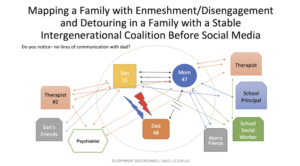
Below is a “traditional” family map that does not consider social media. It represents a compilation of families I’ve seen in therapy, rather than any one family. The symptoms include those typically seen in family practice — poor school performance, school avoidance, vaping, drinking, and using drugs.

From a system’s orientation, the symptoms are a result of the functional and dysfunctional interactions within the family system.

It’s hard for me to understand how therapists begin assessment and treatment without considering or involving the whole family. Some clinicians might say the conflict is too high, and it would only impact the adolescent negatively. Others might assume from the start that one or both parents are not willing to work or are too busy. Some might even be unaware of the importance of beginning from the position that families do not have the strength to make change.

Sometimes therapists and school staff buy into and reinforce the belief that the child or teen is the problem. In the case of this particular map, Mom “reportedly” goes to her private therapist while the son sees his own therapist. Mom and son separately complain about dad to their respective therapists and to the school staff. When mom and son voice frustration about dad and each other in the individual therapy session, disengagement with dad is reinforced. Mom and son are trying to get the type of connections from the system of care that they cannot get with Dad.

While this disengagement takes place, the son turns to his peers, attempting to pull away from mom’s enmeshment, activating her to pursue more. At home, Dad complains that his wife and son always bring up their therapist who agrees that he is unavailable and/or flawed. When this occurs, Dad becomes more distant and angrier, feeling like he is the odd person out.

When Mom gets angry at dad, she turns to her son and vents to him which activates him to challenge his father about money, drinking, and the way he treats her. At other times, the son may jump into the conversation when the parents interact about money, drinking, or the way he treats Mom.

When I attended graduate school, the common exercise was to map the triangles in the family system. Based on the above map, there are at least 24 triangles that are activated in the family-school-mental health system. The 24 triangles are:

  • The mom, son, and dad
  • The mom, son, and school social worker
  • The mom, son, and principal
  • The mom, dad, and school social worker
  • The mom, dad, and principal
  • The mom, dad, and school social worker
  • The mom, dad, and school principal
  • The mom, son, and mom’s friends
  • The mom, dad, and mom’s friends
  • The mother, dad, and dad’s friends
  • The mom, son, and son’s friends
  • The mom, son, and son’s therapist
  • The mom, son, and son’s psychiatrist
  • The mom, dad, and son’s psychiatrist
  • The mom, son’s therapist, and psychiatrist
  • The mom, dad, and son’s therapist
  • The mom, school social worker, and mom’s therapist
  • The dad, son, and son’s therapist
  • The dad, son, and son’s friends
  • The mom, son, and mom’s therapist
  • The mom, dad, and mom’s therapist
  • The son, son’s therapist, and school social worker
  • The son, son’s therapist, and psychiatrist
  • The son, school social worker, and principal

These 24 triangles are at the same time difficult for adults in the family to appreciate, even harder for an adolescent, and deeply challenging for the clinician to manage. In those triangles within the family where cross generational coalitions are activated, the symptoms in the family increase. I have often been challenged whether to discuss the impact of all these cross generational interactions with the family and whether it is important to differentiate the healthy, less healthy, and unhealthy ones from each other

On top of the above complexity, other questions arise like “where did the boundaries go?” The therapist must keep in mind how the boundary between the family and the outside world becomes invisible and the symptoms become more intense, to the point more professionals are recruited to “fix the dysfunction.”

I have also had to maintain awareness of how managed care’s enforcement and reinforcement of the medical model has influenced me and other members of the community of care, including other therapists, psychiatrists, physicians, and schools. This reinforcement has an impact on the family’s interaction with the son focusing only on his diagnosis and the correct medication, while failing to address the family relationships.

As mom turns to the school and the system of care for answers, things are not changing. She reports that her son is getting worse. Mom blames dad’s aloofness and dad blames mom’s overindulgence. Mom increases calls to the psychiatrist. The psychiatrist adjusts the medications frequently. The frequency of crises increases and the boundaries between the family and the outside world are dissolving due to the interaction between the family and the system of care.

The number of alliances increases between different family members and different professionals as more professionals/agencies are pulled into the drama. Professionals unintentionally begin to write/rewrite the individual’s and/or family’s stories, especially when utilizing the medical model.

With more stories, there are more opposing interests for each family member. This phenomenon between families and agencies is a result of a collision when both parties collaborate to uphold sociocultural trends. The goal is not only to interrupt multiple unhealthy alliances with existing professionals/agencies, but to also prevent new transactions from developing. (3)

This phenomenon was usually seen when the system of care worked with economically challenged families. We now see this also occurring with families of significant means because they can afford an individual therapist for each family member and psychiatrist(s) if needed.

As we look back at the map, it is now easier to understand that because the family has already identified what they think is the problem, it really needs to address the triangle between mom, dad, and son. It doesn’t really matter where to begin. A clinician can enter through mother-son enmeshment and coalition, father-son disengagement, or parental/marital disengagement.

It might also be useful to address the system of care coalitions between the therapist and school with the mom and son. Having the family identify how to change the interaction between the whole system allows them to move forward. It may be a challenge because getting directives from an expert, rather than looking within their own system, is what they have come to expect.

Using a Virtual Family Map to Identify Issues in Families

Before talking about the influence of social media on the family, it is important to acknowledge some of the “players” in social media. The system of social media has many parts. Social media success is dependent on an algorithm, which encourages frequent interactions by virtual and non-virtual friends.

The frequent interactions result in the shareholders receiving monetary return on their investment, the employees maintaining their jobs and bonuses, and the advertisers increasing the visibility of their product resulting in increased sales. The influencers are dependent on social media to reach as many people as possible to receive income from the app. There is a lot of pressure to have an effective algorithm to support social media.

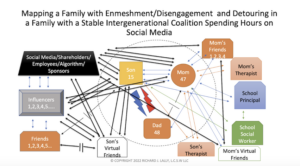
As you next look at a map depicting the interactive nature of the family and social media, it is important to keep in mind that the 24 triangles from the non-virtual map are still present, and the family boundary is already disintegrating with the school workers, friends, and therapists to seek help with the identified patient.

Now in addition to these non-virtual professionals and friends, the family is inviting social media’s virtual friends and influencers to seek help with the identified patient. Clients (and non-clients) often turn to virtual friends and influencers to provide the same connection as non-virtual friends, but these connections are void of physical closeness. Children and adolescents believe a virtual relationship can replace a non-virtual relationship. But all virtual relationships are void of physical closeness in which touch, eye contact, and a warm smile can feed the soul.

The family can turn on a social media app at any time of the day or night and the outside world is invited into the family, increasing the number of triangles exponentially. From the clinical perspective, it is critical to examine what actions (social competition, social comparison, loneliness, etc.) in the family trigger a member(s) to invite social media into the family. The therapist must also discuss how social media algorithms are activating/triggering the member(s) of the family to turn to an app to surf or post an event. This increases the time spent on the smartphone to maintain these virtual friends, non-virtual friends, and influencer relationships.

At times, social media decreases connection with non-virtual relationships and increases the connection with virtual friends and influencers. In the therapy session with this particular family, some members discuss how they rely on virtual friends and influencers more because “they understand me more than the friends in my own town/school.”

The adolescent believes these virtual figures want to listen to them more than family and non-virtual friends. It is important to ask the family what influencers and virtual friends provide that their own family members or non-virtual friends cannot. This allows the clinician to address the patterns and interactions in the family.

In the map below, I do not draw the number of different social media apps, influencers and virtual friends who are involved with the family. However, I do recommend when meeting with families, to draw each app, virtual friend, and influencer to show the number of triangles the family is managing or attempting to manage. For simplicity’s sake, I use one (black) box to represent all the social media apps and one box for all influencers and separated mom and son’s virtual friends.
 

Husband, Wife, and Social Media Triangle

What is the impact of social media on marriage? The wife turns to social media and influencers to figure out how to “fix” her marriage. The wife tries to talk to her husband about what she has learned about marriage on social media. The husband discounts the wife’s attempts to “educate him about marriage.” She eventually gives up on the marriage and “wants to focus more” on her son. She also tries to connect with previous friends and boyfriends from past life because she feels lonely and alone “looking for a connection.”

What you will see in this triangle, and all the triangles which involve social media, is a substitution of a virtual relationship for a non-virtual relationship whose connections are full of conflict or conflict avoidance. The virtual relationships convey an illusion of meaningful connection, but the person(s) feels alone and lonely because it lacks the important ingredients for a fulfilling relationship.

Mother, Father, and Social Media Triangle

Now the wife stops working on the marriage and focuses on parenting. The husband is not aware of this decision, focusing on “making money to provide food, clothing and shelter.” The father continues to feel alienated, disconnected, and disempowered, becoming angry towards the mother and son. The mother turns to school staff, therapists, non-virtual friends, virtual friends, and influencers for ways to “fix her son.”

This fosters more of an enmeshment with son, and disengagement with Dad. The son turns to school staff, his therapist, non-virtual friends, virtual friends, and influencers. Each family member describes a feeling of disconnectedness trying to overcome the feelings of being lonely/alone. Dad voices his frustration, complaining that he is “old school,” and they are “hypnotized by that damn phone.”

Mother, School, and, Social Media Triangle

In this triangle, mom calls the teachers and guidance department for support. She has frequent phone calls with the guidance counselor because the guidance counselor “is an expert with adolescents.” As you can see, dad is left out of the interactions with the school.

After a few months, her son’s behavior is not changing, and mom is frustrated with how the school is not helping her son. Mom begins to turn to social media looking for answers. Mom spends hours on the app talking to non-virtual friends, virtual friends and reading/commenting on influencer’s posts. Mom displaces healthier activities with time spent on social media. Mom begins to complain that the school is not meeting the goals set out by the Individualized Education Plan (IEP). Mom cites information from influencers from social media and the internet. The tension rises between the school and mom.

Schools today are under tremendous pressure to perform. Schools are understaffed, and do not have the mental health training or support to bring in a countercultural systemic approach into the schools despite the money being put into schools after COVID-19.

Parents, Son, and Social Media Triangle

Mom is spending hours on social media looking for answers to why her son is struggling. She also spends time looking for connections. The son also spends hours on the app interacting with non-virtual friends, virtual friends and reading influencers’ posts.

Mom pursues the son, but he only is aligned with her to challenge dad’s limit setting. When the parents attempt to be aligned, the son acts out more. We see the son increase his conflict with parents, who struggle due to their enactment/conflict avoidance with each other on how to help their son. This results in the father leaving and the mother turning to social media to find answers or overcome feelings of loneliness.

When the family interactions are in intense conflict or conflict avoidance, many children, adolescents, and young adults get most of their answers from non-virtual friends, virtual friends and influencer’s posts. The son is seeking temporary relief by getting information and trying to affirm a sense of self.

The non virtual, virtual relationships, and influencers introduce beliefs that are the opposite of the family’s beliefs and further impact the self-esteem of the adolescent. The son discusses what he learns from social media of what “real parents are like.” The decrease in face-to-face communication with family increases his anxiety, depression, irritability, and intrusive thoughts. This also confuses the family of how their family member can “think so differently.”

Son, Non-Virtual Friends, and Social Media Triangle

The son in the session discusses constant social competition/comparison, working for social currency, and thinking he at times is invisible to his non-virtual friends. The son gradually believes his non-virtual friends “don’t understand.” He believes he cannot turn to his parents because “What do they know?!”

The son begins to engage in the same interactions with his peers as his parents and avoids turning to his peers for support. The son begins to spend more time on social media with virtual friends and influencers to seek select information that matches a narrow/closed view, hoping to avoid conflict/interaction. The son then turns more to virtual friends and influencers for answers. Again, this increases his time on his smartphone and increases the family’s sense of not being good enough for each other.

Remember, the son believes there is “less stress” getting information from a stranger, pop culture icon, or a virtual friend than an enmeshed mom, disengaged father, or face-to-face with a peer(s). However, the decrease in face-to-face communication with family and non-virtual friends increases his anxiety, depression, irritability, and intrusive thoughts.

Despite the time spent on social media, the son feels alone/lonely, looking for emotional, face-to-face and physical connection, but does not have the words to express these thoughts to each other.

Mom, Therapist(s), and Social Media Triangle

Dad continues to be absent from the triangle that involves the therapist. The mother attends her own therapy and attends her son’s sessions to discuss what new information she has seen on social media.

She reviews with both therapists what she has learned on social media about new treatment, new medication, and new diagnoses. She advocates with all providers that her son is incorrectly diagnosed, hoping that would help him with his symptoms. The quality of training of the therapist determines their response to entertaining or challenging mom’s research. This may result in mom seeing a new therapist.

The individual therapists and psychiatrists are not looking at how the parents avoid “getting on the same page.” They are reacting to reports by mom about the son’s behavior. Mom and dad are unable to interact differently because they have not figured out how to work together to decrease their son’s phone usage to increase his time with non-virtual friends. The professionals are avoiding addressing the parent’s avoidance!

Mom, Psychiatrist, and Social Media Triangle

Dad is absent from the triangle that involves the psychiatrist. Mom becomes disgruntled with the psychiatrist. She begins to challenge the psychiatrist’s diagnosis and medication recommendation. The psychiatrist recommends if mom is not satisfied with his assessment, she seek a second opinion. Mom begins to look for a psychiatrist who agrees with what she has read on social media.

Son, System of Care, and Social Media

The son is seeing his individual therapist 1-2 times a week and his psychiatrist once a month. He is also spending 2-8 hours on his social app each day. The therapist has not assessed the hours the son is spending on his phone. The app is only showing views/opinions/likes/images that interest him.

The son begins to complain that the therapist does not understand him and challenges his therapist saying, “This doesn’t help.” When the therapist explores the son’s statement, he begins to discuss information from “reliable sources” from social media and influencers. He too begins to diagnose himself and discusses medication that can help. When the system of care discusses reliable sources such as universities and professional journals, the son becomes irritated saying “I don’t want to read them.”

Son, School Staff, and Social Media

Not only does the system of care increase their sessions, but the school staff increase their time with the students. The number of triangles with the son in the school increases between the child study team, teachers, and administration.

The teachers are pursuing him to get his work done — offering to meet him before school, lunchtime, and after school to complete his work. He never shows. The son is seen in class on his phone. Some teachers ignore him, and others nag him. When a teacher challenges the time he is on his phone, he tells the teacher other instructors let him do it.

The social worker is calling him down to discuss his avoidance of work and disruptive behavior in the classroom. Only when the son becomes overwhelmed, he discusses with the school social worker his home life and that medication is not working. The vice principal is meeting with him to give him detentions. The son feels frustrated with the school stating, “They are only doing this because it is their job.”

Son, Non-virtual Friend #1, Non-virtual Friend#2 with Social Media

The son leaves school to go home to continue to work on his non-virtual relationships on social media. It becomes evident that in social media apps, the same social stressors occur online like in school. It is exhausting to navigate being included and avoid being excluded at school and online. The son and non-virtual friends are jockeying for social currency and social position, never getting time off to charge their own social battery.

The son and non-virtual friends stress about the images they post. They are anxious about what the image means to them and others. The son is trying to understand the unspoken rules for posting and the reaction by his peers regarding the image. The son worries if the image appears “authentic” and will help him maintain his position inside the social media group or if a new group be formed without them.

Son, Non-virtual Friend(s), and Virtual Friends

The son struggles connecting with his non-virtual peers. He is not getting feedback from his non-virtual friends about his art and his physical appearance and finds out they have different chat rooms that do not include him. (Remember, he does not want feedback from an overly involved mom or detached father.)

He begins to look for feedback about his art and physical appearance from virtual friends. When looking for connection outside the non-virtual friend group, he states he is looking for virtual friends who are nonjudgmental.

But as time went on, it began to mirror the non-virtual group. Some of his virtual friends on social media become competitive and attempt to increase their social currency on this platform. They do this by making fun of his physical features and his art. This mirrors some of his non-virtual friends’ behavior. The son frantically searches for another virtual peer group that he believes will not activate anxiety by not challenging his views, providing a stress-free venue.

As the son increases his time searching for virtual peers and influencers over non-virtual friends — reinforcing a closed system, increasing isolation at school, and decreasing time to sleep at home. His virtual relationships are now more important — increasing time spent on the app and continuing to strive for more likes and views.

Lack of face-to-face contact with family and non-virtual friends fosters more of a virtual enmeshment with virtual friends. He describes them as “nonjudgmental” and “more accepting.” This further increases his self-doubt and increases his feelings of loneliness and creates a virtually closed system (Virtual Enmeshment).

Son, Virtual Friends, and Influencers

The virtual group is important to maintain when avoiding contact with his parents and non-virtual friends. The son describes his virtual friends as more “authentic” and describes his non-virtual friends as “fake” and “not genuine.” However, some of his virtual friends on social media become competitive and attempt to increase their social currency.

The son frantically looks for another group that is an anxiety and stress-free venue. This further increases his self-doubt and increases his feelings of loneliness. This increases the symptoms of anxiety and depression when waiting for approval from virtual friends saying, “They are the only ones who understand me.”

As the son looks for new virtual friends, he and his virtual (and non-virtual) friends look to influencers for answers on how to portray themselves. Influencers work hard to establish and maintain their position in their virtual community. The influencers are working hard to make money and increase their viewership. The influencers often ask adolescents to agree with their beliefs and recommend products they are selling. The influencers work hard to appear on the “right side” of an issue.

As the son tries to replicate the beliefs of his preferred influencers, he looks for fellow virtual friends that have done the same “research.” They notice the more they make comments in opposition to a belief, it increases their views and likes.

As the symptoms in the family increase in intensity, the members increasingly must decide who to align themselves with in the virtual and non-virtual triangle. The therapist highlights this and encourages the family to discuss and identify the boundaries of virtual and non-virtual triangles that maintain these alliances/symptoms. This allows a family to discuss non-virtual triangles that are underutilized, which reinforce healthy boundaries that benefit the family.

Using Exploring Questions to Make Circular Statements

Much has been written about joining, unbalancing, and mapping in SFT. One of the beautiful ways Structural Family Therapy (SFT) uses language is by employing circular statements to connect the family member’s behavior in the system. When SFT enters the family, the systems therapist uses the family’s own observations to connect their interactions.

It is important today to make a circular statement to widen the lens in which the family sees how all virtual and non-virtual relationships impact the relationship in the family. Below are some examples of circular statements using the words used by each family member.

I agree with you, Mom, that as long as you do not have a voice with Dad and work together, your son will not stop posting explicit images on Snapchat

Dad, as long as you sound like a drill sergeant, Mom will not find her voice as a woman and work with you as a wife and mother of your son who will continue to believe he must mirror images on Instagram

Mom, I agree that the harder you work, the less Dad helps you with parenting your daughter— your daughter will have to turn to influencers about how a woman should look and act

Peter (son), as long as your mom is worried about the frontstage appearance, she will fight with your father who is more concerned about your backstage struggles with you and your mother

What do your virtual friends give you that you cannot get from Mom, Dad, or your non-virtual friends?

Conclusion

Many are worried about the continued increase in suicide, suicide attempts, and mental health issues in the family and how Congress is powerless to challenge these companies. Many providers are not looking at what has changed in our lives in the past 25 years.

Relationships are becoming more complicated than ever. Many families and therapists are unaware of the impact of the system of care and less aware of the impact of the ubiquitous “algorithm.” It is hard to understand how the algorithm works because it is important for these companies to keep the algorithm secret for fear of losing profit.

We must also remember that each influencer, virtual friend, and nonvirtual friend has their own family map. Just as many professionals do, influencers understand how their stories, views, and images echo in the family.

Are families aware of the alliances that occur with virtual and non-virtual friends and influencers? Are we aware that when more virtual influencers and friends enter the family, more alliances increase establishing social hierarchy, increasing social competition and social currency? Are we, the clinicians, aware that influencers and virtual friends unintentionally/intentionally begin to write/rewrite stories in the family and permanently on the internet?

We must begin to understand that with more stories, there are more opposing interests for each family member. This phenomenon between families, virtual friends, nonvirtual friends, and influencers (social media) is a result of collusion when all parties collaborate to uphold their preferred sociocultural trend.

The goal is not only to highlight and interrupt the multi-alliances with existing social media but to highlight the transactional pattern in the home that maintains this pattern. Remember, a virtually closed system impacts all family members, whether one or all are using these platforms excessively.

References

(1) Susruthi, R., Myara, Maymone, B. C. & Vashi, N. Selfies-Living in the era of filtered photographs. JAMA Facial Plastic Surgery. 2018 20:6, 443-444.

(2) Nesi, J. (2022) The impact of social media on youth mental health: Challenges and opportunities. North Carolina Medical Journal, 81(2), 116-121.

(3) Colapinto, J. (1995) Dilution of family process in social services: Implications for treatment of neglectful families. Family Process. 34:59-74.

Questions for Reflections and Discussion

How has social media influenced your personal and family life?

How does the author’s premise resonate with you and the way you practice family therapy?

How have you integrated social media and app use into family therapy?

In what ways do you agree or disagree with the role of social media in family systems?

© Psychotherapy.net 2023

Building on Family Strengths to Solve the Puzzle of Child Protection Work

Information is a difference that makes a difference.
                                               — Gregory Bateson

In nature, it is said that whenever there is a poisonous plant, there can be another nearby which contains its antidote. When it comes to helping families, the same is true that for every problem identified, the resources for resolution can be present somewhere in the family’s ecology.]

Unfortunately, especially for underserved families, competition among divergent treatment philosophies, practices, and limited resources create an unintended conspiracy within the mental health and social service delivery systems — perhaps a benevolent one, but one which nonetheless curtails the identification of systemic homeopaths. The unfortunate consequence of this inability to use potential “antitoxins” naturally present within the client’s ecosystem is inefficiency for the service delivery system, stressed-out workers, high turnover, burnout, and a spiral of reduced possibility in which hope’s grasp is tentative at best, and non-existent at worst.

Mental health and social service clinicians working within the childcare system must search for strengths and solutions that are present, though perhaps hidden, in clients’ ecosystems. The approach is based on systems thinking and the idea gleaned from the practice of Structural Family Therapy (SFT) that change in any system, whether it be a family system or a social services agency, is best affected by the lived experience of doing.

Crossword puzzles as a paradigm stresses thinking and doing as an “out of the box” means to a problem-solving end. This practice mines the strength-based belief of creating a “virtuous circle” — one which recognizes clinicians’ and supervisors’ capacities and creativity, like those of the families they serve.

In resource-poor environments, when the goal of training is the enhanced ability to search for strength, this is not simply a training “add-on.” Rather, it is a foundational principle that requires the same persistence and consistency that Minuchin and other family therapists demonstrated was present in the natural environment in which clients and their families are embedded. The naturally occurring strengths in clients’ ecosystems can be uncovered by robust “doing,” which is an optimistic and energetic search for resources and resilience within both the family and the larger ecosystem of change.

Collaborative Case Planning

Like the proverbial butterfly catcher with net in hand, human service organizations have long been involved in a quest to capture the elusive chrysalis of change. What distinguishes efforts at reform and the ability to succeed is an ecological, “whole systems” approach. Children, families, problems, and possibilities are viewed in toto — economics, social, political, educational, gender, vocational, racial, location, class, and psychological elements are all in play. It acknowledges the margins and builds accountability.

The human and fiscal expense of doing otherwise speaks to the futility of programs that do not account for the organic and sometimes chaotic environment that families attempt to survive and thrive in.
As the 19th century Prussian Field Marshal Helmuth Carl Bernard Von Moltke reminded us, “No plan survives contact with the enemy.” In this instance, the enemy of high-quality service delivery is the tendency to replicate the existing system rather than undergo the reformation needed to absorb the family’s own healing powers.

Another systemically inspired practice that infuses underserved families with greater choice, and ultimately health, is collaborative case planning. This time-honored intervention gets all the major players to the table — including the family — and in the process, becomes a kind of exercise in agency topography that borrows from the tradition of Hartman and her colleagues, who pioneered ecomapping of family systems for adoptive placements.

By using the wide-angle lens of mapping families in all their contexts, resources and potential pressure points can emerge for their potential effect on the child and family. From the agency perspective, efficiency and collaboration are increased with an ecomap; everyone can see who is doing what and when and how it is being done. As a form of “observational therapy,” an ecomap can have the same heliotropic potential. However, as business has learned, outcomes can be improved, but not always for the reasons one might think.

Unfortunately, the promise of systemic work and its healing potential as envisioned by therapists who worked in the family trenches is not always realized in the battles to transform larger systems. For clinicians in the human services, or for those who train them, the pitch of a systemic perspective too often mirrors the president throwing out the first ball of baseball season — well intended, lots of hoopla, but doesn’t reach the plate. Without a clear picture of where they fit in the larger service-delivery system or a sense that they can make a difference, workers can feel overwhelmed, disempowered, and disheartened.

The financial cost to the system in turnover and lost productivity can be measured. The loss of wisdom, the discontinuity of care, and the loss of hope, however, are beyond calculation. In that regard, the experiences of child welfare clinicians mirror the isolation that can permeate the system within which they work and the families that they treat.

It is for this reason that systems of care were re-designed to “wrap” services around families and to minimize the dilution of family processes that occur as a by-product of traditional service delivery. In a sense, “wrapping” can enrich underserved families with a wider net of resources in the way families of higher classes can choose their providers and supports more selectively.

Capitalizing on Strengths

In tracing the strands of effective, systemically inspired service delivery, there is one constant thread: strengths. Thank goodness! But just as it was found that a rising economic tide does not raise all boats, so too can the tidal waters of strength not elevate the all-too-often porous vessels of bureaucracy.

What is amazing is how far a little strength can go, even in conditions that are wanting. There are, after all, some quite beautiful plants that flourish in the shade. Sadly, however, in the wrong bureaucratic hands, even strengths-based practice can invite the agency equivalent of Frankenstein picking flowers with the little girl — it’s a nice idea, but eventually the monster kills it.

How, then, to help clinicians to see that “It’s the difference that makes a difference”? Is there a way to aerate the sometimes root-bound tangle of the childcare bureaucracy so that its ability to heal can be given the room to breathe and prosper? How to give clinicians — especially those just out of school — the understanding and confidence to “trust the process” of searching for strengths, both within disrupted families and the systems designed to serve them? Moreover, are there ways to create a culture of caring and learning transfer so that clinicians see themselves as “action agents” within the larger bureaucratic tangle?

Part of the answer lies in family therapy’s history and co-development with cybernetics — the study of how systems developed the concepts of circularity, non-linearity, recursion, the process of self-correction, and the ways family and organizational systems maintain stability/homeostasis while balancing that with change and transformation. Gregory Bateson and his colleagues at the Mental Research Institute (MRI) in California, along with other early adapters, were the pioneers in this new way of thinking that set the stage for family therapy as we know it today.

Using a notion central to Structural Family Therapy (SFT) about strength and extending it to conceptualizing strength as a verb can be unintentionally overlooked when children and families in dire need get lost within the morass of bureaucracy. The SFT concept of healing is more about thinking of strength as a verb. It’s not so much a matter of finding strengths within the family’s ecosystem as it is strengthening the resources that are hiding in the weeds, so to speak. In that regard, it is more of a leap of faith — that whatever challenges a case presents, health can prevail.

Businesses and non-profits share a challenge: getting their message through environmental “clutter,” or the glut of choices that compete for our attention. How, then, can human service organizations solve the multiple staff training dilemmas they face?

The skills and belief set needed are interwoven and important: ensure the safety of the child and family, reduce decision clutter, increase the active search for strengths, attend to and nurture family connections, expand the problem-solving lens to include extended family, community and idiosyncratic, home-grown resources, and get paperwork in on time. One path on the way toward answering this organizational koan is this: increase experiential capital by linking the worker and their day-to-day decisions with the larger mission of the organization.

Thinking Outside the Therapeutic Box

Bridging the gap between what we know and what we do, however, is no small feat. In Why Didn’t You Say that in the First Place: How to Be Understood at Work, Richard Heyman unravels this knotty problem with a question and a refreshing answer: “Why is it that ‘a picture is worth a thousand words?’ The picture is not talking about something — it is the thing the talk is about.”

From this perspective, to truly “get” the uber-goal of searching for strength and translating that into action, workers must experience the “felt sense” of search and discovery —finding something where apparently nothing exists. This experience is analogous to an “enactment” in SFT, in which the family is guided by the therapist in an interactive experience between members that is designed to offer them new opportunities to use underutilized strengths.

Many consider enactments to be the heart of Structural Family Therapy. The value of enactments is two-fold. First, as a “real-time” assessment tool, and second, for their change-producing potential, both of which scaffold nicely for training in human services.

Enactments between family members during therapy can principally occur in two ways, either spontaneously or through the therapist’s direction, and they are used in two ways, to assess family patterns and to promote change. Spontaneous enactments are readily available ways of interacting that might be thought of as familial “tells” (like the poker player whose nervous smile foretells the bluff), showing habits of relating in which relational organization is embedded. While some might consider these patterns to be so deep as to be unconscious, another way to think of them is as learned ways to relate and survive in the world.

The persistence of patterns can transcend the pull of context. Habituated behaviors tend to reveal themselves in multiple settings— a therapist’s office, a restaurant, school, work, or home. The persistence of these patterns can be linked to the tendency to reduce anxiety through prediction and habit. As the pioneer family therapist, Virginia Satir notably said, “Most people would prefer the misery of certainty over the misery of uncertainty.”

Like an artist who steps back from the picture they are painting, clinicians have the capacity to use themselves differentially, moving in and out of the family system to gain perspective. Minuchin described this as “use of self,” in which the therapist positions themself with the family from “proximate, median or distant” perspectives.

Harry Aponte has written about how therapists can make use of their own personalities, family of origin, and life experiences to guide clients during enactments in the “then and there” of limiting patterns so that they experience themselves and one another with increased possibility and hope.

Like a music student first learning scales as a prelude to improvisation, experiential training can evolve into a more responsive, “whole systems, both-and” approach in which requirements and innovation can co-occur. For example, when supervisors at one county office of a state child welfare agency were asked about their staff’s training needs, their response was, “To be able to think on their own/to think outside of the box.”

Their request comes from the experience of guiding their workers through the complicated bureaucratic and interpersonal seas of child protection. As Mumma wrote in his insightful piece about his agency training in systems work, “Taking these concepts (ways of thinking) and making them work in a particular agency setting is the real work of training.” The analogy of crossword puzzles can make that work a bit easier.

Finding Best Clinical Practices

Just thinking about all the aspects of a case — its who’s, what’s, and how’s — can be a bit overwhelming. Cases in the investigative and early treatment stages, particularly for newer clinicians and social workers, may seem all forest and trees, abounding with unanswered questions.
Over the years, agencies have found genograms, ecomaps, and structural maps to create a set of “blueprints” that graphically represent families and agencies in a way that quickly sorts out relationships and priorities. These tools have been essential in widening the practice/thinking lens to include others who may have clues to potential resources.

The rise in “manualized” treatment and the emphasis on evidence-based treatments has helped to sort through these difficult choices and prescribe “best practices.” While this is a necessary step in the right direction — much like learning scales is in music — it can be insufficient to encompass the unpredictable nature of cases. There needs to be a “both-and” approach that brackets safety, consistency, and growth with improvisation. Thinking in terms of crosswords can do just that.

In its own way, a blank crossword puzzle graphically resembles a complex clinical and, in this case, social services-related case — lots of questions, some inter-related, some not, and just to make it interesting, a few black boxes. As President Clinton said in the crosswords-based movie, Wordplay:

Sometimes you have to go at a problem the way I go at a complicated crossword puzzle. You start where you know the answer and you build on it and eventually you unravel the whole puzzle. And so, I rarely work a puzzle with any difficulty, one across and one down all the way to the end in a totally logical fashion. A lot of difficult, complex problems are like that. You must find some aspect of it you understand and build on it until you can unravel the mystery you are trying to understand and then you build on it and eventually you unravel the whole puzzle.

When one acts as if the answers are there, though perhaps hidden, the puzzle’s resolution moves from the shakier, contingent ground of “if” it will be resolved, to the more possibilistic ground of “how.”

Crossword Puzzles as Metaphor in Child Protection Work

Do you think I know what I am doing?

That for one breath or half-breath I belong to myself?

As much as a pen knows what it is writing,

Or the ball can guess where it’s going next.

Rumi

When a case opens in child protection, the most compelling, sometimes unanswerable question is “Who will keep this child safe?”
If an injury has occurred in the home, the prima facie answer may seem obvious: “no one.” In this instance, unless resources are surfaced, the child will need to be placed outside of the home, “in the system.”

Starting the exploration of strengths from a crossword paradigm assumes that like the printed puzzle, all the answers may not be initially apparent, but once safety is established, one can begin to answer the eternal risk-safety dilemma: Can the person(s) who caused or permitted harm now be responsible for safety? If one only looks at the alleged abuser, then the likelihood is that the answer to the question will be “no.” If more contextual factors are also considered, so, too, are possibilities.

The work becomes both retrospective and prospective, invoking Einstein’s dictum, “You can never solve a problem on the level at which it was created.” The “who” and “when” questions are now also answered by “how.”

The “how” to find and fill those potential strength-based empty boxes begins with questions like “Who else watches the kids when you go out?” or, “When you are having a rough day, who do you talk to?” or, “Who are some of the people you count on?” These ground-level questions are more than a set of techniques, they are the personal implementation of a larger policy that has the capacity to both be safe and value the child’s primary connection.

Enacting Possibility to Help Families in Crisis

Like the Zoysia grass, the grass/weed whose initial plugs merge over time into a uniform carpet, training from a Crosswords perspective can grow the seeds of organizational interpersonal attachment. One way to underscore the marriage of mission and method is to give training participants a felt sense of difference.

The enactment of possibility begins when participants fill out a blank crossword on their own. After five minutes of working alone in silence, the trainer helps the participants process their “silent” experience at multiple levels: What did you notice? Did you fill in the boxes you knew first, or did you have a system? What did it feel like? Did any of you get stuck? How did you get out of that — what did you do? Typically, people report a range of answering strategies — some very methodical, “I do every ‘across' first, then I start with the ‘downs,’” others more radiant, “I just see which ones I know and then go from there.”

Next, the trainer asks the participants what it felt like to do the puzzle. What did they notice about their mental/emotional and physical states? “It was quiet.” “I kind of got into it.” “It was frustrating.” “I felt tense.” “I was worried other people would see how much I didn’t know.” “I kind of enjoyed it.” “It’s like Solitaire or Wordle, I just got lost in it.” All their answers provide abundant raw material to talk about their work, their stresses, successes, and the strategies they use to problem solve. And it sets the stage for helping them think “out of the box” by using the other boxes.

To widen the lens, the trainer may provide another enactment. This time, they can ask participants to form small groups of six or fewer, telling them that they have another five minutes to work on their puzzles, but this time, together. People begin to talk, share their answers, laugh, and fill in the blanks as they see how quickly they can solve the new crossword together as a team.

When the time is up, the group is asked to process their experience and compare it with doing the puzzle alone. Inevitably, they notice the energy level, productivity, speed of producing answers, and their own internal experience of connecting while connecting the dots. In future puzzling cases, this brainstorming model can supply added, shared resource clues to support and, most importantly, help the clinician in their search for resources within the family and larger system.

Materials Needed: Copies of a Crossword Puzzle

Total Amount of time: 10–20 minutes

Lessons Learned: Start with strengths within and around the family, fill in the answers you know to discover the answers you don’t.

One does not need to know all the answers to get all the answers.

A “wrong” answer is eventually corrected by the context of right answers.

Just like a case, one does not know all the answers when starting — answers emerge over time often from unexpected sources.

Persistence pays off — but so does taking a break and getting help.

A Family Crossword Comes Together

The first time I (LPM) met Kyla and her mother, Teresa, was across a cold table in an institutional room. Kyla had been in the residential treatment facility for almost ten months following a series of escalating behavioral incidents in her previous foster home. I thought back to my meeting with the family’s caseworker, who told me that Teresa and her partner Linda’s relationship was volatile and created an unsafe environment in the home. Kyla’s father, according to the caseworker, was out of the picture.

During my first several months working with the family, I felt as if very little progress had been made. Each week, I’d pick Teresa up and drive her to the residential facility for family sessions. Dutifully, I went to family court, holding space for an equally enraged and devastated Teresa on the way home each time reunification was pushed back. I consistently showed up for the family, and despite good rapport with both mother and daughter, Kyla’s behavior remained a challenge and our family sessions felt focused on the crisis of the week, as opposed to addressing underlying family dynamics and struggles.

One day, Teresa unannouncedly brought her partner Linda to session. From that point, treatment changed almost immediately, as both Kyla and Teresa seemed more engaged and open during family therapy, and we began to focus less on minor incidents and more on boundaries and communication within the family system.

Still, somehow, it felt like a piece of the family puzzle was missing. I could sense that Teresa and Linda were holding something back, particularly when we discussed their co-parenting practices. This final piece fell into place one day when I went to pick up Teresa and Linda and Robert, Kyla’s father, eagerly and unexpectedly hopped into the van. It quickly became clear that Robert had been actively involved with the family all along.

I finally could see the full picture of the family structure and their dynamic. Teresa, Linda, and Robert were in a polyamorous relationship. Robert had been understandably hesitant to engage with the child welfare system out of concern that the polyamorous relationship would be condemned, and reunification denied.

The case that had “simply” been presented to me as an unreliable mother with a violent partner unable to meet the emotional needs of her unstable daughter was actually one where a child had three caring adults who wanted to support her. With all the pieces in place and the entire family finally engaged in treatment, meaningful therapeutic work ensued, Kyla’s behavior improved, and she came home.

Conclusion

“The solution to pollution is dilution.”

Using crossword puzzles as a conceptual framework and training method opens workers and the organization to both the learned and the lived experience of complexity, strength, possibility, and the importance of connective relationships when working in child protection. We know that systems can mirror the systems that they treat. For instance, In Child Welfare, the insidious nature of poverty is such that it can quietly, but inexorably, leach into the soil of good intentions in such a way that the attachments between worker and family, workers and other agencies, worker and supervisor, and workers themselves, can suffer the pollution of despair.

This is not to say that using crossword puzzles will wall off the effects of these potential systemic toxins. It is to say, however, that healthy, connected relationships can be grown and nurtured and, over time, create “the difference that makes a difference.”

***

The author would like to thank my friends and colleagues who helped me fill in the blanks, both across as well as up and down. A special thanks go to Lauren McCarthy (LM) for providing the case of Kyla.

Addressing the Relational Impact of Mental Illness

While it can be isolating, mental illness is not an isolated experience. It affects more than just the individual: it impacts friends, family, spouses, significant others, and co-workers. I recall working with a married man who developed Major Depressive Disorder around the time his wife had their second child. He became emotionally distant, socially isolated, lethargic, couldn’t focus, took time off work to the point of being fired, and lost interest in sex. His wife struggled bitterly. She felt completely overwhelmed with the care of two young children. Her husband, on whom she once depended, was no longer contributing. She felt like she had to care for him as well and try to keep the family financially afloat since she was the only one working. Despite the challenging circumstances, she tried to keep their intimacy intact, but he had no interest in sex, going out, connecting with their friends, and he struggled to track during conversations. As you can imagine, this put a strain on their relationship, which they eventually ended. Neither one of them wanted the divorce, but the wife hit her breaking point, and her husband couldn’t find the energy to fight for the relationship. This is a sad story that is reflective of how mental illness impacts a marriage, a career, parenting, and personal finances.

Like what you are reading? For more stimulating stories, thought-provoking articles and new video announcements, sign up for our monthly newsletter.

When working with clients, I try to keep in mind the relational impact of mental illness in all its facets. Mental illnesses, like depression, affect the individual in every sphere of their life, including the social/relational. The above example illustrates how lonely the man felt, and how inexpressible his psychological and physical experience was to his wife. There were no words that existed in his mind or in their relationship for him to utilize. He and she were left in a wretched state of ambiguity. And despite her best efforts, she could not intimately access the depths of his depression. She, too, had no words. She couldn’t prevent feeling shut-out, as if she had been barred from his heart. Her dream was to feel unimaginable connection and joy at the birth of their child, but what she got was facing single-parenting while married.

Needless to say, there is a ripple effect of depression. The man’s relationship with his child will forever be changed. Certainly, it is within his grasp to foster a loving and connected relationship with his child, but he will have to do so with additional barriers due to the divorce, physical distance, child support, navigating co-parenting, and potential co-step parenting.

From my perspective as a clinician, problems are compounded when family and friends don’t understand the nature of mental illness, however, this is not always obvious to my clients and their loved ones. When trying their best to understand their loved one’s struggle, some may conclude that they aren’t trying hard enough, that they don’t care, or that they are seeking attention. Without information, without a sufficient explanation, bad interpretations fill the void, which only lead to judgment and alienation. As a clinician, I step into that void with accurate and compassion-filled information. My aim is to coach clients who are struggling with mental illness as well as their family members and explain that they may be tempted to personalize or create a negative attribution for their loved one’s behavior. It is tempting, natural, and understandable why they would do this, and yet, it is often a mistake in judgment. I try to explain that if their loved one had cancer, they wouldn’t take it personally or judge. Certainly they might have big feelings of sadness or anger at God or the universe, but there would be no assignment of blame to the diagnosed individual. They wouldn’t think, “Why did she choose to have cancer? They must want attention.” That would be absurd, and the vast majority of people would never think this.

So why would a wife, husband, partner, child, friend, or family member personalize a loved one’s depression, anxiety disorder, or phobia? I encourage my clients and their social network to make a genuine effort at understanding mental health disorders. It is natural to want to know as much as possible about a disease when a loved one may be diagnosed with a medical disease. As a clinician, I encourage clients to take that same impulse and learn as much as possible about their loved one’s mental health diagnoses. Ignorance only creates barriers to relationships, and my hope is to remove any barriers to social connection in my client’s way, as well as within their social network. A client is only as healthy as their community. Therefore, I want to empower clients to empower their communities, to mobilize those around them to seek out information and more deeply understand the psychological realities they are dealing with. And to find that middle ground of embracing the mental illness of your loved one but resisting the urge to define them by it.

***

Thinking back to my client mentioned earlier, I wonder how things would have been different if both the husband and wife had more awareness about depression. I wonder how the two of them may have pulled together, rather than apart, if they had known earlier on that the husband was being affected by a mental health disorder. If they had only had the words and concepts to understand not only the husband’s experience of depression, but also the relational impact that depression brought to their marriage and family. The wife was just as much a sufferer of depression as was the husband. This new understanding could have been a catalyst for collaboration, support, mutual understanding, and shared problem-solving.

Successful Intervention with a Family Impacted by Treatment-Resistant BPD

Borderline Personality Disorder (BPD) is one of the most difficult psychiatric disorders to treat, the main reason being that it affects the entire family. Thus, effective treatment requires working with as much of the family as possible in a coordinated effort. Multiple professionals are also often involved, which adds to the need for coordination of resources. Further adding to the complexity of intervening with families impacted by this disorder is the fact that there is usually significant resistance to the treatment by one or more parties.

Treating families impacted by BPD also requires specialized therapeutic skills. I have found that many techniques that are effective with other diagnostic groups are not only ineffective with BPD, but may actually make the disorder worse. This is why most of the families who present themselves to me have already been exposed to numerous therapists and treatment modalities by the time we meet, leaving them exhausted and disappointed. In many cases, large amounts of money and other resources have already been spent, also leaving them jaded and skeptical. These families are very often on the brink of their breaking point.

Am I expected to produce a Hail Mary, or am I just another soon-to-be-discarded and/or disappointing clinician in their minds? This is a very high-pressure situation for a clinician, and for this reason I suggest that colleagues only take on such situations if they have specialized skill in treating this disorder or other debilitating personality disorders. A full illustration of all of the specialized skills needed to work with these families is beyond the scope of this paper. For expediency, I will focus first on four tools that I have crafted and found to be highly useful in treating families impacted by this disorder. These tools are described below and will be illustrated in a case study that follows.

Useful Tools

Manage Expectations

This applies to the patient, the family, the other professionals, and yourself. Healing and growth are processes and not singular, disconnected events. All participants in the intervention should be told overtly that this process will take months, if not years, to reach an optimal outcome. I generally tell patients and their families, “Things will most likely get worse before they get better.” This prepares everyone for the inevitable resistance while creating a future milestone measured by increased cooperation.

Protect, Protect, Protect

You must protect the patient, the family, the process, and yourself. A key, and possibly the most disruptive, feature of BPD is the client’s lashing out at others when frustrated. Many families allow this behavior to provoke them into participating in disruptive behavior by shouting back or threatening. The therapist must provide some basic level of safety to the process and all who are involved in order to avoid disruption of the therapeutic work, often manifested by one or more parties’ walking out.

As a therapist in this situation, you are at very high risk for being triangulated into the family dysfunction, in which case this lashing out may be directed at you. Your chair should be the closest to the door, and you need to prepare to split up the group if you cannot deescalate conflicts with all present.

Modeling

You have to teach the family how to cope with disruptive behaviors such as lashing out, triangulation, codependency, and self-mutilation that are common with BPD and rare in other disorders. This is where the specialized skills come in. Each of these disruptive behaviors requires its own set of coping mechanisms. This is where conventional methods can backfire. For example, healthier families can share diverse opinions without the divisive effects of triangulation. In families with BPD, encouraging sharing of diverse opinions is likely to lead to further polarization and increased conflict, thereby worsening rather than improving the situation.

Starve, Do Not Feed, the Monster

The monster is the disorder, the BPD, not the sufferer. The family must bond together with the sufferer and the professional team to fight it. While traditional therapeutic methods encourage compromise and flexibility as solutions to conflict, these methods may feed the monster or make the disruptive and disturbing nature of the disorder worse in families with BPD. The emotional dysregulation caused by the BPD often escalates into rapid, impulsive acting out towards self and others. Introducing compromise, flexibility, or, worse, compliance, reinforces that lashing out will get at least some of what you want. This will increase the frequency and intensity of the lashing out. Conversely, withholding all possibility of acquiescence because of the lashing out starves the monster and sets the stage for the introduction of more socialized, and hence more successful, strategies. This is consistent with basic behavioral principles.

Case Study

The following is based on a real case, but with many details changed in order to protect identity.

Mary Zohn called me about her 19-year-old daughter, Rosa. She had been referred to me by her therapist because although her daughter was in treatment with a therapist, things were getting much worse at home and the family was in crisis. I agreed to meet with her and her husband Charlie for an intake.

The Zohns showed up at my office with two thick files that documented difficulties with Rosa since the beginning of high school. Since that time, Rosa had experienced steady deterioration despite multiple treatments with several different professionals. They explained that although she was intelligent, she had ongoing difficulty functioning in a school environment. She often missed classes and rarely completed assignments on time, if at all.

In her frustration with school, Rosa began engaging in other less productive and more self-damaging activities such as sexual promiscuity, substance abuse, and excessive computer video gaming. She began staying out late, and then overnight. Her room was dirty and her hygiene was regressing.

The Zohns began confronting her about her poor school performance and unhealthy habits. They tried to set limits. This was associated with screaming conflicts that ended up with her sometimes leaving for days at a time, and often included self-destructive behavior such as cutting and going days without food and water in protest. Her parents were becoming increasingly concerned about her health.

They were also becoming increasingly concerned about her influence on her younger sister. Rosa was the middle child of three girls. Her older sister, Wilma, did very well in school and had a good job. She was self-supporting and lived in her own apartment about an hour away from the family residence. The younger sister, Bertha, was in middle school and struggling with a learning disability and social issues at school. The Zohns were very concerned about how Rosa’s behavior would affect Bertha’s struggles.

Initial Interview

What precipitated their reaching out to me was that Rosa had been arrested with her boyfriend for possession and distribution of narcotics. Following are some excerpts from my initial interview with the Zohn’s:

Dr. Lobel: What is Rosa’s current legal status?

Mary: She is out on bail.

Dr. Lobel: What is she doing with her days?

Charlie: Supposedly she is in school.

Mary: She is enrolled in college but we think that she does not attend classes.

Charlie: She leaves every night pretending to go to school but she goes to see her boyfriend instead.

Dr. Lobel: How do you know that?

Charlie: Because she is getting incompletes in all of her classes and she doesn’t come home until 4 AM.

Dr. Lobel: How does she get to school?

Mary: She drives herself.

Dr. Lobel: She has a car?

Charlie: We got her a car so that she can go to school.

Dr. Lobel: But she is not going to school, right?

Mary: We don’t know for sure.

Charlie: Yes, we do. This is the 3rd semester I am paying for, and she hasn’t even earned two credits.

Dr. Lobel: So, you pay her tuition and buy her a car to go to school. She doesn’t go to school and you continue to pay her bills?

Mary: Are you suggesting that we should cut her off?

Charlie: I can’t do that to my daughter.

Dr. Lobel: You mean stop enabling her?

Charlie: What do you mean?

Dr. Lobel: Under the guise of paying for school you are enabling her to engage in unhealthy and illegal activities with her boyfriend.

Mary: We have discussed this before, but her therapist has recommended that we try not to stress her out; that we should give in to the small stuff so that she does not get dysregulated.

Dr. Lobel: How is that working for you?

Charlie: Not good.

The Zohns left the initial consultation a bit shaken by my recommendations. Up until this point, therapists had recommended walking on eggshells around their daughter by reasoning with her, trying to be flexible and forgiving, and overlooking Rosa’s outbursts and acting out.

Second Consultation

Three months later, the Zohns contacted me again. Rosa had been arrested. This time she had been driving while intoxicated and crashed. The car was totaled, and she was charged with driving under the influence (DUI). Fortunately, she was not significantly injured.

They came in for another consultation. They explained that they had come to realize that they were indeed enabling her, feeding her monster, and that they needed guidance. They didn’t know how to say no to her and follow through consistently. We agreed that we would meet with her together in order to help them to set up some healthier boundaries. Most notably, this included the plan that resources such as money and transportation would only be available for the pursuit of healthy activities.

I asked the Zohns whether they were on the same page regarding what was right for Rosa. They shared that they often argued about whether or not to be “strict” with her and how strict to be. I told them that they must be united in the setting and reinforcement of boundaries and that I would help them with this. They agreed. I suggested that I see Rosa individually before we again met as a family so that she would not feel ganged up on. They agreed, but she did not.

First Family Meeting

When the three arrived for our first session together, I asked Rosa to come in by herself for a few minutes, and she agreed. Here is an excerpt of our meeting.

Dr. Lobel: Do you know why your parents asked you to meet with me?

Rosa: They just want to control me. They irritate me constantly.

Dr. Lobel: How do they do this?

Rosa: They are constantly on my case. I don’t do anything right. They want me to be like Wilma. They have always favored her. I can’t be Wilma so I am a disappointment to them.

Dr. Lobel: In what way do they want you to be like Wilma?

Rosa: Smart, beautiful, and successful. That is not me.

Dr. Lobel: What do you think prevents you from being successful?

Rosa: Them. They nag me all the time and then I can’t concentrate on my studies.

Dr. Lobel: That’s why you don’t go to class?

Rosa: Yes. I get so upset I just want to get high. I would rather be with my boyfriend.

Dr. Lobel: What does your therapist suggest?

Rosa: She has tried to get them to back off, but they can’t stop themselves.

Dr. Lobel: What would you do if they were not bothering you?

Rosa: I would get a job.

Dr. Lobel: Have you ever had a job?

Rosa: Yes. Several.

Dr. Lobel: How did that go?

Rosa: I usually work for a while and then they start hassling me.

Dr. Lobel: At work?

Rosa: Yes.

Dr. Lobel: Out of the blue.

Rosa: They get all upset if I am late once or twice or if I call in sick.

Dr. Lobel: And then you get fired.

Rosa: Yes. But the reason I am late or sick is because of my parents!!

We brought the parents in. We all agreed that Rosa needed to take a leave from college while she resolved her legal issues and living situation and began to more directly address her mental health challenges. We then introduced the idea that Rosa’s access to resources, such as a car and money, would be contingent on her manifesting healthy behaviors. Her parents agreed to support healthy behaviors rather than unhealthy ones. Rosa began yelling at her parents and at me, stating that this was little more than additional control and would make things worse. She stormed out of the meeting. As she came in the car with her parents, we were confident that she would not be able to go far, so we finished the hour by offering suggestions as to how to respond to her agitation. We reviewed the “form before content” tool. This basically required that Rosa speak in civil tones, or the conversation would stop.

Dealing with Resistance from Rosa’s Therapist

The following Monday morning, I received a call from Rosa’s therapist, Ms. Hartman, who wanted to know what was going on in our meetings that was so upsetting to her patient. She expressed that Rosa was “triggered” by the meeting and it was making her sicker. I was expecting this call. Here is an excerpt of our conversation:

Dr. Lobel: What about our meeting did Rosa find triggering?

Ms. Hartman: She felt ganged up on.

Dr. Lobel: Which part made her feel ganged up on.

Ms. Hartman: You and her parents trying to control her.

Dr. Lobel: Did she give you any specifics?

Ms. Hartman: No. She just said that she was so triggered she had to leave.

Dr. Lobel: She appeared to get agitated as soon as I said that her parents would support healthy activities and not support unhealthy ones. Does this contradict what she told you?

Ms. Hartman: No.

Dr. Lobel: I imagine you must be working with Rosa on increasing her tolerance for frustration and difficult situations.

Ms. Hartman: Yes. I specialize in Dialectical Behavior Therapy (DBT). I think she also takes medication.

Dr. Lobel: We are trying to help Rosa take responsibility for her choices and behaviors and she is having difficulty tolerating it. Can you help her accept that she has to accept responsibility for herself while giving her the confidence that she can do so in a healthy way and grow from the experience?

Therapy Begins

Several meetings with the Zohns followed, in which we created a contract through which Rosa could benefit from all of the resources her parents had to offer if she used them for healthy pursuits. She got a job and prepared to resume her studies. She agreed to maintain sobriety. The sticking point was the parents not wanting her to be alone with her boyfriend, as they felt his influence corrupted her. We agreed that he could visit her at the family residence but that the Zohns refused to have their vehicle or their financial support to be used to spend time with him. She very reluctantly agreed.

I also inquired as to the status of her pharmacotherapy. She apparently had a psychiatrist who prescribed a combination of medications that included psychostimulants for attentional difficulties, a mood stabilizer, and an antidepressant. She refused to take the mood stabilizer and antidepressant but wanted to continue with the psychostimulants. The psychiatrist refused to treat her under these circumstances, so she was getting Vyvanse prescriptions from her pediatrician. I suggested that she consult with another psychiatrist, as I thought that the stimulant alone was adding to her emotional dysregulation. She saw a psychiatrist and agreed to work with her on a more therapeutic regimen.

Rosa seemed to stabilize for a few months and was moving forward on our plan, until, that is, when the testing began. Her parents noticed that she was not always at work when she said that she was at work. They suspected that she was seeing her boyfriend. They also found evidence in her bedroom that she was vaping marijuana again.

Mary and Charlie met with me to discuss their fear, apprehension, and guilt at holding to their boundaries. They feared confronting Rosa, which they knew they needed to do, and they feared for Rosa as well. They did confront Rosa, who denied everything. Then Rosa disappeared.

She went to work one day and did not return. The Zohns contacted her employer the next day, who confirmed that she had not shown up for work. They tried to contact her via cell phone, but she “ghosted” them (refused to answer). They were pretty sure that she was with her boyfriend, most likely using drugs and engaging in other unhealthy and risky behaviors.

I met with the parents a few times over the next few days. They were very frightened and questioned our plan. They contemplated texting her and allowing her to do whatever she wanted if she just returned home. I discouraged this and explained that this would be a major setback. I told them that she and her boyfriend did not have the resources to survive on their own and that she would have to return home eventually. She had nowhere else to go.

We began preparing for her return with the understanding that the Zohns’ home was not viable as a therapeutic environment for Rosa and that she was in need of inpatient treatment. I encouraged the Zohns to research options and prepare to have her admitted promptly when she returned.

It took about a month. Rosa missed one of her court appearances and was again arrested. She called from the police station. The Zohn were prepared and let her know her options. She had no choice but to agree.

She was admitted to an inpatient facility that specialized in BPD and substance abuse. She stayed for three months and then transitioned to a sober living residence near her parents. She stayed there for six months, during which time she got a job, resolved her legal issues and embraced sobriety with the help of a Twelve-Step Program and a good sponsor. She went from sober living to the university.

Conclusions

In this case, BPD had not only metastasized throughout the family, but also infected the professionals involved. Approaching Rosa’s treatment from an individual perspective was not successful, because her disorder caused her to manipulate her environment into a codependent mess that enabled her to stay sick and get sicker. The only way for her to recover was to assemble a team that included her entire family and all providers working together and consistently.

Intervening in a system impacted by BPD, as in this case, required specialized skills and the willingness to confront all aspects of the patient’s treatment, including enabling providers. This was often like stirring up a bee’s nest. Great care had to be taken to protect these providers by not making them feel negligent or naïve while at the same time engaging them in a consistent therapeutic process. It was critical to anticipate resistance, even by the professionals who attacked me for challenging them. I didn’t take it personally and haven’t, which has proven to be an effective tactic. I explained to them my process and expectations in non-accusatory terms and showed them their value in the coordinated healing process.

In looking back over the case, I knew I was going to be seen as a snake-oil salesman, met with skepticism and doubt. I had to effect a paradigm shift. I also expected things to get worse before they get better. And they did. I reminded myself that as a clinician. I had to stick with what I knew: with the treatment plan, with the best techniques at my disposal.

I also knew that if this approach failed, there would probably not be another chance. Rosa would lose her only lifeline, and the family would all suffer. I reached the point of no return. I was fully committed and I had to see this case through, no matter what. I have treated families like this countless times over the years, but each case is different and each path its own.

If you are going to venture into this challenging treatment domain, conviction is critical, and still there will be no guarantees.

A Counselor Visits the US/Mexico Border

He sat nestled on a chair, clinging to his father. His quivering 6-year-old body told its story with every tortured word uttered by the man who tried his best to protect him. His father recounted the death of his wife at childbirth and of the life he had created for his beloved son, which included a small business and a supportive community. He recalled how one of his friends and fellow business owners had shared with him that the Mara (a violent predatory gang) had demanded a monthly payment and that he had refused. Two days later, the boy had opened the door to their apartment only to see the mutilated lifeless body of the man who had dared stand up to the gang. Later that evening, the boy’s father was visited by the very same gang who had killed his friend, and who now demanded the same payment from him. They threatened to kill both father and son if the extortion was denied.

Try as I might to engage the child as his father’s pain became more palpably agonizing, he clutched the man even tighter. The father continued telling his story to a pair of young pro-bono law students surrounded by a throng of legal advocates and other fathers recently reunited with their children. He recounted how after the threats, he had gone to the police for help and was assured of his safety and confidentiality. The next night, the child was awakened by the sight of his father being brutally beaten by both the gang members and the police. Desperate and frightened, the boy ran to the neighbors who united to save his father. With borrowed money, father and son fled the very next day. With coyotes on their heels, the journey to safety ended as he held his son aloft to protect him from the bone chilling cold of the Rio Grande.

Amidst the screaming of the men in uniforms, who flashed guns in their faces, father and son were arrested, violently separated with the sound of “How do you like your American dream, now amigo”? Two months later, the father was reunited with the boy at a Texas ICE Detention facility, awaiting probable deportation and the certainty that if he and his son were deported, he would be eagerly greeted by the Mara and killed, leaving his young son alone. If the boy remained in the US and he returned home, his boy would surely be orphaned.

Like what you are reading? For more stimulating stories, thought-provoking articles and new video announcements, sign up for our monthly newsletter.

This story of human beings fleeing from Guatemala, Honduras and El Salvador was repeated over and over, replete with the most horrific violence imaginable. I thought that I had been prepared for this by my work as counselor in Greece where I bore witness to the trauma incurred by unaccompanied child refugees from Syria, Iraq, Afghanistan and other conflict zones. I thought I had been prepared by my years of counseling experience, but nothing prepared me for the trauma inflicted upon these helpless children by the United States policy of family separation. I accompanied law school students and faculty who were deeply affected by the inevitable experience of vicarious trauma and compassion fatigue.

In retrospect, I don’t believe that any educational or clinical knowledge would have adequately prepared any of us for what we encountered. ICE Detention Facilities and places where children are housed separated from their parents, are epicenters of disregard for human dignity, human rights and the immoral infliction of generational trauma on thousands of children. As mental health practitioners, we know this to be true. As lawful people we know this to be unjust. As decent human beings we know this to be immoral.

Mental health practitioners may be completely unaware of a client’s legal status because survival requires invisibility. A child may ostensibly be referred for depression, anxiety or behavioral problems, but be struggling with the pain of separation from their caretakers. Therapists need to learn the intricacies and ever-changing landscape of immigration and asylum that potentially impact their clients, whether directly or indirectly touched by the border separations. Even an otherwise healthy and intact family may in the blink of an eye be devastated by the breadwinner’s arrest and imprisonment. Therapists need to help their affected clients to identify coping skills and obtain grounding in extant and emerging pathways to the assessment and treatment of trauma. The world’s most vulnerable and most invisible will evoke an abiding respect for their unimaginable strength and resilience. If you believe in the inviolable right to the dignity and you are willing to walk the journey together with humility and heart, your client will experience love made visible through a shared humanity.   

Jean McLendon on the Legacy of Virginia Satir

Clock Watchers

Jay Lappin: So, Jean, the first thing I want to ask you is, what can Virginia Satir’s family therapy offer to new therapists? What could young therapists entering the field learn from the model?
Jean McLendon: Well, I find myself wondering, what can the more experienced therapists learn from the model? New therapists who have not been in the room with a client or a patient, or have done very little work, don’t have much of a context or framework for how to even be in the therapeutic interaction.

Just recently I heard that a young therapist asked if it was okay to have a clock in her room, and if so, should the clock be visible just to her or to her and the client? I was floored that someone who was finishing their graduate degree was concerned at all about that. I responded in a way that I didn’t particularly like because I was so astounded by the question. Theoretically I believe that all questions are good questions, but this one led me to think, what is this person learning about the importance of authenticity, of connection, of working with the client, not on or for the client.

I think the worry behind that question is, “I don’t want my client to think that I’m only watching the clock and that I’m not interested in what they have to say,” or something like that. But the clock is not going to give people a message one way or the other, or if they make a meaning of it you have no control over that. My sessions are 45, 50 minutes and I definitely want my clients to have access to the same clock I’m using. Why would I not? So being able to say, “Since we only have 45 minutes, I’ve got a clock here. We can both keep our eyes on it,” or, “I have a clock. I’ll let you know before the 45 minutes is up,” is thoughtful, it's considerate, it is sharing useful information.

Virginia was very astute about engaging clients in the here-and-now, in the room, sharing her thoughts and participating with them.
Virginia was very astute about engaging clients in the here-and-now, in the room, sharing her thoughts and participating with them. So she might say, “I don't want the clock to bother you. We can turn it towards me.” Or, “Would you like to have the clock so that you can see it too?” But to ask the question, “is it okay to have a clock in the office, is it okay if the client knows you have a clock?” I fear there's a whole basis of skill and belief about humans and communication that just isn’t reaching these students.
JL: For many of the young people that I supervise, it's very much a business model for them, and with the advent of evidence-based therapies, people are leaning more in that direction. So some of those human elements that Virginia brought to the field are now right alongside “beat the clock” and cramming as many people in as possible in a day, and really more of a manualized approach. And if you want to secure funding for research, you pretty much have to promise something “evidence-based.”

But one of the things I know from reading Virginia’s work and watching her work over the years is that she just has this way of connecting with people that seems entirely un-manualized. So human and so connected. How do you teach that in today’s context of evidence-based therapies?
JM: I would love for you to ask me in about four or five years, because right now I don't know how to integrate the two. I am teaching Satir family therapy with the University of North Carolina substance abuse and addictions outpatient program and they are finding it marvelously effective and have been able to secure funding for me to continue teaching because the results are so positive. But we’re not doing research on it yet.

I had a supervision group years ago, and I was doing family mapping, which for me is basic to Satir work. Because the family of origin experience is, as I like to think of it, the first PhD we get in life.
The family of origin experience is, as I like to think of it, the first PhD we get in life.
My family maps don’t look particularly like genograms, or at least not traditional ones—they are colorful, a little too messy, more pictorial. It’s a visual aid for the client and for me to appreciate the real narrative of where they have come from and what they are hoping for, and what they are dealing with in their life now.

I don’t have them color-coded, but I might have very strong red zigzag lines between people to show conflict, or very distanced dots to show a weak relationship, or lines that show cutoffs. If it’s a couple, I’ll have her comments in one color and her partner’s in another color. It’s just very colorful.

So I do the family maps as part of supervision because I also believe the places we tend to hit a wall as therapists also have their roots in our family-of-origin experience. You know, what are the basic defensive structures and ways we have of protecting ourselves? We keep those for life and even though we can work on them, it's like gravity—they are kind of always there. They are insidious, unless we are aware of them.

Anyway, this PhD clinical psychologist comes back two weeks later, and I’m hoping that they've all done a family map with a client, and she says, “I did one but I couldn’t remember which color you used for what.” I thought, "Well, this is reflective on you, Jean. You are not a very good teacher."

Wet Cocker Spaniel Therapy

JL: It reminds me of that old Frank Pittman article called “Wet Cocker Spaniel Therapy.” He wrote it when he was doing the Denver research about home-based services for emergencies, for families to keep the patient out of the hospital. The story is very much like what you said. This woman is having problems. They go to her house and she’s lying on the floor, refusing to get up. She won’t talk, and they are trying to think of all these clever strategic moves to get her up and moving, and keep her out of the hospital.

The family dog is outside and it’s raining, so the husband lets the dog in. The dog is soaked. It comes in and just kind of shakes himself, so all this water and mud and stuff goes flying and gets on the woman. And she sits up and says, “Oh, the heck with it, fine, I won’t go to the hospital. I’ll talk to you.” Frank’s point was, does that mean that we need to have wet cocker spaniels for all of our work, to keep people out of the hospital?
JM: I think that's the challenge. People watch those of us who are experienced—and particularly in the Satir model, where we work fast in the here-and-now, whether it’s through sculpting or finding ways to externalize an internal challenge in ways that are helpful for particular clients. How we do these things looks like the methodology, but it's really just executing and implementing something out of a very potent belief system about people.
JL: What do you think Virginia would say to today’s therapists about how to use oneself in therapy? Because really what you're talking about is the use of self and that kind of inner knowledge of one’s defense mechanisms that might get in the way of helping other people connect with their family members in more vital ways.
JM: I think she would be conveying her belief in the power of positive connections and promoting a kind of synergy that enhances a creative resourcefulness between and among people. She models and guides that kind of interaction in the office that helps set it in motion and helps people first experience it and then begin to learn the skills of doing it.

One of the addiction therapists I worked with asked, “How do you know in Satir work when the work is done and you can terminate?” I hate that word, but I said, “Well, there's nothing wrong, if you can afford it, with doing Satir work for the rest of your life, because it's all about growth and healing.” It’s rather luxurious, and most of us are not going to choose to use our resources in that way, but I believe there's always room for more growth.

Becoming More Fully Human

JL: What are some of the other nuts and bolts of the model?
JM: In a sense it's a kind of psychosocial educational model that aims to help people create the kinds of relationships that support them in terms of emotional, physical, psychic, and spiritual health. It’s also about helping people take ownership for themselves and take responsibility for the choices they make.
It's a kind of psychosocial educational model that aims to help people create the kinds of relationships that support them in terms of emotional, physical, psychic, and spiritual health.


I see it played out so often in my couples work, where she thinks that “If only he would do X, then I could do Y.“ Getting people to release their spouses, their parents, from being responsible for what they feel and for choices they make is so critical to helping people figure out what changes they need to make. So I put an increase in self-esteem, congruence, responsibility, and ownership for self up there at the top. All of that helps people, as Virginia said, become more fully human.
JL: One of the things that I remember her saying was, ”The family is a microcosm of the world.” That if you know how to heal the family, you know how to heal the world. And Sal Minuchin, back in the early days of family therapy, said that we could change the world one family at a time.

But he recently told me, “We were wrong.” And what he meant was that you really need to think in terms of larger systems as well, as that is a huge context, particularly when from a structural perspective we work with a lot of families that are poor. The context that they live in, and how agencies work with them, has a huge impact on the structure of the family and how all of these goals are realized.

Could you say a little bit more about taking Virginia’s work into a larger context? I know that you’ve been very involved in helping larger systems adopt some of these principles.
JM: It’s one of the reasons I was so initially attracted to the Satir model. There are two reasons, actually. One is that Virginia was talking about being and what it meant to be human in ways that made absolutely perfect sense to me in terms of my own internal experience, but I never heard anybody talking about it.

And secondly, it seemed obvious to me that she was talking about humans in contact with other humans, but she didn’t differentiate between the family therapy session or the boardroom, the church or Congress, because she basically split the universe into three pieces—she could take things that were very complicated and make them very simple. She said this is what you have to deal with: Yourself at a given moment in time, the “other," whoever that might be, and the context in which the relationship resides.
She didn’t differentiate between the family therapy session or the boardroom, the church or Congress.


So how do we create the most supportive context for the self and the other? Well, ask anybody, any group on the planet, “What kind of behaviors make it easier for you to learn, and to enjoy, and to feel that you can be productive and can contribute? What kinds of behaviors interfere with that?” And you'll find out, of course, that people don’t like to be put down. People don’t like to be interrupted. People like to have their opinions valued, even if not agreed with. It’s very basic. And yet, go into any of these contexts and you’ll see people being put down, ignored, excluded, humiliated, shamed, embarrassed. Not being welcomed.

About the third week into my first month-long with Virginia, I came in early one morning before breakfast and I knocked on the door. I was so excited. And I said, “Virginia, I’ve got it. I think I’ve figured it out.” And she said, “What do you mean?” And I said, “Well, what you were talking about, it's all about the universality of emotionality.” And she said, “Yes,” and went on brushing her hair or something. But it felt so big to me, because everything made sense within that context of being fully human. What our basic needs are at a moment in time, in order for us to feel in contact with our real value, our uniqueness, and the resources that we have inside of us to bring into expression with another person.

It’s not enough for me to know that I’m a valuable human being. At some level, I have to give expression to that. I have to share myself in the world and I do that by way of my relationships. So, how we share that in various contexts across cultures is so important. Virginia talked about the importance of peace within and then peace between people, and then peace among. Moving out into the world and doing the work in a larger context across cultures is peace among.

I worked with a man who has done a tremendous amount of work, including Virginia’s work, with people in the IT world. He and I did 7-day leadership workshops for a number of years, and 95% of the people were IT people.

Satir for Techies

JL: Were 95% also men?
JM: Well, I’d say 85% at least. Which was very different for me, because most of my teaching was with therapists and human service folks, who are 85% to 90% women.
JL: That must have been something, to have that change in gender context.
JM: It was fabulous. They have different learning styles. About 5 years into that, I began bringing them into a year-long performance development program that was Satir-based.
Human is human. We might use different words, we might dress differently, we might be a different color, but our basic innards are the same.
A therapist from Florida came in and she stood up and kind of stammered shyly that if she had known that she was going to be doing this training with non-therapists, IT people, she would not have signed up.

And I thought, “Jean, you were pretty naive.” But she signed up to do it the next year because it was so enriching, and that validated for me that people can be so very different, but ultimately we’re so alike. Human is human. We might use different words, we might dress differently, we might be a different color, but our basic innards are the same.

Positrons and Negatrons

JL: And now she can probably reboot her iPhone.
JM: No doubt, yes. It was helpful on many levels.

Satir, like me, felt that you could change the world one family at a time, but what Jerry Weinberg, the computer scientist who writes and teaches about the psychology of computer programming, said to me in relation to changing organizations, is that it's one individual at a time.

And I think that is also true. There are things that can be done formally at policy levels and through interventions from leaders to change context and to make them more human, but it really is true that in a sense, it's one individual at a time. In a family, it's one individual at a time. And I can only communicate and be in contact with one person at a time. My eyes go to your eyes and if there were others in the room my eyes could only meet them one at a time. Virginia did that beautifully.

Pure contact for humans is at a moment in time, with one other person. And it is the energy that comes out of the congruence between two people that helps people shift and change context. Congruence puts what I call “positrons” into the environment; incongruence puts “negatrons” into it.
JL: Can you say more about that?
JM: Well, I made those words up, but everybody knows what they mean. Positrons are connected to what I think of as the positive family-of-origin trance state, and that's a state of being where I belong, I feel secure, I feel valued.
In the negative family-of-origin trance state I don’t feel valued, I don’t feel seen, heard, known or understood and I emit negatrons, defensive incongruence.

When we are in the positive trance state, we feel energetically different. When I say to an audience, “What I’d like for you to do is just for a moment, close your eyes and position yourself in a way that would reflect to the outside world what it's like for you when you feel less than, or when you feel unseen or unappreciated,” their bodies get very contorted. Heads are down. Shoulders are sloped. Sometimes people ball up their fists. The body responds. That's why I think of it as a trance state. It’s not only about the kinds of thoughts you have or the feelings you have, but what's going on in your body, too.
JL: When people come out of that powerful body experience, what do they usually say?
JM: Well, it's very familiar to them. It’s not strange. In a sense, it's just kind of second nature. I give them permission to exaggerate it just so that they can bring it into their awareness. But if you can stay tuned to your body, your body can also tell you, “I’m not feeling very valued right now. What do I need to do, in the relationship with myself or with others, to bring myself into a kind of attunement?”
JL: As you're saying this, I think about how Virginia was very much ahead of her time with what are now called mindfulness practices. Back in the day it was considered kind of a tree-huggy, mossy non-scientific encounter, but these days it’s everywhere and there are scientific studies coming out all the time about its effectiveness. Can you say a little bit about the ways in which Virginia’s approach was similar or different to what we now know as mindfulness practices?
JM: Well, we knew back then it was not about fluff. Those of us who were getting trained as therapists back in the ‘60s, ‘70s, and ‘80s were learning experientially, so we knew what worked and what didn’t. We knew that experiential work and right-brain symbolic work could take us to places that we couldn’t get to in linear, didactic learning methods. It was also about therapists learning to use themselves. How do I put myself in a space where I am open, I am fully present, I am fully attentive, and available to the family or the client that I’m sitting with?

So we knew its value, and when we used it with our clients, they knew it its value. Maybe the scientific world or the academicians who weren’t using experiential models didn’t know it, but thankfully it has been affirmed and validated by research. Today’s mindfulness work is nothing new, but I think mindfulness training is an excellent way for therapists to be able to move themselves into an open, centered, and at-peace place inside of themselves in preparation to meet someone who’s going to come into their office who is not in a state of peace, but in a state of agitation and possibly feeling threatened. I remember
Virginia said that to feel that you need help, and to ask for it, and to seek it, may be one of the highest forms of congruence.

So people are coming in with that. They may not be able to say, “It really scares me to come in and talk with you. I don't know you. I’m accustomed to doing things on my own,” but I just know that they're likely coming in a state of some level of agitation and that I don't want to add more agitation to that. I don't want to add my anxiety to theirs. I don't want theirs to become mine. So, getting into a positive and solid relationship with myself and staying there is going to make me a much more empowered resource for my clients.

Mission Impossible

JL: Along those lines, could you say a bit more about self-care as a therapist? Because we know that there is a real thing called vicarious traumatization. Sitting with people in that spot with that kind of energy has its own drain on the therapist. What are some ways that people using the Satir model renew and reenergize themselves and continue to be helpful to their clients?
JM: I think the most important thing within this model is for me to believe that everyone who comes into my office has the internal resources to catalyze and to move towards growth and humanity. That takes me off the hook. I don't have to give it to them. I don’t have to give them courage. I don't have to give them a sense of curiosity. I don't have to give them a sense of, or an ability to care deeply about themselves or someone else.

I find new therapists wanting to give these resources to the client, as though the client doesn’t have them.
If I don't believe that my client is fully resourced, I have to take on a huge level of responsibility and burden, and that is mission impossible.
If I don't believe that my client is fully resourced, I have to take on a huge level of responsibility and burden, and that is mission impossible. I think it wears young therapists out. People who don’t learn how to deal with this don’t stay in the profession long. They go into policy or administration or whatever.

Interestingly, some people—I don't know whether they are born this way or how it happens, I’d love to—just have more resilience in their boundary systems. But again, my belief is that to the extent that you see, and know, and believe in the resources of your clients, it makes a huge difference in the burden and the drain that can come from being a therapist over time.

In terms of the vicarious nature of dealing with trauma, other people’s trauma, all day, I think supervision is a tremendous resource for therapists to get support. And of course therapists have their own traumas, so they have to be careful that they are not being triggered and ignoring that in their own process.

Another key is having a life outside of yourself as therapist. I think it's easy as therapists to be flattered or seduced by the way in which some clients express their gratitude for the help you give them, so it's really important that we are in the world relating to people who are not therapists and who are not our clients. It keeps us grounded and fresh.

The other thing I would say is, I think it's really important that therapists be involved in some kind of regular physical exercise, because I think the body needs to discharge those energies also. You sit all day and listen, and you need at some point during the day to exercise that body vigorously, to sweat.
JL: So, things like a good brisk walk on the beach, chasing down your dog?

JM: Absolutely. I can recommend also putting a dog in your office.
JL: As a co-therapist!
JM: Absolutely. He’s only growled at three people.
JL: Today?
JM: To date, he’s only growled at three. And thankfully, he makes up very quickly.

I’ve been working as a therapist for over 45 years, and people say, “Aren’t you ready to get out of it? Aren’t you tired of it?” And I can tell you, because of the model that I work from, I do not feel innervated. I do not feel drained. I do not feel burned out. The problem for me is that I continue to find people very interesting. And though I like being on the beach and I like gardening,
I am content to do this work for as long as it makes sense. I feel it is a privilege. I feel it is interesting work. I’m paid plenty well enough. And it's just a joy.

And I absolutely believe that it is not because of who I am, but rather the belief system and the model that taps in and activates my humanness in a very positive kind of way. So that, as I put myself in a position to enter somebody else’s world, and they join me and I join them on this journey, we are both enriched. I just don’t think that there's anything any better.
JL: I agree. We’re lucky to be in the profession we are. And I think you should continue to do what you're doing, because just listening to you today is energizing and hopeful, and gives me the sense that we can figure this stuff out if we all work together. Thank you so much, Jean, for your time. It’s been great.
JM: You're welcome, Jay.

Philip Guerin on Bowenian Family Therapy

The Family of Origin

Ruth Wetherford: So, Dr. Phil Guerin, give us your background. What is your current situation? How have you gotten into family of origin work?
Philip Guerin: Well, my family of origin work goes way back. I’ve been in practice now about 45 years. I was a medical student at Georgetown, and the program was primarily a psychoanalytic program, so I spent my medical school time using psychoanalytic-psychodynamic models, transference models. I didn’t meet Murray Bowen until I was a resident, and he was my introduction to family of origin work. His whole model is mostly family of origin work, so that was a good introduction.By the time I met him I was already somewhat impatient with what in those days was called “the working through process” in the transferential model. I myself had been in therapy as part of the training and was somewhat dubious about how much the working through process really took place. In my own analytic therapy, I didn’t see much attention being given to it. And in working with patients, I found that things tended to drop off and never quite got through the working through process. And as a result, people often had dredged up a lot of negative affect and feelings about their important objects during their individual therapy and were then left with no place to work that through, other than to hold on to negative precepts about those people which resulted in exaggerated distance and a lot of blaming of those people for their own neurotic hang ups.

RW: That is a common complaint of people in therapy as well as of therapists. We do all this digging, we excavate the woolly mammoth—now what do we do?
PG: Exactly. So I found that trying to find a way that one could put some structure on the family of origin, and then define the field that those people occupied, look at the key conflicted processes, the important triangles, the cutoffs—all those things that we know about from our family system training—and really actually work through some of that process with somebody who knew the terrain. I was fortunate enough to have a guy through my terrain in the person of Bowen. And I did some significant relatively long-term work with him on my own family of origin. So that’s how I got into it. And I have found that it has been a real help in my own personal life. And, on the other hand, difficult to sell to people in terms of being relevant to their everyday lives.So I had to learn to not sell it, but to integrate it somehow around the symptoms of the relationship conflicts that came up so that people could see and learn its relevance. I don’t know what you think, Ruth, but I think in our current culture there’s even less investment in family of origin as an important and valuable asset in people’s lives.

There’s so much fragmentation of families, in particular the multi-generational families, that I think people, now that I’ve been in the business long enough, they kind of self-select in terms of coming to see me. So I either end up with somebody that’s coming in with the family of origin problem or somebody that isn’t awfully interested in it and we end up focusing on their symptoms and maybe working the family of origin in as part of that process.

RW: What are some of the basic concepts that you really like about this approach that help you organize your observations and your moves as a therapist?
PG: I think that the two things that are key, in terms of helping people with this clinically, is that much of the developmental and/or situational stress in our lives emanates from family of origin stuff. You know, you haven’t seen your mother in 15 years and she suddenly has a terminal illness. Something happens to your brother and he loses his job—there’s any number of those kinds of situational things. And the developmental things are obvious—when somebody gets married they are supposed to shift their loyalty from their parents to their loved one as their primary object of choice, but that’s actually very difficult to do.And what that brings up is a triangle right out of nowhere, which you also had when you were a little kid—just born into a family and you started out somewhere caught up between your mother and father. So those kinds of things and contextualizing them into the larger family I find really helpful as a road map to develop people’s treatment plans.

RW: So there’s the concept of the triangle and the other concept is…?
PG: Well, I think the triangle is obviously very central. But when I see a clinical situation that comes to me I make an assumption that it’s based on an increase in stress in the people’s lives.
RW: Stress is a key concept.
PG: That manifests itself in an exacerbation of relationship conflict or some physical symptoms that’s returned or depression or anxiety. And those things are best understood if you can put them into context of a family—the family of their spouse and kids or the family they came from.

Triangles

RW: In your book, Working with Relationship Triangles, which you wrote with Fogarty, Fay and Kautto, you go into great detail about the nature, structure, and process of triangles. It’s a working manual about how to apply your theories and ideas into action. One of the things that you say in the book is that a triangle is not a threesome. A threesome is not a triangle. What is the distinction you’re making here?
PG: I think that’s a distinction that Fogarty makes and it’s something he puts very high on the list of things that people have to be able to do. What it means is that a threesome is three individual relationships in which there isn’t a lot of reactivity among the folks. There’s nobody on the outside looking in. There isn’t an intense conflict in a dyad that the third person is getting distance from. He used to talk about it as an equilateral triangle in which there was calm in each of the three relationships. And if there’s calm, then all kinds of good things can happen.But triangles are very pervasive. You don’t have to put three people together very long before they fall into triangles.

RW: So you’re saying that the term “triangle” itself implies not just that each of the dyads that you’re in with two other people is affected by their relationship with each other, but that it has become dysfunctional in some way.
PG: Yeah, and that can be by excluding one person. The concept of triangle has built into it that it’s dysfunctional and inhibits people in the system from finding ways to uncover and deal with their difficulties.

Differentiation of Self

RW: How much do you use and think about the concept of “differentiation of self”?
PG: Differentiation of self is one of those things that obviously was one of Bowen’s original concepts. And he stuck with that through his whole career and believed it to be of primary importance because he believed that if individuals could increase their level of differentiation—which in concrete clinical terms means that they are less emotionally reactive and can think their way through their problematic relationship road blocks—then everything would fall into place. Symptoms would go away. Functionality in relationships would improve. I find that it’s abstract enough that it’s difficult to stay focused on that.And so one of the things that I developed was the whole idea that we are mostly left with the level of differentiation that we’re born with. We can make some progress on it over time, but mostly by finding ways of working within that to improve our ongoing level of functioning. It’s kind of like functioning in spite of your level of differentiation.
RW: When we add to that definition the internal ability to feel and think what is true for oneself’ separate from the pressures of your closest social environment and separate from coercion, that eliminates many people who are dependent for their survival, their food, etc. on the dominating power of others.But for that subset who can have the freedom to think and feel what might be true for them, and in so doing reduce the emotionality that you were just talking about, that strikes me as something that one can do, slowly and incrementally throughout one’s life if one knows how liberating and freeing it can be. In fact, the first time I was reading about differentiation of self with Bowen, I thought, “What a light bulb for humanity because it rescues us from the prevailing power dynamics in most families—that the rights and needs of the many are meant to be sacrificed for the good of the few.” And this concept that we’re equally entitled to our own subjective experiences, that seemed so new.

PG: I think you put it very succinctly and I think you put it in a way that is very useful for folks. I have been struck over the years by the power of emotional forces and how easily they can overwhelm even the best of strugglers who are trying to get to a differentiated perspective.
RW: Yes, that’s so true.
PG: It’s out of respect for the power of emotionality that I put some qualifiers on differentiation as the central process of family of origin work. I think it’s also one of those things that people hide behind a lot; they talk about how much they’re differentiating themselves but, frankly, I don’t see it, right?From the work I’ve done in my own family, I’ve found how easy it is to kid yourself for five years that you are rolling along increasing your differentiation when it finally hits you over the head that you haven’t been. You’ve been playing the side game, but it doesn’t have much to do with differentiation.

RW: Right. Just following up on what you said about how easy it is to think we’re differentiating, to me the cue of the power of that emotional force is anxiety. I’m getting ready to go visit my family—why am I so anxious? And it’s so helpful to think about who are the two people with whom I feel most anxious and why, and then go into those thoughts. I think you’d call it an application or a “thought experiment.” What kinds of applications have you used that that might help people understand how to go about thinking about this more deeply?
PG: Well, I like to use the concrete behaviors in people’s relationships and develop them into experiments with some kind of modification of a behavioral pattern. And while you’re doing that, pay attention to what’s going on internally. And if you start to get anxious, that’s important information. And pay attention to the reactive behaviors and the important other people in your family. And sometimes you’ll find that the reactivity that they have shuts down your ability to even think.
RW: So you ask for observations.
PG: I do.
RW: And you help people identify what in particular they’re going to be looking for to observe?
PG: You mean like if they’re making a trip home?
RW: Yeah, or a phone call, email, text or any contact with the person who is the trigger for anxiety.
PG: Yeah, or outside of the therapy session as well. Because you often end up working with one family member in a lot of this.
RW: Yes. And you do make a point that the work is best with those people who are open to the approach of taking control of their own calming and who understand that they can try to change their participation and the repeating sequences of interaction. Have you asked people to identify the repeating difficult sequence of interaction that makes their anxiety shoot up?
PG: Well, if they’re going to be going to a family of origin visit, I would be probably more generic than that and just have them go and really try to keep their own anxiety in check and observe what they see around them. And then bring what they observe back and we’ll put it together and talk about it and maybe design something that goes on over time—combination letters, telephone, other visits, etc.And I think that that does help people get a sense of mastery and a sense that they don’t have to be so anxious and frightened about moving into the relationship and changing their responses to difficult interactions.

Techniques

RW: You said in your Bowenian family therapy video that Bowen sneered at the word “technique.” I wonder do you have techniques?
PG: I think that in Working with Triangles and in some of the stuff that I’ve done in the form of chapters in other people’s books, I spell out a number of techniques that I think are important to the method. And I think there’re seven of them. I probably couldn’t even come up with more than three of them now. But I certainly have techniques that I think are just applications of observations and theories about the way relationships work.
RW: Donald S. Williamson, who wrote The Intimacy Paradox, and Betty Carter and others do have explicit sequences of moves to help people identify the toxic triangle and calm themselves, notice the repeating patterns, identify their own reactions to things that are said, and then develop a self-stated goal for their own change in behavior. Then they take a step, however small and metaphoric, toward that goal and report back on how it went. In this way they differentiate themselves gradually and hopefully humorously.When people do this there’s an enormous amount of emotion that’s released which, according to those family therapists, needs to be expressed outside the family—the hurt, the anger, the intensity—so that through the release of pent-up emotion there’s less pressure to have it come out in interactions. How much of that emotional release have you experienced using such a cognitively based therapy?
PG: Well, I think that in all those paradoxical ways if you ask people to put their cognitive apparatus to work and observe and experiment with the relationship process they’re a part of, the emotion surfaces in very dramatic ways. And if it’s going to be external, I hope it’s in a context with somebody who is a coach or a therapist because otherwise, you know—I was just watching a movie over the weekend which was a remake of a 1939 movie called Women, in which part of what was going on was the group of women that surrounded Meg Ryan when she found out her husband had an affair. And they had more opinions about what she should do and ways to deal with her upset. And so that can be somewhat questionable in terms of its helpfulness, but I think if it gets spilled to your coach or your therapist, it can be very beneficial. You somehow neutralize the negative power and then go back into the relationship that is the source of it and get it talked out.
RW: Yes.
PG: That would be the best outcome. But I still think that the emotional vulnerability in each of us that triggers us to respond in an emotional way is very profound. And all the designs that Betty or Donald and myself come up with are ways of helping with this, helping the moment, helping the month—but over a long-term process of life it’s very easy to get pulled back in on an emotional basis and to be unaware of it.And so it becomes kind of a lifetime work. It’s very different than being in therapy for life, you know. I think that the difference is that therapy ties you to the individual, who is the therapist, and that the process of working it through is in that relationship. There’s nothing wrong with that. It works. But if it doesn’t get back into the natural relationships of your system, it’s going to be limited in the impact of that.

RW: Yes. You make the point in the book that when the therapy progress seems to be bogged down it’s useful to look for invisible triangles that may be holding the person’s behavior in a stuck place. And you mention that sometimes it can be the individual therapist or the couple therapist. So you’re alluding to the fact that we therapists ourselves have our own levels of differentiation and sometimes we tend to side with the client or patient against the people they’re complaining about. And what a mistake that is in that the therapist needs to work toward his or her own differentiation. Say more about that.
PG: Well, I think if you don’t develop an ability to empathize with your individual patient about what they’re struggling with and to hear them out and to validate them that the struggle is real and there’s justification for their feelings, then you’re not going to have too many patients for very long.That’s the first phase. And the second phase is, well, now that you know those feelings are natural and that maybe 90% of the folks on the planet would have them, well, how are you going to put them into a context that helps you develop a way to go work them through with that person? We therapists have to watch for that very fine line between being supportive and validating and just providing no real motivation to go do something about it.

RW: That’s right. If I see your point of view and validate your feelings, that does not mean I agree the others also have a point of view and that to do nothing about it. It doesn’t mean you can’t change your own reaction to it.
PG: It also doesn’t mean that part of your response doesn’t have its own negative set in it, you know? That’s a big part of the problem actually.
RW: Yes. You mentioned that this thinking leads you to ask questions that help the person see how their own interaction is negatively influencing the others and that we think of ourselves as innocently going along reacting to others, but we forget that they’re reacting to us. Say more about that.
PG: Well, it’s like the whole concept of constructive criticism. How many people do you know who are good at accepting constructive criticism?So I think an awareness of yourself and the toxic parts of you and how you trigger people into their own stuff is essential as a therapist,

An awareness of yourself and the toxic parts of you and how you trigger people into their own stuff is essential as a therapist.

The Invention of Genograms

RW: You coined the term genogram, is that right?
PG: Well, there’s a rumor to that effect, yes.
RW: Well, talk about the genogram and how useful that’s been to you.
PG: Bowen started using what he called “the family diagram.” And if you look at his writings and you watch his speeches, he never converted that over to genogram. Until the day he died, he talked about the family diagram. When I had left Georgetown and was at Einstein teaching the residents and fellows and medical students and the like, I did a lot of what you were talking about Don Williamson doing. I had what we called “TOF groups”—therapists’ own family groups—which was a practical way of trying to get people to learn the theory and the idea of the impact of the people in your family on your emotional functioning. And part of it was for people to, in seminar style, put their genogram up on a board, either a blackboard or an easel pad. And it just seemed to me that we were also teaching about generational repeats all the time.We were talking about intergenerational triangles and it was impressive how much the issues and the relationship patterns repeated themselves generation to generation. So I just thought people might relate to this and the notion of a genogram might stick in their head. It kind of gives you a structure with the membership of your system and the major issues in your system and the cutoffs and where they are and what drove them.

I think it’s been very helpful to people over the years and it’s probably one of the techniques or structures that people from other therapy approaches use.

RW: So after you create a genogram with people—whether you’re working with one person or a couple or a family—it helps you to understand the different forces that hold the system in place.
PG: Yes.

Functional and Dysfunctional Attachment

RW: In Working with Relationship Triangles, you say, “Quite apart from how people feel about the closeness or distance between themselves and others, we should make another distinction between kinds of closeness and distance. Closeness can be a kind of functional attachment. This allows people in a relationship to preserve their boundaries and their autonomy in thinking, feeling and action while they remain connected in a personal way to each other. Alternatively, closeness can be reactive and driven by anxiety, a kind of dependent clinging or anxious attachment that says implicitly or explicitly, ‘Please don’t leave me. I’ll do anything to keep you. If you leave, something terrible will happen.’ Similarly, distance can be a deliberate and planned exercise to deal appropriately with a developmental or relationship problem” (page 59).I quote this because it jumped out at me as very consistent with what a decade and a half later is the very important focus on attachment and the patterns of attachment—secure versus anxious and avoidant. Because you’re making the point, I think, that once we excavate what the core issue is—and it will often emanate from the marriage that then creates the nuclear family—the dynamic has to do with the tension around closeness and distance, in being able to get access to a feeling of connection or “are you there for me?” Functional attachment, anxious attachment, those are precursors to this new attachment conversation that’s going on. When you work with people, how do you focus on that issue, that struggle in them to find a happy, close enough, but not engulfing, far-enough-away-without-abandoning equilibrium?

PG: That’s a very good question. And I think if you realize that most attachments that people have with one another is of the anxious attachment variety that gets called love—as opposed to the kind of functional attachment where you add to that an ability to be open about your feelings for the other person. That’s different. And that is the root towards the kind of intimacy that all of us are looking for. I was thinking while I was listening to you read that section, “Yeah, that’s pretty good. I agree with that.”You were talking about techniques before—one of the techniques becomes the use of the process question: “Do you think that the importance of being connected to your husband comes from a need for a kind of closeness that will benefit you both in your ability to be intimate with one another and to function as individuals and as a dyad? Or do you think it’s kind of a clingy attempt to hide out behind him or in the relationship itself?” They’ll say, “Will you repeat that?”

I think that you take that notion and you try to get people to think about it. And you try to get people to think about it by asking some fairly brief—a lot briefer than that last question came out—questions to focus them on how much of their attachment is being driven by their anxiety, being driven by a fear of a loss of the other, being driven by a way of toning down what they’re experiencing as criticism. I think that can be very helpful to people.

Each of us has a different allergy in this regard. I mean, some people just have an emotional allergy to somebody who is clingy and wants to have their arm around them all the time and wants to exchange intimacies. Other people have an allergy to too much distance and too much avoidance and an inability to talk about the personal in the relationship itself. And how much of that is testosterone versus estrogen driven or whatever? I don’t think we know.

RW: No.
PG: But it remains something that’s consistent over the decades that that is a part of the problem and also can be a part of what feels good in a relationship. We used to have arguments at Einstein family study section where we’d talk about, “I don’t care if it is emotional fusion; it feels too good to let go of it!”RW: How have you been evolving professionally and philosophically since the publication of your last book?

PG: Well, I’ve gotten involved in a whole bunch of stuff that mainly has to do with being the grandfather of 11 grandchildren.And that has taken away the drive and the energy to write another book. But it’s been worth it. I mean, the kids are terrific and watching them—my oldest grandchild is 19 now and my youngest is 15 months—watching them continues to teach me about myself in ways that are very important. But I’ve been thinking, you know, not a bad idea to start getting back to some of that.

RW: Do you have another book in you? And if so, what would be the message of that book?
PG: I think the ideas that are in The Evaluation and Treatment of Marital Conflict, book that we put out in the middle ‘80’s, and even some of the stuff that was in the original textbook you were talking about before, are only partially developed. I think that the concepts develop most clearly when you’re putting them to the test with your students. And we still do that, but not with the kind of intensity and frequency that we used to. In recent years as managed care has come in, training programs are kind of atrophying. There used to be a battle between five or six models of doing things, and the debate and the discussion and the application to clinical situations of the models were very enriching, very enlightening, very energizing.If I was going to put another portion of my energy into my work as opposed to my grandchildren—they’re going to probably tell me to do that pretty soon—I would try to work towards applying the models that were developed in the late ‘80’s and early ‘90’s and see if they can hold up, you know? Try to make distinctions between ‘70’s and ‘80’s versions of intimacy and attachment and present day. Are they different? What are the differences? Can there be an evolution that provides more refined and sharper models that improve clinical outcomes?

Flying-By-the-Seat-of-Your-Pants Therapy

RW: And would you include integrating the various models?
PG: I think as much as they can be integrated, yeah, absolutely. I think that there’s a need for that. And the question is how do you do the integration without getting the lowest common denominator? And I think that some concepts go together and others don’t. But it’s rare that there’s been one way of thinking about these things. Ego psychologists had a structural way of approaching things just like Minuchin and others have had a structural way of approaching things, you know? And I think that the analytic psychodynamic models really evolved into the multi-generational systems whether it’s Bowen and Fogarty and myself and Carter and Monica and all those folks or if it’s a more strictly psychodynamic approach to things, or Haley and some of those people who really came out with a totally different perspective.So all that stuff that was done kind of side-by-side in the ‘70’s and the ‘80’s. I think if people had time and the interest in the information, more developing could take place. And hopefully that development would provide a refinement that could be taught to people that are doing therapy because it seems like folks are flying by the seat of their pants a lot in doing therapy these days.

Some of therapy has kind of dwindled down to giving advice, you know, from your own particular perspective, which isn’t bad unless it’s the only thing you know. I would love for a day to return where people were working together to define models and refine them and make them reproducible.

Maybe that’s not possible in this time-crunched era that we’re in now, but I would like it.

RW: Many people are calling for a broader dissemination to people. The APA, for instance, is looking for ways to teach psychology outside of clinics, hospitals, private practice and academic settings, using the internet, for example. What are your thoughts about that?
PG: I am intrigued by it. I think folks my age are a little intimidated by the technology, but I think it’s crucially important. What my kids can do with a computer in terms of scope and rhythm and efficiency is so far ahead of what I can do. The grandchildren are even better at it.
RW: I agree and I’m glad to hear it. Are there any final thoughts you would like to share before we close?
PG: Well, I think that making the family of origin work relevant is important, without trying to shove it down people’s throats. A long time ago in our work we saw it as essential to not try to sell a particular approach, but to start with where clients are feeling the pinch, where they’re feeling the pain, and to proceed in a way that first and foremost helps them with their symptoms—whether that’s prescribing medication or using cognitive techniques or incorporating family system theory into the work.And then continuing to check back in with them about what makes sense for them because they’re putting in time and putting in money, so they ought to have some say about where our focus is and where we’re trying to take them.
RW: That makes good sense. Thank you so much. I have greatly enjoyed our discussion and appreciate your body of work and your willingness to share this with us now.
PG: Well, thank you for asking me.

Harry Aponte on Structural Family Therapy

Putting Therapy in Context

Rebecca Aponte: First, just so our readers are not confused, we should clarify that neither of us knows of any family connection, despite our shared last name.
Harry Aponte: That’s correct.
RA: You primarily practice family therapy. It’s interesting, because family therapy seems to be in danger of disappearing–it doesn’t seem like most therapists do it at all. What’s your sense of the state of family therapy today?
HA: I think family therapy has gone through its phase of fanaticism. It’s like so many other perspectives on therapy: it went through a phase where people made a new discovery, and they got infatuated with it, and that became the answer to it all. I believe the thinking about working with families has matured so that it’s not such an exclusive focus. People are much more flexible about working with individuals and couples as well as families, and people are more flexible in terms of being prepared to work with some unit of a complex family system without necessarily seeing all the members of the family, while maintaining a broader perspective so that they understand that the individual or the couple in the context of not only family, but also of community. So I don’t think it’s dead at all. I just think it’s matured to the point that it’s been incorporated into the very large and complex field of therapy.
RA: Do you think that the perspective of keeping the broader sense of community is as integrated into most therapists’ minds as it should be?
HA: Well, to answer the last part of that question, I think it should be. I believe that we have become much more sensitive and knowledgeable and insightful about the impact of the broader social system on people’s personal functioning: the effect of people’s social economic circumstances, the effect of culture, the effect of people’s spirituality, and how all of those affect in a very intimate way how people think of themselves, how they relate to one another, how they understand their reality. Any therapist who wants to engage with another human being at any level at all–to understand that person, that couple, that family–has a lot of factors to take into consideration. And I think that’s happening. I think people are much more comfortable with looking at their clients from a variety of perspectives at the same time.
RA: Is that something you would actively reflect back to a client–that you have their broader context in your mind–although they might not be thinking about themselves in a broader context?
HA: What I reflect back to a client is what I think will be helpful to the client. I’m not there to give the client a lesson on what therapy should be. I’m there to be helpful to the client. I need to take responsibility for having all of those perspectives in mind and taking them into consideration as I explore what the issue is and the roots of the issue, and what resources are in that client’s life for that client to be able to make the necessary changes to solve the issue. I don’t need to explain that to the client, but I do need to be aware of it and work with it.
RA: I’m asking some of these from the perspective of therapists who primarily see individual clients, because that’s probably the most common today. If someone does come to you as an individual, how might you bring up getting their family more involved in the treatment? Is that something you would suggest right away, or does it happen over time?
HA: I’m a pragmatist, so what I do is I listen carefully to what the client’s issue is, and I try to understand the issue, and I try to understand the context of the issue: who’s involved, who’s touching on that issue of that particular individual, as well as what resources are available to that person in their context. And I will try to pull in whatever and whoever is necessary. Even if I need not pull them in, it doesn’t mean that I’m not going to work from a suspended ego complex or perspective. It’s rare that I not ask clients about the history of their issues. And if I ask about the history of their issues, I’m asking about them in the context of their current relationships, their past relationships, including their development within the family of origin. All of that helps me to get some deeper sense of what they’re struggling with and why they’re struggling with it the way they are.

Structural Family Therapy Defined

RA: Let’s back up a bit. What exactly is structural family therapy? Is the distinction from family systems therapy important?
HA: Structural family therapy is an aspect of systems thinking. You have to understand the origins of structural family therapy in order to appreciate its contribution to systems thinking. The work originated, of course, with Salvador Minuchin, Braulio Montalvo, and other people who were working together at the Wiltwyck School for Boys in New York. They were working primarily with all these youngsters who were black and Latino, and who were institutionalized. These therapists began to include the families of these boys in their efforts to be helpful to the boys, because they found that working with them in an institution, outside of the context of their families, they were not achieving the success that they hoped to achieve. As they included the families, they found their success rate change significantly.Well, what happened? Because they were working with boys and families that came from seriously disadvantaged circumstances, they found themselves working with families that were, more often than not, poorly organized, in that they didn’t have the kind of structure that normally helps families to cope with the challenges that life brings. A typical story for a therapist working with the families I’m describing is you find that when you begin to talk with them, they interrupt each other, they speak over each other, and very often it’s unclear who’s really in charge of the family. And if there is somebody in charge, they may be so totally in charge that other people don’t have a voice in the family. You don’t have an organization there that can identify a problem and come together in a way that can solve it.

It’s really no different from what one would be thinking of in another kind of system, such as a business, where when you see a problem in how that business is operating, you’re going to be thinking of the structure and organization of the people who are working within that business. If they’re not effectively communicating with one another, they don’t have a clear hierarchy, and they don’t have clear responsibilities, you’re going to find that things fall through the cracks and the system fails.

Well, that happens with families, and it particularly happens with families that come from disadvantaged circumstances because they also come from disadvantaged communities that are poorly organized. These families, then, suffer the effects of their community, and they’re not able to organize themselves in a way that normally enables families to meet problems and solve them. Every family has problems, but when you don’t have an effective organization, then it’s hard to talk about the problem, it’s hard to identify the problem, it’s hard to cooperate together, it’s hard to find leadership within the family so that you can work towards a particular goal and solve the problem.

That’s the first experience of therapists who worked with families from disadvantaged circumstances. The gift that Minuchin and his colleagues gave us was that they focused on that organization. They understood individual dynamics; they certainly understood the contributions of other systems therapists at the time. But they were dealing with a particular population that had a significant issue around family structure, and that is an aspect of systems thinking. When you are dealing with families that are well organized that still have problems that they can’t solve, you tend to take the structure for granted. You cannot take the structure for granted when you’re working with these families that come from disadvantaged circumstances and who themselves are not organized in a way that’s effective.

RA: It sounds like one of the things that they found was that the pathology of the boys they were working with existed within this much larger environment, far beyond what would have been within the control of the boys or even the therapists.
HA: That’s correct.

An Ecostructural Approach to Family Therapy

RA: You’re talking about major social issues that are much bigger than families as well. How do you overcome those obstacles in a family therapy situation?
HA: Early on, I wrote about an ecostructural approach to family therapy–“eco” referring to the social ecology of the family, highlighting how so many of these families’ problems had their roots in the community they lived in. You have schools that have not only poor resources, but that themselves may have gangs organized within them, that are physically dangerous places for the children there, that make it difficult for the teachers to run the classrooms and create an effective learning environment.When you are working in some of these neighborhoods, the street itself becomes a place that is dangerous. It becomes a place where children just cannot go out and mix together and play together and do the kind of social learning that is important for their development. They’re dealing with drug dealers and other kinds of factors in the community, in the street themselves, that affect how these children think about themselves and how they think about the world. They have to cope; they have to survive. They may have to be more aggressive than children under other circumstances. All of that affects their personal development. And in these neighborhoods, you have problems with getting proper healthcare as well as educational resources. So you have a lot of social factors that are impinging in very direct ways upon the ability of families to function well.

And these families cannot just put all of their energy into nourishing the family environment. They have to be thinking about how to deal with protecting themselves vis-à-vis the community, so they put energy out there that should be put more into the family itself. They’re dealing with difficult environments, and that affects the ability of the family to function successfully.

RA: It’s a lot to think about.
HA: It is a lot to think about. And when you’re thinking about the environment, and you’re thinking about the family, you really cannot offer families coming from these circumstances a service that is exclusively focused on the family unit itself. You have to take a broader perspective that says, “I’m dealing with a child that’s in the context of a family, that’s in the context of a community. So when I then conceive of the work that I’m doing with these families, I have to take all of these into consideration and organize my services so that I can mobilize various aspects of that complex ecosystem to support the goals that I have with this particular family.”My point, though, is that this work with disadvantaged families gave a gift to the whole movement of therapy. It highlighted the importance of this complex social ecosystem– its effect on individual functioning–and the need to be more sophisticated about the dynamics of these various levels, in terms of understanding how they work, and in terms of working with them so that we can achieve our goals. It opened up a whole area of thinking that had to be taken into account. I think it’s been incorporated naturally, and I think people today think in those terms much more readily than they used to.

If we go back historically to the psychoanalytic movement, that was a very intense focus on the individual and what was happening in the individual’s psyche. And that provided critical and wonderful insight. Then we realized, “Well, that’s not the whole person. We need to expand our perspective.” So we expanded it to the families. Then we worked with this particular population and said, “My goodness, we really need to be thinking about the context in which this family is developing.”

So it just broadens our perspective. And we’ve learned ways of understanding these dynamics so that we can actually work with them, not just as sociologists, but as therapists who can be quite focused on trying to obtain a particular objective.

RA: Particularly now that therapy is not just the realm of white, middle-class clients, as historically it has been, there’s a more focus on tailoring therapy to fit people from a multitude of different ethnic and economic backgrounds. Do you have specific advice for therapists who have worked primarily with middle-class individuals, on branching out and working with people who have these bigger issues? One aspect is just being cognizant of the fact that there are many aspects of someone’s development and someone’s selfhood that extends beyond them. But what do you do with that awareness?
HA: I think what we’ve seen now, as a very normal part of therapist’s training, is the therapist being more conscious of the factors of values, world views, culture, spirituality, how these affect the way they see their problems, and how they view a solution that is acceptable to them. We have a much more complex society today than we had 50 years ago or further back, where there was a generally accepted norm of what a family is, how a family should function, and what is acceptable behavior.Today, we have a society that is much more fragmented and often in conflict with itself about what is acceptable in terms of lifestyle and behavior. That changes what one may consider to be a problem, and it certainly affects what we think of as appropriate solutions to problems. That thinking–which was expanding already back in the ’60s, when The Families of the Slums was written by Minuchin and colleagues about the work at Wiltwyck–all of that has been incorporated into everyday, normal therapy.

Nowadays, I don’t know what therapist training doesn’t include some courses that say, “You need to be sensitive to race and culture, and sensitive in such a way that you understand how race and culture directly affect not only how we view the issues and how we work with them, but the very nature of our relationship with our clients, and how we join with our clients.” Therapists will have their own culture, they’ll have their own values, as well as certainly their own personalities and life experience. But how do these therapists relate and connect to clients who are always going to be different in some particular way or another, in a society that says we need to be more accepting of the differences among us? So we’re working in a more complex world today as therapists than we did in the past.

The Person of the Therapist

RA: Certainly. And it sounds like you’re saying, too, that it requires therapists to be more sensitive to themselves and to their own world views, and really have a clear idea of their own personalities and backgrounds and how they appear in the therapy.
HA: If you’re not aware of what you’re bringing to the therapeutic relationship and the therapeutic process, you can’t take responsibility for it.
RA: Is that essentially what “the person of the therapist” means?
HA: That’s exactly what “the person of the therapist” means. The therapy of today is a therapy in which therapists are certainly much more actively engaged with their clients or patients than what would have been the model in the psychoanalytic world. And certainly, if you read the writings on structural family therapy, you would see how therapists use themselves very actively to influence the dynamics within the family, and how they engage with individuals within the family. What I’ve done with the “person of the therapist” model is to try to take that a little deeper and say to therapists, “It isn’t just a matter of how you use yourself.” It starts with understanding yourself, not only from a psychological perspective, but also from a cultural and spiritual perspective. As a therapist I have to get in touch with what’s inside of me–and not only what’s inside of me, but because these are living, active dynamics, I have to get in touch with what I struggle with in my own life, what I struggle with psychologically, what I struggle with in my relationships with people, what I struggle with spiritually. I need to understand that, I need to be in touch with that, because all of those factors are active when I engage with the client. They’re going to affect how I see the client, how I hear what they have to say, how I connect with that person, how I even conceive of how we’re going to try to find some solutions.These factors are active even beyond our normal awareness as therapists. We need to get the kind of training that makes us experts on who we are and what’s happening within us, so that even as we are working with our clients, we’re conscious of what’s going on within ourselves, and we can take responsibility for what we communicate about ourselves and what we try not to communicate about ourselves and how.

RA: How do you practice that? Does that mean therapists do their own therapy, or is it more self-reflective?
HA: It’s a specific kind of training. Traditionally–certainly in the psychoanalytic world–therapists needed to undergo their own therapy. But that objective was one that said, “I need to try to solve my own personal issues so that I am freer to work more effectively with my clients. I’m not going to put on my clients my own hang-ups.” That way of approaching the work of the person of the therapist was continued and picked up by Virginia Satir and Murray Bowen, but again from the point of view of, “Let me identify my issues and try to resolve them so that I will become a more effective therapist.”What I’ve been emphasizing is that all of that is absolutely important and useful, but the simple reality is that we never resolve all of our personal issues. We struggle with ourselves the rest of our lives. We need to go through training programs where we become aware of ourselves in the context of doing therapy, not to resolve personal issues, but the primarily to understand ourselves in vivo: When I’m engaged with my clients, what’s going on inside of me? How do I get in touch with it? How do I decide how to use what’s going on within me in order to understand and empathize better with what’s going on in the client? How can I relate in a way that’s specifically useful to the client at this particular moment in time?

So it’s an approach to preparing the therapist to use this instrument that is me, in a way that is much more effective. Then I can use all of what I’ve learned technically and theoretically of other models of therapy, and I can use it through the person that I am in a way that amplifies the effectiveness of my work.

RA: So this model rejects the psychoanalytic idea of being a blank slate or completely neutral, and focuses instead on the therapist’s personhood.
HA: It certainly does. The advantage that classical psychoanalysis had was that the analyst was sitting behind the couch out of the view of the analysand, and wasn’t engaging eye-to-eye with the patient. Today, most all of our therapy is eye-to-eye, and we feel each other. We and our clients are engaged personally in the therapeutic process, and that’s a simple reality. The question is, how do I engage personally within the boundaries of my professional goals so that I can be of use to this person?

The Role of Spirituality in Therapy

RA: You’ve mentioned a couple of times the role of spirituality in therapy. How do you bring spirituality into the therapeutic relationship in a way that’s safe for clients who might have different views?
HA: It’s not a matter of bringing it into the process as much as it is of being aware that it’s there. Spirituality is just a normal aspect of who we are. We all have a morality of one sort or another. We all have a world view–a philosophical perspective on life and what’s important in life, what’s meaningful about life, what our goals should be in terms of moral principles. And that will certainly affect how we think about the issues that come up for us. A simple example that’s very relevant today is the postmodern view of reality, where reality is something that you cannot know directly, but only through what you sense–meaning that you cannot prove a truth, so truth is only in the eyes of the beholder. That’s a spiritual perspective; that affects the way we look at life.And if you do believe there is a reality that we can perceive, and that there is an objective truth that we can relate to, that’s very different from somebody who comes from a perspective that says, “It’s really what you perceive, more than it is what you think is out there.” That affects how we think of our problems; that affects how we’re going to try to solve our problems.

RA: So you’re trying to understand how clients perceive themselves and their problems, and having knowledge of yourself is primarily to keep you from being closed off from their world view when it’s different from yours?
HA: If I’m going to understand them, I need to try to understand them from an emotional perspective, but also from a cultural and spiritual perspective. So I’m listening for all of that. But I can’t listen to that and understand it unless I am aware of that within myself.You cannot see spirituality in somebody else unless you can see it within your life. How is it real for me? How does it affect me? The better I understand that, the more insight I’m going to have, and the better I’m going to be able to see how it relates to their lives. So that becomes something I normally look for as people present their issues. It also influences what kind of questions I’m asking them, so that I don’t just assume what their moral stance is on things.

For example, when you’re working with adolescents and their families, and their sexuality is an issue–which is almost inevitable when you’re working with adolescents–what is their moral view about sex outside of marriage? What is acceptable? What is not acceptable? That’s going to influence the work that you do; it’s certainly going to influence the goals that you determine are part of your work.

RA: I understand that you worked for some time with Sal Minuchin, and I’m sure some of our readers would like to know what he was like. How was it to work with him?
HA: Sal is a fascinating personality. The man is intellectually so bright and so original in his thinking, but he’s also very much a dynamic human being, and that influences his style of therapy. He always engaged with the clients very fully and emotionally–not only intellectually. It made his model a very dynamic approach to life, so that it could be challenging to therapists who tended to be much more reserved in how they relate to people. But Virginia Satir and Carl Whitaker were also individuals who had dynamic personalities, and used that dynamism in the way that they conducted their therapy. Sometimes people lost perspective and confused the dynamism of the individual with the theory and the technique that they were trying to teach.
RA: What’s your sense of yourself as you developed your own personal style of working in this frame of mind?
HA: Sal was more likely to be confrontive than I would be. My particular personality and style is that I tend to be very direct with people, but I also tend to be more inclined to want to join with people and relate empathically with them. You would get a very different feeling with me than you would have from Sal. Sal, as you see in his writing, talked more about unbalancing the system, and he would often unbalance that system in a more forceful way than I would. I would also unbalance it, but not in the same style.

This really emphasizes the importance of knowing one’s self personally and saying, “I’ve got to work through the person that I am, and not through the person of the guru that I admire.”
RA: Absolutely. You’ve been doing this for quite some time now; do you have a sense of your personal evolution and what’s changed? Do you feel yourself becoming more confrontive over time or less so, or just more refined?
HA: I think what has changed is that as I’ve matured, I’m more confident about myself when I’m with people, and I’m more confident about what my thinking is, so that I can risk being direct with people about what I see and what my opinions are about what’s going on, always allowing for the feedback and room for them to challenge me back. But the challenge is not so much a matter of me confronting as it is a matter of being able to state, “This is the reality that I perceive right now. Now give me your reality and react to what I’m suggesting to you.” That doesn’t work with certain clients, but I find it tends to work with people who are looking for results, and they say, “I can see what you’re saying and I can see why you’re saying it, and it does or does not make sense to me, but now I can give you back some feedback and we can work actively together to make something happen.”
RA: Do you have a sense of where you feel yourself being pulled in the future?
HA: As I look towards the future, I’m now continuing to focus on the person of the therapist and trying to develop that further, not only as an aspect of training therapists, but also as an integrating principle in the therapeutic process: we are integrating our technical and theoretical thinking around who I am and where I am in my life, so that when I do the therapy, it becomes very much my therapy. Even as I’m learning from other people, I’m moving more in that direction. But that also says to me that the common factors work being done by people like Sprenkle is an important contribution. I’m looking more at the common factors among the various models of therapy, and including these factors among the various views of the use of self. I’m thinking about how to highlight those common factors to encourage therapists to extract the essential elements of the therapeutic process, rather than having to choose between various camps of therapy, which I think is such a waste of time.
RA: We’ve definitely covered a lot of ground. Do you have any concluding thoughts you’d like to share with our readers about any of the topics we’ve discussed?
HA: We ended on the note that I hoped we would end on, which is the importance of therapists training to understand themselves more profoundly than they have in the past, not only from a psychological perspective, but also from a cultural and a spiritual perspective, so that they can use all of themselves more effectively in their therapeutic work, on the one hand; and on the other hand, the usefulness of thinking about common factors among the various therapeutic models so that people will not blind themselves to the contributions of the various models because they need to adhere to some particular school of therapy. From my perspective, there is no model of therapy that does not offer us an insight that is useful to all of us. I think it’s important that we open ourselves up to learning from the various schools and approaches to therapy, and then take that and integrate it within ourselves so we become effective therapeutic instruments.
RA: I think that’s sound advice. I appreciate you taking the time to talk with me today. I’ve very much enjoyed it.
HA: Good, I’m glad you did. It was a pleasure, Rebecca.