Blind Side

Empathy Creates a Blind Side

“Empathic personality style” has a nice ring to it. In counseling classes and practicums, we are taught the importance of empathy and how to convey it to our patients. Empathy is part of every counseling skills curriculum, yet much of its application, the post-coursework expression of empathy, emanates from one’s persona, not from a professor or a textbook. We know empathetic traits when we see them. A smile and a thumbs up gesture, a phone call to a friend after a major event, a pep talk during a rough patch at work are all perfect examples, worthy of Hallmark commercials. If such gestures are second nature, then this is a good thing — right? Many therapists were first prompted by a strong innate level of empathy to become interested in psychology. A curiosity about others, a sense of what it may feel like to be them, and a motivation to help them with improvement are all essential traits for therapists.

Empathy Without Caution

There isn’t a paint by numbers pathway to success in any one profession, but there seem to be similarities in the backgrounds of those who enter the helping professions. Often, the adage about circumstances not making a person but revealing them applies. Is it that the sensitive person meets emotionally charged circumstances or that such circumstances bring out one’s capacity for sensitivity? We all know correlation does not prove causality, but correlation is not to be dismissed. As I reflect on my own peer supervision groups, early counseling classes and colleagues, so many of our histories seem like chapters in an open book, clear as day in my memory. The caring guy who returned to grad school to build a new career after a bitter divorce from a woman with untreated alcoholism. The A-student who began to address unresolved issues with her critical father. And there was Lisabeth, my former supervisor and mentor, who grew up in an emotionally abusive family where her parents were charming to the outside world and could teeter on being just healthy enough when on display. Their personas had so much flip-flopping that the dichotomy drove her nuts at times. Finally, my own abandonment by my father and the ripple effect of his abusive behaviors that predated his leaving. Therapists tend to have emotionally rich histories and a capacity for a rich emotional awareness. But are these histories and qualities enough to ensure future success as a clinician?

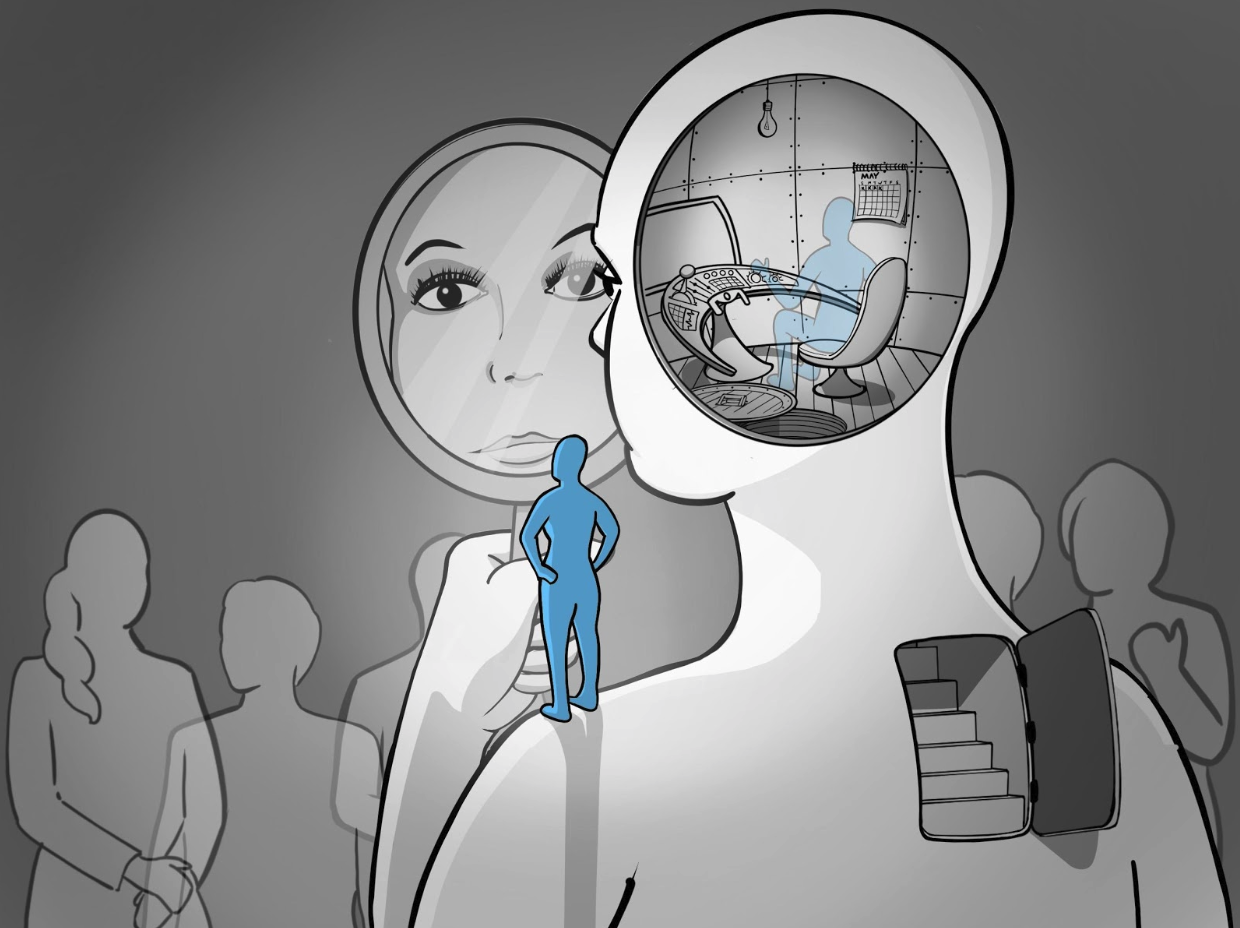
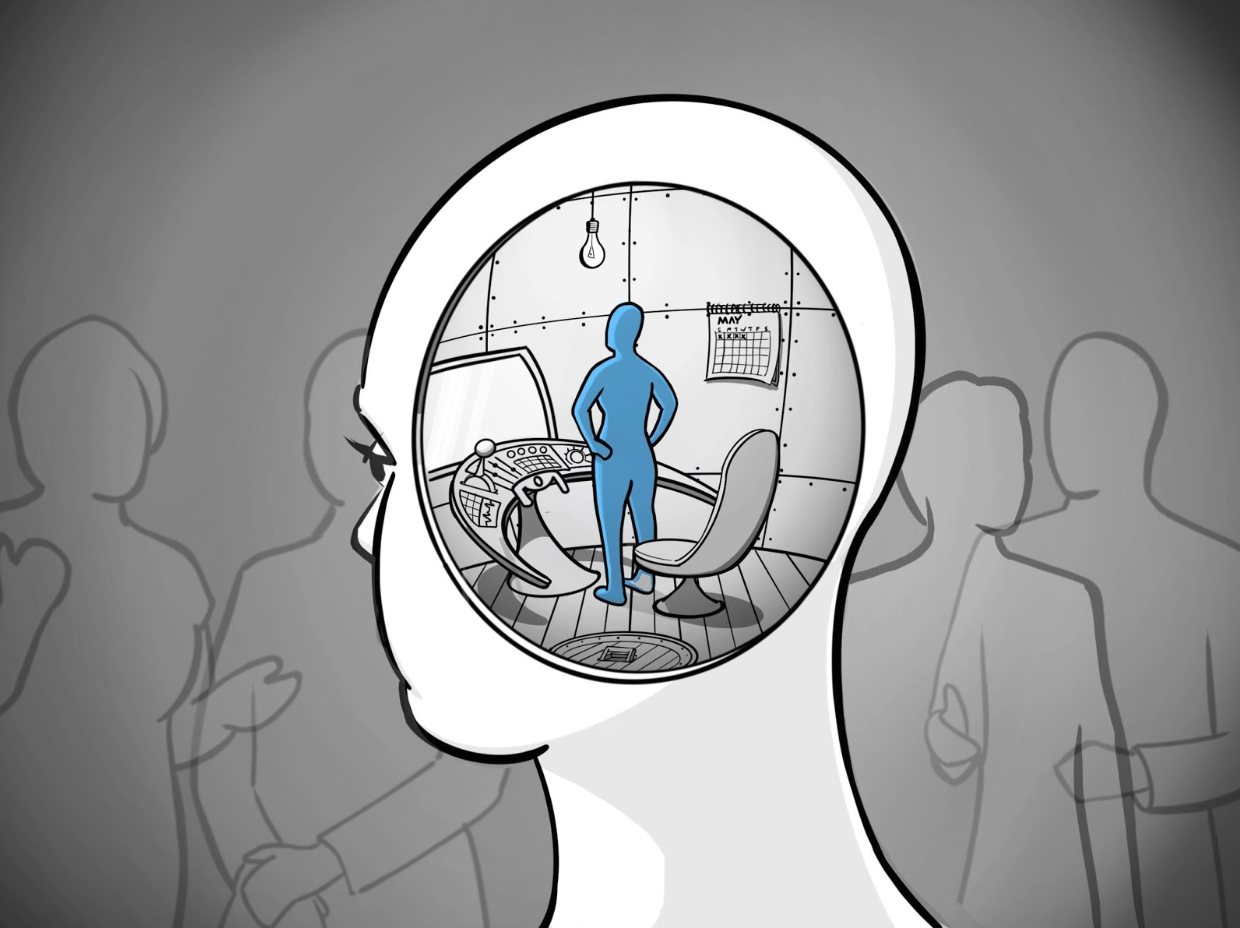
Just as it is physically impossible to be in two places at the same time, it is impossible to fully operate from more than one emotional state of being. Often, therapists don’t shift easily from the mode of helping a patient in the professional realm to the mode of self-protection in the private or social realm. Factor in the dynamic of therapists’ innately having sensitivity towards the point of view of others, and it is easy to understand why therapists often have a blind side when it comes to looking out for themselves.

Mary’s Story

Mary was the picture of the YAVIS patient as she sat on the couch across from me, smiled politely and asked if I was ready. She was new to working on her own therapy but had been a therapist working with veterans and their families for about seven years. She had graduated from a prestigious university and had a quality of poise and presence.

After polite pleasantries, Mary’s face suddenly seemed to fall into her hands. She was talking in fragments, hands now molded to her face, and I had to fight the urge to ask her to speak louder.

“He told me I was making him crazy. He said I had no right to hate his family.” She became silent, as if she were digesting what she had just said. Therapeutic silence seems to move five times slower than real time. She then smiled and her voice became stronger.

“Don’t you just love recent history? Such a tricky phrase that takes you into two different directions at the same time. If it were so recent, it wouldn’t really be history, now would it? And is history ever really history? There is no such thing in the Land of Oz and certainly not in therapy. But I guess that is where we start, of course. How in God’s name one Ken doll protégée could morph into…”

“She started laughing to the point that any more would have been like a Bette Davis scene from Whatever Happened to Baby Jane“.

We were close to ending the session and Mary sounded close to ending her marriage, citing endless criticisms she had endured. The criticism and “picking,” as she called it, typically happened when they were alone, but had recently expanded to being played out in front of others. Often, their audience was his children. Steve had two grade school age daughters from his first marriage. Mary described Steve as being fragile during their courtship.

“At times I’d come away from an evening or early morning with him to head back home and feel like I had to shower all of his pain off me. He would start out as a strong, strapping guy wanting to take me to dinner, movies, or whatever, but by the time the evening took off, it was texts with his ex-wife and children, a sad, vacant look in his eyes and tuning out whatever was left of our conversation, followed up with, well, odd word, but — pleadings for me to see him again.”

I was just about to ask her what that was like for her, but she continued her recall and continued making it all about Steve.

“It was just awful for him.”

I pursed my lips to keep from saying too much after my one-word response of “Him?” followed by what a client used to call my owl-eye stare.

“Well, him, yes, at that time. I know what you’re getting at, but I was okay with him being the center focus at that point. Relationships are like seesaws, and this was the time for me to lift him up.”

“Mary, can you pinpoint at what point it became not okay for you? At what point was Steve’s behavior towards you not okay?”

Through hands that made their way in nanoseconds back to her face, Mary cried suddenly.

“I became a laughingstock. He made it so. Right in front of his kids, ex-wife, ex-neighbors. It had been a risky proposition for me to even go, but then…” Tears formed and she grabbed a tissue from the end table and dabbed her eyes in what seemed like a deliberate patten of four dabs each eye before continuing, “He posed for family photos with his ex and children, ignored me the entire night. “It was as if he was deliberately trying to break me”. I left with him feeling like the child I used to be when my mother and sister each forgot to pick me up from school and I had to ask my teacher for help.”

She threw out the term “gaslighting” as she described the ride home with Steve after the party at his ex’s. Her slightest bit of revealing her feelings was met with Steve’s psychological evaluation of her and “diagnosis” of immaturity. In the next breath, she said, he practically begged her to stay the night with him, that he needed her and would think about what she had said. She was shaking her head as she described ignoring her own upset in exchange for focusing on his wants. It seemed like her emotional pendulum would swing often in this relationship. In a possible attempt to distract from looking at her pattern of focusing on Steve at her own expense, she asked if now was the time to recap her toilet training and her childhood in England. I thought about redirecting her back to the car ride but decided to let this pattern of putting others first, even when their behavior was abusive, have a wider net that could possibly include her life before Steve. My expression of encouragement by curiosity was enough prompting.

“I was always okay, you know. I was the nurse when we kids would all play hospital. Funny, not the doctor, anyway, nurse it was.”

“You can picture it?”

She nodded, “Oh, clever.” Her face became once again hidden by her long hair and her hands, but I knew she was crying. I was prepared to keep her focus on what Mary described as cold, unaffectionate parents and then later in future sessions delve more into the present ground we had initially covered. However, like a detour on a road trip that leads to more and better, Mary processed a direct link between her teenage years and her marriage. Though my own bias and historic blind side in therapy is to identify a plan of action, I yielded and let Mary’s insight be the focus. Insight about trying to win her parents over and this being replayed in her marriage took the focus of the next few weeks. Forever the Freudian, Mary described seeing repetition compulsion in red ink every time she saw her husband. The cognitive behaviorist in me saw this as a concrete decision on her part to change her thinking. No matter the modality, the door was open, and Mary was about to walk through it to freedom.

“Mary recalled baking pretend cookies for her mother when her father was working late and saving a couple “cookies” in a tin for when her dad came home”. She described singing and dancing whenever he was around. Our mutual smiles were slammed shut when she jumped up and started stomping, hands on hips.

“I cowered in the corner when my father’s arrogant, holier-than-thou, pseudo-intellectual family mocked me for having a lisp. And what did I do whenever this happened — and always did whenever any of them seemed displeased? I’ll tell you. I sucked up. I kissed ass. I was a doormat baking fake cookies and singing songs and learning to be gutted by predator animals in the real world my whole fucking life.”

I hesitated before asking what the baking fake cookies behavior looked like in her teen and adult years. She smiled, “I became a good listener. An observer of everything. A helper. The teacher’s pet, the best daughter, sister, student, friend.”

“Others could rely on you for understanding and caring. How did that benefit you?”

Smiling after another pregnant pause, “Well, people don’t bite the hand that feeds, especially while they’re being fed.”

***

Therapy eventually became targeted on how Mary had learned to focus on others at the expense of caring for herself — the origin of her blind side in both her professional and personal life. Mary had simply adapted to focusing on the needs of others, at the expense of her own. Effective personal and therapeutic confrontation were already in her toolbox, but what was needed — what we worked on — was creating another kind of therapeutic confrontation. This was one through which she implemented an internal filtering system that she could use in order to silently confront other people’s words and deeds to herself. Not an actual confrontation, since it was to be only internal; however, it would be as real as those formidable fake cookies. Actual external confrontation was the homework for future sessions.
 

Beyond Resilience: Addressing Moral Distress During the COVID-19 Pandemic

Rachel Smith was deployed to Iraq as a nurse at the height of the war in 2003. When she returned to the States, she recognized she was changed by the war, but didn't speak to anyone about her experiences. She closed off that part of herself and began to question the purpose of her deployment. Rachel did not believe she had PTSD — she wasn't plagued by flashbacks or hypervigilance, but she did feel sad, guilty and helpless over what she experienced. She went on to become a physician assistant and pushed her memories of war to the back of her mind. In 2018, an article in STAT about people in healthcare suffering from moral injury went viral. “Rachel had never heard the term “moral injury” before”, and read this article several times – the concept resonated on a deep level, describing how she felt about both her military experience and her current struggles providing care in a broken system as a physician assistant. She felt a sense of freedom and relief to finally have the vocabulary to describe what she was feeling, and this gave her the starting point to begin processing what she had experienced.

Moral Distress

Right now, everywhere we look, there are articles, both popular and professional, about how to manage, cope and reduce stress. Mental health providers are dispatched to COVID treatment sites to help care providers with the crisis they are experiencing. Apps such as Calm or Headspace, which focus on self-care and breathing, have come into focus to help with the overwhelmingly stressful situations that frontline healthcare workers find themselves in. This is crucial and important primary prevention, but it is only a starting point, not a solution. The challenge is not only about handling acute trauma. The COVID experiences of healthcare workers are slow-moving and life-altering, with important moral features.

By the time healthcare workers finally visit a therapist’s office (for those who do), therapists need to be prepared for more than helping people manage acute anxiety and addressing trauma. They will need to recognize the vocabulary of moral distress and to have internalized its meaning.

Distress is not new to healthcare workers. It is part of their normal routine and work; they experience days where people are sick and cannot be cured, and witness pain, suffering and death. They expect this as part of their role and are accustomed to its happening and to witnessing it. They often feel a sense of privilege at being able to be there for people during these challenging moments of grief, pain and loss.

With COVID, there are unexpected experiences. People around COVID patients suffer, but the resources to which they are accustomed are simply not there. There is not enough equipment or staff. Patients are alone when they die. Healthcare workers may be charged with triage decisions that make them feel they are “playing God,” or they may be following protocols to make those life-or-death decisions that constrain them from making a different choice, resulting in feelings of powerlessness or self-blame. Furthermore, the lack of personal protective equipment or leadership support can result in feelings of anger or of being sacrificial, even disposable. Because of COVID’s unpredictable and devastating nature, “working in a healthcare role right now can lead to more helpless or sad feelings than usual, and potentially a questioning of purpose. When these feelings are associated with one’s belief that he or she is participating in moral wrongdoing, this is “moral distress.””

It is not too early for therapists to get a head start on learning about moral distress. This is what many healthcare workers will be experiencing. We can learn more, and professional organizations can educate their constituents to avoid the potential problems that can happen if we ignore this aspect of what is coming down the pike.

Another concept, “moral injury”, is typically discussed in the context of military populations who had field experiences where they perpetrated, failed to prevent, and/or bore witness to acts that were transgressive and that went against their deeply held moral beliefs. Although such events may additionally give rise to post-traumatic stress symptoms or disorder, moral injury is not a psychiatric disorder.

The concept of moral distress, on the other hand, first arose in the field of nursing literature and has now been discussed in relation to other healthcare professions. In general, the term moral distress has been used to describe one’s inability, due to perceived constraints, to fulfill the moral obligations that those in healing roles assume to others. As a result, one’s core values and duties are violated. Within the nursing profession, some uses of the term reflect experiences of working within traditional hierarchies of decision-making. For example, in some cases, nurses are certain of the right thing to do, but feel constrained to carry out physicians’ orders or abide by other policies which make it impossible to pursue the actions they feel are morally right. Others in healthcare, in addition to nurses, may experience constraints due to power differentials or other obstacles. When any healthcare worker is not certain about the rightness of an action (for example, taking someone off life support), the decision is morally hard as well, and deep distress can arise out of having to make these decisions. Allocation of resources in the healthcare setting can at times lead to problems with unsafe staffing, unsafe practices and sometimes subsequent codes of silence in speaking out or reporting mistakes. These factors may all contribute to moral distress.

“Like moral injury, moral distress is a not a psychiatric disorder”. It is a psychological experience or state, a response to situations that are morally challenging. It is a disorienting feeling, a way one might feel that what they are doing does not fit in with their role as a caregiver, a healer, a health professional. Importantly, moral distress not only occurs at the moment of the morally challenging situation, but can linger for an indefinite period of time after the initial triggering event passes. Those who experience moral distress can be impacted for some time. It is and will become increasingly important for psychotherapists to appreciate the complexities of working with clients experiencing moral distress.

Suggestions for Amelioration of Moral Distress

1. Our primary goal is not to “fix” moral distress. Not only is this impossible, it overlooks something important for the person. Instead, we need to help them integrate their experience into their life and see it as life-altering but not life-impairing, in some ways similar to how we work with other losses and death. Don’t tell someone that you are sure you know what will help. No one knows exactly. But say what you do know — that therapy can give one the opportunity to better understand one’s thoughts, feelings and behavior and to gain insight into our pasts and futures.

2. Early recognition is important. When someone seeks help acutely, we must help them with general wellness in body and mind, and also acknowledge that they may need to make sense of this entire experience later on. Some people may think they are depressed — and in some cases there will be clinical depression or other significant psychiatric symptoms — but there is risk in not also incorporating the concept of moral distress.

3. Be cautious about diagnosis. Don’t make assumptions or over-pathologize moral distress. Depression and PTSD are psychiatric conditions. Burnout is a constellation of symptoms that correlates with psychiatric illness. But moral distress might in some cases resonate better with patients who don’t feel distorted in their thinking, feeling or behavior. In fact, some people might experience the stresses during COVID and attribute their experiences to “doing their job” or an “occupational hazard” and not feel distress, instead coming for other reasons to therapy. The same experiences might cause deep, abiding distress in others. “For some, COVID may be amplifying something they already felt, while for others it is an entirely new set of feelings to contend with.”

4. Use what you already know. Don’t over-specialize the emotional states of moral distress on one hand, yet at the same time recognize the particulars of it as unprecedented. Sit with a patient to listen and understand what happened to them. Develop a narrative that makes sense by revisiting facts and experiences about moral events, particularly those that engendered shame, self-blame, sadness or anger; and ask what else they could have done in those moments or not, to help them move toward the future. This is different for every person and depends on their own individual values and priorities. They can adapt and incorporate what happened and move forward.

5. Use compassion. Bearing witness, being non-judgmental, sitting with intense feelings and acknowledging normal human reactions are important tools to keep the individual well and better able to handle the reactions and feelings they have.

6. All theoretical orientations are welcome. We all practice from different theoretical perspectives: psychodynamic, cognitive-behavioral, relational, mindfulness-based. All of these can be helpful. We also know how to ask people about experiences where they felt powerless, harmed, abandoned, mistreated, overwhelmed, or witnessed others’ suffering. But it is important we have language to discuss what we see, and that patients have some language to use as well. We do not need to be trauma specialists to provide excellent care to healthcare workers and others with moral distress coming to terms with how COVID has affected them.

7. Avoid saying “I know how you feel.” Psychotherapists can relate to some aspects of this. When healthcare systems put in place decisions we might otherwise not make, we may feel our efficacy is undermined by not being able to provide high quality or even adequate care. This can literally feel “demoralizing” to the individual. But here, it is important not to say you know what it is like to be trying to save someone dying from severe hypoxemia while others also need your attention, while at the same time being terrified of catching the virus. Instead, focus on reflecting and supporting, and encouraging people to debrief and connect with trusted colleagues who share their lived experience.

8. Make room for non COVID-related experiences as well. “Healthcare workers seeking help in the coming months are not only about COVID — their lives bring context”. Some may come for psychotherapy for the same reasons many others will — to deal with general worry, sadness, questions about life and relationships, even to seek care for mental health concerns that predate COVID — so we can’t make assumptions that all will experience moral distress.

9. Pursue Purpose and Meaning. Finally, it is important to recognize that our work is not only about making someone feel better, though this is important. But to address moral distress we also need to make room for meaning-making and cultivating the sense of purpose that brought people to healthcare in the first place. Rachel found this by moving into the field of patient safety and quality improvement in health care. At Ariadne Labs, she works on developing solutions to improving healthcare delivery. She is completing a doctorate in Public Health, which will give her the ability to improve the care of patients on a large scale. For some, being able to address the system and effect change in some way is very therapeutic, and attempts to change structures to prevent morally distressing situations in health care systems in the future can help people heal.

***
 

We need more understanding about what best “treats” moral distress across situations and people, and there is great need to invest in research. We need to ask people over time what helped them or would have helped them. But for now, at least, we psychotherapists have the tools we need to carefully listen to our patients affected by COVID and can avoid mistakes if we keep these concepts in mind in the coming months.
    

Bret Moore on Military Psychology and Getting the Mission Done*

Challenges During the Pandemic

Lawrence Rubin: Good afternoon, Dr. Moore, and thank you for sharing your time with us today. Much has obviously changed in the world since the time we scheduled this interview. My understanding of the role of the military psychologist is that they serve the mental health needs of veterans and active personnel. What clinical challenges have you noticed in light of the COVID crisis?
Bret Moore: We often think about service members deploying and helping overseas, fighting wars and those kinds of things. But they actually have quite a strong mission stateside as well. So, in episodes like the COVID-19 pandemic, many military members are tasked to help support local response efforts in states like New York and California that have been been hit the hardest. You have probably seen the news where certain units have been activated to support those efforts — whether it be quarantine or getting supplies to individuals that are sometimes done by National Guard service members or active duty service members.

In the case of the COVID-19 crisis, one of the challenges to military clinicians is having to shift our practice to telehealth
In the case of the COVID-19 crisis, one of the challenges to military clinicians is having to shift our practice to telehealth, just like civilian practitioners are having to do. Obviously you have to be concerned about privacy and not violating HIPAA, and other related issues like what if the video's not working. Can you do the session over the phone, and how much good can you do without seeing each other and having that visual interaction, those visual cues? So, again, not so much unique to military psychologists, but it's something that we're struggling with. You did mention at the beginning that military psychologists provide mental health care to military members. But that is really only one small part.

We also provide consultation to commanders about morale and unit cohesion. In a way we also function as consultants and industrial organizational psychologists. We not only focus on individual wellness; we focus on unit wellness. We focus on organizational functioning. That's what I really like about military psychology. It is a very diverse field, and it is very difficult to get bored being a military psychologist. 
LR: Telehealth is a transition that military and non-military clinicians are making right now, feverishly trying to catch up, get up to speed, so to speak. Do you think that providing telehealth to military personnel, either active or veterans, is a different challenge at this point to military clinicians than it might be to non-military clinicians?
BM: I think the transition to telehealth may be a little bit easier from the standpoint that the VA has been doing telehealth for over a decade. All branches of the military — but primarily the army seems to have had the most sophisticated behavioral telehealth infrastructure for at least a decade, so we are somewhat used to it. Even clinicians within the VA and military systems who don't provide telehealth on an ongoing basis are certainly familiar with certain aspects of telehealth. So, providing telehealth during this crisis is not a shock. It's not a huge amount of adjustment for clinicians within those systems as it is to some of my friends and colleagues who were practicing outside of the federal military system and who are asking questions like, “What system do I use?” “Is it secure?” “How do I get paid?” “How do I bill insurance companies?” The nice thing about the VA and the DOD is that they are really somewhat of a socialized healthcare system. We're not billing insurance companies per se, so clinicians aren't really having to struggle as much with answering those kinds of questions that our civilian counterparts are.
LR: Is telehealth something that a military clinician might use for someone who is deployed, if that clinician is not deployed with them?
BM:
Telehealth has been provided in places like Afghanistan and Iraq, and we have telehealth services that are being provided currently to Germany. Wherever there's a connection
Telehealth has been provided in places like Afghanistan and Iraq, and we have telehealth services that are being provided currently to Germany. Wherever there's a connection, theoretically you could provide services. I think the VA has done very nicely, and I do believe that the Department of Defense is going to be coming online with providing care from federal hospitals, VA clinics, or Department of Defense clinics to patient's homes. Now the VA has been doing that for quite some time and I think we are going to be moving toward in the future. It's important for the VA mostly because so many veterans live in remote areas. When I worked in North Dakota for two years and when I needed to go see and check in, have a physical with my doc at the VA, I literally had to drive four or five hours. So, it is important to be able to provide these services in the home, and hopefully the Department of Defense will come online with that at some point.
LR: What advice might you offer civilian clinicians in our audience about what may be gained after this pandemic passes as opposed to what will be lost?
BM: Well, that's a tough question. It is an excellent question, but it is a tough one because that is something I have been thinking about over the past several weeks. What I hope to see is a deepening of relationships, maybe — certainly within the immediate family. We're spending all this time together and you see memes and jokes like, “We're going to end up killing each other because we're spending all this time together.” I think the opposite is probably more likely, in that people are starting to reconnect and rekindle some of the things that brought them together in the first place. And dads are learning more about their daughters, and mothers are learning more about their sons.

Hopefully, we are developing deeper bonds. But what I really hope is that we develop some compassion and connection with people we have never even met, with larger society in general. We watch the news and we see everything that's going on and it's hard not to feel some kind of connection to the people who are suffering the most right now. So, I am hoping we gain a sense of greater compassion. And I just really wish that we would stop fighting each other. And I wish our politicians would set a good example by showing how we can all play together nicely and respect each other and get along with each other.
But I do hope that we see a deeper connection between individuals once this is all over
But I do hope that we see a deeper connection between individuals once this is all over. 

Trained to Solve Problems

LR: If we want to call the battle against the pandemic a war, would you say that from the standpoint of a military psychologist, service men and women are uniquely prepared to address some of the mental health challenges that crises such as this one create? 
BM: Oftentimes I am asked if there is a certain type of person who joins the military. And the short answer is no. I mean there are a lot of shared characteristics, but there is a lot of individual variability. There is a strong sense of public service and patriotism that you see obviously within the military population. And those individuals who join tend to have people within their immediate family that have served in the military. So, there is a sense of something that is passed down from generation to generation. I will also say, to generalize, I think individuals who join the military already tend to be fairly resilient individuals. And I think that the hard work and training they do in boot camp strengthens their resilience, whether or not they are eventually deployed.

You're probably aware of some of the research that Martin Seligman has done with comprehensive soldier fitness, and how the military has made a strong effort to strengthen the cognitive reserve, cognitive strength and emotional, psychological, physical and spiritual strength of service members. I am not going to speak for that particular program, but I think in general,
our men and women in uniform are some of the toughest individuals you'll ever find. and probably are more equipped to deal with the anxiety and stress that comes with something like the pandemic we are dealing with now
our men and women in uniform are some of the toughest individuals you'll ever find. and probably are more equipped to deal with the anxiety and stress that comes with something like the pandemic we are dealing with now.
LR: Would you anticipate that the levels of anxiety, depression and fear that have been reported in the civilian population might be lower in the military because of their preparation, resilience and the skills that they bring to service?
BM: I would think so. Even though we're not in necessarily active conflict right now, many service members have done deployments, and in some cases, multiple deployments in some of the most stressful environments that you can imagine, where every day is filled with new anxieties and new tensions and new fears. So, yes, just based on that, I think from a larger standpoint or from a broader standpoint, these individuals would be better equipped to deal with the anxiety and tensions that we see today. Absolutely.
LR: Do you think that this preparation and hardened resilience might make it difficult for some military personnel to address the potential lethality of the pandemic? Might they downplay it or minimize the risk because they are accustomed to being ready and prepared for war and death?
BM: No, I don't think so. I think it is more of understanding what the challenges are, because military members and veterans are trained to be problem solvers. You identify the problem and you come up with several solutions. You pick the best solutions, implement them, and then if that doesn't work, you implement something else. So, it is really a calculated approach to things. But no, I don't think that they would under-appreciate the significance and the risks that are associated with something like this. If anything else, I think they may appreciate it more.
LR: So, although not prepared to handle pandemics per se, you're saying that military members, by virtue of their training, by virtue of the resilience and problem solving skills are uniquely prepared to help each other and civilians to address the challenges of the virus.
BM: Yes, absolutely.

The Caretaker’s Perspective

LR: During this crisis, what concerns do you have for the mental health of military clinicians?
BM: There's been a few studies out there looking at provider burnout, compassion fatigue, vicarious trauma.
In general, the stress for clinicians comes with managing their large caseloads, which are made up of trauma
In general, the stress for clinicians comes with managing their large caseloads, which are made up of trauma. A third or a half of their cases are post-traumatic stress. I think it's not so much which area you practice in. I think it's the kind of disorders and presentations that you see, just like a social worker who treats child sexual abuse cases nonstop. If you have clinicians that are constantly treating post-traumatic stress disorder, combat-related trauma, military sexual trauma, whatever the case may be, I think that's going to take a toll more so than someone who's treating adjustment disorders, or even depression or panic disorder. So, I don't think it is any different, but I think it is something that is shared across the profession. So, you know, working with trauma survivors can be very challenging, and I think we probably have a similar rate of burnout and compassion fatigue that you would see across the system.
LR: You had mentioned earlier that by virtue of their training and resilience, service men and women are perhaps better suited than the average person for dealing with crises like this one. Do military clinicians bring a unique blend of characteristics into their role during times like these?
BM: You have military psychologists who, like me, were in active duty for five years. I did two and a half years in Iraq providing services to service members. And then I transitioned back to the civilian world as a civilian psychologist for the Department of the Army. So, my experience is going to be a little bit different than someone that comes out of internship from a university and has never worked with this population, and steps into an internship working with combat veterans. You know, I think over time there is a strength that these clinicians build if they stay within the system long enough.

I do think that those who choose to enter the VA to work as psychologists or the Department of Defense oftentimes have a strong sense of public service and a strong sense of patriotism. One of the webinars I provide is on military mental health and how to treat PTSD and related conditions. I get a lot of clinicians saying that they like working with veterans because “my dad was a veteran.” “My uncle was a veteran.” “I used to sit on my grandfather's lap, and he would tell me stories about what it was like serving in World War II.” So they come with their own experiences, even though they may not be direct experiences. 
LR: When you made that transition from a combat to non-combat military psychologist, did you notice any changes in the way you practiced, or what you brought from the combat sphere into the non-combat sphere?
BM:
I trained as an Adlerian, which involves insight-oriented work and a focus on the past; but I had to shift. You do not get to spend six months doing in-depth insight-oriented work with veterans.
I trained as an Adlerian, which involves insight-oriented work and a focus on the past; but I had to shift. You do not get to spend six months doing in-depth insight-oriented work with veterans. A lot of times, at least with active duty military personnel, you may get four to six sessions. So, I had to shift my approach and, when needed, to be solution-focused. I had to work collaboratively with the service member and identify what it is that we needed to correct, to “fix,” so that they could continue to do their job.

My job as an active duty army psychologist was to care for the wellbeing and emotional health of the personnel, but it was also to make sure they could continue in the fight. You know, a soldier's job is to fight, to win wars. So, if they are not psychologically and emotionally healthy, they cannot do their job. So, not only do I have to take care of them emotionally and psychologically and help them, but also, I have to get them to return to the mission so they can finish what they started. And sometimes people who don't understand the military all that well have a deep conflict with that because they ask, “How can I as a psychologist try to patch people back up just to send them back out to fight?” Well, what is the alternative? Just send them back out to fight and not patch them up? They're soldiers. They're going to have to go to war. So, I need to be able to do whatever I can to make sure they can do their job to the best of their ability. 
LR: If you thought a particular combatant was not fit to continue, did you have the flexibility to send them back stateside, or was there a mandate to patch him up, get them back? In other words, was the threshold lowered because the mission was the mission, and your role was to get him back into the battle?
BM: No, I didn't experience the pressure at any point in my active duty days. The psychologist, the mental health professional in general, has a lot of power, a lot of control and influence over what happens with service members who may be struggling and are not mission-ready. Ultimately, it is usually the commander's call to decide whether to send a soldier away from the fight, maybe back to the States so they can recover. But in general, a commander,
a good commander will listen to his docs and say, “okay, if my doc is telling me that sergeant so-and-so is not fit, I am not going to put him back out there
a good commander will listen to his docs and say, “okay, if my doc is telling me that sergeant so-and-so is not fit, I am not going to put him back out there. Because not only does that put him at risk, it is going to put the rest of my unit at risk.” So, yeah.
LR: Did you ever feel caught between that conflicting obligation toward the military to continue the mission versus the person who might not be ready to get back in the fight?
BM: Near daily. Over two and a half years of being deployed, probably most every day I wrestled with that to varying degrees. Brad Johnson and Jeff Barnett have written a lot of great stuff about that. There is always that push and pull, and you have to find a balance, and you can't be overly rigid. This is not a black and white game. You have to think in various shades of gray and you also don't want to work in a vacuum. So, that's why if, when I was an active duty army psychologist, I got on my high horse and said, “all right, I'm just sending this person home, this person home, and that person home, I don't care what you think,” I wouldn't have lasted very long. There had to be some trust that developed through consultation and education, which oftentimes was an important part of my job, was to educate commanders about the impact of mental illness and mental health conditions on functioning. With that proper education, I was able to resolve most all conflicts in a rapidly short period of time.
LR: So, that moral conflict servicemen and women experience can also be experienced by the military clinician who struggles with the morality of where to send them in or send them back.
BM: Absolutely. I trained as a psychologist. I wanted to help people. If it would have been up to me, we would not have been there in the first place. But it was not up to me, and if it were up to me, I would send everybody home. But I knew I couldn't do that. That is not my job, not my responsibility. So, yeah, it was a challenge.

Military Clinical Competencies

LR: I would like to drop back to some of the core questions I had initially prepared because many of our readers will not have experienced military psychology. I recently did an interview about multicultural competence, and since the military is its own culture, I'm wondering if there might be core clinical competencies that a military clinician must have or develop in the course of their training and service?
BM: The core clinical competencies include being a generalist. The military and the VA definitely have specialists, including neuropsychologists, aviation psychologists, as well as behavioral medicine specialists. But to be a military psychologist, you have to be a generalist because, for example, you may find yourself deployed or in a remote location where you may be the only person available. So, you do not have the luxury to knock on the door of the specialist down the hallway.

There are some good articles and chapters out there about this notion of the distinctiveness of the military culture. In 2008, Greg Reger and colleagues wrote an article in The Military Psychologist in which they talked about the ethical challenges that military psychologists face that are not fully understood by the average clinician. The military has a unique language and a certain class caste system, a socio-economic status of sorts within the military that distinguishes the officers from the lower enlisted.

The lower enlisted have different responsibilities from the senior enlisted versus the officers. So, there is a hierarchy that must be understood.
Sometimes things in the military are not about fairness and it is not about the individual, it is about collectivism and working as a team
Sometimes things in the military are not about fairness and it is not about the individual, it is about collectivism and working as a team. You know, if you think about our current society, we put a lot of emphasis on individual rights and what is best for us. You know, what is best for me. If I take care of myself, I can take care of other people. You hear us say that as clinicians quite often. But in reality, that is not necessarily the mentality within the military. You take care of your group and then as you take care of the group, you are also taking care of yourself. 
LR: So, a commitment to a more generalized approach to intervention and an appreciation for the collectivism that is part of the military. Are there any other core competencies that you can think of that distinguish military clinical competence from non-military clinical competence?
BM: I think comfort with and being well trained in the treatment of trauma-related conditions. Combat trauma is a lot different from civilian trauma, meaning motor vehicle accidents or natural disasters and sexual assault. Combat trauma is more along the lines of complex trauma and multiple traumas. There is generally not one specific incident that leads to post-traumatic stress. For a combat veteran, it could be a year or years-long worth of traumatic events. So, it is about having a comfort to work with very trying and difficult cases, presentations and diagnoses, and being versed in evidence-based treatments. You know, the VA and the DOD are very focused on providing manualized evidence-based therapies for PTSD, like prolonged exposure and cognitive processing therapy. You also must be comfortable with a solution-focused, problem-oriented approach to care. Again, a psychodynamic psychotherapist is going to struggle a bit more than someone who is more of a behavioralist or cognitive behavioral clinician.
LR: Might a non-military clinician working with military personnel be more susceptible to compassion fatigue or vicarious trauma more so than a military psychologist who has worked side by side with these military personnel?
BM: I think that is a reasonable assumption to make. I'm not aware of any data to support that, but
plenty of friends and colleagues who have never served in the military or have never even worked within the military system, but who are private practitioners who take veteran patients, tell me, “Oh my goodness, how do you deal with this on a day-to-day basis?”
plenty of friends and colleagues who have never served in the military or have never even worked within the military system, but who are private practitioners who take veteran patients, tell me, “Oh my goodness, how do you deal with this on a day-to-day basis?” Some of the cases are very overwhelming, as they must listen to the horrific traumas that some of our men and women experience. And the military can be a difficult environment to work in. You know, there is no eight-hour shift for the most part. You work until the job is done. The mission comes first, whether it’s to complete training or to win a war. And that means everything else must come second, third, fourth and fifth, including family, friends, socialization and even self-care.

Non-military clinicians may say that these types of conditions and stresses are an unfair position to put clinicians in. How do you expect them to be happy when they are living in such a stressful environment? And so, I think compassion fatigue and an increased level of frustration are certainly going to impact the non-military clinician. And I think that is normal and to be expected that you are going to find yourself frustrated not only working with this population but with the system that you have really never been a part of. They may be hearing second hand the difficulties of working within that system, but not necessarily the benefits of working in the military. 
LR: It almost sounds like the clinician, whether military or non-, who is working with military personnel has to readjust their relationship with Maslow’s hierarchy of needs because in active military combat, there's not a hell of a lot of time for self-actualization.
BM: No, that is way down on the list.

The Privilege of Prescribing

LR: You are in a unique position because you are a prescriber, one of an elite group, so to speak, in a nation where very few states provide prescription privileges to psychologists. How has this added privilege been a benefit in working with the folks you have had to serve?
BM: It has reduced the number of referrals I have had to make. I will tell you that. I do a lot of medication management as well as administration. About half of my time is research and administration and half of my time is clinical work. I am not a huge proponent of medication and believe in using it sparingly, smartly and only in cases where psychosocial interventions have not worked. But as a clinician who trained initially as a psychotherapist, I know that sometimes psychosocial interventions don't work, or they don't work well enough, and then medications are warranted. I might at times have to refer to somebody else and lose that patient because they resist psychosocial intervention, but also resist having to start over and believe that they have to tell their stories over and over again, especially trauma victims.

So, I might lose patients once I attempt to refer, or if I could obtain a referral while convincing them to stay in treatment, it could be three months before there's an appointment. But, as a prescribing psychologist, I get to do both my therapy and medication management. I have the ability to provide a level of continuity of care that you don't get, I think, in any other mental health profession — even psychiatrists. You know, psychiatrists obviously can do medication management, but very few choose to or can do psychotherapy. So,
I really think prescribing psychologists are in a good position to show that continuity of care is important, that collaborative care is important, because we do best as professionals when we collaborate
I really think prescribing psychologists are in a good position to show that continuity of care is important, that collaborative care is important, because we do best as professionals when we collaborate. I collaborate with primary care physicians and other healthcare professionals. I do not operate in a vacuum. But I have become more effective, I think, as a clinician, and I have grown to truly appreciate the complexities of human nature and psychological presentations and have come to appreciate how powerful psychotherapeutic interventions can be as well. 
LR: Have you found any particular challenges prescribing to service men who are either predisposed to substance abuse or who have histories of substance abuse? Or who are actively using substances while serving?
BM: Not so much substances. My guess is that the rate of true substance use disorders in the military is probably equal or a bit lower than you would see in the general population. The challenge you tend to find as a prescriber within the military system is that there are medications that are not conducive to serving in a harsh environment. So, medications that require careful monitoring and updated laboratory values might not be the most appropriate during times of active combat. Medications like benzodiazepines — Valium and Xanax — can reduce a person's focus and concentration and can lead to drowsiness, so you don’t want someone who is rappelling off a tower on high doses of one of these types of drugs. But there are mechanisms in place if you put someone on one of these medications. Commanders are alerted that hey, these are some limitations that you need to follow while this or that soldier is on this or that medication. That is the biggest challenge.
LR: Are there difficulties certain service men or women have who are prescribed during active combat, and then return home or are transferred into a non-combat area?
BM: I kind of see it as the opposite. The need for meds is limited in a combat environment except for sleep meds. Sleep meds are very, very useful for service members who are working very long shifts in a very noisy environment where it is very difficult to sleep even when allowed to. So, what I find stateside is there's more time to ask the existential questions, even though you would think you would be asking these questions on deployment. But it's so busy and the operational tempo is so fast that you don't really get a chance to sit back and do a lot of introspection about the meaning of life, and why am I not happy, and what's this anxiety that I'm dealing with? When deployed soldiers return home to relative comfort and regular days, we start to see more anxiety and maybe more dissatisfaction with life.

I think transitioning medication from non-deployment to deployment is the bigger challenge — getting them off the medication so that they can be aware, alert and not have any cognitive deficits related to medication so they can really focus on the task at hand
I think transitioning medication from non-deployment to deployment is the bigger challenge — getting them off the medication so that they can be aware, alert and not have any cognitive deficits related to medication so they can really focus on the task at hand. I'll give you a concrete example with nightmares. There is a medication called Prazosin that’s used for nightmares. It's been shown to be really effective. And if you're taking that stateside, that's fine. But when you deploy and take it, one of the side effects is that if you get up too fast, you can faint and hurt yourself. So, yeah, if you are sleeping and a rocket comes in, you hop up out of bed too fast, you could fall and hurt yourself. There are just some medications that aren't conducive to a combat environment. 
LR: It sounds like in your training for prescription privileges, there were specific components of that training that addressed the issues of transitioning from deployment to non-, from non- to deployment, and to the use of medications in combat. Is it that specific during your prescription training?
BM: Not during the formal educational/clinical training. On the job training, yes. One of the nice things about the military is they tell you what they want you to do. There is no shortage of regulations and memos and guidelines to follow. So, there's definitely guidelines for which medications are a go versus no-go, and for what to do if a person is on a medication and they're getting ready to deploy or transition from one base to another base. So, there's definitely plenty of guidelines out there to help clinicians make those decisions.

Myths and Misconceptions

LR: Are any popular misconceptions about the military persona, the military psyche? 
BM: There are some popular misconceptions out there, likely based partly on some truth. Back in the day, the only people that went into the army were the people who went before the judge who said, “Hey, you either go to the army or you go to jail.” But it's not like that anymore. Actually, there are more people joining the military right now who are from the middle class. People tend to think that they’re from lower SES groups. So, it is more of the middle class, middle America that really serves. And the military can be a springboard for very successful careers, not only in the military, but after service ends. You can serve 20 years and get out at the age of 38 with a full retirement and then have another career set aside for you. I guess my point is the idea that people join the military because they don't have any other options is no longer accurate. It's just not true.
LR: Choice versus default. And it is the default conception that leads people to think that military personnel are unstable or simply do not have anywhere else to go.
BM: Sure, there is going to be a segment of military people that join because they do not have any other options. They may come from a small town where either they work at the sawmill or they go into the military. College isn't always an option. And the great thing about the military is it has a very robust college opportunity where if you serve, you basically can go to college for free. And there are some people within inner cities that say, “You know, I've got to get out of this. This is an opportunity for me to make a life of my own.” I don't want this to sound wrong, but it's not the bottom of the barrel of our country that joins the military by any stretch. It is people who come from hardworking families and the middle class, from across the country. And again, many who have a strong patriotism, a love of the country and want to serve others.
LR: You'll probably find the most misconceptions coming from those who are most removed from the military.
BM: Absolutely. Another misperception or conception that I think that some people have post- 911 or post-Iraq and Afghanistan, is that our soldiers are broken, busted, unhinged, crazy. It really, really troubles me. I know they've made great stories for media, but anytime a veteran does something that's not good, you know, a shooting or a high profile crime, they always lead with “combat veteran does this” in the heading — they don't lead when a non-veteran that does something bad, they don't lead with “non-combat veteran does this.” I think it's done to create some of the sensationalism. But I think it feeds into that wrong narrative that our service members are busted and broken, and they are really not. If you look at the vast majority of service members, they don't return home with post-traumatic stress disorder.

And if they do, they go on to lead very healthy and successful lives with symptoms of PTSD. We look at our World War II veterans, you know, the level of post-traumatic stress that these men and women dealt with — primarily men — they helped build this country into what it is today. And they didn't get a lot of treatment. They didn't get a lot of services, but they still found a way to live with those experiences. And that has led me to another area that I am really interested in, which is post-traumatic growth. Working with Rich Tedeschi and Lawrence Calhoun, we have found that
not only do returning soldiers experience symptoms following trauma, they experience growth
not only do returning soldiers experience symptoms following trauma, they experience growth. You can actually become a stronger, better, person following trauma and lead a more rewarding and fulfilling life because of what happened to you. 

Challenges to Military Families

LR: What are some of the challenges that military clinicians typically confront when working with the children and partners or spouses of deployed personnel when they come home, when wheels go down, as you say in one of your books?
BM: When the spouse stays home, it’s typically the female partner. The military member maybe took care of everything when they were home. But again, each household differs. What I found is that the stay-at-home partner or the partner that didn't deploy, the non-military partner, has to take on the responsibilities previously handled by the military member of the family, which creates a significant level of stress, feelings of being overwhelmed — “I'm doing this by myself. I'm having to raise the kids, but now I also have to take care of everything else that you were taking care of.” So, there can be a bit of anger, frustration and animosity toward the service member who is deployed, and when they return home.

But, I have also seen the transition from that frustration and animosity to a new sense of independence. After a year of paying the bills, after a year of making sure the home was being maintained and the cars were maintained, the partner who remains home might feel something like, “I'd like to keep doing this” or “I want to keep doing this.” So, now when the service member comes home and believes that they are going to take over their former responsibilities, there can be a bit of a conflict, as the stay-at-home partner feels, “I don't want to give this back up. I am more capable than I originally thought. I can actually handle a lot.” It's hard to turn that back over. I think non-military clinicians who want to work with couples, especially couples that had at least one party deployed, should understand that this kind of military-related conflict may be a common occurrence. 
LR: What are some of the issues that you've noticed in the parent-child relationship between the deployed and now-returned veteran and the child(ren)?
BM:
One of the complaints I hear from the returning service member is feeling disconnected from their family, especially if they were away for a long time
One of the complaints I hear from the returning service member is feeling disconnected from their family, especially if they were away for a long time, and the only previous contact was through Skype or phone calls. There is a sense of disconnection, and sometimes it is connected to post-traumatic stress, while other times it is outside of the realm of post-traumatic stress. I am not really clear on where that disconnection comes from. It probably has something to do with being separate for so long. And sometimes the children mature and develop in their own ways. So, that tends to be a struggle.

This is certainly true from an adolescent standpoint, particularly if the service member was a strong disciplinarian before deployment, and returns to an older and more independent child who feels something like, “They come back and tell me now what to do,” or “I've been taking care of mom or the sister or brother for the last year while you were off at war, so don't come home and start bossing me around.” The same thing may occur for the spouse, who feels, “Don't come home and start bossing me around. I'm the one that's been taking care of the household for this long.” But again, the nice thing is that with good counseling, marriage counseling, couples counseling, family counseling, this can be corrected. That is because a lot of times it's just a matter of understanding how expectations have changed and understanding how people are feeling, and helping these individuals discuss what they're feeling and what they would like to see happen going forward.
LR: So, is being a well-trained family or couples therapists enough to work with families of returning veterans, or is there additional training they should have in order to work with military families that are reunited after deployment?
BM: I think being a grounded and solid couple or family therapist is important, but also having some additional training. It doesn't have to be formalized training. It could be a CE activity or even reading a couple of books on military culture. Family therapy is family therapy is family therapy.
If the clinician can pair their skills as a couples therapist or family therapist with their newfound awareness of cultural, military cultural aspects, then I think they will be just fine
If the clinician can pair their skills as a couples therapist or family therapist with their newfound awareness of cultural, military cultural aspects, then I think they will be just fine.
LR: If, as we close, you could send a message to those military psychologists, military clinicians working in the combat theater or at home, what would you say to them?
BM: Well, first of all, thanks for doing such an incredible job over the years, and that's directed toward those that have been doing this for a while, because I think we have had a challenge providing for the many needs that our families and our service members have experienced over the past decade and a half. And for those that are new to this field and are just starting to work with veterans and military members, don't give up. You are going to feel frustrated. At times you are going to question, “Why in the world am I doing this? Why would I work with families or individuals that I really don't have a strong connection to?” Because as a civilian provider, you can oftentimes feel like an outsider if you don't have military experience.

Military experience and military service is valued by service members and military families, but it is not a requirement for helping them. But in honesty, in all honesty, it is valued. But for the non-military clinician or clinician who has no experience in the military, ask when you don't know something — don't try to fake it. If you don't understand what the terminology means, let the service member teach you. Let the family teach you. Develop a collaborative relationship, and don't give up. Just work through the frustration, because we have plenty of veterans and families that need the help of good clinicians. 
LR: Stay in the fight.
BM: Stay in the fight. Get the mission done.


* The views expressed herein are those of the interviewee and do not reflect the official
policy or position of U.S. Army Regional Health Command-Central, the U.S. Army Medical Department, the U.S. Army Office of the Surgeon General, the Department of the Army and Department of Defense or the U.S. Government.


Integrating Technology into Mental Healthcare: Theory and Practice

Recent Trends

A recent review by the American Psychiatric Association (APA) found that there are currently over 10,000 mental health apps on the market¹.

At first glance, that number is astounding. However, “technology in mental health is not necessarily a new concept”. The 1966 advent of the Rogerian artificial intelligence therapist named Eliza marked the first formal introduction of technology’s application to mental health in general, and to the process of therapy in particular. Although the limited technology that built Eliza was far from a meaningful contribution to the course of mental healthcare in America, it nonetheless represented an important milestone that has since snowballed into our current ecosystem of mental health applications used by billions of people worldwide.

While there are all kinds of mental health-related applications that service a wide range of functions, most of which are of the “self-serve” type, what has drawn my attention most are those that are used to supplement or enhance my own work as a therapist. Truth be told, my skepticism around the prevalent use of self-serve apps — particularly those with largely unfounded clinical outcome claims about producing a quick fix for [insert any diagnosis here] — has limited my interest in recommending these apps as an alternative to face-to-face therapy. However, technological innovation in the context of supporting, rather than replacing, the work that we do in therapy has piqued my interest for quite some time.

In this context, I have found that technology used to enhance the therapeutic process can be clustered into three overarching domains, which are detailed in brief below.

1. Technology for improving access to care.

It’s no surprise that the largest impact that technology has had on the mental health and wellbeing of individuals across our world is the advent of online telehealth platforms. Individuals who previously were denied care due to a lack of access to qualified health professionals (e.g., those in rural areas, with disabilities, or with limited resources for transportation) can now access quality care in a matter of minutes. Telehealth companies such as Regroup and Ginger are changing the way in which we understand the therapeutic relationship, and the process of therapy more generally, through the addition of a computer screen separating therapist and client. Although there are certainly several noteworthy factors that warrant consideration regarding providing telehealth services (client safety, confidentiality and boundaries come to mind), “even the technology-wary therapist has a hard time arguing against the profound benefits that come from increasing access to care for those who need it”.

2. Technology for screening, assessment, and risk management

Leaders in our field have advocated for measurement-based care for decades, and countless research studies have confirmed that integrating routine screening and outcome monitoring into your practice in one way or another significantly improves your ability to detect client deterioration, make appropriate referrals and make better treatment decisions throughout the course of therapy, among other benefits. However, the implementation of measurement into practice has traditionally been halted by the cumbersome process of collecting relevant information and, quite frankly, the annoyances that inevitably arise when administering and making sense of paper-pencil assessments during your sessions. As a result, less than 20% of clinicians currently practice measurement-based care². Luckily, technological advances are solving these issues by making it easier than ever to routinely screen and assess client symptoms and progress in therapy. For example, companies such as Blueprint allow therapists to assign rating scales and screeners for clients to complete on their own time while at home. These platforms can alert you when a client’s data shows a spike in severity and can even link the client to local crisis resources for just-in-time interventions. Although seemingly simple, these advances can make a world of difference when trying to integrate measurement and screening into your otherwise busy clinical practice.

3. Technology as an adjunct intervention

The research around combining app-based interventions with face-to-face therapy tells a similar story to what is commonly found in outcome studies for psychotropic medication and therapy: they work alone but are better together. Many mental health apps are specifically designed to serve as a supplement to individual therapy by focusing on aspects of care that you want your clients to be doing anyway, such as learning new skills and practicing techniques outside of the therapy office. In fact, simply monitoring thoughts and emotions daily, which represents a fundamental component of cognitive behavior therapy (CBT), has been identified as a leading predictor of early positive change in CBT for depression and anxiety. “It’s no surprise that self-monitoring apps are also among the most downloaded mental health related apps on the market today”. As therapists, we should be encouraging our clients to partake in this type of behavior as a means of engaging more fully in the process of therapy and generalizing skills outside the therapy office.

A Lesson Learned

For some of you, the addition of the three domains of technology into your practice mentioned above comes naturally. For others, myself included, it does not. In fact, throughout my early years of clinical training I was vehemently opposed to introducing technology and apps into my clinical work. The foundation of my focus was (and still is) all about cultivating the therapeutic relationship; between this and my burgeoning passion for helping clients build a contemplative/meditative practice into their daily lives, I just couldn’t fathom why I would ever want to pull up a computer screen or bring out my cell phone during a session.

It wasn’t until my clinical training with Hasbro Children’s Hospital & Alpert Medical School at Brown University that the integration of technology into quality mental healthcare was de-mystified. The psychologists I worked under had a wonderful approach to implementing the three domains of technology mentioned above in a non-invasive and rapport-strengthening manner, and in a way that enhanced the therapeutic work that was being done. I’ll share one small excerpt from this experience in the form of a case study to illustrate how technology can be integrated into your clinical practice to support your work and improve your clients’ mental health and wellbeing. Please note that all identifiable information and certain aspects of the case report have been modified for privacy purposes.

Case Study — Katie

Katie was a 16-year-old female who was referred to me due to PTSD symptoms following a traumatic experience with a family member. She initially presented as cautious, with flat affect, and with little ability for back-and-forth conversation. Given her presenting symptoms and overall demeanor, I used a trauma-focused cognitive-behavioral therapy (TF-CBT) approach to help her overcome distressing internal experiences that were holding her back from engaging fully in her academic, home and social life.

Following a few weeks of psychoeducation and building rapport, we started working on relaxation and grounding skills to help her reduce the panic and hyperarousal that she would experience in the face of trauma-related triggers at school and with friends. Although she would engage in exercises during our sessions, she had difficulty maintaining this practice outside the office. After reviewing several relaxation apps, we collaboratively identified the app “Stop, Breathe & Think” to support her independent practice of these skills. Katie found this app extremely helpful, particularly its feature to support paced breathing, as well as its daily journal function, where she could express her thoughts and feelings in the moment. Moreover, she enjoyed bringing up the journal entries during our sessions as a means of communicating significant events that occurred over the week with more detail than if she relied on recall.

Over the course of six months, Katie became increasingly able to manage her symptoms of PTSD and felt as though she was finally beginning to take back control of her life. However, an upcoming out-of-state move with her parents required that we make a decision regarding the remainder of her care. I felt as though she still required the support and assistance of a therapist, yet had progressed sufficiently to warrant holding off on transferring to a new therapist for continued care. As such, we decided on using a telehealth platform to continue having sessions virtually on a bi-weekly basis with the goal of ending services within the year.

Given that I would no longer be meeting with Katie face to face, I decided to implement a remote assessment and screening platform as an additional precaution for keeping an eye on Katie’s health and wellness as she adjusted to the move. Katie was assigned the Patient Health Questionnaire Adolescent (PHQ-A) and the Trauma Symptom Checklist Short Form (TSCC-SF) to complete through the mobile app on her phone on a bi-weekly basis. I would review the results with Katie during our sessions and bring up any noteworthy changes to her functioning for further discussion.

“Six weeks into her move, I met with Katie through the telehealth platform as usual and things seemed to be going just fine”. She was keeping up with her journal entries in the Stop, Breathe & Think app, which we would use as an additional source of communication. However, when reviewing her most recent assessment, I noticed that Katie reported “sometimes” to the suicide-related question on the PHQ-9. When asked about this response, Katie reported that she had been feeling “a little off lately” and that she had been experiencing suicidal thoughts that were like her experiences early on in our time together. Upon further inquiry and discussion, Katie and I jointly decided to make a referral to a trauma specialty clinic in the area that could better assess safety and set her up for a longer course of care with a local therapist. Katie and I had one final session before her transition to the new therapist, and at that time she was feeling hopeful and optimistic for positive change. Although Katie’s case doesn’t have a resolution for our story today, I hope that it is a helpful example of the ways in which technology can be integrated into clinical practice to support the process of therapy across the care continuum.

Looking Back, Looking Forward

 While the list of mental health apps entering the market is growing each day, the practice of psychotherapy is, and always will be, founded upon the uniquely human relationship that occurs between a therapist and a client – something that technology in and of itself cannot reproduce. As a result, it is our responsibility as therapists to adjust to this new culture and learn how to integrate these tools into our practice, while also being mindful of the limitations that technology may have in supporting our work.

For example, a primary area of interest in contemporary mental health app development is the ability to detect psychological disorders or pathological behaviors using complex data analytic techniques such as machine learning and artificial intelligence. Doing so would, in theory, enable better prevention through linking individuals to healthcare services earlier in the disorder progression, and would help therapists identify clients at risk for relapse before they exhibit observable symptoms or behaviors. However, despite this type of technology’s current availability the market, such innovation is far from obtaining widespread research support and validation. As a result, clients may be vulnerable to the effects of misinformation (e.g., being wrongly identified with a particular mental health disorder), and clinicians need to increasingly trust their clinical judgement amongst potentially opposing information from unvalidated sources.

In summary, technology can and should have a place in the therapy office. In particular, therapists should take notice of technology that increases client access to care, assists in screening and routine assessment, or can be used as an adjunctive intervention to support face-to-face therapy sessions. My own experience has taught me that cultivating a sense of curiosity and willingness for change, together with a healthy sense of skepticism, is the best approach to jump-starting a technology-friendly practice. I’m hopeful that with regard to integrating technology into your mental healthcare services, you all can get out of your comfort zone and do the same.

References:

(1) Torous, J., Luo, J., & Chan, S. R. (2018). Mental health apps: What to tell patients. Current Psychiatry, 17, 21-24.

(2) Lewis, C., Boyd, M., Puspitasari, A., Navarro, E., Howard, J., Kassab, H., Hoffman, M., Scott, K., Lyon, A., Douglass, S., Simon, G., & Kroenke, K. (2019). Implementing measurement-based care in behavioral health: A review. JAMA Psychiatry, 76(3), 324-335. 

Usha Tummala-Narra on Living Multicultural Competence

Lawrence Rubin: I want to thank you very much, Usha, for being with us today and sharing your time and expertise with our audience of psychotherapists.
Usha Tummala-Narra: Thank you for inviting me.

Towards a Definition

LR: Multicultural competence seems to have become somewhat of a buzzword in the field of counseling and psychotherapy, defined differently by different clinicians; but since it’s the nexus of your own clinical and research work, can you tell our readers what you think it is and what you think it isn’t?
UT: Indeed, there’ve been many different definitions. I arrived at cultural competence from a psychoanalytic perspective. Given that, I think of multicultural competence as a way of understanding, a way of engaging with sociocultural context and how it shapes interpersonal processes as well as intrapsychic life and extending into the therapeutic relationship. How do the sociocultural context and dynamics that are evident in broader society get mirrored in the relationship between the therapist and the client? So, cultural competence to me looks at the various layers of an individual’s life, both intrapsychically and interpersonally.
LR: Irvin Yalom talks about the therapeutic relationship as a microcosm for the client’s interpersonal world, so I’m wondering if what you’re saying is that a multiculturally competent clinician strives to build a connection with the client’s broader contextualized experience.
UT: That’s certainly a part of it. I think the other piece is the person of the therapist in terms of their own socio-cultural history. This includes their own history of social oppression – what they find as positive and identify positively with in terms of their cultural background, their religious background or linguistic background. It’s about how all those sets of cultural and socio-cultural experiences shape the therapist and their subjectivity and how that in turn interacts with the subjectivity of the client. There’s this kind of interaction between multiple cultural worlds happening regardless of who we’re working with therapeutically. And this is not specific to working with clients from a particular socio-cultural background, but rather I see it as broader than that. It’s about engaging our broader context within the therapeutic relationship.
And so for me, cultural competence isn’t a specialty, it’s just part of professional competence. I just really see it as a regular part of psychotherapy.
LR: So, it’s more than just two people coming together, but it’s almost like two worlds coming together in the therapeutic encounter.
UT: Yes, that’s right.

Revealing Full Personhood

LR: Traditional therapeutic practice, particularly dynamically-informed practice, is built upon the premise of therapeutic neutrality; so how can a clinician bring their full contextual personhood into the relationship with a client and still be faithful to the ethics and the tenets of psychotherapy?
UT: That’s a great question. We should consider what neutrality actually looks like and feels like for the client. We’ve been socialized as therapists to put everything about ourselves to the side so that we’re not imposing our agenda onto the client. And so, therapists have this idea that “if I was to initiate a discussion about race or culture or gender, that it’s really my personal wish that’s being filled in some way, or my personal longing to engage in those discussions rather than the client’s needs and what might be actually helpful to the client.” But in fact, what I have found is that so many clients in fact need to talk about issues of race and culture and religion but have been told all their lives in one way or another that they shouldn’t. As a result, people’s experiences of racism are often kept hidden, are kept silent, and are more often spoken about within somebody’s home or with a circle of friends.
But, we should consider that psychotherapy is actually a place where we can talk about things that we have been told not to because therapy is not an ordinary conversation, as Freud himself pointed out. For me, then, we must think about what’s not being spoken about when we neglect to address issues of sociocultural context and background. If we’re not talking about something like social class and how it impacts our clients, then perhaps neither will our clients. I don’t see those particular issues as being separate from what may be going on internally for a person – what they might be struggling with. I just see the two as quite intertwined in terms of a person’s suffering and conflicts and relational issues. They’re very intertwined for me.
 
LR:  It’s interesting how you’re saying that people who differ from the so-called mainstream are taught to be invisible, to homogenize themselves and hide the rich context of their life. And the same seems to go for therapists who are taught to blend into the background, to neutralize the rich cultural, racial, gendered, religious aspects of themselves so they may be fully available. But you’re also saying that both client and therapist need to step out of that invisibility and reveal themselves to each other.
UT: Yes. If we’re interested in exploring a full range of experience within our client’s lives, then we must actually explore all of those different aspects of our own life. And I don’t see how we can separate the individual from their context. One other thing that comes to my mind is how we might even from the very start think about developmental history. When we do an intake assessment and ask questions about a person’s development, we typically ask questions about their family, school experiences, work and health history – things of the like. But we tend not to ask more specific cultural, racial and contextual questions like, was the family struggling financially, did they have resources in the community, what was it like growing up in this particular family?
It can be so important to ask about the immigration history not only of the client and their immediate family, but of the extended family. Deep and culturally-informed questions can be so valuable like, was there any bullying related to racism or to sexism or homophobia? These are the kinds of questions I think that could extend what we already do, but into a realm that considers the fact that development is occurring in multiple contexts and that we ought to know and learn about what’s happening in those contexts, especially for kids. But also for adult patients, who have been internalizing all sorts of things as a function of being in and living through those contexts. 

Becoming Culturally Competent

LR: It goes back to what we talked about before—the need to de-neutralize the relational encounter with our clients. What are some of the challenges that you’ve seen clinicians deal with, or that you want to caution clinicians to be careful of?
UT: Actually, something you said pointed to part of my response to this in that I don’t see cultural competence as necessarily an outcome, but as a process. It’s a journey, as you say. And I think one of the things that clinicians are challenged with is this idea that somehow cultural competence only relates to certain outcomes related to people of color, or people holding some kind of minority status, rather than this being relevant to all people of all backgrounds. And so, I think that an important challenge to overcome is the assumptions we make about what is cultural competence and who it is relevant for. If we don’t see it as relevant to all of us, then it becomes a situation for certain people at certain times rather than thinking more broadly. I also don’t see it as only a professional endeavor, but a personal endeavor as well, because if we are not learning to listen to issues of context and culture in our everyday lives, then it’s very difficult to know how to listen for that in our professional work. So, to think that we just need a set of competencies to apply in a technical way in the therapeutic relationship, that’s really not what I think of as cultural competence. To me that’s a mechanical way of being rather than investing the self into the work.
LR: A more fluid way of living multiculturally rather than simply turning on the multicultural switch when in therapy! What do you see as some of the blind spots clinicians may have in working with the “other,” basically someone who’s different from yourself in any regard?
UT: I think that’s a great way to phrase it because so much of the time, the assumption or presumption in our literature is that the clinician is white, and the client is the racial minority person or something like that. Whereas certainly in my case, it might be reversed or there are two racial minority people in the room. So, you can have any combination. I think one blind spot may have to do with our human tendency to overgeneralize about groups or our conceptions about certain, if not all, socio-cultural groups. It is the notion that if someone is affiliated with or identified with a particular group, then they carry certain characteristics or that they have this or that particular set of values. I do think it’s important to have some working knowledge about the history of different cultural groups and a good working sense of that. To me, those form just a beginning framework, a beginning sense, rather than a story or rather than really understanding what belonging to that particular cultural group means for and feels like to the person.
Everybody has a unique experience of their own culture or their own religion or belonging to a particular racial group or being multiracial. I think this is why for me, a psychoanalytic perspective is particularly well-suited to this line of inquiry, because it does allow us to think about experiences that are deeply embedded in relationships, within early life relationships, but also throughout one’s lifespan and one’s evolving relationship with the broader context as well.
Another blind spot that comes to mind has to do with working with somebody who is, in some way, of similar background and making an assumption of sameness, which can get in the way of differentiating ourselves from the other. This is the flip side of overgeneralizing about the other, sort of more about merging – two people whom you think might be similar in some dimension which may not necessarily be true. 
LR: Overgeneralizing about the other and undergeneralizing about someone we perceive to be like ourselves or with whom we share certain demographics. Like me working with a white Jewish male and not inquiring into their whiteness, Judaism or their maleness and as a result, missing out on a lot of potentially good information about what it is like for them.
UT: And sometimes the clients are making assumptions about the therapist, too. So, you might hear a client say, “Oh, you know what it’s like to be Christian,” or biracial, or gay? And I could say, “Well, I know what it’s like for me, but I’m still learning about what it might be like for you and trying to understand that more.” And certainly, with some of my white clients, I routinely ask about their ethnic background. I will ask them to describe it. Some of these clients will say, “Well, I’m just white you know; that’s just who I am.” And to me it always reflects how we’re socialized around race, particularly in this country, to believe that some people don’t have a history beyond just being white. So any previous family history is really kind of disavowed, which people may actually have a lot of complicated feelings about.
LR: And if we don’t allow that into the conversation, then it just continues to be a force of oppression. Just out of…
UT: Disavowal of some kind.

Bearing Witness

LR: Along these lines, what have you learned about social oppression, racism and trauma in working with immigrants and refugees that could help our audience of therapists along their own journeys towards multicultural awareness and competence?
UT: The journey I’ve had has been an incredible one. I feel very grateful for the opportunity to have learned from the people I’ve worked with in therapy. They have been an incredible resource in transforming my understanding of immigration and trauma. One of the things that I have learned along the way is how incredibly complicated the process of immigration is psychologically.
Immigration is rife with hope and optimism and resilience, but also with deep separation and loss. And the ways that people reconcile this are unique to that individual and depend on so many different factors. It depends on their families, the quality of their relational life, their own personalities and what they bring to those relationships. It also very much depends on the traumatic experiences, the support they’ve received and the willingness of people to listen to them and to hear their perspectives. So much of what’s happened in more recent years, certainly since Trump’s election, is we have enormous anxiety among immigrants and refugees.
This anxiety is not only about status, the fear of deportation and separation from loved ones, but also related to the underlying anxiety that immigrants have always felt around not belonging and not being wanted. You know, feeling as though one must find other ways to sustain the self. And that’s been important for me to understand and bear witness to. So, listening to the stories of immigrants and refugees is not just about hearing what happened, but about witnessing and bearing what is happening now and what has happened in the past. There’s tremendous transformation that occurs across the lifespan for immigrants and refugees, as well as developmental points and junctures where their kids and their grandkids are also challenged. And that itself transforms one’s own experience of what it means to be an immigrant or refugee. So, there’s a lot that we still have to understand and learn and research. Actually, I think about these changes that occur as a function of time and cultural shifts and political context and social oppression – all those things.
LR: On a more personal level, if I may, how has or is being an Indian, Hindu female, informed your own multicultural journey as a clinician and a researcher?
UT: Well, certainly it informs a great deal of my whole self, which you know, I bring to my work as well. I immigrated to the United States when I was seven years old from India and grew up first in New York City and then in New Jersey and then moved to Michigan. And we traveled around quite a lot while growing up in the US as well. So, I think that one of the things that stood out to me in that process of adjusting to being in America was how incredibly resourceful my family as well as people in my community — my Indian community, the Hindu temple — were. We really found ways to take care of each other and be very present with each other in one sense. And yet in another way, people also have difficulty talking about painful losses and traumas, so there was this really interesting paradox within the community where I grew up.
I think it’s true for many communities that there’s this sense of cohesion and an incredible connection that feels positive that brings a great deal of strength for people. And yet at the same time, when there are issues of trauma such as violence in the home, racism, sexual abuse, or political oppression that people might have faced prior to immigrating, these things become much more complicated to talk about openly and become stigmatized. So, I became increasingly interested in figuring out what can we do about that and why is that the case? A lot of what I do in my research and in my practice has to do with trying to figure out those gaps and try to make mental health care more accessible to people who typically wouldn’t seek it out or who may not trust the typical mental health professional to understand their context, their values and their families.
I think anything that’s not considered mainstream American is not necessarily considered positive or normal in some cases or normative. People within immigrant communities have a lot of concerns. Racial minority communities as well.
I have concerns that if an immigrant sees a therapist, are they going to be seen as abnormal, or are their families going to be devalued? Is their culture going to be devalued in some way because of the very theories that we use to conduct psychotherapy? And so, there’s a lot of concern around that for people in addition to around providers’ not having awareness of the impact of trauma or the impact of emotional suffering on individuals and families. This is one way I think about my own journey interfacing with and guiding my professional life and is clearly very important to me. 

A Different Worldview

LR: What are the elements of the Indian and Indian American worldview that psychotherapists need to understand?
UT: I think there are some common shared elements. But I think that it’s also important to point out that, as you say, there isn’t one worldview. Somebody may say something like, “what’s it like to be an Indian person?” Well, you can ask a million Indian people and you’ll hear different things about what that means. So, I would say that there’s no one thing that’s definitive. There are many things, but I will try to narrow it down to a Hindu Indian perspective — but again, it depends on how much a person identifies with a particular religion or a particular ethnicity, and even a region within India and language, all those things.
One of the things that comes to mind as a common or a shared element of Indian culture is the ways in which families interact with each other. There is traditionally a respect for older members of a family, in a way — a deference.
And this leads us to think about conflict within families. While there is the tradition of deference to older members of the family, younger members may want to do something that’s not approved of by the older members, but they may then go ahead and do it. But in this instance, they tend to avoid speaking about the conflict. So, there are ways of communicating that are more culturally accepted or valued.
From a Hindu perspective, there’s also a belief in Karma, or a belief in the inevitability of suffering in human life. This is very interesting to me because it parallels psychoanalysis in a particular kind of way in that there is an acceptance of the fact that suffering happens and that there’s value in bearing suffering, at least to a certain extent in service of others, in service of a greater good. So, this feeling of being a part of something greater than yourself or bigger than yourself is something that I think a lot of Indians more broadly, but certainly Hindus, tend to value as well.
These are a couple of more common types of shared elements. There’s also a third thing I could highlight, which is a different sense of ideology around parenting. Parents are typically pretty involved in their children’s lives throughout their lifespan. The Hindu Indian notions of parenting don’t necessarily follow the same developmental lines of being 18 and going to college or being 21 and experiencing a definitive separation from the family. And so, in a lot of Indian families the separation may happen later, or it may take a different form in some other way later in life. So, that can look a little bit different from Western notions of parent involvement. And sometimes it’s extended family too, like aunts and uncles who play a significant role in the attachment and separation experiences within families. 

Sitting with Suffering

LR: Along these lines of differences in worldview, I understand that in Hinduism, as in some other religions, suffering for the greater good is seen as a virtue, as aspirational. Western psychotherapy, in contrast, seems bent on eliminating suffering, resolving irrational thoughts, helping the person to regulate themselves, helping the person to change their behaviors so they don’t suffer. And even though the third wave of cognitive behavior therapy incorporates mindfulness and acceptance, do you still see a tension between traditional Western psychotherapies that are designed to eliminate suffering and therapeutic orientations that embrace suffering for growth?
UT: To see some type of suffering as a normative part of life feels very aligned to me with the reality of what I see every day. But the idea that somehow to live a happy, fulfilled life you must eliminate all suffering, just doesn’t add up. I think it’s sort of a setup for people to actually feel even worse, and it creates more suffering because there’s a way in which this expectation creates the unrealistic expectation that one should never feel bad or one should never have negative experiences. And in fact, we all do and we all will and that’s sort of a foundational idea. So, I do see it as a problem of trying to eliminate the suffering as quickly as possible rather than trying to understand what’s happening. I do see that as a big tension.
LR: I wonder then if Western psychotherapists need to be aware of the intrinsic pressure of our models to sanitize living. An example, perhaps, is our seemingly uncomfortable relationship with death, dying and grieving. We remove people to facilities. We don’t talk about death. We have special grief counselors, which is okay, but what about conversations in families around loss and death? I worry that many therapists in our audience may be too caught up in that need to sanitize and cleanse the person of suffering.
UT: I think we probably feel some pressure to have to relieve people of how bad it feels. And I understand that. And of course, there are certain situations where that suffering is so overwhelming that we do need to help and relieve people. But if it’s something that is a natural part of a loss or separation that happens, we can help people to bear those and know that they will come through it. And so, you’re certainly instilling hope. But you’re not also giving this false hope that somehow everything will be fine after this. Because in fact, it often isn’t, you know?
LR: I wonder if therapists working with refugees and immigrants who have been trafficked, tormented or brutalized simply find it so hard to be in the presence of someone who’s suffered that they try purge them (and themselves by association) of their suffering? Or might some therapists simply not be cut out to work with these clients for reasons related to countertransference?
UT: I do think there are certainly some types of suffering that feel too much to bear for therapists, but that varies for each of us. Some things are going to just feel harder. And perhaps it’s because we’ve been through something similar or that we just don’t want to imagine, you know, and bear witness to that. And certainly, that happens. I’m thinking also of situations where a therapist may not know what to do with that suffering, so they minimize it or push it aside.
LR: Ignore it.
UT: Ignore it. I’m thinking of a situation where clients will talk about experiences of racism at the workplace or at school and wonder within themselves, was that racism? Was that why I feel so badly?
LR: It goes back to something we were talking about earlier in the conversation — core competencies of a clinician who is aspiring to cultural competence. So maybe we should add to this conversation the willingness and ability to sit in the presence of pain, someone else’s pain, our own pain, and bear witness to it — to embrace it, to allow it into the conversation. And in doing so, honor the client who has been oppressed, who’s been trafficked, who’s been marginalized, who’s been hunted.
UT: You’re right. You’re mentioning situations of extreme trauma like trafficking that feel, in some way, so foreign to so many people, as though it’s happening out there somewhere. And in fact, it’s happening in our own neighborhoods and in our own microcosms. I think that it speaks back to that earlier point we touched on which has to do with our own personal investment in these issues. If we don’t take the time to learn about what’s happening to people within our broader society, then it’s going to be very hard to listen for these experiences.
LR: You speak about our broader society. I worry that some psychotherapists consider our broader society maybe a few states away, or “all the way” out to the Coast. But when you expand the definition of “our broader society” to humanity beyond borders, then it’s really a commitment to considering that there but for the grace of Allah or Brahma or Yahweh, go I — that we are all potential sufferers.
UT: Yes.
LR: I wonder if certain therapists would actually benefit from working with such clients and to consider doing so to be a gift of enlightenment for them. A potential gift of the opportunity for awareness and growth.
UT: I think it’s so pivotal to growth as a human being and as a therapist. It’s transformative when you listen to people’s stories from various places and contexts; it is unbelievably transformative.

Final Thoughts

LR: Given that patriarchy and the masculine worldview have historically infused psychotherapy and religion, how does male privilege impact the practice of psychotherapy for you? What are some of the learning lessons we need to learn?
UT: It’s a big framework kind of question. When I think about male privilege more broadly, I see it in the context of our traditional theories that I think hold so much weight over how we think today. I don’t think, oh, well these were some of the older theories or theorists and that was a long time ago. But in fact, I think about how we’ve all been and continue to be socialized under certain models of thinking. In the research world, for example, there is still a valuing of a certain type of research which is quantitative and includes randomized clinical trials as the gold standard. Only certain types of methodologies fall under that umbrella, whereas qualitative research such as case studies are actually more feminized and seen as less valuable. Storytelling and listening and witnessing and participatory action research, which is not valued as highly as quantitative research, is really rooted in community psychology and feminist psychology.

So, I’ve been really interested in using the feminized methodologies and rethinking the issue of being privileged, how it applies to our research paradigms and ultimately to our clinical practices. You know, what narratives and whose narratives are being privileged, and why? Not to say that there isn’t value in all these different paradigms. I see great value and I learn a great deal from each of them, but I do think that the issue of male privilege brings up a broader question about privilege in terms of what therapies are available to different communities. I think about what research is considered to be gold standard and acceptable, and how that all translates to public welfare and people’s wellbeing. I think there are many ways to challenge the status quo in terms of that.

LR: A dichotomy between quantitative and qualitative as masculine and feminine. It seems that the newer therapies are much more relational, inter-psychic, narrative and contextual than the traditional therapies. This makes me wonder about you as a psychotherapist. When a client walks into a room with you, a Hindu, Indian female, what can they expect from you based on the intersectionality of you, of your Usha-hood?
UT: When someone comes to me for psychotherapy, I think they can expect someone who is really interested, curious about their life, about their perspective, how they make meaning of things in their life, and what’s important to them. And I want to hear their story. I want to know who they are as fully as I can know them and as they will let me know them. I want them to understand that we’re all vulnerable in some way or another, but also that being in psychotherapy itself can feel really precarious and that I understand that. I hope to make it a space where they can connect with as much of themselves as they can and make decisions that feel more fulfilling.
LR: So, you are curious, and you are caring, and you are contextual, and you are collaborative.
UT: I would say so, yeah. That’s what I try to be.
LR: Well, it’s about the journey, not about the destination. Right?
UT: True. Very true.
LR: Do you have any questions of me before we stop, Usha?
UT: I have one question. I am curious about how you’re finding this mode of interacting with your audience and what you’ve been learning from that.
LR: This mode of communication, the interviews I conduct, is the pinnacle of the work I do for Psychotherapy.net, because each interaction expands me as a teacher, clinician and as a person. Learning from some of the experts in the field, those who are passionate and committed has ignited my own passion and commitment to learn and grow. It has also made me painfully aware of my biases and limitations, but also of my gifts and strengths. It has made me all the more sensitive to stories, to context, and to the importance of deeply felt personal experiences. I hope that answered the question.
UT: It does and very much aligns with how I’m experiencing you. So, I just want to say that. It’s really been lovely to talk to you.
LR: Same here, Usha. I hope we can speak again.
UT: Me too.

© 2020 Psychotherapy.net, LLC

En Attente (On Hold)

Du Chat et de la Souris (Cat and Mouse)

He would reach out to me roughly once a year, usually during the summer, to let me know that he was still thinking about the work we had embarked on a few years before and wanted to come back… one day.

I grew accustomed to his limited reappearances and almost started to expect them.

Sometimes he would get in touch by email, sometimes by text message. It would always be a cry for help from the middle of a crisis; he would sound distressed and eager to resume therapy… but each time he would postpone it until after the holidays or to the following month. And once the holidays and the crisis were over, he would find an excuse to defer again or simply vanish into the Parisian ether with no further explanation.

He was extremely well read and articulate and had a poignant, self-deprecating sense of humour, which would make him a perfect Brit, even though he was a Spaniard. His name was Pablo, but he was going by a more French-sounding Paul.

“I put myself on hold,” he would say. “You put us on hold,” I would reply.

This is the kind of frugal, WhatsApp dialogue that we produced once every six months or so instead of engaging in the one-hour, face-to-face weekly conversation that therapy usually requires.

And Paul certainly was putting me on hold.

As any therapist, I have learned to tolerate frustration, a great deal of it, but after a few years of this endless and fruitless foreplay, it was beginning to seriously unnerve me. Paused, postponed, and suspended – this is exactly how I felt, and it was not a pleasant place to be.

I tried every possible trick to get us back on track. Every time I would fail, and Paul would disappear for another year. “You should probably try to find another therapist,” I would suggest. He profusely reassured me that I was the best possible therapist for him. But was I?

I knew I had to put an end to it, but also sensed that this thin link Paul was maintaining with me was somehow important to him. I did not want to deprive him of that flimsy connection. This flimsiness became a kind of stable and reassuring buoy. He kept checking on me – are you still there? Are you still remembering me? Waiting for me? I was rattled by this game in which he made me a reluctant but nevertheless active participant. Was it his way of trying to tell me something he was not able to communicate verbally?

Au Début (In the Beginning)

Paul’s French was perfect, as he had lived most of his adult life in Paris. His relationship with his country of origin was as cold and uneventful on the outside as it was dramatic and complex on the inside. He spoke reluctantly about his childhood spent in a small coastal town of Southern Spain. From the very few clues that he had given me, I reconstructed a blurred image of a poor, ugly and hot place from which he had felt mostly alienated. He was an incredibly bright child, and all through his early years he was deprived and under-stimulated until finally, in the third grade, a new French teacher arrived at their school and made Paul discover a new language, which offered him an unexpected gift of novels and poetry.

“Pauls’ teacher was the object of his first sexual fantasies and romantic dreams”. She was tall, blonde, and, with her slim silhouette, indubitably French. Her small family arrived at this unremarkable town to follow her husband’s new position managing the local factory. With her sober but beautifully cut clothes, she stood out from the colourful crowd of local female teachers who all looked at her with suspicion and envy.

She was the one who showed him the way out of his misery and boredom. Paul knew that he was her favourite pupil; she always looked directly at him while reciting a poem or reading one of her favourite passages from Maupassant or Balzac. For the first time in his life he felt important and worthy of interest.

Compared to her, the girls of his age all looked pathetic. Fantasizing about his teacher, he missed out on the first kisses and romantic dates that all his acne-covered peers seemed to be absorbed by. For two years, Paul floated above them, binge-reading French novels and binge-watching French films in which the romantic heroines all looked very much like his teacher.

Did she know that her brilliant young pupil was desperately in love? She probably did, and he often felt that she was reciprocating silently, as her green eyes would pause on him while she recited from her favorite poets, Verlaine or Baudelaire.

Now the adult, Paul recognized that she was probably also bored in this foreign place to which she had been dragged against her will. Maybe playing with the feelings of a local boy gave her some solace and an opportunity to punish her husband (he was very manly, at least this is how he appeared to Paul during the few occasions when he had glimpsed him).

When I asked Paul about how this relationship had ended, he closed up.

The husband was dismissed from his job at the factory and her family disappeared as suddenly as they had arrived. She never said her goodbyes; the only tangible proof of her existence was a book, a Maupassant novel that she had lent him and forgot to reclaim in the fury of her departure. Why did they flee so hurriedly? Sometimes Paul thought that her husband had found out about them.

 “Was there something to find out?” I queried. No, nothing tangible really… a few notes left in the books she was lending him, a few Lorca poems that he translated for her into French. That cheap folio edition of Maupassant was still on his bookshelf.

Sa Vie Francaise (His French Life)

Now Paul was a teacher himself, a professor of modern literature at one of the Parisian universities. His current relationships with women seemed as unhappy and mostly unexamined as his relationship with his birthplace. His mother had always been depressed and exhausted by the five children she had to raise in poverty. He did not maintain contact with his sisters, who were older and remained in their native town. Now they all had lives that felt as foreign and distant to him as some old black-and-white films sometimes can.

Paul was married to very beautiful French woman, as he stressed in the very first session we had. She had experienced sexual abuse in her past, which made her wary of any intimacy. He knew this from the very beginning of their relationship but somehow accepted it as part of who she was. They had not made love in years, and he was barely allowed to touch her. They talked, though, and he loved their conversations about literature (she was a literary critic and a journalist). They had two children, and Paul loved the sense of family and security this marriage was providing him.

Somehow in his French life, which seemingly had all the attributes romanticized during his teenage years, he had managed to reproduce the very essence of his miserable childhood. Despite his perfect French and very Parisian looks, he often felt foreign, and was anxious to appear at ease at social gatherings.

Paul was frustrated by the lack of sex in his marital life but was unwilling to raise this issue with his wife. He was scared to bring up the demons of her past with his demands. At a deeper level, this situation allowed him to fantasize about other women – often his colleagues, or even his students.

His fantasy life was full of shadowy women, all very elegant and very French, mostly coming out of the movies from his childhood. He shamefully admitted that he would lock himself in the bathroom before going to bed and masturbate to the imaginary films he would silently run in his head. Paul recognized that his wife certainly knew what his long evening showers meant. Did he ever think about talking with her about it, or inviting her in, I asked. No, how could he?

I guess that by maintaining his chaste marriage and chasing unreachable and mostly imaginary women, he remained loyal to his French teacher and to his early dreams. As an adult, he felt confused about how unhappy he was despite the successful reproduction of his childhood fantasies.

Toujours en Attente (Forever on Hold)

Even though we managed to slowly and painfully shift from the initial idealization to a more appropriate anger towards his teacher, Paul was still very protective of her in our sessions. He believed that she had saved him, offering him a path to a better life. He seemed to have accepted the hurt that came with this dubious gift. Something similar was probably re-enacted in his sexless marriage: he was offered companionship and a sense of safety by the woman whom he admired but was unable or unwilling to give him the intimacy he craved.

In keeping me on hold, Paul was probably reproducing exactly what the French teacher had made him feel. She had vacated his life, leaving behind a promise of richer possibilities. For a few years after her vanishing and until he finished high school, Paul secretly hoped that she would reappear in their town. He ached and could not believe she would never return to his life. Much later, when he finally moved to Paris—her native city—he secretly hoped to spot her in some café or to bump into her in the narrow streets of the Quartier Latin. This, of course, never happened, but he kept fantasizing about it for years.

An unresolved, unsatisfying relationship with a woman was everything Paul seemed to know—his mother, the French teacher, his wife—and I was now designated by his unconscious to play a part in another variation on this sad relational refrain. But each time he disappeared, I was left feeling unable to do something differently, to create a different theme, a version that would include some stronger connection, and which would allow Paul to believe in the possibility of new relationships.

Each time he disappears, I have tried to change this pattern in vain. At least, so far…

Ego Liberation: A Buddhist Guide to Escaping Your Mental Prison

Awakening

In 2016, I decided I wanted to become a therapist. After years of soldiering silently through unexplainable sadness, I found my way out of that headspace long enough to see hope for myself and others. I didn’t know what it meant to be a therapist at the time I enrolled in my master’s program. I had never really engaged in therapy before enrollment. But for some reason, I believed in the philosophical cure of self-discovery. Now I think self-discovery, on its own, might be part of the problem.

I used to equate therapy to individuation. And that’s partially true. Many therapists, including myself, use self-excavating questions and assessments to help people filter out expectational forces that keep us from “becoming who we are.” But as I’ve grown into this field, I’ve started to believe that self-defining and reframing tools have a limit in their helpfulness, and that perhaps the next philosophical remedy is not in ego defining but rather ego liberation.

When I say ego, I’m not talking about narcissism or prideful thinking. I’m talking about ego as in our sense of self—especially a sense of self that is unchanging and completely autonomous and independent from our environment. I have found the ego has a way of limiting myself and the clients I attempt to help. I specifically remember seeing a student-client I’ll call Olivia, who was living with chronic and severe depression. Olivia wasn’t attending any of her classes, experienced regular dissociation and suicidality, and could barely muster the energy to leave her house. Unfortunately, our counseling services did not have the resources to assuage her advanced depression. I pleaded with her to look into more intensive treatment options. Olivia cried in my office and admitted she was resistant to trying anything new because she was afraid of who she might be without depression. She had no context for her ego outside of her depressive thoughts. I’ll return to Olivia later in this discussion.

We become comfortable in our own mental maze. Even if our maze is limiting and painful, at least we know how to navigate it. All behavior makes sense in context. A healthier sense of self can be reconstructed, but sometimes even that reconstructed self keeps us trapped. If we see ourselves as creative and smart, then what does it mean for us when we make a mistake? “Taking ourselves too seriously and wrapping our identities around positive attributes can have its pitfalls too”.

Our sense of self also has universal implications when we consider how it impacts our understanding of common humanity. In an age of political, racial, sexual, generational, physical, gender, economic and religious othering, maybe the answer to our problem with power, oppression and polarization is not individuation. Our egos like to categorize our attributes and compare them to others, creating a feeling of separateness from our neighbor. It’s no wonder we’re exhausted from a continuous “us vs. them” dialogue. Perhaps there’s another way. Perhaps understanding the synthetic nature of our “self” is what we most need to feel more connected with others, less polarized and less serious about maintaining our identity

Freedom

Buddhist psychology and acceptance-based therapy invite us into recognizing the synthetic nature of our egos so that we may be free of the mental maze. This concept of the synthetic self or synthetic ego is what the Buddhists call anatta, or the doctrine of dependent origin¹. The main idea behind the doctrine of dependent origin is that the ego only feels real because the ego decided it was so. The ego is its own architect, and it desperately wants to be known and understood by others and itself. But the feeling we have of separateness from others and our environment is an illusion the ego creates to examine itself in relation to its environment. Mark Epstein, a famous Buddhist psychotherapist², often references this quote from a Mongolian Buddhist lama: “It’s not that you’re not real. We all think we’re real, and that’s not wrong. You are real. But you think you’re really real, you exaggerate it.” Buddhism attempts to break down that feeling of being really real and helps us see our person as it is, without attaching ourselves too much to our identity.

Seeing through our illusory mental prisons of individuation allows us to explore the mystery of ourselves and not be so attached to the idea of our minds being separate and individualistic. Mindfulness and meditation help with this nonattachment to self. Being grounded and present with our physical world helps liberate the ego. The moment our minds wander off, we regress into autopilot and forget our connection with our environment. The challenge to escaping the mind is that we’re stuck in it. As Sylvia Plath, the famous poet, so beautifully pondered, “Is there no way out of the mind?” “Seeing our egos as illusionary is metaphorically akin to a dog chasing its own tail”. How do we use our ego to liberate itself? This can be an especially difficult task in Eurocentric cultures and schools of psychotherapy, where the rugged individual archetype is widely understood and rewarded.

I’ve found it helpful to look at the ego and ego liberation on three levels. These three levels are essentially stages of thinking and working toward seeing the synthetic ego. Because each level is predicated on the one below it, you cannot skip a level without experiencing the one below. However, people slide in and out of different levels as the mind attempts to deconstruct and reconstruct its own reality. These levels act as a spiral upward, with the level you experience operating in continuous existence with those below it. Meaning, if you are experiencing level 3, you are simultaneously experiencing levels 2 and 1. But you can experience level 1 without experiencing levels 2 and 3. Confused yet? Let me explain.

The first and most basic level of awareness involves perception and reality management. Imagine your ego sitting back in your head with a control panel, responding to and interpreting reality and holding the mind as an independent entity. That’s level 1 thinking. We tell ourselves stories about experiences and what our experiences mean for us. For example, when we experience pain, we may create a suffering story around that pain and tell ourselves, “This happens to me all the time because I’m worthless.” Level 1 thinking is always interpreting life and assigning meaning to life’s events. In many ways, level 1 is judging external events and people by making assumptions about the value, purpose and motivations of these external experiences. The level 1 ego is not self-reflective in understanding its own role within the judgements it makes.

Level 2 ego functioning is self-reflective. Level 2 is more sophisticated than level 1 ego functioning. Level 2 looks down at ego level 1 and evaluates how level 1’s functioning affects the internal world of the ego. Self-reflection is where we would normally find therapists helping clients engage in self-discovery. Questions like “How do you think this judgement about your divorce impacts how you see yourself?” are the essence of level 2 ego functioning. Self-reflective functioning engages in a more critical way of seeing the world, because it is evaluating how seeing the world affects how the ego sees itself. In essence, level 2 is the mirror the ego uses to see and judge its functioning at level 1. Self-reflection is also where the level 2 ego scaffolds itself to create our identity as separate, which is the very thing level 3 sees as synthetic.

The highest level of ego functioning, level 3 or mindful observation, is where the ego understands its false or synthetic nature. It is the ability to step outside the mind, while paradoxically inhabiting it. This is where mindfulness skills are used to achieve their fullest potential. If level 2 is judging level 1 in the mirror, then level 3 is the silent observer noticing level 2 judging level 1.

Mindful observation notices the spiral of self-reflection to reality perception without judgement and analysis. Level 3 ego is perched on top of the ego spiral, looking down at the dog chasing its tail and noticing it, but not in any kind of pejorative way. Mindful observation does not attempt to change or judge level 1 or 2, because the minute it engages in judgement, it is by nature slipping into level 1 or 2 ego functioning. Level 3 sees the process of engaging in self-discovery, and it knows interrupting this process is futile because the mind, by nature, never stops its external and internal self-analysis.

There’s a peace level 3 ego has in accepting the process and synthetic nature of level 1 and 2’s judgement and self-discovery. It understands and accepts the schema level 1 and 2 have built that create the synthetic ego. This understanding is the foundation of mindfulness. It’s the ultimate form of observation. Level 3 sees the purpose of level 1 and 2’s functioning and takes it a step further by integrating the self with the environment. Level 3 is feeling connected to everything. It is also finding the barriers between self and environment to be much more porous than previously imagined. The mindful observer understands that the self is much more flexible to behave and think beyond the barriers level 1 and 2 constructed through their analysis and critique of life and self.

Seeing the illusionary self and getting to level 3 is a long and sometimes arduous process. There are no shortcuts, and I’m not sure if anyone ever fully “arrives.” People must engage in some serious level 2 functioning and self-reflection before they can begin to conceptualize themselves as not being exaggeratedly real and separate. You can’t see the synthetic nature of yourself until you’ve first mapped out your ego’s identity through self-discovery. Jumping straight to understanding the synthetic self is impossible without first constructing the ego. “Identity is important, and it needs to be integrated within relationships and the environment”.

I constantly have to remind myself to practice mindful observation. Level 3 requires not just a philosophical understanding but, more importantly, an experiential understanding of equanimity through mindfulness and meditation. The goal is to behave in such a way that we understand our minds as being deeply connected and integrated with each other.

Olivia

Returning to my work with Olivia, integrating these three levels was essential to her movement toward a meaningful life. When Olivia saw me that day, she had already been engaged in level 2 work. She had reflected, constructed and analyzed all her behavior and thought patterns. Olivia knew her mental maze and was well aware of how her maze never served her needs. When she told me she didn’t know who she’d be without depression, she was really saying, “I don’t know if I’ll have an identity outside of depression.”

“I invited Olivia to consider the reality that her depressive thoughts and feelings were not her identity”. I asked Olivia to consider the perspective that her depression symptoms were not the enemy. Olivia found this was a difficult reality to accept, especially when thoughts and feelings felt painful and overwhelming.

I proposed that the goal of therapy should not be focused on fighting depression, but instead be redirected toward living a meaningful life while being depressed. For some clients, especially those with acute symptoms, this goal doesn’t sound like a good alternative. But for Olivia, a wave of relief came over her in considering living a life of meaning even if happiness was not guaranteed. This realistic goal is often a refreshing perspective for those with chronic symptoms, especially when the elimination of those symptoms seems unattainable. The non-judgment and acceptance that inform this goal are wrapped up in level 3’s mindful observation. It’s creating a different relationship with depressive thoughts and feelings, but not through a position of denial or naiveté. It’s accepting that the symptoms are there, acknowledging that pain, and acting according to your values without symptoms dictating your every move.

As Olivia became mindfully aware of her thoughts and feelings and accepted them without judgment, she began to free up mental space to be present in her school work, music and friendships. Olivia began to see her identity as tethered to her people, her hobbies and her environment through cultivating a commitment to meaning through action. The focus of her attention was no longer on the symptoms within her mind; instead, her focus was turned outward. This attention helped Olivia experientially understand her mind’s integration with others rather than see it as a self-contained, autonomous ego. We’re all hardwired for connection, and we need to step outside of ourselves to get there.

Through Olivia’s work in mindful observation, she approached her patterns and behaviors with more curiosity and mystery. Before, she felt locked in her self-constructed, unchanging identity. Oliva found a way out of that perspective, which gave her permission to exercise more psychological flexibility even in the face of unrelenting sadness. Olivia learned that not all thoughts and feelings needed to carry so much meaning; some thoughts and feelings are better off left alone through mindful observation.

I suppose that’s one of the greatest areas of discernment in psychotherapy — when to self-reflect on thoughts and when to just leave them be. I can’t say there’s any matrix to figuring out that balance other than noticing when you’re becoming exhausted from self-examination and deciding to let thoughts be when self-examination isn’t serving you well.

“Returning to Sylvia Plath’s and humanity’s ubiquitous question, “Is there no way out of the mind?,” I believe we can find our way out”. I think we can be liberated if we choose to see our synthetic self. I think that liberation might help bring us back to each other. The sooner we realize that our brains embody and exchange energy and information through relationships in our environment, the more quickly we will understand the porousness of self and the interdependent nature of the mind³. With this understanding, we cannot help but find ourselves in a deeper place of compassion, empathy and common humanity.

References

¹Mick, D. G. (2017), Buddhist psychology: Selected insights, benefits, and research agenda for consumer psychology. Journal of Consumer Psychology, 27, 117-132. doi: 10.1016/j.jcps.2016.04.003

²Epstein, M. (2014). The trauma of everyday life. New York: Penguin Books.

³Siegel, D. J. (2017). Mind: A journey to the heart of being human (First ed.). New York: W.W. Norton & Company.

Illustrations by Drew Brandt.

David Nylund on Narrative Therapy, Curiosity and Queertopia

Narrative Therapy 101

Lawrence Rubin: Thanks for sharing your time with our readers, David, some of whom may not be familiar with Narrative Therapy. Can you give us an overview that would do it justice? Narrative Therapy 101, so to speak.
David Nylund: Well, that’s a challenge, but I’m going to give it a go. I imagine if you asked me at a different time, I might have a different take on it. Narrative Therapy is based on a narrative metaphor and the idea that people are multi-storied. And people get locked into a singular story which tends to be deficit-based and internalized. The job of the narrative therapist is to create a conversational context, usually through questions, to trace these thin, deficit-based stories that contradict the dominant stories that are always apparent. The job of the narrative therapist is not to coach them or help them build skills, but to trace those alternative stories that are always present but, as Michael White would say, “thinly known.” And through different narrative practices like questions and letters, to help thicken that story so it begins to gain some momentum and density. And when people can step into that story, they come to maybe a different version of who they are.
LR:

Narrative Therapy is based on a narrative metaphor and the idea that people are multi-storied.

You make it sound as if it’s a process of rewriting a life script in which the therapist is a co- editor or the editor. How do they work together to rewrite this story?

DN: I like the idea of a co-editor, where it’s a collaborative inquiry. The therapist is decentered, but is definitely influential, attending to certain things and not others. It’s based on a critique of individualism. It’s a very anti-individualist approach, and it’s very much informed by post-structuralism and thinking relationally. People are always in relationship to others, to a larger cultural narrative. I think narrative pays a lot of attention to how people’s stories are shaped by larger cultural narratives, or what Foucault would call discourses. I think one of the aspects of narrative that really drew me to it was its focus on how peoples’ problems and struggles are not their own, they’re shaped by the larger culture. So, it leads narrative into a certain kind of arena of social justice, which is what I was drawn to as a social worker.
LR: So, the job of the narrative therapist is to disabuse people of those deficit-based stories they’ve been told or have come to believe are true about themselves? How directive is the narrative therapist in moving the person off center in their cherished story?
DN: The intention of the narrative therapist is to not be impositional or directive. I would refer to it as invitational.
LR: Invitational?
DN: And yet, the narrative therapist is informed by a couple of basic premises: that people are multi-storied and many of these stories contradict each other; that people always have skills and abilities and values that run in contradiction to their dominant story that is often very deficit-based or problem-focused; and that problems are separate from people. For Michael White,

the problem is the problem, the person is not the problem

the problem is the problem, the person is not the problem. Peoples’ lives and problems are always relational and informed and shaped by the larger culture, especially around issues like normative ways of being related to race, class, gender and sexuality. And some of those dominant norms help shape peoples’ lived experiences and can contribute to their problems. So, the narrative therapist enters through an invitational conversation from a stance of curiosity about these alternative stories and what they might mean. I think the job of the narrative therapist is not to determine whether these alternative stories are good or bad, but to invite their client to become curious about them. And that might be an entry point into some new stories, and that entry point is often referred to as a unique outcome.

LR: It doesn’t sound like you’re trying to be a car salesman, but you’re visiting a car lot with a person and considering new colors and new models, psychologically. So, from a traditional and individualistic perspective, a client diagnosed with depression might be referred for medication and cognitive behavior therapy. How would a narrative therapist approach that same depressed person?
DN: The first step would be to be curious about depression. Perhaps you would externalize the depression, and then you’d be curious about what the depression means to the person, to the client. I don’t want to assume some clinical DSM version of what depression is. I want to understand it from the client’s perspective and their meaning around it. Now that it’s externalized, we might explore the effects of the depression on their life. I might ask questions like, “How is the depression affecting your thoughts about yourself?” “How it is affecting your relationships?” “Who’s in league with the depression?” “What supports depression?” “If you look back on your life, were there some people or experiences that contributed to depression’s hold over your life?” Through these questions, which are referred to as deconstructive questions or relative influence questions, we always find some contradiction or gap, because no story is seamless. There’s always some event or disruption; one day, one moment where the depression wasn’t as strong. It might be the client reached out to a friend. It could even be the act of coming to therapy is a unique outcome.I might start out by asking, “Did depression want you to come to the session today?” “I’ve worked with many clients with depression, it tries to convince them that therapy won’t be helpful. So, do you think it tried to do some of that?” “How did you defy depression’s dictates to come to the session, and what does that reflect about your hopes, your values, your ethics?”

I don’t want to assume some clinical DSM version of what depression is. I want to understand it from the client’s perspective and their meaning around it

One of the things that is important in Narrative Therapy, but also one of its challenges, is that it requires clinicians to rethink some taken-for-granted ideas in our field, especially around identity. From a modernist perspective, therapists like Jill Friedman and Gene Combs refer to internal states of identity. It’s based on this idea that identity is fixed, it’s static, it’s inside the person. It’s often linked to biology, and it’s outside of language and history and context. From a narrative perspective, it’s more of what I like to call intentional states of identity.

LR: This reminds me of Kenneth Gergen saying, “We come bearing multitudes” when referring to the difference between an individualistic and relational definition of identity.
DN: I like to think of identity as fluid, performed and in context. It’s relational, and about people coming to know themselves in relationship to others and in relationship to what’s important to them, their values, their ethics, their hopes. And so, a narrative therapist is really curious about their clients: their hopes, their intentions and their values that run in contradiction to, in this case, depression. And that leads to a very creative use of language and questions to help that alternative story, maybe anti-depression, to become thicker through reauthoring questions. And these re-authoring questions might be circulated to other folks in their life such as, “I imagine some of your folks in your life have an outdated version of you. What do you think is the best way to bring them up to date in terms of your journey away from depression?”The two challenges to the narrative therapist are to rethink and to challenge some core assumptions that we’re trained in our field and in the larger culture to believe. But your main tool is the use of creative questions that come from a stance of curiosity. This is very different from, for example, CBT or some of the more traditional models where the therapist is more of the expert helping coach people to develop skills. They might make more direct statements. They might interpret the client’s experience for them. In narrative, you’re influential but you’re decentered; maybe you lead from behind and you keep up that stance of curiosity. I think therapists are curious, but

narrative therapists practice a kind of curiosity about how things might be other than what they have been – a curiosity about hope and possibility

narrative therapists practice a kind of curiosity about how things might be other than what they have been – a curiosity about hope and possibility.

LR: It’s a very optimistic type of therapy, a liberating practice in a sense.
DN: Yeah! At the same time, I think narrative gets associated with positive psychology or solution-focused; or in my field of social work, a strength-based perspective. To me, it’s much more than that. It’s like these alternative stories that speak to a whole possibility. Values are always present. There’s evidence of it, and it’s inviting people to speculate about their significance. So, it isn’t like you’re having to find them or search for them, and it’s not about applause and cheerleading. It’s like coming from that place of honoring peoples’ experience, and there’s always things that stand outside the problem.
LR: Helping the person to widen their gaze to see instances in their life when they did stand up to the story that has previously defined them. So, you’re not a cheerleader on the sideline, you’re out on the field, playing with them.
DN: That’s a great metaphor. Definitely.

The Narrative Therapist

LR: What are some of the core qualities of a clinician that would make them a more effective narrative therapist? Not all therapists favor the use of metaphor or consider themselves to be particularly creative.
DN: I think one quality would be a real ethical stance of curiosity and respect for the client. I think there must be the ability to entertain multiple perspectives and not get captured by one singular truth. It might mean having to give up some of our training of being an expert. It also might be a commitment to social justice. And I think what often what attracts folks to Narrative Therapy is its demand to be intentional. If you look at most models, like CBT, for example, you won’t see much attention placed on how, let’s say, thought distortions are shaped by racism or the larger culture or dominant norms. It’s just very highly focused on the individual. I think there’s this commitment to seeing things within the larger social context, which then opens up this ethic of justice. Narrative uses language that can be social justice-oriented. The person is not oppressed, the problem is oppressive. The narrative therapist might ask, “Is it fair that the problem of oppression is cutting you off from your hopes?

a lot of narrative therapists also have this experience of standing outside the norm in their own lived experience, in a good way, like a rebel or an outlaw

As a social worker, I have a commitment to social justice. A lot of narrative therapists also have this experience of standing outside the norm in their own lived experience, in a good way, like a rebel or an outlaw. You know, like a commitment to a broad notion of queer. It’s not necessarily tied to gender and sexuality, just this broader definition of queer as a critique of norms and of normativity. I know that a lot of narrative therapists are committed to critiquing taken-for- granted assumptions or norms. I think that a narrative therapist is also drawn to new ideas and staying curious. It requires not just learning, but kind of more of an unlearning. It can be really challenging for people, especially if you’ve invested time in a model like CBT. It can be hard to give that up a bit.

LR: Do you think it’s more important that graduate social work and other clinical students learn first before they unlearn, or can we teach them first to unlearn before they can learn?
DN: It’s a great question. My preference is to start with unlearning. I don’t think I’m the majority there. I think my classes are as much about unlearning as learning, and I tell my students that. For example, last night in my class, I was presenting an overview of different family therapy models, and most of the students are also in a class to learn the DSM.But then I said, “Here’s another way of doing assessment.” And I introduced them to Karl Tomm’s ideas of assessing relational patterns, not people. So, a lot of my teaching is offering alternatives to the ways one can do the work. It’s a kind of tension between learning and unlearning. I think everywhere in the States, you have to learn some of these dominant ways of working in terms of charting and having to do diagnoses for billing purposes. You might have to use the more traditional language as shorthand to connect with other colleagues. So, I think narrative therapists have to find a way to entertain multiple perspectives simultaneously, even if they contradict each other.

What Counts as Evidence?

LR: Narrative therapists must be subversive!You once said, “I believe in evidence, but I’m more interested in what constitutes evidence and who gets to decide what counts as evidence.” You and I well know that these days, if you’re not doing randomized controlled trial studies, if you’re not doing meta-analyses, if you don’t have outcome studies based on psychological tests, then your work is not considered valuable. How do therapists operate from this anti-evidence base that you talk about?

DN: It was a conference in Osaka, Japan, and on the panel was the top voice of CBT therapy in Japan, and he challenged me about, like, “Hey, this is all great, but what do you think of evidence-based treatment?” And that was in 2001. Evidence-based therapy is much stronger than it was even then. I don’t have an easy answer for that one. I think that you’re right, unless the way you work has evidence from that more traditional notion, quantitative meta-analysis, randomized clinical trials, it doesn’t get the same respect. And that’s been an ongoing journey and struggle for me and my work. I’m in a privileged position now because I’m a professor and I’m the clinical director of the Gender Health Center, which is an agency working with trans and queer communities, but when I was earlier in my career, I had to work in hospitals and other settings. County mental health, community mental health, hospitals at Kaiser, and I just had to learn to be subversive, kind of covert, and let the work speak for itself.And you know, I think one thing that we’ve done at the Gender Health Center is use some of Scott Miller’s ideas around feedback-informed treatment, which is considered evidence-based now and has been sanctioned by SAMHSA, Substance Abuse Mental Health Services Administration. They’ve done a lot of random clinical trials and meta-analyses proving or having evidence that it’s not the model, it’s more about the alliance.

And alliance starts with how the client is doing. You create a culture of feedback. So, it’s interesting that some of the core ideas of feedback-informed treatment line up with narrative, right? Creating a culture of feedback, checking in, privileging the client’s voice. So, that’s one of the ways, strategically, we’ve been able to give narrative a voice. We use those measurements and the online program that gives all this data.

To me, unfortunately, it’s a reality that you need to have numbers. So, that’s one way we do it, and then there is a growing body of research on the effectiveness of narrative. It tends to be mostly qualitative. So, there is some evidence, but again, qualitative doesn’t earn the same merit as quantitative.

LR: Of course.
DN: It’s an ongoing journey.

I think a lot of narrative therapists are just subversive

I think a lot of narrative therapists are just subversive, and they might also be able to work more independently in their private practices. It always helps if somebody in the agency who is a leader or director is supportive of narrative. That can help.

Narrative Thoughts on Gender

LR: I want to move into questions around gender and working with queer folk. I never thought of, and I love being challenged by new thoughts, that queer is a critique of normativity, whether it’s queer racism or queer gender or queer religiosity.
DN: Right.
LR: Queer is an adjective, it’s not a noun.
DN: Right.
LR: Interesting. So, my question, David, is in what way does narrative therapy lend itself to working with gender queer folks?
DN: Okay. And when you say gender queer, are you referring to folks who identify as non-binary or are you talking more just—
LR: Yes, around the work that you’ve done.
DN: Often, what you just referred to is a term that’s used and that comes out of queer theory and queer scholarship, is heteronormativity. The norm that heterosexuality is the only sexual orientation and that the gender binary male/female is the only healthy way of being. So, I think what you’re referring to is everybody who stands outside that heteronormative way of being in their identities or practices. I think narrative therapy lends itself well to that because narrative therapy comes from this deconstructive lens, so it really is curious about these taken-for-granted assumptions, in this case, about gender and sexuality.

Narrative Therapy is informed by post-structuralism, and one of post-structuralism’s theoretical allies is queer theory

Narrative Therapy is informed by post-structuralism, and one of post-structuralism’s theoretical allies is queer theory, so there’s this connection between queer theory and narrative, because both are informed by social constructionism and post-structuralism, which pay close attention to dominant norms and language that can oppress folks.

So, it opens up that kind of dialogue about who gets to decide what’s normal. A lot of the conversations will be around these deeply entrenched gender norms, like masculinity, femininity, and around sexual identity. And I think it gives you some vocabulary; narrative offers a vocabulary to have those conversations.

LR: Can you give an example, David, of a recent client you’ve worked with whom you helped to challenge the heteronormative discourse that’s plagued them and maybe stood between them and becoming who they are from a sexual/gender perspective?
DN: At the Gender Health Center, we often do what has traditionally been called reflecting teams or outsider witnessing. Some folks refer to them as response teams. So, I’ll be interviewing a client in the presence of my colleagues, and my colleagues will then have a conversation amongst themselves while the client and I observe or listen in on that, and they’ll reflect on what stood out in the conversation, where did it take them? The comments are situated in trying to attend to the alternative story. So, I was doing that just yesterday with a 32-year-old person who was assigned male at birth who identifies as a trans female. However, she is in a family that comes from a very conservative faith tradition, and that’s held her back because she’s afraid of losing support from her parents.So, she’s really holding back on moving forward with her transition, meaning like hormones or surgery, because of her fears of how her family and her support network will handle it. So, instead of focusing on those issues, I was really curious about how, in spite of the religion that she was raised with, she was able to challenge that. What gender norms did she have to defy in order to even come to see me? And what did that say about her hopes for her life? I asked, “When you think about a person who comes from that background like yourself, and they’re beginning to consider that they’re trans, would you have respect for that person? Do you think it would take some bravery or courage?” And then, I started to ask questions like, “Who in your life might support this idea that you’re brave?”

And from there, she discussed a friend who supports her gender identity. And that led into some of the restraints and limitations of masculinity and toxic masculinity. I just kind of hovered around that, and then I said, “If you were to get a further appreciation of your bravery in living the counter story, what difference will that make towards your next step?” And that led to a conversation of coming to one of our programs at the Gender Health Center. It’s a respite program. It’s often more of a social context for trans folks who are feeling really isolated and disconnected to meet. You know, three days a week, they have this respite program. It’s for six hours and just kind of a place to hang out, relax, be yourself. They do some narrative work there, but it’s more just a meeting place.

So, by the end, she was open to going to that place. And then we talked about her ability to be more overt in her gender expression, and I noticed that she was wearing painted fingernails and earrings. We then talked about what those acts meant about her and ability to navigate her world, given that her parents wouldn’t be supportive because of their faith. I asked her to consider, “If I move forward, does that mean I’m no longer sinning?” And these kinds of discourses. That was the conversation, and then we had a reflecting team. And of course, in the team, there was various therapists who were queer or trans, so now this client is seeing community and support. One even shared that they also came from a deeply conservative religious tradition, and they talked about their journey and how they were able to move forward in their own life. So, that kind of gave the client some hope and inspiration.

Even Well-Meaning Therapists…

LR: In a sense, you’re helped this client connect with an external reflecting team, but also helped her to consider the internalized reflecting team that has been oppressive and could now be challenged.You’ve worked with and written about transgender oppression and suggested that even well-meaning therapists can further contribute to transgender marginalization through internalized transphobia and cisgender privilege. I find that fascinating. What do you mean that otherwise well-meaning therapists can contribute to the marginalization through those two things?

DN: Most therapists, most social workers I know, including my students, come from a place of ethics and wanting to help and might see themselves as open minded and progressive. When it comes to issues around LGBTQ, however, that acronym doesn’t account for the different hierarchies of worthiness, like gay white men have more power and privilege than, let’s say, lesbians, and then bisexuals are kind of held in somewhat of a suspicious or more marginalized status, and then T is at the end. Often, the T is rendered invisible or not really discussed. So, people will say, “I’m an ally for the LGBT community,” but not really know what T means, never having worked with folks who identify as trans. And so, they might go into a session with somebody who identifies as trans with these predetermined, taken-for-granted ideas of gender.

when it comes to issues around LGBTQ, however, that acronym doesn’t account for the different hierarchies of worthiness

The client might identify as a trans woman but be expressing their gender in a way that’s read as masculine in our culture. And so, what the well-meaning clinician might do is mis-gender the person by not using the pronouns that the client identifies with. The therapist might not share their own pronouns, it’s sort of taken for granted that there’s a normal gender. They might focus more on voyeuristic curiosity about genitalia and might have normative ideas of what it means to be trans. And for trans folks, there’s no one monolithic trans experience.

And then, I think the therapist who’s cisgender–this being a term for somebody whose gender identity is congruent with the sex they’re assigned at birth–may have a lot of unearned privilege in many areas. I am cisgender and don’t get misgendered. If I go to a doctor, the forms are very clear for me. My gender is right there, I click the box male. I don’t have to worry about spaces like restrooms and public bathrooms. I don’t have to worry about questions about my genitalia or dating or all that sort of stuff. Cisgender people don’t necessarily have to worry about being harassed in public because of their gender presentation. So, I think therapists who have cisgender privilege often don’t really take that into account in their work with transgender people.

Another thing that I’ve been really thinking about a lot more lately is the Black Lives Matter movement and some articles I’ve read around transgender allies. I see myself as an ally, but I’ve been reading some material asserting that simply being an ally is not enough. It becomes an identity, a noun, not a practice, and you know the ally almost gets centered, and people build their whole career on being an ally and profit from it, but not necessarily helping the community. That was really hard for me to look at because I do good work. I try to use my voice to support marginalized communities like trans folks. I’m writing a book on it, I do speaking engagements, and so it got me to rethink about what is my role? Am I putting myself out there? Is there any sacrifice? And so, there’s these new ways of rethinking allyship and referring to being an ally as more of a co-conspirator or an accomplice. And that’s happening in Black Lives Matter movements. We don’t want white allies, we want white co-conspirators, where you hold your white colleagues and friends accountable. So, it would be like me, as a cisgender person, really holding other cisgender people accountable for when they make transphobic comments. So, I think those are some of the things that might contribute to well-meaning therapists who are cisgender inadvertently imposing certain ideas that are cisnormative or transphobic.

LR: Elegant answer, David. Elegant. My mind is spinning with possibilities. What is queertopia, and if, in some wonderful future, we can live in that queertopia, would there be a need for therapists?
DN: That’s a great question. I don’t think so. I’m going to take that position of a queertopian, through a queertopian lens. A colleague of mine, Julie Tilson and I, wrote some about queertopia, and I’ve given some speeches on it. One was at an event called the Transgender Day of Remembrance, which is an international event – it’s a very somber, moving event about honoring and recognizing all the folks who were trans or gender nonconforming who were murdered over the past year. So, one of the years, I was asked to do a talk about what it’s like to be cisgender and then about what a queertopian world would look like.

In a queertopia, we would dismantle the gender binary. There would just be multiple genders.

In a queertopia, we would dismantle the gender binary. There would just be multiple genders. There wouldn’t be a need to police sexuality, you know, these hierarchies of gay and straight. There would be a loosening up of these strict identity categories, because I think identity categories can be useful, but they also impose restraints and limitations.

If somebody comes out as gay, there’s all these normative ideas of what it means to be gay. So, it can become another opportunity for policing and surveillance. There would be more of a loosening up of these identity categories. There wouldn’t be a DSM. There would be more work in the communities and community work rather than just individual clinical work. I think it would also be intersectional, so there would probably be a lot of focus on anti-racism and looking at some of the ideas about what it means to be male. There would be a loosening up of those ideas. And there would be a lot of just understanding of people’s identities and lived experiences, not necessarily related to their biology, their genitalia. Those are some of my thoughts about what a queertopia would look like.

LR: In queertopia, therapists might not be cloistered away in private practices behind closed shades. They’d all be social workers, they’d be co-conspirators, they’d be advocates, they’d be out in the community. There’d be more conversation about all the different ways of expressing oneself.
DN: It would be more like a deprivatization of the culture.

Hierarchies of Worthiness

LR: It’s ironic, almost paradoxical, that you have this forward-thinking vision of a queertopia, deprivatization and removal of gatekeepers of normativity. But one of the things that you do in your practice is psychological assessments for trans folks who want to pass through the portal of acceptance. Do you find yourself on the wrong side of the gate when you’re doing these assessments?
DN:

the standards of care when working with trans folks have moved a bit more towards depathologizing trans identities

We have this queertopian vision where mental health would get out of the way of people’s journey or transition, but that’s not the reality. Things are better. The standards of care when working with trans folks have moved a bit more towards depathologizing trans identities. In the DSM-IV, there was Gender Identity Disorder, now it’s Gender Dysphoria. The WHO (World Health Organization), in their next ICD – version XI, will no longer include gender dysphoria in the mental health section. It will be in the sexual health section. So, there is this movement forward. There are more trans voices, including trans folks who are providers, therapists. So, that’s the ideal, where it’s moving. But there still is this requirement by insurance companies and by physicians to diagnose a person with gender dysphoria. It needs to be medicalized in some way or psychiatricized, and since that’s the reality, I’m going to try to use my privilege, my credentials, to help make that gatekeeping as painless as possible, to not go through too many hoops.

What that might mean for me is that instead of a trans person having to see a mental health professional for a three to six session evaluation–which is a big cost and presents a barrier for so many folks, because this population is underemployed or unemployed–I don’t charge them if they need a letter. And I do it as fast as possible. I don’t really question them around whether they have a legitimate trans identity. I’m just using the letter to be an advocate, using letters as another form of co-conspiracy. It’s me saying, “You need this, I’m going to do it as fast as possible. One day, I hope we don’t have to do this, but in the meantime, you know, this is a way I’m trying to help support you.”

LR: A subversive gatekeeper.
DN: And then what I do for trans youth is to write a second letter. So, there’s the traditional clearance letter/assessment in which I diagnose them and say why they need hormones or surgery out of medical necessity, but then I’ll also write a counter letter, a narrative letter that is more about their own standards of care, their own appreciation of their gender journey, so they get two letters.
LR: That’s neat. So, you’re representing both sides of the fence, so people pass through it more easily.
DN: I think over time, I’ve figured that out. So, in my assessments, I’ve focused less on “Do you meet the standard, the criteria?” I’ll even say, “You know, I’m supposed to ask these questions. Why do you think I’m not going to ask them?” And they’ll say, “Because I already know that stuff. I know what hormones do. I know what the side effects are.” So, I focus more on their journey, on their narrative. I was working with this trans youth, where I asked him, “In your journey, have you thought about the kind of masculinities that you want to take up?” A lot of the conversations are more along those lines: their hopes, their visions of their own life, their gender identity.

Final Thought

LR: If we were to finish this interview up by trying to touch on kids, can you say a few words about what a therapist should know about working with trans kids?
DN: So, in working with trans children and teens, one thing that is really important is that young people are pretty clear about their gender identity. There are these discourses that they’re not capable of making decisions, I’m talking more teenagers where they might want to start taking hormones or hormone blockers. There’s this idea that they’re not capable and mature enough to make those decisions. As a narrative therapist, I look at how there’s a lot of discrimination like youth oppression, not honoring their voices. One thing is just to really honor their version of their gender identity and not to begin from the notion that they’re confused about their identity. That would be one thing, in terms of working with trans youth.I think another thing is to have conversations about how is it that they’re able to navigate this in spaces like schools that can be pretty tough and where there can be a lot of bullying. It is about helping them develop strategies to advocate for themselves and protect themselves. I use them a lot as consultants to other trans youth.

I’m working with one young trans man who then consulted another one of my clients and their parents because they’re earlier in their journey and had some questions. The dad is really concerned about hormones and their effects. So, I’ll use my other families’ experiences to help each other. I find that in my work with queer and trans youth, I’m always amazed and honored about how they’ve had to live their life and that they have these amazing ideas we can learn from as adults.

LR: Empowering them.
DN: Around how to look at gender and sexuality differently.
LR: Because of their honesty.
DN: Exactly.
LR: David, I’m going to draw us to a close. Thank you for a couple of things. You’ve been inspirational to me through your writings, truly. And as I did the reading and preparation for this interview, it further deepened my affection for narrative and strengthened my reserve. It’ll make me a better teacher and clinician, and I trust that our readers will also benefit, so I thank you for all you do on both sides of the fence.
DN: Thank you. I appreciate that.

Who’s Listening? Smartphones and Psychotherapy

We both hear the buzz. I watch as he reaches over to the table to pick up one of his phones to see who the message is from. First, he checks his work phone, then his personal phone. I observe the tension in his face and try to hold on to the moment we just lost. It is 7:15 in the morning. He tries not to work during our sessions, but the financial overseas markets are already open, and his work expects him to be available. He does not mean to be disrespectful. I get more of his undivided attention than anyone else, but still I feel frustrated at being put on hold.

No-Smartphone Zone

The therapy hour is the patient’s and it is sacrosanct. In addition to the therapist’s training and expertise, what the patient is buying is fifty minutes of her undivided attention. In the not-so-distant past, the therapist used to receive her patient’s undivided attention as well. But no more. Smartphones have transformed the therapy hour, at least in my practice.

Therapy sessions are a laboratory for understanding human relationships. In addition to the patients’ individual needs, larger cultural trends are exposed in a therapist’s office. Personal devices have simultaneously enhanced and impaired human relationships. Helping our patients (as well as ourselves) adapt to the ever-changing world of technology is essential to functioning in our society. Examining patients’ relationships to their personal devices within therapy sessions sheds light on various ways technology is changing private and public lives.

Being unavailable for as little as an hour without fear of repercussion is no longer possible for many people. In the workplace, schools and within families, we are always expected to be available. Even patients with a standing weekly appointment, who are accustomed to the routine and sanctity of the therapy session, are often interrupted during a session with a non-emergency request. For a few people the consequence of being unreachable is truly unacceptable, but for most, having their smartphone on is merely a habit.

So why not simply have a policy that bans smartphones during therapy, as some of my colleagues do? I forbid anyone to smoke or use drugs during their sessions and I am comfortable enforcing those rules, so why don’t I enforce a rule about cellphone use? I imagine that some of my patients would balk at a prohibition on smartphones in my office. I also don’t want to spend the beginning of each session negotiating whether the potential need to be interrupted rises to the level of granting an override to my ban. But, perhaps more importantly, “I learn things about my patients as I witness their relationship with their phones”. At this point I have no official policy, but rather have incorporated my observations of how my patients use their smartphones into my general understanding of how they function in the larger world. Understanding how people relate to technology reveals important aspects of their values and personalities.

The smartphones—and yes, some people bring more than one—may be out in full view, or they may be stuffed into pockets, handbags or briefcases. On occasion, if they have been inadvertently left in the car, patients excuse themselves to retrieve the phone, “just in case.” It’s not just the phone ringing, but the ping of incoming texts, voicemails and emails that punctuates the session. Increasingly, people wear smartwatches that light up with each incoming text or email notification, adding to the distraction. People claim that they need to have their phones on in case of an emergency, but rarely does the interruption meet that bar. In fact, in over thirty years of practice, I have only twice had situations where a patient had an actual emergency which necessitated leaving the session early. This underscores that “technology has changed the social norms for what constitutes an emergency”. Prior to cell phones, people came to the therapy hour with less worry and distraction about being reachable. There was an implicit understanding that for fifty minutes the world could take care of itself without dire consequences.

GoPhone or StayPhone

Our relationship to our devices is embedded far deeper in our psyche than most of us would care to admit. Thinking of our phone as merely an appendage, like the car keys, denies its emotional connection. This is part of why people feel so unsettled if they can’t find their phone or if the phone is off. It is as though they’ve lost a part of themselves. A recent study in the Journal of Social and Clinical Psychology discussed how limiting social media access could decrease anxiety and depression. It is both the content of what we are seeing as well as the need to be incessantly looking that is impacting our mental health. The understanding that constant connectivity is hurting us is gaining traction, but that does not mean people can easily go cold turkey for an hour a week. Counterintuitively, by allowing smartphones to be out and visible during therapy sessions, some of my patients are calmer and more focused than they would be if left to wonder who might be trying to reach them for that hour.

During my work hours, both my landline and my own smartphone are silenced. Before cell phones existed, patients would occasionally ask me to turn on the ringer to my landline, so a babysitter or physician could reach them if needed. But at that time, the norm was that there was no need for interruption during the session and our time together was the central focus. The patient-therapist relationship was built on the communication that occurred between us in the office.

A colleague reports, “For those who peek at their phones throughout sessions, it feels like a compulsion—they can’t not look.” Some people glance at their devices during sessions to read incoming texts and missed calls throughout the session—as a form of multi-tasking—seemingly unaware of how such behavior disrupts the flow of conversation or limits the emotional depth of our connection. Patients have always had ways of side-tracking themselves during sessions, such as changing the topic, glancing out the window or playing with a tissue box, but the smartphone provides a far more powerful distraction. “Its addictive properties and prevailing social norms that permit having it on at all times contribute to using our smartphones as a psychological shield”.

He takes notes on his phone after their fights because he wants to make sure I hear “both sides.” He is a chemical engineer by training and committed to getting the facts right. He “walks on eggshells in their marriage,” scarred by her words and blind to his own rage. He reads his notes to me during each session, a practice he finds reassuring, confident that he has gotten the wording just right.

Sometimes patients use their phones in therapy to bolster their position on an issue. They want me to agree with their outrage over someone’s insensitive comments or their disgust with inappropriate pictures shared on dating apps. I wonder if people have ever thought about the possibility these photos could be shown to a therapist before posting them. Just as people no longer rely on their memory for phone numbers or directions, whole conversations are readily available to be shared. The story doesn’t unfold. Rather, the evidence is presented like a legal argument. Many of my colleagues have acknowledged the beneficial aspect of this—it allows for a truer glimpse into the patient’s behavior in the outside world. But it can also easily thrust the therapist into the role of judge, rather than allowing for a more nuanced dialogue. For example, at the end of reading a text exchange aloud, the patient may look up from the screen with a fervent expectation that I will be nodding in agreement. This feels entirely different from a story being told in the patient’s own words while maintaining eye contact with me. In an effort to highlight the patient’s reaction, rather than offering my response right away, I typically ask the patient to reflect on what he just read.

Occasionally, patients are genuinely confused about how to interpret a message. They search on the phone for a text or email and read it to me. “What did she mean by this text? Is she trying to break up with me?” “How could he think that was funny? He claims it was a joke.” “How long should I wait before texting back? I don’t want to appear too eager.” Integrating this ever-changing technology into our relationships requires that all of us write the instruction manual in real time. I am not the Ms. Manners of smartphone etiquette, but I think people are turning to their therapists for help in this regard because we are experts in relationships. On a recent episode of the podcast The Cut, “Bad Sex, Good Sex: Fiction That Makes Sense of How We Bone” (2019), one of the panelists reported that she brings her phone into her therapy sessions because she was explicitly looking for help from her therapist with how to interpret the text message exchanges on her dating app. No longer was she relying on her own experience, but rather she read the text exchange aloud looking for help with interpretation. She said, “All therapists need to get hip to this because it’s not just crazy assumptions anymore.” The fact that it is now “he said, she said” in black and white rather than one person’s recollection can add powerful information to the session. The panel went on to discuss how important it is for therapists to be knowledgeable about the varied ways emojis are used.

Therapists have a deeper understanding of our clients’ issues than an advice columnist. For example, someone who is conflict-avoidant would much rather send a text than make a phone call when there is tension in a relationship. As professionals, “being fluent in how smartphones and other forms of technology are used to foster social connections is critical to offering relevant assistance to our patients”.

By making us more reachable, smartphones have increased not only our ways of communicating (a simple “I’m sorry” text on the way to work can ease an early morning fight), but also the expectation that a recipient should respond ASAP. It can be excruciating to wait for a response and people often have a strong reaction to a real or perceived delay in response. Family members, friends and bosses text or email rather than waiting for an opportunity for face-to-face conversation. Sometimes, phones are used in this way to control the communication, pounding out a monologue and hitting send rather than welcoming a dialogue. Patients can use their smartphones as a verbal weapon when they impulsively bombard someone with a rant. Alternatively, being “ghosted” can erode one’s self-esteem. Learning how to interpret both the content and the timing of someone’s texting behavior is on par with learning a new dialect. All these new ways of communicating are significantly altering how relationships are formed and nurtured.

Commenting on the absence of my smartphone during our sessions, one of my college-age patients recently told me, “You’re the only person I talk to who actually looks at me the whole time.” This statement opened a discussion between us about her relationship to her own phone. As Cal Newport wrote in The New York Times (2019, January 25) earlier this year:

Under what I call the ‘constant companion mode,’ we now see our smartphones as always-on portals to information. Instead of improving activities that we found important before this technology existed, this model changes what we pay attention to in the first place—often in ways designed to benefit the stock price of attention-economy conglomerates, not our satisfaction and well-being.

Many of my patients have expressed a desire to spend less time on their phones but feel uncertain about what the consequences for their social life might be. As more people experiment with “Dry January,” could we imagine a social movement toward “Smartphone-free September” where we return to using our Smartphone only as a phone?

Early in my training as a psychologist, a supervisor taught me that he waited 24 hours before returning a phone call from a prospective new patient. He explained that he wanted to “set the stage with realistic expectations about his availability.” I have continued that practice, but recently I have begun to wonder if the wait for a call back feels different to potential patients in this day and age. Do they just “swipe left” and move on to the next therapist’s profile? It is also interesting to see how long a week between sessions feels to different patients. The timing of sessions is always part of the treatment protocol, but in a landscape that is more 24/7 than ever and with so much instant connectivity, waiting a week to continue a conversation is no longer representative of how most relationships function. Increasingly, and counterintuitively, because we will sometimes communicate between sessions, I find I have to remind patients about what happened in past sessions to keep the thread of our in-session work alive. This is a change from earlier in my practice when our time together week to week was more demarcated. Now people are “in touch” with such frequency that it can be harder to hold onto what was said in the session as opposed to all the noise in between. To combat this, I encourage patients to organize their day in such a way that they have time after each session to quietly contemplate our work rather than squeezing it in between all the other parts of their lives. Sometimes “I explicitly encourage someone to not reflexively check their phone the moment the session ends, but rather give themselves time for reflection”. By delaying the inevitable distraction created by reentry into their busy lives, patients can make much better use of their therapy sessions. Ironically, this suggestion is undermined by using the smartphone as a calendar. As soon as patients turn on their phone to make an appointment, they are greeted with all the missed communications of the last hour. Consequently, the session ends abruptly even before the person has left my office.

Worth a Thousand Words

Her son is worried that he is getting fat. She is worried that her own body image issues are scarring her child. She reaches for her phone and offers to show me photos of her family. Her eyes reveal the fear she feels anticipating I will judge her as a bad parent.

With the introduction of photos on phones, I feel that I’ve graduated from radio to television in my sessions. Patients may hand me their phone to look at photos during a session. At times this can involve an awkward dance as we negotiate how to be physically next to each other. Do I get up from my chair or do they come over from the couch to me as I am introduced to the family? Because I usually hear the details of someone’s personality long before I see a photo of them, I often draw my own picture of the person’s appearance, sometimes finding out how wrong I was when I see their image. For example, a tyrannical father may have been only a few inches taller than my patient, but his forceful behavior had me visualizing him as much larger.

There have been occasions when I’ve asked to see an image of someone, such as after the death of a parent, as a way of feeling closer to my patient. Patients sometimes solicit my reaction to the photos they share, but in my role as therapist I always try to reflect to the patient that their opinion is the one that matters. It can be illuminating, though, to see the discrepancy between someone’s self-report and an actual image.

Sharing photos from major life events of my patients can also foster joyous connections with them. In many instances the result of our work was critical to the realization of a wedding day, a baby or a graduation. Prior to smartphones, patients might have brought photos with them to a session in a planned way to share these significant events, but now there can be the spontaneous sharing of a child’s first steps or the photo of a new home.

The availability of photos and videos on phones has also increased how much of my patients’ lives I can share virtually. I have heard musical performances, comedy routines and graduation speeches. I now have greater access to the full scope of my patients’ lives as they send me updates through texts or emails. In addition, the exchange of podcasts and articles to supplement the therapy hour can be beneficial, just as book recommendations have been. But this necessitates that I manage patients’ expectations about my availability between sessions. Sometimes people want me to read or listen to information as a way of getting to know them, rather than relying on the work we do together during the therapy hour. Potentially this can speed up the connection we have together, but there are other times when it feels like resistance to actual therapy.

Incidental Eavesdropping

In an effort to contain how my patients reach me between sessions, I am judicious about sharing my email address or cell phone number. Historically, all these ways of interacting would be considered “grist for the mill” in a therapy relationship. To an extent they still are, but I think it is important to monitor how effective the access to technology is for improving or hurting therapy relationships. An article in Forbes.com, “Sleepwalking Towards Artificial Intimacy: How Psychotherapy is Failing the Future” by Essig, Turkle, and Isaacs Russell (2018, June 7), articulates the slippery slope therapists are on when their behavior contributes to the notion that human interaction can be replaced by technology. From scheduling appointments to responding to patients’ requests with our own text messages, we are succumbing to the ease of using technology and missing the fuller exchange possible in a phone call or face-to-face meeting. When therapists’ behavior reflects social norms regarding technology rather than challenge it, the authors conclude, they are failing their patients.

She reads the text thread on her daughter’s account from her own phone as she tells me about how worried she is that her daughter will be expelled from boarding school.

Recently, one of my patients was complaining that her daughter, who is enrolled at an expensive private high school, was on her device during class time. The mother, my patient, is able to track her daughter’s use of her phone clandestinely. She saw that her daughter did not use her phone during lunch or free periods, when presumably she was having face-to-face contact with friends. When my patient questioned the school about their policy for the use of personal devices, they stated that they choose not to police students’ phones but rather to teach students how to police themselves. Ironically, the mother and I had this conversation while her own phone was lighting up with text messages to her from her daughter and she was paying me for my time. When I pointed out the contradiction between her unhappiness that her daughter was not paying attention in class and her own choice to be on her phone during our sessions, she grew quiet. She was so concerned about being available to her daughter at all times, she had failed to see how she was modeling exactly the behavior she does not respect.

I listen as he talks to his wife. I am a silent observer to one side of the conversation. I can see his facial expression and body language. I hear the frustration in his voice despite the polite language he uses. I wonder if she realizes how close he is to leaving her.

Once, a patient who was going through a nasty divorce continued his phone call with his wife for the first five minutes of our session. He was on his phone as he entered my office and, without acknowledging my presence, continued the conversation. I had heard him describe his frustration and hurt, but to actually hear the anger in his voice and see the veins in his neck throbbing as he shouted at her brought his pain vividly into the session. We are all privy to overhearing phone conversations with little regard for privacy as we go about our day, but hearing snippets of conversations can reveal aspects of patients’ personalities that otherwise might have stayed hidden far longer.

The Newest Addiction

Increasingly, the very topic of addiction to smartphones is the presenting problem in therapy. Patients are looking for help to manage their addiction to the use of the device and/or the content on the device. Hours are spent on pornography, dating apps and/or social media. People spend time chasing down news stories, only to find themselves more depressed than ever. In these cases, a discussion about the presence of personal devices during the therapy hour is essential. Some of my colleagues have a basket in their office with the expectation that patients turn off their phones and drop them in the basket. One colleague, who works primarily with adolescents, told me, “This (dropping phones in baskets) is so routine for them—at school, friends’ parties—they never question this expectation. My adult patients are much more likely to balk at the request with protests of needing to be available “in case of an emergency.”

Patients complain of partners who take their phone to bed and are text messaging with someone else or looking at the Facebook posts of friends as they lie there feeling ignored. Or they engage in parallel play, side by side, watching their own TV show or film. Single patients will talk about the hours they lose to being on their smartphones. It is easier to play another game of Candy Crush than meet a stranger for a date. “Feeling connected to the world virtually makes staying home feel less isolating, but it rarely touches their deep loneliness”.

Even though she knows “it’s crazy” she reflexively checks to make sure her phone is off before talking about her mother. She is terrified that her mother might hear what she is saying.

There are those patients who religiously turn off their phones and direct their full attention to our work from the beginning of each session. I have yet to find a way to predict this behavior by age, gender, profession or presenting problem. I’ve talked to other therapists and they say the same thing. Some patients eventually adopt this stance on their own. As the work gets deeper and our relationship closer, they invest more thoughtfully in our time together by turning off their phones, whereas in the beginning of treatment they may not have been as ready to do that. Some express relief to be away from their devices for an hour and to focus on themselves. Sometimes, when I observe a patient nervously looking at her phone, I may ask her if that is really how she wants to spend our time together. Turning off the phone can be an assertive act and contribute to enhanced self-esteem. It may also generalize outside the therapy office, giving people permission to ask others to turn off their phones for the purpose of decreasing interruptions or staying focused in a face-to-face conversation. Much like the transition from allowing people to smoke everywhere to limiting smoking to designated spaces, I find people are starting to long for a social change where they feel more empowered to ask people to turn off their phones. The quality of the conversation we have during therapy can become a benchmark for the kind of conversation people want to have with other people in their lives. Just as I encourage patients to meet someone for a first date at a coffee shop rather than a place where alcohol is served, discussing how to limit smartphone use before engaging in a difficult conversation seems critical to increasing the likelihood for a successful interaction.

She asks me to slow down as she types my words into her phone. She tells me that she reads them between sessions to remind herself that she has a right to exist.

A Place on the Couch

Smartphones are not the enemy of psychotherapy. In fact, therapy can illuminate how technology is changing the social fabric of society, especially relationships. Psychopharmacology was once seen as a threat to “talk therapy,” but it is now clear that they complement each other. Technology expands the possibility for people to receive treatment in remote areas where there may not be many providers. Through the introduction of Skype, FaceTime and other applications which allow for both visual and verbal communication, patients can have sessions during extended periods of being away. Recently, insurance companies have started to reimburse for teletherapy, thus making it easier for potential patients to find a provider. Although I still prefer to meet with people in person, there have been instances when, because of technology, I was able to continue working with someone, such as when a patient studied abroad for a semester, despite a geographic separation.

Linda Rodriguez McRobbie of the Boston Globe (2019, January 31), reported on a relatively new development- apps that deliver therapy without a therapist; the therapist in your pocket. People use their smartphones to establish meditation practices, exercise routines and various other self-help functions. Cognitive-behavior therapy principles are available to download as an alternative to actually engaging in therapy. Our reliance on our smartphones to fulfill our needs, even going so far as replacing human interactions, is troubling. Perhaps the best example of how seductive a relationship to a smartphone can become is revealed in the 2013 Spike Jonze movie, Her, (where the main character falls in love with his phone and takes it on dates).

Adapting to change is a hallmark of therapy. Therapists are in a unique position to experience as well as reflect on how human connections are floundering or flourishing by the presence of technology in our lives. “When technology enhances our connections, relationships blossom, but when technology becomes an overwhelming focus of our lives, relationships suffer”. The therapy hour can serve as a reprieve from being available, a training ground for practicing a phone-free hour. Ironically, I, of course, have my smartphone silenced and out of sight throughout every session. The person in front of me deserves my full attention and my behavior models that it is still possible to be unavailable to the larger world for an hour.

As I struggle with the reality that technology is omnipresent and ever-changing, I also continue to believe in the power of human connection. One of the benefits of a psychotherapy relationship is its consistency. Every week I show up at the same time ready to listen to the deepest thoughts and feelings my patients choose to share. Together, through our connection, I explore the needs and desires expressed by them to support their change and growth. This is my life’s work and it is enormously gratifying. I have adapted to changes in the field of psychology over the years, yet the heart of my work has remained my ability to establish a positive relationship with each patient.

Recently, a former long-term patient celebrated a milestone birthday. She called my office phone, the landline I have had for over 30 years, grateful to know I was still there. She wanted me to know that despite all odds—she was a newly sober alcoholic at the age of 35 when we first met—she had made it to the age of 70. When I returned her call to offer her my congratulations, she updated me about where she was living and her family members. Then she wistfully asked if I have FaceTime, so we could talk one more time, “in person.”

References

(2019, January 22). Bad Sex, Good Sex, Fiction That Makes Sense of How We Bone. The Cut Podcast. Podcast retrieved from
https://gimletmedia.com/shows/the-cut-on-tuesdays.

Essig, T., Turkle, S., Russell, G.I.. (2018, June 7). Sleepwalking Towards Artificial Intimacy: How Psychotherapy is Failing the Future. Forbes. Article retrieved from http://forbes.com.

McRobbie, L.R.. (2019, January 31). Apps can Put Therapy in the Palm of Your Hand. But What Happens When They Go Haywire?. The Boston Globe. Article retrieved from http://bostonglobe.com.

Newport, C. (2019, January 25). Steve Jobs Never Wanted Us to Use Our iPhones Like This. The New York Times. Article retrieved from http://nytimes.com.
 

Barry Duncan on The Heart and Soul of Change

Routine Outcome Monitoring

Lawrence Rubin: You’ve dedicated your professional career to improving clinical outcomes and effectiveness at the individual and organization level with the Partners for Change Outcome Management System (PCOMS). Can you tell us what this is and why you think it’s so important for optimizing clinical outcome?
Barry Duncan: It’s really a very simple idea that fortunately has had a great return on investment. The idea is simply that you monitor outcome with clients and you identify those consumers who are benefiting from whatever treatment or service that you’re providing to them. You then put your heads together with those clients that aren’t benefiting, collaboratively deciding what to do next and based on the information of their lack of benefit, create a new treatment plan. Try a different venue of service.
Try everything at your disposal that meets the client’s resources and needs and your own areas of expertise and limitations
Try everything at your disposal that meets the client’s resources and needs and your own areas of expertise and limitations. And ultimately, maybe give them to a different provider if you’re not able to get things back on track. So, it is a process of monitoring clients’ response to treatment, and then using that feedback to determine the way the treatment is delivered. So, if it’s working, you rock and roll, keep doing what you’re doing. If it’s not, then you figure out what else to do. That prevents dropouts, and by recapturing those clients who would otherwise not have benefited, you can improve your outcomes quite substantially.
LR: In the truest sense of the word, and perhaps invoking Carl Rogers, it is truly client centered, for together with them we become partners for change.
BD: That’s exactly it. And that’s the part that the field is a little slower to come around on. The idea of routine outcome monitoring is generally thought of as a therapist-driven process. You know, we monitor outcome and then we get our expert information, we figure out what else to do with people. PCOMS is client directed. We get the information collaboratively from clients and then together, we figure out what to do next based on their reaction to the treatment being administered, their reaction to the services, their experience of the alliance. From there, we can formulate a better path for them if they’re not benefiting from our therapeutic business as usual.
LR: So, your approach to working with clients is really trans-theoretical and trans-methodological. A clinician can bring in their own pet therapy as long as they listen to the client as to how that therapy is working.
BD: That’s exactly it. So, do what you do that works best for you and your clients until you have direct evidence from the client that they’re not responding to that, your business as usual, and then, with that, you can move on and try other things. This also happens to be a great way to grow as a therapist in that you don’t always do what you’ve always done, you step outside your comfort zone and do things you’ve never done with people before, and therefore grow and expand your own repertoire of interpersonal relationship and technical therapy skills.
LR: Didn’t Einstein have something to say about doing the same thing over and over again and expecting different results?
BD: It doesn’t make sense to continue doing the same thing in the absence of response from the client. And we only know if our treatment is working if the client says so, if they are monitoring their benefit and reporting that on outcome measures. We haven’t been very good in our field at changing tracks. When treatment fails, therapists are quick to attribute it to client pathology or resistance. Only later do they consider perhaps that “I’m not competent enough to deal with this person.” So, first, we shoot the client, and then the therapist, right? But we don’t want to shoot anybody actually; we just want to alter the treatment to better fit what the client will respond to.

For the Love of Model

LR: Why are therapists so entrenched or in love with their models and techniques? What makes it so difficult for them to say, “This isn’t working. I need to change?”
BD: Our field has had a long love affair with models and techniques. I mean, we’re really enamored of them.
We begin to believe that our models represent truths about human beings, rather than being metaphorical representations of how people can change
We begin to believe that our models represent truths about human beings, rather than being metaphorical representations of how people can change. We just over-attributed the truth value to all these different ways of thinking about things, and some fit our own view of how people really are, our own view of ourselves, and we hold those close and dear.

That makes it very difficult to say that it’s not the client, it’s actually the method that I’m using, and can we find another thing that’s a better fit? It is very hard to let that sense of certainty go, leaving us with the existential angst. It’s like, “Well, if I don’t have these certainties to hold onto, I’m in the abyss of uncertainty when I’m with clients and I won’t know what to do next.” So, the models give structure and focus to the work, and help us manage our own anxiety when we’re in the room with somebody in a lot of distress.

We also have to acknowledge that there’s no conceivable way that every client will respond to a model and technique that we’re using. If that were the case, we’d all use the same one with everybody that walked in the door. In reality, it’s a far more interactive and changing process that we engage in with clients as we try to figure out what will work best with them. 

The Rating Scales (ORS/SRS)

LR: Ironic isn’t it, that on top of this inflexibility, your research strongly suggests that therapeutic technique accounts for only a very minor portion of treatment outcome. Yet still we cleave! May we shift here to a discussion of your remedy for this dilemma which is routine outcome monitoring and use of rating scales like the ORS and SRS?
BD: I’ll start with the Outcome Rating Scale (ORS). It is a four-item analog scale that asks the client how they’re doing in the major areas or domains of their life: individually, their personal wellbeing; interpersonally, how things are going in their close family relationships; socially, how things are going with them outside of the family in the social world at work, school and with friendships; and finally how they are doing overall in their life. The client puts a mark on each of the four 10-centimeter scales. This results in four individual scores and a total score between zero and 40. It takes about 20 seconds to do.

What clients do, amazingly, is that they imbue their life and their life experience on those four little lines of the scale
What clients do, amazingly, is that they imbue their life and their life experience on those four little lines of the scale, and whatever presenting concern they have, they represent that by the scale they mark the lowest. So, if they’re struggling with anxiety or depression, they’ll usually reflect that on the individual scale. If they’re having a relational problem with a kid or a partner, they’ll reflect that, and so on. And so, it goes from this general view of how life is going to a specific representation of what they’re doing in therapy. And at that point, then, it becomes a valid measure of therapy’s progress.

The Session Rating Scale (SRS) is a classic alliance scale built on the major ways of looking at the therapeutic alliance. In fact, it’s built on Borden’s classic view of the alliance, which is the relational bond, the Rogerian triad variables, the degree of agreement with the client about the goals of therapy and then how you’re going to accomplish the goals of therapy. So, it’s a quick check with that. We do the ORS at the beginning of the session. We do the SRS with about five minutes to go in the session to check with them. In essence, we are asking the client, “how is this for you here today?” This way, we can alter our approach if it didn’t go well or there’s something else they want to make sure that we do.

My own style is to do a wrap-up of the session and a take-home message. I ask the client if they have a take home message from the session, and then I give the SRS to check in with them about their experience of the session, with the idea being that
I’m building the alliance, not just giving lip service to it. I am very interested in their experience
I’m building the alliance, not just giving lip service to it. I am very interested in their experience. 
LR: Are these measures a hard sell to clients?
BD: It is not a hard sell at all. First of all, they only take about 20 seconds to fill out, and so it’s not a big investment of time or energy. And it’s all in how you present it to clients. If you’re flicking forms and not using the information, clients are going to get tired of it in a hurry, but if it’s integrated into the therapy that you’re doing, and it makes some sense and they see the benefit of it, then it’s not a hard sell at all. I simply say, “Look, I like to work and use these two very brief forms. The first one is the ORS, and this is a way to ensure that your voice remains central to everything that we do here, that your view of whether your benefiting is going to actually direct what we do in our sessions. And second, it’s going to be the way that you and I can collaboratively look at whether you’re benefiting, and if you’re not, you and I will put our heads together and figure out what else to do.”
LR: I would imagine most good therapists implicitly incorporate some sort of client feedback into therapy. Is there a real difference between those who implicitly check in with their client and those who use standardized measures such as these?
BD: The other advantage is that you have this incredible data that lets you know your effectiveness, so you can then strive to get better and do things to improve yourself over time. You can actually monitor your career development as a therapist and know whether the strategies that you are implementing, the new things you’re learning, are actually improving outcomes. Also, when you have data, then you have your client list, you can look at your client list, and of course, that’s what software does for you. You know, you have a client list and you can look at a glance and see who the clients are who aren’t benefiting so that you can reflect more about them, talk to a colleague, talk to a supervisor before you see them again. And we found just that process alone, to be more reflective about what you’re doing, improves outcomes, improves effectiveness.

PCOMS-The Heart and Soul of Change

LR: And that’s really where psychology is attempting to go; in the direction of a science-based and empirical-based foundation for what some have otherwise called soft science or an art. I’d be remiss if I didn’t ask you to tell us what PCOMS is. We’ve been talking around it?
BD: PCOMS is the Partners for Change Outcome Management System, the title for which came from the book, Heroic Clients, Heroic Agencies: Partners for Change that Jacqueline Sparks and I wrote. We conceptualized the whole therapy process as working together with clients as partners for change. PCOMS brings this partnership process to routine outcome monitoring using the SRS and ORS to solicit the client’s response to therapy and their experience of therapy through the alliance measure. I co-developed the measures with Scott Miller and then developed the process of using them clinically in what would become the EBP of PCOMS. Jackie and I wrote the first PCOMS manual.

I thought it was a great idea to check in with clients more formally, and I wanted to get therapists to talk to clients about outcome and the alliance. Then, we started doing the research to validate the measures and not only were these short, feasible and easy to do, but they were also reliable and valid when compared against much longer measures like the OQ45, Michael Lambert’s gold standard outcome questionnaire. And then, finally, I was able to say, “Well, gosh, I think this really works. Let’s do the language of science. Let’s do a randomized clinical trial.” And
with my colleagues, Morten Anker and Jacqueline Sparks, we did the first RCT of PCOMS. And since then, we’ve done seven more that have shown the increase in benefit
with my colleagues, Morten Anker and Jacqueline Sparks, we did the first RCT of PCOMS. And since then, we’ve done seven more that have shown the increase in benefit.

We next expanded our research populations and implemented the PCOMS in many large organizations. My own main work has been in public behavioral health, so I really wanted to apply it to clients who are often get the short end of the stick. We’ve shown that use of the system improves outcomes in real-world settings where we can achieve outcomes comparable to those achieved in randomized clinical trials. The final step in the evolution of these ideas is performing RCT’s in integrative care, and then making it even easier through technology. We launched a web version of PCOMS called Better Outcomes Now, which allows the whole process to be automated, easy and very visually appealing to clients. 
LR: Because I’m a child clinician, I wonder what challenges you’ve had using your system with kids, considering their developmental differences.
BD: Great question. There are, obviously, developmental differences, and we have implemented with kids since the very beginning. You know, I did family therapy and seeing children has been a part of my own development as a clinician, and so I wanted to develop measures right away that would apply to kids. Soon after the ORS and SRS were developed, Jacqueline Sparks and I applied these measures to children ages six to twelve. In fact,
the child outcome rating scale is the first self-rated outcome measure for children six to twelve in the world
the child outcome rating scale is the first self-rated outcome measure for children six to twelve in the world, because previously, only parents were rating children that young. When you have a child in therapy, it’s always a good idea to get a parent view or an adult view of how the child is doing, as well, just for the reasons that you speak to. While we validated the measure for six-year-olds, that doesn’t necessarily mean they all get it. They have difficulty connecting the dots between what is talked about and what happens in therapy, and what’s going on in their life from session to session.

By the time a child is nine, they pretty much can make that connection, so you have to use your own judgment. That’s why we always also want to have the parents’ view of how the child is doing. On the research side, we just published an RCT that we did in the UK with Mick Cooper with children under 11 years of age, which demonstrated a very similar feedback effect using the Strength and Difficulties Questionnaire, which is a mandatory measure in the UK.
LR: Am I correct in assuming that with kids, you would use pictures on the SRS rather than words, per se?
BD: First of all, the child versions of these measures are in eight-year-old language, and there are faces. There are happy faces and frowns that give an orientation to the child. It’s basically, “How did it go for you today? Did you like what we did? How are things in your family? How are things at school?” So, it really puts it in a way that children can understand. I think it’s been very nice to do with kids, because kids can be very lost in the shuffle and not have a voice.
I think a good therapist will make sure that children have a voice in therapy, but this systematizes the process
I think a good therapist will make sure that children have a voice in therapy, but this systematizes the process. And whether the measures are valid, I’m still going to use it to check in with the kid.
LR: For the connection.
BD: Yes.
LR: I’m wondering if the PCOMS has been effectively used with families? Are you actually going to give out the SRS and the ORS to six family members in the room, or is that sort of an insurmountable challenge?
BD: It’s not an insurmountable challenge. Actually, it works quite well with families. The more people you get in the room, the greater the logistical challenge, so you’ve got to use it wisely. For example, if I have five people in the room, and the kid is presented as a problem, I’m going to do only the key people. I’ll have everybody do it, but the only data I’ll record will probably be the kid or the main parent that’s there, or both parents, if they’re there. If I also have grandma and a pastor, I’m certainly going to include them in the conversation and get their viewpoints, but the data points will be the parent(s) and the kid.

And you know, in this day and age you can have two iPads in the room for filling out the scales. Twenty seconds each and I’m rocking and rolling. I can put all their scores on the same graph and talk about it in that way. It quickly cuts to the chase with families. I really like that about it, so I’ve used it with families since the very beginning. I know who is seeing the problem the most, who is seeing it the least, what the differences are, and I have them explain those differences to me right at the top of the hour.
LR: I can see therapists believing that they can easily use the PCOMS measures without training. What do you say to them?
BD: I would encourage them by saying, “I’m glad you’re really interested in this and you’re seeing the benefit this could bring to your practice. So, I would just ask you to invest a very small amount of time. For example, you know, on our website, betteroutcomesnow.com, there are 250 free resources. There are 20-minute webinars about every aspect of doing PCOM, so with very little time investment you can access a whole curriculum of reading and watching free videos about how you might do this.” So, I think it’s quite possible for a thoughtful therapist to implement this just with the available resources.
LR: You’ve mentioned, and I’ve read in your work, that you’ve applied the PCOMS at the institutional level in community mental health centers and hospital settings. And I know documentation is critically important on that end of it. What challenges and benefits have you seen in this facet of your work?
BD: There’s almost always, at the very least, institutional apathy, if not resistance. Because the way therapists are in institutions tends to be “Oh, now, gosh, here’s the new paradigm shift. The next one will be five days from now. Let me just hunker down, the storm will pass, and we’ll go back to business as usual here.” One thing that’s helped is that the three main accrediting bodies now require client generated outcome data.
LR: Yours or just in general?
BD: In general. We’re one of the approved ones, but nevertheless, it’s required now, and people are coming to grips. If they’re going to be re-accredited or accredited by COA (Council on Accreditation) or JCAHO (Joint Commission on Accreditation of Healthcare Organizations), they’re going to have to face this. So, that’s the wakeup call to a lot of places which is making them move. However,
if an organization’s mission is to put consumers first, outcome monitoring allows for an operationalization of that mission in a very real way
if an organization’s mission is to put consumers first, outcome monitoring allows for an operationalization of that mission in a very real way. That’s an institutional benefit. As a quality improvement or quality assurance initiative, this allows the organization to know whether any of their initiatives are actually working—the beauty of data. You can know at the individual provider level, you can know at the program level, you can know at the location level.

Let’s say you implemented another evidence-based practice like functional family therapy for your kids who have been adjudicated. So, you spend the money, you get the training, you implement it. You’ll know whether that was or wasn’t money well spent because you’re collecting data on every client that comes in the system. So, besides the benefit of looking at your supervisory practice, identifying at-risk clients and looking at programs to address the needs of people who aren’t benefiting, you can track each program to see which ones are really doing the job for you and which ones are not. And again, not to be punitive about that, but to learn from that data what else you can do to improve your outcomes. The largest public behavioral health venue in Arizona, Southwest Behavioral Health, was an early adapter of PCOMS. By collecting and analyzing data, they have been able to raise the bar of their performance in all their programs, including their inpatient units. So, there are institutional benefits, but it’s not for the faint of heart to implement this. You’ve got to be in it for the long haul. You’ve got to think this whole process through.

The Heroic Client

LR: We began by discussing the PCOMS, its use in the individual consulting room and then its use at the institutional level. I’d like to drop back to the level of the client/therapist relationship and ask about the so-called “heroic client” you discussed in your book of the same title.
BD: I coined the name of that book, like I did The Heart and Soul of Change. Titles are important and in guiding readers. For too long, we’ve thought of the client as this helpless victim of their own psychopathology. But what if we think about clients in terms of what they’ve endured, what they’ve accomplished, what they’ve overcome.
The metaphor of the heroic client was a way of shifting our thinking about therapists riding in on this white horse of theoretical purity and brandishing the sword of evidence-based treatment to slay those psychic dragons that terrorize them
The metaphor of the heroic client was a way of shifting our thinking about therapists riding in on this white horse of theoretical purity and brandishing the sword of evidence-based treatment to slay those psychic dragons that terrorize them. It’s their story of transformation, not ours.

We’re a useful component of change in that story, but it’s not us making those changes, so I just wanted to shift that. The notion of the heroic client is really borne out by the literature which says that the client and their life factors account for the majority of the variance of change in psychotherapy. If look at how change happens—at meta-analytic views of psychotherapy change, about 86% of it is due to the client. If we discard them in the process, or only see the more negative sides of who they are, we are really starting out with two strikes against us in terms of how change happens. In fact, we are embarking on a new, edited book process about the common factors, and one of the themes of the book is that you should spend your time in therapy commensurate to the amount of variance that the different factors account for.

Since client variables account for 86% of outcome, you probably ought to be spending most of your time harvesting, recruiting, activating clients’ resources, strengths and resiliencies. You’ve got to spend a fair amount of time doing that because clients walk in with a lot already to contribute to the process of change.
I call it soliciting these heroic stories, because where there’s pain, there’s endurance; where there’s suffering, there’s coping and where there’s destitution, there’s desire for something different
I call it soliciting these heroic stories, because where there’s pain, there’s endurance; where there’s suffering, there’s coping and where there’s destitution, there’s desire for something different. Those are the sides of the story I want to come out in my interview with a client, these more heroic aspects of who they are. Doing this doesn’t invalidate the struggles that they’re having, but it also puts it next to the other things about them that could be utilized to deal with the struggles they’re having, if that makes sense.
LR: It reminds me very much of some of the basic tenets of narrative therapy and solution focused brief therapy in that it’s really the therapist’s obligation to dig into the life of their clients to find evidence of strength and resilience. You know, it’s interesting. Patch Adams said that if you treat a disease, you win or you lose, but if you treat a patient, you win, regardless of outcome.
BD: It is a real shift, and as you mentioned, there are approaches that line themselves up with that shift, like narrative and solution focused views, and positive psychology as well. The Heart and Soul of Change books have been best sellers because people like the idea. I wrote an article in 1994, published in Psychotherapy and with Dorothy Monaghan, who was a student of mine at the time, about the clients’ frame of reference guiding psychotherapy.

I had been publishing for almost 10 years at that time, but I got more requests for reprints from that article than all the other articles I’d written. I got almost 1,400 of them for that article. So, the idea of the common factors and actually operationalizing them, what that actually means in therapy, really resonated with a lot of people. So, of course, then that led into “The Heart and Soul” and all that business, so I think there are a lot of people out there that these ideas resonate with, and that speaks to this shift and the way that psychotherapy is thought of as a far more collaborative, client-directed process.
LR: In therapy, we try to teach clients, if i may evoke John Bradshaw, how to move from the perspective of human doings to human beings. In your model, we’re asking therapists to do the same, “Don’t be a therapist, don’t be someone doing therapy. Be someone in a caring, monitored relationship with a client, with whom you’re not central, but influential.” It’s almost liberating for the therapist.
BD: I think that is liberating, for sure, and I think that in the course of training, younger clinicians really get that. They like the liberation that flows from the idea that “we’re in this thing together. It’s not solely my responsibility. I don’t want to have to figure everything out, we can come to some terms about what change means.” The measure then provides some structure to that process about how you know whether the client is benefiting and how is the client experiencing their time with me so that I can alter that. So, in that way it does free you from having to know the right way to be a therapist, as if there is some golden right way to be or right method to use. We’ve been in search of that holy grail throughout our history as a field, but it’s not been very fruitful considering all the different models and techniques.
At last “count”, I think it was up around 400 different models and techniques, and still no holy grail yet
At last “count”, I think it was up around 400 different models and techniques, and still no holy grail yet.

In Search of the Grail

LR: Why do you think the field is so hell-bent on finding the holy grail? Is that taking us away from the true holy grail, which is the relationship with the client?
BD: People are so dismissive of the relationship, it drives me crazy. It’s my biggest irk with the field, that people think that, “Oh, you form a relationship and then you do the real treatment.” It’s like it’s anesthesia before surgery, right? We dumb the client down with our Rogerian reflections until they’re asleep, and then we kind of on the sly stick it to them, right? It’s crazy, because you could make a much stronger empirical case that the relationship alliance is the therapy, right? That’s the continuum for everything to happen, all the exploration, and it’s not easy to experience with everybody that you see. You have to work at it. I used to love it when someone would come in and we’d hit it off great, we got down to what we needed to be doing really quickly, but then there’s everybody else. It’s the same with those people who are not so sure about therapy or they don’t want to invest, or they’re mandated, or they haven’t ever been in a good relationship, or they’ve been screwed over so many times. My job is still the same. I’ve got to form a relationship with that person, and it’s not easy. It’s a daunting task. It’s not something I do just because I’m a nice guy. So, it’s those things that are real misconceptions about the change process and the skill it takes to form strong alliances with the varied amount of people that we see.
LR: I can’t tell you how many times I hear from interns, “Okay, I built rapport. Now what do I do?” It’s just amazing.
BD: It’s such a simple idea of just asking the client, what do you think, do you have any ideas? A lot of people have ideas about how things started with their struggles, and perhaps even ideas about what would make it any better? You know, I call it the client’s theory of change, and it’s a great alliance building tool, and a way to dig into their own viewpoint. And you know, what I find is clients have very good ideas. Not all the time, but most of the time. These are worthwhile questions to ask. And you know, what do I do next? Well, what does the client think about that? That’s my broken record in the situation. What does the client say? Then you talk to them about them not benefiting. What are their ideas about that? That’s what you’ve got to do, have a dialogue about this.
LR: What would you offer to the readers who are not really tuned into this whole evidence-based relationship gig yet, or who are not even aware of the value of client-driven informed therapy. What would you offer as closing words?
BD: My closing words to them would be, take a step back and think about the way that they are a therapist, and what their identity is as a therapist, and who they aspire to be as a therapist. And that it is a relational process more so than any other way that you can describe it.
Therapy is not a biomedical process, it’s not diagnosis plus prescription equals cure
Therapy is not a biomedical process, it’s not diagnosis plus prescription equals cure. That’s not what we do. It’s a relational process. The main things that account for outcome in psychotherapy are the people involved, the client, the therapist and their relationship. These account for the overwhelming majority of outcome variance, so they should focus on those aspects, harvesting the client, you know, monitoring their own outcomes and improving themselves in that way, and then putting their efforts into getting better at their relational repertoire.

That would be the way they can improve. In fact, my recipe for improvement is to focus on harvesting client resources, abilities, and the therapist’s alliance and relational abilities. And the way that you can get at both of those things is to monitor outcomes in the alliance with clients. It’s long-winded advice, but nevertheless, that’s how people can get going. And there’s lots of free stuff to help them do that. Very brief videos to help getting their thinking process going about all those things on the website I mentioned.
LR: As you make these concluding comments, I think of medical practice, and it seems that doctors have this built in magic by virtue of their tools, medicines, techniques and machines. I wonder if medicine could be better oriented if it moved in the direction of outcome monitoring, patient collaboration and relationship building.
BD: I think this would be a very nice fit into the primary care world, and in fact, a colleague and I, Bob Bohanske, developed and validated primary care measures analogous to the PCOMS. The next step will be an RCT, and so they’re patient-guided quality of life measures. We believe that if patients improve the quality of their life with treatment, then that will translate to biomedical markers. The physician checking in to ensure that their intervention is what the patient is looking for—the part of their life they’re most distressed about, and then checking in with them that it was indeed a collaborative process, we think will have an impact on chronic illness outcomes.
LR: This seems to be a necessary next step; taking all that you’ve learned from psychotherapeutic relationships to medical relationships and treatment.
BD: Absolutely.
LR: I want to thank you Barry, for the voluminous amount of time and research you put into developing PCOMS, the contributions you have made to the field and for sharing your time today.
BD: Great, great. No, Larry, thanks very much. I enjoyed it. My pleasure, totally.