Addressing Common (and Reasonable) Myths About Exposure-Based Therapy for Child Anxiety

Despite prevailing evidence that exposures are an effective (if not, the most effective) component of treatment for child anxiety disorders¹, therapists might reasonably feel reluctant to implement this therapeutic strategy in their practice. “By design, and simply stated, exposures make children with anxiety feel more anxious”. How, then, can they be used to treat anxiety? This seems counterintuitive. I certainly thought so when I first started my training as a doctoral student in clinical psychology, and as a child-anxiety therapist. However, through my training, I learned more about the rationale that underlies the efficacy of exposures, and continuously witnessed the benefits of exposures firsthand through my own clinical work. Through this process, I transitioned from an exposure-skeptic to a strong believer.

Exposures, Anxiety & Children

“Exposures” are clinically created and controlled scenarios that involve introducing an anxiety-evoking image or experience in a graded fashion so that individuals can learn how to regulate and manage their anxiety response to a feared stimulus or situation. For example, if a child has a fear of the dark, then an “exposure” would involve having the child sit in a dark room. Exposures are effective because they allow anxious children the opportunity to learn through their own experience that what they fear will happen (e.g., a monster will pop out from a dark corner) does not actually happen. After repeated practice experiencing the feared event or image while building coping responses, the child learns that the feared situation (e.g., dark room) is no longer associated with danger (e.g., because a monster never popped out of the corner). Some children learn this after only one or two exposures, other children require more practice. Additionally, exposures allow children the opportunity to “sit in” their anxious feelings and learn how to tolerate them by letting uncomfortable, anxious feelings come and go. Many children initially think that if they confront a feared situation, their anxiety levels will skyrocket and never come back down. Exposures allow children the opportunity to learn that although their fear levels will likely increase when confronting a feared situation, over time (i.e., as they learn that nothing “bad” or “dangerous” is happening), their fear levels will eventually come back down—and usually within a few minutes.

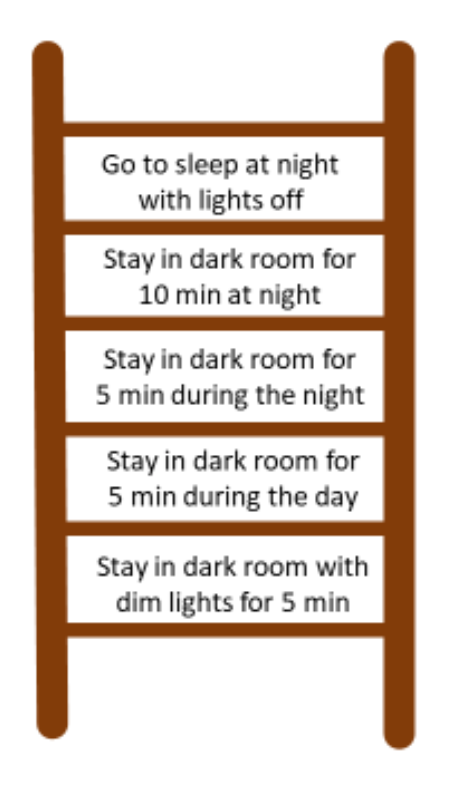
In my clinical experience, exposures work best when they are implemented gradually. I wouldn’t have the child sit in a pitch-black room by himself for 20 minutes at the second or third treatment session. This is called “flooding” and may have detrimental effects. Instead, I might start with having the child sit in a room with dim lighting for 30 seconds, and then gradually move up in time and darkness level week-by-week until the child reaches his treatment goal (which in this case, might be to fall asleep alone at night with the lights off).

Exposures should also be planned in advance and agreed upon by all parties. The child (and parent) should know what’s coming and should play a collaborative role in planning the exposures. This is often done by creating a “fear ladder” wherein the child, parent, and clinician determine a treatment goal (e.g., to be able to fall asleep alone with the lights off) which is at the top of the ladder, and then plan “steps” to reach that goal (in the form of gradual exposures).

Example fear ladder that I created:
In addition to being gradual and planned, exposures should be frequently practiced. The more practice the child has with exposures, the easier (i.e., less scary) the exposures will get. More practice with the exposures allows for more opportunities to realize that the feared situation is not truly dangerous. Therefore, exposures should ideally be conducted both in-session and at-home as “therapy homework.”

Furthermore, given that one of the main purposes of anxiety treatment is to improve the child’s use of coping skills when facing feared events, exposures should be taught and delivered alongside active coping skills. Other coping skills include relaxation strategies (e.g., slow, controlled breathing; progressive muscle relaxation) and thought switching (i.e., identifying negative, anxious thoughts and switching them to neutral or positive thoughts). These skills should be practiced before and during the exposures, and are meant to facilitate the regulation of the child’s fears as s/he sits through the exposure. Coping skills teach the child that “I have some control of my scary feelings” and exposures teach the child that “Nothing bad happened, even though I thought it would.” Together, these practices work to reduce anxiety in children.

Common (and Reasonable) Myths

The prospect of conducting exposures in treatment sessions can be daunting for therapists, particularly beginning clinicians. At first, I, too, had reservations. What if these exposures make my patients’ anxiety worse? What if my patients despise me for putting them through distress and they never return again? How am I supposed to convince children that confronting the things they’re extremely afraid of will actually help them?

To my relief, I am not alone in having experienced these concerns, as other therapists, according to Stephen Whiteside and his colleagues², have reported feeling reluctant about exposures for similar reasons. Over time, however, I have come to learn that although these concerns are shared and understandable, they are actually myths, or perhaps in the lingo of practice, irrational thoughts.

Myth #1: Exposures Make Anxiety Worse

The proper delivery of exposures involves the following three steps:

  1. The child confronts a feared situation (increase in anxiety)
  2. Nothing “bad” or “dangerous” happens (decrease in anxiety)
  3. The child realizes that what s/he was afraid was going to happen did not end up happening (return to zero anxiety)

Given that proper exposure delivery involves steps 2 and 3, exposures do not make anxiety worse. Rather, exposures help children learn that the feared situation is not associated with real danger, which leads to reductions in anxiety, and often a sense of pride and accomplishment for successfully facing their fears. A potential concern might then be, “Well, what if something bad does happen during the exposure?” This is an understandable concern (one I admittedly had), but perhaps not a reasonable one. For example, let’s say the child with the dark phobia hears a noise while he is in the dark room. At first, he may interpret this as something “scary” happening, which one might reason would lead to an increase in anxiety during the exposure and subsequent maintenance of the dark phobia. However, upon examining the situation more closely, the therapist can guide the child into realizing that even though the child perceived the noise as something “scary” or “bad” happening, nothing bad actually happened. Did the noise itself cause the child any danger? What other (non-scary) thing could the noise have been?

Another important lesson here is that even though something dangerous happening during an exposure is possible, that does not mean that it is probable (this is also a lesson that we teach our patients!). Just like it is possible for us to get into a car accident any time we get into a car, it is not highly probable; therefore, we should not let the possibility of a car accident prevent us from ever getting into a car. This is because the benefits of car transportation (i.e., the ability to get around to wherever we want, whenever we want) outweigh the slight risk involved. Similarly, we should not let the possibility of something bad happening during an exposure prevent us from delivering exposures to our patients. There is a much stronger likelihood that the exposure will be successful, which will lead to major anxiety reductions in our patients. The benefits here outweigh the risk.

Another potential counterargument may then be, “Well, why can’t I just continue to do what I do (e.g., teach relaxation skills and/or teach children to focus on “positive” thoughts), given that these strategies are less risky and are also beneficial to my patients?” This is a great point. Relaxation and other strategies (e.g., changing anxious thoughts to positive thoughts) are important coping tools for anxious children. However, to maximize the effectiveness of our therapeutic work, these strategies should be taught alongside exposures. This allows children to practice such coping tools in real-time while they are doing an exposure during the treatment session. Therefore, instead of telling our patient to “practice slow breathing the next time you are anxious,” we get to witness the patient practicing slow breathing in real time while s/he is anxious. This allows us to provide live feedback on the child’s use of the skills (e.g., “try breathing even slower”) while they are in an anxiety-provoking situation. By receiving such feedback while they are in an anxiety-provoking situation, the skill is more likely to generalize to when they confront anxiety-provoking situations outside of the session (compared to practicing the skills in-session while they are calm/not anxious).

Myth #2: Exposures Damage the Therapeutic Relationship

This one was a big concern for me. I feared that if I pushed children into confronting distressing situations, they would resent me, hate coming to therapy sessions, and then convince their parents to take them out of therapy. However, after conducting hundreds of exposures with my patients, this has never happened. Not even once. In fact, by the end of treatment, many of my patients have reported that they are happy that they completed exposures as part of treatment. They say that they are proud of themselves for completing the exposures, and have reported “feeling brave” after the sessions. I’ve even heard patients say, “I didn’t think I could do it, but I did, and it wasn’t so bad!”

This is not to say that I have never been met with resistance when planning or bringing up the idea of exposures. Usually that is addressed by patiently re-explaining the purpose of why we’re doing the exposures, in a way the child understands. But overall, based on my experience, I believe that as long as the therapist conveys empathy/understanding towards the patient’s fears (e.g., “I understand how scary this might feel for you”), remains consistent in encouraging the patient to face his/her fears (e.g., “It’s okay if that was too hard this time, let’s talk about it and then see if we can try again”) and demonstrates a sense of pride when the patient attempts or successfully completes an exposure (e.g., “Nice job facing your fear! That was so brave!”), the therapeutic relationship tends to stay intact.

But don’t just take my word for it. Research also shows that “introducing exposures into treatment does not damage the therapeutic relationship”³.

Myth #3: Children Are Unable to Foresee the Benefits of Exposures

A third major concern that I had was whether younger children (i.e., as young as 6 or 7 years old) would be able to understand the purpose and rationale for doing exposures. I worried that children would consider therapy a “scary” place and wouldn’t understand why I was asking them to confront their fears.

Contrary to my initial belief, most children can grasp the concept if explained in a developmentally appropriate manner. For example, for younger children, I give an example of a girl named Andrea who is very scared of puppies (first I make sure the child is not scared of dogs or puppies). I ask the kids,
“If Andrea is really, really scared of puppies, will she want to play with puppies, or stay away from them?”

Most will say “Stay away from them.”

“But are puppies actually scary?”

“No!”

“What will probably happen if Andrea goes up to a puppy?”

“I don’t know, maybe it will lick her and want to play.”

“Yes, that’s right, the puppy probably just wants to play. But if Andrea is scared of puppies, what does Andrea think will happen if she goes up to one?”

“She probably thinks it will bark at her or bite her, maybe.”

“Yes that’s probably exactly what she’s thinking! But will it?”

“Probably not.”

“Okay, so let’s say Andrea practices being brave one day, and goes up to a puppy. Like we just talked about, the puppy just licks her on the hand a couple times and maybe brings her a toy. Makes sense, right?”

“Right.”

“So, once Andrea realizes that the puppy didn’t bite her or bark at her, will this make her feel more scared of puppies next time or less scared?”

“Less scared.”

“Yes, less scared! Now Andrea is less scared of puppies. So, the way Andrea became less scared of puppies was by facing her fears, going up to the puppy, and seeing that nothing bad happened (even though she thought the puppy would bark or bite). Does that make sense?”

“Yeah.”

“So in the same way, the work we will be doing together will involve being brave, facing our fears, and learning (like Andrea did) that even though we think something bad will happen, it actually won’t. But we’re going to do this in a slow, step-by-step way to make sure it’s not too scary.”

After this, I present a rationale for why we do it step-by-step, and let the child know that s/he plays a role in deciding which exposures to do. Most of the time, this rationale and an explanation of the up-and-down nature of fearful feelings are enough to help children understand the purpose of exposures.

Tips on Delivering Exposures

There is a right and wrong way to deliver exposures, so here are some (research-supported) techniques on how to reduce the chances of exposures going wrong:

Prior to beginning exposures:

  • Ensure that the child and parent understand the rationale behind exposures

Just like therapists need to know how and why exposures work in order to feel comfortable delivering them, children need to know how and why exposures work so they can feel more comfortable practicing them. See the example above on how to explain the rationale for exposures. Keep in mind that the type of explanation should match the child’s developmental level.

  • Seek child and/or parent input during the construction of the fear ladder

The child and parent should be a part of the treatment planning process. Allowing child and parent input can make exposures seem less intimidating, and allow children a sense of control over their treatment. Work together to determine a treatment goal and ensure that the exposures gradually move toward and reach that goal. “Remind children and parents that the exposures should ideally elicit a moderate amount of fear” (not too little, and not too much).

During exposures:

  •  Track the child’s fear ratings immediately before, during, and immediately after the exposures

Tracking the child’s fears can be done by obtaining a number from a scale of 0-10 of how scared the child is feeling. There are multiple benefits to tracking the child’s fear ratings throughout the exposures. From the therapist’s perspective, tracking the child’s fear ratings can provide helpful insight into whether the exposures are “too easy” or “too difficult.” Fear monitoring can also provide insight into whether the fear is moving in the anticipated direction (with fear ratings highest before the exposure and lowest after the exposure). From the child’s perspective, fear monitoring can provide “evidence” that the anticipation of the exposure tends to make him/her feel more scared than the exposure itself.

  • Try to minimize distractions

In order to maximize the effectiveness of exposures, the child should enter the exposure with some level of fear and anticipation that something negative/dangerous will happen. While in the exposure, the child should still experience some fear and think about what it is s/he is afraid will happen. After the exposure, the child should realize that the feared outcome did not happen.

If the child is distracted during the exposure (i.e., doing anything that would prevent him/her from realizing and s/he is scared and fearful of some outcome), then the effectiveness of the exposure goes down. It is better for the child to confront the anxious feelings and realize that “I was scared and thought something bad would happen, but everything still turned out okay” versus “I wasn’t scared because I was distracted, but yes, nothing bad happened”.

After exposures:

  • Praise the child’s efforts

Given that exposures can be temporarily distressing to children, it is important to “acknowledge the child’s bravery for attempting to face his/her fears”. Praise should be given when the child successfully completes an assigned exposure, or when the child makes any effort to complete the exposure (even if completion of the exposure is unsuccessful). Praising the child allows the child to feel a sense of accomplishment, reinforces continued practice of exposures, and can also aid in maintaining the therapeutic relationship.

  •  Help the child articulate what s/he learned from doing the exposure (i.e., that what s/he feared was going to happen, did not happen)

For exposures to be successful, the child should be able to articulate that the feared outcome did not occur. Therapists can facilitate this conclusion by explicitly asking, “What did you learn from this practice?” For younger children, the question can be framed as, “What did you think was going to happen before you went into the dark room?” “Did that end up happening?” “What actually happened?”

Stephanie’s Messy Hair

Stephanie (name and identifying details changed) was a 10-year old girl who had previously been diagnosed with social anxiety disorder. At the start of treatment, Stephanie and her mother reported that Stephanie avoided asking or answering questions in class, initiating or joining in peer conversations, and speaking to adults (e.g., waiters) because of excessive fear of appearing “stupid” or “weird”. Stephanie’s mother also reported that she took 30 minutes to fix her hair in the morning, which often resulted in arriving late to school and her mother arriving late to work. Stephanie reported that the reason she spent 30 minutes on her hair was because she was afraid other people would make fun of her if her hair was messy.

Stephanie’s main treatment goal was to be able to initiate and join conversations with other kids in school and extracurricular activities. Stephanie and her mother reported that a secondary treatment goal was to decrease the amount of time it took Stephanie to get ready in the morning, so that she and her mother were no longer late to school and work. Stephanie was on board with doing exposures to achieve her treatment goals (although she would initially try to avoid doing them), and demonstrated a good understanding of why we were doing exposures. I devised a “fear ladder” jointly with Stephanie and her mother. The first few weeks of exposure practice involved situations such as Stephanie saying “hello” and introducing herself to another adult and child in the clinic, asking questions to the front desk staff (e.g., “Can I borrow a pen?” and “What time is it?”), ordering for herself at restaurants, and saying “hi” to peers at school. Stephanie also practiced doing presentations in front of an audience of 3-4 people and engaging in back-and-forth conversations with other people for at least 5 minutes. By the ninth session, after completing several steps on the ladder, it was time for her to practice going out in public with messy hair. Here’s how the exposure went:

Therapist (Me): “Alright Stephanie, do you remember what was next up on the ladder for this week?”

Stephanie: “Yes, going outside with messy hair”.

Therapist: “That’s right. And how are you feeling about practicing that today?”

Stephanie: “Do we have to?”

Therapist: Smiles. “What do you think?”

Stephanie: Smiles and looks down. “Ok, I’ll try…”

Therapist: “Ok, wonderful! That’s all I care about, remember? That you try. So, going outside with your hair kind of messy: what makes that scary for you? What do you think will happen?”

Stephanie: “Wait. How messy is my hair going to be?”

Therapist: “We can decide that together. I was thinking of putting your hair in braids and having some hair falling out and sticking out in different places, because your mom told me about how you don’t like that. What do you think?”

Stephanie takes a deep breath and I notice her start to blush.

Stephanie: “Okay…”

Therapist: “I like how you just took a deep breath when you started to notice your fear go up. So now, back to my previous question: what makes this scary for you? What do you think will happen when we go outside?”

Stephanie: “Everyone will stare at me and come up to me and say, ‘Why is your hair so messed up?’”

Therapist: “Has that ever happened before, when your hair has been messed up?”

Stephanie: “No.”

Therapist: “Okay, so what do you think the chances are of that happening today?”

Stephanie: “I don’t know. I’m still scared it will happen.”

Therapist: “Okay, so as always, this will be our experiment. It’s never happened before, but let’s see if it happens this time.”

Stephanie nods.

Therapist: “So what’s your fear rating right now?”

Stephanie: “Seven.”

Therapist: “Ok, and what are some coping skills we can do to prepare us for this practice?”

Stephanie: “Deep breaths and positive thoughts.”

Therapist: “Exactly. What’s a positive thought you can tell yourself to feel more brave?”

Stephanie: “I’ve done this before and nothing’s happened.”

Therapist: “Great! And what if someone does stare at you? What did we talk about last time that you can tell yourself?”

Stephanie: “That I should say to myself, ‘So what?’”

Therapist: “Yes! You can ask yourself, ‘So what if they stare? Will it matter tomorrow that a random person stared?’ And will it?”

Stephanie: “No.”

Therapist: “Alright, let’s go.”

While we walked outside, Stephanie initially walked close behind me, hiding her face. After the first person walked by, I asked Stephanie, “Did that person stare at you?”

Stephanie: “No.”

Therapist: “Okay. Let’s keep experimenting and see what happens.”

As we walked around outside the therapy building, I asked a couple more times if she caught anyone staring. Stephanie reported that her fear rating decreased to a 4 in about 45 seconds. After another minute passed by, Stephanie reported that her fear rating was 2. Once we returned to the therapy room:

Therapist: “You did it! You walked around for 5 whole minutes with your hair messy, even though there were other people around. You stayed in the situation the whole time (even though you didn’t want to do it at first), and I even noticed that you moved from behind me to next to me! How did that feel for you?”

Stephanie: “Good. I was scared at first, but that wasn’t as bad as I thought it’d be.”

Therapist: “Great. So, what are the results from our experiment? Did anyone stare at you or ask you why your hair looked like that?”

Stephanie: “No, nothing bad happened.”

Therapist: “Yes, nothing bad happened. And what did you learn from today’s practice?”

Stephanie: “If I go outside with messy hair, people might not stare at me or come up to me.”

Therapist: “Great. And how do you feel knowing that you just faced your fear on something that was really scary, and stayed with it the whole time? You were at a 7!”

Stephanie: “I feel good, proud.”

Therapist: “Glad to hear it. I feel good and proud, too.”

Closing Comment

At first, I was intimidated by conducting exposures. I worried that exposures might make my patients’ anxiety worse, rupture the therapeutic relationship, and that I would not be able to effectively explain the purpose of exposures to children. Despite these fears, my training experiences have led me to become a strong believer in their effectiveness in treating child anxiety.

Once I “exposed” myself to the delivery of exposures with children and adolescents, I quickly learned that what I was afraid was going to happen (e.g., their anxiety will get worse, the therapeutic relationship will be damaged) did not actually happen. After continuously conducting exposures in treatment sessions with my patients, I learned that exposures do not tend to have negative or dangerous consequences. (It also helps that decades of strong research evidence show exposures do not have negative consequences). So, for any therapists out there who treat children (or adults) with anxiety disorders, especially those new to the field, I encourage you to confront any fears, myths or preconceptions you might have about exposures (gradually, if you must) and join me in this beneficial and therapeutic practice.

Resources

1. Chorpita, B. F., Daleiden, E. L., Ebesutani, C., Young, J., Becker, K. D., Nakamura, B. J., … & Smith, R. L. (2011). Evidence?based treatments for children and adolescents: An updated review of indicators of efficacy and effectiveness. Clinical Psychology: Science and Practice, 18(2), 154-172.

2. Whiteside, S. P., Deacon, B. J., Benito, K., & Stewart, E. (2016). Factors associated with practitioners’ use of exposure therapy for childhood anxiety disorders. Journal of Anxiety disorders, 40, 29-36. https://www.ncbi.nlm.nih.gov/pmc/articles/PMC4868775/

3. Kendall, P. C., Comer, J. S., Marker, C. D., Creed, T. A., Puliafico, A. C., Hughes, A. A., . . . Hudson, J. (2009). In-session exposure tasks and therapeutic alliance across the treatment of childhood anxiety disorders. Journal of Consulting and Clinical Psychology, 77(3), 517-525. doi:10.1037/a0013686.  

Money Matters in Therapy

Money is often an emotion-laden topic that triggers many associations and meanings for both the therapist and the client. As a therapist starting out in private practice, I had to stumble and fumble my way around decisions regarding setting session fees, enforcing or waiving my cancellation fees and other money matters. I am sharing with you my lessons learned—and what better way to learn than from the mistakes I made.

Mistake #1: Adhering to theory or rules, even when it feels "wrong" (i.e., not aligned with my own personal values).

Something that is ingrained in us as therapists, especially for those of us who are trained psychoanalytically, is to "keep the frame" and "set boundaries." Stating and holding clear boundaries within the therapeutic relationship creates safety for the client. This could be translated rigidly into not negotiating around our fee, or enforcing cancellation policies by the rule. However, depending on the client’s situation and their personal history, this can actually backfire. It can negatively affect the client and the therapeutic relationship, especially if it is experienced by the client as punitive, shaming, unfair/exploitative or controlling. There must be some flexibility in all matters to accommodate therapists’ own values and clients’ needs, which translates into a willingness to reconsider session frequency, waiving cancellation fees, or negotiating around the fee on a case-by-case basis.

Mistake #2: Not examining and having clarity around my own issues with money/fees.

It is important to examine and have clarity on our own internal conflicts and issues around money matters, as well as to know the limits on our flexibility (e.g., what is the lowest fee that we will be comfortable with for a particular client and their situation?), especially when trying to establish boundaries and set a framework with a client.

I had to consider several conflicting needs and values when establishing my regular rate for therapy sessions. I do value my experience, training and what I have to offer as a psychotherapist, and a therapist with a higher fee is often perceived as offering “higher quality” services. At the same time, I think therapy is quite expensive, especially since weekly (or more frequent) sessions are usually recommended. People belonging to lower socio-economic classes face more stressors, therefore making it even more necessary to offer affordable mental health services. Despite my desire to make my services affordable and accessible, I have a strong aversion to being paneled with insurance companies. With so many competing values, initially I was often riddled with guilt, resentment or doubt as I tried to establish a fee that was “just right.” I have finally found a formula (using a combination of a regular rate, sliding scale fees and offering low fee and pro-bono slots via openpathcollective.org that works well for me, embodying the maxim “No size fits all.”

Scenario

What follows is a description of a scenario from when I was just starting out in private practice that highlights both Mistake #1 and Mistake #2 mentioned above:

The client and I agreed on a fee of $120 during the initial free consultation. At the end of the next session, the client told me she’d just found out that her insurance did not cover her sessions (she had a very high deductible) and asked for a reduced fee. Since we were already at the end of session (and keeping in mind that I had already provided her with a free initial consultation), I said that she had to pay $120 for this session, and that we could work out a lower fee moving forward. She asked for a fee of $80, and I said, “That is too low.” (yes, I have to admit that I actually said that). The client wrote a check for $120 for the first session and perhaps not unsurprisingly, did not return to therapy.

What played out in the above scenario were my own unresolved issues around money, and unfortunately these negatively impacted the client.

  • I was not completely okay with having provided her with an initial free consultation—I was holding some resentment, and thinking that the client now owed me or should feel obliged to me.
  • I was unsure about how low I could or should slide my fees. I was conflicted between what I had learned about enforcing boundaries, and my own instinct to be flexible in accepting lower fees. This resulted in me responding “That is too low” to the fee suggested by the client. This was shaming to my client, especially given her history of having grown up very poor.

Mistake #3: Not taking into account a client’s culture, history/background and relationship with money.

What I have seen replayed again and again, is that a client's relationship with money and how they approach the issue of the fee is often an extension of their psychology, and therefore, a clinical issue to be examined in therapy in order to help the client navigate more skillfully around such matters. Sometimes their relationship with money is shaped by culture—I have some clients who are bent on trying to negotiate a lower fee, although they have very high incomes—they cannot imagine paying so much “just” for therapy. Sometimes it is shaped by their personal history. I had another client who requested a lower fee due to her many medical expenses and I agreed, only to learn through the course of therapy that this client is a multimillionaire with an inherited fortune. Having grown up with financial scarcity and hardship, the client found it hard to spend or truly enjoy her newfound financial abundance, and she was always looking for a “good deal” or discount. If I, as the therapist, merely see such clients as “manipulative” or if I am offended by their requests and fail to consider the client's context and subjective experience, it is a signal for me to look into what is being triggered for me. I have learned that I must be mindful and navigate such issues around money with skill and sensitivity to the client's experience. In other words, letting the client know that I am open to discussing or negotiating the fee, but that it is important for me to first understand more of their history and their subjective experiences and relationship regarding having or not having things.

Guidelines

Below are my own personal guidelines around money matters in therapy:

  • Rules (such as charging for missed sessions) are set and enforced based on clinical implications and the client's best interest, and not merely based on business considerations.
  • Own my own issues (including privilege or scarcity) around money, examine my own relationship and views around money, and gain clarity on my limits in flexibility regarding session fees, cancellation policies and other money-related issues.
  • A client’s relationship with money (their meanings and associations around money, rather than simply their income or wealth) is an important factor to take into consideration when discussing and setting fees.
  • What works well for one therapist may not work for another. Differences may be due to business goals, theoretical orientation, populations served, and personal style/values.
  • Above all, be authentic.

I would like to end this article with a scenario that was posted on an online group for therapists that I participate in, that started me thinking more on this topic and prompted me to write this article. The scenario went as follows: If a person you were working with needed time off from therapy for a couple of months due to a short-term schedule conflict, but didn't want to lose their appointment space, and they offer to pay for that space until they were able to return (you have no other available appointments), is it ethical to accept that offer? The question elicited some emotionally charged but widely differing responses from the therapist group members. How would you handle this situation?

We’d love to hear your responses. Feel free to post to our facebook page here.  

When the Clinician Becomes a Client

After my husband and I moved to our new home state, I found myself coping poorly, to put it mildly. Hundreds of miles from our friends and family, unable to find work and struggling to start a family, I found myself spending entire afternoons lying on the floor of our would-be nursery. I had no appetite, snapped at my husband over every minor annoyance, and was consumed by utter hopelessness.

Like what you are reading? For more stimulating stories, thought-provoking articles and new video announcements, sign up for our monthly newsletter.

But when my husband gently suggested that I seek professional help, my defensive glare could have sliced him in half. Me go to counseling? Had he forgotten that I was the therapist here? I knew what to do; I didn’t need anyone’s help.

But after another month of being impossible to live with, I conceded. I found a clinician who shared my therapeutic approach, swallowed my pride, and stepped into her office feeling completely powerless.

I quickly discovered that my therapist had no idea what to do with me. She also believed that I already knew everything I needed to know to cure my own symptoms, and spent most sessions starting psychoeducational sentences, then cutting herself off.

“Here is a sheet with some common types of cognitive distortions—although I’m sure you already know them…Let’s try keeping a thought record. In the first column—well, you don’t need me to explain that.”

To make matters worse, I was a horrible client. I had intentionally chosen a clinician with more education and experience than me, but the result was that every session felt like supervision with one of my old bosses. I felt the need to impress her, and struggled to discuss my symptoms honestly. When I didn’t offer her anything to work with, my therapist ended up talking shop with me, making me feel more than ever that I was in a work setting where my symptoms would be unacceptable signs of weakness.

After a few months, I stopped booking appointments. The feeling of discomfort must have been mutual, because my therapist never reached out to ask why I had stopped coming. I wondered to myself if this was a common experience, if those of us who are the most steadfast proponents of therapy and bear the emotional burdens of 20 to 30 people at a time, end up having the most difficulty accessing (or contributing to) quality treatment.

A Washington, D.C. area clinician I asked about this noted that she had long avoided counseling for the same reasons I had. “I am certain that working in this field has prevented me from seeking out treatment in times where I could have greatly used it,” she said. “I believe I didn’t seek treatment because of my own belief that I could ‘treat’ myself because ‘I know what I should do and not do.’” Another clinician, based in Massachusetts, confided that when she did seek out mental health treatment, differences in therapeutic approach between her and her therapist made her experience unsatisfying.

“[My therapist] was very approachable, patient and validating,” she recalled. “[But] what I found disappointing was that, in my work with my clients, I generally had items prepared as tools we could use to address challenges or present new perspectives and techniques, and that was not my experience in my own sessions. It had more of your stereotypical air about it where you sit on a couch and talk about your feelings, no preparation, just whatever the client brings. And my work being different, I had a harder time appreciating that and eventually discontinued my work with her.”

I only found one person who felt that being a clinician had improved her experience as a client. Mia DeCristofaro, a Florida-based LMHC, recalled seeking counseling early in her career, when concern for her clients escalated into unmanageable anxiety. “My fear of not doing a good enough job or someone getting hurt on my watch was really hard for me to manage at first,” she recounted. “But being in the field also made it easier to be a client, I think, because I knew what I expected for my own treatment, what I believed about treatment, and I knew how motivated I had to be for it to be effective.”

Perhaps if more therapists who have received mental health treatment were open about their experiences, other clinicians would not feel like professional failures for seeking counseling. Although it may be awkward to discuss, who knows how many clinicians—and their clients—could benefit from this transparency. “We take on a lot of pain in this field and, diagnosable or not, I think we need somewhere to safely manage our own feelings,” DeCristofaro said. “Even if a problem we’re going through isn’t related to our work, we should manage it so that it doesn’t impact our work.”

Maybe this shift in focus from reducing our own symptoms to better serving our clients is the cognitive key to getting more mental health professionals through a therapist’s door. But whatever your reason for going, be the brave one at work and start the conversation about your experiences; you may be surprised to find you’re in good company.

Why I Hate Alzheimer’s

Alzheimer’s is a Thief

As a therapist, to say I hate a disorder is a big deal for me. I specialize in personality disorders—narcissism, borderline, and anti-social—and have found beauty and giftedness where most see dysfunction. I don’t hate any of these disorders, even the ones that tend to be destructive for the client and their family, and exceedingly challenging to work with clinically.

But Alzheimer's is different. A personality disorder can be understood and even managed. Someone with a personality disorder can grow in their perception of how the disorder changes their perception of reality. They can learn new ways of coping and relating. But such is not the case when working with clients who struggle with Alzheimer's. Because people with a personality disorder tend to be long-term clients, I have the unique opportunity to see these clients, as opposed to Alzheimer’s patients, though many life stages, including the aging process.

“Alzheimer’s comes like a thief in the night”; except it keeps returning at random times during the same night and on nights thereafter for years at a time. Like a thief, it steals one item at a time—a memory, a possession, a skill—and moves around others, so they appear to be lost but are not. Sometimes it breaks things and leaves the pieces behind in unrecognizable forms. For the most part, it is sneaky, always moving and changing what is least expected. But in the end, it steals the whole house or the whole person leaving no remnant behind.

The worst part is not what it does to the person but what it does to the family and friends. The family remembers what was in the house and cannot forget what was lost or moved. With each visit from the thief, the family is traumatized by the stolen items or damaged goods. Bit by bit, the family suffers a new loss each time the thief comes. They cannot forget what is missing. They want to forget but are unable.
This is why I hate Alzheimer’s.

My Father’s Struggle

My dad had Alzheimer’s. Watching him fade away was one of the most difficult experiences of my life, both personally and professionally. It challenged my ideals, tested my patience, expanded my knowledge, and wore me out.

My dad was an exceptional person. He is credited as one of the pioneers of the computer age. He took the early building-size, main-frame computers and found practical applications for business such as the airline reservation system and the storage of security documents for the government.

His genius IQ, matched with a reserved but intense narcissism, made him a force to be reckoned with. In his personal life, he turned a paralyzing airplane accident into a triumph of brain over body. At 22 years old, he was told he would never walk again, but his determination, willpower and never-give-up attitude allowed him to walk until Alzheimer’s stole that ability away.

“No amount of brainpower, willpower, determination, or perseverance could stop the negative progression of Alzheimer’s”. As a therapist, I am trained to spot changes in a person’s behavior. But seeing them firsthand was difficult, and even more difficult was placing my father in a brain clinic to see how far his dementia had progressed. It was what I feared, and even worse was the realization that he was rapidly headed towards Alzheimer’s.

To test the regression, I asked my dad for a ride to a local grocery store that he had been going to weekly for over 20 years. He could not find it, he could not stay within the lanes of the road, he was driving extremely slowly, and he was yelling at the other drivers as if they were in the wrong. That was when I made the decision to take his driver’s license away. He yelled. He screamed. He threw a giant temper tantrum accusing me of trying to keep him hostage and imprisoned. I was just trying to keep him and everyone else on the road safe. But he saw it as an attack on his freedom and came after me for it.

Nearly every time I visited him, some other decision like this had to be made. He sent a $3,000 check to pay a $300 electric bill, so the bills had to be taken from him. He called old business partners and started telling them about a “new project” that occurred over 30 years ago. His phone access was then limited. He left the house in his PJ’s and we would find him wandering the neighborhood lost. An alarm was always set on the house signaling an open door. He lit a candle and nearly burned down the whole house. With each restriction came more attacks.

This was not my dad. Bit by bit, the independent, self-assured, if somewhat narcissistic, man I knew was transforming into a dependent, emotional shell of a human. Nearly every aspect of his personality was erased. I dreaded my visits to him and the realization that some new restriction would need to be placed for his safety and my mother’s. I hated what was happening to him. I hated how my mother aged 15 years in the span of three. And I hated having to make the hard decisions. I fell deeply in hate with Alzheimer’s.

The Thief Unmasked

Confusion. One of the early signs of Alzheimer's is confusion about family members, favorite locations or regular activities. In the beginning, it seems as if the patient is playing a joke about what they can and cannot remember. At first, the patient goes along with the laugh but later it turns to frustration and then anger or worse, rage. The hard part is that the confusion is different nearly every time. One day a family member is recognized and the next they are a stranger. It is terrifying for the patient to be told they should remember something that they cannot. Think of it as a wave crashing onto the shore, this wave of confusion will pass but another will be right behind it.

Anger. Also known as Sundowner’s Syndrome, the Alzheimer's patient becomes enraged late in the day resulting in temper tantrums that rival those of a two-year-old. It is as if the confusion of the day builds to a crescendo which is then released in outbursts that are uncharacteristic, intense and extremely hurtful to those around. Foul language, throwing things, abusive speech and physical aggression are common. It is often impossible for the caretaker, especially if this is a spouse or child, not to take these words personally. But that is precisely what needs to happen. It helps to disassociate by seeing the outbursts like an acting performance instead of words from a person they love. The words spoken are not reality-based, but rather exaggerations and extremes of delusional thoughts.

Disintegration. The negative progression of the disease means that one day the patient can push a button and the next, completely forgets how to do so. One day, the patient remembers to eat and the next, they do not. Simple, everyday tasks become impossible feats where everything takes much longer to complete than ever before. Like pieces falling away from a formed puzzle one at a time, such is the disintegration of the patient’s mind. This is difficult for the caretaker to absorb because the pattern of deterioration is unique to each patient. Sometimes it helps to see this process as a reverse of childhood progressions and accomplishments. As the disease progresses, the patient becomes more infantile in every way.

Delusions. One of the scariest parts of watching the progression of Alzheimer's is witnessing the impact of the patient’s delusions—on them and those around them. A patient can watch something on TV and be transported into that reality as if they were the ones experiencing the program. Or they might call a hospital a prison, identify a friend as an enemy, or walk out of the house unaware of their nakedness. The temptation for the caretaker is to point out the delusional thinking as a way of comforting the patient. But this can and often does backfire into an angry rage where the patient can become paranoid and believe that everyone is against them. As painful as it is to watch, it is far better to accept the delusion and play along until the patient is in a safe location or has settled down.

Fluidity. Occasionally, the Alzheimer's patient becomes lucid and fully aware of their circumstances to the point that they seem normal again, if only briefly. The fog from their confusion lifts, their natural mood returns, and they are thinking clearly and logically. When this happens, the caretaker gets excited, relieved, and begins to wonder if they were imagining the whole nightmare of deterioration. The caretaker questions their reactions and judgment, putting aside the negative experiences. This is where things can become traumatic for the caretaker. They can begin to believe that it is all over when suddenly out of the blue, the patient snaps. The unsuspecting caretaker is caught off guard as the Alzheimer's patient sinks to a new progressive low point. The discouragement and depression that transpires with each event take a huge emotional toll on the caretaker.

What I didn’t know then but realize now is just how those years traumatized me. It is a form of C-PTSD (Complex- PTSD) to have a parent who was never abusive act in a manner so inconsistent with their personality. It shakes the foundation of their house and yet they are not to blame. Alzheimer's is.

It wasn’t until a client had a dementia-induced manic episode that I realized the level of trauma I had experienced with my father. Listening to the client’s illogical rants followed by emotional outbursts inconsistent with the topic brought back my dad’s behavior. At least with a client, there is the ability to emotionally detach and disconnect in a way that preserves perspective and clarity of thought. But with a parent, it is different.

My dad said things that he would never say. I was adopted by him at the age of 12 and he always treated me like I was his blood child. But, in the last years of his life, he told me he didn’t want me and that I was a terrible daughter. Logically, I knew he didn’t mean it. Emotionally, I detached because there were so many decisions to make. And now, looking back, I see the traumatic impact. This was not my dad. This was Alzheimer’s and I hate what it did to him, to us, to our family.

Looking back, there were a few things I learned along the way that helped me to keep my perspective and not completely lose it during the crisis. I’m a firm believer in losing it after the crisis is over.

Important Lessons Learned

They are not lazy. Alzheimer’s patients are struggling to do even the most automatic routine. As Alzheimer’s progresses, the brain loses its ability to process, recall, reason, and function. What took seconds to register in the past, can now take minutes and even hours depending on the subject, time of day, emotional awareness, and significance. It is not laziness to struggle with matters such as buttoning a shirt, reading a clock, or remembering how to use the microwave. It is a result of the disorder.

There is no significance in what they do and don’t remember. Looking at an old photo album, my dad was unable to identify family members, but he could identify people he worked with. The brain organizes information in a variety of ways, almost unique to everyone. “Alzheimer’s attacks the brain in random ways with some areas of the brain deteriorating more quickly than others”. This makes the progression distinct for each patient, and the patient is not responsible for how any of these parts operate or worsen.

Their comments should not be taken personally. This is particularly difficult especially when the comments are hurtful and said in anger. Anger is a base emotion and is the easiest to express. My dad took his anger out on me. I preferred that over him taking it out on my mother, his caretaker. Alzheimer’s steals the house in pieces, changes the personality, and leaves mere shadows. When the patient speaks, they are rarely their true self. It is useful during these times to hold onto the comments that were consistent with past behavior and leave the other comments at the door.

They can perform when needed. Some Alzheimer’s patients can pull it together for a short period of time during certain special events, almost as if there is nothing wrong. This may cause family and friends to say the reports of the condition are exaggerated. They are not. Usually, after the event, the patient will become even more detached from reality and might even suffer a setback. The “show” is their survival instincts kicking in which can only be sustained for limited periods of time. Once their energy is depleted, they tend to retreat and shut down for a period of time.

They have delusions. As the disorder progresses, it is not unusual for an Alzheimer’s patient to watch something on television and believe it happened to them. These delusions are usually harmless unless they begin acting out paranoid thoughts. Think of the visions as part of an overactive imagination with no filter for what is real and what is fictional. If the fantasies are challenged, however, the patient can become unnecessarily confused, frustrated, agitated, and even violent. It is very important to remember not to challenge the delusions. Just go with them even though it might be painful to watch or hear.

They remember random events. Even the most significant days such as a wedding or birth can be impossible for an Alzheimer’s patient to remember. Showing pictures with names and dates can be useful with the expectation that it won’t work every time. The nature of the disorder causes memories to be recalled one day and lost the next, only to be recalled and forgotten again. Alzheimer’s patients are not in control of what is remembered when it is recalled, and what is not. Sometimes they assign great significance to minute moments and no value to major ones.

They still need visitors. It is easy to justify not seeing Alzheimer’s patients because they don’t remember, so there may seem to be no point in visiting. Stopping by to receive recognition, approval, or attention will not be rewarded with an Alzheimer’s patient. Often, the visits are very difficult and painful. However, it is precisely during these times that the character of a person is revealed. Spending time with them can be thankless but the internal rewards of determination, patience, and perseverance are worth the effort.

Their angry responses should be released. It is not uncommon for Alzheimer’s patients to become confused as the sun goes down, the aforementioned Sundowner’s Syndrome. As the disorder progresses, any change, including increased darkness, can be a source of uncertainty and fear. Anger is a base emotion and frequently is a go-to for anxiety, depression, loneliness, distress, and even terror. As the sun sets, the patient becomes fearful and reacts in anger usually forgetting the occurrence the next day. Holding onto the comments made in anger hurts the caregiver, not the patient.

They will not improve. This is a degenerative disorder for which there is yet no cure. Perhaps one-day things will be different as more research is conducted. The good news is that there is medication available to those who qualify to slow the progression. But there is nothing available to undo the deterioration of the brain. Hoping they will improve adds to the frustration for everyone, setting the stage for large amounts of disappointment.

They shouldn’t be compared. Each person is unique in personality, the associations they attach to an event, what they assign as significant and how they utilize information. In addition, Alzheimer’s impacts the brain in different locations at a variety of progression rates. This creates a distinctive experience for an individual. While it is helpful to be involved in a support group with others who struggle as caregivers of Alzheimer’s patients, it is not helpful to assume the journeys will be the same.

What was helpful for my family was a strong support network of empathetic people. My mother and I shared stories with each other and others who were on a similar journey. Today, we can be far more empathetic to others who are walking where we have gone. Seeking out professional assistance during this time to reset expectations, learn about the disorder, and process the difficulties is extremely beneficial.

Epilogue

As for my client with the dementia-induced manic episode, my ability to relate to the family’s experience was greatly improved because of the deep empathy I experienced rooted in the relationship with my dad and his disease. I found that I could better listen to their concerns, fears, and panic moments without judging, dismissing or overreacting. They knew, as I did, that they had shifted to a new normal and with each change, the grieving process evolved and deepened. We could work simultaneously in the present and future on behalf of the client, and of course, them.

My client will not get better. While the mania may pass, the dementia will remain, and her personality will transform into the same shell-like existence of my father’s. The thief has walked straight through the front door of their lives and begun cleaning them out, insidiously and ravenously, until there will be nothing left to devour.

I grieved when my dad was diagnosed, again when the restrictions began, once again when he had to be hospitalized, and finally when he passed. Each phase in the grieving process was familiar because it was the same issue and yet unique circumstances. What I didn’t expect was to continue my own grieving as I watched and witnessed my clients endure the same or similar loss.

But as I grieve, new insights and understandings form. I’m building a new house out of the remnants left behind by the thief. A house that embraces a new normal, gives allowances for grieving, sifts disorganized thoughts, and allows freedom of expression. And so, I am free as well. Free to hate Alzheimer’s.
 

The 7 Ways Psychotherapists Undermine Psychotherapy

We evaluate. That’s what we do. We ask question after question after question, and when we’re not asking questions, we’re noting answers to questions we haven’t asked. We’re so curious, professionally curious. It’s a trained curiosity, and if we’re not careful, a habitual curiosity, a distractive curiosity, a harmful curiosity.

Like what you are reading? For more stimulating stories, thought-provoking articles and new video announcements, sign up for our monthly newsletter.

Psychologist James Hillman (1967) warned: “Curiosity awakens curiosity in the other. He then begins to look at himself as an object, to judge himself good or bad, to find faults and place blame for these faults, to develop more superego and ego at the expense of simple awareness, to see himself as a case with a label from the textbook, to consider himself as a problem rather than to feel himself as a soul.”

There is often a contradiction between my image of a person in therapy through their self-assessment of their issue and my actual experience of the person. There is also a vast gulf between the diagnosable issues as seen through the lens of psychological expertise and the essence, identity, strengths, and hopes of the person before me.

Therefore, I must cultivate space to come to know the whole person. This begs the question of what “knowing the whole person” entails. But let’s be clear: trained curiosity and assessment are not the soul of psychological change. Therapists mean well, but at times we all stray outside of the bounds of helpfulness.

Here are seven ways psychotherapists get in the way of psychotherapy—

Interrogating

When people come into session in the midst of an emotional storm, the last thing they need is to be inundated with endless questions on the basis of an agenda that is likely intended more to fulfill organizational protocols than to promote a foundation of therapeutic empathy and rapport.
Questioning always runs the risk of interrogation. The details learned about people’s lives ever tempt helping professionals toward distraction. There is a distinct difference between a personality and a person, a diagnosis and a destiny. It is our responsibility to stir hope and catalyze strengths rather than to stew history and analyze at length.

Pathologizing

The concept of “mental disorder” is rigid and misleading. In short, diagnosis is description, and by and large, mental health diagnosis provides description of “software” issues rather than “hardware,” so to speak. It’s a language of understanding what type of struggle a person is experiencing. When therapists refer to people by these diagnostic labels, we overgeneralize a person’s experience and distance ourselves from a critical resource: the powerful, complex, and fluid process of therapeutic understanding, the power center of effective therapy.

One of my professors, Bill Collins, taught me “pathology” is a dangerous categorization of a person’s experience. He contrasted “providing treatment to people” with “puzzling through a process with someone.” He told of one friend whose father, growing up, would never let him finish anything without taking over. His friend would, as his father asked, begin to screw in a nail with a screwdriver, and before he could finish, his father would grab it from him and say, “Oh, just give me that.” Those kinds of experiences, he noted, leave long-lasting impressions on a person regarding self-worth and competencies. Bill said we are to “help others to unpack their conclusions about who they are.”

Shaming

We ever risk a false sense of expertise about people’s lives against the backdrop of anxiety about our own. If we’re not careful, we may find ourselves reinforcing the tyranny of the perceived should. Should is shame's accomplice, and therapists must take care not to aid and abet them.

Sympathizing

Researcher Brené Brown (2010) rightfully proclaimed, "Empathy fuels connection, while sympathy drives disconnection.” Saying you understand is unhelpful and probably not true. And let’s be honest—it’s usually a ploy to rush people out of their emotionalism, which sends the message, “I really don’t care enough to walk with you through your suffering.”

Lecturing

Psychologist and psychotherapy researcher Les Greenberg (2002) wrote, “Darwin, on jumping back from the strike of a glassed-in snake, having approached it with determination not to start back, noted that his will and reason were powerless against even the imagination of a danger that he had never even experienced. Reason is seldom sufficient to change automatic emergency-based emotional responses.”

With a surge in cognitive therapies, there has been a surge in their wrongful implementation, with many therapists engaging in power struggles to convince people of faulty beliefs in order for new, more positive truths to simply work some magic ripple effect into their lives.

As an emotion-focused therapist, I have been prone to, for instance, encourage couples to engage in safer, softer, and more emotionally responsive interactions, yet when I have stood on my own soapbox, encouraging them to do so out of pace with their own readiness, I have violated my own guidance. Miller (1986) observed that people will “persist in an action when they perceive that they have personally chosen to do so.”

Babbling

Silence can provoke anxiety, even for therapists, who think they should surely be redirecting, conjecturing, advising. I find myself observing people in therapy watch me watch them watching me watch them. And I have found a power in it. Like a Rorschach ink blot, presence has power in and of itself to nudge a person’s anxiety, so it presents and speaks up for itself.

My former colleague, Blanche Douglas (2015), wrote: “There was a method in Freud's madness when he prescribed the analyst be as undefined as possible, not disclosing details about his life and sitting behind the patient out of sight, saying little. This forced the patient to make meaning out of an ambiguous situation, and the only way he could do this was by recourse to his own experiences.”

Methodologizing

If a psychotherapist is lifeless or their technique too technical, their efforts to help may be worthless. Therapy, in this case, is not a relationship but a poor excuse for scientific experimentation. The mechanisms of some psychotherapies undermine their therapeutic value. When we fixate on therapeutic modality, we run great risk of missing prime opportunities to interject the most valuable therapeutic tool we have to offer—ourselves.

Conclusion

As a new therapist, I remember trying hard to demonstrate my own capacity for psychological insight—even though, I must confess for my wise professors’ sake, I was certainly not trained to be an egotistical show-off. Fortunately, somewhere along the way, I started to better understand and experience the disparity between knowing and being. All these years, I am still learning each day how to lean into the latter. There is something powerful in it, not just in the experience of the therapist but in the experience of the therapy.

The family therapy pioneer Lynn Hoffman, who sadly died in 2017, gave a language of values for sitting with clients—the non-expert position, relational responsibility, generous listening, one perspective is never enough.

If a therapist is not fully present as a warm, accepting, genuine, caring, and appropriately vulnerable person, the power center of therapy remains turned off. Whatever insight may come along the way, meaningful, sustainable change requires transformative experiencing. Analysis without encounter is nihilistic, all the apparatus of thought busily working in a vacuum. Far from data to be interpreted or even a patient to be treated, we are heart and soul, of the same essence, both facing existential predicament.

Only in the context of authentic relationship and therapeutic alliance can I grasp and catalyze the breadth and depth of formidable resources already existing within my clients. 

———
 

References

Brown, B. (Speaker). (2010). Brené Brown: The power of vulnerability [Video file]. Retrieved from https://www.ted.com/talks/brene_brown_on_vulnerability?language=en

Douglas, B.D. (2015). Therapeutic space and the creation of meaning. Context. Warrington, England, United Kingdom: Association for Family Therapy and Systemic Practice. [Edited by Edwards, B.G.]

Greenberg, L.S. (2002). Emotion-focused therapy: Coaching clients to work through their feelings. Washington, DC: American Psychological Association.

Hillman, J. (1967). Insearch: Psychology and religion. New York, NY: Charles Scribner’s Sons.

Miller, W.R. (1986). Increasing motivation for change. In W.R. Miller & N.H. Heather (Eds.), Addictive behaviors: Processes of change. New York, NY: Plenum.

Coping with Infidelity in Professional Couples

Couples seek therapy for many reasons, but among the thorniest issues are those involving infidelity. Of course, circumstances vary widely, so it’s difficult to isolate causes that are equally relevant for all. Given that, I’ll focus on themes that have emerged with some professional couples with whom I have worked that have been married for some time (10+ years), with demanding careers, and for whom these issues arise after having children.

Like what you are reading? For more stimulating stories, thought-provoking articles and new video announcements, sign up for our monthly newsletter.

They may have met in college or graduate school. They became fast friends first, and they never imagined that would change. Both were career-minded and imagined living a life of significance, healthier and happier than that of their parents. They recognized one another as good, bright and hard-working persons. They felt heard, understood, and supported. They shared a vision of life.

Then, as the demands of their careers pulled them into individual tracks of ambition and responsibility, and as they began to have children, their friendship suffered—intimacy too. It wasn’t fully conscious yet, but they had become rutted in role-based “necessities” of duty and obligation. A shift occurred from a vital pursuit of happiness to accountabilities to children, home, and career—life felt burdensome.

The Sources of Disenchantment

The relative ease with which life’s demands were managed in the early, pre-parental years were gone. Back then, there was more time, unpressured and less distracted opportunities to talk. Everything was easier then, even though financial resources were limited. So, what had their success really purchased?

The couple was left feeling that life had somehow gotten away from them. They were overwhelmed and learning that feelings are a complex and nuanced form of meaning, confusing enough to experience let alone to articulate. It was easier when there was more breathing space, when they could get away for a weekend of hiking or big-city stimulation. Sometimes that alone, without talk was enough.

Taking on work-related duties, struggling to realize career aspirations, life became more serious. Then, with kids and parenting added to the mix, along with the financial demands of mortgage, child care, and interruption to a second income; it all added up to a loss of the enchanted vision of life they had in the beginning. Exchanges became strained. Soon they decided it just wasn’t worth the effort to argue.
They began wondering “is this all there is?” Exhausted by work strain, stressed by unrelenting demands, and lacking the friendship they once provided one another, they began to foreclose on the possibility of making things better. But settling is not very satisfying is it? Thus, arises the restless yearning.

Desperate Delusions

For these couples there is seldom a desire to abandon one’s partner. Very few had seriously considered divorce even as they began to look elsewhere for affection. Intact bonds remained that coexisted with urgent needs for emotional intimacy. They could not see a way to reconnect within the marriage. It’s a cognitive, emotional, and moral quandary that they’re unable to resolve, it looks impossible.
That’s where the desperation comes in. It may be equally felt by both members of the couple. But neither is able to frame the issues, broach the conversation, and make them “discussable.” They’ve learned (come to believe) that contentious tones, demanding voices and fault-finding quickly follows. So, they conclude, “I can’t meet my needs here; the situation won’t allow it.”

What they believe they cannot achieve in reality, they seek to address through fantasy and delusion, or perhaps more benignly framed—wishful thinking. Yes, there’s also the sense that they deserve something more and better given how hard they’re working. So, they seek “justice” through a kind of “let’s pretend.” They want to believe that there’ll be no harm as long as no one finds out. Sometimes drinking helps contain the cognitive dissonance. It’s regression in service of play, to invoke Freud, and a symptom of arrested development in the marriage.

The Bubble Bursts, Work Begins

When the truth comes out, a period of crisis ensues. Soon it becomes clear that the act of infidelity only ruptured a relationship that was already suffering from deep, long-standing strains. Upon reflection, both knew things were not going the way they wanted them to. In some cases, partners had even taken separate bedrooms, started vacationing separately, becoming more roommate than spouse.
But the initial disclosure brings jolting pain. Anger, embarrassment, and betrayal are only a few of the emotions that should be expected. It’s not a victimless act. The aggrieved party is deeply hurt. And the unfaithful party frequently suffers a different shame and loss of self-respect that he or she must endure without much sympathy while seeking redemption and forgiveness.

The saving grace for many of these couples is that they usually have reason enough to at least attempt reconciliation and repair. And if they seek help soon enough, before acting out their emotions in ways that make their problem even more difficult to address, their odds improve immensely. Because they are bright and hard-working, they may be able to use that ethic to persevere with the task at hand in some or all of the following ways.

Containment. The couple must have a safe place to process their feelings, and therapy must help them learn how to do even more of this outside the consulting room. Initially, they’ll struggle with managing the intensity of their exchanges outside of therapy.

Learning. The couple must now acquire the interpersonal communications skills to navigate emotionally charged conversations that they had earlier concluded were not possible. They will learn that doing good in their relationship requires knowing how to do good.

Forgiveness. Learning that infidelity is at least partly attributable to arrested development as a couple, a lack of insight, knowledge, skill, and hope concerning what was missing and how to correct it, helps both find a way to forgive.

Forgiveness is something we do for ourselves as much as for our partner. When we lose our capacity for the love, openness, and honesty to discuss the divide that is growing between us, it is not because we willfully intend to do harm to one another. We fail due to our fears and ignorance, our desperation and loss of hope. We lose the ability to focus more on coulds than shoulds.

This is what they learn in therapy.  

Judith Grisel on Addiction, Neuroscience and Choice

The Age of Neurophilia

Lawrence Rubin: Hi Dr. Grisel. I first became aware of you when Terry Gross interviewed you on her NPR show, Fresh Air, about your book, Never Enough. You mentioned that after that interview, they led you through a room where they store the hundreds of books they receive each week for consideration. I’m wondering, why did they pick yours from that pile?
Judith Grisel: Three things I guess. One is that we are really in a time in history where we’re very interested in the brain and in science. So, seventh graders appreciate things about the brain that we didn’t even know 30 years ago, and
I think there’s a neurophilia going on
I think there’s a neurophilia going on. Second, addiction is so widespread, practically everybody is touched by it. And third, I also think on my part, being at a liberal arts university and having to speak to students about complex ideas on a daily basis, I must be able to mine the minutiae of scientific inquiry and translate and explain its general principles in a way that people can understand.
LR: That reminds me of Stephen Hawking’s tiny volume, A Brief History of Time. Bringing it to the people, so to speak. What do you hope your slender volume will do that others haven’t in this conversation around the neuroscience of addiction?
JG: My hope is that the readers who aren’t scientists will learn about and be able to appreciate the core principles of brain adaptation—how it adapts to every single drug-related repeated experience that alters the way we feel. Seatbelts and sunscreen were not considered life-saving before the research taught us differently. Now, we understand the risks of not wearing seatbelts or using sunscreen, and both are seemingly simple, but most definitely life-saving practices. I want people to develop that kind of understanding about the brain’s adaptive capacity and drug use. My secondary hope is that scientists who read it will come closer to appreciating what it’s like to be an addict. My hope is that I was able to explain that in a way that made sense to both audiences.

Our Brain on Drugs

LR: You use this term, “neurophilia.” The folks who are going to read this interview may have some neuroscience interest, background or even training. Some may be neurophobic, but many, I suspect are armchair neuroscientists using trendy brain-based buzzwords, but who don’t know how to integrate the fruits of neuroscience into their psychotherapy. How can your book and your work around the neuroscience of addiction help neurophobic psychotherapists?
JG: Well, the first thing I would say—even though I’m not a therapist (and neuroscientists don’t understand it all that well, themselves) is that
there’s a difference between understanding the implications for people suffering with addictions and simply collecting piles of data
there’s a difference between understanding the implications for people suffering with addictions and simply collecting piles of data. I think that there’s definitely a place for all voices and insights to come together and try to work on this problem. It’s certainly not as if neuroscientists have made any great strides. So, that should alleviate some fear.

I also think that scientists like me who are working at a chemistry bench top or with laboratory mice, are looking at little trees or even particular leaves on particular trees. In contrast, I think clinicians are more trained to see the big picture—the psychological and social factors beyond the brain chemistry. I think we need a lot more communication and interaction between the neuroscientists and social scientists and the clinicians actually working day to day with addicts. 
LR: I interviewed Jose Rey, a psychopharmacologist, a while back and he spoke similarly of the importance of communication between disciplines, especially behavioral scientists like therapists. But you are both neuroscientists and I worry that our psychotherapist audience needs a bit of a primer—addiction neuroscience 101, if you will.
JG: I’d first define addiction, even though there is some controversy over that, and the definition changes quite frequently as anybody who looks at the DSM would know. I would say that there are five characteristics of addiction: Tolerance, dependence, craving, the drug use or the activity needs to be detrimental to the person and to their community, and denial. Those five things coming together are what I’m interested in understanding better. And the tolerance, dependence and craving are due to the brain’s adaptive capacity.

Any experience or drug that alters our neutral or baseline affective state—and this is a little different for each person, forces the brain to adapt to try to bring the chemistry in the brain, and associated behavior, back to that neutral baseline. Some people are naturally lighthearted and happy and some are naturally a little depressive and melancholy. Whatever their particular neutral is, it is the brain’s business to try to figure that out and return to its neutral position. The pathology arises when that neutral baseline is going up and down like wild all the time because of constant ingestion of drugs, because, in part, the brain is unable to sort what’s happening and do something about it.

I drink coffee every day, and what is going on in my brain is a good example. I am completely addicted to coffee. The only good news is it doesn’t cause any problems for me, so you can say maybe I’m not addicted; I’m just dependent. When I wake up in the morning, I am unable to really think or communicate until I get the coffee. I don’t wake up like my 16-year-old does, hopping out of bed and ready to go. I wake up like I’m in a coma. I get a big cup of coffee, and then I feel normal. That is true for every drug. If you take benzodiazepines regularly to deal with anxiety, your brain produces tension and anxiety so that now the benzos make you feel okay and without them you’re a wreck. The brain does something similar, but in the other direction with opiates.

Opiates affect our neutral or baseline affective state. They make us feel great. The brain makes us feel crappy to counteract that and bring us back to an affective neutral. When we take away the opiates, then we just feel bad and miserable. And that’s true for any drug: alcohol, stimulants, marijuana. I think, if I were
working with clients, I would want them to understand that their using has diminishing returns as the brain adapts
working with clients, I would want them to understand that their using has diminishing returns as the brain adapts. 
LR: The brain is always trying to pull the body and affect back to neutral?
JG: That’s right. It’s necessary for survival.
LR: Can you quickly run through the different classes of drugs and how they affect the brain and behavior differently?
JG: Let's start with the most complicated drug, which is also the smallest molecule—alcohol. Because it's so small and can go anywhere, it diffuses easily through membranes, and acts very promiscuously throughout the brain, including making us sedated, euphoric and less anxious.

At the other end of the spectrum are the stimulants; the class of drugs that includes methamphetamine, amphetamine, MDMA. They act in particular spots in the brain to enhance the amount of monoamines—dopamine, norepinephrine, and serotonin—in the synaptic spaces. By acting locally that way, they do two things. They make you more active behaviorally, so that's why they're stimulants, and they also make you euphoric, because dopamine works more directly in the mesolimbic system.

THC also acts all over the brain, like alcohol, but unlike stimulants it has a unique mechanism of action. THC mimics the endocannabinoids which can swim upstream across a synapse—it's a really unique pharmacology. The presynaptic cell sends a message to the postsynaptic cell, which on occasion makes these endocannabinoids tell the presynaptic cell, "What you just told me was really important." It can do that all over the brain, because we never know which circuits are going to be responsible for keeping track of important things. And when it does that with THC, then the whole brain thinks things are important, which is why Rice-A-Roni is delicious when you’re stoned.

And then there is LSD and the psychedelics—mescaline, peyote, and DMT, or the stuff in ayahuasca; and those four chemicals are unbelievably selective. They're agonists, so they mimic serotonin at the serotonin 2A receptor, and that action causes the serotonin filter to turn off. So, we can think of serotonin normally as kind of dampening or inhibiting most of the neural activity in the cortex. It's like a widespread filter. And when the filter comes off, things go wild. And so, there's it's kind of unfiltered cortical activation.

The benzodiazepines and the barbiturates are basically alcohol in a pill. The difference between benzos and barbiturates is that the barbiturates can be lethal, and the benzodiazepines cannot, although they both make a mean dependence.
LR: Is this new craze around cannabidiol (CBD) products potentially problematic, because they're touted as non-addictive and non-pharmacological, but useful for everything—like pharmacological duct tape, I guess.
JG: Placebos work for everything, though it's very hard to sort the science from the hype, and I think people are completely lost. On the other hand,
CBD is not dangerous, as far as we know, and if anything, it inhibits the effects of THC
CBD is not dangerous, as far as we know, and if anything, it inhibits the effects of THC, which has been linked to psychosis. There is also some evidence that CBD can inhibit psychosis. So, CBD is not addictive and it's an antagonist to THC. There is great evidence that CBD blocks certain seizures in children. I think overall that the evidence for THC is 10 times messier than for CBD. And one important way it's messy is that we can see that acutely, it helps somebody sleep or it helps anxiety. But because you develop tolerance, my strong prediction is that those returns are going to diminish with time and, in fact, the drug will create anxiety and insomnia, which is what regular users say. They cannot sleep without it. They cannot get through a day without it.

Self-Regulation

LR: When I teach abnormal psychology to my graduate students, I discuss addictions, eating disorders, gambling and even obsessive-compulsive disorders under the broad umbrella of disturbances of self-regulation. Our society seems so hellbent on opposing the body’s natural need to regulate itself into a neutral state.
JG: I first want to point out that this is a terrific example of what we were just saying—that we need both sides. We need the information that neuroscience provides at the molecular level but also the broader perspective that your observation implies. Your broad perspective suggests that all addictive disorders can fall under the umbrella of obsessive-compulsive disorders. Maybe obsessive-compulsive disorders, in turn, are under the umbrella of self-regulation. So, I really think it’s helpful because we’re focusing on some little, tiny detail and missing the big landscape.

I do want to say that we’re absolutely clear in neuroscience that everybody’s innate capacity for self-regulation is not the same. So, some people are fortunate with metabolism of monoamines, for instance, in a way that makes them a little more cautious and less impulsive. Impulsivity certainly counteracts self-regulation. So does frontal-lobe capacity. If you have a large frontal lobe, you’re better able to do it. I think community support and teaching can contribute to that, so I think everybody’s capable of it. I’m still working on it, myself. It’s not easy for me.

I’m somebody who tends toward extremes right away. I think, just to point out another big-picture view of this, it makes sense from an evolutionary perspective that some of us would be tending toward self-regulation and conscientiousness and careful thought and consideration before acting, and some of us would be more likely to swim to the other shore right away without even considering the implications—whether it’s good for the population—because you need both extremes. So, I think if everybody were reserved or everybody was impulsive, it would be detrimental for the whole group.

I do think in certain conditions, like the ones that you alluded to now of our current social institutions, we definitely value more highly the ability to pause, and you’ll do better if you’re not too impulsive, especially with all these drugs widely available. They are high potency and easy to administer. It’s not a good time and place for people who are poor at self-regulation, that’s for sure. 
LR: You say opiates are popular because they are the perfect antidote to suffering. Are we allergic to suffering in this society? We rush to mask it. We rush to medicate it. We rush to therapize it. What is it about suffering that is so abhorrent that it drives millions to drugs and other addictions?
JG: I really love that question. It’s really out of my expertise, so it’s going to be my opinion that I give here, and I can do that best from my own experience. I really did suffer for no good reason as a child. I think I was overly sensitive and tuned in to other people’s plights and confused by the values that seemed to be expressed around me. I don’t know, but I think if I had had an opportunity to talk about this kind of existential confusion, maybe I wouldn’t have found marijuana and alcohol such a sell.

It’s almost a knee-jerk reaction among otherwise sober, sane people to suppress and deny and minimize and escape any feelings of discomfort. Maybe I’m too heavy handed here, but as someone who couldn’t afford to do that anymore, I really think my suffering was the very thing that led to the not so much happy, as the well person.
I think it’s impossible to be well if you can’t face darkness
I think it’s impossible to be well if you can’t face darkness. We don’t have a lot of ways—I know I didn’t find any—to help people face the darkness. If you’re not taking medicinal alcohol, you’re taking medical marijuana. And if you’re not taking either of those, you’re taking prescriptions. If we look at the percentage of people in western societies who are medicating their existence, we are not talking about a physical malady, so much as a psychological malady. I think it’s hard to find people who are models for walking through it. I think that might be a dead end. I have gotten a lot of notes and letters from young people who say, “This is so hypocritical. My parents say, ‘Don’t smoke weed’, My parents say, ‘Don’t do this,’ but they do these things.” I even had a therapist the other day tell me, “Well, alcohol’s not really a drug.” I think that we’re all in denial, I guess. Not maybe you, but many of us. 
LR: Well, it seems that—and I know you’ve studied evolution—that an anesthetized and a medicated society does not build a stronger society.
JG: So true. If there was ever a time not to check out, maybe you could say this at any time, but I’m saying it now.
This is not the time to escape our reality.

Choice Versus Addiction

LR: In the latter part of your book, you say the opposite of addiction is choice. Some would argue that’s a bit on the simplistic side; especially those who say it’s a disease.   
JG: I’ve gotten a fair amount of pushback about that. We were so bad at solving addiction and the NIH and NSF were funding all this research on addiction and Congress, probably about 15 or 20 years ago, said, “What’s wrong with you guys? Fix it.” At that time, we didn’t understand how the brain works. Like the “No Child Left Behind,” they thought if they made an edict, it would solve the problem.

So, scientists realized, “Well, we’re not going to fix it if our criterion is that people are well.” So, we’ve said, now, that you can minimize the harm—reduce the harm—and that’s partly strategic to say, “Look. We are being successful.” Suboxone is better than overdosing on fentanyl. I completely agree. So, I’m not dualistic about this; that you’re either clean or you’re not and too bad. I really think every single strategy should be employed.

I think we’re diminishing our potential by capitulating to this quasi-existence where we’re not really engaged with reality but we’re also not dying. So, I think short-term strategies are terrific, but I object to giving someone a prescription for a substitute drug and sending them on their way. The causes of their excessive use, I think, need to be looked at. For me, it was a really hard, multipronged effort on my part and on the part of a fair number of professionals before I was willing to take responsibility.

This may sound trite, but
in order to be free, you have to take responsibility
in order to be free, you have to take responsibility. I think, in some cases, people don’t want that. Initially, I sure didn’t want that. I’m so grateful for it today, because sometimes I have a really rough period or day and it does occur to me, “Oh, my gosh. I would just like a brief—” 
LR: Escape.
JG: Escape. I go to the movies or take a hot bath. That’s my option. I think that surviving that, awake, looking at the factors in me that contributed to that discontent, or those things I can’t control, I think that’s powerful.
LR: Can we get back to the notion of choice as a path away from addiction. The choice between addiction and what? What did you mean?
JG: What I meant comes from my experience. When I was using, occasionally I would think, "Mm, it's probably not a good idea to use today." Like, I was going to my grandfather's funeral or I was going to be traveling on a plane, or I had a final exam, or something pretty big, you know. So, the thought would come to my head, "I should not do this." And then I would compulsively steer right for it, recognizing for a moment that it was going to be bad. It was going to hurt, cost me, but I couldn't stop.
So, I think the obsession to use is still occasionally in my brain
So, I think the obsession to use is still occasionally in my brain. But what's different is I have some space now between the thought and the act. And I guess what I meant was that having that space is the opposite, because addicts often don't want to use but it’s just inevitable because they don’t have that space.
LR: So, it's a matter of expanding that space that's left if you confront the impulse, if you wait 5 seconds, although I know it's not as easy as counting to 10 to break an addiction.
JG: Are you kidding? No, I counted to 10 many, many times, and also walked around the block and, you know, chewed on spaghetti sticks and just kind of disconnect that habit part of my brain, the striatal part, which
by the time you become an addict, you might as well be a rat in a cage, because it's just press the bar, press the bar, press the bar
by the time you become an addict, you might as well be a rat in a cage, because it's just press the bar, press the bar, press the bar. Even if nothing is coming out.
LR: Like you said, helping build a tolerance to those spaces that feel like crap or those existential spaces where life doesn't have any meaning and life is still not going to have meaning after you stop using. It's how to deal with that lack of meaning.
JG: Yeah, or disappointment, which is a huge trigger for people like me, because disappointment is sort of low dopamine, you know? But I think that a therapist can have a great role here. Instead of trying to avoid the obsessions, to experience the obsessions with somebody who helps us get that distance would be useful. I remember it slowly dawning on me, wow, just because it occurs to me doesn't mean I have to do it, and that was a novel thought.
LR: Where do you land on the debate between those who advocate abstinence versus controlled use, and how can you help therapists understand that distinction?
JG:
I am not against drug use. I am really against addiction
I am not against drug use. I am really against addiction. I don’t think there’s good evidence that people who are addicted can manage a controlled use, ever. Sometimes, they grow out of it, if they’re young enough, so that can happen if they get stopped really early like before they’re 20. The way I think of controlled use is being on a perpetual diet at a holiday party. It’s just miserable because—and for me, it really would be. How can I control myself? There are all these tasty things. So, it’s just the cost—I think the goal should be freedom. I think that’s hard for most people like me to imagine if I was trying to manage my drug use. I’ve heard a million creative ways of doing it and they all look miserable.
LR: What about the difference between those who have a bone fide addiction and those who are midway down a punitive trajectory?
JG: I guess I would ask you a question about that. When I was in abnormal psychology—and this is in the ‘80s—I thought that my teacher told me that the understanding of pathology was qualitative. So, you’re either sick or you’re well, basically. I thought that seemed surprising, but it was a great relief because I was among the well, I thought, for most things. My understanding of the way it is now is that we see most disorders as spectra and at some point, normal functioning becomes pathological.

For addiction, I think that, at some point, the reward pathway—this mesolimbic dopamine pathway that mediates the pleasure we get from addictive drugs–becomes altered. For some people controlled, moderate use—making other things like your children’s wellbeing, for instance, more important than your getting high—those kinds of things become impossible. I guess I see that in my own life. What happened is all I really cared about was drugs. There was nothing—no consequence—that I wasn’t willing to pay. I basically gave it all away so I could have this momentary escape. I think that is so compelling for some of us, either at birth or as a result of experience or probably both, that it’s a point of no return. I think age might influence that. 

I’m really concerned for kids. We know 80 percent of substance abusers—people who have addictions—start before they’re 18. Using moderation or avoiding excessive use before their brain is done developing around 23 or 25 might be the way for them to avoid addiction. I think it’s possible, then, to grow out of it, if you can back away.
Maybe addictions that develop in adulthood might be neurologically different than the ones that come on early
Maybe addictions that develop in adulthood might be neurologically different than the ones that come on early.

Teens and Drugs

LR: That’s interesting because a lot of therapists in our audience work with adolescents who live in a very confusing world full of stress, contradictions, widespread drug availability and increasingly pro-marijuana legislation. What must these therapists understand?
JG: The one thing I didn’t understand was: since when do adolescents worry about death? Don’t they think they’re immune to it? Isn’t their ability to self-regulate naturally and appropriately diminished? Isn’t this the time in life when they’re supposed to be taking risks?

I just want to say to the psychotherapists working with adolescents that this seems to me to be incredibly important. For children growing up today, it is, as you say, unbelievably confusing and drugs are everywhere. You can smoke pot now in school right in your seat where you’re taking your math test with no one knowing it. I think that it’s a treacherous time to try to find yourself and a place for yourself in such a confusing world. I think that our future depends on these kids.
LR: How do we convey the information of neuroscience and addiction to adolescents without their eyes rolling back and them dismissing us? Do we do it through the parents? Do we do it through the therapists? Do we teach adolescents about neuroscience and about the vulnerabilities of their brain and their neurocircuitry?
JG: I think that the kids in my town are very interested in neuroscience and I think most kids are interested in information. One of the things that’s really had a big impact, surprisingly, because they don’t worry about their own death so much or their own mortality, is this idea of the transgenerational effects from epigenetics. There was pretty alarming data piling up and we don’t understand it so well.

We understand the mechanism but it just seems incredibly inconvenient that if an adolescent is exposed to a drug like marijuana or alcohol and then grows up normally—doesn’t get any more of the drug, the offspring of that adolescent partier are prone to anxiety and depression and higher self-administration of drugs of abuse. I have to wonder if the epidemic of anxiety and depression is in part due to what our parents were doing in the 60s and ‘70s. Talk about a complicated, systemic way of understanding suffering, so that you reap what you sow. Also, most of the blame has been on the mothers, on the women who, somehow, were crappy. In fact, we know that the pathway for the sperm through the epididymis is marked by these experiences. We have a mechanism for how this can happen. Fathers to sons and grandsons is clear in the lab. Another analogy for even younger people that I talk about—and I don’t know if this will impact them or not—but it’s almost like you have a bank.
You start out with a certain amount of money in your bank and that’s your affective state. When you use a drug to feel great, you’re withdrawing from that. It is always the case that you have to pay it back; quickly or slowly.
You start out with a certain amount of money in your bank and that’s your affective state. When you use a drug to feel great, you’re withdrawing from that. It is always the case that you have to pay it back; quickly or slowly. 

So, a hangover is a little payback of the great time you had last night but there is no influx of funds coming from any place else. They have to come from us, so that’s why, if you withdraw a little bit at a time and you put money in, maybe, by learning the kinds of self-regulation and purposeful nourishing of yourself and your goals, having a little treat every now and then isn’t going to cause bankruptcy. 
LR: So, parents of adolescents might benefit from a far less restrictive approach to substance use. It might be helpful for therapists to help parents of teenagers not get so crazy about occasional or small-dose usage, rather than talk to the parents about the importance of absolute abstinence.
JG: If we had a perfect world, I would say nobody would overdo it.

I think kids don’t listen to parents making rules so that’s not a great strategy because you cannot enforce this. They do what they do. I hesitate to say, “Help them do it at home,” or, “help them learn moderation,” because, really,
any time the brain gets a big enough taste of a drug to feel great, especially in adolescence, that’s likely to have a lasting impact in the opposite direction
any time the brain gets a big enough taste of a drug to feel great, especially in adolescence, that’s likely to have a lasting impact in the opposite direction.

So, I’m quite convinced that my brain is less sensitive to pleasure and reward, so that when I got married or had my daughter or any other kind of peak experiences, which were good, they might have been even better if I hadn’t dampened my sensitivity to that. While we know this to be the case, I agree with you, though, that coming down hard and fast is a waste of time.

It’s impractical. In general, I tried to bribe my children. I said, “If you can not get wasted until you’re 21, I’ll buy you a plane ticket anywhere.” That’s what I would like. I don’t think it worked but I do think they’ve, in some way, taken it to heart. I mean, we talk about it an awful lot. 
LR: I’ll bet you do.
JG: I put different pictures of the brain impacted by drugs in the book, by the way, because I think those pictures have an impact on kids. So, seeing how chronic pot smoking decreases the number of brain receptors that respond to pot, I think that might help.
LR: Well, there’s also the irony or maybe a paradox that—as you said in the beginning—teenagers are invincible. They see themselves as unbreakable. Unless they’ve had real adverse experiences with alcohol or pot, beyond a bad hangover the next morning, they haven’t been threatened with death. They don’t see their synapses deteriorating. They don’t see brain centers shrinking. So, at a point where the most damage can be done, they’re least amenable to contradictory information. It’s tough.
JG: I have heard, though, from dozens, maybe hundreds, of kids, 15, 16, 17, 18 who completely identify with the lost, empty feeling that they cannot get enough of a drug. If these kids can stop early, their brain is much more capable of restoring things than it would be if they wait ‘till their 30. So, on the other hand, just because they have an increased risk of developing addiction, they also have an increased aptitude for recovering. Maybe this is a unique opportunity for them to begin to understand that these drugs really are so potent and so widely used, that it really is a dead end.
LR: Are you suggesting that it may be more therapeutically useful to point out to adolescents how crappy they feel when they’re not using the drug because the brain is trying to adapt, than how crappy or perhaps stupid and self-destructive they were feeling and acting when they were using the drug?
JG: Absolutely.
LR: So, the real danger is in what their body is experiencing when it’s craving or when they’re doing ridiculous and/or destructive things to acquire the drug.
JG: For me and for many pot smokers, what that looks like is that everything is just completely boring and flat and uninteresting. I mean,
I remember not caring about anything unless I was stoned
I remember not caring about anything unless I was stoned. That is profoundly painful. It’s a big deal.
LR: So, it’s helping our young to build up resistance to feelings of loneliness. To existential pain. To sadness. To injustice. Giving them the skills not so much to battle addiction but to battle the natural response to the pains of life.
JG: I’m interested that you say battle it. I guess I wouldn’t expect that. Is it that we want them to battle the pains or do we want them to negotiate the pains?
LR: Negotiate.
JG: Yeah, and one way that’s helped me a lot is to realize it’s overwhelming if I look at everything. If I just pick something that’s important to me, one thing that’s important to me, and live my life to show that, then that’s enough. I don’t have to get overwhelmed by what’s going on in Yemen or what’s going on with the rising water—these are things that are beyond my scope, but I can do a little bit and that is, I think, maybe a message that’s lost to them right now. That there’s a place for each of us.
LR: I guess the irony, also, is that because they have increased cognitive ability and they can think about thinking and think beyond their skin, the problems of the world become their problems—they have to worry about everything at once. They’re not worrying about Yemen or Syria or rising tides or climate. They’re not doing their job, but it’s in taking on the world just because they can that they forget to take on themselves and what they can control.
JG: Then, you point out the incredible irony, which is that they’re aware of all of this, and how do they deal with it? They completely erase it all by getting high, and by becoming withdrawn into themselves and their own private mental state which is being further manipulated by the drugs they are using. It’s simply not functional or adaptive.
LR: It seems from what you’re saying is that the antidote to addiction is connection.
JG: I think so. Connection! I mean, this is probably, blatantly obvious, but requires another side. Others who need us. I don’t think we can do it outside of the support of wise people. Connecting to art. Connecting to our bodies. Connecting to the earth. Connecting to mentors.
LR: Therapists can play a very powerful role, there.
JG: Absolutely.

Loose Ends

LR: May we shift gears here for a bit because I have, and I know our readers have, so many more questions, like about the recent FDA approval of esketamine nasal spray for severe depression.
JG: Every new drug, when it comes out, has all kinds of promise and no side effects and that turns out to be true for a few months, until we get some data. I think
it’s absolutely clear that the existing pharmacological treatment we have for depression is largely useless
it’s absolutely clear that the existing pharmacological treatment we have for depression is largely useless, and if nothing else, is really benefiting drug companies.
LR: Thomas Szasz’s notion of “pharmacracy,” government and control by and for the pharmaceutical industry.
JG: I don’t think we have good pharmacological interventions, going back to what you said earlier. I think we are a society always looking for a quick fix. I’m not against this. What I like about this new drug is it’s finally a novel mechanism of action. It’s also not something you take every day. The chemical esketamine, though, is a little bit of a baloney because the drug that it’s copying, ketamine, is cheap and old. What do they have to do, because the patent’s out on that? They have to develop a fancy version on that, which is no more efficacious, but it’s going to earn a lot more money.

I think people are desperate for treatment for depression. There are so many people who are pleading, “Please, let me have brain surgery to alleviate my depression.” So, we clearly need something. I don’t think that it’s going to be a magic bullet, but maybe it’s good to see some movement in that area. 
LR: We may start seeing esketamine clinics and esketamine overdoses and illicit copies of esketamine. It will be helpful to some perhaps, but will the societal consequences be far worse?
JG: You know, it’s possible. It’s a dissociative anesthetic. It’s Special K, basically, which is abused.
LR: You mentioned that women metabolize alcohol and some drugs differently than men because of the greater distribution and density of fat, as opposed to muscle. I know you’re not a therapist and I’m not asking you to be one, but you have some really good insights and you’re raising a young person. Do we have to work differently in therapy with girls and women as opposed to men and boys?
JG: Oh, my gosh. That is worth an hour in itself. I think it’s critical. We basically did 96 percent of our research until the turn of the century on white males. They are not the default population, so it turns out—especially with drugs of abuse,but much more than anybody suspected—women respond differently. That’s evident in the clinic because
women progress toward addiction and to toxic side effects much more quickly than men
women progress toward addiction and to toxic side effects much more quickly than men.

Women need lower doses. I think the reasons for using are different. I suspect—and it’s borne out by some data that’s accumulating—women use drugs more to cope and men use more to get off—to enjoy it. Those are really two different things. I think for men anger and resentment are big precipitating factors. For women, anxiety and insecurity are the precipitating factors. 
LR: So, as you said earlier in the interview, we need to address the core issues that girls and women struggle with by virtue of being girls and women in a patriarchal society. Do you have any final thoughts you’d like to share with our readers?
JG: I think the conversation was really enriching for me because I think we are both interested in the same goals but from different perspectives. I think it’s important to have these conversations, these bridges between what I know and what you know and our shared experiences from these different sides. So, I think that was really pleasant and novel for me because everybody only wants to talk about the brain molecules, evading these big, important, systemic, and social and spiritual questions.
LR: Did I betray my roots? My psychosocial roots?
JG: I hope so.
LR: You really have some powerful insights and I think your wisdom goes beyond mice and the lab. I think it also transcends neural circuitry. I think you understand the bigger issues and I hope more neuroscientists recognize the importance of the psychosocial elements of addiction and disease. I did an interview with Allen Frances a while back. He, like you, thinks that we really need to create bridges between the scientists—the behavioral scientists and the neuroscientists.
JG: Can I tell you, lastly, why I think you don’t have to worry about that? The neuroscience is not yielding answers. So, it’s going to be the data itself or the lack of data—the lack of understanding, the lack of impact—that brings us back to the wider community—to these connections outside of ourselves. As I say in the book, we thought that the brain was acting like Oz behind the curtain.
Now, we realize, “Oh, the brain is just a way that the environment influences us.”
Now, we realize, “Oh, the brain is just a way that the environment influences us.” We are coming full circle, I think, and we will, eventually, get to the same place where we realize everything’s social, psychological and biological.
LR: So, what do you say to those psychotherapists out there who are addicted to neuroscience research and who have fallen in love with the brain and who are rabid neurophiliacs?
JG: I would say they don’t understand it. I guess they’re selling something but it’s not understanding. It’s not wisdom.
LR: So, psychotherapists need, as you said, to position themselves along the spectrum somewhere between the extremes of neurophilia and neurophobia?
JG: Absolutely.
LR: On that note, Judy, thank you so much for sharing your time, research and wisdom with our readers.
JG: Thank you.

Finally Getting Sober

The email from my former client arrived on a recent Wednesday morning.

I smiled as I read it, “Just thought you would like to know that I’m celebrating my first year of sobriety and with no slips! Thanks again for all your help.”

Pausing to reflect on our work together over a three-year period of regular and very challenging therapy sessions, I marveled at his present sobriety, given how severe his drinking had become. When he had arrived at my office in early 2016, he was consuming up to two bottles of wine a night and was often experiencing blackouts.

Like what you are reading? For more stimulating stories, thought-provoking articles and new video announcements, sign up for our monthly newsletter.

As with all my clients who struggle with substance abuse and related issues, we had started our work by examining the criteria for a substance use disorder, and in his situation, an alcohol use disorder. He had met 6 of the 11 criteria, including some of the most common issues I look for including tolerance and experiencing regular cravings for alcohol. It had helped my client build his motivation to change when he realized that his drinking habit was actually a diagnosable disorder, and it had allowed him to puncture some of the denial he was experiencing about the severity and destructive nature of his alcohol use.

Once we had established that he did indeed have an alcohol use disorder, I had asked about his drinking goals. I have learned that it is important to not assume a client wants to get sober. In fact, most clients, even those with severe substance issues, generally want to strive for moderation rather than abstinence. If they sense I have an agenda for them to quit, they often withdraw from therapy prematurely. Thankfully, my client had recognized that he was unable to drink moderately and was committed to finally getting sober–complete abstinence.

We had started our work with the goal of gradually reducing his drinking, with the idea that if he was unable to significantly alter his intake through individual therapy, we would consider outpatient treatment centers to further support his recovery. We aimed to reduce his drinking by 25% each week, as this would be sufficiently challenging while not overwhelming. I had asked him about his daily drinking patterns, and we paid special attention to his triggers. For him, fights with his partner would leave him feeling frustrated, angry and alone, and would inevitably lead to heavy drinking that night. He would also associate arriving home from work with going directly to the fridge to pour a sizable glass of wine, often before he had even removed his coat. Another potent trigger was social functions associated with his job—he would often drink too much and not remember much from the previous night.

“The key to getting sober is to anticipate which evenings will be threatening to your sobriety and then develop a concrete plan to get through them,” I had told him.

Each week, we spent time talking about upcoming events that worried him because there would be alcohol present. We worked out how many drinks he could have based on our reduction goals. We also reduced the window of time where he would be out of the house, thereby giving him less time and opportunity to drink. He would arrive late to the various events and leave early. We also discussed some effective strategies he could use, such as having a big glass of water between each drink, eating a meal before going out to slow the absorption of the alcohol, and only bringing the necessary cash to buy our predetermined number of drinks—he would leave his cards at home to reduce temptation.

At the beginning of each session, we would review how the previous week had transpired and we would adjust our goals or strategies accordingly. I would often remind my client that getting sober is not a linear process, there will be inevitable slips and even potentially full relapses. I assured him that this was normal and reminded him to not be too critical of himself if he drank too much one night. He just needed to continue moving forward, learning from his slips and applying that knowledge to the next experience.

My client had struggled in those initial months to meet our goals for reducing his drinking, so we had agreed that he would also start attending Smart Recovery, a weekly support and psycho-education group. This additional support was what he needed, and we began to see a steady decline in his overall drinking.

Several months into our work, I recall him arriving at our session one morning and he was beaming. He sat down, stared at me and waited for me to ask, “How did it go this week?”

“I didn’t drink a thing,” he reported through a smile. “I can’t believe I actually did it.” My client was ready in every possible way to change his relationship with alcohol and worked diligently toward that goal.

I was brought back to the present moment with the sound of my kids demanding something from upstairs. I quickly reread his email, felt quietly proud for his recovery, and continued with my day, a bit lighter. 

That Certain Feeling: “How Ya Gonna Keep ’em Down on the Farm (After They’ve Seen Paree?)”

I used to drink bad coffee. Growing up with canned Maxwell House, how would I have known any better? Coffee shops at college served percolated coffee, which wasn’t any better. The paper filter and easy access to whole roasted beans changed things. I didn’t really want to taste the difference, because I thought the procedure of grinding and pour-overs was snooty, and because in fact the flavor (which I now recognize as “coffee”) set a new standard of expectations. It wasn’t only that I knew that from then on that there was something I had been missing; it was also that I knew not to be satisfied with less. I suppose I might move to an even higher standard someday, if exposed to something even more delicious and not too expensive.

Like what you are reading? For more stimulating stories, thought-provoking articles and new video announcements, sign up for our monthly newsletter.

One thing all kinds of therapy have in common is that they produce and consolidate certain feelings and psychological states that clients are not used to experiencing. For example, a depressed client might have a moment of joy, or an anxious client may feel serene. Technique aside, if the therapy dyad or the couple or the family can appreciate the moment, a number of positive consequences may follow. The client might have proof that she is capable of serenity, for example, or a couple may recognize that they are capable of making each other laugh, or a family may see that a disruptive child is capable of cooperation. The focus then turns from whether the client is capable of positive behavior to when, under what circumstances, this occurs, and how to reproduce it.

Once a desirable feeling or psychological state occurs, clients can see what they are missing and begin to insist on it. The depressed person becomes motivated to change not by a promise of paradise but by a taste of honey. Parents relinquish the self-protection of “nothing works,” and they try to reproduce the cooperation they experienced firsthand. Just as I never knew what good coffee tasted like, some people go on dates and don’t know what curious attention feels like. They don’t then insist on it (by not continuing to date someone who doesn’t provide it). They also drive away people who do provide it, since their prospective partner’s curious attention falls on deaf ears, and the partner feels the way talented baristas feel when they prepare a delicious cup and the customer gulps it down without tasting it.

Virtually every client can be construed as wrestling with aspects of themselves that don’t fit the narrative they are promoting, internally and externally, about who they are. In whatever manner those ignored aspects of the self eventually get integrated into the total self, it goes more smoothly if they are seen as natural and welcome facets of the human condition. Thus, the feeling of being understood is central to therapeutic growth. Once the marginalized aspects of the self learn what this feels like, they can insist on it. (I’m talking about feeling understood, which is different from being catered to). Clients are then likely to stop doing things that defensively drive away other people, because the feeling of being understood undermines a sense of being repulsive or unacceptable. Clients who feel understood are likely to seek opportunities to feel it again, and collaborative, mutual relationships follow.

Therapists are people, too. No therapist can provide a collaborative mutual relationship if they don’t know what it feels like, and no therapist can provide it in therapy if they know only how to provide it in romance or friendship. You don’t necessarily need to have felt truly understood in your own therapy to become a good therapist, but it helps, just as drinking great coffee is a good foundation for becoming a master roaster. Therapists can also feel understood in supervision or peer consultation groups, where showing mistakes plays a role similar to revealing marginalized aspects of the self in therapy.

Tips for Working with Vegan Clients

What do you do when a potential new client calls and asks if you work with vegan clients? Perhaps you say no because you never have before (or didn’t know you had) and don’t know much, if anything, about veganism. Maybe you say yes but are not sure what working with a vegan client might entail and figure you’ll wing it and hope for the best. And then it’s highly possible that no one has ever asked you that question. I think it’s fair to say that most of us don’t have experience working with every issue nor with every population that contacts us. However, as veganism continues to grow, it’s increasingly likely that we’ll be finding more vegans reaching out to us.

Like what you are reading? For more stimulating stories, thought-provoking articles and new video announcements, sign up for our monthly newsletter.

The one question I am continuously asked is, does eating a diet free of animal products in itself make a person vegan? The short answer is no. The longer answer is eating plant-based is a major part of being vegan, but veganism isn’t just about what people eat; it’s about the way one views and treats all animals, human and non-human. People following a vegan lifestyle can’t help thinking about the exploitation of animals because they’re continuously confronted with it. Sitting next to people eating meat, walking behind someone wearing fur or leather, or overhearing conversations about hunting and fishing trips or visits to circuses and zoos, are all constant reminders. In my clinical experience, the thought of institutionalized animal exploitation is what prompts many vegans with whom I have worked to seek therapy for depression, anxiety, relationship issues and sometimes, trauma. How these issues may manifest in a session can be illustrated in my work with Tessa, a former client.

When 32 year-old Tessa contacted me, she announced that she was vegan and had been searching for either a vegan therapist or, she quipped, one who was “vegan-friendly, like a restaurant.” Consequently, I had a hunch her issue(s) would be vegan-related. However, I had worked with individuals requesting a vegan-friendly therapist where that wasn’t the focus-?they just wanted assurance I would be supportive, if the issue came up. And it did come up with Tessa. Parenthetically, my therapeutic style is direct and eclectic. I have been influenced by various therapeutic approaches, including psychodynamic, Somatic Experiencing, hypnotherapy, cognitive/behavioral, ecotherapy, Internal Family Systems, and Existentialism. I believe we must look not only inside ourselves for what ails us but also to our relationship with the world around us. In this context, I work with individuals who are grappling with a wide variety of issues including, but not limited to relationships, life transitions, animal bereavement and ethical veganism, which is both a mindset and lifestyle practiced by people who care deeply about all animals and oppose harming them in any way.

Tessa smiled weakly as she slumped onto my couch, silent for a few moments. She had been feeling “very low, very anxious. My heart races or my stomach feels like someone’s on a trampoline.” Her difficulties began after watching two videos detailing animal exploitation–she used the words, “animal abuse.” She transitioned to a vegan lifestyle after seeing the second video. Tessa felt immense guilt “that she had been part of the problem,” chastised herself for “not knowing sooner,” and felt “hopeless about the situation.” When confronted with the frequent images of animal abuse on social media, she’d break down. Often these images would spontaneously pop into her mind.

When discussing this subject with family and friends, responses were dismissive of her and/or the issue: “there are more important things to worry about”, “you’re being way too sensitive”, “get a life!”

Before reaching out to me, she had been seeing another therapist. While the “person was very nice,” her questions repeatedly intimated that the root of Tessa’s problems lay elsewhere. Consistently feeling misunderstood, Tessa ultimately decided to find a therapist “who got that someone could be depressed thinking about all the abused animals in the world.”

In working with Tessa, I took a three-prong approach. My first goal was validation that sensitivity to animal exploitation could lead to depression and anxiety. She also needed to trust I could handle her intense emotions, without judgment.

My next objective was helping her find effective ways to calm herself when triggered by disturbing images, thoughts, or conversations. I used various techniques, including several from somatic experiencing and hypnotherapy. For example, I helped her transform distressing images into ones less fraught. Intrusive thoughts about animal abuse were attenuated by both diverse breathing techniques and anxiety-reducing visualization exercises. To recharge and reset, she created a mental image of a special place, one filled with calming images, sounds, and smells. Formerly a meditator, I suggested she resume her practice to help let go of unwelcome thoughts. Reducing her time on social media was also discussed.

The third prong was to address her hopelessness by exploring options for helping animals. Because everyone has different talents, interests, and time constraints it was important that whatever actions we came up with were realistic. Being a “people person”, she decided to research animal welfare groups whose focus was public outreach. Tessa loved planning and hosting parties so organizing fund-raising events for animal organizations sounded appealing.

Within a few months, Tessa began feeling better. She now had tools for calming her mind and nervous system and strategies for advocating for animals. Perhaps most importantly, she felt she had been understood.

As you can see, the techniques for working with vegan clients are the same we’d use with anyone else. So with this newfound knowledge and an open mind, the next time someone calls and asks if you know anything about working with vegans, you can say, absolutely!