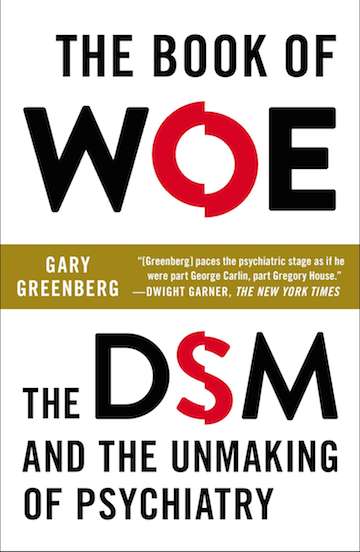
The Book of Woe: The DSM and the Unmaking of Psychiatry

Editor's Note: The following is excerpted from The Book of Woe: The DSM and the Unmaking of Psychiatry by Gary Greenberg. Published by arrangement with Blue Rider Press, a member of Penguin Group (USA).

In 2002, the APA officially announced that [the DSM-IV] had had its day. In A Research Agenda for DSM?V, a book that kicked off the official revision effort, the APA acknowledged that the reification of the DSM?IV’s categories, “to the point that they are considered to be the equivalent of diseases,” had most likely “hindered research.” Nor was “research exclusively focused on refining the DSM-defined syndromes [likely to] be successful in uncovering their underlying etiologies.” Searching for the causes of the illnesses listed in the DSM was proving to be not unlike a drunk looking for his car keys under a streetlight even if that’s not where he dropped them. Scientists were unlikely to find the causes of Generalized Anxiety Disorder or Major Depressive Disorder or any of the other DSM categories­—as descriptive psychiatrists had been promising to do since Kraepelin—because it increasingly seemed unlikely that they really were the equivalent of diseases.

So the APA did what organizations everywhere do when they find themselves flummoxed. They convened a committee. To be exact, they convened thirteen committees that, beginning in 2004, held a series of “planning conferences” at APA headquarters. Because the conferences were explicitly devoted to finding that new paradigm—which, according to the Research Agenda, was “yet unknown”—the NIMH helped pay for them.

Among the people appointed to organize the conferences was a Columbia University psychiatrist named Michael First. First had been the text editor for the DSM?IV and the editor of the DSM?IV?TR. Since 1990, part of his salary at Columbia had been paid by the APA, for which he consulted on all matters related to the DSM. He’d already worked on DSM?5, editing the Research Agenda and writing its foreword.

When he’s not traveling around the world, lecturing on diagnostic issues or consulting to the Centers for Disease Control or the World Health Organization or teaching clinicians how to use the DSM, First can be found in a basement office at the New York State Psychiatric Institute, part of Columbia Presbyterian hospital on the northern tip of Manhattan. He’s bent over in his office chair when I arrive, searching for something amid the piles of papers that have spilled over from his desk and tables and onto the floor. Bearded and rumpled, he looks like a psychiatrist in a New Yorker cartoon. When he talks, thoughts tumble out like the papers in his office, one on top of another, but somehow usually making sense. So you’d be mistaken to think that he’s absentminded. If I hadn’t interrupted him, he would surely have reached into the mess and found just what he was looking for, just as he seems to be able to rummage around in his memory and retrieve the slightest detail of the DSM’s history.

“In a way, I was born to do the DSM,” First told me. But he didn’t always think so. “When I first saw DSM-III”—at the University of Pitts-burgh’s medical school in 1978—“I thought it was preposterous. I saw the Chinese-menu approach and thought, ‘This is how they do diagnosis in psychiatry?’ It seemed overly mechanical and didn’t fit my idea of what the study of the mind and psychiatry should be.”

First had a second love: computer science, which he had pursued as an undergraduate at Princeton. He’d almost chucked pre-med for computers, and during medical school, he continued his interest, working with a team using artificial intelligence for diagnosis in internal medicine. He took a year off to earn a master’s degree in computer science, working on a program to diagnose neurological problems. When he returned to medical school, he settled on psychiatry as his specialty, and his interest in using computers to aid diagnosticians made that Chinese-menu approach seem not quite so preposterous. “I thought, ‘Well, psychiatry is actually relatively straightforward. It’s got a book with rules in it already—an obvious good fortune if I was going to try to get a computer to be able to do this.” Which he was, and which is why he decided to go to the New York State Psychiatric Institute, the professional home of Bob Spitzer, where he planned to exploit his good fortune.

Spitzer had already flirted with computer­-assisted diagnosis in the 1970s, when he was first developing the criteria-based approach. He’d abandoned the attempt, however, and soured on the idea. First managed to negotiate a bargain: he could work on his program so long as he helped out with one of Spitzer’s—an old-fashioned paper-and-pencil test Spitzer was developing called Structured Clinical Interview for DSM Disorders, or SCID. The SCID, which is still in use, is straight forward to use. If you answer yes when the doctor asks you if you’ve been sad for two weeks or more, then he is directed to ask you about the next criterion for depression—whether or not you have lost interest in your usual activities. If you answer no, then he moves on to a criterion for a different disorder. This goes on for forty-five minutes or so, the questions shunting you from one branch of the diagnostic tree to the next until you land on the leaf that is your diagnosis.

First eventually did develop his own diagnostic program. He called it DTREE, but it was a commercial failure. “I learned a lesson,” First said. “Doctors don’t care much about diagnosis. They use diagnosis mostly for codes. They don’t really care what the rules are.” When a patient comes in complaining of pervasive worry and jitters, with a little dread thrown in, most clinicians don’t take the time to climb around on the diagnostic tree. They don’t bother consulting the DSM’s list of criteria to diagnose Generalized Anxiety Disorder. They just write the code, 300.02, in the chart (and on the bill) and move on.

“That was my first lesson in how people think about diagnosis,” First told me.

First doesn’t think the solution is more reverence toward the DSM. Indeed, there may be only one thing worse than not paying attention to the DSM and that is paying it too much heed. “I think people take diagnosis too seriously,” he said. The DSM may appear to be a master text of psychological suffering, but this is misleading. “The fiction that diagnosis could be boiled down to a set of rules is something that people find very appealing, but I think it’s gotten out of hand. It is a convenient language for communication, and nothing more.” The rules are important, but they should not be applied outside of a very particular game.

In this respect, First thinks, “the DSM has been a victim of its own success.” If it was merely the lexicon that gave psychiatrists a way to talk to one another, then it might live in the same dusty obscurity as, say, Interventional Radiology in Women’s Health or Consensus in Clinical Nutrition does. If it was treated as a convenient fiction fashioned by expert consensus, and not the embodiment of a scientific understanding of human functioning, then newspapers would not be giving psychiatrists valuable op?ed real estate to debate its merits. If it hadn’t escaped its professional confines, it would not be seen as a Rosetta Stone capable of decoding the complexities of our inner lives. If it had not become an epistemic prison, psychiatrists wouldn’t be languishing in it, trying to find the biological correlates of disorders that don’t really exist, that were invented rather than discovered, whose inventors never meant to make such mischief, and whose sufferers, apparently unreasonably, take medical diagnoses seriously enough to expect them to be real.

First is right about at least one thing. Most clinicians don’t care what the DSM’s rules are. I know I don’t. I rarely take it down off my shelf. I use only a handful of the codes and by now I know them by heart.

At the top of my favorites list is 309.28, which stands for Adjustment Disorder with Mixed Anxiety and Depressed Mood. Here’s how the DSM?IV defines it:

A. The development of emotional or behavioral symptoms in response to an identifiable stressor(s) occurring within 3 months of the onset of the stressor(s)

B. These symptoms or behaviors are clinically significant as evidenced by either of the following:

  1. marked distress that is in excess of what would be expected from exposure to the stressor
  2. significant impairment in social or occupational (academic) functioning

C. The stress-related disturbance does not meet the criteria for another disorder

D. The symptoms do not represent Bereavement

E. Once the stressor (or its consequences) has terminated, the symptoms do not persist for more than an additional 6 months

I’m sure you can see why 309.28 is popular with clinicians, and why insurance company claims examiners probably see it all the time. It sounds innocuous, which makes it go down easy with patients (if, as I do, you tell your patients which mental illness you are now adding to their medical dossier) and with employers or insurers or others who might have occasion to scrutinize a patient’s medical history and be put off by a more serious-sounding diagnosis. It offers all kinds of diagnostic flexibility. Take Criterion B1, for instance. It is easy to meet; it is easy enough to use the fact that the patient made an appointment as evidence of “marked distress.” And that lovely parenthetical in Criterion E makes it possible to re?up the patient even after the six months have elapsed.

But Adjustment Disorder also has a special place in my heart because it was my own first diagnosis, or at least the first one I knew about. I got it sometime in the early 1980s, when I was in my early twenties and the DSM was in its third edition. I don’t remember why I wanted to be in therapy or very much of what I talked about with my therapist. I do remember that my father was paying for it. He was probably hoping I would discover that my self-chosen circumstances—living alone in a cabin in the woods without the modern conveniences—were a symptom of something that could be cured. What I was being treated for, however, was not “Back to the Land Disorder” or “Why Don’t You Grow Up Already Disorder,” but rather, as I discovered one day when I glanced down at my statement on the receptionist’s desk, Adjustment Disorder.

I guess the tag seemed about right. I definitely wasn’t adjusting; and if it occurred to me that by calling my lifestyle an illness (if indeed that’s what he meant to do, as opposed to just rendering the most innocuous-sounding diagnosis possible), my therapist had passed judgment on exactly where the problem resided, I didn’t think much of it at the time. But I do remember that I noticed, for the first time, that I’d been going to these weekly appointments in a doctor’s office. It happened to be in a building adjacent to the office of my childhood pediatrician, but it did not smell like alcohol or have a white­shoed woman bustling about, nor did its business seem a bit related to the shots and probes I’d suffered next door, so the discord stood out. But still the fact of that diagnosis, right there in black-and-white, was undeniable. I was a mental patient.

I was eventually cured of my maladjustment—not by therapy, but by a family coup that resulted in my grandfather’s being relieved of the farm he’d inherited from his mother. That happened to be the land on which I’d built my home, and so I was evicted, my cabin eventually bulldozed and the land converted to McMansions, and it became necessary for me to earn a living. Of the many adjustments I have had to make, diagnosing people in order to secure an income was one of the strangest—not only because the DSM’s labels seemed so insufficient, its criteria so deracinated, the whole procedure so banal in comparison with the rich and disturbing and ultimately inexhaustible conversation that was occurring in my office, but also, and much more important, because of the bad faith involved. I didn’t mind colluding with my patients against the insurance companies; sometimes I actually enjoyed the thought. I brought them in on the scam, explaining exactly what diagnosis I was giving them, sometimes even taking out the book and reading the criteria and occasionally offering them a choice. But the fact that we were sharing the lie didn’t make our business any less dishonest.

I know therapists who diagnose everyone with Adjustment Disorder unless the insurance company limits benefits for its treatment on the grounds that it isn’t enough of an illness to warrant much treatment—at which point the patient often contracts a sudden case of something much worse, like Major Depressive Disorder. Myself, I prefer to mix things up a little. But mostly I prefer not to do business with insurance companies, so I often don’t have to bother with such dilemmas. Of course, that means I get paid less money, since not everyone can afford my rates without a little help from their friends at Aetna, so I end up giving people a break in return for steering clear of the whole unsavory business. Over the thirty years I’ve been in practice, I’ve probably left a couple million dollars on the table by avoiding the DSM. It’s an expensive habit, but I think of it as buying my way out of bad faith.

And it’s not just my rank­and-file colleagues and I who think of the DSM as if it were a colonoscopy: a necessary evil, something to be endured and quickly forgotten, and surely not to be taken seriously unless you have to. I once asked psychiatrist and former president of the APA Paul Fink to tell me how the DSM was helpful in his daily practice.

“I have a patient that I’ve been seeing for two months,” he told me. “And my secretary said, ‘What’s the diagnosis?’ I thought a lot about it because I hadn’t really formulated it, and then I began to think: What are her symptoms? What does she do? How does she behave? I diagnosed her with obsessive­ compulsive disorder.”

“Did this change the way you treated her?” I asked.

“No.”

“So what was its value, would you say?”

“I got paid.”

It is at least ironic that a profession once dedicated to the pursuit of psychological truth is now dependent on this kind of dishonesty for its survival. But I suppose that any system guided by the invisible­hand—financial markets no more than healthcare financing—is bound to be gamed. And the DSM, whatever its flaws, has proved to be a superb playbook.


On Quitting The Practice of Psychotherapy

Workplace Wounds

My name is Michael Sussman and I’m a recovering psychotherapist.

By this I don’t mean that I am a therapist who attends Alcoholics Anonymous, but rather that I’m in recovery from being a therapist.

I made a decent living as a clinician, and took great satisfaction in helping people in distress. Over time, however, the strains of practice overwhelmed my own coping capacities and I was forced to close up shop. Ironically, it appears that working as a therapist aggravated the very same wounds that first drew me to the field.

Like many practitioners, my early family experiences groomed me for the role of psychotherapist. As a typical middle child, I felt unsure of my place in the family and hungered for acceptance. I dealt with these insecurities by becoming mother’s little helper and confidante. Outwardly, I did all I could to help her care for my younger brother. But underlying feelings of jealousy and malice toward the intruder drove me to torment my brother on the sly. This, and my failure to somehow heal my parents’ troubled marriage, left me with deep reservoirs of guilt and remorse. As I’d later learn, such feelings—along with intense needs to atone and make amends—supply a powerful impetus toward pursuing a career in the helping professions.

Unfortunately, they also provided fertile soil for the development of emotional illness. By the age of 15, I was already showing signs of depression. In my late teens I dropped out of college and joined a cult, and by my early twenties I was bouncing in and out of psychiatric wards with bouts of both depression and mania.

I eventually stabilized enough to return to school and earn a bachelor’s degree in music composition and performance. And who knows? If I’d become a professional musician or a music teacher, perhaps I would never have suffered another episode of severe mental illness Instead, with considerable trepidation, I entered graduate training in clinical psychology.

From the start, graduate school undermined my emotional stability by weakening my defenses. As I learned in class, we all employ an array of defense mechanisms to help maintain psychological equilibrium. These protective strategies tend to function largely outside of conscious awareness. Why? Because our psychic defenses—like a nation’s military strategies—must remain concealed in order to be effective. If you become aware, for instance, that you’re using denial to avoid facing painful feelings, those feelings are more likely to emerge.

By gaining understanding of these defensive maneuvers, my own defenses were inevitably compromised. And in a variant of what has been dubbed medical students’ disease, I began experiencing the symptoms of the disorders we covered in class.

If studying psychopathology was a bit dodgy, actually working with disturbed people turned out to be downright perilous. The empathy that allowed me to tune in and connect with patients also left me vulnerable to taking on their pain. In addition, I was ill prepared for the enormous burden of responsibility entailed in caring for the sick. During my third year, a middle-aged patient of mine jumped to her death from the window of her 20th-floor apartment, shortly after transferring to a new therapist. Though devastated by her death, it only intensified my dedication to the calling.

But as the years passed, the emotional toll mounted. Overly dedicated to work, I neglected my social life and grew increasingly isolated. Rather than freeing me from an introspective disposition, clinical practice only deepened it. And while clinical successes were exhilarating, they did little to assuage the guilt from my childhood “crimes.” Clinical setbacks and failures, on the other hand, intensified my inner sense of badness. Far from bringing redemption, the practice of psychotherapy engendered in me what the psychiatrist Richard Chessick termed soul sadness.

Ultimately, my career was cut short by full blown major depressive episodes requiring electroshock treatment. I’m better now and have had former patients literally plead with me to return to practice. But my susceptibility to depression precludes me from providing emotional stability to others. Moreover, I can no longer ignore the fact that practicing psychotherapy is hazardous to my own health.

Recovery

So, what broader lessons can be drawn from my saga?

First, wanting to help people is not sufficient reason for becoming a therapist. Admissions committees must help applicants explore their hidden motivations for practice.

Second, although a mild to moderate degree of emotional conflict needn’t be problematic, training programs ought to be wary of admitting applicants with a history of serious mental illness.

Third, all applicants ought to be fully warned about the potential dangers inherent in learning and practicing psychotherapy, and therapist self-care should be included in the curriculum.

Fourth, the last bastion of the stigma of mental illness appears to be within the mental health profession itself. It can no longer be denied that a substantial percentage of practitioners are significantly stressed or impaired. It’s imperative that the professional community stops fostering shame, and begins creating an environment in which struggling clinicians dare to reach out for help and support.

Meanwhile, I’m writing fiction. I’ve spoken to several former colleagues who are also in recovery. One runs her own bakery, another owns a bookstore, and a third raises llamas. What’s disturbing to contemplate is that, in all likelihood, there are thousands of therapists out there who ought to be doing something else, but continue to practice.

*This article was originally published in the May/June 2013 issue of New Therapist magazine.

Scott Miller on Why Most Therapists Are Just Average (and How We Can Improve)

Escape from Babel

Tony Rousmaniere: Many people know you as a Common Factors researcher, but recently you’ve transitioned away from that. Could you explain both what Common Factors is and your transition away from it?
Scott Miller: Sure. As old-fashioned as it sounds, I’m interested in the truth—what it is that really matters in the effectiveness of treatment. Early on in my career, I learned and promoted and helped develop a very specific model of treatment, solution-focused therapy. We had some researchers come in near the end of my tenure at the Family Therapy Center in Milwaukee who found that, while what we were doing was effective, it wasn’t any more effective than anything else. Now, for somebody who had been running around claiming that doing solution-focused work would make you more effective in a shorter period of time, that was a huge shock.
All models are equivalent. Pick one that appeals to you and your client.


It was at that point that I started to cast about looking for an alternate explanation for the findings, which concluded that virtually everything clinicians did, however it was named, seemed to work despite the differences. That led back to the Common Factors—the theory that there are components shared by the various psychotherapy methodologies and that those shared components account more for positive therapy outcomes than any components that are unique to an approach. It was something that one of my college professors, Mike Lambert, had talked about, but that I had dismissed as not very sexy or interesting. I thought, how could that possibly be true?

It was at that time that I ran into a couple of people that I worked with for some time, Mark Hubble and Barry Duncan, and we had written several books about this. If you read Escape from Babel, which we coauthored, the argument wasn’t that Common Factors were a way of doing therapy, but rather a frame for people—therapists speaking different languages—to share and meet with each other. They were a common ground.

But by 1999, it was very clear to me that Common Factors were being turned into a model by folks, including members of our own team, and viewed as a way to do therapy. But you can’t do a Common Factors model of therapy—it’s illogical. The Common Factors are based on all models. This caused a large amount of consternation and difficulty, numerous discussions, and eventually I suggested to the team that the way therapists work didn’t make much of a difference.

What was critical was whether it worked with a particular client and a particular therapist at a particular time. Mike Lambert was already moving in this direction and said, “Let’s just measure them. Let’s find out. Who cares what model you use? Let’s make sure that the client is engaged by it and that it’s helping them.” So we began measuring, and what became clear very quickly was that some therapists were better at it than others.

So, since about 2004, Mark Hubble and others at the International Center for Clinical Excellence (ICCE) have been researching the practice patterns of top performing therapists. It’s not that I don’t believe, and in fact know, that the Common Factors are what accounts for effective psychotherapy. It’s just that an explanation is not the same as a strategy for effecting change. And the Common Factors can never be used as such. All models are equivalent. Pick one that appeals to you and your client.

The Siren Song

TR: So Common Factors are a way of studying the effects of psychotherapy, but not a way of actually implementing it.
SM: Well, by definition, you can’t do a Common Factors model because then it’s a specific factor. I’m not saying the Common Factors don’t matter—what I’m saying is that they are a therapeutic dead end. They will not help you do therapy. You still have to have a method for doing the therapy, and the Common Factors are not a method. Why?
What I say is, pick one of the 400 that appeals to you and then measure and see: Does your client like it, too? If not, then it’s time for you to change, not your client.
All treatment approaches return equal efficacy when the data is aggregated and methods compared in a randomized controlled trial. So you still need some kind of way to operationalize the Common Factors.

Since we have 400 or so different models of therapy, why invent a new one? It seems to be because in our field, each person has to have it their own way. The promise of a new model is a siren song in our profession that we have a hard time not turning our ship towards. What I say is, pick one of the 400 that appeals to you and then measure and see: Does your client like it, too? If not, then it’s time for you to change, not your client.
TR: You have an article out in Psychotherapy where you mentioned three keys for therapists to improve their work. Your major focus now seems to be how therapists improve their work with each client. Can you describe those three keys?
SM: The first one is knowing your baseline. You can’t get any better at an activity until you actually know how good you are at it now. We therapists think we know, but it turns out that data indicates that we generally, as a group, inflate our effectiveness by as much as 65%. So you really have to know just how effective you are in the aggregate. That means you’re going to have to use some kind of outcome tool to measure the effectiveness of your work with clients over time.
We generally, as a group, inflate our effectiveness by as much as 65%.


The second step is to get deliberate feedback. So once you know how effective you are, then it’s time to get some coaching, get some feedback, and you can do that in two ways. Number one, you can use the very same measures that you used to determine your effectiveness to get feedback from your clients on a case-by-case basis. Meaning that you can actually see when you’re helping and when you’re not, and use that to alter the course of the services provided to that individual client.

The second kind of feedback to get is from somebody whose work you admire, who has a slightly broader skill base than you do, and have them look at your work and comment specifically about those particular cases where your work falls short. In other words, you begin to look for patterns in your data about when it is you’re not particularly helpful to people, and seek out somebody who can provide you with coaching. It’s like in golf, once you know what your handicap is you can hire a coach who can look at your game and make fine tweaks. It’s not about revamping your whole style, or about learning an entirely new method of treatment, but pushing your skills and abilities to the next level of performance.

The third piece is deliberate practice. The key word in that expression is “deliberate.” All of us practice. We go to work. But it turns out the number of hours spent on a job is not a good predictor. In fact, it’s a poor predictor of treatment effectiveness. So what you have to do is identify the edge of your current realm of reliable performance. In other words, where’s the next spot where you don’t do your work quite as well? And then develop a plan, acquire the skills, practice those skills and then put them into place. Then measure again to see, have you made any improvement?

I can’t take credit for coming up with these three steps. We’ve simply borrowed them lock, stock, and barrel from the performance literature, and in particular, Anders Ericsson’s work, which has been applied in fields like the training of pilots, chess masters, computer programmers, surgeons, etc. If we have any sort of claim to fame, it’s that we’ve begun applying these to psychotherapy for the first time.
TR: One of my first reactions to this is, aren’t some people just born better therapists?
SM: Well Ericsson notes that the search for genetic factors responsible for the performance of eminent individuals has been surprisingly unsuccessful. In sports we often think, “Oh, there must be some genetic component involved here,” or “he just has the gift of music.” But it turns out that virtually everyone that researchers looked at where the “gift” is implied, even with Mozart—he had been playing the piano for 17 years before he wrote anything that was unique, which happened at about age 21. He’d been playing since he was 4. His father had been doing music scales with him since he was in the crib. So once you remove the practice component, you just don’t find any evidence for genetic factors—with very few exceptions.

For example, in boxing it appears that people with a slightly longer reach have a slight advantage. But we also know that if baseball pitchers don’t start pitching at a particular age, their arms will not make the adjustment required to throw the ball as fast and accurately as professional pitchers do.

There was another study that looked at social skills. You often will hear, in addition to the genetic claims, that, “Good therapists just have great social skills.” Well, they’ve measured that. It turns out not to be the case, and the reason is that these kinds of ideas are too high or general a level of abstraction. The real difference between the best and the rest is that they possess more deep, domain-specific knowledge. They have a highly contextualized knowledge base that is much thicker than average performers, and much more accessible to them and responsive to contextual clues.

Deep Contextual Knowledge

TR: Could you give a specific example of what a deep contextual knowledge would look like in a therapy room?
SM: Well the classic one—and I say it to make fun of it—is suicide contracting. Or the suicide prevention interview.
Somebody comes in and says, “I’m going to commit suicide.” And we respond with, “Do you have a plan? Have you ever attempted this before?” Blah, blah, blah. That’s decontextualized knowledge. You could ask those questions to a stick.

What a top performer does is ask those questions very differently, nuanced by the client’s presentation, in ways that the rest of us can’t see. Because of their more complex and well-organized knowledge, they can actually see patterns in what clients present that the rest of us would miss and respond to in a much more generic fashion. Is this making sense?
TR: Absolutely.
SM: So the real question is how to help clinicians develop that highly contextualized knowledge. Because once you have it, not only can you retrieve that knowledge at the appropriate moment, but it turns out you can make unique combinations and use them in novel ways that would never occur to the rest of us, or would only occur to the rest of us by chance.
TR: This also doesn’t suggest that treatment manuals are necessarily the best way to train therapists.
SM: We know that following a treatment manual doesn’t result in better outcomes and it doesn’t decrease variability among clinicians using the same manual. So you still get a spread of outcomes, even when everybody is doing the same treatment.

At the same time, I think it’s critical that therapists learn a way of working, and, in the beginning at least, they hew to that approach. Why? Well, if you begin to introduce variation in your performance early on, you will not have the same ability to extend your performance in the future.

Let me give you an example. The first time I had a guitar lesson, I was taking classical guitar with this really interesting teacher. We spent the entire first lesson on how he wanted me to hold the neck of the guitar with my left hand—and I’m right handed. He said, “If you try to vary your hand grip from the outset, you’ll never have the same reach and ability to vary reliably when you need to in the future. So start with a common foundation, and then when we need to introduce variations later, we will.” My sense is that therapists instead begin in a highly complex, nuanced way and introduce variations into their style randomly and without much thought.
TR: So it would be better to begin with a frame or structure that provides a stable base, and then develop the deep contextualized knowledge later on.
SM: And to vary your work in ways that allow you to measure the impact of your variation against what you usually do. This is the key. Otherwise, what you have is a bag of tricks. You can do them all, but there’s no cohesiveness to it, and you can’t explain why you vary at certain times rather than others.
TR: Starting with a manual isn’t necessarily a bad idea then.
SM: Absolutely not. In fact, I would suggest grabbing a manual and going to a place where they are teaching a specific approach that will allow you to practice and also watch others in a two-way mirror. Once you have that foundation down, you can introduce your own variations.
TR: I hear therapists say, “I have 20 years experience,” or “I have 30 years experience.” Does this research find that experience, itself, makes someone better?
SM: No, it doesn’t. We know that not only in therapy, but in a variety of activities. If you think about it, you’ll understand why. While you’re doing your work, you don’t have time enough to correct your mistakes thoughtfully.
The difference between the best and the rest is what they do before they meet a client and after they’ve met them, not what they’re doing when they’re with them.
So what we found, which I think is quite shocking, is that the difference between the best and the rest is what they do before they meet a client and after they’ve met them, not what they’re doing when they’re with them.  Let me give you an example from a field that is similar—figure skating. If you watch a championship figure skater perform a gold medal winning performance, you can describe what they did, but it won’t tell you how to do it yourself. Do you follow me?
TR: Yeah.
SM: In order to be able to accomplish that performance, that figure skater must do something before they go on the ice, and after they leave the ice. It’s that time that leads to superior performance. You can go out and try to turn triple axels during the performances as much as you want. That experience will not make you better. You have to plan, practice, perform, and then reflect. Most of us don’t see all of the effort that goes into that great performance. We just appreciate how good it is.
TR: But one of the tricky differences is that we’re trying to help each client. And if we’re practicing new skills, invariably we’re going to make mistakes. And that’s emotionally harder because you’re making a mistake with a real person sitting across from you.
SM: Well, number one, we’re all already making these mistakes. And the ones that I’m referring to are generally small and not fatal. So your performance doesn’t improve by isolating gross mistakes, or gross skills. Your performance improves when your usual skills begin to break down—meaning they don’t deliver—and remembering those, thinking about them after the session, and making a plan for what to do instead. That’s where improvement takes place.

When I hear people mention this kind of objection, I think they’re thinking that the errors are far grosser than what I’m talking about. Once therapists assess their baseline, most are going to find out—to their, perhaps, surprise—that they’re average in terms of their outcome, or slightly less than average. So if we’re average, then it’s not about bringing your game up to the average level. It’s about extending it to the next. That requires a focus on small process errors.

Let me give you another example. We have a pianist come and perform at one of our conferences. She is eight years old and she is really unbelievably able as a concert pianist. She plays a very difficult piece. I ask her if she made any mistakes. She says, “Of course, I made a lot.” I tell her I didn’t hear any, to which she says, “Well, that’s because you’re no good at this.”

I then say, “What do you mean? And what do you do about your mistakes?”

She says, “Look. I made lots of mistakes, but you cannot get better at playing the piano while you’re performing.” This is an 8-year-old.

I say, “So what do you do?”

She says, “Well, I hear these small errors. I remember them. My coach in the audience remembers them, and then that’s what I isolate for periods of practice between performances.”

Most of Us Are Average

TR: How many therapists really practice between sessions? I mean, that’s pretty rare, isn’t it?
SM: Most of us are average.
TR: Right.
SM: And 50% of us are below average, right?
The best performers spend significantly more time reading books and articles….and reviewing basic therapeutic texts.
So very few people do it, and this is the real mystery of expertise and excellence. Why do some go this extra mile? There’s no financial pay-off. I think this will change in the future, but at the present time, you don’t get paid one dime more if you’re average, crappy, or really good. The fees are set by the service provided.
TR: That is a great problem with our field and I hope that does change in the future.
SM: I think that we’re seeing movement in that direction. I think that our field will become like other fields, where outcome of the process is what leads to payment, rather than the delivery of it.
TR: So back to practicing. Therapists read books and go to workshops, but that’s kind of passive learning. What are your thoughts about that?
SM: That’s a component of practicing. A graduate student that I’ve been working with, Darryl Chow, who just finished his PhD at University of Perth in Australia, did his dissertation on this topic and found that the best performers spend significantly more time reading books and articles. We also know that the best performers spend more time reviewing basic therapeutic texts.

Therapists are often in search of the variation from their performance that will allow them to reach an individual client they’re struggling with. Top performers not only do that, but they’re also constantly going back to basics to make sure they’ve provided those. They spend time reading basic books that may be hugely boring but are nonetheless really helpful. Gerard Eagin’s The Skilled Helper, Corey Hammond’s book on therapeutic communication—these basic texts that remind us of things that we often forget in the flurry of cases we see every week.
TR: So reading counts. What about workshops?
SM:
We don’t know about workshops. I’m cynical about them, simply because they’re not set up in a way that respects any principles of the last 30 years of research on human learning.
We don’t know about workshops. I’m cynical about them, simply because they’re not set up in a way that respects any principles of the last 30 years of research on human learning. Six hours, chosen by the person who needs the continuing education, and there’s no testing of skills, acquisition of skills, no awareness of particular deficits in practice. Greg Neimeyer has done a fair bit of research on this and he finds no evidence that our current CE standards lead to improved performance. None.
TR: There’s a psychotherapy instructor I know, Jon Frederickson, who has his students go through psychotherapy drills, kind of like role-playing drills in a circle. Would that count as practice?
SM: It depends, but I like the sound of it. Not a scrimmage, where you do a whole game, but rather drilling people in very specific small skill sets again and again. That aligns with the principles of Ericsson’s researchers.

If you’re an experienced professional, your motivation for going to a CE event can be really varied. I know for me, I’m often just grateful to have a day off and hang out with friends. The particular content of the workshop, I’m ashamed to admit, is less important. The incentives are just all wrong.
TR: It goes back to your motivation question.
SM: I don’t think our field incentivizes that kind of stuff. In fact, you can be punished.
TR: Well, one incentive I discovered myself in my own private practice was my drop-out rate. That motivated me to get further training. Maybe other therapists don’t have the same problem I had, but I know that was a powerful motivation.
SM: Drop-out can be both a good and a bad thing. For example, our current system incentivizes therapists to have a butt in the seat every available, billable hour. What that means is that therapists may be incentivized—we have some data about this, too—to keep clients, whether they are changing or not. That’s what I mean when I say that the incentives are all screwed up. There are, every once in a while, motivated people like yourself who say, “Wait a second. There has to be something beyond this.” But that requires a degree of reflection that may be difficult for most of us, especially if we are well defended. For these folks, people drop out because they are in denial about their own problems, not because of anything they, themselves, might be doing.

You put those things together and it can be a fatal combination. We need to take a step back as payers for services and as consumers of services and think about the incentives in our current system. I know this sounds terribly economic, but I think it’s important for our field.
TR: That sounds sensible to me. What about watching psychotherapy videos by psychotherapy experts like the ones psychotherapy.net produces. Would that count as practice?
SM: Yes it would. Especially in the beginning, when you have identified a particular area or weakness in your skill set that you may need some help with. In essence, you’re spending more time swimming in it while reflecting, which is the key part.
TR: Do you have other examples of deliberate practice that you’ve heard of therapists engaging in?
SM: Well there’s the stop-start strategies that Darryl Chow has been talking about. And Chris Hall is doing a study at UNC that we’re involved with, where therapists will watch short segments of a video and then they have to respond in the moment in a way that is maximally empathic, collaborative, and non-distancing. So they’re training therapists to develop a certain degree of proficiency with fairly straightforward clients.

Then you begin to vary the emotional context, or the physical context, in which the service is delivered. So now the client’s not just saying, “Hey, I feel sad.” They’re threatening to drop out or to commit suicide. More difficult and challenging things. And then simply spending time outside of the office planning and discussing individual particular cases with peers or consultants is another strategy.

In Darryl Chow’s research, which I think is the most exciting stuff, he found that within the first eight years of practice, therapists with the best outcomes spend approximately seven times more hours than the bottom two-thirds of clinicians engaged in these kinds of activities. Seven times.
TR: Wow.
SM:
The key to this is really starting early and investing a little bit at a time. It’s sort of like how you’re advised to save for your retirement. Not in the last five years. Not in the first five years, but a little bit every year.
The good news is, now that we know this, we can start this process earlier. The bad news is, if you’ve been at this for awhile, it becomes impossible to catch up with the best. We just age out. We can’t do it. The key to this is really starting early and investing a little bit at a time. It’s sort of like how you’re advised to save for your retirement. Not in the last five years. Not in the first five years, but a little bit every year.
TR: One advantage that great athletes have is that their coaches gets to determine day by day what moves or what performances they’re going to practice. I run a training program here at University of Alaska, Fairbanks, at the University Center for Student Health and Counseling, and I don’t get to pick what clients come in day to day. It could be anxiety, depression, any number of different things, so I’ll do a training on, let’s say, working with anxiety, but the client that comes in will have depression. So what do you do about that?
SM: Well, in essence, we’re violating John Wooden’s primary rule, which is, we are allowing students to scrimmage before they drill. And I have to tell you, all students want to scrimmage, but what you need to do more of, before and during, is drilling. The kind of drilling that I think your colleague was talking about. Or you go back to, “Here’s how we hold the guitar.” And we play very simple songs and then we begin varying the drill with greater degrees of complexity once easier tasks are managed.
TR: So you’d recommend a longer period of training and practice and drills before seeing clients.
SM: I’d want to see that kind of mastery. Let me give you an example. Do you want the pilot to be proficient at flying in fair weather, as demonstrated on the simulator, before they fly a plane?
TR: Yes.
SM: You want them to be prepared for all the complications: “Wait a minute, it’s raining,” “Wait a minute, you’ve got problems with your rudder.” These are complex skills and, yes, we can teach people to manage them as one-offs, but then they never integrate it into a coherent package that makes it easier to retrieve from memory later on when they need that skill. If it’s viewed as a one-off—“With the anxiety client, I did this”—it’s not integrated into an organized structure for retrieval later on.
TR: So on a therapist’s resume, you’d want to see not just hours of direct service provided, but also hours spent practicing and learning.
SM: Or, better yet, somebody who has measured results, like yourself. All I need is an average pilot. I don’t need the best pilot in the world, because most of the time there’s not huge challenges. If you can document your results, and if you’re checking in with me, we’re going to catch most of the errors anyway. And then I want a therapist who has a professional development plan, that’s working on the aggregation of small improvements over a long period of time.
TR: So for tracking results, I know you recommend quantitative outcome measures, like the Outcome Rating Scale or the Outcome Questionnaire. But I have found that there are certain clients that quantitative measures just don’t seem valid for. It’s not a large percentage of clients, but there are some that underreport problems at first. So it can look like they’re deteriorating even while they’re improving. Can you recommend any kind of qualitative methods or other methods of trying to accurately assess outcome in addition to those measures?
SM: I don’t buy it. Personally, I just don’t see that stuff and I would offer a very different explanation for it. Let me give you an example.

We know that each time there is a deterioration in scores, the probability of client drop-out goes up, whether or not the therapist thinks that it’s a good sign that the client is “getting in touch with reality and finally admitting their issues,” or had inflated how they really were doing for the first visit. So the key task here is not to say, “There must be another measure,” but to figure out what skills are required for me to get a higher score.

Dig Into the One You Know

TR: That’s a new perspective. To look at what I can change about my performance, rather than a new measure to assess it.
SM: Now you see why I think our field is forever chasing its tail. Because instead of becoming fully connected to our performance, we are constantly looking for the trick that will make us great.
Instead of becoming fully connected to our performance, we are constantly looking for the trick that will make us great.
It’s like a singer looking for the song that will make them famous rather than learning how to sing. We’re forever going to workshops, and the level of the workshops are often so basic even when they’ve claimed to be advanced. The truth is, you can’t do an advanced workshop on psychotherapy for 100 people. You can’t do it. The content is too abstract and too general. You need to see a clinician’s performance and fine-tune it. So therapists go around and around, constantly picking up these techniques that they use in an unreliable fashion, and their outcomes don’t improve, but their confidence does.
TR: So instead of picking up a new modality every year, dig into the one you know, preferably with a real expert, and get individualized or maybe small group training and practice.
SM: I think that once you’ve achieved a level of proficiency, the only hope for improvement is to get feedback on your specific deficits. And yours will be different from mine.
TR: It sounds like you’d definitely be a fan of videotaping sessions and reviewing them and that kind of thing.
SM: Not alone—with an expert eye reviewing small segments. Otherwise the flood of information from video will have you second-guessing yourself, which can actually interrupt the way you work in an unhelpful way.
TR: What about live supervision?
SM: I’m not averse to it, but I think it’s a little bit like a GPS—it can correct your moves in the moment, but you become GPS-dependent and you don’t learn the territory. What’s required in learning is reflection. If you don’t reflect, you can’t learn. As my uncle used to say, “You got to study that thang.”

I actually had great opportunities with live supervision when I was at the Family Therapy Center and got corrected in the moment by two really masterful clinicians. But I also think that what really made a difference was sitting behind a mirror, without any financial worries, watching endless hours of psychotherapy being done, and then talking about it afterwards. “This was said. What could you have said? How come we said this? What do you need to do?” It was a heavenly experience and as a result, I came away with a very highly nuanced and contextualized way of delivering that particular model.

And today, when I’m doing my Scott Miller way of working and I notice that a particular client wasn’t engaged or interested at a particular moment, I think, “What could I have said differently?” It’s at that small micro level that improved outcome is likely to be found. As opposed to just gross generic level.

People go to workshops and say, “I’ve had some traumatized clients. Maybe I’ll learn that EMDR thing.”

“Really?” I think. “Do you know how effective you are in working with these clients already?”

“No, I don’t.”

“What makes you think you need to do EMDR?”

“Well, it just seems so interesting.”

And I think, “Oh, you’re doomed.” Not that there’s anything wrong with EMDR, but I have to tell you, I watched Francine Shapiro do it and it looks a lot different than some other people I’ve seen doing it.
TR: So the problem there is switching modalities rather than getting a lot better at the one you’re currently using.
SM: It’s looking for a trick rather than thinking through, what else could I have said? What else could I have done that I already know how to do? Or getting a little bit of tweaking from a trusted mentor.
TR: I know you present this information all over the world. Do you find therapists are open and receptive to these ideas?
SM: Yes. I think that there are some very real barriers that we need to address, but yes, I do.
TR: This has been a really fascinating conversation. Thank you for making the time.
SM: I like this stuff. I’m fascinated by it and I’m very hopeful about the direction we’re going research-wise, so thank you for giving me the opportunity.

Paradise Lost: When Clients Commit Suicide

Becky

“May I speak to Becky, please?” I asked the female voice that had answered the phone.

“Who’s calling?”

“Dr. Joyce,” I replied.

“Her therapist?” she asked. I knew I had to protect my client’s confidentiality, so I couldn’t answer that question. I began to feel uneasy.

“I’m sorry," she said softly. "Becky killed herself last night.”

I felt as though underwater, my voice garbled, when I finally managed to say, “Okay, thanks for telling me.”

Becky’s gone? My patient committed suicide? I wandered into my living room, dazed. I stared out the picture window into the courtyard where the heavenly bamboo were growing. I hadn’t noticed how they had reddened, with berries forming, signaling the start of winter. The liquid amber tree was bare, dried leaves cluttering the bed. I need to clean up those dead leaves, I thought.

I looked at the clock. It was 9:45 and I was to meet my husband at our new house at 11:00. On my way over, I began to reflect on my last therapy session with Becky, a mere six days earlier. She had been struggling with depression, but she did not seem more deeply depressed than before, nor did she mention suicide. The only clue I had was a casual comment made towards the end of the session.

“I really don’t know what I’m going to do now. I thought about the Peace Corps,” Becky said. “But I need to be close to a therapist and psychiatrist.”

“Yes. And I wonder if being far away from Matt would also be hard,” I said. Becky was having difficulty recovering from a breakup with Matt.

“Well, that too,” she said. Then she changed the subject.

“I like having more time now that school is over,” she said. “I’ve been reading The Inferno.” I didn’t follow up on her comment and she moved on to a new topic.

At the end of the session, I escorted her to the door and, for some reason, I felt compelled to do “doorknob therapy,” unusual for me. As I opened the door, I said, “Maybe you might try reading something less…less intense than the Inferno?“

“And that is when she beamed that smile, forever imprinted on my psyche, as last looks must always be.”

“Less intense? You mean, like, Paradise Lost?” A wide, brilliant smile. Then she exited down the hallway.

As I later found out, four days later she walked in on Matt with another woman and then drove herself to the emergency room because she was feeling suicidal. Six hours later, she was discharged and ten hours later she was dead. I’ll bet she flashed that same smile to the hospital staff before they let her go.

My husband, Joe, was already at the 1911 arts and crafts house that we had bought three weeks earlier. We were full of optimism and hope for rescuing this gem from neglect, but we hadn’t yet moved in.

“Marian, where do you want to put the bathroom sink? If we put it here,” Joe said, pointing to the back, “there’ll be more room for the closet. Glynn needs to know.” Glynn was our contractor.

I found myself pondering the ideal location of the sink. I imagined all the alternatives and finally settled on placing the sink towards the back.

Then Joe and Glynn were at it again, arguing about where to put the dishwasher. I tuned them out as I thought about the subtext of Becky’s Inferno/Paradise Lost comments. Had she tried to tell me: “I am bad, a sinner. I want to die and I will probably burn in hell”? How had I missed that reference?

Some people think that being a therapist is easy. “All you do is just sit there and listen,” they often say. But sometimes the client’s thoughts swim deep underwater, like fish that surface only briefly. Blink and you will have missed the sighting. Fortunately, clients will find creative ways to draw my attention to what they want me to hear until I finally “get it.” But I wouldn’t have that opportunity with Becky. I was left with so many unanswered questions: Should I have detected something that last session? Was there something I could have done? Why did she do it?

The 1:00 Spot

The next day I opened my planner and saw Becky’s name in the 1:00 spot. I stared at it for a moment. When I wrote that in, Becky was sitting in the room with me. And now she is gone. What was I supposed to do with her name? Crossing it off seemed disrespectful. I decided to leave it alone.

My 10:00 appointment was Sherry, a woman who had been going through a particularly rough patch lately. At 10:10 when she still hadn’t arrived, I began to panic. Where is she? I could feel my heart pounding. I frantically flipped through my planner to find her phone number.

“Hello,” she said. I sighed with relief.

“Hi, Sherry. It’s Dr. Joyce,” I tried to sound calm. “I had you down for a 10:00. Is everything okay?”

“Yeah, I’m on my way. My mother called just as I was leaving and I couldn’t get her off the phone. I’ll be right there.”

After our session, I hurried out of the office to make my appointment with a seasoned psychologist I had sought out to help me with my cases before Becky’s suicide.

“Well, a lot has happened since I made the appointment,” I said.

“Oh really?” she replied. Then she got out of her chair and stood up. “You don’t mind if I stand while we talk, do you? I have a bad back.”

I didn’t know whether to stand up with her, which felt awkward, or remain seated, which made me feel like I was a child. I chose the latter, and proceeded to look up at her intense gaze and recount the story of my patient’s suicide. “I felt shame as I described Becky’s case, her depression, my treatment plan, her ultimate giving up. I waited for her to offer some words of concern or encouragement.”

“Well, why don’t we go over your case session by session so we can find out what went wrong?” she said instead.

All I heard was “wrong.” Did she mean to say that if I had done things differently, Becky would still be alive? The thought of putting the entire year and a half that I treated Becky under the microscope terrified me.

“We could do that,” I said, but I knew I would never perform that “psychological autopsy” with her.

A few weeks later, some colleagues and I went out for a drink at a rooftop terrace overlooking San Diego bay. I began to relax for the first time in weeks as I watched the planes float by at practically eye level. This respite was suddenly interrupted by an emergency call from a client. I found a private corner and spent a few minutes calming her down.

“Sorry, client in crisis,” I said, returning to the table. “Seems like I’ve had a tough caseload lately.”

“You know, Marian,” Gita said, “that’s why we screen our clients and choose them carefully.” Gita knew about my client’s recent suicide.

“I guess I’m not very good at predicting that stuff,” I finally said.

Afterwards, I stopped by one of my colleague’s offices to get a book she was lending me. I found myself studying an abstract painting on her wall that I had never really looked at before.

“That looks like a nasty dragon,” I said. “I never noticed that before.”

She gave me a very concerned look and said, ““Marian, I think this suicide has traumatized you. You are seeing dragons and danger everywhere.”” At first I sighed—she is a classical psychoanalyst and injects meaning into everything—but I could see her point.

“It’s just that I keep blaming myself and I can’t stop visualizing my client’s last moments. I can’t let it go.”

“This is not your fault. You couldn’t have known she was going to do that. We can’t stop someone from killing themselves if they really want to,“ she said.

But I had a hard time believing this. Can’t we stop them? Shouldn’t we know how to do this? Isn’t that just an excuse therapists use to get themselves off the hook?

I was very careful about revealing Becky’s suicide to others. Thinking back on the entire experience, that isolation was the most pernicious aspect of the ordeal. I now realize that most people could not fathom how wounding it is to lose a patient. The slightest nuance or tone of blame from an esteemed colleague could ruin my day.

I had shared my experience with a friend from graduate school whom I thought would be understanding. He responded flippantly, “What did you do wrong now, Marian?” I knew his sense of humor. He didn't mean that, but there it was again… my fault.

The Lawsuit

Shortly after the suicide, I contacted my professional liability insurance company to inform them of the suicide. They asked me a few questions regarding Becky’s case: age, employment status, relationship with parents and so on.

At the end, the person said, “It’s very likely the parents will sue you for wrongful death. Given what you have told me, they will need someone to blame. Please write up a summary of the incident and let us know if you are contacted regarding a lawsuit.”

Most therapists I know live in fear of being sued. I was no exception. And, of course, that is exactly what happened. Approximately three months later I received a request for medical records from an attorney representing the family.

“You must release these records, Dr. Joyce,” she said when I called her.

“I will be happy to as soon as I receive a release from the representative of the deceased’s estate,” I replied, referring to the notes from my conversation with the insurance company.

“You know that her parents can get these records. Your refusal is just causing additional emotional distress,” she said. “I had been warned that the attorney would attempt to control me through intimidation. I thought I was ready for this, but I noticed my hand was shaking.”

“Are you giving me legal advice then, about who holds the privilege?” I said as firmly as I could under the circumstances.

“Alright, then, I will have the parents send you a release,” she finally conceded.

I received the release a day before I was about to leave for vacation, so I wrote to the attorney to say that I would respond to her request when I returned.

When I got back, I was welcomed by more correspondence from the attorney’s office threatening to lodge a complaint with the Board of Psychology. I am able to smile now at my naïveté then, to think that the friendly letter I wrote her before vacation would keep the pit bull from biting.

My insurance company assigned me an attorney before the lawsuit was even filed in order to intercept the badgering correspondence. My attorney arranged to come to my office to meet me in person, dressed very casually in jeans and cowboy boots. It was Friday, but his attire did not inspire confidence.

“So, how long have you been in this office?" he asked me. "I love this part of San Diego.”

"Oh, I've been here for seven years. Yeah, it's great to be so close to the park." He did not seem concerned, which worried me immensely. Perhaps he was trying to set me at ease, but his nonchalant approach was far from reassuring to me.

"Do you want to go over the details of the case?" I said. Why did I feel like the only one ready to work? Don’t you see the danger I am in, I thought. Don’t you understand what is at stake?

"We've got time," he said, "This is sort of a get-to-know you meeting. I already read the report you sent to the insurance company and I think we have a great case. Nothing to worry about."

About a month later, I received a letter, a “90 Day Notice Intent to Sue a Health Care Provider.” My attorney had warned me it was coming, but I was unprepared for the false allegations justifying the lawsuit, written up in a short paragraph, all set in boldface. It didn’t look like a carefully crafted legal document, more like a rushed memo by an employee who would later regret having written it. Like all of the attorney’s previous correspondence, it lacked proper punctuation and spacing—no period after Dr., no comma after however, no spacing between paragraphs. She doesn’t follow the rules, I thought. She doesn’t care about them. This frightened me.

A 90-day waiting period. So I have the summer off, I thought. No more letters in white or gray envelopes or upsetting voicemails from attorneys. It sounded heavenly. I can get a lot of house projects done in 90 days.

I eagerly returned to my current project painting the upstairs bedroom. I opened the can of Benjamin Moore Philadelphia Cream paint and stirred it until smooth and blended. I turned on the radio and the Westerfield trial was on. In February, David Westerfield, a 50-something single man, sexually brutalized and murdered Danielle Van Damm, a 7-year old girl who lived next door to him.

The defense attorney was cross examining Brenda Van Damm, the mother, who had been at a local bar with her friends, drinking, dancing, and smoking marijuana the night of the murder, returning home at 2 am.

“All of the doors were a little bit open,” Brenda said, describing the children’s rooms and then explained that she closed them that night when she returned home.

“Did you look inside?”

“No,” she said quietly.

“Why not?” What is the correct answer to that accusatory question, I thought. It’s going to come out defensive. He’s making her look negligent and wanton, obviously his intent.

“Because when I got—when I went upstairs to tell Damon,” she said, referring to her husband, “that I was home, I asked him how…how the tuck-in went, how everything went that night, if anyone asked for me, and he said that everything had gone fine, that they all had brushed their teeth and been read to and no one asked for me.”

As the defense attorney continued grilling her about her alcohol consumption that night, I felt my stomach tightening, my anger forming. Even if she had been too lax, she wasn’t responsible for her child’s murder. Her husband was home with her daughter. A mother is allowed a night out once in awhile.

I then imagined myself on the stand for the wrongful death of my client:

“Well, Dr. Joyce, did you ask your client if she was suicidal the session before she killed herself?”

“No.”

“And why not?”

“Because she didn’t appear to be more distressed than usual.”

“Than usual? What was her usual distress?”

“She was depressed.”

“And you didn’t think depression was cause enough to inquire about her suicidal thoughts?”

There really was no way to answer these questions. If I said I didn’t detect her distress, I appeared incompetent, but if I said I recognized her distress and did nothing, I was negligent. I’m screwed, I thought. I got down off the step ladder, set the paint brush down, and turned the radio off.

How was I supposed to live with all this uncertainty? I realized that I was deluding myself about a “summer off.” I decided to call my attorney, hoping he could help.

“Did you get the 90-day intent to sue letter?” he asked.

“Yes. It’s a bunch of lies. Where is she getting this stuff?”

“Don’t worry,” he said. “It’s always like this. I told you, you are low on the totem pole of people to sue in this case. It is what it is.” Once again, his cavalier approach was not reassuring

“Hey, have you been watching the Van Dam trial?” I said, changing the subject. “I had to turn it off. I don’t think I can get on the stand like that,” I said.

He laughed. “Relax, Marian. It’s not going to be anything like that. ” I thought of my dentist, needle poised over my gaping mouth: “This won’t hurt a bit.”

That phone call didn’t help, I thought after I hung up the phone. So instead, I popped in a U2 CD, turned up the volume, and went back to cutting in.

The “summons,” an official version of the “intent to sue” letter, arrived in September. I knew that all the allegations were false, but I didn’t trust that the truth would be sufficient. By then, six months into my dealings with the legal world, I was beginning to understand that the lawsuit was solely about money, how much the plaintiff’s attorney could get for her clients, how little the insurance company could pay on my behalf. “My attorney” was really working for the liability insurance company, not for me.

My attorney planned a lengthy phone appointment to prepare me for my deposition. As usual, he was his upbeat self.

“You just need to answer the questions,” he instructed me. “Don’t offer any information that the attorney doesn’t ask for,” he said.

“What if she asks me something way off-base? Will you make an objection?” I was already feeling tense. I found myself drawing spirals on my notepad.

“I can object, but you still have to answer the question. It’s not like in court, because there’s no judge,” he explained. “Don’t worry, Marian. She’s not going to ask you anything you can’t answer.”

I felt dread after our conversation. I went out to get the mail and I brightened when I saw the envelope from Bradbury and Bradbury, a company that makes exact reproductions of arts and crafts wallpaper. I spread the samples out and compared them. I liked the one with a delicate leaf pattern, and the accompanying border with vines and red berries. I called and ordered ten rolls for the dining room, and then impulsively added three of the rose pattern for the powder room.

When people ask me today how I survived a wrongful death lawsuit, I tell them that I threw myself into the renovation of my home. I wanted desperately to bring this house back to life because I could not resuscitate my client.

At the deposition, I finally saw the pit bull in person. She was a stout middle-aged woman with two inch grey roots on her dyed red hair. The attorneys for the hospital, psychiatrist, and emergency room doctor were there as well, dressed in dark suits. We sat around an oval table. I was at the far end seated in front of the plaintiff’s attorney and the court reporter was to my right.

“The plaintiff’s attorney grilled me regarding my credentials for thirty minutes. Then she worked her way line-by-line through the treatment notes.” After four hours, we took a lunch break and then she fired off detailed questions about the week of the suicide.

Afterwards, I met my husband for drinks at the Torrey Pines Lodge, a sprawling, gorgeous building in the Arts and Crafts style of architecture, like our house. I gravitated to the fire in the lobby bar.

“I love the wood tones in this trim,” I said, referring to the honey-colored wood on the fireplace. “It’s so warm, not like our dark mahogany.”

“Hey,” Joe said. I knew that “hey” meant he was coming up with an idea, which usually meant more work. “Let’s take down our wainscoting and trim and plane it. Then we can stain it a lighter, warmer tone.”

Normally I would have dissuaded Joe from such a time-consuming project. But I liked the idea of transforming the dark and dirty into something fresh and light.

“Great idea,” I said. “Let’s do it. It’ll make such a difference.”

That project involved sanding, staining and shellacking yards of wood, a project that outlasted the lawsuit.

After much haggling, the attorneys finally agreed on a settlement amount, which was shared among the defendants. Because it was a settlement, there was no admission of guilt by anyone. That should have set my mind at ease, but by then I knew the case was only about the money.

Grief and Healing

About five months later, I attended a course on clinical hypnosis given by a UCLA professor. He was demonstrating a particular projective device in which clients project unconscious material onto an imagined screen.

"I want you to get comfortable and close your eyes," he said in a soothing voice. I opened one eye to see if everyone was following instructions. They were, so I decided to give this a try.

He began to take us down a spiral staircase and count backwards from ten. When he made the suggestion my arm might lift up, it did. Once established that we were in a hypnotic state, he described the screen where my movie would play out.

“You are sitting in a dark movie theatre facing the screen. Let yourself go and watch the movie that unfolds on the screen.”

It took a minute to see anything on my screen. But then cartoon characters started dancing on a stage and then my sister appeared. The next movie was of my husband calling me from a train and then dancing with me once I boarded. Both movies were joyful.

I suppose I could analyze these for deeper meaning, but what happened next took me by surprise. I began to sob. I knew it was about Becky. I hadn’t yet cried like that about her death, about losing my client. I could finally let myself feel sad that she would never get that rewarding job she desired, or be free of her attachment to Matt to find the love of her life, or even be able to bury her parents.

It was only after that pivotal moment under hypnosis, when I wasn’t looking for it, really, that I was at last able to move past the feelings of guilt, blame, shame, and anger at the lawsuit.

The lawsuit settled, the house renovations finished, Joe and I decided to celebrate with a housewarming party.

Guests gushed over the house as they filed in.

“I can’t believe what you did with this house! Wow! How did you get rid of that dark stain?” a friend asked.

Joe and I looked at each other and smiled.

“It was a big job,” Joe said. “I wouldn’t recommend it for everyone.” I thought back to the evening after the deposition in front of the Torrey Pines fire. I guess we would have never done it if I hadn’t had the lawsuit, I thought. Then it struck me: I was beginning to gain some distance and perspective.

The friend from graduate school whose remark months earlier had so unsettled me came up to me.

“I meant to ask you about your lawsuit. Did it work out okay?” he said.

“Yes, it’s all settled. There shouldn’t be any repercussions,” I said.

“I’m really glad to hear that. I often wondered how you were doing. And I don’t think I ever told you I was sorry that you lost your client. I think I was a little afraid of the whole thing, to tell you the truth.”

“Thanks for that.” I said.

Regarding my work, I have once again recovered my enthusiasm, but it is tempered. I now know that anyone is capable of losing hope at times and even though I listen carefully to the subtle messages my clients share with me, sometimes they choose to keep parts of themselves completely concealed. I know my limitations and that I can’t predict or know what a person will do. And I have to live with that uncertainty and with the consequences that may ensue.
 

 ———————
 

If you or someone you know is struggling or in crisis, help is available. Call or text 988 or chat 988lifeline.org

The Power of Custom in Psychotherapy

It’s the kind of telephone call that every therapist gets and every therapist hates to get.

“I’m sorry to disappoint you on such short notice, but I can’t come in today.”

It was a patient who had come only once before, the week prior, and though he was articulate about what troubled him, one could discern that he was deeply conflicted about whether he even wanted help at all to solve his problems or even ease his difficulties. So it was no surprise to me when he attempted to cancel.

But here he was, live on the phone, the morning of his appointment, his words saying one thing, I’m not coming—but his voice full of conflict and ambivalence. One could sense the pulse of life in him, fragile and quivering.

Patients cancel with painfully short notice or sometimes with no notice at all. That is the way of the world. It’s a loss for them, for you, a loss of money and time. Most often there is little to be done. You put the receiver down and regrettably, you write them off. People will be people, you tell yourself. But every once in a while, you get a feeling that someone who ordinarily might cancel, ought to be encouraged, encouraged that is to keep the appointment. Was this one of those people, I wondered.

“Is there anything keeping you from making your appointment today?” I asked.

“Well, it’s just that as I explained last week, I wasn’t sure if I wanted to come at all…”

“Yes, you are in conflict, that’s true. But you know it is customary, usual and customary that is, to keep appointments unless they were canceled with 24 hours notice. You’re aware of that custom, aren’t you?"

“Hmm…it’s a custom? I suppose it is,” he said haltingly, sparingly. Okay, I will keep the appointment.” And so it was.

What is it about customs that seem to excite less resistance while “laws” and commandments appear to excite more resistance?

From my own experience it would seem that "customs" act in some sense seem to lubricate the traumatized psyche to negotiate the torturous demands of id and superego while "laws" further tighten an already overloaded, cramped psyche.

***
In my neighborhood of Orthodox Jews there are many families with young children. One mother once came to me a couple of years ago. “My 8-year-old daughter, she refuses to take a bath or shower, even on Fridays before the Sabbath.”

“What do you tell her?” I ask.

“I tell her that she has to do it; that she smells or will smell very badly and no one will want to be near her or even come to play with her.”

“And what is her response?”

“It seems to make her even more stubborn. She won’t do it. She says she doesn’t care. She just won’t.”

“Consider telling her that it is the custom in Passaic, New Jersey that girls take a bath before the Sabbath—emphasize that she doesn’t have to, but that is the custom. Say this and no more.”
The mother followed through with the suggestion and reported back to me with pleasure and satisfaction: “My daughter said, ‘if it’s the custom, then I will do it’ and she went into the bath just like that.”

When Life Gets Messy, Don’t Cut and Run!

It was not one of my better moments. It was a very busy time of year, getting ready for Passover, juggling my schedule with patients and the kids' spring break. It was one of those times where I stood at the intersection of my mothering and my profession and my head was spinning.

On the top of the TTD list (things to do) was getting my five year old daughter a haircut. Routine errand as it seems, it did require a bit of scheduling and some tenderness, as she is quite fond of her long, wild and unruly hair. As am I. We did not want to mess with the mess on her head in haste. But my mother's eye knew it had to be tamed somewhat.

I was short on time. I was seeing clients until the last minute, trying to accommodate my own interrupted schedule and not have to cut out too many sessions due to the holiday. So, If you'll forgive the line, "T'was the night before Passover…." and even though most things were set and ready….the unruly hair atop my daughter's head still waited.

So I decided to cut it myself.

I was egged on a bit by another child. And advised (poorly, as it turns out), to cut the hair dry. Cutting in haste, dry or not, is not, I have learned, a good idea.  But I was not thinking clearly. You can guess what happened. I cut a little, and then a little more and soon we were heading toward a bad combo of Larry, Curly and Moe.

So among other good lessons about knowing when to say when, knowing our limits, not doing things that we are not "cut out" to do and getting help when we need it, I was once again reminded about the importance of slowing down. And I was thinking how this is a lesson I can never learn enough. In both my mothering and my practice.

Sometimes in our work, we can get rushed into all kinds of urgencies to take care of things quickly. Things hurt. We are healers. And we are constantly in the fluid space of intense feelings, unconscious undercurrents and old patterns being recycled.  And sometimes it feels like such an unruly mess, if not on top of the head, then certainly in it. And in the heart as well. I can never learn this message enough either: we have to live with unruly messes sometimes. We have to help our clients live with unruly messes. We have to wait and study the mess and not be so quick to the cut.

As it turns out, I knew when to say when, and thanks to the help of a good neighbor who knows how to cut hair properly, my daughter's new "do" is pretty cute. And even though she likes it, she wants it long again. We keep telling her it will take some time, but it will grow. Just like all of us.

The Therapist and the Fee: Why Everything Works out and Also Doesn

A close friend of mine is a wonderful therapist, a child of the 60s, a gifted man, large-souled, big-hearted and wise. His practice nourishes him and is saturated with life. He is committed to a worldview that eschews anything close to greed. “I won’t ask my patients for more, at least not if I can avoid it,” he says. “Often I will wait years to do it.”

My friend’s position makes perfect sense to me. He is a thoughtful and principled man. His role as a professional is anchored in a deep caring for the poor and those who have less. People trust him and his love for them. Anyone can see why he is successful.

And yet what fascinates me is that there are practitioners equally effective who take the opposite point of view. They are practically bullet-proof around money. They regularly raise fees with no compunctions. One colleague, a psychoanalyst and social worker, charges $200 per session and raises the price every two years in $25 increments.

Both of these therapists have large practices and enjoy their work. Both of them claim that they work in the best interests of clients. In fact, my high-flying colleague insists that she raises her fees in order “to help” her clients. “It is selfish not to raise fees,” she insisted to me.

“Clients form an unrealistic dependency and attachment to me,” she explained. “When I raise them, it allows them to separate from me by getting angry at me. It helps me too to be sure, but it is also a gift to them.”

Who is “right”?

Of course, it would be difficult to establish what is right and wrong in a field where so many different, seemingly counter-intuitive actions can be therapeutic. Where else do you have a field in which the “giving” or “self-sacrificing” therapist who is easy on the rules, winks at missed sessions, lowers the fee at the drop of a hat, can often be counter-therapeutic?

And yet it is possible that both therapists are “right.” Each, by being whole-hearted in their approach, may have a struck a deal with their patients’ unconscious. In the case of my friend who almost never raises fees, he has communicated successfully to his patients a simple message: “I won’t easily leave you. I will be with you and be kind to you.” If you knew this man, you would know how genuinely he feels this and believes this and whole-hearted he is. This communication may be helpful to some people who have experienced the traumas of life. They trust his love for them and their love for him until they gradually integrate reality into their lives and mature.

The other therapist seems to have communicated the exact opposite message—that may be equally helpful: “I will always leave you. I will always raise fees and I will always take care of myself in this relationship as well as you.” Paradoxically, for some people, that may be a building block of psychological maturation. Patients may need to trust the therapist’s narcissism in order to accept their love. Bertolt Brecht once famously quipped, “I desperately need someone upon whom I can firmly not rely.”

The late Hyman Spotnitz, father of modern psychoanalysis asked: How do you know if someone needs treatment? He likened a person to a car. “If the driver turns the wheel to the right and the car goes right, or if he steps on the brakes and the car stops, he won’t need to bring the car to a mechanic. But if you turn right and the car goes left, or you brake and the car doesn’t stop, then you need a mechanic.”

People try to lose weight, to be better spouses, to not yell at their kids. We give ourselves all kinds of commands and yet some of us find ourselves moving to the right when we ordered ourselves left. Instead of saying no we said yes or the other way around. And we are astonished.

Many therapists are confused about what to charge in the first place and when to raise fees. One therapist in a supervision group I ran was skittish about her fees, but wanted very much to raise them. She drilled with the group over and over again: “I am going to tell that patient my fee is $150!” I am going to wash that man right out of my hair. And the group cheered her on: “You go girl!” But when it came to saying it to the patient, the actual number got stuck in her throat. “How much do I owe you?” her cooperative new patient asked her. “$110,” the therapist blurted out uncontrollably. “I hate myself,” the therapist later told the group. “I am a loser.” The group would have none of this self-attack. They warmly helped her to talk about her conflicts around money, which were deep, and within a short time she proudly set her fee with a full heart.

If you’re whole-hearted about what you do, as in the cases above, it usually works out just fine no matter what you do. If you are conflicted, it won’t and you, your practice and your patients will suffer.
We therapists may resist this as intensely as our patients, but most often, the way to find out more about what is right for you and what is in your heart, is to talk about it in treatment and supervision.

Michael Lambert on Preventing Treatment Failures (and Why You’re Not as Good as You Think)

The Blind Spot

Tony Rousmaniere: Let’s jump right in. You’re a leading researcher in the field of helping clinicians track their clients’ outcomes.
Michael Lambert: Right.
TR: Despite a quickly growing body of evidence that tracking outcomes can really help clinical practice, there are still many clinicians who don’t do it or who don’t want to do it. How would you make the case to these clinicians that tracking outcomes can be beneficial for their practice and for their clients?
ML: Well, the system we developed, the OQ (outcome questionnaire) Analyst, essentially monitors people’s mental health by asking 45 questions about their mental health. Clinicians can’t do that on a weekly basis because it takes too much time to do it, so the best way to do it is through a client self-report measure that asks very specific questions about different areas of functioning. It’s important to use a self-report measure and to tap into a broad range of symptoms that wouldn’t normally come up in a session, since sessions usually focus on what happened last week. It’s like taking a patient’s blood pressure and checking their vital signs for each visit. It gives you a much more precise measure of how they’re doing over time.

We developed the measure essentially to reduce treatment failure. It came out of the problem of managed care bothering clinicians with management bureaucracy around cases they knew nothing about. And so the idea was to stop managed care from managing all the patients in the clinician’s caseload and to focus on the management of patients not responding to treatment. So it’s not for all patients. It’s not necessary for the majority of the patients, actually—but it is necessary for patients who are not progressing or are getting worse. 
About 8 percent of adult patients actually deteriorate at the time they leave treatment, and with kids it’s double that at least. So 15—24 percent of adolescent child clients actually leave treatment worse off than when they started.


Our estimate is that about 8 percent of adult patients actually deteriorate at the time they leave treatment, and with kids it’s double that at least. So 15—24 percent of adolescent child clients actually leave treatment worse off than when they started, which doesn’t include people who simply aren’t improving. But in our survey with clinicians we asked what percent of their patients were improving in psychotherapy, and they estimated 85 percent. This is a major blind spot for clinicians. They’re not good at identifying cases where patients are not progressing or are getting worse. Even in clinical trials where you’re delivering evidenced based psychotherapy and get well trained clinicians who are following protocol, etc., you’re only getting about two-thirds of those patients responding to treatment. And then in routine care, the percentage of responders is closer to one-third. So clinicians’ estimates are way overstated.

In many ways, I think it’s a necessary distortion for clinicians; in order for us to remain optimistic and dedicated and committed and engaged, we have to look for the silver lining even when patients are overall not changing or outright worsening. It’s kind of a defensive posture, and it serves clients well generally and it serves clinicians well generally because the more success we see in our patients the happier we are in our jobs. But the downside is for the subset of patients who are not on track for a positive outcome. The distortion doesn’t work in their favor.
 

We Are the 90 Percent

TR: So are you saying that therapists are kind of inherently optimistic and positive, which helps them with most clients, but creates a blind spot for clients who are possibly deteriorating?
ML: Exactly. The evidence for that comes from a few studies we’ve done. It’s been true since it was first studied in the 1970s that individual private practice clinicians are overestimating treatment effects. This has been going on for 40 or 50 years that we know of and probably forever and it goes on today.


So if you’re in that world of overestimating the successes, then you’re not going to be motivated to adopt what we’ve developed because you can just stay in the happy world of optimism. But if you actually measure people’s symptoms and their interpersonal relationships and their functioning at work or homemaking or study, then the patients aren’t reporting the same thing that clinicians are reporting. That’s a problem.

Another related problem is just how good clinicians think they are at having success compared to other clinicians. Ninety percent of us who practice—I’m one of those 90 percent—think our patients’ outcomes are better than our peers outcomes. So
90 percent of us think we’re above the 75th percentile.
90 percent of us think we’re above the 75th percentile. And none of us in our survey saw any clinician who rated themselves below average compared to their peers; whereas, 50 percent of us have to be below average because it’s normally distributed. So we live in this world where we not only think our patients are having excellent success, but we think we’re having greater success than our peers.
 
That’s one line of evidence to support formal measurement. Another one is a guy named Hatfield in Pennsylvania, who did a study where he compared patients’ mental health with clinicians case notes, and clinicians missed 75 percent of people who were getting worse.

In the study we did we asked 20 clinicians, doctoral level psychologists, and 20 trainees getting doctorate degrees to identify the cases they were treating where patients were getting worse and who they predicted would leave treatment worse off. The patients answered a questionnaire at the end of every session and we identified 40 out of about 350 patients who got worse over the course of their treatment. Of the clinicians in the study, one trainee identified one of those 40 as being worse at the end of the treatment. The licensed professionals didn’t identify a single case.
We live in this world where we not only think our patients are having excellent success, but we think we’re having greater success than our peers.


They did identify about 16 people who were worse off in a particular session than they were when they entered treatment, so if they had just used that information alone, they would have increased their predictability a lot. We thought maybe licensed professionals would be better than trainees, but there was absolutely no difference. It’s a blind spot. We’re just ignoring it.
 

The Moneyball Approach to Therapy

TR: This reminds me of that movie, “Moneyball,” where they talk about using statistics to improve baseball outcomes. It’s like a Moneyball approach to therapy.
ML: Exactly. And if you listen to any recent talks by Bill Gates about improving the health of kids in underdeveloped nations and teaching in the U.S., he’s advocating essentially the same thing we’re advocating. You’ve got to measure it. You’ve got to identify the problems because you can’t solve the problem unless you can identify the problem.
Our clinicians are no better now than they were before we started doing this research. They actually have to use the data.
The way to identify it is not to ask clinicians. We are optimistic. We have to be. I want clinicians to continue thinking that they’re better than their peers. I want them to continue to have huge impacts on their patients. But there are some patients for whom it just isn’t true. So clinicians can’t do it with their intuition.

In our statistical algorithms, we look for the 10 percent of clients that are furthest off track and then we tell clinicians, “This patient is not on track.” That’s what clinicians can't do on their own. That’s information they need. They don’t actually get better at this over time. Our clinicians are no better now than they were before we started doing this research. They actually have to use the data.
TR: So this isn’t something that therapists should hope to improve, like getting rid of this blind spot?
ML: No. All our data suggests they don’t improve. 

But Therapy is So Complicated and Nuanced…

TR: We use the OQ Analyst here at my clinic and we find it really helpful. When I talk about it with other clinicians, one thing I hear a lot is, “Therapy is so complicated and nuanced and subtle. How could a computer program possibly understand that?” What would you say to them?
ML: I’d say that computers weigh evidence properly and clinicians don’t. Clinicians don’t know what evidence is relevant to predicting failure and they don’t weigh it. A statistical system actually gives things weight. 
TR: Are you a practicing therapist yourself?
ML: Yes, and I think I’m better than 90 percent of other therapists [laughs].
TR: I’m sure you are! So how has using the OQ affected your personal practice?
ML: Well, I pay attention to it. I realize that it’s much more accurate than I am. So when somebody goes off track I take that seriously. I say, “Well, whatever is causing this—whether it’s something about our therapy or something in the outside world—something is making them deviate from the usual course to recovery.”

The second part in what we developed was a clinical support tool for identifying what might be going on that’s causing the deterioration. We have a 40-item measure, the ASC, the Assessment for Single Cases, that measures generic problems in psychotherapy like the therapeutic alliance, negative life events, social support outside of therapy and motivation. And there’s a prompt to consider referral for medication. If a patient is getting worse and we’re working hard in therapy, then maybe they need to consider being on a medication. And there’s a prompt for change in therapy tactics, like delivering a more structured psychotherapy—you start increasing the directiveness of the therapy for the off track cases. If you’ve ever read any of Luborsky’s stuff, they do brief psychodynamic psychotherapy of about 20-25 sessions and they divide what they’re doing into supportive tactics and expressive tactics. One goes into deeper exploration of a person and the other one offers a more supportive environment. So you might shift from an expressive tactic to a supportive tactic when people go off track instead of pushing harder to break down fences. You start to try to strengthen the defenses that are there.
When clients are interviewed about the course of therapy, they lie to protect their therapists. But when they take a self-report measure, they're inclined to give a more honest appraisal.


For example, if I were treating a posttraumatic stress disorder patient and we were doing exposure and I was tracking their mental health status and they were going off track, I’d think about giving them coping strategies to deal with their anxiety. We might back off from exposure and make sure they have the tools they need to deal with the anxiety that’s provoked by the exposure. Because they should get more anxious, they should become more disturbed, but it shouldn’t last every day of the week after an exposure session. So you might think you’ve got them in the habit of breathing, but they’re actually not breathing and you have to go back to basics and make sure they’re taking some time to breathe when they get panicked. So the problem could be anything from a technique that’s being misapplied, like exposure therapy, or the need for medication because they’re not really able to make use of the therapy and they’re decompensating.

Another blind spot for clinicians is the therapeutic alliance. Clinicians tend to overrate it as positive, but it really does correlate with outcome if it’s based on client self-report. We’ve looked at studies where clients are interviewed about the course of therapy and in that case they lie to protect their therapists. But when they take a self-report measure, they’re inclined to give a more honest appraisal. 

My Therapist Was Glad to See Me

TR: What do you use to measure the alliance?
ML: We use the ASC for that, too. Eleven of the 40 items are alliance items and they’re based on traditional conceptions of therapeutic alliance, but with 11 specific items like “my therapist was glad to see me.”
It would be nice if therapists knew when patients didn’t think they were glad to see them.
It would be nice if therapists knew when patients didn’t think they were glad to see them. That’s something that therapists can take action on pretty fast unless there’s strong countertransference problems, in which case they probably need to seek supervision and figure out why they don’t like a client.

It might be the time of day, for example. If you see somebody at 5:00, you may not be as perky as at 4:00. Or it may be certain client characteristics like they’re intellectualizing and boring. So we just try to provide clinicians with individual item feedback on items of the 11 that are below average. But it’s only for the 20 percent or so of clients who go off track.
TR: What about dropouts? That’s a pretty chronic, widespread problem in our field that we generally don’t like to talk about. Did OQ help clinicians with that at all?
ML: Yes. What it tends to do in our feedback studies is it keeps the patients who go off track in treatment longer with much better outcomes at the end. And it tends to shorten the treatment with people who are responding well to treatment because it presumably facilitates the discussion of ending treatment. So overall you get about the same treatment lengths, but you’ve got more treatment aimed at people who are having a problematic response and less treatment than people who are responding. We actually find that about half the dropouts are completely satisfied with treatment. So they quit because they felt better. And that can happen really fast, so not all dropouts are a bad thing; about half of them are.

Suicide and Substance Abuse

TR: You mentioned earlier that the OQ assesses for suicide and drinking and other red flags. Maybe you could just speak to that and how it can help clinicians dealing with these issues.
ML: Well, there are three subscales. There’s the symptom distress subscale that’s mainly anxiety and depression with some physical anxiety symptoms. Then there’s one on interpersonal relations and one on social role functioning. The role of adults is often to go to work and do their job and get raises and advance their careers. If you’re a student, it’s succeeding in college or some training program. You can look at those different areas and sort of calibrate problem areas in those three areas. Is it across the board or is it one of the three? And then you can focus your treatment based on where the problems are. And then there are critical items that go into those subscales that are substance abuse and suicide.

We find clinicians tend to underestimate the problems people have with substances.
We find clinicians tend to underestimate the problems people have with substances. They’re under reported, but when they are reported it’s often not addressed because people underestimate the negative consequences of substance use. With suicide, no clinician asks patients at every session how suicidal they were this last week, but that can spike quickly. A patient can go from not thinking of suicide much at all to thinking of it almost daily over the last week. One item on suicide isn’t a predictor of suicide, but, of course, predicting suicide is sort of beyond us generally speaking. So it’s important to ask more questions about It more frequently.

When I see a client and I give them the OQ45, it gives me right off the bat a gauge of just how unhappy they are, but I don’t find it a rich diagnostic instrument. It’s more like a blood pressure test. Some people come in with a really high score. If they score a 100 then I’m really alert because if that doesn’t come down, they’re going to do something stupid. They’re going to try suicide, or drink too much or be too promiscuous or they’re going to end up in the hospital. So for me, if I was tracking somebody that has a score of 100 and we had three weeks of therapy and their score didn’t come down, I’d be thinking about medication if they were depressed more than if somebody had a score of 70, which is moderately or mildly disturbed.

For people scoring really high, they’ll likely have a better outcome if they’re not just relying on psychotherapy. So it could prompt a referral, but certainly it’s going to prompt you to be very alert. I usually have a good sense in the first session without the OQ45 of how disturbed people are—unless they’re that exceptional person that doesn’t want to admit to anything, but has plenty of problems. They may not trust you and they may not trust the system and they may not want to report stuff. You find that a lot in the military. When they start to trust you they’re more open.

I saw a borderline patient who didn’t look very borderline on the surface, and it took six months for me to learn that she was cutting herself. I gave her the MMPI as well and she scored quite normally on the MMPI and then was within the average range with OQ45. She presented herself with a simple phobia, a driving phobia. So we were concentrating on the phobia, but there was all kinds of stuff that came out once she felt more trusting. So if there’s a discrepancy between the score on the test and your own intuition, then that tells you the patient may be too ashamed or distrustful to tell you.
 

When Confidence Hinders Us

TR: It seems that a real crux of this is therapists being willing to acknowledge their own limits or blind spots. I came across the outcome measurement before I was licensed. I was a beginner, so it was pretty easy for me to acknowledge. Do you find that more experienced clinicians have a harder time acknowledging that they have blind spots and might need something like the OQ45 to help find them?
ML: I think people trained in CBT and behavior therapies would be open to measurement. Although, in routine practice, they don’t really do it the way it’s supposed to be done and start relying on their intuition. But CBT therapists generally are more open to it. If you get somebody who’s psychodynamic, they’re very, very resistant. I’ve found that it does depend on theoretical orientation. I think also in certain community mental health settings where the patients are so disturbed it can be quite disheartening to see the slow rate of change if there’s any change at all.So you’d just rather not see the bad news because you’re kind of used to people not responding very much.

So it’s a lot harder to sell with psychodynamic therapists and maybe post-modern therapy. Even though client-centered approaches have a long history of studying the effects of psychotherapy and the process of psychotherapy, they still see simple self-report measures as easily faked.
Psychodynamic therapists are usually overly confident in their clinical judgment, so they see defenses at work everywhere and don’t trust self-report measures.
Psychodynamic therapists are usually overly confident in their clinical judgment, so they see defenses at work everywhere and don’t trust self-report measures. But I think underneath all of that is that once we get into a routine and we develop confidence, we think there is no reason to give new interventions a try. You just hear all kinds of excuses for why people can’t do this and they usually don’t hold water. For example, patients don’t mind doing it at all. They like it.

It’s true across all of medicine, where people are really slow to take advantage of innovations. They only adopt new innovations when the gal in the office adopts it. So you’ve got to get people doing it around you before you decide you’ll give it a try. In our very first study, we only got half the therapists to participate. And then by the time we did our third study, all but one participated. And now if the computer system goes down, people get really upset. They don’t want to work without it. But it took two or three years to get all of them into it.

Innovations are a hard sell. Unfortunately, the way most clinicians get exposed to this is through administrators who make them do it, and then their general attitude is distrust of the way the information is being used. Clinicians passively-aggressively don’t participate, and as a result they sabotage the whole effort. It ends up being a power struggle between clinicians and administrators.
 
TR: This brings up a question I wanted to ask you, which is about using the OQ to compare therapists. I think I’ve heard you say that you don’t think it or other outcome measures should be used to compare therapists. Is that accurate?
ML: Yes. I think you end up being on thin ice in settings where patients are assigned randomly. In most settings, like private practice settings, they’re not assigned randomly but you can’t assume that clinicians have equivalent caseloads. Plus we find most clinicians are in the middle. But you can see a big difference between clinicians at the extremes. The average deterioration rate at the institute is about two to three percent, and then we’ll find a clinician that has a deterioration rate of 17 percent. We had one clinician in our center whose patients on average got worse. So I think you can do something with that data. But you wouldn’t want to make too much of it because most of us can’t be distinguished. Our patients do well. And our student therapists do as well as our licensed, supervising professionals. That’s very disturbing [laughs].
Our student therapists do as well as our licensed, supervising professionals. That’s very disturbing.


The only thing we can find is that when you see somebody with a lot of experience, their patients get better faster. But the overall outcome is the same. Even the stuff on paraprofessionals doesn’t show a huge difference between professionals and paraprofessionals.

If you go to a conference where people present outcome data on borderlines, they spend half their time arguing that the patients in their setting are real borderlines and the patients in the other people’s settings are mild borderlines or not real borderlines. Everybody always wants to say, “I have tougher cases,” but it’s not true all that often.
 
TR: Well, that’s how I personally know them in the top 10 percent of therapists, because I’m getting average results, but with really tough cases [laughs].
ML: But the really tough cases, from the point of view of measuring outcomes, are patients who aren’t disturbed. If I was going to fill my caseload to make my data look good, I’d go for the moderately disturbed patients. I would not want a patients who were close to the norm because those people are not going to change. They have nowhere to go. Whereas, the people that are admitting a lot of disturbance, it’s harder for them to get worse and there’s a lot of room for them to improve. Does that make sense?
TR: Absolutely.
ML: They would change a lot. They may never enter the ranks of normal functioning, but they would definitely improve.

The Fact is, We're All About Average

TR: There’s a handful of therapists, including myself, who have been making our outcome data available to the general public, to prospective clients. Do you think that’s a legitimate use of the outcome data?
ML: I have some concerns about it, so I guess it depends on how it’s used. Because in some ways you don’t want patients to know the truth that they have, say, a 50 percent chance of recovering. And if it’s in comparison to other therapists, then you’ve got to make sure there’s some way of making the cases equivalent. Individual clinicians can’t do this, unless they’re gifted with statistics. What we’re doing in managed care is we can calculate the expected level of success for a clinician based on their mix of clients. So if you had one kind of mix, the expectations would be higher than if you had a different mix. And then you can see how they perform in relation to the expected treatment response for their mix.
You don’t want patients to know the truth that they have, say, a 50 percent chance of recovering.
 

The fact is we’re all just about average. So we have no unique claim to effectiveness unless we’re the outlier. So it might be good for outliers on the positive side. For the average clinician you are just able to say, “my outcomes are as good as others.”
 
TR: Our outcomes, as a field, are pretty good, though, especially when you compare it to medical outcomes.
ML: Yes, I think we have a lot to be proud of. 
TR: So your average clinic therapist is actually pretty good.
ML: Yes, I think so. But knowing routine care clinics, the average number of sessions is three or four. So that’s a dose of therapy that’s good for 25 percent of people, not 75 percent. 
TR: What about for therapists who do want to get better? I know a lot of the Psychotherapy.net readers are there to learn new techniques and broaden their skills and knowledge. Can the OQ help people become better therapists?
ML: Maybe in the long, long run, but I don’t think there’s any evidence for it. I think you’ve got to go through the procedures, get the feedback and figure out a way to make it work for the patient. But if they don’t get feedback, they’re not going to be able to identify problem cases and make appropriate adjustments.

What’s true is you need to be measuring patients on an ongoing basis and get feedback when client’s are failing. I don’t think there’s too much effect for giving feedback to clinicians whose patients are progressing well. They may like it, but as far as improving their outcomes, most of the bang for the buck is when the therapy has gone off track. That’s the novel information.
Feedback helps when it’s novel, when it’s giving you information that you didn’t know about.
 
TR: It sound like what you are saying is the way that we improve is by really recognizing our blind spots and finding tools to help us there rather than thinking we’re going to overcome them.
ML: Yes. The practice of medicine is a good analogy. I don’t think my doctor is any better at guessing my blood pressure after measuring everybody’s blood pressure and getting feedback. I just don’t think he can operate without a lab test. I don’t think we want people managing medical illnesses without lab tests. And they don’t feel any shame at all. They feel like they really get good information and they wouldn’t dream of managing a disease without that information. They don’t expect themselves to be able to do it or learn from it.

If you look at the psychoactive medications—I’m just shocked at how poorly it’s managed. If you work at UCLA, you believe one thing’s the best practice and if you work at NYU, you’ve got a completely different set of practices. And it’s not like it’s based on how your patients are responding to the drugs because it’s very poorly monitored.

I hope this is not too disappointing.
 
TR: How so?
ML: Well just that the feedback is absolutely essential. Therapists can’t just “get good.”
TR: I actually find it liberating because it means I don’t have to try to become good at something that I’m just inherently not good at. So it kind of takes the load off. I just hope we can find more things like this in the future to point out our blind spots and help us so we don’t have to run around pretending they’re not there.
ML: We’ve confirmed our findings in study after study—and now there are more studies coming out of Europe—but it’s really hard to get clinicians to do it. There are people who adopt this early in their careers, but many people are pretty closed and defensive.
TR: Well I’m a psycho dynamic therapist—I do short-term dynamic work and I’m part of a psychodynamic community—and I have found that newer therapists are just a lot more open to it and are kind of growing up with it. 
ML: And they’re not so afraid of technology.
TR: Yeah, that too. So I’m really hoping that the psychodynamic community can start to embrace this instead of resisting it.
ML: It’s not an easy sell, but we’ll see.
TR: Well, it’s been a really fascinating conversation. Thank you so much for taking the time to talk about your work. 
ML: : It was my pleasure.

The Whole Truth: Coping Creatively with the Dark Side of Therapeutic Practice

We are sitting down to dinner, like we do every night. My oldest son, home briefly from college, has reclaimed his seat to the left of me. Across from me sit my other two children, sweaty and satisfied by their after-school sports practices. The four of us chirp out a collective, “Thank you,” to my husband, the cook, for such a good dinner. We eat and talk and wind down our day.

Only moments before, I was finishing up one of those long, intense days, hour after hour filled with client struggle and crisis and touching connection. I had silently shooed my last client out the door, my thoughts becoming a bit frantic when I thought she was going to stop at the bathroom, further delaying my departure. I swooped out—lights off, sound machine off, alarm set—hurrying to get on the road that would take me to my daughter’s soccer practice just in time to pick her up.

Most days are like this. I dive deeply into my commitment to healing and helping clients. I work with their internal worlds, and willingly make contact with some of the most painful aspects of life. And, just as quickly, I rush up from the depths, back into daily living.

Today was more difficult than average. A long-term client came in with the news that she’d been diagnosed with an aggressive form of cancer. A 15-year-old who had been successfully using art as an alternative to self-harm arrived to session with a freshly cut X in her shoulder. I struggled to engage a new client—a sullen, depressed teen. I listened patiently to a client tell a different version of the same story about her frustrating husband. And I hosted a culminating art show (both celebration and termination) with the work done in treatment by my client, a recovering addict, for her and her large extended family.

Yet when I sit at dinner now with my own amazing family, there is nothing to say in reply to my kids’ inquiries: “How was your day, Mom?” I can’t give them details; everything is confidential. Besides, it feels impossible to convey the depth of pain and joy that my job delivers. And while I think they are actually asking, “How are you, Mom?” I haven’t even had the time to figure that out. Between racing out of the office to soccer practice pickup, and then home for dinner, there hasn’t been an ounce of room for self-reflection. And if I use the time at dinner to really see how I am, I know I will come up with confusing and disparate adjectives: drained, energized, discouraged, overwhelmed, fascinated, curious, amazed, sad. The truth is I’m full of joy and gratitude for the opportunity to midwife significant changes in so many clients’ lives. At the same time, I also have my fill of others’ pain, their traumatic stories, and the experience of feeling helpless in the face of intransigent symptoms. I know too well that, if I’m not careful, this visceral awareness of human tragedy can lead me to disconnect from even the most basic dinner conversation, or worse, cause burnout at work and alienation from family and friends.

Confronting the Dark Side

I’ve come to learn that what I once held true about my profession is in fact not the whole truth. Being a therapist is not only about being effective at helping clients reach their goals. Aspiring to help clients make significant changes, achieve their treatment goals, and improve their functioning is a worthy pursuit that requires a lifetime of work and experience, but effectiveness is only part of the story.

In 2009, psychologists David Orlinsky and Michael Ronnestad studied over 5,000 therapists’ experience and careers, and brought to light the double-edged nature that psychotherapeutic work embodies. They found that, while over half of the therapists studied feel they have effective practices that yield feelings of competence, positive relational interactions, and flow states, another quarter have what the researchers deemed a challenging practice. The therapists studied were equally likely to experience this stress across orientations, career levels, and licenses. But what is fascinating is that those therapists with challenging practices—who experienced professional self-doubt, frustrations, and difficult feelings—still reported high engagement and positive relational interactions. This challenges what therapists might assume to be true: either you feel good because you’re doing your job well, or you feel bad because you are not helping your clients effectively enough. In fact, it offers an alternate view of our work: that there really is a way to experience difficulty without being inadequate, a way to hold self-doubt without feeling incompetent. Orlinsky and Ronnestad’s research reveals that while it is important to increase effectiveness for the therapist’s sense of healing involvement and for the client’s satisfaction with the services offered, effectiveness alone will not mitigate the stress of the profession. “If we do pursue ideal effectiveness as our one and only buffer for professional stress, it seems we are setting ourselves up for burnout.”

When I started seeing therapists as individual clients, I began to hear how easily this stressful involvement can easily turn into shame. If we don’t figure out ways to cope with the difficult feelings that accompany our work, burnout and self-doubt can begin to interfere with our well being and cause emotional disconnection from our therapeutic relationship with clients.

I’ve heard the narrative many times. It goes something like this: “I’m a therapist; I’m supposed to be emotionally healthy. But every single day, hour after hour, I have the chance to feel like a failure. Whether or not I succeed in empathizing with my clients, I feel struggle and pain and tragedy. I’m supposed to be healthy enough to withstand it. If I don’t feel emotionally resilient and instead feel bored and unconnected, or dread seeing my clients, I am a failure. But I can’t be a failure, so I will cover it all up and live with shame.” It’s a closed narrative that doesn’t provide alternative reactions to feeling stress and uncertainty.

Orlinskey and Ronnestad’s study identified a dual coping strategy as the key to therapists’ ability to sustain themselves and to stay engaged in their work. Besides the development of clinical skills, the other aspect of coping had to do with self-reflection. In order to tolerate difficulties such as the distress of feeling powerless to affect a client’s tragic life situation, or needing to regulate intense feelings in order to establish the one-way intimacy of a therapeutic relationship, therapists need to use their creativity to see the problem differently and to “give themselves permission” to experience disturbing or difficult feelings.

When I was an intern twenty-odd years ago, my supervisors coached me to practice good boundaries, and they implied that any struggles I did have with my role as therapist or career choice were due to my lack of experience, my unresolved personal issues, or the fact that I wasn’t seasoned enough and didn’t know how to “leave it at the office.” In his book, A Perilous Calling: The Hazards of Psychotherapy Practice, Michael Sussman suggests that the original blank-screen approach to the therapeutic task has dangerously infiltrated modern practice: “Throughout the history of psychotherapy, the personhood of the practitioner has been all but ignored. Successive generations of therapist have received and, in turn, passed along a professional culture that often leaves little room for the clinician’s humanity.” My own experience as an intern mirrors Sussman’s warning: “I didn’t feel I was allowed to have personal feelings about my professional work as a therapist, but these feelings didn’t stop rising to the surface.” Yet, because I didn’t have a safe place to bring them or a way to work through them, I also couldn’t let myself acknowledge their looming presence.

According to psychologists John Norcross and James Guy, 75% of therapists complain that work issues spill over into their family lives. Norcross and Guy highlight the fact that increased work stress is related to decreased marital satisfaction: the emotional exhaustion of our work can leave us too tired to engage in family relationships. One might think that we therapists could just share our work drama and download to our spouses like any other stressed professional would. But confidentiality rules prevent this from happening. Besides, if we don’t understand that powerlessness and uncertainty are difficult feelings that we need to learn to allow, and instead feel inadequate for having these feelings, we are even less likely to be able to share with family or colleagues how very hard our work is.

Having weathered two decades of this amazing vocation, it’s only now that I am able to turn and look without shame or inadequacy at the shadow side of this work: the part that is painful and dark and that can become toxic, breeding isolation and disillusionment. I’ve been down that path where ineffectiveness led to powerlessness and shame, where the mask of clinical expertise and emotional stability prevented me from connecting to what was true for me, where I bought into the idea that difficult feelings were a sign of inadequacy. At one time, I thought that feeling effective was a true salve against this shadow side. I was so set on being helpful, I was willing to sacrifice almost anything. I didn’t know how to use self-reflection to process the trauma and intense emotion being poured into the core of me again and again. This is the side of my work that I don’t really want to share with my family, and the side that so few of my colleagues readily admit to experiencing.

Finding Support

Externalizing: Painting by Lisa MitchellRonnestad and Orlinksy found that quality of the work setting and available peer support are crucial in assisting therapists to cope with isolation and the sense of helplessness. This seems to be an obvious solution: a work setting in which supervision and peer support groups invite discussions about these issues. Given that the researchers found many therapists to value personal therapy as a tool that helps them engage constructively with clients and feel they are thriving in their work, it would seem like validating these messier and darker inner-world experiences should be a regular work practice among colleagues as well—not just one hidden away in the private realm of individual therapy.

Certainly, there has to be a time and place for this kind of activity. When working directly with clients, we need to exercise appropriate boundaries. We don’t want to be processing our internal experience to the exclusion of tending to our clients’ experiences. But even when I invite fellow therapists to talk about and reveal their inner worlds in a safe non-clinical setting, they have a hard time doing it without relating it back to some kind of analysis of countertransference. We are so good at trying to understand our clients that even the act of excavating our inner experience of being a therapist becomes another avenue for more insight about our clients. So often I hear therapists report a feeling like irritation, and then immediately justify their irritation with a countertranference explanation about how their client reminds them of a mother-in-law, for instance. I have to ask: when can your inner experience of irritation simply be a by-product of being a therapist?

If, as Ronnestad and Orlinsky’s research suggests, nearly half of therapists feel pressured, overwhelmed, anxious, and trapped at least occasionally in session, why don’t we take these feelings more seriously? Why can’t we be open about them with ourselves and with colleagues—collectively honoring both the light and dark of our profession? Can we allow our knee-jerk therapeutic use of self-analysis to slow down just a little so that we can look at ourselves without wearing our therapist masks?

Taking Off the Mask

Just last week, in an altered book workshop that I was facilitating, I saw how sharing this inner world and this double-edged experience can benefit all who participate. The group was mixed: therapists who had been in practice for decades, a few interns, and one trainee. I invited them each to make collages that represented what they carry for themselves and for clients in their hearts. It’s always amazing to me the level of depth therapists are willing to bring to this kind of nonverbal self-reflection. The heart images were powerful and raw. One woman made a weaving that juxtaposed operating room images with strips of wholesome nature scenes. Another took large nails and screws and attached them as if they were impaling the walls of her heart. Many had innocent images of children: smooth skin, wide eyes, swaddling cloth.

Embodied: Painting by Lisa MitchellIn the course of the workshop, I coached these therapists about the creative process. The start of any artistic activity is always fraught with some level of fear. Sometimes the fear is so high, especially for people new to art making in adulthood, that they may have difficulty starting because they are not familiar with this line between stressful involvement and full engagement. But it often just takes a nudge to begin. I like to remind folks that they don’t have to know how it will turn out; they just have to start with a color or a brushstroke.

For the therapists I have encountered in my workshops, the first step in an art-making activity can be hard for this reason, and yet the process mirrors one all therapists are familiar with. Beginning without knowing where our efforts will end up is much like beginning a relationship with a new client, or starting a session and finding that the treatment plan has taken an entirely different direction, and things are no longer as they seemed.

Even for experienced artists, this starting can sometimes be hard, but it is also exhilarating at the most passionate level. Artists know, when they start, that if they plan too much, the process is going to be stifled, boring, and probably not very creative. If that exhilarating feeling of anxiety before the unknown is present—better call the feeling “anticipation”—it is an indicator of newness and risk, which will inevitably bring discovery of the highest order.

During the training, when we shared our images, there was a collective sigh of relief. One therapist said, “Sometimes there is a jolt of pain in my heart—the sheer rawness of it all. Who do you share this with? I could never go home and show this image to my husband. He wouldn’t understand. It’s so hard to express it honestly for yourself. But then to show it other people—I have so much gratitude that there are others who can see this, hold this, and still not judge me as inadequate.”

The opportunity to view others’ experience in a visceral way normalized the more difficult feelings that the group members carried as therapists. Hearing everybody talk about their art and the experiences that it represented allowed participants to stop pathologizing these feelings. “Seeing others’ openness made the darker side of being a therapist feel more okay in a very powerful way.”

In another activity, I invited the group members to make art that represented the gifts that clients had given them. They first had to get past the fear of admitting that they did actually benefit from client relationships. Then, when they were able to see how much each person’s life had been touched and changed as a result of real, concrete lessons or ideas clients had taught them, they cried. They were so relieved to see that things were actually coming in rather than just going out. One therapist would never have pursued her dream of being a professor if her client hadn’t showed her that it was possible. Another therapist credits her client with the fact that she survived cancer due to an alternative treatment approach that her client mentioned. I credit one particular teen client for teaching me how to show teens respect, and I use it every day with my own children and with all of my other teenage clients.

At the end of the workshop, after they had all made art and reflected honestly about how the profession affects their lives positively and negatively, one of the interns said that it had been an amazing gift to hear that even the most successful and seasoned therapists have difficulties in their work. She hadn’t heard about the difficulties, hadn’t seen others struggling, and hadn’t been well informed about what to expect and how to cope. The older therapists talked about the sense of validation and belongingness that the honest art expressions and discussions had allowed.

When therapists collectively allow there to be a dual experience of light and dark, abundance and depletion, there is a sigh of relief—an acceptance of the whole truth. And self-blame, inadequacy, and shame simply dissipate.

The Therapist as Artist

In the course of my trainings and also my own personal and creative life, the analogy of therapist as artist continues to take on richer, more profound meaning. Not only do therapists have amazing inner worlds that they are constantly mining for ideas, inspiration, and sustenance; to be creative, therapists have to know that anxiety, overwhelm, and uncertainty are all necessary aspects of making their art. This speaks to the idea that therapists can experience growth and depletion concurrently in their work. Just as for an artist, the therapist’s main objective becomes hanging in despite uncertainty, treating the unexpected as opportunity, seeing things from new and different perspectives, and maintaining involvement even when things get stressful. In other words, staying in flow feelings, maintaining a relational manner, and employing effective clinical skills even in the presence of stressful involvement are the ticket to being a creative therapist and staving off burnout.

Operating from the artist’s perspective, therapists can recognize that stressful involvement doesn’t have to block healing involvement. Rather, it is simply a necessary accompaniment to any creative endeavor. As Carl Rogers pointed out, constructive creativity requires openness to experience and tolerance for ambiguity: “It means the ability to receive much conflicting information without forcing closure.” The process of absorption or being wholly involved is characterized by Rollo May as “intensity of awareness and a heightened consciousness.” With this creative encounter come neurological changes—quickened heartbeat, narrowed vision, diminished appetite, loss of time awareness—that mirror physiological reactions to anxiety and fear. May suggests, however, that the artist doesn’t experience this arousal response as negative, but rather as joyful. In the creative process, flow feelings and arousal—whether experienced as anxiety or pleasure—go hand in hand. They are a result of engaging in a creative process. One without the other is impossible. The goal is not to eliminate the anxiety, but to make sure that it doesn’t block the flow.

When therapists see that their work is truly creative in nature and realize that the act of working with clients requires all the same components of any creative act, there is a built-in context for coping. How else do artists and other creatives endure their daily grind? Who else but the most creative know how to hold disparate experiences and make something of them? “Just like an artist, a therapist must hold the experience of being fully, heartfully engaged to painful experiences.” A therapist has to strive to connect on a vulnerable and intimate level with the client, yet maintain a professional boundary so as not to become merged in the relationship. And, despite scary or frustrating situations, a therapist must maintain engagement and strive to stay in contact with the relationship at hand.

As therapists then, we must stay creative: flexible, engaged, committed, willing to hang out in the unknown and greet newness and possibility as it comes. Be open to the process. This is not a passive state—it requires active exploration, self-reflection, sharing, curiosity, fearlessness to look at the unknown, risk taking to express that which is ugly, negative, or difficult. This commitment to staying creative must start with finding a way to communicate that inner-world experience to people who get it—to express these feelings without having to stay in the role of therapist, and to be in the presence of peers who understand that this kind of expression—can be the very key to sustaining self in our work. And because the creative process teaches us to welcome anxiety and other difficult feelings, doing art with other therapists can be a source of continual renewal.

At the End of the Day

If the creative process brings us freedom and new possibilities, it also brings us beauty. So when things aren’t seeming that beautiful around the office, when high healing involvement is giving way to self-doubt, frustration, and boredom, I’m remind myself that stress and flow are not mutually exclusive. I keep up a dialogue with myself on a daily basis. The question that I constantly ask is one that author Michael Ventura asks: “Where is the beauty in my work? Where is the beauty in this client?”

The other day, while sitting with a new teen client, I found myself melting into that beauty. She was reading a poem that she’d written as part of her therapy homework assignment. I instantly saw past her self-harm and angry outbursts, and said a deep thank you for the beauty that my work allows me to see. It’s been a long haul—from those days of meticulously monitoring client numbers and celebrating results to stepping into the quiet, reflective relationship between authentic self and work. I think I’m finally embracing that long, beautiful journey—no shell around my heart needed.

In my work with other therapists, I continue to emphasize what Jeffrey Kottler says in his wise book, On Being a Therapist: “[As therapists] we are touched by [our clients’] goodness and the joy and privilege we feel in being allowed to get so close to a human soul. And we are harmed by their malicious and destructive energy.” Having that focus, and the creative means with which to process all that comes with our work, will allow me to sustain myself and others for the long haul.

So the next time I’m sitting at dinner struggling to cross the bridge between my personal and professional lives, I’m going to consider that “How was your day, Mom?” as an invitation to take stock of my inner canvas. I’ll remember that my work is a creative process and feel more freedom in my reply. If it was one of those days, I think I will tell the kids all those disparate adjectives—drained, energized, discouraged, overwhelmed, fascinated, curious, amazed, sad—without feeling bad about my work. And then I will simply say, with a smile on my face, ”It’s great to be home.”

Suggested Activity

Individually, or with a group of safe colleagues, get together to create a representation of ‘Your Doorway to Therapeutic Presence.” You can do this by using magazine images and computer paper. As you prepare, think, write, and talk about the transition that you make when you begin work in session—from the moment that marks the transition between being alone in your office to your first encounter with your client in the waiting room. Consider what you leave behind as you transition—thoughts of other clients, preoccupation with family issues, plans for the weekend, etc. And consider what you welcome—awareness, presence, compassion, openness to the unknown. We do this transition over and over again, all day long. Some days we do it without effort. Other days our responses to disturbing material in client sessions or personal tragedy cause the transition to be arduous.

As you consider your internal experience of this transition and the state of being on either side of that doorway of therapeutic presence, find collage pictures that represent your experience. For most, the feeling of being present with a client comes with pictures of broad landscape, nature, the representation of awe and the feeling of being at peace with the world. And, depending on the current life situations, the experience outside of therapeutic presence ranges from blissful faces of children to painful images that depict life challenges such as illness, death, and other real struggles.

When you are finished with your doorway, share it. Really—go ahead. This opportunity to allow yourself to be seen outside of your role as therapist by other therapists is the very thing that we are conditioned not to do. This is also one of the most important coping strategies that so many of the researchers suggest. Allow difficulties to be there, honor the intense experience, increase knowledge of self and the therapeutic process, and embrace therapy as a creative process.

References

Kottler, J. (2010). On being a therapist. Jossey-Bass.
Kottler, J. (2005). The client who changed me: Stories of therapist personal transformation (p. 1). New York: Routledge.
May, Rollo. (1959). The nature of creativity. In Anderson, H. (Ed.).Creativity and its cultivation (pp. 55-68). New York, NY: Harper and Brothers.
Norcross, J., & Guy, J. (2009, August 19). Leaving it at the office: Taking care of yourself.
Orlinsky, D., & Ronnestad, M. (2009).How psychotherapists develop: A study of therapeutic work and professional growth. Washington, DC: American Psychological Association.

Rogers, Carl, R. (1954). Toward a theory of creativity. In Anderson, H. (Ed.) Creativity and its cultivation (pp.69-82). New York, NY: Harper and Brothers. 
Sussman, M. (Ed.). (1995). A perilous calling: The hazards of psychotherapy practice. New York: John Wiley and Sons, Inc.
Ventura, M. Beauty resurrected: Awakening wonder in the consulting room.

Preventing Psychotherapy Dropouts with Client Feedback

“You understand me thirty percent of the time.”

“I need to you to slow down.”

“I was sad and you cut me off.”

These words of dissatisfaction are from my clients. They weren’t easy to hear, but they have changed how I practice psychotherapy and have significantly reduced my dropout rate.

Anne: A Case Study

I had been treating Anne, a Latin-American woman in her early 20s, in psychotherapy for six months. She presented with weekly panic attacks, daily cutting, severe sleep disturbances, a range of somatic symptoms that she attributed to her anxiety, and persistent interpersonal difficulties. She presented as attentive and likeable, though beneath her mask of smiling and compliance she clearly hid a tremendous amount of pain. Anne has a history of sexual abuse by multiple family members over a six-year period starting before age four. Her mother had been a prostitute for most of Anne’s life, and both her biological father and stepfather are in prison for sexual assault. Despite these and many other challenges, Anne demonstrated tremendous resiliency and had just graduated from college with a very strong GPA.

Anne had been in individual and group therapy for much of her childhood and teens, but by her own report she had never really tried to make it work. After graduating from college, Anne decided she wanted to find a solution to her anxiety, sought out individual therapy, and found me.

Anne’s treatment progressed well at first. In the first few months her panic attacks stopped, her general anxiety decreased, she stopped cutting, her somatic symptoms decreased, and her sleep gradually improved. Anne’s interpersonal difficulties, however, persisted. We had been digging into that material for a few months but had made little progress. In fact, her social and romantic life was getting worse. Anne was becoming restless and frustrated. I pulled out my two favorite “getting therapy unstuck” tools: consultation groups and additional training. Neither helped. As a dynamic therapist, I knew what I was supposed to do: work in the transference, bring insight to the dynamics in the room, monitor my counter-transference, and above all hold the frame. But “the frame of a therapy case cannot be stronger than the frame of a therapy practice, and mine was starting to splinter.”

Existential Threat

In the same month that my treatment of Anne was getting stuck, I had two new clients drop out after one session in the same week. I knew about the research that we are all told in graduate school about how the modal number of psychotherapy sessions nationwide is one, and how not every client and therapist is a good match, and yada yada. But for a new therapist trying to build a practice during a recession, having two new clients drop out in one week is an existential threat. I decided something had to change.

On my commute home one evening that week, I listened to a recording of Scott Miller’s presentation at the 2009 Evolution of Psychotherapy Conference regarding his pioneering work on feedback-informed psychotherapy. Scott got my attention when he referred to dropouts as the “largest threat to outcome facing behavioral health” in the United States and Canada. He was talking about my practice! I realized that I was not the only therapist with a dropout problem, and there was no reason to hide it out of embarrassment. I resolved to seek counsel from my colleagues and mentors.

The Ubiquitous Scourge

In the first, difficult year of building my private practice, I ate a lot of lunch. Networking lunches are like lottery tickets: one in ten results in a few referrals, and every referral was worth its weight in gold in that difficult first year. I enjoy networking lunches, because it’s fun to meet senior clinicians and hear their war stories. They tell me that they enjoy the lunches because they get to pass on the gift of mentoring that was once given to them. Senior clinicians are a generally calm, relaxed and self-assured bunch; they have established referral sources and can easily afford to lose a client here and there. Want to make some highly regarded pillars of the therapeutic community stop eating their free lunch and sweat a bit? Ask about their dropout rate. It’s as if you’re asking what sexually transmitted diseases they may have. It’s not polite. Never mind that dropouts are one of the ubiquitous scourges of our profession, affecting all diagnoses and treatment modalities. Therapy dropouts are the dirty secret of our profession: everyone has them yet few want to talk about them. Unfortunately, avoidance has not proven to be an effective solution to the problem. With few exceptions, the overall psychotherapy dropout rate is as bad now as it was fifty years ago, despite decades of treatment research and empirical certification.

What Counts as a Dropout?

For 2010, the overall dropout rate for my private practice was 37%. Unfortunately, it is hard to know whether this number is good, average or poor, because there is no general consensus in the literature on what exactly constitutes a “dropout.” The average psychotherapy dropout rate has been reported to be from 15% to 60%, or higher, depending upon whether you define dropout as quitting therapy before all treatment goals were achieved, terminating without the therapist’s agreement, or a variety of other definitions. For my own practice, I define dropout as any time a client terminates therapy without telling me that they are stopping because they have achieved enough positive results. I chose this definition because I think it points most directly to the problem I want to resolve: clients who could benefit from more therapy but choose to not be in treatment with me anymore. Of course, this definition is not precise and won’t work for all therapists. If a client terminates due to factors that make continued treatment impossible, such as moving out of town, then I do not count it as a dropout; but if the given reason is that he or she cannot afford therapy anymore, but isn’t interested in talking about a sliding scale, then I do count this.

Of course, there are many reasons a client may drop out. Most of the research on dropouts has focused on what we call client factors, such as the client’s diagnosis, demographics, rate of progress in therapy, etc. But this research doesn’t help my dropout problem because I’m trying to keep my practice full, and I don’t have the luxury of excluding clients who are at high risk of dropout. So instead I have to focus on therapist factors: what can I change about how I work to reduce my dropout rate.

Insisting on Feedback

“Of course I ask for feedback from my clients. I do it every session!” Every therapist believes they ask for client feedback. True for you too? Then tell me why your last three dropouts happened. Sure, we ask for feedback, in the same way that my previous dentists asked—as an offhand, pro-forma fly-by at the end of the root canal. “Was that ok?” And the information we get is usually as meaningful as the effort we expend asking. “Yeah, that was great,” or “You’re a great therapist,” or “I’m really feeling better.” Vague and general; even worse, polite. Just enough for the client to think that they have satisfied the therapist and just enough for the therapist to keep the specter of dropout in the closet. It’s a mutual con-job—a wink and a nod to accountability. But if we don’t embrace accountability in the therapy room, then it will make itself known in dropouts.

Sure, some clients are tripping all over themselves to give you feedback. Sometimes you can’t stop the feedback. But those aren’t the clients I’m worried about losing to dropout. Maybe some therapists are able to get meaningful information through informal soliciting of feedback, but I’ve found the hard way that if I don’t make a Big Formal Procedure out of it, I end up with empty, vague generalities.

Another fruitless session had just ended with Anne, and I was pretty sure that she was about to drop out. I handed her a feedback form and asked her to complete it. “She looked at the piece of paper, snorted and said, “Are you kidding me?”” As a beginning therapist, I have a lot of practice hiding my nervousness. I replied, “I need your feedback in order to learn how to help you better, but also to become a better therapist overall, so I appreciate your time and candor in filling this out.” Anne snorted again, rolled her eyes, and completed the Session Rating Scale, an ultra-brief tool that measures the working alliance along four dimensions. She handed the form back to me and I saw that our working alliance, as I would have guessed, was a sinking ship. I asked what specifically I could do to help her better. Anne replied, “You could listen.”

I said, “More specifically, tell me how I don’t listen and how I can help you better.”

She gave me the look clients give you when they’re not sure if you really mean what you say or if you’re just doing a canned intervention. “You understand me thirty percent of the time,” she said, visibly angry. I asked for an example. “When I mentioned my cousin you cut me off,” Anne said. “That was important.”

I couldn’t remember Anne mentioning her cousin. “What else?” I said.

“You tuned out two or three times this session. I can always tell you’re tired when we meet this time of day.” I thought I had managed to hide my mid-afternoon fatigue.

“What else?”

“There are times when I am sad that you really don’t understand how I’m feeling—even though I can tell that you think you do.”

None of Anne’s feedback struck me as accurate. Above all, I pride myself on accurate empathy. What kind of therapist am I if I don’t feel a client’s sadness?

Four Rules for Receiving Feedback

We all have areas of known weakness. Take cultural diversity, for example. I am a straight, white, middle-aged male. Anne is a young bisexual Latina. I would expect for her to tell me about culturally based misunderstandings. This would be ego-syntonic for me and not cause anxiety. But tuning out or missing sadness—that’s not me!

The feedback I get from clients that is confusing or seems inaccurate is the most important feedback I get. “Why is it that we trust our supervisors to point out our blind spots, but not the people who are actually in the room with us?” It’s odd how we spend so much effort and money getting feedback from peers and experts, yet so little effort on getting formal feedback from our customers.

I’ve come to see that there were two major problems with how I had been using feedback. First, my collection of feedback was pro-forma. I wasn’t invested in getting it, and my clients could tell. Second, I interpreted the feedback. I conceptualized it as part of the therapeutic process, which meant that it was ultimately about the client, not about me. Of course, getting and using feedback affects and informs the therapeutic process. I needed to learn, however, to set aside the process for a moment to accurately hear the feedback as it pertained to me.

Since then I have developed a four-step feedback rule. First, I make a Big Deal out of it. I use a paper form (the Session Rating Scale) because the act of pulling out the paper and pen serves as a symbolic shift in focus away from the client’s process towards my performance. If a client always gives me high marks on the form, or responds with platitudes like, “Tony, everything is great,” I’ll say, “Well, there’s always something I can improve. Can you give me one or two specific ideas on what I could be doing better?” In therapy, it’s all about the client. In feedback, it’s all about me—I’m downright selfish!

The second rule of feedback is that I don’t interpret. If I make the feedback about the therapeutic process then I am missing the actual feedback. As a dynamic therapist, all my training was telling me to interpret Anne’s response as transference or a projection: she was reliving her past pathological attachments in our relationship. But I’m convinced this approach would have caused Anne to drop out, because she would have seen (correctly) that I was ignoring her.

Scott Miller calls this kind of attribution “burden shifting”—when we misattribute our mistakes to client factors. He warns therapists that blaming dropouts on client demographics or diagnostic categories can block our insight into our own mistakes.

The American Psychological Association is moving towards requiring trainees to learn how to collect clinical outcome data. Likewise, Michael Lambert1 and others have developed tools to predict and reduce dropout by tracking clients’ session-by-session clinical progress throughout treatment. This data is valuable, but still focuses on client factors, and thus can miss important information that only the client has on what the therapist is doing wrong. I need to know my part in the story so I can stay ahead of potential dropouts. Without session-by-session feedback, when a client drops out, it is already too late to find out why.

As therapists we claim clinical legitimacy by using empirically certified treatments. We advertise our professional trainings and certifications proudly. But just as important are our personal treatment data, including our dropout rate, which we generally hide in the closet. Krause, Lutz and Saunders2 have argued that instead of having empirically certified therapies, we should have empirically certified psychotherapists. As public health providers, assessing outcome is an ethical responsibility. If we continue to hide to our mess then we run the risk of others exposing it for us. (For example, teachers’ unions across the country are getting clobbered for their resistance to incorporating meaningful outcome evaluations into their work.)

Incorporating Feedback

How do I actually use feedback? Sometimes it is easy. For example, in response to Anne’s feedback, I moved her appointment to a time of day when I wouldn’t be tired. (Now I use her previous time for a midday nap, so other afternoon clients are benefiting from Anne’s feedback as well.) Other feedback can be harder to use, especially when it is about my own unconscious behaviors. Anne insisted that I cut her off when she had brought up her cousin, but I couldn’t remember doing so. Likewise, I had no awareness of avoiding her sadness. While I did want to take her comments seriously, I also didn’t want to automatically assume her perceptions were correct.

However, feedback that points to my unconscious behaviors is also the most valuable. This is the third rule of feedback, which is the hardest rule to follow: to “focus most on the feedback that seems inaccurate, confusing, or anxiety-provoking. This is where the treasure is buried. “

When I’m unsure about the accuracy of the feedback I am getting, I use a strategy I call perspective triangulation. First, I videotape my sessions with that client and review the video myself. I then review it with colleagues in consultation groups. Comparing the perspectives of the client, myself and my colleagues usually results in a definitive answer.

In my experience, the client’s perceptions are correct at least two-thirds of the time, and I make consequent course corrections in their treatment. It is important to note, however, that even when I think the client’s perceptions are incorrect, I still have to substantively address their feedback, or else there is a growing risk of dropout.

My review of the video showed that, yes, I had cut her off. Colleagues in a consultation group watched the video and pointed out multiple instances where Anne was about to have a rise of sadness, but I had blocked her sadness by refocusing on her anger. (Later sessions revealed that the two were in fact connected, as her sadness was about being unable to protect her cousin from abuse.) This was the hardest feedback for me to receive; I never would have believed it, had it not been clear as day on the video. Investigation of videos revealed that I had an unconscious pattern of re-directing from sadness with a range of other clients in addition to Anne. I never would have found out had I not insisted on feedback.

The fourth step in my feedback process brings it back to the client. If I agree with their comments, then I make appropriate course corrections in our work. If I disagree, then we discuss our different points of view. Either way, I make sure to be clear and transparent in my process, and to let clients know that I take their feedback seriously. So in this case Anne and I had a discussion about her feedback. I agreed to be more attentive to not cutting off her sadness. She agreed to let me know, in the moment, if she saw me doing it.

I was trained to get a review of my clinical weaknesses from my trainers and supervisors. Now I also get it from my clients. They have given me an amazing gift: an empirically validated list of my clinical weaknesses. I can’t think of a better resource to prevent dropouts.

Now, six months later, Anne has made significant progress on her interpersonal challenges. She has improved her relationships with friends, roommates and employers. She started setting firm boundaries with previously abusive family members. Her sleep, anxiety and somatic symptoms all continue to improve. Every session Anne teaches me how to better help her.

Before using feedback, I had one to three dropouts per month. Since getting serious about feedback, I’ve had only one dropout in over three months. While this is too soon to draw definitive conclusions, the results so far are very encouraging.

The client sitting across from me knows something about my dropout problem that I don’t. All I have to do is ask, and listen.

2011 Update

 I am pleased to report that my dropout rate for 2011 was 18%, one-half what it was in 2010. I'm confident that getting serious about client feedback contributed to this improvement. This raises the question: how low can a dropout rate realistically go? Besides improving as a therapist, what else can help lower the rate further? (One of my clients recently suggested offering coffee in the waiting room for night sessions!) Hopefully we will find answers to these questions from future research.

Footnotes

1. Lambert, M. J., Harmon, C., Slade, K., Whipple, J. L., & Hawkins, E. J. (2005). Providing feedback to psychotherapists on their patients' progress: Clinical results and practice suggestions. Journal of Clinical Psychology, 61, 165–174.

2. Krause, M.S.; Lutz, W. & Saunders, S.M. Empirically certified treatments or therapists: The issue of separability. (2007). Psychotherapy: Theory, Research, Practice, Training. 44, 347-353.

Further Reading

“When I’m good I’m very good , but when I’m bad I’m better”: A New Mantra for Psychotherapists. by Barry Duncan, PhD and Scott Miller, PhD.