Self-Esteem is Overrated. Here’s Why Self-Compassion is Better


For decades, hordes of psychologists and those of similar ilk and inclination, have preached the gospel of self-esteem as the agreed upon hallmark of sound good mental health. Admittedly, haven’t most of us been persuaded by the cogency and utility of this lionized concept? Its strongest advocates boast that it is the lone-star indicator of psychological and emotional health. Can you think of any other sole criterion of mental health that has the same gutsy, enveloping reach? But what exactly is self-esteem and how is it best achieved? In short, most would likely agree that’s a global assessment that yields a zero-one type metric — an either-or proposition. Simply, the esteem I have for myself is either “good” or “bad.” 


Those of our clients who are fortunate enough to have “good self-esteem" are to be admired and emulated while those who don’t have it are in need of psychological repair. Not surprisingly, low self-esteem is “transdiagnostic,” meaning its threads run throughout the fabric of many mental disorders. Still, how do we help our clients achieve it? Are there evidence-based methods for acquiring it? To me, and other critics, there is one big, seemingly obvious question ominously hovering over the traditional concept of self-esteem — shouldn’t one’s self-appraisal reflect the reality of one’s uneven and multifaceted development, which is rarely if ever, binary, and vastly more complicated and nuanced? Of equal concern; if one’s self-evaluations are too dichotomous, too rigidly black or white, cognitive inflexibility could easily upset the proverbial emotional applecart. 
 

One in 76 Trillion

Besides being problematically binary in concept and application, the conventional notion of self-esteem faces another problem in that it subsists upon a steady diet of interpersonal comparisons; in short, it “makes its living” on “I’m better (or less) than you — I’m special (or not).” One must see themself as set apart in some way, above average — where mediocrity is decried and even anathema. Imagine complimenting a friend by saying, “Good job! That was so average!” Further, all our clients can’t be above average; this is statistically illogical. However, whether they like it or not, their judgements of “better” or “worse” are entwined in the minefield of interpersonal politics and deeply embedded in everyday social commerce. Moreover, this “who is better, me or you,” juggernaut can be so thoroughly baked into their thinking that it steamrolls everything in its path. And clients are not always fully aware they’re doing it. Commonly, without a speck of thought, their esteem for themselves instinctively balloons when others praise them, and conversely, their egos deflate with the explosive speed of a pricked balloon the instant they are targeted with criticism or perceive any one to be more attractive socially, physically, professionally, financially, or otherwise.  
 

Further, self-esteem can have an insatiable appetite that feeds upon an unending influx of accolades, the conspicuous trappings of social success — e.g., prestigious professions, high-paying jobs, big homes, luxury cars, and the like. Measured in these terms, the warm glow of success is rarely permanent and must be continuously re-lit, just as a healthy economy thrives upon never-ending consumerism.  
 

Of course, this familiar business of making comparisons flourishes across an expanse of social functions and activities of every kind both formal and informal. Classic example: On the sports field, scorekeeping is a precise and indispensable numerical gauge of the competition among individuals or teams — a comparison of athleticism. Imagine gauging the degree of sportsmanship or fun with the same precision. However, consider the plausible illegitimacy of making person-to-person comparisons from another perspective, one conducted on the larger “playing field” of our everyday lives. To explain, statisticians have calculated the probability of genetically duplicating any one of us is one in 76 trillion (the exception is homozygous or identical twins). Nature has gone to great lengths to ensure each of us is genomically unique. Given our uniqueness, should person-to-person comparisons be regarded as a valid metric?  
 

Granted, many of our clients make comparisons and for a variety of reasons, but isn’t it arguably more legitimate to make a “me-to-me” rather than a “me-to-you” comparison given that each of us has a unique set of genes — not to mention, a unique history of experience and learning which are even more individualizing? By this logic, none of us occupies the same exact “playing field.” For instance, compare two distinct types of self-dialogue: “I did better this time than I did the last time — maybe I’m improving” (a me-to-me” comparison more akin to the reasoning of self-compassion). As opposed to this, “I did better than John…but will I do better next time” (a me-to-you comparison more akin to the reasoning of self-esteem). 

The Ideal Self vs. The Real Self

Carl Rogers dubbed the terms “ideal self” and “real self” to mean the person we would like to be, in contrast to the de facto person we are, respectively. In sync with Roger’s reasoning, self-esteem is tightly bridled to our aspirations. Our clients (and we, their therapists) are indeed aspiring creatures who set goals which, by contrast, differ from who they are, or what their abilities are, or what they currently possess. However, this chasm between what they would like to become or attain verses what they have attained, generates tension, and often desensitizes them to any fulfillment stemming from our past accomplishments. Or worse, it can discourage or even disable them by fomenting a crippling, demotivating discontent with themselves. And we often see the fruits of this painful labor in our clinical sessions, particularly with depressed and anxious clients. 

Maybe at their best, these same tensions create a “deficit motivation” that can energize goal-directed action. Certainly, many assume this deficit motivation or tension-filled chasm is necessary to mobilize our clients to take actions in pursuit of their goals. Again, however, the opposite often occurs, and they can become discouraged as their esteem is hinged to the achievement of the next success or accolade. But at their worst, unrealized goals, especially chronic ones, can breed a sense of failure leading to despair and self-contemptuousness. Despite all the homage we pay it, self-self-esteem has a discernable dark side: It promotes all or nothing, either or, forced choice self-evaluations, coupled with its “who’s better than who,” social comparisons and its insatiable appetite for unending social success, all of which may be self-esteem’s kryptonite. Fortunately, research on self-compassion, even amid personal failings, can spawn strong motivation that can be used in the pursuit of our goals without self-esteem’s clear pitfalls.  


Conspicuous vs. Inconspicuous Outcomes

Self-compassion, on the other hand, delivers all the benefits of self-esteem without its cognitive rigidity, its “either or’s” and “better than’s.” For example, self-compassion is not an either you have it, or you don’t proposition. In fact, it’s not an evaluation, or a comparison, nor is it contingent on fleeting social success. Instead, it is a deeply non-judgmental love relationship with the self for who and how I am. Further, this affirming self-approbation promotes how I am like others, not set apart from them. This sense of similarity and belonging is strongly correlated with feelings of well-being and is served with a healthy topping of deepening self and other understanding and forgiveness. Thus, self-compassion’s enrichments are not characterized by the usual metrics of success, the conspicuous outcomes we expect or hope for, but the inconspicuous ones as measured by a stable, enduring, and positive relationship with oneself.  
 

For example, consider this episode of “personal failing” couched within several subtle but far-reaching successes: As an adolescent, my son loved to play baseball. Once during a championship playoff, he struck out in the bottom of the ninth with two men on base with his team behind two to four. Had he hit a homerun or even a base hit, his team might have won a critical game with a dramatic comeback — a conspicuous outcome of success. But as is often the case, it didn’t happen, and my son was devastated. Days after the game, once his acute frustration and self-disappointment had softened, I surprised him by telling him I was proud of his unflinching determination and courage at home plate where he had made his best effort to hit the ball, despite the enormous personal and team pressures on him and that he had done this in the face of an uncertain outcome. I told him these were the inconspicuous outcomes or successes that had escaped his recognition and that of the crowd of spectators (mostly other moms and dads). I tried to explain that these qualities defined success in broader terms and were the very ones that would serve him best over time, even more than a self-exalting memory of a heroic hit. I remember thinking at the time, I hope I’ve planted a seed of self-compassion in my son’s fourteen-year-old brain that will germinate, even flourish into his adulthood 
 

A Quick Recipe for Self-Compassion

When genuinely “friending” others, aren’t we, and our clients in particular, unconditionally accepting, warm, supportive, respectful, and generous with praise, understanding and encouragement? The answer is unequivocally yes. Now, simply by reversing the flow of this patently compassionate prescription and dosing themselves with it, our clients have an excellent recipe for self-compassion. So, quiz them by asking these pertinent questions: Are you as compassionate to yourself as you are to your friends? Specifically, can you turn inward to your own internally siloed resources for self-compassion and reliably draw upon them to nurture and uplift yourself, especially during times of personal stress? Further, are you more likely to criticize than to praise and accept yourself? Similarly, are you as quick to exonerate yourself for your inevitable missteps and shortcomings as you are ready to forgive your friends? 
 

I am a true believer, a devout but amateurish practitioner/proselytizer of self-compassion in both my professional and personal life. I’ve found self-compassion to be a challenging but worthy lodestar that very gently nudges me and my clients upward to the highest quality of self-care and love. When self-compassion is most needed, it can be elusive, difficult to access or apply. Here is another personal example to further explain what I mean: I treated a severely abused adult survivor of intense and chronic early childhood trauma. Sadly, her symptoms would peak and trough unpredictably and, all too often, would overwhelm her diminished abilities to regulate her emotions. During one never-to-forget session, after making what I thought was a kind, empathic comment, the patient suddenly erupted in a firestorm of crude expletives, dropping the “F-bomb” repeatedly throughout her intense diatribe. All this full-throated venom was launched at me because I had inadvertently jabbed at a raw, and extremely sensitive psychological nerve.  
 

While under attack, the sheer volume and malicious content of her verbal salvos made them especially transmissible, and I was instantly infected with deep self-doubt about my professional abilities. For what felt like a brief eternity I agonized in recriminating self-interrogation: “Had I committed a ‘clinical crime’ of some type. Had my clinical clumsiness harmed my patient?” For a painfully embarrassing moment, I convinced myself that other clinicians never find themselves in these same indignant circumstances; they don’t make the same mistakes.  
 

Almost as quickly as it had started, my patient's fury ended with a remorseful, “I'm really sorry, I just go crazy sometimes.” With her contrite admission, my abrupt and steep dive into self-reproach was replaced with a moment of mutually felt awkwardness while we stared at each other as if to say, “So, what do we do now?” Mercifully, her sincere apology, combined with my prior efforts to learn self-compassion, sped the retrieval of my professional composure, despite the maelstrom of emotion we'd both just endured. Before the session was over, I was fully recovered and back to the business of trying to accurately empathize. Most importantly, I awoke to the fact that my first negative reactions were self-esteem based they were the regrettable by-products of comparing myself to a nonexistent, illusory ideal clinician. You know, the one who is always unerring, competent, confident, and who never reacts, or in this case, overreacts to their emotionally dysregulated patient. 
 

                                                                 *** 
 

A much-welcomed calm began to settle back over me. Practicing self-compassion had worked (I acknowledge that it came easier following her apology). I pictured myself digging out from under a needless and self-imposed misadventure of being buried alive in the debris of self-condemnation. Further, I focused on my therapeutic intentions and how they had been benevolent and forced myself to remember that all therapists make mistakes. With these efforts, empathy for myself rose, like Lazarus from the dead. But self-empathy came first, a necessary precursor followed by a revival of my empathy for my patient in that order. It's cliche but still valid to say, relationships require work, but the relationship with our self-compassion is the one needing the greatest amount of never-ending work. And when done well, it can change how we view others, even “difficult others.” In fact, we may be no more compassionate to others than we are compassionate towards ourselves. I highly recommend it. 


Final Questions for Thought 
 

How important is the concept of self-esteem in your own clinical work? 
 

How did the author’s argument “sit with you” regarding the concept of self-esteem? 
 

In what ways does the concept of self-compassion resonate with you personally? Professionally? 

Stephen Schueller on the Power and Promise of Mental Health Apps

Mental Health Apps 101

Lawrence Rubin: Thanks for joining me today, Stephen. I first became familiar with your work when I took a deeper dive into mental health apps and came across your work with One Mind PsyberGuide, a system for evaluating these tools. For those of our readers who may not yet be familiar with or worked with them personally or professionally, can you define a mental health app?
Stephen Schueller: A mental health app is essentially a software program that can support people in their mental health journeys. There are various kinds of mental health apps, with estimates suggesting that there are somewhere between 10,000 to 20,000 of them out there. Some of them are intended to be used on their own, so a consumer might use a product to self-manage facets of their own condition, like anxiety, depression, or trauma. And others are really meant to be used in conjunction with standard therapy.
So, for example, the Veterans Administration and the Department of Defense have developed a suite of different apps that are designed as adjuncts to standard evidence-based treatment. For example, CPT Coach for cognitive processing therapy. PTSD Coach for PTSD treatment. PE Coach for prolonged exposure. These are meant to be tools that help support a therapist and a client who are engaged in a specific type of treatment, like prolonged exposure or cognitive processing therapy.
LR:  Are the apps themselves subjected to the same type of empirical validation standards as the therapies they are adjunctive to?
SS: I think it is an appropriate question to ask. To consider what level of evaluation is needed depends on the type of product, the type of app. Those apps that are meant to be therapy adjuncts for example, are designed to replace worksheets or other supplemental content that would go along with an established evidenced-based treatments. Cognitive Processing Therapy Coach, developed by the VA and DOD, is meant to support cognitive processing therapy. Its various homework assignments, tracking components, and capacity to record the actual sessions so that clients can listen to them later and do some of the exposure exercises, all get done in the context of the app. And so, to the same degree that you probably don’t need to evaluate every new version of a worksheet associated with an established treatment protocol, you don’t need to undergo the same types of rigorous evaluations as you would do to the treatment itself.As opposed to apps that are therapeutic adjuncts, there are those that are meant to be more treatments unto themselves. And if they’re not some type of formal treatment like the ones I mentioned, they might be like self-help or self-management products, which opens some interesting questions. Like if these are replacing the self-help books of the past, do we need an evaluation of every single self-help book out there? Or is it sufficient that a self-help book aligns with evidence-based treatments and evidence-based principles if it does not have a formal evaluation?

And so, I think for these adjunctive apps, it’s important to distinguish between direct and indirect evidence. Direct evidence would entail an evaluation of the app itself that explores whether it has been subjected to clinical research studies that show effectiveness for the target condition or goal that that app is trying to change. Indirect research would be based off a pre-existing evidence-based practice, where we would be looking for fidelity of the app to that evidence-based practice.

In this latter case, the app would be evidence-informed rather than evidence-based. An app like that might be a digital CBT tool, that has some fidelity to Cognitive Behavioral Therapy principles. And I would argue that there are various levels of evidence that we should be looking at for with these apps. Obviously, I would love it if every app out there had a clinical trial showing its benefit, but I will tell you that’s not the case. Research suggests that about only 1 to 3 percent of mental health apps have any direct scientific evidence behind them. But I think if it doesn’t, an app that is evidence-informed is probably better than an app that is not based on evidence-based treatment. I think, again, it’s degrees of evidence, and that’s one of the things that we explore at One Mind PsyberGuide, is trying to look at the various degrees of evidence that are supporting various products.

LR: So, what you’re saying is that just as there is a hierarchy of what are considered highest levels of empirically backed treatment research, from randomized control trials down to anecdotal evidence, there are different levels of scientific evaluation that apps can be subjected to.
SS: That’s right. And I think I would add one other point, which is that in a lot of places we see that when treatments are adapted to new mediums, they often maintain their effectiveness. So, Cognitive Behavioral Therapy for depression has evidence that it works in person. It also works via teletherapy, in a group therapy format, as well as through self-help books. And so, to some degree, to continue to conduct the same level of studies as we move to new mediums may not be the most efficient use of our resources.When we’re taking something to new mediums and apps, is this really a new treatment, or a new practice that’s being developed through this technology? Or is it taking something that’s worked before and packaging it in a new way? And so, I think that’s the thinking around the evaluation of indirect evidence. That an established intervention already works in various realities and formats gives a lot of confidence that it would likely work in this digital delivery format, as long as it shows fidelity to those evidence-based principles that that treatment involves.

LR: We briefly mentioned self-help books. John Norcross, as an example, has done treatment outcome research at the highest empirical levels, but he has also written self-help books based on the same principles that drive his research. So that’s what you mean when you say if a therapeutic modality is robust and valid, we shouldn’t be that concerned with the transition into a different medium, such as digital technologies and apps.
SS: That’s right. Or at least we should be less concerned. The situations I worry most about are where new, innovative treatments are made possible using technology. I think those do need to meet really high standards of evidence to support their benefits.
LR: What would be an example of this?
SS: I think there’s a lot of work to do around chatbot apps, where you would interact with the app as if you’re chatting with a person, or potentially a therapist. Although they’re often based on evidence-based principles, I have some questions about the benefit of chatting with a computer program

And similarly, I’m also curious about some of these virtual care platforms using text message-based interactions with a therapist. Does that work? And what is the benefit someone gets from text-messaging back and forth with someone, even if they don’t have credentials? How do we distill evidence-based psychotherapy practices into these very brief back-and-forth interchanges?

So, I think there’s a lot of places where we do need new evidence to suggest that these things are beneficial. And I think that there is some promising evidence supporting both chatbots and text message-based interactions as potentially being clinically efficacious. But I do think these are places where we need more research to support these practices.

LR: Are these chatbot apps like virtual assistants, driven by artificial intelligence programs designed to provide human-type responses?
SS: There definitely are products like that. Three examples would be Woebot, Youper, and Wysa. All of these are apps where a user who downloads the app would be able to message back and forth with this virtual agent that is going to provide back full-text answers. Again, they’re often based on therapeutic principles. But I think that these are types of things that were not possible just a brief time ago. This is not like taking a self-help book and digitizing it. This is a very new type of thing that is possible because we have computer programs and software that can do these types of interactions.
LR: Would these types of virtual assistants be programmed with keywords that might be sent off to a therapist if the person is simultaneously working with a “live” therapist, or are they completely asynchronous standalone surrogates for therapy?
SS: It’s a little of both. You couldn’t take this program and bring it to your therapist and say, “Okay, I’m going to use this on the side, and it’s going to reach out to you if these certain words come up.” Some of the programs are designed to communicate directly with a therapist. Or they are a gateway. One way to think about these is as a low-intensity first step that can then introduce or connect someone to a therapist if necessary. And some of these programs do have that model, where if there is need for a therapist, they can step up to that higher level of care. But these aren’t the types of things where you as a client would say, “Okay, I’m going to use this in conjunction with a therapist I’m seeing.”
LR: I know that there are apps for medical care. For instance, those that monitor cardiovascular activity and then send that data to a physician or a physician’s assistant. Are there ways for some of these apps to communicate directly with a therapist, who then would respond to the client?
SS: There definitely are some apps that try to digitize measurement-based care, to allow some communication or transmission of data based on symptom tracking or logging, or other types of things that people would be doing or as part of the treatment that they’re receiving and feeding that information back to their therapist.

The Wild Frontier

LR: In the “old days,” people crowded the self-help aisles at Barnes & Noble or other bookstores. Today, in contrast, e-consumers routinely scroll through platforms like Amazon. How do folks who may not be ready or interested in taking the step into therapy find their way through this labyrinth of 10,000 to 20,000 apps? Is there some sort of roadmap, or a central directory?
SS: I think it’s hard. And I’ll say that there’s no one centralized hub. But I think most consumers go to the app stores and they put in keywords like depression, anxiety, or stress, or whatever they’re struggling with. But I think that the app stores do a very poor job differentiating these products, because most of the search results bring up apps that have four-and-a-half to five stars. That doesn’t really provide a lot of information about the difference between these apps, or which are the evidence-based ones. Relatedly, a lot of people hope or think that the FDA is going to solve this problem. I will say that the FDA has cleared some mental and behavioral health apps, starting with Reset back in 2017, which was an app focused on substance use disorders. But since then, there’s only about a handful of mental health apps, about 10, that have been cleared by the FDA. But that’s 10 out of 10,000 to 20,000 over a period of about five years, which is about two products per year that are being evaluated and cleared.

There is a class of products about which the FDA has said that “they are exercising enforcement discretion,” which means, “We probably could regulate these, but given our assessment of the risk-benefit ratio, we’ve decided not to.” Examples of apps in that category are those that allow consumers with diagnosed mental health conditions to self-manage their own symptoms, such as by providing a tool of the day or different behavioral coping skills. A lot of people think that the FDA regulation shows that something is efficacious or effective, but in actuality the FDA is mostly concerned about safety. They’re looking at the risk profile of these products, and then clearing it based on that. This is all to say that FDA is not really doing much or has not done much in this space. At the beginning of the pandemic, they paused their review of products in this space given the potential need for digital services to help support mental health problems in the pandemic. So, this is a space that’s been traditionally messy and has gotten even more so over the past couple of years.

I think a couple of places that I would point to as being better able to provide more information for consumers are the Veterans Administration and the Department of Defense. While they are mostly focused on veterans, their apps and evaluation procedures are also useful to diverse consumers, especially for therapists who are providing some of these evidence-based practices. And my project, One Mind PsyberGuide, which really tries to collect and provide some of this information for consumers to help them make informed decisions.

LR: So, with the exception of the small handful of apps the FDA and the VA and DOD have approved, publishers of mental health apps do not have to post any black box warnings.
SS: That’s exactly right. There’s little regulation of this space outside of the area that the FDA decided that they’re going to regulate, which, as you mentioned, is quite small.
LR: What are some of the criteria that a consumer should be looking at when they go to the app store?
SS: I think there are three main buckets of elements that are important to consider when searching for a mental health app. Credibility or evidence base, user experience, and then safety, especially related to privacy and data security.Credibility or evidence base goes back to the conversation we were having earlier around the evaluation of the evidence behind these products. Is there either direct (evidence-based) or indirect (evidence informed) support of the app’s effectiveness?

User experience, which is subjective, is about whether the app is easy to use, easy to learn, aesthetically pleasing, free of technical glitches, engaging, something you would come back to? Based upon this criterion, users can narrow down a set of apps to a selection of three to four and then try each of them out to see which works better for their needs.

Lastly, safety and security issues are related to data security and privacy. What is their privacy policy? What do they do with your data? Who is it accessible to? A few years back, we did a review of security policies on 120 depression apps and found that about half didn’t have any policy whatsoever, so they told you nothing about what they did with your data, which was a major red flag to us. And of the half that did have data security and privacy policies, using our scale that we developed at One Mind PsyberGuide, half of these were deemed unacceptable. These apps didn’t provide their data security and privacy policies until after you already put in information about yourself. So, for example, you would create a user profile by putting in your personal information, only after which the app would tell you, “Okay, now we’ll tell you what we do with our data.” That would be a pretty easy red flag for a consumer.

LR: In this Wild West of the internet, what entities might data be shared with?
SS: Often, it’s back to some of the big tech companies—the Googles and the Facebooks, where one’s data might be used for advertising or other marketing purposes. That would make me a little uncomfortable with mental health apps, although, honestly, I do use products that are associated with those worlds. With some of these apps, consumers just won’t know.I talk a lot about the importance of transactional value for data in this space. So, what do I get back, and does that align with what I’m using the data for? With Google Maps, for example, I’m sharing my location information, but in return, it’s helping me navigate to somewhere based on my location. That’s the transactional value, but it feels a little bit different when it comes to mental health apps. Why do they need to know my location?

LR: And since the FDA has only regulated a very small percentage of the apps, I imagine the potential for consumer deception is very great.
SS: That’s right. I think another thing is that sometimes there is a misconception where some people assume that if there’s data present, these apps must be regulated under HIPAA. But it’s important to realize that HIPAA is related to data that’s coming from covered entities, which in our case would be traditional health care providers. If an app is sharing information with a health care provider like your therapist, it should be, and hopefully is, following HIPAA regulations. But if there’s not a covered entity, then a lot of these apps are not regulated by HIPAA regulations, and they can change their terms of services or privacy policies without having to get approval from you. I’m much more comfortable with apps that are not collecting or sharing data, like a lot of the VA and DOD ones that don’t collect or share your information.

LR: I would also imagine that if a therapist assigns or recommends a particular app to a client, there’s the issue of potential vicarious liability. It would therefore behoove the clinician to become aware of all these different elements of the apps, particularly their privacy policies.
SS: That’s exactly right.
LR: Have you found that there are particular mental health conditions or client types that are more amenable to the use of mental health apps?
SS: There’s a lot of evidence to support the use of these tools for depression and anxiety. That doesn’t necessarily mean that these conditions are more amenable to apps. It’s more a reflection of where the research started and what information has accumulated. What I often say is that everything that has been treated with a psychosocial intervention has a digital tool or app that might be useful.

LR: And relatedly, some of the most effective treatments for anxiety and depression are cognitive behavioral. Have you also found some useful trans-theoretical mental health apps or those that capitalize on other types of interventions like Gestalt, or Psychoanalytic, or Existential?
SS: A lot of the apps out there are based on Cognitive Behavioral Therapy principles, but I do think there are some that could be amenable to some of the other treatments like you mentioned. Especially if we think about some of the general aspects of some of these apps. For example, you might be interested in tracking your mood or your symptoms, or different goals or values you have over time. You could imagine an app like that could be useful in a variety of different treatments.It has more to do with the theoretically aligned goals that you’re trying to achieve in those treatments and what products might support those goals that you’re trying to accomplish. But you’re right in suggesting that a lot of the tools out there are CBT-based. We recently did a study in which we reviewed apps with different features of thought records for Cognitive Behavioral Therapy. Traditionally, a therapist using CBT would give their client paper thought records to keep between sessions.

Since there are now all these digital tools that are promising or promoting that they can do this, we went back to see how faithful they were to traditional paper-and-pencil thought records. What we found is that although the set of apps we reviewed all had some elements of thought records, very few had all the elements. So, I think this is an important call for, if you’re a therapist or if you’re a consumer, to look under the hood of the app and to see what’s present in it. Pilot it, so you know what’s there. Just because it says it’s a cognitive behavioral therapy app doesn’t mean it has all the elements that you would want to be using, either as a provider or as a consumer.

LR: Have you found that to be an “optimal consumer” profile for users of mental health apps, defined by a certain set of characteristics?
SS: I think we see that people who are young, tech-savvy, and motivated tend to do better with these apps, especially on their own. In my own experience, older clients or those with less digital literacy might be a little bit more challenging to onboard. If you can train them and work with them, essentially providing a little bit of digital literacy training, these particular clients become most excited and engaged in using one of these tools. And for some of these clients, some basic digital literacy training or support can be useful in other areas of their life. I often tell clinicians to do some sort of assessment of their clients regarding their digital literacy skills, their interests, their previous experiences using apps, and health apps specifically. That information would help clinicians guide clients to the most appropriate and useful digital tool.

If they’re interested and willing to learn and excited to do so, that person might become a client who would be a good fit for a mental health app. I don’t think these tools are for everyone, and I would never, nor should a clinician ever force them on anyone. These should simply be a tool in the toolbox. It’s not the only thing we have available. But don’t assume if someone doesn’t fit the perfect profile, that there might not be some other ways to support them in using these tools. They might eventually end up being a very great fit and a very great client for it.

Challenges

LR: So, young, motivated, tech-savvy—got it! What about marginalized clients? Those that have been and/or continue to be disenfranchised, whether due to SES, education, race, culture, age?
SS: Yeah, well, I’ll say this is a place that I think the field has really failed so far. There’s a lot of promise, and a lot of dialogue like, “Oh, we’ll build these technologies, and we’ll reach people who haven’t been reached otherwise. And we’ll expand access.” The reality of the situation currently is that a lot of these products are made for White majority individuals, in terms of the language (English), the imagery, and the style of the dialogue that’s present.I think that’s shifting a little bit. I think there definitely are developers and entrepreneurs who are creating products that are tailored for traditionally marginalized and underserved groups. And I think that’s important. It’s something we’ve seen in both research studies and in our experience talking to consumers. Products that are tailored to specific populations are more effective and engaging, and those consumers see them as more appealing. But I think the reality of the situation is if you try to find a Spanish-language app or one tailored to another underserved group, there are far fewer out there. So, I think it’s a place where it’s an unfulfilled promise right now in this space, and more work needs to be done.

LR: Sort of the digital equivalent of the finding that specialized populations need specialized services by professionals who are most familiar with their needs?
SS: I think that’s exactly right, despite there being a lot of rhetoric of like, “Oh, we’ll have these products, and it gets around this problem, because we don’t have to rely on the provider. We’ve got technologies. But you still have to design it. It’s not technology—the apps must be able to meet the needs of these distinct groups. It’s not just going to be a one-size-fits-all and we can create a product without consideration of racial, ethnic, and cultural diversity.
LR: And availability is a self-limiting issue, because not everybody has an iPhone. Not everybody who has an iPhone knows what to do with it. And not everybody has a computer. If they do, it may just be for simple functioning. I don’t know if I’m overstating it when I suggest that mental health apps and digital technology like this really favors the educated, the employed, the informed, the digitally familiar.
SS:  I don’t think it’s overstated. Even if we look at research studies, the most common participants are middle-aged White women. So, I think that’s the group we know a lot about who these tools work for.
LR: What role do you see mental health apps playing in working with suicidal clients or those in crisis?
SS: I think there’s a couple places where these tools can be useful. I think one is having these apps be collections of crisis resources. I know, for example, in the case of PTSD Coach that there was a safety planning tool and crisis support services tool directly in that app. And it was such a popular feature that they developed a standalone version of that containing provider resources. So, I think some of it is putting the resources in the pockets of people at the places and time that they need them the most and that they can save lives. I’ve been part of a team that has done a little bit of work in using these tools while a person is undergoing acute treatment. We were working with people who were on an inpatient unit, learning Dialectical Behavior Therapy skills, who used this app or got the app after leaving the setting as a reminder to use the tools.We often talk about these tools as being on-ramps and off-ramps to mental health care. On-ramps to introduce people to what is this whole therapy thing about, and what are some of the things I’m going to be learning in therapy? So, not replacing treatment, but getting someone ready so that they might be more willing to go and have started learning some of those skills. And then off-ramps being the booster sessions, or the reinforcement of the skills. And I think the same thing applies to individuals who are dealing with suicidal ideation or who have been through a suicide attempt, in that these tools might be ways to provide them reinforcement of some of the skills that might be able to help support some of the things that they learned.

LR: So, mental health apps can have a wide range of usages for suicidal clients and other clients in crisis, but not as standalone resources.
SS: I think that’s exactly right. And a great point, and I think that’s something I should really emphasize and just say directly. I don’t think that these apps are replacements for therapists. But I also don’t think this is an either/or. This is a yes/and. I think that these tools can be useful in the toolboxes of therapists, as well as in toolboxes to provide mental health services broadly. And that we must think about ways in which technologies can really augment and support therapists to give them skills. Or give them resources to do things that they weren’t able to do before. But in all, I think that putting resources in the hands of clients at the times they need them is one of the biggest potentials of these tools.
LR: There’s a wide body of research that examines the impact of therapeutic relational variables on treatment outcome. When it comes to apps, that relational connection is absent. How might mental health apps, especially those that are asynchronous or not connected to a therapist, take the place of relationship? Or is it, again, not an either/or, but a yes/and?
SS:Yeah, I think it is a yes/and. We’ve done a little bit of research, as have others, looking at relational variables or therapeutic alliance to these products specifically. And we find that people do form relationships to products—in this case, apps. I think that people have attachments to their phones. It’s something I do often during in-person talks. I might say, “Everyone, hold up your phone,” and everyone whips their phone out of their pockets and shows like, hey, everyone has one of these. And I’m like, “Okay, now pass it to the person on your left.” And everyone looks at me like, “Why would I do that? I’m not giving up my phone. I’m not letting someone else touch it.” We can form attachments or feelings… I mean, not the same that we would to a therapist, but there are relational aspects that occur. I think sometimes with these apps, it’s to the authority or the sense of who developed this, and do we trust them? There are various aspects that come up. So, I think that’s one aspect.

I think another aspect, and this applies more to the products that do have some sort of human support or human component to it, is that having the smaller interactions sometimes can actually create a sense of connection or relationship. There was a study that a colleague of mine did where they had someone reach out to people. And they referred to this as mobile hovering. It was a daily text message from a person—not a therapist, not their therapist, but just someone who checked in—and would start out with three questions. Did you take your medication today? Have you had any side effects? And how are things going for you? And those were the three messages they got every day, and they got a response back. This was what was called mobile hovering. They had their therapist and their psychiatrist as well. And at the end of the study, they asked about relational variables, and the person felt most connected to the person sending them those three text messages every day, because they felt like they were really invested in them, and they were checking up on them. We’ve also done some work with automated text messaging — just pushing notifications to people every day. And clients will respond to them. And they’ll say, “Thank you.” We’ll tell them, “Hey, no one’s monitoring this. This is automatic.” Like, “Yeah, I just felt like I had to respond.” So, I do think it’s not the same. But there are relational things that come up, even with automated programs.

LR: What about mental health apps for children and teens?
SS: Some research suggests that a lot of teens have used these types of tools. There was a nationally representative survey of folks 14 to 22, and about two-thirds had used a health app. And a lot of those were focused on mental health conditions, stress, anxiety, substance use, or were apps that used interventions that related to mental health, like mindfulness. Interestingly, if you looked at those with elevated levels of depression, those who met clinical cutoffs on standard measures, three-fourths of those teens had used a help app.So, we find that they’re using these types of tools. I think one thing that is disappointing to me is that there aren’t a lot of apps that are really tailored for teens. And this goes back to some of the conversation we had earlier around traditionally underserved or marginalized populations. And I think the same thing occurs for teens, which is that a lot of the products that have been developed were developed for adults. And we typically youthify it by adding different images without really designing it with teens in mind.

we need to develop more products that are specifically designed for teens, with teens

So, I think it’s a place where there’s a lot of promise, and there’s a lot of potential. You mentioned some of them. Teens are on their phones often. They’re digital natives. They’re comfortable using technology. But we need to develop more products that are specifically designed for teens, with teens, in ways to make them better fits for that population.

Evaluation

LR: Circling back to the early part of this discussion when we addressed the evaluation of mental health apps, can you describe what One Mind PsyberGuide does?
SS: I can refer to One Mind PsyberGuide like a Consumer Reports or Wirecutter of digital mental health products. We identify, evaluate, and disseminate information about these products to help consumers make informed decisions. And we operate a website that posts all the reviews that we’ve done on them. We evaluate them on three dimensions related to the categories I mentioned earlier. We look at their credibility, user experience, and transparency around data security and privacy. And we say “transparency,” not “data security and privacy,” because we don’t do a technical audit of the app. We review their privacy policies. So, for example, if an app says that their data is safe and it’s encrypted, we don’t try to hack into their system so we can say, “Is it really encrypted?” We say, “Okay, we’ll take that at face value.” Our guide is designed to be mostly consumer-focused, geared toward people looking to use those products themselves. But we also know that a lot of clinicians turn to our product to be able to better understand what the evidence is base behind these tools.We also provide professional reviews for some of the products that we review, by which I mean we have a professional in the field use the product, review the product, and write up a short narrative review about what are some of the pros and cons, and how might you use this tool in your practice or your life. That’s like a user guide or a user manual for these tools, because a lot of these apps don’t come with instructions like, “Well, this is how you might be able to use it to help benefit clients or yourselves.” So, we provide some of that information. And that’s one of the more popular sections of our website — those professional reviews around specific products.

LR: Like what the Buros Mental Measurement Yearbook provides for psychological instruments.
SS: That’s right.
LR: I know the APA, the American Psychiatric Association, has its App Advisor. Is that similar or equivalent to One Mind PsyberGuide’s system?
SS: Yeah, I think it’s similar. The difference between the App Advisor at APA and what we do at One Mind PsyberGuide is the App Advisor is a framework that talks about the different areas you should be considering when you are evaluating an app. At One Mind PsyberGuide, we’re doing some of the evaluation and providing scores. The two systems can be quite complementary. What I often recommend for clinicians and providers is that you might use One Mind PsyberGuide as a narrowing tool, to be able to go from those 10,000 to 20,000 to a smaller subset that might be reasonable for you to look at. And then you could use the APA’s framework, to pilot and evaluate them yourselves.

As I mentioned, or as we’ve talked about, there’s a lot of ways these are like self-help books. And I wouldn’t recommend a clinician to give out a self-help book if they hadn’t read it or at least looked at it. So, I think the American Psychiatric Association’s framework is a good way to think about when you’re evaluating and looking at these apps, to identify the different features that you should be considering in your own review and evaluation of it.

LR: As we close, Stephen, I recall your saying that you were working on and had just submitted a grant to SAMSHA. Are you at liberty to share what the grant was about?
SS: It’s loosely related to mental health apps, although it will be more exciting if we get the grant. SAMSHA is starting a Center of Excellence on social media and mental well-being. So, effectively, developing a clearinghouse to help summarize the research and the evidence-based practices that might help protect children and youth who are using social media and support them in being empowered and resilient in using those tools effectively. And providing technical assistance to youth and parents and caregivers and mental health professionals around what they might be able to do around children and youth and social media.I think that it will be a great resource to help better understand what risks that social media plays, and how we might better help kids navigate that space. Because I do think that it’s an interesting challenge that was not present in my youth, in terms of the dangers, but also the opportunities that social media presents.

LR: What are you most excited about now in this whole area of mental health apps? What really gets your blood flowing?
SS:One thing I’m really interested in is how we can better use these tools to empower people who are not professionals to be able to support people in evidence-based ways. Or to embed them with extra skills that they don’t have. So, something that I’m really interested in is, as we’ve seen a lot of peer certifications programs develop across the country, how we might be able to better empower peers to connect or use mental health apps or digital products in their support of other people to bring evidence-based practices into the work that they’re doing.

So, how do we really scale with technology? Because I think that the current technologies we have, the most effective ones are those that have some form of human support. Although there’s a promise of scalability in technology, it’s not currently actual. That’s one aspect that I think is really exciting.

And another aspect that just kind of touches on the place that we’ve talked about a couple times is, how do we develop better products for different populations? For ethnic and racial minorities, for youth, for LGBTQ individuals? And I think that there are a lot of really exciting groups that are supporting that. The Upswing Fund, Headstream, different funding, and innovation platforms that are really trying to empower people from these groups to develop and evaluate products to show their benefit. Hopefully in a couple of years, I won’t have to say this is an unmet promise of this field.

LR: In a related vein, is venture capitalism something that might really boost mental health apps to the whole next level? Or is it something that might undermine the quality of mental health apps?
SS: That’s a great question. Venture capital funding in this space has grown exponentially over the past decade. So, I am excited to see people excited. And excited to see people investing money in this space. But I think ultimately it will be determined whether this is going to lead to more effective resources for those in need.
LR: Stephen, I appreciate your time. But even more, your incredible breadth of knowledge and passion in this burgeoning field. I’m going to close by thanking you.
SS: I appreciate your interest in the area.

Trauma Survivors React to Overturning Roe

At the start of every day, I check the news – not because I’m a responsible citizen, but because doing so helps me prepare for my work as a psychotherapist who specializes in working with complex trauma. George Floyd’s murder, the COVID outbreak, the war in Ukraine: in the wake of these each of these events, I had to take deep breaths before seeing my clients. On the morning of 6/24/22, I read that Roe v. Wade had been overturned, and deep breathing was no longer enough. Instead, I held back tears as several of my clients bravely unpacked the ramifications of this historic decision for their safety, autonomy, and sense of self-worth.

Like what you are reading? For more stimulating stories, thought-provoking articles and new video announcements, sign up for our monthly newsletter.

“When Will I Matter?”

Ruth is 72-year-old black heterosexual cis woman and complex trauma survivor who suffered from years of childhood sexual abuse as she was continually raped by her father. She participated in talk therapy for years with little progress and began seeing me in order to try EMDR, Internal Family Systems Therapy, and Somatic Experiencing. This combination of theoretical perspectives and interventions appeared to be successful, as Ruth reported feeling safer, an improved sense of self-worth, and the courage to begin exploring her sexuality (which had been developmentally delayed for most of her life). The day following the Supreme Court’s ruling on Roe v. Wade, Ruth arrived at our session appearing irritable and stated, “Don’t ask me how I’m doing, you don’t want to know.”

Even though she often presented herself to others as “the nice old lady” (which is a response to complex trauma that many mental health professionals refer to as “fawning” or “people- pleasing''), fortunately Ruth and I had developed a relationship in which she was comfortable feeling and expressing her emotions.

“What if I had gotten pregnant by my father?” she asked. “Some of these states would have forced me to give birth like it was my fault. It’s taken me most of my life to realize that it wasn’t my fault and that it was my father’s illness, but now it feels like there are people who believe that I would have been to blame and that I should have suffered the consequences.” Ruth’s voice began to quiver as her anger morphed into grief. “It’s like my father mattered more than me, my mother mattered more than me, and if I had gotten pregnant now, that fetus would have mattered more than me. When will I matter?”

Complex trauma creates and fuels low self-worth. Ruth was treated like a second-class citizen for most of her life: as a child, as a woman, and particularly as a black woman. The overturning of Roe v. Wade re-awakened and exacerbated past experiences that had nearly destroyed her self-worth. It’s difficult to sustain a healthy sense of self-worth when you are constantly barraged with messages – perpetuated by systemic racism and misogyny – that you are not, in fact, inherently worthy of life, liberty, happiness, or respect; that your life is disposable or only, at best, peripherally or instrumentally considerable. Under such circumstances, how can I help Ruth sustain the self-worth that she has fought so hard to obtain ?

“I’m Next, They’re Coming For Me!”

Leigh is a 32-year-old white married gay man and complex trauma survivor who experienced childhood neglect, abandonment, and emotional abuse. At 14, he was outed by a sibling and subsequently kicked out of his home. He lived on the streets and eventually found his chosen family. After Roe was overturned, he arrived at session making no eye contact, which wasn’t like him. He began the session stating, “I have to start by reading you one of my favorite poems.” I encouraged him to read the poem, which was written by Martin Niemöller.

“First, they came for the Communists
And I did not speak out
Because I was not a Communist
Then they came for the Socialists
And I did not speak out
Because I was not a Socialist
Then they came for the trade unionists
And I did not speak out
Because I was not a trade unionist
Then they came for the Jews
And I did not speak out
Because I was not a Jew
Then they came for me
And there was no one left
To speak out for me”

We sat in silence as his eyes darted around the room, desperately trying to find the words to express what he was thinking and feeling. “I’m next, they’re coming for me,” he whispered. Some therapists might categorize this thought as paranoia, but I didn’t. There are now rumblings to suggest that overturning Roe v. Wade will become a precedent for overturning same-sex marriage and legal consensual gay sex. Clarence Thomas has even explicitly suggested this.

Leigh arrived to therapy 2 years ago experiencing severe anxiety in social situations, sexual situations, and intimate relationships. He worked hard to address his trauma with attachment-based therapy, EMDR, and Animal Assisted Therapy in order to feel safe and secure in his relationships, sexuality, and social interactions. Now, once again, his safety is threatened. Every therapist knows that if your client doesn’t feel safe, they can only make so much progress. The client’s mind and body are focused on reestablishing safety, leaving little energy to focus on recovering from trauma or coping with the demands of their daily lives. Trauma survivors need to feel safe in order to heal, and now Leigh no longer feels safe.

“I’m Just a Vessel For Others To Use”

April is a 24-year-old nonbinary heterosexual Latina who survived multiple sexual assaults. At age 9, they were raped by an uncle, at age they were molested by a baby sitter, and at 15, gang raped at a college party. As a child, April was taught that they had no agency over their body. They were forced to hug and kiss their relatives on command, and thus they learned that adults get to decide what happens to their body – an experience that is all too common in many cultures. Unfortunately, these experiences caused April to internalize a lack of autonomy that made them unable to report their sexual assaults.

“Déjà vu,” April said, smiling wryly.
“Déjà vu?” I asked.
“My body isn’t mine, remember?”
“Yes, I do. Does this feel like before?
“Exactly like before.”

Due to a greater awareness of child sexual abuse and the importance of bodily autonomy, there is a movement in the psychology community that urges adults to ask children for their consent to acts of physical intimacy (e.g., hugs, kisses, snuggles, etc.) rather than command or coerce them to engage. There is a hope that these children will experience and internalize the value of bodily autonomy, practice establishing physical boundaries with adults, and be able to report violations of their boundaries. April never experienced bodily autonomy, and each sexual assault reinforced this lack of autonomy.

Over the past year, April addressed their trauma with Somatic Experiencing, EMDR, and Art Therapy. Slowly, they began to feel safer with others and in their body and were better able to establish boundaries in their relationships. I remember the first time they were able to say “no” on a date. They arrived at the session stating, “I didn’t want to go to his place and I didn’t care if he got angry.” Yet, after the overturning of Roe v. Wade, April experienced intense triggers that made them feel as if they were back at the beginning.

“I’m just a vessel for others to use,” April said as if it were a fact.

Once a trauma survivor is denied bodily autonomy, they are deprived of safey. The overturning of Roe v. Wade undercut April’s sense of autonomy, thus interfering in her trauma recovery. Will Ruth reclaim her self-worth? Will Leigh feel safe again? Will April reclaim her sense of bodily autonomy? I believe they will, but now they’ll have to struggle to do so more than anyone ever ought to have to. They have all made gains in their treatment that are still present at a deep level, and none of them are giving up.

As April proudly proclaimed at the end of their session, “ You know what? Fuck that, I’m not going back.”

On the Continuum of Real to Imagined Abandonment

Real or Imagined Abandonment

Real or imagined abandonment. I read the words out loud in time with my ex-fiancé Dan’s index finger as it moved along his computer screen. The DSM pages that had been all too familiar to me since graduate school felt like a loved one’s obituary following a car accident. The term borderline personality disorder has fit many of my clients over the years and, at the risk of sounding cliché or contrived with “some of my best friends are,” well, some of my best friends have shown signs of BPD. And I have experienced these signs in myself. While my long-standing self-diagnosis of Complex PTSD has often felt like a badge of honor, attachment issues have always been my true Achilles heel. The dull ache of a relationship’s potential for derailment and deterioration has been etched on my mind and present in the throbbing headaches that often settled between my brows. Headaches and worry became as familiar—and as distressing—as red lights and waiting in line.

A glass of ice-cold water in the face could not rival the moment when the man you love asks you to read the word “abandonment” in conjunction with all the associated components of borderline personality disorder, the condition that is the zenith of the experience of pain-by-abandonment. BPD is a testament of pain. Just the phrase stirs in me that same kind of sadness as whenever I look at old family photos, watch the movie Of What Dreams May Come or listen to the song “As Tears Go By” by Marianne Faithful.

My whole body trembled as I forced myself to remain standing steadily enough to continue reading the rest of the diagnostic criteria out loud. We were technically in his living room, which sometimes felt like our living room, standing in the aftermath of one of our all-too-regular fights.

My tears, the white flag of surrender, bonded us. Again. I fell into the warmth of his familiar, coffeeshop-scented Saturday sweatjacket and strong heartbeat as his arms tightened around me, his hands first locked on the middle of my back, gently patting me until finally finding their way to my face in order for him to gently pull the hair away from my tear-bleached eyes until those tears finally stopped.

After a childhood derailed by my parent’s and stepparent’s drug use, along with the twists and turns of moving in and out of assorted relatives’ homes, I had earned my black belt in therapy patienthood by the time I was twelve. And while my vocational pathway was not a carefully pre-planned collaboration but a mystery left for me to solve on my own, I condensed what I knew of life to that point and studied counseling psychology in order to become a therapist. My torturous family history prepared me well to hone in on the essence of what those around me were feeling and what their state of mind was. My direct familiarity with how invalidation stung empowered me with a stance of caution in my work that, paired with curiosity, became a starting point for my work with clients through which I could offer validation and encouragement. With caution, I could spare clients from the therapeutic experience of being pathologized for circumstances that were beyond their control.

The adages of the shoemaker’s children having holes in their shoes or the hairdresser’s hair never quite looking good always seemed to ring true for me. In my personal life, I could not access my own therapy skill set. The never-ending question “What would you tell one of your clients?” was posed like clockwork by those well-meaning people I confided in during moments when my pursuit of comfort overshadowed practicality.

Understanding another’s life is risky business, even with the best of intentions. As a therapist, I have asked clients struggling with abandonment issues to try to make sense of the very same message Dan was trying to convey to me after our most recent fight as he attempted to quiet my own abandonment fears. Even our own couples therapy sessions, which initially seemed promising, resulted in my pained response to Dan’s distancing, deafening silence; with that, those sessions failed to yield a secure structure for the relationship we had co-created.

Why was Dan immersed in his phone at all times, especially right before and during that very therapy session, why was the therapist not acknowledging this, why did we have a constant rotation of bonded togetherness followed by cold detachment, without any seemingly clear catalyst? Why was this the one relationship on any level that I could never figure out? And, most of all, how could a union hold so much potential and goodness, only for me to then feel fleeting and irrelevant to Dan before cycling back to calm and contentment?

The deeper my intimate feelings for Dan became, the more urgent it seemed for me to safeguard our relationship by vigilantly monitoring its emotional climate—and his commitment to me. Priority one was seeking out potential threats along with warning signs of betrayal, loss of interest in me, or perceived slips in my relational ranking compared with his family, friends and co-workers. While Dan brought me into his family fold and once said he would make me part of whatever he was part of, he also said he wanted to protect me from the meanness of the world. And there was always something about his whiskey bar associations that felt like exactly that—the meanness of the world. I suspected that he interpreted my stance as that of the insecure and controlling female who wanted to dominate her guy’s friend time. I’d argue with him that even a broken clock is correct twice a day, but our relationship security, or at least mine, repeatedly seemed to plummet until my frustration turned to rage, and I was then the screaming woman ranting about a few hours at a bar or a house party planned for the weekend. Validation became too emotionally expensive, no matter how much I wanted to participate in making my point of view clear and appreciated for its well-meaning intent.

My favorite quote in Who’s Afraid of Virginia Woolf, “What we are talking about is not what we are talking about,” always seemed to apply during one of these moments. What I was focused on was not what I was focused on. I had my appointment book, my pen-to-paper lists always at the ready in order to securely defend my position of insecurity. And I had my “tangible and legitimate” complaints. His nephew didn't want us to marry or be in a relationship; Dan treated me differently after his nephew called or they spent time together. His friends wanted to see him often and I wasn’t fitting in, his work was demanding, his mother needed him on Sundays. These were real reasons for stress for me, but they weren’t giving us the real reasons for our seemingly predictable conflicts. Even his fluctuating treatment of me felt impossible to describe, except for my feelings about it. Life was the equivalent of reading accurate directions for finding a building, but still not finding its entrance even after circling the building with a Quonset light overhead.

Focusing on Survival Can be a Liability

“In your childhood, you were forced to live a borderline life,” I once said to a client who responded by saying how true it was. The image of baking a cake with the needed ingredients came to mind. Past events, such as her father not showing up to pick her up from the first grade on his various visitation days and a mother who was always traveling for work, were like toxic ingredients in her upbringing used to bake the cake of her later pain, problems, and pathology.

With similar clients, I have been able to offer understanding and to then use this to set goals, but I could never quite develop the same traction in my own relationship with Dan. With my clients who were trauma survivors, I always felt like there was a clear linear strategy that guided the order of our work—first, build rapport; second, accumulate recent history and present life circumstances; third, explore assets and resources, such as friends, talents, finance, hobbies; fourth, assess liabilities, including symptoms, people, events, debt, health; and last was the hook, the motivation. What was it in their darkest and most painful eleventh hour that motivated them to seek the safety net that kept them from hitting bottom and giving up? Could they share this with me? And could I help them to recognize that I valued this very private and fragile inner faultline they’d given me access to?

For trauma survivors, the asset of being good at surviving and focusing on keeping the safety net secure can also be a liability. I have to carefully keep this in mind with my clients. The risk is that the frame of therapy, along with my validation of their status quo and past pain, can become too much of a lifeline. If this happens, a client who is accustomed to getting by on little comfort and relatedness from others may become too comfortable to take social and emotional risks outside of therapy. Here is where the balance of minimal confrontation over avoiding fun or healthy risks must be met with continued acknowledgment of their survival skills and circumstances.

Cindy, my smart and savvy managing director client, was often reluctant to go to her company's happy hours. She emphasized how different she felt from her coworkers because of her family background. She resented the feelings that came up for her whenever others spoke about their lives but, at the same time, she hated feeling alone. Curiosity about others helped create an emotional bridge strong enough for Cindy to give the happy hour—and others—a chance. While she didn’t find much to feel compassion about, she continued acting curious until doing so took her focus from herself and onto the social world around her. Cindy liked this feeling. We named it “Moment Therapy.” We then established a Moment Therapy Quota, where she scheduled three moments per week where she would attend an event that she could bring curiosity to, and through which she could begin to cross the bridge to a safe connection.

Sacrificing Sanity for Connection

My client David wanted his wife to be on his team. He often returned home well after dinnertime, which was upsetting to his wife and led to conflicts. He felt distanced from her at those times but felt more at peace and secure in their relationship whenever he bought her jewelry. Six months into therapy, he described this cycle as one of conflict, followed by estrangement and then presentation of the jewelry, much like a cat triumphantly bringing home its catch of the day to its owner. Then all of a sudden, presents no longer worked. He would try to help around the house, even when he wouldn’t get home until 8 PM, even though his wife was a self-described stay-at-home pet-parent. He always felt like he was failing her until finally, when he would start to give up, she’d turn around and embrace him.

David’s scenario evoked memories of my relationship with Dan, particularly when he would hang out with his friends in whiskey bars. I believed that Dan's relationship with these particular friends was ripe for trouble and fueled my own insecurities, I could just feel it. Being around them made me feel the way I did many years before when I did my internship at a state-run drug and alcohol facility. While some attendees did hard work and were honest, there were also the court ordered system-savvy patients who offered little more than mock compliance at best. The whiskey bar hangout of his friends was a breeding ground for gambling and other so-called hobbies that pair accordingly with sinister people masquerading as friends. Some of the whiskey bar guys were okay, some very likable and even charming, but the setting was rough and some of them were rough with it. Dan had an ability to access people with a combination of book and street smarts. This did not include the people from this whiskey bar party-based petri dish. I believed that I had a right, an obligation, to share my concerns with urgency. The problem was that I was a one-trick pony. My mind had its doctorate in domestic trauma, but not in the imperfections of regular life. I couldn’t communicate to Dan my concerns with an emotional delivery that didn’t push him away.

With my clients such as David, I easily described their behavior as blocking old punches in real time. They typically appreciated and quickly understood this phrase and worked on compiling a weekly list of such events where the analogy applied. Many eventually learned to recognize their pattern of reacting from past conditioning as if it were happening in the present. We would then work on finding the similarities within each event and then the meaning—the core essence that they were responding to. Once my clients demonstrated security in feeling validated and were comfortable challenging their impressions, we questioned the meanings they assigned to the events and wondered together if they could be exchanged for other, less destructive interpretations. Did the original meanings still feel accurate? Or were past meanings from past events being recycled, like a hand-me-down-sweater from a relative that never quite fit and nevertheless compelled wearing during visits from them?

The Illusory Promise of Diagnosis

While I permitted Dan to highlight my flaws in our review of the DSM, I remember having fantasies in which he underwent psychological testing which would provide us with some insight into his behavior and relational style and move the focus from me to him. Dan and I would sit holding hands as a team, ready to face the results as the psychologist spoke. In the calm of this fantasy office, the psychologist would reveal a truth about Dan that lay hidden from him and me that would explain so much about our quixotic relationship and offer it hope for survival.

Asperger’s Disorder—Marked impairment in the use of multiple behaviors such as eye-to-eye gaze, facial expression, body postures and gestures to regulate social interaction, a lack of social or emotional reciprocity. Encompassing preoccupation with one or more stereotyped and restricted patterns of interest. A psychological diagnosis is an odd thing to wish for anyone, let alone your significant other. But more than anything, I wanted answers for why Dan felt out of reach when we were together, why even our phone calls could deteriorate into mini verbal landmines, and why I couldn't somehow find some way to get us to have a shared emotional experience, a mirrored sentimentality of love and life or home and hearth. Something so seemingly trivial as a kiss outside a restaurant where we had just had dinner could be risky. I would be heading home, and Dan wanted to stop off at the bar. I’d make a silly, playful comment about parting being such a sweet sorrow, and Dan found it irksome. Finally, I’d call him out for not caring. “It's not true, Pamela.” That's what he would say to me whenever I accused him of not loving me or wanting me. I missed him much of the time even when we were together, and somehow, I would blame myself in the process. After all, it was me with the diagnosis, not him! Yet when he would leave to meet his friends, I felt like the warden helplessly watching a prisoner escape. I wanted something—anything—a diagnosis to make our reoccurring disconnect make sense. I wanted a diagnosis to take on wearing the hat of the culprit. I wanted a diagnosis to blame, something instead of Dan and me. And though I had my own challenges to still work through, I wanted the diagnosis to belong to Dan.

In retrospect, and into the present, the clarity a diagnosis promises is illusory because ultimately, we all find a way to do what we want in life, especially within our closest relationships. Actions speak the loudest, by themselves. Under the refracting and distracting prism of diagnosis, explanation, or etiology, as we professionals call it, still falls woefully short of explanation. Emotional matters like attachment and love cannot be solved solely by looking at someone’s actions or solely through the lens of a diagnosis. Even combining a person’s actions and their diagnosis doesn't promise all the answers. Nothing can offer that promise, not even time.

Sometimes a diagnosis is validation, affirmation, confirmation. Sometimes, a diagnosis tells a patient, “You've been heard. And here is tangible evidence.” In working with couples, if we all get on the same page as to agreeing about the specific problems and, if then, each is capable of articulating the other’s point of view as well as their own, then we can effectively talk about symptoms of a disorder and what each is experiencing. The result is a combination of mutual personal responsibility and empathy.

Jane felt anxious every time Ben didn’t call on time. The two had recently married after a year of dating. Both were in their early forties. It was Ben’s second marriage and Jane’s first. On the heels of Ben’s ultimatum that Jane seek therapy, she called me for an individual appointment. Following an initial double session, per Jane’s request, I scheduled a session for both her and Ben.

The two sat together on my couch and eagerly faced me. They looked prepared, Jane wide-eyed and Ben holding a notebook and pen. Jane was clear that she was looking for understanding from Ben about her recent behavior, however, she then said that even she didn’t fully understand why she did the things she did. Her latest self-identified “stunt” was shutting off her cell phone and checking into a hotel room when Ben failed to call as scheduled. Jane had waited an hour for Ben to break from hanging out with his friends. By the time an hour passed with still no phone call, Jane made herself unavailable until the middle of the night when she came home.

Ben was not experienced with therapy, but said he was open to trying anything in order to save his marriage or come to terms with another divorce. The last part of his statement led to a marked change in Jane’s physical appearance. She became almost feral, in what seemed a ready- to-pounce position. I let the therapeutic silence communicate my acknowledgment of what Ben said and how Jane reacted. Each looked uncomfortable but ready to continue, waiting for my lead.

We agreed that the initial goal was for Jane’s experience of Ben and life in general to be understood—not declared right or wrong, sustainable or not, but solely to hone in on uncovering what her life and her interactions with Ben felt like. We agreed that our focus did not mean Ben was less important or was exempt from responsibility for contributing to their problems and that, in time, we could shift the spotlight to him. We also agreed that I could take license to use psychological material to help strengthen the meaning of what we would be uncovering. They accepted my request to be seventy-five percent clients and twenty-five percent psychology students, learning terms and doing assigned research online.

Fantasy (and Reality) Therapy

Many people plan fantasy vacations, ones that they never take but experience internally at the mere sight of a palm tree or the fleeting sound of notes from a favorite song. In my mind's eye, I used to picture a therapy session that never happened. A session where Dan went alone and met with a male therapist about ten to fifteen years older, just enough to earn the status of wise older brother. Instead of the therapist taking a passive position, providing a psychoeducational lecture on boundaries and intimacy or encouraging Dan in an unfettered, free association-driven monologue, Dan would be challenged to explore his own role in our tumultuous relationship and not engage in diagnostic finger-pointing at me.

My fantasy therapy session for Dan would also include his feeling the same pain I experienced whenever that familiar and predictable disconnect occurred, and deeply breathing into and accepting his own role in that painful process. After a moment of therapeutic silence, Dan would be encouraged by the therapist to describe the disappointment he felt when his father was preoccupied with work and his own financial struggles to the point that he was unavailable for his family, and the disappointment when his first wife started working long hours and decided that married life was interfering with her career. Where was the pain, the abandonment that Dan felt from his own father and later his wife? Letting my fantasy tape roll, the therapist would highlight Dan’s experiences of having felt let down by his own parent and, later, his spouse, and how those painful feelings and memories played out in his future relationship with me. Empathy would follow, and we would be freed to have a relationship grounded in mutual understanding and respect, and the relational skills needed to weather whatever storms lay ahead.

***

The most valuable part of the fantasy therapy session with Dan has been the way that I have since then been able to apply it in both my own personal life and in my therapeutic work. I have learned how it is essential to help clients, particularly those in tumultuous relationships, to understand the other’s point of view. How the emotional upset in one must be met not with withdrawal and distancing, but with even greater empathy and attempts to remain connected. I have come to appreciate that raw and deeply pained emotional and angry outbursts can be, and often are, pleadings for acknowledgment, validation, and acceptance. I have also come to appreciate how avoidance and distancing are just as credible forms of emotional expression as anger and sorrow. With these insights, hard-earned through my own subsequent relationships and my own therapeutic growth, I have had more to offer clients who are playing out similar cycles of withdrawal, anger, and re-connection within their relationships. Where I might have previously rushed to diagnose the shut-down client, in the shadow of my own experiences with Dan, I now lean forward with far greater empathy and hope that they can learn to do the same. I have also learned the importance of expressing my own pain whenever the specter of abandonment rears its ugly head in my intimate relationships, and teach my clients the importance of remaining whole, even when feeling fractured.

Survival Strategies

Survival Strategies

Stories have to be told or they die, and when they die,
we can’t remember who we are or why we’re here.
–SUE MONK KIDD
 

A few years ago, I was giving a presentation about mental illness to a group of schizophrenic clients and their families. My hour-long talk included a description of symptoms, medications, and various forms of available treatment. After I was done with my talk, I took some questions, the group had a brief discussion, and we ended for the evening. As I was putting away my notes, one client came up, vigorously shook my hand, and said, “Good job, Doc. You’re just a suppository of information!” He then spun on his heels and left.

At first, I thought this might be a loose association. Then I began to suspect that he was telling me where I could put my “expertise” concerning his illness. Regardless of his true intent, whenever I begin to take myself too seriously, remembering that I am a suppository of information helps me to put things into perspective.

We do serious work. At times it can overwhelm us. Too often we are left to discover the risks and pitfalls of the profession on our own. Therefore, it is helpful to begin training with some strategies to increase our chances of having long and enjoyable careers. Following are a few “survival strategies” that I have found to be particularly helpful.

Don’t Panic in the Face of the Pathology

When I reflect on my past experiences, the clinical situations that have most challenged my ability to remain calm and centered have involved the following:

  • Suicidal threats and behaviors
  • Self-mutilation
  • Child sexual or physical abuse
  • The reporting of traumatic experiences
  • Dealing with a client’s sexual interests and/or advances
  • Bizarre psychotic beliefs

If you are facing any of these, you need to remember survival strategy Number One: Don’t panic! A competent clinician remains competent in the face of these kinds of challenges. Anxiety is the enemy of rational problem solving, and panic leads even experienced clinicians to operate from survival reflexes instead of therapeutic knowledge.

Clients with painful experiences and frightening symptoms are accustomed to living in a world where others avoid and reject them. Our ability to remain empathically connected to them through the expression of their suffering sets the stage for therapy to be a qualitatively different relationship experience—?one where they are accepted, pain and all. Whether they are telling stories of their traumas or acting out their struggles in the therapeutic relationship, remaining centered, attentive, and connected is the foundation of our ability to provide a healing relationship.

Another reason not to panic is more subtle and more profound. Victims of trauma and abuse often find that sharing their experiences is extremely upsetting to listeners, so much so that they end up having to take care of the very people who are supposed to be taking care of them. Many victims report that others can’t tolerate knowing what they have been through and, sadly, this is often true. Victims learn to edit or silence themselves to avoid upsetting others, being rejected, and having to cope with the emotional reaction their victimization engenders. Not telling their story is the most untherapeutic outcome possible. By not panicking, you allow your clients to share their painful experiences, which frees them from slipping into the familiar but untherapeutic caretaker role.

One of my first clients was a young man named Shaun. He had a flair for the dramatic and would stride around the consulting room making grand gesticulations while wrapping his problems in eloquent words. On one occasion, he threw open the window and sat on the sill. He took the cord from the blinds, performed some clever knot making, and came up with a perfect hangman’s noose. He dangled the noose from his hand, swinging it back and forth like an executioner. Every so often he would look over to check out my reaction to his nonverbal communication. Alternately, he would lean out the third-?story window to the point where most of his torso hung outside.

This was my first clinical panic. I thought, “Oh, great, I’m going to be known as the intern with the client who jumped out the window during a session. There will probably be a famous lawsuit with my name on it. How will that look in my evaluations?!” Each time his head disappeared out the window, I turned around to look at the one-?way mirror, behind which my supervisor and other students were observing the session. With the expressiveness of a tragic opera character, I mouthed the word “help!”

In his wisdom, my supervisor chose not to intervene, and Shaun, fortunately, never jumped out the window. I later came to realize that Shaun was testing my ability to cope with his behaviors; he knew he was a handful. He wanted to see if I had the courage and centeredness to remain calm and stick with him in ways that his family and friends could not.

Over the years, I have had to deal with clients showing up at my door with gashes in their wrists, fathers threatening violence because I reported them for abusing their children, and tales of the most depraved human behaviors (the latter while working with victims of political torture and sadistic child abuse). Clients have had seizures, gone into diabetic comas, and experienced long and painful flashbacks during sessions. Although I haven’t always known the best thing to do, I always remember survival strategy Number One – – don’t panic. If I don’t panic, I can think about what is happening and what I can do.

Experience counts. The more you deal with situations like this, the easier it is to stay calm. Part of this is developing a “memory for the future” – – ?meaning that, over time, we become accustomed to facing frightening and dangerous situations, which are followed by conscious problem solving and good outcomes. Repetitive experiences like this form an emotional memory that we have access to in crisis situations and that reminds us that things will work out.

In addition to a growing sense of confidence, it also helps to have crisis – situation action plans prepared in advance. For example:

  • Early in supervision, discuss with your supervisor, in detail, what you should do in case of various emergencies such as when a client is a danger to himself or others.
  • Put emergency phone numbers, including your supervisor’s, on speed dial.
  • Schedule potentially problematic or dangerous clients for times when your supervisor or other backup professionals are present.
  • Alert others around you when you are meeting with a client who makes you uneasy so that they are on alert and can serve as backup if needed.
  • Pay attention to your subtle feelings and instincts about a client and discuss them in supervision

Expect the Unexpected

Never underestimate the value of preparation in being able to successfully deal with crises and problem situations. This leads to survival strategy Number Two: Expect the unexpected. When extreme situations do arise, keep some of the following principles in mind:

  • Don’t catastrophize. A client’s strong emotions such as angry outbursts and uncontrollable sobbing tend to shift in a matter of a minute or two.
  • Maintain boundaries. If a client has a feeling, it does not mean you also have to have it.
  • Stay centered. If you sit calmly, it will provide a sense of safety and calm to your client.
  • Provide structure. When a client is emotionally out of control, it is often helpful to provide gentle but firm instructions, such as “I think it would be helpful if you would sit down and focus on your breathing – – let’s do it together.”
  • Provide hope. While understanding your client’s feelings, also remind him or her that things will get better. Many clients find hope in the fact that you have helped others with problems similar to theirs. Tell them stories of clients similar to them who had positive outcomes.
  • Discuss strengths and resources. It is easy to forget our strengths, resources, and accomplishment when in a crisis. Taking a couple of minutes to discuss these at the end of a difficult session not only provides hope but also yields clues for additional interventions, such as the reestablishment of relationships and activities that have been forgotten during difficult periods.

I received a call on a Sunday morning with a request that I meet a young girl for an emergency consultation that afternoon. When I arrived at my office, I found Sandy slumped down in a chair, looking half asleep and half in shock. She looked so emaciated, her color so bad, that I felt immediate concern for her physical health. Once in my office she told me in an emotionless tone that she thought that she had been raped the night before in a parking lot outside of a nightclub. She was home for a week from her East Coast prep school and had gone out dancing with some friends. As was her habit, she had drunk to the point of unconsciousness, so she couldn’t recall whether the sex she had was consensual or not.

Sandy’s words flowed like water from a cracking dam; she wanted and needed to tell me everything on her mind and in her heart. She described a long history of bulimia, cocaine use, binge drinking, a number of serious automobile accidents, failing grades at school, and her victimization at the hands of numerous boyfriends. Sandy also told me of her loveless childhood and her parents’ sending her off to boarding schools from a very young age. She spoke for almost 90 minutes and I didn’t interrupt because I sensed her need to finally share all of her pain with someone who might be able to help.

Sandy said that she had “half a dozen” problems, many diagnoses, needed to be in several support groups, and felt that there was no hope for her. What had happened to her the night before wasn’t atypical for her; what was different was her feeling of hopelessness and thoughts of suicide. After this, she became silent, glanced over at me, sat back into the couch, and gave me a look that said, “Okay, your turn.” I was so immersed in her story and so impressed with her emptiness and pain that it took me a while to turn my attention to what I would say.

Sandy’s life clearly felt out of control. What I wanted to do was to take all that she had told me and to present it back to her in a way that demonstrated to her that I had heard what she said, understood the depth of her suffering, and could provide a perspective and plan that would give her hope of having a better life. I thought about all she had told me and came up with some ideas. This is what I told her: “Sandy, although it feels like you have many different problems, it seems to me that you have one core struggle – – the need to feel loved and cared for.” I thought that this might be correct because I could see Sandy’s posture change as the first tears poured from her eyes. “My sense is that although your eating disorder, alcohol and drug use, and bad relationships all seem like different problems, they may all be attempts to cope with the loneliness and anxiety you feel every day. Even your car accidents, where you drive your new car into a tree, may be a way to tell your parents something is wrong. With each accident, instead of hearing your pain, they only have another car delivered to your school.”

Having one central problem as opposed to “half a dozen” made Sandy feel a sense of hope. She took off time from school and I began to work with her and her family around issues of attachment, bonding, parenting, caring, and love. Sandy’s family wasn’t ideal for her, but she needed to learn that many of her parents’ emotional inadequacies were not because she was unlovable but because of their own limitations. They needed to learn that their daughter needed more than money from them and Sandy had to learn a healthier way of asking for what she needed.

Having one central problem as opposed to “half a dozen” made Sandy feel a sense of hope. She took off time from school and I began to work with her and her family around issues of attachment, bonding, parenting, caring, and love. Sandy’s family wasn’t ideal for her, but she needed to learn that many of her parents’ emotional inadequacies were not because she was unlovable but because of their own limitations. They needed to learn that their daughter needed more than money from them and Sandy had to learn a healthier way of asking for what she needed.

Crisis as Communication

As with Sandy, crises are often forms of communication–ways of communicating when words can’t be found or aren’t heeded. Many clients struggle with suicide and there are few clinical situations more difficult to deal with. Suicidal acts, gestures, and ideation make us concerned for our clients and ourselves. We are all told that we have a duty to protect our clients, but what is the best way to do this and still preserve the therapeutic relationship and the client’s confidentiality? These are difficult clinical situations that we learn to cope with but never get easy.

Roberta had been depressed for years. She told me that every few years she would try to kill herself in ways that were fairly lethal. Over the years, Roberta had come to understand that her suicidal actions were desperate attempts to gain the love and attention that she never felt she was given by her parents, siblings, or friends. Although it was clear to me that she wanted to live, I was concerned that she would someday miscalculate these calls for help and accidentally kill herself. One afternoon, she came to my office with a clear plan to commit suicide later that evening. As she described her detailed plan of getting a gun, going down into her basement, and setting the stage for her death, I grew more and more frightened. Her description was so detailed, I could vividly picture every stage of the process. I raced through options in my mind: barring her from leaving my office, calling the police, taking her to a hospital, and so on. I tried not to panic, stay calm, and think through the logistics, complications, and risks of these options. All of the interventions that came to mind had been done by Roberta’s previous therapists and had led to her ending each relationship. Was there something else I could do?

Still struggling to remain calm, I asked Roberta what she hoped to accomplish by attempting suicide. As she spoke, it became clear that she wanted her brother to know how alone and hurt she felt. She wanted him to feel guilty for not paying better attention to her. This soon flowed into a discussion of her wanting me to know these things about her inner experience and my empathic shortcomings. Roberta somehow felt that a suicide attempt was the only way she could make me understand the intensity of her pain.

By the end of the session, I had somehow assured her that I understood the depth of her suffering and why she would commit suicide, but that a suicide attempt (as a form of communication) would be redundant to what I already knew. I also assured her that I wanted our relationship to continue and that her past hospitalizations always resulted in so much shame that she discontinued her work with her therapist. Roberta and I made a standard suicide contract and scheduled extra meetings to help her through this difficult time. For me, the most important aspect of this session was my ability to avoid panicking, remember my training, stay in the role of a therapist, and hang in there with Roberta’s experience.

Don’t Try to Reason with an Irrational Person

This is survival strategy Number Three. It will save you hours of wasted energy and keep you from missing the important emotional realities behind much irrational behavior. Although we can generally rely on reason to aid us in finding solutions to complex problems, it doesn’t always work. Some people have such a firm image of what is true that they cannot be swayed by reason. The emotional circuits of the brain are easily capable of inhibiting or overriding rational thought; some clients only see things that fall in line with their prejudices and beliefs. Those fighting with God on their side seldom stop to think about the god leading their enemies into battle.

For a number of years, I worked in a hospital ward with actively psychotic individuals. I saw clients in both individual and group therapy and participated in many ward activities. During a session with a woman named Wanda, I became aware that she believed she was a few months pregnant. In discussion with the nurses, I was assured that this could not possibly be the case and that Wanda was suffering from a delusional belief. It made no difference that the nurses had told this to Wanda; she remained steadfast in her belief that she would soon be a mother.

To complicate things even more, during one of our sessions, Wanda revealed to me that she was pregnant with a cat! I liked cats, but this one caught me by surprise – – I still hadn’t learned to expect the unexpected–and I decided that I definitely needed to do something. I suggested that she bring this belief up in group therapy later that day, assuming that when the other group members heard her story, they would help Wanda to realize the impossibility of her belief.

Based on my suggestion, she waited her turn in group and made her joyous announcement. Although there were some doubters at first, by the end of the hour Wanda had convinced the group that it was possible for a woman to become pregnant by a male cat if the conditions were right. Amazed and impressed by her skills of persuasion, I nevertheless refused to give up my reality campaign. After the group meeting, I asked the nurse to schedule a pregnancy exam so that Wanda could hear from a physician that she was not pregnant. That had to work!

The next week Wanda came back from her pregnancy test just beaming! She told everyone that she had been to the doctor and was happy to announce that her kitten was doing fine. In fact, she had even spotted a few whiskers during the pelvic exam. The group began planning a kitten shower and, under some pressure, I agreed to contribute a litter box. The nurses cried with laughter when I told them about the kitten shower my group was planning for Wanda. They had learned long ago not to argue with Wanda’s delusional beliefs. Apparently, I was not the first intern who had tried to get her to engage in “reality testing.” Wearing a sympathetic smile, one of the nurses suggested that I might have bumped up against the limits of psychotherapy.

We run into irrational beliefs all the time. The chronic alcoholic client will insist he can drink in moderation; the emaciated anorectic client will adamantly claim to be obese. Rather than feeling compelled to impose your reality, sit back and discover what the world looks like through their eyes. Be patient and understanding. As most people go through the process of therapy, they steadily reevaluate their beliefs with gentle, strategic, and well-timed doses of reality. As Wanda demonstrated, “in your face” reality testing doesn’t always work. Even very delusional clients often realize that their reality differs from yours. Your empathic availability may do more to bring them to consensual reality than any rational argument, and it will protect you from feelings of frustration that may be counterproductive.

Instead of trying to impose my reality on Wanda, I needed to learn that, despite her mental illness, she desired to be loving and nurturant. Wanda was coping with other realities – – separation from her family, getting older, and never having children of her own. Her needs to nurture and be fulfilled as a woman were the eventual foci of therapy, as they should have been from the beginning. She needed to take her medication on a regular basis, so she could be home with her family, and her family needed to know how to care for her illness. Perhaps now I would have started therapy by going to the animal shelter and getting Wanda a kitten.

Don’t Forget a Client’s Strengths

After you’ve spent years in classes focusing on abnormal psychology, diagnosis, and treatment, it is easy to see pathology in every action and behavior. But, as Freud suggested, not every cigar is a phallic symbol. Because people are coming to therapy for their problems, it is easy for both client and therapist to get tunnel vision and forget to see the positive aspects of their lives. If your client has struggled with anxiety, depression, or trauma for a long period of time, they may have lost sight of the people, accomplishments, and good things in their life.

In your quest to diagnose and treat pathology, remember that every client possesses at least one strength. Whether that strength is a musical talent, the love of a pet, or a burning passion to ride motorcycles, it may boost self-esteem or motivate change. A desire to see lions in their natural habitat–or to show up a high school counselor who said they would never amount to anything-can be used as leverage to take on new challenges and inspire new behaviors.

Describing resources and strengths may help to put the problems you plan to focus on in perspective. Keep in mind, however, that this needs to be done with great care. You run the risk of having your client think that you are not taking their problems seriously and that you want to avoid their negative feelings. They may actually have a point if, based on your discomfort with their troubles, you try to steer the therapy in a way that communicates to them “just look at the bright side” or “keep a stiff upper lip.” With this caution in mind, try to balance your attention to “problems” with attention to “strengths.”

I have been pleasantly surprised on a number of occasions at the positive results I’ve gained from encouraging (and sometimes even harassing) clients into describing their strengths. I’ve found that encouraging clients to review their past accomplishments, positive relationships, interests, hobbies, and passions will actually lift their spirits. Having them reconnect with activities of interest as soon as possible in the process of therapy can also enhance their receptivity to what is focused on during sessions. When people feel sad and guilty, they often deprive themselves of positive experiences. If you prescribe these as part of the therapy, they may feel less guilty about doing them and rationalize their enjoyment as “doctor’s orders.”

Psychotherapists Do Not Cry Here: Hope During the War in Ukraine

Alina

Over the last few days, she has slept and eaten very little. She advises her audience to see the bright side of everything. “I just discovered that I have cheekbones,” she says with a sense of unanticipated pleasure. Her voice is otherwise quiet and calm, with slow, thoughtful tones that strike a peaceful chord in me and no doubt the rest of her audience, like a friendly and familiar echo. Her name is Alina, and she is a fellow psychotherapist who works in Ukraine. Though her face reveals neither panic nor despair, there is something more profound and deep about her that hints at fatigue and sorrow, but also of hope.

Like what you are reading? For more stimulating stories, thought-provoking articles and new video announcements, sign up for our monthly newsletter.

Alina webcasts live every day in order to support her people. To support those who need to be in the presence of a kind and compassionate face in the midst of pitch-black darkness. You can almost feel the touch of her cold hands, which she desperately tries to warm by clutching a mug of hot tea. “You need to drink a lot of water, friends, it helps to fight against the stress,” she says, while at the same time listening to the sounds of regular explosions, whose proximity she tries to determine in order to decide whether to rush to the nearest shelter. In her webcast, Alina is “ready to take tender care” of any suffering soul, regardless of nationality or current place of residence. “Please just don’t swear in the chat. Everyone is suffering right now. I understand all of you, but please let’s love and take care of each other,” she says so gently, as if she is gently stroking each one in her audience.

Mikhail

“I don't know what to talk about…,” Mikhail, my own client, says after a long pause. And along with the words, tears that were just moments before frozen within him melt and cascade freely. Yet he cries in complete silence. His face is twisted by pain and horror. But I can see by the position of his neck, shoulders, and arms that something inside of him has been released, opening a space which later may be filled with something other than those tormenting feelings. Three days ago, he found out that his only son had died in Kharkov. From that day, he has known nothing of the simple comforts of sleeping, eating, or any other “normal” part of his previous life. He only knows that his child was killed. “He… was… ki-i-i-illed… killed…” Again, a speechless yet deafening grief which starts my own hands trembling, so I hide them away from the screen. “What would I do if Mikhail was actually sitting right in front of me?” a thorny voice echoes from deep within me. Mikhail blames himself. It was he who left his child in Kharkov several years ago when he moved to Moscow for work. It was he, the father who could not protect his son. It was he who did not die in place of his son.

Long before I became a therapist, my own great-grandmother told me how she had survived the orphanage, World War II, the evacuations, tuberculosis, breast cancer, and her only husband by 50 years. She was the most cheerful and resilient person I have ever known. She always had something to tell me, something to share. However, she almost never talked about the war, only briefly mentioning it. Whenever I cried over some trifle, she would look at me in surprise with her gentle blue eyes and admonish: “Why are you crying? Has a war begun? No. No reason to cry, then, right?” “Okay,” I remember thinking at the age of seven, “should the war start, I’ll cry then to my heart’s content.” That calmed me.

Now I can't cry. During the worst of my life’s upheavals, I have never cried. This has helped in my work. Who needs a tear-stained psychotherapist?

Alina

While Alina's voice sounds more subdued over the following days, there is an increasing power in it. She sniffles but does not cry. Maybe it’s just a cold. Alina will not leave her homeland. Ukraine is her home, this is where her family is with whom she will stay to the end, and “this is not a subject for debate.” Alina promises to go live whenever possible. This is how she chooses to create, or perhaps re-create, the world around her. And there are more and more participants with each of her webcasts, which means the boundaries of her world are getting wider, rather than smaller. This is her contribution, her mission. Over the ensuing days, it seems harder for her to choose words, but they are becoming more precise, and her message is becoming clearer. “Take care of your loved ones, hug them, take care of yourself.” It is amazing how much sense shapes these simple messages. “Do your everyday routine, physical exercise, drink herbal teas.” During one of the live chats, someone asks, “Do you drink tea with or without sugar?” Alina replies, “I drink mine without sugar.” Suddenly, her eyes widen and twinkle as she says, “You know, the most delicious tea is served in trains! There it is served with sugar and lemon. I normally don’t drink tea with sugar, but I just love that one they serve on the trains! You are traveling somewhere far, far away with your tea in tea cup holders…” It is not only the Ukrainian audience that is warmed by the cordial human flame that is Alina. This flame spreads well beyond her Ukrainian audience. By the end of the nearly two-hour webcast, someone who is not from Ukraine suddenly calls in and says, “It is we who should support you, not the other way around.” Alina shrugs it off and sends air kisses.

Mikhail

Again, Mikhail doesn't know what to say. The pauses are the longest we’ve had in our sessions. I hear my heart pounding in anticipation of what he will say. Even through the screen, I seem to be able to hear his heart as well. I follow his chest as he slowly but rhythmically draws in and then out. It seems labored and pained. I know from our work together that he needs a doctor and medicine. But right now, he is here. And I'm here with him. I feel the urgency of helping right here and right now. “And you are,” an inner voice confirms that I am, indeed, already helping. Although I am a cognitive behavioral therapist as a last resort in the most difficult situations, I reach far up my sleeve now and pull out what I believe will be the most useful therapeutic offerings—trance techniques, light hypnosis. Slowly and carefully, I calibrate my voice and tone. I follow his facial expressions, his posture. It is as if I am conducting open-heart surgery. He starts following me. Or perhaps it only seems so to me? No, he is definitely following, his eyes are closed, his lower jaw has slightly slipped down. Good. We go ahead.

That 60-minute session with Mikhail seems to last for weeks. Towards its end, I ask him about his feelings or whether he has anything he wants to say. “When I closed my eyes, I saw his face so clearly, as if he was standing in front of me. I was asking for forgiveness; asking again and again.” At that very moment, Mikhail’s face falls below the sweep of the camera, and he quietly slips away from view. My hands shake, but this time, there is nobody to hide them from. After an instant, I see Mikhail's face again on my screen. He says, “…and you know what? He forgave me, my son forgave me.”

Alina

Alina did not go live today. In the chat, she hurried once again to calm everyone in her audience. “Don't worry, my friends, the connection is acting up. But know this! I believe we will all meet in person in some wonderful place and hug each other.”

Russian Shame

The Russian invasion of Ukraine muted me for several days. Shame has a powerful silencing capacity. The words with which to talk about this war come to me in English and not in Russian, my mother tongue.

Like what you are reading? For more stimulating stories, thought-provoking articles and new video announcements, sign up for our monthly newsletter.

I spent the first weekend after the Russian invasion of Ukraine with two Russian friends (things are not that straightforward, one is actually better described as an American Jew and the other as a half-Ukrainian, half-Russian living in France) and one of their children. Their car still has Russian plates, and as they stopped to refuel, an Eastern European truck driver approached them to insult them for being “Russian murderers.” They had to rush away, mostly to avoid scaring the children any further.

As he recounted the incident, my friend was hiding his eyes; his shame was palpable. His pain resonated with me, amplifying my own. Walking in silence on the windy Normandy beach, we looked at the reddish sunset, which evoked for us the cruel bloodshed taking place in Ukraine. In the evening, with a glass of wine around the fireplace, we talked. Before leaving, one of them went out in the night to put white tape above the small Russian flag on his plates. His hands were shaking as he came back.

“Dogili—this is what we have come to,” he kept repeating, his whispering sounding like sobbing.

His young son was incredulous, confused about his father’s meddling with the car plates. He did his best to explain, avoiding his son’s inquisitive eyes.

“I am terrified about him being bullied at school,” he whispered.

When my friends left to return to their lives, shattered by the consequences of this pointless war, the house felt empty. In the silence, the question of the highest dramatic order resounded within me with a sense of great urgency: Who am I in relation to these events?

Even though I left Russia more than two decades ago, in the eclectic construction of my emigrant self, the ‘Russian me’ has been a structural and defining element. Even if other multiple self-narratives have developed over time, sometimes taking precedence over the original simpler version—the ‘me-therapist,’ the ‘me-mother,’ the ‘me-French,’ etc.… Today this foundation pillar of my identity has been undermined, sending my whole self into turmoil.

This is not the first time I have not exactly been proud to be Russian. My original place, like an abusive parent, keeps rocking my sense of self-worth, constantly tainting it with shame.

As a therapist, I do know that the emotional axis of shame and pride is central to the human psyche. I also guess that one of the secrets of Putin’s political success and longevity has been his promise to restore the greatness of Russia, give a sense of national and perhaps personal pride back to Russians—a pride of belonging to a great place. Rebuilding an empire is the easiest narrative trick that a politician can perform- to create and then dangle this alluring psychological carrot before the masses.

The days that followed the beginning of the war sent waves of shock through my life and my therapy practice. Some of my clients are Russian, and they are in disbelief. Some of them have been to street protests, some have just sat in their kitchens until the grayish Moscow morning, drinking and talking with their friends, sharing their confusion, their fear, but mostly trying to cope with their shame.

With their lives wrecked by the dirty war initiated by their motherland, they are wrestling with the immediate questions of survival, not only pragmatic but also psychological.

They will find different ways to cope with their humiliation. Some are leaving Russia in a desperate attempt to escape this feeling. Creating enough geographical distance can alleviate shame temporarily, but it never quite does the trick of entirely canceling it. The shame we were made to feel by our parents has the lingering power to transcend time and space and forever undermine our self-worth. This is what many of my emigrant clients wrestle with.

Russia will remain the pariah of the West and the world for the foreseeable future. We, the Russians living inside and outside of the country, will have to bear the shame of this situation for years to come. We can do very little to turn down the volume of this feeling, no matter how many Ukrainian flags we display on our social media feeds or either publicly or privately in our daily lives.

We will have to learn how to live with this shame, and if we listen to it carefully, we may gain a chance to do better, to learn from the terrible mistake of giving power to a monster, letting him take over our country, and use our language and our history for personal gratification, propaganda, and war.
 

Truth and Fiction in Psychotherapy

Arrhythmic Interventions

Sometimes with clients, I feel that I have gone on too long, offered several mixed if not confusing metaphors, used far too many words.

As confusion settles like snowflakes in the client’s eyes, drifting left to right, forming frosty banks of disinterest beneath the eaves of their lids, a sense of failure comes over me. It is a familiar, critical, internal voice that identifies my arrhythmic intervention as a product of inept clinical desperation, further proof of my sporadically undisciplined, ego-driven approach. Attempting to re-engage the client I often and fumblingly ask, “Does that make sense to you?”

This is intended to communicate that my preceding monologue was a humble offering for the client’s consideration, neither a pronouncement of truth nor an authoritative directive. I explicitly invite disagreement by disclosing therapeutic doubt as to the relevance of my intervention, graciously allowing space for the client to reject, accept, or reconstrue my thoughts to fit their own preferences. A leveling of the clinical playing field, I suppose. An empowerment of the client, particularly highlighting their interpretive role, calling them into a more active engagement in the dialogue.

But it is merely a closed, if not defensive question: it invites either a yes or no answer. What I justify as empowering of the client is actually highly restrictive. It fundamentally does not, regardless of my sound intentions, invite the client to reflect on their own thoughts and feelings. The query instead directs an assessment of my words and my performance as a therapist!

It is uncomfortably reminiscent of the stock illustration of common narcissism: “Enough about me! Let’s talk about you. What do you think of me?”

Perhaps when I respond negatively to my own clinical intervention, it’s because I recognize it as an unintended self-disclosure. Perhaps I am frustrated by the client’s perceived lack of progress, or they provoke in me uncomfortable personal associations. Or maybe there was an annoying itch on my left ankle. In asking the client to make sense of my words, I may be attempting to coerce them into helping me bury what I have inadvertently exposed about myself. Smoke and mirrors to distract from my embarrassment! A fiction masquerading as curiosity to distract us both from the truth about my outburst.

The Fallacy of Making Sense

Another problematic aspect of my question—“Does that make sense to you?”—is the importance it places on things making sense. But must every sentence in a therapeutic exchange be complete? No. Do the associations we make need to conform to a logical rubric? No. Must our emotions be reasonable and defensible? Of course not.

When I ask a client whether things “make sense,” I may be communicating that they should. In so doing I might exile from therapy parts of the person that are either currently or permanently outside of the logical realm. Such parts may contain important information about the problems faced, and they often are part of the solutions. Simple acceptance of unarticulated emotion, whether loss, pain, anger, or sadness, has so often marked the turning point in a client’s healing process. That such emotions may be illogical, in conflict with relevant facts, or appear baseless when judged cognitively, often serve as the underlying motivation for denial and repression.

When I over-value making sense within psychotherapy, I am suggesting that we are searching for a Truth. Not merely a true expression of the client’s experience but rather a Truth that will stand up to objective investigation. Something that stands the test of logic and reasoning, as some subjective experience does. For example, if I report that my wife hates me, and my wife explicitly confirms this impression, my felt experience is supported by objective evidence. In the case where my wife denies such hatred, psychotherapy teaches us that my experience of being hated by my wife is of equal or greater significance when it is disproven by factual inquiry as when it is supported. In the instance where my impression appears unsupported by the facts, further clinical work may reveal that I am suffering from paranoia, or it may reveal that my wife’s love is expressed in a manner easily understood by me as disinterest or hatred.

Therapy needs to be a space where we witness and accept the patient’s narrative, in whatever form they choose to offer it. For there are truths about sexual assaults that I have only come to understand when a client expressed themselves with a vague gesture, or another victim described watching their own rape from the ceiling of the room, or another interspersed details of the assault with seemingly unrelated and irrelevant trivia about their daily routines.

In Fiction Lies Truth

A central theme in the writings of Tim O’Brien, an acclaimed novelist and Vietnam veteran, is that a war story that is not fictionalized is not a true war story. Why? Because war is such a massively distorting human experience that telling of it in a rigidly accurate, factual manner is wholly distorting the truth about war. A war story without fiction is, by necessity, a lie:

In any war story, but especially a true one, it’s difficult to separate what happened from what seemed to happen. What seems to happen becomes its own happening and has to be told that way. The angles of vision are skewed. When a booby trap explodes, you close your eyes and duck and float outside yourself. When a guy dies…you look away and then look back for a moment and then look away again. The pictures get jumbled; you tend to miss a lot. And then afterward, when you go to tell about it, there is always that surreal seemingness, which makes the story seem untrue, but which in fact represents the hard and exact truth as it seemed.¹


When clients tell of traumatic events, exposing not just what happened but speaking of “its own happening,” I have experienced the raw power of their account and self-protectively withdrawn by responding with curiosity about what actually happened.

In his recent memoir, Dad’s Maybe Book, O’Brien instructs his two sons that maintaining humility about our own understanding and experience is an essential safeguard against arrogance and our own vulnerability to notions that there are truths we hold as self-evident. He argues that all such truths are subject to change and to cultural relativism. Better to say “maybe” than to believe you have a hold on Truth; better to say “it seems” rather than “it is.” In these times of “epidemic terror” and intolerance of ambiguity and uncertainty, O’Brien pleads: “I’m asking only that you remain human in your terror, that you preserve the gifts of decency and modesty, and that you do not permit arrogance to overwhelm the possibility that you may be wrong as often as you are right.”

One of the examples of a war story O’Brien tells in The Things They Carried is of a six-man patrol assigned to establish a listening-post in the mountains. They sat, camouflaged in almost complete silence and stillness for a week listening for enemy movements. After some time, they hear music, chit-chat, and what sounds like a cocktail party, with popping champagne and clinking glasses. The soldier telling O’Brien this story clarifies that the voices he and his comrades heard were not those of people but were voices arising from the mountain itself. “Follow me? The rock – it’s talking. And the fog, too, and the grass and the goddamn mongooses. Everything talks. The trees talk politics, the monkeys talk religion. The whole country. Vietnam. The place talks. It talks. Understand? Nam—it truly talks.”

Driven to their wits’ end, the patrol calls in air strikes and the mountain is bombarded throughout the night. When they return to base camp and a senior officer questions the basis for the airstrike, none of the men respond. “They just look at him for a while, sort of funny like, sort of amazed, and the whole war is right there in that stare. It says everything you can’t ever say. It says, man, you got wax in your ears. It says, poor bastard, you’ll never know – wrong frequency – you don’t even want to hear this. Then they salute the fucker and walk away, because certain stories you don’t ever tell.”

On the Wrong Frequency

How often am I as a therapist on the wrong frequency? Am I tuning in to analysis? Diagnosis? Cognition? Emotion? Is the client communicating in the equivalent of a dog-whistle? Is the lie telling me a truth? Is the truth masking what is not true but essential? It is not difficult to imagine clients who have saluted me and walked away thinking that I was a well-intentioned poor bastard who hadn’t heard them at all.

Earlier in my clinical career, a middle-aged man, Curtis, sought me out for my expertise in trauma. He complained that earlier therapists had been unable to impact his symptoms, including persistent intrusive memories of early childhood sexual trauma perpetrated by a family member. I had recently been trained in EMDR (Eye Movement Desensitization & Reprocessing) and was eager to utilize the approach with a case of complex trauma. After gathering a general history, forming an understanding of his current relationships, internal/external resources and supports, I was confident of a reasonable degree of rapport. We cautiously waded into an exploration of Curtis’s childhood relationships to both of his parents and how those dynamics, combined with family finances, regularly left him in the care of his perpetrator for most of each weekday through the years of his childhood.

Details of the sexual assaults were not remarkable to me. They were consistent with common incestuous, pedophilic behaviors. What struck me, however, were Curtis’s accounts. From session to session they seemed to become increasingly detailed, and the details sounded increasingly melodramatic. What I heard initially to be cold-blooded genital manipulation evolved into stories of emotional attachment, culminating in a seven-year-old’s feeling emotionally abandoned by his molester and proceeding to threaten her with exposing her deeds if she didn’t comply with his wishes. After several months, Curtis began disclosing memories of horrific, ritualistic abuse involving multiple members of their rural community.

EMDR was having no significant impact on Curtis’s current levels of distress. In fact, there were signs that the clinical exposure to the increasingly disturbing memories were making things worse. His alcohol consumption was on the rise and seemed linked to increasing conflicts with his wife, who served as his principal support. To mitigate these negative secondary effects of the therapy I began to lessen the use of EMDR and increased identification of his drinking as a principal obstacle to healing from his past wounds.

Within a month of making this shift, Curtis withdrew from treatment with little comment or clarification. At the time I saw this as an indication that he wasn’t ready to confront his addiction, which was disabling him from processing the past traumas effectively.

In hindsight, and with my evolving perspective on truth and fiction, Curtis seems to have been in the same predicament as the soldiers in O’Brien’s account asked by their commanding officer to justify their ordering up an airborne attack based on their experience of talking rocks, grass, and fog. The soldiers opted to walk away from the commanding officer without a word. Curtis tried to communicate to me how his misshapen inner landscape was behaving. To his credit, he didn’t bother to salute when taking his leave.

Now, I imagine he knew I didn’t want to hear what he was telling me. This resistance led me to make a distorting effort to escape the truth via facts. I thought if we got the alcohol out of the picture we had a shot at finding out what really happened all those years ago.

Having since worked for close to ten years with victims of sexual abuse, I understood that the narrative often evolves over time. Difficult facts and experiences might be avoided in early sessions and disclosed later in the process. Conflicts in current relationships might reflect dynamics of the abuse. Adult memories of childhood events are most often fairly accurate as to the essence of an experience. Use of alcohol and drugs or other dangerous behaviors are adaptive means of survival, often difficult to abandon for less harmful comforts.

Now, ten years later, I have come to understand how crucial it is to believe the victim’s recounting, regardless of its form, and why it was difficult for me to fully accept Curtis’s narrative when I first began this work. The details of his account sounded like the climactic scene of a horror movie. I didn’t want to believe that such things actually occur in the basement of a neighbor’s house and that a half-dozen or more people could be complicit in such acts. My gut told me: Rosemary’s Baby was not only a fiction, it was, and is, impossible! Another part of me knew that the kind of nightmarish abuse Curtis described has happened before and, therefore, it remains uncomfortably possible that his memory may be partially or wholly accurate.

I fled to the problem of alcohol consumption.

I was fleeing from a combination of the client’s disturbing narrative and the failure of my interventions to make a dent in his very distressing symptoms. My flight was an abandonment of this client to his painful story, a story that he had bravely shown and invited me to enter.

Beyond Self-Protective Fictions

When Billow, an important voice in Relational Group Therapy, asks, “Where is fact, where is fable?” he is not only asking this about the client’s statements. His focus is on the therapist.
 

My self-disclosures give some idea of how I think and feel, how I think I think and feel, and how I would like others to believe I think and feel. Perhaps we need to put a Surgeon General’s Warning on all clinical contributions, certainly not just those intending self-disclosure: The analyst’s communications contain aspects of infantile as well as dissociated inner experience. Gross commissions and omissions are to be expected, involving conscious and unconscious censorship, relating to the analyst’s emotional, cognitive, and psycho-linguistic limitations, shame and guilt, fear of embarrassment, humiliation and ostracism, fear of the unknown, and fear of loss of livelihood…²


As a therapist, I have lots of reasons to generate fictions. We are trained to assume these human responses are regularly present throughout clinical work and to task ourselves with recognizing and utilizing them both in service of the client and of expanding the therapist’s own self-awareness. Richard Billow’s clinical warning label is not an identification of life-threatening effects of exposure to psychotherapy and its practitioners, it is a reminder that the truths being uncovered and the healing achieved in clinical interactions are inseparable from distortions by both the client and the therapist.

More recently, I was working with a client, Maureen, who was also an adult survivor of childhood incest. She courageously disclosed a series of traumatic childhood events over several sessions. We planned to proceed to processing these traumas utilizing EMDR. When the next session began, however, it was clear that the self-confidence evident in prior sessions was now absent. Maureen shared with me that the events we’d previously discussed had overwhelmed her during the week, and when I inquired as to the specific nature of the overwhelm, she explained that while she intellectually knew that these traumatic events were separated by significant periods of time, they’d been presenting as interconnected. Pieces of one event seemed spliced into the images of another. This not only condensed images but also magnified their emotional and psychological power. Maureen described feeling “shook,” out-of-control, and increasingly uncertain as to her experience and her memories.

With Maureen I was able to hear this distortion of her memories and her current experience of past events as essential points of focus for processing. In fact, I made the choice to explicitly communicate to Maureen that I heard this unification of her historically separate events, accompanied by numerous somatic expressions, to hold greater “truths” for our clinical work than the accuracy of her historical and chronological memory. She could see that all these terrible things, while having happened separately, had happened to her one and only body and brain. This communication had an immediate effect of relieving her emotional and physical tension. It also led directly to a discussion of how she could utilize the historical memory to reduce the sense of overwhelm that might resurface prior to our successful processing of the trauma. Unlike in my work with Curtis, I tuned into and remained on Maureen’s frequency, accepting her version of the truth as the Truth.

***


What O’Brien says about war stories is closely related to what Billow says about therapy. An exclusive focus on facts tends to obstruct recognition and development of appreciation for the truth of the human experience, whether that experience is a past traumatic event or a current meeting with the complexities of a clinical conversation. For the most important truths are always in the moment of the telling—not in the subject of the story. Therefore, the value of the telling is not located in its being verifiable. All effective communication, in fact, relies heavily on the honest, truthful aspects of our fictions.

¹O’Brien, T. (1990). The Things They Carried. Mariner Books; Houghton Mifflin Harcourt.

² Tzachi, S. (Ed.) (2021). Richard M. Billow’s Selected Papers on Psychoanalysis and Group Process. Routledge.

Confusion of Tongues

Confusion of Tongues

I’m not surprised when I get an email from Lara, who was my patient nineteen years ago. Lara was only ten years old when her parents suddenly ended her treatment and moved the family to the West Coast. In the years since, I have thought about her often, remembering her unusual story, wondering how she is doing. When I see her name in my inbox it is almost as if I am expecting it.

“I’m writing to see if we could meet,” Lara writes. “I’m twenty-nine years old now and there is so much I would like to talk to you about. Do you even remember me?”

It is hard not to remember Lara. She was one of my first child patients when I opened my private practice in New York City. I saw her for two years and often felt uneasy thinking about her unresolved family situation, which I have revisited in my head over all these years.

Lara’s was one of the most confusing cases of sexual abuse that I have treated, and as time passed and I studied the nature of the intergenerational aspect of sexual abuse, I felt that I was able to make better sense of it. Maybe it was my ongoing desire to share those thoughts with Lara that made me hope that she would contact me.

I was researching the topic of sexual abuse in childhood when I started seeing Lara.

Beatrice Beebe, one of my mentors and an infant researcher at Columbia University, is known for saying “Research is me-search.” By that she means that all psychological research, even when we are not aware of it, is our quest to understand and heal ourselves and the people who raised us.

Starting this research, I was not sure what I was looking for. What was it that I really needed to know about myself and about the world around me? What was my “me-search”?

That is the question I have asked every student I have mentored since, with the genuine belief that deep inside we continuously try to resolve the mysteries of our own minds. Feelings are always the motivations for intellectual investigations, even as we rationalize the world around us. I started my research interested in what the Hungarian psychoanalyst Sándor Ferenczi called “the confusion of tongues.” Borrowing from the biblical story of the Tower of Babel, Ferenczi refers to the confusion between the language of tenderness that children speak and the language of passion that abusers introduce.

The paradox of affection and exploitation is one of the most prevalent confusions related to sexual abuse, one that leaves children bewildered and tormented. Abusers don’t just threaten and scare children; they often provide affection, promise security, and make the child feel special. I focused my research on what children’s play could teach us about their emotional experiences and vulnerabilities, and I was particularly interested in documenting the playing out with children of fairy tales, stories that contain emotional material that carries universal meaning. I chose one fairy tale to research with my young patients: “Little Red Riding Hood.”

About a week after my research proposal was approved, Lara walked into my office. She opened the session by saying, “Today I have an idea of what we could do.”

She and I usually played “family” together. She would ask me to play the daughter so she could be the mother, and through that role-play I not only learned but also felt how painful it was to be a daughter in her family. Playing a daughter who, like herself, lived with her parents, Hanna and Jed, and with her half brother, Ethan, who was nine years older, allowed me to know what no one could tell me in words: that they were all confused and scared and that Lara was holding a family secret for all of them.

“What is your idea?” I asked, and Lara surprised me with the answer: “Can we play Red Riding Hood together?”

I was stunned by the coincidence. How did she know that this was the fairy tale I had chosen for my research and that I had gotten the approval to start only the week before?

The more experience I have with patients, the more I learn how unconsciously connected we are to the people around us. With Lara, it was the first time I’d experienced that, but it wouldn’t be the last. Since then I have had many uncanny coincidences with my patients. Through our dreams, reveries, and synchronicities we realize that we know more about one another than we are aware of.

Lara smiled. “You are the daughter and I am the mother,” she said.

I opened the closet. There were the new puppets I had just gotten: a girl with a red dress, a mother, a grandmother, and a wolf.

“What about the grandmother and the wolf?” I asked. “Who plays them?”

Lara paused. “We don’t need a wolf,” she said. “There are no wolves in our story.”

A few weeks before my first session with Lara, I had met with her parents, Hanna and Jed.

When working with children I always meet first with the parents, to gather information about the child and the family and to discuss the goals and process of therapy. Although the child is the one in therapy, very often it is the parents who need the most help. Children frequently express the reality of the family and become what we call the “identified patient,” which means the one who seems like the “sick” member of the family. Those children usually carry and express the problems of the whole family as a unit. Most families have one member who is unconsciously assigned to carry the symptoms, that is, the family member on whom the family projects the pathology. That person, often one of the children, will be the one sent to therapy. When treating families as a system, we explore the role of the child as the symptom carrier for the family.

Lara was the “identified patient” in her family. She was in second grade and would wake up in the mornings nauseous, holding her stomach and crying that she didn’t want to go to school. Her parents believed she suffered from social anxiety. After meeting with Lara, I understood her anxiety a little differently, realizing that she was worried about her mother, and therefore it was hard for her to separate from her. It wasn’t that Lara didn’t want to go to school, but rather that she wanted to stay home with Hanna, whom she experienced as distressed and felt she needed to protect.

A Frightening and Unusual Story

During that first session, Hanna and Jed told me an unusual and frightening story. They explained that when Lara was only five years old, her grandmother, Hanna’s mother, Masha, filed a complaint against Ethan, Jed’s son from his first marriage, for molesting Lara. Ethan was fourteen years old then, and social services were called to the house to investigate. But no signs of sexual abuse were found and the file was closed. Since then, Masha had filed eight more complaints against Ethan. Each time there was an investigation but no evidence was found and no charges were filed.

“Our family is torn. We don’t know what to do and whom to believe,” Hanna told me during that first session. “I haven’t slept well since it happened.”

Jed looked at Hanna and told me that Hanna was the one who had raised Ethan. Jed’s first wife had died when Ethan was only seven years old, and when Hanna had married Jed, she had become a mother to his son. Hanna loved Ethan.

“Since her mother accused Ethan of molesting Lara, everything in our family has changed,” Jed said. “We all became suspicious of one another, not sure who lies and whom to believe, whom we need to protect and whom to blame.”

Hanna started to cry. “I don’t believe he did it,” she said. “I really don’t believe it. I know him so well and I know my mother; when it comes to these things she can be a little crazy.”

“What are ‘these things’?” I asked.

Jed reached out and held Hanna’s hand. She didn’t answer.

“This situation has created a lot of tension between us,” he said. “Hanna became depressed. She blames herself.”

“What are you blaming yourself for?” I asked.

“I’m her mother,” Hanna said, sobbing. “I’m the one who should know what the truth is.” She grabbed a tissue from the box and looked at me. “I don’t know, maybe I’m wrong and my mother is right and something terrible happened right in front of my eyes. I don’t know how to protect my daughter.”

There was a long silence and then Hanna said, “I realize that maybe it’s my mother that I should protect my daughter from. My own mother, whom I love. But why would she blame him? Why would she do that?”

Hanna and Jed hoped that someone would tell them what had really happened. They yearned for the truth.

“What does Lara know about this situation? Is she aware of anything?” I asked before we ended the session.

Jed looked at Hanna and they were both silent for a long minute.

“About a year ago, my mother came to visit and told Lara that Ethan had sexually abused her.” Hanna sighed.

“She told Lara that all those years she had been trying to help her, ‘to scream her scream’ she called it. But that no one listened to her. She told her that she should never be alone with Ethan.”

Jed nodded. “From then on, Lara didn’t want to go to school anymore. We thought she had become afraid of people and that’s why we decided to bring her to therapy.” The first session ended and my head was spinning. I felt nauseous and realized that those were exactly the symptoms Lara’s parents described Lara as having. I was curious to meet her.

The next day Lara arrived at her first session accompanied by Jed. She held her father’s hand, her long black hair tied in a ponytail, and didn’t look at me. “I like your office,” she said quietly, looking around, a shy smile on her face. I liked Lara from the first moment. In that initial session, Lara told me about her family and described nonchalantly how Ethan was accused of touching her inappropriately.

“My grandmother doesn’t like my brother,” she said. “Maybe she even hates him and she wants him to go to jail.”

Lara talked about these facts without emotion, as if none of this was about her. She turned to look at the dolls in the corner of the room and asked if she could play with them.

For a year, during every session we played while we talked. I observed the play and tried to listen to what she was teaching me about her world, her emotional experience, and her vulnerabilities.

Since it was not clear whether Lara had in fact been sexually abused, I decided not to include her in my research. It was surprising then when she suggested that we play Little Red Riding Hood. “It’s my favorite fairy tale.” She smiled. “Except there are no wolves in our story, remember?”

Years before it was adapted by the Grimm Brothers, “Little Red Riding Hood” made its debut in a version written by Charles Perrault in 1697. Perrault’s story was adapted from the folktale, and in it he described the moment the child met the wolf, referred to as “Mister Wolf,” implying that the wolf stood for a human being.

In Perrault’s version, when Little Red Riding Hood arrives at her grandmother’s house, the wolf is lying in bed and asks her to undress and join him. Little Red Riding Hood is alarmed to see his disrobed body and says, “Grandmother, what long arms you have,” to which the wolf replies, “The better to hug you with.” Perrault’s version ends with the wolf devouring Little Red Riding Hood, followed by a short poem that teaches the moral of the story: that good girls should be cautious when approached by men. As for wolves, he adds, these take on many different forms, and the nice ones are the most dangerous of all, especially those who follow young girls in the streets and into their homes.

Perrault presented his readers with a somewhat refined version of the popular folktale, which was originally filled with sexual seduction, rape, and murder. His version speaks to the deceiving nature of nice wolves, who hurt their victims while pretending to offer something special, presenting sexual perversion as a form of love. It was to become even more highly refined over the years to the point where the sexual innuendo was entirely omitted and the story transformed into a children’s fairy tale.

While fairy tales usually differentiate between good and bad people in ways that help children organize their world and feel safe, “nice wolves” leave children confused, unsure of what is dangerous and what is not. Abused children end up feeling that they themselves are bad, that they have done something wrong. That confusion of tongues between love and perversion will haunt them for years.

“You are Little Red Riding Hood,” Lara says, and hands me the puppet of the girl with the red dress.

“She is going to visit her grandmother,” she says and then whispers, “The girl thinks the grandmother is an old lady but she is actually a wolf.”

“A wolf?” I repeat her words and remember how she kept stating there were to be no wolves in our story.

“You will see.” She smiles as if hiding something. “You will see what I mean soon. The grandmother has a lot of secrets.”

But we don’t find out what the grandmother’s secrets are, nor do we ever get to her house. Instead Lara instructs me, as Red Riding Hood, to sit under a tree and wait for her to come pick me up.

“I will be back soon,” she says firmly.

She turns her back to me and starts playing on her own. I am left to sit there for a long while, knowing that I have been assigned to be the girl that Lara has been, lost alone in the woods, overwhelmed by the secrets of others. Sitting there in silence, waiting for Lara to come back, I feel like the little girl I used to be, when I was left to wait for my parents to come pick me up from the candy store. My “me-search” enters the room and I realize what I am looking for. I suddenly remember what I always knew.

I was seven years old, younger than Lara. I had started second grade in a new school far from our home. During the first week of school my parents had told me that we were planning to move to a new apartment, closer to the new school, but until then I should wait at the candy store after school and they would pick me up from there.

Every day, I walked to the candy store on the corner and waited, exactly as they’d told me to do. Moses, the owner of the store, was a kindly old man with a white mustache and a big smile. I liked him. I believed that he liked me too, and I especially liked that he gave me candy.

As a little girl, there was nothing I loved more than candy. My mother, in an attempt to feed us healthy food, did not allow it in the house. She used to serve us plates with sliced apples and dried fruit. “Candy made by nature,” she called it.

When Moses offered me candy for the first time, I was thrilled and ate it as fast as I could. He looked at me and smiled. “I see that you really love it.”

The following day he offered me ice cream that he kept in a freezer in the back of the store. “What kind do you like?” He had a cone in each hand. “Vanilla or chocolate?”

I pointed to the vanilla one.

“Why did I know you would choose that one?” he teased, and then asked if I wanted to come pick out something from the back of the store.

“I will let you choose whatever you like,” he said.

Moses always smiled, and his kisses were ticklish and wet. Once in a while his wife would come to the store and he would put a little chair for me in the front and ignore me until she left.

When my dad arrived to pick me up, Moses would tell him what a good girl I was and wave goodbye. “See you tomorrow.”

I liked waiting for my parents there, but as time passed I started feeling nauseous.

“Moses gives you too much candy,” my mother would say. “That’s why your stomach hurts.”

But that wasn’t the reason. I wasn’t sure why; I just knew that I didn’t like it when he hugged me so tight. I still liked him even when I didn’t.

In third grade I stopped liking Moses. We moved to our new home and I tried to avoid walking near his store. Only years later was I able to put it all together and understand what had really happened in the first few months of second grade. I never told anyone, and I wasn’t always sure if it had actually happened or if I’d imagined it.

Freud viewed memory as a fluid entity that was constantly changing and being reworked over time. He referred to this dynamic as nachträglichkeit, translated into English as “afterwardness,” which means that early traumatic events are layered with new meanings throughout life. Freud was especially focused on sexual abuse as an event that would be reworked retrospectively as the child got older and reached certain developmental phases. Sexual abuse in childhood isn’t always registered by the child as traumatic. The child is overwhelmed with something they cannot process or even make sense of.

As time passes, the traumatic experience is reprocessed. In every developmental phase the child will revisit the abuse from a different angle and with different understanding. When that abused child becomes a teenager and then an adult, when they have sex for the first time or have children, when their child reaches the age they were when the abuse happened — in each moment the abuse will be reprocessed from a slightly different perspective. The process of mourning keeps changing and accrues new layers of meaning. Time will not necessarily make the memory fade; instead, the memory will appear and reappear in different forms and will be experienced simultaneously as real and unreal.

Nineteen years after I first met Lara, it is a gloomy day in mid-September and I’m about to meet her again. It is also my birthday. In the intervening years, I’ve had three children. I have stopped working with children and am now only seeing adults. My office is in the same neighborhood as it was nineteen years ago, in downtown Manhattan.

I open my door and look at the tall young woman who stands there. I do not recognize her.

“I grew up quite a bit.” She smiles as if reading my mind. “Thank you for answering my email so quickly, and for agreeing to see me.”

She sits on the couch and looks around. “I like your new office.”

I recognize her smile and these first words.

“Those were your exact words when I met you for the first time,” I say, trying to learn something about her from the way she looks: the black T-shirt, the black long silk skirt, her sneakers and blue nail polish, and her long straight hair, which I think used to be curly. I’m trying to read what has happened to her in the years since then. Where has she been? Is she happy? Did she find out what really happened?

“I know it’s your birthday today,” she then says to my surprise.

I nod and smile. Some things don’t change. She still knows more about me than I expect.

“Don’t worry, I can’t read your mind,” she adds as if reading my mind. “When I tried to find you, I googled you, and one of the first things I found on your Wikipedia page was your birthday. I was happy you scheduled our session for today. I really wanted to give you a gift.”

Traditionally, therapists do not accept gifts from patients. The contract with our patients is clear; there is no dual relationship, no exchanges other than our professional services for an hourly fee. Psychoanalyst and patient share a joint goal of trying to explore the unconscious; therefore, it’s interesting to understand when and why a patient brings a gift and what that gift represents. But in reality nothing can make a gift feel unappreciated and dismissed more than analyzing it.

Lara opens her bag and hands me a small puppet. It is a girl wearing a red dress. Our Little Red Riding Hood.

She surprises me again.

“Do you remember?” she asks, and she suddenly sounds like the little girl she used to be.

“Of course I do. I never forgot,” I say.

We look at each other. I like her as much as I did all those years ago, and I wonder what has made her look for me now.

“I came to see you because I need your help.” She answers the question I haven’t yet asked out loud.

We start where we stopped years before. Lara tells me about her family’s move back then to the West Coast. It was sudden; she didn’t even have a chance to say goodbye. “In retrospect maybe we were running away,” she says. “Running away from the unhappiness my family lived in. But the unhappiness followed us and in fact only got worse.” The tension between Lara’s parents, Hanna and Jed, became intolerable, and four years later, they got divorced. Jed lost his job and had to move to work in Denver. Hanna grew even more depressed and was hospitalized. Lara found herself alone, and at the age of fourteen she had to move yet again, this time to live with her grandmother Masha.

Lara talks and I feel sad and worried. How was it for her to move again, to separate from both her parents? To live with her grandmother, whom she used to have mixed feelings about?

“At that point things actually got better,” she continues. “My grandmother was wonderful and my life with her was so much easier. I realized why my mother loved her so much. She supported me and understood how hard this new living situation was for me. She was caring and gave me everything I needed. Once a week we traveled together to visit my mother in the hospital, and once a month we visited my father. At some point, after my mother was discharged, I made the decision to stay and live with my grandmother permanently.”

I listen to Lara and remember the way Hanna used to talk about her mother, defend her, describe how in spite of the fact that she believed her mother was responsible for the break in their family, she loved her and could never fully blame her. When Jed expected Hanna to cut her mother out of their life, she refused. Now Lara expresses the same feelings about her grandmother. Something has changed since her grandmother was our bad wolf.

“My grandmother grew up in Russia with eight siblings,” Lara tells me. “She is the youngest and the only one who is educated. She values education and encouraged me to go to graduate school. In fact, she’ll be paying for my doctoral degree,” Lara says and then smiles shyly. “I decided to study psychology. I was just accepted into a PhD program.” Then she starts giggling. “Maybe I want to be you. I mean, as a child, therapy was the only time I didn’t feel alone. I felt that you really wanted to know me.”

Lara takes a deep breath. She looks tired and I see how hard she tries to be likable, easygoing, not depressed like her mother. She was always tuned in to others, making sure she was not a burden on them and instead taking care of those around her.

“You said you needed my help.” My voice sounds softer than usual as I ask, “Tell me, what brings you here today, Lara?”

Lara stares out the window for a long time.

“Your old office used to have big windows looking at Grace Church, I remember,” she says, still gazing outside. “There was a coffee place across the street and I used to sit there with my father every week after therapy. He would order fresh mint tea and a croissant, and I would get a baguette and use all the chocolate spreads that were on the table. Every week we would sit there silently, eating and not looking at each other. He never asked me how therapy was. Maybe he was too afraid to know. And I didn’t think about anything else but the sweet spreads that my mother didn’t like me to eat and that made the end of a session less bitter. I never liked separations."

“I remember sitting across the street, staring at the entrance of your building, hoping to see you walk out and wave to me. I didn’t want you to meet anyone else after I left. I wanted you just for myself. And I wished that my father would say something, ask me something, it didn’t matter what. Even one question would have been enough, so we wouldn’t have to sit there in silence. I wished that he would wonder out loud if I liked the spreads and which one I liked most. I would point to the hazelnut chocolate, and maybe then I could tell him about Little Red Riding Hood’s basket that we packed just before the end of the session and how I put unhealthy candy in it and nothing else. I wished that he would smile and say that he knew I loved sweets because he noticed that I ordered the spreads after therapy every time. But he didn’t ask anything, and I wasn’t sure that he noticed what I was eating or anything else about me.”


Lara pauses and looks straight into my eyes.

“There are many questions from my childhood that were never asked. There was no grown-up who could know the answers. There is a mystery that I wasn’t able to resolve on my own,” she says, and I know what she is talking about.

Lara and I start meeting again once a week. She begins her doctoral program, trying to find the topic for her dissertation, her “me-search.” Her mind will lead us to the questions that were never asked. Her research question will be born in that void and so will the truth.

It is a winter day when Lara comes in holding an old picture; in it she is thirteen years old, with a backpack on her shoulders. She is wearing gym clothes and is smiling at the camera.

“This is from the time before my parents got divorced,” she says, and I recognize the girl in the picture; she looks very much like the girl I knew. “I will never forget that day; it’s when I got my period for the first time. My mother took this picture and then called my grandmother to tell her that the ‘aunt was visiting’ or something funny like that.” She pauses.

“I heard them fighting for the first time. My mother was crying and yelling at my grandmother. I couldn’t hear what my grandmother was saying but I knew it was bad. I knew she made my mother very upset and I felt terrible. I thought it was all because of me.

“It was the one time I remember asking directly: ‘Mom, what happened?’ “‘It’s nothing; it’s between me and Grandma,’ my mother said, but I didn’t give up. ‘What did she say? Why are you crying?’”

Hanna told Lara that her mother had asked her to cut Lara’s hair short.

“My mother told me that and started crying again. She thought it was the meanest thing one could do to a girl. She thought it was crazy.

She told me that when she was about my age and got her period for the first time, my grandmother took her to the barber and without further explanation had her hair cut short. She remembered looking in the mirror and the tears running down her cheeks. ‘I look like a boy,’ she sobbed.

“‘Why did she do that?’ I asked, but my mother didn’t answer. I asked again, ‘Mom, why did Grandma do that to you when you were my age?’

“‘Sometimes it’s hard to understand Grandma,’ my mother answered. ‘She brought strange traditions from her country, from her own childhood, who knows.’”

Lara and I are silent. I wonder if she has the same thought I have. Does she realize that her grandmother was trying to protect her daughter by making her look like a boy and not a girl? Did she try to protect her daughter, and now her granddaughter, from sexual abuse?

No one wanted to know. No one ever asked.

I remain silent, asking myself if Lara is ready to question her family history.

Our wish to know everything about our parents is a myth. Children are in fact often ambivalent about learning too much about their parents. They don’t want to know about their parents’ sexuality and often try to avoid knowing intimate things from their history.

“I need to know what really happened,” Lara says decisively and points her finger at the girl in the picture.

The girl in the picture smiles a fake smile.

“My grandmother,” she says, touching her long straight hair, “was always so protective of me. She accused Ethan of abusing me, but then after my parents got divorced that was all forgotten. No one talked about it anymore. That was strange.”

Lara looks severe. She suddenly seems much older than her twenty-nine years. She takes a brief glimpse at her watch, calculating how long we have until the end of the session. I know she needs time to think through her history.

“When I lived with my grandmother she used to scare me,” she says. “She used to repeat that I had to be careful. She would tell me strange things, for instance, that I needed to wear underwear to bed, other- worms would get into my vagina. She would whisper it and I remember feeling nauseous. Every time she talked about my body she would start whispering. When it came to sex her boundaries were strange. She talked about inappropriate things as if they were normal and about normal things as if they were perverse. Her whispering made me feel dirty, as if she had dark secrets that came out at night, and then in the morning she would be my loving grandmother again.”

“When you were ten years old and we played Little Red Riding Hood, you told me that the grandmother in the story had a lot of secrets,” I say. ‘You will see,’ you used to repeat, ‘you will see.’ But we never found out what those secrets were. Maybe you are ready now to ask the questions that were never asked.”

Lara travels to meet with her grandmother Masha. She wants to learn about Masha’s childhood and hopes to find her own answers there.

Masha grew up in a chaotic household with very few resources. Her parents went to work early in the morning and came back late at night. Her oldest sister, who was thirteen, became her main caretaker. Masha told Lara that she always felt her mother didn’t want her, that deep inside, her mother regretted having so many children. Masha was a shy girl and a good student. Excelling at school was her way to feel special and worthy.

One night, when Masha was ten years old, she had a bad dream. She often had bad dreams but knew she couldn’t wake her parents up or they would be upset with her. She sneaked into her fifteen-year-old brother’s bed. Her brother was the smartest; he was funny and brave and the one she admired the most.

He kissed her.

From then on her brother came into her bed every few nights. She would make believe she was asleep and wouldn’t make any noise. He would touch her gently and never hurt her. In the morning they behaved as if nothing had happened.

It was when Masha was about thirteen and got her period for the first time that her mother told her in a very matter-of-fact way that she shouldn’t let her brother in her bed anymore.

“Do you mean her mother knew?” I can’t stop myself as I interrupt Lara, who is still shaken by what she learned.

Lara nods. “Yes, but they never talked about it. She never told anyone.”

Unprocessed experiences always find ways to come back to life, to reenact themselves again and again. Masha’s repressed memory came to life in the typical way repressed memories do. It snuck into the mind unexpectedly, triggered by later events. For Masha, Ethan and Lara were a reminder of her and her older brother. That close relationship between a brother and a sister awakened her own repressed memory, and she felt the urge to give Lara the protection she never had, to be the parent she herself had always wanted. Her request that Lara’s hair be cut short was an attempt to protect Lara, in the same way that Masha believed she protected her daughter, Hanna, when she became a woman. Through Lara, Masha relived her own sexual abuse, which she could never fully process.

Sexual abuse is one of the most confusing traumatic experiences that we know. The intergenerational aspect of sexual abuse is unique in the way that each generation overwhelms the next and inflicts on it the drama of their sexual trauma.

The next generation’s world is often sexualized in the same way that the victim was sexualized as a child. They feel flooded by the parent’s unintegrated sexuality and perplexing boundaries. As Lara describes, innocent, trivial things, such as the underwear she wore when she went to sleep, were filled with sexual meanings. The adult — in this case Lara’s grandmother — who tries to make sense of her own feelings often communicates to the child the confusion about what is safe and what isn’t. The original confusion between innocence and perversion is played out through the next generation, with seduction, promiscuity, and prohibition all intermingled. The next generation usually describes growing up with a constant, vague feeling of violation that only later in therapy is understood to be related to the original break of boundaries in their family’s history of sexual abuse.

In her article “Enduring Mothers, Enduring Knowledge: On Rape and History,” Dr. Judith Alpert describes how sexual abuse can present itself in the mind of the next generation. Using her own childhood experience, she discusses the way traumatic thoughts and “memories” can be transmitted from parents and grandparents and present themselves in the child’s mind as their own. That phenomenon leaves everyone, the child and her caretakers, with the confusion that is at the core of sexual abuse. As in Lara’s case, our challenge is to hold all generations in mind — grandmother, mother, and child — as victims of either sexual abuse or the intergenerational inheritance of sexual abuse.

Masha, who was reliving her own unprocessed trauma, devastated her family with the idea that Lara’s brother sexually abused her. Lara became more and more overwhelmed. It was as if she were reliving her grandmother’s repressed feelings. Through the family’s ongoing rumination and the premature introduction of sex, Lara felt the intrusion into her body and thus the scene of sexual abuse was reenacted.

“When I was sitting with my grandmother last week and she told me about her childhood, I cried. She didn’t,” Lara says, and tears drop down her cheeks. “I tried to listen to her the way you listen to me, and to help her understand that she could tell me anything and I wouldn’t judge her, that I really wanted to know her.

“At some point she stopped and said she didn’t want to talk about it anymore. But she kept talking and I didn’t say a word. She started blaming herself, saying it was she who went into his bed first. Then she started to question her memory and said that it all sounded much worse than it actually was, that things were different then.

“Before we went to sleep she made me a cup of tea and served it with a slice of the chocolate cake she had baked for me.

“‘I know how much you like chocolate,’ my grandmother said, and hugged me. Then she held my shoulders, making sure I looked at her. ‘Lara, please don’t take my problems on you,’ she said. ‘I don’t want you to be sad because bad things happened to me. Worse things happen to people. That’s life; my life isn’t so special.’

“‘You had to keep a secret for so many years, Grandma,’ I said, and hugged her as tight as I could. But she just kept nodding. ‘I didn’t keep a secret. It was something I didn’t always remember. The secret kept itself.’”

“I think I found my ‘me-search,’” Lara tells me as she wipes her tears.

       ***

She will go on to study the tormenting and deceptive impact of incest and sexual abuse on the next generation, those aspects that are hard to research, as they are seemingly irrational, puzzling, and unformulated experiences, but that Lara lived through in her own childhood. We both recognize that one way to face that transmission from generation to generation is to process those experiences and help others process and own them, too. Demons tend to vanish when we turn on the lights.
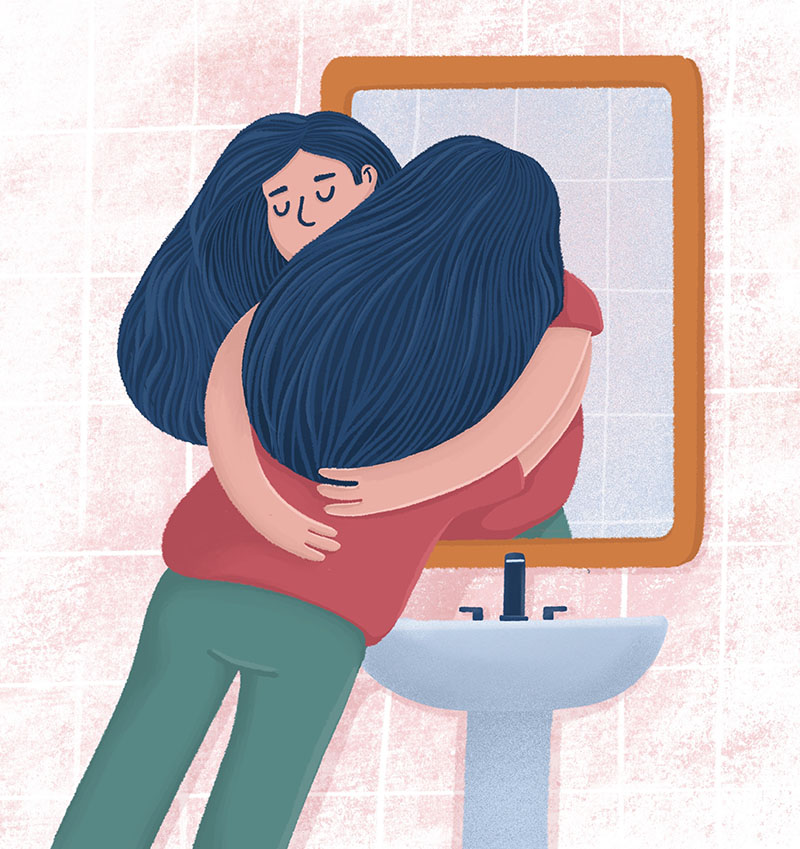

Stefani Goerlich on Becoming a Kink-Affirming Therapist

Defining Our Terms

Lawrence Rubin: Hi, Stefani. Thank you for joining me today. I’m just going to get right into it and ask you—especially for those readers who may not be fully aware—what is kink?
Stefani Goerlich:
kink is nonnormative sexual and relational expression
Kink is a very broad term, but at its most basic, simply means any sort of sexual or relational expression that falls outside of the social norm or mainstream for the people who are engaging in it. What is normal, obviously, varies from culture to culture. But kink is nonnormative sexual and relational expression.
LR: Are there certain standards for normative sexual behavior across cultures that make a place for kink?
SG: When it comes to relational models, polyamory versus monogamy here in the States for example, polyamory is considered a form of kink expression. They’re often sort of rolled in together. But if you go into parts of Europe or the Middle East, polyamory is a cultural norm. On the other hand, things like sadomasochism and sensory exchange tend to be considered somewhat atypical across the board. So there are some things that lend themselves more towards universal kinks and others that are much more culturally contextualized.
LR: For some of our readers unfamiliar with these terms, what are “sadomasochism” and “sensory exchange?”
SG: Within kink, most of what people talk about is BDSM, which actually encompasses several different, smaller sorts of acronyms. It’s a multipurpose concept that includes bondage and discipline, which is an exchange of control. Usually this means control of movement, control of behavior. Then, there’s DS—dominance and submission—which I explain as an exchange of authority between the partners. This may or may not include control of behavior. But often, authority involves decision making sort of power. S&M is sadism and masochism, which we as clinicians think about as pain, giving and receiving pain.

But pain is a very subjective term and varies widely based on the individual. When I’m training other professionals, I talk about sadism and masochism as the exchange of intense sensation. So, within kink relationships, we’ll have one or more of those three—an exchange of control, an exchange of authority, or an exchange of sensation.
LR: So, that exchange of sensation does not necessarily include sexual sensation—direct stimulation of the genitals, which is only one subset of sensory exchange or pain?
SG:
We tend to assume that kink is sexual. But kink, in its most basic, is relational
Absolutely. That’s actually true for all three. We tend to assume that kink is sexual. But kink, in its most basic, is relational. Kink can sometimes be sexual in how it’s expressed. But ultimately, it is a relational form. So you’re right that the exchange of sensation might never involve sexual contact. It could be temperature. It could be impact. It could be electrostimulation. There’s a wide variety of sensations that can be exchanged that never involve removing one’s clothing.

50 Shades of Confusion

LR: How has American pop culture impacted consumers’ (therapists included) understanding of BDSM?
SG:
I think that pop culture has definitely sexualized BDSM
I think that pop culture has definitely sexualized BDSM, but I also think that is true historically. I’m working on a new conference talk and potentially a new journal article that looks at 500 years of how BDSM practices have been portrayed in popular media. And they’ve often been conflated with deviant sexual behavior regardless of whether the people engaging in kink view it as sexual. So that lends itself to this perpetuation of kink stigma. We typically see BDSM signals or cues, like leather or somebody wearing a collar, and immediately sexualize those in a way that they perhaps might not mean for themselves and their relationship.
LR: I go immediately to my only pop culture experience with BDSM, 50 Shades of Grey. Given that therapists are certainly part of the consuming public, did the movie and book help or undermine our understanding of BDSM?
SG:
Unfortunately, the actual relationship the 50 Shades books portray is incredibly abusive
I’m deeply conflicted. I have a conference talk that I offer—or, now, in COVID times, a webinar—called “Kink Affirming Practice: What Your Clients Wish You Knew but Are Afraid You’ll Ask.” And I noticed that my rooms started becoming much fuller after the 50 Shades book and then the movie came out.

On one hand, E. L. James did a great job of bringing kink dynamics into the mainstream, where soccer moms, housewives, and school teachers were reading about this kind of relationship. It was no longer the secreted experience of buying the pulp novel from behind the counter at the adult bookstore. So from that perspective, it was fabulous.

Unfortunately, the actual relationship the 50 Shades books portray is incredibly abusive. It is not a healthy model of kink. And in fact, the only time I mention it in my intro talk is as a case example where I walk people through a case study and offer a few different scenarios. I then ask the participants to tell me if the various scenarios represent consensual kink or domestic violence. At the end, I ask them if they recognize my case study, which is 50 Shades. So, it’s done wonders for normalizing conversations about and knowledge of BDSM. But I think it’s done a lot of harm in terms of how people understand BDSM relationships to actually be.
LR: So 50 Shades sort of limited our understanding of BDSM by grabbing our focus and making it sexual and, as a result, the line that separates BDSM from intimate partner violence was blurred.
SG: And its normalized dominance as a form of coercion, as opposed to dominance as a gift that the submissive gives to their partner.
LR: This may seem like a weird analogy, but when the movie 101 Dalmatians first came out, the breeders were going wild breeding dalmatians. And around Halloween, black cats are oversold and many later abandoned or abused. Did 50 Shades of Gray drive people to the therapists’ office, partners wanting to experiment and their partners not being open to it? Did it increase your practice?
SG: I saw an increase in my conversations with members of the BDSM community who expressed frustration with an influx of people who had read these books and had decided that they wanted to explore kink, but who were coming into it with this unhealthy understanding of what kink should look like. And so a lot of my already kinky clients were very, very frustrated and upset with the sort of change in the zeitgeist of the community, and the way new dominants were expecting submissives to respond or were expecting behaviors to be okay that are not. And newly-identified people who wanted to explore their submissive side seeking out really unhealthy dynamics because they weren’t clear on what healthy kink looks like. So what I saw in my practice was long-time kinksters being very frustrated with the sort of new people that 50 Shades brought into that world.
LR: And I wonder if it also resulted in an influx of clients with already very disturbed patterns of relationships who now wanted to incorporate kink without having a sound, healthy relational foundation. I’d imagine that there needs to be a reasonably healthy pattern of communication and awareness of power dynamics before adding in kink.
SG:
the problem is when people who have never identified as kinky before start to take on a BDSM identity as a way to rationalize or contextualize their already problematic behavior
Absolutely! I think that in general, there is a lot that the BDSM community can teach the vanilla world about negotiation, about consent, about communication, about after-care. But the problem is when people who have never identified as kinky before start to take on a BDSM identity as a way to rationalize or contextualize their already problematic behavior.

When somebody who has struggled to form relationships because they have abusive patterns now decides, “Well, I’m a dominant and so the way I have a relationship with a partner who won’t leave me is to find a partner who likes being mistreated.” That sort of mindset misunderstands what it means to be submissive and also misunderstands what it means to be dominant.
LR: So this kind of person might say, “All these years, the people I’ve dated have called me abusive, but I’m really not. I’m just a dominant. And they’re not understanding. So, I need to find just the right submissive.”
SG: Exactly.

Kink-Affirming Practice

LR: Shifting gears a bit here, Stefani, what exactly is kink-affirming clinical practice?
SG:
Kink-affirming practice understands that kink is its own distinct subculture, with strengths and resources and things that we can use in clinical work with our clients
Kink-affirming practice is the understanding that kink is not just something that we need to know about. Most clinicians that I encounter will say that they are kink-aware. They know what BDSM stands for. They have a general understanding of the idea of kink. But that’s about where their knowledge ends. Kink-affirming practice understands that kink is its own distinct subculture, with strengths and resources and things that we can use in clinical work with our clients, and that we can leverage their kink identities in our treatment planning, in our intervention strategies, and really work with that in the same way that we would use any other aspect of our clients’ identities. So it’s taking it beyond “I understand this” and moving it into “This is a key part of your identity. And we are going to weave this into our work.”
LR: Just as a clinician working with any client is interested in tapping into their resources, you’re saying that a kink-aware therapist uses the person’s kink identity as potential for resources. Can you give me an example of what kind of resources for healthy relationships kink clients bring to you as a therapist?
SG: Sure, but I want to clarify—that’s what I mean when I say, “kink-affirming.” Kink aware therapists understand what kink is, but they might not necessarily have a structure for using that in their work with their clients. They just know enough about it to not cause harm or to stigmatize their clients for being kinky.

In kink-affirming practice, we would look at the use of protocols and rituals to enhance the work that we’re doing with clients perhaps with a trauma history or with a rejection dysphoria. Working daily protocols with their partner into their treatment planning can be really positive for them. If we’re working with somebody with disordered eating, for example, working with their partner—their dominant partner—to help establish rules around that so that they have accountability in their relationship in a way that doesn’t feel focused on their eating but becomes an act of service to complete a meal, can be a really healthy reframing for them.

Another great example for a dominant partner would be—I had a client who struggled with their own med management, blood pressure medication in this case. But they were very busy, and because it wasn’t a huge priority for them, their health was compromised. So we actually worked together to make it an act of service for their partner to remind them of their meds. It became, “Sir, it’s 6:00. It’s time for you to take your medication.” In another context, or one that was not kink-affirming, this reminder could have felt bossy or nagging, controlling. But we played to the strengths of their dynamic and made it something that felt like service to them. Both of these examples reflect a DS context.
LR: These two scenarios are perfect examples of how kink and BDSM are not necessarily about sexual gratification, sexual stimulation, or sexual experiences. It’s about a relational process. One aspect of which might be sexual. You brought up trauma, which is a whole other area. But it made me wonder if it might be a dog whistle to a kink-unaware or non-kink-affirming therapists to search for trauma in the history of these folks who bring their kink identities or practices into therapy?
SG:
One of the biggest misconceptions and biases is that people who identify as kinky are kinky because they have a trauma history
One of the biggest misconceptions and biases is that people who identify as kinky are kinky because they have a trauma history. Actually, when you look at the research and the data, it’s fascinating because people who identify as kinky do not have—they don’t report a trauma history any more than the general population. So trauma within the kink community is on par with trauma in the general community. Where we see a difference is that people within the kink community tend to report higher rates of PTSD than vanilla people. And what that tells me is that you don’t necessarily have more traumatized people who identify as kinky. But what you have is a group of people who have found an outlet and a cathartic modality that works for them who are then coming to kink as a way to further their own healing. So, I can understand why on the surface if you’re working with a heavy population of PTSD, you might make that corollary that, oh, kink is more prevalent in people with trauma. That’s statistically not true. But more likely, people with PTSD may be using kink as an outlet to process those feelings.
LR: What do you mean in your book when you say that consensual BDSM for trauma survivors can be an effective way of processing trauma memories?
SG:
Kink is not, in and of itself, therapy
I want to be really clear. We don’t have enough evidence to say that BDSM play is an intervention. We have some people who are doing that research. But we’re not there yet. Kink is not, in and of itself, therapy. But my background is with sexual assault and trauma survivors, and for a lot of people who have had their control taken away, who have been in situations where they have lost agency, lost autonomy, literally lost physical control over their bodies and their voices, kink can be very powerful. Being able to put themselves in a situation where they can say, “These are my limits. This is what I want. This is what I don’t,” to know with absolute certainty that if they say stop, things will stop. It can be very, very healing to put themselves in situations that offer similar sensory experiences to their trauma in a controlled, safe setting. So it works almost similarly to exposure therapy with a phobia. But it’s self-directed and self-controlled.
LR: When you talk about the healing potential of kink, I think about people who have had chronic health conditions or who have had to undergo medical procedures that have involved involuntary intense pain or submission to painful procedures.
SG:
illness and medical trauma can often be supported and processed through the use of intentional sensory experiences like BDSM
Emma Sheppard is doing some phenomenal work around using kink as an outlet for chronic pain treatment and using intentional chosen pain to offset and to recontextualize pain that perhaps we don’t choose. I know Lee Phillips, in Virginia, does a lot of work around chronic illness and BDSM. So there is a growing sort of small but strong number of voices working on exactly that—on recognizing that illness and medical trauma can often be supported and processed through the use of intentional sensory experiences like BDSM.
LR: If there’s anything I want the readers to take from this interview, it is the importance of that simple finding from research and practice that BDSM and kink in general are not necessarily about sexual gratification, which was the misconception you mentioned earlier. Are there other kink-related myths and misconceptions?
SG: I think there are a number. One of the big ones that I encounter is the idea that people who identify as sadists are intentionally or are diagnostically problematic and that we need to be vigilant around these sadistic clients because they are more likely to be offenders who are sublimating this violent urge into their relationships. Which, on one hand, if that is true for a given client, I would argue that’s exactly what we want them to be doing.

If they have a consenting partner who enjoys receiving the kind of aggressive sensation they want to be giving out, then, yay, we all win, and nobody’s consent is being violated. But we also need to recognize that there is such a thing as prosocial sadism—people who enjoy evoking these reactions in willing people who, in turn, enjoy receiving these sensations. We need to be mindful as clinicians to not assume deeper social or psychological implications here simply because our clients enjoy giving or receiving these intense sensations.
LR: I know that as a clinician, you’re also a certified sex therapist, so would assume that some clients seek you out for sex-therapy related issues, and others do not. What are some of the main concerns that clients bring to you?
SG:
people that perhaps are kink-unaware or kink-uninformed rush to assume that you’re kinky because you’re depressed, or you’re depressed because you’re kinky
I would say that even within my general mental health clients, a sizable number of them come to me because they know that they are kinky and depressed or and anxious or considering divorce. They want to work with somebody who is not going to tie threads that don’t need to be tied. So often—and this comes back to the question you asked about myths—people that perhaps are kink-unaware or kink-uninformed rush to assume that you’re kinky because you’re depressed, or you’re depressed because you’re kinky, or you’re anxious because you’re kinky, or you want to get divorced. Sometimes my clients just need a clinician who understands the way they like to have relationships or the way that they like to have sex, and that this is not necessarily connected with their mental health issues.

Another good chunk of my practice is people who are experiencing desire discrepancy between themselves and their partners, mismatched fetish interests, mismatched kink dynamic interests. I’m starting to look at those sorts of cases more as a mixed-orientation marriage than as a libido issue, because when we look at things as a desire-libido issue, we’re operating from the assumption that one person’s libido needs to be adjusted. When instead we look at it as a mixed-orientation relationship, neither person is wrong. Neither person needs to be fixed or corrected or medicated. We simply need to find the Venn-connection between their common erotic maps. So helping these couples through a mixed-orientation framework has become a big part of my practice.

And the last group is couples and individuals who are newly aware of or newly willing to discuss their interest in kink or polyamory. They’re coming to me for guidance and for a place to talk through and process these new ideas and new experiences as they start to enter into those initial sort of explorations and community engagements.
LR: So a kink-unaware therapist or a therapist who might be conflicted around their own sexuality or relational dynamics might be predisposed to see a red light flashing over the head of a client when kink comes into the room, rather than sort of hold it as just one of the other elements of the person’s identity.
SG: Exactly. There’s also just the resource knowledge. If we have a client who’s struggling with a substance use issue, if we have somebody that’s perhaps overusing alcohol, we can—most of us—have a conversation around several different treatment options for them. We can talk about AA versus Smart Recovery versus Dharma Recovery. We can talk about intensive outpatient versus going to rehab. But if you’re not kink aware or kink affirming, and a client comes to you and says, “I really want to explore this side of me and I don’t know where to start,” most of us are totally unprepared to talk about what conferences are best for somebody who’s curious about pet play versus age play versus BDSM, where somebody can go for educational content without an expectation that there’s going to be any sort of public play component versus somebody who’s interested in polyamory but maybe not swinging. Those are resources our kinky clients need to have access to. And as clinicians, we need to be able to have those conversations with them in the same way we would about any other community resource.
LR: Might there be a profile of the clinician who might be more susceptible to countertransferential responses to a kink client—a kink-practicing client?
SG:
The clinician who is more philosophically conservative and wedded to the sex addiction model is more likely to struggle when working with kinky clients and to pathologize BDSM and kink
I don’t know if I could say there’s an evidence-based profile. I can tell you anecdotally what I’ve encountered. The clinician who is more philosophically conservative and wedded to the sex addiction model is more likely they are to struggle when working with kinky clients and to pathologize BDSM and kink. I have several local colleagues who have told me, verbatim, that I’m the one they send the weird sex stuff to, which is fascinating because the weird sex stuff they send me tends to be masturbation.
LR: Oh, my! Blindness next, right?
SG: I mean I have a lot of conversations with referrals who are sent to me because they’re told they have very problematic sexual behavior. In their intakes, I’m like, “You are well within the margins of normal. Nothing you are telling me is at all concerning to me.” And I’m not saying that as a kink-affirming clinician. I am saying that just as a sex therapist.
LR: One of the things our readers will not be able to appreciate unless they look you up is that you have pink hair, you’re sitting in a pink chair with a statue of Wonder Woman next to you, and that behind you is a beautifully colored floral wreath. I don’t know if it’s macramé.
SG: Embroidered lace I brought back from Romania as we were fleeing Europe ahead of COVID.
LR: So I wonder if a therapist who is not as comfortable in displaying themselves as freely as you or who is struggling in their own relationships is going to have much more difficulty accepting kink clients.
SG:
I try very hard to be very cheerful, very colorful, very approachable, so that I don’t look like what people picture when they picture a kink specialist therapist
It’s interesting that you bring up sort of the color palette of things. Because one of the things I very intentionally try to do in my practice is to be very approachable to avoid that sort of black metal, sleek chrome look—I don’t want my office to look like a dungeon space. I want to look friendly and cheerful and approachable, partly because it’s so important to me to normalize these relationships for my clients, for my colleagues. And a huge part of that is looking normal in the work that I do. I mean the pink hair, I suppose, is maybe a little bit atypical. But I try very hard to be very cheerful, very colorful, very approachable, so that I don’t look like what people picture when they picture a kink specialist therapist.
LR: I wonder if clients who are on the verge of experimenting with or beginning to wonder what kink is, and who approach a therapist who is not particularly approachable—if the relationship will not work.
SG: I will say that every single year, I ask my accountant if I can write my hair dye off as a marketing expense because I hear from so many people that I look friendly and like somebody they could talk to because I had pink hair.
LR: Stefani, I’m going to be presumptuous here and say that I think you need to explore the power dynamics with your accountant. Perhaps you should be telling your accountant what is to be written off and push your accountant into a submissive position when it comes to that. A practice-what-you-preach sort of thing. Sorry, I couldn’t resist that one.
SG: I’ll let her know you said so.
LR: Is the therapist who has not practiced kink at any level capable of working with a client who either is kink practicing or contemplating kink practice or experimentation?
SG:
I don’t think it’s fair to ask our clients to pay us to use their therapeutic hour to teach us what we need to know to do the work with them
I think so. I think that, in the same way that I don’t necessarily have to be gay to work with a gay male couple, I simply need to be willing to educate myself and empathize with them and respect them, that other people can work with kinky clients if they’re willing to do that same work. I actually think it can sometimes be easier because when I’m doing case consultation with peers who themselves are kink-identified, that’s where I see countertransference. That’s where I see, well, the way that their relationship is set up or the way that they’re doing kink isn’t the way I think that kink should be done. And so we have to have conversations around your kinks, not their kink. But that doesn’t make their kink wrong. At times, it might actually be easier to have somebody who is very affirming, but not necessarily kinky themselves, doing that work.

I think that one caveat I would add is we need to be willing to let clients teach us about their dynamic and the way that they do kink. I do not think we should be looking to our clients to educate us about kink in general. We need to be pursuing continuing education. We need to be reading books or watching documentaries or attending conferences written by members of the kink community. We need to be educating ourselves, and then asking our clients, “What does this look like for you?” I don’t think it’s fair to ask our clients to pay us to use their therapeutic hour to teach us what we need to know to do the work with them.

Hard Places and Soft Spots

LR: When should a therapist consider referring a client who may be reconsidering their relationship style and/or sexual practices to include kink practices?
SG: I think, if it’s not something that you’re willing to—if it’s outside your scope of practice and you’re not willing to do the work of learning, then you need to refer. And it’s okay to be uncomfortable with something. I’ve worked with clients whose individual practices or particular fetishes made me uncomfortable. I’ve referred a couple of people out whom I simply know I can’t provide unconditional positive regard to. Not because there’s anything wrong with them. But because I just know where I’m at. So if you are encountering a client you are unprepared to work with and unwilling to educate yourself to do the work with, you have an ethical obligation to them to connect them with somebody who can and who will.
LR: You said that you will refer some clients and you talked about fetishes. Are there some fetishistic behaviors that go beyond your level of moral acceptance? I mean, when would a person’s fetish be such that you would need to refer them, since I’m sure you have seen and heard it all.
SG:
Moral is tricky because my clients, both kinky and non-kinky, engage in all sorts of behavior that I have moral issues with
Moral is tricky because my clients, both kinky and non-kinky, engage in all sorts of behavior that I have moral issues with. If somebody’s stealing from their employer, I have a moral issue with that. I think that we tend to ascribe socially greater moral weight to sexual things than to nonsexual things. But that doesn’t make it any more or less moral. So I don’t know that I want to define it as a moral thing.

But for me, in terms of comfort, really diving into the details of somebody’s experience, where I’m able to sit and hold space for a given narrative, people who are zoophiles—that’s something that I personally struggle with.

Thankfully, I have colleagues I can refer out to. And I do. And again, I’m not necessarily putting a moral weight on that. It’s just I can’t be what they need. I work with people who struggle with pedophilic urges. And I’m comfortable doing that. I’m a member of the Association for the Treatment of Sexual Abusers. I’m comfortable working with non-offending pedophiles. I don’t work with actively offending pedophiles. But for the most part, those are the two big ones for me. I have people that engage in a lot of niche fetishes that some of my peers struggle with, like coprophilia. So, most things I am fully capable of holding space with. For me, really, just in terms of being able to sit and hear the stories and process and be present for, those are the two that I refer out for, personally.
LR: So, like any competent clinician, you have your boundaries. What kinds of concerns around BDSM do you hear from parents who have concerns for their children and teens?
SG:
I have such a soft spot for kinky adolescents because they are completely adrift
I have such a soft spot for kinky adolescents because they are completely adrift. There are very few ethical resources available to young people who identify as kinky. And it’s tricky because when we interview kinky adults, most of them say that they first recognized an interest in kink starting around age 10, if not a little bit earlier. So, most people who are kinky knew they were kinky early.

And we have a huge population of young people who know that this is a part of how they form relationships, how they give and express affection. And yet they can’t attend kink conferences. They can’t go to BDSM events. And absolutely, we have to be aware of predators and of problematic situations. That’s because, when you’re talking about power exchange in young people, you want to make sure that they’re capable of consent. So, there are really no great answers. I think where I focus with parents is on recognizing that BDSM is a healthy relational expression, on normalizing BDSM as something that can be done in a safe, consensual way, on recontextualizing power exchange as not coercive and grooming behavior, but as a future relationship model their children may aspire to. Even though they’re not adequately able to enter into a dynamic like that now.
LR: Research tells us that children who are victimized by sexual and physical abuse are at higher likelihood of becoming abusers themselves. Is kink interest in children and teens a potential risk factor for them? Especially for trans youth, who are at even higher risk for adverse outcomes?
SG:
providing gender-affirming care to young people is so fraught and contentious that we haven’t even gotten as far as people being able to have a conversation around affirming kink identities
I honestly don’t know that I could speak to that. I don’t know that there’s been enough research. And I think right now, the conversation around simply providing gender-affirming care to young people is so fraught and contentious that we haven’t even gotten as far as people being able to have a conversation around affirming kink identities in gender nonconforming young people. I think that might cause heads to explode in ways that are not fair to young people.
LR: I’m wondering if there’s a hierarchy of kink practice and kink fetish that can be ranked in terms of likelihood of bringing ire to parents and people in general?
SG: SG: I think somebody’s gender identity is such a core aspect of who they are that that has to be supported and affirmed before any sort of relational preference or sexual expression could ever be hoped to act on. They can’t have a happy, healthy, consensual power exchange relationship or engage in a happy, healthy, sensory exchange relationship if they’re not happy and healthy in who they are as a human. And so their ability to engage in any sort of relationship model—kinky, vanilla, or otherwise—is really predicated on our first affirming them and their gender identity to start with.
LR: So healthy kink practice requires healthy personality development first.
SG:
I don’t know that we necessarily need to be rushing to include kinky young people in the broader kink community
Absolutely. As you know, the last part of the brain to develop is the area that controls cause and effect thinking, good and ethical decision making, and being able to anticipate outcomes. And all of those skills are necessary in order to truly negotiate with a potential partner and especially when it comes to BDSM and kink—in order to be able to consent to some of the things that kinky people do. So, I think that supporting young people in their identity formation, in affirming their gender identity, in teaching strong consent culture early and often and bodily autonomy and sex positivity—these are all ways that we can support kinky young people. But I don’t know that we necessarily need to be rushing to include kinky young people in the broader kink community. I think that we need to give them space to be able to have the adult conversations that kinky people have around negotiation of scenes and relationships.
LR: What might be the relationship between the age of the therapist and their capacity to embrace broader elements of identity like kink? Or is it more a matter of the developmental level of the therapist rather than their age?
SG: I don’t know that I would want to speak to that. I feel like it might be far more generational. I think that my son’s generation is so much more inclusive and eager to affirm and accept people with diverse identities and experiences in a way that my parents’ generation really struggles with. And I know that as a Gen-Xer, we try really hard to always get it right. So, I don’t know if it’s an age thing so much as it is a generational thing.

Unanticipated Outcomes

LR: That makes a lot of sense. From your own clinical experience, can you share an unanticipated success story and an unanticipated unsuccess story—I won’t call it “failure”—around working in the kink domain?
SG:
it broke my heart a little bit because they deserved to—whatever their identity was—be affirmed in that
When I first went into private practice after leaving agency settings, I was still in sex therapy supervision. And my very first gender nonconforming client was a person who had lived as a heterosexual man their entire life, who had always struggled with thoughts that perhaps they would be happier as a woman and had come to therapy to explore this. Being me, I was very, very, very excited to help explore this. And we had many wonderful conversations and I offered lots of activities and resources. One day, they came in and said, “I don’t want to do it. It’s too hard, and the payoff isn’t worth it. If I were to announce that I am a woman, I would lose my children, I would lose everything I have. I’ve been doing it this long, I can keep doing it. Sure, it would be nice. But, at the end of the day, the reward isn’t worth the risk and having these conversations is just too painful. So, I’m done.”

There was nothing I could say to that. You have to respect everybody’s process. But it broke my heart a little bit because they deserved to—whatever their identity was—be affirmed in that. Whether that was a heterosexual cis-man that just liked wearing dresses every so often, or whether that was a complete reshaping of their gender identity, I wanted them to be loved and accepted for who they were. And after having so many conversations about what it would be like if they could have that, to have them come in and say, “I just decided it’s not worth trying,” was really—it made me very sad for them.
LR: Perhaps it’s the therapist or supervisor in me that says, maybe it wasn’t really a failure. You created a space for the conversation. And they weighed the pros and cons and did what was best for them, even though you would have hoped that they could have done what was better for them, rather than just best. How about another experience from the—you’re glowing—oh, my God—this was wonderful and…
SG:
I am very much—as you might guess—not a kink-shaming person
I had a client who said that she was in a 24/7 DS relationship, but that it didn’t feel comfortable for her and she wanted to work through her feelings because her dominant was telling her that she wasn’t doing DS right. He wanted her to come to therapy to figure out how she could be a better submissive. And I am very much—as you might guess—not a kink-shaming person. But about two months into this, I paused mid-conversation and said, “I want to print something off, and I want to show it to you.” I went to my laptop and printed off the Duluth Model of Domestic Violence Wheel of Power and Control. I said, “I want you to tell me whether or not anything here looks familiar to you.” And she pointed out—I gave her a highlighter—and she started highlighting a whole bunch of things. And she said, “Well, yeah. But this says, ‘Power and Control.’ This is just what DS is.” And I said, “But how much of this did you agree to?”

I then asked her, “How much of this is okay, because not everything on here can be healthy. And sure, there are things on the Wheel of Power and Control that can be negotiated. Absolutely. Name-calling—absolutely. If that’s your thing, go for it. But there are some things like threatening to harm pets or children that are never a part of—and it seems sort of counterintuitive considering the conversation you and I have had.” Looking back on that powerful interchange, I was able to help somebody understand that they had been gaslighted by their partner into thinking that she was just a terrible submissive, and, if she was just a better submissive, they would have a great relationship. She understood at that moment that this was not kink, that this was a really abusive relationship—and that was very hard.

That was the start of about two years’ worth of work. She ended up moving out. He ended up making some threats to me. I had to have security walk me to and from my car for quite a while. And then she terminated. And I was worried about her. But last summer, out of nowhere, I got a text message saying that she had moved across the country and she had gotten her dream job and she had a new dog that she’d always wanted to have that he would never have let her have. It was a very lengthy text message. And she was just living her best life. And she told me that she would never have thought that she was capable of doing that if she hadn’t had me look at her and say, “This isn’t what kink looks like.”
LR: It is wonderful to have those kinds of memories. I could not possibly end this wonderful conversation, Stefani, without asking you the significance of the Wonder Woman action figure on your desk.
SG:
Wonder Woman originally was intended to represent a new vision of womanhood that was intended to challenge patriarchal norms
I love Wonder Woman. William Moulton Marston, the creator of Wonder Woman, not only invented the first lie detector, but he created the DISC personality profile, which is one of the first attempts to actually use the concepts of dominant and submissive. He tried to sort of codify what those personality types looked like. And Wonder Woman originally was intended to represent a new vision of womanhood that was intended to challenge patriarchal norms and to challenge relationship models and to give young people a new vision for what relationship dynamics could look like.
LR: Does Gal Gadot capture the essence of what Marston envisioned?
SG: As a Jewish woman myself, I love having a Jewish Wonder Woman. She is my favorite.
LR: There was an ad in a magazine in the ‘40s that featured Wonder Woman strapped to a lie detector. I wonder if that was a subtle domination image—not so subtle actually.
SG: Not so subtle. Golden Era Wonder Woman had some pretty overt bondage themes. Marston was in a DS relationship with his partners—a DS poly relationship with his partners.
LR: Well, we’ll leave our readers with that, and I thank you, Stefani.