Seeds of Self-Compassion

“If your compassion does not include yourself, it is incomplete.”
— Jack Kornfield

My therapist was attuned to me. She was speaking, I thought, "eloquently like poetry,” as I sat across from her, feeling held, listening to her, reflecting her own authentic experience of being with me.

I was in a good place in my life with a stable, happy family—my husband and I filled with pride and happiness at seeing the joy in our toddler's life. I was saying how much I treasured what I had built with my husband; a close and loving family, and celebrating and creating family traditions, especially as I had not known that warmth and security as a child. Receiving a gift one has never had makes it so much more precious.

Like what you are reading? For more stimulating stories, thought-provoking articles and new video announcements, sign up for our monthly newsletter.

As I continued talking, I noticed my therapist's face fill with sadness and tears forming around her eyes. I thought to myself "Oh, she must have had a very hard time as a child" and I blurted out to her, "I hope this doesn't remind you of your own pain and what you did not have as a child.” Then I quickly added, "Anyway, I don't want to hear about that!” This was my therapy, after all! As someone who is well attuned to the other’s emotional state, I didn’t want to be burdened with the responsibility of having to take care of my therapist and her feelings in these sessions.

My therapist's face softened as she explained that she was merely reflecting what she was feeling, listening to MY story, and that although I was in a happy place in my life now, my story was tinged with sadness and loss for what I had missed as a child, and that was the reason for her tears. I allowed what she had just said to sink in and inhaled long and deep.

I have always been critical of that unhappy child (the younger me), holding her responsible for the unhappiness of those around her, and fervently refusing to feel compassion for her own suffering. Connecting with the genuine compassion that my therapist felt for the younger me, I began to feel compassion for the little girl (or rather me in my tweens, with the unhappy, angry face, the dark and clouded me) and I allowed myself to feel the grief and sadness that came along with it.

This was a pivotal experience for me, both in my personal growth and in my growth as a psychotherapist, for this is when I learned experientially that it is only by cultivating self-compassion that one can find true healing—and it was my therapist's own authentic and compassionate stance towards me that helped me find my way back to it.

In my role as a psychotherapist, I am now better able to help my clients, especially those who carry the burdens of childhood emotional neglect, by seeing beyond their fierce independence, their overly self-reliant front, to their core empathic selves that deeply cares about others—helping them to experience that their feelings matter, and more importantly that they matter. 

#DigitalTriad

17-year-old Ellie and her mother sat on my office couch ready to discuss how Ellie’s mood had been since starting on an antidepressant medication. Before getting started, Ellie’s mom handed me her credit card to pay for the visit. Again, my phone’s app wouldn’t respond but after some fiddling, finally accepted the payment. Forgetting to mute my phone for this first appointment of the day, I set my phone on the table next to my chair. As soon as Ellie began sharing about her first few days of school, my phone beeped alerting me to a call waiting on my office line. I apologized to Ellie and her mother, muting my phone and moving it behind my chair. After briefly discussing how Ellie was feeling, I asked her mom to leave so that Ellie and I could talk privately. Before I could begin to explore Ellie’s mood in more depth, she excitedly pulled out her phone and showed me Instagram posts of several cheesecakes she had created from her own recipes. Beaming, she told me that she hoped to one day become a chef. I praised Ellie for her creativity and work. I was pleased to see such excitement from a girl who, a couple of months ago, couldn’t name anything that she did for fun.

One of the earliest lessons I learned in residency was the importance of tuning into the emotional and physical cues of everyone in my office. Lectures described personality types, relational dynamics and defense mechanisms such as transference and countertransference, all issues important in understanding patients’ complex lives. Now years out of training, I have become comfortable integrating all these concepts into my patient interactions. However, recently I have become aware of a surreptitious invader into the safe space that I have created in my office: technology.

Like what you are reading? For more stimulating stories, thought-provoking articles and new video announcements, sign up for our monthly newsletter.

Technology has become ubiquitous in our personal and professional lives. Before I have arrived in my office in the morning, I have used my phone and often my computer. Both have become integral in my work used to communicate with patients, track visits, collect payment and carry through a variety of medically necessary tasks. It is the third entity in the room during every patient visit. However, I have always felt uneasy about the presence of my devices in my space, especially when they creep into my patient encounters. Experimenting with my laptop placement, I tried resting it on my lap as I attempted to simultaneously type and listen to patients as they discussed their concerns. Uncomfortable with my computer’s interference, I returned to handwritten notes, dismissing my laptop to my desk. Not long after, my smart phone eased its way to my side table, an arm’s length away to collect payments and research medication questions. I wondered if my patients felt its intrusiveness as it sat waiting to alert me to some call, text or other notification. I quickly learned to not only turn off my phone off during patient visits, but to move it out of our direct line of sight when a patient is in the room.

All of this has left me wondering how we as mental health providers can invite technology into our practices with intention. While devices can be invasive and disruptive to my connection with my patients, I also realize that these digital instruments can be helpful, even mandatory, in our work. As professionals whose work depends on engaging in and modeling healthy relationships, understanding the presence of technology in our practices is critical.

The very physical presence of technology can have both a behavioral and emotional impact. A 2019 study by Glas and Kang showed that college students who were allowed to have their phones and computers during class scored lower on final exams than their peers. The proximity and intrusiveness of our devices can impact our work with patients. Turning devices off or placing them on mute, putting devices out of site or, at the very least, removing them from between us and our patients, can help reduce the disruption of the person-to-person interaction. Not only are we modeling prosocial behaviors for the people who we work with, we can use our own behaviors to highlight the impact of devices in our lives. I have placed a basket in my office for devices that prove too tempting and distracting for the youth and families that I see. It is kept near the door so that, physically and visually, it is removed from our interaction.

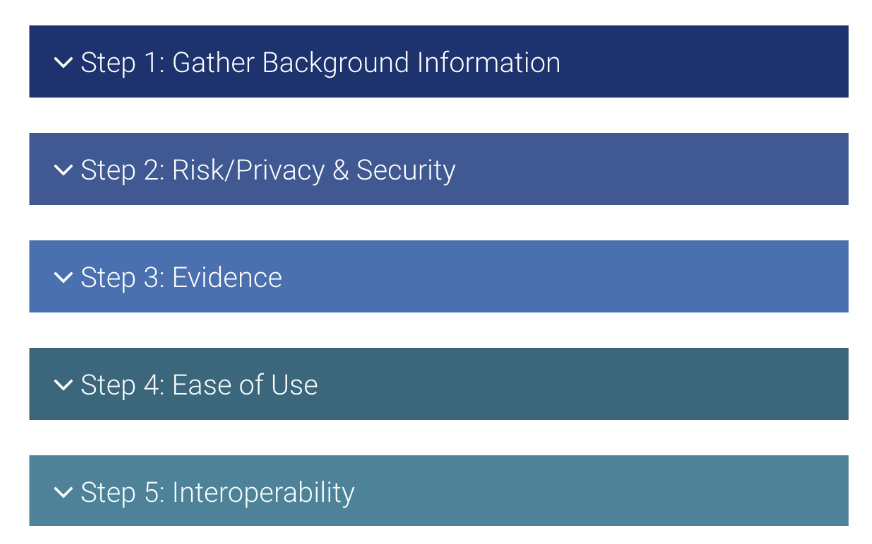
On the other hand, technology can be an important tool in our work. For my children and adolescent patients, using apps to track mood and sleep have yielded more cooperation than tracking those metrics on paper. Apps that track mood and anxiety symptoms can help individuals share their symptoms with their doctor or therapist. As professionals, we can guide our patients in choosing apps that best meet their needs. Apps are not regulated and there is little oversight into their creation or claims. We can help our patients become better equipped to choose apps that are helpful rather than harmful. The American Psychiatric Association has created guidelines to assist professionals in helping individuals choose the best mental health related apps. The APA has developed the App Evaluation Model that can help providers evaluate the appropriateness of an app with their patients. (see figure)

Technology can also help us learn more about our patient’s interests and can assist us in forming a better treatment alliance. Asking a teenager about his or her Instagram or Snapchat accounts can lead to discussions about personal interests, friendships and conflicts with peers.

Technology is not leaving anytime soon and is likely to gain a greater presence in our personal and professional lives. When we are proactive about recognizing where technology can enhance or interfere with our work and connection to the people we care for, we can become better equipped to optimize its presence and function in our professional lives.

References:

Arnold L. Glass & Mengxue Kang (2019) Dividing attention in the classroom reduces exam performance, Educational Psychology, 39:3, 395-408

The American Psychiatric Association, https://www.psychiatry.org 

The Importance of Admitting a Mistake in Therapy

My patient, Karen, emailed me saying she had come to my office for our appointment and I was not there. Oh my God! I had it written down in my scheduling book, but decided it was a mistake and crossed it out. I didn’t call or email her before the session to confirm that it was cancelled. I didn’t go to my office at the time of the session to make sure I didn’t make a scheduling mistake. It was obvious to me that this was countertransference. I responded to her email saying I was very sorry for my mistake and that I would see her at the next appointment. Then I started to think about what this “mistake” meant.

Like what you are reading? For more stimulating stories, thought-provoking articles and new video announcements, sign up for our monthly newsletter.

I thought about what had been going on in recent sessions. She had been changing appointments frequently, so maybe I was angry at her for treating her therapy (and me) so casually. Then I thought about our last session—it had been particularly difficult. At one point in the session Karen said she thought therapy was about learning lessons.

“What kind of lessons?” I asked.

“You know, you’re the therapist, you tell me what I’m doing wrong.”

“Therapy isn’t about lessons or showing you what you’re doing wrong. It’s about understanding how you feel,” I said.

“I know it isn’t about lessons. I’m not stupid,” she responded tersely.

I knew this was going in a bad direction. How was I going to get the two of us on the same side again?

“Let’s take a time out, okay? Let’s look at what’s going on between us,” I said.

She nodded, but in a stilted way.

“You said you thought therapy was about lessons about what you do wrong,” I said. I thought I was just going back to the beginning of the interchange so we could trace the steps.

“No,” she protested, “I never said the word ‘lessons’, you used that word, not me.”

She was defending herself from what she experienced as my criticism and she also didn’t believe me.

“You sound angry,” I said.

“Not angry. I’m frustrated. You don’t get it.”

“What is it that I don’t get?” I asked.

“You want to go in a direction and you’re just focused on that,” she said.

I understood that this was her mother transference. She felt her mother had constantly criticized her and didn’t tell the truth. She had told me, in earlier sessions, that her mother had her own agenda. Discussions were never about Karen and her needs.

“You seem to feel therapy is not for you. I have my own agenda and it’s telling you what’s wrong with you.”

She was quiet for a few moments. Then she said, “It’s strange. I don’t feel therapy is for me.”

The session was over and I sat in my chair for a while after she left the office. I felt beat up. The next session was the one I missed. I decided it must have been cancelled! I acted out my unconscious wish.

When Karen arrived for the next appointment, I apologized again. She said it was okay, shrugging it off. I asked how she felt about arriving at my office for her session and finding I was not there.

“I thought I made a mistake,” she said.

“That’s curious, isn’t it, that you thought it was your mistake?”

“Well, I figured you would say I got the time confused,” she said.

“You mean, you thought I would blame you?”

“Yes, I guess I’m used to being blamed when things go wrong. My mother never admitted being wrong about anything,” she said tearfully. “I don’t think anything is for me,” she continued. “It’s always for someone else and I get blamed for everything that goes wrong. I think I’ve been living like that for a long time.”

Admitting that I made a mistake was a breakthrough in the treatment. It made Karen aware that she didn’t trust me. She expected me to blame her for my mistake as her mother would have done. The fact that I took responsibility for my mistake helped her begin to understand that she often feels criticized unjustly and when she defends herself, she expects the other person to respond like her mother.

Missing the session was also a breakthrough for me because it made me realize the depth of my reaction to her mother transference toward me. I know that her constant defensiveness and distrust of me will not end because of her new insight, but this episode was the beginning of a working alliance, and I think my ability to withstand her defensiveness will be enhanced. While I was at first mortified that I had missed a session, now I was hopeful that her insight that she was treating me as if I was her mother, would help to grow and deepen our work. 

Managing Emotion in Sports

Whether it’s the anger-fueled drive that results in the winning goal or the disgust over a ref’s call that ends in a turnover, emotion is almost always present in sports.

The field of sports psychology is relatively young and is comprised of various disciplines such as mental performance, mental health, coaching education and leadership development. As universities are hiring in-house sports psychology practitioners to improve the performance, wellbeing, and leadership of athletes and coaches, high schools across the country are beginning to follow suit. While I continue my journey in the field of counseling psychology as a 4th year doctoral student at UW-Milwaukee, I also help area teams and individuals improve their mental performance through my performance consulting practice.

Like what you are reading? For more stimulating stories, thought-provoking articles and new video announcements, sign up for our monthly newsletter.

One of my major clients is a high school in Southeastern Wisconsin, where my role is to work on an integrated team that oversees the 22 sports programs at the school. This team is comprised of an athletic trainer, school counselors, strength and conditioning coaches, head coaches, and administrators. Each part of the team comes in contact with student-athletes to help them improve, and my role as the mental skills coach is to help athletes enhance mental and emotional aspects of training and competition that are sub-clinical in nature. Should elevated risk become apparent, student-athletes are referred to the school counselor.

Following an early season mental skills session with the girls track and field program, an assistant coach approached me with an athlete I had not yet met. Anna, a shotput and discus thrower on the team, asked if I would be willing to work with her to improve her confidence and the mindset she carries into competition.

After we chatted for a bit, it became clear that Anna was looking for two things. First, she directly discussed her lack of self-confidence and asked for help improving it, and secondly, she alluded to an inability to manage her emotions when she was in the throwing ring at competitions.

Throughout the season, Anna and I met during practice to discuss progress made toward becoming more confident when competing. Things seemed to be trending in a positive direction as she was able to improve her self-talk, visualization, and acceptance of things she cannot control, all elements to improving confidence in sports. She was achieving high grades in her advanced-placement courses and was throwing better and better at each meet. While the championship season approached, Anna, like so many other high school athletes, started to doubt her ability to complete a successful season, yet was excited to throw at the upcoming Regional Championships coming.

After throwing a personal best in both shotput and discus at the regional championship, Anna qualified for the sectional championships—a goal she’d had since beginning her athletic career.

Despite having achieved her goal, at the sectional meet Anna seemed to lack the confidence and poise that had become a staple in her competition game plan. She scratched her first throw in discus and under-performed in her next two. With three throws remaining, Anna was feeling the heat. Her coaches continued to give feedback on technique, and finally she came up to the coach’s box where I was watching her throw.

“You look really angry, and your body language is showing it,” I said. This was a tone not typical in my repertoire, yet the situation called for a direct approach as time was an imminent factor.

“Yeah, my first three throws were horrible and I’m not going to make it to state,” she responded.

“Has being angry been helping?”

“No.”

“Has telling yourself you’re not going to make it to state been helping?”

“No.”

“Am I way out of line to think that maybe we need to try something new?”

“No.”

“How can we manage our anger right now?”

“Let it go?”

“Yes! We’ve been working on a lot of breathing and that may help but find a way to bring your anger down a little during these next few throws and let’s go from there.”

“Alright, yeah, that sounds good.”

Anna closed her eyes, focused on her breath, and looked visibly more relaxed heading into the next few throws. She qualified for the state meet on her fifth throw, delivering a new personal record in discus. Carrying her relief into shotput, Anna set another personal record to qualify in her second event.

Two weeks later, after setting a new discus school record at the state championship and the largest stage of her career, Anna sat in the stands discussing her progression throughout the season.

“I just got in the ring and relaxed,” she said. “I don’t know, I just let it go.”

As the mental skills coach, I could not have been prouder.

My joy for Anna didn’t come from some sort of vicarious experience through her state championship run and school record toss, but rather in her ability to acknowledge her areas for growth, seek out someone to help, and engage in the journey to improve. The end result was the product of intrinsic motivation and facing up to vulnerability week in and week out.

Not once did Anna need to “calm down” nor was she ever told that her emotions were “getting in the way” It wasn’t implied by anyone who she trusted to work with. Instead, she was empowered by her coaching staff to find ways to manage what she was experiencing and go after her goals with all she had. She was tough, and her fighting spirit shone through in the good times and the bad.

No matter how you identify or what you do, emotions are not inherently bad. They’re just a piece of the puzzle that can be analyzed, managed, and at times, utilized. Anna was encouraged to strive for more, but not at the cost of her self-identity or personal values. She showed up on the biggest athletic stage in her career and found success by sticking to her values and game plan; and having a little fun along the way.  

Equine Facilitated Psychotherapy: The Healing Power of Horses within Clinical Practice

Horses are amazing, beautiful animals—everyone knows that. I’ve had a mild obsession since my first riding lesson at age six (Thanks, Mom and Dad!). After twenty-two years of competitive riding, and a few degrees later, I was eager to incorporate horses into my clinical practice. During graduate school, I took a course entitled Animal Assisted Interventions, and while it certainly sparked my interest, at the time I didn’t put a lot of thought into it. My primary focus at that moment, like most recent graduates, was finding gainful employment. Three years later, I found myself wanting to combine my two passions: therapy and horses. At the beginning of 2019, I was able to do just that—I started offering Equine Facilitated Psychotherapy at the North Carolina Therapeutic Riding Center in Mebane, NC.

Like what you are reading? For more stimulating stories, thought-provoking articles and new video announcements, sign up for our monthly newsletter.

Equine Facilitated Psychotherapy (EFP) is a relatively new framework within the mental health field. Experts have long agreed on the healing power of animals, which is evidenced by the recent surge in emotional support animals. Although, I find comfort in simply being around animals, there has always been something unique about horses. After doing quite a bit of research, what I always suspected to be true was confirmed: horses mirror human emotions. Even non-horse people have heard, “if you’re afraid while you’re riding a horse, the horse can sense it.” The reason behind that is the horse’s ability to respond to and interpret non-verbal communication offered by humans.

EFP is deeply rooted in observing the horse’s feedback to a client—and then connecting that information to the individual’s life. For instance, if a client has mild anxiety but can present more confidently, the horse will likely still pick up on that anxiety and may take a few steps back when approached by the client. This interaction then holds space for a conversation around the client’s anxiety which may have gone unnoticed in a traditional office setting. Angela Dunning, author of The Horse Leads the Way, notes, “subtle changes in breathing, heart rate, muscle tension, nervous system, and energy levels offer invaluable information about our true emotional state. Therefore, because horses fully inhabit their bodies, their inherent ability to pick up on these subtle changes is one of the main reasons why equine facilitated practice is such a powerful method.” If a client is not making marked progress within the confines of office, EFP is a great option to have.

Trust building is another large component of EFP, highlighted by granting the horse an option to participate willingly. That is, we emphasize the horses’ consent in activities by not tying them and forcing their involvement. To a client that may not have a lot of autonomy in their personal life, the treatment of the horse speaks volumes. Further, when the horse chooses to participate in the session, the client feels a sense of accomplishment in building trust in that relationship. When a horse makes a choice about whether to participate in an activity, it encourages dialogue around emotional regulation and past trauma, and paints a picture of patterns within interpersonal relationships.

The benefits of EFP are endless, as it can address a broad spectrum of mental health concerns. Aside from the therapeutic results, Equine Facilitated Psychotherapy can also encourage professional growth in mental health practice. Although I personally have an equine background, it is not necessary for the mental health professional practicing EFP to be a seasoned equestrian. PATH Intl guidelines require both a mental health professional and an Equine Specialist to be present in each session. The Mental Health Professional’s primary focus is the client and interpreting feedback as it comes up. The role of the Equine Specialist is equally important, as they operate to keep the horse, and all human participants, safe. The Equine Specialist and Mental Health Professional collaborate to plan activities for each session, which encourages a partnership between the two roles.

Recently, I have been working with a teenage client who was placed in foster care. This client entered treatment with the implicit disclaimer: I will likely not talk to you, and when she first arrived, understandably she was eager to keep me at an emotional distance. With all clients, the first activity I utilize in a session is “Observe the Herd.” This activity is exactly what it sounds like: you ask the client to observe a herd of horses, and describe what they believe the horses are doing and feeling, and why they may be feeling that. This particular client pointed out that one of the horses had walked away from the other, and the horse left alone felt scared and nervous. This provided me with insight into how the client has felt since being removed from her family and guided the structure of further interventions. Though this client was guarded with me, her interaction with the horses was the complete opposite. For instance, when taught to communicate with the horse in order to walk her around the arena, the client was very attuned with the horse's feelings. The horse started to turn, without the client directing her to, to which the client responded, "Oh, do you want to go that way? Okay, we can go that way," while rubbing the horse's nose. She then noted, "I don't want her to feel trapped." That sentiment offered insight into how the client was feeling within her current circumstances, as well as provided a chance to further the discussion about how the horse may feel.

At the beginning of each session, we begin by brushing the horse and catching up on the previous week. During this time, this client is often tearful when articulating her desire to return home. Without fail, the horse she is brushing turns around and nudges her, looks at her or acknowledges in a meaningful way how the client is feeling. She has since formed an amazing relationship with a horse at NCTRC and is quite possibly one of the most open and honest clients I’ve encountered. Through EFP, this client has been able to form a trusting relationship—first with a horse, and then with me. The progress she’s made is truly remarkable.

Equine Facilitated Psychotherapy has completely transformed the way I approach my clinical practice and my lifelong relationship with horses. EFP is a growing presence in the mental health field, and one that—if you have the opportunity—I highly recommend finding out more about.  

Nightmares are Easily Treatable, Though Too Few Seek Help

Nightmares are common and distressing phenomena that often co-occur with anxiety, depression, stress and trauma, and they are one of the main symptoms of trauma-based pathology. Most people who suffer from nightmares have no idea how quick and easy it can be to stop or change their distressing dreams. Yet, in my experience, and as the literature suggests, clinicians may veer away from focusing on their client’s’ nightmares for fear of potentially making things worse, especially when those nightmares occur in the context of trauma.

Like what you are reading? For more stimulating stories, thought-provoking articles and new video announcements, sign up for our monthly newsletter.

A client I will call Jill woke up with a start, her heart pounding, the fear of being chased by a dark, unknown pursuer still a fresh and very real sensation. As she looked around her bedroom, it dawned on her that she had just experienced a version of the same recurring nightmare that had haunted her since adolescence. Such dreams often revisit in times of stress. They disrupt sleep and can fill the dreamer with dark, foreboding feelings or disturbing images that persist, sending daytime thoughts down darker pathways than they might have gone.

In our therapy session, Jill and I explored the dream, first its setting which was a mix between an office building and her childhood home. The dream ended with Jill crouched on the small balcony outside one of the top-floor bedrooms with the door just opening, the dark man about to find her and try to kill her. In exploring the dream, I invited Jill to pick up a few resources along the way. For example, her gym bag at the front door brought her a feeling of strength and speed as she recalled how she used to compete in distance running. Still an athlete, she sensed how at home she feels in her body. Bolstered by this, she allowed her dream to play forward, following my instruction to simply let it unfold as if she had just pressed play on the dream scene.

When she did this, Jill opted to use her sense of power and speed to leap off the balcony and run through the air, flying away into the night. In other versions of this common pursuit nightmare, dreamers like Jill have chosen to turn and face their pursuer, and often this leads to a conversation that softens the entire encounter, bringing some peace and understanding between aggressor and dream ego. Like any true encounter, the outcome is unpredictable, but in most cases, interacting with the dream aggressor helps.

There are numerous studies demonstrating that re-scripting nightmares can be an effective way to reduce their frequency and distressing impact on the dreamer. In fact, almost any kind of imagined change is helpful. A pair of clinical trials by Krakow and his colleagues in 2000/2001 showed Imagery Rehearsal Therapy (IRT), which involves giving the nightmare a new ending and rehearsing it, to be an effective treatment for nightmares compared with waitlist controls. Since then, many other forms of nightmare re-scripting have shown similar effectiveness. It appears that almost any kind of nightmare treatment has the potential to help, providing the dreamer with a sense of control.

I attended a nightmare research symposium at the recent conference for the International Association for the Study of Dreams (IASD) in Kerkrade, The Netherlands in June 2019. Presenter Kate?ina Surovcová presented a qualitative study of the experiences of social dream sharing of nightmares. She noted that only one in 8 people sought help for their nightmares. She said people are reluctant to share nightmares for fear of being seen as crazy, and because they don’t want to burden others with the darkness of their dreams.

Another recent study, a randomized controlled trial by Carolin Schmid, compared two established imagery-based treatments and showed that all treatments are effective at reducing nightmare frequency and distress, even the control condition! In the study, which had 96 participants, Schmid compared three different imagery-based methods. The first was imagery rehearsal therapy (IRT); the second was exposure therapy, in which the client is repeatedly exposed to their nightmare imagery; and the third, an active rather than waitlist control, asked clients to imagine a safe place. Interestingly, all three methods worked equally well, and all worked with just one treatment session. So, in treating nightmares, it may be that any treatment is better than no treatment, and just one session may be enough to make a difference.

Schredl noted that in nightmare studies and clinical treatment, the distress caused by the nightmare is the most important variable, and the frequency is secondary. He said people’s attitudes toward their nightmares matter, another area where clinical intervention can be helpful. In Jill’s case, the experience of successfully flying off the balcony and away from her pursuer brought a sense of exhilaration and power, and since that session, she has not experienced the nightmare again. But even if she had, Jill said she would now be far more welcoming of it because the original scared and helpless feelings have shifted so dramatically. It is important that clinicians consider forging ahead when clients present nightmares because it appears that almost any kind of therapeutic attention to the dream might make a positive difference.

“Are you Thor?”

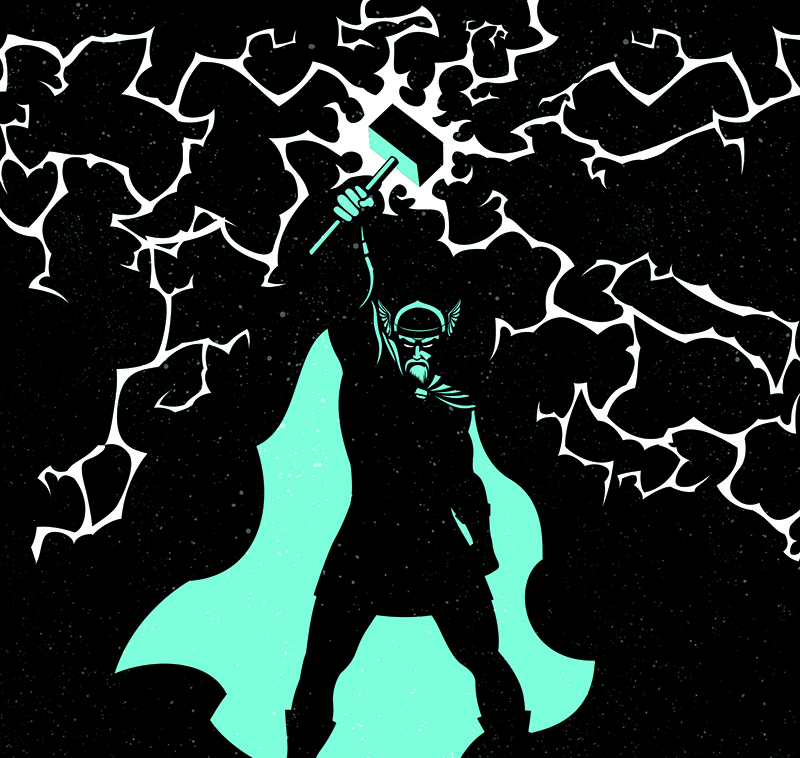
We ask our clients time and time again: “What would help you remember your worth?” It can be a difficult question to answer. Using the tool of therapeutic fanfiction, it’s possible to give clients a totem or talisman by which to remember their worth: Thor’s hammer, Mjolnir. We’ve been using this intervention quite a lot recently as Thor is present in the social consciousness by virtue of his appearance on the big screen. For those unfamiliar with the story, Mjolnir was a magical hammer gifted to Thor from his father Odin. As told by the Marvel Cinematic Universe (MCU), Odin enchants the hammer with his words “Whosoever holds this hammer, if he be worthy, shall possess the power of Thor.” Thor himself seems to hold the belief that the hammer is what gives him his strength. It takes him losing his hammer, and being faced with fighting without it, for him to realize that he is not “the god of hammers” but rather the god of thunder. He inherently has the strength within himself. The hammer is simply a tool. This imagery allows clients to see that while it’s important to have a tote—their own Mjolnir—this isn’t from whence their worth springs. Their strength and value come from within. This is highlighted in the most recent iteration of the Avengers films when Thor experiences a bout of depression. While it is never overtly stated, we see him in his home where he has clearly been for a very long time. He has ceased to care for his mane of hair or his god-like physique with the love that he once did. Even during Thor’s depressive state, when he calls for Mjolnir, the hammer flies to him. He is still worthy despite his profound struggle with loss, depression and loneliness. Our clients too have experienced loss and felt despair; lacking in important others to validate them. If clients do not have significant others to help remind them of their worth, their own Mjolnir can serve as a tangible reminder of their value. If clients can place themselves in the narrative of Thor, a hero who has met with some setbacks much like they have themselves, they can use the power of therapeutic fanfiction to find the Mjolnir within themselves. Embodying Thor also allows clients to practice self-compassion. Thor blames himself for what transpired with the destroyer, Thanos, but is this truly the god of thunder’s fault? Or is it the fault of the destroyer, Thanos himself, for creating the situation, when Thor was simply doing the best that he could to manage it? If we can find compassion for Thor, can we not also find compassion for ourselves? A good place to start with a client who is struggling to find their own self-worth is to begin with a character like Thor—one who has inherent power, though it may not be readily apparent. Luke Skywalker wielding the force that is within him, not in his lightsaber, is another great example, as well as imagery of wands for witches, or Wonder Woman’s bracelets. Encourage clients to engage in imaginative world-building with you, their psychotherapist, as a helpful guide. You can spend 1-2 sessions world-building in this way—the key is to encourage your client to find a character within modern mythology that speaks to them. This world-building includes setting the metaphorical scene that the client will inhabit and placing them within that therapeutic context. Once the client has settled on a personal fandom, you can help them begin to cast themselves as this character and to explore the challenges of their daily life in which they need a Mjolnir, a light saber, a wand, or whatever tool the character wields. From there, client and therapist will use the power of therapeutic fanfiction to help the client first foster an increased sense of strength with their own Mjolnir. Once they approach mastery, the clinician will prompt the client to explore the deeper truth: with or without their Mjolnir, they are their own hero. Such was the case for Chris (an amalgam case), a 33-year-old white bisexual cisgender man with whom we have been working for three months around family of origin concerns, specifically a lack of attachment to primary caregivers. Recently Chris’s feelings around lack of self-worth have come to the fore. During one such session, we remarked “if only there was some way that you could remember that you are inherently worthy.” We paused and held the therapeutic space, allowing the word “worthy” to catch our own attention. The metaphor took shape. “Chris, are you a fan of Marvel?” Having worked with us for some time, Chris knew that this conversation was moving in the direction of therapeutic fanfiction and was open to seeing if this would be a fandom fit for him. “Oh yeah! Thor’s cool. I loved his arc in Endgame” “Do you remember the scene where Thor talks to his mother and she says a bunch of wonderful things and a couple of shamey ones?” Chris nods. “He then calls for Mjolnir and the hammer flies right to him! Mjolnir still saw his worth! And of course, Thor had the power inside of himself all along. It was really just validation; a way to remember. We wish that you had a Mjolnir to remind you of your own worth.” Chris was able to take the lead as the author of his own therapeutic fanfiction, talking with us in detail about situations in which his own Mjolnir could be both helpful and healing. Two weeks later, Chris came into session with his own Mjolnir and a story of how his personal totem helped him navigate a challenging situation with a friend. Helping clients find their own Mjolnir is a powerful first step on their journey to embrace the hero within.

“I Want You to Be There.”: Accompanying a Client Through a Death

“Hey Kevin? My mom has had a stroke and is in the hospital. It’s really bad this time.” My client’s voice quivered, and I could hear fear rippling through it. After asking a series of preliminary questions, I closed my computer and headed to the car to drive to the hospital. It had been, until that moment, a free afternoon of writing and grading assignments. I pushed aside the nagging voice listing all the things that would not get done and focused instead on my client and his mother. He was about five years old when I first met him and his mother nearly seventeen years prior. A single mother, her son was attending an afterschool program where I had been counseling for about a year. He had many neurodevelopmental challenges, along with ADHD, anger and emotional outbursts that resulted in physical altercations with teachers and peers. I worked with him through elementary, middle and high school, and eventually helped him through the transition from high school into adulthood. Each year of development brought new challenges, but with those came developmental achievements so that by high school, he no longer experienced meltdowns and functioned very much like a neurotypical adolescent. If ever there was a picture of the analogy of “mama bear,” it was my client’s mother. She had lived a hard life, complete with childhood attachment trauma and a string of relationships with adults that had neglected and abused her. She had finally found love in my client’s father and had managed to create a safe and loving home for the three of them. They did not have much in terms of money or possessions, but she was committed to doing whatever was necessary to get her son the help he needed. I had numerous parenting sessions with her to help her understand her son’s challenges and how she could him. Over the years, due to a lack of available counseling as a result of low income, I ended up doing a lot of individual counseling with her to overcome previous traumatic events that had plagued her for many years. She had also experienced health problems for many years which was a constant source of worry for my client. He, like many young people on the autism spectrum, found a special sense of safety with his mother. She was a source of strength for him, and while they had their battles during his teen years, she was the most important person in his life. As I drove to the hospital, my mind raced with thoughts of worry over how he would cope if he lost her. And what about his father who was now on full disability? How would my client navigate it all? Upon arriving at the hospital, we found out the news was not good. My client’s mother was not breathing on her own and there was little brain activity. For the next several days, there was no change and finally the doctors met with my client and other family members to tell them that there was nothing that could be one. The process of shutting off life support would be necessary. I remember feeling a number of conflicted feelings. I truly cared for this woman and admired her strength and resolve in the face of many life challenges. A survivor of childhood neglect and abuse, she had a special place in my heart. I felt the sadness and anger of immediate grief, and an overwhelming sense of helplessness seeing her lying in the hospital bed hooked up to tubes and wires. But my client needed me. Right now. He was scared and worried, having immense responsibilities and decisions thrust upon him in just a matter of hours. I found myself having to shove aside the grieving and shift my focus to him. Finally, after much deliberation, my client chose a date and time for the removal of life support. He called me to let me know. “I want you to be there,” he said; “I want you to be with me when it happens.” I assured him that I would be. The final hours were excruciating at times, yet it brought a sense of honor to be a witness and to help my client say goodbye to the person he loved more than anything in the world. I stood by my client and his family members, laughing at funny stories, and offering words of comfort and encouragement. As his mother took her final breath, I held him and felt the heaving tension of unadulterated grief in the muscles of his back and shoulders, and the hot tears flying from his eyes. I prayed silently and wept too, for I realized that I had lost a dear client who had trusted me with her most valuable possession. I stayed with my client through the evening as he navigated the details of the handling of the remains and made preliminary funeral plans. The funeral soon followed, and he delivered one of the most beautiful eulogies I have ever heard. It was an amazing experience to witness the poise and spiritual grounding of this young man who, at one time, struggled with social situations and expressing himself. The ethics codes divide our world as therapists into neat little boxes that work so well on paper. Yet, at times, thrown into the fray of life with all the ugly that comes with it, we find ourselves in roles that are uncomfortable and unfamiliar. My journey into the shadow of death with my client forced me to be a case manager, community liaison, spiritual guide, and at times, just a simple human being who joined another human being in the process of grief and loss. I have learned through this experience that our work is sacred, and that the therapeutic relationship can stretch far beyond the 50-minute safety zone of an office. At times, I did not want to be in this position, and I was uncomfortable. Now; however, I see that in the discomfort, both mine and my client’s, was growth for which I am now very thankful.

Monitoring Engagement in Clinical Supervision

This blog post is a rejoinder to my Psychotherapy.net article, Seven Mistakes in Clinical Supervision. Here, I start by expanding on mistake #4, which is the failure to monitor engagement levels in clinical supervision, and then provide a way to deal with this issue.
 

Once we are able to escape the trappings of the first three mistakes in clinical supervision by avoiding too much theory-talk, helping our supervisees in their circle of development, and teaching them to marry the use of outcomes and alliance data to guide the treatment process, we can turn to thinking about the actual engagement levels of our supervisees.
 

Like what you are reading? For more stimulating stories, thought-provoking articles and new video announcements, sign up for our monthly newsletter.

Let’s ask ourselves, What is clinical supervision for?

Ultimately, the aim of supervision is to help therapists develop so that their clients may reap the benefits. Edward Watkins noted in his 2011 review of clinical supervision impact on client outcomes that “If we cannot show that supervision affects patient outcomes, then how can we continue to justify supervision? The benefits of supervision on supervisees alone are not necessarily sufficient.”

And in order to ensure optimal learning benefits for our supervisees, we need to keep our eye on the ball regarding engagement level in supervision. As I previously mentioned, eliciting feedback from clients sounds simple in theory, but is not an easy thing to do in practice. In supervision, paradoxically, it can be even harder to give and receive feedback, given that there might be overlapping roles or a collegial relationship outside of the supervision context. Given this, I would argue that all the more, some kind of formal and systematic procedure for monitoring the engagement levels—whether the supervisory work is “on-track” or “off-track”—is necessary.

Here’s How

Instead of leaving it to some type of bi-annual or annual review—which is often too late—I propose that supervisors formally elicit feedback at the end of every consult. This allows real-time calibration so that the learner’s feedback can be fed-forward into the subsequent supervision sessions.

Now, I don’t know about your part of the world, but here in Australia, when we ask, “How has it been for you?” we typically get the response, “All good!” The aim here is to get nuanced feedback that can help you adjust and refine the process of supervision for that particular supervisee. This is why, not unlike the process of asking clients for feedback, I recommend that supervisors learn to take a pitstop near the end of a consult and use some form of engagement tool. This provides some distance and reflection for the supervisee to think it through.

An example of a supervision engagement inventory, The Leeds Alliance in Supervision Scale (LASS)

How Do You Know the Effectiveness of Your Supervision?

Let’s circle back to the question that we asked ourselves earlier, what is clinical supervision for? If client improvement is the primary reason for clinical supervision, monitoring supervisee’s engagement alone is not sufficient. We also need to monitor the effects of supervision on client outcomes.

This can happen on two levels:

1. Single client outcome, based on the case discussion in supervision.


This is a simple but critical piece that supervisors tend to miss. It is important to close the loop after a supervisory session to see if your guidance helped to improve things for the particular client. Did the therapist try what you suggested? Did it have a measurable impact?

Take notes on what helped your supervisee, and what barriers were faced in their attempts to implement the ideas discussed in supervision.

2. Improvement in supervisee’s overall performance.

This is where alchemy happens. Beyond just a case-by-case discussion, you want to keep an eye on the therapist’s overall development as well. Supervisors can help a therapist discriminate what are case-specific issues to adapt to specific clients’ needs, and what are non-random issues that surface repeatedly for the therapist.

Supervisors have a real opportunity to influence when they learn to look at the data, spot patterns and help supervisees figure out what to work on that is influenceable and predictive of improving their outcomes.

References:

Wainwright, N. A. (2010). The development of the Leeds Alliance in Supervision Scale (LASS): A brief sessional measure of the supervisory alliance. Unpublished Doctoral Thesis. University of Leeds 

An Ending Without Closure

Being a psychologist is a deeply rewarding and meaningful profession, but it is often tinged with a sense of loss and a lingering concern over my clients. I regularly form complex, genuine and caring relationships with a multitude of clients, but these same people can and often do disappear from my life, leaving me to ponder how they are faring and whether they are safe and taking care of themselves.

One client in particular returns often to my mind; I wonder if he gained some semblance of control over his substance abuse issues, whether he was able to resist prostituting himself again for his food and rent, or whether he was alive at all.

Like what you are reading? For more stimulating stories, thought-provoking articles and new video announcements, sign up for our monthly newsletter.

As with the other clients I work with who have severe borderline pathology, it was challenging to determine which serious, self-destructive behavior to begin treating first. Should I focus on his growing weed, alcohol and amphetamine addiction? What about the self-harm scars adorning his arms and legs? Or the chronic, suicidal thoughts that had consumed him since he was 10 years old?

The smiling young man in his twenties who greeted me in our first session was attentive but difficult to connect with. He responded to my initial queries with short, practiced responses. He had already visited with multiple therapists and been hospitalized several times beginning at a young age, and he understood his role to be compliant but not forthcoming. Those early sessions forced me to slow down my typically quick therapeutic pace and to meet him where he was. The focus was simply to get him to trust me, to validate his pain and to reframe his self-destructive behavior as an understandable, albeit unhealthy, coping mechanism. He had experienced a great deal of shame because of the various traumas he had endured, so it was soothing for him to feel understood and accepted.

One of the struggles in working with clients with borderline pathology is that there is often a different crisis that has transpired each week that threatens to become the focus of the session, crowding out the larger, more pervasive patterns and issues. I would try to spend some time each session dealing with whatever had happened over the previous week, while focusing on behaviors and thought patterns that were impediments to his health. An ongoing theme of our work was self-esteem, which I have found undergirds many mental health issues. If a therapist can effectively improve a client’s sense of self-worth, issues such as depression, anxiety and self-destructive behaviors often begin to improve.

In those early sessions, I had explained to my client that self-esteem can manifest as an internal, critical voice. We can recognize that voice because it tends to be vague and it disparages our basic personality and worth. For example, if my client ate too much at a meal, his inner critic might say, “You are disgusting and have no self-control.” Or if he was avoiding a task and laying on the couch instead, it would yell, “You are so lazy.” I encouraged him to pay attention and to try and notice this critical voice, and then to yell back at it. I told him that when he heard the critic in his heard criticizing him, he should say, “Shut up critic, go away!” I explained that through repetition, noticing and responding to the critic in this manner, he would diminish its intensity and frequency, and feel better about himself.

In addition to his self-esteem, we also worked diligently on his distress tolerance. This client, like many of those with borderline pathology, felt emotions intensely but didn’t know how to manage them. Since he couldn’t express them in a healthy way and didn’t feel justified doing so, he would internalize them, manifesting as self-harm or binge eating. We worked on identifying and accepting his emotions and then discussed ways to self-soothe. Due to his intense self-hatred, he often struggled to justify treating himself kindly or performing otherwise self-calming activities. In time though, he would occasionally come into a session and report back on something he had done to feel better, earning much praise and support from me.

Over the two years we worked together in weekly sessions, I developed a great deal of sympathy and concern for this client. Even at his young age, his life had already been exceedingly difficult, and I worried about his future. How would he find and maintain work? Would he meet a partner who would treat him well? Would he go back to school? With each new crisis, my apprehension for him grew. The worry morphed into sadness, as I grew to acknowledge to myself how little control or influence I had over my client’s life. I could provide compassion, strategies and tools, along with a safe environment, but I couldn’t save him, despite how much I wished to.

Eventually, my young client moved out of his home and found his own place, though he moved several more times within just a few months, as he struggled with landlords and finding money for rent. The frequency of our sessions diminished, and often several months would pass before an email would arrive, requesting a session.

It has now been a year since I have heard from him. In our last session together, my client was struggling to maintain his new job at a coffee shop. He was also feeling lonely and drinking too much. We discussed ways for him to feel better and explored options in his community where he could receive further support. Whether he followed through on these recommendations, I don’t know.

In my more hopeful moments, I reassure myself that my young client likely availed himself of at least some of the resources that we had discussed, given his desire to get healthy and improve his life. Surely, he wouldn’t have gone through with all of our therapy sessions if he didn’t harbor some optimism for a better future. Yet my worry and doubts remain to this day. All I can do is hope that wherever he is, he is safe and knows that I am here if he needs me.