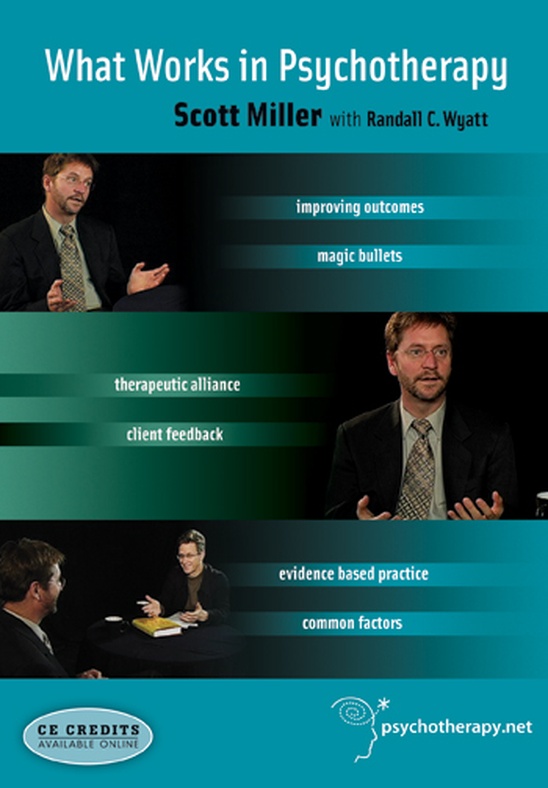
What Works in Psychotherapy
Video
with
Scott Miller, PhD
Video

What Works in Psychotherapy

What works in psychotherapy? In this interview by Randall C. Wyatt, Miller shares everything he knows about psychotherapy outcomes, including simple practices that significantly improves outcomes.   Video length: 28m
Buy a Membership
COURSE DETAILS

Overview

“Our diversity as a profession… is not a weakness that needs to be cured with evidence-based practice. It’s a strength and it needs to be nurtured with outcome-informed measures.” – Scott Miller, PhD

Miller suggests that to begin with, it’s the therapeutic alliance that’s one of the most important elements. And here’s the real ticker—Miller has found that the therapist is the determining factor, not the treatment model. This means that therapists can learn, grow and be more effective with their clients by systematically monitoring therapy outcomes, inviting negative feedback, and asking the simple question that so often seems too difficult for therapists to ask: “How is this working for you?”

Miller warns against manualized systems that require therapists to narrowly work in a particular model, citing research that shows that therapists are the most effective when they are allowed to practice what they believe and are confident in. This means you don’t need to change your modality to be more effective, and, in fact, can have a meaningful evidence-based practice by adapting some of Miller’s simple tools to invite client feedback.


About the Experts

Scott Miller, PhD
Expert

Scott Miller, PhD

Scott Miller, PhD is co-founder of the Institute for the Study of Therapeutic Change, a private group of clinicians and researchers dedicated to studying "what works" in mental health and substance abuse treatment. Dr. Miller conducts workshops and training, and speaks at conferences worldwide. He is the author of numerous articles and co-author of The Heart and Soul of Change: What Works in Therapy, The Heroic Client: A Revolutionary Way to Improve Effectiveness through Client-Directed, Outcome-Informed Therapy, and What Works…

View full profile

Disclosures

Scott Miller was compensated for his contribution. None of his books or additional offerings are required for any of the Psychotherapy.net content. Should such materials be referenced, it is as an additional resource.

This Disclosure Statement has been designed to meet accreditation standards; Psychotherapy.net does its best to mitigate potential conflicts of interest and eliminate bias in all areas of content. Psychotherapy.net offers training for cost but has no financial or other relationships to disclose. Additionally, there is no commercial support for this activity. None of the planners or any employee at Psychotherapy.net who has worked on this educational activity has relevant financial relationship(s) to disclose with ineligible companies.

Psychotherapy.net defines ineligible companies as those whose primary business is producing, marketing, selling, re-selling, or distributing healthcare products used by or on patients. There is no minimum financial threshold; individuals must disclose all financial relationships, regardless of the amount, with ineligible companies. We ask that all contributors disclose any and all financial relationships they have with any ineligible companies whether the individual views them as relevant to the education or not. Each experts’ specific disclosures can be found in their biography.