Advanced Clinical Skills
by Arnold Lazarus
Watch as master therapist Arnold Lazarus consults with both an experienced therapist as well as a novice, who each present real, challenging therapy cases.
by James Bugental
Existential-Humanistic Psychotherapy in Action shows James Bugental, the legendary clinician and teacher, conducting two actual psychotherapy sessions with the same client.
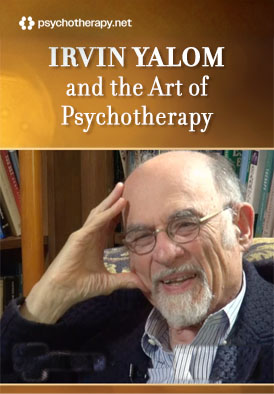
by Irvin Yalom
Yalom provides consultation to therapists on individual and group therapy cases. See how he translates his existential and interpersonal approach into action in this highly acclaimed video.
by James Bugental
This video presents a rare and invaluable opportunity to view renowned existential-humanistic psychotherapist James Bugental demonstrate his unique group consultation style.
by Rollo May
See this legendary Existential Psychotherapy master in a dialogue on what matters most in the practice of psychotherapy.
by Stephen Feldman
Finally, a video program to fulfill your CE requirement that is engaging, entertaining and informative.
by Stephen Feldman
A pragmatic, informative and entertaining video offering solutions to the common ethical dilemmas that mental health practitioners face. Great way to meet your Legal & Ethical CE requirements!
These two videos provide essential tools and techniques for all therapists treating clients with PTSD. Each video is useful on its own, and they are even more valuable when paired as a set. We hope you will take advantage of the package pricing we offer if you purchase these 2 videos together.
by Otto Kernberg
Take advantage of this rare opportunity to sit in on three fascinating consultation sessions with legendary psychoanalyst, Dr. Otto Kernberg. The clarity of his insights, and the direct and practical advice he gives, will certainly dispel many myths about contemporary psychoanalytic practice.
by John C. Norcross
In this compelling interview with one of the most prominent psychotherapy researchers of our time, Dr. John Norcross presents the results from fourteen meta-analyses that reveal the secrets to successful therapy.
by Sue Johnson
Dr. Sue Johnson has been hailed as “the most original contributor to couples therapy to come along in the last 30 years.” Now you’ll have the chance to watch her conduct an actual session with a challenging couple haunted by the “echoes of war.”
by Erving Polster
In this in-depth interview, you’ll get to know Polster’s unique take on Gestalt therapy, and see for yourself how he boldly elevates ordinary conversations into life-affirming encounters.
by Violet Oaklander
In this live consultation, you will get a tangible sense of how Violet Oaklander works with a variety of children, while gaining practical skills to bring back to your own clients immediately.
by Reid Wilson
In these live sessions with a real patient, Reid Wilson demonstrates Exposure Therapy in action, offering a frame of reference that clinicians can begin to apply immediately.
by Reid Wilson
In these live sessions with a patient suffering from obsessive thinking, Reid Wilson demonstrates tools and techniques of cognitive therapy that clinicians can begin to apply immediately.
by Reid Wilson
In these lively sessions with real clients, anxiety disorder expert Reid Wilson, PhD, demonstrates the core concepts underlying his paradoxical approach to treating anxiety disorders.
by Barry Duncan, PhD and Scott Miller, PhD
Barry Duncan and Scott Miller provide a comprehensive summary of the Outcome-Informed, Client-Directed approach and a detailed, practical overview of its application in clinical practice.
by Robert-Jay Green
The main elements of successful therapy include a positive therapeutic alliance, a clear focus, a coherent problem formulation, and improvised techniques—not a particular theoretical orientation.
by Richard P. Halgin
Richard Halgin shares the story of a long-term client's unexpected death, and how he managed his professional boundaries around this tragic event.
by Tracy A. Knight
Reflections on the client's capacity for change, including a case study of a successful single-session therapeutic intervention.
by Steven Kraus
A psychologist's skeptical look at the science (or lack thereof) behind much of the self-help industry,
by Barry Duncan, PhD and Scott Miller, PhD
Clients of the best therapists improve at a rate at least 50-percent higher and drop out at a rate at least 50-percent lower than those of average clinicians. What is the key to superior performance?
by Clifton Mitchell
Encountering resistance is likely evidence that therapy is taking place. In fact, successful psychotherapy is highly related to increases in resistance, and low resistance corresponds with negative outcomes.
by Ilene Philipson
In a discussion of the growing problem of work-life balance in American culture, Dr. Philipson shares the stories of clients whose overidentification with work ended in disaster.
by Herbert Rabin
Dr. Rabin shares lessons culled from 40 years of psychotherapy teaching and practice.
by Lillian B. Rubin
Lillian Rubin's moving account of her challenging psychotherapy with a man struggling with his disability. Reprinted from the book of the same title.
by Evelyn Sommers
Dr. Sommers discusses the prevalent problem of cultural silencing called "niceness," and offers case studies and advice for addressing associated client issues of anxiety and helplessness.
by Amy Urdang
A psychotherapist explores client-therapist boundaries and termination issues in a particularly intensive course of therapy.
by Irvin Yalom
Existential psychotherapist Irv Yalom offers insights into the therapist's role as an obstacle remover and fellow traveler. Excerpted from his book The Gift of Therapy.
by Jeffrey Kottler
We all know that clients may withhold critical information, but what do we do when they deliberately lie? Jeffrey Kottler explores this in an excerpt from his latest book, The Assassin and the Therapist: An Exploration of Truth in Psychotherapy and in Life.
by Ron Leifer
Psychiatrist Ron Leifer gives a compelling account of the historical context of Thomas Szasz's career as the leading critic of the medical model of psychiatry, along with its implications for the profession of psychiatry and for free thought and speech in the United States.
by Bernard Schwartz, PhD and John Flowers, PhD
If we could learn from all of our less-than-optimal therapy outcomes, we'd really acquire some true clinical wisdom. Here are some practical tips to increase your odds of success.
by Melissa Groman
A therapist explores the complex feelings that arise when a client terminates abruptly.
by Nancy Gunzberg
Working in the here-and-now of the therapeutic relationship requires therapists to be fully engaged, and take risks in revealing themselves. But utilizing the transference and counter-transference makes for rewarding and powerful therapy.
by Esther W. Wright-Wilson
A therapist poetically chronicles an underreported occupational hazard.
by Carol Howard Wooton, MFT & Gwyn Fallbrooke
After suffering from a stroke herself, a therapist recounts her journey from patient to professional, culminating in her leading groups for other stroke survivors.
Larry Beutler discusses how to incorporate scientific findings into psychotherapy practice and teaching, and what horse training has to do with any of this.
The founder of the first professional school of psychology, visionary, and gadfly Nick Cummings reflects on the history and predicts the future of psychotherapy.
The foremost psychiatric critic of our times, Thomas Szasz, engages in an in-depth dialogue of his life's work including freedom and liberty, the myth of mental illness, drug laws, the fragile state of psychotherapy, and his passion for humanistic values and social justice.
Mardi Horowitz discusses his research on psychotherapy for stress and trauma, his recent book on happiness, and what therapists can teach their clients about attaining it.
Renegade psychoanalyst Owen Renegade argues that psychoanalysis and psychoanalytic psychotherapy can and must be practical.


Help
Shopping Cart
Site Map
Share
Home
Join us on Facebook
Follow Us on Twitter
Need Help? Call 1-800-577-4762