Psychotherapy Blog
Subscribe to our blog
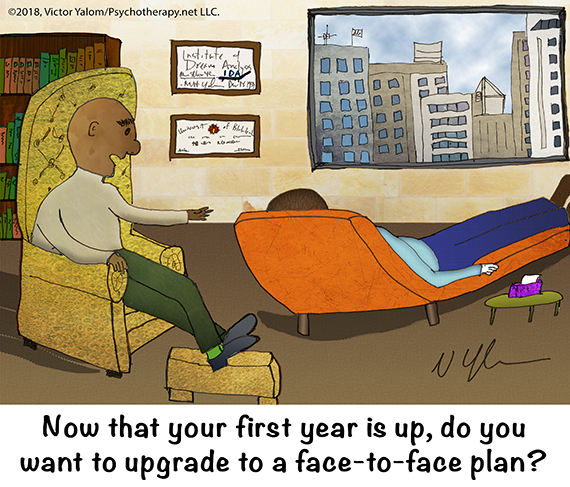
Videotaping Therapy
Recent technological advances have allowed for a range of creative new affordable ways to record “picture-in-picture”, so the video shows both the client and therapist. These setups do not require any video editing.
Is Self-Regulation or Co-Regulation Better for Couples?
Should couples in distress attempt to change their partner or themselves? Recent research discusses concerns about both of these strategies, and raises an interesting third option. Shreena Hira and Nickola Overall examined 160 couples attempting to change their partner or themselves. As they expected, attempts to change their partner didn’t make either their partner or themselves feel better. Surprisingly, however, a focus on self-change did not consistently help the relationship either. Instead, the researchers discovered that the most beneficial change...
Supervision of Executive Coaching
Last year I was tempted out of my retirement as a psychotherapist to provide supervision to a group of colleagues working with business executives. This was not psychotherapy but coaching, and my protests that I had never done any coaching or even read very much about it were overruled: they wanted me and they had every confidence that I would do a good job. I was flattered of course, intrigued too, and the extra money was welcome. So I began....
Training for the Treatment of Eating Disorders
Eating disorders are widely recognized as some of the most challenging psychological diagnoses. I was surprised to learn that they are also the most dangerous: eating disorders have the highest mortality rate of any diagnosis. Many clinicians assume that eating disorders only occur in young women. However, research has shown that the frequency of eating disorders is rising across a wide range of client populations, including men, middle-aged, and the elderly. Regardless of the population you work with, sooner or later you will encounter clients with eating disorders.
Training in Couples Therapy
Why might a therapist who works primarily with individuals consider studying couples’ therapy? If you work from an attachment perspective, as an increasing number of therapists do, then training in couples therapy may greatly inform and improve your work.
1 comment
The 7 real reasons why psychotherapists flunk their licensing and certification exams
A friend of mine (let's call him Kurt to preserve confidentiality and perhaps more importantly not to embarrass him) told me was gearing up to take his state licensing exam. Had he prepared for the exam? "Come on Rosenthal, I just spent two of the best years of life in grad school and another three or so in supervision. I think I know this stuff by now." "Really," I remarked. "Who is the father of rational emotive behavior therapy?" "Come on dude, that's...
Training in Microexpressions
There is a growing movement in psychotherapy towards reading clients’ facial microexpressions and body “tells”. One of the leaders in this movement is Stan Tatkin, PsyD, who teaches a Psychobiological Approach to Couples Therapy (PACT). I recently talked with Dr. Tatkin about how he uses microexpressions to enhance couples therapy.
Free Psychotherapy Training
As a psychotherapy training nerd, I’m always looking for good training opportunities. What’s the most training one can find on a limited time and budget? I recently talked about this with Carol Odsess, PhD. Dr. Odsess is a psychotherapy trainer in Albany, California who specializes in EMDR and Energy Psychology. (www.carolodsess.com)
Psychotherapy outcomes: The best therapy or the best therapist?
How can our clients pick the most effective therapist? They can’t. There is no industry standard for tracking and reporting psychotherapy outcomes. This won’t last. Regulators and consumers are going to demand public accounting of treatment effectiveness. If I have the right to ask my surgeon for their success rate, then why can’t my clients ask for mine?


Help
Shopping Cart
Site Map
Share
Home
Join us on Facebook
Follow Us on Twitter
Need Help? Call 1-800-577-4762